
A English
Class-Reptilia Questions in English
Class 11 Biology · Animal Kingdom · Class-Reptilia
136+
Questions
English
Language
100%
With Solutions
Showing 36 of 136 questions in English
101
MediumMCQ
Which one of these animals is not a homeotherm?
A
Psittacula
B
Macropus
C
Camelus
D
Chelone
Solution
(D) Homeotherms (or endotherms) are animals that can maintain a constant body temperature regardless of the environmental temperature. Birds $(Aves)$ and mammals $(Mammalia)$ are homeotherms.
$Psittacula$ (Parrot) is a bird.
$Macropus$ (Kangaroo) is a mammal.
$Camelus$ (Camel) is a mammal.
$Chelone$ (Green sea turtle) belongs to the class $Reptilia$. Reptiles are poikilotherms (ectotherms),meaning they cannot maintain a constant body temperature and their body temperature fluctuates with the environment.
Therefore,$Chelone$ is not a homeotherm.
$Psittacula$ (Parrot) is a bird.
$Macropus$ (Kangaroo) is a mammal.
$Camelus$ (Camel) is a mammal.
$Chelone$ (Green sea turtle) belongs to the class $Reptilia$. Reptiles are poikilotherms (ectotherms),meaning they cannot maintain a constant body temperature and their body temperature fluctuates with the environment.
Therefore,$Chelone$ is not a homeotherm.
0 likes
View Solution102
MediumMCQ
$A$ lizard-like member of $Reptilia$ is sitting on a tree with its tail coiled around a twig. This animal could be
A
$Hemidactylus$ showing sexual dimorphism
B
$Varanus$ showing mimicry
C
Garden lizard $(Calotes)$ showing camouflage
D
$Chamaeleon$ showing protective colouration
Solution
(D) $Chamaeleon$ is a specialized lizard known for its prehensile tail,which it uses to coil around twigs for stability while climbing trees.
It exhibits protective colouration (camouflage) to blend in with its surroundings,such as leaves and twigs,to avoid predators and hunt prey effectively.
It exhibits protective colouration (camouflage) to blend in with its surroundings,such as leaves and twigs,to avoid predators and hunt prey effectively.
0 likes
View Solution103
Medium
Write the characteristics of class $Reptilia$.
Solution
(N/A) $\rightarrow$ The class name refers to their creeping or crawling mode of locomotion (Latin,$repere$ or $reptum$,to creep or crawl).
$\rightarrow$ They are mostly terrestrial animals and their body is covered by dry and cornified skin,epidermal scales or scutes.
$\rightarrow$ They do not have external ear openings. $Tympanum$ represents the ear.
$\rightarrow$ Limbs,when present,are two pairs.
$\rightarrow$ Heart is usually three-chambered,but four-chambered in crocodiles.
$\rightarrow$ Reptiles are poikilotherms (cold-blooded).
$\rightarrow$ Snakes and lizards shed their scales as skin cast.
$\rightarrow$ Sexes are separate (dioecious).
$\rightarrow$ Fertilisation is internal.
$\rightarrow$ They are oviparous and development is direct.
$\rightarrow$ Examples: $Chelone$ (Turtle),$Testudo$ (Tortoise),$Chameleon$ (Tree lizard),$Calotes$ (Garden lizard),$Crocodilus$ (Crocodile),$Alligator$ (Alligator),$Hemidactylus$ (Wall lizard),Poisonous snakes - $Naja$ (Cobra),$Bangarus$ (Krait),$Vipera$ (Viper).
$\rightarrow$ They are mostly terrestrial animals and their body is covered by dry and cornified skin,epidermal scales or scutes.
$\rightarrow$ They do not have external ear openings. $Tympanum$ represents the ear.
$\rightarrow$ Limbs,when present,are two pairs.
$\rightarrow$ Heart is usually three-chambered,but four-chambered in crocodiles.
$\rightarrow$ Reptiles are poikilotherms (cold-blooded).
$\rightarrow$ Snakes and lizards shed their scales as skin cast.
$\rightarrow$ Sexes are separate (dioecious).
$\rightarrow$ Fertilisation is internal.
$\rightarrow$ They are oviparous and development is direct.
$\rightarrow$ Examples: $Chelone$ (Turtle),$Testudo$ (Tortoise),$Chameleon$ (Tree lizard),$Calotes$ (Garden lizard),$Crocodilus$ (Crocodile),$Alligator$ (Alligator),$Hemidactylus$ (Wall lizard),Poisonous snakes - $Naja$ (Cobra),$Bangarus$ (Krait),$Vipera$ (Viper).
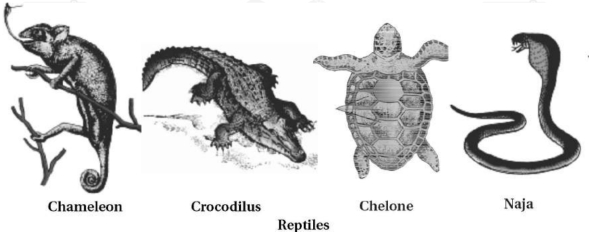
0 likes
View Solution104
EasyMCQ
What is specific in the heart of crocodiles among reptiles?
A
Presence of two auricles and two ventricles
B
Presence of three-chambered heart
C
Presence of sinus venosus
D
Presence of incomplete double circulation
Solution
(A) In most reptiles,the heart is three-chambered with an incomplete division of the ventricle.
However,crocodiles are an exception among reptiles as they possess a four-chambered heart with a completely divided ventricle,consisting of two atria and two ventricles.
However,crocodiles are an exception among reptiles as they possess a four-chambered heart with a completely divided ventricle,consisting of two atria and two ventricles.
0 likes
View Solution105
EasyMCQ
The eggs of reptiles and birds are covered by what?
A
Calcareous shell
B
Magnesium-rich shell
C
Potassium-rich shell
D
Sodium-rich shell
Solution
(A) The eggs of reptiles and birds are covered by a hard,calcareous shell.
This shell is primarily composed of calcium carbonate $(CaCO_3)$.
It provides protection to the developing embryo from environmental stress and prevents desiccation.
This shell is primarily composed of calcium carbonate $(CaCO_3)$.
It provides protection to the developing embryo from environmental stress and prevents desiccation.
0 likes
View Solution106
MediumMCQ
To which class does the organism 'Kashyapa' (Tortoise) belong?
A
Amphibia
B
Reptilia
C
Aves
D
Mammalia
Solution
(B) The organism 'Kashyapa' refers to a tortoise or turtle.
Tortoises and turtles belong to the class $Reptilia$ in the animal kingdom.
They are cold-blooded,air-breathing vertebrates characterized by a bony or cartilaginous shell developed from their ribs.
Tortoises and turtles belong to the class $Reptilia$ in the animal kingdom.
They are cold-blooded,air-breathing vertebrates characterized by a bony or cartilaginous shell developed from their ribs.
0 likes
View Solution107
MediumMCQ
To which class does the $Tautara$ (Tuatara) belong?
A
Aves
B
Reptilia
C
Mammalia
D
Amphibia
Solution
(B) The $Tuatara$ ($Sphenodon$ $punctatus$) is a reptile endemic to New Zealand.
It belongs to the order $Rhynchocephalia$ within the class $Reptilia$.
It is often referred to as a 'living fossil' because it is the only surviving member of its order,which flourished during the Mesozoic era.
Therefore,the correct option is $B$.
It belongs to the order $Rhynchocephalia$ within the class $Reptilia$.
It is often referred to as a 'living fossil' because it is the only surviving member of its order,which flourished during the Mesozoic era.
Therefore,the correct option is $B$.
0 likes
View Solution108
EasyMCQ
Which of the following are absent in snakes?
A
Pectoral girdle
B
Urinary bladder
C
Sternum
D
All of these
Solution
(D) Snakes belong to the class $Reptilia$.
Due to their elongated body structure and mode of locomotion, they lack limbs, which results in the absence of both pectoral and pelvic girdles.
Additionally, snakes do not possess a urinary bladder, and they lack a sternum (breastbone) because they do not have a rib cage that connects to a central ventral bone.
Therefore, all the mentioned structures are absent in snakes.
Due to their elongated body structure and mode of locomotion, they lack limbs, which results in the absence of both pectoral and pelvic girdles.
Additionally, snakes do not possess a urinary bladder, and they lack a sternum (breastbone) because they do not have a rib cage that connects to a central ventral bone.
Therefore, all the mentioned structures are absent in snakes.
0 likes
View Solution109
MediumMCQ
Dry skin with scales or scutes without glands is a characteristic of
A
Fishes
B
Reptilia
C
Amphibia
D
Aves
Solution
(B) The skin of reptiles is dry,cornified,and devoid of glands. They possess epidermal scales or scutes on their body surface,which helps in preventing water loss and provides protection.
0 likes
View Solution110
EasyMCQ
Scientific name of king cobra is
A
Naja naja
B
Bungarus caeruleus
C
Ophiophagus hannah
D
Daboia russelii
Solution
(C) The scientific name of the king cobra is $Ophiophagus$ $hannah$.
$Naja$ $naja$ is commonly known as the Indian cobra or Nag.
$Bungarus$ $caeruleus$ is the common krait.
$Daboia$ $russelii$ is the Russell's viper.
$Naja$ $naja$ is commonly known as the Indian cobra or Nag.
$Bungarus$ $caeruleus$ is the common krait.
$Daboia$ $russelii$ is the Russell's viper.
0 likes
View Solution111
EasyMCQ
Zoological name of common Indian krait is
A
Bungarus caeruleus
B
Ophiophagus hannah
C
Daboia russelii
D
Naja naja
Solution
(A) The zoological name of the common Indian krait is $Bungarus$ $caeruleus$.
It is a highly venomous snake found in the Indian subcontinent.
$Ophiophagus$ $hannah$ is the King Cobra,$Daboia$ $russelii$ is Russell's viper,and $Naja$ $naja$ is the Indian cobra.
It is a highly venomous snake found in the Indian subcontinent.
$Ophiophagus$ $hannah$ is the King Cobra,$Daboia$ $russelii$ is Russell's viper,and $Naja$ $naja$ is the Indian cobra.
0 likes
View Solution112
EasyMCQ
Which of the following snakes is non-poisonous?
A
Cobra
B
Krait
C
Viper
D
Python
Solution
(D) Among the given options,$Cobra$,$Krait$,and $Viper$ are examples of poisonous snakes. $Python$ is a non-poisonous snake that kills its prey by constriction.
0 likes
View Solution113
MediumMCQ
Which of the following statements are correct?
$I.$ Venom of cobra is neurotoxic.
$II.$ Venom of sea snake is neurotoxic.
$III.$ Venom of viper is haemotoxic.
$I.$ Venom of cobra is neurotoxic.
$II.$ Venom of sea snake is neurotoxic.
$III.$ Venom of viper is haemotoxic.
A
$I, II$ and $III$
B
$I$ and $III$
C
$I$ and $II$
D
$II$ and $III$
Solution
(A) $1$. The venom of the cobra (genus $Naja$) is primarily neurotoxic,which affects the nervous system.
$2$. The venom of sea snakes (family $Hydrophiinae$) is also primarily neurotoxic.
$3$. The venom of vipers (family $Viperidae$) is primarily haemotoxic,which affects the blood and circulatory system.
$4$. Since all three statements ($I, II,$ and $III$) are scientifically accurate,the correct option is $A$.
$2$. The venom of sea snakes (family $Hydrophiinae$) is also primarily neurotoxic.
$3$. The venom of vipers (family $Viperidae$) is primarily haemotoxic,which affects the blood and circulatory system.
$4$. Since all three statements ($I, II,$ and $III$) are scientifically accurate,the correct option is $A$.
0 likes
View Solution114
MediumMCQ
Jacobson's organs,which are additional olfactory organs,are present in:
A
Rat
B
Snakes
C
Man
D
All of these
Solution
(D) Jacobson's organs (also known as the vomeronasal organs) are auxiliary olfactory sense organs.
They are found in many tetrapods,including mammals and reptiles.
While they are present in rats,snakes,and humans (though often vestigial in humans),they are particularly well-developed in snakes and lizards,where they play a crucial role in detecting chemical cues in the environment.
Therefore,they are present in all the listed organisms.
They are found in many tetrapods,including mammals and reptiles.
While they are present in rats,snakes,and humans (though often vestigial in humans),they are particularly well-developed in snakes and lizards,where they play a crucial role in detecting chemical cues in the environment.
Therefore,they are present in all the listed organisms.
0 likes
View Solution115
EasyMCQ
Choose the kind of erythrocyte found in Reptiles.
A
Circular - biconvex - nucleated
B
Oval - biconcave - denucleated
C
Circular - biconcave - denucleated
D
Oval - biconvex - nucleated
Solution
(D) In the animal kingdom,the structure of erythrocytes varies across classes.
Amphibians,Reptiles,and Birds (Aves) possess erythrocytes that are oval in shape,biconvex,and nucleated.
In contrast,Mammals possess erythrocytes that are circular,biconcave,and denucleated (lacking a nucleus at maturity).
Amphibians,Reptiles,and Birds (Aves) possess erythrocytes that are oval in shape,biconvex,and nucleated.
In contrast,Mammals possess erythrocytes that are circular,biconcave,and denucleated (lacking a nucleus at maturity).
0 likes
View Solution116
EasyMCQ
Poison glands of snake are modified
A
Sebaceous glands
B
Ceruminous glands
C
Salivary glands
D
Endocrine glands
Solution
(C) Poison glands in snakes are specialized structures derived from the parotid salivary glands. These glands produce venom,which is injected through specialized teeth known as fangs to immobilize or kill prey.
0 likes
View Solution117
MediumMCQ
All of the following are characteristics of reptiles,except:
A
Lizards shed their scales as skin cast
B
Scutes are present on their body
C
Heart is three-chambered in all reptiles
D
They are poikilotherms
Solution
(C) Reptiles are generally characterized by having a three-chambered heart,consisting of two atria and one partially divided ventricle. However,this is not true for all reptiles,as members of the order Crocodilia (such as crocodiles and alligators) possess a four-chambered heart. Therefore,the statement that all reptiles have a three-chambered heart is incorrect.
0 likes
View Solution118
EasyMCQ
Which among the following has a four-chambered heart?
A
Vipera
B
Crocodilus
C
Testudo
D
Hemidactylus
Solution
(B) Most reptiles,such as $Vipera$ (viper snake),$Testudo$ (tortoise),and $Hemidactylus$ (wall lizard),possess a three-chambered heart consisting of two atria and one partially divided ventricle.
However,$Crocodilus$ (crocodile) is an exception within the class $Reptilia$ as it possesses a completely four-chambered heart,similar to birds and mammals.
Therefore,the correct answer is $Crocodilus$.
However,$Crocodilus$ (crocodile) is an exception within the class $Reptilia$ as it possesses a completely four-chambered heart,similar to birds and mammals.
Therefore,the correct answer is $Crocodilus$.
0 likes
View Solution119
MediumMCQ
Which among the following is an exception to possessing a three-chambered heart?
A
Alligator
B
Testudo
C
Chelone
D
Bungarus
Solution
(A) Most reptiles,such as $Testudo$ (Tortoise),$Chelone$ (Turtles),and $Bungarus$ (Krait snake),possess a three-chambered heart.
However,the $Alligator$,which belongs to the order $Crocodilia$ of the class $Reptilia$,is an exception because it possesses a four-chambered heart.
However,the $Alligator$,which belongs to the order $Crocodilia$ of the class $Reptilia$,is an exception because it possesses a four-chambered heart.
0 likes
View Solution120
EasyMCQ
Which among them has a moderately long and pointed snout and is very aggressive and dangerous for man?
A
Crocodile
B
Alligator
C
Gavialis
D
Salamandra
Solution
(A) The $Crocodile$ is characterized by a moderately long and pointed snout. It is known to be highly aggressive and poses a significant danger to humans. In contrast,$Alligators$ have a broad and rounded snout,$Gavialis$ (Gharial) have a very long and slender snout adapted for eating fish,and $Salamandra$ is an amphibian that does not possess a snout.
0 likes
View Solution121
EasyMCQ
Which among the following is a living fossil?
A
Hydrophis
B
Archaeopteryx
C
Sphenodon
D
Vipera
Solution
(C) $Sphenodon$ belongs to the order $Rhynchocephalia$,class $Reptilia$.
$Sphenodon$ is commonly called $Tuatara$ and possesses a pineal gland or a third eye.
$Sphenodon$ retains ancestral characters of stem reptiles,hence it is referred to as a living fossil.
$Sphenodon$ is commonly called $Tuatara$ and possesses a pineal gland or a third eye.
$Sphenodon$ retains ancestral characters of stem reptiles,hence it is referred to as a living fossil.
0 likes
View Solution122
MediumMCQ
Choose the correct statement.
A
Lizards show autotomy
B
Most lizards are oviparous
C
Poison gland in snakes are modified parotid gland
D
All of these
Solution
(D) Lizards exhibit autotomy,which is the voluntary shedding of their tail to distract predators,followed by regeneration of the tail.
Most lizard species are oviparous,meaning they lay eggs protected by a shell.
In venomous snakes,the poison glands are specialized modifications of the superior labial or parotid glands.
Therefore,all the given statements are correct.
Most lizard species are oviparous,meaning they lay eggs protected by a shell.
In venomous snakes,the poison glands are specialized modifications of the superior labial or parotid glands.
Therefore,all the given statements are correct.
0 likes
View Solution123
MediumMCQ
Which of the following is a viviparous lizard?
A
Uromastix
B
Chameleon
C
Hydrophis
D
All of these
Solution
(B) Most lizards are oviparous,meaning they lay eggs. However,some species exhibit viviparity,where they give birth to live young. Among the given options,$Chameleon$ is a well-known example of a viviparous lizard. $Uromastix$ is oviparous,and $Hydrophis$ is a sea snake,not a lizard.
0 likes
View Solution124
MediumMCQ
Poikilothermous animals having a single occipital condyle belong to:
A
Amphibia
B
Reptiles
C
Aves
D
Mammals
Solution
(B) Poikilotherms are organisms that change their internal body temperature according to the surroundings.
$1$. Amphibia: These are poikilotherms and are dicondylic (having two occipital condyles).
$2$. Reptilia: These are poikilotherms and are monocondylic (having a single occipital condyle).
$3$. Aves: These are homeotherms (maintain a constant body temperature) and are monocondylic.
$4$. Mammals: These are homeotherms and are dicondylic.
Therefore,poikilothermous animals with a single occipital condyle belong to the class Reptilia.
$1$. Amphibia: These are poikilotherms and are dicondylic (having two occipital condyles).
$2$. Reptilia: These are poikilotherms and are monocondylic (having a single occipital condyle).
$3$. Aves: These are homeotherms (maintain a constant body temperature) and are monocondylic.
$4$. Mammals: These are homeotherms and are dicondylic.
Therefore,poikilothermous animals with a single occipital condyle belong to the class Reptilia.
0 likes
View Solution125
MediumMCQ
Lateral line sense organs are absent in
A
Tadpole larva of frog
B
Fishes
C
Reptiles
D
Cartilaginous fishes
Solution
(C) The lateral line system is a sensory system found in aquatic vertebrates,including fishes and the larval stages of amphibians (like the tadpole larva of a frog),which helps them detect movement,vibration,and pressure gradients in the surrounding water.
$1$. Fishes,including cartilaginous fishes,possess a well-developed lateral line system.
$2$. The tadpole larva of a frog is aquatic and also possesses a lateral line system.
$3$. Reptiles are primarily terrestrial vertebrates and have evolved to live on land; therefore,they lack the lateral line sense organs as they are not required for their survival in a terrestrial environment.
$1$. Fishes,including cartilaginous fishes,possess a well-developed lateral line system.
$2$. The tadpole larva of a frog is aquatic and also possesses a lateral line system.
$3$. Reptiles are primarily terrestrial vertebrates and have evolved to live on land; therefore,they lack the lateral line sense organs as they are not required for their survival in a terrestrial environment.
0 likes
View Solution126
Medium
Mention two modifications in reptiles required for terrestrial mode of life.
Solution
(N/A) $\rightarrow$ Following are the two modifications in reptiles required for terrestrial mode of life:
$(a)$ Dry and cornified skin with epidermal scales,which prevents water loss from the body.
$(b)$ Internal fertilization,which allows reproduction to occur independently of an external water source.
$(a)$ Dry and cornified skin with epidermal scales,which prevents water loss from the body.
$(b)$ Internal fertilization,which allows reproduction to occur independently of an external water source.
0 likes
View Solution127
MediumMCQ
Which of the following reptiles is an exception regarding the heart structure?
A
Crocodile
B
Cobra
C
Sea turtle
D
Wall lizard
Solution
(A) Most reptiles possess a $3$-chambered heart,consisting of two atria and one partially divided ventricle. However,crocodiles are an exception among reptiles as they possess a $4$-chambered heart,similar to birds and mammals,with two atria and two completely separated ventricles. Therefore,the crocodile is the exception.
0 likes
View Solution128
MediumMCQ
Organisms that possess dry and cornified skin belong to which class?
A
Garden lizard
B
Crocodile
C
Cobra
D
All of the above
Solution
(D) The class $Reptilia$ is characterized by the presence of dry and cornified skin,epidermal scales,or scutes.
These animals are poikilotherms (cold-blooded).
Garden lizard $(Calotes)$,Crocodile $(Crocodilus)$,and Cobra $(Naja)$ are all members of the class $Reptilia$.
Therefore,all the given options possess dry and cornified skin.
These animals are poikilotherms (cold-blooded).
Garden lizard $(Calotes)$,Crocodile $(Crocodilus)$,and Cobra $(Naja)$ are all members of the class $Reptilia$.
Therefore,all the given options possess dry and cornified skin.
0 likes
View Solution129
MediumMCQ
Select the correct option for reptiles.
A
They evolved from amphibians.
B
Reptiles lay thick-shelled eggs which do not dry up in the sun unlike those of amphibians.
C
The descendants of reptiles are turtles,tortoises,and crocodiles.
D
All of the above.
Solution
(D) Reptiles evolved from amphibians during the Carboniferous period.
Unlike amphibians,reptiles developed the ability to lay thick-shelled eggs that are resistant to desiccation,allowing them to survive and hatch on land without drying out in the sun.
Modern-day descendants of the ancient reptilian lineage include turtles,tortoises,and crocodiles.
Therefore,all the given statements are correct.
Unlike amphibians,reptiles developed the ability to lay thick-shelled eggs that are resistant to desiccation,allowing them to survive and hatch on land without drying out in the sun.
Modern-day descendants of the ancient reptilian lineage include turtles,tortoises,and crocodiles.
Therefore,all the given statements are correct.
0 likes
View Solution130
MediumMCQ
Which of the following animals has a three-chambered heart?
A
Scoliodon
B
Hippocampus
C
Chelone
D
Pteropus
Solution
(C) The heart structure varies among vertebrates:
$1$. $Scoliodon$ (Dogfish) is a cartilaginous fish,which has a two-chambered heart (one atrium and one ventricle).
$2$. $Hippocampus$ (Seahorse) is a bony fish,which also has a two-chambered heart.
$3$. $Chelone$ (Green sea turtle) is a reptile. Most reptiles,including turtles,possess a three-chambered heart consisting of two atria and one partially divided ventricle.
$4$. $Pteropus$ (Flying fox/Bat) is a mammal,which has a four-chambered heart.
Therefore,the correct answer is $Chelone$.
$1$. $Scoliodon$ (Dogfish) is a cartilaginous fish,which has a two-chambered heart (one atrium and one ventricle).
$2$. $Hippocampus$ (Seahorse) is a bony fish,which also has a two-chambered heart.
$3$. $Chelone$ (Green sea turtle) is a reptile. Most reptiles,including turtles,possess a three-chambered heart consisting of two atria and one partially divided ventricle.
$4$. $Pteropus$ (Flying fox/Bat) is a mammal,which has a four-chambered heart.
Therefore,the correct answer is $Chelone$.
0 likes
View Solution131
EasyMCQ
Which of the following is a non-poisonous snake?
A
Vipera
B
Naja
C
Bungarus
D
Azgar
Solution
(D) $Vipera$ (Viper),$Naja$ (Cobra),and $Bungarus$ (Krait) are all examples of highly poisonous snakes. $Azgar$ (Python) is a non-poisonous snake that kills its prey by constriction.
0 likes
View Solution132
MediumMCQ
Which of the following is an oviparous animal?
A
Scoliodon
B
Viper
C
Scorpion
D
Cobra
Solution
(D) An oviparous animal is one that lays eggs,which then hatch outside the mother's body.
$A$. $Scoliodon$ (Dogfish) is a viviparous shark,meaning it gives birth to live young.
$B$. $Viper$ is an ovoviviparous snake,where eggs hatch inside the mother's body.
$C$. $Scorpion$ is generally ovoviviparous or viviparous.
$D$. $Cobra$ is an oviparous animal,as it lays eggs that develop and hatch externally.
$A$. $Scoliodon$ (Dogfish) is a viviparous shark,meaning it gives birth to live young.
$B$. $Viper$ is an ovoviviparous snake,where eggs hatch inside the mother's body.
$C$. $Scorpion$ is generally ovoviviparous or viviparous.
$D$. $Cobra$ is an oviparous animal,as it lays eggs that develop and hatch externally.
0 likes
View Solution133
EasyMCQ
Which animals cast off their scales as skin casts?
A
Snake
B
Lizard
C
Hyla
D
Both $A$ and $B$
Solution
(D) Both snakes and lizards belong to the class $Reptilia$.
These animals possess an exoskeleton of keratinized scales or scutes.
As they grow,they periodically shed their outer layer of skin,a process known as ecdysis or molting,which is often observed as a 'skin cast'.
These animals possess an exoskeleton of keratinized scales or scutes.
As they grow,they periodically shed their outer layer of skin,a process known as ecdysis or molting,which is often observed as a 'skin cast'.
0 likes
View Solution134
MediumMCQ
Reptiles are$-$
A
Mostly terrestrial animals
B
Mostly oviparous
C
Slimy skinned animals
D
$(1)$ and $(2)$ both
Solution
(D) Reptiles belong to the class $Reptilia$. They are mostly terrestrial animals and their body is covered by dry and cornified skin,epidermal scales,or scutes. They do not have slimy skin; instead,their skin is dry. They are mostly oviparous and exhibit direct development. Therefore,both statements $(1)$ and $(2)$ are correct.
0 likes
View Solution135
EasyMCQ
In which one of the following animals does the cloaca serve as a respiratory organ?
A
Bird
B
Fish
C
Turtle
D
Tadpole of salamander
Solution
(C) The cloaca in certain aquatic animals,such as the $Turtle$ (specifically species like the $Fitzroy$ River turtle),acts as an accessory respiratory organ.
These animals possess specialized bursae (cloacal bursae) that are highly vascularized.
By pumping water in and out of the cloaca,the animal can extract dissolved oxygen from the water,allowing it to remain submerged for extended periods without surfacing to breathe.
These animals possess specialized bursae (cloacal bursae) that are highly vascularized.
By pumping water in and out of the cloaca,the animal can extract dissolved oxygen from the water,allowing it to remain submerged for extended periods without surfacing to breathe.
0 likes
View Solution136
EasyMCQ
An animal which has both exoskeletal and endoskeletal structures is
A
frog
B
jelly fish
C
fresh water mussel
D
tortoise
Solution
(D) tortoise.
$Tortoises$ possess an exoskeletal shell made of bony plates covered by keratin and an endoskeleton comprising a backbone and internal bones.
This dual skeletal system provides protection and structural support.
This distinguishes $tortoises$ from $frogs$ (which have an endoskeleton only),$jellyfish$ (which lack both a true exoskeleton and endoskeleton),and $freshwater$ $mussels$ (which have an exoskeleton only).
$Tortoises$ possess an exoskeletal shell made of bony plates covered by keratin and an endoskeleton comprising a backbone and internal bones.
This dual skeletal system provides protection and structural support.
This distinguishes $tortoises$ from $frogs$ (which have an endoskeleton only),$jellyfish$ (which lack both a true exoskeleton and endoskeleton),and $freshwater$ $mussels$ (which have an exoskeleton only).
0 likes
View SolutionAnimal Kingdom — Class-Reptilia · Frequently Asked Questions
1Are these Animal Kingdom questions useful for JEE and NEET?
Yes. All questions in this section are mapped to JEE Main and NEET exam patterns. Previous year questions from JEE Main, NEET, GUJCET and state-level exams are included with full solutions.
2Can I switch to Hindi or Gujarati for these questions?
Yes. Use the language tabs in the hero section or the sidebar to view the same questions and solutions in English, Hindi or Gujarati.
3How do I generate a question paper from this subtopic?
Use the Vedclass Exam Paper Generator — select the chapter and subtopic, set difficulty, and generate Sets A, B, C, D automatically. First 3 chapters of every subject are free.
Vedclass Products
For Students
Vedclass Test Series
Mock tests in real JEE/NEET style with performance analysis. 5-day free trial.
Start Free TrialFor Teachers
Exam Paper Generator
Generate Set A/B/C/D papers from this chapter in 2 minutes. 3 chapters free.
Try FreeFor Institutes
Online Exam Module
Live online exams with unlimited students, 360° analytics & white-label branding.
See DemoFor Teachers & Institutes
Generate a Animal Kingdom Exam Paper in 2 Minutes
Select subtopic & difficulty — Sets A, B, C, D auto-generated with No Repeat logic.
First 3 chapters of every subject are free — no payment required.