
A English
Class-Mammalia Questions in English
Class 11 Biology · Animal Kingdom · Class-Mammalia
245+
Questions
English
Language
100%
With Solutions
Showing 44 of 245 questions in English
201
MediumMCQ
All mammals without any exception are characterized by
A
viviparity and biconcave red blood cells
B
extra-abdominal testes and a four-chambered heart
C
heterodont teeth and $12$ pairs of cranial nerves
D
a muscular diaphragm and milk-producing glands
Solution
(D) Mammals are unique among vertebrates because they possess a muscular diaphragm,which aids in respiration,and mammary (milk-producing) glands,which are used to nourish their young. While other features like a four-chambered heart or heterodont teeth are common,they are not present in every single mammal without exception (e.g.,some monotremes have different characteristics,and not all mammals have $12$ pairs of cranial nerves).
0 likes
View Solution202
MediumMCQ
Which are exclusively viviparous?
A
Bony fishes
B
Cartilaginous fishes
C
Sharks
D
Whales
Solution
(D) Whales are exclusively viviparous. In viviparous animals (the majority of mammals,including human beings),the zygote develops into a young one inside the body of the female organism.
After attaining a certain stage of growth,the young ones are delivered out of the body of the female organism.
After attaining a certain stage of growth,the young ones are delivered out of the body of the female organism.
0 likes
View Solution203
MediumMCQ
Assertion $(A)$: Cold-blooded animals do not have a fat layer.
Reason $(R)$: Cold-blooded animals use their fat for metabolic processes during hibernation.
Reason $(R)$: Cold-blooded animals use their fat for metabolic processes during hibernation.
A
If both Assertion and Reason are correct and the Reason is a correct explanation of the Assertion.
B
If both Assertion and Reason are correct but Reason is not a correct explanation of the Assertion.
C
If the Assertion is correct but Reason is incorrect.
D
If both the Assertion and Reason are incorrect.
Solution
(D) The Assertion is incorrect because many cold-blooded animals (ectotherms) do possess fat layers or fat bodies for energy storage.
The Reason is correct because cold-blooded animals,such as certain reptiles and amphibians,rely on stored fat reserves to sustain metabolic activities during periods of dormancy like hibernation or aestivation.
Therefore,the Assertion is incorrect,but the Reason is correct.
The Reason is correct because cold-blooded animals,such as certain reptiles and amphibians,rely on stored fat reserves to sustain metabolic activities during periods of dormancy like hibernation or aestivation.
Therefore,the Assertion is incorrect,but the Reason is correct.
0 likes
View Solution204
MediumMCQ
Assertion: Bats and whales are classified as mammals.
Reason: Bats and whales have a $4$-chambered heart.
Reason: Bats and whales have a $4$-chambered heart.
A
If both Assertion and Reason are correct and the Reason is a correct explanation of the Assertion.
B
If both Assertion and Reason are correct but Reason is not a correct explanation of the Assertion.
C
If the Assertion is correct but Reason is incorrect.
D
If both the Assertion and Reason are incorrect.
Solution
(B) Both the Assertion and the Reason are correct statements.
Bats and whales are classified as mammals because they possess mammary glands,have hair (at some stage of development),and are warm-blooded (homeothermic).
They also possess a $4$-chambered heart,which is a characteristic feature of mammals.
However,the presence of a $4$-chambered heart is not the defining characteristic that classifies an animal as a mammal; rather,it is the presence of mammary glands and other mammalian traits.
Therefore,the Reason is a correct statement but does not explain why they are classified as mammals.
Bats and whales are classified as mammals because they possess mammary glands,have hair (at some stage of development),and are warm-blooded (homeothermic).
They also possess a $4$-chambered heart,which is a characteristic feature of mammals.
However,the presence of a $4$-chambered heart is not the defining characteristic that classifies an animal as a mammal; rather,it is the presence of mammary glands and other mammalian traits.
Therefore,the Reason is a correct statement but does not explain why they are classified as mammals.
0 likes
View Solution205
MediumMCQ
Assertion : The duck-billed Platypus and the spiny ant-eater,both are egg-laying animals yet they are grouped under mammals.
Reason : Both of them have seven cervical vertebrae and $12$ pairs of cranial nerves.
Reason : Both of them have seven cervical vertebrae and $12$ pairs of cranial nerves.
A
If both Assertion and Reason are correct and the Reason is a correct explanation of the Assertion.
B
If both Assertion and Reason are correct but Reason is not a correct explanation of the Assertion.
C
If the Assertion is correct but Reason is incorrect.
D
If both the Assertion and Reason are incorrect.
Solution
(C) The Assertion is correct because the duck-billed platypus and the spiny ant-eater (echidna) are prototherian mammals that lay eggs (oviparous) but possess mammary glands.
The Reason is incorrect because,while mammals generally have $7$ cervical vertebrae,the number of cranial nerves in mammals is $12$ pairs,but this specific anatomical feature is not the defining characteristic that classifies them as mammals. Furthermore,the statement implies these are the reasons for their classification as mammals,which is scientifically inaccurate; they are classified as mammals due to the presence of mammary glands,hair,and a diaphragm.
The Reason is incorrect because,while mammals generally have $7$ cervical vertebrae,the number of cranial nerves in mammals is $12$ pairs,but this specific anatomical feature is not the defining characteristic that classifies them as mammals. Furthermore,the statement implies these are the reasons for their classification as mammals,which is scientifically inaccurate; they are classified as mammals due to the presence of mammary glands,hair,and a diaphragm.
0 likes
View Solution206
Easy
Define Homeothermy and Poikilothermy.
Solution
(N/A) $1$. Homeothermy (Endothermy): It is the ability of an organism to maintain a constant internal body temperature regardless of the external environmental temperature. Examples include mammals and birds.
$2$. Poikilothermy (Ectothermy): It is the condition where an organism's internal body temperature fluctuates in accordance with the changes in the external environmental temperature. Examples include most reptiles,amphibians,and fish.
$2$. Poikilothermy (Ectothermy): It is the condition where an organism's internal body temperature fluctuates in accordance with the changes in the external environmental temperature. Examples include most reptiles,amphibians,and fish.
0 likes
View Solution207
Medium
Write the characteristics of the class Mammalia.
Solution
(N/A) $\rightarrow$ Mammals are found in a variety of habitats - polar ice caps,deserts,mountains,forests,grasslands,and dark caves.
$\rightarrow$ Some of them have adapted to fly or live in water.
$\rightarrow$ The most unique mammalian characteristic is the presence of milk-producing glands (mammary glands) by which the young ones are nourished.
$\rightarrow$ They have two pairs of limbs,adapted for walking,running,climbing,burrowing,swimming,or flying.
$\rightarrow$ The skin of mammals is unique in possessing hair.
$\rightarrow$ External ears or pinnae are present.
$\rightarrow$ Different types of teeth are present in the jaw.
$\rightarrow$ The heart is four-chambered.
$\rightarrow$ They are homoiothermous (warm-blooded).
$\rightarrow$ Respiration is by lungs.
$\rightarrow$ Sexes are separate and fertilisation is internal.
$\rightarrow$ They are generally viviparous,with few exceptions,and development is direct.
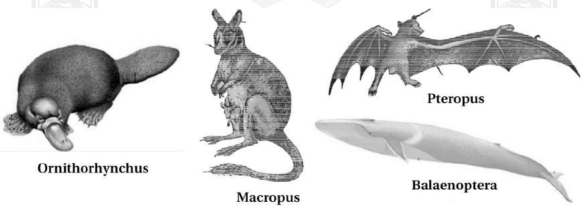
$\rightarrow$ Examples: Oviparous - Ornithorhynchus (Platypus); Viviparous - Macropus (Kangaroo),Pteropus (Flying fox),Camelus (Camel),Macaca (Monkey),Rattus (Rat),Canis (Dog),Felis (Cat),Elephas (Elephant),Equus (Horse),Delphinus (Common dolphin),Balaenoptera (Blue whale),Panthera tigris (Tiger),Panthera leo (Lion).
$\rightarrow$ Some of them have adapted to fly or live in water.
$\rightarrow$ The most unique mammalian characteristic is the presence of milk-producing glands (mammary glands) by which the young ones are nourished.
$\rightarrow$ They have two pairs of limbs,adapted for walking,running,climbing,burrowing,swimming,or flying.
$\rightarrow$ The skin of mammals is unique in possessing hair.
$\rightarrow$ External ears or pinnae are present.
$\rightarrow$ Different types of teeth are present in the jaw.
$\rightarrow$ The heart is four-chambered.
$\rightarrow$ They are homoiothermous (warm-blooded).
$\rightarrow$ Respiration is by lungs.
$\rightarrow$ Sexes are separate and fertilisation is internal.
$\rightarrow$ They are generally viviparous,with few exceptions,and development is direct.
$\rightarrow$ Examples: Oviparous - Ornithorhynchus (Platypus); Viviparous - Macropus (Kangaroo),Pteropus (Flying fox),Camelus (Camel),Macaca (Monkey),Rattus (Rat),Canis (Dog),Felis (Cat),Elephas (Elephant),Equus (Horse),Delphinus (Common dolphin),Balaenoptera (Blue whale),Panthera tigris (Tiger),Panthera leo (Lion).
0 likes
View Solution208
Easy
State the characteristics of the most evolved class in the animal kingdom.
Solution
(N/A) The most evolved class in the animal kingdom is Class Mammalia. Its characteristics are as follows:
$1$. Habitat: They are found in a variety of habitats like polar ice caps,deserts,mountains,forests,grasslands,and dark caves.
$2$. Adaptations: Some have adapted to fly (e.g.,Bat) or live in water (e.g.,Blue Whale).
$3$. Mammary Glands: The presence of milk-producing glands (mammary glands) is a unique characteristic,by which the young ones are nourished.
$4$. Limbs: They have two pairs of limbs,adapted for walking,running,climbing,burrowing,swimming,or flying.
$5$. Skin: The skin of mammals is unique in possessing hair.
$6$. External Ears: Pinnae (external ears) are present.
$7$. Dentition: Different types of teeth (incisors,canines,premolars,and molars) are present in the jaw.
$8$. Heart: The heart is four-chambered. The aortic arch curves to the left.
$9$. Physiology: They are homoiothermous (warm-blooded) animals. Sexes are separate and fertilization is internal.
$10$. Reproduction: They are generally viviparous (giving birth to young ones) with direct development,with few exceptions like the oviparous Platypus (Ornithorhynchus).
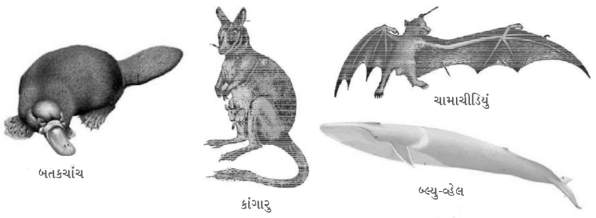
$11$. Examples: Platypus (Ornithorhynchus),Kangaroo (Macropus),Bat (Pteropus),Blue Whale (Balaenoptera).
$1$. Habitat: They are found in a variety of habitats like polar ice caps,deserts,mountains,forests,grasslands,and dark caves.
$2$. Adaptations: Some have adapted to fly (e.g.,Bat) or live in water (e.g.,Blue Whale).
$3$. Mammary Glands: The presence of milk-producing glands (mammary glands) is a unique characteristic,by which the young ones are nourished.
$4$. Limbs: They have two pairs of limbs,adapted for walking,running,climbing,burrowing,swimming,or flying.
$5$. Skin: The skin of mammals is unique in possessing hair.
$6$. External Ears: Pinnae (external ears) are present.
$7$. Dentition: Different types of teeth (incisors,canines,premolars,and molars) are present in the jaw.
$8$. Heart: The heart is four-chambered. The aortic arch curves to the left.
$9$. Physiology: They are homoiothermous (warm-blooded) animals. Sexes are separate and fertilization is internal.
$10$. Reproduction: They are generally viviparous (giving birth to young ones) with direct development,with few exceptions like the oviparous Platypus (Ornithorhynchus).
$11$. Examples: Platypus (Ornithorhynchus),Kangaroo (Macropus),Bat (Pteropus),Blue Whale (Balaenoptera).
0 likes
View Solution209
MediumMCQ
Which of the following are viviparous animals?
A
Platypus and Echidna
B
Kangaroo and Blue Whale
C
Ostrich and Penguin
D
Crocodile and Snake
Solution
(B) Viviparous animals are those that give birth to young ones directly.
Most mammals, including humans, are viviparous.
Examples of viviparous animals include:
- Kangaroo $(Macropus)$
- Bat $(Pteropus)$
- Camel $(Camelus)$
- Monkey $(Macaca)$
- Rat $(Rattus)$
- Dog $(Canis)$
- Cat $(Felis)$
- Elephant $(Elephas)$
- Horse $(Equus)$
- Dolphin $(Delphinus)$
- Blue Whale $(Balaenoptera)$
- Tiger $(Panthera \text{ } tigris)$
- Lion $(Panthera \text{ } leo)$
Among the given options, Kangaroo and Blue Whale are classic examples of viviparous mammals.
Most mammals, including humans, are viviparous.
Examples of viviparous animals include:
- Kangaroo $(Macropus)$
- Bat $(Pteropus)$
- Camel $(Camelus)$
- Monkey $(Macaca)$
- Rat $(Rattus)$
- Dog $(Canis)$
- Cat $(Felis)$
- Elephant $(Elephas)$
- Horse $(Equus)$
- Dolphin $(Delphinus)$
- Blue Whale $(Balaenoptera)$
- Tiger $(Panthera \text{ } tigris)$
- Lion $(Panthera \text{ } leo)$
Among the given options, Kangaroo and Blue Whale are classic examples of viviparous mammals.
0 likes
View Solution210
Easy
Mammals are the most adapted among the vertebrates. Explain.
Solution
(N/A) $\rightarrow$ Mammalia are found in a variety of habitats - polar ice caps,deserts,mountains,forests,grasslands and dark caves.
$\rightarrow$ Some of them have adapted to fly or live in water.
$\rightarrow$ The most unique mammalian characteristic is the presence of milk-producing glands (mammary glands) by which the young ones are nourished.
$\rightarrow$ They have two pairs of limbs,adapted for walking,running,climbing,burrowing,swimming or flying.
$\rightarrow$ The skin of mammals is unique in possessing hair.
$\rightarrow$ External ears or pinnae are present.
$\rightarrow$ Different types of teeth are present in the jaw.
$\rightarrow$ Heart is four-chambered.
$\rightarrow$ They are homoiothermous (warm-blooded).
$\rightarrow$ Respiration is by lungs.
$\rightarrow$ Sexes are separate and fertilisation is internal.
$\rightarrow$ They are viviparous with few exceptions and development is direct.
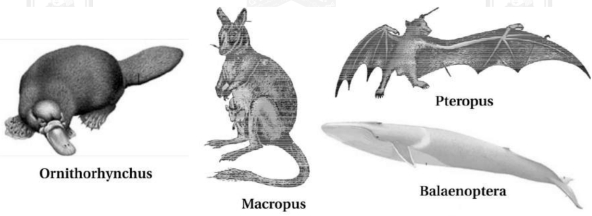
$\rightarrow$ Examples: Oviparous - Ornithorhynchus (Platypus); Viviparous - Macropus (Kangaroo),Pteropus (Flying fox),Camelus (Camel),Macaca (Monkey),Rattus (Rat),Canis (Dog),Felis (Cat),Elephas (Elephant),Equus (Horse),Delphinus (Common dolphin),Balaenoptera (Blue whale),Panthera tigris (Tiger),Panthera leo (Lion).
$\rightarrow$ Some of them have adapted to fly or live in water.
$\rightarrow$ The most unique mammalian characteristic is the presence of milk-producing glands (mammary glands) by which the young ones are nourished.
$\rightarrow$ They have two pairs of limbs,adapted for walking,running,climbing,burrowing,swimming or flying.
$\rightarrow$ The skin of mammals is unique in possessing hair.
$\rightarrow$ External ears or pinnae are present.
$\rightarrow$ Different types of teeth are present in the jaw.
$\rightarrow$ Heart is four-chambered.
$\rightarrow$ They are homoiothermous (warm-blooded).
$\rightarrow$ Respiration is by lungs.
$\rightarrow$ Sexes are separate and fertilisation is internal.
$\rightarrow$ They are viviparous with few exceptions and development is direct.
$\rightarrow$ Examples: Oviparous - Ornithorhynchus (Platypus); Viviparous - Macropus (Kangaroo),Pteropus (Flying fox),Camelus (Camel),Macaca (Monkey),Rattus (Rat),Canis (Dog),Felis (Cat),Elephas (Elephant),Equus (Horse),Delphinus (Common dolphin),Balaenoptera (Blue whale),Panthera tigris (Tiger),Panthera leo (Lion).
0 likes
View Solution211
MediumMCQ
Choose the correct option for the following statements:
$(i)$ Animals that maintain a constant body temperature are called $cold-blooded$ / $warm-blooded$ animals.
$(ii)$ Mammals are $viviparous$ / $oviparous$ animals.
$(i)$ Animals that maintain a constant body temperature are called $cold-blooded$ / $warm-blooded$ animals.
$(ii)$ Mammals are $viviparous$ / $oviparous$ animals.
A
$(i)$ Cold-blooded,$(ii)$ Viviparous
B
$(i)$ Warm-blooded,$(ii)$ Viviparous
C
$(i)$ Warm-blooded,$(ii)$ Oviparous
D
$(i)$ Cold-blooded,$(ii)$ Oviparous
Solution
(B) $(i)$ Animals that maintain a constant body temperature regardless of the external environment are known as $warm-blooded$ (homeothermic) animals.
$(ii)$ Mammals are characterized by giving birth to young ones, which makes them $viviparous$ animals.
Therefore, the correct choice is $(i)$ $warm-blooded$, $(ii)$ $viviparous$.
$(ii)$ Mammals are characterized by giving birth to young ones, which makes them $viviparous$ animals.
Therefore, the correct choice is $(i)$ $warm-blooded$, $(ii)$ $viviparous$.
0 likes
View Solution212
EasyMCQ
Which of the following organisms is not a primate?
A
Rat
B
Tiger
C
Cow
D
All of the above
Solution
(D) Primates are a group of mammals that include monkeys,apes,and humans.
- Rats belong to the order $Rodentia$.
- Tigers belong to the order $Carnivora$.
- Cows belong to the order $Artiodactyla$.
Since none of these organisms belong to the order $Primates$,the correct answer is $D$.
- Rats belong to the order $Rodentia$.
- Tigers belong to the order $Carnivora$.
- Cows belong to the order $Artiodactyla$.
Since none of these organisms belong to the order $Primates$,the correct answer is $D$.
0 likes
View Solution213
EasyMCQ
Which of the following is a primate?
A
Sheep
B
Deer
C
Horse
D
Ape
Solution
(D) Primates are a group of mammals that include lemurs,monkeys,apes,and humans.
Among the given options,$A$ (Sheep),$B$ (Deer),and $C$ (Horse) are ungulates (hoofed mammals).
$D$ (Ape) belongs to the order $Primates$.
Therefore,the correct option is $D$.
Among the given options,$A$ (Sheep),$B$ (Deer),and $C$ (Horse) are ungulates (hoofed mammals).
$D$ (Ape) belongs to the order $Primates$.
Therefore,the correct option is $D$.
0 likes
View Solution214
MediumMCQ
Select the odd one out.
A
Whale
B
Bat
C
Brachiosaurus
D
Cheetah
Solution
(C) The correct answer is $C$.
$A$,$B$,and $D$ (Whale,Bat,and Cheetah) are all mammals.
$C$ (Brachiosaurus) is a dinosaur,which belongs to the class Reptilia.
Therefore,Brachiosaurus is the odd one out as it does not belong to the class Mammalia.
$A$,$B$,and $D$ (Whale,Bat,and Cheetah) are all mammals.
$C$ (Brachiosaurus) is a dinosaur,which belongs to the class Reptilia.
Therefore,Brachiosaurus is the odd one out as it does not belong to the class Mammalia.
0 likes
View Solution215
MediumMCQ
Select the appropriate option for a pouched mammal.
A
Placental mammal
B
Marsupial
C
Reptile
D
Bird
Solution
(B) pouched mammal is known as a $Marsupial$.
These mammals give birth to relatively undeveloped young,which then climb into a pouch on the mother's abdomen to continue their development.
Examples include kangaroos and koalas.
Therefore,the correct option is $B$.
These mammals give birth to relatively undeveloped young,which then climb into a pouch on the mother's abdomen to continue their development.
Examples include kangaroos and koalas.
Therefore,the correct option is $B$.
0 likes
View Solution216
MediumMCQ
Which of the following animals is not aquatic?
A
Dolphin
B
Whale
C
Koala
D
Seal
Solution
(C) The $Koala$ ($Phascolarctos$ $cinereus$) is an arboreal herbivorous marsupial native to Australia. Unlike dolphins,whales,and seals,which are aquatic or semi-aquatic mammals adapted to life in water,the koala is strictly terrestrial and lives in eucalyptus trees. Therefore,it is not an aquatic animal.
0 likes
View Solution217
MediumMCQ
The success of mammals is primarily due to which of the following?
A
Constant body temperature
B
Climatic stability
C
Homeothermic nature
D
Both $A$ and $B$
Solution
(A) Mammals are successful because they are homeothermic (endothermic) organisms.
They maintain a constant body temperature regardless of the external environmental conditions.
This ability allows them to remain active and survive in diverse climatic conditions,ranging from extreme cold to extreme heat.
Therefore,the ability to maintain a constant body temperature is the key factor for their success.
They maintain a constant body temperature regardless of the external environmental conditions.
This ability allows them to remain active and survive in diverse climatic conditions,ranging from extreme cold to extreme heat.
Therefore,the ability to maintain a constant body temperature is the key factor for their success.
0 likes
View Solution218
MediumMCQ
In which group of organisms is reserve food stored in the form of glycogen and fat?
A
Man and Monkey
B
Cuscuta and Dog
C
Bladderwort and Cuscuta
D
Bladderwort and Venus fly trap
Solution
(A) In animals,reserve food is typically stored in the form of glycogen and fat.
$A$. Man and Monkey are both animals (mammals).
$B$. $Cuscuta$ is a parasitic plant (stores starch).
$C$. $Bladderwort$ and $Cuscuta$ are plants (store starch).
$D$. $Bladderwort$ and $Venus$ $fly$ $trap$ are insectivorous plants (store starch).
Therefore,both Man and Monkey store reserve food as glycogen and fat.
$A$. Man and Monkey are both animals (mammals).
$B$. $Cuscuta$ is a parasitic plant (stores starch).
$C$. $Bladderwort$ and $Cuscuta$ are plants (store starch).
$D$. $Bladderwort$ and $Venus$ $fly$ $trap$ are insectivorous plants (store starch).
Therefore,both Man and Monkey store reserve food as glycogen and fat.
0 likes
View Solution219
EasyMCQ
In echolocation,the animal that produces high frequency sounds is
A
Monkey
B
Butterfly
C
Squirrel
D
Bat
Solution
(D) Echolocation is a biological sonar used by several animal species. Bats produce high-frequency ultrasonic sounds that bounce off objects in their environment. By listening to the echoes of these sounds,they can determine the location,size,and distance of objects,which helps them navigate and hunt in the dark.
0 likes
View Solution220
EasyMCQ
$A$ group of animals having a marsupium is
A
Monotremata
B
Eutheria
C
Metatheria
D
Pantotheria
Solution
(C) Metatherians are commonly known as pouched mammals.
They possess a specialized abdominal pouch called a marsupium.
The embryo is born in an underdeveloped state and completes its development within this marsupium.
They possess a specialized abdominal pouch called a marsupium.
The embryo is born in an underdeveloped state and completes its development within this marsupium.
0 likes
View Solution221
EasyMCQ
Among the following,which one lays eggs and does not produce young ones directly?
A
Echidna
B
Kangaroo
C
Porcupine
D
Whale
Solution
(A) Echidna belongs to the group $Prototheria$ of the class $Mammalia$.
It is oviparous,meaning it lays eggs instead of giving birth to live young.
Only the female incubates the eggs,and the young ones lap the milk secreted by the mammary glands.
It is oviparous,meaning it lays eggs instead of giving birth to live young.
Only the female incubates the eggs,and the young ones lap the milk secreted by the mammary glands.
0 likes
View Solution222
MediumMCQ
Note the following:
$I.$ Dentition is heterodont.
$II.$ Canines are poorly developed.
$III.$ Incisors are chisel-like,poorly developed.
$IV.$ Herbivorous and diastema is present.
$V.$ The dental formula is $I \frac{2}{1}, C \frac{0}{0}, P m \frac{3}{2}, M \frac{3}{3}$.
Which of the above are true for $Oryctolagus$?
$I.$ Dentition is heterodont.
$II.$ Canines are poorly developed.
$III.$ Incisors are chisel-like,poorly developed.
$IV.$ Herbivorous and diastema is present.
$V.$ The dental formula is $I \frac{2}{1}, C \frac{0}{0}, P m \frac{3}{2}, M \frac{3}{3}$.
Which of the above are true for $Oryctolagus$?
A
$I, II$ and $IV$
B
$I, IV$ and $V$
C
$I, II, IV$ and $V$
D
$III, IV$ and $V$
Solution
(B) $Oryctolagus$ $cuniculus$ (rabbit) is a representative of class $Mammalia$.
$1.$ Dentition in all mammals is heterodont (i.e.,presence of dissimilar types of teeth). Thus,statement $I$ is true.
$2.$ Canines are completely absent in rabbits,not just poorly developed. Thus,statement $II$ is false.
$3.$ Incisors in rabbits are well-developed,sharp,and chisel-like,used for gnawing. Thus,statement $III$ is false.
$4.$ Rabbits are herbivorous,and due to the absence of canines,a gap exists between the incisors and premolars,known as a diastema. Thus,statement $IV$ is true.
$5.$ The dental formula of a rabbit is $I \frac{2}{1}, C \frac{0}{0}, P m \frac{3}{2}, M \frac{3}{3}$,which gives a total of $28$ teeth. Thus,statement $V$ is true.
Therefore,statements $I, IV,$ and $V$ are correct.
$1.$ Dentition in all mammals is heterodont (i.e.,presence of dissimilar types of teeth). Thus,statement $I$ is true.
$2.$ Canines are completely absent in rabbits,not just poorly developed. Thus,statement $II$ is false.
$3.$ Incisors in rabbits are well-developed,sharp,and chisel-like,used for gnawing. Thus,statement $III$ is false.
$4.$ Rabbits are herbivorous,and due to the absence of canines,a gap exists between the incisors and premolars,known as a diastema. Thus,statement $IV$ is true.
$5.$ The dental formula of a rabbit is $I \frac{2}{1}, C \frac{0}{0}, P m \frac{3}{2}, M \frac{3}{3}$,which gives a total of $28$ teeth. Thus,statement $V$ is true.
Therefore,statements $I, IV,$ and $V$ are correct.
0 likes
View Solution223
EasyMCQ
Elephant tusks are
A
Molars
B
Canines
C
Incisors
D
Premolars
Solution
(C) The tusks of an elephant are its second upper incisors.
These teeth grow continuously throughout the life of the elephant.
These teeth grow continuously throughout the life of the elephant.
0 likes
View Solution224
MediumMCQ
Thecodont teeth are present in:
$a.$ Sphenodon
$b.$ Crocodiles
$c.$ Mammals
$d.$ Scoliodon
$a.$ Sphenodon
$b.$ Crocodiles
$c.$ Mammals
$d.$ Scoliodon
A
$c \; \text{only}$
B
$b \; \& \; c \; \text{only}$
C
$a, b, \; \& \; c \; \text{only}$
D
$a, b, c \; \& \; d$
Solution
(B) Thecodont dentition refers to teeth that are embedded in deep sockets of the jaw bone.
$1.$ Crocodiles and mammals possess thecodont teeth.
$2.$ Sphenodon (a reptile) possesses acrodont teeth, where teeth are attached to the crest of the jaw bone.
$3.$ Scoliodon (a cartilaginous fish) also possesses acrodont teeth.
Therefore, only crocodiles and mammals exhibit thecodont teeth.
$1.$ Crocodiles and mammals possess thecodont teeth.
$2.$ Sphenodon (a reptile) possesses acrodont teeth, where teeth are attached to the crest of the jaw bone.
$3.$ Scoliodon (a cartilaginous fish) also possesses acrodont teeth.
Therefore, only crocodiles and mammals exhibit thecodont teeth.
0 likes
View Solution225
EasyMCQ
The Haversian canal is found in the bone of:
A
Mammals
B
Reptiles
C
Pisces
D
Amphibians
Solution
(A) The Haversian canal is a microscopic structure found within the compact bone of mammals. It consists of a central canal containing blood vessels and nerves,surrounded by concentric layers of bone matrix called lamellae. This system,known as the Haversian system or osteon,is a characteristic feature of mammalian bone tissue.
0 likes
View Solution226
MediumMCQ
Common among all mammals is
A
Ventral nerve cord
B
Seven cervical vertebrae
C
All are carnivores
D
All are producers
Solution
(B) The presence of seven cervical vertebrae in the neck is a common feature in all mammals. These vertebrae are acoelous and are typically covered by cartilaginous pads,i.e.,epiphysis. This characteristic remains constant regardless of the length of the neck in different mammalian species.
0 likes
View Solution227
EasyMCQ
All of the following are mammals that live entirely in water,except:
A
Penguins
B
Dolphins
C
Seals
D
Sea cows
Solution
(A) The organisms listed are aquatic,but they belong to different biological classes.
$1$. Dolphins are aquatic mammals belonging to the order $Cetacea$.
$2$. Seals are semi-aquatic marine mammals belonging to the order $Carnivora$.
$3$. Sea cows (manatees and dugongs) are fully aquatic herbivorous mammals belonging to the order $Sirenia$.
$4$. Penguins are flightless birds belonging to the class $Aves$.
Therefore,penguins are the only organisms in the list that are not mammals.
$1$. Dolphins are aquatic mammals belonging to the order $Cetacea$.
$2$. Seals are semi-aquatic marine mammals belonging to the order $Carnivora$.
$3$. Sea cows (manatees and dugongs) are fully aquatic herbivorous mammals belonging to the order $Sirenia$.
$4$. Penguins are flightless birds belonging to the class $Aves$.
Therefore,penguins are the only organisms in the list that are not mammals.
0 likes
View Solution228
EasyMCQ
$A$ mammal which lays eggs instead of giving birth to offspring is
A
Rabbit
B
Macropus
C
Duck-billed platypus
D
Whale
Solution
(C) Most mammals are viviparous,meaning they give birth to live young. However,there are exceptions known as monotremes. The Duck-billed platypus $(Ornithorhynchus)$ is a well-known example of an oviparous mammal,which means it lays eggs instead of giving birth to offspring.
0 likes
View Solution229
MediumMCQ
Point out the mammalian characters.
A
Diaphragm,four-chambered heart,lungs
B
Hairy skin,viviparity,feathers
C
Fins,gills,viviparity
D
Neural gland,gills,four-chambered heart
Solution
(A) Mammals are characterized by the presence of a diaphragm,which is a muscular partition separating the thorax from the abdomen,a four-chambered heart,and lungs for respiration.
Viviparity is a common trait but not absolute,as some mammals like the $Platypus$ are oviparous (egg-laying).
Feathers are characteristic of birds,while gills and fins are typical of aquatic organisms like fish.
Neural glands are not a feature of mammals.
Therefore,the correct set of mammalian characters is diaphragm,four-chambered heart,and lungs.
Viviparity is a common trait but not absolute,as some mammals like the $Platypus$ are oviparous (egg-laying).
Feathers are characteristic of birds,while gills and fins are typical of aquatic organisms like fish.
Neural glands are not a feature of mammals.
Therefore,the correct set of mammalian characters is diaphragm,four-chambered heart,and lungs.
0 likes
View Solution230
EasyMCQ
The following statements regarding mammals are correct except:
A
Cloaca is present
B
External ear pinna present
C
Non-nucleated $RBC$
D
Excrete urea
Solution
(A) In mammals,the cloaca is typically absent,as they possess separate openings for the digestive and urogenital tracts.
External ears (pinnae) are a characteristic feature of most mammals.
Mammalian mature red blood cells $(RBCs)$ are non-nucleated to increase surface area for oxygen transport.
Mammals are ureotelic,meaning they excrete urea as their primary nitrogenous waste product.
Therefore,the statement that a cloaca is present is incorrect.
External ears (pinnae) are a characteristic feature of most mammals.
Mammalian mature red blood cells $(RBCs)$ are non-nucleated to increase surface area for oxygen transport.
Mammals are ureotelic,meaning they excrete urea as their primary nitrogenous waste product.
Therefore,the statement that a cloaca is present is incorrect.
0 likes
View Solution231
EasyMCQ
Amongst the following mammals,which of the following is a monotreme?
A
Macropus (Kangaroo)
B
Ornithorhynchus (Platypus)
C
Balaenoptera (Blue whale)
D
Elephas (Elephant)
Solution
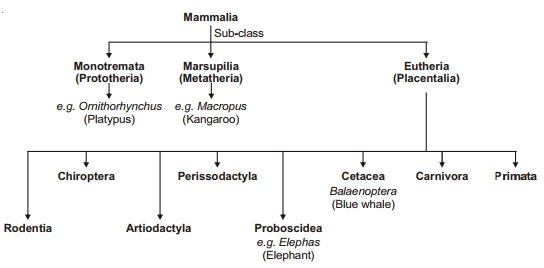
(B) Mammals are classified into three subclasses: Prototheria (Monotremata),Metatheria (Marsupialia),and Eutheria (Placentalia).
Monotremes are egg-laying mammals.
According to the classification provided:
$1$. $Ornithorhynchus$ (Platypus) belongs to the subclass Prototheria (Monotremata).
$2$. $Macropus$ (Kangaroo) belongs to the subclass Metatheria (Marsupialia).
$3$. $Balaenoptera$ (Blue whale) and $Elephas$ (Elephant) belong to the subclass Eutheria (Placentalia).
Therefore,the correct option is $B$.
Monotremes are egg-laying mammals.
According to the classification provided:
$1$. $Ornithorhynchus$ (Platypus) belongs to the subclass Prototheria (Monotremata).
$2$. $Macropus$ (Kangaroo) belongs to the subclass Metatheria (Marsupialia).
$3$. $Balaenoptera$ (Blue whale) and $Elephas$ (Elephant) belong to the subclass Eutheria (Placentalia).
Therefore,the correct option is $B$.
0 likes
View Solution232
MediumMCQ
$A$: In metatherians,the scrotum is present in front of the penis.
$R$: In prototherians,the scrotum is present behind the penis.
$R$: In prototherians,the scrotum is present behind the penis.
A
Assertion and Reason both are correct and Reason is the correct explanation of Assertion.
B
Assertion and Reason both are correct but Reason is not the correct explanation of Assertion.
C
Assertion is correct,but Reason is incorrect.
D
Both Assertion and Reason are incorrect.
Solution
(C) The Assertion is correct because in metatherians (marsupials),the scrotum is located anterior to the penis.
The Reason is incorrect because in prototherians (monotremes),the testes are abdominal and do not descend into a scrotum at all.
Therefore,the correct option is $C$.
The Reason is incorrect because in prototherians (monotremes),the testes are abdominal and do not descend into a scrotum at all.
Therefore,the correct option is $C$.
0 likes
View Solution233
MediumMCQ
$A$: The duck-billed platypus and the spiny ant-eater,both are egg-laying animals yet are grouped under mammals.
$R$: Both of them have seven cervical vertebrae and mammary glands without teats.
$R$: Both of them have seven cervical vertebrae and mammary glands without teats.
A
Assertion and Reason both are correct and Reason is the correct explanation of Assertion.
B
Assertion and Reason both are correct but Reason is not the correct explanation of Assertion.
C
Assertion is correct,but Reason is incorrect.
D
Both Assertion and Reason are incorrect.
Solution
(A) Assertion is correct because the duck-billed platypus and the spiny ant-eater are oviparous (egg-laying) mammals.
They are classified as mammals because they possess characteristic mammalian features,such as the presence of seven cervical vertebrae in the neck and mammary glands (though they lack teats).
Since the Reason provides the specific anatomical evidence that justifies their classification as mammals despite being egg-layers,the Reason is the correct explanation for the Assertion.
They are classified as mammals because they possess characteristic mammalian features,such as the presence of seven cervical vertebrae in the neck and mammary glands (though they lack teats).
Since the Reason provides the specific anatomical evidence that justifies their classification as mammals despite being egg-layers,the Reason is the correct explanation for the Assertion.
0 likes
View Solution234
MediumMCQ
$A$ : Bats and whales are classified as mammals.
$R$ : Bats and whales show echolocation and four-chambered heart.
$R$ : Bats and whales show echolocation and four-chambered heart.
A
Assertion and Reason both are correct and Reason is the correct explanation of Assertion.
B
Assertion and Reason both are correct but Reason is not the correct explanation of Assertion.
C
Assertion is correct,but Reason is incorrect.
D
Both Assertion and Reason are incorrect.
Solution
(B) Assertion is correct because bats (order $Chiroptera$) and whales (order $Cetacea$) possess mammary glands and are classified as mammals.
Reason is correct because both bats and whales exhibit echolocation (used for navigation and hunting) and possess a four-chambered heart,which is a characteristic feature of mammals.
However,the presence of echolocation and a four-chambered heart is not the defining reason why they are classified as mammals; they are classified as mammals due to the presence of mammary glands,hair,and other mammalian traits. Thus,Reason is not the correct explanation for Assertion.
Reason is correct because both bats and whales exhibit echolocation (used for navigation and hunting) and possess a four-chambered heart,which is a characteristic feature of mammals.
However,the presence of echolocation and a four-chambered heart is not the defining reason why they are classified as mammals; they are classified as mammals due to the presence of mammary glands,hair,and other mammalian traits. Thus,Reason is not the correct explanation for Assertion.
0 likes
View Solution235
MediumMCQ
Which of the following animals is oviparous?
A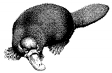
B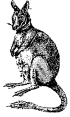
C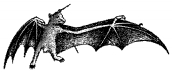
D
Solution
(A) Most mammals are viviparous,meaning they give birth to live young. However,members of the order Monotremata are an exception as they are oviparous (egg-laying mammals).
$1$. $Ornithorhynchus$ (Platypus) is a well-known example of a monotreme,which lays eggs.
$2$. $Macropus$ (Kangaroo) is a marsupial,which is viviparous.
$3$. $Pteropus$ (Flying fox) is a placental mammal,which is viviparous.
$4$. $Balaenoptera$ (Blue whale) is a placental mammal,which is viviparous.
Therefore,the correct answer is $Ornithorhynchus$ (Platypus).
$1$. $Ornithorhynchus$ (Platypus) is a well-known example of a monotreme,which lays eggs.
$2$. $Macropus$ (Kangaroo) is a marsupial,which is viviparous.
$3$. $Pteropus$ (Flying fox) is a placental mammal,which is viviparous.
$4$. $Balaenoptera$ (Blue whale) is a placental mammal,which is viviparous.
Therefore,the correct answer is $Ornithorhynchus$ (Platypus).
0 likes
View Solution236
MediumMCQ
How many of the following are fully aquatic mammals?
Whale,Dog,Dolphin,Seal,Shark,Sea cow,Elephant
Whale,Dog,Dolphin,Seal,Shark,Sea cow,Elephant
A
$3$
B
$4$
C
$2$
D
$1$
Solution
(A) To identify the fully aquatic mammals from the given list:
$1$. Whale: Fully aquatic mammal.
$2$. Dog: Terrestrial mammal.
$3$. Dolphin: Fully aquatic mammal.
$4$. Seal: Semi-aquatic mammal (spends time on land and water).
$5$. Shark: Fish (not a mammal).
$6$. Sea cow (Manatee): Fully aquatic mammal.
$7$. Elephant: Terrestrial mammal.
Therefore,the fully aquatic mammals are Whale,Dolphin,and Sea cow. The total count is $3$.
$1$. Whale: Fully aquatic mammal.
$2$. Dog: Terrestrial mammal.
$3$. Dolphin: Fully aquatic mammal.
$4$. Seal: Semi-aquatic mammal (spends time on land and water).
$5$. Shark: Fish (not a mammal).
$6$. Sea cow (Manatee): Fully aquatic mammal.
$7$. Elephant: Terrestrial mammal.
Therefore,the fully aquatic mammals are Whale,Dolphin,and Sea cow. The total count is $3$.
0 likes
View Solution237
MediumMCQ
What is the primary reason for the success of mammals on Earth?
A
Ability to maintain constant body temperature
B
Ability to run fast
C
Ability to fly
D
Being omnivorous
Solution
(A) The primary reason for the success of mammals is their ability to maintain a constant internal body temperature,a process known as $thermoregulation$ or $homeostasis$. This allows mammals to survive in diverse and extreme environmental conditions,ranging from freezing polar regions to scorching deserts,by keeping their metabolic processes stable regardless of external environmental fluctuations.
0 likes
View Solution238
MediumMCQ
The unique mammalian characteristics are:
A
pinna,monocondylic skull and mammary glands
B
hairs,tympanic membrane and mammary glands
C
hairs,pinna and mammary glands
D
hairs,pinna and indirect development
Solution
(C) The correct answer is $C$ because the presence of hairs,pinna,and mammary glands are unique features of mammals.
$A$ is incorrect because mammals have a dicondylic skull,whereas a monocondylic skull is found in reptiles and aves.
$B$ is incorrect because the tympanic membrane is also present in amphibians,so it is not a unique feature of mammals.
$D$ is incorrect because mammals exhibit direct development,not indirect development.
$A$ is incorrect because mammals have a dicondylic skull,whereas a monocondylic skull is found in reptiles and aves.
$B$ is incorrect because the tympanic membrane is also present in amphibians,so it is not a unique feature of mammals.
$D$ is incorrect because mammals exhibit direct development,not indirect development.
1 likes
View Solution239
MediumMCQ
Select the example of an oviparous mammal.
A
Macropus
B
Platypus
C
Aptenodytes
D
Neophron
Solution
(B) Mammals are generally viviparous,meaning they give birth to young ones.
However,there is a small group of mammals known as monotremes that are oviparous,meaning they lay eggs.
$Ornithorhynchus$ (commonly known as the $Platypus$) is a classic example of an oviparous mammal.
$Macropus$ (kangaroo) is a marsupial and is viviparous.
$Aptenodytes$ (penguin) and $Neophron$ (vulture) are birds,not mammals.
However,there is a small group of mammals known as monotremes that are oviparous,meaning they lay eggs.
$Ornithorhynchus$ (commonly known as the $Platypus$) is a classic example of an oviparous mammal.
$Macropus$ (kangaroo) is a marsupial and is viviparous.
$Aptenodytes$ (penguin) and $Neophron$ (vulture) are birds,not mammals.
0 likes
View Solution240
MediumMCQ
External ear pinna are present in $:-$
A
Elephas
B
Columba
C
Hemidactylus
D
Naja
Solution
(A) The presence of an external ear or pinna is a characteristic feature of the class $Mammalia$.
Among the given options:
$A$. $Elephas$ (Elephant) belongs to the class $Mammalia$ and possesses external ear pinnae.
$B$. $Columba$ (Pigeon) belongs to the class $Aves$,which lacks external pinnae.
$C$. $Hemidactylus$ (Wall lizard) belongs to the class $Reptilia$,which lacks external pinnae.
$D$. $Naja$ (Cobra) belongs to the class $Reptilia$,which lacks external pinnae.
Therefore,the correct option is $A$.
Among the given options:
$A$. $Elephas$ (Elephant) belongs to the class $Mammalia$ and possesses external ear pinnae.
$B$. $Columba$ (Pigeon) belongs to the class $Aves$,which lacks external pinnae.
$C$. $Hemidactylus$ (Wall lizard) belongs to the class $Reptilia$,which lacks external pinnae.
$D$. $Naja$ (Cobra) belongs to the class $Reptilia$,which lacks external pinnae.
Therefore,the correct option is $A$.
0 likes
View Solution241
EasyMCQ
Mammary glands are present in?
A
Camelus
B
Neophron
C
Pavo
D
Corvus
Solution
(A) Mammary glands are a characteristic feature of the class $Mammalia$.
$Camelus$ (camel) belongs to the class $Mammalia$.
$Neophron$ (vulture),$Pavo$ (peacock),and $Corvus$ (crow) belong to the class $Aves$ (birds).
Therefore,mammary glands are present in $Camelus$.
$Camelus$ (camel) belongs to the class $Mammalia$.
$Neophron$ (vulture),$Pavo$ (peacock),and $Corvus$ (crow) belong to the class $Aves$ (birds).
Therefore,mammary glands are present in $Camelus$.
0 likes
View Solution242
EasyMCQ
Complete the following analogy with respect to the habitat of mammals.
Fossorial mammals: $i$ :: Arboreal mammals: $ii$
Fossorial mammals: $i$ :: Arboreal mammals: $ii$
A
| $A$. $i$: bats | $ii$: seals |
B
| $B$. $i$: kangaroo rats | $ii$: lemurs |
C
| $C$. $i$: sea cow | $ii$: kangaroo rats |
D
| $D$. $i$: whales | $ii$: lemurs |
Solution
(B) The analogy is based on the habitat of mammals.
Fossorial mammals are those that live primarily underground or in burrows (e.g.,kangaroo rats).
Arboreal mammals are those that live primarily in trees (e.g.,lemurs).
Therefore,the correct analogy is: Fossorial mammals: kangaroo rats :: Arboreal mammals: lemurs.
Thus,option $B$ is the correct answer.
Fossorial mammals are those that live primarily underground or in burrows (e.g.,kangaroo rats).
Arboreal mammals are those that live primarily in trees (e.g.,lemurs).
Therefore,the correct analogy is: Fossorial mammals: kangaroo rats :: Arboreal mammals: lemurs.
Thus,option $B$ is the correct answer.
0 likes
View Solution243
EasyMCQ
Pick the mammal with a true placenta.
A
Kangaroo
B
Flying fox
C
Platypus
D
Mongoose
Solution
(D) The correct answer is $D$ (Mongoose).
$1$. Mammals are classified into three groups: Prototherians (egg-laying mammals like Platypus),Metatherians (marsupials like Kangaroo),and Eutherians (placental mammals).
$2$. $A$ true placenta is a characteristic feature of Eutherians,which allows for the exchange of nutrients and waste between the mother and the fetus.
$3$. Mongoose is a Eutherian mammal and thus possesses a true placenta.
$4$. Kangaroo is a marsupial (Metatherian) with a short-lived yolk-sac placenta,and Platypus is a monotreme (Prototherian) that lays eggs.
$1$. Mammals are classified into three groups: Prototherians (egg-laying mammals like Platypus),Metatherians (marsupials like Kangaroo),and Eutherians (placental mammals).
$2$. $A$ true placenta is a characteristic feature of Eutherians,which allows for the exchange of nutrients and waste between the mother and the fetus.
$3$. Mongoose is a Eutherian mammal and thus possesses a true placenta.
$4$. Kangaroo is a marsupial (Metatherian) with a short-lived yolk-sac placenta,and Platypus is a monotreme (Prototherian) that lays eggs.
0 likes
View Solution244
EasyMCQ
Identify the group which includes animals all of which give birth to young ones directly.
A
Shrew,bat,kiwi,cat
B
Lion,whale,ostrich,bat
C
Dolphin,kangaroo,bat,cat
D
Platypus,penguin,bat,hippopotamus
Solution
(C) The correct answer is $C$.
Animals that give birth to young ones directly are known as viviparous animals.
$1$. Dolphin,kangaroo,bat,and cat are all mammals that exhibit viviparity.
$2$. Kiwi,ostrich,and penguin are birds,which are oviparous (egg-laying).
$3$. Platypus is a monotreme,which is an egg-laying mammal.
Therefore,the group containing only viviparous animals is Dolphin,kangaroo,bat,and cat.
Animals that give birth to young ones directly are known as viviparous animals.
$1$. Dolphin,kangaroo,bat,and cat are all mammals that exhibit viviparity.
$2$. Kiwi,ostrich,and penguin are birds,which are oviparous (egg-laying).
$3$. Platypus is a monotreme,which is an egg-laying mammal.
Therefore,the group containing only viviparous animals is Dolphin,kangaroo,bat,and cat.
0 likes
View SolutionAnimal Kingdom — Class-Mammalia · Frequently Asked Questions
1Are these Animal Kingdom questions useful for JEE and NEET?
Yes. All questions in this section are mapped to JEE Main and NEET exam patterns. Previous year questions from JEE Main, NEET, GUJCET and state-level exams are included with full solutions.
2Can I switch to Hindi or Gujarati for these questions?
Yes. Use the language tabs in the hero section or the sidebar to view the same questions and solutions in English, Hindi or Gujarati.
3How do I generate a question paper from this subtopic?
Use the Vedclass Exam Paper Generator — select the chapter and subtopic, set difficulty, and generate Sets A, B, C, D automatically. First 3 chapters of every subject are free.
Vedclass Products
For Students
Vedclass Test Series
Mock tests in real JEE/NEET style with performance analysis. 5-day free trial.
Start Free TrialFor Teachers
Exam Paper Generator
Generate Set A/B/C/D papers from this chapter in 2 minutes. 3 chapters free.
Try FreeFor Institutes
Online Exam Module
Live online exams with unlimited students, 360° analytics & white-label branding.
See DemoFor Teachers & Institutes
Generate a Animal Kingdom Exam Paper in 2 Minutes
Select subtopic & difficulty — Sets A, B, C, D auto-generated with No Repeat logic.
First 3 chapters of every subject are free — no payment required.