
A English
Class-Mammalia Questions in English
Class 11 Biology · Animal Kingdom · Class-Mammalia
245+
Questions
English
Language
100%
With Solutions
Showing 47 of 245 questions in English
151
EasyMCQ
The presence of an external ear (pinna) is a characteristic feature of which of the following?
A
Birds
B
Mammals
C
Birds and Mammals
D
Mammals and Reptiles
Solution
(B) The presence of an external ear or pinna is a unique and defining characteristic of the class $Mammalia$.
Birds do not have an external pinna; instead,they have small openings covered by feathers.
Reptiles also lack an external pinna and typically have a tympanum representing the ear.
Therefore,the correct option is $B$.
Birds do not have an external pinna; instead,they have small openings covered by feathers.
Reptiles also lack an external pinna and typically have a tympanum representing the ear.
Therefore,the correct option is $B$.
0 likes
View Solution152
EasyMCQ
Which of the following is the largest mammal?
A
Elephant
B
Rhinoceros
C
Whale
D
Dinosaur
Solution
(C) The blue whale $(Balaenoptera musculus)$ is the largest mammal currently living on Earth. It belongs to the order $Cetacea$. While dinosaurs were large reptiles,they are not mammals. Elephants and rhinoceroses are large land mammals,but they are significantly smaller than the blue whale.
0 likes
View Solution153
MediumMCQ
Both birds and bats can fly. Bats differ from birds due to the presence of:
A
Wings
B
Four-chambered heart
C
Diaphragm
D
Homeothermy
Solution
(C) Both birds $(Aves)$ and bats $(Mammalia)$ possess wings for flight and are homeothermic (warm-blooded) with a four-chambered heart.
However, the presence of a $diaphragm$ is a characteristic feature unique to mammals.
Birds lack a diaphragm; instead, they possess an air sac system associated with their lungs for efficient respiration.
Therefore, the presence of a diaphragm is the key anatomical feature that distinguishes bats from birds.
However, the presence of a $diaphragm$ is a characteristic feature unique to mammals.
Birds lack a diaphragm; instead, they possess an air sac system associated with their lungs for efficient respiration.
Therefore, the presence of a diaphragm is the key anatomical feature that distinguishes bats from birds.
0 likes
View Solution154
EasyMCQ
Which of the following is a viviparous animal?
A
Dolphin
B
Platypus
C
Ostrich
D
Penguin
Solution
(A) Viviparous animals are those that give birth to live young ones instead of laying eggs.
Among the given options,$A$ (Dolphin) is a mammal that is viviparous.
$B$ (Platypus) is an oviparous mammal (egg-laying).
$C$ (Ostrich) and $D$ (Penguin) are birds,and all birds are oviparous.
Among the given options,$A$ (Dolphin) is a mammal that is viviparous.
$B$ (Platypus) is an oviparous mammal (egg-laying).
$C$ (Ostrich) and $D$ (Penguin) are birds,and all birds are oviparous.
0 likes
View Solution155
EasyMCQ
Which class of animals possesses a pinna (external ear)?
A
Reptilia
B
Aves
C
Amphibia
D
Mammalia
Solution
(D) The presence of a pinna (external ear) is a unique characteristic feature of the class $Mammalia$.
Other classes like $Reptilia$,$Aves$,and $Amphibia$ do not possess an external ear or pinna.
Other classes like $Reptilia$,$Aves$,and $Amphibia$ do not possess an external ear or pinna.
0 likes
View Solution156
EasyMCQ
To which class does the bat belong?
A
Reptilia
B
Amphibia
C
Aves
D
Mammalia
Solution
(D) The bat is a flying mammal. It belongs to the class $Mammalia$ because it possesses mammary glands,has hair on its body,and gives birth to young ones rather than laying eggs.
0 likes
View Solution157
EasyMCQ
Assertion $(P)$: Mammals are viviparous.
Reason $(Q)$: Mammals possess external pinnae.
Reason $(Q)$: Mammals possess external pinnae.
A
$P$ (Assertion) and $Q$ (Reason) are both true,and $P$ is the correct explanation of $Q$.
B
$P$ (Assertion) and $Q$ (Reason) are both true,but $P$ is not the correct explanation of $Q$.
C
$P$ (Assertion) is true,but $Q$ (Reason) is false.
D
$P$ (Assertion) is false,but $Q$ (Reason) is true.
Solution
(B) Assertion $(P)$ is true because most mammals give birth to young ones (viviparous),although there are exceptions like monotremes (e.g.,platypus).
Reason $(Q)$ is also true because the presence of external ears or pinnae is a characteristic feature of mammals.
However,the fact that mammals are viviparous is not caused by the presence of external pinnae. These are two independent characteristics of the class Mammalia.
Therefore,both statements are true,but $P$ is not the correct explanation of $Q$.
Reason $(Q)$ is also true because the presence of external ears or pinnae is a characteristic feature of mammals.
However,the fact that mammals are viviparous is not caused by the presence of external pinnae. These are two independent characteristics of the class Mammalia.
Therefore,both statements are true,but $P$ is not the correct explanation of $Q$.
0 likes
View Solution158
MediumMCQ
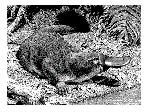
Identify the type of mammal shown in the figure based on its mode of reproduction.
A
Oviparous
B
Ovoviviparous
C
Viviparous
D
Non-reproductive
Solution
(A) The animal shown in the figure is the Platypus (Ornithorhynchus anatinus).
Platypus is a unique mammal that belongs to the order Monotremata.
Unlike most mammals which are viviparous (giving birth to live young),monotremes are oviparous,meaning they lay eggs.
Therefore,the correct option is $(A)$.
Platypus is a unique mammal that belongs to the order Monotremata.
Unlike most mammals which are viviparous (giving birth to live young),monotremes are oviparous,meaning they lay eggs.
Therefore,the correct option is $(A)$.
0 likes
View Solution159
EasyMCQ
Which of the following is an oviparous mammal?
A
Duck-billed platypus
B
Penguin
C
Dolphin
D
All of the above
Solution
(A) Mammals are generally viviparous, meaning they give birth to live young. However, there is a small group of mammals known as monotremes that lay eggs. The $Duck-billed$ $platypus$ $(Ornithorhynchus$ $anatinus)$ is a classic example of an oviparous mammal. Penguins are birds, and dolphins are viviparous mammals. Therefore, the correct option is $A$.
0 likes
View Solution160
MediumMCQ
$P$: Bats and whales are classified as mammals.
$Q$: The heart of a bat and a whale is four-chambered.
$Q$: The heart of a bat and a whale is four-chambered.
A
$P$ is true and $Q$ is true,but $Q$ is not the explanation of $P$.
B
$P$ is true and $Q$ is the correct explanation of $P$.
C
$P$ is true and $Q$ is false.
D
Both $P$ and $Q$ are false.
Solution
(B) Both statements are correct. Bats and whales are mammals because they possess mammary glands,hair,and give birth to young ones. $A$ characteristic feature of mammals is the presence of a four-chambered heart (two atria and two ventricles),which ensures complete separation of oxygenated and deoxygenated blood. Since the four-chambered heart is a defining anatomical trait that supports the high metabolic demands of mammals,statement $Q$ explains why they are classified as mammals. Therefore,$Q$ is the correct explanation for $P$.
0 likes
View Solution161
EasyMCQ
Which of the following groups of four animals are viviparous?
A
Bat,Cat,Penguin,Crocodile
B
Kangaroo,Dolphin,Rat,Whale
C
Platypus,Lion,Ostrich,Whale
D
Platypus,Penguin,Bat,Kangaroo
Solution
(B) Viviparous animals are those that give birth to live young ones instead of laying eggs.
$1$. Kangaroo,Dolphin,Rat,and Whale are all mammals.
$2$. Most mammals are viviparous.
$3$. Platypus is an oviparous (egg-laying) mammal.
$4$. Penguins,crocodiles,and ostriches are oviparous.
Therefore,the group consisting of Kangaroo,Dolphin,Rat,and Whale are all viviparous.
$1$. Kangaroo,Dolphin,Rat,and Whale are all mammals.
$2$. Most mammals are viviparous.
$3$. Platypus is an oviparous (egg-laying) mammal.
$4$. Penguins,crocodiles,and ostriches are oviparous.
Therefore,the group consisting of Kangaroo,Dolphin,Rat,and Whale are all viviparous.
0 likes
View Solution162
EasyMCQ
Which of the following is a characteristic of all mammals without any exception?
A
Viviparous and biconcave red blood cells
B
Four-chambered heart and abdominal testes
C
Heterodont teeth and viviparous
D
Muscular diaphragm and mammary glands
Solution
(D) The class $Mammalia$ is characterized by several unique features.
$1$. The presence of $mammary$ $glands$ (milk-producing glands) is the most defining characteristic of mammals,used for nourishing their young.
$2$. The $muscular$ $diaphragm$ is a unique structure found in all mammals that separates the thoracic cavity from the abdominal cavity and plays a crucial role in respiration.
$3$. While other features like viviparity or heterodont teeth are common,they have exceptions (e.g.,$Ornithorhynchus$ or platypus is oviparous).
$4$. Therefore,the presence of a muscular diaphragm and mammary glands are the universal characteristics of all mammals.
$1$. The presence of $mammary$ $glands$ (milk-producing glands) is the most defining characteristic of mammals,used for nourishing their young.
$2$. The $muscular$ $diaphragm$ is a unique structure found in all mammals that separates the thoracic cavity from the abdominal cavity and plays a crucial role in respiration.
$3$. While other features like viviparity or heterodont teeth are common,they have exceptions (e.g.,$Ornithorhynchus$ or platypus is oviparous).
$4$. Therefore,the presence of a muscular diaphragm and mammary glands are the universal characteristics of all mammals.
0 likes
View Solution163
EasyMCQ
The mammal that is oviparous is .......... .
A
Rabbit
B
Rat
C
Kangaroo
D
Platypus
Solution
(D) Most mammals are viviparous,meaning they give birth to live young.
However,there is a small group of mammals known as monotremes that are oviparous,meaning they lay eggs.
The $Ornithorhynchus$ (Platypus) and $Tachyglossus$ (Echidna) are classic examples of oviparous mammals.
Therefore,the correct option is $D$.
However,there is a small group of mammals known as monotremes that are oviparous,meaning they lay eggs.
The $Ornithorhynchus$ (Platypus) and $Tachyglossus$ (Echidna) are classic examples of oviparous mammals.
Therefore,the correct option is $D$.
0 likes
View Solution164
EasyMCQ
Which gland is present in animals that leads to their classification in the class $Mammalia$?
A
Digestive gland
B
Proboscis gland
C
Cerebral gland
D
Mammary gland
Solution
(D) The class $Mammalia$ is characterized by the presence of mammary glands (milk-producing glands) in females,which are used to nourish their young ones. This is the most unique and defining feature of mammals. Other features include the presence of hair on the skin and two pairs of limbs.
0 likes
View Solution165
MediumMCQ
Which of the following is $NOT$ true for an elephant?
A
The aortic arch turns to the left.
B
The aortic arch turns to the right.
C
It is a homeothermic animal.
D
Well-developed pinnae are present.
Solution
(B) Elephants belong to the class $Mammalia$. Like all mammals,they possess a left-sided aortic arch (the systemic arch curves to the left). Therefore,the statement that the aortic arch turns to the right is incorrect. Elephants are homeothermic (warm-blooded) animals and possess well-developed pinnae (external ears) for thermoregulation.
0 likes
View Solution166
EasyMCQ
Assertion $A$: Mammals are viviparous.
Reason $R$: In mammals,the developing embryo receives nutrition from the maternal body and is born as a living offspring.
Reason $R$: In mammals,the developing embryo receives nutrition from the maternal body and is born as a living offspring.
A
$A$ and $R$ are both true and $R$ is the correct explanation of $A$.
B
$A$ and $R$ are both true but $R$ is not the correct explanation of $A$.
C
$A$ is true and $R$ is false.
D
$A$ is false and $R$ is true.
Solution
(A) Mammals are characterized by the presence of mammary glands and are generally viviparous,meaning they give birth to young ones.
This is because the developing embryo is nourished within the maternal body through a specialized structure called the placenta,which allows for the exchange of nutrients and waste products.
Therefore,the assertion that mammals are viviparous is correct,and the reason provided correctly explains the biological basis for this characteristic.
This is because the developing embryo is nourished within the maternal body through a specialized structure called the placenta,which allows for the exchange of nutrients and waste products.
Therefore,the assertion that mammals are viviparous is correct,and the reason provided correctly explains the biological basis for this characteristic.
0 likes
View Solution167
EasyMCQ
Which animal is distinct in terms of embryonic development among mammals?
A
Platypus
B
Kangaroo
C
Whale
D
Bat
Solution
(A) Mammals are generally viviparous,meaning they give birth to live young.
However,the $Platypus$ (Ornithorhynchus) is an oviparous mammal,meaning it lays eggs.
This makes it distinct from other mammals like kangaroos,whales,and bats,which are viviparous.
Therefore,the correct answer is $A$.
However,the $Platypus$ (Ornithorhynchus) is an oviparous mammal,meaning it lays eggs.
This makes it distinct from other mammals like kangaroos,whales,and bats,which are viviparous.
Therefore,the correct answer is $A$.
0 likes
View Solution168
EasyMCQ
Which animal possesses adaptations for swimming in water?
A
Rat
B
Kangaroo
C
Dolphin
D
Bat
Solution
(C) The $Dolphin$ is a marine mammal that exhibits specific adaptations for an aquatic lifestyle, such as a streamlined body, flippers (modified limbs), and a blowhole for breathing. These features allow it to swim efficiently in water. In contrast, rats, kangaroos, and bats are primarily terrestrial or aerial animals.
0 likes
View Solution169
MediumMCQ
Which animal has an aortic arch that curves to the left?
A
Pigeon
B
Crow
C
Dolphin
D
Peacock
Solution
(C) In mammals,the systemic aorta (aortic arch) curves to the left side of the heart. In birds (Aves),such as pigeons,crows,and peacocks,the systemic aorta curves to the right side. Since the dolphin is a mammal,its aortic arch curves to the left.
0 likes
View Solution170
EasyMCQ
In the animals of this class,red blood cells $(RBCs)$ are enucleated.
A
Chondrichthyes
B
Aves
C
Reptilia
D
Mammalia
Solution
(D) In most mammals,mature red blood cells $(RBCs)$ lack a nucleus (enucleated) to provide more space for hemoglobin,which increases the oxygen-carrying capacity of the blood. Exceptions include camels and llamas,which possess nucleated $RBCs$. Other classes like $Chondrichthyes$,$Aves$,and $Reptilia$ possess nucleated $RBCs$ throughout their life.
0 likes
View Solution171
EasyMCQ
Which of the following is a flying mammal?
A
Bat
B
Kangaroo
C
Platypus
D
Whale
Solution
(A) The $Bat$ (order $Chiroptera$) is the only mammal capable of true and sustained flight. While other mammals like flying squirrels can glide,they do not possess the anatomical adaptations for powered flight like bats do.
0 likes
View Solution172
EasyMCQ
Which of the following is true for bats?
A
Air sacs are connected to the lungs.
B
They are capable of flight.
C
They possess a gizzard for grinding food.
D
Jaws are modified into a beak.
Solution
(B) Bats belong to the class $Mammalia$.
Key characteristics of mammals include the presence of mammary glands,hair on the skin,and being warm-blooded $(homeothermic)$.
Unlike birds,bats do not have air sacs connected to their lungs,nor do they have a gizzard or a beak.
Bats are the only mammals capable of true flight due to the presence of patagium (skin membranes) between their digits.
Key characteristics of mammals include the presence of mammary glands,hair on the skin,and being warm-blooded $(homeothermic)$.
Unlike birds,bats do not have air sacs connected to their lungs,nor do they have a gizzard or a beak.
Bats are the only mammals capable of true flight due to the presence of patagium (skin membranes) between their digits.
0 likes
View Solution173
EasyMCQ
Which of the following animals possesses a four-chambered heart?
A
Bat
B
Frog
C
Snake
D
Turtle
Solution
(A) The heart structure varies across different classes of vertebrates.
$1$. Frogs (Amphibians) have a $3$-chambered heart ($2$ atria and $1$ ventricle).
$2$. Snakes and Turtles (Reptiles) generally have a $3$-chambered heart,except for crocodiles which have a $4$-chambered heart.
$3$. Bats (Mammals) possess a $4$-chambered heart ($2$ atria and $2$ ventricles),which allows for complete separation of oxygenated and deoxygenated blood,supporting their high metabolic rate.
$1$. Frogs (Amphibians) have a $3$-chambered heart ($2$ atria and $1$ ventricle).
$2$. Snakes and Turtles (Reptiles) generally have a $3$-chambered heart,except for crocodiles which have a $4$-chambered heart.
$3$. Bats (Mammals) possess a $4$-chambered heart ($2$ atria and $2$ ventricles),which allows for complete separation of oxygenated and deoxygenated blood,supporting their high metabolic rate.
0 likes
View Solution174
EasyMCQ
$A$: Mammals are viviparous.
$R$: Mammals possess external ear pinnae.
$R$: Mammals possess external ear pinnae.
A
$A$ and $R$ are both true and $R$ is the correct explanation of $A$.
B
$A$ and $R$ are both true,but $R$ is not the correct explanation of $A$.
C
$A$ is true and $R$ is false.
D
$A$ is false and $R$ is true.
Solution
(B) Statement $A$ is true because most mammals are viviparous,meaning they give birth to young ones.
Statement $R$ is true because the presence of external ear pinnae is a characteristic feature of mammals.
However,the presence of external ear pinnae is not the reason why mammals are viviparous. Both are distinct diagnostic features of the class $Mammalia$. Therefore,$R$ is not the correct explanation of $A$.
Statement $R$ is true because the presence of external ear pinnae is a characteristic feature of mammals.
However,the presence of external ear pinnae is not the reason why mammals are viviparous. Both are distinct diagnostic features of the class $Mammalia$. Therefore,$R$ is not the correct explanation of $A$.
0 likes
View Solution175
EasyMCQ
Which of the following animals possesses a four-chambered heart?
A
Whale
B
Earthworm
C
Shark
D
Salamander
Solution
(A) four-chambered heart is a characteristic feature of mammals,birds,and crocodiles.
Among the given options,the whale is a mammal.
Earthworms have a closed circulatory system with lateral hearts (pseudo-hearts) but not a four-chambered heart.
Sharks are cartilaginous fish and possess a two-chambered heart.
Salamanders are amphibians and possess a three-chambered heart.
Therefore,the correct answer is the whale.
Among the given options,the whale is a mammal.
Earthworms have a closed circulatory system with lateral hearts (pseudo-hearts) but not a four-chambered heart.
Sharks are cartilaginous fish and possess a two-chambered heart.
Salamanders are amphibians and possess a three-chambered heart.
Therefore,the correct answer is the whale.
0 likes
View Solution176
MediumMCQ
Given below are statements $X, Y,$ and $Z$ regarding the duck-billed platypus. Select the correct option based on these statements.
$X =$ It is an oviparous animal.
$Y =$ It has a four-chambered heart and the aortic arch curves to the right.
$Z =$ It is a mammal.
$X =$ It is an oviparous animal.
$Y =$ It has a four-chambered heart and the aortic arch curves to the right.
$Z =$ It is a mammal.
A
$X$ and $Y$ are correct,$Z$ is incorrect.
B
$X$ and $Z$ are correct,$Y$ is incorrect.
C
All are correct.
D
All are incorrect.
Solution
(B) The duck-billed platypus (Ornithorhynchus anatinus) is a monotreme,which is a unique group of mammals.
$X$: Platypuses are oviparous (egg-laying) mammals,so statement $X$ is correct.
$Y$: While platypuses have a four-chambered heart,their aortic arch curves to the left,not the right. Therefore,statement $Y$ is incorrect.
$Z$: Platypuses possess mammary glands and hair,which are characteristic features of mammals,so statement $Z$ is correct.
Thus,$X$ and $Z$ are correct,while $Y$ is incorrect.
$X$: Platypuses are oviparous (egg-laying) mammals,so statement $X$ is correct.
$Y$: While platypuses have a four-chambered heart,their aortic arch curves to the left,not the right. Therefore,statement $Y$ is incorrect.
$Z$: Platypuses possess mammary glands and hair,which are characteristic features of mammals,so statement $Z$ is correct.
Thus,$X$ and $Z$ are correct,while $Y$ is incorrect.
0 likes
View Solution177
EasyMCQ
Which class of animals secretes fresh milk for the nourishment of their young ones?
A
Aves
B
Mammalia
C
Amphibia
D
Pisces
Solution
(B) The class $Mammalia$ is characterized by the presence of mammary glands in females.
These glands secrete milk,which is used to nourish the young ones.
This is a unique feature that distinguishes mammals from all other classes of vertebrates.
These glands secrete milk,which is used to nourish the young ones.
This is a unique feature that distinguishes mammals from all other classes of vertebrates.
0 likes
View Solution178
EasyMCQ
Which of the following characteristics is associated with the life of mammals?
A
Pinna (External ear)
B
Hair on the body
C
Mammary glands
D
All of the above
Solution
(D) Mammals are characterized by several unique features that distinguish them from other classes of vertebrates.
$1$. The presence of mammary glands is the most distinct feature,which is used for the nourishment of their young ones.
$2$. Hair on the skin or body is a unique characteristic of mammals.
$3$. The presence of an external ear or pinna is also a characteristic feature of mammals.
Since all these features are present in mammals,the correct answer is $D$.
$1$. The presence of mammary glands is the most distinct feature,which is used for the nourishment of their young ones.
$2$. Hair on the skin or body is a unique characteristic of mammals.
$3$. The presence of an external ear or pinna is also a characteristic feature of mammals.
Since all these features are present in mammals,the correct answer is $D$.
0 likes
View Solution179
EasyMCQ
Which characteristics can be used to define a mammal?
A
Pinna (external ear)
B
Fins
C
Hair on the body
D
Both $A$ and $C$
Solution
(D) Mammals (Class $Mammalia$) are characterized by several unique features that distinguish them from other vertebrates.
$1$. The presence of hair on the skin is a unique characteristic of mammals.
$2$. The presence of an external ear or pinna is also a characteristic feature of most mammals.
$3$. Fins are characteristic of fish,not mammals.
Therefore,both the presence of pinna and hair on the body are defining characteristics of mammals.
$1$. The presence of hair on the skin is a unique characteristic of mammals.
$2$. The presence of an external ear or pinna is also a characteristic feature of most mammals.
$3$. Fins are characteristic of fish,not mammals.
Therefore,both the presence of pinna and hair on the body are defining characteristics of mammals.
0 likes
View Solution180
EasyMCQ
Which of the following characteristics is associated with the group of mammals?
A
Gills
B
Pinnae (External ears)
C
Fins
D
Scales
Solution
(B) The presence of $Pinnae$ (external ears) is a unique and defining characteristic of mammals.
$Gills$ are respiratory organs typically found in fish and some amphibians.
$Fins$ are appendages used for swimming,primarily found in fish.
$Scales$ are typically found on the skin of reptiles and fish.
Therefore,the correct option is $B$.
$Gills$ are respiratory organs typically found in fish and some amphibians.
$Fins$ are appendages used for swimming,primarily found in fish.
$Scales$ are typically found on the skin of reptiles and fish.
Therefore,the correct option is $B$.
0 likes
View Solution181
EasyMCQ
Which group of organisms is characterized by the presence of external ear pinnae and hair on the body?
A
Mammals
B
Insects
C
Birds
D
Fishes
Solution
(A) The presence of external ear pinnae (auricles) and hair on the skin are unique and diagnostic characteristics of the class $Mammalia$.
These features distinguish mammals from other vertebrate classes like $Aves$ (birds),$Reptilia$ (reptiles),and $Pisces$ (fishes).
Therefore,organisms possessing these traits belong to the group $Mammals$.
These features distinguish mammals from other vertebrate classes like $Aves$ (birds),$Reptilia$ (reptiles),and $Pisces$ (fishes).
Therefore,organisms possessing these traits belong to the group $Mammals$.
0 likes
View Solution182
EasyMCQ
Which among these is the correct combination of aquatic mammals?
A
Dolphins,Seals,Trygon
B
Whales,Dolphins,Seals
C
Trygon,Whales,Seals
D
Seals,Dolphins,Sharks
Solution
(B) The correct answer is $B$.
Whales,dolphins,and seals are classified as aquatic mammals because they are warm-blooded,breathe air through lungs,and give birth to live young.
Trygon (stingray) and sharks belong to the class Chondrichthyes,which are cartilaginous fishes,not mammals.
Whales,dolphins,and seals are classified as aquatic mammals because they are warm-blooded,breathe air through lungs,and give birth to live young.
Trygon (stingray) and sharks belong to the class Chondrichthyes,which are cartilaginous fishes,not mammals.
0 likes
View Solution183
MediumMCQ
Which one of the following characteristics is not shared by birds and mammals?
A
Viviparity
B
Warm-blooded nature
C
Ossified endoskeleton
D
Breathing using lungs
Solution
(A) : Viviparity is not a shared characteristic.
All birds are oviparous (egg-laying),whereas most mammals are viviparous (giving birth to young ones).
Exceptions among mammals include monotremes like $Ornithorhynchus$ (duck-billed platypus) and $Tachyglossus$ (spiny anteater),which are oviparous.
However,since the majority of mammals are viviparous and all birds are oviparous,viviparity is not a common trait shared by both groups.
All birds are oviparous (egg-laying),whereas most mammals are viviparous (giving birth to young ones).
Exceptions among mammals include monotremes like $Ornithorhynchus$ (duck-billed platypus) and $Tachyglossus$ (spiny anteater),which are oviparous.
However,since the majority of mammals are viviparous and all birds are oviparous,viviparity is not a common trait shared by both groups.
0 likes
View Solution184
MediumMCQ
Which of the following animals is not viviparous?
A
Platypus
B
Whale
C
Flying fox (Bat)
D
Elephant
Solution
(A) : Duck-billed platypus is an egg-laying mammal (oviparous).
It is found in the rivers of eastern Australia and Tasmania.
It is a beaver-like monotreme about $50-60 \ cm$ long and is well-adapted to live in water.
Usually,two eggs are laid at a time.
The female curls around them for incubation and remains inactive for about two weeks.
Newly hatched young ones are very immature,naked,blind,and each is $2.5 \ cm$ long.
In contrast,whales,bats,and elephants are placental mammals and are viviparous.
It is found in the rivers of eastern Australia and Tasmania.
It is a beaver-like monotreme about $50-60 \ cm$ long and is well-adapted to live in water.
Usually,two eggs are laid at a time.
The female curls around them for incubation and remains inactive for about two weeks.
Newly hatched young ones are very immature,naked,blind,and each is $2.5 \ cm$ long.
In contrast,whales,bats,and elephants are placental mammals and are viviparous.
0 likes
View Solution185
MediumMCQ
In which one of the following sets of animals do all the four give birth to young ones?
A
Kangaroo,hedgehog,dolphin,Loris
B
Lion,bat,whale,ostrich
C
Platypus,penguin,bat,hippopotamus
D
Shrew,bat,cat,kiwi
Solution
(A) The correct answer is $A$.
$1$. Kangaroo,hedgehog,dolphin,and Loris are all mammals that give birth to live young ones (viviparous).
$2$. Ostrich and kiwi are birds,which are oviparous (egg-laying).
$3$. Platypus is a monotreme,a primitive mammal that lays eggs.
$4$. Therefore,only the set in option $A$ consists entirely of viviparous mammals.
$1$. Kangaroo,hedgehog,dolphin,and Loris are all mammals that give birth to live young ones (viviparous).
$2$. Ostrich and kiwi are birds,which are oviparous (egg-laying).
$3$. Platypus is a monotreme,a primitive mammal that lays eggs.
$4$. Therefore,only the set in option $A$ consists entirely of viviparous mammals.
0 likes
View Solution186
MediumMCQ
Which of the following is an order of the class $Mammalia$?
A
$Sapindales$
B
$Carnivora$
C
$Poales$
D
$Polemoniales$
Solution
(B) Taxonomic hierarchy classifies organisms into various categories.
$Mammalia$ is a class within the phylum $Chordata$.
$Carnivora$ is an order belonging to the class $Mammalia$,which includes flesh-eating animals like cats,dogs,and bears.
$Sapindales$,$Poales$,and $Polemoniales$ are orders belonging to the class $Angiospermae$ (flowering plants).
$Mammalia$ is a class within the phylum $Chordata$.
$Carnivora$ is an order belonging to the class $Mammalia$,which includes flesh-eating animals like cats,dogs,and bears.
$Sapindales$,$Poales$,and $Polemoniales$ are orders belonging to the class $Angiospermae$ (flowering plants).
0 likes
View Solution187
MediumMCQ
Identify the mammal from the following options.
A
Corvus
B
Macropus
C
Alligator
D
Chelone
Solution
(B) $Macropus$ (Kangaroo) is a member of the class $Mammalia$.
$Corvus$ (Crow) belongs to the class $Aves$.
$Alligator$ belongs to the class $Reptilia$.
$Chelone$ (Turtle) belongs to the class $Reptilia$.
$Corvus$ (Crow) belongs to the class $Aves$.
$Alligator$ belongs to the class $Reptilia$.
$Chelone$ (Turtle) belongs to the class $Reptilia$.
0 likes
View Solution188
MediumMCQ
Which of the following represents the correct match of a feature with the given animal?
A
Oviparous - Ornithorhynchus
B
Viviparous - Columba
C
Scale - Bufo
D
Tympanum - Angel fish
Solution
(A) The correct match is $A$ (Oviparous - Ornithorhynchus).
$Ornithorhynchus$ (Platypus) is a monotreme,which is an egg-laying mammal (oviparous).
$Columba$ (Pigeon) is a bird,which is oviparous,not viviparous.
$Bufo$ (Toad) belongs to the class Amphibia and has moist,glandular skin without scales.
$Angel$ fish (Pterophyllum) is a bony fish; it does not have a tympanum (which is characteristic of tetrapods like amphibians and reptiles).
$Ornithorhynchus$ (Platypus) is a monotreme,which is an egg-laying mammal (oviparous).
$Columba$ (Pigeon) is a bird,which is oviparous,not viviparous.
$Bufo$ (Toad) belongs to the class Amphibia and has moist,glandular skin without scales.
$Angel$ fish (Pterophyllum) is a bony fish; it does not have a tympanum (which is characteristic of tetrapods like amphibians and reptiles).
0 likes
View Solution189
EasyMCQ
Which of the following is an oviparous mammal?
A
Rat
B
Monkey
C
Cat
D
Platypus
Solution
(D) Mammals are generally viviparous,meaning they give birth to live young.
However,there is a small group of mammals known as monotremes that lay eggs.
These are called oviparous mammals.
The $Ornithorhynchus$ (Platypus) and $Tachyglossus$ (Echidna) are the two primary examples of oviparous mammals.
Therefore,the correct option is $D$.
However,there is a small group of mammals known as monotremes that lay eggs.
These are called oviparous mammals.
The $Ornithorhynchus$ (Platypus) and $Tachyglossus$ (Echidna) are the two primary examples of oviparous mammals.
Therefore,the correct option is $D$.
0 likes
View Solution190
EasyMCQ
All mammals possess hair,except .........
A
Rodentia
B
Chiroptera
C
Primata
D
Cetacea
Solution
(D) Mammals are characterized by the presence of hair on their skin. However,in the order $Cetacea$ (which includes whales,dolphins,and porpoises),hair is either completely absent or reduced to a few sensory bristles around the mouth in adults. This is an adaptation to their fully aquatic lifestyle.
0 likes
View Solution191
EasyMCQ
The characteristic feature of Eutherians is ......
A
Hairy skin
B
True placenta
C
Ovoviviparous
D
Glandular skin
Solution
(B) Eutherians,also known as placental mammals,are characterized by the presence of a $True \ placenta$ (chorioallantoic placenta) which facilitates the exchange of nutrients,gases,and waste products between the mother and the developing fetus. This allows for a longer gestation period and more advanced development of the young before birth. Therefore,the correct option is $B$.
0 likes
View Solution192
EasyMCQ
Which of the following is an oviparous mammal?
A
Kangaroo
B
Platypus
C
Koala
D
Whale
Solution
(B) Mammals are generally viviparous,meaning they give birth to live young. However,there is a small group of mammals known as monotremes that lay eggs. The $Ornithorhynchus$ (Platypus) and $Tachyglossus$ (Echidna) are examples of oviparous mammals. Therefore,the correct option is $B$.
0 likes
View Solution193
MediumMCQ
What is common among whales,bats,and rats?
A
Absence of neck
B
Muscular diaphragm between thorax and abdomen
C
Extra-abdominal testes to protect from high body temperature
D
Presence of external ears
Solution
(B) Whales,bats,and rats are all members of the class $Mammalia$.
One of the defining characteristics of mammals is the presence of a muscular diaphragm that separates the thoracic cavity from the abdominal cavity.
This structure plays a crucial role in respiration.
While some mammals have external ears (pinnae),not all do (e.g.,whales have internal ear openings).
Extra-abdominal testes are not a universal feature of all mammals (e.g.,in whales,testes are abdominal).
Therefore,the presence of a muscular diaphragm is the most accurate common feature among these organisms.
One of the defining characteristics of mammals is the presence of a muscular diaphragm that separates the thoracic cavity from the abdominal cavity.
This structure plays a crucial role in respiration.
While some mammals have external ears (pinnae),not all do (e.g.,whales have internal ear openings).
Extra-abdominal testes are not a universal feature of all mammals (e.g.,in whales,testes are abdominal).
Therefore,the presence of a muscular diaphragm is the most accurate common feature among these organisms.
0 likes
View Solution194
MediumMCQ
Which of the following is $NOT$ a characteristic feature of mammals?
A
Thecodont dentition
B
Alveolar lungs
C
$10$ pairs of cranial nerves
D
$7$ cervical vertebrae
Solution
(C) Mammals are characterized by several unique features such as the presence of mammary glands,hair on the skin,and a diaphragm.
Regarding the given options:
$1$. Thecodont dentition (teeth embedded in sockets) is a characteristic feature of mammals.
$2$. Alveolar lungs are present in mammals for efficient gas exchange.
$3$. Mammals possess $12$ pairs of cranial nerves,not $10$. Amphibians and reptiles possess $10$ pairs of cranial nerves. Therefore,this is not a characteristic feature of mammals.
$4$. Most mammals have $7$ cervical vertebrae,regardless of the length of their neck.
Thus,the correct answer is $C$.
Regarding the given options:
$1$. Thecodont dentition (teeth embedded in sockets) is a characteristic feature of mammals.
$2$. Alveolar lungs are present in mammals for efficient gas exchange.
$3$. Mammals possess $12$ pairs of cranial nerves,not $10$. Amphibians and reptiles possess $10$ pairs of cranial nerves. Therefore,this is not a characteristic feature of mammals.
$4$. Most mammals have $7$ cervical vertebrae,regardless of the length of their neck.
Thus,the correct answer is $C$.
0 likes
View Solution195
MediumMCQ
Which of the following groups of four animals all give birth to young ones?
A
Platypus,Penguin,Bat,Hippopotamus
B
Sparrow,Bat,Cat,Kiwi
C
Kangaroo,Hedgehog,Dolphin,Loris
D
Lion,Bat,Whale,Ostrich
Solution
(C) Animals that give birth to young ones are known as viviparous mammals.
$A$. Platypus is an oviparous (egg-laying) mammal.
$B$. Sparrow and Kiwi are birds (oviparous).
$C$. Kangaroo (marsupial),Hedgehog (placental mammal),Dolphin (aquatic mammal),and Loris (primate) are all mammals that give birth to young ones.
$D$. Ostrich is a bird (oviparous).
$A$. Platypus is an oviparous (egg-laying) mammal.
$B$. Sparrow and Kiwi are birds (oviparous).
$C$. Kangaroo (marsupial),Hedgehog (placental mammal),Dolphin (aquatic mammal),and Loris (primate) are all mammals that give birth to young ones.
$D$. Ostrich is a bird (oviparous).
0 likes
View Solution196
MediumMCQ
Which of the following represents a correct grouping of aquatic animals?
A
Seal,Dolphin,Shark
B
Dolphin,Seal,Trygon
C
Whale,Dolphin,Seal
D
Trygon,Whale,Seal
Solution
(C) The correct grouping of aquatic animals is Whale,Dolphin,and Seal.
$1$. Whales and Dolphins are aquatic mammals belonging to the class $Mammalia$.
$2$. Seals are also aquatic mammals belonging to the class $Mammalia$.
$3$. Sharks and Trygon (stingray) are cartilaginous fishes belonging to the class $Chondrichthyes$.
$4$. Therefore,the group consisting of Whale,Dolphin,and Seal represents a consistent grouping of aquatic mammals.
$1$. Whales and Dolphins are aquatic mammals belonging to the class $Mammalia$.
$2$. Seals are also aquatic mammals belonging to the class $Mammalia$.
$3$. Sharks and Trygon (stingray) are cartilaginous fishes belonging to the class $Chondrichthyes$.
$4$. Therefore,the group consisting of Whale,Dolphin,and Seal represents a consistent grouping of aquatic mammals.
0 likes
View Solution197
EasyMCQ
The number of cervical vertebrae in a camel is .......
A
More than that of a rabbit
B
Less than that of a rabbit
C
Same as that of a whale
D
More than that of a horse
Solution
(C) In almost all mammals,the number of cervical vertebrae is $7$. This is a characteristic feature of the class $Mammalia$. Whether it is a camel,a rabbit,a horse,or a whale,they all possess $7$ cervical vertebrae. Therefore,the number of cervical vertebrae in a camel is equal to that of a rabbit,a horse,and a whale. Among the given options,the statement that the number is the same as that of a whale is correct.
0 likes
View SolutionAnimal Kingdom — Class-Mammalia · Frequently Asked Questions
1Are these Animal Kingdom questions useful for JEE and NEET?
Yes. All questions in this section are mapped to JEE Main and NEET exam patterns. Previous year questions from JEE Main, NEET, GUJCET and state-level exams are included with full solutions.
2Can I switch to Hindi or Gujarati for these questions?
Yes. Use the language tabs in the hero section or the sidebar to view the same questions and solutions in English, Hindi or Gujarati.
3How do I generate a question paper from this subtopic?
Use the Vedclass Exam Paper Generator — select the chapter and subtopic, set difficulty, and generate Sets A, B, C, D automatically. First 3 chapters of every subject are free.
Vedclass Products
For Students
Vedclass Test Series
Mock tests in real JEE/NEET style with performance analysis. 5-day free trial.
Start Free TrialFor Teachers
Exam Paper Generator
Generate Set A/B/C/D papers from this chapter in 2 minutes. 3 chapters free.
Try FreeFor Institutes
Online Exam Module
Live online exams with unlimited students, 360° analytics & white-label branding.
See DemoFor Teachers & Institutes
Generate a Animal Kingdom Exam Paper in 2 Minutes
Select subtopic & difficulty — Sets A, B, C, D auto-generated with No Repeat logic.
First 3 chapters of every subject are free — no payment required.