
A English
Class - Chondrichthyes Questions in English
Class 11 Biology · Animal Kingdom · Class - Chondrichthyes
108+
Questions
English
Language
100%
With Solutions
Showing 50 of 108 questions in English
51
MediumMCQ
Statement $X$: Boat-shaped body,skin covered with placoid scales.
Statement $Y$: Mouth is generally ventral,jaws are generally toothed.
Statement $Y$: Mouth is generally ventral,jaws are generally toothed.
A
Both statement $X$ and statement $Y$ are incorrect.
B
Statement $X$ is correct and statement $Y$ is incorrect.
C
Both statement $X$ and statement $Y$ are correct. Both are associated with the same class.
D
Both statement $X$ and statement $Y$ are correct. Both are not associated with the same class.
Solution
(C) Statement $X$ describes the characteristic features of the class $Chondrichthyes$ (cartilaginous fishes),which include a streamlined,boat-shaped body and skin covered with placoid scales.
Statement $Y$ also describes the characteristics of the class $Chondrichthyes$,where the mouth is located ventrally and the jaws are powerful and toothed.
Since both statements describe the diagnostic features of the class $Chondrichthyes$,both statements are correct and belong to the same class.
Statement $Y$ also describes the characteristics of the class $Chondrichthyes$,where the mouth is located ventrally and the jaws are powerful and toothed.
Since both statements describe the diagnostic features of the class $Chondrichthyes$,both statements are correct and belong to the same class.
0 likes
View Solution52
MediumMCQ
$S$ - Statement: Shark is an example of cartilaginous fish.
$R$ - Reason: The endoskeleton is made of cartilage.
$R$ - Reason: The endoskeleton is made of cartilage.
A
$S$ and $R$ are both true,and $R$ is the correct explanation of $S$.
B
$S$ and $R$ are both true,but $R$ is not the correct explanation of $S$.
C
$S$ is true and $R$ is false.
D
$S$ is false and $R$ is true.
Solution
(A) The class $Chondrichthyes$ includes marine animals with a streamlined body and a cartilaginous endoskeleton.
Sharks (e.g.,$Scoliodon$) belong to this class.
Since the endoskeleton is composed of cartilage,they are called cartilaginous fishes.
Therefore,both the statement $(S)$ and the reason $(R)$ are true,and the reason $(R)$ correctly explains the statement $(S)$.
Sharks (e.g.,$Scoliodon$) belong to this class.
Since the endoskeleton is composed of cartilage,they are called cartilaginous fishes.
Therefore,both the statement $(S)$ and the reason $(R)$ are true,and the reason $(R)$ correctly explains the statement $(S)$.
0 likes
View Solution53
EasyMCQ
In which class of fishes is the caudal fin heterocercal (asymmetrical)?
A
Osteichthyes
B
Chondrichthyes
C
Urochordata
D
All of the above
Solution
(B) The class $Chondrichthyes$ (cartilaginous fishes) is characterized by the presence of a heterocercal caudal fin,where the vertebral column extends into the upper lobe of the tail,making it asymmetrical.
In contrast,the class $Osteichthyes$ (bony fishes) typically possesses a homocercal (symmetrical) caudal fin.
$Urochordata$ is a subphylum of $Chordata$ and does not belong to the class of fishes.
Therefore,the correct answer is $Chondrichthyes$.
In contrast,the class $Osteichthyes$ (bony fishes) typically possesses a homocercal (symmetrical) caudal fin.
$Urochordata$ is a subphylum of $Chordata$ and does not belong to the class of fishes.
Therefore,the correct answer is $Chondrichthyes$.
0 likes
View Solution54
EasyMCQ
In which of the following animals is the endoskeleton made of cartilage?
A
Seahorse
B
Catla
C
Labeo
D
Ray fish
Solution
(D) The animal kingdom is divided into various classes. The class $Chondrichthyes$ consists of cartilaginous fishes,meaning their endoskeleton is made entirely of cartilage.
Among the given options:
$1$. $Seahorse$ $(Hippocampus)$,$Catla$,and $Labeo$ belong to the class $Osteichthyes$ (bony fishes),which have a bony endoskeleton.
$2$. $Ray$ $fish$ $(Trygon)$ belongs to the class $Chondrichthyes$,which possesses a cartilaginous endoskeleton.
Therefore,the correct answer is $Ray$ $fish$.
Among the given options:
$1$. $Seahorse$ $(Hippocampus)$,$Catla$,and $Labeo$ belong to the class $Osteichthyes$ (bony fishes),which have a bony endoskeleton.
$2$. $Ray$ $fish$ $(Trygon)$ belongs to the class $Chondrichthyes$,which possesses a cartilaginous endoskeleton.
Therefore,the correct answer is $Ray$ $fish$.
0 likes
View Solution55
MediumMCQ
Which class of animals lacks an exoskeleton?
A
Reptilia
B
Chondrichthyes
C
Amphibia
D
Aves
Solution
(B) The class $Chondrichthyes$ (cartilaginous fishes) consists of animals that lack an exoskeleton. Their skin is covered with placoid scales,which are dermal in origin and not considered a true exoskeleton like the scales found in $Reptilia$ or the feathers in $Aves$. $Amphibia$ also generally lack an exoskeleton,but $Chondrichthyes$ is the classic example in this context regarding the absence of a protective external covering like scales or feathers.
0 likes
View Solution56
MediumMCQ
Which of the following animals possesses an endoskeleton made entirely of cartilage?
A
Ichthyophis
B
Ray-fish
C
Catla
D
Labeo
Solution
(B) The animals belonging to the class $Chondrichthyes$ (cartilaginous fishes) possess an endoskeleton made entirely of cartilage.
Among the given options,$Ray-fish$ (e.g.,$Trygon$) belongs to the class $Chondrichthyes$.
$Ichthyophis$ is an amphibian,while $Catla$ and $Labeo$ are bony fishes belonging to the class $Osteichthyes$.
Among the given options,$Ray-fish$ (e.g.,$Trygon$) belongs to the class $Chondrichthyes$.
$Ichthyophis$ is an amphibian,while $Catla$ and $Labeo$ are bony fishes belonging to the class $Osteichthyes$.
0 likes
View Solution57
EasyMCQ
Cartilaginous fishes possess which type of scales?
A
Ctenoid
B
Placoid
C
Cycloid
D
Epidermal
Solution
(B) Cartilaginous fishes belong to the class $Chondrichthyes$.
These fishes are characterized by a cartilaginous endoskeleton.
The skin of these fishes is tough and contains minute,tooth-like structures called $Placoid$ scales.
These scales are structurally similar to teeth,consisting of a central pulp cavity covered by dentine and an outer layer of enamel.
Therefore,the correct answer is $Placoid$ scales.
These fishes are characterized by a cartilaginous endoskeleton.
The skin of these fishes is tough and contains minute,tooth-like structures called $Placoid$ scales.
These scales are structurally similar to teeth,consisting of a central pulp cavity covered by dentine and an outer layer of enamel.
Therefore,the correct answer is $Placoid$ scales.
0 likes
View Solution58
MediumMCQ
The electric ray fish is a...
A
Cartilaginous fish
B
Not a fish
C
Bony fish
D
Freshwater fish
Solution
(A) The electric ray fish,belonging to the genus $Torpedo$,is a member of the class $Chondrichthyes$.
Members of the class $Chondrichthyes$ are characterized by having a cartilaginous endoskeleton.
Therefore,the electric ray is classified as a cartilaginous fish.
Members of the class $Chondrichthyes$ are characterized by having a cartilaginous endoskeleton.
Therefore,the electric ray is classified as a cartilaginous fish.
0 likes
View Solution59
MediumMCQ
Which of the following is a true fish?
A
Jellyfish
B
Ray fish
C
Hagfish
D
Ichthyofish
Solution
(B) true fish belongs to the class $Chondrichthyes$ (cartilaginous fishes) or $Osteichthyes$ (bony fishes).
$1$. Jellyfish is a $Cnidarian$,not a fish.
$2$. Ray fish (like $Stingray$) belongs to the class $Chondrichthyes$ and is a true fish.
$3$. Hagfish $(Myxine)$ belongs to the class $Cyclostomata$,which are jawless vertebrates,but they are often distinguished from 'true' fishes $(Gnathostomata)$.
$4$. Ichthyofish is not a standard biological name for a fish.
Among the given options,the Ray fish is a cartilaginous fish and is considered a true fish.
$1$. Jellyfish is a $Cnidarian$,not a fish.
$2$. Ray fish (like $Stingray$) belongs to the class $Chondrichthyes$ and is a true fish.
$3$. Hagfish $(Myxine)$ belongs to the class $Cyclostomata$,which are jawless vertebrates,but they are often distinguished from 'true' fishes $(Gnathostomata)$.
$4$. Ichthyofish is not a standard biological name for a fish.
Among the given options,the Ray fish is a cartilaginous fish and is considered a true fish.
0 likes
View Solution60
MediumMCQ
Which of the following has a cartilaginous and fibrous endoskeleton?
A
Lamprey
B
Shark
C
Ray fish
D
Catla
Solution
(B) The organisms belonging to the class $Chondrichthyes$ (cartilaginous fishes) possess a cartilaginous endoskeleton.
Among the given options,the shark belongs to the class $Chondrichthyes$.
Lamprey belongs to the class $Cyclostomata$ (which have a cartilaginous and fibrous endoskeleton,but the question specifically targets the cartilaginous nature of the shark in typical classification contexts).
Ray fish also belongs to $Chondrichthyes$,but sharks are the most representative example of cartilaginous fish.
Catla belongs to the class $Osteichthyes$ (bony fishes).
Therefore,the shark is the correct answer.
Among the given options,the shark belongs to the class $Chondrichthyes$.
Lamprey belongs to the class $Cyclostomata$ (which have a cartilaginous and fibrous endoskeleton,but the question specifically targets the cartilaginous nature of the shark in typical classification contexts).
Ray fish also belongs to $Chondrichthyes$,but sharks are the most representative example of cartilaginous fish.
Catla belongs to the class $Osteichthyes$ (bony fishes).
Therefore,the shark is the correct answer.
0 likes
View Solution61
MediumMCQ
Which of the following animals possesses open gill slits?
A
Shark
B
Catla
C
Seahorse
D
Labeo
Solution
(A) The animals belonging to the class $Chondrichthyes$ (cartilaginous fishes),such as sharks,possess gill slits that are separate and not covered by an operculum (gill cover).
In contrast,members of the class $Osteichthyes$ (bony fishes),such as $Catla$,$Labeo$,and $Hippocampus$ (seahorse),possess four pairs of gills which are covered by an operculum on each side.
Therefore,the shark is the correct answer as it has open gill slits.
In contrast,members of the class $Osteichthyes$ (bony fishes),such as $Catla$,$Labeo$,and $Hippocampus$ (seahorse),possess four pairs of gills which are covered by an operculum on each side.
Therefore,the shark is the correct answer as it has open gill slits.
0 likes
View Solution62
EasyMCQ
Which fin is heterocercal (asymmetrical) in cartilaginous fishes (Chondrichthyes)?
A
Caudal fin
B
Pectoral fin
C
Dorsal fin
D
All of the above
Solution
(A) In cartilaginous fishes (class $Chondrichthyes$),the caudal fin is heterocercal,meaning it is asymmetrical with the vertebral column extending into the upper lobe. This structure provides efficient propulsion and maneuverability in water.
0 likes
View Solution63
MediumMCQ
The skin of a shark is covered with which type of scales?
A
Cycloid
B
Leptoid
C
Placoid
D
Cosmoid
Solution
(C) Sharks belong to the class $Chondrichthyes$ (cartilaginous fishes).
Their skin is characterized by the presence of $placoid$ scales.
These scales are structurally similar to teeth,consisting of a central pulp cavity surrounded by dentine and covered by an enamel-like substance.
$Cycloid$ and $ctenoid$ scales are typically found in bony fishes $(Osteichthyes)$,while $cosmoid$ scales are found in lungfishes and some fossil fishes.
Their skin is characterized by the presence of $placoid$ scales.
These scales are structurally similar to teeth,consisting of a central pulp cavity surrounded by dentine and covered by an enamel-like substance.
$Cycloid$ and $ctenoid$ scales are typically found in bony fishes $(Osteichthyes)$,while $cosmoid$ scales are found in lungfishes and some fossil fishes.
0 likes
View Solution64
MediumMCQ
In rays (cartilaginous fish),the mouth is located on which side?
A
Antero-dorsal
B
Antero-ventral
C
Antero-lateral
D
Anterior
Solution
(B) In the class $Chondrichthyes$,which includes cartilaginous fishes like sharks and rays,the mouth is located on the ventral side of the body. Specifically,in rays,the mouth is positioned on the $Antero-ventral$ side to facilitate feeding from the sea floor.
0 likes
View Solution65
MediumMCQ
In which animal is the caudal fin heterocercal (asymmetrical)?
A
Shark
B
Seahorse
C
Catla
D
Labeo
Solution
(A) The caudal fin is the tail fin of a fish.
In Chondrichthyes (cartilaginous fishes),such as the $Shark$,the caudal fin is heterocercal,meaning it is asymmetrical with the vertebral column extending into the upper lobe.
In contrast,Osteichthyes (bony fishes) like $Catla$,$Labeo$,and $Seahorse$ typically possess homocercal (symmetrical) caudal fins.
In Chondrichthyes (cartilaginous fishes),such as the $Shark$,the caudal fin is heterocercal,meaning it is asymmetrical with the vertebral column extending into the upper lobe.
In contrast,Osteichthyes (bony fishes) like $Catla$,$Labeo$,and $Seahorse$ typically possess homocercal (symmetrical) caudal fins.
0 likes
View Solution66
EasyMCQ
Assertion $A$: Sharks are viviparous animals.
Reason $R$: Sharks possess mammary glands.
Which option is correct for Assertion $A$ and Reason $R$?
Reason $R$: Sharks possess mammary glands.
Which option is correct for Assertion $A$ and Reason $R$?
A
$A$ and $R$ are both true and $R$ is the correct explanation of $A$.
B
$A$ and $R$ are both true but $R$ is not the correct explanation of $A$.
C
$A$ is true and $R$ is false.
D
$A$ and $R$ are both false.
Solution
(C) Assertion $A$ is true because many shark species are indeed viviparous,meaning they give birth to live young.
Reason $R$ is false because sharks are cartilaginous fishes (Class $Chondrichthyes$),not mammals.
Mammary glands are a unique characteristic of mammals,which sharks do not possess.
Therefore,$A$ is true and $R$ is false.
Reason $R$ is false because sharks are cartilaginous fishes (Class $Chondrichthyes$),not mammals.
Mammary glands are a unique characteristic of mammals,which sharks do not possess.
Therefore,$A$ is true and $R$ is false.
0 likes
View Solution67
EasyMCQ
Which type of scales are $NOT$ found in fish?
A
Placoid
B
Cycloid
C
Ctenoid
D
Epidermal
Solution
(D) Fish scales are typically derived from the dermis,such as placoid,cycloid,and ctenoid scales.
Epidermal scales are characteristic of terrestrial vertebrates like reptiles (e.g.,snakes and lizards) and are not found in fish.
Therefore,the correct answer is $D$.
Epidermal scales are characteristic of terrestrial vertebrates like reptiles (e.g.,snakes and lizards) and are not found in fish.
Therefore,the correct answer is $D$.
0 likes
View Solution68
EasyMCQ
Which of the following is a true fish?
A
Dogfish
B
Silverfish
C
Starfish
D
Cuttlefish
Solution
(A) true fish belongs to the class $Pisces$ (or $Chondrichthyes$/$Osteichthyes$).
$1$. $Dogfish$ $(Scoliodon)$ is a cartilaginous fish belonging to the class $Chondrichthyes$.
$2$. $Silverfish$ is an insect $(Arthropoda)$.
$3$. $Starfish$ is an echinoderm $(Echinodermata)$.
$4$. $Cuttlefish$ is a mollusk $(Mollusca)$.
Therefore,$Dogfish$ is the only true fish among the given options.
$1$. $Dogfish$ $(Scoliodon)$ is a cartilaginous fish belonging to the class $Chondrichthyes$.
$2$. $Silverfish$ is an insect $(Arthropoda)$.
$3$. $Starfish$ is an echinoderm $(Echinodermata)$.
$4$. $Cuttlefish$ is a mollusk $(Mollusca)$.
Therefore,$Dogfish$ is the only true fish among the given options.
0 likes
View Solution69
MediumMCQ
Which of the following structures is not associated with fish scales?
A
Placoid
B
Steroid
C
Cycloid
D
Ctenoid
Solution
(B) Fish scales are classified based on their structure and composition.
Common types of fish scales include $Placoid$,$Cycloid$,$Ctenoid$,and $Ganoid$ scales.
$Placoid$ scales are typically found in cartilaginous fishes (Chondrichthyes).
$Cycloid$ and $Ctenoid$ scales are commonly found in bony fishes (Osteichthyes).
$Steroid$ is a type of lipid (hormone) and is not a structure associated with fish scales.
Common types of fish scales include $Placoid$,$Cycloid$,$Ctenoid$,and $Ganoid$ scales.
$Placoid$ scales are typically found in cartilaginous fishes (Chondrichthyes).
$Cycloid$ and $Ctenoid$ scales are commonly found in bony fishes (Osteichthyes).
$Steroid$ is a type of lipid (hormone) and is not a structure associated with fish scales.
0 likes
View Solution70
EasyMCQ
Which of the following animals is odd one out?
A
Seahorse
B
Labeo
C
Catla
D
Shark
Solution
(D) The animals $Seahorse$ $(Hippocampus)$,$Labeo$ $(Rohu)$,and $Catla$ $(Catla)$ belong to the class $Osteichthyes$ (bony fishes).
$Shark$ $(Scoliodon)$ belongs to the class $Chondrichthyes$ (cartilaginous fishes).
Therefore,$Shark$ is the odd one out because it has a cartilaginous endoskeleton,while the others have a bony endoskeleton.
$Shark$ $(Scoliodon)$ belongs to the class $Chondrichthyes$ (cartilaginous fishes).
Therefore,$Shark$ is the odd one out because it has a cartilaginous endoskeleton,while the others have a bony endoskeleton.
0 likes
View Solution71
EasyMCQ
Select the incorrect statement regarding the evolution of the heart.
A
Cartilaginous fishes have a non-chambered heart.
B
Amphibians have a heart with two atria and one ventricle.
C
Reptiles have a heart with two atria and a partially divided ventricle.
D
Birds have a heart with two atria and two ventricles.
Solution
(A) The evolution of the heart shows a transition from simple to complex structures.
$1$. Cartilaginous fishes (Chondrichthyes) possess a two-chambered heart (one atrium and one ventricle),not a non-chambered heart.
$2$. Amphibians have a three-chambered heart (two atria and one ventricle).
$3$. Reptiles (except crocodiles) have a three-chambered heart with a partially divided ventricle.
$4$. Birds and mammals have a four-chambered heart (two atria and two ventricles).
Therefore,option $A$ is the incorrect statement.
$1$. Cartilaginous fishes (Chondrichthyes) possess a two-chambered heart (one atrium and one ventricle),not a non-chambered heart.
$2$. Amphibians have a three-chambered heart (two atria and one ventricle).
$3$. Reptiles (except crocodiles) have a three-chambered heart with a partially divided ventricle.
$4$. Birds and mammals have a four-chambered heart (two atria and two ventricles).
Therefore,option $A$ is the incorrect statement.
0 likes
View Solution72
EasyMCQ
Which of the following is $NOT$ a characteristic feature of the group $Pisces$ (fishes)?
A
Gills
B
Fins
C
Scales
D
External pinnae
Solution
(D) The group $Pisces$ (fishes) are aquatic organisms that possess gills for respiration,fins for locomotion,and scales covering their body for protection.
External pinnae (external ears) are a characteristic feature of the class $Mammalia$ (mammals),not $Pisces$.
Therefore,the correct answer is $D$.
External pinnae (external ears) are a characteristic feature of the class $Mammalia$ (mammals),not $Pisces$.
Therefore,the correct answer is $D$.
0 likes
View Solution73
MediumMCQ
Which of the following characteristic features always holds true for the corresponding group of animals?
A
Possess a mouth with an upper and a lower jaw $\implies$ Chordata
B
$3$-chambered heart with one incompletely divided ventricle $\implies$ Reptilia
C
Cartilaginous endoskeleton $\implies$ Chondrichthyes
D
Viviparous $\implies$ Mammalia
Solution
(C) is the correct answer.
$1$. Phylum Chordata includes both jawless vertebrates (Agnatha) and jawed vertebrates (Gnathostomata). Therefore,not all chordates possess jaws.
$2$. Most reptiles have a $3$-chambered heart with one incompletely divided ventricle,but crocodiles have a $4$-chambered heart.
$3$. Class Chondrichthyes consists of cartilaginous fishes,which always possess a cartilaginous endoskeleton.
$4$. While most mammals are viviparous,some like the duck-billed platypus and spiny anteater are oviparous.
$1$. Phylum Chordata includes both jawless vertebrates (Agnatha) and jawed vertebrates (Gnathostomata). Therefore,not all chordates possess jaws.
$2$. Most reptiles have a $3$-chambered heart with one incompletely divided ventricle,but crocodiles have a $4$-chambered heart.
$3$. Class Chondrichthyes consists of cartilaginous fishes,which always possess a cartilaginous endoskeleton.
$4$. While most mammals are viviparous,some like the duck-billed platypus and spiny anteater are oviparous.
0 likes
View Solution74
EasyMCQ
$A$ marine cartilaginous fish that can produce electric current is
A
Pristis
B
Torpedo
C
Trygon
D
Scoliodon
Solution
(B) $Torpedo$ is a bottom-living marine cartilaginous fish that can discharge electricity,which is sufficient to stun prey such as small fishes.
$A$ pair of electric organs are situated on the dorsal side of the trunk region.
In fact,these electric organs are modified lateral muscle plates innervated by the cranial nerves.
$A$ pair of electric organs are situated on the dorsal side of the trunk region.
In fact,these electric organs are modified lateral muscle plates innervated by the cranial nerves.
0 likes
View Solution75
MediumMCQ
Sharks and dogfishes differ from skates and rays because
A
gill slits are ventrally placed
B
head and trunk are widened considerably
C
distinct demarcation between body and tail
D
their pectoral fins are distinctly marked off from cylindrical bodies
Solution
(D) : Sharks and dogfishes possess a cylindrical body shape. In contrast,skates and rays have their pectoral fins fused with the body,giving them a flattened,wing-like appearance that is not distinctly separated from the main body.
0 likes
View Solution76
MediumMCQ
Which one of the following groups of animals is correctly matched with its characteristic feature without any exception?
A
Reptilia : possess $3$-chambered heart with an incompletely divided ventricle
B
Chordata : possess a mouth with an upper and a lower jaw
C
Chondrichthyes : possess cartilaginous endoskeleton
D
Mammalia : give birth to young ones
Solution
(C) The correct option is $C$.
$A$: Reptiles like crocodiles have a $4$-chambered heart,so this is not true for all reptiles.
$B$: Chordates include Agnatha (jawless vertebrates),so this is not true for all chordates.
$C$: All members of the class Chondrichthyes are characterized by a cartilaginous endoskeleton. This is a defining feature without exception.
$D$: Mammals like Ornithorhynchus (platypus) and Tachyglossus (echidna) are oviparous (egg-laying),so this is not true for all mammals.
$A$: Reptiles like crocodiles have a $4$-chambered heart,so this is not true for all reptiles.
$B$: Chordates include Agnatha (jawless vertebrates),so this is not true for all chordates.
$C$: All members of the class Chondrichthyes are characterized by a cartilaginous endoskeleton. This is a defining feature without exception.
$D$: Mammals like Ornithorhynchus (platypus) and Tachyglossus (echidna) are oviparous (egg-laying),so this is not true for all mammals.
0 likes
View Solution77
MediumMCQ
Identify the vertebrate from the following options.
A
Branchiostoma
B
Ascidia
C
Scoliodon
D
Salpa
Solution
(C) Vertebrates are chordates that possess a vertebral column.
$A$. $Branchiostoma$ (Amphioxus) is a cephalochordate,not a vertebrate.
$B$. $Ascidia$ is a urochordate (tunicate),not a vertebrate.
$C$. $Scoliodon$ (Dogfish) belongs to the class Chondrichthyes under the subphylum Vertebrata.
$D$. $Salpa$ is a urochordate,not a vertebrate.
Therefore,$Scoliodon$ is the correct answer.
$A$. $Branchiostoma$ (Amphioxus) is a cephalochordate,not a vertebrate.
$B$. $Ascidia$ is a urochordate (tunicate),not a vertebrate.
$C$. $Scoliodon$ (Dogfish) belongs to the class Chondrichthyes under the subphylum Vertebrata.
$D$. $Salpa$ is a urochordate,not a vertebrate.
Therefore,$Scoliodon$ is the correct answer.
0 likes
View Solution78
EasyMCQ
Electric organ is present in
A
Trygon
B
Torpedo
C
Catla
D
Flying fish
Solution
(B) The electric organ is a specialized structure found in certain fish species that allows them to generate electric fields for defense,navigation,or communication.
Among the given options,$Torpedo$ (also known as the electric ray) is well-known for possessing paired electric organs located on either side of its head.
These organs are modified muscle tissues capable of producing significant electric shocks.
$Trygon$ (stingray) possesses a venomous spine,$Catla$ is a bony fish,and $Flying$ $fish$ $(Exocoetus)$ is known for its ability to glide,but none of these possess specialized electric organs.
Among the given options,$Torpedo$ (also known as the electric ray) is well-known for possessing paired electric organs located on either side of its head.
These organs are modified muscle tissues capable of producing significant electric shocks.
$Trygon$ (stingray) possesses a venomous spine,$Catla$ is a bony fish,and $Flying$ $fish$ $(Exocoetus)$ is known for its ability to glide,but none of these possess specialized electric organs.
0 likes
View Solution79
MediumMCQ
$Trygon$ (sting ray) possesses which of the following characteristics?
A
Two-chambered heart
B
Males have claspers
C
Presence of placoid scales
D
All of the above
Solution
(D) $Trygon$ belongs to the class $Chondrichthyes$ (cartilaginous fishes).
$1$. Like all fishes,they have a two-chambered heart consisting of one atrium and one ventricle.
$2$. In $Chondrichthyes$,the pelvic fins of males bear special copulatory organs called claspers.
$3$. Their skin is tough and contains minute placoid scales.
Since all these statements are correct,the correct option is $D$.
$1$. Like all fishes,they have a two-chambered heart consisting of one atrium and one ventricle.
$2$. In $Chondrichthyes$,the pelvic fins of males bear special copulatory organs called claspers.
$3$. Their skin is tough and contains minute placoid scales.
Since all these statements are correct,the correct option is $D$.
0 likes
View Solution80
MediumMCQ
Match the following:
| Column-$I$ | Column-$II$ |
| $(1)$ $Scoliodon$ | $(p)$ $Saw$ $fish$ |
| $(2)$ $Pristis$ | $(q)$ $Sting$ $ray$ |
| $(3)$ $Carcharodon$ | $(r)$ $Dog$ $fish$ |
| $(4)$ $Trygon$ | $(s)$ $Great$ $white$ $shark$ |
A
$1-p, 2-q, 3-r, 4-s$
B
$1-q, 2-r, 3-p, 4-s$
C
$1-r, 2-p, 3-s, 4-q$
D
$1-s, 2-p, 3-q, 4-r$
Solution
(C) The correct matches are as follows:
$(1)$ $Scoliodon$ is commonly known as the $Dog$ $fish$.
$(2)$ $Pristis$ is commonly known as the $Saw$ $fish$.
$(3)$ $Carcharodon$ is commonly known as the $Great$ $white$ $shark$.
$(4)$ $Trygon$ is commonly known as the $Sting$ $ray$.
Therefore,the correct matching sequence is $1-r, 2-p, 3-s, 4-q$.
$(1)$ $Scoliodon$ is commonly known as the $Dog$ $fish$.
$(2)$ $Pristis$ is commonly known as the $Saw$ $fish$.
$(3)$ $Carcharodon$ is commonly known as the $Great$ $white$ $shark$.
$(4)$ $Trygon$ is commonly known as the $Sting$ $ray$.
Therefore,the correct matching sequence is $1-r, 2-p, 3-s, 4-q$.
0 likes
View Solution81
EasyMCQ
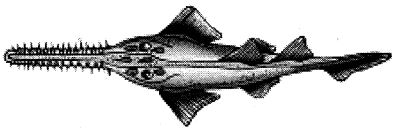
Identify the figure.
A
Scoliodon
B
Salamandra
C
Catla
D
Pristis
Solution
(D) The figure shows a sawfish,which is scientifically known as $Pristis$. It is a cartilaginous fish belonging to the class Chondrichthyes. The characteristic feature of this organism is its long,saw-like rostrum.
0 likes
View Solution82
MediumMCQ
In $Chondrichthyes$,the heart possesses:
A
Two auricles and two ventricles
B
One auricle and one ventricle
C
One auricle and two ventricles
D
Two auricles and one ventricle
Solution
(B) The class $Chondrichthyes$ (cartilaginous fishes) possesses a $2$-chambered heart.
This heart consists of one auricle (atrium) and one ventricle.
It is a venous heart,meaning it pumps only deoxygenated blood to the gills for oxygenation.
This heart consists of one auricle (atrium) and one ventricle.
It is a venous heart,meaning it pumps only deoxygenated blood to the gills for oxygenation.
0 likes
View Solution83
MediumMCQ
In males,pelvic fins bear claspers in:
A
Pristis
B
Petromyzon
C
Hagfish
D
Lamprey
Solution
(A) Claspers are specialized copulatory organs found in the pelvic fins of male cartilaginous fishes (Chondrichthyes).
Among the given options,$Pristis$ (Sawfish) belongs to the class Chondrichthyes.
$Petromyzon$ (Lamprey) and Hagfish belong to the class Cyclostomata,which lack paired fins and claspers.
Therefore,the correct answer is $Pristis$.
Among the given options,$Pristis$ (Sawfish) belongs to the class Chondrichthyes.
$Petromyzon$ (Lamprey) and Hagfish belong to the class Cyclostomata,which lack paired fins and claspers.
Therefore,the correct answer is $Pristis$.
0 likes
View Solution84
MediumMCQ
Which of the following characteristic features always holds true for the corresponding group of animals?
A
Possess a mouth with an upper and a lower jaw - Chordata
B
$3-$chambered heart with one incompletely divided ventricle - Reptilia
C
Cartilaginous endoskeleton - Chondrichthyes
D
Viviparous - Mammalia
Solution
(C) Let us analyze each option:
$A$: Chordata includes Agnatha (jawless vertebrates like lampreys),so this is not true for all chordates.
$B$: Reptiles like crocodiles have a $4$-chambered heart,so this is not true for all reptiles.
$C$: Chondrichthyes are characterized by a cartilaginous endoskeleton,which is a defining feature of this class.
$D$: While most mammals are viviparous,monotremes (like the platypus) are oviparous,so this is not true for all mammals.
Therefore,the correct option is $C$.
$A$: Chordata includes Agnatha (jawless vertebrates like lampreys),so this is not true for all chordates.
$B$: Reptiles like crocodiles have a $4$-chambered heart,so this is not true for all reptiles.
$C$: Chondrichthyes are characterized by a cartilaginous endoskeleton,which is a defining feature of this class.
$D$: While most mammals are viviparous,monotremes (like the platypus) are oviparous,so this is not true for all mammals.
Therefore,the correct option is $C$.
0 likes
View Solution85
DifficultMCQ
Which of the following features is used to identify the sex of the given animal?
A
Female Ascaris - Posterior end is curved.
B
Male Frog - Copulatory pad on the first digit of the hind limb.
C
Female Cockroach - Anal styles.
D
Male Shark - Claspers on the pelvic fins.
Solution
(D) $1$. In $Ascaris$ (roundworm),the male is smaller than the female and has a curved posterior end,while the female is longer and has a straight posterior end. Thus,option $A$ is incorrect.
$2$. In frogs,the male can be identified by the presence of a copulatory pad (nuptial pad) on the first digit of the forelimb (not hind limb). Thus,option $B$ is incorrect.
$3$. In cockroaches,the male possesses anal styles,while the female does not. Thus,option $C$ is incorrect.
$4$. In male sharks (cartilaginous fish),the pelvic fins bear specialized copulatory organs called claspers,which are used to transfer sperm to the female. This is a correct diagnostic feature for identifying the sex of a shark. Thus,option $D$ is correct.
$2$. In frogs,the male can be identified by the presence of a copulatory pad (nuptial pad) on the first digit of the forelimb (not hind limb). Thus,option $B$ is incorrect.
$3$. In cockroaches,the male possesses anal styles,while the female does not. Thus,option $C$ is incorrect.
$4$. In male sharks (cartilaginous fish),the pelvic fins bear specialized copulatory organs called claspers,which are used to transfer sperm to the female. This is a correct diagnostic feature for identifying the sex of a shark. Thus,option $D$ is correct.
0 likes
View Solution86
MediumMCQ
Which of the following animal groups correctly matches its characteristic without any exceptions?
A
Reptiles - Three-chambered heart,with an incompletely divided ventricle
B
Chordates - Mouth with upper and lower jaws
C
Chondrichthyes - Cartilaginous endoskeleton
D
Mammals - Give birth to young ones
Solution
(C) Let's analyze the options:
$A$. Reptiles: Most reptiles have a three-chambered heart,but crocodiles have a four-chambered heart. Thus,this is not an exception-free statement.
$B$. Chordates: Not all chordates have jaws (e.g.,Agnatha are jawless vertebrates). Thus,this is incorrect.
$C$. Chondrichthyes: This class is defined by having a cartilaginous endoskeleton. This is a universal characteristic for all members of this class.
$D$. Mammals: While most mammals are viviparous,monotremes (like the platypus) are oviparous (egg-laying). Thus,this is not an exception-free statement.
Therefore,the correct option is $C$.
$A$. Reptiles: Most reptiles have a three-chambered heart,but crocodiles have a four-chambered heart. Thus,this is not an exception-free statement.
$B$. Chordates: Not all chordates have jaws (e.g.,Agnatha are jawless vertebrates). Thus,this is incorrect.
$C$. Chondrichthyes: This class is defined by having a cartilaginous endoskeleton. This is a universal characteristic for all members of this class.
$D$. Mammals: While most mammals are viviparous,monotremes (like the platypus) are oviparous (egg-laying). Thus,this is not an exception-free statement.
Therefore,the correct option is $C$.
0 likes
View Solution87
MediumMCQ
Which of the following marine cartilaginous fishes produces an electric current?
A
Pristis
B
Torpedo
C
Trygon
D
Scoliodon
Solution
(B) The cartilaginous fish $Torpedo$,commonly known as the electric ray,possesses specialized electric organs derived from modified muscle tissue. These organs are capable of generating a powerful electric discharge used for both defense and capturing prey. $Pristis$ is the sawfish,$Trygon$ is the stingray,and $Scoliodon$ is the dogfish shark; none of these produce electric currents.
0 likes
View Solution88
Medium
Write the characteristics of class $Chondrichthyes$.
Solution
(N/A) The class $Chondrichthyes$ (cartilaginous fishes) exhibits the following characteristics:
$1$. They are marine animals with a streamlined body and have a cartilaginous endoskeleton.
$2$. The mouth is located ventrally.
$3$. Notochord is persistent throughout life.
$4$. Gill slits are separate and without an operculum (gill cover).
$5$. The skin is tough,containing minute placoid scales.
$6$. Teeth are modified placoid scales which are backwardly directed.
$7$. Their jaws are very powerful.
$8$. Due to the absence of an air bladder,they have to swim constantly to avoid sinking.
$9$. The heart is two-chambered (one auricle and one ventricle).
$10$. Some of them have electric organs (e.g.,$Torpedo$) and some possess poison stings (e.g.,$Trygon$).
$11$. They are cold-blooded (poikilothermous) animals.
$12$. Sexes are separate. In males,pelvic fins bear claspers.
$13$. Fertilization is internal and many of them are viviparous.
$1$. They are marine animals with a streamlined body and have a cartilaginous endoskeleton.
$2$. The mouth is located ventrally.
$3$. Notochord is persistent throughout life.
$4$. Gill slits are separate and without an operculum (gill cover).
$5$. The skin is tough,containing minute placoid scales.
$6$. Teeth are modified placoid scales which are backwardly directed.
$7$. Their jaws are very powerful.
$8$. Due to the absence of an air bladder,they have to swim constantly to avoid sinking.
$9$. The heart is two-chambered (one auricle and one ventricle).
$10$. Some of them have electric organs (e.g.,$Torpedo$) and some possess poison stings (e.g.,$Trygon$).
$11$. They are cold-blooded (poikilothermous) animals.
$12$. Sexes are separate. In males,pelvic fins bear claspers.
$13$. Fertilization is internal and many of them are viviparous.
0 likes
View Solution89
MediumMCQ
State the adaptive features of the class $Chondrichthyes$.
A
Presence of air bladder
B
Presence of placoid scales and lack of air bladder
C
Presence of operculum
D
Presence of bony endoskeleton
Solution
(B) The adaptive features of $Chondrichthyes$ are as follows:
$1$. They are cartilaginous fishes with a streamlined body.
$2$. They lack an air bladder,which is why they must swim constantly to avoid sinking.
$3$. They possess placoid scales and their jaws are very powerful.
$4$. Some members possess electric organs (e.g.,$Torpedo$) or poison stings (e.g.,$Trygon$).
$1$. They are cartilaginous fishes with a streamlined body.
$2$. They lack an air bladder,which is why they must swim constantly to avoid sinking.
$3$. They possess placoid scales and their jaws are very powerful.
$4$. Some members possess electric organs (e.g.,$Torpedo$) or poison stings (e.g.,$Trygon$).
0 likes
View Solution90
Medium
Describe class - Chondrichthyes.
Solution
(N/A) $\rightarrow$ Chondrichthyes are marine animals with a streamlined body and a cartilaginous endoskeleton.
$\rightarrow$ The mouth is located ventrally.
$\rightarrow$ The notochord is persistent throughout life.
$\rightarrow$ Gill slits are separate and without an operculum (gill cover).
$\rightarrow$ The skin is tough, containing minute placoid scales.
$\rightarrow$ Teeth are modified placoid scales which are backwardly directed.
$\rightarrow$ Their jaws are very powerful.
$\rightarrow$ These animals are predaceous.
$\rightarrow$ Due to the absence of an air bladder, they have to swim constantly to avoid sinking.
$\rightarrow$ The heart is two-chambered (one auricle and one ventricle).
$\rightarrow$ Some of them have electric organs (e.g., Torpedo) and some possess a poison sting (e.g., Trygon).
$\rightarrow$ They are cold-blooded (poikilothermous) animals, i.e., they lack the capacity to regulate their body temperature.
$\rightarrow$ Sexes are separate.
$\rightarrow$ In males, pelvic fins bear claspers.
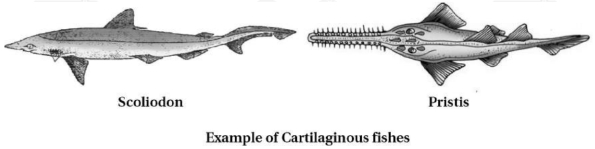
$\rightarrow$ Examples: Scoliodon (Dog fish), Pristis (Saw fish), Carcharodon (Great white shark), Trygon (Sting ray).
$\rightarrow$ The mouth is located ventrally.
$\rightarrow$ The notochord is persistent throughout life.
$\rightarrow$ Gill slits are separate and without an operculum (gill cover).
$\rightarrow$ The skin is tough, containing minute placoid scales.
$\rightarrow$ Teeth are modified placoid scales which are backwardly directed.
$\rightarrow$ Their jaws are very powerful.
$\rightarrow$ These animals are predaceous.
$\rightarrow$ Due to the absence of an air bladder, they have to swim constantly to avoid sinking.
$\rightarrow$ The heart is two-chambered (one auricle and one ventricle).
$\rightarrow$ Some of them have electric organs (e.g., Torpedo) and some possess a poison sting (e.g., Trygon).
$\rightarrow$ They are cold-blooded (poikilothermous) animals, i.e., they lack the capacity to regulate their body temperature.
$\rightarrow$ Sexes are separate.
$\rightarrow$ In males, pelvic fins bear claspers.
$\rightarrow$ Examples: Scoliodon (Dog fish), Pristis (Saw fish), Carcharodon (Great white shark), Trygon (Sting ray).
0 likes
View Solution91
MediumMCQ
Which fish,caught in South Africa in $1938$,was thought to be extinct?
A
Coelacanth
B
Catla
C
Rohu
D
Shark
Solution
(A) The $Coelacanth$ is a lobe-finned fish that was believed to have gone extinct approximately $65$ million years ago. However,in $1938$,a living specimen was caught off the coast of South Africa. This discovery provided significant evidence for the evolutionary transition from aquatic to terrestrial life,as $Coelacanths$ are considered to be the ancestors of amphibians.
0 likes
View Solution92
MediumMCQ
Choose the correct option with regards to $Chondrichthyes$.
A
Presence of swim bladders that help them to maintain buoyancy.
B
These are usually ammoniotelic animals.
C
Statement $(a)$ is true,but $(b)$ is false.
D
Both statements $(a)$ and $(b)$ are false.
Solution
(D) $Chondrichthyes$ lack swim bladders,which help in maintaining buoyancy; therefore,they must swim constantly to avoid sinking.
$Chondrichthyes$ are ureotelic animals,meaning they excrete urea as their primary nitrogenous waste.
Since both statements $(a)$ and $(b)$ are incorrect,the correct option is $(d)$.
$Chondrichthyes$ are ureotelic animals,meaning they excrete urea as their primary nitrogenous waste.
Since both statements $(a)$ and $(b)$ are incorrect,the correct option is $(d)$.
0 likes
View Solution93
MediumMCQ
Teeth in $Chondrichthyes$ are modified:
A
Placoid scales
B
Cycloid scales
C
Ctenoid scales
D
Rhomboid scales
Solution
(A) $Chondrichthyes$ are cartilaginous fishes.
In $Chondrichthyes$,teeth are modified placoid scales which are backwardly directed.
In $Chondrichthyes$,teeth are modified placoid scales which are backwardly directed.
0 likes
View Solution94
EasyMCQ
Which fish has an electric organ?
A
Torpedo
B
Pristis
C
Trygon
D
Carcharodon
Solution
(A) Torpedo (electric ray) is a carnivorous fish. It stuns or kills its prey with an electric shock generated by its specialized electric organs. These electric organs are modified muscles that can produce an electric discharge ranging from $8$ volts to $220$ volts.
0 likes
View Solution95
MediumMCQ
Which type of scales are found on the skin of cartilaginous fishes?
A
Ganoid
B
Placoid
C
Ctenoid
D
Cycloid
Solution
(B) Cartilaginous fishes (class $Chondrichthyes$) possess $Placoid$ scales on their skin,which are backwardly directed.
In contrast,$Cycloid$,$Ctenoid$,and $Ganoid$ scales are typically observed in bony fishes (class $Osteichthyes$).
In contrast,$Cycloid$,$Ctenoid$,and $Ganoid$ scales are typically observed in bony fishes (class $Osteichthyes$).
0 likes
View Solution96
EasyMCQ
Ampullae of Lorenzini are thermoreceptors which are found in
A
Fishes
B
Man
C
Reptiles
D
Bats
Solution
(A) Ampullae of Lorenzini are specialized sensory organs found in cartilaginous fishes,such as sharks and rays. They are located in the snout and act as electroreceptors and thermoreceptors,allowing these animals to detect changes in temperature and weak electric fields in their aquatic environment.
0 likes
View Solution97
MediumMCQ
In $Torpedo$ (electric ray),electric organs are present as modified musculature between:
A
Nostrils and mouth
B
Pectoral and caudal fin
C
Gills and eyes
D
Eyes and nostrils
Solution
(C) In $Torpedo$ (electric ray),the electric organs are specialized structures derived from modified branchial muscles. These organs are located on the dorsal side of the head,specifically positioned between the gills and the eyes.
0 likes
View Solution98
MediumMCQ
Which of the following statements are not true about shark?
$a$. The skin is tough and covered with placoid scales
$b$. They possess a swim bladder which regulates buoyancy
$c$. The tail of shark is heterocercal
$d$. Ampulla of Lorenzini present in the snout of shark is a thermoreceptor.
$e$. It has five pairs of gill slits covered by operculum
$a$. The skin is tough and covered with placoid scales
$b$. They possess a swim bladder which regulates buoyancy
$c$. The tail of shark is heterocercal
$d$. Ampulla of Lorenzini present in the snout of shark is a thermoreceptor.
$e$. It has five pairs of gill slits covered by operculum
A
$a, c, d, e$
B
$b, c, d, e$
C
$b$ and $e$ only
D
$c$ and $e$ only
Solution
(C) Sharks belong to the class $Chondrichthyes$ (cartilaginous fishes).
$a$. The skin is tough and covered with placoid scales: This is true.
$b$. They possess a swim bladder which regulates buoyancy: This is false. Cartilaginous fishes lack a swim bladder,which is why they must swim continuously to avoid sinking.
$c$. The tail of shark is heterocercal: This is true.
$d$. Ampulla of Lorenzini present in the snout of shark is a thermoreceptor: This is true. These organs are sensitive to temperature and electrical fields.
$e$. It has five pairs of gill slits covered by operculum: This is false. In $Chondrichthyes$,gill slits are separate and without an operculum (gill cover).
Therefore,statements $b$ and $e$ are not true.
$a$. The skin is tough and covered with placoid scales: This is true.
$b$. They possess a swim bladder which regulates buoyancy: This is false. Cartilaginous fishes lack a swim bladder,which is why they must swim continuously to avoid sinking.
$c$. The tail of shark is heterocercal: This is true.
$d$. Ampulla of Lorenzini present in the snout of shark is a thermoreceptor: This is true. These organs are sensitive to temperature and electrical fields.
$e$. It has five pairs of gill slits covered by operculum: This is false. In $Chondrichthyes$,gill slits are separate and without an operculum (gill cover).
Therefore,statements $b$ and $e$ are not true.
0 likes
View Solution99
MediumMCQ
Which of the following statements are not true?
$a$. Dermal scales of fishes form the exoskeleton.
$b$. Cycloid and ctenoid scales have distinct lines of growth which aid in determining the age of the fish.
$c$. Fish scales are never shed.
$d$. The skin in elasmobranchs is covered with placoid scales.
$e$. The development of a placoid scale is not like the development of a tooth.
$a$. Dermal scales of fishes form the exoskeleton.
$b$. Cycloid and ctenoid scales have distinct lines of growth which aid in determining the age of the fish.
$c$. Fish scales are never shed.
$d$. The skin in elasmobranchs is covered with placoid scales.
$e$. The development of a placoid scale is not like the development of a tooth.
A
$a, b, c$ and $e$
B
$b, c$ and $e$
C
$c, d$ and $e$
D
Only $e$
Solution
(B) Statement $a$ is true: Dermal scales in fishes form the exoskeleton.
Statement $b$ is true: Cycloid and ctenoid scales exhibit growth rings (circuli) that help in age determination.
Statement $c$ is false: Some fish species do shed their scales,or scales may be lost due to injury and regenerated.
Statement $d$ is true: Elasmobranchs (cartilaginous fishes) possess placoid scales.
Statement $e$ is false: The development of a placoid scale is structurally and developmentally similar to that of a vertebrate tooth,as both consist of a pulp cavity,dentine,and an enamel-like covering (vitrodentine).
Statement $b$ is true: Cycloid and ctenoid scales exhibit growth rings (circuli) that help in age determination.
Statement $c$ is false: Some fish species do shed their scales,or scales may be lost due to injury and regenerated.
Statement $d$ is true: Elasmobranchs (cartilaginous fishes) possess placoid scales.
Statement $e$ is false: The development of a placoid scale is structurally and developmentally similar to that of a vertebrate tooth,as both consist of a pulp cavity,dentine,and an enamel-like covering (vitrodentine).
0 likes
View Solution100
MediumMCQ
Teeth are modified . . . . . . scales which are backwardly directed.
A
Ctenoid
B
Cycloid
C
Placoid
D
Ganoid
Solution
(C) In cartilaginous fishes (Chondrichthyes),placoid scales are modified into teeth which are backwardly directed.
0 likes
View SolutionAnimal Kingdom — Class - Chondrichthyes · Frequently Asked Questions
1Are these Animal Kingdom questions useful for JEE and NEET?
Yes. All questions in this section are mapped to JEE Main and NEET exam patterns. Previous year questions from JEE Main, NEET, GUJCET and state-level exams are included with full solutions.
2Can I switch to Hindi or Gujarati for these questions?
Yes. Use the language tabs in the hero section or the sidebar to view the same questions and solutions in English, Hindi or Gujarati.
3How do I generate a question paper from this subtopic?
Use the Vedclass Exam Paper Generator — select the chapter and subtopic, set difficulty, and generate Sets A, B, C, D automatically. First 3 chapters of every subject are free.
Vedclass Products
For Students
Vedclass Test Series
Mock tests in real JEE/NEET style with performance analysis. 5-day free trial.
Start Free TrialFor Teachers
Exam Paper Generator
Generate Set A/B/C/D papers from this chapter in 2 minutes. 3 chapters free.
Try FreeFor Institutes
Online Exam Module
Live online exams with unlimited students, 360° analytics & white-label branding.
See DemoFor Teachers & Institutes
Generate a Animal Kingdom Exam Paper in 2 Minutes
Select subtopic & difficulty — Sets A, B, C, D auto-generated with No Repeat logic.
First 3 chapters of every subject are free — no payment required.