
A English
Basic of classification Questions in English
Class 11 Biology · Animal Kingdom · Basic of classification
160+
Questions
English
Language
100%
With Solutions
Showing 50 of 160 questions in English
101
Difficult
What are the difficulties that you would face in the classification of animals if common fundamental features are not taken into account?
Solution
(N/A) The classification of living organisms relies on identifying common fundamental characteristics to group them systematically.
If common fundamental features are ignored and only specific or unique characteristics are considered,every organism would likely be placed in a separate group,making the classification system impractical and overly complex.
The primary objective of classification is to simplify the study of diverse life forms and understand their evolutionary relationships.
By focusing on shared traits such as the level of organization,symmetry,diploblastic or triploblastic nature,coelom,and segmentation,we can establish a hierarchy that reflects biological relationships.
Without these common features,it would be impossible to compare different organisms or determine their evolutionary significance,thereby defeating the entire purpose of biological classification.
If common fundamental features are ignored and only specific or unique characteristics are considered,every organism would likely be placed in a separate group,making the classification system impractical and overly complex.
The primary objective of classification is to simplify the study of diverse life forms and understand their evolutionary relationships.
By focusing on shared traits such as the level of organization,symmetry,diploblastic or triploblastic nature,coelom,and segmentation,we can establish a hierarchy that reflects biological relationships.
Without these common features,it would be impossible to compare different organisms or determine their evolutionary significance,thereby defeating the entire purpose of biological classification.
0 likes
View Solution102
Medium
If you are given a specimen,what are the steps that you would follow to classify it?
Solution
(N/A) To classify a specimen,we observe its fundamental biological features. The following steps are used for classification:
$(i)$ Level of organization: Determine if it is at the $\text{cellular}$,$\text{tissue}$,or $\text{organ}$ level.
$(ii)$ Body symmetry: Check if the organism exhibits $\text{radial}$ or $\text{bilateral}$ symmetry.
$(iii)$ Germ layers: Identify if it is $\text{diploblastic}$ or $\text{triploblastic}$.
$(iv)$ Body cavity (Coelom): Determine if the coelom is $\text{absent}$ $(\text{acoelomate})$,$\text{pseudocoelomate}$,or a $\text{true coelom}$ $(\text{eucoelomate})$.
$(v)$ Segmentation: Check for the presence or absence of $\text{metameric segmentation}$.
$(vi)$ Notochord: Check for the presence or absence of a $\text{notochord}$ to distinguish between $\text{non-chordates}$ and $\text{chordates}$.
By systematically evaluating these features,one can classify the specimen into its respective phylum.
$(i)$ Level of organization: Determine if it is at the $\text{cellular}$,$\text{tissue}$,or $\text{organ}$ level.
$(ii)$ Body symmetry: Check if the organism exhibits $\text{radial}$ or $\text{bilateral}$ symmetry.
$(iii)$ Germ layers: Identify if it is $\text{diploblastic}$ or $\text{triploblastic}$.
$(iv)$ Body cavity (Coelom): Determine if the coelom is $\text{absent}$ $(\text{acoelomate})$,$\text{pseudocoelomate}$,or a $\text{true coelom}$ $(\text{eucoelomate})$.
$(v)$ Segmentation: Check for the presence or absence of $\text{metameric segmentation}$.
$(vi)$ Notochord: Check for the presence or absence of a $\text{notochord}$ to distinguish between $\text{non-chordates}$ and $\text{chordates}$.
By systematically evaluating these features,one can classify the specimen into its respective phylum.
0 likes
View Solution103
Difficult
How useful is the study of the nature of body cavity and coelom in the classification of animals?
Solution
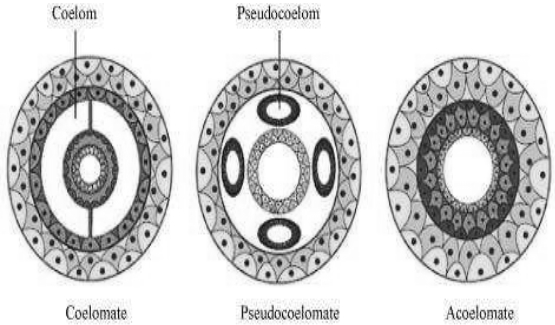
(N/A) Coelom is a fluid-filled space between the body wall and the digestive tract. The presence or absence of a body cavity or coelom plays a very important role in the classification of animals.
$1$. Coelomates: Animals that possess a fluid-filled cavity lined by mesoderm between the body wall and the digestive tract are known as coelomates. Examples include Annelida,Mollusca,Arthropoda,Echinodermata,and Chordata.
$2$. Pseudocoelomates: Animals in which the body cavity is not lined by mesoderm,but instead,the mesoderm is present as scattered pouches in between the ectoderm and endoderm,are known as pseudocoelomates. Aschelminthes is an example of this.
$3$. Acoelomates: In certain animals,the body cavity is completely absent. These are known as acoelomates. An example of acoelomates is Platyhelminthes.
$1$. Coelomates: Animals that possess a fluid-filled cavity lined by mesoderm between the body wall and the digestive tract are known as coelomates. Examples include Annelida,Mollusca,Arthropoda,Echinodermata,and Chordata.
$2$. Pseudocoelomates: Animals in which the body cavity is not lined by mesoderm,but instead,the mesoderm is present as scattered pouches in between the ectoderm and endoderm,are known as pseudocoelomates. Aschelminthes is an example of this.
$3$. Acoelomates: In certain animals,the body cavity is completely absent. These are known as acoelomates. An example of acoelomates is Platyhelminthes.
0 likes
View Solution104
Medium
What is the difference between direct and indirect development?
Solution
(N/A)
| Direct development | Indirect development |
|---|---|
| $(1)$ It is a type of development in which an embryo develops into a mature individual without involving a larval stage. | $(1)$ It is a type of development that involves a sexually-immature larval stage,having different food requirements than adults. |
| $(2)$ Metamorphosis is absent. | $(2)$ Metamorphosis involving development of larva to a sexually mature adult is present. |
| $(3)$ It occurs in fishes,reptiles,birds,and mammals. | $(3)$ It occurs in most of the invertebrates and amphibians. |
0 likes
View Solution105
Easy
Why is there a need for classification,and what are the bases of classification?
Solution
(N/A) $\rightarrow$ There are millions of animal species with diverse structures and forms.
$\rightarrow$ Since over a million species have been described so far,classification is essential to organize and study them systematically.
$\rightarrow$ Classification helps in assigning a systematic position to newly discovered species.
$\rightarrow$ The fundamental bases of animal classification include:
$1$. Arrangement of cells.
$2$. Body symmetry.
$3$. Nature of coelom (body cavity).
$4$. Patterns of digestive,circulatory,and reproductive systems.
$5$. Notochord presence or absence.
$\rightarrow$ Since over a million species have been described so far,classification is essential to organize and study them systematically.
$\rightarrow$ Classification helps in assigning a systematic position to newly discovered species.
$\rightarrow$ The fundamental bases of animal classification include:
$1$. Arrangement of cells.
$2$. Body symmetry.
$3$. Nature of coelom (body cavity).
$4$. Patterns of digestive,circulatory,and reproductive systems.
$5$. Notochord presence or absence.
0 likes
View Solution106
Medium
Discuss the various levels of organization in the animal kingdom.
Solution
(N/A) $\rightarrow$ All members of $Animalia$ are multicellular,heterotrophic eukaryotes.
$\rightarrow$ However,they do not all exhibit the same pattern of cellular organization.
$\rightarrow$ The cells in their bodies are of several types and are organized into functional units of increasing complexity.
$\rightarrow$ The animal body shows four basic levels of structural organization:
$(1)$ Cellular Level:
$\rightarrow$ In this level,the body shows some division of labor among cells.
$\rightarrow$ It is found in sponges $(Porifera)$.
$\rightarrow$ The body consists of many cells arranged as loose cell aggregates,but the cells do not form tissues.
$(2)$ Tissue Level Organization:
$\rightarrow$ In coelenterates $(Cnidaria)$,the arrangement of cells is more complex.
$\rightarrow$ Cells performing the same function are arranged into tissues; hence,it is called the tissue level of organization.
$(3)$ Organ Level:
$\rightarrow$ In $Platyhelminthes$ and other higher phyla,tissues are grouped together to form organs,each specialized for a particular function.
$(4)$ Organ System Level:
$\rightarrow$ In animals like annelids,arthropods,molluscs,echinoderms,and chordates,organs have associated to form functional systems,each concerned with a specific physiological function.
$\rightarrow$ This pattern is called the organ system level of organization,which exhibits various patterns of complexity across different animal groups.
$\rightarrow$ However,they do not all exhibit the same pattern of cellular organization.
$\rightarrow$ The cells in their bodies are of several types and are organized into functional units of increasing complexity.
$\rightarrow$ The animal body shows four basic levels of structural organization:
$(1)$ Cellular Level:
$\rightarrow$ In this level,the body shows some division of labor among cells.
$\rightarrow$ It is found in sponges $(Porifera)$.
$\rightarrow$ The body consists of many cells arranged as loose cell aggregates,but the cells do not form tissues.
$(2)$ Tissue Level Organization:
$\rightarrow$ In coelenterates $(Cnidaria)$,the arrangement of cells is more complex.
$\rightarrow$ Cells performing the same function are arranged into tissues; hence,it is called the tissue level of organization.
$(3)$ Organ Level:
$\rightarrow$ In $Platyhelminthes$ and other higher phyla,tissues are grouped together to form organs,each specialized for a particular function.
$(4)$ Organ System Level:
$\rightarrow$ In animals like annelids,arthropods,molluscs,echinoderms,and chordates,organs have associated to form functional systems,each concerned with a specific physiological function.
$\rightarrow$ This pattern is called the organ system level of organization,which exhibits various patterns of complexity across different animal groups.
0 likes
View Solution107
Easy
Write a short note on Symmetry.
Solution
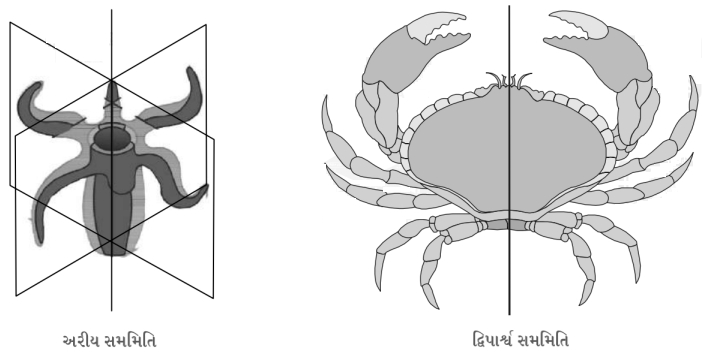
(N/A) Symmetry refers to the arrangement of body parts in relation to the central axis of an organism. Based on symmetry,animals can be categorized into three main types:
$1$. Asymmetrical: Animals cannot be divided into two equal halves by any plane passing through the center (e.g.,Sponges).
$2$. Radial Symmetry: When any plane passing through the central axis of the body divides the organism into two identical halves,it is called radial symmetry (e.g.,Coelenterates,Ctenophores,and Echinoderms).
$3$. Bilateral Symmetry: When the body can be divided into identical left and right halves in only one plane,it is called bilateral symmetry (e.g.,Annelids,Arthropods,etc.).
$1$. Asymmetrical: Animals cannot be divided into two equal halves by any plane passing through the center (e.g.,Sponges).
$2$. Radial Symmetry: When any plane passing through the central axis of the body divides the organism into two identical halves,it is called radial symmetry (e.g.,Coelenterates,Ctenophores,and Echinoderms).
$3$. Bilateral Symmetry: When the body can be divided into identical left and right halves in only one plane,it is called bilateral symmetry (e.g.,Annelids,Arthropods,etc.).
0 likes
View Solution108
Easy
Describe the different types of symmetry observed in the animal kingdom.
Solution
(N/A) Symmetry in animals refers to the arrangement of body parts around a central axis or plane. It is classified into three main types:
$1$. Asymmetry: Animals are considered asymmetrical if any plane passing through the center of the body does not divide them into two equal halves. Example: $Sponges$.
$2$. Radial Symmetry: When any plane passing through the central axis of the body divides the organism into two identical halves, it is called radial symmetry. This is common in coelenterates, ctenophores, and echinoderms. Example: $Hydra$, $Starfish$.
$3$. Bilateral Symmetry: When the body can be divided into identical left and right halves only through a single plane, it is called bilateral symmetry. This is observed in annelids, arthropods, and chordates. Example: $Humans$, $Earthworm$.
$1$. Asymmetry: Animals are considered asymmetrical if any plane passing through the center of the body does not divide them into two equal halves. Example: $Sponges$.
$2$. Radial Symmetry: When any plane passing through the central axis of the body divides the organism into two identical halves, it is called radial symmetry. This is common in coelenterates, ctenophores, and echinoderms. Example: $Hydra$, $Starfish$.
$3$. Bilateral Symmetry: When the body can be divided into identical left and right halves only through a single plane, it is called bilateral symmetry. This is observed in annelids, arthropods, and chordates. Example: $Humans$, $Earthworm$.
0 likes
View Solution109
Medium
Explain the organisation of embryonic layers in animals.
Solution
(N/A) Animals can be classified based on the number of germinal layers present during their embryonic development:
$1$. Diploblastic Animals: Animals in which the cells are arranged in two embryonic layers, an external $ \text{ectoderm} $ and an internal $ \text{endoderm} $. An undifferentiated layer called $ \text{mesoglea} $ is present in between the $ \text{ectoderm} $ and the $ \text{endoderm} $. Examples include $ \text{Cnidarians} $.
$2$. Triploblastic Animals: Animals in which the developing embryo has a third germinal layer, the $ \text{mesoderm} $, in addition to the $ \text{ectoderm} $ and $ \text{endoderm} $. Examples include animals from $ \text{Platyhelminthes} $ to $ \text{Chordates} $.
$1$. Diploblastic Animals: Animals in which the cells are arranged in two embryonic layers, an external $ \text{ectoderm} $ and an internal $ \text{endoderm} $. An undifferentiated layer called $ \text{mesoglea} $ is present in between the $ \text{ectoderm} $ and the $ \text{endoderm} $. Examples include $ \text{Cnidarians} $.
$2$. Triploblastic Animals: Animals in which the developing embryo has a third germinal layer, the $ \text{mesoderm} $, in addition to the $ \text{ectoderm} $ and $ \text{endoderm} $. Examples include animals from $ \text{Platyhelminthes} $ to $ \text{Chordates} $.
0 likes
View Solution110
Medium
Explain: Coelom.
Solution
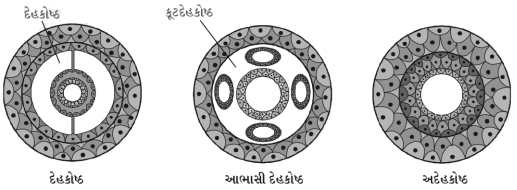
(N/A) The body cavity,which is lined by mesoderm,is called the coelom. Animals possessing a coelom are called coelomates (e.g.,annelids,molluscs,arthropods,echinoderms,hemichordates,and chordates).
In some animals,the body cavity is not lined by mesoderm; instead,the mesoderm is present as scattered pouches in between the ectoderm and endoderm. Such a body cavity is called a pseudocoelom,and the animals are called pseudocoelomates (e.g.,Aschelminthes).
The animals in which the body cavity is absent are called acoelomates (e.g.,Platyhelminthes).
In some animals,the body cavity is not lined by mesoderm; instead,the mesoderm is present as scattered pouches in between the ectoderm and endoderm. Such a body cavity is called a pseudocoelom,and the animals are called pseudocoelomates (e.g.,Aschelminthes).
The animals in which the body cavity is absent are called acoelomates (e.g.,Platyhelminthes).
0 likes
View Solution111
Medium
Write a short note on: Coelom.
Solution
(N/A) The $Coelom$ is a body cavity which is lined by the mesoderm.
$1$. Based on the presence or absence of a cavity between the body wall and the gut wall,animals are classified into three types:
$2$. $Acoelomates$: Animals in which the body cavity is absent (e.g.,Platyhelminthes).
$3$. $Pseudocoelomates$: Animals in which the body cavity is not lined by the mesoderm,instead,the mesoderm is present as scattered pouches in between the ectoderm and endoderm (e.g.,Aschelminthes).
$4$. $Eucoelomates$ (True Coelomates): Animals possessing a true body cavity that is lined by the mesoderm on all sides (e.g.,Annelida to Chordata).
$1$. Based on the presence or absence of a cavity between the body wall and the gut wall,animals are classified into three types:
$2$. $Acoelomates$: Animals in which the body cavity is absent (e.g.,Platyhelminthes).
$3$. $Pseudocoelomates$: Animals in which the body cavity is not lined by the mesoderm,instead,the mesoderm is present as scattered pouches in between the ectoderm and endoderm (e.g.,Aschelminthes).
$4$. $Eucoelomates$ (True Coelomates): Animals possessing a true body cavity that is lined by the mesoderm on all sides (e.g.,Annelida to Chordata).
0 likes
View Solution112
Medium
What is coelom? Describe its types.
Solution
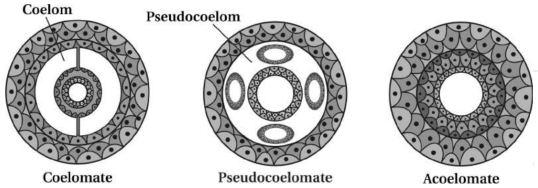
(N/A) The body cavity,which is lined by mesoderm,is called coelom. The presence or absence of coelom is very important in animal classification.
Based on the presence or absence of coelom,animals are classified into three groups:
$1$. Acoelomate: Animals in which the body cavity is absent are called acoelomates. Examples include Porifera,Platyhelminthes,Coelenterata,and Ctenophora.
$2$. Pseudocoelomate: In some animals,the body cavity is not lined by mesoderm. Instead,the mesoderm is present as scattered pouches in between the ectoderm and endoderm. Such a body cavity is called a pseudocoelom,and the animals possessing them are called pseudocoelomates (e.g.,Aschelminthes).
$3$. Coelomate: Animals possessing a true coelom (body cavity lined by mesoderm on all sides) are called coelomates. Examples include Annelida,Mollusca,Arthropoda,Echinodermata,Hemichordata,and Chordata.
Based on the presence or absence of coelom,animals are classified into three groups:
$1$. Acoelomate: Animals in which the body cavity is absent are called acoelomates. Examples include Porifera,Platyhelminthes,Coelenterata,and Ctenophora.
$2$. Pseudocoelomate: In some animals,the body cavity is not lined by mesoderm. Instead,the mesoderm is present as scattered pouches in between the ectoderm and endoderm. Such a body cavity is called a pseudocoelom,and the animals possessing them are called pseudocoelomates (e.g.,Aschelminthes).
$3$. Coelomate: Animals possessing a true coelom (body cavity lined by mesoderm on all sides) are called coelomates. Examples include Annelida,Mollusca,Arthropoda,Echinodermata,Hemichordata,and Chordata.
0 likes
View Solution113
Easy
Explain: Segmentation.
Solution
(N/A) $\rightarrow$ In some animals,the body is externally and internally divided into segments with a serial repetition of at least some organs.
$\rightarrow$ For example,in earthworm,the body shows this pattern called metameric segmentation,and the phenomenon is known as metamerism.
$\rightarrow$ For example,in earthworm,the body shows this pattern called metameric segmentation,and the phenomenon is known as metamerism.
0 likes
View Solution114
Medium
Describe the general characteristics used for the classification of the Kingdom Animalia.
Solution
(N/A) The classification of Kingdom Animalia is based on several fundamental features of animals,which are as follows:
$1$. Levels of Organization: Animals exhibit different levels of organization,such as cellular level,tissue level,organ level,or organ-system level.
$2$. Symmetry: Animals can be asymmetrical,radially symmetrical,or bilaterally symmetrical.
$3$. Diploblastic and Triploblastic Organization: Based on the number of germ layers,animals are classified as diploblastic (two layers: ectoderm and endoderm) or triploblastic (three layers: ectoderm,mesoderm,and endoderm).
$4$. Coelom (Body Cavity): The presence or absence of a cavity between the body wall and the gut wall is crucial. Animals are classified as acoelomates (no body cavity),pseudocoelomates (false body cavity),or coelomates (true body cavity).
$5$. Segmentation: In some animals,the body is externally and internally divided into segments with a serial repetition of at least some organs (metamerism).
$6$. Notochord: The presence or absence of a notochord is a significant feature used to distinguish between non-chordates and chordates.
$1$. Levels of Organization: Animals exhibit different levels of organization,such as cellular level,tissue level,organ level,or organ-system level.
$2$. Symmetry: Animals can be asymmetrical,radially symmetrical,or bilaterally symmetrical.
$3$. Diploblastic and Triploblastic Organization: Based on the number of germ layers,animals are classified as diploblastic (two layers: ectoderm and endoderm) or triploblastic (three layers: ectoderm,mesoderm,and endoderm).
$4$. Coelom (Body Cavity): The presence or absence of a cavity between the body wall and the gut wall is crucial. Animals are classified as acoelomates (no body cavity),pseudocoelomates (false body cavity),or coelomates (true body cavity).
$5$. Segmentation: In some animals,the body is externally and internally divided into segments with a serial repetition of at least some organs (metamerism).
$6$. Notochord: The presence or absence of a notochord is a significant feature used to distinguish between non-chordates and chordates.
0 likes
View Solution115
Medium
Distinguish between intracellular and extracellular digestion.
Solution
(N/A) $\rightarrow$ Intracellular digestion: When food particles are taken into the cell and digestion occurs within the cell,it is called intracellular digestion. Example: Members of Phylum $Porifera$.
$\rightarrow$ Extracellular digestion: When digestion occurs outside the cells,typically within a specialized cavity or lumen where digestive enzymes are secreted,it is called extracellular digestion. Example: Most higher animals including humans.
$\rightarrow$ Extracellular digestion: When digestion occurs outside the cells,typically within a specialized cavity or lumen where digestive enzymes are secreted,it is called extracellular digestion. Example: Most higher animals including humans.
1 likes
View Solution116
MediumMCQ
What is meant by biological symmetry (homogeneity) in the context of animal classification?
A
The arrangement of body parts around a central axis.
B
The presence of a true coelom.
C
The division of the body into segments.
D
The presence of a notochord.
Solution
(A) In the context of animal classification,symmetry refers to the balanced arrangement of body parts on either side of a plane or around a central axis.
Animals can be asymmetrical (no symmetry),radially symmetrical (body parts arranged around a central axis),or bilaterally symmetrical (body parts arranged in two identical halves along a single plane).
This is a fundamental criterion for classifying animals into different phyla.
Animals can be asymmetrical (no symmetry),radially symmetrical (body parts arranged around a central axis),or bilaterally symmetrical (body parts arranged in two identical halves along a single plane).
This is a fundamental criterion for classifying animals into different phyla.
0 likes
View Solution117
Medium
Define the following terms:
$(i)$ Incomplete digestive tract
$(ii)$ Complete digestive tract
$(i)$ Incomplete digestive tract
$(ii)$ Complete digestive tract
Solution
(N/A) $(i)$ An incomplete digestive tract is one that has only a single opening to the outside of the body that serves as both mouth and anus.
$(ii)$ $A$ complete digestive tract is one that has two openings,a mouth at the anterior end and an anus at the posterior end.
$(ii)$ $A$ complete digestive tract is one that has two openings,a mouth at the anterior end and an anus at the posterior end.
0 likes
View Solution118
Medium
Define the following terms:
$(i)$ Asymmetrical
$(ii)$ Radial symmetry
$(i)$ Asymmetrical
$(ii)$ Radial symmetry
Solution
(N/A) $(i)$ Asymmetrical: When any plane that passes through the center of the body does not divide it into two equal halves,it is called asymmetrical. Example: Sponges.
$(ii)$ Radial symmetry: When any plane passing through the central axis of the body divides the organism into two identical halves,it is called radial symmetry. Example: Coelenterates,Ctenophores,and Echinoderms.
$(ii)$ Radial symmetry: When any plane passing through the central axis of the body divides the organism into two identical halves,it is called radial symmetry. Example: Coelenterates,Ctenophores,and Echinoderms.
0 likes
View Solution119
Easy
Define the following terms:
$(i)$ Bilateral symmetry
$(ii)$ Diploblastic
$(i)$ Bilateral symmetry
$(ii)$ Diploblastic
Solution
(N/A) $(i)$ Bilateral symmetry: It is a type of body organization in which the body can be divided into identical left and right halves only in one plane.
$(ii)$ Diploblastic: Animals in which the cells are arranged in two embryonic layers,an external ectoderm and an internal endoderm,are called diploblastic animals. In addition,an undifferentiated layer called mesoglea is present between the ectoderm and the endoderm,e.g.,$Coelenterates$.
$(ii)$ Diploblastic: Animals in which the cells are arranged in two embryonic layers,an external ectoderm and an internal endoderm,are called diploblastic animals. In addition,an undifferentiated layer called mesoglea is present between the ectoderm and the endoderm,e.g.,$Coelenterates$.
0 likes
View Solution120
Medium
Define the following terms:
$(i)$ Triploblastic
$(ii)$ Coelom
$(i)$ Triploblastic
$(ii)$ Coelom
Solution
(N/A) $(i)$ Triploblastic: Animals in which the developing embryo has a third germinal layer,the mesoderm,present between the ectoderm and endoderm are called triploblastic animals. Examples include all animals from phylum Platyhelminthes to phylum Chordata.
$(ii)$ Coelom: The body cavity which is lined by mesoderm is called coelom. Animals possessing coelom are called coelomates (e.g.,Annelids,Molluscs,Arthropods,Echinoderms,Hemichordates,and Chordates).
$(ii)$ Coelom: The body cavity which is lined by mesoderm is called coelom. Animals possessing coelom are called coelomates (e.g.,Annelids,Molluscs,Arthropods,Echinoderms,Hemichordates,and Chordates).
0 likes
View Solution121
Medium
Differentiate between: Acoelomate and Pseudocoelomate.
Solution
(N/A)
| Acoelomate | Pseudocoelomate |
|---|---|
| $(1)$ Animals without a coelom are called acoelomates. | $(1)$ Animals that possess a false coelom. |
| $(2)$ Body cavity is completely absent. | $(2)$ Body cavity is not lined by mesoderm; instead,the mesoderm is present as scattered pouches between the ectoderm and endoderm. |
| $(3)$ Examples include sponges,cnidarians,ctenophores,and flatworms (Platyhelminthes). | $(3)$ Example includes roundworms (Aschelminthes). |
0 likes
View Solution122
Medium
What is the relationship between germinal layers and the formation of the body cavity in the case of coelomates,acoelomates,and pseudocoelomates?
Solution
(N/A) $\rightarrow$ All adult multicellular organisms typically possess a concentric arrangement of tissues in the body. These tissues are derived from embryonic cell layers called germinal layers.
$(i)$ Coelomate: These organisms possess three germinal layers: ectoderm,mesoderm,and endoderm. The body cavity (coelom) is lined by the mesoderm on all sides,resulting in a true coelom.
$(ii)$ Acoelomate: These organisms possess three germinal layers (ectoderm,mesoderm,and endoderm),but the body cavity is completely absent because the space between the body wall and the digestive tract is filled with parenchyma or mesoderm.
$(iii)$ Pseudocoelomate: These organisms possess three germinal layers (ectoderm,mesoderm,and endoderm). However,the mesoderm is present as scattered pouches between the ectoderm and endoderm,and it does not line the body cavity,hence a true coelom is absent.
$\rightarrow$ Examples:
$(i)$ Coelomates: Phylum $Annelida$,$Mollusca$,$Arthropoda$,$Echinodermata$,$Hemichordata$,and $Chordata$.
$(ii)$ Acoelomate: e.g.,$Platyhelminthes$.
$(iii)$ Pseudocoelomate: e.g.,$Ascaris$ (Phylum $Aschelminthes$).
$(i)$ Coelomate: These organisms possess three germinal layers: ectoderm,mesoderm,and endoderm. The body cavity (coelom) is lined by the mesoderm on all sides,resulting in a true coelom.
$(ii)$ Acoelomate: These organisms possess three germinal layers (ectoderm,mesoderm,and endoderm),but the body cavity is completely absent because the space between the body wall and the digestive tract is filled with parenchyma or mesoderm.
$(iii)$ Pseudocoelomate: These organisms possess three germinal layers (ectoderm,mesoderm,and endoderm). However,the mesoderm is present as scattered pouches between the ectoderm and endoderm,and it does not line the body cavity,hence a true coelom is absent.
$\rightarrow$ Examples:
$(i)$ Coelomates: Phylum $Annelida$,$Mollusca$,$Arthropoda$,$Echinodermata$,$Hemichordata$,and $Chordata$.
$(ii)$ Acoelomate: e.g.,$Platyhelminthes$.
$(iii)$ Pseudocoelomate: e.g.,$Ascaris$ (Phylum $Aschelminthes$).
0 likes
View Solution123
Medium
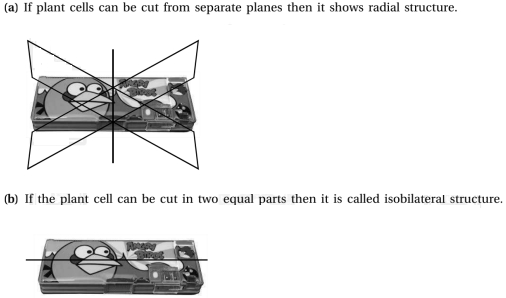
Assume that a pencil box held in your hand represents a plant cell. In how many possible planes can it be cut? Indicate these cuts with the help of line drawings.
Solution
(N/A) pencil box,representing a plant cell,is an asymmetrical or rectangular object. It can be cut into two equal halves only through specific planes:
$1$. Longitudinal plane (vertical cut along the length).
$2$. Transverse plane (horizontal cut across the width).
$3$. Sagittal plane (vertical cut along the depth).
If a structure can be cut into two equal halves through only one plane,it is called bilaterally symmetrical. If it can be cut through more than one plane,it shows radial symmetry. The pencil box demonstrates that it can be cut in limited planes,illustrating the concept of symmetry in biological structures.
$1$. Longitudinal plane (vertical cut along the length).
$2$. Transverse plane (horizontal cut across the width).
$3$. Sagittal plane (vertical cut along the depth).
If a structure can be cut into two equal halves through only one plane,it is called bilaterally symmetrical. If it can be cut through more than one plane,it shows radial symmetry. The pencil box demonstrates that it can be cut in limited planes,illustrating the concept of symmetry in biological structures.
0 likes
View Solution124
Medium
Describe the different types of symmetry in animals.
Solution
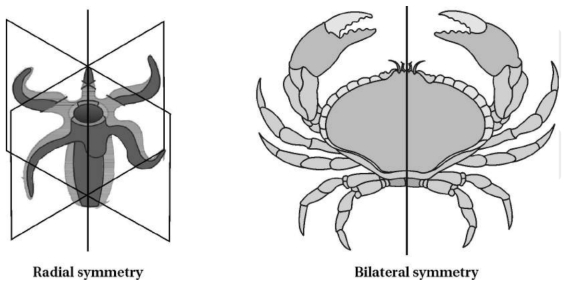
(N/A) Animals can be categorized on the basis of their symmetry into three main types:
$(1)$ Asymmetrical: Sponges are mostly asymmetrical,meaning any plane that passes through the center does not divide them into equal halves.
$(2)$ Radial Symmetry: When any plane passing through the central axis of the body divides the organism into two identical halves,it is called radial symmetry. Examples include Coelenterates,Ctenophores,and Echinoderms.
$(3)$ Bilateral Symmetry: Animals like Annelids,Arthropods,etc.,where the body can be divided into identical left and right halves in only one plane,exhibit bilateral symmetry.
$(1)$ Asymmetrical: Sponges are mostly asymmetrical,meaning any plane that passes through the center does not divide them into equal halves.
$(2)$ Radial Symmetry: When any plane passing through the central axis of the body divides the organism into two identical halves,it is called radial symmetry. Examples include Coelenterates,Ctenophores,and Echinoderms.
$(3)$ Bilateral Symmetry: Animals like Annelids,Arthropods,etc.,where the body can be divided into identical left and right halves in only one plane,exhibit bilateral symmetry.
0 likes
View Solution125
Easy
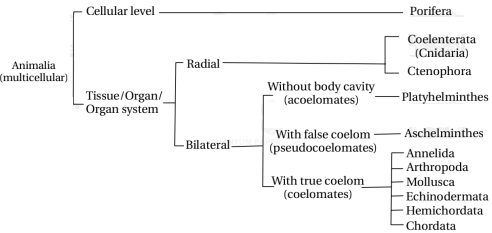
Draw the chart of animal classification and state the factors on which it is based.
Solution
(N/A) The classification of the Kingdom Animalia is based on the following fundamental features:
$1$. Levels of organization: Cellular,Tissue,Organ,or Organ system level.
$2$. Symmetry: Radial or Bilateral symmetry.
$3$. Diploblastic or Triploblastic organization (germ layers).
$4$. Presence or absence of a body cavity (coelom): Acoelomates,Pseudocoelomates,or Coelomates.
$5$. Segmentation (metamerism).
$6$. Presence or absence of Notochord.
The classification chart is as follows:
Animalia (multicellular) -> Cellular level: Porifera; Tissue/Organ/Organ system level -> Radial: Coelenterata (Cnidaria),Ctenophora; Bilateral -> Without body cavity (acoelomates): Platyhelminthes; With false coelom (pseudocoelomates): Aschelminthes; With true coelom (coelomates): Annelida,Arthropoda,Mollusca,Echinodermata,Hemichordata,Chordata.
$1$. Levels of organization: Cellular,Tissue,Organ,or Organ system level.
$2$. Symmetry: Radial or Bilateral symmetry.
$3$. Diploblastic or Triploblastic organization (germ layers).
$4$. Presence or absence of a body cavity (coelom): Acoelomates,Pseudocoelomates,or Coelomates.
$5$. Segmentation (metamerism).
$6$. Presence or absence of Notochord.
The classification chart is as follows:
Animalia (multicellular) -> Cellular level: Porifera; Tissue/Organ/Organ system level -> Radial: Coelenterata (Cnidaria),Ctenophora; Bilateral -> Without body cavity (acoelomates): Platyhelminthes; With false coelom (pseudocoelomates): Aschelminthes; With true coelom (coelomates): Annelida,Arthropoda,Mollusca,Echinodermata,Hemichordata,Chordata.
0 likes
View Solution126
Medium
Using appropriate examples,differentiate between false and true body segmentation.
Solution
(N/A) $\Rightarrow$ Segmentation: It is the division of an animal's body into a series of repetitive segments.
$\Rightarrow$ True Segmentation (Metamerism): It is observed in phyla $Annelida$,$Arthropoda$,and $Chordata$. In this,the body is divided into repetitive segments called metameres,where both external and internal organs are repeated. For example,in earthworms $(Pheretima)$,the body shows clear external and internal metamerism.
$\Rightarrow$ False Segmentation (Pseudometamerism): It occurs when the body is divided into many segments,but each segment is independent and not derived from the same embryonic origin. Each segment (proglottid) is capable of performing biological functions like reproduction. The growth of the body occurs by adding new segments from the anterior side (neck region). For example,in tapeworms ($Taenia$ $solium$).
$\Rightarrow$ True Segmentation (Metamerism): It is observed in phyla $Annelida$,$Arthropoda$,and $Chordata$. In this,the body is divided into repetitive segments called metameres,where both external and internal organs are repeated. For example,in earthworms $(Pheretima)$,the body shows clear external and internal metamerism.
$\Rightarrow$ False Segmentation (Pseudometamerism): It occurs when the body is divided into many segments,but each segment is independent and not derived from the same embryonic origin. Each segment (proglottid) is capable of performing biological functions like reproduction. The growth of the body occurs by adding new segments from the anterior side (neck region). For example,in tapeworms ($Taenia$ $solium$).
0 likes
View Solution127
EasyMCQ
Aristotle classified animals into two groups based on the presence or absence of $RBC$. The group which does not have $RBCs$ is:
A
Anaima
B
Enaima
C
Ovipera
D
Vivipera
Solution
(A) Aristotle classified animals into two main groups based on the presence or absence of red blood cells $(RBCs)$:
$1$. $Enaima$: Animals that possess red blood cells (red-blooded animals).
$2$. $Anaima$: Animals that do not possess red blood cells (bloodless animals).
Therefore,the group which does not have $RBCs$ is $Anaima$.
$1$. $Enaima$: Animals that possess red blood cells (red-blooded animals).
$2$. $Anaima$: Animals that do not possess red blood cells (bloodless animals).
Therefore,the group which does not have $RBCs$ is $Anaima$.
0 likes
View Solution128
EasyMCQ
Heterotrophic,eukaryotic,multicellular organisms lacking a cell wall are included in the kingdom
A
Protista
B
Fungi
C
Plantae
D
Animalia
Solution
(D) The kingdom $Animalia$ consists of organisms that are heterotrophic,eukaryotic,and multicellular.
These organisms are characterized by the absence of a cell wall in their cells.
These organisms are characterized by the absence of a cell wall in their cells.
0 likes
View Solution129
MediumMCQ
$A$ coelom is a
A
Cavity between body wall and gut wall
B
Body cavity lined by ectoderm
C
Body cavity not lined by mesoderm
D
Body cavity lined by mesoderm
Solution
(D) coelom is defined as a body cavity that is lined by the mesoderm on all sides.
In acoelomate animals,the body cavity is absent.
In pseudocoelomates,the mesoderm is present as scattered pouches between the ectoderm and endoderm,rather than lining the cavity completely.
Therefore,the correct definition of a true coelom is a body cavity lined by the mesoderm.
In acoelomate animals,the body cavity is absent.
In pseudocoelomates,the mesoderm is present as scattered pouches between the ectoderm and endoderm,rather than lining the cavity completely.
Therefore,the correct definition of a true coelom is a body cavity lined by the mesoderm.
0 likes
View Solution130
MediumMCQ
Three types of body cavity are
A
True coelom,pseudocoelom and haemocoel
B
Pseudocoelom,protocoelom and acoelom
C
Acoelom,deuterocoel and homocoel
D
Protocoel,deuterocoel and pseudocoelom
Solution
(A) The three main types of body cavity based on the presence or absence of a mesoderm-lined cavity are true coelom,pseudocoelom,and haemocoel.
$1$. True coelom: $A$ body cavity lined by mesoderm on all sides.
$2$. Pseudocoelom: $A$ body cavity not completely lined by mesoderm; instead,mesoderm is present as scattered pouches.
$3$. Haemocoel: $A$ body cavity filled with blood,typically seen in phyla $Arthropoda$ and $Mollusca$,where the true coelom is reduced and blood fills the spaces between the viscera.
$1$. True coelom: $A$ body cavity lined by mesoderm on all sides.
$2$. Pseudocoelom: $A$ body cavity not completely lined by mesoderm; instead,mesoderm is present as scattered pouches.
$3$. Haemocoel: $A$ body cavity filled with blood,typically seen in phyla $Arthropoda$ and $Mollusca$,where the true coelom is reduced and blood fills the spaces between the viscera.
0 likes
View Solution131
MediumMCQ
When the body is externally and internally divided into segments,it is called
A
True segmentation
B
False segmentation
C
Pseudo segmentation
D
Asegmentation
Solution
(A) Metamerism or true segmentation is a phenomenon where the body of an organism is divided into repeating segments both externally and internally. This is a characteristic feature of phyla like Annelida.
0 likes
View Solution132
MediumMCQ
The response to external stimulus is quicker and more precise in which of the following symmetry?
A
Radial
B
Bilateral
C
Spherical
D
Biradial
Solution
(B) In bilaterally symmetrical animals,the body is organized such that the head region contains sensory organs and a centralized nervous system (cephalization). This organization allows for a more efficient,quicker,and precise response to external stimuli compared to radially or spherically symmetrical organisms.
0 likes
View Solution133
MediumMCQ
Coelom is important because
A
It allows the internal organs to grow
B
It separates the gut from the body wall muscles
C
It has evolutionary significance
D
All of the above
Solution
(D) The coelom is a fluid-filled body cavity that is lined by mesoderm.
$1$. It provides space for the internal organs to grow and function independently of the body wall.
$2$. It separates the gut from the body wall muscles,allowing the gut to move independently.
$3$. The presence or absence of a coelom is a key criterion for classification,which holds significant evolutionary importance in understanding the complexity of animal body plans.
$1$. It provides space for the internal organs to grow and function independently of the body wall.
$2$. It separates the gut from the body wall muscles,allowing the gut to move independently.
$3$. The presence or absence of a coelom is a key criterion for classification,which holds significant evolutionary importance in understanding the complexity of animal body plans.
0 likes
View Solution134
MediumMCQ
Which of the following statements is not true?
A
All members of the kingdom Animalia are multicellular.
B
Nature of coelom is used as one of the basis of animal classification.
C
There is no need of classification now as over a million species of animals have been described till now.
D
The arrangement of cells in the body is one of the classifying features of the animals.
Solution
(C) In kingdom $Animalia$,over a million species have been described to date. $Animalia$ is the largest kingdom,with over $1.2$ million members. Due to such a large number of species,the need for classification becomes even more important to study and understand their diversity systematically.
0 likes
View Solution135
MediumMCQ
$A$ complete digestive system has
A
Single opening that serves as both mouth and anus
B
Two openings,one as mouth and other as anus
C
Single opening that acts as mouth only
D
Two openings,both act as mouth as well as anus
Solution
(B) digestive system is considered complete when it has two separate openings: a mouth for the ingestion of food and an anus for the egestion of undigested waste. This arrangement allows for a one-way flow of food through the alimentary canal.
0 likes
View Solution136
EasyMCQ
Mesoglea is
A
$A$ germinal layer present between ectoderm and endoderm
B
An undifferentiated layer present between ectoderm and endoderm
C
Another name of mesoderm
D
$A$ spongy layer of skin
Solution
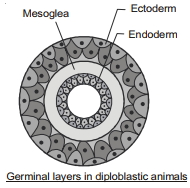
(B) In diploblastic animals,the developing embryo has only two germinal layers,$i.e.$,an external ectoderm and an internal endoderm.
Mesoderm is not present between the ectoderm and endoderm; instead,an undifferentiated,jelly-like layer is present between them.
This undifferentiated layer is called Mesoglea.
Mesoderm is not present between the ectoderm and endoderm; instead,an undifferentiated,jelly-like layer is present between them.
This undifferentiated layer is called Mesoglea.
0 likes
View Solution137
MediumMCQ
Coelom derived from blastocoel is known as
A
Pseudocoelom
B
Schizocoel
C
Haemocoel
D
Enterocoelom
Solution
(A) The body cavity that is derived from the embryonic blastocoel is called a pseudocoelom. In pseudocoelomate animals,the body cavity is not completely lined by mesoderm; instead,scattered pouches of mesoderm are present between the ectoderm and endoderm.
0 likes
View Solution138
MediumMCQ
Schizocoelomates and enterocoelomates are
A
Acoelomates
B
True coelomates
C
Vertebrates
D
Echinoderms only
Solution
(B) Eucoelomates are true coelomates,where the body cavity is lined by mesoderm on both sides.
Based on the mode of formation of the coelom,eucoelomates are of two types:
$(a)$. Schizocoelom: The body cavity develops by the splitting of the mesoderm. It is found in annelids and arthropods.
$(b)$. Enterocoelom: The mesoderm arises from the wall of the embryonic gut or enteron as hollow outgrowths. It occurs in echinoderms and chordates.
Based on the mode of formation of the coelom,eucoelomates are of two types:
$(a)$. Schizocoelom: The body cavity develops by the splitting of the mesoderm. It is found in annelids and arthropods.
$(b)$. Enterocoelom: The mesoderm arises from the wall of the embryonic gut or enteron as hollow outgrowths. It occurs in echinoderms and chordates.
0 likes
View Solution139
MediumMCQ
Animals are:
A
Heterotrophic
B
Autotrophic
C
Both $(a)$ and $(b)$
D
None of these
Solution
(A) Animals are heterotrophic organisms.
This means they cannot synthesize their own food and must obtain nutrients from other sources.
They consume plants directly (herbivores) or consume other animals that have eaten plants (carnivores).
This means they cannot synthesize their own food and must obtain nutrients from other sources.
They consume plants directly (herbivores) or consume other animals that have eaten plants (carnivores).
0 likes
View Solution140
Easy
Give the difference between Diploblastic and Triploblastic organisms.
Solution
(N/A)
| Diploblastic | Triploblastic |
|---|---|
| $(1)$ Cells are arranged in two germinal layers,i.e.,ectoderm and endoderm. | $(1)$ Cells are arranged in three germinal layers,i.e.,ectoderm,mesoderm,and endoderm. |
| $(2)$ This is known as diploblastic organization. | $(2)$ This is known as triploblastic organization. |
| $(3)$ An undifferentiated,non-cellular layer called mesoglea is present between the ectoderm and endoderm. | $(3)$ $A$ cellular layer called mesoderm is present between the ectoderm and endoderm. |
| $(4)$ Examples include Phylum $Coelenterata$ (Cnidaria). | $(4)$ Examples include Phylum $Platyhelminthes$ to $Chordata$. |
0 likes
View Solution141
Easy
Distinguish between Acoelomata and Coelomata.
Solution
(N/A)
| Acoelomata | Coelomata |
|---|---|
| $(1)$ The body cavity is absent. | $(1)$ $A$ true body cavity (coelom) is present. |
| $(2)$ There is no space between the body wall and the digestive tract. | $(2)$ The coelom is lined by mesoderm on all sides. |
| $(3)$ Example: Platyhelminthes. | $(3)$ Example: Annelida to Chordata. |
0 likes
View Solution142
Medium
Give a scientific reason: Sessile animals are common in aquatic habitats.
Solution
(N/A) $1$. In aquatic habitats,water currents constantly flow,which helps in transporting food particles towards the sessile (attached) animals.
$2$. This makes it relatively easy for these organisms to capture food without needing to move.
$3$. In contrast,on land,there are no such consistent currents to bring food to an organism,which is why very few sessile animals have evolved in terrestrial environments.
$2$. This makes it relatively easy for these organisms to capture food without needing to move.
$3$. In contrast,on land,there are no such consistent currents to bring food to an organism,which is why very few sessile animals have evolved in terrestrial environments.
0 likes
View Solution143
Easy
Define / Explain: Symmetry.
Solution
(N/A) Symmetry refers to the arrangement of body parts in respect to size,shape,and position on opposite sides of an axis or center. It is a fundamental criterion used for the classification of animals. Animals can be asymmetrical,radially symmetrical,or bilaterally symmetrical.
0 likes
View Solution144
Easy
Define/Explain: Metameric segmentation.
Solution
(N/A) $\rightarrow$ In some animals,the body is externally and internally divided into segments with serial repetition of at least some organs,as seen in earthworms. This phenomenon is called metameric segmentation.
0 likes
View Solution145
Easy
Define the term: Coelom.
Solution
(N/A) The coelom is defined as the body cavity that is lined by the mesoderm layer on all sides.
In animals,the presence or absence of a cavity between the body wall and the gut wall is very important in classification.
Animals possessing a coelom are called coelomates (e.g.,annelids,molluscs,arthropods,echinoderms,hemichordates,and chordates).
In animals,the presence or absence of a cavity between the body wall and the gut wall is very important in classification.
Animals possessing a coelom are called coelomates (e.g.,annelids,molluscs,arthropods,echinoderms,hemichordates,and chordates).
0 likes
View Solution146
Easy
Differentiate between a diploblastic and a triploblastic animal.
Solution
(N/A) $1$. In diploblastic animals,the cells are arranged in two embryonic layers: an external ectoderm and an internal endoderm.
$2$. In triploblastic animals,the developing embryo has three germinal layers: an external ectoderm,a middle mesoderm,and an internal endoderm.
$2$. In triploblastic animals,the developing embryo has three germinal layers: an external ectoderm,a middle mesoderm,and an internal endoderm.
0 likes
View Solution147
MediumMCQ
Match the following columns:
| Column-$I$ | Column-$II$ |
| $P$. Cellular level of organization | $I$. Cnidaria,Ctenophora |
| $Q$. Tissue level of organization | $II$. Porifera |
| $R$. Organ level of organization | $III$. Aschelminthes to Chordata |
| $S$. Organ system level of organization | $IV$. Platyhelminthes |
A
$(P-IV), (Q-III), (R-II), (S-I)$
B
$(P-I), (Q-II), (R-III), (S-IV)$
C
$(P-II), (Q-I), (R-IV), (S-III)$
D
$(P-III), (Q-IV), (R-II), (S-I)$
Solution
(C) The levels of organization in animals are classified as follows:
$1$. Cellular level of organization: Cells are arranged as loose cell aggregates. This is characteristic of the phylum Porifera $(P-II)$.
$2$. Tissue level of organization: Cells performing the same function are arranged into tissues. This is seen in phyla Cnidaria and Ctenophora $(Q-I)$.
$3$. Organ level of organization: Tissues are grouped together to form organs, each specialized for a particular function. This is observed in Platyhelminthes $(R-IV)$.
$4$. Organ system level of organization: Organs have associated to form functional systems, where each system is concerned with a specific physiological function. This is seen from Aschelminthes to Chordata $(S-III)$.
Therefore, the correct matching is $(P-II), (Q-I), (R-IV), (S-III)$.
$1$. Cellular level of organization: Cells are arranged as loose cell aggregates. This is characteristic of the phylum Porifera $(P-II)$.
$2$. Tissue level of organization: Cells performing the same function are arranged into tissues. This is seen in phyla Cnidaria and Ctenophora $(Q-I)$.
$3$. Organ level of organization: Tissues are grouped together to form organs, each specialized for a particular function. This is observed in Platyhelminthes $(R-IV)$.
$4$. Organ system level of organization: Organs have associated to form functional systems, where each system is concerned with a specific physiological function. This is seen from Aschelminthes to Chordata $(S-III)$.
Therefore, the correct matching is $(P-II), (Q-I), (R-IV), (S-III)$.
0 likes
View Solution148
MediumMCQ
In this type of circulatory system, veins are absent.
A
Incomplete circulatory system
B
Complete circulatory system
C
Open circulatory system
D
Closed circulatory system
Solution
(C) In an $Open$ $circulatory$ $system$, the blood is pumped out of the heart into blood vessels that open into body cavities or sinuses called $haemocoel$.
There is no distinction between blood and interstitial fluid, and the blood flows directly over the tissues.
Since there is no complex network of capillaries or veins to return the blood to the heart, veins are considered absent in this system.
In contrast, a $Closed$ $circulatory$ $system$ involves blood flowing through a series of vessels of varying diameters (arteries, veins, and capillaries).
There is no distinction between blood and interstitial fluid, and the blood flows directly over the tissues.
Since there is no complex network of capillaries or veins to return the blood to the heart, veins are considered absent in this system.
In contrast, a $Closed$ $circulatory$ $system$ involves blood flowing through a series of vessels of varying diameters (arteries, veins, and capillaries).
0 likes
View Solution149
MediumMCQ
Identify the type of symmetry in the given figures.
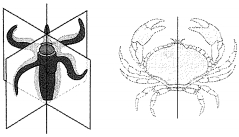
A
Radial symmetry $\quad\quad$ Bilateral symmetry
B
Bilateral symmetry $\quad\quad$ Radial symmetry
C
Radial symmetry $\quad\quad$ Asymmetry
D
Asymmetry $\quad\quad$ Radial symmetry
Solution
(A) The first figure shows an organism (like a sea anemone) where any plane passing through the central axis divides the body into two identical halves. This is known as radial symmetry.
The second figure shows a crab,where the body can be divided into identical left and right halves only in one plane. This is known as bilateral symmetry.
Therefore,the correct sequence is radial symmetry and bilateral symmetry.
The second figure shows a crab,where the body can be divided into identical left and right halves only in one plane. This is known as bilateral symmetry.
Therefore,the correct sequence is radial symmetry and bilateral symmetry.
0 likes
View Solution150
MediumMCQ
Match the following columns:
| Column-$I$ | Column-$II$ |
| $P$. Asymmetry | $I$. Coelenterates,Ctenophores,Echinoderms |
| $Q$. Radial symmetry | $II$. Poriferans |
| $R$. Bilateral symmetry | $III$. Annelids,Arthropods,Chordates |
A
$(P-III), (Q-II), (R-I)$
B
$(P-II), (Q-I), (R-III)$
C
$(P-I), (Q-II), (R-III)$
D
$(P-III), (Q-I), (R-II)$
Solution
(B) The classification of animals based on symmetry is as follows:
$1$. Asymmetry: In this type,any plane that passes through the centre does not divide the body into equal halves. Example: Poriferans $(P-II)$.
$2$. Radial symmetry: When any plane passing through the central axis of the body divides the organism into two identical halves. Examples: Coelenterates,Ctenophores,and Echinoderms $(Q-I)$.
$3$. Bilateral symmetry: When the body can be divided into identical left and right halves in only one plane. Examples: Annelids,Arthropods,and Chordates $(R-III)$.
Therefore,the correct matching is $(P-II), (Q-I), (R-III)$.
$1$. Asymmetry: In this type,any plane that passes through the centre does not divide the body into equal halves. Example: Poriferans $(P-II)$.
$2$. Radial symmetry: When any plane passing through the central axis of the body divides the organism into two identical halves. Examples: Coelenterates,Ctenophores,and Echinoderms $(Q-I)$.
$3$. Bilateral symmetry: When the body can be divided into identical left and right halves in only one plane. Examples: Annelids,Arthropods,and Chordates $(R-III)$.
Therefore,the correct matching is $(P-II), (Q-I), (R-III)$.
0 likes
View SolutionAnimal Kingdom — Basic of classification · Frequently Asked Questions
1Are these Animal Kingdom questions useful for JEE and NEET?
Yes. All questions in this section are mapped to JEE Main and NEET exam patterns. Previous year questions from JEE Main, NEET, GUJCET and state-level exams are included with full solutions.
2Can I switch to Hindi or Gujarati for these questions?
Yes. Use the language tabs in the hero section or the sidebar to view the same questions and solutions in English, Hindi or Gujarati.
3How do I generate a question paper from this subtopic?
Use the Vedclass Exam Paper Generator — select the chapter and subtopic, set difficulty, and generate Sets A, B, C, D automatically. First 3 chapters of every subject are free.
Vedclass Products
For Students
Vedclass Test Series
Mock tests in real JEE/NEET style with performance analysis. 5-day free trial.
Start Free TrialFor Teachers
Exam Paper Generator
Generate Set A/B/C/D papers from this chapter in 2 minutes. 3 chapters free.
Try FreeFor Institutes
Online Exam Module
Live online exams with unlimited students, 360° analytics & white-label branding.
See DemoFor Teachers & Institutes
Generate a Animal Kingdom Exam Paper in 2 Minutes
Select subtopic & difficulty — Sets A, B, C, D auto-generated with No Repeat logic.
First 3 chapters of every subject are free — no payment required.