
A English
Basic of classification Questions in English
Class 11 Biology · Animal Kingdom · Basic of classification
160+
Questions
English
Language
100%
With Solutions
Showing 50 of 160 questions in English
51
MediumMCQ
$A$ true coelom is surrounded by:
A
Ectoderm
B
Endoderm
C
Mesoderm
D
Both ectoderm and endoderm
Solution
(C) true coelom is a body cavity that is completely lined by the mesoderm.
In triploblastic animals,the body wall is formed by three germ layers: ectoderm,mesoderm,and endoderm.
When the mesoderm splits to form a cavity,it lines both the body wall (somatic mesoderm) and the gut wall (splanchnic mesoderm),resulting in a true coelom.
Therefore,the correct answer is mesoderm.
In triploblastic animals,the body wall is formed by three germ layers: ectoderm,mesoderm,and endoderm.
When the mesoderm splits to form a cavity,it lines both the body wall (somatic mesoderm) and the gut wall (splanchnic mesoderm),resulting in a true coelom.
Therefore,the correct answer is mesoderm.
0 likes
View Solution52
EasyMCQ
The common term used for the body cavity in triploblastic animals is:
A
Coelomate
B
Acoelomate
C
Pseudocoelomate
D
All of the above
Solution
(A) In triploblastic animals,the presence or absence of a body cavity between the body wall and the gut wall is very important in classification.
$1$. The body cavity which is lined by mesoderm is called the $Coelom$.
$2$. Animals possessing this coelom are called $Coelomates$ (e.g.,Annelids,Molluscs,Arthropods,Echinoderms,Hemichordates,and Chordates).
$3$. In some animals,the body cavity is not lined by mesoderm,instead,the mesoderm is present as scattered pouches in between the ectoderm and endoderm. Such a body cavity is called a $Pseudocoelom$ and the animals are called $Pseudocoelomates$ (e.g.,Aschelminthes).
$4$. Animals in which the body cavity is absent are known as $Acoelomates$ (e.g.,Platyhelminthes).
Since the question asks for the common term used for the body cavity in triploblastic animals,$Coelom$ is the standard term for the true body cavity.
$1$. The body cavity which is lined by mesoderm is called the $Coelom$.
$2$. Animals possessing this coelom are called $Coelomates$ (e.g.,Annelids,Molluscs,Arthropods,Echinoderms,Hemichordates,and Chordates).
$3$. In some animals,the body cavity is not lined by mesoderm,instead,the mesoderm is present as scattered pouches in between the ectoderm and endoderm. Such a body cavity is called a $Pseudocoelom$ and the animals are called $Pseudocoelomates$ (e.g.,Aschelminthes).
$4$. Animals in which the body cavity is absent are known as $Acoelomates$ (e.g.,Platyhelminthes).
Since the question asks for the common term used for the body cavity in triploblastic animals,$Coelom$ is the standard term for the true body cavity.
0 likes
View Solution53
EasyMCQ
How are triploblastic animals classified based on their body cavity (coelom) organization?
A
One
B
Two
C
Three
D
Four
Solution
(C) Triploblastic animals are classified into three categories based on the presence or absence of a body cavity (coelom) between the body wall and the gut wall:
$1$. Acoelomates: Animals in which the body cavity is absent (e.g.,Platyhelminthes).
$2$. Pseudocoelomates: Animals in which the body cavity is not lined by mesoderm,but instead,the mesoderm is present as scattered pouches in between the ectoderm and endoderm (e.g.,Aschelminthes).
$3$. Coelomates: Animals possessing a true coelom,which is a body cavity lined by mesoderm (e.g.,Annelida to Chordata).
$1$. Acoelomates: Animals in which the body cavity is absent (e.g.,Platyhelminthes).
$2$. Pseudocoelomates: Animals in which the body cavity is not lined by mesoderm,but instead,the mesoderm is present as scattered pouches in between the ectoderm and endoderm (e.g.,Aschelminthes).
$3$. Coelomates: Animals possessing a true coelom,which is a body cavity lined by mesoderm (e.g.,Annelida to Chordata).
0 likes
View Solution54
MediumMCQ
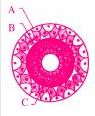
In the given figure,what do '$A$' and '$C$' represent respectively?
A
Ectoderm,Endoderm
B
Ectoderm,Mesoderm
C
Mesoderm,Ectoderm
D
Mesoderm,Endoderm
Solution
(A) The given figure represents a triploblastic animal body plan in cross-section.
- '$A$' points to the outermost layer,which is the Ectoderm.
- '$B$' points to the middle layer,which is the Mesoderm.
- '$C$' points to the innermost layer,which is the Endoderm.
Therefore,'$A$' represents the Ectoderm and '$C$' represents the Endoderm.
- '$A$' points to the outermost layer,which is the Ectoderm.
- '$B$' points to the middle layer,which is the Mesoderm.
- '$C$' points to the innermost layer,which is the Endoderm.
Therefore,'$A$' represents the Ectoderm and '$C$' represents the Endoderm.
0 likes
View Solution55
EasyMCQ
What are animals possessing a coelom called?
A
Coelomates
B
Pseudocoelomates
C
Acoelomates
D
Pseudopodial
Solution
(A) Animals that possess a true body cavity,which is lined by mesoderm,are known as coelomates.
- $A$: Coelomates are animals with a true coelom.
- $B$: Pseudocoelomates have a body cavity that is not lined by mesoderm.
- $C$: Acoelomates are animals that lack a body cavity.
- $D$: Pseudopodial refers to organisms that use pseudopodia for locomotion,such as Amoeba.
- $A$: Coelomates are animals with a true coelom.
- $B$: Pseudocoelomates have a body cavity that is not lined by mesoderm.
- $C$: Acoelomates are animals that lack a body cavity.
- $D$: Pseudopodial refers to organisms that use pseudopodia for locomotion,such as Amoeba.
0 likes
View Solution56
EasyMCQ
The coelom is lined by which germ layer on all sides?
A
Ectoderm
B
Mesoderm
C
Endoderm
D
Pseudocoelom
Solution
(B) true coelom is defined as a body cavity that is completely lined by the mesoderm on all sides.
Animals possessing this type of body cavity are called coelomates (e.g.,annelids,molluscs,arthropods,echinoderms,hemichordates,and chordates).
In contrast,pseudocoelomates have a body cavity that is not completely lined by the mesoderm,but instead,the mesoderm is present as scattered pouches between the ectoderm and endoderm.
Animals possessing this type of body cavity are called coelomates (e.g.,annelids,molluscs,arthropods,echinoderms,hemichordates,and chordates).
In contrast,pseudocoelomates have a body cavity that is not completely lined by the mesoderm,but instead,the mesoderm is present as scattered pouches between the ectoderm and endoderm.
0 likes
View Solution57
MediumMCQ
What does '$a$' indicate in the given figure?

A
Alimentary canal
B
Coelom
C
Pseudocoelom
D
Acoelomate
Solution
(B) The provided figure represents a cross-section of an animal body showing the body cavity.
In this diagram,the label '$a$' points to the fluid-filled space between the body wall and the digestive tract,which is lined by mesoderm on both sides.
This type of body cavity is known as the true coelom (or simply coelom).
Therefore,'$a$' indicates the coelom.
In this diagram,the label '$a$' points to the fluid-filled space between the body wall and the digestive tract,which is lined by mesoderm on both sides.
This type of body cavity is known as the true coelom (or simply coelom).
Therefore,'$a$' indicates the coelom.
0 likes
View Solution58
EasyMCQ
The lining of the coelom is formed by which of the following?
A
Ectoderm
B
Mesoderm
C
Endoderm
D
Mesoglea
Solution
(B) The coelom is a body cavity that is lined by the mesoderm on all sides. In triploblastic animals,the mesoderm splits to form the coelomic cavity. Therefore,the lining of the coelom is derived from the mesoderm.
0 likes
View Solution59
EasyMCQ
Animals in which the body cavity is absent are known as?
A
Coelomates
B
Acoelomates
C
Invertebrates
D
Pseudocoelomates
Solution
(B) In the classification of animals,the presence or absence of a body cavity (coelom) between the body wall and the gut wall is a very important criterion.
$1$. Animals in which the body cavity is absent are called $Acoelomates$.
$2$. Animals in which the body cavity is present are called $Coelomates$.
$3$. In some animals,the body cavity is not lined by mesoderm,but instead,the mesoderm is present as scattered pouches in between the ectoderm and endoderm; such a body cavity is called a $Pseudocoelom$,and these animals are called $Pseudocoelomates$.
$1$. Animals in which the body cavity is absent are called $Acoelomates$.
$2$. Animals in which the body cavity is present are called $Coelomates$.
$3$. In some animals,the body cavity is not lined by mesoderm,but instead,the mesoderm is present as scattered pouches in between the ectoderm and endoderm; such a body cavity is called a $Pseudocoelom$,and these animals are called $Pseudocoelomates$.
0 likes
View Solution60
EasyMCQ
What is the body cavity found between the alimentary canal and the body wall of animals called?
A
Coelom
B
Pseudocoelom
C
Acoelomate
D
Mesoglea
Solution
(A) The body cavity, which is lined by mesoderm, is called the $Coelom$.
Animals possessing this cavity are called $Coelomates$.
If the body cavity is not lined by mesoderm but instead is present as scattered pouches between the ectoderm and endoderm, it is called a $Pseudocoelom$.
Animals without a body cavity are called $Acoelomates$.
$Mesoglea$ is an undifferentiated layer present between the ectoderm and endoderm in $Cnidarians$.
Animals possessing this cavity are called $Coelomates$.
If the body cavity is not lined by mesoderm but instead is present as scattered pouches between the ectoderm and endoderm, it is called a $Pseudocoelom$.
Animals without a body cavity are called $Acoelomates$.
$Mesoglea$ is an undifferentiated layer present between the ectoderm and endoderm in $Cnidarians$.
0 likes
View Solution61
EasyMCQ
The body cavity which is lined by mesoderm and is present between the body wall and the gut wall is called:
A
Gastrointestinal tract
B
Blastocoel
C
Enterocoel
D
Coelom
Solution
(D) The body cavity which is lined by mesoderm and is present between the body wall and the gut wall is known as the $Coelom$.
Animals possessing this cavity are called $Coelomates$.
$Blastocoel$ is the cavity of the blastula, while $Enterocoel$ is a type of coelom formed by the outpocketing of the embryonic gut.
Animals possessing this cavity are called $Coelomates$.
$Blastocoel$ is the cavity of the blastula, while $Enterocoel$ is a type of coelom formed by the outpocketing of the embryonic gut.
0 likes
View Solution62
EasyMCQ
Which of the following forms the lining of the coelom?
A
Ectoderm
B
Mesoderm
C
Endoderm
D
None of these
Solution
(B) The coelom is a body cavity that is lined by the mesoderm.
In triploblastic animals,the body wall is composed of three germ layers: the ectoderm,the mesoderm,and the endoderm.
The coelom is specifically defined as a cavity that is completely surrounded by the mesoderm on all sides.
Therefore,the correct answer is the mesoderm.
In triploblastic animals,the body wall is composed of three germ layers: the ectoderm,the mesoderm,and the endoderm.
The coelom is specifically defined as a cavity that is completely surrounded by the mesoderm on all sides.
Therefore,the correct answer is the mesoderm.
0 likes
View Solution63
MediumMCQ
Which of the following is not a type of organism based on the presence or absence of a coelom?
A
Acoelomate
B
Pseudocoelomate
C
Coelomate
D
Enterocoelomate
Solution
(D) The classification of animals based on the presence or absence of a body cavity (coelom) between the body wall and the gut wall divides them into three main categories:
$1$. $Acoelomates$: Animals in which the body cavity is absent (e.g., Platyhelminthes).
$2$. $Pseudocoelomates$: Animals in which the body cavity is not lined by mesoderm, but is present as scattered pouches (e.g., Aschelminthes).
$3$. $Coelomates$: Animals possessing a true body cavity lined by mesoderm (e.g., Annelida to Chordata).
'Enterocoelomate' refers to the mode of formation of the coelom (from the archenteron) rather than a primary category of classification based on the presence or absence of the coelom itself. Therefore, $D$ is the correct answer.
$1$. $Acoelomates$: Animals in which the body cavity is absent (e.g., Platyhelminthes).
$2$. $Pseudocoelomates$: Animals in which the body cavity is not lined by mesoderm, but is present as scattered pouches (e.g., Aschelminthes).
$3$. $Coelomates$: Animals possessing a true body cavity lined by mesoderm (e.g., Annelida to Chordata).
'Enterocoelomate' refers to the mode of formation of the coelom (from the archenteron) rather than a primary category of classification based on the presence or absence of the coelom itself. Therefore, $D$ is the correct answer.
0 likes
View Solution64
MediumMCQ
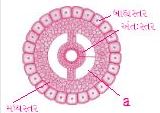
What does '$a$' represent in the given figure?
A
Coelom
B
Pseudocoelom
C
Acoelomate
D
Blastocoel
Solution
(A) The provided figure shows a cross-section of an animal body wall.
In this diagram,the space labeled '$a$' is situated between the ectoderm (outer layer) and endoderm (inner layer),and it is lined by mesoderm on both sides.
This type of body cavity,which is completely lined by mesoderm,is known as the coelom.
Therefore,'$a$' represents the coelom.
In this diagram,the space labeled '$a$' is situated between the ectoderm (outer layer) and endoderm (inner layer),and it is lined by mesoderm on both sides.
This type of body cavity,which is completely lined by mesoderm,is known as the coelom.
Therefore,'$a$' represents the coelom.
0 likes
View Solution65
MediumMCQ
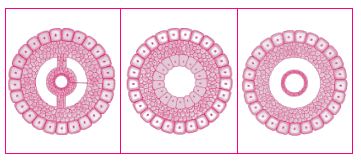
What do the given figures $1, 2, 3$ represent sequentially?
A
$1$. Coelomate,$2$. Pseudocoelomate,$3$. Acoelomate
B
$1$. Acoelomate,$2$. Coelomate,$3$. Pseudocoelomate
C
$1$. Coelomate,$2$. Acoelomate,$3$. Pseudocoelomate
D
$1$. Acoelomate,$2$. Pseudocoelomate,$3$. Coelomate
Solution
(A) The provided figure illustrates the classification of animals based on the presence or absence of a body cavity (coelom) between the body wall and the gut wall.
$1$. The first figure shows a true coelom,where the body cavity is lined by mesoderm on both sides. This represents a Coelomate animal.
$2$. The second figure shows a body cavity that is not lined by mesoderm; instead,the mesoderm is present as scattered pouches between the ectoderm and endoderm. This represents a Pseudocoelomate animal.
$3$. The third figure shows no body cavity between the body wall and the gut wall. This represents an Acoelomate animal.
Therefore,the sequence is $1$. Coelomate,$2$. Pseudocoelomate,$3$. Acoelomate.
$1$. The first figure shows a true coelom,where the body cavity is lined by mesoderm on both sides. This represents a Coelomate animal.
$2$. The second figure shows a body cavity that is not lined by mesoderm; instead,the mesoderm is present as scattered pouches between the ectoderm and endoderm. This represents a Pseudocoelomate animal.
$3$. The third figure shows no body cavity between the body wall and the gut wall. This represents an Acoelomate animal.
Therefore,the sequence is $1$. Coelomate,$2$. Pseudocoelomate,$3$. Acoelomate.
0 likes
View Solution66
EasyMCQ
What does the given figure represent?

A
Coelomate
B
Pseudocoelomate
C
Acoelomate
D
Triploblastic and Coelomate
Solution
(C) The provided figure shows a cross-section of an animal body where the body cavity is completely absent between the body wall and the digestive tract. This condition is characteristic of acoelomates,such as Platyhelminthes (flatworms). In acoelomates,the space between the ectoderm and endoderm is filled with parenchyma or mesoderm,leaving no cavity.
0 likes
View Solution67
MediumMCQ
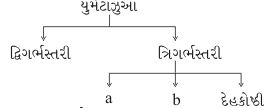
In the given chart,what do $a$ and $b$ represent respectively?
$(i)$ Acoelomate
$(ii)$ Hemichordata
$(iii)$ Agnatha
$(iv)$ Pseudocoelomate
$(v)$ Gnathostomata
$(vi)$ Cephalochordata
$(i)$ Acoelomate
$(ii)$ Hemichordata
$(iii)$ Agnatha
$(iv)$ Pseudocoelomate
$(v)$ Gnathostomata
$(vi)$ Cephalochordata
A
$(i)$ and $(iv)$
B
$(iii)$ and $(v)$
C
$(ii)$ and $(vi)$
D
$(i)$ and $(ii)$
Solution
(A) The classification of Eumetazoa based on germ layers leads to Diploblastic and Triploblastic animals.
Triploblastic animals are further classified based on the presence or absence of a body cavity (coelom).
These are categorized as:
$1$. Acoelomate (no body cavity),represented by $a$.
$2$. Pseudocoelomate (false body cavity),represented by $b$.
$3$. Coelomate (true body cavity).
Therefore,$a$ represents Acoelomate $(i)$ and $b$ represents Pseudocoelomate $(iv)$.
Triploblastic animals are further classified based on the presence or absence of a body cavity (coelom).
These are categorized as:
$1$. Acoelomate (no body cavity),represented by $a$.
$2$. Pseudocoelomate (false body cavity),represented by $b$.
$3$. Coelomate (true body cavity).
Therefore,$a$ represents Acoelomate $(i)$ and $b$ represents Pseudocoelomate $(iv)$.
0 likes
View Solution68
MediumMCQ
Which of the following is the origin of the coelom?
A
Mesoderm
B
Respiratory system
C
Excretory system
D
Water vascular system
Solution
(A) The coelom is a fluid-filled body cavity that is completely lined by the mesoderm.
During embryonic development,the coelom originates from the mesoderm,which is the middle germ layer.
Triploblastic animals are characterized by the presence of this cavity,which develops within the mesodermal tissue.
Therefore,the correct origin of the coelom is the mesoderm.
During embryonic development,the coelom originates from the mesoderm,which is the middle germ layer.
Triploblastic animals are characterized by the presence of this cavity,which develops within the mesodermal tissue.
Therefore,the correct origin of the coelom is the mesoderm.
0 likes
View Solution69
MediumMCQ
In the given chart, what do "a" and "b" represent respectively?
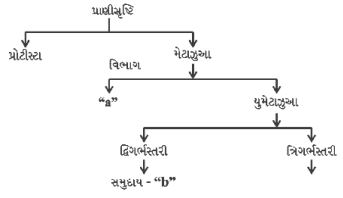
A
Protozoa, Platyhelminthes
B
Coelenterata, Parazoa
C
Parazoa, Coelenterata
D
Acoelomate, Platyhelminthes
Solution
(C) The classification of the animal kingdom is based on the level of organization and germ layers.
Metazoa is divided into Parazoa and Eumetazoa. Parazoa includes the phylum Porifera, which lacks true tissues.
Eumetazoa is further classified based on germ layers into Diploblastic and Triploblastic.
Diploblastic animals possess two germ layers (ectoderm and endoderm). The phylum Coelenterata (Cnidaria) is the primary example of diploblastic animals.
Therefore, "a" represents Parazoa and "b" represents Coelenterata.
Metazoa is divided into Parazoa and Eumetazoa. Parazoa includes the phylum Porifera, which lacks true tissues.
Eumetazoa is further classified based on germ layers into Diploblastic and Triploblastic.
Diploblastic animals possess two germ layers (ectoderm and endoderm). The phylum Coelenterata (Cnidaria) is the primary example of diploblastic animals.
Therefore, "a" represents Parazoa and "b" represents Coelenterata.
0 likes
View Solution70
EasyMCQ
In which class of the phylum Protozoa is Amoeba placed?
A
Flagellated
B
Amoeboid
C
Ciliated
D
Sporozoan
Solution
(B) Amoeba belongs to the class Sarcodina (Amoeboid protozoans) within the phylum Protozoa. These organisms move and capture their prey by putting out pseudopodia (false feet). Therefore,they are classified as Amoeboid protozoans.
0 likes
View Solution71
EasyMCQ
Scorpion, shark, and bat exhibit which type of body symmetry?
A
Radial symmetry
B
Asymmetry
C
Bilateral symmetry
D
Pentamerous radial symmetry
Solution
(C) Scorpion (an arthropod), shark (a chordate/fish), and bat (a chordate/mammal) all possess a body plan where the body can be divided into identical left and right halves through a single plane. This type of body organization is known as $Bilateral \text{ symmetry}$. Therefore, the correct option is $C$.
0 likes
View Solution72
MediumMCQ
What do '$A$' and '$B$' represent in the given chart?
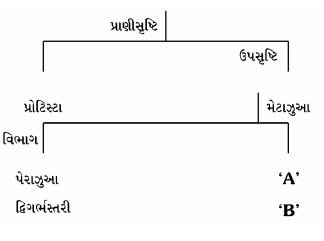
A
Eumetazoa,Triploblastic
B
Triploblastic,Eumetazoa
C
Protista,Coelenterata
D
Porifera,Coelomate
Solution
(A) The animal kingdom is classified into sub-kingdoms based on cellular organization. The sub-kingdom Metazoa is further divided into Parazoa (e.g.,Porifera) and Eumetazoa. Eumetazoa is further classified based on germ layers into Diploblastic and Triploblastic animals. In the provided chart,'$A$' represents Eumetazoa,which is the group of multicellular animals with tissue-level organization,and '$B$' represents Triploblastic,which refers to animals having three germ layers (ectoderm,mesoderm,and endoderm).
0 likes
View Solution73
DifficultMCQ
Which of the following represents the correct level of organization for the given organisms?
A
Cellular level $\rightarrow$ Hydra,Tissue level $\rightarrow$ Liver fluke,Organ level $\rightarrow$ Leucosolenia,Organ-system level $\rightarrow$ Spongilla
B
Cellular level $\rightarrow$ Spongilla,Tissue level $\rightarrow$ Corals,Organ level $\rightarrow$ Nereis,Organ-system level $\rightarrow$ Ascaris
C
Cellular level $\rightarrow$ Hyalonema,Tissue level $\rightarrow$ Sea anemone,Organ level $\rightarrow$ Flatworm,Organ-system level $\rightarrow$ Scorpion
D
Cellular level $\rightarrow$ Corals,Tissue level $\rightarrow$ Nereis,Organ level $\rightarrow$ Hyalonema,Organ-system level $\rightarrow$ Flatworm
Solution
(C) The levels of organization in the animal kingdom are classified as follows:
$1$. Cellular level: Found in Porifera (e.g.,$Hyalonema$,$Spongilla$).
$2$. Tissue level: Found in Coelenterata/Cnidaria (e.g.,Sea anemone/Adamsia).
$3$. Organ level: Found in Platyhelminthes (e.g.,Flatworm/Liver fluke).
$4$. Organ-system level: Found in Aschelminthes to Chordata (e.g.,$Ascaris$,Scorpion,Nereis).
Evaluating the options:
- Option $A$ is incorrect because $Hydra$ is tissue level and $Leucosolenia$ is cellular level.
- Option $B$ is incorrect because $Nereis$ is organ-system level.
- Option $C$ is correct: $Hyalonema$ (Porifera) is cellular,Sea anemone (Cnidaria) is tissue,Flatworm (Platyhelminthes) is organ,and Scorpion (Arthropoda) is organ-system level.
- Option $D$ is incorrect because $Corals$ are tissue level.
$1$. Cellular level: Found in Porifera (e.g.,$Hyalonema$,$Spongilla$).
$2$. Tissue level: Found in Coelenterata/Cnidaria (e.g.,Sea anemone/Adamsia).
$3$. Organ level: Found in Platyhelminthes (e.g.,Flatworm/Liver fluke).
$4$. Organ-system level: Found in Aschelminthes to Chordata (e.g.,$Ascaris$,Scorpion,Nereis).
Evaluating the options:
- Option $A$ is incorrect because $Hydra$ is tissue level and $Leucosolenia$ is cellular level.
- Option $B$ is incorrect because $Nereis$ is organ-system level.
- Option $C$ is correct: $Hyalonema$ (Porifera) is cellular,Sea anemone (Cnidaria) is tissue,Flatworm (Platyhelminthes) is organ,and Scorpion (Arthropoda) is organ-system level.
- Option $D$ is incorrect because $Corals$ are tissue level.
0 likes
View Solution74
MediumMCQ
Which type of body plan is shown in the given figure?
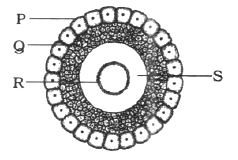
A
Acoelomate
B
Coelomate
C
Pseudocoelomate
D
None of these
Solution
(C) The provided figure shows a cross-section of an animal body where the body cavity (coelom) is not lined by mesoderm,but instead,the mesoderm is present as scattered pouches between the ectoderm and endoderm. This specific arrangement is characteristic of a pseudocoelomate body plan,as seen in organisms like Ascaris (roundworms).
0 likes
View Solution75
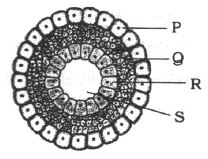
MediumMCQ
Identify the correct labeling for the given diagram.
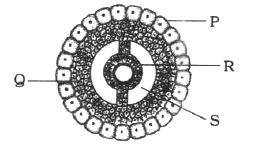
A
$P - \text{Ectoderm}, Q - \text{Mesoderm}, R - \text{Endoderm}, S - \text{Transport cavity}$
B
$P - \text{Ectoderm}, Q - \text{Mesoderm}, R - \text{Endoderm}, S - \text{Digestive cavity}$
C
$P - \text{Ectoderm}, Q - \text{Mesoderm}, R - \text{Endoderm}, S - \text{Pseudocoelom}$
D
$P - \text{Ectoderm}, Q - \text{Mesoderm}, R - \text{Endoderm}, S - \text{Coelom}$
Solution
(D) The provided diagram represents a cross-section of a triploblastic, coelomate animal body plan.
$P$ points to the outermost germ layer, which is the Ectoderm.
$Q$ points to the middle germ layer, which is the Mesoderm.
$R$ points to the innermost germ layer, which is the Endoderm.
$S$ points to the body cavity lined by mesoderm on all sides, which is the Coelom.
Therefore, the correct labeling is $P - \text{Ectoderm}, Q - \text{Mesoderm}, R - \text{Endoderm}, S - \text{Coelom}$.
$P$ points to the outermost germ layer, which is the Ectoderm.
$Q$ points to the middle germ layer, which is the Mesoderm.
$R$ points to the innermost germ layer, which is the Endoderm.
$S$ points to the body cavity lined by mesoderm on all sides, which is the Coelom.
Therefore, the correct labeling is $P - \text{Ectoderm}, Q - \text{Mesoderm}, R - \text{Endoderm}, S - \text{Coelom}$.
0 likes
View Solution76
MediumMCQ
What type of body organization is shown in the given figure?
A
Acoelomate
B
Coelomate
C
Pseudocoelomate
D
None of these
Solution
(A) The provided figure shows a cross-section of an animal body.
In this figure,the space between the ectoderm (outer layer) and endoderm (inner layer) is completely filled with mesoderm,leaving no body cavity.
This type of body organization,where the body cavity is absent,is known as Acoelomate.
Therefore,the correct option is $A$.
In this figure,the space between the ectoderm (outer layer) and endoderm (inner layer) is completely filled with mesoderm,leaving no body cavity.
This type of body organization,where the body cavity is absent,is known as Acoelomate.
Therefore,the correct option is $A$.
0 likes
View Solution77
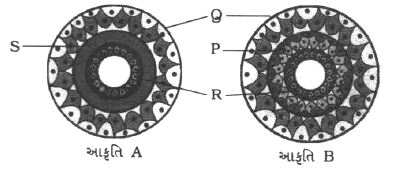
EasyMCQ
Which of the following figures represents triploblastic organization?
A
Figure $A$
B
Figure $B$
C
Both Figure $A$ and Figure $B$
D
None of these
Solution
(B) In animal classification,organisms can be classified based on the number of germ layers present during embryonic development.
Figure $A$ shows two germ layers: an outer ectoderm and an inner endoderm,with an undifferentiated layer (mesoglea) in between. This represents diploblastic organization.
Figure $B$ shows three distinct germ layers: an outer ectoderm,a middle mesoderm,and an inner endoderm. This represents triploblastic organization.
Therefore,Figure $B$ correctly represents triploblastic organization.
Figure $A$ shows two germ layers: an outer ectoderm and an inner endoderm,with an undifferentiated layer (mesoglea) in between. This represents diploblastic organization.
Figure $B$ shows three distinct germ layers: an outer ectoderm,a middle mesoderm,and an inner endoderm. This represents triploblastic organization.
Therefore,Figure $B$ correctly represents triploblastic organization.
0 likes
View Solution78
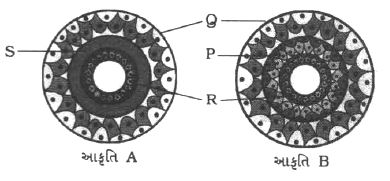
EasyMCQ
Which of the following figures represents diploblastic organization?
A
Figure $A$
B
Figure $B$
C
Both Figure $A$ and Figure $B$
D
None of these
Solution
(A) Diploblastic organization refers to animals in which the cells are arranged in two embryonic layers,an external ectoderm and an internal endoderm.
In the given figure,Figure $A$ shows two distinct layers with an undifferentiated layer (mesoglea) in between,which is characteristic of diploblastic animals (e.g.,Cnidarians).
Figure $B$ shows three distinct layers (ectoderm,mesoderm,and endoderm),which represents triploblastic organization.
Therefore,Figure $A$ represents diploblastic organization.
In the given figure,Figure $A$ shows two distinct layers with an undifferentiated layer (mesoglea) in between,which is characteristic of diploblastic animals (e.g.,Cnidarians).
Figure $B$ shows three distinct layers (ectoderm,mesoderm,and endoderm),which represents triploblastic organization.
Therefore,Figure $A$ represents diploblastic organization.
0 likes
View Solution79
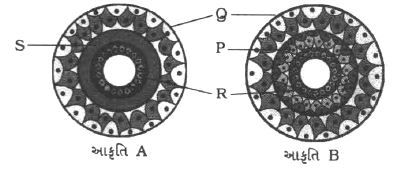
MediumMCQ
Identify the correct labeling sequence for the given figure $A$.
A
$Q -$ Ectoderm,$R -$ Endoderm,$S -$ Mesoglea
B
$Q -$ Ectoderm,$R -$ Endoderm,$S -$ Mesoderm
C
$Q -$ Ectoderm,$R -$ Endoderm,$S -$ Mesoglea
D
$Q -$ Ectoderm,$R -$ Mesoglea,$S -$ Endoderm
Solution
(A) The figure $A$ represents a diploblastic organism.
In diploblastic animals,the body is composed of two germinal layers: an external ectoderm $(Q)$ and an internal endoderm $(R)$.
Between these two layers,an undifferentiated layer called mesoglea $(S)$ is present.
Therefore,the correct sequence is $Q -$ Ectoderm,$R -$ Endoderm,and $S -$ Mesoglea.
In diploblastic animals,the body is composed of two germinal layers: an external ectoderm $(Q)$ and an internal endoderm $(R)$.
Between these two layers,an undifferentiated layer called mesoglea $(S)$ is present.
Therefore,the correct sequence is $Q -$ Ectoderm,$R -$ Endoderm,and $S -$ Mesoglea.
0 likes
View Solution80
MediumMCQ
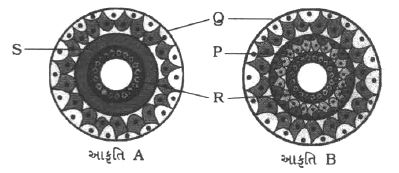
Identify the correct labeling for the given figure $B$.
A
$P - \text{Mesoglea}, Q - \text{Ectoderm}, R - \text{Endoderm}$
B
$P - \text{Mesoderm}, Q - \text{Ectoderm}, R - \text{Endoderm}$
C
$P - \text{Mesoderm}, Q - \text{Endoderm}, R - \text{Ectoderm}$
D
$P - \text{Mesoglea}, Q - \text{Endoderm}, R - \text{Ectoderm}$
Solution
(B) The figure shows the cross-section of two types of animals based on germ layers.
Figure $A$ represents a diploblastic animal, where $S$ is the mesoglea (an undifferentiated layer between the ectoderm and endoderm).
Figure $B$ represents a triploblastic animal, where $P$ is the mesoderm (the middle germ layer), $Q$ is the ectoderm (the outer germ layer), and $R$ is the endoderm (the inner germ layer).
Therefore, the correct labeling for figure $B$ is $P - \text{Mesoderm}, Q - \text{Ectoderm}, R - \text{Endoderm}$.
Figure $A$ represents a diploblastic animal, where $S$ is the mesoglea (an undifferentiated layer between the ectoderm and endoderm).
Figure $B$ represents a triploblastic animal, where $P$ is the mesoderm (the middle germ layer), $Q$ is the ectoderm (the outer germ layer), and $R$ is the endoderm (the inner germ layer).
Therefore, the correct labeling for figure $B$ is $P - \text{Mesoderm}, Q - \text{Ectoderm}, R - \text{Endoderm}$.
0 likes
View Solution81
EasyMCQ
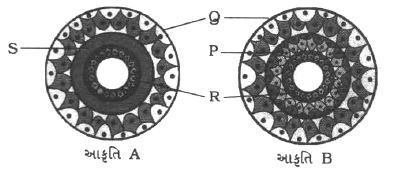
In which animals is the germinal layer organization shown in figure $B$ observed?
A
Planaria
B
Spongilla
C
Jellyfish
D
Sea anemone
Solution
(A) Figure $A$ represents diploblastic organization,where two germinal layers (ectoderm and endoderm) are present with an undifferentiated mesoglea in between. This is characteristic of Phylum Cnidaria (e.g.,Jellyfish,Sea anemone).
Figure $B$ represents triploblastic organization,where three germinal layers (ectoderm,mesoderm,and endoderm) are present. This is characteristic of animals from Phylum Platyhelminthes to Chordata.
Among the given options,Planaria is a member of Phylum Platyhelminthes,which is triploblastic. Spongilla (Porifera),Jellyfish (Cnidaria),and Sea anemone (Cnidaria) are either diploblastic or lack true tissue organization.
Figure $B$ represents triploblastic organization,where three germinal layers (ectoderm,mesoderm,and endoderm) are present. This is characteristic of animals from Phylum Platyhelminthes to Chordata.
Among the given options,Planaria is a member of Phylum Platyhelminthes,which is triploblastic. Spongilla (Porifera),Jellyfish (Cnidaria),and Sea anemone (Cnidaria) are either diploblastic or lack true tissue organization.
0 likes
View Solution82
EasyMCQ
What is the basis of animal classification?
A
Shape,form,and size.
B
Level of organization and symmetry.
C
Coelom and germ layers.
D
All of the above.
Solution
(D) The classification of animals is based on several fundamental features,which include:
$1$. Levels of organization (cellular,tissue,organ,organ system).
$2$. Body symmetry (asymmetry,radial,bilateral).
$3$. Presence or absence of a body cavity (coelom).
$4$. Number of germ layers (diploblastic or triploblastic).
$5$. Patterns of digestive,circulatory,or reproductive systems.
Since options $A$,$B$,and $C$ are all fundamental criteria used in the classification of the animal kingdom,the correct answer is $D$.
$1$. Levels of organization (cellular,tissue,organ,organ system).
$2$. Body symmetry (asymmetry,radial,bilateral).
$3$. Presence or absence of a body cavity (coelom).
$4$. Number of germ layers (diploblastic or triploblastic).
$5$. Patterns of digestive,circulatory,or reproductive systems.
Since options $A$,$B$,and $C$ are all fundamental criteria used in the classification of the animal kingdom,the correct answer is $D$.
0 likes
View Solution83
MediumMCQ
Identify the correct sequence of various levels of organization observed in members of the Kingdom $Animalia$.
A
Cellular level $\rightarrow$ Tissue level $\rightarrow$ Organ level $\rightarrow$ Organ system level
B
Cellular level $\rightarrow$ Tissue level $\rightarrow$ Organ system level $\rightarrow$ Organ level
C
Tissue level $\rightarrow$ Cellular level $\rightarrow$ Organ level $\rightarrow$ Organ system level
D
Organ system level $\rightarrow$ Organ level $\rightarrow$ Tissue level $\rightarrow$ Cellular level
Solution
(A) The classification of the Kingdom $Animalia$ is based on the complexity of body organization.
$1$. The simplest level is the $Cellular$ level (e.g.,$Porifera$).
$2$. As complexity increases,cells performing similar functions aggregate to form the $Tissue$ level (e.g.,$Coelenterata$).
$3$. Further complexity leads to the formation of the $Organ$ level (e.g.,$Platyhelminthes$).
$4$. The most complex level is the $Organ$ $system$ level (e.g.,$Aschelminthes$ to $Chordata$).
Therefore,the correct sequence is $Cellular$ level $\rightarrow$ $Tissue$ level $\rightarrow$ $Organ$ level $\rightarrow$ $Organ$ $system$ level.
$1$. The simplest level is the $Cellular$ level (e.g.,$Porifera$).
$2$. As complexity increases,cells performing similar functions aggregate to form the $Tissue$ level (e.g.,$Coelenterata$).
$3$. Further complexity leads to the formation of the $Organ$ level (e.g.,$Platyhelminthes$).
$4$. The most complex level is the $Organ$ $system$ level (e.g.,$Aschelminthes$ to $Chordata$).
Therefore,the correct sequence is $Cellular$ level $\rightarrow$ $Tissue$ level $\rightarrow$ $Organ$ level $\rightarrow$ $Organ$ $system$ level.
0 likes
View Solution84
EasyMCQ
Statement $X$: The body of the animal is divided into identical radial parts from the central axis.
Reason $Y$: Animals possess bilateral symmetry.
Reason $Y$: Animals possess bilateral symmetry.
A
Reason $Y$ is incorrect for Statement $X$.
B
Reason $Y$ is correct for Statement $X$.
C
Statement $X$ is correct for Reason $Y$.
D
Both Statement $X$ and Reason $Y$ are incorrect.
Solution
(A) Statement $X$ describes radial symmetry,where the body can be divided into identical halves by any plane passing through the central axis.
Reason $Y$ states that animals possess bilateral symmetry,which is a different type of body organization where the body can be divided into identical left and right halves only through a single plane.
Since radial symmetry and bilateral symmetry are mutually exclusive types of body symmetry,Reason $Y$ is incorrect as an explanation for Statement $X$.
Reason $Y$ states that animals possess bilateral symmetry,which is a different type of body organization where the body can be divided into identical left and right halves only through a single plane.
Since radial symmetry and bilateral symmetry are mutually exclusive types of body symmetry,Reason $Y$ is incorrect as an explanation for Statement $X$.
0 likes
View Solution85
EasyMCQ
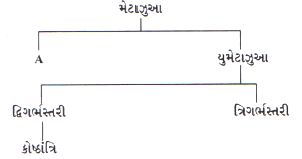
Which level of organization is observed at $A$ in the given chart?
A
Tissue level
B
Germinal layer level
C
Organ level
D
Cellular level
Solution
(D) In the classification of the animal kingdom,Metazoa is divided into two groups based on the level of organization: Parazoa and Eumetazoa.
$A$ represents Parazoa,which includes organisms like sponges (Porifera).
Organisms in the group Parazoa exhibit a cellular level of organization,where cells are arranged as loose cell aggregates and do not form tissues.
Therefore,the correct option is $D$.
$A$ represents Parazoa,which includes organisms like sponges (Porifera).
Organisms in the group Parazoa exhibit a cellular level of organization,where cells are arranged as loose cell aggregates and do not form tissues.
Therefore,the correct option is $D$.
0 likes
View Solution86
MediumMCQ
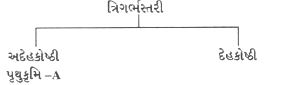
In the given chart,which layer of the $A$ group decomposes to form a cavity?
A
Ectoderm
B
Mesoderm
C
Endoderm
D
Notochord
Solution
(B) In triploblastic animals,the body cavity or coelom is a cavity lined by the mesoderm.
In acoelomates (like Platyhelminthes,represented by $A$),the mesoderm is present as a solid mass between the ectoderm and endoderm,and no cavity is formed.
However,the question asks about the layer that,if it were to decompose or split,would form a cavity.
In the development of a true coelom,the mesoderm splits to form the coelomic cavity.
Therefore,the mesoderm is the layer associated with the formation of the body cavity.
In acoelomates (like Platyhelminthes,represented by $A$),the mesoderm is present as a solid mass between the ectoderm and endoderm,and no cavity is formed.
However,the question asks about the layer that,if it were to decompose or split,would form a cavity.
In the development of a true coelom,the mesoderm splits to form the coelomic cavity.
Therefore,the mesoderm is the layer associated with the formation of the body cavity.
0 likes
View Solution87
EasyMCQ
Which of the following kingdoms consists of organisms that lack a cell wall in their cells?
A
Fungi
B
Animalia
C
Monera
D
Plantae
Solution
(B) In the $5$-kingdom classification system,the kingdom $Animalia$ consists of organisms that are multicellular,eukaryotic,and heterotrophic. $A$ defining characteristic of $Animalia$ is that their cells lack a cell wall. In contrast,$Fungi$ have cell walls made of chitin,$Monera$ have cell walls made of peptidoglycan,and $Plantae$ have cell walls made of cellulose.
0 likes
View Solution88
EasyMCQ
Which members are included in the Kingdom Animalia?
A
Multicellular, Eukaryotic
B
Aquatic heterotrophic, Eukaryotic
C
Terrestrial heterotrophic, Eukaryotic
D
All of the above
Solution
(D) Kingdom $Animalia$ consists of organisms that are $multicellular$ and $eukaryotic$.
These organisms are $heterotrophic$, meaning they depend on other organisms for food.
They can be found in various habitats, including $aquatic$ (water) and $terrestrial$ (land) environments.
Therefore, all the given characteristics describe members of the Kingdom $Animalia$.
These organisms are $heterotrophic$, meaning they depend on other organisms for food.
They can be found in various habitats, including $aquatic$ (water) and $terrestrial$ (land) environments.
Therefore, all the given characteristics describe members of the Kingdom $Animalia$.
0 likes
View Solution89
MediumMCQ
Which of the following kingdoms is characterized by the absence of a cell wall?
A
Plantae
B
Animalia
C
Fungi
D
Monera
Solution
(B) In the $5$-kingdom classification system,the kingdom $Animalia$ consists of multicellular,eukaryotic organisms that lack a cell wall.
$Plantae$ have a cell wall made of cellulose.
$Fungi$ have a cell wall made of chitin.
$Monera$ (bacteria) possess a cell wall made of peptidoglycan.
Therefore,the correct answer is $Animalia$.
$Plantae$ have a cell wall made of cellulose.
$Fungi$ have a cell wall made of chitin.
$Monera$ (bacteria) possess a cell wall made of peptidoglycan.
Therefore,the correct answer is $Animalia$.
0 likes
View Solution90
EasyMCQ
It is a cavity between the body wall and the gut wall.
A
Notochord
B
Coelom
C
Lumen of digestive tract
D
Ostia
Solution
(B) The $Coelom$ is defined as the body cavity which is lined by mesoderm. It is situated between the body wall and the gut wall. The presence or absence of this cavity is a very important criterion for classification of animals.
0 likes
View Solution91
MediumMCQ
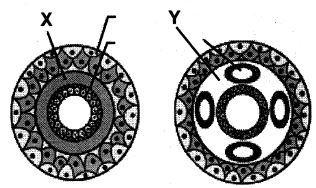
Identify $X$ and $Y$ in the given diagrams representing body cavities.
A
Ectoderm - Coelom
B
Mesoglea - Pseudocoelom
C
Coelom - Pseudocoelom
D
Ectoderm - Mesoderm
Solution
(C) In the provided diagrams,the first figure shows a body cavity completely lined by mesoderm,which is characteristic of a true coelom $(X)$.
The second figure shows a body cavity where the mesoderm is present as scattered pouches between the ectoderm and endoderm,which is characteristic of a pseudocoelom $(Y)$.
Therefore,$X$ represents Coelom and $Y$ represents Pseudocoelom.
The second figure shows a body cavity where the mesoderm is present as scattered pouches between the ectoderm and endoderm,which is characteristic of a pseudocoelom $(Y)$.
Therefore,$X$ represents Coelom and $Y$ represents Pseudocoelom.
0 likes
View Solution92
MediumMCQ
What does the term $Asymmetrical$ mean in the context of animal body organization?
A
When any plane passing through the central axis of the body divides the organism into two identical halves.
B
Any plane that passes through the center does not divide the body into two equal halves.
C
Where the body can be divided into identical left and right halves in only one plane.
D
None of these.
Solution
(B) In biology,$Asymmetry$ refers to an organism that lacks a definite body plan or symmetry.
This means that no plane passing through the center of the body can divide the organism into two identical or mirror-image halves.
Examples of asymmetrical organisms include most sponges $(Porifera)$.
This means that no plane passing through the center of the body can divide the organism into two identical or mirror-image halves.
Examples of asymmetrical organisms include most sponges $(Porifera)$.
0 likes
View Solution93
MediumMCQ
$A$ coelom is a
A
cavity between inner and outer gut wall
B
body cavity lined by mesoderm
C
body cavity not lined by mesoderm
D
body cavity lined by endoderm
Solution
(B) coelom is defined as a body cavity that is lined by the mesoderm.
In triploblastic animals,the presence or absence of a cavity between the body wall and the gut wall is very important in classification.
$A$ body cavity which is lined by mesoderm is called coelom.
Animals possessing coelom are called coelomates (e.g.,annelids,molluscs,arthropods,echinoderms,hemichordates,and chordates).
In triploblastic animals,the presence or absence of a cavity between the body wall and the gut wall is very important in classification.
$A$ body cavity which is lined by mesoderm is called coelom.
Animals possessing coelom are called coelomates (e.g.,annelids,molluscs,arthropods,echinoderms,hemichordates,and chordates).
0 likes
View Solution94
MediumMCQ
Animals are classified on the basis of which of the following features?
$I$. Coelomic cavity
$II$. Level of organisation
$III$. Notochord
$IV$. Skeletal structure
$I$. Coelomic cavity
$II$. Level of organisation
$III$. Notochord
$IV$. Skeletal structure
A
$I$ and $II$
B
$I$ and $III$
C
$I, II$ and $III$
D
$II$ and $IV$
Solution
(C) The classification of animals is based on various fundamental features such as:
$1$. Levels of organisation (Cellular,Tissue,Organ,Organ-system level).
$2$. Symmetry (Radial or Bilateral).
$3$. Diploblastic and triploblastic organisation.
$4$. Coelom (Presence or absence of a body cavity).
$5$. Segmentation.
$6$. Notochord (Presence or absence).
Among the given options,$I$ (Coelomic cavity),$II$ (Level of organisation),and $III$ (Notochord) are fundamental criteria used for the classification of animals in the $NCERT$ textbook. Skeletal structure is not considered a primary taxonomic criterion for broad animal classification. Therefore,the correct combination is $I, II$ and $III$.
$1$. Levels of organisation (Cellular,Tissue,Organ,Organ-system level).
$2$. Symmetry (Radial or Bilateral).
$3$. Diploblastic and triploblastic organisation.
$4$. Coelom (Presence or absence of a body cavity).
$5$. Segmentation.
$6$. Notochord (Presence or absence).
Among the given options,$I$ (Coelomic cavity),$II$ (Level of organisation),and $III$ (Notochord) are fundamental criteria used for the classification of animals in the $NCERT$ textbook. Skeletal structure is not considered a primary taxonomic criterion for broad animal classification. Therefore,the correct combination is $I, II$ and $III$.
0 likes
View Solution95
MediumMCQ
Radial symmetry is generally exhibited by animals that have:
A
$A$ single opening for the digestive tract
B
An aquatic habitat
C
$A$ benthic/sessile lifestyle
D
Ciliary mode of feeding
Solution
(C) Radial symmetry is a type of body plan where an organism can be divided into identical halves by any plane passing through the central axis. This type of symmetry is commonly found in organisms that are sessile (attached to a substrate) or free-floating,such as Cnidarians (e.g.,Hydra,Jellyfish) and adult Echinoderms. $A$ sessile or benthic lifestyle allows the organism to interact with its environment from all directions,making radial symmetry an evolutionary advantage for such animals.
0 likes
View Solution96
MediumMCQ
Organisms attached to a substratum generally possess:
A
Radial symmetry
B
$A$ single opening for the digestive tract
C
Asymmetrical body organization
D
Surface cilia to create water currents
Solution
(A) Organisms that are sessile (attached to a substratum) often exhibit radial symmetry. This type of symmetry allows the organism to detect food or threats from any direction in their environment,which is advantageous for a stationary lifestyle. Examples include members of the phylum Cnidaria (like sea anemones) and Echinodermata (adults). Therefore,radial symmetry is a common feature associated with a sessile mode of life.
0 likes
View Solution97
MediumMCQ
Radial symmetry is generally associated with ............ .
A
Aquatic mode of life
B
Lower level of organization
C
Creeping mode of locomotion
D
Sessile mode of life
Solution
(D) Radial symmetry is a body plan in which the body can be divided into identical halves by any plane passing through the central axis.
This type of symmetry is typically found in organisms that are sessile (attached to a substrate) or free-floating,such as Cnidarians and adult Echinoderms.
Because these organisms do not move actively in a specific direction,radial symmetry allows them to detect food or threats from any direction in their environment.
Therefore,it is generally associated with a sessile mode of life.
This type of symmetry is typically found in organisms that are sessile (attached to a substrate) or free-floating,such as Cnidarians and adult Echinoderms.
Because these organisms do not move actively in a specific direction,radial symmetry allows them to detect food or threats from any direction in their environment.
Therefore,it is generally associated with a sessile mode of life.
0 likes
View Solution98
MediumMCQ
$A$ true coelom is a body cavity which is lined by layers of ............ on both sides.
A
Ectoderm on both sides
B
Endoderm on one side and ectoderm on the other side
C
Mesoderm on one side and ectoderm on the other side
D
Mesoderm on both sides
Solution
(D) true coelom is defined as a body cavity that is completely lined by the mesoderm on all sides.
In triploblastic animals,the mesoderm splits to form the coelomic cavity.
This cavity is lined by the parietal peritoneum (derived from mesoderm) on the body wall side and the visceral peritoneum (derived from mesoderm) on the gut wall side.
Therefore,the correct answer is that it is lined by mesoderm on both sides.
In triploblastic animals,the mesoderm splits to form the coelomic cavity.
This cavity is lined by the parietal peritoneum (derived from mesoderm) on the body wall side and the visceral peritoneum (derived from mesoderm) on the gut wall side.
Therefore,the correct answer is that it is lined by mesoderm on both sides.
0 likes
View Solution99
EasyMCQ
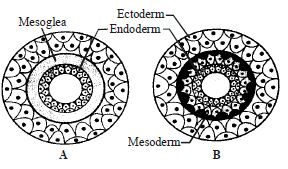
The above diagram shows the germ layers. The animals having structures shown in the figures $A$ and $B$ are respectively called:
A
Diploblastic,Triploblastic
B
Triploblastic,Diploblastic
C
Diploblastic,Diploblastic
D
Triploblastic,Triploblastic
Solution
(A) Figure $A$ shows two germinal layers: an outer ectoderm and an inner endoderm,with an undifferentiated layer called mesoglea in between. Animals with this organization are called Diploblastic (e.g.,Coelenterata).
Figure $B$ shows three germinal layers: an outer ectoderm,a middle mesoderm,and an inner endoderm. Animals with this organization are called Triploblastic (e.g.,Platyhelminthes to Chordata).
Figure $B$ shows three germinal layers: an outer ectoderm,a middle mesoderm,and an inner endoderm. Animals with this organization are called Triploblastic (e.g.,Platyhelminthes to Chordata).
0 likes
View Solution100
Easy
Write the main characteristics of Kingdom Animalia.
Solution
(N/A) $\rightarrow$ Kingdom $Animalia$ is characterized by heterotrophic,eukaryotic organisms that are multicellular,and their cells lack cell walls.
$\rightarrow$ They directly or indirectly depend on plants for food.
$\rightarrow$ They digest their food in an internal cavity and store food reserves as glycogen or fat.
$\rightarrow$ Their mode of nutrition is holozoic by ingestion of food.
$\rightarrow$ They follow a definite growth pattern and grow into adults that have a definite shape and size.
$\rightarrow$ Higher forms show elaborate sensory and neuromotor mechanisms.
$\rightarrow$ Most of them are capable of locomotion.
$\rightarrow$ Sexual reproduction is by copulation of male and female,followed by embryological development.
$\rightarrow$ They directly or indirectly depend on plants for food.
$\rightarrow$ They digest their food in an internal cavity and store food reserves as glycogen or fat.
$\rightarrow$ Their mode of nutrition is holozoic by ingestion of food.
$\rightarrow$ They follow a definite growth pattern and grow into adults that have a definite shape and size.
$\rightarrow$ Higher forms show elaborate sensory and neuromotor mechanisms.
$\rightarrow$ Most of them are capable of locomotion.
$\rightarrow$ Sexual reproduction is by copulation of male and female,followed by embryological development.
0 likes
View SolutionAnimal Kingdom — Basic of classification · Frequently Asked Questions
1Are these Animal Kingdom questions useful for JEE and NEET?
Yes. All questions in this section are mapped to JEE Main and NEET exam patterns. Previous year questions from JEE Main, NEET, GUJCET and state-level exams are included with full solutions.
2Can I switch to Hindi or Gujarati for these questions?
Yes. Use the language tabs in the hero section or the sidebar to view the same questions and solutions in English, Hindi or Gujarati.
3How do I generate a question paper from this subtopic?
Use the Vedclass Exam Paper Generator — select the chapter and subtopic, set difficulty, and generate Sets A, B, C, D automatically. First 3 chapters of every subject are free.
Vedclass Products
For Students
Vedclass Test Series
Mock tests in real JEE/NEET style with performance analysis. 5-day free trial.
Start Free TrialFor Teachers
Exam Paper Generator
Generate Set A/B/C/D papers from this chapter in 2 minutes. 3 chapters free.
Try FreeFor Institutes
Online Exam Module
Live online exams with unlimited students, 360° analytics & white-label branding.
See DemoFor Teachers & Institutes
Generate a Animal Kingdom Exam Paper in 2 Minutes
Select subtopic & difficulty — Sets A, B, C, D auto-generated with No Repeat logic.
First 3 chapters of every subject are free — no payment required.