
A English
The tissue system Questions in English
Class 11 Biology · Anatomy of Flowering Plants · The tissue system
150+
Questions
English
Language
100%
With Solutions
Showing 50 of 150 questions in English
101
MediumMCQ
Select the correct option for the following statements:
$(i)$ The vessel element is made up of cells arranged one above the other.
$(ii)$ When xylem and phloem are arranged together on the same radius,it is called a conjoint/radial vascular bundle.
$(i)$ The vessel element is made up of cells arranged one above the other.
$(ii)$ When xylem and phloem are arranged together on the same radius,it is called a conjoint/radial vascular bundle.
A
$(i)$ True,$(ii)$ True
B
$(i)$ True,$(ii)$ False
C
$(i)$ False,$(ii)$ True
D
$(i)$ False,$(ii)$ False
Solution
(B) $(i)$ The statement is True. Vessel elements are elongated,lignified cells arranged in a vertical series to form a tube-like structure called a vessel.
$(ii)$ The statement is False. When xylem and phloem are arranged on the same radius,it is called a conjoint vascular bundle. If they are on different radii,it is called a radial vascular bundle.
$(ii)$ The statement is False. When xylem and phloem are arranged on the same radius,it is called a conjoint vascular bundle. If they are on different radii,it is called a radial vascular bundle.
0 likes
View Solution102
EasyMCQ
The stele is composed of
A
Vascular bundle
B
Pericycle,Pith and vascular bundle
C
Cortex and endodermis
D
Pith and cortex
Solution
(B) The stele is defined as all the tissues lying internal to the endodermis. It includes the pericycle,vascular bundles,and the pith (if present).
Therefore,the stele is composed of the pericycle,pith,and vascular bundles.
Therefore,the stele is composed of the pericycle,pith,and vascular bundles.
0 likes
View Solution103
MediumMCQ
Vascular bundle with cambium is called
A
Closed
B
Open
C
Exarch
D
Endarch
Solution
(B) When cambium is present between the phloem and xylem tissue of a vascular bundle,the vascular bundle is called $Open$.
If cambium is absent,the vascular bundle is called $Closed$.
If cambium is absent,the vascular bundle is called $Closed$.
0 likes
View Solution104
EasyMCQ
Which one of the following is well-developed in hydrophytes?
A
Aerenchyma
B
Collenchyma
C
Stomata
D
Root system
Solution
(A) The cortex of hydrophytes is well-developed. $A$ major portion of it is occupied by well-developed,prominent air cavities called aerenchyma,which increase buoyancy and allow for rapid gaseous exchange.
0 likes
View Solution105
MediumMCQ
All the tissues on the inner side of the endodermis together constitute the
A
Vascular bundle
B
Conjunctive tissue
C
Pith
D
Stele
Solution
(D) The tissues on the inner side of the endodermis include the pericycle,vascular bundles,and pith. Collectively,these tissues are known as the stele.
0 likes
View Solution106
MediumMCQ
Desert grasses often roll their leaves due to the presence of:
A
Oily surface
B
Bulliform cells
C
Spines
D
None of these
Solution
(B) Desert grasses often roll their leaves due to the presence of bulliform cells.
These are large,thin-walled,and vacuolated cells found in the upper epidermis of the leaves of grasses.
When water stress occurs,these cells lose turgidity,causing the leaves to curl or roll inward to minimize water loss through transpiration.
These are large,thin-walled,and vacuolated cells found in the upper epidermis of the leaves of grasses.
When water stress occurs,these cells lose turgidity,causing the leaves to curl or roll inward to minimize water loss through transpiration.
0 likes
View Solution107
MediumMCQ
Pith is a central part of the ground tissues generally made up of
A
Parenchyma
B
Collenchyma
C
Chlorenchyma
D
Sclerenchyma
Solution
(A) The pith,also known as the medulla,forms the central region of the stem and root.
It is composed of thin-walled cells with intercellular spaces.
In most dicotyledonous stems,the pith is primarily composed of parenchyma cells.
These cells are responsible for the storage of food and water.
It is composed of thin-walled cells with intercellular spaces.
In most dicotyledonous stems,the pith is primarily composed of parenchyma cells.
These cells are responsible for the storage of food and water.
0 likes
View Solution108
MediumMCQ
Subsidiary cells are the specialised cells in the
A
Vicinity of guard cells
B
Vicinity of stomatal cells
C
Absence of stomatal cells
D
Absence of guard cells
Solution
(A) Sometimes,a few epidermal cells in the vicinity of the guard cells become specialised in their shape and size and are known as subsidiary cells.
0 likes
View Solution109
EasyMCQ
$A$ vascular bundle in which two patches of phloem are present on both sides of the xylem is called:
A
Collateral
B
Bicollateral
C
Concentric
D
Radial
Solution
(B) Vascular bundles that possess both xylem and phloem are called conjoint vascular bundles.
In a bicollateral conjoint vascular bundle,phloem is present on both the outer and inner sides of the xylem.
This type of arrangement is characteristic of the family Cucurbitaceae,for example,in $Cucurbita$.
In a bicollateral conjoint vascular bundle,phloem is present on both the outer and inner sides of the xylem.
This type of arrangement is characteristic of the family Cucurbitaceae,for example,in $Cucurbita$.
0 likes
View Solution110
MediumMCQ
In leaves,the ground tissue consists of
A
Epidermis
B
Vascular tissue
C
Mesophyll cells
D
Medullary rays
Solution
(C) The ground tissue system encompasses all tissues of the plant body except the epidermis and the vascular bundles.
In leaves,the ground tissue is specialized for photosynthesis and is known as the mesophyll.
Mesophyll consists of thin-walled chloroplast-containing cells,which are differentiated into two types: palisade parenchyma and spongy parenchyma.
In leaves,the ground tissue is specialized for photosynthesis and is known as the mesophyll.
Mesophyll consists of thin-walled chloroplast-containing cells,which are differentiated into two types: palisade parenchyma and spongy parenchyma.
0 likes
View Solution111
MediumMCQ
$A$ vascular bundle without pith is
A
Protostele
B
Siphonostele
C
Solenostele
D
None of these
Solution
(A) The stele without pith is known as a protostele.
Protostele is considered the most primitive type of stele.
It consists of a solid central core of xylem,which is surrounded by phloem and pericycle.
Protostele is considered the most primitive type of stele.
It consists of a solid central core of xylem,which is surrounded by phloem and pericycle.
0 likes
View Solution112
EasyMCQ
Simple sieve plate with single perforation is present in
A
Cucurbita
B
Prunus
C
Pyrus
D
Vitis
Solution
(A) In phloem,sieve tubes possess perforated oblique or transverse sieve plates.
Sieve plates are classified as simple when they consist of a single region of pores (e.g.,$Cucurbita$,$Nicotiana$).
They are classified as compound when they consist of several pored regions separated by bars or wall thickenings (e.g.,$Vitis$).
Sieve plates are classified as simple when they consist of a single region of pores (e.g.,$Cucurbita$,$Nicotiana$).
They are classified as compound when they consist of several pored regions separated by bars or wall thickenings (e.g.,$Vitis$).
0 likes
View Solution113
MediumMCQ
$I.$ Protection of internal tissues
$II.$ Protection of leaves from microbes
$III.$ Gaseous exchange
$IV.$ Reduction in the rate of transpiration through epidermal cells due to trichomes
Which of the functions of the epidermis is/are relevant from the above-given statements?
$II.$ Protection of leaves from microbes
$III.$ Gaseous exchange
$IV.$ Reduction in the rate of transpiration through epidermal cells due to trichomes
Which of the functions of the epidermis is/are relevant from the above-given statements?
A
Only $II$
B
$I$ and $II$
C
$II$ and $III$
D
$I, II, III$ and $IV$
Solution
(D) The epidermis is the outermost layer of the primary plant body.
$I.$ It provides protection to the underlying internal tissues.
$II.$ The cuticle and epidermal structures protect leaves from microbes and mechanical injury.
$III.$ Stomata,which are present in the epidermis,facilitate gaseous exchange.
$IV.$ Trichomes (epidermal hairs) help in reducing the rate of transpiration by creating a microclimate and reflecting sunlight.
Therefore,all the given statements are correct functions of the epidermis.
$I.$ It provides protection to the underlying internal tissues.
$II.$ The cuticle and epidermal structures protect leaves from microbes and mechanical injury.
$III.$ Stomata,which are present in the epidermis,facilitate gaseous exchange.
$IV.$ Trichomes (epidermal hairs) help in reducing the rate of transpiration by creating a microclimate and reflecting sunlight.
Therefore,all the given statements are correct functions of the epidermis.
0 likes
View Solution114
EasyMCQ
$A$ vascular bundle having phloem at the centre encircled by xylem is known as:
A
Bicollateral
B
Conjoint collateral
C
Amphivasal
D
Amphicribral
Solution
(C) In a concentric vascular bundle,when the phloem is located at the center and is completely surrounded by xylem,it is known as an amphivasal or leptocentric vascular bundle.
This type of vascular bundle is typically observed in monocotyledonous plants such as $Dracaena$,$Yucca$,and $Aloe$.
This type of vascular bundle is typically observed in monocotyledonous plants such as $Dracaena$,$Yucca$,and $Aloe$.
0 likes
View Solution115
MediumMCQ
$I.$ Phloem transports the food materials usually from the leaves to other parts of the plant.
$II.$ Phloem in the angiosperm is composed of sieve tube elements,companion cells,phloem parenchyma,and phloem fibres.
Identify which of the following statements is correct and select the correct option.
$II.$ Phloem in the angiosperm is composed of sieve tube elements,companion cells,phloem parenchyma,and phloem fibres.
Identify which of the following statements is correct and select the correct option.
A
$I$ and $II$ are correct
B
$I$ and $II$ are incorrect
C
$I$ is correct,but $II$ is incorrect
D
$II$ is correct,but $I$ is incorrect
Solution
(A) Statement $I$ is correct: Phloem is the vascular tissue responsible for the translocation of food (sucrose) from the source (leaves) to the sink (other parts of the plant).
Statement $II$ is correct: In angiosperms,the phloem consists of four main components: sieve tube elements,companion cells,phloem parenchyma,and phloem fibres. Gymnosperms,on the other hand,lack sieve tubes and companion cells,possessing sieve cells and albuminous cells instead.
Statement $II$ is correct: In angiosperms,the phloem consists of four main components: sieve tube elements,companion cells,phloem parenchyma,and phloem fibres. Gymnosperms,on the other hand,lack sieve tubes and companion cells,possessing sieve cells and albuminous cells instead.
0 likes
View Solution116
MediumMCQ
Choose the incorrect statement.
A
Medullary rays connect the pith with pericycle and cortex.
B
Medullary rays make intimate contact with the conducting cells of both phloem and xylem.
C
Medullary rays help in radial conduction.
D
None of the above.
Solution
(D) Medullary rays,also known as pith rays,are radial strips of parenchyma cells located between adjacent vascular bundles.
They connect the pith with the pericycle and cortex.
These ray cells establish intimate contact with the conducting cells of both xylem and phloem through pits.
Medullary rays facilitate the radial conduction of food and water.
They also transport gases from the pith to the cortex and vice-versa.
Since all the given statements are correct,the correct answer is $D$.
They connect the pith with the pericycle and cortex.
These ray cells establish intimate contact with the conducting cells of both xylem and phloem through pits.
Medullary rays facilitate the radial conduction of food and water.
They also transport gases from the pith to the cortex and vice-versa.
Since all the given statements are correct,the correct answer is $D$.
0 likes
View Solution117
MediumMCQ
Select the correct statements.
$I.$ Epidermal cells have a small amount of cytoplasm and a large vacuole.
$II.$ $A$ waxy layer,the cuticle,is absent in roots.
$III.$ Root hairs are unicellular,while stem hairs/trichomes are multicellular.
$IV.$ Trichomes are branched/unbranched,soft/stiff,and secretory or transpiration-preventive.
$V.$ Guard cells are dumb-bell-shaped in monocots (e.g.,grass) and bean-shaped in dicots.
$I.$ Epidermal cells have a small amount of cytoplasm and a large vacuole.
$II.$ $A$ waxy layer,the cuticle,is absent in roots.
$III.$ Root hairs are unicellular,while stem hairs/trichomes are multicellular.
$IV.$ Trichomes are branched/unbranched,soft/stiff,and secretory or transpiration-preventive.
$V.$ Guard cells are dumb-bell-shaped in monocots (e.g.,grass) and bean-shaped in dicots.
A
All except $I$ and $II$
B
All except $III$
C
All except $II$ and $IV$
D
All except $V$
Solution
(D) The correct statements are $I, II, III,$ and $IV$. Statement $V$ is incorrect because the shapes are reversed.
$I.$ Epidermal cells are elongated,compactly arranged,and possess a small amount of cytoplasm with a large central vacuole.
$II.$ The epidermis is often covered with a waxy,thick layer called the cuticle,which prevents water loss. This layer is absent in roots.
$III.$ Root hairs are unicellular elongations of epidermal cells that help in water absorption. Trichomes (stem hairs) are multicellular elongations of the epidermis that help in preventing water loss.
$IV.$ Trichomes can be branched or unbranched,soft or stiff,and may be secretory or help in preventing transpiration.
$V.$ In grasses (monocots),guard cells are dumb-bell-shaped,whereas in dicots (e.g.,bean,pea),they are bean or kidney-shaped. Since the statement claims the opposite,it is incorrect.
$I.$ Epidermal cells are elongated,compactly arranged,and possess a small amount of cytoplasm with a large central vacuole.
$II.$ The epidermis is often covered with a waxy,thick layer called the cuticle,which prevents water loss. This layer is absent in roots.
$III.$ Root hairs are unicellular elongations of epidermal cells that help in water absorption. Trichomes (stem hairs) are multicellular elongations of the epidermis that help in preventing water loss.
$IV.$ Trichomes can be branched or unbranched,soft or stiff,and may be secretory or help in preventing transpiration.
$V.$ In grasses (monocots),guard cells are dumb-bell-shaped,whereas in dicots (e.g.,bean,pea),they are bean or kidney-shaped. Since the statement claims the opposite,it is incorrect.
0 likes
View Solution118
EasyMCQ
What is the function of vessels in flowering plants?
A
Transport of food
B
To get rid of excess water
C
Photosynthesis
D
Transport of water and minerals
Solution
(D) Vessels are a type of xylem element involved in the conduction of water and minerals from roots to other parts of the plant.
- Transport of food is the function of phloem.
- Getting rid of excess water is the function of stomata (transpiration).
- Photosynthesis is the function of chloroplasts.
- Transport of food is the function of phloem.
- Getting rid of excess water is the function of stomata (transpiration).
- Photosynthesis is the function of chloroplasts.
0 likes
View Solution119
MediumMCQ
Stomata are the component of
A
Epidermal tissue system
B
Ground tissue system
C
Conducting tissue system
D
Vascular tissue system
Solution
(A) The plant body is composed of three main tissue systems: the epidermal tissue system,the ground tissue system,and the vascular tissue system.
$1$. The epidermal tissue system forms the outermost covering of the whole plant body and comprises epidermal cells,stomata,and epidermal appendages (trichomes and hairs).
$2$. The ground tissue system consists of all tissues except the epidermis and vascular bundles,such as parenchyma,collenchyma,and sclerenchyma.
$3$. The vascular tissue system consists of complex tissues,namely xylem and phloem.
Therefore,stomata are a component of the epidermal tissue system.
$1$. The epidermal tissue system forms the outermost covering of the whole plant body and comprises epidermal cells,stomata,and epidermal appendages (trichomes and hairs).
$2$. The ground tissue system consists of all tissues except the epidermis and vascular bundles,such as parenchyma,collenchyma,and sclerenchyma.
$3$. The vascular tissue system consists of complex tissues,namely xylem and phloem.
Therefore,stomata are a component of the epidermal tissue system.
0 likes
View Solution120
MediumMCQ
The specialised epidermal cells present in the vicinity of guard cells are called
A
Bulliform cells
B
Companion cells
C
Subsidiary cells
D
Mesophyll cells
Solution
(C) The specialised epidermal cells that surround the guard cells are known as subsidiary cells or accessory cells.
Bulliform cells are large,empty,colourless epidermal cells found on the adaxial surface of monocot leaves,which help in the rolling and unrolling of leaves to minimize water loss.
Companion cells are specialised parenchymatous cells associated with sieve tube elements in the phloem.
Mesophyll cells are the photosynthetic cells found between the upper and lower epidermis of a leaf.
Bulliform cells are large,empty,colourless epidermal cells found on the adaxial surface of monocot leaves,which help in the rolling and unrolling of leaves to minimize water loss.
Companion cells are specialised parenchymatous cells associated with sieve tube elements in the phloem.
Mesophyll cells are the photosynthetic cells found between the upper and lower epidermis of a leaf.
0 likes
View Solution121
EasyMCQ
The distinguishing feature of open vascular bundles is the presence of
A
Cambium
B
Xylem and phloem
C
Pericycle
D
Endodermis
Solution
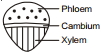
(A) In vascular bundles,the presence of a strip of meristematic tissue called cambium between the xylem and phloem allows for secondary growth. Such vascular bundles are termed as 'open' vascular bundles,which are characteristic of dicotyledonous stems.
0 likes
View Solution122
MediumMCQ
Parenchymatous structure with intercellular spaces is
A
Epidermis
B
Endodermis
C
Cortex
D
Pericycle
Solution
(C) The cortex is the region between the epidermis and the endodermis. It consists of several layers of thin-walled parenchymatous cells with intercellular spaces. These cells are responsible for the storage of food and water.
0 likes
View Solution123
MediumMCQ
Select correct features w.r.t. trichomes in the shoot system:
$(a)$ Usually unicellular
$(b)$ Branched or unbranched
$(c)$ May be secretory
$(d)$ Soft or stiff
$(e)$ Helps against transpiration
$(a)$ Usually unicellular
$(b)$ Branched or unbranched
$(c)$ May be secretory
$(d)$ Soft or stiff
$(e)$ Helps against transpiration
A
$a, b, d$ and $e$
B
All except $c$ and $d$
C
All except $a$
D
$a, c$ and $e$
Solution
(C) Trichomes are epidermal outgrowths on the shoot system.
$(a)$ They are usually multicellular,not unicellular.
$(b)$ They can be branched or unbranched.
$(c)$ They may be secretory in nature.
$(d)$ They can be soft or stiff.
$(e)$ They help in preventing water loss due to transpiration.
Therefore,statements $(b), (c), (d),$ and $(e)$ are correct. The correct option is $C$ (All except $a$).
$(a)$ They are usually multicellular,not unicellular.
$(b)$ They can be branched or unbranched.
$(c)$ They may be secretory in nature.
$(d)$ They can be soft or stiff.
$(e)$ They help in preventing water loss due to transpiration.
Therefore,statements $(b), (c), (d),$ and $(e)$ are correct. The correct option is $C$ (All except $a$).
0 likes
View Solution124
MediumMCQ
Which of the following vascular bundles are always open?
A
Radial
B
Collateral
C
Bicollateral
D
Concentric
Solution
(C) vascular bundle is termed 'open' if it contains cambium between the xylem and phloem,allowing for secondary growth.
Bicollateral vascular bundles are characterized by having phloem on both the outer and inner sides of the xylem,with two strips of cambium present.
Because these two cambium strips are always present in bicollateral bundles,they are always considered 'open' vascular bundles.
Bicollateral vascular bundles are characterized by having phloem on both the outer and inner sides of the xylem,with two strips of cambium present.
Because these two cambium strips are always present in bicollateral bundles,they are always considered 'open' vascular bundles.
0 likes
View Solution125
EasyMCQ
The Casparian strips of the root endodermis are made up of:
A
Suberin
B
Cellulose
C
Chitin
D
Keratin
Solution
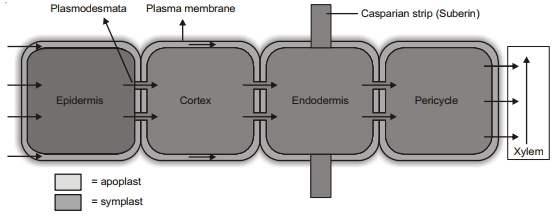
(A) The endodermis is an inner layer of the cortex in plant roots.
It contains a band of water-impermeable,waxy material known as the Casparian strip.
This strip is composed of suberin,a hydrophobic substance that prevents water and solutes from passing through the cell walls (apoplastic pathway),forcing them to enter the cytoplasm (symplastic pathway) to cross the endodermis.
Therefore,the correct answer is Suberin.
It contains a band of water-impermeable,waxy material known as the Casparian strip.
This strip is composed of suberin,a hydrophobic substance that prevents water and solutes from passing through the cell walls (apoplastic pathway),forcing them to enter the cytoplasm (symplastic pathway) to cross the endodermis.
Therefore,the correct answer is Suberin.
0 likes
View Solution126
MediumMCQ
What is present on the surface of the leaves which helps the plant prevent loss of water but is absent in roots?
A
Stomata
B
Cuticle
C
Trichomes
D
Root hairs
Solution
(B) $\Rightarrow$ The cuticle is a waxy,protective layer present on the epidermis of aerial parts of plants,such as leaves and stems.
$\Rightarrow$ Its primary function is to reduce the rate of transpiration,thereby preventing excessive water loss.
$\Rightarrow$ The cuticle is typically absent in roots because roots are underground and do not require protection against desiccation in the same way as aerial parts; instead,they are adapted for water absorption.
$\Rightarrow$ Its primary function is to reduce the rate of transpiration,thereby preventing excessive water loss.
$\Rightarrow$ The cuticle is typically absent in roots because roots are underground and do not require protection against desiccation in the same way as aerial parts; instead,they are adapted for water absorption.
0 likes
View Solution127
MediumMCQ
What is the epidermal cell modification in plants that prevents water loss?
A
Bulliform cells
B
Guard cells
C
Trichomes
D
Root hairs
Solution
(A) The epidermal cell modification that helps in preventing water loss is known as $Bulliform$ cells.
These are large,bubble-shaped epidermal cells present in the upper epidermis of leaves in many monocotyledonous plants,such as grasses.
During water stress,these cells lose water and become flaccid,which causes the leaves to curl inwards,thereby reducing the exposed surface area and minimizing water loss through transpiration.
These are large,bubble-shaped epidermal cells present in the upper epidermis of leaves in many monocotyledonous plants,such as grasses.
During water stress,these cells lose water and become flaccid,which causes the leaves to curl inwards,thereby reducing the exposed surface area and minimizing water loss through transpiration.
0 likes
View Solution128
MediumMCQ
Which of the following is $NOT$ a characteristic of a tissue?
A
$A$ group of cells having a common origin.
B
$A$ group of cells performing a common function.
C
Plants have different types of tissues.
D
Plants are classified into three main groups.
Solution
(D) tissue is defined as a group of cells having a common origin and usually performing a common function.
Option $A$ is a correct definition of a tissue.
Option $B$ is also a correct characteristic of a tissue.
Option $C$ is a true statement regarding plant anatomy.
Option $D$ is incorrect as a definition or characteristic of a tissue; it refers to the classification of plant tissues (meristematic,simple,and complex),not the definition of a tissue itself.
Therefore,option $D$ is the correct answer.
Option $A$ is a correct definition of a tissue.
Option $B$ is also a correct characteristic of a tissue.
Option $C$ is a true statement regarding plant anatomy.
Option $D$ is incorrect as a definition or characteristic of a tissue; it refers to the classification of plant tissues (meristematic,simple,and complex),not the definition of a tissue itself.
Therefore,option $D$ is the correct answer.
0 likes
View Solution129
MediumMCQ
How many of the following structures are associated with the conduction of water?
Tracheids,Xylem parenchyma,Xylem fibers,Vessels
Tracheids,Xylem parenchyma,Xylem fibers,Vessels
A
$1$
B
$2$
C
$3$
D
$4$
Solution
(B) The xylem tissue in flowering plants is composed of four types of elements: Tracheids,Vessels,Xylem parenchyma,and Xylem fibers.
$1$. Tracheids: These are elongated,tube-like cells with thick,lignified walls and tapering ends. They are the primary water-conducting elements in gymnosperms and are also present in angiosperms.
$2$. Vessels: These are long,cylindrical,tube-like structures made up of many cells called vessel members. They are the main water-conducting elements in angiosperms.
$3$. Xylem parenchyma: These are living cells that store food materials (starch or fat) and assist in the short-distance transport of water.
$4$. Xylem fibers: These are highly thickened,dead cells that provide mechanical support to the plant.
Out of these,Tracheids and Vessels are the primary elements responsible for the long-distance conduction of water. Therefore,there are $2$ such structures.
$1$. Tracheids: These are elongated,tube-like cells with thick,lignified walls and tapering ends. They are the primary water-conducting elements in gymnosperms and are also present in angiosperms.
$2$. Vessels: These are long,cylindrical,tube-like structures made up of many cells called vessel members. They are the main water-conducting elements in angiosperms.
$3$. Xylem parenchyma: These are living cells that store food materials (starch or fat) and assist in the short-distance transport of water.
$4$. Xylem fibers: These are highly thickened,dead cells that provide mechanical support to the plant.
Out of these,Tracheids and Vessels are the primary elements responsible for the long-distance conduction of water. Therefore,there are $2$ such structures.
0 likes
View Solution130
MediumMCQ
The xylem provides mechanical strength to the plant. Which of the following components is responsible for this function?
A
Xylem vessel
B
Tracheid
C
Xylem fiber
D
Xylem parenchyma
Solution
(C) The xylem tissue consists of four types of elements: xylem vessels,tracheids,xylem fibers,and xylem parenchyma.
Among these,xylem fibers (also known as wood fibers) are highly lignified,dead cells that provide mechanical support and strength to the plant body.
While tracheids and vessels also provide some structural support,the primary function of providing mechanical strength is attributed to the xylem fibers.
Among these,xylem fibers (also known as wood fibers) are highly lignified,dead cells that provide mechanical support and strength to the plant body.
While tracheids and vessels also provide some structural support,the primary function of providing mechanical strength is attributed to the xylem fibers.
0 likes
View Solution131
DifficultMCQ
The ground tissue system is equal to $...........$
A
Organ $-$ Epidermis $-$ Vascular tissue
B
Organ $-$ Epidermis $+$ Vascular tissue
C
Organ $+$ Epidermis $+$ Vascular tissue
D
Organ $+$ Epidermis $-$ Vascular tissue
Solution
(A) In plant anatomy, the plant body is composed of three main tissue systems: the epidermal tissue system, the vascular tissue system, and the ground tissue system.
$1$. The epidermal tissue system forms the outermost covering of the whole plant body.
$2$. The vascular tissue system consists of complex tissues, the phloem and the xylem.
$3$. The ground tissue system includes all tissues except the epidermis and the vascular bundles.
Therefore, the ground tissue system can be represented as: $\text{Ground tissue system} = \text{Organ} - (\text{Epidermis} + \text{Vascular tissue})$.
This simplifies to $\text{Organ} - \text{Epidermis} - \text{Vascular tissue}$.
$1$. The epidermal tissue system forms the outermost covering of the whole plant body.
$2$. The vascular tissue system consists of complex tissues, the phloem and the xylem.
$3$. The ground tissue system includes all tissues except the epidermis and the vascular bundles.
Therefore, the ground tissue system can be represented as: $\text{Ground tissue system} = \text{Organ} - (\text{Epidermis} + \text{Vascular tissue})$.
This simplifies to $\text{Organ} - \text{Epidermis} - \text{Vascular tissue}$.
0 likes
View Solution132
MediumMCQ
The epidermal tissue system is composed of which cells?
A
Parenchyma cells
B
Collenchyma cells
C
Sclerenchyma fibers
D
Sclereids
Solution
(A) The epidermal tissue system forms the outermost covering of the whole plant body and comprises epidermal cells,stomata,and epidermal appendages (trichomes and hairs).
These epidermal cells are primarily composed of parenchyma cells,which are thin-walled and living at maturity.
These epidermal cells are primarily composed of parenchyma cells,which are thin-walled and living at maturity.
0 likes
View Solution133
MediumMCQ
In which of the following epidermis is the cuticle absent?
A
Root epidermis
B
Stem epidermis
C
Leaf upper epidermis
D
Leaf lower epidermis
Solution
(A) The epidermis is the outermost layer of the primary plant body.
In aerial parts like the stem and leaves,the epidermis is covered by a waxy,thick layer called the cuticle,which prevents water loss.
However,in the roots,the epidermis is known as the epiblema or piliferous layer.
The cuticle is absent in the root epidermis to facilitate the absorption of water and minerals from the soil.
In aerial parts like the stem and leaves,the epidermis is covered by a waxy,thick layer called the cuticle,which prevents water loss.
However,in the roots,the epidermis is known as the epiblema or piliferous layer.
The cuticle is absent in the root epidermis to facilitate the absorption of water and minerals from the soil.
0 likes
View Solution134
MediumMCQ
Identify the given conjoint vascular bundle.
A
Amphicribral closed vascular bundle
B
Collateral closed vascular bundle
C
Collateral open vascular bundle
D
Amphicribral open vascular bundle
Solution
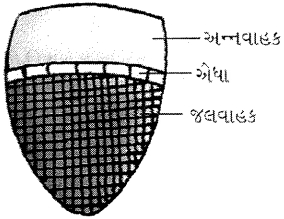
(C) The provided image shows a conjoint vascular bundle where the phloem is located on the outer side and the xylem is located on the inner side,with a layer of cambium present between them.
$1$. Since the phloem and xylem are on the same radius,it is a conjoint vascular bundle.
$2$. Since the phloem is on the outer side and xylem is on the inner side,it is a collateral vascular bundle.
$3$. The presence of a cambium layer between the xylem and phloem indicates that it is an open vascular bundle,which is capable of secondary growth.
Therefore,it is a collateral open vascular bundle.
$1$. Since the phloem and xylem are on the same radius,it is a conjoint vascular bundle.
$2$. Since the phloem is on the outer side and xylem is on the inner side,it is a collateral vascular bundle.
$3$. The presence of a cambium layer between the xylem and phloem indicates that it is an open vascular bundle,which is capable of secondary growth.
Therefore,it is a collateral open vascular bundle.
0 likes
View Solution135
MediumMCQ
In this type of vascular bundle,xylem and phloem do not lie on the same radius.
A
Radial vascular bundle
B
Concentric vascular bundle
C
Collateral vascular bundle
D
Bicollateral vascular bundle
Solution
(A) In a $Radial$ vascular bundle,the xylem and phloem are arranged in an alternating manner on different radii. This is a characteristic feature of roots in dicot and monocot plants. In contrast,in $Collateral$,$Bicollateral$,and $Concentric$ bundles,the xylem and phloem are located on the same radius.
0 likes
View Solution136
MediumMCQ
Which of the following tissues are included in the ground tissue system?
A
Parenchyma
B
Collenchyma
C
Sclerenchyma
D
All of the above
Solution
(D) The ground tissue system includes all tissues except the epidermis and vascular bundles.
It consists of simple tissues such as parenchyma,collenchyma,and sclerenchyma.
Parenchyma is usually present in the cortex,pericycle,pith,and medullary rays in the primary stems and roots.
In leaves,the ground tissue consists of thin-walled chloroplast-containing cells and is called mesophyll.
Therefore,all the given options are part of the ground tissue system.
It consists of simple tissues such as parenchyma,collenchyma,and sclerenchyma.
Parenchyma is usually present in the cortex,pericycle,pith,and medullary rays in the primary stems and roots.
In leaves,the ground tissue consists of thin-walled chloroplast-containing cells and is called mesophyll.
Therefore,all the given options are part of the ground tissue system.
0 likes
View Solution137
MediumMCQ
How many of the following tissues are responsible for bulk transport in plants?
Parenchyma,Collenchyma,Sclerenchyma,Xylem,Phloem
Parenchyma,Collenchyma,Sclerenchyma,Xylem,Phloem
A
$2$
B
$3$
C
$4$
D
$5$
Solution
(A) Bulk transport in plants is primarily carried out by the vascular tissues,which are Xylem and Phloem.
$1$. Xylem: Responsible for the bulk transport of water and dissolved minerals from roots to other parts of the plant.
$2$. Phloem: Responsible for the bulk transport of organic nutrients (food) from leaves to other parts of the plant.
Parenchyma,Collenchyma,and Sclerenchyma are ground tissues primarily involved in support,storage,and photosynthesis,not bulk transport.
Therefore,there are $2$ tissues responsible for bulk transport.
$1$. Xylem: Responsible for the bulk transport of water and dissolved minerals from roots to other parts of the plant.
$2$. Phloem: Responsible for the bulk transport of organic nutrients (food) from leaves to other parts of the plant.
Parenchyma,Collenchyma,and Sclerenchyma are ground tissues primarily involved in support,storage,and photosynthesis,not bulk transport.
Therefore,there are $2$ tissues responsible for bulk transport.
0 likes
View Solution138
EasyMCQ
Complete the following statement by identifying blank '$A$'. In '$A$' type of vascular bundles, the xylem and phloem are jointly situated along the same radius of vascular bundles.
A
Concentric
B
Conjoint
C
Radial
D
Open
Solution
(B) In plants, vascular bundles are classified based on the arrangement of xylem and phloem.
$1$. In 'Conjoint' vascular bundles, the xylem and phloem are jointly situated along the same radius of the vascular bundle.
$2$. These are commonly found in stems and leaves.
$3$. In contrast, in 'Radial' vascular bundles, xylem and phloem are arranged in an alternate manner on different radii, which is characteristic of roots.
$4$. Therefore, the correct term for the description provided is 'Conjoint'.
$1$. In 'Conjoint' vascular bundles, the xylem and phloem are jointly situated along the same radius of the vascular bundle.
$2$. These are commonly found in stems and leaves.
$3$. In contrast, in 'Radial' vascular bundles, xylem and phloem are arranged in an alternate manner on different radii, which is characteristic of roots.
$4$. Therefore, the correct term for the description provided is 'Conjoint'.
0 likes
View Solution139
EasyMCQ
In leaves,mesophyll is the component of $:-$
A
Epidermal tissue system
B
Ground tissue system
C
Vascular tissue system
D
Both $(1) \ \& \ (2)$
Solution
(B) In plant anatomy,the tissue systems are classified into three types: the epidermal tissue system,the ground tissue system,and the vascular tissue system.
$1$. The epidermal tissue system forms the outermost covering of the plant body.
$2$. The vascular tissue system consists of complex tissues,namely xylem and phloem.
$3$. The ground tissue system includes all tissues except the epidermis and vascular bundles. In leaves,the ground tissue consists of thin-walled chloroplast-containing cells called mesophyll,which are responsible for photosynthesis.
Therefore,mesophyll is a component of the ground tissue system.
$1$. The epidermal tissue system forms the outermost covering of the plant body.
$2$. The vascular tissue system consists of complex tissues,namely xylem and phloem.
$3$. The ground tissue system includes all tissues except the epidermis and vascular bundles. In leaves,the ground tissue consists of thin-walled chloroplast-containing cells called mesophyll,which are responsible for photosynthesis.
Therefore,mesophyll is a component of the ground tissue system.
0 likes
View Solution140
MediumMCQ
Consider the following structures and select the structures which form the stele.
$(A)$ Endodermis
$(B)$ Pericycle
$(C)$ Vascular tissue system
$(D)$ Pith
$(A)$ Endodermis
$(B)$ Pericycle
$(C)$ Vascular tissue system
$(D)$ Pith
A
$C, D$ only
B
$A, C, D$ only
C
$B, D$ only
D
$B, C, D$ only
Solution
(D) The stele is defined as all the tissues on the inner side of the endodermis.
These tissues include the pericycle,vascular bundles (vascular tissue system),and the pith (if present).
Therefore,the structures that form the stele are the pericycle $(B)$,vascular tissue system $(C)$,and pith $(D)$.
Thus,the correct option is $D$.
These tissues include the pericycle,vascular bundles (vascular tissue system),and the pith (if present).
Therefore,the structures that form the stele are the pericycle $(B)$,vascular tissue system $(C)$,and pith $(D)$.
Thus,the correct option is $D$.
0 likes
View Solution141
MediumMCQ
Leaf mesophyll cells are included in $:-$
A
Epidermal tissue system
B
Ground tissue system
C
Vascular tissue system
D
All of the above
Solution
(B) In plants,the tissue system is classified into three main types: the epidermal tissue system,the ground tissue system,and the vascular tissue system.
$1$. The epidermal tissue system forms the outermost covering of the plant body.
$2$. The vascular tissue system consists of complex tissues,namely xylem and phloem.
$3$. The ground tissue system includes all tissues except the epidermis and vascular bundles. It consists of simple tissues such as parenchyma,collenchyma,and sclerenchyma.
In leaves,the ground tissue consists of thin-walled chloroplast-containing cells and is called mesophyll. Therefore,leaf mesophyll cells are part of the ground tissue system.
$1$. The epidermal tissue system forms the outermost covering of the plant body.
$2$. The vascular tissue system consists of complex tissues,namely xylem and phloem.
$3$. The ground tissue system includes all tissues except the epidermis and vascular bundles. It consists of simple tissues such as parenchyma,collenchyma,and sclerenchyma.
In leaves,the ground tissue consists of thin-walled chloroplast-containing cells and is called mesophyll. Therefore,leaf mesophyll cells are part of the ground tissue system.
0 likes
View Solution142
MediumMCQ
$A$ vascular bundle in which a group of xylem and a group of phloem are on the same radius with xylem near the pith and phloem near the cortex and both are not separated by the cambium,is called:
A
Radial
B
Conjoint,collateral and open
C
Conjoint,collateral and closed
D
Concentric
Solution
(C) In a vascular bundle,when xylem and phloem are situated on the same radius,it is known as a conjoint vascular bundle.
When the phloem is located towards the outer side (cortex) and the xylem is located towards the inner side (pith),it is called collateral.
If there is no cambium present between the xylem and phloem,the vascular bundle is termed as closed.
Therefore,a vascular bundle with xylem and phloem on the same radius,without cambium,is classified as conjoint,collateral,and closed.
When the phloem is located towards the outer side (cortex) and the xylem is located towards the inner side (pith),it is called collateral.
If there is no cambium present between the xylem and phloem,the vascular bundle is termed as closed.
Therefore,a vascular bundle with xylem and phloem on the same radius,without cambium,is classified as conjoint,collateral,and closed.
0 likes
View Solution143
MediumMCQ
The figures given below represent different types of vascular bundles. Select the correct option for these diagrams :-
A
$A \longrightarrow$ Shows concentric vascular bundle
B
$B \longrightarrow$ Shows radial vascular bundle
C
$C \longrightarrow$ Shows conjoint open vascular bundle
D
$A \longrightarrow$ Shows conjoint closed vascular bundle
Solution
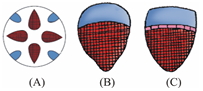
(C) In the given figures:
$A$ represents a radial vascular bundle,where xylem and phloem are arranged in an alternate manner on different radii,commonly found in roots.
$B$ represents a conjoint closed vascular bundle,where xylem and phloem are present on the same radius and cambium is absent,commonly found in monocot stems.
$C$ represents a conjoint open vascular bundle,where xylem and phloem are present on the same radius and cambium is present between them,commonly found in dicot stems.
Therefore,the correct option is $C$.
$A$ represents a radial vascular bundle,where xylem and phloem are arranged in an alternate manner on different radii,commonly found in roots.
$B$ represents a conjoint closed vascular bundle,where xylem and phloem are present on the same radius and cambium is absent,commonly found in monocot stems.
$C$ represents a conjoint open vascular bundle,where xylem and phloem are present on the same radius and cambium is present between them,commonly found in dicot stems.
Therefore,the correct option is $C$.
0 likes
View Solution144
MediumMCQ
Epidermal cells modify to form $:$
A
Trichomes only
B
Trichomes,Root hairs only
C
Trichomes,Root hair,Subsidiary cells
D
Root hairs only
Solution
(C) The epidermis is the outermost layer of the primary plant body.
Epidermal cells undergo various modifications to perform specialized functions.
$1$. Trichomes: These are epidermal outgrowths on the stem,which can be unicellular or multicellular,branched or unbranched,and soft or stiff. They help in preventing water loss due to transpiration.
$2$. Root hairs: These are unicellular elongations of the epidermal cells (epiblema) of the root,which help in the absorption of water and minerals from the soil.
$3$. Subsidiary cells: These are specialized epidermal cells that surround the guard cells of the stomata.
Therefore,epidermal cells modify to form trichomes,root hairs,and subsidiary cells.
Epidermal cells undergo various modifications to perform specialized functions.
$1$. Trichomes: These are epidermal outgrowths on the stem,which can be unicellular or multicellular,branched or unbranched,and soft or stiff. They help in preventing water loss due to transpiration.
$2$. Root hairs: These are unicellular elongations of the epidermal cells (epiblema) of the root,which help in the absorption of water and minerals from the soil.
$3$. Subsidiary cells: These are specialized epidermal cells that surround the guard cells of the stomata.
Therefore,epidermal cells modify to form trichomes,root hairs,and subsidiary cells.
0 likes
View Solution145
MediumMCQ
Which one of the following is not part of the Epidermal tissue system?
A
Guard cell
B
Trichome
C
Root hair
D
Stele
Solution
(D) The epidermal tissue system forms the outermost covering of the whole plant body and comprises epidermal cells,stomata,and epidermal appendages (trichomes and hairs).
$1$. Epidermal cells: The outermost layer of the primary plant body.
$2$. Stomata: Structures present in the epidermis of leaves,which include guard cells.
$3$. Epidermal appendages: These include trichomes (in shoots) and root hairs (in roots).
$4$. Stele: The stele is not part of the epidermal tissue system. It is the central part of the root or stem containing the vascular tissues (xylem and phloem) and is part of the vascular tissue system.
Therefore,the correct answer is $D$.
$1$. Epidermal cells: The outermost layer of the primary plant body.
$2$. Stomata: Structures present in the epidermis of leaves,which include guard cells.
$3$. Epidermal appendages: These include trichomes (in shoots) and root hairs (in roots).
$4$. Stele: The stele is not part of the epidermal tissue system. It is the central part of the root or stem containing the vascular tissues (xylem and phloem) and is part of the vascular tissue system.
Therefore,the correct answer is $D$.
0 likes
View Solution146
MediumMCQ
Assertion $:-$ Collenchyma forms the hypodermis of dicot stem.
Reason $:-$ This is the reason for flexibility of young dicotyledonous stems.
Reason $:-$ This is the reason for flexibility of young dicotyledonous stems.
A
Both Assertion and Reason are correct and Reason is the correct explanation of Assertion.
B
Both Assertion and Reason are correct but Reason is not the correct explanation of Assertion.
C
Assertion is correct and Reason is false.
D
Assertion is false and Reason is correct.
Solution
(A) In dicotyledonous stems,the hypodermis is composed of collenchyma cells.
Collenchyma is a living mechanical tissue that provides both mechanical support and tensile strength to the plant body.
Because collenchyma cells have thickened corners (due to cellulose,hemicellulose,and pectin deposition) and are flexible,they allow for the bending and growth of young stems without breaking.
Therefore,both the assertion and the reason are correct,and the reason correctly explains why collenchyma is present in the hypodermis of young dicot stems.
Collenchyma is a living mechanical tissue that provides both mechanical support and tensile strength to the plant body.
Because collenchyma cells have thickened corners (due to cellulose,hemicellulose,and pectin deposition) and are flexible,they allow for the bending and growth of young stems without breaking.
Therefore,both the assertion and the reason are correct,and the reason correctly explains why collenchyma is present in the hypodermis of young dicot stems.
0 likes
View Solution147
MediumMCQ
Select the false statement from the following $:-$
A
Vascular bundles without cambium are called closed vascular bundles
B
Open vascular bundles are found in dicotyledonous stem
C
In conjoint type of vascular bundles,the xylem $\&$ phloem are situated at the same radius of vascular bundles
D
Conjoint vascular bundles are common in roots
Solution
(D) $1$. Vascular bundles without cambium are called closed vascular bundles: This is a true statement. Closed bundles lack the ability to form secondary tissues.
$2$. Open vascular bundles are found in dicotyledonous stem: This is a true statement. The presence of cambium allows for secondary growth.
$3$. In conjoint type of vascular bundles,the xylem $\&$ phloem are situated at the same radius: This is a true statement. Conjoint bundles have both tissues on the same radius.
$4$. Conjoint vascular bundles are common in roots: This is a false statement. In roots,vascular bundles are of the radial type,where xylem and phloem are arranged in an alternate manner on different radii.
$2$. Open vascular bundles are found in dicotyledonous stem: This is a true statement. The presence of cambium allows for secondary growth.
$3$. In conjoint type of vascular bundles,the xylem $\&$ phloem are situated at the same radius: This is a true statement. Conjoint bundles have both tissues on the same radius.
$4$. Conjoint vascular bundles are common in roots: This is a false statement. In roots,vascular bundles are of the radial type,where xylem and phloem are arranged in an alternate manner on different radii.
0 likes
View Solution148
EasyMCQ
Trees and shrubs have . . . . . . in their bark for gaseous exchange.
A
Hydathodes
B
Stomata
C
Lenticels
D
Plasmodesmata
Solution
(C) Lenticels are small,raised,porous structures present on the bark of woody stems and roots of trees and shrubs.
They consist of loosely arranged cells that allow for the exchange of gases between the internal tissues of the plant and the external atmosphere.
Unlike stomata,which are primarily found on leaves and are regulated by guard cells,lenticels remain permanently open to facilitate continuous gas exchange in woody tissues.
They consist of loosely arranged cells that allow for the exchange of gases between the internal tissues of the plant and the external atmosphere.
Unlike stomata,which are primarily found on leaves and are regulated by guard cells,lenticels remain permanently open to facilitate continuous gas exchange in woody tissues.
0 likes
View Solution149
EasyMCQ
$A$ student observed grass and $Hibiscus$ plants in his garden during noon. To his surprise,only the leaves of grass were found rolled inwards. The reason could be
A
due to higher rate of transpiration
B
presence of more number of stomata on the grass leaves
C
undifferentiated mesophyll in grass leaves
D
presence of bulliform cells in the grass leaves
Solution
(D) - presence of bulliform cells in the grass leaves.
In grasses,certain adaxial epidermal cells along the veins modify themselves into large,empty,colourless cells. These are called bulliform cells.
When the bulliform cells in the leaves have absorbed water and are turgid,the leaf surface is exposed.
When they are flaccid due to water stress,they make the leaves curl inwards to minimise water loss.
In grasses,certain adaxial epidermal cells along the veins modify themselves into large,empty,colourless cells. These are called bulliform cells.
When the bulliform cells in the leaves have absorbed water and are turgid,the leaf surface is exposed.
When they are flaccid due to water stress,they make the leaves curl inwards to minimise water loss.
0 likes
View Solution150
EasyMCQ
In which type of vascular bundles are xylem and phloem present at the same radius?
A
Radial
B
Closed
C
Conjoint
D
Exarch
Solution
(C) The correct answer is $C$.
In a $Conjoint$ type of vascular bundle,both xylem and phloem are present on the same radius of the vascular bundle.
This arrangement is commonly found in the stems and leaves of flowering plants.
In a $Conjoint$ type of vascular bundle,both xylem and phloem are present on the same radius of the vascular bundle.
This arrangement is commonly found in the stems and leaves of flowering plants.
0 likes
View SolutionAnatomy of Flowering Plants — The tissue system · Frequently Asked Questions
1Are these Anatomy of Flowering Plants questions useful for JEE and NEET?
Yes. All questions in this section are mapped to JEE Main and NEET exam patterns. Previous year questions from JEE Main, NEET, GUJCET and state-level exams are included with full solutions.
2Can I switch to Hindi or Gujarati for these questions?
Yes. Use the language tabs in the hero section or the sidebar to view the same questions and solutions in English, Hindi or Gujarati.
3How do I generate a question paper from this subtopic?
Use the Vedclass Exam Paper Generator — select the chapter and subtopic, set difficulty, and generate Sets A, B, C, D automatically. First 3 chapters of every subject are free.
Vedclass Products
For Students
Vedclass Test Series
Mock tests in real JEE/NEET style with performance analysis. 5-day free trial.
Start Free TrialFor Teachers
Exam Paper Generator
Generate Set A/B/C/D papers from this chapter in 2 minutes. 3 chapters free.
Try FreeFor Institutes
Online Exam Module
Live online exams with unlimited students, 360° analytics & white-label branding.
See DemoFor Teachers & Institutes
Generate a Anatomy of Flowering Plants Exam Paper in 2 Minutes
Select subtopic & difficulty — Sets A, B, C, D auto-generated with No Repeat logic.
First 3 chapters of every subject are free — no payment required.