
A English
The tissue system Questions in English
Class 11 Biology · Anatomy of Flowering Plants · The tissue system
150+
Questions
English
Language
100%
With Solutions
Showing 50 of 150 questions in English
51
MediumMCQ
.......... is the outer protective tissue.
A
Cortex and Epidermis
B
Epidermis and Pericycle
C
Cortex and Pericycle
D
Epidermis and Epiblema
Solution
(D) The outer protective tissues in plants are the epidermis and the epiblema (also known as piliferous layer or rhizodermis in roots).
Epidermis is the outermost layer of the primary plant body in stems and leaves,providing protection against mechanical injury and water loss.
Epiblema is the outermost layer of the root,which is responsible for the absorption of water and minerals from the soil.
Epidermis is the outermost layer of the primary plant body in stems and leaves,providing protection against mechanical injury and water loss.
Epiblema is the outermost layer of the root,which is responsible for the absorption of water and minerals from the soil.
0 likes
View Solution52
MediumMCQ
According to the Histogen theory,three histogens are formed at the apex. Which part is differentiated by the plerome?
A
Cortex
B
Phloem and Xylem
C
Epidermal tissue system
D
Stele
Solution
(D) The Histogen theory,proposed by Hanstein,states that the root apex is composed of three distinct histogens:
$1$. Dermatogen: Gives rise to the epidermis.
$2$. Periblem: Gives rise to the cortex.
$3$. Plerome: Gives rise to the central stele (vascular cylinder),which includes the xylem and phloem.
Therefore,the plerome is responsible for the differentiation of the stele.
$1$. Dermatogen: Gives rise to the epidermis.
$2$. Periblem: Gives rise to the cortex.
$3$. Plerome: Gives rise to the central stele (vascular cylinder),which includes the xylem and phloem.
Therefore,the plerome is responsible for the differentiation of the stele.
0 likes
View Solution53
MediumMCQ
What happens in a plant during the formation of a vascular bundle?
A
Differentiation of procambium is followed by the formation of primary phloem and then primary xylem.
B
Differentiation of procambium is followed by primary phloem and xylem alternately.
C
Procambium,primary phloem,and xylem are formed one after another.
D
Differentiation of procambium is followed by secondary xylem.
Solution
(A) During the development of a vascular bundle,the procambium cells differentiate first.
Following this,the primary phloem is formed towards the periphery,and subsequently,the primary xylem is formed towards the center.
This sequence of differentiation ensures the proper arrangement of vascular tissues within the plant body.
Following this,the primary phloem is formed towards the periphery,and subsequently,the primary xylem is formed towards the center.
This sequence of differentiation ensures the proper arrangement of vascular tissues within the plant body.
0 likes
View Solution54
EasyMCQ
$A$ vascular bundle in which the phloem is found on both sides of the xylem is called .....
A
Collateral
B
Radial
C
Bicollateral
D
Amphicribral
Solution
(C) In a $Bicollateral$ vascular bundle,the phloem is present on both the outer and inner sides of the xylem.
This type of vascular bundle is commonly found in the family $Cucurbitaceae$ (e.g.,pumpkin,cucumber).
In contrast,a $Collateral$ bundle has phloem only on the outer side,a $Radial$ bundle has xylem and phloem in alternate radii,and an $Amphicribral$ (or $Hadrocentric$) bundle has xylem surrounded by phloem.
This type of vascular bundle is commonly found in the family $Cucurbitaceae$ (e.g.,pumpkin,cucumber).
In contrast,a $Collateral$ bundle has phloem only on the outer side,a $Radial$ bundle has xylem and phloem in alternate radii,and an $Amphicribral$ (or $Hadrocentric$) bundle has xylem surrounded by phloem.
0 likes
View Solution55
MediumMCQ
$A$ concentric vascular bundle is one in which:
A
Xylem is in the center and surrounded by phloem.
B
Phloem is in the center and surrounded by xylem.
C
Phloem is present only on the inner side,surrounded laterally by xylem.
D
Xylem is present only on the outer side,surrounded laterally by phloem.
Solution
(A) concentric vascular bundle is a type of vascular bundle where one tissue completely surrounds the other.
There are two types of concentric vascular bundles:
$1$. Amphicribral (Hadrocentric): The xylem is in the center and is completely surrounded by phloem.
$2$. Amphivasal (Leptocentric): The phloem is in the center and is completely surrounded by xylem.
Option $A$ describes the amphicribral condition,which is a classic definition of a concentric vascular bundle.
There are two types of concentric vascular bundles:
$1$. Amphicribral (Hadrocentric): The xylem is in the center and is completely surrounded by phloem.
$2$. Amphivasal (Leptocentric): The phloem is in the center and is completely surrounded by xylem.
Option $A$ describes the amphicribral condition,which is a classic definition of a concentric vascular bundle.
0 likes
View Solution56
MediumMCQ
What is the vascular bundle called when the xylem and phloem are located on the same radius?
A
Radial
B
Conjoint
C
Concentric
D
Exarch
Solution
(B) In plants, vascular bundles are classified based on the arrangement of xylem and phloem.
$1$. When xylem and phloem are situated on the same radius, the vascular bundle is known as a $Conjoint$ vascular bundle.
$2$. In $Radial$ bundles, xylem and phloem are arranged in an alternate manner on different radii.
$3$. In $Concentric$ bundles, one vascular tissue surrounds the other.
$4$. $Exarch$ refers to the condition where protoxylem lies towards the periphery, which is a characteristic of roots.
Therefore, the correct answer is $Conjoint$.
$1$. When xylem and phloem are situated on the same radius, the vascular bundle is known as a $Conjoint$ vascular bundle.
$2$. In $Radial$ bundles, xylem and phloem are arranged in an alternate manner on different radii.
$3$. In $Concentric$ bundles, one vascular tissue surrounds the other.
$4$. $Exarch$ refers to the condition where protoxylem lies towards the periphery, which is a characteristic of roots.
Therefore, the correct answer is $Conjoint$.
0 likes
View Solution57
EasyMCQ
Vascular bundles containing cambium are called ......
A
Open
B
Closed
C
Intrastelar
D
Extrastelar
Solution
(A) Vascular bundles are classified based on the presence or absence of cambium between xylem and phloem.
$1$. Open vascular bundles: These contain cambium between the xylem and phloem,which allows for secondary growth. These are characteristic of dicotyledonous stems.
$2$. Closed vascular bundles: These lack cambium between the xylem and phloem,meaning they do not undergo secondary growth. These are characteristic of monocotyledonous stems.
Therefore,vascular bundles containing cambium are called open vascular bundles.
$1$. Open vascular bundles: These contain cambium between the xylem and phloem,which allows for secondary growth. These are characteristic of dicotyledonous stems.
$2$. Closed vascular bundles: These lack cambium between the xylem and phloem,meaning they do not undergo secondary growth. These are characteristic of monocotyledonous stems.
Therefore,vascular bundles containing cambium are called open vascular bundles.
0 likes
View Solution58
MediumMCQ
Generally,the cells of the cortex lack $.....$.
A
Chlorophyll
B
Nucleus
C
Stored food
D
Nucleolus
Solution
(A) The cortex is the ground tissue located between the epidermis and the stele in stems and roots.
In most plants,the cortical cells are parenchyma cells that primarily function in the storage of food materials like starch.
While some cortical cells in specific plants (like aquatic plants or young stems) may contain chloroplasts,the most fundamental characteristic of mature cortical cells is that they are generally non-photosynthetic and lack chlorophyll.
Therefore,the most appropriate answer is chlorophyll.
In most plants,the cortical cells are parenchyma cells that primarily function in the storage of food materials like starch.
While some cortical cells in specific plants (like aquatic plants or young stems) may contain chloroplasts,the most fundamental characteristic of mature cortical cells is that they are generally non-photosynthetic and lack chlorophyll.
Therefore,the most appropriate answer is chlorophyll.
0 likes
View Solution59
MediumMCQ
What is the function of the hypodermis?
A
Protection
B
Hardness
C
Mechanical support
D
Storage
Solution
(C) The hypodermis is a layer of cells located immediately below the epidermis in stems and leaves. Its primary function is to provide mechanical support to the plant organ,helping it withstand environmental stresses such as wind. In dicot stems,it is typically composed of collenchyma,which provides both flexibility and tensile strength.
0 likes
View Solution60
EasyMCQ
Laticifers are found in ..........
A
Hevea
B
Calotropis
C
Euphorbia
D
All of the above
Solution
(D) Laticifers are specialized cells or vessels that contain latex,a milky,viscous fluid.
They are commonly found in plants belonging to families like $Euphorbiaceae$,$Apocynaceae$,and $Moraceae$.
$Hevea$ (rubber tree),$Calotropis$ (milkweed),and $Euphorbia$ are all well-known examples of plants that possess laticiferous tissues.
Therefore,the correct answer is all of the above.
They are commonly found in plants belonging to families like $Euphorbiaceae$,$Apocynaceae$,and $Moraceae$.
$Hevea$ (rubber tree),$Calotropis$ (milkweed),and $Euphorbia$ are all well-known examples of plants that possess laticiferous tissues.
Therefore,the correct answer is all of the above.
0 likes
View Solution61
MediumMCQ
What is a vascular bundle called when phloem is present on both sides of the xylem and is separated from the xylem by strips of cambium?
A
Bicollateral open
B
Amphicribral
C
Concentric
D
Bicollateral closed
Solution
(A) vascular bundle in which the phloem is situated on both the outer and inner sides of the xylem,separated by strips of cambium,is known as a $Bicollateral$ $open$ vascular bundle.
In this arrangement,there are two cambium strips: one between the outer phloem and xylem,and another between the inner phloem and xylem.
This type of vascular bundle is characteristic of the family $Cucurbitaceae$.
In this arrangement,there are two cambium strips: one between the outer phloem and xylem,and another between the inner phloem and xylem.
This type of vascular bundle is characteristic of the family $Cucurbitaceae$.
0 likes
View Solution62
MediumMCQ
The ground tissue system includes ...............
A
All tissues external to the endodermis
B
All tissues except epidermis and vascular bundles
C
Epidermis and cortex
D
All tissues internal to the endodermis
Solution
(B) The ground tissue system in plants consists of all tissues except the epidermis and vascular bundles. It includes simple tissues such as parenchyma,collenchyma,and sclerenchyma. In primary stems and roots,ground tissue consists of the cortex,pericycle,pith,and medullary rays. In leaves,the ground tissue consists of a thin-walled chloroplast-containing cell called mesophyll.
0 likes
View Solution63
EasyMCQ
What are the living cells present in the lenticel called?
A
Conjunctival cells
B
Connective tissue
C
Complementary cells
D
Epidermis
Solution
(C) Lenticels are lens-shaped openings found in the bark of woody plants.
These structures allow for the exchange of gases between the internal tissues of the stem and the outer atmosphere.
The tissue filling the lenticel consists of loosely arranged,thin-walled,living parenchymatous cells,which are known as complementary cells.
These structures allow for the exchange of gases between the internal tissues of the stem and the outer atmosphere.
The tissue filling the lenticel consists of loosely arranged,thin-walled,living parenchymatous cells,which are known as complementary cells.
0 likes
View Solution64
MediumMCQ
The complementary cells of lenticels are ..........
A
Compact and suberized
B
Loose and non-suberized
C
Compact and lignified
D
Loose and lignified
Solution
(B) Lenticels are lens-shaped openings found in the bark of woody stems and roots that allow for gas exchange between the internal tissues and the external atmosphere.
These openings are filled with loosely arranged,thin-walled,non-suberized parenchyma cells known as complementary cells.
Because these cells are loosely arranged with large intercellular spaces and lack suberin,they facilitate the diffusion of gases like $O_2$ and $CO_2$.
These openings are filled with loosely arranged,thin-walled,non-suberized parenchyma cells known as complementary cells.
Because these cells are loosely arranged with large intercellular spaces and lack suberin,they facilitate the diffusion of gases like $O_2$ and $CO_2$.
0 likes
View Solution65
EasyMCQ
The $3$ types of tissue systems,namely epidermal,ground,and vascular tissue systems,were proposed by whom?
A
Hanstein
B
Buvat
C
Sachs
D
Nageli
Solution
(C) The concept of tissue systems in plants was introduced by the German botanist Julius von Sachs in $1875$. He classified plant tissues into $3$ distinct systems based on their location and function:
$1$. Epidermal tissue system (dermal system)
$2$. Ground tissue system (fundamental system)
$3$. Vascular tissue system (conducting system)
Therefore,the correct answer is Sachs.
$1$. Epidermal tissue system (dermal system)
$2$. Ground tissue system (fundamental system)
$3$. Vascular tissue system (conducting system)
Therefore,the correct answer is Sachs.
0 likes
View Solution66
EasyMCQ
Which xylem element is living?
A
Vessels
B
Tracheids
C
Xylem fibers
D
Xylem parenchyma
Solution
(D) Xylem consists of four types of elements: $1.$ Tracheids,$2.$ Vessels,$3.$ Xylem fibers,and $4.$ Xylem parenchyma.
Among these,tracheids,vessels,and xylem fibers are dead tissues at maturity because they lack protoplasm.
Xylem parenchyma is the only living component of the xylem tissue,as it contains a nucleus and cytoplasm,and is responsible for the storage of food materials like starch or fat and the radial conduction of water.
Among these,tracheids,vessels,and xylem fibers are dead tissues at maturity because they lack protoplasm.
Xylem parenchyma is the only living component of the xylem tissue,as it contains a nucleus and cytoplasm,and is responsible for the storage of food materials like starch or fat and the radial conduction of water.
0 likes
View Solution67
MediumMCQ
Suberin is a ..........
A
Polysaccharide
B
Protein
C
Fatty acid
D
Pectocellulose
Solution
(C) Suberin is a complex,hydrophobic,and waxy substance found in the cell walls of cork cells,endodermis,and exodermis of plants. Chemically,it is a polymer composed of long-chain fatty acids (such as phellonic acid) and phenolic compounds. Among the given options,it is most closely associated with fatty acid derivatives.
0 likes
View Solution68
MediumMCQ
When the 'intrafascicular cambium' is present within the vascular bundle,the vascular bundle is called ........
A
Conjoint
B
Open
C
Closed
D
Radial
Solution
(B) In plants,vascular bundles are classified based on the presence or absence of cambium.
$1$. If cambium is present between the xylem and phloem,it allows for secondary growth,and such vascular bundles are called 'Open' vascular bundles.
$2$. If cambium is absent,they are called 'Closed' vascular bundles.
$3$. Since the intrafascicular cambium is a type of cambium found within the vascular bundle,its presence makes the bundle 'Open'.
$1$. If cambium is present between the xylem and phloem,it allows for secondary growth,and such vascular bundles are called 'Open' vascular bundles.
$2$. If cambium is absent,they are called 'Closed' vascular bundles.
$3$. Since the intrafascicular cambium is a type of cambium found within the vascular bundle,its presence makes the bundle 'Open'.
0 likes
View Solution69
MediumMCQ
$A$ vascular bundle in which the phloem surrounds the xylem is called .....
A
Concentric
B
Collateral
C
Bicollateral
D
Radial
Solution
(A) In a concentric vascular bundle,one vascular tissue (either xylem or phloem) completely surrounds the other.
When the phloem surrounds the xylem,it is known as an amphicribral or hadrocentric vascular bundle.
This type of arrangement is a specific form of a concentric vascular bundle.
Therefore,the correct option is $A$.
When the phloem surrounds the xylem,it is known as an amphicribral or hadrocentric vascular bundle.
This type of arrangement is a specific form of a concentric vascular bundle.
Therefore,the correct option is $A$.
0 likes
View Solution70
MediumMCQ
What type of vascular bundles are amphicribral (hadrocentric) bundles?
A
Endarch
B
Exarch
C
Mesarch
D
All of the above
Solution
(C) Amphicribral or hadrocentric vascular bundles are those in which the xylem is located in the center and is completely surrounded by phloem.
In these bundles,the xylem is typically mesarch,meaning the protoxylem is situated in the center and the metaxylem develops towards the periphery.
Therefore,the correct type of vascular bundle in this context is mesarch.
In these bundles,the xylem is typically mesarch,meaning the protoxylem is situated in the center and the metaxylem develops towards the periphery.
Therefore,the correct type of vascular bundle in this context is mesarch.
0 likes
View Solution71
EasyMCQ
Which waxy protective layer is found on the outer surface of the aerial parts of plants?
A
Chitin
B
Cuticle
C
Keratin
D
Carotene
Solution
(B) The outer surface of the aerial parts of plants,such as leaves and stems,is covered by a waxy,non-cellular layer known as the $Cuticle$.
This layer is primarily composed of $Cutin$,a fatty acid derivative,and wax.
The main function of the $Cuticle$ is to prevent excessive water loss through transpiration and to protect the plant from mechanical injury and pathogens.
This layer is primarily composed of $Cutin$,a fatty acid derivative,and wax.
The main function of the $Cuticle$ is to prevent excessive water loss through transpiration and to protect the plant from mechanical injury and pathogens.
0 likes
View Solution72
EasyMCQ
The protective layer on the outer surface of the aerial parts of plants is:
A
Lignin
B
Wax
C
Suberin
D
Cellulose
Solution
(B) The aerial parts of plants,such as leaves and stems,are covered by a thin,waxy,and water-repellent layer known as the cuticle.
This cuticle is primarily composed of cutin,a fatty acid derivative,and is often coated with epicuticular waxes.
These waxes help in reducing water loss through transpiration and provide protection against environmental stress,pathogens,and mechanical injury.
Therefore,the correct answer is $B$ (Wax).
This cuticle is primarily composed of cutin,a fatty acid derivative,and is often coated with epicuticular waxes.
These waxes help in reducing water loss through transpiration and provide protection against environmental stress,pathogens,and mechanical injury.
Therefore,the correct answer is $B$ (Wax).
0 likes
View Solution73
EasyMCQ
Specialised epidermal cells surrounding the guard cells are called
A
bulliform cells
B
lenticels
C
complementary cells
D
subsidiary cells
Solution
(D) The epidermis of plant leaves and stems is covered with pores called $stomata$.
Each $stomata$ is surrounded by a pair of specialised epidermal cells known as $guard$ $cells$.
In many cases,these $guard$ $cells$ are further surrounded by another category of less modified epidermal cells known as $subsidiary$ $cells$ (or accessory cells),which provide structural and functional support to the $guard$ $cells$.
Each $stomata$ is surrounded by a pair of specialised epidermal cells known as $guard$ $cells$.
In many cases,these $guard$ $cells$ are further surrounded by another category of less modified epidermal cells known as $subsidiary$ $cells$ (or accessory cells),which provide structural and functional support to the $guard$ $cells$.
0 likes
View Solution74
MediumMCQ
Ground tissue includes
A
all tissues external to endodermis
B
all tissues except epidermis and vascular bundles
C
epidermis and cortex
D
all tissues internal to endodermis
Solution
(B) : Ground tissue can be defined as all the tissues except epidermis and vascular bundles. Ground tissue constitutes the interior of organs except the vascular system. It consists of simple tissues such as parenchyma,collenchyma,and sclerenchyma. Parenchymatous cells are usually present in the cortex,pericycle,pith,and medullary rays in the primary stems and roots. The ground tissue system of the leaves is called mesophyll.
0 likes
View Solution75
MediumMCQ
Some vascular bundles are described as open because these
A
are surrounded by pericycle but no endodermis
B
are capable of producing secondary xylem and phloem
C
possess conjunctive tissue between xylem and phloem
D
are not surrounded by pericycle
Solution
(B) : In dicot stems,cambium is present between xylem and phloem,and such vascular bundles are called open. In monocot stems,the cambium is absent,and such vascular bundles are called closed. Cambium consists of meristematic cells which are capable of producing secondary xylem and secondary phloem.
0 likes
View Solution76
EasyMCQ
The chief function of vessels in the plant body is to:
A
Transport food materials manufactured in the leaves to other parts of the plant.
B
Store food material in the form of starch or fat.
C
Conduct water and mineral salts.
D
Eliminate excess of water.
Solution
(C) Vessels are specialized conducting elements found in the xylem tissue of angiosperms.
Their primary function is the long-distance transport of water and dissolved mineral salts from the roots to the aerial parts of the plant.
Unlike phloem,which transports food,or parenchyma,which stores food,vessels are dead,hollow,tube-like structures that provide a low-resistance pathway for the upward movement of water (xylem sap).
Their primary function is the long-distance transport of water and dissolved mineral salts from the roots to the aerial parts of the plant.
Unlike phloem,which transports food,or parenchyma,which stores food,vessels are dead,hollow,tube-like structures that provide a low-resistance pathway for the upward movement of water (xylem sap).
0 likes
View Solution77
MediumMCQ
Trichomes are.........
A
Generally multicellular
B
Branched
C
Unbranched
D
All correct
Solution
(D) Trichomes are epidermal outgrowths on the stem or other parts of the plant.
They are generally multicellular,though they can be unicellular in some cases.
They can be branched or unbranched,and they can be soft or stiff.
Therefore,all the given options are correct descriptions of trichomes.
They are generally multicellular,though they can be unicellular in some cases.
They can be branched or unbranched,and they can be soft or stiff.
Therefore,all the given options are correct descriptions of trichomes.
0 likes
View Solution78
MediumMCQ
Which is not correct for $vessels$?
A
Long structure.
B
Cylindrical-like structure.
C
Attached with companion cells.
D
Acts as a water transport route.
Solution
(C) $Vessels$ are long,cylindrical,tube-like structures made up of many cells called vessel members,each with lignified walls and a large central cavity.
They are devoid of protoplasm at maturity.
$Vessels$ are characteristic features of $angiosperms$ and are primarily responsible for the conduction of water and minerals.
$Companion$ $cells$ are specialized $parenchymatous$ cells associated with $sieve$ $tube$ $elements$ in the $phloem$,not with $vessels$ in the $xylem$.
Therefore,the statement that $vessels$ are attached with $companion$ $cells$ is incorrect.
They are devoid of protoplasm at maturity.
$Vessels$ are characteristic features of $angiosperms$ and are primarily responsible for the conduction of water and minerals.
$Companion$ $cells$ are specialized $parenchymatous$ cells associated with $sieve$ $tube$ $elements$ in the $phloem$,not with $vessels$ in the $xylem$.
Therefore,the statement that $vessels$ are attached with $companion$ $cells$ is incorrect.
0 likes
View Solution79
MediumMCQ
Which of the following is not a part of the epidermal tissue system in plants?
A
Stomata
B
Trichome
C
Root hairs
D
Pericycle
Solution
(D) The epidermal tissue system in plants consists of the epidermis,epidermal appendages (such as trichomes and root hairs),and stomata.
$1$. The epidermis is the outermost layer of the primary plant body.
$2$. Stomata are structures present in the epidermis of leaves that regulate gas exchange.
$3$. Trichomes are epidermal hairs on the stem.
$4$. Root hairs are unicellular elongations of the epidermal cells of the root.
$5$. The pericycle is a layer of cells located between the endodermis and the vascular bundles,which is part of the ground tissue system,not the epidermal tissue system.
$1$. The epidermis is the outermost layer of the primary plant body.
$2$. Stomata are structures present in the epidermis of leaves that regulate gas exchange.
$3$. Trichomes are epidermal hairs on the stem.
$4$. Root hairs are unicellular elongations of the epidermal cells of the root.
$5$. The pericycle is a layer of cells located between the endodermis and the vascular bundles,which is part of the ground tissue system,not the epidermal tissue system.
0 likes
View Solution80
MediumMCQ
The outside of the epidermis is often covered with a waxy layer; its function is.....
A
To prevent the loss of water
B
Increase the water loss
C
Increase the plant growth
D
Photosynthesis
Solution
(A) The epidermis is the outermost layer of the primary plant body. In many plants,especially those in dry environments,the epidermis is covered by a thick,waxy,thick layer called the cuticle. The primary function of this waxy cuticle is to prevent the loss of water through evaporation (transpiration). Therefore,it acts as a protective barrier against desiccation.
0 likes
View Solution81
MediumMCQ
Closed vascular bundles lack
A
Xylem
B
Phloem
C
Cambium
D
All are absent
Solution
(C) In plants,vascular bundles are classified based on the presence or absence of cambium.
Open vascular bundles contain cambium between the xylem and phloem,which allows for secondary growth.
Closed vascular bundles lack cambium between the xylem and phloem,meaning they do not undergo secondary growth.
Therefore,closed vascular bundles lack cambium.
Open vascular bundles contain cambium between the xylem and phloem,which allows for secondary growth.
Closed vascular bundles lack cambium between the xylem and phloem,meaning they do not undergo secondary growth.
Therefore,closed vascular bundles lack cambium.
0 likes
View Solution82
EasyMCQ
Which of the following cells lacks a nucleus at maturity?
A
Nerve cell
B
Sieve tube cell of vascular plants
C
Amoeba
D
Animal cell
Solution
(B) The $Sieve$ $tube$ $cell$ of vascular plants (angiosperms) is a specialized cell involved in the transport of food (phloem).
At maturity,these cells lose their nucleus and many other organelles to facilitate the efficient flow of sap through the sieve plates.
In contrast,nerve cells,Amoeba,and typical animal cells possess a well-defined nucleus.
At maturity,these cells lose their nucleus and many other organelles to facilitate the efficient flow of sap through the sieve plates.
In contrast,nerve cells,Amoeba,and typical animal cells possess a well-defined nucleus.
0 likes
View Solution83
MediumMCQ
Sieve tubes are associated with the translocation of food because they possess:
A
Bordered pits
B
End walls without pores
C
Peripheral cytoplasm and perforated cell walls
D
Lack of cytoplasm
Solution
(C) Sieve tubes are the main conducting elements of phloem in angiosperms.
They are long,tube-like structures arranged longitudinally and are associated with companion cells.
Their end walls are perforated in a sieve-like manner to form 'sieve plates'.
Mature sieve tube elements possess a peripheral layer of cytoplasm and a large central vacuole,but they lack a nucleus.
The presence of peripheral cytoplasm and perforated end walls (sieve plates) facilitates the efficient translocation of food materials.
They are long,tube-like structures arranged longitudinally and are associated with companion cells.
Their end walls are perforated in a sieve-like manner to form 'sieve plates'.
Mature sieve tube elements possess a peripheral layer of cytoplasm and a large central vacuole,but they lack a nucleus.
The presence of peripheral cytoplasm and perforated end walls (sieve plates) facilitates the efficient translocation of food materials.
0 likes
View Solution84
MediumMCQ
The characteristic feature of a bicollateral vascular bundle is ............ .
A
Phloem is present on both sides of the xylem.
B
Transverse division of the vascular bundle.
C
Longitudinal division of the vascular bundle.
D
Xylem is sandwiched between phloem tissues.
Solution
(A) bicollateral vascular bundle is a type of conjoint vascular bundle where the phloem is present on both the outer and inner sides of the xylem.
This means the xylem is sandwiched between two layers of phloem.
This arrangement is commonly found in the stems of plants belonging to the family $Cucurbitaceae$.
This means the xylem is sandwiched between two layers of phloem.
This arrangement is commonly found in the stems of plants belonging to the family $Cucurbitaceae$.
0 likes
View Solution85
MediumMCQ
What is observed during the formation of vascular bundles in plants?
A
Procambium differentiates immediately into secondary xylem and phloem.
B
Procambium differentiates into xylem and phloem as they develop.
C
Procambium,xylem,and phloem differentiate sequentially.
D
After the differentiation of procambium,primary phloem develops first,followed by primary xylem.
Solution
(D) During the development of vascular bundles in plants,the procambium is the meristematic tissue that gives rise to the vascular tissues.
As the procambium differentiates,it gives rise to the primary vascular tissues.
Specifically,the procambium differentiates into primary phloem and primary xylem.
In most vascular bundles,the primary phloem develops first (protophloem),followed by the development of primary xylem (protoxylem).
As the procambium differentiates,it gives rise to the primary vascular tissues.
Specifically,the procambium differentiates into primary phloem and primary xylem.
In most vascular bundles,the primary phloem develops first (protophloem),followed by the development of primary xylem (protoxylem).
0 likes
View Solution86
MediumMCQ
The primary function of lenticels is $..........$.
A
Transpiration
B
Guttation
C
Gaseous exchange
D
Secretion
Solution
(C) Lenticels are small,lens-shaped openings found in the bark of woody stems and roots.
Their primary function is to facilitate the exchange of gases between the internal tissues of the plant and the external atmosphere.
While some transpiration may occur through them,their main physiological role is gaseous exchange.
Their primary function is to facilitate the exchange of gases between the internal tissues of the plant and the external atmosphere.
While some transpiration may occur through them,their main physiological role is gaseous exchange.
0 likes
View Solution87
EasyMCQ
The ground tissue system includes ................ .
A
All tissues except epidermis and vascular bundles
B
Epidermis and cortex
C
All tissues below the endodermis
D
All tissues outside the endodermis
Solution
(A) In plants,the ground tissue system consists of all tissues except the epidermis and vascular bundles. It includes simple tissues such as parenchyma,collenchyma,and sclerenchyma. In primary stems and roots,ground tissue consists of the cortex,pericycle,pith,and medullary rays. In leaves,it consists of thin-walled chloroplast-containing cells called mesophyll.
0 likes
View Solution88
EasyMCQ
In closed vascular bundles,the $..........$ is absent.
A
Ground tissue
B
Connective tissue
C
Cambium
D
Pith
Solution
(C) Vascular bundles are classified into two types based on the presence or absence of cambium:
$1$. Open vascular bundles: These contain cambium between the xylem and phloem,allowing for secondary growth. These are typically found in dicot stems.
$2$. Closed vascular bundles: These lack cambium between the xylem and phloem,meaning they do not undergo secondary growth. These are typically found in monocot stems.
Therefore,in closed vascular bundles,the cambium is absent.
$1$. Open vascular bundles: These contain cambium between the xylem and phloem,allowing for secondary growth. These are typically found in dicot stems.
$2$. Closed vascular bundles: These lack cambium between the xylem and phloem,meaning they do not undergo secondary growth. These are typically found in monocot stems.
Therefore,in closed vascular bundles,the cambium is absent.
0 likes
View Solution89
MediumMCQ
In what respect do the conducting elements of the $Xylem$ differ from each other?
A
Presence of $Casparian$ strips
B
Nature of perforations
C
Absence of nucleus
D
Deposition of $Lignin$
Solution
(B) The primary conducting elements of $Xylem$ are $Vessels$ and $Tracheids$.
$Tracheids$ are elongated,narrow cells with tapered ends,whereas $Vessels$ are cylindrical,tube-like structures.
The fundamental difference between these two elements lies in the nature of the perforations at their end walls.
$Vessels$ possess large perforations (perforation plates) at their end walls,which allow them to form a continuous pipe-like structure for efficient water transport.
In contrast,$Tracheids$ lack such large perforations and are connected to each other primarily through $Pits$.
$Tracheids$ are elongated,narrow cells with tapered ends,whereas $Vessels$ are cylindrical,tube-like structures.
The fundamental difference between these two elements lies in the nature of the perforations at their end walls.
$Vessels$ possess large perforations (perforation plates) at their end walls,which allow them to form a continuous pipe-like structure for efficient water transport.
In contrast,$Tracheids$ lack such large perforations and are connected to each other primarily through $Pits$.
0 likes
View Solution90
MediumMCQ
What are the specialized epidermal cells surrounding the guard cells called?
A
Subsidiary cells
B
Mechanical cells
C
Stomata
D
Complementary cells
Solution
(A) The stomatal apparatus consists of the stomatal aperture,guard cells,and the surrounding specialized epidermal cells known as subsidiary cells. These cells provide structural and functional support to the guard cells during the opening and closing of the stomata.
0 likes
View Solution91
EasyMCQ
Grass leaves curl inwards during very dry weather. Select the most appropriate reason from the following:
A
Closure of stomata
B
Flaccidity of bulliform cells
C
Shrinkage of air spaces in spongy mesophyll
D
Tyloses in vessels
Solution
(B) In many monocot leaves,such as grasses,certain adaxial epidermal cells along the veins modify themselves into large,empty,colourless cells called $bulliform$ cells.
When these cells absorb water and are turgid,the leaf surface is exposed.
However,during very dry weather,these $bulliform$ cells lose water due to stress and become flaccid.
This loss of turgidity causes the leaves to curl inwards to minimize the surface area exposed to the atmosphere,thereby reducing the rate of transpiration and preventing water loss.
When these cells absorb water and are turgid,the leaf surface is exposed.
However,during very dry weather,these $bulliform$ cells lose water due to stress and become flaccid.
This loss of turgidity causes the leaves to curl inwards to minimize the surface area exposed to the atmosphere,thereby reducing the rate of transpiration and preventing water loss.
0 likes
View Solution92
Difficult
Name the three basic tissue systems in flowering plants. List the tissues included under each system.
Solution
(N/A) The three basic tissue systems in flowering plants are as follows:
| Tissue System | Tissues Included |
|---|---|
| $1$. Epidermal tissue system | Epidermis,trichomes,hairs,and stomata |
| $2$. Ground tissue system | Parenchyma,collenchyma,sclerenchyma,and mesophyll |
| $3$. Vascular tissue system | Xylem,phloem,and cambium |
1 likes
View Solution93
Easy
Write a note on the Epidermal Tissue system.
Solution
(N/A) $\rightarrow$ On the basis of their structure and location,there are three types of tissue systems: Epidermal tissue system,ground or fundamental tissue system,and vascular or conducting tissue system.
$\rightarrow$ Epidermal Tissue System: The epidermal tissue system forms the outermost covering of the whole plant body and comprises epidermal cells,stomata,and epidermal appendages (trichomes and hairs).
$\rightarrow$ The epidermis is the outermost layer of the primary plant body. It is made up of elongated,compactly arranged cells which form a continuous layer.
$\rightarrow$ Epidermis is usually single-layered. Epidermal cells are parenchymatous with a small amount of cytoplasm lining the cell wall and a large vacuole.
$\rightarrow$ The outside of the epidermis is often covered with a waxy thick layer called the cuticle,which prevents the loss of water.
$\rightarrow$ Cuticle is absent in roots.
$\rightarrow$ Stomata are structures present in the epidermis of leaves. Stomata regulate the process of transpiration and gaseous exchange.
$\rightarrow$ In dicot plants,each stoma is composed of two bean-shaped cells known as guard cells.
$\rightarrow$ In grasses,the guard cells are dumb-bell shaped. The outer walls of guard cells (away from the stomatal pore) are thin and the inner walls (towards the stomatal pore) are highly thickened.
$\rightarrow$ The guard cells possess chloroplasts and regulate the opening and closing of stomata.
$\rightarrow$ Sometimes,a few epidermal cells in the vicinity of the guard cells become specialized in their shape and size and are known as subsidiary cells.
$\rightarrow$ The stomatal aperture,guard cells,and the surrounding subsidiary cells are together called the stomatal apparatus.
$\rightarrow$ The cells of the epidermis bear a number of hairs. The root hairs are unicellular elongations of the epidermal cells and help absorb water and minerals from the soil.
$\rightarrow$ Epidermal Tissue System: The epidermal tissue system forms the outermost covering of the whole plant body and comprises epidermal cells,stomata,and epidermal appendages (trichomes and hairs).
$\rightarrow$ The epidermis is the outermost layer of the primary plant body. It is made up of elongated,compactly arranged cells which form a continuous layer.
$\rightarrow$ Epidermis is usually single-layered. Epidermal cells are parenchymatous with a small amount of cytoplasm lining the cell wall and a large vacuole.
$\rightarrow$ The outside of the epidermis is often covered with a waxy thick layer called the cuticle,which prevents the loss of water.
$\rightarrow$ Cuticle is absent in roots.
$\rightarrow$ Stomata are structures present in the epidermis of leaves. Stomata regulate the process of transpiration and gaseous exchange.
$\rightarrow$ In dicot plants,each stoma is composed of two bean-shaped cells known as guard cells.
$\rightarrow$ In grasses,the guard cells are dumb-bell shaped. The outer walls of guard cells (away from the stomatal pore) are thin and the inner walls (towards the stomatal pore) are highly thickened.
$\rightarrow$ The guard cells possess chloroplasts and regulate the opening and closing of stomata.
$\rightarrow$ Sometimes,a few epidermal cells in the vicinity of the guard cells become specialized in their shape and size and are known as subsidiary cells.
$\rightarrow$ The stomatal aperture,guard cells,and the surrounding subsidiary cells are together called the stomatal apparatus.
$\rightarrow$ The cells of the epidermis bear a number of hairs. The root hairs are unicellular elongations of the epidermal cells and help absorb water and minerals from the soil.
0 likes
View Solution94
Easy
Write a note on the Ground Tissue System.
Solution
(N/A) $\rightarrow$ All tissues except the epidermis and vascular bundles constitute the ground tissue system.
$\rightarrow$ The ground tissue system consists of simple tissues such as parenchyma,collenchyma,and sclerenchyma.
$\rightarrow$ Parenchymatous cells are usually present in the cortex,pericycle,pith,and medullary rays in primary stems and roots.
$\rightarrow$ In leaves,the ground tissue consists of thin-walled,chloroplast-containing cells and is called mesophyll.
$\rightarrow$ The ground tissue system consists of simple tissues such as parenchyma,collenchyma,and sclerenchyma.
$\rightarrow$ Parenchymatous cells are usually present in the cortex,pericycle,pith,and medullary rays in primary stems and roots.
$\rightarrow$ In leaves,the ground tissue consists of thin-walled,chloroplast-containing cells and is called mesophyll.
0 likes
View Solution95
Easy
Write a note on the Vascular Tissue System.
Solution
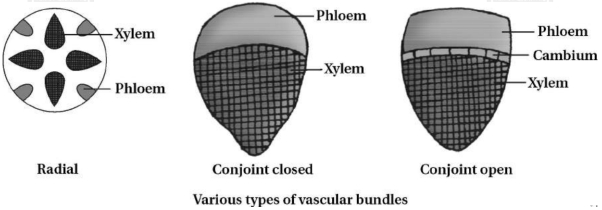
(N/A) $\rightarrow$ The vascular system consists of complex tissues, the phloem and the xylem. The xylem and phloem together constitute vascular bundles.
$\rightarrow$ In dicotyledonous stems, cambium is present between phloem and xylem. Such vascular bundles, because of the presence of cambium, possess the ability to form secondary xylem and phloem tissues, and hence are called open vascular bundles.
$\rightarrow$ In the monocotyledons, the vascular bundles have no cambium present in them. Hence, since they do not form secondary tissues, they are referred to as closed vascular bundles.
$\rightarrow$ When xylem and phloem within a vascular bundle are arranged in an alternate manner on different radii, the arrangement is called radial, such as in roots.
$\rightarrow$ In the conjoint type of vascular bundles, the xylem and phloem are situated at the same radius of vascular bundles.
$\rightarrow$ Such vascular bundles are common in stems and leaves.
$\rightarrow$ The conjoint vascular bundles usually have the phloem located only on the outer side of xylem.
$\rightarrow$ In dicotyledonous stems, cambium is present between phloem and xylem. Such vascular bundles, because of the presence of cambium, possess the ability to form secondary xylem and phloem tissues, and hence are called open vascular bundles.
$\rightarrow$ In the monocotyledons, the vascular bundles have no cambium present in them. Hence, since they do not form secondary tissues, they are referred to as closed vascular bundles.
$\rightarrow$ When xylem and phloem within a vascular bundle are arranged in an alternate manner on different radii, the arrangement is called radial, such as in roots.
$\rightarrow$ In the conjoint type of vascular bundles, the xylem and phloem are situated at the same radius of vascular bundles.
$\rightarrow$ Such vascular bundles are common in stems and leaves.
$\rightarrow$ The conjoint vascular bundles usually have the phloem located only on the outer side of xylem.
0 likes
View Solution96
Medium
Identify the location and function of the following structures:
$(i)$ Casparian strips
$(ii)$ Starch sheath
$(i)$ Casparian strips
$(ii)$ Starch sheath
Solution
(N/A) $(i)$ Location: Found in the endodermal cells of dicot roots,where suberin and lignin thicken the radial and tangential walls in the form of a strip.
$\Rightarrow$ Function: Acts as a barrier that is impermeable to water,forcing water to move through the symplastic pathway.
$(ii)$ Location: Found in the endodermis of dicot stems (e.g.,sunflower),where the cells contain abundant starch grains.
$\Rightarrow$ Function: Serves as a storage site for starch,hence it is often referred to as the starch sheath.
$\Rightarrow$ Function: Acts as a barrier that is impermeable to water,forcing water to move through the symplastic pathway.
$(ii)$ Location: Found in the endodermis of dicot stems (e.g.,sunflower),where the cells contain abundant starch grains.
$\Rightarrow$ Function: Serves as a storage site for starch,hence it is often referred to as the starch sheath.
0 likes
View Solution97
Medium
Identify the location and function of the following structures:
$(i)$ Resin duct
$(ii)$ Passage cells
$(iii)$ Albumin cells
$(i)$ Resin duct
$(ii)$ Passage cells
$(iii)$ Albumin cells
Solution
(N/A) $(i)$ Resin duct:
Location: Found in the cortex of gymnosperm stems (e.g.,Pinus).
Function: Secretes resin,which provides mechanical strength and protection against pathogens.
$(ii)$ Passage cells:
Location: Thin-walled cells present in the endodermis of roots,opposite to protoxylem.
Function: Facilitate the radial transport of water and dissolved minerals from the cortex to the stele.
$(iii)$ Albumin cells:
Location: Present in the phloem of gymnosperms.
Function: Associated with sieve cells; they perform metabolic functions similar to companion cells in angiosperms.
Location: Found in the cortex of gymnosperm stems (e.g.,Pinus).
Function: Secretes resin,which provides mechanical strength and protection against pathogens.
$(ii)$ Passage cells:
Location: Thin-walled cells present in the endodermis of roots,opposite to protoxylem.
Function: Facilitate the radial transport of water and dissolved minerals from the cortex to the stele.
$(iii)$ Albumin cells:
Location: Present in the phloem of gymnosperms.
Function: Associated with sieve cells; they perform metabolic functions similar to companion cells in angiosperms.
0 likes
View Solution98
Easy
Epidermal cells are often modified to perform specialised functions in plants. Name some of them and the functions they perform.
Solution
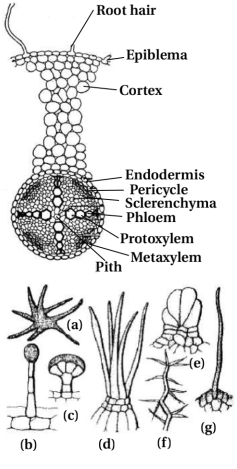
(N/A) $ \Rightarrow $ Modification of epidermal cells: The following modifications are observed in epidermal tissues:
$(1)$ Root hairs:
$ \Rightarrow $ Structure: In the root hair region, epidermal cells of the root are extended as unicellular root hairs.
$ \Rightarrow $ Function: They increase the surface area for the absorption of water and mineral elements from the soil.
$(2)$ Trichomes:
$ \Rightarrow $ Structure: These are epidermal outgrowths on the stem. They can be unicellular or multicellular, branched or unbranched, and sometimes secretory.
$ \Rightarrow $ Function: They help in preventing water loss due to transpiration and protect the plant against herbivores.
$(1)$ Root hairs:
$ \Rightarrow $ Structure: In the root hair region, epidermal cells of the root are extended as unicellular root hairs.
$ \Rightarrow $ Function: They increase the surface area for the absorption of water and mineral elements from the soil.
$(2)$ Trichomes:
$ \Rightarrow $ Structure: These are epidermal outgrowths on the stem. They can be unicellular or multicellular, branched or unbranched, and sometimes secretory.
$ \Rightarrow $ Function: They help in preventing water loss due to transpiration and protect the plant against herbivores.
0 likes
View Solution99
Easy
What is the difference between lenticels and stomata?
Solution
(N/A)
| Lenticels | Stomata |
|---|---|
| $\Rightarrow$ Lenticels are formed due to the loosening of cortical tissue. | $\Rightarrow$ Stomata are specific structures located in the epidermis. |
| $\Rightarrow$ They are mainly seen in the stem. | $\Rightarrow$ They are mainly seen on the lower surface of leaves. |
| $\Rightarrow$ Lenticels do not have guard cells. | $\Rightarrow$ Stomata have guard cells. |
| $\Rightarrow$ These pores are not regulated; they work for the removal of waste material. | $\Rightarrow$ The opening and closing of stomata are regulated; they are associated with gaseous exchange and the removal of extra water and waste material. |
0 likes
View Solution100
MediumMCQ
Distinguish between the following: Open and closed vascular bundles.
A
Open vascular bundles contain cambium; closed vascular bundles lack cambium.
B
Open vascular bundles are found in monocots; closed in dicots.
C
Open vascular bundles have xylem outside; closed have xylem inside.
D
Open vascular bundles are always circular; closed are always triangular.
Solution
(A) The primary distinction between open and closed vascular bundles lies in the presence or absence of the cambium layer between the xylem and phloem.
$1$. Open Vascular Bundles: These contain a layer of cambium between the xylem and phloem. This cambium allows for secondary growth,which is characteristic of dicot stems.
$2$. Closed Vascular Bundles: These lack a cambium layer between the xylem and phloem. Consequently,they do not undergo secondary growth,which is characteristic of monocot stems.
$1$. Open Vascular Bundles: These contain a layer of cambium between the xylem and phloem. This cambium allows for secondary growth,which is characteristic of dicot stems.
$2$. Closed Vascular Bundles: These lack a cambium layer between the xylem and phloem. Consequently,they do not undergo secondary growth,which is characteristic of monocot stems.
0 likes
View SolutionAnatomy of Flowering Plants — The tissue system · Frequently Asked Questions
1Are these Anatomy of Flowering Plants questions useful for JEE and NEET?
Yes. All questions in this section are mapped to JEE Main and NEET exam patterns. Previous year questions from JEE Main, NEET, GUJCET and state-level exams are included with full solutions.
2Can I switch to Hindi or Gujarati for these questions?
Yes. Use the language tabs in the hero section or the sidebar to view the same questions and solutions in English, Hindi or Gujarati.
3How do I generate a question paper from this subtopic?
Use the Vedclass Exam Paper Generator — select the chapter and subtopic, set difficulty, and generate Sets A, B, C, D automatically. First 3 chapters of every subject are free.
Vedclass Products
For Students
Vedclass Test Series
Mock tests in real JEE/NEET style with performance analysis. 5-day free trial.
Start Free TrialFor Teachers
Exam Paper Generator
Generate Set A/B/C/D papers from this chapter in 2 minutes. 3 chapters free.
Try FreeFor Institutes
Online Exam Module
Live online exams with unlimited students, 360° analytics & white-label branding.
See DemoFor Teachers & Institutes
Generate a Anatomy of Flowering Plants Exam Paper in 2 Minutes
Select subtopic & difficulty — Sets A, B, C, D auto-generated with No Repeat logic.
First 3 chapters of every subject are free — no payment required.