
A English
Permanent Tissue Questions in English
Class 11 Biology · Anatomy of Flowering Plants · Permanent Tissue
316+
Questions
English
Language
100%
With Solutions
Showing 16 of 316 questions in English
301
MediumMCQ
This tissue is known as living mechanical tissue.
A
Parenchyma
B
Collenchyma
C
Sclerenchyma
D
All of the above
Solution
(B) $Collenchyma$ is known as living mechanical tissue.
It provides mechanical support to the growing parts of the plant, such as young stems and petioles of leaves.
Unlike $Sclerenchyma$, which consists of dead cells at maturity, $Collenchyma$ cells are living and possess thick primary cell walls composed of cellulose, hemicellulose, and pectin.
It provides mechanical support to the growing parts of the plant, such as young stems and petioles of leaves.
Unlike $Sclerenchyma$, which consists of dead cells at maturity, $Collenchyma$ cells are living and possess thick primary cell walls composed of cellulose, hemicellulose, and pectin.
0 likes
View Solution302
MediumMCQ
How many of the following cells are dead?
Parenchyma,Sclerenchyma fibers,Sclereids,Collenchyma
Parenchyma,Sclerenchyma fibers,Sclereids,Collenchyma
A
$1$
B
$3$
C
$2$
D
$4$
Solution
(C) The cells are classified based on their viability at maturity:
$1$. Parenchyma: These are living cells with thin cell walls.
$2$. Sclerenchyma fibers: These are dead cells at maturity,providing mechanical support.
$3$. Sclereids: These are also dead cells at maturity,characterized by thick,lignified walls.
$4$. Collenchyma: These are living cells that provide mechanical support to young stems and petioles.
Therefore,Sclerenchyma fibers and Sclereids are dead cells,while Parenchyma and Collenchyma are living cells.
Total number of dead cells = $2$.
$1$. Parenchyma: These are living cells with thin cell walls.
$2$. Sclerenchyma fibers: These are dead cells at maturity,providing mechanical support.
$3$. Sclereids: These are also dead cells at maturity,characterized by thick,lignified walls.
$4$. Collenchyma: These are living cells that provide mechanical support to young stems and petioles.
Therefore,Sclerenchyma fibers and Sclereids are dead cells,while Parenchyma and Collenchyma are living cells.
Total number of dead cells = $2$.
0 likes
View Solution303
MediumMCQ
Match the following columns:
| Column-$I$ | Column-$II$ |
|---|---|
| $P$. Parenchyma | $I$. No thickening |
| $Q$. Collenchyma | $II$. Pectin thickening |
| $R$. Sclerenchyma | $III$. Lignin thickening |
A
$(P-I), (Q-III), (R-II)$
B
$(P-I), (Q-II), (R-III)$
C
$(P-III), (Q-II), (R-I)$
D
$(P-III), (Q-I), (R-II)$
Solution
(B) $P$. Parenchyma cells have thin cell walls made of cellulose,so they show no significant thickening.
$Q$. Collenchyma cells are characterized by uneven thickening of the cell wall due to the deposition of pectin,cellulose,and hemicellulose.
$R$. Sclerenchyma cells have thick,lignified secondary cell walls,which provide structural support.
Therefore,the correct matching is $(P-I), (Q-II), (R-III)$.
$Q$. Collenchyma cells are characterized by uneven thickening of the cell wall due to the deposition of pectin,cellulose,and hemicellulose.
$R$. Sclerenchyma cells have thick,lignified secondary cell walls,which provide structural support.
Therefore,the correct matching is $(P-I), (Q-II), (R-III)$.
0 likes
View Solution304
EasyMCQ
Which tissue provides mechanical support to the young stem and petiole of leaves?
A
Collenchyma
B
Parenchyma
C
Sclerenchyma
D
Xylem
Solution
(A) Collenchyma is a simple permanent tissue that provides mechanical support to the growing parts of the plant,such as young stems and the petioles of leaves.
It consists of cells that are thickened at the corners due to the deposition of cellulose,hemicellulose,and pectin.
Unlike sclerenchyma,which provides support to mature plant parts,collenchyma provides flexibility and support to young,growing organs.
It consists of cells that are thickened at the corners due to the deposition of cellulose,hemicellulose,and pectin.
Unlike sclerenchyma,which provides support to mature plant parts,collenchyma provides flexibility and support to young,growing organs.
0 likes
View Solution305
MediumMCQ
Which substance is responsible for the thickening of the walls of xylem vessels and tracheids?
A
Pectin
B
Lignin
C
Lipid
D
Cellulose
Solution
(B) Xylem vessels and tracheids are the main conducting elements of the xylem tissue in plants.
These cells have thick,lignified secondary walls.
Lignin is a complex polymer that provides structural support and mechanical strength to the plant body,allowing it to withstand the negative pressure generated during water transport.
Therefore,the thickening of the walls of xylem vessels and tracheids is due to the deposition of lignin.
These cells have thick,lignified secondary walls.
Lignin is a complex polymer that provides structural support and mechanical strength to the plant body,allowing it to withstand the negative pressure generated during water transport.
Therefore,the thickening of the walls of xylem vessels and tracheids is due to the deposition of lignin.
0 likes
View Solution306
MediumMCQ
Protoxylem and metaxylem are types of which of the following?
A
Primary xylem
B
Secondary xylem
C
Primary phloem
D
Secondary phloem
Solution
(A) In plants,the primary xylem is differentiated into two types based on the time of their development:
$1$. $Protoxylem$: The first formed primary xylem elements are called protoxylem.
$2$. $Metaxylem$: The later formed primary xylem elements are called metaxylem.
These are components of the primary xylem,which develops from the procambium during primary growth.
$1$. $Protoxylem$: The first formed primary xylem elements are called protoxylem.
$2$. $Metaxylem$: The later formed primary xylem elements are called metaxylem.
These are components of the primary xylem,which develops from the procambium during primary growth.
0 likes
View Solution307
MediumMCQ
Cells of permanent tissue are $...........$.
A
Differentiated
B
Undifferentiated
C
Dividing
D
Both $B$ and $C$
Solution
(A) Permanent tissues are composed of cells that have lost the ability to divide. These cells are derived from meristematic tissues and have attained a specific shape,size,and function through the process of differentiation. Therefore,cells of permanent tissue are differentiated.
0 likes
View Solution308
MediumMCQ
Which structure of the phloem is responsible for providing mechanical support to the plant?
A
Phloem parenchyma
B
Phloem fibers
C
Sieve tube elements
D
Companion cells
Solution
(B) The phloem consists of four types of elements: sieve tube elements,companion cells,phloem parenchyma,and phloem fibers.
Phloem fibers (also known as bast fibers) are made of sclerenchymatous cells.
These cells are generally absent in primary phloem but are found in secondary phloem.
Due to their thick-walled,lignified nature,phloem fibers provide mechanical support to the plant body.
Phloem fibers (also known as bast fibers) are made of sclerenchymatous cells.
These cells are generally absent in primary phloem but are found in secondary phloem.
Due to their thick-walled,lignified nature,phloem fibers provide mechanical support to the plant body.
0 likes
View Solution309
MediumMCQ
What type of food materials are stored by xylem parenchyma and phloem parenchyma?
A
Xylem parenchyma = Starch or fat and tannins; Phloem parenchyma = Mucilage,resins,latex
B
Xylem parenchyma = Mucilage,resins,latex; Phloem parenchyma = Starch or fat and tannins
C
Xylem parenchyma = Starch or fat and resins; Phloem parenchyma = Mucilage,tannins,latex
D
Xylem parenchyma = Mucilage,tannins,latex; Phloem parenchyma = Starch or fat and resins
Solution
(A) Xylem parenchyma cells are the only living cells in the xylem tissue. They store food materials in the form of starch or fat,and other substances like tannins.
Phloem parenchyma cells are composed of elongated,tapering cylindrical cells which have dense cytoplasm and nucleus. They store food materials in the form of food reserves like starch or fat,and other substances like mucilage,resins,or latex.
Phloem parenchyma cells are composed of elongated,tapering cylindrical cells which have dense cytoplasm and nucleus. They store food materials in the form of food reserves like starch or fat,and other substances like mucilage,resins,or latex.
0 likes
View Solution310
MediumMCQ
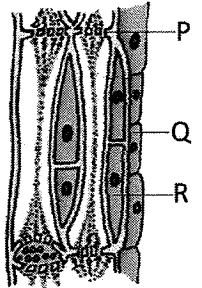
Identify $P, Q,$ and $R$ in the given figure.
A
$P-$Sieve pore,$Q-$Companion cell,$R-$Phloem parenchyma
B
$P-$Sieve pore,$Q-$Phloem parenchyma,$R-$Companion cell
C
$P-$Sieve pore,$Q-$Phloem parenchyma,$R-$Phloem fibre
D
$P-$Sieve pore,$Q-$Phloem fibre,$R-$Phloem parenchyma
Solution
(A) The provided figure shows the structure of phloem tissue.
$P$ points to the sieve pores located on the sieve plate,which allow for the transport of materials between sieve tube elements.
$Q$ points to the companion cell,which is a specialized parenchyma cell associated with the sieve tube element.
$R$ points to the phloem parenchyma,which is involved in the storage of food materials and other substances.
Therefore,the correct identification is $P-$Sieve pore,$Q-$Companion cell,$R-$Phloem parenchyma.
$P$ points to the sieve pores located on the sieve plate,which allow for the transport of materials between sieve tube elements.
$Q$ points to the companion cell,which is a specialized parenchyma cell associated with the sieve tube element.
$R$ points to the phloem parenchyma,which is involved in the storage of food materials and other substances.
Therefore,the correct identification is $P-$Sieve pore,$Q-$Companion cell,$R-$Phloem parenchyma.
0 likes
View Solution311
MediumMCQ
Protoxylem and metaxylem are components of which of the following?
A
Primary xylem
B
Secondary xylem
C
Primary phloem
D
Secondary phloem
Solution
(A) In plants,the primary xylem is the first formed xylem tissue that differentiates from the procambium during primary growth.
It consists of two types of vessels based on the time of their development:
$1$. $Protoxylem$: The first-formed primary xylem elements,which are smaller in diameter.
$2$. $Metaxylem$: The later-formed primary xylem elements,which are larger in diameter.
Therefore,both $Protoxylem$ and $Metaxylem$ are components of the primary xylem.
It consists of two types of vessels based on the time of their development:
$1$. $Protoxylem$: The first-formed primary xylem elements,which are smaller in diameter.
$2$. $Metaxylem$: The later-formed primary xylem elements,which are larger in diameter.
Therefore,both $Protoxylem$ and $Metaxylem$ are components of the primary xylem.
0 likes
View Solution312
MediumMCQ
Companion cells are specialized cells derived from $.........$.
A
Parenchyma cells
B
Collenchyma cells
C
Sclerenchyma cells
D
None of these
Solution
(A) Companion cells are specialized parenchymatous cells that are closely associated with sieve tube elements.
They are derived from the same mother cell as the sieve tube elements.
Since sieve tube elements are specialized parenchyma,companion cells are also considered to be derived from parenchyma cells.
They are derived from the same mother cell as the sieve tube elements.
Since sieve tube elements are specialized parenchyma,companion cells are also considered to be derived from parenchyma cells.
0 likes
View Solution313
MediumMCQ
Which of the following structures is absent in primary phloem?
A
Phloem parenchyma
B
Phloem fibers
C
Sieve tube elements
D
Companion cells
Solution
(B) Primary phloem is formed from the procambium during the early development of the plant.
In primary phloem,phloem fibers are generally absent or very rare.
Phloem fibers (bast fibers) are typically found in secondary phloem,which is formed later by the vascular cambium.
Therefore,the correct answer is $B$.
In primary phloem,phloem fibers are generally absent or very rare.
Phloem fibers (bast fibers) are typically found in secondary phloem,which is formed later by the vascular cambium.
Therefore,the correct answer is $B$.
0 likes
View Solution314
MediumMCQ
The type of tissue commonly found in the fruit wall of nuts is:
A
Parenchyma
B
Collenchyma
C
Sclerenchyma
D
Sclereid
Solution
(D) The fruit wall of nuts,such as walnuts or almonds,is extremely hard and provides protection to the seed.
This hardness is due to the presence of $Sclerenchyma$ tissue,specifically a type of $Sclerenchyma$ cell known as $Sclereids$ (or stone cells).
$Sclereids$ are dead cells with highly thickened,lignified cell walls that provide mechanical support and rigidity to plant parts.
While $Sclereids$ are a type of $Sclerenchyma$,in the context of specific anatomical structures like fruit walls (endocarp) and seed coats,$Sclereids$ is the most precise answer.
This hardness is due to the presence of $Sclerenchyma$ tissue,specifically a type of $Sclerenchyma$ cell known as $Sclereids$ (or stone cells).
$Sclereids$ are dead cells with highly thickened,lignified cell walls that provide mechanical support and rigidity to plant parts.
While $Sclereids$ are a type of $Sclerenchyma$,in the context of specific anatomical structures like fruit walls (endocarp) and seed coats,$Sclereids$ is the most precise answer.
0 likes
View Solution315
MediumMCQ
Given below are two statements:
Statement $I$: Parenchyma is living but collenchyma is dead tissue.
Statement $II$: Gymnosperms lack xylem vessels but presence of xylem vessels is the characteristic of angiosperms.
In the light of the above statements,choose the correct answer from the options given below:
Statement $I$: Parenchyma is living but collenchyma is dead tissue.
Statement $II$: Gymnosperms lack xylem vessels but presence of xylem vessels is the characteristic of angiosperms.
In the light of the above statements,choose the correct answer from the options given below:
A
Both Statement $I$ and Statement $II$ are false
B
Statement $I$ is true but Statement $II$ is false
C
Statement $I$ is false but Statement $II$ is true
D
Both Statement $I$ and Statement $II$ are true
Solution
(C) Statement $I$ is false because both parenchyma and collenchyma are living tissues. Collenchyma cells are living and possess protoplasm.
Statement $II$ is true because gymnosperms typically lack xylem vessels (tracheids are the main water-conducting elements),whereas the presence of xylem vessels is a defining characteristic of angiosperms.
Statement $II$ is true because gymnosperms typically lack xylem vessels (tracheids are the main water-conducting elements),whereas the presence of xylem vessels is a defining characteristic of angiosperms.
0 likes
View Solution316
EasyMCQ
Identify from the following,a plant tissue in which lignin does not occur in the cell walls.
A
Sclerenchyma fibers
B
Collenchyma
C
Xylem tracheae
D
Sclereids
Solution
(B) The correct answer is $B$.
Collenchyma is a living mechanical tissue found in plants.
The cell walls of collenchyma are unevenly thickened due to the deposition of cellulose,hemicellulose,and pectin.
Unlike sclerenchyma (fibers and sclereids) and xylem elements (tracheae/vessels),collenchyma cells do not contain lignin in their cell walls.
Collenchyma is a living mechanical tissue found in plants.
The cell walls of collenchyma are unevenly thickened due to the deposition of cellulose,hemicellulose,and pectin.
Unlike sclerenchyma (fibers and sclereids) and xylem elements (tracheae/vessels),collenchyma cells do not contain lignin in their cell walls.
0 likes
View SolutionAnatomy of Flowering Plants — Permanent Tissue · Frequently Asked Questions
1Are these Anatomy of Flowering Plants questions useful for JEE and NEET?
Yes. All questions in this section are mapped to JEE Main and NEET exam patterns. Previous year questions from JEE Main, NEET, GUJCET and state-level exams are included with full solutions.
2Can I switch to Hindi or Gujarati for these questions?
Yes. Use the language tabs in the hero section or the sidebar to view the same questions and solutions in English, Hindi or Gujarati.
3How do I generate a question paper from this subtopic?
Use the Vedclass Exam Paper Generator — select the chapter and subtopic, set difficulty, and generate Sets A, B, C, D automatically. First 3 chapters of every subject are free.
Vedclass Products
For Students
Vedclass Test Series
Mock tests in real JEE/NEET style with performance analysis. 5-day free trial.
Start Free TrialFor Teachers
Exam Paper Generator
Generate Set A/B/C/D papers from this chapter in 2 minutes. 3 chapters free.
Try FreeFor Institutes
Online Exam Module
Live online exams with unlimited students, 360° analytics & white-label branding.
See DemoFor Teachers & Institutes
Generate a Anatomy of Flowering Plants Exam Paper in 2 Minutes
Select subtopic & difficulty — Sets A, B, C, D auto-generated with No Repeat logic.
First 3 chapters of every subject are free — no payment required.