
A English
Permanent Tissue Questions in English
Class 11 Biology · Anatomy of Flowering Plants · Permanent Tissue
316+
Questions
English
Language
100%
With Solutions
Showing 50 of 316 questions in English
201
MediumMCQ
$A$ common structural feature of vessel elements and sieve tube elements is
A
enucleate condition
B
thick secondary walls
C
pores on lateral walls
D
presence of $P$-protein
Solution
(A) $Xylem$ is the principal water-conducting tissue of the plant. It consists of four types of cells: tracheids,vessels,xylem fibres,and xylem parenchyma.
$Xylem$ vessels are hollow,elongated cells with open ends and pitted walls. Cell walls are lignified. At maturity,the nucleus is absent in vessels.
The constituent cells of the phloem are sieve elements (sieve cells,sieve tubes),companion cells,phloem fibres,and phloem parenchyma cells.
Sieve tube members are long,slender,tube-like cells joined end-to-end to form long tubular channels called sieve tubes. Sieve tube members possess specialized sieve areas on the end walls called sieve plates. Young sieve tube members have abundant cytoplasm,but there is no nucleus. The nucleus disintegrates during their development.
Therefore,the common feature between mature vessel elements and mature sieve tube elements is the absence of a nucleus (enucleate condition).
$Xylem$ vessels are hollow,elongated cells with open ends and pitted walls. Cell walls are lignified. At maturity,the nucleus is absent in vessels.
The constituent cells of the phloem are sieve elements (sieve cells,sieve tubes),companion cells,phloem fibres,and phloem parenchyma cells.
Sieve tube members are long,slender,tube-like cells joined end-to-end to form long tubular channels called sieve tubes. Sieve tube members possess specialized sieve areas on the end walls called sieve plates. Young sieve tube members have abundant cytoplasm,but there is no nucleus. The nucleus disintegrates during their development.
Therefore,the common feature between mature vessel elements and mature sieve tube elements is the absence of a nucleus (enucleate condition).
0 likes
View Solution202
MediumMCQ
Which simple tissue is found in the pulp of fruits like guava,pear,and sapota?
A
Sclerenchyma
B
Living tissue
C
Parenchyma
D
Collenchyma
Solution
(A) The pulp of fruits like guava,pear,and sapota contains stone cells,which are a type of sclereids.
Sclereids are a form of sclerenchyma tissue that provides mechanical support and hardness to plant parts.
These cells are dead at maturity and have thick,lignified cell walls.
Therefore,the correct answer is $A$ (Sclerenchyma).
Sclereids are a form of sclerenchyma tissue that provides mechanical support and hardness to plant parts.
These cells are dead at maturity and have thick,lignified cell walls.
Therefore,the correct answer is $A$ (Sclerenchyma).
0 likes
View Solution203
EasyMCQ
......... occurs in layers below the epidermis in dicotyledonous plants.
A
Collenchyma
B
Parenchyma
C
Sclerenchyma fibers
D
None of the above
Solution
(A) In dicotyledonous plants,the $Collenchyma$ tissue is typically found in layers just below the epidermis.
It provides mechanical support to the growing parts of the plant such as young stems and petioles of leaves.
$Parenchyma$ is generally found in the ground tissue,while $Sclerenchyma$ fibers are usually associated with vascular bundles or found in mature,non-growing parts.
It provides mechanical support to the growing parts of the plant such as young stems and petioles of leaves.
$Parenchyma$ is generally found in the ground tissue,while $Sclerenchyma$ fibers are usually associated with vascular bundles or found in mature,non-growing parts.
0 likes
View Solution204
MediumMCQ
Food material stored in xylem parenchyma in the form of................
A
Starch,fat,tannin
B
Resin,latex,mucous
C
$A$ and $B$ correct
D
$A$ and $B$ incorrect
Solution
(A) Xylem parenchyma cells are the only living cells in the xylem tissue.
Their primary function is the storage of food materials.
These cells store food in the form of starch,fats,and other substances like tannins.
Resin,latex,and mucous are typically associated with secretory structures or specialized ducts,not the storage function of xylem parenchyma.
Therefore,the correct substances stored are starch,fat,and tannin.
Their primary function is the storage of food materials.
These cells store food in the form of starch,fats,and other substances like tannins.
Resin,latex,and mucous are typically associated with secretory structures or specialized ducts,not the storage function of xylem parenchyma.
Therefore,the correct substances stored are starch,fat,and tannin.
0 likes
View Solution205
MediumMCQ
Which of the following tissues is found in mature plant parts?
A
Secondary tissue
B
Intercalary meristem
C
Xylem
D
Apical meristem
Solution
(C) In plants, tissues are broadly classified into meristematic and permanent tissues.
Meristematic tissues (like $Apical$ and $Intercalary$ meristems) are composed of actively dividing cells and are found in growing regions.
Permanent tissues are composed of cells that have lost the ability to divide and have attained a mature form.
$Xylem$ is a complex permanent tissue that is found in mature plant parts and is responsible for the conduction of water and minerals.
Therefore, $Xylem$ is the tissue found in mature plant parts.
Meristematic tissues (like $Apical$ and $Intercalary$ meristems) are composed of actively dividing cells and are found in growing regions.
Permanent tissues are composed of cells that have lost the ability to divide and have attained a mature form.
$Xylem$ is a complex permanent tissue that is found in mature plant parts and is responsible for the conduction of water and minerals.
Therefore, $Xylem$ is the tissue found in mature plant parts.
0 likes
View Solution206
MediumMCQ
Which of the following statements is true regarding Sclerenchyma tissue?
A
They have thin walls and are made up of cellulose.
B
They are usually dead and without protoplast.
C
They assimilate food when they contain chloroplast.
D
None of the above.
Solution
(B) Sclerenchyma is a type of simple permanent tissue in plants.
$1$. Sclerenchyma cells are characterized by thick,lignified secondary cell walls,which provide structural support to the plant.
$2$. At maturity,these cells are typically dead and lack a protoplast.
$3$. Because they are dead at maturity,they do not contain chloroplasts and cannot perform photosynthesis or assimilate food.
$4$. Therefore,statement $B$ is the correct description of Sclerenchyma tissue.
$1$. Sclerenchyma cells are characterized by thick,lignified secondary cell walls,which provide structural support to the plant.
$2$. At maturity,these cells are typically dead and lack a protoplast.
$3$. Because they are dead at maturity,they do not contain chloroplasts and cannot perform photosynthesis or assimilate food.
$4$. Therefore,statement $B$ is the correct description of Sclerenchyma tissue.
0 likes
View Solution207
MediumMCQ
Phloem fibers are made up of .......... tissue.
A
Sclerenchymal
B
Parenchymal
C
Collenchymal
D
None of them
Solution
(A) Phloem fibers,also known as bast fibers,are made up of sclerenchymatous cells.
These cells are generally absent in primary phloem but are found in secondary phloem.
They are elongated,unbranched,and have pointed,needle-like apices.
At maturity,these fibers lose their protoplasm and become dead,providing mechanical support to the plant body.
These cells are generally absent in primary phloem but are found in secondary phloem.
They are elongated,unbranched,and have pointed,needle-like apices.
At maturity,these fibers lose their protoplasm and become dead,providing mechanical support to the plant body.
0 likes
View Solution208
MediumMCQ
It is not a part of the tissue which is responsible for the conduction of water and minerals from roots to the stem and leaves.
A
Tracheid
B
Companion cells
C
Vessels
D
Xylem fibre
Solution
(B) The tissue responsible for the conduction of water and minerals from roots to the stem and leaves is $Xylem$.
$Xylem$ is a complex permanent tissue composed of four types of elements: $Tracheids$,$Vessels$,$Xylem$ $fibres$,and $Xylem$ $parenchyma$.
$Companion$ $cells$ are a component of $Phloem$,which is responsible for the translocation of food (sugars) from leaves to other parts of the plant.
Therefore,$Companion$ $cells$ are not a part of the $Xylem$ tissue.
$Xylem$ is a complex permanent tissue composed of four types of elements: $Tracheids$,$Vessels$,$Xylem$ $fibres$,and $Xylem$ $parenchyma$.
$Companion$ $cells$ are a component of $Phloem$,which is responsible for the translocation of food (sugars) from leaves to other parts of the plant.
Therefore,$Companion$ $cells$ are not a part of the $Xylem$ tissue.
0 likes
View Solution209
MediumMCQ
Which of the following statements is correct for sclerenchyma tissue?
A
Intercellular space,oval-shaped cells,photosynthesis,storage,and secretion are its functions.
B
Cells may be oval,spherical,or polygonal,contain chlorophyll,and are living cells.
C
Dead cells without protoplast,providing mechanical support.
D
Cell wall is thin and made up of cellulose,and intercellular space is present.
Solution
(C) Sclerenchyma cells are typically dead at maturity and lack a protoplast. Their cell walls are heavily thickened with lignin,which provides significant mechanical strength and support to the plant body. Options $A$,$B$,and $D$ describe characteristics of parenchyma or collenchyma tissues,not sclerenchyma.
0 likes
View Solution210
MediumMCQ
The companion cells are specialized ........ which are closely associated with sieve tube elements.
A
Collenchymatous cells.
B
Parenchymatous cells.
C
Sclereids.
D
Fibers.
Solution
(B) Companion cells are specialized parenchymatous cells that are closely associated with sieve tube elements.
They are connected to the sieve tube elements by pit fields present between their common longitudinal walls.
These cells help in maintaining the pressure gradient in the sieve tubes,which is essential for the translocation of food materials.
They are connected to the sieve tube elements by pit fields present between their common longitudinal walls.
These cells help in maintaining the pressure gradient in the sieve tubes,which is essential for the translocation of food materials.
0 likes
View Solution211
MediumMCQ
What is incorrect for $vessel$?
A
Lignified wall is present.
B
Cylindrical tube-like structure.
C
Presence of protoplasm.
D
Possess a large central cavity.
Solution
(C) Vessels are one of the components of $xylem$ in angiosperms.
They are long,cylindrical,tube-like structures made up of many cells called vessel members.
Each vessel member has lignified walls and a large central cavity.
These cells are devoid of protoplasm at maturity,meaning they are dead cells.
Therefore,the statement 'Presence of protoplasm' is incorrect for vessels.
They are long,cylindrical,tube-like structures made up of many cells called vessel members.
Each vessel member has lignified walls and a large central cavity.
These cells are devoid of protoplasm at maturity,meaning they are dead cells.
Therefore,the statement 'Presence of protoplasm' is incorrect for vessels.
0 likes
View Solution212
MediumMCQ
Choose the correct pair.
A
Parenchyma tissue - found in seed coats of legumes
B
Collenchyma tissue - Intercellular space is present.
C
Xylem parenchyma - Dead cells and thick cell wall.
D
Sclerenchyma tissue - Narrow cells,with lignified cell wall.
Solution
(D) The correct pair is $D$.
$A$: Parenchyma is a simple permanent tissue found in the soft parts of plants,not in the hard seed coats of legumes (which contain sclereids).
$B$: Collenchyma tissue is characterized by the absence of intercellular spaces due to localized thickening of cell walls.
$C$: Xylem parenchyma is the only living component of xylem; other elements like tracheids,vessels,and xylem fibers are dead.
$D$: Sclerenchyma tissue consists of long,narrow cells with thick,lignified cell walls,which provide mechanical support to the plant.
$A$: Parenchyma is a simple permanent tissue found in the soft parts of plants,not in the hard seed coats of legumes (which contain sclereids).
$B$: Collenchyma tissue is characterized by the absence of intercellular spaces due to localized thickening of cell walls.
$C$: Xylem parenchyma is the only living component of xylem; other elements like tracheids,vessels,and xylem fibers are dead.
$D$: Sclerenchyma tissue consists of long,narrow cells with thick,lignified cell walls,which provide mechanical support to the plant.
0 likes
View Solution213
MediumMCQ
They provide mechanical support to the growing parts of the plant such as young stem and petiole of leaf.
A
Root hair
B
Sclerenchyma tissue
C
Collenchyma tissue
D
Parenchyma tissue
Solution
(C) Collenchyma is a type of simple permanent tissue found in the dicotyledonous plants.
It occurs in layers below the epidermis in most dicotyledonous stems and petioles.
Its cells are much thickened at the corners due to the deposition of cellulose,hemicellulose,and pectin.
Collenchyma provides mechanical support to the growing parts of the plant,such as the young stem and the petiole of a leaf,while also allowing for growth and elongation.
It occurs in layers below the epidermis in most dicotyledonous stems and petioles.
Its cells are much thickened at the corners due to the deposition of cellulose,hemicellulose,and pectin.
Collenchyma provides mechanical support to the growing parts of the plant,such as the young stem and the petiole of a leaf,while also allowing for growth and elongation.
0 likes
View Solution214
MediumMCQ
In parenchyma,thickening is of
A
Lignin
B
Chitin
C
Suberin
D
Do not show thickening
Solution
(D) Parenchyma is a type of simple permanent tissue that forms the basic packing tissue of plants.
Its cells are generally isodiametric,thin-walled,and living.
The cell walls are primarily composed of cellulose.
Unlike collenchyma (which shows pectin thickening) or sclerenchyma (which shows lignin thickening),parenchyma cells do not exhibit secondary wall thickening.
Therefore,they do not show thickening.
Its cells are generally isodiametric,thin-walled,and living.
The cell walls are primarily composed of cellulose.
Unlike collenchyma (which shows pectin thickening) or sclerenchyma (which shows lignin thickening),parenchyma cells do not exhibit secondary wall thickening.
Therefore,they do not show thickening.
0 likes
View Solution215
MediumMCQ
Intercellular space is more in..
A
Collenchyma
B
Sclerenchyma
C
Parenchyma
D
All correct
Solution
(C) The $Parenchyma$ tissue consists of relatively unspecialized cells with thin cell walls made of cellulose.
These cells are generally isodiametric and are either closely packed or have small intercellular spaces.
In contrast,$Collenchyma$ cells have thickened corners due to cellulose,hemicellulose,and pectin deposition,leaving little to no intercellular space.
$Sclerenchyma$ cells are dead at maturity and have thick,lignified cell walls that provide structural support,with no intercellular spaces.
Therefore,compared to the other two,$Parenchyma$ cells have the most significant intercellular space.
These cells are generally isodiametric and are either closely packed or have small intercellular spaces.
In contrast,$Collenchyma$ cells have thickened corners due to cellulose,hemicellulose,and pectin deposition,leaving little to no intercellular space.
$Sclerenchyma$ cells are dead at maturity and have thick,lignified cell walls that provide structural support,with no intercellular spaces.
Therefore,compared to the other two,$Parenchyma$ cells have the most significant intercellular space.
0 likes
View Solution216
MediumMCQ
Identify the odd one out.
A
Parenchyma
B
Xylem
C
Sclerenchyma
D
Collenchyma
Solution
(B) The correct answer is $B$.
$Parenchyma$,$Sclerenchyma$,and $Collenchyma$ are types of simple permanent tissues,which are composed of only one type of cell.
$Xylem$ is a complex permanent tissue,which is composed of different types of cells (tracheids,vessels,xylem parenchyma,and xylem fibers) working together as a unit to conduct water and minerals.
$Parenchyma$,$Sclerenchyma$,and $Collenchyma$ are types of simple permanent tissues,which are composed of only one type of cell.
$Xylem$ is a complex permanent tissue,which is composed of different types of cells (tracheids,vessels,xylem parenchyma,and xylem fibers) working together as a unit to conduct water and minerals.
0 likes
View Solution217
MediumMCQ
Xylem tissue is composed of
A
four same kinds of elements
B
three same kinds of elements
C
four different kinds of elements
D
three different kinds of elements
Solution
(C) Xylem is a complex permanent tissue that functions as a conducting tissue for water and minerals from roots to the stem and leaves.
It is composed of four different kinds of elements:
$1$. Tracheids: Elongated tube-like cells with thick,lignified walls and tapering ends.
$2$. Vessels: Long cylindrical tube-like structures made up of many cells called vessel members,each with lignified walls and a large central cavity.
$3$. Xylem parenchyma: These are the only living cells in the xylem,responsible for the storage of food materials (starch or fat) and radial conduction of water.
$4$. Xylem fibers: Highly thickened walls and obliterated central lumens,providing mechanical support.
Since these four elements have different structures and functions,xylem is considered a complex tissue.
It is composed of four different kinds of elements:
$1$. Tracheids: Elongated tube-like cells with thick,lignified walls and tapering ends.
$2$. Vessels: Long cylindrical tube-like structures made up of many cells called vessel members,each with lignified walls and a large central cavity.
$3$. Xylem parenchyma: These are the only living cells in the xylem,responsible for the storage of food materials (starch or fat) and radial conduction of water.
$4$. Xylem fibers: Highly thickened walls and obliterated central lumens,providing mechanical support.
Since these four elements have different structures and functions,xylem is considered a complex tissue.
0 likes
View Solution218
MediumMCQ
The first formed primary phloem is referred to as $A$. The later formed primary phloem is referred to as $B$. Choose the correct combination of $A$ and $B$.
A
$A$-protoxylem,$B$-metaxylem
B
$A$-protophloem,$B$-sieve tube cells
C
$A$-metaphloem,$B$-sieve tube cells
D
$A$-protophloem,$B$-metaphloem
Solution
(D) In plants,primary phloem is formed during the development of the plant body.
$1$. The first formed primary phloem elements are narrow and are called $A$-protophloem.
$2$. The later formed primary phloem elements are larger and are called $B$-metaphloem.
Therefore,the correct combination is $A$-protophloem and $B$-metaphloem.
$1$. The first formed primary phloem elements are narrow and are called $A$-protophloem.
$2$. The later formed primary phloem elements are larger and are called $B$-metaphloem.
Therefore,the correct combination is $A$-protophloem and $B$-metaphloem.
0 likes
View Solution219
MediumMCQ
Identify the figure:
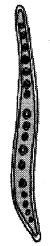
A
Bacillus bacteria
B
$A$ tracheid
C
Mesophyll cell
D
Nerve cell
Solution
(B) The provided figure shows a $tracheid$.
Tracheids are elongated or tube-like cells with thick and lignified walls and tapering ends.
These are dead cells and are devoid of protoplasm.
They are the main water-conducting elements in gymnosperms and pteridophytes.
Therefore,the correct option is $B$.
Tracheids are elongated or tube-like cells with thick and lignified walls and tapering ends.
These are dead cells and are devoid of protoplasm.
They are the main water-conducting elements in gymnosperms and pteridophytes.
Therefore,the correct option is $B$.
0 likes
View Solution220
MediumMCQ
In which of the following are fibers produced?
A
Coconut
B
Oak
C
Teak
D
Sheesham
Solution
(A) Fibers are a type of sclerenchyma tissue that provide mechanical support to plants.
In the case of $Cocos$ $nucifera$ (coconut),the husk is composed of abundant sclerenchymatous fibers,which are commercially known as coir.
These fibers are highly lignified and provide strength to the fruit covering.
In the case of $Cocos$ $nucifera$ (coconut),the husk is composed of abundant sclerenchymatous fibers,which are commercially known as coir.
These fibers are highly lignified and provide strength to the fruit covering.
0 likes
View Solution221
MediumMCQ
Collenchyma is found in the stem and petiole of . . . . . . .
A
Xerophytes
B
Monocots
C
Dicot plants
D
Hydrophytes
Solution
(C) Collenchyma is a type of simple permanent tissue that provides mechanical support to the growing parts of the plant,such as young stems and petioles of leaves.
It is characteristically absent in monocot stems and roots.
It is primarily found in the hypodermis of dicot stems and the petioles of dicot leaves.
Therefore,collenchyma is found in the stem and petiole of dicot plants.
It is characteristically absent in monocot stems and roots.
It is primarily found in the hypodermis of dicot stems and the petioles of dicot leaves.
Therefore,collenchyma is found in the stem and petiole of dicot plants.
0 likes
View Solution222
MediumMCQ
$A$ structure that is well-organized and differentiated,containing cytoplasm but lacking a nucleus is:
A
Vessels
B
Xylem parenchyma
C
Sieve tubes
D
Tracheids
Solution
(C) Sieve tube elements are specialized cells in the phloem of angiosperms.
During their maturation,they lose their nucleus,ribosomes,and vacuoles to facilitate the transport of food materials.
However,they retain a thin layer of cytoplasm and are associated with companion cells that regulate their metabolic activities.
During their maturation,they lose their nucleus,ribosomes,and vacuoles to facilitate the transport of food materials.
However,they retain a thin layer of cytoplasm and are associated with companion cells that regulate their metabolic activities.
0 likes
View Solution223
EasyMCQ
Angular collenchyma is found in ...............
A
Cucurbita
B
Tagetes
C
Althaea
D
Salvia
Solution
(A) Collenchyma is a type of simple permanent tissue that provides mechanical support to the plant. Based on the deposition of pectin and cellulose,collenchyma is classified into three types:
$1$. Angular collenchyma: Thickening is present at the corners where cells meet. It is found in $Cucurbita$ (pumpkin/gourd family).
$2$. Lamellar collenchyma: Thickening is present on the tangential walls. It is found in $Althaea$.
$3$. Lacunar collenchyma: Thickening is present near the intercellular spaces. It is found in $Salvia$ or $Malva$.
$1$. Angular collenchyma: Thickening is present at the corners where cells meet. It is found in $Cucurbita$ (pumpkin/gourd family).
$2$. Lamellar collenchyma: Thickening is present on the tangential walls. It is found in $Althaea$.
$3$. Lacunar collenchyma: Thickening is present near the intercellular spaces. It is found in $Salvia$ or $Malva$.
0 likes
View Solution224
EasyMCQ
Bordered pits are found in . . . . . . .
A
Sieve cells
B
Vessel elements
C
Companion cells
D
Sieve tube elements
Solution
(B) Bordered pits are specialized structures found in the cell walls of xylem elements,particularly in tracheids and vessel elements. These pits facilitate the lateral transport of water and minerals between adjacent cells. Sieve cells,companion cells,and sieve tube elements are components of the phloem and do not possess bordered pits.
0 likes
View Solution225
MediumMCQ
Which of the following is $NOT$ true for sclereids?
A
They are elongated,elastic,and have pointed ends.
B
These cells have highly thickened,lignified walls.
C
They are commonly found in the fruit walls of nuts,pulp of guavas,and pears.
D
They are also known as stone cells.
Solution
(A) Sclereids are a type of sclerenchyma cells that are typically short,irregular in shape,and possess extremely thick,lignified cell walls with narrow lumens.
Option $A$ is incorrect because elongated,elastic cells with pointed ends are characteristic of sclerenchyma fibers,not sclereids.
Option $B$ is correct as sclereids possess highly thickened,lignified walls.
Option $C$ is correct as sclereids provide grit to the pulp of fruits like guavas and pears.
Option $D$ is correct as they are commonly referred to as stone cells due to their hardness.
Option $A$ is incorrect because elongated,elastic cells with pointed ends are characteristic of sclerenchyma fibers,not sclereids.
Option $B$ is correct as sclereids possess highly thickened,lignified walls.
Option $C$ is correct as sclereids provide grit to the pulp of fruits like guavas and pears.
Option $D$ is correct as they are commonly referred to as stone cells due to their hardness.
0 likes
View Solution226
EasyMCQ
Which of the following cells becomes enucleated upon maturity?
A
Sieve tube elements
B
Companion cells
C
Palisade cells
D
Cortical cells
Solution
(A) In angiosperms,the $Sieve$ $tube$ $elements$ are the main conducting cells of the phloem. During their development and maturation,they lose their nucleus,ribosomes,and vacuoles to facilitate the efficient transport of food materials. This process makes them enucleated at maturity,while they remain associated with companion cells that regulate their metabolic activities.
0 likes
View Solution227
MediumMCQ
Which of the following statements is correct?
A
Vessels are multicellular structures with narrow lumens.
B
Tracheids are multicellular structures with narrow lumens.
C
Vessels are unicellular structures with wide lumens.
D
Vessels are unicellular and have wide lumens.
Solution
(A) Vessels $(tracheae)$ are long,cylindrical,tube-like structures made up of many cells,each called a vessel member. These members possess lignified walls and a large central cavity (lumen). In contrast,tracheids are individual,elongated cells with tapering ends and relatively narrower lumens compared to vessels. Therefore,vessels are multicellular structures with wide lumens,while tracheids are unicellular structures.
0 likes
View Solution228
MediumMCQ
Vessels are found in $..........$.
A
All angiosperms and some gymnosperms
B
Almost all angiosperms and some gymnosperms
C
All angiosperms,few gymnosperms,and some pteridophytes
D
All pteridophytes
Solution
(B) Vessels are a characteristic feature of angiosperms.
Almost all angiosperms possess vessels,while they are generally absent in gymnosperms and pteridophytes.
However,there are exceptions; for example,some gymnosperms like $Gnetum$ possess vessels.
Therefore,the most accurate description is that they are found in almost all angiosperms and some gymnosperms.
Almost all angiosperms possess vessels,while they are generally absent in gymnosperms and pteridophytes.
However,there are exceptions; for example,some gymnosperms like $Gnetum$ possess vessels.
Therefore,the most accurate description is that they are found in almost all angiosperms and some gymnosperms.
0 likes
View Solution229
MediumMCQ
Which structure is common to both xylem elements (tracheary elements) and sieve tube elements?
A
Pits on lateral walls
B
Presence of $P$-protein
C
Enucleated condition (lack of nucleus)
D
Thick secondary walls
Solution
(A) Both xylem tracheary elements (vessels and tracheids) and sieve tube elements are specialized for long-distance transport of substances.
$1$. Xylem vessels and tracheids are dead at maturity and lack a nucleus.
$2$. Sieve tube elements,although living,lose their nucleus at maturity to facilitate the flow of sap.
$3$. Both cell types possess pits on their lateral walls,which allow for the lateral movement of water and solutes between adjacent cells.
$1$. Xylem vessels and tracheids are dead at maturity and lack a nucleus.
$2$. Sieve tube elements,although living,lose their nucleus at maturity to facilitate the flow of sap.
$3$. Both cell types possess pits on their lateral walls,which allow for the lateral movement of water and solutes between adjacent cells.
0 likes
View Solution230
EasyMCQ
Companion cells are thin-walled cells found in:
A
Phloem elements where substances are transported towards other plant parts.
B
The endodermis of the root for rapid water transport from the cortex to the pericycle.
C
The seed coat to facilitate the emergence of the developing embryonic axis during germination.
D
The central part of the style through which the pollen tube grows towards the ovule.
Solution
(A) Companion cells are specialized parenchyma cells associated with sieve tube elements in the phloem of angiosperms. They are involved in the loading and unloading of sugars into the sieve tubes for translocation to various parts of the plant. Therefore,they are found in phloem tissue.
0 likes
View Solution231
EasyMCQ
In angiosperms,the conduction of water takes place through ......... .
A
Tracheids
B
Vessels
C
Sieve tubes
D
All of the above
Solution
(B) In angiosperms,the xylem is the principal water-conducting tissue.
It consists of tracheids and vessels,which are the main elements responsible for the long-distance transport of water and minerals from roots to other parts of the plant.
Sieve tubes are part of the phloem,which is responsible for the translocation of food (organic solutes).
Since both tracheids and vessels are involved in water conduction in angiosperms,the most accurate answer is that water conduction occurs through these xylem elements. However,in the context of multiple-choice questions where 'all of the above' is provided,it is important to note that sieve tubes do not conduct water. Therefore,the question implies the primary xylem elements. Given the options,'Vessels' are the most specialized and efficient water-conducting structures in angiosperms.
It consists of tracheids and vessels,which are the main elements responsible for the long-distance transport of water and minerals from roots to other parts of the plant.
Sieve tubes are part of the phloem,which is responsible for the translocation of food (organic solutes).
Since both tracheids and vessels are involved in water conduction in angiosperms,the most accurate answer is that water conduction occurs through these xylem elements. However,in the context of multiple-choice questions where 'all of the above' is provided,it is important to note that sieve tubes do not conduct water. Therefore,the question implies the primary xylem elements. Given the options,'Vessels' are the most specialized and efficient water-conducting structures in angiosperms.
0 likes
View Solution232
EasyMCQ
Sclerenchyma usually . . . . . . and . . . . . . protoplasts.
A
live,without
B
dead,with
C
live,with
D
dead,without
Solution
(D) Sclerenchyma consists of long,narrow cells with thick and lignified cell walls having a few or numerous pits.
They are usually dead and without protoplasts.
They are usually dead and without protoplasts.
0 likes
View Solution233
MediumMCQ
Assertion: Collenchyma is a thick-walled dead tissue.
Reason: Collenchymatous cells show thickenings of pectin.
Reason: Collenchymatous cells show thickenings of pectin.
A
If both Assertion and Reason are correct and the Reason is a correct explanation of the Assertion.
B
If both Assertion and Reason are correct but Reason is not a correct explanation of the Assertion.
C
If the Assertion is correct but Reason is incorrect.
D
If the Assertion is incorrect but the Reason is correct.
Solution
(D) Collenchyma consists of living cells with unevenly thickened cell walls.
The cell walls are composed of cellulose,hemicellulose,and pectin.
Since collenchyma cells are living,the assertion that they are 'dead tissue' is incorrect.
However,the reason stating that collenchymatous cells show thickenings of pectin is correct.
Therefore,the Assertion is incorrect,but the Reason is correct.
The cell walls are composed of cellulose,hemicellulose,and pectin.
Since collenchyma cells are living,the assertion that they are 'dead tissue' is incorrect.
However,the reason stating that collenchymatous cells show thickenings of pectin is correct.
Therefore,the Assertion is incorrect,but the Reason is correct.
0 likes
View Solution234
MediumMCQ
Assertion: In angiosperms,the conduction of water is more efficient because their xylem has vessels.
Reason: Conduction of water by vessel elements is an active process with energy supplied by xylem parenchyma rich in mitochondria.
Reason: Conduction of water by vessel elements is an active process with energy supplied by xylem parenchyma rich in mitochondria.
A
If both Assertion and Reason are correct and the Reason is a correct explanation of the Assertion.
B
If both Assertion and Reason are correct but Reason is not a correct explanation of the Assertion.
C
If the Assertion is correct but Reason is incorrect.
D
If both the Assertion and Reason are incorrect.
Solution
(C) The Assertion is correct because the presence of vessels in the xylem of angiosperms provides a more efficient pathway for water transport compared to tracheids alone.
However,the Reason is incorrect. The conduction of water through xylem vessels is a passive process driven by transpiration pull (cohesion-tension theory),not an active process requiring energy from xylem parenchyma.
However,the Reason is incorrect. The conduction of water through xylem vessels is a passive process driven by transpiration pull (cohesion-tension theory),not an active process requiring energy from xylem parenchyma.
0 likes
View Solution235
DifficultMCQ
Assertion : Vessels are more efficient for water conduction as compared to tracheids.
Reason : Vessels are dead lignified.
Reason : Vessels are dead lignified.
A
If both Assertion and Reason are correct and the Reason is a correct explanation of the Assertion.
B
If both Assertion and Reason are correct but Reason is not a correct explanation of the Assertion.
C
If the Assertion is correct but Reason is incorrect.
D
If both the Assertion and Reason are incorrect.
Solution
(A) Vessels are more efficient for water conduction compared to tracheids because they form long,continuous,tube-like structures with perforated end walls,which offer less resistance to water flow.
Tracheids are individual,elongated cells with tapered ends,whereas vessels are composed of a vertical row of cylindrical cells with dissolved end walls.
Both vessels and tracheids are dead and lignified at maturity,which provides structural support and facilitates water transport.
Since the Reason correctly describes a characteristic of vessels that contributes to their function,it is a correct explanation of the Assertion.
Tracheids are individual,elongated cells with tapered ends,whereas vessels are composed of a vertical row of cylindrical cells with dissolved end walls.
Both vessels and tracheids are dead and lignified at maturity,which provides structural support and facilitates water transport.
Since the Reason correctly describes a characteristic of vessels that contributes to their function,it is a correct explanation of the Assertion.
0 likes
View Solution236
MediumMCQ
The xerophytic plants conserve water by storing it in
A
intercellular spaces
B
normal parenchymatous cells
C
intercellular spaces and parenchymatous cells
D
parenchymatous cells specialized for this purpose
Solution
(D) Xerophytic plants conserve water by storing it in parenchymatous cells specialized for this purpose.
These plants are specially adapted to survive in arid climates.
They are typically able to withstand long periods of drought and the drying effects of desert winds.
Some plants have adapted to arid lands by developing specialized water-storage tissues,which are modified parenchymatous cells.
These plants are specially adapted to survive in arid climates.
They are typically able to withstand long periods of drought and the drying effects of desert winds.
Some plants have adapted to arid lands by developing specialized water-storage tissues,which are modified parenchymatous cells.
0 likes
View Solution237
Medium
Why are xylem and phloem called complex tissues?
Solution
(A) Xylem and phloem are known as complex tissues because they are made up of more than one type of cells. These cells work in a coordinated manner,as a unit,to perform the various functions of the xylem and phloem.
Xylem helps in conducting water and minerals. It also provides mechanical support to plants. It is made up of the following components:
$1$. Tracheids (xylem vessels and xylem tracheids)
$2$. Xylem parenchyma
$3$. Xylem fibres
Tracheids are elongated,thick-walled dead cells with tapering ends. Vessels are long,tubular,and cylindrical structures formed from the vessel members,with each having lignified walls and large central cavities. Both tracheids and vessels lack protoplasm. Xylem fibres consist of thick walls with an almost insignificant lumen. They help in providing mechanical support to the plant. Xylem parenchyma is made up of thin-walled parenchymatous cells that help in the storage of food materials and in the radial conduction of water.
Phloem helps in conducting food materials. It is composed of:
$1$. Sieve tube elements
$2$. Companion cells
$3$. Phloem parenchyma
$4$. Phloem fibres
Sieve tube elements are tube-like elongated structures associated with companion cells. The end walls of sieve tube elements are perforated to form the sieve plate. Sieve tube elements are living cells containing cytoplasm and nucleus. Companion cells are parenchymatous in nature. They help in maintaining the pressure gradient in the sieve tube elements. Phloem parenchyma helps in the storage of food and is made up of long tapering cells with a dense cytoplasm. Phloem fibres are made up of elongated sclerenchymatous cells with thick cell walls.
Xylem helps in conducting water and minerals. It also provides mechanical support to plants. It is made up of the following components:
$1$. Tracheids (xylem vessels and xylem tracheids)
$2$. Xylem parenchyma
$3$. Xylem fibres
Tracheids are elongated,thick-walled dead cells with tapering ends. Vessels are long,tubular,and cylindrical structures formed from the vessel members,with each having lignified walls and large central cavities. Both tracheids and vessels lack protoplasm. Xylem fibres consist of thick walls with an almost insignificant lumen. They help in providing mechanical support to the plant. Xylem parenchyma is made up of thin-walled parenchymatous cells that help in the storage of food materials and in the radial conduction of water.
Phloem helps in conducting food materials. It is composed of:
$1$. Sieve tube elements
$2$. Companion cells
$3$. Phloem parenchyma
$4$. Phloem fibres
Sieve tube elements are tube-like elongated structures associated with companion cells. The end walls of sieve tube elements are perforated to form the sieve plate. Sieve tube elements are living cells containing cytoplasm and nucleus. Companion cells are parenchymatous in nature. They help in maintaining the pressure gradient in the sieve tube elements. Phloem parenchyma helps in the storage of food and is made up of long tapering cells with a dense cytoplasm. Phloem fibres are made up of elongated sclerenchymatous cells with thick cell walls.
0 likes
View Solution238
Easy
What is meant by permanent tissue? Give its types.
Solution
(N/A) $\rightarrow$ Following divisions of cells in both primary and secondary meristems, the newly formed cells become structurally and functionally specialised and lose the ability to divide. Such cells are termed permanent or mature cells and constitute the permanent tissues.
$\rightarrow$ There are two types of permanent tissues: $(A)$ Simple Tissues $(B)$ Complex Tissues.
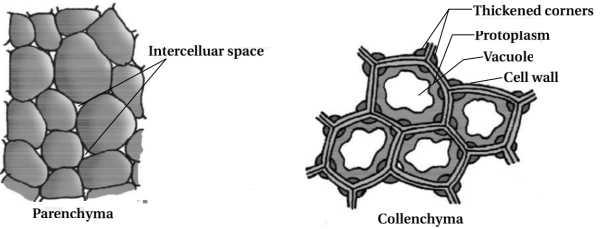
$(A)$ Simple Tissues: The cells of the permanent tissues do not generally divide further. Permanent tissues having all cells similar in structure and function are called simple tissues. There are $3$ types of simple tissues: $(a)$ Parenchyma $(b)$ Collenchyma $(c)$ Sclerenchyma.
$(a)$ Parenchyma Tissues: Parenchyma forms the major component within organs.
$\rightarrow$ The cells of the parenchyma are generally isodiametric.
$\rightarrow$ They may be spherical, oval, round, polygonal or elongated in shape.
$\rightarrow$ Their walls are thin and made up of cellulose.
$\rightarrow$ They may either be closely packed or have small intercellular spaces.
$\rightarrow$ Importance: The parenchyma performs various functions like photosynthesis, storage, and secretion.
$(b)$ Collenchyma Tissues: The collenchyma occurs in layers below the epidermis in dicotyledonous plants. It is absent in monocotyledonous and underground parts of the plant.
$\rightarrow$ It is found either as a homogeneous layer or in patches.
$\rightarrow$ It consists of cells which are much thickened at the corners due to a deposition of cellulose, hemicellulose and pectin.
$\rightarrow$ Collenchymatous cells may be oval, spherical or polygonal and often contain chloroplasts.
$\rightarrow$ These cells assimilate food when they contain chloroplasts.
$(c)$ Sclerenchyma Tissues: These consist of long, narrow cells with thick and lignified cell walls having a few or numerous pits. They are usually dead and without protoplasts.
$\rightarrow$ There are two types of permanent tissues: $(A)$ Simple Tissues $(B)$ Complex Tissues.
$(A)$ Simple Tissues: The cells of the permanent tissues do not generally divide further. Permanent tissues having all cells similar in structure and function are called simple tissues. There are $3$ types of simple tissues: $(a)$ Parenchyma $(b)$ Collenchyma $(c)$ Sclerenchyma.
$(a)$ Parenchyma Tissues: Parenchyma forms the major component within organs.
$\rightarrow$ The cells of the parenchyma are generally isodiametric.
$\rightarrow$ They may be spherical, oval, round, polygonal or elongated in shape.
$\rightarrow$ Their walls are thin and made up of cellulose.
$\rightarrow$ They may either be closely packed or have small intercellular spaces.
$\rightarrow$ Importance: The parenchyma performs various functions like photosynthesis, storage, and secretion.
$(b)$ Collenchyma Tissues: The collenchyma occurs in layers below the epidermis in dicotyledonous plants. It is absent in monocotyledonous and underground parts of the plant.
$\rightarrow$ It is found either as a homogeneous layer or in patches.
$\rightarrow$ It consists of cells which are much thickened at the corners due to a deposition of cellulose, hemicellulose and pectin.
$\rightarrow$ Collenchymatous cells may be oval, spherical or polygonal and often contain chloroplasts.
$\rightarrow$ These cells assimilate food when they contain chloroplasts.
$(c)$ Sclerenchyma Tissues: These consist of long, narrow cells with thick and lignified cell walls having a few or numerous pits. They are usually dead and without protoplasts.
0 likes
View Solution239
Medium
Describe the importance of companion cells in plants.
Solution
(N/A) Companion cells are specialized parenchyma cells associated with sieve tube elements in the phloem of angiosperms.
Their importance includes:
$1$. Maintenance of Pressure Gradient: They help in maintaining the pressure gradient in the sieve tubes,which is essential for the translocation of food.
$2$. Metabolic Support: Since mature sieve tube elements lack a nucleus and other organelles,companion cells provide metabolic support by supplying proteins and $ATP$.
$3$. Loading and Unloading: They play a crucial role in the active loading of sugars into the sieve tubes at the source and unloading at the sink.
Their importance includes:
$1$. Maintenance of Pressure Gradient: They help in maintaining the pressure gradient in the sieve tubes,which is essential for the translocation of food.
$2$. Metabolic Support: Since mature sieve tube elements lack a nucleus and other organelles,companion cells provide metabolic support by supplying proteins and $ATP$.
$3$. Loading and Unloading: They play a crucial role in the active loading of sugars into the sieve tubes at the source and unloading at the sink.
0 likes
View Solution240
Medium
Write a note on complex tissues.
Solution
(N/A) $\rightarrow$ Complex tissues are made of more than one type of cells, and these cells work together as a single unit.
$\rightarrow$ These tissues are primarily associated with the transport of water, mineral substances, nutrients, and organic substances; therefore, they are also known as vascular tissues.
$\rightarrow$ In plants, the two main types of complex tissues are xylem and phloem.
$\rightarrow$ Xylem is responsible for the conduction of water and minerals from roots to the stem and leaves.
$\rightarrow$ Phloem is responsible for the translocation of food (organic substances) from leaves to other parts of the plant.
$\rightarrow$ These tissues are primarily associated with the transport of water, mineral substances, nutrients, and organic substances; therefore, they are also known as vascular tissues.
$\rightarrow$ In plants, the two main types of complex tissues are xylem and phloem.
$\rightarrow$ Xylem is responsible for the conduction of water and minerals from roots to the stem and leaves.
$\rightarrow$ Phloem is responsible for the translocation of food (organic substances) from leaves to other parts of the plant.
0 likes
View Solution241
Medium
Write a note on sclerenchyma tissue.
Solution
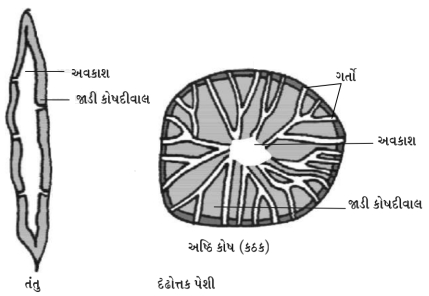
(N/A) $\rightarrow$ Sclerenchyma consists of long, narrow cells with thick and lignified cell walls having a few or numerous pits.
$\rightarrow$ They are usually dead and without protoplasts.
$\rightarrow$ Due to the deposition of lignin, the cell wall is strong, hard, and impermeable to water.
$\rightarrow$ Cells do not have intercellular spaces.
$\rightarrow$ They are usually dead and without protoplasts.
$\rightarrow$ Due to the deposition of lignin, the cell wall is strong, hard, and impermeable to water.
$\rightarrow$ Cells do not have intercellular spaces.
0 likes
View Solution242
Medium
Write a note on complex tissues.
Solution
(N/A) Complex tissues are made up of more than one type of cells that work together as a unit to perform a common function. In plants,the two main types of complex tissues are $Xylem$ and $Phloem$.
$1$. $Xylem$: It functions primarily as a conducting tissue for water and minerals from roots to the stem and leaves. It also provides mechanical strength to the plant parts. $Xylem$ is composed of four different kinds of elements: $Tracheids$,$Vessels$,$Xylem$ $fibres$,and $Xylem$ $parenchyma$.
$2$. $Phloem$: It transports food materials,usually from leaves to other parts of the plant. $Phloem$ in angiosperms is composed of $Sieve$ $tube$ $elements$,$Companion$ $cells$,$Phloem$ $parenchyma$,and $Phloem$ $fibres$.
$1$. $Xylem$: It functions primarily as a conducting tissue for water and minerals from roots to the stem and leaves. It also provides mechanical strength to the plant parts. $Xylem$ is composed of four different kinds of elements: $Tracheids$,$Vessels$,$Xylem$ $fibres$,and $Xylem$ $parenchyma$.
$2$. $Phloem$: It transports food materials,usually from leaves to other parts of the plant. $Phloem$ in angiosperms is composed of $Sieve$ $tube$ $elements$,$Companion$ $cells$,$Phloem$ $parenchyma$,and $Phloem$ $fibres$.
0 likes
View Solution243
EasyMCQ
Differentiate between Parenchyma and Sclerenchyma tissues.
A
Parenchyma cells are living; Sclerenchyma cells are dead.
B
Parenchyma cell walls are thin and made of cellulose; Sclerenchyma cell walls are thick and lignified.
C
Parenchyma provides storage and photosynthesis; Sclerenchyma provides mechanical support.
D
Parenchyma cells have intercellular spaces; Sclerenchyma cells are tightly packed without intercellular spaces.
Solution
(A-D) The differences between Parenchyma and Sclerenchyma are as follows:
$1$. Nature: Parenchyma cells are living at maturity,whereas Sclerenchyma cells are dead at maturity.
$2$. Cell Wall: Parenchyma has thin cell walls composed of cellulose. Sclerenchyma has thick,lignified secondary cell walls.
$3$. Function: Parenchyma performs storage,photosynthesis,and secretion. Sclerenchyma provides mechanical strength and rigidity to the plant.
$4$. Intercellular Spaces: Parenchyma cells usually have intercellular spaces. Sclerenchyma cells are closely packed and lack intercellular spaces.
$1$. Nature: Parenchyma cells are living at maturity,whereas Sclerenchyma cells are dead at maturity.
$2$. Cell Wall: Parenchyma has thin cell walls composed of cellulose. Sclerenchyma has thick,lignified secondary cell walls.
$3$. Function: Parenchyma performs storage,photosynthesis,and secretion. Sclerenchyma provides mechanical strength and rigidity to the plant.
$4$. Intercellular Spaces: Parenchyma cells usually have intercellular spaces. Sclerenchyma cells are closely packed and lack intercellular spaces.
0 likes
View Solution244
Easy
Give differences: Sieve cell and Sieve tubes.
Solution
(N/A)
| Sieve cell | Sieve tubes |
|---|---|
| $(1)$ In Gymnosperms,it is a unicellular element. | $(1)$ It is a multicellular element found in Angiosperms. |
| $(2)$ It possesses a nucleus. | $(2)$ It lacks a nucleus at maturity. |
| $(3)$ Sieve areas are less specialized and scattered. | $(3)$ The end walls are modified into sieve plates with large pores. |
| $(4)$ Food transport capacity is relatively low. | $(4)$ Food transport capacity is significantly higher. |
0 likes
View Solution245
Easy
Distinguish between: Tracheids and Vessels.
Solution
(N/A)
| Tracheids | Vessels |
| $1$. These are unicellular components found in gymnosperms. | $1$. These are multicellular components found in angiosperms. |
| $2$. Their transverse walls are perforated. | $2$. Their transverse walls are completely dissolved. |
| $3$. They are elongated,tube-like cells with tapering ends. | $3$. They are long,cylindrical,tube-like structures. |
| $4$. They have lower water conduction efficiency. | $4$. They have higher water conduction efficiency. |
0 likes
View Solution246
Easy
Distinguish between: Parenchyma and Sclerenchyma.
Solution
(N/A)
| Parenchyma | Sclerenchyma |
| $(1)$ Universally present in plants, found in roots, stems, leaves, fruits, etc. | $(1)$ Found in the pericycle of dicot stems, and hypodermis of monocot stems and petioles. |
| $(2)$ Cells are living with thin cell walls made of cellulose. | $(2)$ Cells are generally dead and lack protoplasm. |
| $(3)$ Intercellular spaces are present. | $(3)$ Intercellular spaces are absent. |
| $(4)$ Performs functions like photosynthesis, storage, and secretion. | $(4)$ Provides mechanical strength to organs due to lignin deposition. |
0 likes
View Solution247
Easy
Give scientific reasons: Vascular tissues are also called complex tissues.
Solution
(N/A) $\Rightarrow$ Vascular tissues are composed of more than one type of cell that work together as a unit to perform a common function. Because they consist of diverse cell types,they are termed complex tissues.
$\Rightarrow$ Xylem tissue is composed of tracheids,vessels,xylem parenchyma,and xylem sclerenchyma (fibres).
$\Rightarrow$ Phloem tissue is composed of sieve tube elements,companion cells,phloem parenchyma,and phloem sclerenchyma (fibres).
$\Rightarrow$ Since these tissues are made up of different types of cells working in coordination,they are classified as complex tissues.
$\Rightarrow$ Xylem tissue is composed of tracheids,vessels,xylem parenchyma,and xylem sclerenchyma (fibres).
$\Rightarrow$ Phloem tissue is composed of sieve tube elements,companion cells,phloem parenchyma,and phloem sclerenchyma (fibres).
$\Rightarrow$ Since these tissues are made up of different types of cells working in coordination,they are classified as complex tissues.
0 likes
View Solution248
EasyMCQ
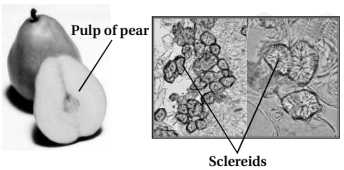
While eating peach or pear,it is usually seen that some stone-like structures get entangled in the teeth. What are these stone-like structures called?
A
Sclereids
B
Tracheids
C
Vessels
D
Fibers
Solution
(A) The stone-like structures found in the fleshy pulp of fruits like peach and pear are called sclereids.
Sclereids are a type of sclerenchyma cell,which are dead cells at maturity with highly thickened,lignified cell walls.
Their primary function is to provide mechanical support and rigidity to the soft tissues of the plant.
Sclereids are a type of sclerenchyma cell,which are dead cells at maturity with highly thickened,lignified cell walls.
Their primary function is to provide mechanical support and rigidity to the soft tissues of the plant.
0 likes
View Solution249
MediumMCQ
Deciduous plants shed their leaves during hot summer or in autumn. This process of shedding of leaves is called abscission. Apart from physiological changes,what anatomical mechanism is involved in the abscission of leaves?
A
Formation of a cork layer at the base of the petiole.
B
Dissolution of the middle lamella and primary cell walls in the abscission zone.
C
Increased lignification of the cells in the abscission zone.
D
Rapid cell division in the petiole base leading to mechanical rupture.
Solution
(B) $\Rightarrow$ The shedding of leaves by plants during hot summer or autumn is known as abscission.
$\Rightarrow$ Anatomically,a specialized region called the abscission zone forms at the base of the petiole.
$\Rightarrow$ The cells in this zone are thin-walled and lack secondary wall thickenings like suberin or lignin.
$\Rightarrow$ During abscission,enzymes (such as cellulases and pectinases) dissolve the middle lamella and the primary cell walls between the cells of the abscission layer.
$\Rightarrow$ As these cell walls break down,the structural connection between the leaf and the stem is lost,allowing the leaf to fall off easily due to wind or gravity.
$\Rightarrow$ Anatomically,a specialized region called the abscission zone forms at the base of the petiole.
$\Rightarrow$ The cells in this zone are thin-walled and lack secondary wall thickenings like suberin or lignin.
$\Rightarrow$ During abscission,enzymes (such as cellulases and pectinases) dissolve the middle lamella and the primary cell walls between the cells of the abscission layer.
$\Rightarrow$ As these cell walls break down,the structural connection between the leaf and the stem is lost,allowing the leaf to fall off easily due to wind or gravity.
0 likes
View Solution250
Medium
Give the functions of companion cells.
Solution
(N/A) $1$. Companion cells are specialized parenchymatous cells that are closely associated with sieve tube elements.
$2$. They maintain the pressure gradient in the sieve tube elements,which is essential for the translocation of food (sugars) through the phloem.
$3$. They provide metabolic support to the sieve tube elements,as sieve tube elements lack a nucleus and other organelles at maturity.
$4$. The sieve tube elements and companion cells are connected by pit fields present between their common longitudinal walls,facilitating the exchange of materials.
$2$. They maintain the pressure gradient in the sieve tube elements,which is essential for the translocation of food (sugars) through the phloem.
$3$. They provide metabolic support to the sieve tube elements,as sieve tube elements lack a nucleus and other organelles at maturity.
$4$. The sieve tube elements and companion cells are connected by pit fields present between their common longitudinal walls,facilitating the exchange of materials.
0 likes
View SolutionAnatomy of Flowering Plants — Permanent Tissue · Frequently Asked Questions
1Are these Anatomy of Flowering Plants questions useful for JEE and NEET?
Yes. All questions in this section are mapped to JEE Main and NEET exam patterns. Previous year questions from JEE Main, NEET, GUJCET and state-level exams are included with full solutions.
2Can I switch to Hindi or Gujarati for these questions?
Yes. Use the language tabs in the hero section or the sidebar to view the same questions and solutions in English, Hindi or Gujarati.
3How do I generate a question paper from this subtopic?
Use the Vedclass Exam Paper Generator — select the chapter and subtopic, set difficulty, and generate Sets A, B, C, D automatically. First 3 chapters of every subject are free.
Vedclass Products
For Students
Vedclass Test Series
Mock tests in real JEE/NEET style with performance analysis. 5-day free trial.
Start Free TrialFor Teachers
Exam Paper Generator
Generate Set A/B/C/D papers from this chapter in 2 minutes. 3 chapters free.
Try FreeFor Institutes
Online Exam Module
Live online exams with unlimited students, 360° analytics & white-label branding.
See DemoFor Teachers & Institutes
Generate a Anatomy of Flowering Plants Exam Paper in 2 Minutes
Select subtopic & difficulty — Sets A, B, C, D auto-generated with No Repeat logic.
First 3 chapters of every subject are free — no payment required.