
A English
Permanent Tissue Questions in English
Class 11 Biology · Anatomy of Flowering Plants · Permanent Tissue
316+
Questions
English
Language
100%
With Solutions
Showing 50 of 316 questions in English
251
MediumMCQ
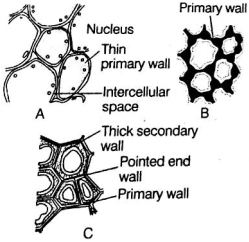
Identify the permanent tissues shown in the following figures.
A
$A$ - Collenchyma,$B$ - Parenchyma,$C$ - Sclerenchyma
B
$A$ - Sclerenchyma,$B$ - Collenchyma,$C$ - Parenchyma
C
$A$ - Collenchyma,$B$ - Sclerenchyma,$C$ - Parenchyma
D
$A$ - Parenchyma,$B$ - Collenchyma,$C$ - Sclerenchyma
Solution
(D) Based on the structural characteristics shown in the figures:
$1$. Figure $A$ shows cells with thin primary walls and intercellular spaces,which are characteristic of Parenchyma.
$2$. Figure $B$ shows cells with thickened corners (primary wall thickening),which is characteristic of Collenchyma.
$3$. Figure $C$ shows cells with very thick secondary walls and narrow lumens,which is characteristic of Sclerenchyma.
Therefore,the correct identification is $A$ - Parenchyma,$B$ - Collenchyma,$C$ - Sclerenchyma.
$1$. Figure $A$ shows cells with thin primary walls and intercellular spaces,which are characteristic of Parenchyma.
$2$. Figure $B$ shows cells with thickened corners (primary wall thickening),which is characteristic of Collenchyma.
$3$. Figure $C$ shows cells with very thick secondary walls and narrow lumens,which is characteristic of Sclerenchyma.
Therefore,the correct identification is $A$ - Parenchyma,$B$ - Collenchyma,$C$ - Sclerenchyma.
0 likes
View Solution252
MediumMCQ
Sclerenchyma fibres are
A
Thick-walled
B
Elongated
C
Pointed cells
D
All of these
Solution
(D) Sclerenchyma fibres are a type of simple permanent tissue characterized by the following features:
$1$. They have thick,lignified cell walls which provide structural support.
$2$. They are typically elongated in shape.
$3$. They have pointed ends (tapering ends).
Since all these characteristics describe sclerenchyma fibres,the correct option is $D$.
$1$. They have thick,lignified cell walls which provide structural support.
$2$. They are typically elongated in shape.
$3$. They have pointed ends (tapering ends).
Since all these characteristics describe sclerenchyma fibres,the correct option is $D$.
0 likes
View Solution253
MediumMCQ
Collenchyma is
A
Living and contains protoplasm
B
Dead and hollow
C
Dead and filled with reserve food
D
Living and lack nucleus
Solution
(A) Collenchyma is a specialized supporting simple permanent tissue consisting of living cells.
These cells contain protoplasm and are characterized by unevenly distributed thickenings of cellulose,pectin,and hemicellulose on their cell walls.
These cells contain protoplasm and are characterized by unevenly distributed thickenings of cellulose,pectin,and hemicellulose on their cell walls.
0 likes
View Solution254
MediumMCQ
On the basis of variation in form,structure,origin,and development,sclerenchyma may be:
A
Fibres
B
Sclereids
C
Either $(a)$ or $(b)$
D
Both $(a)$ and $(b)$
Solution
(D) Sclerenchyma is classified into two types based on variation in form,structure,origin,and development: Fibres and Sclereids.
$1$. Fibres are thick-walled,elongated,and pointed cells.
$2$. Sclereids are generally spherical,oval,or cylindrical cells.
Therefore,both $(a)$ and $(b)$ are correct.
$1$. Fibres are thick-walled,elongated,and pointed cells.
$2$. Sclereids are generally spherical,oval,or cylindrical cells.
Therefore,both $(a)$ and $(b)$ are correct.
0 likes
View Solution255
MediumMCQ
Lignification is associated with
A
Xylem
B
Phloem
C
Parenchyma
D
Chlorenchyma
Solution
(A) Lignification refers to the deposition of lignin in the cell walls,which provides structural support and rigidity to the plant.
In vascular plants,the xylem tissue is characterized by the presence of lignified cell walls,particularly in tracheids,vessels,and xylem fibers.
This lignification makes the xylem cells dead at maturity and enables them to conduct water efficiently while providing mechanical strength.
In vascular plants,the xylem tissue is characterized by the presence of lignified cell walls,particularly in tracheids,vessels,and xylem fibers.
This lignification makes the xylem cells dead at maturity and enables them to conduct water efficiently while providing mechanical strength.
0 likes
View Solution256
EasyMCQ
$P$-proteins are associated with
A
Sieve tube elements
B
Xylem parenchyma
C
Trichomes
D
Tracheids and vessels
Solution
(A) $P$-proteins (phloem proteins) are specialized proteins found in the phloem tissue of flowering plants. They are primarily associated with sieve tube elements. Their main function is to seal the sieve pores in response to injury,thereby preventing the loss of phloem sap.
0 likes
View Solution257
MediumMCQ
In flowering plants,the main water transporting elements are
A
Tracheids
B
Vessels
C
Fibres
D
Both $(A)$ and $(B)$
Solution
(D) Tracheids are elongated or tube-like cells with thick and lignified walls and tapering ends. These are dead and lack protoplasm. The inner layers of the cell walls have thickenings which vary in form. In flowering plants,both tracheids and vessels are the main water-transporting elements.
0 likes
View Solution258
MediumMCQ
The sclerenchyma of the hypodermis in the $Pinus$ needle helps in:
A
Increasing the absorptive surface of the cell
B
Checking transpiration
C
Mechanical support
D
Photosynthesis
Solution
(C) Sclerenchyma cells are thick-walled,lignified,and dead at maturity.
These cells provide mechanical support to the $Pinus$ needle,helping it maintain its structure against environmental stress.
Sclerenchyma may be fibrous or sclereid in nature.
These cells provide mechanical support to the $Pinus$ needle,helping it maintain its structure against environmental stress.
Sclerenchyma may be fibrous or sclereid in nature.
0 likes
View Solution259
EasyMCQ
Aerenchyma is helpful in plants by
A
Providing buoyancy in hydrophytes
B
Absorption in stilt roots
C
Giving mechanical strength to plants
D
Giving flexibility to plants
Solution
(A) Parenchyma is the most primitive type of permanent tissue.
In hydrophytes (aquatic plants),parenchyma develops abundant air spaces and is known as aerenchyma.
Aerenchyma helps in floatation by providing buoyancy to the plants in water.
In hydrophytes (aquatic plants),parenchyma develops abundant air spaces and is known as aerenchyma.
Aerenchyma helps in floatation by providing buoyancy to the plants in water.
0 likes
View Solution260
EasyMCQ
Complex tissue includes
A
Collenchyma
B
Apical meristem
C
Conducting tissue
D
Idioblast
Solution
(C) Complex tissues are made up of more than one type of cells which work together as a unit.
$Xylem$ and $Phloem$ are the main complex tissues in plants,which are collectively known as conducting tissues.
$Collenchyma$ is a simple permanent tissue.
$Apical$ $meristem$ is a type of meristematic tissue.
$Idioblast$ is a specialized parenchyma cell containing non-living inclusions.
$Xylem$ and $Phloem$ are the main complex tissues in plants,which are collectively known as conducting tissues.
$Collenchyma$ is a simple permanent tissue.
$Apical$ $meristem$ is a type of meristematic tissue.
$Idioblast$ is a specialized parenchyma cell containing non-living inclusions.
0 likes
View Solution261
MediumMCQ
The phloem of angiosperms differs from that of other vascular plants by the presence of
A
Vessels
B
Companion cells
C
Tylosoides
D
Albuminous cells
Solution
(B) Companion cells are thin-walled,elongated cells that are connected to sieve tube elements via plasmodesmata within the phloem.
They are a characteristic feature of angiosperms and play a crucial role in regulating the metabolic activities of sieve tube elements through their own nucleus.
In contrast,pteridophytes and gymnosperms (other vascular plants) lack companion cells and instead possess specialized cells known as albuminous cells.
They are a characteristic feature of angiosperms and play a crucial role in regulating the metabolic activities of sieve tube elements through their own nucleus.
In contrast,pteridophytes and gymnosperms (other vascular plants) lack companion cells and instead possess specialized cells known as albuminous cells.
0 likes
View Solution262
MediumMCQ
Fibres associated with phloem are known as ...... fibres.
A
Hard
B
Wood
C
Surface
D
Bast
Solution
(D) The fibres associated with the phloem,pericycle,and cortex are referred to as stem,bast,or soft fibres.
These fibres are primarily derived from dicotyledonous plants.
Therefore,phloem fibres are commonly known as bast fibres.
These fibres are primarily derived from dicotyledonous plants.
Therefore,phloem fibres are commonly known as bast fibres.
0 likes
View Solution263
MediumMCQ
The jute fibres anatomically are
A
Bast fibres
B
Cortical fibres
C
Xylem fibres
D
Pith fibres
Solution
(A) Anatomically, jute fibres are classified as bast fibres or phloem fibres.
These fibres are found in the pericycle of the stem.
Examples of plants yielding bast fibres include $Corchorus capsularis$ (jute), $Hibiscus cannabinus$ (patsan), and $Crotalaria juncea$ (sunnhemp).
These fibres are also referred to as extraxylary fibres because they are located outside the xylem tissue.
These fibres are found in the pericycle of the stem.
Examples of plants yielding bast fibres include $Corchorus capsularis$ (jute), $Hibiscus cannabinus$ (patsan), and $Crotalaria juncea$ (sunnhemp).
These fibres are also referred to as extraxylary fibres because they are located outside the xylem tissue.
0 likes
View Solution264
MediumMCQ
Which of the following is/are living cells?
$I.$ Vessel,$II.$ Tracheids,$III.$ Companion cells
$I.$ Vessel,$II.$ Tracheids,$III.$ Companion cells
A
$I$ and $II$
B
Only $III$
C
$II$ and $III$
D
Only $I$
Solution
(B) In xylem,vessels $(I)$ and tracheids $(II)$ are dead cells at maturity because they lose their protoplasm to facilitate water conduction.
Companion cells $(III)$ are specialized parenchyma cells found in the phloem of angiosperms. They are living cells that contain a dense cytoplasm and a large nucleus,which helps regulate the metabolic activities of the adjacent sieve tube elements.
Companion cells $(III)$ are specialized parenchyma cells found in the phloem of angiosperms. They are living cells that contain a dense cytoplasm and a large nucleus,which helps regulate the metabolic activities of the adjacent sieve tube elements.
0 likes
View Solution265
MediumMCQ
$I.$ Made up of sclerenchymatous cells
$II.$ Generally absent in primary phloem
$III.$ Much elongated and pointed
Given above characters belong to which of the following?
$II.$ Generally absent in primary phloem
$III.$ Much elongated and pointed
Given above characters belong to which of the following?
A
Phloem fibre
B
Xylem fibre
C
Companion cells
D
Sieve cells
Solution
(A) Phloem fibres (bast fibres) are made up of sclerenchymatous cells.
These are generally absent in the primary phloem but are found in the secondary phloem.
These are much elongated,unbranched,and have pointed,needle-like apices.
The cell wall of phloem fibres is quite thick.
At maturity,these fibres lose their protoplasm and become dead.
Phloem fibres of jute,flax,and hemp are used commercially.
These are generally absent in the primary phloem but are found in the secondary phloem.
These are much elongated,unbranched,and have pointed,needle-like apices.
The cell wall of phloem fibres is quite thick.
At maturity,these fibres lose their protoplasm and become dead.
Phloem fibres of jute,flax,and hemp are used commercially.
0 likes
View Solution266
MediumMCQ
$I.$ These tissues are found as layers or patches.
$II.$ It consists of cells which are thickened at the corners.
$III.$ It often contains chloroplasts.
$IV.$ Intercellular spaces are absent.
$V.$ They provide mechanical support to growing parts of plants.
The above characters are attributed to:
$II.$ It consists of cells which are thickened at the corners.
$III.$ It often contains chloroplasts.
$IV.$ Intercellular spaces are absent.
$V.$ They provide mechanical support to growing parts of plants.
The above characters are attributed to:
A
Vascular tissue
B
Collenchyma
C
Parenchyma
D
Simple sclerenchyma
Solution
(B) The correct answer is Collenchyma.
Collenchyma occurs in layers below the epidermis in dicotyledonous plants. It is found either as a homogeneous layer or in patches.
It consists of cells which are thickened at the corners due to the deposition of cellulose,hemicellulose,and pectin.
Collenchymatous cells may be oval,spherical,or polygonal and often contain chloroplasts.
These cells assimilate food when they contain chloroplasts.
Intercellular spaces are absent in this tissue.
They provide mechanical support to the growing parts of the plant,such as young stems and the petiole of a leaf.
Collenchyma occurs in layers below the epidermis in dicotyledonous plants. It is found either as a homogeneous layer or in patches.
It consists of cells which are thickened at the corners due to the deposition of cellulose,hemicellulose,and pectin.
Collenchymatous cells may be oval,spherical,or polygonal and often contain chloroplasts.
These cells assimilate food when they contain chloroplasts.
Intercellular spaces are absent in this tissue.
They provide mechanical support to the growing parts of the plant,such as young stems and the petiole of a leaf.
0 likes
View Solution267
MediumMCQ
Sclereids are commonly found in the
$I.$ Fruit wall of nuts
$II.$ Pulp of fruits like guava and pear
$III.$ Seed coat of legumes
$IV.$ Micropyle of pea
Select the correct combination.
$I.$ Fruit wall of nuts
$II.$ Pulp of fruits like guava and pear
$III.$ Seed coat of legumes
$IV.$ Micropyle of pea
Select the correct combination.
A
All except $I$
B
All except $II$
C
All except $III$
D
All except $IV$
Solution
(D) The correct answer is All except $IV$.
Sclerenchyma is classified into two types based on variation in form,structure,origin,and development: fibres and sclereids.
$1.$ Fibres are thick-walled,elongated,and pointed cells that generally occur in groups in various parts of the plant.
$2.$ Sclereids are spherical,oval,or cylindrical,highly thickened dead cells with a very narrow cavity (lumen).
$3.$ Sclereids are commonly found in the fruit wall of nuts,the pulp of fruits like guava,pear,and sapota,the seed coats of legumes,and the leaves of tea.
$4.$ The micropyle is an opening in the ovule/seed,not a structure composed of sclereids.
Therefore,statements $I, II,$ and $III$ are correct,while $IV$ is incorrect.
Sclerenchyma is classified into two types based on variation in form,structure,origin,and development: fibres and sclereids.
$1.$ Fibres are thick-walled,elongated,and pointed cells that generally occur in groups in various parts of the plant.
$2.$ Sclereids are spherical,oval,or cylindrical,highly thickened dead cells with a very narrow cavity (lumen).
$3.$ Sclereids are commonly found in the fruit wall of nuts,the pulp of fruits like guava,pear,and sapota,the seed coats of legumes,and the leaves of tea.
$4.$ The micropyle is an opening in the ovule/seed,not a structure composed of sclereids.
Therefore,statements $I, II,$ and $III$ are correct,while $IV$ is incorrect.
0 likes
View Solution268
MediumMCQ
Complex tissues are
A
Made up of more than one kind of cells
B
Xylem and phloem
C
Both $(A)$ and $(B)$
D
None of the above
Solution
(C) Complex tissues are permanent tissues that consist of more than one type of cell.
All these different types of cells work together as a single unit to perform a common function.
Xylem and phloem are the most common examples of complex permanent tissues in plants,which are primarily responsible for the conduction of water,minerals,and food.
All these different types of cells work together as a single unit to perform a common function.
Xylem and phloem are the most common examples of complex permanent tissues in plants,which are primarily responsible for the conduction of water,minerals,and food.
0 likes
View Solution269
MediumMCQ
The cells without nuclei are present in
A
Vascular cambium
B
Root hair
C
Companion cell
D
Members of sieve tube
Solution
(D) In mature angiosperms,the sieve tube elements are living cells that lack a nucleus at maturity. This allows them to conduct food materials more efficiently. Companion cells,which are associated with sieve tubes,retain their nuclei and regulate the metabolic activities of the sieve tube elements.
0 likes
View Solution270
MediumMCQ
Permanent or mature cells are formed by
A
Cell division in the primary meristem
B
Cell division in the secondary meristem
C
Both $(A)$ and $(B)$
D
Specialisation of secondary meristem
Solution
(C) Cells produced by both primary and secondary meristems undergo structural and functional differentiation.
During this process,they lose their ability to divide and become permanent or mature cells.
During this process,they lose their ability to divide and become permanent or mature cells.
0 likes
View Solution271
MediumMCQ
Tracheids
A
Are the dominant cell types of xylem in angiosperms
B
Are primarily found in mosses and liverworts
C
Are responsible for water conduction and support in many land plants
D
First appeared during Palaeozoic era
Solution
(C) Tracheids are elongated cells with tapered ends. Their cell walls are usually extensively thickened by the deposition of lignin,which provides structural support. Water flows from one tracheid to another through unthickened regions known as pits in the cell walls. They are the primary water-conducting elements in gymnosperms and pteridophytes,and are also present in angiosperms.
0 likes
View Solution272
MediumMCQ
All the following statements regarding sieve tube elements are true except
A
Their end walls have perforated sieve plates which become impregnated with lignin at maturity
B
They possess peripheral cytoplasm as well as a large vacuole
C
Distinct proteinaceous inclusions,the $P$-proteins are seen evenly distributed throughout the lumen
D
Long,slender,tube-like structures arranged in longitudinal series
Solution
(A) Sieve tube elements are the main conducting cells of the phloem.
They are long,slender,tube-like structures arranged in longitudinal series.
They possess peripheral cytoplasm and a large central vacuole,but they lack a nucleus at maturity.
They contain $P$-proteins (phloem proteins) in their lumen.
The end walls are perforated to form sieve plates,which are lined with callose,not lignin.
Therefore,the statement that they become impregnated with lignin is incorrect,as lignin is a characteristic of xylem elements (tracheids and vessels).
They are long,slender,tube-like structures arranged in longitudinal series.
They possess peripheral cytoplasm and a large central vacuole,but they lack a nucleus at maturity.
They contain $P$-proteins (phloem proteins) in their lumen.
The end walls are perforated to form sieve plates,which are lined with callose,not lignin.
Therefore,the statement that they become impregnated with lignin is incorrect,as lignin is a characteristic of xylem elements (tracheids and vessels).
0 likes
View Solution273
MediumMCQ
The parenchymatous cells are
A
Dead
B
Thick-walled
C
Thin-walled
D
Thick-walled and dead
Solution
(C) Parenchyma cells are the most common simple permanent tissue in plants.
These cells are living and possess thin cell walls made up of cellulose.
They are generally isodiametric in shape and perform functions like photosynthesis,storage,and secretion.
These cells are living and possess thin cell walls made up of cellulose.
They are generally isodiametric in shape and perform functions like photosynthesis,storage,and secretion.
0 likes
View Solution274
MediumMCQ
Collenchyma differs from parenchyma in
A
Possessing thick cell wall
B
Lacking protoplasm
C
Containing chloroplasts usually
D
Being meristematic
Solution
(A) Collenchyma differs from parenchyma in possessing thick cell walls due to the deposition of pectin at the corners.
- Sclerenchymatous cells lack protoplasm at maturity.
- Both parenchyma and collenchyma,when they contain chloroplasts,are known as Chlorenchyma.
- Both collenchyma and parenchyma are simple permanent tissues that have lost their capacity to divide; therefore,they are not meristematic.
- Sclerenchymatous cells lack protoplasm at maturity.
- Both parenchyma and collenchyma,when they contain chloroplasts,are known as Chlorenchyma.
- Both collenchyma and parenchyma are simple permanent tissues that have lost their capacity to divide; therefore,they are not meristematic.
0 likes
View Solution275
MediumMCQ
Which among the following are absent in the collenchyma?
A
Chloroplasts
B
Vacuoles
C
Intercellular spaces
D
Pectin deposition
Solution
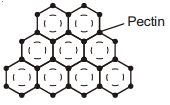
(C) Collenchyma cells are characterized by the deposition of cellulose,hemicellulose,and pectin at the corners of the cells.
This deposition leads to the thickening of the cell walls at these points,which results in the absence of intercellular spaces between the collenchyma cells.
Therefore,intercellular spaces are absent in collenchyma.
This deposition leads to the thickening of the cell walls at these points,which results in the absence of intercellular spaces between the collenchyma cells.
Therefore,intercellular spaces are absent in collenchyma.
0 likes
View Solution276
MediumMCQ
The elongated,thick-walled and tapering cells are
A
Parenchymatous
B
Collenchymatous
C
Chlorenchymatous
D
Sclerenchymatous
Solution
(D) Sclerenchyma cells are typically elongated,narrow,and have thick,lignified cell walls with few or no protoplasts.
They are generally dead at maturity and provide mechanical support to the plant organs.
Specifically,sclerenchyma fibers are characterized by being elongated,thick-walled,and having tapering ends,which matches the description provided.
They are generally dead at maturity and provide mechanical support to the plant organs.
Specifically,sclerenchyma fibers are characterized by being elongated,thick-walled,and having tapering ends,which matches the description provided.

0 likes
View Solution277
MediumMCQ
Sclereids are commonly found in
A
Leaves of monocots
B
Fruit walls of nuts
C
Roots
D
Fleshy stems
Solution
(B) Sclereids are a type of sclerenchyma cells that are highly thickened,dead,and provide mechanical support to plant organs. They are commonly found in the fruit walls of nuts,the pulp of fruits like guava,pear,and sapota,and in the seed coats of legumes.
0 likes
View Solution278
MediumMCQ
Which of the following statements is correct?
A
Angiosperms lack vessels in their xylem
B
The presence of vessels is a characteristic feature of angiosperms
C
The cells of vessels are living
D
Vessel is a long cylindrical tube-like cell made up of many vessel members
Solution
(D) The correct statement is that a vessel is a long cylindrical tube-like structure made up of many cells called vessel members.
$A$. Angiosperms possess vessels in their xylem,so this is incorrect.
$B$. While vessels are characteristic of angiosperms,gymnosperms (like Gnetales) also possess them,making this statement less precise than $D$.
$C$. Vessel cells are dead at maturity because they lack protoplasm,so this is incorrect.
$D$. This is the accurate definition of a vessel.
$A$. Angiosperms possess vessels in their xylem,so this is incorrect.
$B$. While vessels are characteristic of angiosperms,gymnosperms (like Gnetales) also possess them,making this statement less precise than $D$.
$C$. Vessel cells are dead at maturity because they lack protoplasm,so this is incorrect.
$D$. This is the accurate definition of a vessel.
0 likes
View Solution279
MediumMCQ
The central lumens are obliterated in
A
Xylem fibres
B
Phloem parenchyma
C
Xylem parenchyma
D
Sieve tubes
Solution
(A) Xylem fibres are dead cells with highly thickened walls and narrow or obliterated central lumens. Due to the extreme deposition of lignin,the cell cavity (lumen) becomes very small or completely disappears,which is referred to as being obliterated.
0 likes
View Solution280
MediumMCQ
Which of the following is absent in most of the monocotyledons?
A
Phloem parenchyma
B
Tracheids
C
Vessels
D
Xylem parenchyma
Solution
(A) In most monocotyledons,phloem parenchyma is absent. Phloem parenchyma is composed of elongated,tapering cylindrical cells which have dense cytoplasm and nucleus. It is generally present in dicotyledons but is absent in most monocots.
0 likes
View Solution281
MediumMCQ
Collenchyma is a type of mechanical tissue but it is not as efficient as sclerenchyma. However,it has certain advantages like
A
It offers no resistance to the growing organs
B
It has no cellulose in the cell wall.
C
It is flexible
D
It has the power of growth,it offers no resistance to the growing organs and is not flexible
Solution
(C) Collenchyma is a living mechanical tissue that provides both mechanical support and flexibility to the growing parts of plants. Unlike sclerenchyma,which is dead and rigid,collenchyma cells are flexible and possess the ability to grow and divide,allowing them to support organs like young stems and petioles without hindering their growth.
0 likes
View Solution282
MediumMCQ
Isodiametric sclereids,found in the hard endocarp of coconut and the fleshy portion of some fruits,are known as:
A
Brachysclereids
B
Asterosclereids
C
Osteosclereids
D
Trichosclereids
Solution
(A) Sclereids are classified based on their shape and size:
$1$. $Brachysclereids$: These are isodiametric (short and stone-like) sclereids,commonly found in the hard endocarp of fruits like coconut and the fleshy pulp of fruits like guava.
$2$. $Asterosclereids$: These are star-shaped sclereids.
$3$. $Osteosclereids$: These are bone-shaped or rod-shaped sclereids with swollen ends.
$4$. $Trichosclereids$: These are hair-like,elongated,and branched sclereids.
Therefore,the correct answer is $Brachysclereids$.
$1$. $Brachysclereids$: These are isodiametric (short and stone-like) sclereids,commonly found in the hard endocarp of fruits like coconut and the fleshy pulp of fruits like guava.
$2$. $Asterosclereids$: These are star-shaped sclereids.
$3$. $Osteosclereids$: These are bone-shaped or rod-shaped sclereids with swollen ends.
$4$. $Trichosclereids$: These are hair-like,elongated,and branched sclereids.
Therefore,the correct answer is $Brachysclereids$.
0 likes
View Solution283
EasyMCQ
The main water-conducting element of xylem in homoxylous plants is:
A
Tracheary element
B
Vessel
C
Tracheid
D
Xylem parenchyma
Solution
(C) Homoxylous plants are those that lack vessels in their xylem,such as most gymnosperms. In these plants,tracheids are the primary elements responsible for the conduction of water and minerals. Therefore,tracheids are the main water-conducting elements in homoxylous plants.
0 likes
View Solution284
MediumMCQ
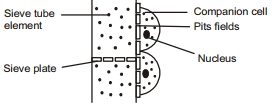
Find the set of cells connected by pit fields between their common longitudinal walls.
A
Companion cell and phloem fibres
B
Companion cell and sieve tube
C
Sieve cell and albuminous cell
D
Sieve tube and phloem fibre
Solution
(B) The sieve tube elements and companion cells are connected by pit fields present between their common longitudinal walls. These pit fields facilitate the transport of materials between the two cells,as the sieve tube elements lack a nucleus at maturity and rely on the companion cells for metabolic support.
0 likes
View Solution285
EasyMCQ
In old sieve tubes at the end of the growing season,which of the following gets deposited over the sieve plate to regulate sugar transport?
A
$P-protein$
B
Callose
C
Lignin
D
Suberin
Solution
(B) During the end of the growing season,the sieve pores in old sieve tubes become blocked by the deposition of a polysaccharide called $Callose$.
This deposition of $Callose$ forms a $Callose$ pad or plug over the sieve plate,which effectively reduces or stops the transport of sugars and other organic solutes through the sieve tubes.
This deposition of $Callose$ forms a $Callose$ pad or plug over the sieve plate,which effectively reduces or stops the transport of sugars and other organic solutes through the sieve tubes.
0 likes
View Solution286
MediumMCQ
$A$: Cells of sclerenchyma have thickened secondary walls.
$R$: Cells have deposition of lignin.
$R$: Cells have deposition of lignin.
A
Assertion and Reason both are correct and Reason is the correct explanation of Assertion.
B
Assertion and Reason both are correct but Reason is not the correct explanation of Assertion.
C
Assertion is correct,but Reason is incorrect.
D
Both Assertion and Reason are incorrect.
Solution
(A) Sclerenchyma cells are dead at maturity and possess extremely thick,lignified secondary cell walls.
The deposition of lignin provides mechanical strength and rigidity to the plant body.
Since the thickened secondary walls are primarily due to the deposition of lignin,the Reason correctly explains the Assertion.
The deposition of lignin provides mechanical strength and rigidity to the plant body.
Since the thickened secondary walls are primarily due to the deposition of lignin,the Reason correctly explains the Assertion.
0 likes
View Solution287
MediumMCQ
$A$ : Sieve tubes and companion cells are related ontogenetically.
$R$ : Both develop from same mother cell.
$R$ : Both develop from same mother cell.
A
Assertion and Reason both are correct and Reason is the correct explanation of Assertion.
B
Assertion and Reason both are correct but Reason is not the correct explanation of Assertion.
C
Assertion is correct,but Reason is incorrect.
D
Both Assertion and Reason are incorrect.
Solution
(A) Sieve tubes and companion cells are ontogenetically related because they both originate from the same mother cell through a series of divisions.
Specifically,a single mother cell undergoes an unequal division to produce a smaller cell that differentiates into a companion cell and a larger cell that differentiates into a sieve tube element.
Therefore,both the Assertion and the Reason are correct,and the Reason provides the correct explanation for the Assertion.
Specifically,a single mother cell undergoes an unequal division to produce a smaller cell that differentiates into a companion cell and a larger cell that differentiates into a sieve tube element.
Therefore,both the Assertion and the Reason are correct,and the Reason provides the correct explanation for the Assertion.
0 likes
View Solution288
EasyMCQ
In plants,long distance transport of organic and inorganic substances occurs through
A
Simple permanent tissues
B
Complex permanent tissues
C
Meristematic tissues
D
Epithelial tissues
Solution
(B) In plants,the long-distance transport of organic and inorganic substances occurs through complex permanent tissues.
These complex permanent tissues are known as vascular tissues,which include $Xylem$ and $Phloem$.
$Xylem$ is responsible for the transport of water and minerals,while $Phloem$ is responsible for the transport of organic solutes (food).
These complex permanent tissues are known as vascular tissues,which include $Xylem$ and $Phloem$.
$Xylem$ is responsible for the transport of water and minerals,while $Phloem$ is responsible for the transport of organic solutes (food).
0 likes
View Solution289
MediumMCQ
Tracheids do not collapse under extreme tension due to the presence of
A
Strong,elastic lignocellulosic secondary cell wall
B
Thick,cellulosic primary cell wall
C
Thin,elastic,cellulosic primary cell wall
D
Thick,hard suberised secondary cell wall
Solution
(A) Tracheids are dead cells at maturity that form the primary water-conducting elements in gymnosperms and pteridophytes.
They possess a thick,lignified secondary cell wall,which provides high mechanical strength and elasticity.
This lignocellulosic secondary wall prevents the tracheids from collapsing under the extreme negative pressure (tension) generated during the transpiration pull.
They possess a thick,lignified secondary cell wall,which provides high mechanical strength and elasticity.
This lignocellulosic secondary wall prevents the tracheids from collapsing under the extreme negative pressure (tension) generated during the transpiration pull.
0 likes
View Solution290
EasyMCQ
Fibres are made of:
A
Parenchyma
B
Chlorenchyma
C
Sclerenchyma
D
Collenchyma
Solution
(C) Fibres are a type of $Sclerenchyma$ tissue.
$Sclerenchyma$ cells are dead at maturity and possess thick,lignified secondary cell walls.
These cells provide mechanical strength and support to the plant body.
Fibres are elongated,narrow,and pointed cells that occur in bundles in various parts of the plant,such as the stem,leaves,and vascular tissues.
$Sclerenchyma$ cells are dead at maturity and possess thick,lignified secondary cell walls.
These cells provide mechanical strength and support to the plant body.
Fibres are elongated,narrow,and pointed cells that occur in bundles in various parts of the plant,such as the stem,leaves,and vascular tissues.
0 likes
View Solution291
EasyMCQ
Aerenchyma is the characteristic feature of
A
Mesophytes
B
Hydrophytes
C
Xerophytes
D
Aesophytes
Solution
(B) The correct answer is $B$ (Hydrophytes).
$1$. Aerenchyma is a specialized type of parenchyma tissue that contains large air-filled spaces or lacunae.
$2$. These air spaces provide buoyancy to aquatic plants,allowing them to float on the water surface or remain upright in the water column.
$3$. Additionally,aerenchyma facilitates the exchange of gases,particularly oxygen,which is often limited in submerged aquatic environments.
$4$. Therefore,aerenchyma is a characteristic feature of hydrophytes (aquatic plants).
$1$. Aerenchyma is a specialized type of parenchyma tissue that contains large air-filled spaces or lacunae.
$2$. These air spaces provide buoyancy to aquatic plants,allowing them to float on the water surface or remain upright in the water column.
$3$. Additionally,aerenchyma facilitates the exchange of gases,particularly oxygen,which is often limited in submerged aquatic environments.
$4$. Therefore,aerenchyma is a characteristic feature of hydrophytes (aquatic plants).
0 likes
View Solution292
Medium
Differentiate between Tracheids and Vessels.
Solution
(N/A)
| Tracheids | Vessels |
|---|---|
| $1$. They are unicellular elements primarily found in gymnosperms. | $1$. They are multicellular elements primarily found in angiosperms. |
| $2$. Their end walls are intact and possess pits for water conduction. | $2$. Their end walls are perforated or completely broken down to form a continuous tube. |
| $3$. Cells are narrow,elongated,and have tapering ends. | $3$. Cells are wide,cylindrical,and tube-like structures. |
| $4$. Water transport capacity is relatively lower. | $4$. Water transport capacity is significantly higher. |
0 likes
View Solution293
MediumMCQ
What is the function of phloem parenchyma?
A
Storage of food materials
B
Conduction of water
C
Mechanical support
D
Photosynthesis
Solution
(A) The phloem parenchyma is composed of elongated,tapering cylindrical cells which have dense cytoplasm and nucleus.
Its primary functions include:
$1$. Storage of food materials such as starch,fats,and other substances like resins,latex,and mucilage.
$2$. It also assists in the radial conduction of food materials.
Its primary functions include:
$1$. Storage of food materials such as starch,fats,and other substances like resins,latex,and mucilage.
$2$. It also assists in the radial conduction of food materials.
0 likes
View Solution294
Medium
What do hardwood and softwood stand for?
Solution
(N/A) The difference between softwood and hardwood is as follows:
Softwood is typically produced by gymnosperms (conifers), which lack vessels in their xylem. Hardwood is typically produced by angiosperms (flowering plants), which possess vessels in their xylem.
| Softwood | Hardwood |
| $(1)$ In gymnosperms, softwood mainly possesses tracheids. | $(1)$ In angiosperms, hardwood mainly consists of vessels. |
| $(2)$ It lacks vessels. | $(2)$ It lacks tracheids. |
Softwood is typically produced by gymnosperms (conifers), which lack vessels in their xylem. Hardwood is typically produced by angiosperms (flowering plants), which possess vessels in their xylem.
0 likes
View Solution295
Medium
Give differences: Collenchyma and Sclerenchyma.
Solution
(N/A)
| Collenchyma | Sclerenchyma |
| $(1)$ It is found in the hypodermis of dicot stems. | $(1)$ It is found in the pericycle of stems and vascular bundles. |
| $(2)$ Cells are living and contain a nucleus. | $(2)$ Cells are dead at maturity. |
| $(3)$ Cell walls are thickened at the corners due to cellulose,hemicellulose,and pectin. | $(3)$ Cell walls are uniformly thickened with lignin. |
| $(4)$ Cells are oval,spherical,or polygonal in shape. | $(4)$ Cells are long,narrow,and fiber-like or sclereids. |
| $(5)$ It provides mechanical support and flexibility to growing parts. | $(5)$ It provides mechanical strength and rigidity to mature parts. |
0 likes
View Solution296
Medium
Give differences: Parenchyma Tissue and Sclerenchyma.
Solution
(N/A)
| Parenchyma Tissue | Sclerenchyma Tissue |
|---|---|
| $(1)$ Cells are living and possess a thin cell wall made of cellulose. | $(1)$ Cells are generally dead at maturity and lack protoplasm. |
| $(2)$ Cell walls are thin and flexible. | $(2)$ Cell walls are highly thickened due to the deposition of lignin. |
| $(3)$ Intercellular spaces are usually present. | $(3)$ Intercellular spaces are absent. |
| $(4)$ Primary functions include photosynthesis,storage of food,and secretion. | $(4)$ Primary function is to provide mechanical strength and support to the plant organs. |
0 likes
View Solution297
MediumMCQ
Which simple plant tissue is responsible for photosynthesis,storage,and secretion?
A
Parenchyma
B
Collenchyma
C
Sclerenchyma
D
Xylem
Solution
(A) Parenchyma is the most common simple permanent tissue in plants.
It consists of relatively unspecialized cells with thin cell walls made of cellulose.
These cells perform various functions such as photosynthesis (when they contain chloroplasts,known as chlorenchyma),storage of food materials,and secretion of various substances.
Therefore,the correct answer is $A$.
It consists of relatively unspecialized cells with thin cell walls made of cellulose.
These cells perform various functions such as photosynthesis (when they contain chloroplasts,known as chlorenchyma),storage of food materials,and secretion of various substances.
Therefore,the correct answer is $A$.
0 likes
View Solution298
MediumMCQ
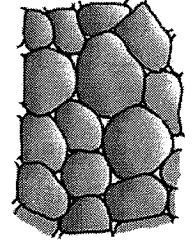
Select the incorrect option for the tissue shown below.
A
The cell wall is thick and made of cellulose.
B
It is parenchyma tissue.
C
It is a tissue that performs photosynthesis,storage,and secretion.
D
It is located in the ground tissue system.
Solution
(A) The image shows parenchyma cells,which are characterized by thin cell walls made of cellulose. Option $A$ states that the cell wall is thick,which is incorrect for parenchyma cells (collenchyma cells have unevenly thickened walls). Parenchyma cells are the primary components of the ground tissue system and perform various functions such as photosynthesis,storage,and secretion.
0 likes
View Solution299
MediumMCQ
What is the thickening material present in this tissue?
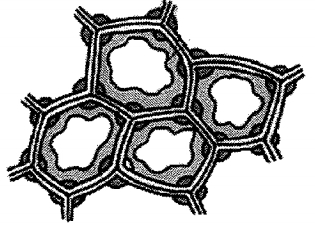
A
Lignin
B
Pectin
C
Starch
D
Glycogen
Solution
(B) The provided image shows cells with uneven thickening at the corners,which is a characteristic feature of collenchyma tissue.
Collenchyma cells are characterized by the deposition of cellulose,hemicellulose,and pectin at the corners of the cell wall.
Therefore,the thickening material present in this tissue is pectin.
Collenchyma cells are characterized by the deposition of cellulose,hemicellulose,and pectin at the corners of the cell wall.
Therefore,the thickening material present in this tissue is pectin.
0 likes
View Solution300
MediumMCQ
Identify the location of the structure shown in the image.
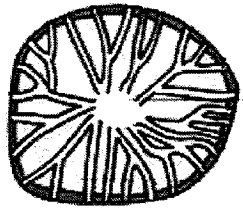
A
In the fruit walls of nuts.
B
In the pulp of guava,pear,and sapodilla.
C
In the leaves of tea and seed coats of legumes.
D
All of the above.
Solution
(D) The structure shown in the image is a 'Sclereid',which is a type of Sclerenchyma.
Sclereids are commonly found in the pulp of guava,pear,and sapodilla,providing them with a gritty texture.
They are also found in the fruit walls of nuts,the leaves of tea,and the seed coats of legumes.
Therefore,the correct option is $D$.
Sclereids are commonly found in the pulp of guava,pear,and sapodilla,providing them with a gritty texture.
They are also found in the fruit walls of nuts,the leaves of tea,and the seed coats of legumes.
Therefore,the correct option is $D$.
0 likes
View SolutionAnatomy of Flowering Plants — Permanent Tissue · Frequently Asked Questions
1Are these Anatomy of Flowering Plants questions useful for JEE and NEET?
Yes. All questions in this section are mapped to JEE Main and NEET exam patterns. Previous year questions from JEE Main, NEET, GUJCET and state-level exams are included with full solutions.
2Can I switch to Hindi or Gujarati for these questions?
Yes. Use the language tabs in the hero section or the sidebar to view the same questions and solutions in English, Hindi or Gujarati.
3How do I generate a question paper from this subtopic?
Use the Vedclass Exam Paper Generator — select the chapter and subtopic, set difficulty, and generate Sets A, B, C, D automatically. First 3 chapters of every subject are free.
Vedclass Products
For Students
Vedclass Test Series
Mock tests in real JEE/NEET style with performance analysis. 5-day free trial.
Start Free TrialFor Teachers
Exam Paper Generator
Generate Set A/B/C/D papers from this chapter in 2 minutes. 3 chapters free.
Try FreeFor Institutes
Online Exam Module
Live online exams with unlimited students, 360° analytics & white-label branding.
See DemoFor Teachers & Institutes
Generate a Anatomy of Flowering Plants Exam Paper in 2 Minutes
Select subtopic & difficulty — Sets A, B, C, D auto-generated with No Repeat logic.
First 3 chapters of every subject are free — no payment required.