
A English
Mix Examples - Life Processes Questions in English
Class 10 Science · Life Processes · Mix Examples - Life Processes
205+
Questions
English
Language
100%
With Solutions
Showing 50 of 205 questions in English
151
MediumMCQ
$(a)$ Name the hormone which is released into the blood when its sugar level rises. Name the organ which produces this hormone and its effect on blood sugar level. Also,mention the digestive enzymes secreted by this organ with one function of each.
$(b)$ Explain the need for chemical communication in multicellular organisms.
$(b)$ Explain the need for chemical communication in multicellular organisms.
A
Insulin
B
Pancreas
C
Reduces blood sugar
D
Digestive enzymes
Solution
(A) The hormone released into the blood when sugar levels rise is $Insulin$.
The organ that produces this hormone is the $Pancreas$.
$Insulin$ helps in reducing the blood sugar level by facilitating the uptake of glucose by cells.
The digestive enzymes secreted by the $Pancreas$ are:
$1$. $Pancreatic \ amylase$: Breaks down carbohydrates into simpler sugars.
$2$. $Trypsin$: Digests proteins into peptides.
$3$. $Lipase$: Breaks down emulsified fats into fatty acids and glycerol.
$(b)$ In multicellular organisms,electrical impulses (nerve impulses) can only reach a limited number of cells connected by nervous tissue. Furthermore,cells cannot continuously create and transmit electrical impulses. Therefore,to ensure that all cells in the body receive necessary signals,multicellular organisms use chemical communication (hormones),which can travel through the blood to reach every cell in the body.
The organ that produces this hormone is the $Pancreas$.
$Insulin$ helps in reducing the blood sugar level by facilitating the uptake of glucose by cells.
The digestive enzymes secreted by the $Pancreas$ are:
$1$. $Pancreatic \ amylase$: Breaks down carbohydrates into simpler sugars.
$2$. $Trypsin$: Digests proteins into peptides.
$3$. $Lipase$: Breaks down emulsified fats into fatty acids and glycerol.
$(b)$ In multicellular organisms,electrical impulses (nerve impulses) can only reach a limited number of cells connected by nervous tissue. Furthermore,cells cannot continuously create and transmit electrical impulses. Therefore,to ensure that all cells in the body receive necessary signals,multicellular organisms use chemical communication (hormones),which can travel through the blood to reach every cell in the body.
0 likes
View Solution152
Easy
$(a)$ State the reason for the following:
$(i)$ Herbivores need a longer small intestine,while carnivores have a shorter small intestine.
$(ii)$ The lungs in human beings are designed to maximize the area for the exchange of gases.
$(b)$ The rate of breathing in aquatic organisms is much faster than that seen in terrestrial organisms.
$(i)$ Herbivores need a longer small intestine,while carnivores have a shorter small intestine.
$(ii)$ The lungs in human beings are designed to maximize the area for the exchange of gases.
$(b)$ The rate of breathing in aquatic organisms is much faster than that seen in terrestrial organisms.
Solution
(A) $(a) (i)$ Herbivores,which consume grass,possess a longer small intestine to facilitate the digestion of cellulose. Cellulose is a complex carbohydrate that requires more time to break down,necessitating a longer transit time within the digestive tract.
$(a) (ii)$ Carnivores,which consume meat,have a shorter small intestine because meat is protein-rich and relatively easy to digest,requiring less time for nutrient absorption.
$(b) (i)$ Within the lungs,the trachea branches into smaller tubes called bronchi and bronchioles,which terminate in numerous balloon-like structures known as alveoli. These alveoli are surrounded by an extensive network of blood capillaries,providing a massive surface area for the efficient diffusion of gases.
$(b) (ii)$ The concentration of dissolved oxygen in water is significantly lower than the concentration of oxygen in the atmosphere. Consequently,aquatic organisms,such as fish,must pump water through their gills at a much higher rate to extract sufficient oxygen for their metabolic needs.
$(a) (ii)$ Carnivores,which consume meat,have a shorter small intestine because meat is protein-rich and relatively easy to digest,requiring less time for nutrient absorption.
$(b) (i)$ Within the lungs,the trachea branches into smaller tubes called bronchi and bronchioles,which terminate in numerous balloon-like structures known as alveoli. These alveoli are surrounded by an extensive network of blood capillaries,providing a massive surface area for the efficient diffusion of gases.
$(b) (ii)$ The concentration of dissolved oxygen in water is significantly lower than the concentration of oxygen in the atmosphere. Consequently,aquatic organisms,such as fish,must pump water through their gills at a much higher rate to extract sufficient oxygen for their metabolic needs.
0 likes
View Solution153
Medium
$(a)$ Bile does not contain any digestive enzyme,yet it is important for the digestion of food. Why?
$(b)$ Name the products formed after the complete digestion of carbohydrates,proteins,and fats in the small intestine.
$(b)$ Name the products formed after the complete digestion of carbohydrates,proteins,and fats in the small intestine.
Solution
(N/A) Bile makes the acidic food coming from the stomach alkaline,which enables pancreatic enzymes to act. Bile salts emulsify large fat globules into smaller ones,which increases the surface area for enzyme action,thereby increasing the efficiency of digestion.
$(b)$ The products formed after complete digestion are:
Carbohydrates: Glucose
Proteins: Amino acids
Fats: Fatty acids and glycerol
$(b)$ The products formed after complete digestion are:
Carbohydrates: Glucose
Proteins: Amino acids
Fats: Fatty acids and glycerol
0 likes
View Solution154
Medium
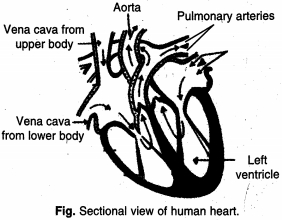
$(a)$ Draw a sectional view of the human heart and label on it Aorta,Pulmonary arteries,Vena cava,Left ventricle.
$(b)$ Why is double circulation of blood necessary in human beings?
$(b)$ Why is double circulation of blood necessary in human beings?
Solution
(N/A) The sectional view of the human heart is shown in the provided figure.
$(b)$ Double circulation of blood is necessary in human beings for the following reasons:
$(i)$ To separate deoxygenated blood from oxygenated blood,preventing their mixing.
$(ii)$ To meet the high energy and oxygen demands of the body,as humans are warm-blooded organisms.
$(iii)$ To maintain a constant body temperature (homeothermy) by ensuring efficient oxygen supply to all tissues.
$(b)$ Double circulation of blood is necessary in human beings for the following reasons:
$(i)$ To separate deoxygenated blood from oxygenated blood,preventing their mixing.
$(ii)$ To meet the high energy and oxygen demands of the body,as humans are warm-blooded organisms.
$(iii)$ To maintain a constant body temperature (homeothermy) by ensuring efficient oxygen supply to all tissues.
0 likes
View Solution155
Medium
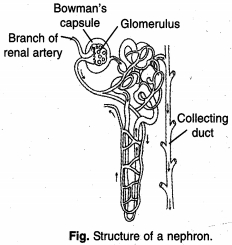
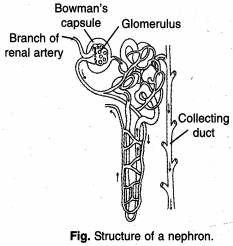
$(a)$ Draw the structure of a nephron and label the following on it: Glomerulus,Bowman's capsule,Renal artery,Collecting duct.
$(b)$ What happens to glucose that enters the nephron along with the filtrate?
$(b)$ What happens to glucose that enters the nephron along with the filtrate?
Solution
(N/A) The structure of a nephron is shown in the figure. The key parts are the Glomerulus (a cluster of capillaries),Bowman's capsule (a cup-shaped structure surrounding the glomerulus),the Renal artery (which brings blood to the nephron),and the Collecting duct (which collects urine from various nephrons).
$(b)$ When blood is filtered through the glomerulus,substances like glucose,amino acids,salts,and water enter the Bowman's capsule as part of the filtrate. As this filtrate moves through the tubular part of the nephron,useful substances like glucose are selectively reabsorbed back into the blood capillaries surrounding the tubule.
$(b)$ When blood is filtered through the glomerulus,substances like glucose,amino acids,salts,and water enter the Bowman's capsule as part of the filtrate. As this filtrate moves through the tubular part of the nephron,useful substances like glucose are selectively reabsorbed back into the blood capillaries surrounding the tubule.
0 likes
View Solution156
Medium
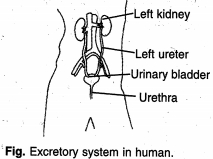
$(a)$ Draw a diagram of the human urinary system and label the following parts:
$(i)$ Kidney
$(ii)$ Ureter
$(iii)$ Urinary bladder
$(iv)$ Urethra
$(b)$ Name the two major components of normal human urine.
$(i)$ Kidney
$(ii)$ Ureter
$(iii)$ Urinary bladder
$(iv)$ Urethra
$(b)$ Name the two major components of normal human urine.
Solution
(N/A) The human urinary system consists of a pair of kidneys,a pair of ureters,a urinary bladder,and a urethra. (Refer to the provided diagram for labeling).
$(b)$ The two major components of normal human urine are:
$1.$ Water (which constitutes about $95\%$ of urine).
$2.$ Nitrogenous waste products,primarily urea (which constitutes about $2\%$ of urine),along with other salts and minerals.
$(b)$ The two major components of normal human urine are:
$1.$ Water (which constitutes about $95\%$ of urine).
$2.$ Nitrogenous waste products,primarily urea (which constitutes about $2\%$ of urine),along with other salts and minerals.
0 likes
View Solution157
Medium
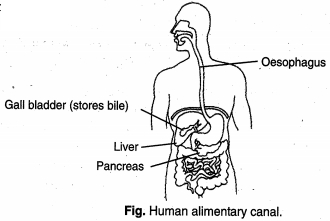
$(a)$ Draw a diagram of the human alimentary canal and label the following: Oesophagus,Gall bladder,Liver,and Pancreas.
$(b)$ Explain the statement: 'Bile does not contain any enzyme but it is essential for digestion.'
$(b)$ Explain the statement: 'Bile does not contain any enzyme but it is essential for digestion.'
Solution
(N/A) Refer to the provided diagram of the human alimentary canal.
$(b)$ Bile does not contain any digestive enzymes,yet it is essential for digestion due to the following reasons:
$(i)$ It makes the acidic food coming from the stomach alkaline,which is necessary for the action of pancreatic enzymes.
$(ii)$ It contains bile salts that help in the emulsification of fats,breaking down large fat globules into smaller ones to increase the efficiency of enzyme action.
$(b)$ Bile does not contain any digestive enzymes,yet it is essential for digestion due to the following reasons:
$(i)$ It makes the acidic food coming from the stomach alkaline,which is necessary for the action of pancreatic enzymes.
$(ii)$ It contains bile salts that help in the emulsification of fats,breaking down large fat globules into smaller ones to increase the efficiency of enzyme action.
0 likes
View Solution158
Medium
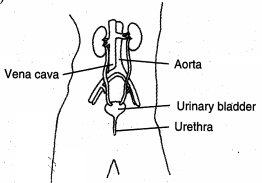
$(a)$ Draw a diagram of the human excretory system and label the following: Aorta,Vena cava,Urinary bladder,Urethra.
$(b)$ List two vital functions of the kidney.
$(b)$ List two vital functions of the kidney.
Solution
(N/A) The diagram of the human excretory system is provided in the image.
$(b)$ Two vital functions of the kidneys are:
$(i)$ They maintain the $pH$ and salt concentration of the body constant,and also regulate the water balance.
$(ii)$ They help in the removal of nitrogenous waste products (like urea) that are harmful to the human body.
$(b)$ Two vital functions of the kidneys are:
$(i)$ They maintain the $pH$ and salt concentration of the body constant,and also regulate the water balance.
$(ii)$ They help in the removal of nitrogenous waste products (like urea) that are harmful to the human body.
0 likes
View Solution159
Medium
Define enzyme. Name one enzyme in humans which digests fats.
Solution
(N/A) Enzymes are biological catalysts that accelerate the rate of biochemical reactions within living organisms. They are primarily proteinaceous in nature.
In humans,the enzyme $Lipase$ is responsible for the digestion of fats (lipids) into fatty acids and glycerol.
In humans,the enzyme $Lipase$ is responsible for the digestion of fats (lipids) into fatty acids and glycerol.
0 likes
View Solution160
Medium
Explain,giving any three reasons,the significance of transpiration in plants.
Solution
(N/A) Transpiration is the loss of water in the form of water vapor from the aerial parts of the plant,primarily the leaves.
Significance of transpiration:
$(i)$ Cooling effect: Transpiration helps in cooling the plant surface,especially during hot weather,as the evaporation of water consumes heat energy.
$(ii)$ Transport of water and minerals: It creates a transpiration pull (a suction force) that helps in the upward movement of water and dissolved minerals from the roots to the leaves.
$(iii)$ Distribution of water: It ensures the continuous supply and proper distribution of water and essential nutrients throughout the plant body.
$(iv)$ Maintenance of turgidity: It helps in maintaining the turgidity of cells,which is essential for the structural support and growth of the plant.
Significance of transpiration:
$(i)$ Cooling effect: Transpiration helps in cooling the plant surface,especially during hot weather,as the evaporation of water consumes heat energy.
$(ii)$ Transport of water and minerals: It creates a transpiration pull (a suction force) that helps in the upward movement of water and dissolved minerals from the roots to the leaves.
$(iii)$ Distribution of water: It ensures the continuous supply and proper distribution of water and essential nutrients throughout the plant body.
$(iv)$ Maintenance of turgidity: It helps in maintaining the turgidity of cells,which is essential for the structural support and growth of the plant.
0 likes
View Solution161
Medium
$A$ doctor advised a patient to take less sugar in his diet. Mention the possible disease the patient would be suffering from? Explain.
Solution
(N/A) The possible disease the patient is suffering from is $Diabetes$ $Mellitus$.
$Insulin$ is a hormone secreted by the $\beta$ cells of the $pancreas$ that regulates blood glucose levels in the body.
When the $pancreas$ fails to produce sufficient $insulin$, or when the body cells do not respond effectively to $insulin$, blood sugar levels rise significantly.
High blood sugar levels lead to $diabetes$, which is why doctors advise patients to reduce sugar intake to manage and control their blood glucose levels.
$Insulin$ is a hormone secreted by the $\beta$ cells of the $pancreas$ that regulates blood glucose levels in the body.
When the $pancreas$ fails to produce sufficient $insulin$, or when the body cells do not respond effectively to $insulin$, blood sugar levels rise significantly.
High blood sugar levels lead to $diabetes$, which is why doctors advise patients to reduce sugar intake to manage and control their blood glucose levels.
0 likes
View Solution162
Medium
$(a)$ State two functions of bile juice.
$(b)$ Differentiate between the functions of enzymes pepsin and trypsin.
$(b)$ Differentiate between the functions of enzymes pepsin and trypsin.
Solution
(N/A) Functions of bile juice:
$(i)$ It emulsifies large fat globules into smaller ones,thereby increasing the surface area for enzyme action.
$(ii)$ It makes the acidic food coming from the stomach alkaline,which is essential for the activity of pancreatic enzymes.
$(b)$ Differences between pepsin and trypsin:
$1.$ Pepsin: It acts on proteins in an acidic medium in the stomach.
$2.$ Trypsin: It acts on proteins in an alkaline medium in the small intestine.
$(i)$ It emulsifies large fat globules into smaller ones,thereby increasing the surface area for enzyme action.
$(ii)$ It makes the acidic food coming from the stomach alkaline,which is essential for the activity of pancreatic enzymes.
$(b)$ Differences between pepsin and trypsin:
$1.$ Pepsin: It acts on proteins in an acidic medium in the stomach.
$2.$ Trypsin: It acts on proteins in an alkaline medium in the small intestine.
0 likes
View Solution163
Medium
$(a)$ How does the exchange of respiratory gases,oxygen and carbon dioxide,take place between tissues and blood in human beings?
$(b)$ Name the respiratory pigment in humans. Where is it found?
$(b)$ Name the respiratory pigment in humans. Where is it found?
Solution
(N/A) In tissues,oxygen is consumed for metabolic activities,leading to a low concentration of oxygen and a high concentration of carbon dioxide. Conversely,blood arriving from the lungs has a high concentration of oxygen and a low concentration of carbon dioxide. Due to this partial pressure gradient,gases move between the blood and tissues via the process of simple diffusion.
$(b)$ The respiratory pigment in humans is Haemoglobin. It is found inside the Red Blood Corpuscles $(RBCs)$.
$(b)$ The respiratory pigment in humans is Haemoglobin. It is found inside the Red Blood Corpuscles $(RBCs)$.
0 likes
View Solution164
Medium
State the function of the following in the alimentary canal:
$(i)$ Liver $(ii)$ Gall bladder $(iii)$ Villi.
$(i)$ Liver $(ii)$ Gall bladder $(iii)$ Villi.
Solution
(N/A) Liver: Produces bile juice. Bile salts present in it emulsify large fat globules into smaller ones,facilitating digestion. It also stores excess glucose in the form of glycogen.
Gall bladder: Stores and concentrates the bile juice produced by the liver until it is needed for digestion in the small intestine.
Villi: These are numerous finger-like projections present on the inner lining of the small intestine. They increase the surface area for the absorption of digested food. The villi are richly supplied with blood vessels that transport the absorbed nutrients to every cell of the body.
Gall bladder: Stores and concentrates the bile juice produced by the liver until it is needed for digestion in the small intestine.
Villi: These are numerous finger-like projections present on the inner lining of the small intestine. They increase the surface area for the absorption of digested food. The villi are richly supplied with blood vessels that transport the absorbed nutrients to every cell of the body.
0 likes
View Solution165
Easy
Name one nitrogenous waste present in urine. What is the basic filtration unit of kidney called? How is the amount of urine produced regulated?
Solution
(N/A) One nitrogenous waste present in urine is $Urea$.
The basic filtration unit of the kidney is called a $Nephron$.
The amount of urine produced is regulated by the quantity of excess water present in the body and the amount of dissolved nitrogenous wastes that need to be excreted. Additionally,hormones like $ADH$ (Antidiuretic Hormone) play a crucial role in reabsorbing water from the kidney tubules based on the body's hydration status.
The basic filtration unit of the kidney is called a $Nephron$.
The amount of urine produced is regulated by the quantity of excess water present in the body and the amount of dissolved nitrogenous wastes that need to be excreted. Additionally,hormones like $ADH$ (Antidiuretic Hormone) play a crucial role in reabsorbing water from the kidney tubules based on the body's hydration status.
0 likes
View Solution166
Medium
Explain the process by which the energy requirements of autotrophic organisms are fulfilled. In which form are the unused carbohydrates stored?
Solution
(N/A) Autotrophic organisms fulfill their energy requirements through a process called $Photosynthesis$.
In this process, autotrophs take in external substances like $CO_2$ and $H_2O$ and convert them into energy-rich carbohydrates in the presence of sunlight and chlorophyll.
The chemical reaction is: $6CO_2 + 12H_2O \xrightarrow[Chlorophyll]{Sunlight} C_6H_{12}O_6 + 6O_2 + 6H_2O$.
The carbohydrates that are not immediately used by the plant are stored in the form of $Starch$.
In this process, autotrophs take in external substances like $CO_2$ and $H_2O$ and convert them into energy-rich carbohydrates in the presence of sunlight and chlorophyll.
The chemical reaction is: $6CO_2 + 12H_2O \xrightarrow[Chlorophyll]{Sunlight} C_6H_{12}O_6 + 6O_2 + 6H_2O$.
The carbohydrates that are not immediately used by the plant are stored in the form of $Starch$.
0 likes
View Solution167
Medium
Mention the site of photosynthesis. List basic requirements for this process to occur.
Solution
(N/A) The site of photosynthesis is the chloroplast,which is a green-coloured plastid found in plant cells.
$(b)$ The basic requirements for the process of photosynthesis are:
$(i)$ Carbon dioxide $(CO_2)$
$(ii)$ Water $(H_2O)$
$(iii)$ Sunlight (as an energy source)
$(iv)$ Chlorophyll (the photosynthetic pigment)
$(b)$ The basic requirements for the process of photosynthesis are:
$(i)$ Carbon dioxide $(CO_2)$
$(ii)$ Water $(H_2O)$
$(iii)$ Sunlight (as an energy source)
$(iv)$ Chlorophyll (the photosynthetic pigment)
0 likes
View Solution168
Medium
Complete the following table:
| Name of the gland | Name of hormone | Function |
| $(i)$ Thyroid | ................... | Regulates metabolism of fat,protein and carbohydrates |
| $(ii)$ ................... | Insulin | Regulates blood sugar level |
| $(iii)$ Pituitary | ................... | ................... |
Solution
(N/A) $(i)$ The hormone secreted by the thyroid gland is thyroxine,which regulates the metabolism of carbohydrates,proteins,and fats in the body.
$(ii)$ The gland that secretes insulin is the pancreas. Insulin plays a crucial role in regulating blood sugar levels by facilitating the uptake of glucose into cells.
$(iii)$ The pituitary gland secretes several hormones,most notably the growth hormone $(GH)$,which regulates the growth and development of the body.
$(ii)$ The gland that secretes insulin is the pancreas. Insulin plays a crucial role in regulating blood sugar levels by facilitating the uptake of glucose into cells.
$(iii)$ The pituitary gland secretes several hormones,most notably the growth hormone $(GH)$,which regulates the growth and development of the body.
0 likes
View Solution169
Medium
$(a)$ Name the organs which secrete the following enzymes in the human digestive system:
$(i)$ Pepsin
$(ii)$ Salivary amylase
$(iii)$ Trypsin
$(iv)$ Lipase
$(b)$ Name the organs which perform the following functions in the human alimentary canal:
$(i)$ Absorption of digested food
$(ii)$ Absorption of water
$(i)$ Pepsin
$(ii)$ Salivary amylase
$(iii)$ Trypsin
$(iv)$ Lipase
$(b)$ Name the organs which perform the following functions in the human alimentary canal:
$(i)$ Absorption of digested food
$(ii)$ Absorption of water
Solution
(N/A) $(i)$ Pepsin is secreted by the gastric glands present in the stomach wall.
$(ii)$ Salivary amylase is secreted by the salivary glands located in the mouth.
$(iii)$ Trypsin is secreted by the pancreas.
$(iv)$ Lipase is secreted by the pancreas.
$(b)$ $(i)$ The small intestine is the primary site for the absorption of digested food into the bloodstream.
$(ii)$ The large intestine is responsible for the absorption of water and salts from the undigested food material.
$(ii)$ Salivary amylase is secreted by the salivary glands located in the mouth.
$(iii)$ Trypsin is secreted by the pancreas.
$(iv)$ Lipase is secreted by the pancreas.
$(b)$ $(i)$ The small intestine is the primary site for the absorption of digested food into the bloodstream.
$(ii)$ The large intestine is responsible for the absorption of water and salts from the undigested food material.
0 likes
View Solution170
Medium
$(a)$ Draw the structure of a nephron and label the following parts on it:
$(i)$ Renal artery
$(ii)$ Bowman's capsule
$(iii)$ Glomerulus
$(iv)$ Collecting duct
$(b)$ Name four substances in the initial filtrate which are selectively reabsorbed as the filtrate flows along the tubule.
$(i)$ Renal artery
$(ii)$ Bowman's capsule
$(iii)$ Glomerulus
$(iv)$ Collecting duct
$(b)$ Name four substances in the initial filtrate which are selectively reabsorbed as the filtrate flows along the tubule.
Solution
(N/A) The structure of a nephron is shown in the provided diagram,with the renal artery,Bowman's capsule,glomerulus,and collecting duct clearly labeled.
$(b)$ As the initial filtrate flows along the nephron tubule,the following four substances are selectively reabsorbed into the blood:
$(i)$ Glucose
$(ii)$ Amino acids
$(iii)$ Salts (such as $Na^+$,$Cl^-$)
$(iv)$ Water
$(b)$ As the initial filtrate flows along the nephron tubule,the following four substances are selectively reabsorbed into the blood:
$(i)$ Glucose
$(ii)$ Amino acids
$(iii)$ Salts (such as $Na^+$,$Cl^-$)
$(iv)$ Water
0 likes
View Solution171
Medium
Design an experiment to demonstrate that sunlight is essential for photosynthesis.
Solution
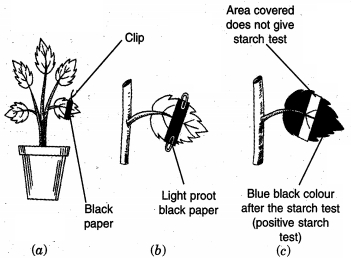
(N/A) $(i)$ Keep a potted plant in a dark room for $48-72$ hours to destarch its leaves. (Fig. $(a)$)
$(ii)$ Cover a portion of a leaf on both sides with strips of black paper using paper clips. This prevents sunlight from reaching the covered area. (Fig. $(b)$)
$(iii)$ Place the plant in bright sunlight for $4-6$ hours.
$(iv)$ Detach the leaf and remove the black paper strips. Perform a starch test by boiling the leaf in alcohol to remove chlorophyll and then adding iodine solution.
$(v)$ The part of the leaf that was covered with black paper does not turn blue-black,indicating the absence of starch. (Fig. $(c)$)
$(vi)$ The uncovered part of the leaf turns blue-black,indicating the presence of starch. This proves that sunlight is essential for photosynthesis.
$(ii)$ Cover a portion of a leaf on both sides with strips of black paper using paper clips. This prevents sunlight from reaching the covered area. (Fig. $(b)$)
$(iii)$ Place the plant in bright sunlight for $4-6$ hours.
$(iv)$ Detach the leaf and remove the black paper strips. Perform a starch test by boiling the leaf in alcohol to remove chlorophyll and then adding iodine solution.
$(v)$ The part of the leaf that was covered with black paper does not turn blue-black,indicating the absence of starch. (Fig. $(c)$)
$(vi)$ The uncovered part of the leaf turns blue-black,indicating the presence of starch. This proves that sunlight is essential for photosynthesis.
0 likes
View Solution172
Medium
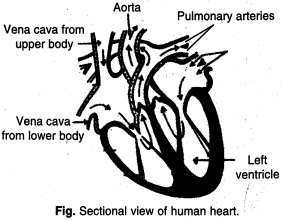
$(a)$ Draw a sectional view of the human heart and label the following parts on it:
Pulmonary artery,right atrium,left ventricle,septum.
$(b)$ What do the following transport?
$(i)$ Xylem
$(ii)$ Phloem
$(iii)$ Pulmonary vein
$(iv)$ Vena cava
Pulmonary artery,right atrium,left ventricle,septum.
$(b)$ What do the following transport?
$(i)$ Xylem
$(ii)$ Phloem
$(iii)$ Pulmonary vein
$(iv)$ Vena cava
Solution
(N/A) The sectional view of the human heart shows the four chambers and major blood vessels. The pulmonary artery carries deoxygenated blood from the right ventricle to the lungs. The right atrium receives deoxygenated blood from the body. The left ventricle pumps oxygenated blood to the rest of the body. The septum separates the right and left sides of the heart to prevent the mixing of oxygenated and deoxygenated blood.
$(b)$ $(i)$ Xylem: Transports water and dissolved minerals from the roots to the leaves.
$(ii)$ Phloem: Transports food (sucrose) synthesized in the leaves to other parts of the plant (translocation).
$(iii)$ Pulmonary vein: Transports oxygenated blood from the lungs to the left atrium of the heart.
$(iv)$ Vena cava: Transports deoxygenated blood from the body tissues to the right atrium of the heart.
$(b)$ $(i)$ Xylem: Transports water and dissolved minerals from the roots to the leaves.
$(ii)$ Phloem: Transports food (sucrose) synthesized in the leaves to other parts of the plant (translocation).
$(iii)$ Pulmonary vein: Transports oxygenated blood from the lungs to the left atrium of the heart.
$(iv)$ Vena cava: Transports deoxygenated blood from the body tissues to the right atrium of the heart.
0 likes
View Solution173
EasyMCQ
After a vigorous exercise,you may experience cramps in your leg muscles. Why does this happen?
A
Due to the accumulation of carbon dioxide.
B
Due to the accumulation of lactic acid.
C
Due to the accumulation of alcohol.
D
Due to the accumulation of glucose.
Solution
(B) This happens due to the build-up of lactic acid in our muscles.
During vigorous exercise,the demand for energy increases,leading to a shortage of oxygen in our muscle cells.
Under these anaerobic conditions,the muscle cells switch to an alternative pathway where pyruvate is converted into lactic acid instead of entering the aerobic respiration cycle.
The accumulation of this lactic acid causes muscle fatigue and cramps.
During vigorous exercise,the demand for energy increases,leading to a shortage of oxygen in our muscle cells.
Under these anaerobic conditions,the muscle cells switch to an alternative pathway where pyruvate is converted into lactic acid instead of entering the aerobic respiration cycle.
The accumulation of this lactic acid causes muscle fatigue and cramps.
0 likes
View Solution174
Easy
Which organ secretes a hormone when the blood sugar rises? Name a digestive enzyme released by this organ.
Solution
(N/A) The $pancreas$ secretes a hormone called $insulin$ when the blood sugar level rises, which helps in regulating the glucose level in the blood.
The $pancreas$ also acts as a digestive gland and releases several digestive enzymes, such as $trypsin$ (which helps in the digestion of proteins) and $lipase$ (which helps in the digestion of fats).
The $pancreas$ also acts as a digestive gland and releases several digestive enzymes, such as $trypsin$ (which helps in the digestion of proteins) and $lipase$ (which helps in the digestion of fats).
0 likes
View Solution175
Medium
What is the functional difference between the four chambers of the heart?
Solution
(N/A) The heart consists of four chambers, each with a specific role in the circulatory system:
| Chamber | Function |
|---|---|
| $Right \text{ atrium}$ | Receives deoxygenated (impure) blood from the rest of the body via the $vena \text{ cava}$ and pumps it into the $right \text{ ventricle}$. |
| $Left \text{ atrium}$ | Receives oxygenated (pure) blood from the lungs via the $pulmonary \text{ vein}$ and pumps it into the $left \text{ ventricle}$. |
| $Right \text{ ventricle}$ | Receives deoxygenated blood from the $right \text{ atrium}$ and pumps it to the lungs for oxygenation via the $pulmonary \text{ artery}$. |
| $Left \text{ ventricle}$ | Receives oxygenated blood from the $left \text{ atrium}$ and pumps it to the entire body via the $AORTA$ (the main artery). |
0 likes
View Solution176
MediumMCQ
The opening and closing of the stomatal pore depends upon:
A
oxygen
B
temperature
C
concentration of $CO_{2}$ in stomata
D
water in guard cells
Solution
(D) The opening and closing of the stomatal pore is regulated by the turgor pressure within the guard cells.
When water enters the guard cells,they become turgid and swell,causing the stomatal pore to open.
Conversely,when water leaves the guard cells,they become flaccid,causing the stomatal pore to close.
Therefore,the movement of water into and out of the guard cells is the primary factor determining the state of the stomata.
When water enters the guard cells,they become turgid and swell,causing the stomatal pore to open.
Conversely,when water leaves the guard cells,they become flaccid,causing the stomatal pore to close.
Therefore,the movement of water into and out of the guard cells is the primary factor determining the state of the stomata.
0 likes
View Solution177
MediumMCQ
Choose the forms in which most plants absorb nitrogen:
$(i)$ Proteins
$(ii)$ Nitrates and Nitrites
$(iii)$ Urea
$(iv)$ Atmospheric nitrogen
$(i)$ Proteins
$(ii)$ Nitrates and Nitrites
$(iii)$ Urea
$(iv)$ Atmospheric nitrogen
A
$(ii)$ and $(iii)$
B
$(i)$ and $(ii)$
C
$(iii)$ and $(iv)$
D
$(i)$ and $(iv)$
Solution
(A) Plants require nitrogen for the synthesis of proteins and other compounds.
Although nitrogen is abundant in the atmosphere,plants cannot absorb it directly in its gaseous form $(N_2)$.
Most plants absorb nitrogen from the soil primarily in the form of nitrates $(NO_3^-)$ and nitrites $(NO_2^-)$.
Some plants can also absorb nitrogen in the form of urea or ammonium compounds,which are converted into nitrates by soil bacteria.
Therefore,the forms in which most plants absorb nitrogen are nitrates and nitrites,and sometimes urea.
Although nitrogen is abundant in the atmosphere,plants cannot absorb it directly in its gaseous form $(N_2)$.
Most plants absorb nitrogen from the soil primarily in the form of nitrates $(NO_3^-)$ and nitrites $(NO_2^-)$.
Some plants can also absorb nitrogen in the form of urea or ammonium compounds,which are converted into nitrates by soil bacteria.
Therefore,the forms in which most plants absorb nitrogen are nitrates and nitrites,and sometimes urea.
0 likes
View Solution178
EasyMCQ
Which is the first enzyme to mix with food in the digestive tract?
A
Pepsin
B
Amylase
C
Cellulose
D
Trypsin
Solution
(B) The process of digestion begins in the mouth (buccal cavity).
Salivary glands secrete saliva,which contains the enzyme salivary amylase (also known as ptyalin).
This enzyme is the first to mix with food and it starts the breakdown of complex carbohydrates (starch) into simpler sugars like maltose.
Salivary glands secrete saliva,which contains the enzyme salivary amylase (also known as ptyalin).
This enzyme is the first to mix with food and it starts the breakdown of complex carbohydrates (starch) into simpler sugars like maltose.
0 likes
View Solution179
MediumMCQ
If salivary amylase is lacking in the saliva,which of the following events in the mouth cavity will be affected?
A
Proteins breaking down into amino acids
B
Fats breaking down into fatty acids and glycerol
C
Starch breaking down into sugars
D
Absorption of vitamins
Solution
(C) Salivary amylase is an enzyme present in the saliva that initiates the chemical digestion of carbohydrates.
It specifically acts on starch (a complex carbohydrate) and breaks it down into simpler sugars like maltose.
If salivary amylase is absent,the breakdown of starch into sugars in the mouth cavity will be significantly affected or inhibited.
It specifically acts on starch (a complex carbohydrate) and breaks it down into simpler sugars like maltose.
If salivary amylase is absent,the breakdown of starch into sugars in the mouth cavity will be significantly affected or inhibited.
0 likes
View Solution180
EasyMCQ
The inner lining of the stomach is protected from hydrochloric acid by which of the following? Choose the correct one:
A
Pepsin
B
Bile
C
Salivary amylase
D
Mucus
Solution
(D) The stomach wall secretes gastric juice,which contains hydrochloric acid $(HCl)$,pepsin,and mucus.
$HCl$ creates an acidic medium necessary for the activation of the enzyme pepsin.
However,$HCl$ can be corrosive to the stomach lining.
Mucus is secreted by the goblet cells in the stomach lining to form a protective layer.
This layer prevents the acid from damaging the stomach wall,thus protecting it from erosion and ulcers.
$HCl$ creates an acidic medium necessary for the activation of the enzyme pepsin.
However,$HCl$ can be corrosive to the stomach lining.
Mucus is secreted by the goblet cells in the stomach lining to form a protective layer.
This layer prevents the acid from damaging the stomach wall,thus protecting it from erosion and ulcers.
0 likes
View Solution181
EasyMCQ
Which part of the alimentary canal receives bile from the liver?
A
Small intestine
B
Stomach
C
Large intestine
D
Oesophagus
Solution
(A) The liver produces bile,which is stored in the gallbladder. Bile is released into the duodenum,which is the first part of the small intestine. This bile helps in the emulsification of fats,breaking down large fat globules into smaller ones to facilitate digestion by enzymes.
0 likes
View Solution182
EasyMCQ
$A$ few drops of iodine solution were added to rice water. The solution turned blue-black in colour. This indicates that rice water contains:
A
complex proteins
B
starch
C
fats
D
simple proteins
Solution
(B) The iodine test is a chemical test used to detect the presence of starch in a sample.
When iodine solution ($I_2$ in $KI$) is added to a substance containing starch,it forms a starch-iodine complex,which results in a characteristic blue-black colour.
Since the rice water turned blue-black upon the addition of iodine,it confirms the presence of starch in the rice water.
Therefore,the correct option is $B$.
When iodine solution ($I_2$ in $KI$) is added to a substance containing starch,it forms a starch-iodine complex,which results in a characteristic blue-black colour.
Since the rice water turned blue-black upon the addition of iodine,it confirms the presence of starch in the rice water.
Therefore,the correct option is $B$.
0 likes
View Solution183
EasyMCQ
In which part of the alimentary canal is food finally digested?
A
Stomach
B
Mouth cavity
C
Small intestine
D
Large intestine
Solution
(C) The process of digestion begins in the mouth and continues in the stomach.
However,the final digestion of food,including carbohydrates,proteins,and fats,is completed in the small intestine.
The small intestine receives secretions from the liver (bile) and the pancreas (pancreatic juice),and its walls secrete intestinal juice.
These enzymes break down complex food molecules into their simplest absorbable forms,such as glucose,amino acids,and fatty acids,which are then absorbed into the bloodstream.
However,the final digestion of food,including carbohydrates,proteins,and fats,is completed in the small intestine.
The small intestine receives secretions from the liver (bile) and the pancreas (pancreatic juice),and its walls secrete intestinal juice.
These enzymes break down complex food molecules into their simplest absorbable forms,such as glucose,amino acids,and fatty acids,which are then absorbed into the bloodstream.
0 likes
View Solution184
MediumMCQ
Choose the function of the pancreatic juice from the following:
A
trypsin digests protein and lipase carbohydrates
B
trypsin digests emulsified fats and lipase proteins
C
trypsin and lipase digest fats
D
trypsin digests proteins and lipase emulsified fats
Solution
(D) Pancreatic juice contains several enzymes that play a crucial role in digestion.
$1$. $Trypsin$ is a proteolytic enzyme that breaks down proteins into smaller peptides.
$2$. $Lipase$ is an enzyme that acts on emulsified fats and breaks them down into fatty acids and glycerol.
Therefore,the correct function is that $trypsin$ digests proteins and $lipase$ digests emulsified fats.
$1$. $Trypsin$ is a proteolytic enzyme that breaks down proteins into smaller peptides.
$2$. $Lipase$ is an enzyme that acts on emulsified fats and breaks them down into fatty acids and glycerol.
Therefore,the correct function is that $trypsin$ digests proteins and $lipase$ digests emulsified fats.
0 likes
View Solution185
MediumMCQ
When air is blown from the mouth into a test tube containing lime water,the lime water turns milky due to the presence of:
A
carbon dioxide
B
oxygen
C
nitrogen
D
water vapour
Solution
(A) When we exhale,the air we breathe out contains a significant amount of $CO_2$ (carbon dioxide).
When this $CO_2$ is passed through lime water $(Ca(OH)_2)$,it reacts to form calcium carbonate $(CaCO_3)$,which is an insoluble white precipitate.
The chemical reaction is: $Ca(OH)_2 + CO_2 \rightarrow CaCO_3 + H_2O$.
This formation of calcium carbonate makes the lime water appear milky.
When this $CO_2$ is passed through lime water $(Ca(OH)_2)$,it reacts to form calcium carbonate $(CaCO_3)$,which is an insoluble white precipitate.
The chemical reaction is: $Ca(OH)_2 + CO_2 \rightarrow CaCO_3 + H_2O$.
This formation of calcium carbonate makes the lime water appear milky.
0 likes
View Solution186
MediumMCQ
Which of the following statements is (are) true about the heart?
A
$(i)$
B
$(ii)$ and $(iv)$
C
$(ii)$
D
$(i)$ and $(iii)$
Solution
(B) The human heart functions as a double pump system:
$1$. The left atrium receives oxygenated blood from the lungs via pulmonary veins,not from the body. Thus,statement $(i)$ is false.
$2$. The left ventricle pumps oxygenated blood to the entire body through the aorta,and the right ventricle pumps deoxygenated blood to the lungs for oxygenation. Thus,statement $(ii)$ is true.
$3$. The left atrium transfers oxygenated blood to the left ventricle,not the right ventricle. Thus,statement $(iii)$ is false.
$4$. The right atrium receives deoxygenated blood from the body,and the left ventricle pumps oxygenated blood to the body. Thus,statement $(iv)$ is true.
Therefore,statements $(ii)$ and $(iv)$ are correct.
$1$. The left atrium receives oxygenated blood from the lungs via pulmonary veins,not from the body. Thus,statement $(i)$ is false.
$2$. The left ventricle pumps oxygenated blood to the entire body through the aorta,and the right ventricle pumps deoxygenated blood to the lungs for oxygenation. Thus,statement $(ii)$ is true.
$3$. The left atrium transfers oxygenated blood to the left ventricle,not the right ventricle. Thus,statement $(iii)$ is false.
$4$. The right atrium receives deoxygenated blood from the body,and the left ventricle pumps oxygenated blood to the body. Thus,statement $(iv)$ is true.
Therefore,statements $(ii)$ and $(iv)$ are correct.
0 likes
View Solution187
EasyMCQ
What prevents backflow of blood inside the heart during contraction?
A
Thin walls of atria
B
Thick muscular walls of ventricles
C
Valves in heart
D
All of the above
Solution
(C) The heart contains specialized structures called valves (such as the tricuspid,bicuspid,and semilunar valves).
These valves act as one-way doors that open to allow blood to flow in the correct direction and close tightly to prevent the backflow of blood during the contraction (systole) of the heart chambers.
These valves act as one-way doors that open to allow blood to flow in the correct direction and close tightly to prevent the backflow of blood during the contraction (systole) of the heart chambers.
0 likes
View Solution188
MediumMCQ
Single circulation,i.e.,blood flows through the heart only once during one cycle of passage through the body,is exhibited by:
A
Labeo,Chameleon,Salamander
B
Whale,Dolphin,Turtle
C
Hyla,Rana,Draco
D
Hippocampus,Exocoetus,Anabas
Solution
(D) In single circulation,the heart receives only deoxygenated blood,which is then pumped to the gills for oxygenation and subsequently distributed to the rest of the body without returning to the heart. This type of circulation is characteristic of fishes.
$1$. $Labeo$ (Rohu),$Hippocampus$ (Sea horse),$Exocoetus$ (Flying fish),and $Anabas$ (Climbing perch) are all bony fishes.
$2$. $Chameleon$,$Salamander$,$Whale$,$Dolphin$,$Turtle$,$Hyla$,$Rana$,and $Draco$ are not fishes; they possess either double circulation or incomplete double circulation.
Therefore,the correct group exhibiting single circulation is $Hippocampus$,$Exocoetus$,and $Anabas$.
$1$. $Labeo$ (Rohu),$Hippocampus$ (Sea horse),$Exocoetus$ (Flying fish),and $Anabas$ (Climbing perch) are all bony fishes.
$2$. $Chameleon$,$Salamander$,$Whale$,$Dolphin$,$Turtle$,$Hyla$,$Rana$,and $Draco$ are not fishes; they possess either double circulation or incomplete double circulation.
Therefore,the correct group exhibiting single circulation is $Hippocampus$,$Exocoetus$,and $Anabas$.
0 likes
View Solution189
MediumMCQ
In which of the following vertebrate group/groups,does the heart not pump oxygenated blood to different parts of the body?
A
Pisces only
B
Amphibians and reptiles
C
Amphibians only
D
Pisces and amphibians
Solution
(A) In $Pisces$ (fishes),the heart is two-chambered,consisting of one atrium and one ventricle. The heart pumps deoxygenated blood to the gills for oxygenation. This oxygenated blood then goes directly to the rest of the body without returning to the heart. Thus,the heart only pumps deoxygenated blood. This is known as single circulation. In amphibians and reptiles,the heart is three-chambered (or partially four-chambered in reptiles),allowing for the pumping of both oxygenated and deoxygenated blood to the body tissues. Therefore,the correct group is $Pisces$ only.
0 likes
View Solution190
EasyMCQ
Which is the correct sequence of air passage during inhalation?
A
Nostrils $\rightarrow$ larynx $\rightarrow$ pharynx $\rightarrow$ trachea $\rightarrow$ lungs
B
Nostrils $\rightarrow$ pharynx $\rightarrow$ larynx $\rightarrow$ trachea $\rightarrow$ alveoli
C
larynx $\rightarrow$ nostrils $\rightarrow$ pharynx $\rightarrow$ lungs
D
Nasal passage $\rightarrow$ trachea $\rightarrow$ pharynx $\rightarrow$ larynx $\rightarrow$ alveoli
Solution
(B) During inhalation,air enters through the nostrils.
From the nostrils,it passes into the nasal cavity and then into the pharynx.
The pharynx leads to the larynx (voice box).
From the larynx,air moves into the trachea (windpipe).
The trachea branches into bronchi,which further divide into bronchioles and finally reach the alveoli in the lungs for gas exchange.
Therefore,the correct sequence is: Nostrils $\rightarrow$ pharynx $\rightarrow$ larynx $\rightarrow$ trachea $\rightarrow$ alveoli.
From the nostrils,it passes into the nasal cavity and then into the pharynx.
The pharynx leads to the larynx (voice box).
From the larynx,air moves into the trachea (windpipe).
The trachea branches into bronchi,which further divide into bronchioles and finally reach the alveoli in the lungs for gas exchange.
Therefore,the correct sequence is: Nostrils $\rightarrow$ pharynx $\rightarrow$ larynx $\rightarrow$ trachea $\rightarrow$ alveoli.
0 likes
View Solution191
EasyMCQ
During respiration,exchange of gases takes place in:
A
trachea and larynx
B
alveoli and throat
C
alveoli of Lungs
D
throat and larynx
Solution
(C) During the process of respiration,the exchange of gases ($O_2$ and $CO_2$) occurs in the $alveoli$ of the lungs.
$Alveoli$ are tiny,balloon-like structures present at the terminal ends of the bronchioles.
These structures provide a large surface area for the diffusion of gases between the air in the lungs and the blood in the surrounding capillaries.
The trachea and larynx are parts of the conducting zone and do not participate in gas exchange.
$Alveoli$ are tiny,balloon-like structures present at the terminal ends of the bronchioles.
These structures provide a large surface area for the diffusion of gases between the air in the lungs and the blood in the surrounding capillaries.
The trachea and larynx are parts of the conducting zone and do not participate in gas exchange.
0 likes
View Solution192
MediumMCQ
Which of the following statements is (are) correct?
$(i)$ Pyruvate can be converted into ethanol and carbon dioxide by yeast.
$(ii)$ Fermentation takes place in aerobic bacteria.
$(iii)$ Fermentation takes place in mitochondria.
$(iv)$ Fermentation is a form of anaerobic respiration.
$(i)$ Pyruvate can be converted into ethanol and carbon dioxide by yeast.
$(ii)$ Fermentation takes place in aerobic bacteria.
$(iii)$ Fermentation takes place in mitochondria.
$(iv)$ Fermentation is a form of anaerobic respiration.
A
$(i)$ and $(iii)$
B
$(ii)$ and $(iv)$
C
$(ii)$ and $(iii)$
D
$(i)$ and $(iv)$
Solution
(D) Statement $(i)$ is correct: In yeast,during fermentation,pyruvate is converted into ethanol and carbon dioxide.
Statement $(ii)$ is incorrect: Fermentation is an anaerobic process,not an aerobic one.
Statement $(iii)$ is incorrect: Fermentation occurs in the cytoplasm,not in the mitochondria.
Statement $(iv)$ is correct: Fermentation is a type of anaerobic respiration that occurs in the absence of oxygen.
Therefore,statements $(i)$ and $(iv)$ are correct.
Statement $(ii)$ is incorrect: Fermentation is an anaerobic process,not an aerobic one.
Statement $(iii)$ is incorrect: Fermentation occurs in the cytoplasm,not in the mitochondria.
Statement $(iv)$ is correct: Fermentation is a type of anaerobic respiration that occurs in the absence of oxygen.
Therefore,statements $(i)$ and $(iv)$ are correct.
0 likes
View Solution193
MediumMCQ
Lack of oxygen in muscles often leads to cramps among cricketers. This results due to:
A
conversion of pyruvate to lactic acid
B
conversion of pyruvate to glucose
C
non-conversion of glucose to pyruvate
D
conversion of pyruvate to ethanol
Solution
(A) During intense physical activity,such as playing cricket,the demand for energy in muscle cells increases significantly.
When the supply of oxygen is insufficient to meet this demand,muscle cells switch to anaerobic respiration.
In this process,the pyruvate produced from glucose breakdown is converted into lactic acid instead of entering the aerobic pathway (Krebs cycle).
The accumulation of lactic acid in the muscle tissues causes fatigue and painful muscle cramps.
When the supply of oxygen is insufficient to meet this demand,muscle cells switch to anaerobic respiration.
In this process,the pyruvate produced from glucose breakdown is converted into lactic acid instead of entering the aerobic pathway (Krebs cycle).
The accumulation of lactic acid in the muscle tissues causes fatigue and painful muscle cramps.
0 likes
View Solution194
EasyMCQ
Choose the correct path of urine in our body:
A
kidney $\rightarrow$ ureter $\rightarrow$ urethra $\rightarrow$ urinary bladder
B
kidney $\rightarrow$ ureter $\rightarrow$ urinary bladder $\rightarrow$ urethra
C
kidney $\rightarrow$ urinary bladder $\rightarrow$ urethra $\rightarrow$ ureter
D
urinary bladder $\rightarrow$ kidney $\rightarrow$ ureter $\rightarrow$ urethra
Solution
(B) The process of urine formation and excretion in the human body follows a specific pathway:
$1$. Urine is produced in the kidneys through the process of filtration.
$2$. From the kidneys,urine travels through the ureters,which are thin tubes that carry urine to the bladder.
$3$. The urinary bladder acts as a storage organ for urine until it is ready to be expelled.
$4$. Finally,urine is expelled from the body through the urethra.
Therefore,the correct sequence is: kidney $\rightarrow$ ureter $\rightarrow$ urinary bladder $\rightarrow$ urethra.
$1$. Urine is produced in the kidneys through the process of filtration.
$2$. From the kidneys,urine travels through the ureters,which are thin tubes that carry urine to the bladder.
$3$. The urinary bladder acts as a storage organ for urine until it is ready to be expelled.
$4$. Finally,urine is expelled from the body through the urethra.
Therefore,the correct sequence is: kidney $\rightarrow$ ureter $\rightarrow$ urinary bladder $\rightarrow$ urethra.
0 likes
View Solution195
MediumMCQ
Which of the following is an incorrect statement?
A
Organisms grow with time
B
Organisms must repair and maintain their structure
C
Movement of molecules does not take place among cells
D
Energy is essential for life processes
Solution
(C) Life processes are the basic functions performed by living organisms to survive and maintain their body structure.
$1$. Organisms grow with time as they assimilate nutrients and build new cellular components.
$2$. Maintenance and repair of body structures are continuous processes to replace worn-out tissues.
$3$. Movement of molecules is essential for life; substances like oxygen,carbon dioxide,nutrients,and waste products constantly move between cells and the environment to sustain metabolism.
$4$. Energy is required for all life processes,including growth,repair,and transport.
Therefore,the statement that 'Movement of molecules does not take place among cells' is incorrect.
$1$. Organisms grow with time as they assimilate nutrients and build new cellular components.
$2$. Maintenance and repair of body structures are continuous processes to replace worn-out tissues.
$3$. Movement of molecules is essential for life; substances like oxygen,carbon dioxide,nutrients,and waste products constantly move between cells and the environment to sustain metabolism.
$4$. Energy is required for all life processes,including growth,repair,and transport.
Therefore,the statement that 'Movement of molecules does not take place among cells' is incorrect.
0 likes
View Solution196
EasyMCQ
The chemical process involved in the removal of harmful metabolic wastes from the body is called excretion.
A
True
B
False
Solution
(B) The statement is $False$.
Excretion is defined as the biological process by which an organism eliminates metabolic waste products from its body.
While metabolic processes are chemical in nature,excretion itself is a physiological or biological process,not merely a chemical reaction.
Excretion is defined as the biological process by which an organism eliminates metabolic waste products from its body.
While metabolic processes are chemical in nature,excretion itself is a physiological or biological process,not merely a chemical reaction.
0 likes
View Solution197
EasyMCQ
Just as $CO_{2}$ is removed from the blood in the lungs,nitrogenous wastes such as urea or uric acid are removed from blood in the liver.
A
True
B
False
C
Cannot be determined
D
Partially true
Solution
(B) The statement is False.
While the liver is responsible for the formation of urea through the ornithine cycle (converting toxic ammonia into less toxic urea),the actual removal or filtration of nitrogenous wastes from the blood occurs in the kidneys.
The lungs are responsible for the exchange of gases ($CO_{2}$ and $O_{2}$),whereas the kidneys are the primary organs for the excretion of nitrogenous metabolic wastes.
While the liver is responsible for the formation of urea through the ornithine cycle (converting toxic ammonia into less toxic urea),the actual removal or filtration of nitrogenous wastes from the blood occurs in the kidneys.
The lungs are responsible for the exchange of gases ($CO_{2}$ and $O_{2}$),whereas the kidneys are the primary organs for the excretion of nitrogenous metabolic wastes.
0 likes
View Solution198
EasyMCQ
Urine is stored in the urinary bladder until the pressure of the expanded bladder leads to the urge to pass it out through the urethra.
A
True
B
False
Solution
(A) The statement is $True$. The urinary bladder is a muscular sac that stores urine produced by the kidneys. As the bladder fills with urine,its walls stretch,increasing the internal pressure. This expansion triggers stretch receptors in the bladder wall,which send nerve impulses to the central nervous system,creating the voluntary urge to micturate (urinate) through the urethra.
0 likes
View Solution199
EasyMCQ
Kidneys are located in the thoracic cavity, one on either side of the backbone.
A
True
B
False
Solution
(B) The statement is $False$.
Kidneys are not located in the thoracic cavity.
They are located in the abdominal cavity, specifically in the retroperitoneal space, one on either side of the vertebral column (backbone).
Kidneys are not located in the thoracic cavity.
They are located in the abdominal cavity, specifically in the retroperitoneal space, one on either side of the vertebral column (backbone).
0 likes
View Solution200
EasyMCQ
The walls of auricles are comparatively thicker than ventricles.
A
True
B
False
Solution
(B) The statement is $False$. In the human heart,the walls of the ventricles are significantly thicker than those of the auricles (atria). This is because the ventricles are responsible for pumping blood out of the heart to the lungs (right ventricle) and to the rest of the body (left ventricle),which requires much higher pressure. The auricles only need to pump blood into the adjacent ventricles,which requires less force.
0 likes
View SolutionLife Processes — Mix Examples - Life Processes · Frequently Asked Questions
1Are these Life Processes questions useful for JEE and NEET?
Yes. All questions in this section are mapped to JEE Main and NEET exam patterns. Previous year questions from JEE Main, NEET, GUJCET and state-level exams are included with full solutions.
2Can I switch to Hindi or Gujarati for these questions?
Yes. Use the language tabs in the hero section or the sidebar to view the same questions and solutions in English, Hindi or Gujarati.
3How do I generate a question paper from this subtopic?
Use the Vedclass Exam Paper Generator — select the chapter and subtopic, set difficulty, and generate Sets A, B, C, D automatically. First 3 chapters of every subject are free.
Vedclass Products
For Students
Vedclass Test Series
Mock tests in real JEE/NEET style with performance analysis. 5-day free trial.
Start Free TrialFor Teachers
Exam Paper Generator
Generate Set A/B/C/D papers from this chapter in 2 minutes. 3 chapters free.
Try FreeFor Institutes
Online Exam Module
Live online exams with unlimited students, 360° analytics & white-label branding.
See DemoFor Teachers & Institutes
Generate a Life Processes Exam Paper in 2 Minutes
Select subtopic & difficulty — Sets A, B, C, D auto-generated with No Repeat logic.
First 3 chapters of every subject are free — no payment required.