
A English
Textbook - Life Processes Questions in English
Class 10 Science · Life Processes · Textbook - Life Processes
34+
Questions
English
Language
100%
With Solutions
Showing 34 of 34 questions in English
1
MediumMCQ
Why is diffusion insufficient to meet the oxygen requirements of multicellular organisms like humans?
A
The body surface area is too small.
B
Most cells are not in direct contact with the external environment.
C
The rate of diffusion is too fast.
D
Oxygen is not required by all cells.
Solution
(B) Multicellular organisms,such as humans,possess complex body designs.
They have specialized cells and tissues for performing various necessary functions of the body,such as the intake of food and oxygen.
Unlike unicellular organisms,most cells in multicellular organisms are not in direct contact with the outside environment.
Therefore,diffusion is a slow process and cannot meet the oxygen requirements of all cells in a complex body.
They have specialized cells and tissues for performing various necessary functions of the body,such as the intake of food and oxygen.
Unlike unicellular organisms,most cells in multicellular organisms are not in direct contact with the outside environment.
Therefore,diffusion is a slow process and cannot meet the oxygen requirements of all cells in a complex body.
0 likes
View Solution2
Easy
What criteria do we use to decide whether something is alive?
Solution
(N/A) To decide whether something is alive,we generally look for visible movements such as walking,breathing,or growth.
However,living organisms also exhibit molecular movements that are not visible to the naked eye.
Therefore,the presence of life processes,such as nutrition,respiration,transport,and excretion,is the fundamental criterion used to determine if an organism is alive.
However,living organisms also exhibit molecular movements that are not visible to the naked eye.
Therefore,the presence of life processes,such as nutrition,respiration,transport,and excretion,is the fundamental criterion used to determine if an organism is alive.
0 likes
View Solution3
EasyMCQ
What are outside raw materials used for by an organism?
A
For energy production
B
For growth and repair
C
For maintenance of body structures
D
All of the above
Solution
(D) An organism uses outside raw materials,primarily in the form of food and oxygen,to perform various life processes.
These raw materials are essential for energy production,which powers cellular activities.
They are also used for the growth,development,and repair of body tissues.
Furthermore,they help in the maintenance of body structures to ensure the survival of the organism.
The specific raw materials required vary significantly depending on the complexity of the organism and its environment.
These raw materials are essential for energy production,which powers cellular activities.
They are also used for the growth,development,and repair of body tissues.
Furthermore,they help in the maintenance of body structures to ensure the survival of the organism.
The specific raw materials required vary significantly depending on the complexity of the organism and its environment.
0 likes
View Solution4
EasyMCQ
What processes would you consider essential for maintaining life?
A
Nutrition and Respiration
B
Transportation and Excretion
C
All of the above
D
None of the above
Solution
(C) The processes that are essential for maintaining life are collectively known as life processes. These include:
$1$. Nutrition: The process of obtaining energy from food.
$2$. Respiration: The process of breaking down food to release energy.
$3$. Transportation: The movement of substances within the organism.
$4$. Excretion: The removal of metabolic waste products from the body.
$1$. Nutrition: The process of obtaining energy from food.
$2$. Respiration: The process of breaking down food to release energy.
$3$. Transportation: The movement of substances within the organism.
$4$. Excretion: The removal of metabolic waste products from the body.
0 likes
View Solution5
Difficult
What are the differences between autotrophic nutrition and heterotrophic nutrition?
Solution
(N/A)
| < strong>Autotrophic nutrition | < strong>Heterotrophic nutrition |
| $(i)$ Food is synthesized from simple inorganic raw materials such as $CO_2$ and water. | $(i)$ Food is obtained directly or indirectly from autotrophs. This food is broken down with the help of enzymes. |
| $(ii)$ Presence of green pigment (chlorophyll) is necessary. | $(ii)$ No pigment is required in this type of nutrition. |
| $(iii)$ Food is generally prepared during daytime. | $(iii)$ Food can be obtained or processed at all times. |
| $(iv)$ All green plants and some bacteria exhibit this type of nutrition. | $(iv)$ All animals and fungi exhibit this type of nutrition. |
0 likes
View Solution6
Medium
Where do plants get each of the raw materials required for photosynthesis?
Solution
(N/A) The following raw materials are required for photosynthesis:
$1$. $CO_2$: It enters the plant from the atmosphere through the stomata present on the surface of the leaves.
$2$. Water $(H_2O)$: It is absorbed from the soil by the plant roots through the process of osmosis and transported to the leaves via the xylem.
$3$. Sunlight: It is the energy source required for the reaction,which is captured by the chlorophyll pigment present in the chloroplasts of the plant cells.
$1$. $CO_2$: It enters the plant from the atmosphere through the stomata present on the surface of the leaves.
$2$. Water $(H_2O)$: It is absorbed from the soil by the plant roots through the process of osmosis and transported to the leaves via the xylem.
$3$. Sunlight: It is the energy source required for the reaction,which is captured by the chlorophyll pigment present in the chloroplasts of the plant cells.
0 likes
View Solution7
MediumMCQ
What is the role of the acid in our stomach?
A
It kills harmful bacteria present in food.
B
It creates an acidic medium for the action of pepsin.
C
It helps in the digestion of proteins.
D
All of the above.
Solution
(D) The hydrochloric acid $(HCl)$ present in our stomach serves several critical functions:
$1$. It creates an acidic medium ($pH$ of $1.5$ to $3.5$) which is essential for the activation of the enzyme pepsinogen into its active form,pepsin.
$2$. Pepsin is a proteolytic enzyme that breaks down complex proteins into simpler peptides.
$3$. The acidic environment also acts as a defense mechanism by killing harmful bacteria and pathogens ingested along with food.
Therefore,all the given options are correct.
$1$. It creates an acidic medium ($pH$ of $1.5$ to $3.5$) which is essential for the activation of the enzyme pepsinogen into its active form,pepsin.
$2$. Pepsin is a proteolytic enzyme that breaks down complex proteins into simpler peptides.
$3$. The acidic environment also acts as a defense mechanism by killing harmful bacteria and pathogens ingested along with food.
Therefore,all the given options are correct.
0 likes
View Solution8
MediumMCQ
What is the function of digestive enzymes?
A
To synthesize complex food molecules.
B
To break down complex food particles into simple,absorbable forms.
C
To transport nutrients to the cells.
D
To store energy in the form of fat.
Solution
(B) Digestive enzymes such as amylase,lipase,pepsin,and trypsin help in the breaking down of complex food particles into simple,soluble forms. These simple particles can be easily absorbed by the blood and thus transported to all the cells of the body for energy production,growth,and repair.
0 likes
View Solution9
Difficult
How is the small intestine designed to absorb digested food?
Solution
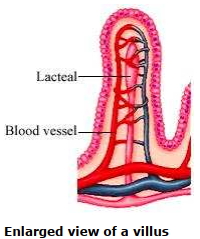
The inner lining of the small intestine has numerous finger-like projections called villi.
These villi significantly increase the surface area for the absorption of digested food.
Each villus is richly supplied with blood vessels and lacteals (lymph vessels).
The blood vessels absorb the digested food (nutrients like glucose,amino acids) and transport it into the bloodstream.
From the bloodstream,the absorbed food is delivered to each and every cell of the body for energy production,growth,and repair.
These villi significantly increase the surface area for the absorption of digested food.
Each villus is richly supplied with blood vessels and lacteals (lymph vessels).
The blood vessels absorb the digested food (nutrients like glucose,amino acids) and transport it into the bloodstream.
From the bloodstream,the absorbed food is delivered to each and every cell of the body for energy production,growth,and repair.
0 likes
View Solution10
DifficultMCQ
What advantage over an aquatic organism does a terrestrial organism have with regard to obtaining oxygen for respiration?
A
Terrestrial organisms have more surface area for gas exchange.
B
Terrestrial organisms can breathe faster than aquatic organisms.
C
The amount of dissolved oxygen in air is much higher than the amount of dissolved oxygen in water.
D
Terrestrial organisms do not require oxygen for respiration.
Solution
(C) Terrestrial organisms take up oxygen from the atmosphere,whereas aquatic animals must utilize oxygen dissolved in water.
Air contains a significantly higher concentration of $O_2$ compared to water.
Because the availability of $O_2$ in the atmosphere is high,terrestrial animals do not need to breathe as rapidly as aquatic animals to obtain sufficient oxygen.
Consequently,terrestrial organisms do not require the same complex adaptations for gaseous exchange that aquatic organisms often possess.
Air contains a significantly higher concentration of $O_2$ compared to water.
Because the availability of $O_2$ in the atmosphere is high,terrestrial animals do not need to breathe as rapidly as aquatic animals to obtain sufficient oxygen.
Consequently,terrestrial organisms do not require the same complex adaptations for gaseous exchange that aquatic organisms often possess.
0 likes
View Solution11
Medium
What are the different ways in which glucose is oxidised to provide energy in various organisms?
Solution
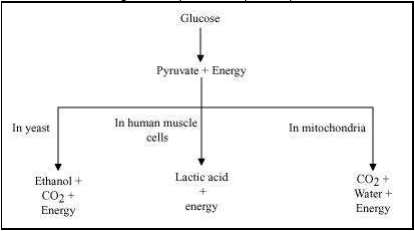
(N/A) Glucose is first broken down in the cell cytoplasm into a three-carbon molecule called pyruvate. This process is known as glycolysis.
Pyruvate is further broken down by different pathways to provide energy depending on the availability of oxygen:
$1$. In yeast (anaerobic respiration): Pyruvate is converted into ethanol,$CO_2$,and energy.
$2$. In human muscle cells (lack of oxygen): During vigorous exercise,pyruvate is converted into lactic acid and energy.
$3$. In mitochondria (aerobic respiration): Pyruvate is broken down in the presence of oxygen to produce $CO_2$,water,and a large amount of energy.
Pyruvate is further broken down by different pathways to provide energy depending on the availability of oxygen:
$1$. In yeast (anaerobic respiration): Pyruvate is converted into ethanol,$CO_2$,and energy.
$2$. In human muscle cells (lack of oxygen): During vigorous exercise,pyruvate is converted into lactic acid and energy.
$3$. In mitochondria (aerobic respiration): Pyruvate is broken down in the presence of oxygen to produce $CO_2$,water,and a large amount of energy.
0 likes
View Solution12
Difficult
How are oxygen and carbon dioxide transported in human beings?
Solution
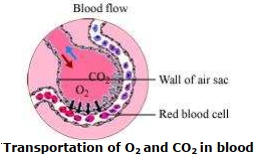
(N/A) In human beings,oxygen $(O_2)$ is transported by the respiratory pigment haemoglobin present in red blood cells. Haemoglobin has a very high affinity for $O_2$. It binds with $O_2$ molecules obtained from the lungs during breathing to form oxyhaemoglobin,making the blood oxygenated. This oxygenated blood is then pumped by the heart to all body cells for cellular respiration.
After delivering $O_2$ to the body cells,the blood collects carbon dioxide $(CO_2)$,which is a byproduct of cellular respiration. Since haemoglobin has a much lower affinity for $CO_2$ compared to $O_2$,most of the $CO_2$ is transported in a dissolved form in the blood plasma. This de-oxygenated blood carries $CO_2$ back to the lung alveoli,where it is released and exchanged for fresh $O_2$.
After delivering $O_2$ to the body cells,the blood collects carbon dioxide $(CO_2)$,which is a byproduct of cellular respiration. Since haemoglobin has a much lower affinity for $CO_2$ compared to $O_2$,most of the $CO_2$ is transported in a dissolved form in the blood plasma. This de-oxygenated blood carries $CO_2$ back to the lung alveoli,where it is released and exchanged for fresh $O_2$.
0 likes
View Solution13
Medium
How are the lungs designed in human beings to maximize the area for exchange of gases?
Solution
(N/A) The exchange of gases takes place between the blood of the capillaries that surround the alveoli and the gases present in the alveoli.
Thus,alveoli are the site for the exchange of gases.
The lungs get filled with air during the process of inhalation as the ribs are lifted up and the diaphragm is flattened.
The air that rushes inside the lungs fills the numerous alveoli present in the lungs.
Each lung contains $300-350$ million alveoli.
These numerous alveoli significantly increase the surface area for gaseous exchange,making the process of respiration more efficient.
Thus,alveoli are the site for the exchange of gases.
The lungs get filled with air during the process of inhalation as the ribs are lifted up and the diaphragm is flattened.
The air that rushes inside the lungs fills the numerous alveoli present in the lungs.
Each lung contains $300-350$ million alveoli.
These numerous alveoli significantly increase the surface area for gaseous exchange,making the process of respiration more efficient.
0 likes
View Solution14
Difficult
What are the components of the transport system in human beings? What are the functions of these components?
Solution
(N/A) The main components of the transport system in human beings are the heart, blood, and blood vessels.
$1$. $Heart$: It acts as a pumping organ that circulates oxygenated blood to all parts of the body and collects deoxygenated blood to send it to the lungs for oxygenation.
$2$. $Blood$: As a fluid connective tissue, it transports oxygen, nutrients, $CO_2$, and nitrogenous waste products throughout the body.
$3$. $Blood$ $vessels$: These include arteries, veins, and capillaries. They form a network of tubes that carry blood away from the heart to the tissues and return it back to the heart.
$1$. $Heart$: It acts as a pumping organ that circulates oxygenated blood to all parts of the body and collects deoxygenated blood to send it to the lungs for oxygenation.
$2$. $Blood$: As a fluid connective tissue, it transports oxygen, nutrients, $CO_2$, and nitrogenous waste products throughout the body.
$3$. $Blood$ $vessels$: These include arteries, veins, and capillaries. They form a network of tubes that carry blood away from the heart to the tissues and return it back to the heart.
0 likes
View Solution15
Medium
Why is it necessary to separate oxygenated and deoxygenated blood in mammals and birds?
Solution
(N/A) Warm-blooded animals,such as birds and mammals,maintain a constant body temperature by cooling themselves in hotter environments and warming their bodies in cooler environments.
This process requires a significant amount of energy,which is generated through cellular respiration.
To support high rates of cellular respiration,these animals require a constant and efficient supply of oxygen $(O_2)$.
Separating oxygenated and deoxygenated blood ensures that the circulatory system functions at maximum efficiency,preventing the mixing of blood and ensuring that oxygen-rich blood is delivered effectively to all tissues to meet their high energy demands for thermoregulation.
This process requires a significant amount of energy,which is generated through cellular respiration.
To support high rates of cellular respiration,these animals require a constant and efficient supply of oxygen $(O_2)$.
Separating oxygenated and deoxygenated blood ensures that the circulatory system functions at maximum efficiency,preventing the mixing of blood and ensuring that oxygen-rich blood is delivered effectively to all tissues to meet their high energy demands for thermoregulation.
0 likes
View Solution16
EasyMCQ
What are the components of the transport system in highly organised plants?
A
Xylem and Phloem
B
Stomata and Lenticels
C
Root hairs and Leaves
D
Chloroplasts and Mitochondria
Solution
(A) In highly organised plants, there are two different types of conducting tissues: $Xylem$ and $Phloem$.
$Xylem$ is responsible for the conduction of water and dissolved minerals absorbed from the soil by the roots to the various parts of the plant.
$Phloem$ is responsible for the translocation of food materials (synthesized during photosynthesis) from the leaves to other parts of the plant body.
$Xylem$ is responsible for the conduction of water and dissolved minerals absorbed from the soil by the roots to the various parts of the plant.
$Phloem$ is responsible for the translocation of food materials (synthesized during photosynthesis) from the leaves to other parts of the plant body.
0 likes
View Solution17
Medium
How are water and minerals transported in plants?
Solution
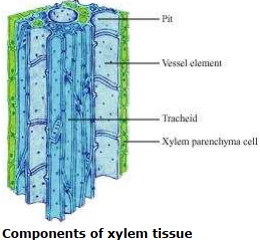
(N/A) The components of $xylem$ tissue (tracheids and vessels) of roots,stems,and leaves are interconnected to form a continuous system of water-conducting channels that reaches all parts of the plant.
Transpiration creates a suction pressure,as a result of which water is forced into the $xylem$ cells of the roots.
Then,there is a steady movement of water from the root $xylem$ to all the plant parts through the interconnected water-conducting channels.
Transpiration creates a suction pressure,as a result of which water is forced into the $xylem$ cells of the roots.
Then,there is a steady movement of water from the root $xylem$ to all the plant parts through the interconnected water-conducting channels.
0 likes
View Solution18
Medium
How is food transported in plants?
Solution
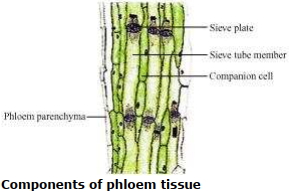
(N/A) In plants,food is transported through a specialized vascular tissue called phloem.
Phloem transports food materials,primarily sucrose,from the leaves (source) to different parts of the plant body (sink),such as roots,stems,and fruits.
The process of food transportation in phloem is known as translocation and is achieved by utilizing energy from $ATP$.
When sucrose is loaded into the phloem,it increases the osmotic pressure in the tissue,causing water to move into the phloem from adjacent xylem vessels.
This increase in pressure creates a pressure gradient that moves the food material in the phloem towards tissues with lower pressure.
This mechanism allows the plant to transport nutrients efficiently according to its metabolic needs.
Phloem transports food materials,primarily sucrose,from the leaves (source) to different parts of the plant body (sink),such as roots,stems,and fruits.
The process of food transportation in phloem is known as translocation and is achieved by utilizing energy from $ATP$.
When sucrose is loaded into the phloem,it increases the osmotic pressure in the tissue,causing water to move into the phloem from adjacent xylem vessels.
This increase in pressure creates a pressure gradient that moves the food material in the phloem towards tissues with lower pressure.
This mechanism allows the plant to transport nutrients efficiently according to its metabolic needs.
0 likes
View Solution19
Difficult
Describe the structure and functioning of nephrons.
Solution
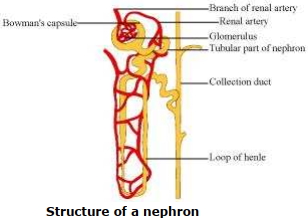
(N/A) Nephrons are the basic filtering units of kidneys. Each kidney possesses a large number of nephrons,approximately $1-1.5$ million. The main components of the nephron are the glomerulus,Bowman's capsule,and a long renal tubule.
Functioning of a nephron:
$1$. The blood enters the kidney through the renal artery,which branches into many capillaries associated with the glomerulus.
$2$. The water and solutes are transferred to the nephron at Bowman's capsule.
$3$. In the proximal tubule,some substances such as amino acids,glucose,and salts are selectively reabsorbed,and unwanted molecules are added to the urine.
$4$. The filtrate then moves down into the loop of Henle,where more water is absorbed.
$5$. From here,the filtrate moves upwards into the distal tubule and finally to the collecting duct. The collecting duct collects urine from many nephrons.
$6$. The urine formed in each kidney enters a long tube called the ureter. From the ureter,it is transported to the urinary bladder and then into the urethra.
Functioning of a nephron:
$1$. The blood enters the kidney through the renal artery,which branches into many capillaries associated with the glomerulus.
$2$. The water and solutes are transferred to the nephron at Bowman's capsule.
$3$. In the proximal tubule,some substances such as amino acids,glucose,and salts are selectively reabsorbed,and unwanted molecules are added to the urine.
$4$. The filtrate then moves down into the loop of Henle,where more water is absorbed.
$5$. From here,the filtrate moves upwards into the distal tubule and finally to the collecting duct. The collecting duct collects urine from many nephrons.
$6$. The urine formed in each kidney enters a long tube called the ureter. From the ureter,it is transported to the urinary bladder and then into the urethra.
1 likes
View Solution20
Easy
What are the methods used by plants to get rid of excretory products?
Solution
(N/A) Plants utilize several methods to eliminate excretory products:
$1$. Transpiration: Plants remove excess water through the process of transpiration.
$2$. Storage in Vacuoles: Many waste products are stored within the cell vacuoles.
$3$. Secretion: Waste materials like gums and resins are stored in old xylem tissues.
$4$. Shedding: Some waste products are stored in leaves,which eventually fall off the plant.
$1$. Transpiration: Plants remove excess water through the process of transpiration.
$2$. Storage in Vacuoles: Many waste products are stored within the cell vacuoles.
$3$. Secretion: Waste materials like gums and resins are stored in old xylem tissues.
$4$. Shedding: Some waste products are stored in leaves,which eventually fall off the plant.
0 likes
View Solution21
MediumMCQ
How is the amount of urine produced regulated?
A
By the amount of excess water in the body.
B
By the amount of dissolved wastes in the body.
C
By the secretion of Antidiuretic hormone $(ADH)$.
D
All of the above.
Solution
(D) The amount of urine produced is regulated by several factors:
$1$. The amount of excess water present in the body: If the body has excess water,more urine is produced.
$2$. The amount of dissolved wastes: The kidneys need water to excrete these wastes.
$3$. Hormonal control: The Antidiuretic hormone $(ADH)$,also known as vasopressin,is secreted by the pituitary gland. It increases the reabsorption of water in the kidney tubules,thereby reducing the volume of urine produced.
$4$. Habitat: Organisms living in aquatic environments generally produce more dilute urine compared to those in terrestrial environments.
$1$. The amount of excess water present in the body: If the body has excess water,more urine is produced.
$2$. The amount of dissolved wastes: The kidneys need water to excrete these wastes.
$3$. Hormonal control: The Antidiuretic hormone $(ADH)$,also known as vasopressin,is secreted by the pituitary gland. It increases the reabsorption of water in the kidney tubules,thereby reducing the volume of urine produced.
$4$. Habitat: Organisms living in aquatic environments generally produce more dilute urine compared to those in terrestrial environments.
0 likes
View Solution22
EasyMCQ
The kidneys in human beings are a part of the system for
A
nutrition.
B
excretion.
C
respiration.
D
transportation.
Solution
(B) In human beings,the kidneys are the primary organs of the excretory system. They function to filter the blood,remove nitrogenous waste products like urea,and regulate water and electrolyte balance,which is the process of excretion.
0 likes
View Solution23
EasyMCQ
The $xylem$ in plants is responsible for:
A
transport of amino acids.
B
transport of food.
C
transport of water.
D
transport of oxygen.
Solution
(C) In plants,the $xylem$ tissue is a complex permanent tissue that is primarily responsible for the upward conduction of water and dissolved minerals from the roots to the stem and leaves. This process is known as the ascent of sap.
0 likes
View Solution24
MediumMCQ
The autotrophic mode of nutrition requires
A
carbon dioxide and water
B
chlorophyll
C
sunlight
D
all of the above
Solution
(D) The autotrophic mode of nutrition,specifically photosynthesis,requires carbon dioxide $(CO_2)$,water $(H_2O)$,chlorophyll,and sunlight to synthesize glucose $(C_6H_{12}O_6)$.
All the listed components are essential for the process to occur.
All the listed components are essential for the process to occur.
0 likes
View Solution25
MediumMCQ
The breakdown of pyruvate to give carbon dioxide,water and energy takes place in
A
mitochondria
B
cytoplasm
C
chloroplast
D
nucleus
Solution
(A) The breakdown of pyruvate into carbon dioxide $(CO_2)$,water $(H_2O)$,and energy $(ATP)$ occurs during aerobic respiration. This process takes place in the mitochondria of the cell,where the pyruvate produced in the cytoplasm enters the Krebs cycle and the electron transport chain to release energy.
0 likes
View Solution26
Easy
How are fats digested in our bodies? Where does this process take place?
Solution
(N/A) Fats are present in the form of large globules in the small intestine. The small intestine receives secretions in the form of bile juice from the liver and pancreatic juice from the pancreas. The bile salts (from the liver) break down the large fat globules into smaller globules,increasing the surface area for the action of enzymes. This process is known as the emulsification of fats. Subsequently,the enzyme lipase (present in pancreatic juice) acts on these emulsified fats to break them down into fatty acids and glycerol. This entire process takes place in the small intestine.
0 likes
View Solution27
EasyMCQ
What is the role of saliva in the digestion of food?
A
It helps in the mechanical breakdown of food.
B
It contains enzymes that break down proteins.
C
It moistens food and contains salivary amylase to break down starch into sugar.
D
It kills all bacteria present in the food.
Solution
(C) Saliva is secreted by the salivary glands located in the mouth.
It performs two primary functions:
$1$. It moistens the food,which helps in the formation of a food bolus for easy swallowing.
$2$. It contains an enzyme called salivary amylase,which initiates the chemical digestion of carbohydrates by breaking down starch into simpler sugars like maltose.
It performs two primary functions:
$1$. It moistens the food,which helps in the formation of a food bolus for easy swallowing.
$2$. It contains an enzyme called salivary amylase,which initiates the chemical digestion of carbohydrates by breaking down starch into simpler sugars like maltose.
0 likes
View Solution28
Medium
What are the necessary conditions for autotrophic nutrition and what are its byproducts?
Solution
(N/A) Autotrophic nutrition occurs through the process of photosynthesis.
The necessary conditions for autotrophic nutrition are:
$1$. Presence of chlorophyll pigment.
$2$. Availability of sunlight.
$3$. Availability of carbon dioxide $(CO_2)$.
$4$. Availability of water $(H_2O)$.
The byproducts of photosynthesis are carbohydrates (glucose,$C_6H_{12}O_6$) and oxygen $(O_2)$.
The chemical equation for the process is:
$6CO_2 + 6H_2O \xrightarrow[\text{Chlorophyll}]{\text{Sunlight}} C_6H_{12}O_6 + 6O_2$
The necessary conditions for autotrophic nutrition are:
$1$. Presence of chlorophyll pigment.
$2$. Availability of sunlight.
$3$. Availability of carbon dioxide $(CO_2)$.
$4$. Availability of water $(H_2O)$.
The byproducts of photosynthesis are carbohydrates (glucose,$C_6H_{12}O_6$) and oxygen $(O_2)$.
The chemical equation for the process is:
$6CO_2 + 6H_2O \xrightarrow[\text{Chlorophyll}]{\text{Sunlight}} C_6H_{12}O_6 + 6O_2$
2 likes
View Solution29
Medium
What are the differences between aerobic and anaerobic respiration? Name some organisms that use the anaerobic mode of respiration.
Solution
(N/A)
Organisms that use anaerobic respiration include yeasts,certain bacteria,parasitic worms (like Ascaris),and human muscle cells during intense physical activity.
| Aerobic Respiration | Anaerobic Respiration |
|---|---|
| $1.$ Occurs in the presence of $O_2$. | $1.$ Occurs in the absence of $O_2$. |
| $2.$ Complete breakdown of glucose occurs. | $2.$ Incomplete breakdown of glucose occurs. |
| $3.$ Occurs in the cytoplasm and mitochondria. | $3.$ Occurs only in the cytoplasm. |
| $4.$ End products are $CO_2$ and $H_2O$. | $4.$ End products are ethanol,lactic acid,or $CO_2$. |
| $5.$ Yields a large amount of energy ($36-38$ $ATP$). | $5.$ Yields a small amount of energy ($2$ $ATP$). |
Organisms that use anaerobic respiration include yeasts,certain bacteria,parasitic worms (like Ascaris),and human muscle cells during intense physical activity.
1 likes
View Solution30
Medium
How are the alveoli designed to maximise the exchange of gases?
Solution
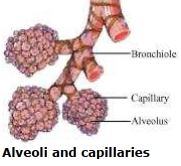
(N/A) The alveoli are small,balloon-like structures present in the lungs.
The walls of the alveoli consist of an extensive network of blood vessels (capillaries).
Each lung contains $300-350$ million alveoli,making a total of approximately $700$ million in both lungs.
When spread out,the total alveolar surface area covers about $80\, m^2$.
This large surface area and the thin,moist walls facilitate efficient gaseous exchange.
The walls of the alveoli consist of an extensive network of blood vessels (capillaries).
Each lung contains $300-350$ million alveoli,making a total of approximately $700$ million in both lungs.
When spread out,the total alveolar surface area covers about $80\, m^2$.
This large surface area and the thin,moist walls facilitate efficient gaseous exchange.
1 likes
View Solution31
DifficultMCQ
What would be the consequences of a deficiency of haemoglobin in our bodies?
A
Increased oxygen transport
B
Reduced oxygen-carrying capacity of blood
C
Enhanced cellular respiration
D
No effect on the body
Solution
(B) Haemoglobin is the respiratory pigment responsible for transporting oxygen to body cells for cellular respiration.
Deficiency of haemoglobin reduces the oxygen-carrying capacity of the blood.
This leads to an insufficient supply of oxygen to the body cells,which can cause fatigue,weakness,and a condition known as anaemia.
Deficiency of haemoglobin reduces the oxygen-carrying capacity of the blood.
This leads to an insufficient supply of oxygen to the body cells,which can cause fatigue,weakness,and a condition known as anaemia.
0 likes
View Solution32
Medium
Describe double circulation of blood in human beings. Why is it necessary?
Solution
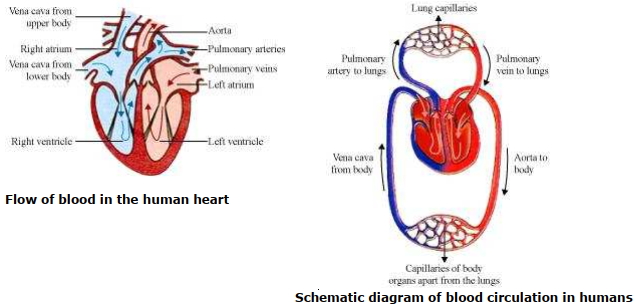
(N/A) The human heart is divided into four chambers: the right atrium,the right ventricle,the left atrium,and the left ventricle.
Flow of blood in the heart:
The heart has superior and inferior vena cava,which carry deoxygenated blood from the upper and lower regions of the body respectively and supply this deoxygenated blood to the right atrium of the heart.
The right atrium then contracts and passes the deoxygenated blood to the right ventricle through an atrioventricular aperture.
Then,the right ventricle contracts and pumps the deoxygenated blood into the two pulmonary arteries,which carry it to the lungs where the blood becomes oxygenated. From the lungs,the pulmonary veins transport the oxygenated blood to the left atrium of the heart.
Then,the left atrium contracts and the oxygenated blood enters the left ventricle through the atrioventricular aperture.
The blood then passes into the aorta from the left ventricle. The aorta gives rise to many arteries that distribute the oxygenated blood to all regions of the body.
Therefore,the blood passes twice through the heart in one complete cycle. This is known as double circulation.
Importance of double circulation:
The separation of oxygenated and deoxygenated blood allows for a more efficient supply of oxygen to the body cells. This efficient system of oxygen supply is essential for warm-blooded animals like human beings.
Warm-blooded animals must maintain a constant body temperature by regulating heat. Hence,they require more $O_2$ for cellular respiration to produce the energy needed to maintain their body temperature. Thus,the circulatory system of humans is highly efficient due to the double circulatory heart.
Flow of blood in the heart:
The heart has superior and inferior vena cava,which carry deoxygenated blood from the upper and lower regions of the body respectively and supply this deoxygenated blood to the right atrium of the heart.
The right atrium then contracts and passes the deoxygenated blood to the right ventricle through an atrioventricular aperture.
Then,the right ventricle contracts and pumps the deoxygenated blood into the two pulmonary arteries,which carry it to the lungs where the blood becomes oxygenated. From the lungs,the pulmonary veins transport the oxygenated blood to the left atrium of the heart.
Then,the left atrium contracts and the oxygenated blood enters the left ventricle through the atrioventricular aperture.
The blood then passes into the aorta from the left ventricle. The aorta gives rise to many arteries that distribute the oxygenated blood to all regions of the body.
Therefore,the blood passes twice through the heart in one complete cycle. This is known as double circulation.
Importance of double circulation:
The separation of oxygenated and deoxygenated blood allows for a more efficient supply of oxygen to the body cells. This efficient system of oxygen supply is essential for warm-blooded animals like human beings.
Warm-blooded animals must maintain a constant body temperature by regulating heat. Hence,they require more $O_2$ for cellular respiration to produce the energy needed to maintain their body temperature. Thus,the circulatory system of humans is highly efficient due to the double circulatory heart.
3 likes
View Solution33
Easy
What are the differences between the transport of materials in xylem and phloem?
Solution
(N/A)
| Transport of materials in xylem | Transport of materials in phloem |
|---|---|
| $(i)$ Xylem tissue helps in the transport of water and minerals. | $(i)$ Phloem tissue helps in the transport of food. |
| $(ii)$ Water is transported upwards from roots to all other plant parts. | $(ii)$ Food is transported in both upward and downward directions. |
| $(iii)$ Transport in xylem occurs with the help of simple physical forces such as transpiration pull. | $(iii)$ Transport of food in phloem requires energy in the form of $ATP$. |
0 likes
View Solution34
Medium
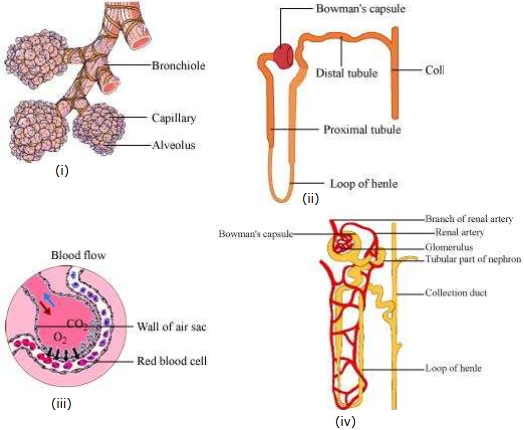
Compare the functioning of alveoli in the lungs and nephrons in the kidneys with respect to their structure and functioning.
Solution
(N/A)
| Alveoli | Nephron |
|---|---|
| < strong>Structure | < strong>Structure |
| $(i)$ Alveoli are tiny balloon-like structures present inside the lungs. | $(i)$ Nephrons are tubular structures present inside the kidneys. |
| $(ii)$ The walls of the alveoli are one cell thick and contain an extensive network of blood capillaries. | $(ii)$ Nephrons consist of a glomerulus,Bowman's capsule,and a long renal tubule. They also contain a cluster of thin-walled capillaries. |
| < strong>Function | < strong>Function |
| $(i)$ The exchange of $O_2$ and $CO_2$ takes place between the blood of the capillaries surrounding the alveoli and the gases present in the alveoli. | $(i)$ Blood enters the kidneys through the renal artery,which branches into many capillaries in the glomerulus. Water and solutes are transferred to the nephron at Bowman's capsule. The filtrate then moves through the proximal tubule,the loop of Henle,the distal tubule,and finally into the collecting duct. During this process,substances like glucose,amino acids,and water are selectively reabsorbed. |
| $(ii)$ Alveoli are the primary site of gaseous exchange. | $(ii)$ Nephrons are the basic filtration units of the kidney. |
4 likes
View SolutionLife Processes — Textbook - Life Processes · Frequently Asked Questions
1Are these Life Processes questions useful for JEE and NEET?
Yes. All questions in this section are mapped to JEE Main and NEET exam patterns. Previous year questions from JEE Main, NEET, GUJCET and state-level exams are included with full solutions.
2Can I switch to Hindi or Gujarati for these questions?
Yes. Use the language tabs in the hero section or the sidebar to view the same questions and solutions in English, Hindi or Gujarati.
3How do I generate a question paper from this subtopic?
Use the Vedclass Exam Paper Generator — select the chapter and subtopic, set difficulty, and generate Sets A, B, C, D automatically. First 3 chapters of every subject are free.
Vedclass Products
For Students
Vedclass Test Series
Mock tests in real JEE/NEET style with performance analysis. 5-day free trial.
Start Free TrialFor Teachers
Exam Paper Generator
Generate Set A/B/C/D papers from this chapter in 2 minutes. 3 chapters free.
Try FreeFor Institutes
Online Exam Module
Live online exams with unlimited students, 360° analytics & white-label branding.
See DemoFor Teachers & Institutes
Generate a Life Processes Exam Paper in 2 Minutes
Select subtopic & difficulty — Sets A, B, C, D auto-generated with No Repeat logic.
First 3 chapters of every subject are free — no payment required.