
A English
Mix Examples - Life Processes Questions in English
Class 10 Science · Life Processes · Mix Examples - Life Processes
205+
Questions
English
Language
100%
With Solutions
Showing 50 of 205 questions in English
51
DifficultMCQ
What will happen if mucus is not secreted by the gastric glands?
A
The stomach will not be able to digest food.
B
The inner lining of the stomach will be damaged by hydrochloric acid.
C
The stomach will produce more enzymes.
D
The stomach will stop producing hydrochloric acid.
Solution
(B) Gastric glands in the stomach secrete hydrochloric acid $(HCl)$,the enzyme pepsin,and mucus.
Mucus plays a crucial role in protecting the inner lining (mucosa) of the stomach from the corrosive action of $HCl$ and the digestive action of pepsin.
If mucus is not secreted,the protective barrier is lost,which leads to the erosion of the stomach lining.
This condition causes severe acidity,inflammation,and eventually leads to the formation of peptic ulcers.
Mucus plays a crucial role in protecting the inner lining (mucosa) of the stomach from the corrosive action of $HCl$ and the digestive action of pepsin.
If mucus is not secreted,the protective barrier is lost,which leads to the erosion of the stomach lining.
This condition causes severe acidity,inflammation,and eventually leads to the formation of peptic ulcers.
0 likes
View Solution52
MediumMCQ
What is the significance of emulsification of fats?
A
It converts fats into amino acids.
B
It increases the surface area of fat globules for enzyme action.
C
It helps in the absorption of proteins.
D
It directly converts fats into energy.
Solution
(B) Fats are present in food in the form of large globules,which makes it difficult for enzymes to act on them.
Bile salts present in bile break these large globules down mechanically into smaller globules.
This process is known as emulsification.
By breaking fats into smaller droplets,the surface area available for the action of fat-digesting enzymes (like lipase) is significantly increased,thereby enhancing the efficiency of fat digestion.
Bile salts present in bile break these large globules down mechanically into smaller globules.
This process is known as emulsification.
By breaking fats into smaller droplets,the surface area available for the action of fat-digesting enzymes (like lipase) is significantly increased,thereby enhancing the efficiency of fat digestion.
0 likes
View Solution53
EasyMCQ
What causes the movement of food inside the alimentary canal?
A
Peristalsis
B
Digestion
C
Absorption
D
Assimilation
Solution
(A) The wall of the alimentary canal contains layers of smooth muscles.
These muscles undergo rhythmic contraction and relaxation,which pushes the food forward through the digestive tract.
This wave-like movement is known as peristalsis,and it occurs throughout the entire length of the alimentary canal.
These muscles undergo rhythmic contraction and relaxation,which pushes the food forward through the digestive tract.
This wave-like movement is known as peristalsis,and it occurs throughout the entire length of the alimentary canal.
0 likes
View Solution54
MediumMCQ
Why does absorption of digested food occur mainly in the small intestine?
A
It is the longest part of the alimentary canal.
B
It has a large surface area due to the presence of villi.
C
It is connected to the liver and pancreas.
D
It secretes digestive enzymes.
Solution
(B) Maximum absorption occurs in the small intestine because:
$(a)$ Digestion is completed in the small intestine.
$(b)$ The inner lining of the small intestine is provided with villi,which significantly increases the surface area for absorption.
$(c)$ The wall of the intestine is richly supplied with blood vessels,which transport the absorbed food to every cell of the body.
$(a)$ Digestion is completed in the small intestine.
$(b)$ The inner lining of the small intestine is provided with villi,which significantly increases the surface area for absorption.
$(c)$ The wall of the intestine is richly supplied with blood vessels,which transport the absorbed food to every cell of the body.
0 likes
View Solution55
Easy
Match Group $(A)$ with Group $(B)$:
| Group $(A)$ | Group $(B)$ |
| $(a)$ Autotrophic nutrition | $(i)$ Leech |
| $(b)$ Heterotrophic nutrition | $(ii)$ Paramecium |
| $(c)$ Parasitic nutrition | $(iii)$ Deer |
| $(d)$ Digestion in food vacuoles | $(iv)$ Green plant |
Solution
$(A-IV, B-III, C-I, D-II)$ Autotrophic nutrition is found in organisms that synthesize their own food, such as $(iv)$ Green plants.
$(b)$ Heterotrophic nutrition involves organisms that depend on others for food, such as $(iii)$ Deer (herbivore).
$(c)$ Parasitic nutrition involves organisms that live on or inside a host to derive nutrients, such as $(i)$ Leech.
$(d)$ Digestion in food vacuoles is a characteristic feature of unicellular organisms like $(ii)$ Paramecium.
Therefore, the correct matching is: $(a-iv, b-iii, c-i, d-ii)$.
$(b)$ Heterotrophic nutrition involves organisms that depend on others for food, such as $(iii)$ Deer (herbivore).
$(c)$ Parasitic nutrition involves organisms that live on or inside a host to derive nutrients, such as $(i)$ Leech.
$(d)$ Digestion in food vacuoles is a characteristic feature of unicellular organisms like $(ii)$ Paramecium.
Therefore, the correct matching is: $(a-iv, b-iii, c-i, d-ii)$.
0 likes
View Solution56
EasyMCQ
Why is the rate of breathing in aquatic organisms much faster than in terrestrial organisms?
A
Aquatic organisms have smaller lungs.
B
The amount of dissolved oxygen in water is much lower than the amount of oxygen in the air.
C
Aquatic organisms are more active than terrestrial organisms.
D
Aquatic organisms need more energy for swimming.
Solution
(B) Aquatic organisms,such as fishes,obtain oxygen from water in a dissolved state through their gills.
Since the concentration of dissolved oxygen in water is significantly lower compared to the concentration of oxygen in the atmosphere,aquatic organisms must breathe much faster to extract sufficient oxygen for their metabolic needs.
In contrast,terrestrial organisms have easy access to the high concentration of oxygen present in the air,allowing for a slower rate of breathing.
Since the concentration of dissolved oxygen in water is significantly lower compared to the concentration of oxygen in the atmosphere,aquatic organisms must breathe much faster to extract sufficient oxygen for their metabolic needs.
In contrast,terrestrial organisms have easy access to the high concentration of oxygen present in the air,allowing for a slower rate of breathing.
0 likes
View Solution57
Easy
Why is blood circulation in the human heart called double circulation?
Solution
(N/A) The blood circulation in the human heart is called double circulation because the blood passes through the heart twice in one complete cycle of the body.
First,deoxygenated blood enters the right half of the heart to be pumped to the lungs for oxygenation.
Second,oxygenated blood returns to the left half of the heart to be pumped to the rest of the body.
This separation ensures that oxygenated and deoxygenated blood do not mix,making the process highly efficient.
First,deoxygenated blood enters the right half of the heart to be pumped to the lungs for oxygenation.
Second,oxygenated blood returns to the left half of the heart to be pumped to the rest of the body.
This separation ensures that oxygenated and deoxygenated blood do not mix,making the process highly efficient.
0 likes
View Solution58
MediumMCQ
What is the advantage of having a four-chambered heart?
A
It allows for the mixing of oxygenated and deoxygenated blood.
B
It prevents the mixing of oxygenated and deoxygenated blood,ensuring efficient oxygen supply.
C
It reduces the energy requirement of the body.
D
It simplifies the circulatory system.
Solution
(B) In a four-chambered heart,the left half is completely separated from the right half by septa.
This structural separation prevents oxygenated and deoxygenated blood from mixing.
Consequently,this allows for a highly efficient supply of oxygenated blood to all parts of the body.
This adaptation is particularly beneficial for endothermic animals like birds and mammals,which have high energy requirements to maintain their body temperature.
This structural separation prevents oxygenated and deoxygenated blood from mixing.
Consequently,this allows for a highly efficient supply of oxygenated blood to all parts of the body.
This adaptation is particularly beneficial for endothermic animals like birds and mammals,which have high energy requirements to maintain their body temperature.
0 likes
View Solution59
Medium
Mention the major events during photosynthesis.
Solution
(N/A) The major events during photosynthesis are:
$(a)$ Absorption of light energy by chlorophyll.
$(b)$ Conversion of light energy into chemical energy and splitting of water molecules $(H_2O)$ into hydrogen $(H_2)$,oxygen $(O_2)$,and electrons $(e^-)$.
$(c)$ Reduction of carbon dioxide $(CO_2)$ to carbohydrates.
$(a)$ Absorption of light energy by chlorophyll.
$(b)$ Conversion of light energy into chemical energy and splitting of water molecules $(H_2O)$ into hydrogen $(H_2)$,oxygen $(O_2)$,and electrons $(e^-)$.
$(c)$ Reduction of carbon dioxide $(CO_2)$ to carbohydrates.
0 likes
View Solution60
DifficultMCQ
In each of the following situations,what happens to the rate of photosynthesis?
$(a)$ Cloudy days
$(b)$ No rainfall in the area
$(c)$ Good manuring in the area
$(d)$ Stomata get blocked due to dust
$(a)$ Cloudy days
$(b)$ No rainfall in the area
$(c)$ Good manuring in the area
$(d)$ Stomata get blocked due to dust
A
Cloudy days
B
No rainfall in the area
C
Good manuring in the area
D
Stomata get blocked due to dust
Solution
(A-D) Cloudy days: The rate of photosynthesis decreases because light intensity is a limiting factor.
$(b)$ No rainfall in the area: The rate of photosynthesis decreases because water is a raw material for photosynthesis,and its scarcity leads to stomatal closure.
$(c)$ Good manuring in the area: The rate of photosynthesis increases because manure provides essential minerals like magnesium and nitrogen,which are necessary for chlorophyll synthesis and plant growth.
$(d)$ Stomata get blocked due to dust: The rate of photosynthesis decreases because the blockage prevents the exchange of gases ($CO_2$ and $O_2$),which is essential for the process.
$(b)$ No rainfall in the area: The rate of photosynthesis decreases because water is a raw material for photosynthesis,and its scarcity leads to stomatal closure.
$(c)$ Good manuring in the area: The rate of photosynthesis increases because manure provides essential minerals like magnesium and nitrogen,which are necessary for chlorophyll synthesis and plant growth.
$(d)$ Stomata get blocked due to dust: The rate of photosynthesis decreases because the blockage prevents the exchange of gases ($CO_2$ and $O_2$),which is essential for the process.
0 likes
View Solution61
Easy
Name the energy currency in the living organisms. When and where is it produced?
Solution
(N/A) The energy currency in living organisms is Adenosine Triphosphate $(ATP)$.
It is produced during the process of cellular respiration in the mitochondria of cells.
In plants,it is also produced during the light-dependent reactions of photosynthesis within the chloroplasts.
It is produced during the process of cellular respiration in the mitochondria of cells.
In plants,it is also produced during the light-dependent reactions of photosynthesis within the chloroplasts.
0 likes
View Solution62
EasyMCQ
What is common for $Cuscuta$,ticks,and leeches?
A
They are all autotrophs.
B
They are all parasites.
C
They are all saprophytes.
D
They are all decomposers.
Solution
(B) $Cuscuta$ (dodder) is a parasitic plant that derives nutrients from other plants.
Ticks are ectoparasites that feed on the blood of animals.
Leeches are also ectoparasites that feed on the blood of hosts.
Therefore,the common characteristic among them is that they are all parasites,as they derive nutrition from other living organisms (hosts) without killing them immediately.
Ticks are ectoparasites that feed on the blood of animals.
Leeches are also ectoparasites that feed on the blood of hosts.
Therefore,the common characteristic among them is that they are all parasites,as they derive nutrition from other living organisms (hosts) without killing them immediately.
0 likes
View Solution63
Easy
Explain the role of the mouth in the digestion of food.
Solution
(N/A) The teeth crush food into small pieces,increasing the surface area for enzyme action.
$(b)$ Saliva is secreted by the salivary glands,which moistens the food and contains the enzyme salivary amylase.
$(c)$ Salivary amylase breaks down complex starch into simpler sugars (maltose).
$(d)$ The tongue helps in the thorough mixing of food with saliva and facilitates swallowing by forming a food bolus.
$(b)$ Saliva is secreted by the salivary glands,which moistens the food and contains the enzyme salivary amylase.
$(c)$ Salivary amylase breaks down complex starch into simpler sugars (maltose).
$(d)$ The tongue helps in the thorough mixing of food with saliva and facilitates swallowing by forming a food bolus.
0 likes
View Solution64
MediumMCQ
What are the functions of gastric glands present in the wall of the stomach?
A
Secretion of hydrochloric acid,pepsin,and mucus.
B
Secretion of bile and pancreatic juice.
C
Absorption of water and nutrients.
D
Production of insulin and glucagon.
Solution
(A) The gastric glands present in the wall of the stomach perform the following functions:
$(a)$ Secretion of Hydrochloric acid $(HCl)$: It creates an acidic medium which facilitates the action of the enzyme pepsin and kills bacteria present in the food.
$(b)$ Secretion of Pepsin: It is a protein-digesting enzyme that breaks down complex proteins into simpler peptides.
$(c)$ Secretion of Mucus: It protects the inner lining of the stomach from the corrosive action of the hydrochloric acid under normal conditions.
$(a)$ Secretion of Hydrochloric acid $(HCl)$: It creates an acidic medium which facilitates the action of the enzyme pepsin and kills bacteria present in the food.
$(b)$ Secretion of Pepsin: It is a protein-digesting enzyme that breaks down complex proteins into simpler peptides.
$(c)$ Secretion of Mucus: It protects the inner lining of the stomach from the corrosive action of the hydrochloric acid under normal conditions.
0 likes
View Solution65
EasyMCQ
Match the terms in Column $(A)$ with those in Column $(B)$:
| Column $(A)$ | Column $(B)$ |
| $(a)$ Trypsin | $(i)$ Pancreas |
| $(b)$ Amylase | $(ii)$ Liver |
| $(c)$ Bile | $(iii)$ Gastric glands |
| $(d)$ Pepsin | $(iv)$ Saliva |
A
$(a)-(i), (b)-(iv), (c)-(ii), (d)-(iii)$
B
$(a)-(ii), (b)-(iv), (c)-(i), (d)-(iii)$
C
$(a)-(i), (b)-(ii), (c)-(iv), (d)-(iii)$
D
$(a)-(iv), (b)-(i), (c)-(ii), (d)-(iii)$
Solution
(A) The correct matching is as follows:
$(a)$ Trypsin is a protein-digesting enzyme secreted by the $(i)$ Pancreas.
$(b)$ Amylase is an enzyme found in $(iv)$ Saliva that breaks down starch into sugars.
$(c)$ Bile is a digestive juice produced by the $(ii)$ Liver.
$(d)$ Pepsin is a protein-digesting enzyme secreted by the $(iii)$ Gastric glands in the stomach.
Therefore, the correct sequence is $(a)-(i), (b)-(iv), (c)-(ii), (d)-(iii)$.
$(a)$ Trypsin is a protein-digesting enzyme secreted by the $(i)$ Pancreas.
$(b)$ Amylase is an enzyme found in $(iv)$ Saliva that breaks down starch into sugars.
$(c)$ Bile is a digestive juice produced by the $(ii)$ Liver.
$(d)$ Pepsin is a protein-digesting enzyme secreted by the $(iii)$ Gastric glands in the stomach.
Therefore, the correct sequence is $(a)-(i), (b)-(iv), (c)-(ii), (d)-(iii)$.
0 likes
View Solution66
Easy
Name the correct substrates for the following enzymes:
$(a)$ Trypsin
$(b)$ Amylase
$(c)$ Pepsin
$(d)$ Lipase
$(a)$ Trypsin
$(b)$ Amylase
$(c)$ Pepsin
$(d)$ Lipase
Solution
(N/A) Trypsin acts on Proteins.
$(b)$ Amylase acts on Starch (carbohydrates).
$(c)$ Pepsin acts on Proteins.
$(d)$ Lipase acts on Fats (lipids).
$(b)$ Amylase acts on Starch (carbohydrates).
$(c)$ Pepsin acts on Proteins.
$(d)$ Lipase acts on Fats (lipids).
0 likes
View Solution67
MediumMCQ
Why do veins have thin walls as compared to arteries?
A
To allow for faster blood flow.
B
Because blood in veins is not under high pressure.
C
To store more blood.
D
To facilitate gas exchange.
Solution
(B) Arteries carry blood from the heart to various organs of the body under high pressure,which is why they have thick and elastic walls.
Veins collect blood from different organs and return it to the heart.
Since the blood in veins is no longer under high pressure,their walls are thin.
Additionally,veins contain valves to ensure that blood flows in only one direction.
Veins collect blood from different organs and return it to the heart.
Since the blood in veins is no longer under high pressure,their walls are thin.
Additionally,veins contain valves to ensure that blood flows in only one direction.
0 likes
View Solution68
EasyMCQ
What will happen if platelets were absent in the blood?
A
Blood clotting will not occur.
B
Oxygen transport will stop.
C
Immunity will decrease.
D
Digestion will be affected.
Solution
(A) Platelets are specialized blood cells that play a crucial role in the process of blood coagulation or clotting.
When an injury occurs,platelets aggregate at the site of the wound to form a plug,which prevents excessive blood loss.
If platelets were absent in the blood,the body would be unable to form these clots,leading to continuous bleeding even from minor injuries,which could be life-threatening.
When an injury occurs,platelets aggregate at the site of the wound to form a plug,which prevents excessive blood loss.
If platelets were absent in the blood,the body would be unable to form these clots,leading to continuous bleeding even from minor injuries,which could be life-threatening.
0 likes
View Solution69
Easy
Plants have low energy needs as compared to animals. Explain.
Solution
(N/A) Plants are stationary organisms and do not move from one place to another.
In a large plant body,a significant proportion of cells are dead,such as those found in sclerenchyma tissue,which provide structural support without requiring metabolic maintenance.
In contrast,animals are mobile and possess a higher proportion of living,metabolically active cells that require constant energy for movement,physiological processes,and maintaining body temperature.
Therefore,plants have lower energy requirements compared to animals.
In a large plant body,a significant proportion of cells are dead,such as those found in sclerenchyma tissue,which provide structural support without requiring metabolic maintenance.
In contrast,animals are mobile and possess a higher proportion of living,metabolically active cells that require constant energy for movement,physiological processes,and maintaining body temperature.
Therefore,plants have lower energy requirements compared to animals.
0 likes
View Solution70
Easy
Why and how does water enter continuously into the root xylem?
Solution
(N/A) The cells of the root are in close contact with the soil and actively take up mineral ions from the soil.
This accumulation of ions increases the solute concentration inside the root cells,which in turn increases the osmotic pressure.
Due to this difference in osmotic pressure,water moves from the soil into the root cells by osmosis.
This process creates a steady movement of water,which then enters the root xylem and is transported upwards.
This accumulation of ions increases the solute concentration inside the root cells,which in turn increases the osmotic pressure.
Due to this difference in osmotic pressure,water moves from the soil into the root cells by osmosis.
This process creates a steady movement of water,which then enters the root xylem and is transported upwards.
0 likes
View Solution71
EasyMCQ
Why is transpiration important for plants?
A
It helps in the absorption and upward movement of water and minerals.
B
It helps in the synthesis of food.
C
It helps in the excretion of waste products.
D
It helps in the storage of water.
Solution
(A) Transpiration is important for plants due to the following reasons:
$(a)$ It creates a transpiration pull that helps in the absorption and upward movement of water and dissolved minerals from the roots to the leaves.
$(b)$ It helps in regulating the temperature of the plant by cooling the plant parts through the evaporation of water,thereby preventing them from overheating.
$(a)$ It creates a transpiration pull that helps in the absorption and upward movement of water and dissolved minerals from the roots to the leaves.
$(b)$ It helps in regulating the temperature of the plant by cooling the plant parts through the evaporation of water,thereby preventing them from overheating.
0 likes
View Solution72
Easy
How do leaves of plants help in excretion?
Solution
(N/A) Many plants store waste materials in the vacuoles of mesophyll cells and epidermal cells.
When old leaves fall,the waste materials are excreted along with the leaves.
When old leaves fall,the waste materials are excreted along with the leaves.
0 likes
View Solution73
EasyMCQ
Explain the process of nutrition in Amoeba.
A
Holozoic nutrition involving ingestion, digestion, absorption, assimilation, and egestion.
B
Autotrophic nutrition using chlorophyll.
C
Saprophytic nutrition by secreting enzymes outside the body.
D
Parasitic nutrition by living inside a host.
Solution
(A) The process of nutrition in $Amoeba$ is known as holozoic nutrition.
$1$. Ingestion: $Amoeba$ ingests food by forming finger-like projections called $pseudopodia$ around the food particle, which fuse to form a $food \, vacuole$.
$2$. Digestion: Inside the $food \, vacuole$, complex substances are broken down into simpler substances by digestive enzymes.
$3$. Absorption and Assimilation: These simpler substances diffuse into the $cytoplasm$ and are used for energy and growth.
$4$. Egestion: The undigested waste material is moved to the surface of the cell and thrown out of the body.
$1$. Ingestion: $Amoeba$ ingests food by forming finger-like projections called $pseudopodia$ around the food particle, which fuse to form a $food \, vacuole$.
$2$. Digestion: Inside the $food \, vacuole$, complex substances are broken down into simpler substances by digestive enzymes.
$3$. Absorption and Assimilation: These simpler substances diffuse into the $cytoplasm$ and are used for energy and growth.
$4$. Egestion: The undigested waste material is moved to the surface of the cell and thrown out of the body.
0 likes
View Solution74
Medium
Describe the alimentary canal of man.
Solution
(N/A) The alimentary canal of man is a long,muscular tube that extends from the mouth to the anus. It consists of the following parts:
$1$. Mouth and Buccal Cavity: The process of digestion begins here with the ingestion of food,mastication by teeth,and mixing with saliva.
$2$. Oesophagus: $A$ muscular tube that transports food from the pharynx to the stomach through peristaltic movements.
$3$. Stomach: $A$ $J$-shaped organ where food is mixed with gastric juices containing $HCl$,pepsin,and mucus for protein digestion.
$4$. Small Intestine: The primary site for complete digestion and absorption of nutrients. It is divided into the duodenum,jejunum,and ileum.
$5$. Large Intestine: It absorbs water and electrolytes from the undigested food and forms feces,which are stored in the rectum and eliminated through the anus.
$1$. Mouth and Buccal Cavity: The process of digestion begins here with the ingestion of food,mastication by teeth,and mixing with saliva.
$2$. Oesophagus: $A$ muscular tube that transports food from the pharynx to the stomach through peristaltic movements.
$3$. Stomach: $A$ $J$-shaped organ where food is mixed with gastric juices containing $HCl$,pepsin,and mucus for protein digestion.
$4$. Small Intestine: The primary site for complete digestion and absorption of nutrients. It is divided into the duodenum,jejunum,and ileum.
$5$. Large Intestine: It absorbs water and electrolytes from the undigested food and forms feces,which are stored in the rectum and eliminated through the anus.
0 likes
View Solution75
Medium
Explain the process of breathing in humans.
Solution
(N/A) The process of breathing in humans involves two main phases: inhalation and exhalation.
$1.$ Inhalation: The diaphragm contracts and moves downward,and the rib muscles contract,lifting the ribs upward and outward. This increases the volume of the thoracic cavity,decreasing the air pressure inside the lungs. Consequently,air from the atmosphere rushes into the lungs through the respiratory tract.
$2.$ Exhalation: The diaphragm relaxes and moves upward,and the rib muscles relax,causing the ribs to move downward and inward. This decreases the volume of the thoracic cavity,increasing the air pressure inside the lungs. Consequently,air is pushed out of the lungs into the atmosphere.
$3.$ Gaseous Exchange: This occurs in the alveoli. Oxygen from the inhaled air diffuses into the blood,while carbon dioxide from the blood diffuses into the alveoli to be exhaled.
$1.$ Inhalation: The diaphragm contracts and moves downward,and the rib muscles contract,lifting the ribs upward and outward. This increases the volume of the thoracic cavity,decreasing the air pressure inside the lungs. Consequently,air from the atmosphere rushes into the lungs through the respiratory tract.
$2.$ Exhalation: The diaphragm relaxes and moves upward,and the rib muscles relax,causing the ribs to move downward and inward. This decreases the volume of the thoracic cavity,increasing the air pressure inside the lungs. Consequently,air is pushed out of the lungs into the atmosphere.
$3.$ Gaseous Exchange: This occurs in the alveoli. Oxygen from the inhaled air diffuses into the blood,while carbon dioxide from the blood diffuses into the alveoli to be exhaled.
0 likes
View Solution76
Medium
Explain the importance of soil for plant growth.
Solution
(N/A) $1.$ Anchoring the plant: Soil provides a physical base that holds the plant upright.
$2.$ Source of water and minerals: Soil acts as a reservoir for water and essential mineral nutrients required for plant metabolism.
$3.$ Availability of oxygen for respiration of root cells: The air spaces in the soil allow for the diffusion of oxygen,which is necessary for root respiration.
$4.$ Symbiotic association with microbes: Soil provides a habitat for beneficial microorganisms like nitrogen-fixing bacteria and mycorrhizal fungi,which aid in nutrient uptake.
$2.$ Source of water and minerals: Soil acts as a reservoir for water and essential mineral nutrients required for plant metabolism.
$3.$ Availability of oxygen for respiration of root cells: The air spaces in the soil allow for the diffusion of oxygen,which is necessary for root respiration.
$4.$ Symbiotic association with microbes: Soil provides a habitat for beneficial microorganisms like nitrogen-fixing bacteria and mycorrhizal fungi,which aid in nutrient uptake.
0 likes
View Solution77
Medium
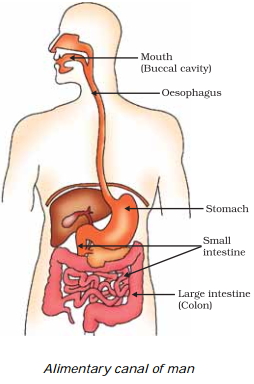
Draw the diagram of the alimentary canal of a human and label the following parts:
Mouth,Oesophagus,Stomach,Intestine.
Mouth,Oesophagus,Stomach,Intestine.
Solution
(N/A) The human alimentary canal is a continuous tube extending from the mouth to the anus. It consists of several organs that work together to digest food and absorb nutrients.
$1$. Mouth (Buccal cavity): The starting point of the alimentary canal where ingestion occurs and mechanical digestion begins with the help of teeth and saliva.
$2$. Oesophagus: $A$ muscular tube that carries food from the mouth to the stomach through peristaltic movements.
$3$. Stomach: $A$ $J$-shaped muscular organ that stores food and mixes it with gastric juices for chemical digestion.
$4$. Intestine: Divided into the small intestine (where major digestion and absorption of nutrients take place) and the large intestine (where water is absorbed and waste is prepared for excretion).
Refer to the provided diagram for the anatomical positions of these parts.
$1$. Mouth (Buccal cavity): The starting point of the alimentary canal where ingestion occurs and mechanical digestion begins with the help of teeth and saliva.
$2$. Oesophagus: $A$ muscular tube that carries food from the mouth to the stomach through peristaltic movements.
$3$. Stomach: $A$ $J$-shaped muscular organ that stores food and mixes it with gastric juices for chemical digestion.
$4$. Intestine: Divided into the small intestine (where major digestion and absorption of nutrients take place) and the large intestine (where water is absorbed and waste is prepared for excretion).
Refer to the provided diagram for the anatomical positions of these parts.
0 likes
View Solution78
Easy
How do carbohydrates,proteins,and fats get digested in human beings?
Solution
(N/A) The digestion of food in humans occurs in the following stages:
$1$. Carbohydrates: Digestion begins in the mouth where salivary amylase breaks down starch into simpler sugars. It continues in the small intestine,where pancreatic amylase converts remaining carbohydrates into glucose.
$2$. Proteins: Digestion begins in the stomach with the action of pepsin in an acidic medium. It is completed in the small intestine by pancreatic enzymes like trypsin and chymotrypsin,which break proteins down into amino acids.
$3$. Fats: Digestion occurs primarily in the small intestine. Bile salts emulsify large fat globules into smaller droplets,and then the enzyme lipase breaks them down into fatty acids and glycerol.
$1$. Carbohydrates: Digestion begins in the mouth where salivary amylase breaks down starch into simpler sugars. It continues in the small intestine,where pancreatic amylase converts remaining carbohydrates into glucose.
$2$. Proteins: Digestion begins in the stomach with the action of pepsin in an acidic medium. It is completed in the small intestine by pancreatic enzymes like trypsin and chymotrypsin,which break proteins down into amino acids.
$3$. Fats: Digestion occurs primarily in the small intestine. Bile salts emulsify large fat globules into smaller droplets,and then the enzyme lipase breaks them down into fatty acids and glycerol.
0 likes
View Solution79
Medium
Explain the mechanism of photosynthesis.
Solution
(N/A) The mechanism of photosynthesis involves the following three main steps:
$1$. Absorption of light energy by chlorophyll: The green pigment chlorophyll present in the chloroplasts of plant cells absorbs solar energy.
$2$. Conversion of light energy into chemical energy: The absorbed light energy is used to split water molecules $(H_2O)$ into hydrogen and oxygen. This process is known as photolysis. Chemical energy is stored in the form of $ATP$ and $NADPH$.
$3$. Reduction of $CO_2$ into carbohydrates: The chemical energy generated is used to reduce carbon dioxide $(CO_2)$ into glucose $(C_6H_{12}O_6)$,which serves as the primary food source for the plant.
$1$. Absorption of light energy by chlorophyll: The green pigment chlorophyll present in the chloroplasts of plant cells absorbs solar energy.
$2$. Conversion of light energy into chemical energy: The absorbed light energy is used to split water molecules $(H_2O)$ into hydrogen and oxygen. This process is known as photolysis. Chemical energy is stored in the form of $ATP$ and $NADPH$.
$3$. Reduction of $CO_2$ into carbohydrates: The chemical energy generated is used to reduce carbon dioxide $(CO_2)$ into glucose $(C_6H_{12}O_6)$,which serves as the primary food source for the plant.
0 likes
View Solution80
MediumMCQ
Explain the three pathways of breakdown of glucose in living organisms.
A
Breakdown into ethanol,$CO_2$ and energy (Anaerobic respiration in yeast).
B
Breakdown into lactic acid and energy (Anaerobic respiration in muscle cells).
C
Breakdown into $CO_2, H_2O$ and energy (Aerobic respiration in mitochondria).
D
All of the above.
Solution
(D) The breakdown of glucose in living organisms occurs through three main pathways:
$1$. In the absence of oxygen (anaerobic respiration) in yeast: Glucose is converted into ethanol $(C_2H_5OH)$,carbon dioxide $(CO_2)$,and energy.
$2$. In the lack of oxygen (anaerobic respiration) in muscle cells: Glucose is converted into lactic acid $(C_3H_6O_3)$ and energy. This usually happens during vigorous exercise.
$3$. In the presence of oxygen (aerobic respiration) in mitochondria: Glucose is converted into carbon dioxide $(CO_2)$,water $(H_2O)$,and a large amount of energy.
$1$. In the absence of oxygen (anaerobic respiration) in yeast: Glucose is converted into ethanol $(C_2H_5OH)$,carbon dioxide $(CO_2)$,and energy.
$2$. In the lack of oxygen (anaerobic respiration) in muscle cells: Glucose is converted into lactic acid $(C_3H_6O_3)$ and energy. This usually happens during vigorous exercise.
$3$. In the presence of oxygen (aerobic respiration) in mitochondria: Glucose is converted into carbon dioxide $(CO_2)$,water $(H_2O)$,and a large amount of energy.
0 likes
View Solution81
Medium
Describe the flow of blood through the heart of human beings.
Solution
(N/A) The flow of blood through the human heart follows a specific pathway:
$1$. De-oxygenated blood from the body enters the $Right \text{ Atrium}$ through the $Vena \text{ Cava}$.
$2$. From the $Right \text{ Atrium}$, blood flows into the $Right \text{ Ventricle}$ through the $Tricuspid \text{ Valve}$.
$3$. The $Right \text{ Ventricle}$ pumps this de-oxygenated blood to the lungs via the $Pulmonary \text{ Artery}$ for oxygenation.
$4$. Oxygenated blood returns from the lungs to the $Left \text{ Atrium}$ through the $Pulmonary \text{ Veins}$.
$5$. From the $Left \text{ Atrium}$, blood flows into the $Left \text{ Ventricle}$ through the $Mitral \text{ Valve}$.
$6$. Finally, the $Left \text{ Ventricle}$ pumps the oxygenated blood into the $Aorta$ to be distributed to the rest of the body.
$1$. De-oxygenated blood from the body enters the $Right \text{ Atrium}$ through the $Vena \text{ Cava}$.
$2$. From the $Right \text{ Atrium}$, blood flows into the $Right \text{ Ventricle}$ through the $Tricuspid \text{ Valve}$.
$3$. The $Right \text{ Ventricle}$ pumps this de-oxygenated blood to the lungs via the $Pulmonary \text{ Artery}$ for oxygenation.
$4$. Oxygenated blood returns from the lungs to the $Left \text{ Atrium}$ through the $Pulmonary \text{ Veins}$.
$5$. From the $Left \text{ Atrium}$, blood flows into the $Left \text{ Ventricle}$ through the $Mitral \text{ Valve}$.
$6$. Finally, the $Left \text{ Ventricle}$ pumps the oxygenated blood into the $Aorta$ to be distributed to the rest of the body.
0 likes
View Solution82
Medium
Describe the process of urine formation in kidneys.
Solution
(N/A) Urine formation in the kidneys occurs through three main processes:
$1$. Glomerular Filtration: Blood enters the glomerulus under high pressure,where water,glucose,amino acids,and nitrogenous wastes are filtered into the Bowman's capsule.
$2$. Tubular Reabsorption: As the filtrate passes through the renal tubule,essential substances like glucose,amino acids,salts,and a significant amount of water are reabsorbed back into the blood capillaries.
$3$. Tubular Secretion: Certain substances like potassium ions,hydrogen ions,and some drugs are actively secreted from the blood into the filtrate to maintain the ionic balance and $pH$ of the body fluids.
$1$. Glomerular Filtration: Blood enters the glomerulus under high pressure,where water,glucose,amino acids,and nitrogenous wastes are filtered into the Bowman's capsule.
$2$. Tubular Reabsorption: As the filtrate passes through the renal tubule,essential substances like glucose,amino acids,salts,and a significant amount of water are reabsorbed back into the blood capillaries.
$3$. Tubular Secretion: Certain substances like potassium ions,hydrogen ions,and some drugs are actively secreted from the blood into the filtrate to maintain the ionic balance and $pH$ of the body fluids.
0 likes
View Solution83
EasyMCQ
Why is it advised to use iodised salt in our diet?
A
To prevent goitre
B
To improve digestion
C
To increase blood pressure
D
To enhance taste
Solution
(A) Iodine is an essential trace element required by the thyroid gland to synthesize the hormone thyroxine. Thyroxine regulates the metabolism of carbohydrates,proteins,and fats in the body. $A$ deficiency of iodine in the diet leads to an enlargement of the thyroid gland,a condition known as goitre. Therefore,the consumption of iodised salt is advised to ensure adequate iodine intake and prevent such disorders.
0 likes
View Solution84
EasyMCQ
Name the organisms which utilize complex substances and break them down to simpler forms.
A
Autotrophs
B
Heterotrophs
C
Chemoautotrophs
D
Photoautotrophs
Solution
(B) Heterotrophic organisms,commonly known as heterotrophs,are those that cannot synthesize their own food. They utilize complex organic substances obtained from other organisms and break them down into simpler forms using enzymes to derive energy. Examples include animals,fungi,and most bacteria.
0 likes
View Solution85
EasyMCQ
Name the cell organelle in which the breakdown of pyruvate to give carbon dioxide,water,and energy takes place.
A
Cytoplasm
B
Mitochondria
C
Nucleus
D
Ribosome
Solution
(B) The cell organelle in which the breakdown of pyruvate occurs to produce carbon dioxide,water,and energy is the $Mitochondria$. This process is known as aerobic respiration,which takes place in the presence of oxygen.
0 likes
View Solution86
Easy
Name the components of blood which transport:
$(i)$ Food,carbon dioxide and nitrogenous wastes
$(ii)$ Oxygen
$(i)$ Food,carbon dioxide and nitrogenous wastes
$(ii)$ Oxygen
Solution
(N/A) $(i)$ Plasma: It is the fluid matrix of blood that transports food,dissolved carbon dioxide,and nitrogenous wastes like urea.
$(ii)$ Haemoglobin: It is a red pigment present in red blood cells $(RBCs)$ that binds with oxygen to form oxyhaemoglobin and transports it to various tissues.
$(ii)$ Haemoglobin: It is a red pigment present in red blood cells $(RBCs)$ that binds with oxygen to form oxyhaemoglobin and transports it to various tissues.
0 likes
View Solution87
Easy
When we breathe out,why does the air passage not collapse?
Solution
(N/A) The air passage,specifically the trachea and bronchi,is supported by $C$-shaped cartilaginous rings. These rings provide structural rigidity and prevent the airway from collapsing when the air pressure inside decreases during exhalation.
0 likes
View Solution88
EasyMCQ
Name the process of loss of water in the form of vapour from the aerial parts of the plants.
A
Photosynthesis
B
Transpiration
C
Respiration
D
Translocation
Solution
(B) The process of loss of water in the form of water vapour from the aerial parts of the plants,such as leaves and stems,is known as $Transpiration$. This process helps in the upward movement of water and minerals from the roots to the leaves.
0 likes
View Solution89
EasyMCQ
Name the component of food that is not digested in the stomach.
A
Carbohydrates
B
Proteins
C
Roughage (Dietary Fiber)
D
Fats
Solution
(C) Roughage,also known as dietary fiber,is the component of food that is not digested in the human stomach. It consists mainly of cellulose,a complex carbohydrate found in plant cell walls,which human digestive enzymes cannot break down. It passes through the digestive tract and helps in the movement of food and waste.
0 likes
View Solution90
EasyMCQ
Name the reserved food of plant cell.
A
Starch
B
Glycogen
C
Glucose
D
Cellulose
Solution
(A) The reserved food material in plant cells is $Starch$. Plants synthesize glucose during photosynthesis and store the excess glucose in the form of $Starch$ for later use.
0 likes
View Solution91
EasyMCQ
Name the stored food of animals.
A
Starch
B
Glycogen
C
Cellulose
D
Glucose
Solution
(B) In animals,carbohydrates are stored in the form of $Glycogen$. This is often referred to as animal starch and is primarily stored in the liver and muscle cells to be used as an energy reserve.
0 likes
View Solution92
EasyMCQ
In which part of the digestive system is water absorbed?
A
Stomach
B
Small intestine
C
Large intestine
D
Oesophagus
Solution
(C) The absorption of water and certain salts from the undigested food material occurs in the large intestine. After the absorption of water,the remaining waste material is solidified and eliminated from the body through the anus.
0 likes
View Solution93
EasyMCQ
Which type of nutrition is present in tapeworm?
A
Autotrophic
B
Holozoic
C
Parasitic
D
Saprophytic
Solution
(C) Tapeworms exhibit $Parasitic$ nutrition. They live inside the body of the host (such as humans) and derive their nutrients directly from the host's digested food, which is a form of heterotrophic nutrition.
0 likes
View Solution94
Easy
Explain holozoic nutrition.
Solution
(N/A) Holozoic nutrition is a type of heterotrophic nutrition in which an organism ingests complex organic food materials,either solid or liquid. This food is then broken down into simpler,absorbable forms through the process of digestion. After digestion,the nutrients are absorbed into the body cells and assimilated. Examples include $Amoeba$,humans,and frogs.
0 likes
View Solution95
EasyMCQ
The volume of glomerular filtrate produced is $180 \, L$ per day,but the volume of urine excreted is just $1-2 \, L$. Give a suitable reason for this statement.
A
The kidneys filter more blood than required.
B
Most of the filtrate is reabsorbed into the blood by the kidney tubules.
C
The bladder stores most of the filtrate.
D
The body consumes most of the water in the filtrate.
Solution
(B) The volume of glomerular filtrate produced is approximately $180 \, L$ per day.
However,the actual volume of urine excreted is only $1-2 \, L$ per day.
This significant difference occurs because the kidney tubules perform the process of selective reabsorption.
During this process,essential substances like water,glucose,amino acids,and salts are reabsorbed back into the blood capillaries surrounding the nephron tubules,leaving behind only the waste products to be excreted as urine.
However,the actual volume of urine excreted is only $1-2 \, L$ per day.
This significant difference occurs because the kidney tubules perform the process of selective reabsorption.
During this process,essential substances like water,glucose,amino acids,and salts are reabsorbed back into the blood capillaries surrounding the nephron tubules,leaving behind only the waste products to be excreted as urine.
0 likes
View Solution96
EasyMCQ
How does the transportation of water occur at night in the absence of transpiration?
A
Due to capillary action
B
Due to root pressure
C
Due to photosynthesis
D
Due to diffusion
Solution
(B) During the day,transpiration is the primary force driving water upward in plants.
However,at night,when stomata are closed and transpiration is minimal or absent,water is transported upward primarily due to root pressure.
Root pressure is generated by the active accumulation of ions from the soil into the vascular tissue of the roots,which creates an osmotic gradient that draws water into the xylem.
However,at night,when stomata are closed and transpiration is minimal or absent,water is transported upward primarily due to root pressure.
Root pressure is generated by the active accumulation of ions from the soil into the vascular tissue of the roots,which creates an osmotic gradient that draws water into the xylem.
0 likes
View Solution97
EasyMCQ
How many chambers are present in the heart of fishes? How many times does blood flow through the heart during each cycle?
A
Two chambers,one time
B
Three chambers,two times
C
Four chambers,two times
D
Two chambers,two times
Solution
(A) The heart of fishes is $2$-chambered,consisting of one atrium and one ventricle.
In fishes,blood passes through the heart only once during each complete circulation through the body,which is known as single circulation.
In fishes,blood passes through the heart only once during each complete circulation through the body,which is known as single circulation.
0 likes
View Solution98
EasyMCQ
What role does bile play in digestion?
A
Emulsification of fats
B
Digestion of proteins
C
Absorption of vitamins
D
Synthesis of glucose
Solution
(A) Bile,secreted by the liver and stored in the gallbladder,plays a crucial role in the digestion of fats.
It contains bile salts that break down large fat globules into smaller droplets,a process known as emulsification.
This increases the surface area of the fats,allowing enzymes like lipase to act more efficiently on them.
It contains bile salts that break down large fat globules into smaller droplets,a process known as emulsification.
This increases the surface area of the fats,allowing enzymes like lipase to act more efficiently on them.
0 likes
View Solution99
Easy
How do autotrophs obtain $CO_{2}$ and $N_{2}$ to make their food?
Solution
(N/A) $(i)$ Autotrophs obtain $CO_{2}$ from the atmosphere through the diffusion process via stomata present on the surface of leaves.
$(ii)$ Autotrophs obtain nitrogen $(N_{2})$ from the soil in the form of inorganic nitrates and nitrites,which are absorbed by the roots along with water.
$(ii)$ Autotrophs obtain nitrogen $(N_{2})$ from the soil in the form of inorganic nitrates and nitrites,which are absorbed by the roots along with water.
0 likes
View Solution100
EasyMCQ
Why is the rate of breathing in aquatic organisms much faster than that seen in terrestrial organisms?
A
Aquatic organisms have smaller lungs.
B
The amount of dissolved oxygen in water is much lower than the amount of oxygen in the air.
C
Aquatic organisms are more active than terrestrial organisms.
D
Water is denser than air.
Solution
(B) The rate of breathing in aquatic organisms is much faster because the amount of dissolved oxygen in water is significantly lower compared to the amount of oxygen available in the atmosphere. To obtain the same amount of oxygen required for metabolic processes,aquatic organisms must process a larger volume of water through their respiratory organs.
0 likes
View SolutionLife Processes — Mix Examples - Life Processes · Frequently Asked Questions
1Are these Life Processes questions useful for JEE and NEET?
Yes. All questions in this section are mapped to JEE Main and NEET exam patterns. Previous year questions from JEE Main, NEET, GUJCET and state-level exams are included with full solutions.
2Can I switch to Hindi or Gujarati for these questions?
Yes. Use the language tabs in the hero section or the sidebar to view the same questions and solutions in English, Hindi or Gujarati.
3How do I generate a question paper from this subtopic?
Use the Vedclass Exam Paper Generator — select the chapter and subtopic, set difficulty, and generate Sets A, B, C, D automatically. First 3 chapters of every subject are free.
Vedclass Products
For Students
Vedclass Test Series
Mock tests in real JEE/NEET style with performance analysis. 5-day free trial.
Start Free TrialFor Teachers
Exam Paper Generator
Generate Set A/B/C/D papers from this chapter in 2 minutes. 3 chapters free.
Try FreeFor Institutes
Online Exam Module
Live online exams with unlimited students, 360° analytics & white-label branding.
See DemoFor Teachers & Institutes
Generate a Life Processes Exam Paper in 2 Minutes
Select subtopic & difficulty — Sets A, B, C, D auto-generated with No Repeat logic.
First 3 chapters of every subject are free — no payment required.