
A English
Mix Examples - Heredity and Evolution Questions in English
Class 10 Science · Heredity · Mix Examples - Heredity and Evolution
204+
Questions
English
Language
100%
With Solutions
Showing 50 of 204 questions in English
101
Medium
Give differences between
$(a)$ Heredity and variations.
$(b)$ Dominant and recessive traits.
$(c)$ Natural and artificial selection.
$(a)$ Heredity and variations.
$(b)$ Dominant and recessive traits.
$(c)$ Natural and artificial selection.
Solution
(N/A) Heredity: It is the transmission of characters from parents to the next generation.
Variations: The changes that occur in the $DNA$ of an organism due to mutations,recombination,or environmental factors.
$(b)$ Dominant: The trait which is able to express itself even in the presence of a contrasting trait. It appears in all the progenies in the $F_{1}$ generation.
Recessive: The trait which can express itself only in a homozygous condition. It does not appear in the $F_{1}$ generation.
$(c)$ Natural selection: It is the gradual natural process by which biological traits become either more or less common in a population based on survival advantage. Example: Green beetles surviving better than red beetles in green foliage.
Artificial selection: It is the human-driven mechanism of selecting organisms with desirable characters to bring about major changes in plants and animals. Example: Different vegetables like broccoli,cauliflower,and kale derived from the wild cabbage variety.
Variations: The changes that occur in the $DNA$ of an organism due to mutations,recombination,or environmental factors.
$(b)$ Dominant: The trait which is able to express itself even in the presence of a contrasting trait. It appears in all the progenies in the $F_{1}$ generation.
Recessive: The trait which can express itself only in a homozygous condition. It does not appear in the $F_{1}$ generation.
$(c)$ Natural selection: It is the gradual natural process by which biological traits become either more or less common in a population based on survival advantage. Example: Green beetles surviving better than red beetles in green foliage.
Artificial selection: It is the human-driven mechanism of selecting organisms with desirable characters to bring about major changes in plants and animals. Example: Different vegetables like broccoli,cauliflower,and kale derived from the wild cabbage variety.
0 likes
View Solution102
Difficult
$(a)$ What is geographical isolation?
$(b)$ Illustrate the formation of a species with the help of an example where individuals become very different from each other and are no longer capable of reproduction among themselves.
$(b)$ Illustrate the formation of a species with the help of an example where individuals become very different from each other and are no longer capable of reproduction among themselves.
Solution
(N/A) Geographical isolation refers to the separation of a population by physical barriers such as mountain ranges or large bodies of water,which prevents gene flow between the separated groups.
$(b)$ Consider a large population of red beetles living in a mountain area covered with green bushes. Various sub-populations exist in the neighborhood. Individuals within a sub-population reproduce sexually,and numerous variations accumulate over generations.
If a river forms between these sub-populations,they become geographically isolated:
$(i)$ Variations continue to accumulate independently in each isolated sub-population.
$(ii)$ Over many generations,processes like genetic drift and natural selection cause these sub-populations to diverge significantly.
$(iii)$ Eventually,the genetic differences become so great that individuals from the two groups can no longer interbreed,leading to the formation of a new species.
$(b)$ Consider a large population of red beetles living in a mountain area covered with green bushes. Various sub-populations exist in the neighborhood. Individuals within a sub-population reproduce sexually,and numerous variations accumulate over generations.
If a river forms between these sub-populations,they become geographically isolated:
$(i)$ Variations continue to accumulate independently in each isolated sub-population.
$(ii)$ Over many generations,processes like genetic drift and natural selection cause these sub-populations to diverge significantly.
$(iii)$ Eventually,the genetic differences become so great that individuals from the two groups can no longer interbreed,leading to the formation of a new species.
0 likes
View Solution103
Medium
Name any five vegetables generated from a common ancestor through artificial selection rather than natural selection. Also,mention the features for which each vegetable is selected.
Solution
(N/A) Some of the vegetables generated from a common ancestor,$Wild \ Cabbage$,through artificial selection are:
$1$. $Cabbage$: Selected for short distances between leaves.
$2$. $Broccoli$: Selected for arrested flower development and thick stems.
$3$. $Cauliflower$: Selected for sterile flowers forming a large flower head.
$4$. $Kohlrabi$: Selected for a swollen edible stem.
$5$. $Kale$: Selected for large leaves.
$1$. $Cabbage$: Selected for short distances between leaves.
$2$. $Broccoli$: Selected for arrested flower development and thick stems.
$3$. $Cauliflower$: Selected for sterile flowers forming a large flower head.
$4$. $Kohlrabi$: Selected for a swollen edible stem.
$5$. $Kale$: Selected for large leaves.
0 likes
View Solution104
EasyMCQ
Mendel observed a contrasting trait in relation to the position of flowers. Mention that trait.
A
Axial and Terminal
B
Violet and White
C
Tall and Dwarf
D
Inflated and Constricted
Solution
(A) Gregor Mendel studied seven pairs of contrasting traits in pea plants.
Regarding the position of flowers,the two contrasting traits are $Axial$ and $Terminal$.
$Axial$ position is the dominant trait,while $Terminal$ position is the recessive trait.
Therefore,the contrasting trait pair is $Axial$ and $Terminal$.
Regarding the position of flowers,the two contrasting traits are $Axial$ and $Terminal$.
$Axial$ position is the dominant trait,while $Terminal$ position is the recessive trait.
Therefore,the contrasting trait pair is $Axial$ and $Terminal$.
0 likes
View Solution105
EasyMCQ
Why are males considered heterogametic?
A
Because they produce only one type of gamete.
B
Because they have dissimilar sex chromosomes $(X, Y)$.
C
Because they have similar sex chromosomes $(X, X)$.
D
Because they do not produce gametes.
Solution
(B) Males are considered heterogametic because they possess two dissimilar sex chromosomes,specifically $(X)$ and $(Y)$.
During the process of meiosis,these chromosomes segregate into different gametes.
As a result,males produce two distinct types of gametes: one type containing the $(X)$ chromosome and the other type containing the $(Y)$ chromosome.
This production of two different types of gametes is the definition of heterogamety.
During the process of meiosis,these chromosomes segregate into different gametes.
As a result,males produce two distinct types of gametes: one type containing the $(X)$ chromosome and the other type containing the $(Y)$ chromosome.
This production of two different types of gametes is the definition of heterogamety.
0 likes
View Solution106
Medium
Homologous organs are different from analogous organs. Mention the two basic characteristics that decide about analogy and homology between the two organs.
Solution
(N/A) The two basic characteristics that decide about analogy and homology are:
$(i)$ Basic anatomical structure and embryonic origin.
$(ii)$ Function performed by the organ.
In homologous organs,the basic structure and embryonic origin are similar,but the functions are different (e.g.,forelimbs of humans and wings of birds).
In analogous organs,the basic structure and embryonic origin are different,but the functions are similar (e.g.,wings of butterflies and wings of birds).
$(i)$ Basic anatomical structure and embryonic origin.
$(ii)$ Function performed by the organ.
In homologous organs,the basic structure and embryonic origin are similar,but the functions are different (e.g.,forelimbs of humans and wings of birds).
In analogous organs,the basic structure and embryonic origin are different,but the functions are similar (e.g.,wings of butterflies and wings of birds).
0 likes
View Solution107
MediumMCQ
What evidences can suggest that, "Modern human beings have originated in Africa"?
A
Fossil records found in Africa
B
Molecular phylogeny ($DNA$ analysis)
C
Archaeological excavations
D
All of the above
Solution
(D) The evidence suggesting that modern humans originated in Africa includes:
$(i)$ Fossil records: The oldest fossils of anatomically modern humans ($Homo$ $sapiens$) have been discovered in Africa.
$(ii)$ Molecular phylogeny: Studies of mitochondrial $DNA$ and $Y$-chromosome $DNA$ indicate that all non-African populations share a common ancestry that traces back to Africa.
$(iii)$ Archaeological excavations: Tools and artifacts found in African sites provide a chronological timeline of human development and migration.
$(iv)$ Carbon dating: This technique helps in determining the age of fossils and artifacts, confirming their ancient origins in the African continent.
$(i)$ Fossil records: The oldest fossils of anatomically modern humans ($Homo$ $sapiens$) have been discovered in Africa.
$(ii)$ Molecular phylogeny: Studies of mitochondrial $DNA$ and $Y$-chromosome $DNA$ indicate that all non-African populations share a common ancestry that traces back to Africa.
$(iii)$ Archaeological excavations: Tools and artifacts found in African sites provide a chronological timeline of human development and migration.
$(iv)$ Carbon dating: This technique helps in determining the age of fossils and artifacts, confirming their ancient origins in the African continent.
0 likes
View Solution108
Medium
Mendel crossed a pea plant having inflated green pod with a constricted yellow pod.
$(a)$ What type of a cross is it?
$(b)$ What type of plants are obtained in $F_{1}$ generation?
$(c)$ In $F_{2}$ generation the phenotype ratio is $9:3:3:1$. State the rule for the inheritance of traits observed by Mendel.
$(a)$ What type of a cross is it?
$(b)$ What type of plants are obtained in $F_{1}$ generation?
$(c)$ In $F_{2}$ generation the phenotype ratio is $9:3:3:1$. State the rule for the inheritance of traits observed by Mendel.
Solution
(N/A) This is a Dihybrid cross because it involves the study of the inheritance of two pairs of contrasting traits (pod shape and pod color).
$(b)$ In the $F_{1}$ generation,all plants obtained have inflated and green pods,as these are the dominant traits.
$(c)$ The rule observed is the Law of Independent Assortment. It states that when two pairs of traits are combined in a hybrid,segregation of one pair of characters is independent of the other pair of characters at the time of gamete formation.
$(b)$ In the $F_{1}$ generation,all plants obtained have inflated and green pods,as these are the dominant traits.
$(c)$ The rule observed is the Law of Independent Assortment. It states that when two pairs of traits are combined in a hybrid,segregation of one pair of characters is independent of the other pair of characters at the time of gamete formation.
0 likes
View Solution109
Medium
Humans have a genetic basis for sex determination.
$(a)$ Besides humans,which organisms have a genetic basis for sex determination?
$(b)$ Which chromosomes are similar in human males and females?
$(c)$ What is the function of these types of chromosomes?
$(a)$ Besides humans,which organisms have a genetic basis for sex determination?
$(b)$ Which chromosomes are similar in human males and females?
$(c)$ What is the function of these types of chromosomes?
Solution
(N/A) Besides humans,many other organisms such as cats,lions,monkeys,and dogs (all mammals) exhibit a genetic basis for sex determination.
$(b)$ In humans,the first $22$ pairs of chromosomes,known as autosomes,are similar in both males and females.
$(c)$ Autosomes carry genes that determine the somatic (body) characteristics of an individual,such as eye color,height,and skin texture,which are not directly related to sex determination.
$(b)$ In humans,the first $22$ pairs of chromosomes,known as autosomes,are similar in both males and females.
$(c)$ Autosomes carry genes that determine the somatic (body) characteristics of an individual,such as eye color,height,and skin texture,which are not directly related to sex determination.
0 likes
View Solution110
Medium
Who studied inheritance of traits in pea plants? Why did he select the pea plant? Which trait gets expressed in the first generation? In what ratio,traits with two contrasting characters get expressed in the second generation?
Solution
(D) Gregor Johann Mendel studied the inheritance of traits in pea plants.
He selected the pea plant because it possesses several contrasting visible characters such as round/wrinkled seeds,tall/short plants,and white/violet flowers. Furthermore,pea plants are easy to cultivate and have a short life cycle.
Only the dominant traits are expressed in the first generation ($F_1$ generation).
In the second generation ($F_2$ generation) of a dihybrid cross,the traits with two contrasting characters are expressed in the ratio of $9: 3: 3: 1$.
He selected the pea plant because it possesses several contrasting visible characters such as round/wrinkled seeds,tall/short plants,and white/violet flowers. Furthermore,pea plants are easy to cultivate and have a short life cycle.
Only the dominant traits are expressed in the first generation ($F_1$ generation).
In the second generation ($F_2$ generation) of a dihybrid cross,the traits with two contrasting characters are expressed in the ratio of $9: 3: 3: 1$.
0 likes
View Solution111
MediumMCQ
In a dihybrid cross of plants having yellow round and green wrinkled seeds,$16$ combinations were found. What type of plants were found in the following ratios?
A
$9 / 16$
B
$1 / 16$
C
$3 / 16$
D
$1 / 18$
Solution
(A-D) In a dihybrid cross between yellow round $(YYRR)$ and green wrinkled $(yyrr)$ seeds,the $F_2$ generation exhibits a phenotypic ratio of $9:3:3:1$.
$(a)$ $9 / 16$ represents the plants with both dominant traits: Round and Yellow seeds.
$(b)$ $1 / 16$ represents the plants with both recessive traits: Wrinkled and Green seeds.
$(c)$ $3 / 16$ represents the plants with one dominant and one recessive trait: Either Round Green seeds or Wrinkled Yellow seeds.
$(a)$ $9 / 16$ represents the plants with both dominant traits: Round and Yellow seeds.
$(b)$ $1 / 16$ represents the plants with both recessive traits: Wrinkled and Green seeds.
$(c)$ $3 / 16$ represents the plants with one dominant and one recessive trait: Either Round Green seeds or Wrinkled Yellow seeds.
0 likes
View Solution112
MediumMCQ
There is a sub-population $A$ and another sub-population $B$. Both are separated by a natural barrier. What will happen in such a case?
A
They will interbreed freely.
B
They will become genetically similar.
C
They will undergo speciation over time.
D
They will remain identical.
Solution
(C) When two sub-populations are separated by a natural barrier,genetic drift and natural selection accumulate different variations in each of the two geographically isolated sub-populations over several generations.
In due course of time,these two sub-populations become significantly different from each other.
Due to reproductive isolation,they eventually become unable to interbreed even if they are brought together.
Consequently,these two groups transform into two distinct new species.
In due course of time,these two sub-populations become significantly different from each other.
Due to reproductive isolation,they eventually become unable to interbreed even if they are brought together.
Consequently,these two groups transform into two distinct new species.
0 likes
View Solution113
Difficult
Charles Darwin proposed the theory of evolution of species by natural selection. How do Gregor Mendel's experiments support Darwin's view?
Solution
(N/A) $(i)$ Darwin's theory of evolution explains how life evolved from simple to more complex forms through the slow and gradual process of natural selection. However,Darwin could not explain the mechanism by which variations arise in species.
$(ii)$ Mendel's work provides the missing link. He discovered that alleles of genes do not blend or change when inherited but remain distinct and separate in the offspring. This ensures that genetic variation is not lost but persists across generations,providing the necessary raw material for natural selection to act upon. Thus,Mendel's experiments support Darwin's view by providing the genetic basis for heredity,which is essential for the process of evolution.
$(ii)$ Mendel's work provides the missing link. He discovered that alleles of genes do not blend or change when inherited but remain distinct and separate in the offspring. This ensures that genetic variation is not lost but persists across generations,providing the necessary raw material for natural selection to act upon. Thus,Mendel's experiments support Darwin's view by providing the genetic basis for heredity,which is essential for the process of evolution.
0 likes
View Solution114
Medium
Variation is useful for the survival of species over a long time. However,the variants have unequal chances of survival. Explain this statement.
Solution
(N/A) Each population survives and interacts within a specific environment. Any drastic change in ecological conditions can negatively impact the population,potentially leading to damage or even extinction. Organisms within a species that possess beneficial variations are more likely to survive these environmental changes. These surviving individuals can then reproduce and pass on their advantageous traits,eventually leading to the development of a new species or the adaptation of the existing one.
0 likes
View Solution115
Medium
Explain the following scenarios in a group of organisms,providing reasons for each:
$(a)$ Predators are more in the group.
$(b)$ Organisms survive accidentally.
$(c)$ Organisms are not able to survive in changing environmental conditions.
$(a)$ Predators are more in the group.
$(b)$ Organisms survive accidentally.
$(c)$ Organisms are not able to survive in changing environmental conditions.
Solution
(N/A) If predators are more in a group,it will lead to a rapid decrease in the population of prey on which the predators are dependent. Eventually,due to the lack of food,the predator population will also decline,potentially leading to the elimination of both populations.
$(b)$ Organisms that survive accidentally often possess certain variations or adaptations that provide a survival advantage. These individuals have a better chance to reproduce,continue their lineage,and increase their population size.
$(c)$ Organisms that are not able to adapt or survive in changing environmental conditions fail to reproduce and pass on their genes. Consequently,these individuals are eliminated from the population,which may eventually lead to the extinction of the species.
$(b)$ Organisms that survive accidentally often possess certain variations or adaptations that provide a survival advantage. These individuals have a better chance to reproduce,continue their lineage,and increase their population size.
$(c)$ Organisms that are not able to adapt or survive in changing environmental conditions fail to reproduce and pass on their genes. Consequently,these individuals are eliminated from the population,which may eventually lead to the extinction of the species.
0 likes
View Solution116
Medium
Farmers generated different vegetables from wild cabbage by artificial selection. Name the vegetables obtained for the following desired traits:
$(i)$ Arrested flower development
$(ii)$ Sterile flowers
$(iii)$ Very short distances between leaves
$(iv)$ Swollen parts
$(v)$ Broader leaves
$(i)$ Arrested flower development
$(ii)$ Sterile flowers
$(iii)$ Very short distances between leaves
$(iv)$ Swollen parts
$(v)$ Broader leaves
Solution
(N/A) Through the process of artificial selection,humans have bred wild cabbage into various vegetables to suit specific dietary preferences:
$(i)$ Arrested flower development results in $Broccoli$.
$(ii)$ Sterile flowers result in $Cauliflower$.
$(iii)$ Very short distances between leaves result in $Cabbage$.
$(iv)$ Swollen parts result in $Kohlrabi$.
$(v)$ Broader leaves result in $Kale$.
$(i)$ Arrested flower development results in $Broccoli$.
$(ii)$ Sterile flowers result in $Cauliflower$.
$(iii)$ Very short distances between leaves result in $Cabbage$.
$(iv)$ Swollen parts result in $Kohlrabi$.
$(v)$ Broader leaves result in $Kale$.
0 likes
View Solution117
Medium
$(a)$ When a pesticide is sprayed on a population of insects,all insects do not get killed but few of them survive. Give reason.
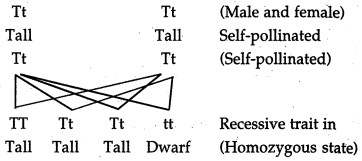
$(b)$ When is a recessive trait capable of expressing itself? Write its expression with respect to the height of a plant (genotype).
$(b)$ When is a recessive trait capable of expressing itself? Write its expression with respect to the height of a plant (genotype).
Solution
(N/A) The insects that survive have developed resistance against the pesticide by generating variations in their $DNA$ in comparison to other insects. The insects that did not have these variations in their $DNA$ could not develop resistance against the pesticide and were thus killed (eliminated).
$(b)$ $A$ recessive trait is capable of expressing itself only when it is in a homozygous recessive state,i.e.,both chromosomes have the same type of gene representing the trait.
For example,in the case of plant height,the recessive trait (dwarfness) is expressed only in the genotype $tt$.
$(b)$ $A$ recessive trait is capable of expressing itself only when it is in a homozygous recessive state,i.e.,both chromosomes have the same type of gene representing the trait.
For example,in the case of plant height,the recessive trait (dwarfness) is expressed only in the genotype $tt$.
0 likes
View Solution118
Medium
Define evolution. How does it occur? Describe how fossils provide us evidence in support of evolution.
Solution
(N/A) Evolution: The gradual unfolding of organisms from pre-existing organisms through changes since the origin of life.
It occurs because there is an inbuilt tendency to variation during reproduction due to errors in $DNA$ copying and as a result of sexual reproduction.
Fossils provide evidence for evolution by showing that although organisms in the past appeared different from existing species,they often share certain features with them. This establishes evolutionary linkages between ancestral and modern forms. Furthermore,fossils provide information about extinct species that were distinct from those existing today,helping us reconstruct the history of life on Earth.
It occurs because there is an inbuilt tendency to variation during reproduction due to errors in $DNA$ copying and as a result of sexual reproduction.
Fossils provide evidence for evolution by showing that although organisms in the past appeared different from existing species,they often share certain features with them. This establishes evolutionary linkages between ancestral and modern forms. Furthermore,fossils provide information about extinct species that were distinct from those existing today,helping us reconstruct the history of life on Earth.
0 likes
View Solution119
Medium
What is molecular phylogeny?
Solution
(N/A) Molecular phylogeny is an approach based on the principle that organisms which are more distantly related will accumulate a greater number of differences in their $DNA$ sequences over time. By comparing these genetic differences,scientists can trace the evolutionary relationships among different organisms,which provides a scientific basis for their classification and understanding of evolutionary history.
0 likes
View Solution120
Easy
What are the three ways which can produce variant genotypes in the environment?
Solution
(N/A) The three primary ways that produce variant genotypes in a population are:
$(i)$ Gene mutations: These are sudden,stable changes in the $DNA$ sequence that create new alleles.
$(ii)$ Crossing over (recombination): This occurs during meiosis,where homologous chromosomes exchange genetic material,leading to new combinations of genes.
$(iii)$ Hybridisation: This involves the crossing of two genetically different individuals,which results in offspring with new combinations of parental genes.
$(i)$ Gene mutations: These are sudden,stable changes in the $DNA$ sequence that create new alleles.
$(ii)$ Crossing over (recombination): This occurs during meiosis,where homologous chromosomes exchange genetic material,leading to new combinations of genes.
$(iii)$ Hybridisation: This involves the crossing of two genetically different individuals,which results in offspring with new combinations of parental genes.
0 likes
View Solution121
Medium
The genotype of a green-stemmed tomato plant is denoted as $GG$ and that of a purple-stemmed tomato plant as $gg$. When these two are crossed:
$(i)$ What colour of stem would you expect in their $F_1$ progeny?
$(ii)$ Give the percentage of purple-stemmed plants if $F_1$ plants are self-pollinated.
$(iii)$ In what ratio would you find the genotypes $GG$ and $Gg$ in the $F_2$ progeny?
$(i)$ What colour of stem would you expect in their $F_1$ progeny?
$(ii)$ Give the percentage of purple-stemmed plants if $F_1$ plants are self-pollinated.
$(iii)$ In what ratio would you find the genotypes $GG$ and $Gg$ in the $F_2$ progeny?
Solution
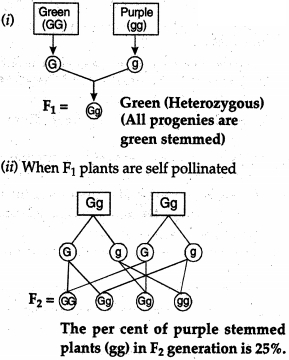
(A) $(i)$ Since green $(G)$ is dominant over purple $(g)$,all $F_1$ progeny will have the genotype $Gg$ and will be green-stemmed.
$(ii)$ When $F_1$ $(Gg)$ plants are self-pollinated,the $F_2$ generation results in the ratio $1GG : 2Gg : 1gg$. The purple-stemmed plants $(gg)$ represent $1$ out of $4$ plants,which is $25\%$.
$(iii)$ In the $F_2$ progeny,the ratio of genotypes $GG$ to $Gg$ is $1:2$.
$(ii)$ When $F_1$ $(Gg)$ plants are self-pollinated,the $F_2$ generation results in the ratio $1GG : 2Gg : 1gg$. The purple-stemmed plants $(gg)$ represent $1$ out of $4$ plants,which is $25\%$.
$(iii)$ In the $F_2$ progeny,the ratio of genotypes $GG$ to $Gg$ is $1:2$.
0 likes
View Solution122
Difficult
In dogs, the barking trait is dominant over the silent trait and erect ears are dominant over drooping ears. Now, find out
$(i)$ What is the expected phenotypic ratio of the offspring when dogs, heterozygous for both the traits are crossed?
$(ii)$ What are different phenotypes observed?
$(iii)$ What is this type of cross known as?
$(i)$ What is the expected phenotypic ratio of the offspring when dogs, heterozygous for both the traits are crossed?
$(ii)$ What are different phenotypes observed?
$(iii)$ What is this type of cross known as?
Solution
(N/A) $(i)$ Let $B$ be the allele for barking and $b$ for silent. Let $E$ be the allele for erect ears and $e$ for drooping ears. The cross is $BbEe \times BbEe$.
The expected phenotypic ratio is $9:3:3:1$.
$(ii)$ The different phenotypes observed are:
$(iii)$ This type of cross is known as a Dihybrid cross.
The expected phenotypic ratio is $9:3:3:1$.
$(ii)$ The different phenotypes observed are:
| Barking dogs with erect ears | Barking dogs with drooping ears | Silent dogs with erect ears | Silent dogs with drooping ears |
| $9$ | $3$ | $3$ | $1$ |
$(iii)$ This type of cross is known as a Dihybrid cross.
0 likes
View Solution123
Medium
$A$ guinea pig having black color,when crossed with a guinea pig having the same color,produced $80$ offspring,out of which $60$ were black and $20$ were white. Now,find out:
$(i)$ What is the possible genotype of the guinea pig?
$(ii)$ Which trait is dominant and which trait is recessive?
$(iii)$ What is this cross called,and what is its phenotypic ratio?
$(i)$ What is the possible genotype of the guinea pig?
$(ii)$ Which trait is dominant and which trait is recessive?
$(iii)$ What is this cross called,and what is its phenotypic ratio?
Solution
(A) $(i)$ Since the offspring show a $3:1$ ratio of black to white,both parents must be heterozygous. Thus,the genotype of both parents is $Bb \times Bb$.
$(ii)$ Black color is the dominant trait because it appears in the majority of the offspring,while white color is the recessive trait.
$(iii)$ This cross is called a monohybrid cross. The phenotypic ratio is $3:1$ (black:white).
$(ii)$ Black color is the dominant trait because it appears in the majority of the offspring,while white color is the recessive trait.
$(iii)$ This cross is called a monohybrid cross. The phenotypic ratio is $3:1$ (black:white).
0 likes
View Solution124
Difficult
$A$ woman having blood group $B$ marries a man having blood group $A$ and they have four offspring. Two children have blood group $O$,one has blood group $B$,and one has blood group $AB$. Now,answer the following:
$(i)$ Which blood group is dominant?
$(ii)$ Which blood group is recessive?
$(iii)$ What are the genotypes of the parents?
$(iv)$ Show the possible genotypes and phenotypes of the offspring.
$(i)$ Which blood group is dominant?
$(ii)$ Which blood group is recessive?
$(iii)$ What are the genotypes of the parents?
$(iv)$ Show the possible genotypes and phenotypes of the offspring.
Solution
(N/A) $(i)$ Both blood group $A$ and blood group $B$ are dominant (codominant).
$(ii)$ Blood group $O$ is recessive.
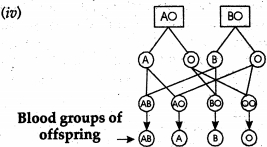
$(iii)$ Since the offspring include blood group $O$ $(OO)$,both parents must carry the $O$ allele. Therefore,the father's genotype is $AO$ and the mother's genotype is $BO$.
$(iv)$ The cross between $AO$ and $BO$ results in the following genotypes and phenotypes for the offspring:
- $AB$ (Phenotype: $AB$)
- $AO$ (Phenotype: $A$)
- $BO$ (Phenotype: $B$)
- $OO$ (Phenotype: $O$)
This cross explains the presence of all four blood groups in the offspring.
$(ii)$ Blood group $O$ is recessive.
$(iii)$ Since the offspring include blood group $O$ $(OO)$,both parents must carry the $O$ allele. Therefore,the father's genotype is $AO$ and the mother's genotype is $BO$.
$(iv)$ The cross between $AO$ and $BO$ results in the following genotypes and phenotypes for the offspring:
- $AB$ (Phenotype: $AB$)
- $AO$ (Phenotype: $A$)
- $BO$ (Phenotype: $B$)
- $OO$ (Phenotype: $O$)
This cross explains the presence of all four blood groups in the offspring.
0 likes
View Solution125
MediumMCQ
In human males,all the chromosomes are paired perfectly except one. These unpaired chromosomes are:
$(i)$ Large chromosome
$(ii)$ Small chromosome
$(iii)$ $Y$-chromosome
$(iv)$ $X$-chromosome
$(i)$ Large chromosome
$(ii)$ Small chromosome
$(iii)$ $Y$-chromosome
$(iv)$ $X$-chromosome
A
$(iii)$ and $(iv)$
B
$(iii)$ only
C
$(i)$ and $(ii)$
D
$(ii)$ and $(iv)$
Solution
(A) In human males,the sex chromosomes are $XY$.
These two chromosomes are not identical in size and shape.
The $X$-chromosome is a large chromosome,while the $Y$-chromosome is a small chromosome.
Since they are not a homologous pair,they are considered the unpaired chromosomes in the male karyotype.
Therefore,both the $X$-chromosome and the $Y$-chromosome represent the unpaired condition in males.
These two chromosomes are not identical in size and shape.
The $X$-chromosome is a large chromosome,while the $Y$-chromosome is a small chromosome.
Since they are not a homologous pair,they are considered the unpaired chromosomes in the male karyotype.
Therefore,both the $X$-chromosome and the $Y$-chromosome represent the unpaired condition in males.
0 likes
View Solution126
EasyMCQ
The maleness of a child is determined by
A
the $X-$ chromosome in zygote
B
the $Y-$ chromosome in zygote
C
the cytoplasm of germ cell which determines the sex
D
sex is determined by chance
Solution
(B) In humans,the sex of a child is determined by the sex chromosomes inherited from the parents.
Females have two $X$ chromosomes $(XX)$,while males have one $X$ and one $Y$ chromosome $(XY)$.
During fertilization,the mother always contributes an $X$ chromosome to the zygote.
The father can contribute either an $X$ chromosome or a $Y$ chromosome.
If the sperm carrying the $Y$ chromosome fertilizes the egg,the resulting zygote will have an $XY$ genotype,which develops into a male child.
Therefore,the presence of the $Y$ chromosome is the deciding factor for maleness.
Females have two $X$ chromosomes $(XX)$,while males have one $X$ and one $Y$ chromosome $(XY)$.
During fertilization,the mother always contributes an $X$ chromosome to the zygote.
The father can contribute either an $X$ chromosome or a $Y$ chromosome.
If the sperm carrying the $Y$ chromosome fertilizes the egg,the resulting zygote will have an $XY$ genotype,which develops into a male child.
Therefore,the presence of the $Y$ chromosome is the deciding factor for maleness.
0 likes
View Solution127
MediumMCQ
$A$ zygote which has an $X$-chromosome inherited from the father will develop into a
A
boy
B
$X$-chromosome does not determine the sex of a child
C
girl
D
either boy or girl
Solution
(C) In humans,the sex of an individual is determined by the sex chromosomes inherited from the parents.
Females have two $X$-chromosomes $(XX)$,while males have one $X$ and one $Y$-chromosome $(XY)$.
The mother always contributes an $X$-chromosome to the zygote.
If the father contributes an $X$-chromosome,the resulting zygote will have $XX$ chromosomes,which develops into a girl.
If the father contributes a $Y$-chromosome,the resulting zygote will have $XY$ chromosomes,which develops into a boy.
Therefore,a zygote inheriting an $X$-chromosome from the father will develop into a girl.
Females have two $X$-chromosomes $(XX)$,while males have one $X$ and one $Y$-chromosome $(XY)$.
The mother always contributes an $X$-chromosome to the zygote.
If the father contributes an $X$-chromosome,the resulting zygote will have $XX$ chromosomes,which develops into a girl.
If the father contributes a $Y$-chromosome,the resulting zygote will have $XY$ chromosomes,which develops into a boy.
Therefore,a zygote inheriting an $X$-chromosome from the father will develop into a girl.
0 likes
View Solution128
MediumMCQ
Select the incorrect statement.
A
Frequency of certain genes in a population changes over several generations resulting in evolution.
B
Low weight parents can have heavy weight progeny.
C
Traits which are not inherited over generations do not cause evolution.
D
Reduction in weight of the organism due to starvation is genetically controlled.
Solution
(D) Evolution is defined as the change in the frequency of genes in a population over several generations. This is a correct statement.
Traits that are not inherited (acquired traits) do not cause evolution because they are not passed on to the next generation. This is a correct statement.
Low weight parents can have heavy weight progeny due to variations in genetic makeup or environmental factors affecting growth. This is a correct statement.
Reduction in weight due to starvation is an acquired trait caused by environmental factors (lack of food). It is not genetically controlled and will not be inherited by the offspring. Therefore,this statement is incorrect.
Traits that are not inherited (acquired traits) do not cause evolution because they are not passed on to the next generation. This is a correct statement.
Low weight parents can have heavy weight progeny due to variations in genetic makeup or environmental factors affecting growth. This is a correct statement.
Reduction in weight due to starvation is an acquired trait caused by environmental factors (lack of food). It is not genetically controlled and will not be inherited by the offspring. Therefore,this statement is incorrect.
0 likes
View Solution129
MediumMCQ
New species may be formed if
$(i)$ $DNA$ undergoes significant changes in germ cells
$(ii)$ chromosome number changes in the gamete
$(iii)$ there is no change in the genetic material
$(iv)$ mating does not take place
$(i)$ $DNA$ undergoes significant changes in germ cells
$(ii)$ chromosome number changes in the gamete
$(iii)$ there is no change in the genetic material
$(iv)$ mating does not take place
A
$(i)$ and $(ii)$
B
$(i)$ and $(iii)$
C
$(ii), (iii)$ and $(iv)$
D
$(i), (ii)$ and $(iii)$
Solution
(A) Speciation is the evolutionary process by which populations evolve to become distinct species.
$(i)$ Significant changes in the $DNA$ of germ cells lead to variations that are inherited by the next generation,which is a primary driver of speciation.
$(ii)$ Changes in chromosome number in gametes (such as polyploidy) can lead to reproductive isolation,preventing interbreeding with the parent population and resulting in the formation of a new species.
$(iii)$ If there is no change in the genetic material,the offspring will be identical to the parents,and no new species will be formed.
$(iv)$ Mating is essential for sexual reproduction and gene flow; lack of mating does not inherently create a new species.
Therefore,statements $(i)$ and $(ii)$ are correct.
$(i)$ Significant changes in the $DNA$ of germ cells lead to variations that are inherited by the next generation,which is a primary driver of speciation.
$(ii)$ Changes in chromosome number in gametes (such as polyploidy) can lead to reproductive isolation,preventing interbreeding with the parent population and resulting in the formation of a new species.
$(iii)$ If there is no change in the genetic material,the offspring will be identical to the parents,and no new species will be formed.
$(iv)$ Mating is essential for sexual reproduction and gene flow; lack of mating does not inherently create a new species.
Therefore,statements $(i)$ and $(ii)$ are correct.
0 likes
View Solution130
EasyMCQ
From the list given below,select the character which can be acquired but not inherited.
A
Colour of eye
B
Size of body
C
Colour of skin
D
Nature of hair
Solution
(B) Acquired traits are those that an organism develops during its lifetime due to environmental factors,lifestyle,or practice. These traits do not change the $DNA$ of the germ cells and are therefore not inherited by the next generation.
$1$. Colour of eye,colour of skin,and nature of hair are inherited traits determined by the genetic makeup $(DNA)$ of an individual.
$2$. Size of body is an acquired trait because it can be influenced by nutrition,physical exercise,and environmental conditions during an individual's life,and these changes are not passed on to offspring.
$1$. Colour of eye,colour of skin,and nature of hair are inherited traits determined by the genetic makeup $(DNA)$ of an individual.
$2$. Size of body is an acquired trait because it can be influenced by nutrition,physical exercise,and environmental conditions during an individual's life,and these changes are not passed on to offspring.
0 likes
View Solution131
EasyMCQ
The two versions of a trait (character) which are brought in by the male and female gametes are situated on
A
two different chromosomes
B
sex chromosomes
C
copies of the same chromosome
D
any chromosome
Solution
(C) In diploid organisms,every somatic cell contains two copies of each chromosome,one inherited from each parent.
These are known as homologous chromosomes.
Each gene (which determines a trait) exists in two versions,called alleles.
These alleles are located at the same locus on the two copies of the same chromosome (homologous chromosomes).
Therefore,the two versions of a trait brought by the male and female gametes are situated on copies of the same chromosome.
These are known as homologous chromosomes.
Each gene (which determines a trait) exists in two versions,called alleles.
These alleles are located at the same locus on the two copies of the same chromosome (homologous chromosomes).
Therefore,the two versions of a trait brought by the male and female gametes are situated on copies of the same chromosome.
0 likes
View Solution132
MediumMCQ
Select the statements that describe characteristics of genes:
$(i)$ Genes are specific sequences of bases in a $DNA$ molecule.
$(ii)$ $A$ gene does not code for proteins.
$(iii)$ In individuals of a given species,a specific gene is located on a particular chromosome.
$(iv)$ Each chromosome has only one gene.
$(i)$ Genes are specific sequences of bases in a $DNA$ molecule.
$(ii)$ $A$ gene does not code for proteins.
$(iii)$ In individuals of a given species,a specific gene is located on a particular chromosome.
$(iv)$ Each chromosome has only one gene.
A
$(i)$ and $(ii)$
B
$(ii)$ and $(iv)$
C
$(i)$ and $(iv)$
D
$(i)$ and $(iii)$
Solution
(D) Statement $(i)$ is correct because genes are segments of $DNA$ that contain specific sequences of nucleotide bases.
Statement $(ii)$ is incorrect because the primary function of most genes is to code for specific proteins or polypeptides.
Statement $(iii)$ is correct because genes have fixed positions (loci) on specific chromosomes within a species.
Statement $(iv)$ is incorrect because a single chromosome contains hundreds to thousands of genes.
Therefore,statements $(i)$ and $(iii)$ are the correct characteristics of genes.
Statement $(ii)$ is incorrect because the primary function of most genes is to code for specific proteins or polypeptides.
Statement $(iii)$ is correct because genes have fixed positions (loci) on specific chromosomes within a species.
Statement $(iv)$ is incorrect because a single chromosome contains hundreds to thousands of genes.
Therefore,statements $(i)$ and $(iii)$ are the correct characteristics of genes.
0 likes
View Solution133
MediumMCQ
In peas,a pure tall plant $(TT)$ is crossed with a short plant $(tt).$ The ratio of pure tall plants to short plants in $F_{2}$ is
A
$1: 1$
B
$3: 1$
C
$1: 3$
D
$1: 2: 1$
Solution
(A) $1$. In the $F_{1}$ generation,the cross between $TT$ and $tt$ results in all heterozygous tall plants $(Tt)$.
$2$. When $F_{1}$ plants $(Tt)$ are self-pollinated to produce the $F_{2}$ generation,the genotypes obtained are $TT, Tt, Tt,$ and $tt$.
$3$. The phenotypic ratio is $3$ tall : $1$ short,but the question asks for the ratio of pure tall $(TT)$ to short $(tt)$ plants.
$4$. In the $F_{2}$ generation,the genotype $TT$ appears once and the genotype $tt$ appears once.
$5$. Therefore,the ratio of pure tall $(TT)$ to short $(tt)$ plants is $1:1$.
$2$. When $F_{1}$ plants $(Tt)$ are self-pollinated to produce the $F_{2}$ generation,the genotypes obtained are $TT, Tt, Tt,$ and $tt$.
$3$. The phenotypic ratio is $3$ tall : $1$ short,but the question asks for the ratio of pure tall $(TT)$ to short $(tt)$ plants.
$4$. In the $F_{2}$ generation,the genotype $TT$ appears once and the genotype $tt$ appears once.
$5$. Therefore,the ratio of pure tall $(TT)$ to short $(tt)$ plants is $1:1$.
0 likes
View Solution134
MediumMCQ
$A$ basket of vegetables contains carrot, potato, radish, and tomato. Which of them represent the correct homologous structures?
A
Carrot and potato
B
Radish and carrot
C
Carrot and tomato
D
Radish and potato
Solution
(B) Homologous structures are those that have a common evolutionary origin and similar basic structure, even if they perform different functions or look different.
In the given options, both the carrot $(Daucus \, carota)$ and the radish $(Raphanus \, sativus)$ are modified taproots.
They share a common structural origin as roots, despite being different species.
Therefore, carrot and radish are considered homologous structures.
Potato is a modified stem (tuber), and tomato is a fruit, so they do not share the same structural origin as the roots mentioned.
In the given options, both the carrot $(Daucus \, carota)$ and the radish $(Raphanus \, sativus)$ are modified taproots.
They share a common structural origin as roots, despite being different species.
Therefore, carrot and radish are considered homologous structures.
Potato is a modified stem (tuber), and tomato is a fruit, so they do not share the same structural origin as the roots mentioned.
0 likes
View Solution135
MediumMCQ
Select the correct statement.
A
Wings of birds and limbs of lizards are analogous.
B
Tendril of a pea plant and phylloclade of Opuntia are analogous.
C
Tendril of a pea plant and phylloclade of Opuntia are homologous.
D
Wings of birds and wings of bat are homologous.
Solution
(B) $1$. Homologous organs are those that have the same basic structural design and developmental origin but perform different functions.
$2$. Analogous organs are those that have different origins but perform similar functions.
$3$. The tendril of a pea plant (modified leaf) and the phylloclade of Opuntia (modified stem) are both modified plant parts that perform the function of support or photosynthesis,but they have different evolutionary origins,making them analogous structures.
$4$. Wings of birds and wings of bats are analogous (both used for flight,but different structures),while wings of birds and forelimbs of lizards are homologous (same skeletal structure,different functions).
$2$. Analogous organs are those that have different origins but perform similar functions.
$3$. The tendril of a pea plant (modified leaf) and the phylloclade of Opuntia (modified stem) are both modified plant parts that perform the function of support or photosynthesis,but they have different evolutionary origins,making them analogous structures.
$4$. Wings of birds and wings of bats are analogous (both used for flight,but different structures),while wings of birds and forelimbs of lizards are homologous (same skeletal structure,different functions).
0 likes
View Solution136
MediumMCQ
If the fossil of an organism is found in the deeper layers of the Earth,then we can predict that:
A
the extinction of the organism has occurred recently.
B
the time of extinction cannot be determined.
C
the fossil position in the layers of the Earth is not related to its time of extinction.
D
the extinction of the organism has occurred thousands of years ago.
Solution
(D) The study of fossils provides evidence for evolution. According to the principle of stratigraphy,the Earth's crust is formed in layers. The deeper layers of the Earth were deposited earlier than the upper layers. Therefore,fossils found in deeper layers are older than those found in the upper layers. If an organism's fossil is found in a deeper layer,it indicates that the organism lived and became extinct a long time ago (thousands of years ago).
0 likes
View Solution137
MediumMCQ
Which of the following statements is not true with respect to variation?
A
All variations in the species have equal chance of survival.
B
Change in genetic composition results in variation.
C
Selection of variants by environmental factors forms the basis of evolutionary processes.
D
Variation is minimum in asexual reproduction.
Solution
(A) The correct answer is $A$.
$1$. Not all variations have an equal chance of survival. Variations that provide a survival advantage in a specific environment are selected by nature,while others may be eliminated.
$2$. Genetic changes (mutations,recombination) are the primary source of variation.
$3$. Natural selection acts on these variations,which is the fundamental mechanism of evolution.
$4$. Asexual reproduction involves a single parent and minimal genetic recombination,leading to very little variation compared to sexual reproduction.
$1$. Not all variations have an equal chance of survival. Variations that provide a survival advantage in a specific environment are selected by nature,while others may be eliminated.
$2$. Genetic changes (mutations,recombination) are the primary source of variation.
$3$. Natural selection acts on these variations,which is the fundamental mechanism of evolution.
$4$. Asexual reproduction involves a single parent and minimal genetic recombination,leading to very little variation compared to sexual reproduction.
0 likes
View Solution138
EasyMCQ
$A$ trait in an organism is influenced by
A
paternal $DNA$ only
B
both maternal and paternal $DNA$
C
maternal $DNA$ only
D
neither by paternal nor by maternal $DNA$
Solution
(B) In sexually reproducing organisms,offspring inherit genetic material from both parents.
Each parent contributes one set of chromosomes (containing $DNA$) to the zygote during fertilization.
These $DNA$ segments contain genes that code for specific traits.
Therefore,the expression of a trait in an organism is influenced by the combination of $DNA$ inherited from both the mother (maternal) and the father (paternal).
Each parent contributes one set of chromosomes (containing $DNA$) to the zygote during fertilization.
These $DNA$ segments contain genes that code for specific traits.
Therefore,the expression of a trait in an organism is influenced by the combination of $DNA$ inherited from both the mother (maternal) and the father (paternal).
0 likes
View Solution139
MediumMCQ
Two pink coloured flowers on crossing resulted in $1$ red,$2$ pink and $1$ white flower progeny. The nature of the cross will be
A
double fertilisation
B
cross fertilisation
C
self pollination
D
no fertilisation
Solution
(C) The phenotypic ratio obtained is $1:2:1$ (red:pink:white). This is a classic example of incomplete dominance,which is observed in $Antirrhinum$ $majus$ (Snapdragon).
When two pink flowers $(RW)$ are crossed,the offspring are $RR$ (red),$RW$ (pink),$RW$ (pink),and $WW$ (white).
Since the parents are of the same phenotype (pink) and are being crossed to produce this specific ratio,the process is known as self-pollination (or selfing).
When two pink flowers $(RW)$ are crossed,the offspring are $RR$ (red),$RW$ (pink),$RW$ (pink),and $WW$ (white).
Since the parents are of the same phenotype (pink) and are being crossed to produce this specific ratio,the process is known as self-pollination (or selfing).
0 likes
View Solution140
MediumMCQ
$A$ cross between a tall plant $(TT)$ and a short pea plant $(tt)$ resulted in progeny that were all tall plants because:
A
shortness is the dominant trait
B
tallness is the recessive trait
C
height of pea plant is not governed by gene $'T'$ or $'t'$
D
tallness is the dominant trait
Solution
(D) In a cross between a homozygous tall plant $(TT)$ and a homozygous short plant $(tt)$,the $F_1$ generation offspring all receive one allele from each parent,resulting in a genotype of $(Tt)$.
Since the allele for tallness $(T)$ is dominant over the allele for shortness $(t)$,the phenotype of all $F_1$ individuals is tall.
Therefore,the observation that all progeny are tall confirms that tallness is the dominant trait.
Since the allele for tallness $(T)$ is dominant over the allele for shortness $(t)$,the phenotype of all $F_1$ individuals is tall.
Therefore,the observation that all progeny are tall confirms that tallness is the dominant trait.
0 likes
View Solution141
MediumMCQ
Which of the following statements is incorrect?
A
For every molecule of fat there is a gene.
B
For every hormone there is a gene.
C
For every protein there is a gene.
D
For production of every enzyme there is a gene.
Solution
(A) Genes are segments of $DNA$ that contain the instructions for synthesizing specific proteins.
Since enzymes are biological catalysts made of proteins,their production is also controlled by genes.
Many hormones are also proteinaceous in nature (peptide hormones),and their synthesis is directed by genes.
However,fats (lipids) are not synthesized directly from genetic templates in the same way proteins are.
Fats are synthesized through complex metabolic pathways involving various enzymes,which are themselves gene products,but there is no 'one gene-one fat molecule' relationship.
Therefore,the statement 'for every molecule of fat there is a gene' is incorrect.
Since enzymes are biological catalysts made of proteins,their production is also controlled by genes.
Many hormones are also proteinaceous in nature (peptide hormones),and their synthesis is directed by genes.
However,fats (lipids) are not synthesized directly from genetic templates in the same way proteins are.
Fats are synthesized through complex metabolic pathways involving various enzymes,which are themselves gene products,but there is no 'one gene-one fat molecule' relationship.
Therefore,the statement 'for every molecule of fat there is a gene' is incorrect.
0 likes
View Solution142
MediumMCQ
According to the evolutionary theory,the formation of a new species is generally due to:
A
sudden creation by nature
B
accumulation of variations over several generations
C
clones formed during asexual reproduction
D
movement of individuals from one habitat to another
Solution
(B) According to the theory of evolution,speciation occurs when a population of a species becomes reproductively isolated from the original population.
This process is driven by the gradual accumulation of genetic variations (mutations and recombination) over many generations.
As these variations accumulate,the population undergoes significant changes in its genetic makeup,eventually leading to the formation of a new species that can no longer interbreed with the ancestral population.
Therefore,the correct answer is the accumulation of variations over several generations.
This process is driven by the gradual accumulation of genetic variations (mutations and recombination) over many generations.
As these variations accumulate,the population undergoes significant changes in its genetic makeup,eventually leading to the formation of a new species that can no longer interbreed with the ancestral population.
Therefore,the correct answer is the accumulation of variations over several generations.
0 likes
View Solution143
MediumMCQ
Some dinosaurs had feathers although they could not fly,but birds have feathers that help them to fly. In the context of evolution,this means that:
A
reptiles have evolved from birds
B
there is no evolutionary connection between reptiles and birds
C
birds have evolved from reptiles
D
feathers are homologous structures in both the organisms
Solution
(C) The presence of feathers in dinosaurs (which were reptiles) and their presence in modern birds suggests an evolutionary link.
Since dinosaurs existed long before birds,it indicates that birds evolved from feathered reptiles (dinosaurs).
This is a classic example of evolutionary adaptation where a trait (feathers) originally evolved for a different purpose (likely insulation or display) in reptiles and was later co-opted for flight in birds.
Since dinosaurs existed long before birds,it indicates that birds evolved from feathered reptiles (dinosaurs).
This is a classic example of evolutionary adaptation where a trait (feathers) originally evolved for a different purpose (likely insulation or display) in reptiles and was later co-opted for flight in birds.
0 likes
View Solution144
EasyMCQ
In humans, there are two pairs of sex chromosomes.
A
True
B
False
Solution
(B) The statement is $False$. Humans have $23$ pairs of chromosomes in total. Out of these, $22$ pairs are autosomes, and only $1$ pair consists of sex chromosomes (allosomes). In males, the sex chromosomes are $XY$, and in females, they are $XX$.
0 likes
View Solution145
Easy
In snails, individuals can change sex, indicating that sex is not genetically determined in them.
Solution
(A) The statement is $True$. In many species of snails, sex determination is not strictly genetic but is influenced by environmental factors, such as temperature, population density, or social cues. This phenomenon allows individuals to change their sex during their lifetime, a process known as $sequential \text{ } hermaphroditism$.
0 likes
View Solution146
EasyMCQ
$A$ child who inherits an $X$-chromosome from her father will be a boy.
A
True
B
False
Solution
(B) In humans,the sex of a child is determined by the sex chromosomes inherited from the parents.
Females have two $X$-chromosomes $(XX)$,and males have one $X$ and one $Y$-chromosome $(XY)$.
$A$ father contributes either an $X$ or a $Y$-chromosome to the offspring.
If the father passes an $X$-chromosome,the child will be a girl $(XX)$.
If the father passes a $Y$-chromosome,the child will be a boy $(XY)$.
Therefore,a child who inherits an $X$-chromosome from her father will be a girl,not a boy.
Females have two $X$-chromosomes $(XX)$,and males have one $X$ and one $Y$-chromosome $(XY)$.
$A$ father contributes either an $X$ or a $Y$-chromosome to the offspring.
If the father passes an $X$-chromosome,the child will be a girl $(XX)$.
If the father passes a $Y$-chromosome,the child will be a boy $(XY)$.
Therefore,a child who inherits an $X$-chromosome from her father will be a girl,not a boy.
0 likes
View Solution147
MediumMCQ
$A$ child who inherits an $X-$chromosome from her father will be a boy.
A
True
B
False
Solution
(B) In humans,the sex of a child is determined by the sex chromosomes inherited from the parents.
Females have $XX$ chromosomes and males have $XY$ chromosomes.
$A$ father contributes either an $X$ or a $Y$ chromosome to his offspring.
If a father passes an $X$ chromosome to his child,the child will be a girl $(XX)$.
If a father passes a $Y$ chromosome to his child,the child will be a boy $(XY)$.
Therefore,inheriting an $X$ chromosome from the father results in a girl,not a boy.
Females have $XX$ chromosomes and males have $XY$ chromosomes.
$A$ father contributes either an $X$ or a $Y$ chromosome to his offspring.
If a father passes an $X$ chromosome to his child,the child will be a girl $(XX)$.
If a father passes a $Y$ chromosome to his child,the child will be a boy $(XY)$.
Therefore,inheriting an $X$ chromosome from the father results in a girl,not a boy.
0 likes
View Solution148
EasyMCQ
$A$ child who inherits an $Y$-chromosome from her father will be a girl.
A
True
B
False
Solution
(B) In humans,the sex of a child is determined by the sex chromosomes inherited from the parents. Females have $XX$ chromosomes and males have $XY$ chromosomes.
When a child inherits an $X$-chromosome from the father,the child will be a girl $(XX)$.
When a child inherits a $Y$-chromosome from the father,the child will be a boy $(XY)$.
Therefore,the statement that a child inheriting a $Y$-chromosome will be a girl is false.
When a child inherits an $X$-chromosome from the father,the child will be a girl $(XX)$.
When a child inherits a $Y$-chromosome from the father,the child will be a boy $(XY)$.
Therefore,the statement that a child inheriting a $Y$-chromosome will be a girl is false.
0 likes
View Solution149
MediumMCQ
There is an inbuilt tendency to variation during reproduction,both because of errors in $DNA$ copying,and as a result of sexual reproduction.
A
True
B
False
Solution
(A) The statement is True.
Variation is an inherent feature of reproduction.
In asexual reproduction,variations arise primarily due to minor errors in $DNA$ copying during cell division.
In sexual reproduction,variations are more significant due to the combination of $DNA$ from two different parents,the process of crossing over during meiosis,and random fertilization.
Variation is an inherent feature of reproduction.
In asexual reproduction,variations arise primarily due to minor errors in $DNA$ copying during cell division.
In sexual reproduction,variations are more significant due to the combination of $DNA$ from two different parents,the process of crossing over during meiosis,and random fertilization.
0 likes
View Solution150
MediumMCQ
The frequency of certain genes in a population changes over generations. This is the essence of the idea of evolution.
A
True
B
False
C
Cannot be determined
D
None of the above
Solution
(A) Evolution is defined as the change in the heritable characteristics of biological populations over successive generations. At the genetic level,this corresponds to changes in the allele frequencies within a population's gene pool over time. Therefore,the statement that the frequency of certain genes in a population changes over generations is the fundamental essence of the theory of evolution.
0 likes
View SolutionHeredity — Mix Examples - Heredity and Evolution · Frequently Asked Questions
1Are these Heredity questions useful for JEE and NEET?
Yes. All questions in this section are mapped to JEE Main and NEET exam patterns. Previous year questions from JEE Main, NEET, GUJCET and state-level exams are included with full solutions.
2Can I switch to Hindi or Gujarati for these questions?
Yes. Use the language tabs in the hero section or the sidebar to view the same questions and solutions in English, Hindi or Gujarati.
3How do I generate a question paper from this subtopic?
Use the Vedclass Exam Paper Generator — select the chapter and subtopic, set difficulty, and generate Sets A, B, C, D automatically. First 3 chapters of every subject are free.
Vedclass Products
For Students
Vedclass Test Series
Mock tests in real JEE/NEET style with performance analysis. 5-day free trial.
Start Free TrialFor Teachers
Exam Paper Generator
Generate Set A/B/C/D papers from this chapter in 2 minutes. 3 chapters free.
Try FreeFor Institutes
Online Exam Module
Live online exams with unlimited students, 360° analytics & white-label branding.
See DemoFor Teachers & Institutes
Generate a Heredity Exam Paper in 2 Minutes
Select subtopic & difficulty — Sets A, B, C, D auto-generated with No Repeat logic.
First 3 chapters of every subject are free — no payment required.