
A English
Textbook - Heredity and Evolution Questions in English
Class 10 Science · Heredity · Textbook - Heredity and Evolution
29+
Questions
English
Language
100%
With Solutions
Showing 29 of 29 questions in English
1
Medium
If a trait $A$ exists in $10\%$ of a population of an asexually reproducing species and a trait $B$ exists in $60\%$ of the same population,which trait is likely to have arisen earlier?
Solution
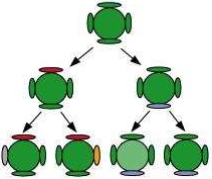
(B) In asexual reproduction,the reproducing cells produce a copy of their $DNA$ through some chemical reactions. However,this copying of $DNA$ is not perfectly accurate,and therefore,the newly formed $DNA$ has some variations.
It can be observed that in asexual reproduction,very few variations are allowed. Therefore,if a trait is present in only $10\%$ of the population,it is more likely that the trait has arisen recently. Conversely,a trait present in $60\%$ of the population has had more time to spread through successive generations. Hence,it can be concluded that trait $B$,which exists in $60\%$ of the same population,has arisen earlier than trait $A$.
It can be observed that in asexual reproduction,very few variations are allowed. Therefore,if a trait is present in only $10\%$ of the population,it is more likely that the trait has arisen recently. Conversely,a trait present in $60\%$ of the population has had more time to spread through successive generations. Hence,it can be concluded that trait $B$,which exists in $60\%$ of the same population,has arisen earlier than trait $A$.
0 likes
View Solution2
Difficult
How does the creation of variations in a species promote survival?
Solution
(N/A) Sometimes,environmental conditions change so drastically that the survival of a species becomes difficult. For example,if the temperature of water increases suddenly,most of the bacteria living in that water would die. Only a few variants resistant to heat would be able to survive. If these variants were not present,the entire species of bacteria would have been destroyed. Thus,these variations help in the survival of the species.
However,it is important to note that not all variations are useful. Therefore,variations are not necessarily beneficial for the individual organisms in all situations.
However,it is important to note that not all variations are useful. Therefore,variations are not necessarily beneficial for the individual organisms in all situations.
0 likes
View Solution3
Difficult
How do Mendel's experiments show that traits may be dominant or recessive?
Solution
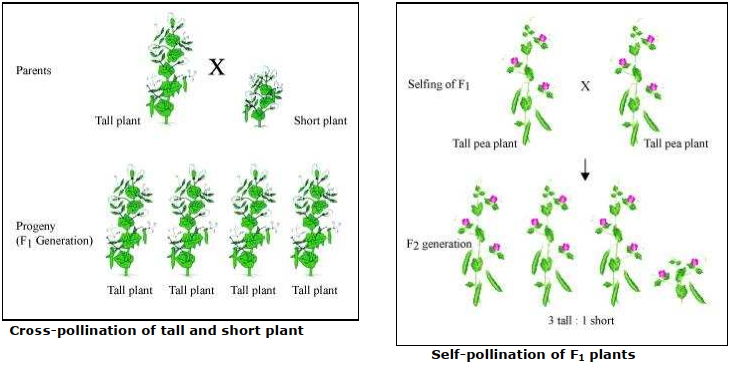
Mendel selected true-breeding tall $(TT)$ and dwarf $(tt)$ pea plants.
He crossed these two plants to obtain the first filial or $F_1$ generation.
All the $F_1$ plants obtained were tall.
Then,Mendel self-pollinated the $F_1$ plants and observed that not all plants in the $F_2$ generation were tall; one-fourth of the $F_2$ plants were short.
From this experiment,Mendel concluded that the $F_1$ tall plants were not true-breeding.
They carried traits for both short and tall height.
They appeared tall only because the tall trait is dominant over the dwarf trait,which is recessive.
He crossed these two plants to obtain the first filial or $F_1$ generation.
All the $F_1$ plants obtained were tall.
Then,Mendel self-pollinated the $F_1$ plants and observed that not all plants in the $F_2$ generation were tall; one-fourth of the $F_2$ plants were short.
From this experiment,Mendel concluded that the $F_1$ tall plants were not true-breeding.
They carried traits for both short and tall height.
They appeared tall only because the tall trait is dominant over the dwarf trait,which is recessive.
0 likes
View Solution4
Medium
How do Mendel's experiments show that traits are inherited independently?
Solution
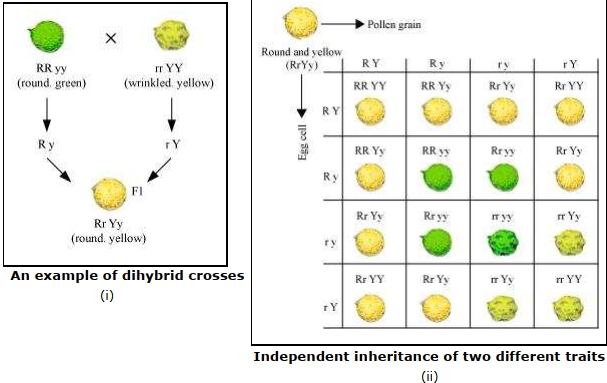
(N/A) Mendel performed a dihybrid cross by crossing pea plants having round green seeds $(RRyy)$ with pea plants having wrinkled yellow seeds $(rrYY)$.
In the $F_1$ generation,all plants produced round yellow seeds $(RrYy)$ because round and yellow are dominant traits.
When these $F_1$ plants were self-pollinated,the $F_2$ progeny showed four types of combinations: yellow round,green round,yellow wrinkled,and green wrinkled seeds in a phenotypic ratio of $9:3:3:1$.
The appearance of new combinations (green round and yellow wrinkled seeds) in the $F_2$ generation,which were not present in the parents,clearly demonstrates that the traits for seed shape and seed color are inherited independently of each other.
In the $F_1$ generation,all plants produced round yellow seeds $(RrYy)$ because round and yellow are dominant traits.
When these $F_1$ plants were self-pollinated,the $F_2$ progeny showed four types of combinations: yellow round,green round,yellow wrinkled,and green wrinkled seeds in a phenotypic ratio of $9:3:3:1$.
The appearance of new combinations (green round and yellow wrinkled seeds) in the $F_2$ generation,which were not present in the parents,clearly demonstrates that the traits for seed shape and seed color are inherited independently of each other.
0 likes
View Solution5
Medium
$A$ man with blood group $A$ marries a woman with blood group $O$ and their daughter has blood group $O$. Is this information enough to tell you which of the traits - blood group $A$ or $O$ - is dominant? Why or why not?
Solution
(N/A) No. This information is not sufficient to determine which of the traits - blood group $A$ or $O$ - is dominant.
Blood group $A$ can be genotypically $I^A I^A$ (homozygous) or $I^A i$ (heterozygous),while blood group $O$ is always $ii$ (homozygous recessive).
Since the daughter has blood group $O$ $(ii)$,she must have inherited one $i$ allele from the father and one $i$ allele from the mother. This confirms the father is heterozygous $(I^A i)$.
However,this single cross does not provide enough data to establish dominance patterns across a population,as we do not know the genotypes of all potential progeny or the expression of other combinations.
Blood group $A$ can be genotypically $I^A I^A$ (homozygous) or $I^A i$ (heterozygous),while blood group $O$ is always $ii$ (homozygous recessive).
Since the daughter has blood group $O$ $(ii)$,she must have inherited one $i$ allele from the father and one $i$ allele from the mother. This confirms the father is heterozygous $(I^A i)$.
However,this single cross does not provide enough data to establish dominance patterns across a population,as we do not know the genotypes of all potential progeny or the expression of other combinations.
0 likes
View Solution6
Difficult
How is the sex of the child determined in human beings?
Solution
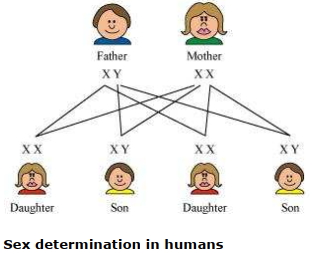
(N/A) In human beings,females have two $X$ chromosomes and males have one $X$ and one $Y$ chromosome. Therefore,the genotype of females is $XX$ and that of males is $XY$.
During gametogenesis,gametes receive half of the chromosomes. Male gametes contain $22$ autosomes and either an $X$ or a $Y$ sex chromosome.
Types of male gametes: $22+X$ or $22+Y$.
Since females have $XX$ sex chromosomes,all their gametes contain an $X$ sex chromosome.
Type of female gamete: $22+X$.
Thus,the mother always contributes an $X$ chromosome. The sex of the child is determined by the type of male gamete ($X$ or $Y$) that fertilizes the female egg (which always carries an $X$ chromosome). If an $X$-bearing sperm fertilizes the egg,the zygote becomes $XX$ (female). If a $Y$-bearing sperm fertilizes the egg,the zygote becomes $XY$ (male).
During gametogenesis,gametes receive half of the chromosomes. Male gametes contain $22$ autosomes and either an $X$ or a $Y$ sex chromosome.
Types of male gametes: $22+X$ or $22+Y$.
Since females have $XX$ sex chromosomes,all their gametes contain an $X$ sex chromosome.
Type of female gamete: $22+X$.
Thus,the mother always contributes an $X$ chromosome. The sex of the child is determined by the type of male gamete ($X$ or $Y$) that fertilizes the female egg (which always carries an $X$ chromosome). If an $X$-bearing sperm fertilizes the egg,the zygote becomes $XX$ (female). If a $Y$-bearing sperm fertilizes the egg,the zygote becomes $XY$ (male).
0 likes
View Solution7
MediumMCQ
What are the different ways in which individuals with a particular trait may increase in a population?
A
Natural selection
B
Genetic drift
C
Acquired traits
D
All of the above
Solution
(D) Individuals with a particular trait may increase in a population as a result of the following:
$(i)$ Natural selection: When that trait offers a survival advantage,individuals possessing it are more likely to survive and reproduce,passing the trait to the next generation.
$(ii)$ Genetic drift: This refers to the random change in the frequency of alleles in a population over generations,which can cause a particular trait to become more common by chance,especially in small populations.
$(iii)$ Acquired traits: While these are not inherited,if a trait is acquired during an individual's lifetime due to environmental factors,it may appear more frequently in a population if the environment consistently induces that trait in many individuals.
$(i)$ Natural selection: When that trait offers a survival advantage,individuals possessing it are more likely to survive and reproduce,passing the trait to the next generation.
$(ii)$ Genetic drift: This refers to the random change in the frequency of alleles in a population over generations,which can cause a particular trait to become more common by chance,especially in small populations.
$(iii)$ Acquired traits: While these are not inherited,if a trait is acquired during an individual's lifetime due to environmental factors,it may appear more frequently in a population if the environment consistently induces that trait in many individuals.
0 likes
View Solution8
Medium
Why are traits acquired during the lifetime of an individual not inherited?
Solution
(N/A) Acquired traits involve changes in non-reproductive tissues,also known as somatic cells.
Since these changes do not affect the $DNA$ of the germ cells (reproductive cells),they cannot be passed on to the next generation.
Therefore,traits acquired during an individual's lifetime are not inherited.
Since these changes do not affect the $DNA$ of the germ cells (reproductive cells),they cannot be passed on to the next generation.
Therefore,traits acquired during an individual's lifetime are not inherited.
0 likes
View Solution9
EasyMCQ
Why are the small numbers of surviving tigers a cause of worry from the point of view of genetics?
A
It leads to an increase in the population size.
B
It reduces the genetic diversity and the potential for evolutionary adaptation.
C
It ensures that all tigers are healthy.
D
It has no impact on the survival of the species.
Solution
(B) Small numbers of tigers mean that fewer variations in terms of genes are available in the population.
This limited gene pool implies that when these tigers reproduce,there are fewer chances of producing progeny with new or useful variations.
Genetic diversity is essential for the survival of a species as it allows them to adapt to changing environmental conditions.
Therefore,a small population size is a cause of worry from the point of view of genetics because it increases the risk of extinction due to a lack of adaptive traits.
This limited gene pool implies that when these tigers reproduce,there are fewer chances of producing progeny with new or useful variations.
Genetic diversity is essential for the survival of a species as it allows them to adapt to changing environmental conditions.
Therefore,a small population size is a cause of worry from the point of view of genetics because it increases the risk of extinction due to a lack of adaptive traits.
0 likes
View Solution10
EasyMCQ
What factors could lead to the rise of a new species?
A
Natural selection
B
Genetic drift
C
Acquisition of traits during the lifetime of an individual
D
All of the above
Solution
(D) The formation of a new species,known as speciation,occurs due to several factors:
$1$. Natural selection: Individuals with favorable variations are better adapted to their environment and survive to reproduce.
$2$. Genetic drift: Random changes in allele frequencies in a population,especially in small populations,can lead to significant evolutionary changes.
$3$. Acquisition of traits: While somatic traits are not inherited,the accumulation of genetic variations over generations,combined with reproductive isolation,leads to the emergence of new species.
$1$. Natural selection: Individuals with favorable variations are better adapted to their environment and survive to reproduce.
$2$. Genetic drift: Random changes in allele frequencies in a population,especially in small populations,can lead to significant evolutionary changes.
$3$. Acquisition of traits: While somatic traits are not inherited,the accumulation of genetic variations over generations,combined with reproductive isolation,leads to the emergence of new species.
0 likes
View Solution11
Medium
Will geographical isolation be a major factor in the speciation of a self-pollinating plant species? Why or why not?
Solution
(NO) Geographical isolation is generally considered a major factor in speciation for organisms that rely on cross-pollination or migration to exchange genetic material.
However,in the case of a self-pollinating plant species,the pollen is transferred from the anther to the stigma of the same flower or another flower on the same plant.
Because these plants do not depend on external factors or other individuals for fertilization,geographical isolation does not significantly impact their gene flow or reproductive isolation.
Therefore,geographical isolation will not be a major factor in the speciation of self-pollinating plant species.
However,in the case of a self-pollinating plant species,the pollen is transferred from the anther to the stigma of the same flower or another flower on the same plant.
Because these plants do not depend on external factors or other individuals for fertilization,geographical isolation does not significantly impact their gene flow or reproductive isolation.
Therefore,geographical isolation will not be a major factor in the speciation of self-pollinating plant species.
0 likes
View Solution12
Medium
Will geographical isolation be a major factor in the speciation of an organism that reproduces asexually? Why or why not?
Solution
(NO) Geographical isolation prevents gene flow between populations of a species,whereas asexual reproduction generally involves only one individual.
In an asexually reproducing organism,variations can occur only when the copying of $DNA$ is not accurate.
Since asexual reproduction does not involve the exchange of genetic material between different individuals,geographical barriers do not restrict the gene pool in the same way they do for sexually reproducing organisms.
Therefore,geographical isolation is not a major factor in the speciation of an organism that reproduces asexually.
In an asexually reproducing organism,variations can occur only when the copying of $DNA$ is not accurate.
Since asexual reproduction does not involve the exchange of genetic material between different individuals,geographical barriers do not restrict the gene pool in the same way they do for sexually reproducing organisms.
Therefore,geographical isolation is not a major factor in the speciation of an organism that reproduces asexually.
0 likes
View Solution13
Medium
Give an example of characteristics being used to determine how close two species are in evolutionary terms.
Solution
(N/A) The presence of feathers in both dinosaurs and birds indicates that they are evolutionarily related. Dinosaurs possessed feathers not for flight,but to provide insulation to these warm-blooded animals. Later,these feathers were adapted for flight in birds. This evolutionary link proves that reptiles and birds are closely related and that the evolution of wings originated in reptiles.
0 likes
View Solution14
Medium
Can the wing of a butterfly and the wing of a bat be considered homologous organs? Why or why not?
Solution
(B) No,the wing of a butterfly and the wing of a bat cannot be considered homologous organs.
Homologous organs are those that have a similar basic structural design and developmental origin,even if they perform different functions.
In this case,the wings of a butterfly and a bat perform the same function (flying),but they have different structural designs and different evolutionary origins.
The wing of a butterfly is a thin fold of membrane with very few muscles,whereas the wing of a bat is a bony forelimb covered with skin.
Since they have different basic structures and origins,they are considered analogous organs,not homologous organs.
Homologous organs are those that have a similar basic structural design and developmental origin,even if they perform different functions.
In this case,the wings of a butterfly and a bat perform the same function (flying),but they have different structural designs and different evolutionary origins.
The wing of a butterfly is a thin fold of membrane with very few muscles,whereas the wing of a bat is a bony forelimb covered with skin.
Since they have different basic structures and origins,they are considered analogous organs,not homologous organs.
0 likes
View Solution15
Medium
What are fossils? What do they tell us about the process of evolution?
Solution
(N/A) Fossils are the preserved remains or impressions of organisms that lived in the distant past.
They provide direct evidence of evolution by showing the structural characteristics of ancient organisms.
By studying fossils,scientists can determine the evolutionary history of species and observe the gradual changes that have occurred over millions of years.
They help in establishing the link between extinct organisms and their modern-day descendants,thereby demonstrating the process of descent with modification.
They provide direct evidence of evolution by showing the structural characteristics of ancient organisms.
By studying fossils,scientists can determine the evolutionary history of species and observe the gradual changes that have occurred over millions of years.
They help in establishing the link between extinct organisms and their modern-day descendants,thereby demonstrating the process of descent with modification.
0 likes
View Solution16
Difficult
Why are human beings,who look so different from each other in terms of size,colour,and appearance,said to belong to the same species?
Solution
(N/A) species is defined as a group of organisms that are capable of interbreeding to produce fertile offspring.
Skin colour,physical appearance,and size are all variations of features present in human beings.
These features are generally influenced by environmental factors and genetic variations within the population.
Although different human populations exhibit these variations,there is no biological basis for classifying them into different species.
Since all human beings,regardless of their colour,size,or appearance,are capable of interbreeding and producing fertile offspring,they are classified as a single species,$Homo$ $sapiens$.
Skin colour,physical appearance,and size are all variations of features present in human beings.
These features are generally influenced by environmental factors and genetic variations within the population.
Although different human populations exhibit these variations,there is no biological basis for classifying them into different species.
Since all human beings,regardless of their colour,size,or appearance,are capable of interbreeding and producing fertile offspring,they are classified as a single species,$Homo$ $sapiens$.
0 likes
View Solution17
Advanced
In evolutionary terms,can we say which among bacteria,spiders,fish,and chimpanzees have a 'better' body design? Why or why not?
Solution
(N/A) Evolution cannot always be equated with progress or 'better' body designs.
Evolution simply creates more complex body designs over time.
However,this does not mean that simpler body designs are inefficient.
In fact,bacteria,which possess a very simple body design,are among the most successful and cosmopolitan organisms found on Earth.
They can survive in extreme conditions such as hot springs,the deep sea,and freezing environments.
Therefore,bacteria,spiders,fish,and chimpanzees represent different,successful branches of evolution,and none can be considered 'better' than the others.
Evolution simply creates more complex body designs over time.
However,this does not mean that simpler body designs are inefficient.
In fact,bacteria,which possess a very simple body design,are among the most successful and cosmopolitan organisms found on Earth.
They can survive in extreme conditions such as hot springs,the deep sea,and freezing environments.
Therefore,bacteria,spiders,fish,and chimpanzees represent different,successful branches of evolution,and none can be considered 'better' than the others.
0 likes
View Solution18
DifficultMCQ
$A$ Mendelian experiment consisted of breeding tall pea plants bearing violet flowers with short pea plants bearing white flowers. The progeny all bore violet flowers,but almost half of them were short. This suggests that the genetic make-up of the tall parent can be depicted as
A
$TTWW$
B
$TtWW$
C
$TTww$
D
$TtWw$
Solution
(B) Let $T$ represent the dominant trait for tallness and $t$ represent the recessive trait for shortness. Let $W$ represent the dominant trait for violet flowers and $w$ represent the recessive trait for white flowers.
$1$. The progeny all bore violet flowers,which indicates that the tall parent must be homozygous dominant for flower color $(WW)$,as the short parent is white $(ww)$.
$2$. Almost half of the progeny were short,which indicates that the tall parent must be heterozygous for height $(Tt)$ because a cross between $Tt$ and $tt$ results in $50\%$ tall and $50\%$ short offspring.
$3$. Therefore,the genotype of the tall parent is $TtWW$.
$1$. The progeny all bore violet flowers,which indicates that the tall parent must be homozygous dominant for flower color $(WW)$,as the short parent is white $(ww)$.
$2$. Almost half of the progeny were short,which indicates that the tall parent must be heterozygous for height $(Tt)$ because a cross between $Tt$ and $tt$ results in $50\%$ tall and $50\%$ short offspring.
$3$. Therefore,the genotype of the tall parent is $TtWW$.
0 likes
View Solution19
EasyMCQ
An example of homologous organs is
A
our arm and a dog's fore-leg
B
potato and runners of grass
C
our teeth and an elephant's tusks
D
all of the above
Solution
(D) Homologous organs are those that have the same basic structural design and developmental origin but perform different functions.
$A$. Our arm and a dog's fore-leg are homologous as they share a similar skeletal structure.
$B$. Potato tubers and runners of grass are homologous plant structures (modified stems).
$C$. Our teeth and an elephant's tusks are also homologous as they are modified teeth.
Since all the given examples represent organs with common ancestry and structural similarity,the correct answer is $D$.
$A$. Our arm and a dog's fore-leg are homologous as they share a similar skeletal structure.
$B$. Potato tubers and runners of grass are homologous plant structures (modified stems).
$C$. Our teeth and an elephant's tusks are also homologous as they are modified teeth.
Since all the given examples represent organs with common ancestry and structural similarity,the correct answer is $D$.
0 likes
View Solution20
MediumMCQ
In evolutionary terms,we have more in common with:
A
a bacterium
B
a chimpanzee
C
a spider
D
a Chinese school-boy
Solution
(D) In evolutionary terms,all humans belong to the same species,$Homo$ $sapiens$. Therefore,we share a very recent common ancestor with any other human,regardless of their geographical location or ethnicity. While we share a common ancestor with chimpanzees,that divergence occurred millions of years ago,making our genetic and evolutionary similarity to another human significantly higher than to any other organism listed.
0 likes
View Solution21
Easy
$A$ study found that children with light-coloured eyes are likely to have parents with light-coloured eyes. On this basis,can we say anything about whether the light eye colour trait is dominant or recessive? Why or why not?
Solution
(D) Let us assume that the trait for light-coloured eyes is represented by the allele $l$ and dark-coloured eyes by $L$.
If light eye colour is recessive,the genotype of the child must be $ll$. For the child to have $ll$ genotype,both parents must contribute an $l$ allele,meaning both parents must have at least one $l$ allele.
If light eye colour is dominant,the genotype of the child could be $LL$ or $Ll$. If the child is $LL$,both parents must have at least one $L$ allele.
Since the observation only states that children with light-coloured eyes have parents with light-coloured eyes,it does not provide enough information to determine if the trait is dominant or recessive. Both dominant and recessive traits can be passed from parents to offspring,and the presence of a trait in parents does not confirm its dominance or recessiveness without knowing the phenotypic ratios in the offspring of multiple generations.
If light eye colour is recessive,the genotype of the child must be $ll$. For the child to have $ll$ genotype,both parents must contribute an $l$ allele,meaning both parents must have at least one $l$ allele.
If light eye colour is dominant,the genotype of the child could be $LL$ or $Ll$. If the child is $LL$,both parents must have at least one $L$ allele.
Since the observation only states that children with light-coloured eyes have parents with light-coloured eyes,it does not provide enough information to determine if the trait is dominant or recessive. Both dominant and recessive traits can be passed from parents to offspring,and the presence of a trait in parents does not confirm its dominance or recessiveness without knowing the phenotypic ratios in the offspring of multiple generations.
0 likes
View Solution22
Medium
How are the areas of study - evolution and classification - interlinked?
Solution
(N/A) Classification involves grouping organisms into a formal system based on similarities in internal and external structures or evolutionary history.
Two species are more closely related if they have more characteristics in common. If two species are more closely related,it implies they share a more recent common ancestor.
For example,in a family,a brother and sister are closely related and share a recent common ancestor,i.e.,their parents. $A$ brother and his cousin are also related,but less closely than the brother and sister. This is because the brother and his cousin share a common ancestor,i.e.,their grandparents,in the second generation,whereas the parents were from the first generation.
With subsequent generations,genetic variations make organisms increasingly different from their ancestors.
This discussion clearly proves that we classify organisms according to their resemblance,which is essentially similar to creating an evolutionary tree.
Two species are more closely related if they have more characteristics in common. If two species are more closely related,it implies they share a more recent common ancestor.
For example,in a family,a brother and sister are closely related and share a recent common ancestor,i.e.,their parents. $A$ brother and his cousin are also related,but less closely than the brother and sister. This is because the brother and his cousin share a common ancestor,i.e.,their grandparents,in the second generation,whereas the parents were from the first generation.
With subsequent generations,genetic variations make organisms increasingly different from their ancestors.
This discussion clearly proves that we classify organisms according to their resemblance,which is essentially similar to creating an evolutionary tree.
0 likes
View Solution23
Medium
Explain the terms analogous and homologous organs with examples.
Solution
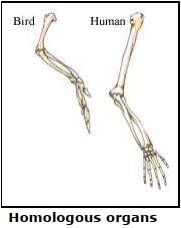
(N/A) Homologous organs are those that have a similar basic structural design and developmental origin,but perform different functions. For example,the forelimbs of humans and the wings of birds have a similar skeletal structure,indicating a common evolutionary origin,but they perform different functions (grasping vs. flying).
Analogous organs are those that have different developmental origins and structural designs,but perform similar functions. For example,the wings of a bird and the wings of a bat are analogous. While both are used for flight,the wing of a bird is supported by the entire arm,whereas the wing of a bat is a fold of skin stretched between elongated fingers. This indicates that they evolved independently to serve the same function.
Analogous organs are those that have different developmental origins and structural designs,but perform similar functions. For example,the wings of a bird and the wings of a bat are analogous. While both are used for flight,the wing of a bird is supported by the entire arm,whereas the wing of a bat is a fold of skin stretched between elongated fingers. This indicates that they evolved independently to serve the same function.
0 likes
View Solution24
Medium
Outline a project which aims to find the dominant coat colour in dogs.
Solution
(A) Dogs have a variety of genes that govern coat colour. There are at least eleven identified gene series $(A, B, C, D, E, F, G, M, P, S, T)$ that influence coat colour in dogs.
$A$ dog inherits one gene from each of its parents. The dominant gene gets expressed in the phenotype. For example,in the $B$ series,a dog can be genetically black or brown.
Let us assume that one parent is homozygous black $(BB)$,while the other parent is homozygous brown $(bb)$.
In this case,all the offspring will be heterozygous $(Bb)$.
Since black $(B)$ is dominant,all the offspring will be black. However,they will have both $B$ and $b$ alleles.
If such heterozygous pups are crossed,they will produce $25\%$ homozygous black $(BB)$,$50\%$ heterozygous black $(Bb)$,and $25\%$ homozygous brown $(bb)$ offspring.
$\begin{array}{ccc} & B & b \\ B & BB & Bb \\ b & Bb & bb \end{array}$
$A$ dog inherits one gene from each of its parents. The dominant gene gets expressed in the phenotype. For example,in the $B$ series,a dog can be genetically black or brown.
Let us assume that one parent is homozygous black $(BB)$,while the other parent is homozygous brown $(bb)$.
| $bb$ | $BB$ |
| $b$ | $Bb$ |
| $b$ | $Bb$ |
In this case,all the offspring will be heterozygous $(Bb)$.
Since black $(B)$ is dominant,all the offspring will be black. However,they will have both $B$ and $b$ alleles.
If such heterozygous pups are crossed,they will produce $25\%$ homozygous black $(BB)$,$50\%$ heterozygous black $(Bb)$,and $25\%$ homozygous brown $(bb)$ offspring.
$\begin{array}{ccc} & B & b \\ B & BB & Bb \\ b & Bb & bb \end{array}$
0 likes
View Solution25
Medium
Explain the importance of fossils in deciding evolutionary relationships.
Solution
(N/A) Fossils are the preserved remains or traces of organisms that lived in the past. They serve as crucial evidence for evolution by revealing the characteristics of ancient life forms and the gradual changes that led to the development of modern species.
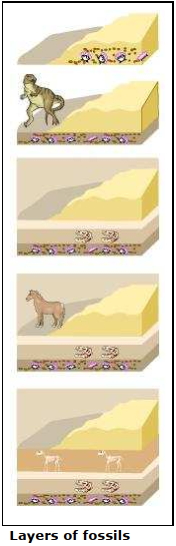
To understand their importance in determining evolutionary history,consider the following example:
$1$. Approximately $100$ million years ago,invertebrates died and were buried in sediment,which eventually turned into sedimentary rock.
$2$. Millions of years later,dinosaurs died in the same area,and their remains were buried in a new layer of sediment on top of the older rock. This layer also fossilized.
$3$. Much later,horse-like creatures died in the same region,and their fossils formed in a layer above the dinosaur fossils.
$4$. Over time,geological processes like soil erosion or flooding may expose the upper layers containing the horse-like fossils.
If scientists excavate deeper into the earth at this site,they will find the dinosaur fossils,and deeper still,the invertebrate fossils. By analyzing these layers,scientists can conclude that horse-like animals evolved more recently than dinosaurs,which in turn evolved after the invertebrates. Thus,fossils found closer to the surface are generally more recent than those found in deeper geological strata.
To understand their importance in determining evolutionary history,consider the following example:
$1$. Approximately $100$ million years ago,invertebrates died and were buried in sediment,which eventually turned into sedimentary rock.
$2$. Millions of years later,dinosaurs died in the same area,and their remains were buried in a new layer of sediment on top of the older rock. This layer also fossilized.
$3$. Much later,horse-like creatures died in the same region,and their fossils formed in a layer above the dinosaur fossils.
$4$. Over time,geological processes like soil erosion or flooding may expose the upper layers containing the horse-like fossils.
If scientists excavate deeper into the earth at this site,they will find the dinosaur fossils,and deeper still,the invertebrate fossils. By analyzing these layers,scientists can conclude that horse-like animals evolved more recently than dinosaurs,which in turn evolved after the invertebrates. Thus,fossils found closer to the surface are generally more recent than those found in deeper geological strata.
0 likes
View Solution26
Medium
What evidence do we have for the origin of life from inanimate matter?
Solution
(N/A) British scientist,$J$.$B$.$S$. Haldane,suggested that life originated from simple inorganic molecules. He believed that when the earth was formed,it was a hot gaseous mass containing elements such as nitrogen,oxygen,carbon,and hydrogen. These elements combined to form molecules like water $(H_2O)$,carbon dioxide $(CO_2)$,methane $(CH_4)$,and ammonia $(NH_3)$.
After the formation of water,the earth's surface slowly cooled,and the inorganic molecules interacted with one another in water to form simple organic molecules such as sugars,fatty acids,and amino acids.
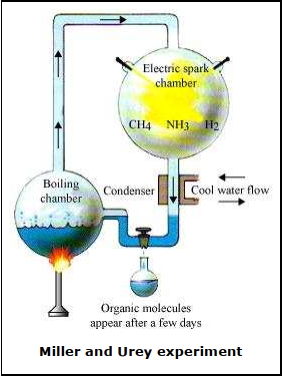
The energy for these reactions was provided by solar radiation,lightning,and volcanic eruptions. This was proved by the experiment of Stanley $L$. Miller and Harold $C$. Urey in $1953$. They took a mixture of water $(H_2O)$,methane $(CH_4)$,ammonia $(NH_3)$,and hydrogen gas $(H_2)$ in a chamber and passed sparks through this mixture using two electrodes. After one week,$15\%$ of the carbon from methane was converted into amino acids,sugars,etc. These organic molecules polymerized and assembled to form protein molecules that gave rise to life on earth.
After the formation of water,the earth's surface slowly cooled,and the inorganic molecules interacted with one another in water to form simple organic molecules such as sugars,fatty acids,and amino acids.
The energy for these reactions was provided by solar radiation,lightning,and volcanic eruptions. This was proved by the experiment of Stanley $L$. Miller and Harold $C$. Urey in $1953$. They took a mixture of water $(H_2O)$,methane $(CH_4)$,ammonia $(NH_3)$,and hydrogen gas $(H_2)$ in a chamber and passed sparks through this mixture using two electrodes. After one week,$15\%$ of the carbon from methane was converted into amino acids,sugars,etc. These organic molecules polymerized and assembled to form protein molecules that gave rise to life on earth.
0 likes
View Solution27
Medium
Explain how sexual reproduction gives rise to more viable variations than asexual reproduction. How does this affect the evolution of those organisms that reproduce sexually?
Solution
(N/A) In sexual reproduction,two individuals having different variations combine their $DNA$ to give rise to a new individual. Therefore,sexual reproduction allows more variations,whereas in asexual reproduction,chance variations can only occur when the copying of $DNA$ is not accurate.
Additionally,asexual reproduction allows for very few variations because if there are too many variations,the resultant $DNA$ may not be able to function within the inherited cellular apparatus.
However,in sexual reproduction,more variations are allowed and the resultant $DNA$ is able to survive,thus making the variations viable.
$Variation$ and $Evolution$: Variants help the species to survive in changing conditions. Environmental factors such as heat,light,pests,and food availability can change suddenly. At such times,only those variants resistant to these conditions are able to survive. This slowly leads to the evolution of a better-adapted species. Thus,variation plays a crucial role in the evolution of sexually reproducing organisms.
Additionally,asexual reproduction allows for very few variations because if there are too many variations,the resultant $DNA$ may not be able to function within the inherited cellular apparatus.
However,in sexual reproduction,more variations are allowed and the resultant $DNA$ is able to survive,thus making the variations viable.
$Variation$ and $Evolution$: Variants help the species to survive in changing conditions. Environmental factors such as heat,light,pests,and food availability can change suddenly. At such times,only those variants resistant to these conditions are able to survive. This slowly leads to the evolution of a better-adapted species. Thus,variation plays a crucial role in the evolution of sexually reproducing organisms.
0 likes
View Solution28
Medium
How is the equal genetic contribution of male and female parents ensured in the progeny?
Solution
(N/A) In human beings,every somatic cell of the body contains $23$ pairs of chromosomes.
Out of these $23$ pairs,the first $22$ pairs are known as autosomes and the remaining one pair is known as sex chromosomes,represented as $X$ and $Y$.
Females have two $X$ chromosomes and males have one $X$ and one $Y$ chromosome.
The gametes are formed through the process of meiosis,which reduces the number of chromosomes to half.
Therefore,the male gametes contain $22$ autosomes and either an $X$ or a $Y$ chromosome.
The female gamete,on the other hand,contains $22$ autosomes and an $X$ chromosome.
During fertilization,the male and female gametes fuse to form a zygote.
Thus,the progeny receives $22$ autosomes and one sex chromosome from each parent,ensuring an equal genetic contribution of $23$ pairs of chromosomes in the offspring.
Out of these $23$ pairs,the first $22$ pairs are known as autosomes and the remaining one pair is known as sex chromosomes,represented as $X$ and $Y$.
Females have two $X$ chromosomes and males have one $X$ and one $Y$ chromosome.
The gametes are formed through the process of meiosis,which reduces the number of chromosomes to half.
Therefore,the male gametes contain $22$ autosomes and either an $X$ or a $Y$ chromosome.
The female gamete,on the other hand,contains $22$ autosomes and an $X$ chromosome.
During fertilization,the male and female gametes fuse to form a zygote.
Thus,the progeny receives $22$ autosomes and one sex chromosome from each parent,ensuring an equal genetic contribution of $23$ pairs of chromosomes in the offspring.
0 likes
View Solution29
Advanced
Only variations that confer an advantage to an individual organism will survive in a population. Do you agree with this statement? Why or why not?
Solution
(N/A) In species,variations that offer survival advantages are naturally selected. Individuals adjust to their environments with the help of these selected variations,and consequently,these variations are passed on to their progeny. Evolution of organisms occurs as a result of this natural selection.
However,there can be some other variations that do not offer any survival advantage and arise only accidentally. Such variations in small populations can change the frequency of some genes even if they are not important for survival. This accidental change in the frequency of genes in small populations is referred to as genetic drift.
Thus,genetic drift provides diversity (variations) without any survival advantage.
However,there can be some other variations that do not offer any survival advantage and arise only accidentally. Such variations in small populations can change the frequency of some genes even if they are not important for survival. This accidental change in the frequency of genes in small populations is referred to as genetic drift.
Thus,genetic drift provides diversity (variations) without any survival advantage.
0 likes
View SolutionHeredity — Textbook - Heredity and Evolution · Frequently Asked Questions
1Are these Heredity questions useful for JEE and NEET?
Yes. All questions in this section are mapped to JEE Main and NEET exam patterns. Previous year questions from JEE Main, NEET, GUJCET and state-level exams are included with full solutions.
2Can I switch to Hindi or Gujarati for these questions?
Yes. Use the language tabs in the hero section or the sidebar to view the same questions and solutions in English, Hindi or Gujarati.
3How do I generate a question paper from this subtopic?
Use the Vedclass Exam Paper Generator — select the chapter and subtopic, set difficulty, and generate Sets A, B, C, D automatically. First 3 chapters of every subject are free.
Vedclass Products
For Students
Vedclass Test Series
Mock tests in real JEE/NEET style with performance analysis. 5-day free trial.
Start Free TrialFor Teachers
Exam Paper Generator
Generate Set A/B/C/D papers from this chapter in 2 minutes. 3 chapters free.
Try FreeFor Institutes
Online Exam Module
Live online exams with unlimited students, 360° analytics & white-label branding.
See DemoFor Teachers & Institutes
Generate a Heredity Exam Paper in 2 Minutes
Select subtopic & difficulty — Sets A, B, C, D auto-generated with No Repeat logic.
First 3 chapters of every subject are free — no payment required.