
A English
Mix Examples - Heredity and Evolution Questions in English
Class 10 Science · Heredity · Mix Examples - Heredity and Evolution
204+
Questions
English
Language
100%
With Solutions
Showing 50 of 204 questions in English
51
Easy
An organism which is a worm,has very simple 'eyes',that are really eye spots which detect light. Name that organism.
Solution
(PLANARIA) The organism is $Planaria$. $Planaria$ is a flatworm that possesses simple eye spots known as ocelli. These structures are not true eyes capable of forming images but are photoreceptors that allow the organism to detect the intensity and direction of light,helping it move away from bright light to stay in dark,safe environments.
0 likes
View Solution52
EasyMCQ
Why is the progeny always tall when a tall pea plant is crossed with a short pea plant?
A
Tallness is a recessive trait.
B
Tallness is a dominant trait.
C
Shortness is a dominant trait.
D
Both traits are codominant.
Solution
(B) In pea plants,the gene for tallness $(T)$ is dominant over the gene for shortness $(t)$. When a homozygous tall plant $(TT)$ is crossed with a homozygous short plant $(tt)$,all offspring in the $F_1$ generation have the genotype $Tt$. Since the tall trait is dominant,it masks the expression of the short trait,resulting in all progeny being tall.
0 likes
View Solution53
Easy
All the variations in a species do not have equal chances of survival. Why?
Solution
(N/A) Variations are differences in the characteristics of individuals within a species.
Some variations provide a survival advantage to an organism in a specific environment,while others may be neutral or disadvantageous.
Natural selection acts on these variations; individuals with beneficial variations are more likely to survive and reproduce,passing those traits to the next generation.
Since not all variations are equally beneficial for survival in a changing environment,they do not have equal chances of survival.
Some variations provide a survival advantage to an organism in a specific environment,while others may be neutral or disadvantageous.
Natural selection acts on these variations; individuals with beneficial variations are more likely to survive and reproduce,passing those traits to the next generation.
Since not all variations are equally beneficial for survival in a changing environment,they do not have equal chances of survival.
0 likes
View Solution54
EasyMCQ
Why is it that asexual reproduction produces exact copies, but sometimes minor variations are also seen in the next progeny?
A
Due to mutation
B
Due to $DNA$ copying errors
C
Due to environmental factors
D
All of the above
Solution
(B) Asexual reproduction involves the replication of $DNA$ to create copies for the offspring.
Since no biochemical reaction is $100\%$ reliable, the process of $DNA$ copying can result in slight errors or inaccuracies.
These minor changes in the $DNA$ sequence lead to variations in the next progeny, even though they are clones of the parent.
Since no biochemical reaction is $100\%$ reliable, the process of $DNA$ copying can result in slight errors or inaccuracies.
These minor changes in the $DNA$ sequence lead to variations in the next progeny, even though they are clones of the parent.
0 likes
View Solution55
EasyMCQ
How can the chromosomes be identified?
A
By their length
B
By the position of the centromere
C
By their banding pattern after staining
D
All of the above
Solution
(D) In human beings,individual chromosomes are identified by three primary characteristics:
$1$. Their relative lengths.
$2$. The position of the centromere (which determines the shape of the chromosome,such as metacentric,submetacentric,etc.).
$3$. The specific banding pattern observed after staining with dyes like Giemsa.
$1$. Their relative lengths.
$2$. The position of the centromere (which determines the shape of the chromosome,such as metacentric,submetacentric,etc.).
$3$. The specific banding pattern observed after staining with dyes like Giemsa.
0 likes
View Solution56
Medium
$(a)$ How many gene sets should a germ cell have?
$(b)$ Mention two factors causing evolution.
$(b)$ Mention two factors causing evolution.
Solution
(N/A) germ cell should have one set of genes. This is because germ cells are haploid $(n)$ and are formed through meiosis,ensuring that when they fuse during fertilization,the resulting zygote has the correct diploid $(2n)$ number of chromosomes.
$(b)$ Two factors causing evolution are:
$(i)$ Genetic drift (random changes in gene frequency).
$(ii)$ Natural selection (differential survival and reproduction of individuals based on their traits).
$(b)$ Two factors causing evolution are:
$(i)$ Genetic drift (random changes in gene frequency).
$(ii)$ Natural selection (differential survival and reproduction of individuals based on their traits).
0 likes
View Solution57
Medium
What is micro-evolution? Does it explain speciation?
Solution
(N/A) Micro-evolution refers to the small-scale changes in allele frequencies within a population over a few generations,which alter the common characteristics of a particular species.
It does not fully explain speciation,as speciation involves significant evolutionary changes that lead to the formation of new,reproductively isolated species,whereas micro-evolution only accounts for minor variations within an existing species.
It does not fully explain speciation,as speciation involves significant evolutionary changes that lead to the formation of new,reproductively isolated species,whereas micro-evolution only accounts for minor variations within an existing species.
0 likes
View Solution58
MediumMCQ
In an area $A$,the leaf materials available to beetles were very less. What are the two consequences seen in case of beetles?
A
Increase in population and weight
B
Decrease in population and average weight
C
Increase in population and decrease in weight
D
Decrease in population and increase in weight
Solution
(B) $(i)$ Due to poor nutrition,the average weight of adult beetles decreases.
$(ii)$ The number of beetles (population) decreases due to starvation.
$(ii)$ The number of beetles (population) decreases due to starvation.
0 likes
View Solution59
Medium
What is $F_{2}$ generation?
Solution
(N/A) The $F_{2}$ generation,or second filial generation,is the generation produced by the self-pollination or interbreeding of individuals from the $F_{1}$ (first filial) generation. In this process,the $F_{1}$ generation acts as the parent generation to produce the $F_{2}$ offspring.
0 likes
View Solution60
EasyMCQ
"The chromosome number of the sexually reproducing parents and their offspring is the same." Justify this statement.
A
Meiosis occurs in parents.
B
Mitosis occurs in parents.
C
Fertilization restores the chromosome number.
D
Both $A$ and $C$.
Solution
(D) In sexual reproduction, the parents are diploid $(2n)$.
During gametogenesis, meiosis occurs, which reduces the chromosome number to half (haploid, $n$) in the gametes.
When these two haploid gametes fuse during fertilization, the original diploid number $(2n)$ is restored in the zygote.
Thus, the offspring maintain the same chromosome number as their parents.
During gametogenesis, meiosis occurs, which reduces the chromosome number to half (haploid, $n$) in the gametes.
When these two haploid gametes fuse during fertilization, the original diploid number $(2n)$ is restored in the zygote.
Thus, the offspring maintain the same chromosome number as their parents.
0 likes
View Solution61
Easy
If $YYRR$ represents round and yellow seeds,what do the following genotypes represent?
$yyrr$ $\quad$ $yyRR$
$yyrr$ $\quad$ $yyRR$
Solution
(N/A) $yyrr$ represents wrinkled and green seeds.
$yyRR$ represents wrinkled and yellow seeds.
Explanation: In pea plants,the allele for round shape $(R)$ is dominant over wrinkled $(r)$,and the allele for yellow color $(Y)$ is dominant over green $(y)$. Therefore,$yyrr$ (homozygous recessive) results in wrinkled and green seeds,while $yyRR$ (homozygous recessive for shape,homozygous dominant for color) results in wrinkled and yellow seeds.
$yyRR$ represents wrinkled and yellow seeds.
Explanation: In pea plants,the allele for round shape $(R)$ is dominant over wrinkled $(r)$,and the allele for yellow color $(Y)$ is dominant over green $(y)$. Therefore,$yyrr$ (homozygous recessive) results in wrinkled and green seeds,while $yyRR$ (homozygous recessive for shape,homozygous dominant for color) results in wrinkled and yellow seeds.
0 likes
View Solution62
Easy
Variations are important for the survival of species over time. Justify this statement with reasons.
Solution
(N/A) $(i)$ Variations allow organisms to adapt to changing environmental conditions,ensuring their survival.
$(ii)$ Variations provide the raw material for natural selection,where individuals with advantageous traits are more likely to survive and reproduce,passing those traits to the next generation.
$(iii)$ They prevent the extinction of a species by ensuring that at least some individuals can survive if the environment changes drastically.
$(ii)$ Variations provide the raw material for natural selection,where individuals with advantageous traits are more likely to survive and reproduce,passing those traits to the next generation.
$(iii)$ They prevent the extinction of a species by ensuring that at least some individuals can survive if the environment changes drastically.
0 likes
View Solution63
Difficult
In a monohybrid cross between tall pea plants denoted by $TT$ and short pea plants denoted by $tt,$ SehajAnant obtained only tall plants denoted by $Tt$ in the $F_{1}$ generation. However,in $F_{2}$ generation she obtained both tall and short plants. Using the above information,explain the law of dominance.
Solution
(N/A) According to the Law of Dominance,in a heterozygous condition,the trait that expresses itself in the $F_{1}$ generation is called the dominant trait,while the trait that remains masked is called the recessive trait.
In this cross,the $F_{1}$ generation consists of $Tt$ genotypes,all of which are tall. This indicates that the allele for tallness $(T)$ is dominant over the allele for shortness $(t)$.
Even though both alleles are present in the $F_{1}$ generation,only the dominant trait $(T)$ is phenotypically expressed. The recessive trait $(t)$ only expresses itself in the $F_{2}$ generation when it is present in a homozygous condition $(tt)$.
In this cross,the $F_{1}$ generation consists of $Tt$ genotypes,all of which are tall. This indicates that the allele for tallness $(T)$ is dominant over the allele for shortness $(t)$.
Even though both alleles are present in the $F_{1}$ generation,only the dominant trait $(T)$ is phenotypically expressed. The recessive trait $(t)$ only expresses itself in the $F_{2}$ generation when it is present in a homozygous condition $(tt)$.
0 likes
View Solution64
Medium
How can we say that a change in genes can bring about a change in $DNA$?
Solution
(N/A) gene is a specific segment of $DNA$ located on a chromosome that codes for a particular protein or functional $RNA$.
Since genes are the functional units of inheritance composed of $DNA$ sequences,any alteration in the nucleotide sequence of a gene (mutation) directly modifies the structure of the $DNA$ molecule.
Because the $DNA$ molecule is essentially a long chain of these gene segments and non-coding regions,a change in the genetic code of a gene segment constitutes a change in the $DNA$ itself.
Therefore,it is accurate to state that a change in genes brings about a change in $DNA$.
Since genes are the functional units of inheritance composed of $DNA$ sequences,any alteration in the nucleotide sequence of a gene (mutation) directly modifies the structure of the $DNA$ molecule.
Because the $DNA$ molecule is essentially a long chain of these gene segments and non-coding regions,a change in the genetic code of a gene segment constitutes a change in the $DNA$ itself.
Therefore,it is accurate to state that a change in genes brings about a change in $DNA$.
0 likes
View Solution65
Easy
Where are the genes located? What is the chemical nature of a gene?
Solution
(N/A) Genes are located on chromosomes in a linear sequence at specific positions known as loci. Chemically,genes are acidic in nature because they are composed of $DNA$ (Deoxyribonucleic acid),which is a type of nucleic acid.
0 likes
View Solution66
Medium
$(a)$ Write the full form of $DNA$.
$(b)$ Why are variations essential for the species?
$(b)$ Why are variations essential for the species?
Solution
(N/A) The full form of $DNA$ is $Deoxyribonucleic \text{ } Acid$.
$(b)$ Variations are essential for the species because they provide the ability to adapt to changing environmental conditions. This ensures the survival of the species over time, as individuals with favorable variations are more likely to survive and reproduce in a dynamic environment.
$(b)$ Variations are essential for the species because they provide the ability to adapt to changing environmental conditions. This ensures the survival of the species over time, as individuals with favorable variations are more likely to survive and reproduce in a dynamic environment.
0 likes
View Solution67
Medium
What is the importance of $DNA$ copying in reproduction? Why is variation beneficial to the species but not necessarily for the individual? Explain.
Solution
(N/A) $DNA$ copying is an essential part of reproduction because it ensures that the same blueprint of the body design is passed on to the offspring.
Variation is beneficial to the species because it allows populations to adapt to changing environmental conditions,ensuring the survival of the species over time.
However,variation is not necessarily beneficial for the individual because a specific variation might not provide an immediate advantage to that organism in its current environment,and in some cases,it could even be harmful or neutral.
Variation is beneficial to the species because it allows populations to adapt to changing environmental conditions,ensuring the survival of the species over time.
However,variation is not necessarily beneficial for the individual because a specific variation might not provide an immediate advantage to that organism in its current environment,and in some cases,it could even be harmful or neutral.
0 likes
View Solution68
Medium
$(a)$ "Recent fossils are found closer to the earth's surface." Comment on the statement stating reason.
$(b)$ List two factors which could lead to the rise of new species.
$(b)$ List two factors which could lead to the rise of new species.
Solution
(N/A) This statement is correct. Fossils are formed in sedimentary rock layers. As new layers of sediment are deposited over time, the older organisms are buried deeper, while the more recent organisms are buried in the upper, shallower layers.
$(b)$ Two factors that lead to the rise of new species (speciation) are:
$1$. Natural selection: The process where organisms better adapted to their environment tend to survive and produce more offspring.
$2$. Genetic drift: The change in the frequency of an existing gene variant in a population due to random chance.
$(b)$ Two factors that lead to the rise of new species (speciation) are:
$1$. Natural selection: The process where organisms better adapted to their environment tend to survive and produce more offspring.
$2$. Genetic drift: The change in the frequency of an existing gene variant in a population due to random chance.
0 likes
View Solution69
Medium
"Experiences of an individual during its lifetime cannot be passed on to its progeny and cannot direct evolution". Justify this statement giving an example.
Solution
(N/A) The statement is correct because acquired traits are changes in the somatic (non-reproductive) tissues of an organism and do not affect the $DNA$ of the germ cells. Since only the genetic information in the germ cells is passed to the next generation, these experiences cannot be inherited.
Example: If a person learns to play a musical instrument or develops strong muscles through exercise, these are acquired traits. The offspring of such an individual will not be born with the ability to play the instrument or with developed muscles because these changes did not occur in the reproductive $DNA$.
Example: If a person learns to play a musical instrument or develops strong muscles through exercise, these are acquired traits. The offspring of such an individual will not be born with the ability to play the instrument or with developed muscles because these changes did not occur in the reproductive $DNA$.
0 likes
View Solution70
Medium
What are sex chromosomes? Which sex chromosomes are found in male and female human beings? State the chromosome responsible for the development of a male child in human beings?
Solution
(N/A) Sex chromosomes are a specific pair of chromosomes that determine the biological sex of an individual.
In human beings,females possess a pair of $XX$ chromosomes,while males possess one $X$ and one $Y$ chromosome $(XY)$.
The $Y$ chromosome is responsible for the development of a male child. When a sperm carrying a $Y$ chromosome fertilizes an egg (which always carries an $X$ chromosome),the resulting zygote has $XY$ chromosomes,leading to the development of a male child.
In human beings,females possess a pair of $XX$ chromosomes,while males possess one $X$ and one $Y$ chromosome $(XY)$.
The $Y$ chromosome is responsible for the development of a male child. When a sperm carrying a $Y$ chromosome fertilizes an egg (which always carries an $X$ chromosome),the resulting zygote has $XY$ chromosomes,leading to the development of a male child.
0 likes
View Solution71
Medium
$(a)$ Distinguish between homologous and analogous organs.
$(b)$ State one evidence of organic evolution.
$(b)$ State one evidence of organic evolution.
Solution
(N/A) Homologous organs are those organs which have a common ancestral origin and similar basic structural design,but perform different functions (e.g.,forelimbs of humans and wings of birds).
Analogous organs are those organs which perform similar functions and have a similar appearance,but have different ancestral origins and different basic structural designs (e.g.,wings of a butterfly and wings of a bird).
$(b)$ One evidence of organic evolution is the study of fossils (paleontology),which provides a chronological record of organisms that lived in the past and shows how species have changed over time.
Analogous organs are those organs which perform similar functions and have a similar appearance,but have different ancestral origins and different basic structural designs (e.g.,wings of a butterfly and wings of a bird).
$(b)$ One evidence of organic evolution is the study of fossils (paleontology),which provides a chronological record of organisms that lived in the past and shows how species have changed over time.
0 likes
View Solution72
Difficult
Explain Mendel's concept of heredity, by giving three points.
Solution
(N/A) $(i)$ Mendel worked on pea plant $(Pisum \text{ } sativum)$ and discovered the fundamental laws of inheritance. He found that traits (characteristics) are controlled by factors (which are now called genes) and each factor (gene) comes in pairs. These factors (genes) are inherited as distinct units, one from each parent.
$(ii)$ Mendel studied that genes segregate during the formation of gametes (sperms in males and ova in females) and they again combine in the offspring (one from each parent) and appear as a dominant or recessive trait.
$(iii)$ Mendel proposed three laws, namely:
$(a)$ Law of segregation: Each inherited trait is defined by a pair of genes. Parental genes are randomly separated into the germ cells so that each germ cell contains only one gene of the pair.
$(b)$ Law of independent assortment: Genes for different traits are sorted separately from one another so that the inheritance of one trait is not dependent on the inheritance of another.
$(c)$ Law of dominance: An organism with alternate forms of a gene will express the form that is dominant.
$(ii)$ Mendel studied that genes segregate during the formation of gametes (sperms in males and ova in females) and they again combine in the offspring (one from each parent) and appear as a dominant or recessive trait.
$(iii)$ Mendel proposed three laws, namely:
$(a)$ Law of segregation: Each inherited trait is defined by a pair of genes. Parental genes are randomly separated into the germ cells so that each germ cell contains only one gene of the pair.
$(b)$ Law of independent assortment: Genes for different traits are sorted separately from one another so that the inheritance of one trait is not dependent on the inheritance of another.
$(c)$ Law of dominance: An organism with alternate forms of a gene will express the form that is dominant.
0 likes
View Solution73
Medium
$(a)$ What function is performed by human arms,forelimbs of a dog,and forelimbs of whales?
$(b)$ Which type of organs are these?
$(c)$ Why are they called so?
$(b)$ Which type of organs are these?
$(c)$ Why are they called so?
Solution
(N/A) Human arms are used for holding and manipulating objects.
Forelimbs of a dog are used for running and locomotion.
Forelimbs of whales are used as paddles for swimming.
$(b)$ These are known as homologous organs.
$(c)$ They are called homologous organs because they share a common ancestral origin and similar basic anatomical structure,even though they have evolved to perform different functions in different environments.
Forelimbs of a dog are used for running and locomotion.
Forelimbs of whales are used as paddles for swimming.
$(b)$ These are known as homologous organs.
$(c)$ They are called homologous organs because they share a common ancestral origin and similar basic anatomical structure,even though they have evolved to perform different functions in different environments.
0 likes
View Solution74
Medium
If a population of red beetles,living on green bushes,is being eaten by crows. During sexual reproduction,a green beetle is found in the progeny.
$(a)$ What is the future of the new trait?
$(b)$ Will it survive in the new habitat?
$(a)$ What is the future of the new trait?
$(b)$ Will it survive in the new habitat?
Solution
(N/A) When a green beetle appears in the progeny,it gains a survival advantage because it camouflages with the green bushes,making it harder for crows to spot and eat it. Consequently,the population of green beetles will increase,while the population of red beetles will decrease due to predation.
$(b)$ Yes,the new trait (green color) will survive and proliferate because it provides a selective advantage in the given environment.
$(b)$ Yes,the new trait (green color) will survive and proliferate because it provides a selective advantage in the given environment.
0 likes
View Solution75
Medium
An angiosperm plant having red coloured flowers when crossed with another having the same colour produced $40$ progenies,out of which $30$ plants were with red coloured flowers and $10$ plants were with white coloured flowers. Find out:
$(a)$ What is the possible genotype of parent plants?
$(b)$ Which trait is dominant and which is recessive?
$(c)$ What is this cross called and what is its phenotypic ratio?
$(a)$ What is the possible genotype of parent plants?
$(b)$ Which trait is dominant and which is recessive?
$(c)$ What is this cross called and what is its phenotypic ratio?
Solution
(A) The parent plants must be heterozygous $(Rr)$ because they produced white-flowered offspring $(rr)$,which is only possible if both parents carry the recessive allele.
$(b)$ Red colour is the dominant trait because it appears in the majority of the progeny $(30/40)$,while white colour is the recessive trait as it only appears in the homozygous recessive condition $(10/40)$.
$(c)$ This is a monohybrid cross. The phenotypic ratio is $30:10$,which simplifies to $3:1$ (Red:White).
$(b)$ Red colour is the dominant trait because it appears in the majority of the progeny $(30/40)$,while white colour is the recessive trait as it only appears in the homozygous recessive condition $(10/40)$.
$(c)$ This is a monohybrid cross. The phenotypic ratio is $30:10$,which simplifies to $3:1$ (Red:White).
0 likes
View Solution76
Medium
Explain the following:
$(a)$ Speciation
$(b)$ Natural Selection
$(a)$ Speciation
$(b)$ Natural Selection
Solution
(N/A) Speciation:
It is the process of evolution of a new species from pre-existing species.
It occurs due to the accumulation of variations over many generations.
It is driven by processes like genetic drift or geographical barriers such as mountains,rivers,etc.,which lead to reproductive isolation,making the populations incapable of interbreeding.
$(b)$ Natural Selection:
It refers to the change in the frequency of certain genes in a population over time.
It provides a survival advantage to individuals possessing beneficial traits,preventing their elimination from the population.
For example,in a population of beetles,a new variation (green colour) provides a survival advantage to green beetles against predators,whereas the other variant (red) is more easily spotted and perishes.
It is the process of evolution of a new species from pre-existing species.
It occurs due to the accumulation of variations over many generations.
It is driven by processes like genetic drift or geographical barriers such as mountains,rivers,etc.,which lead to reproductive isolation,making the populations incapable of interbreeding.
$(b)$ Natural Selection:
It refers to the change in the frequency of certain genes in a population over time.
It provides a survival advantage to individuals possessing beneficial traits,preventing their elimination from the population.
For example,in a population of beetles,a new variation (green colour) provides a survival advantage to green beetles against predators,whereas the other variant (red) is more easily spotted and perishes.
0 likes
View Solution77
Medium
$A$ pea plant with blue colour flower denoted by $BB$ is cross-bred with a pea plant with white flower denoted by $ww$.
$(a)$ What is the expected colour of the flowers in their $F_{1}$ progeny?
$(b)$ What will be the percentage of plants bearing white flower in $F_{2}$ generation,when the flowers of $F_{1}$ plants were selfed?
$(c)$ State the expected ratio of the genotypes $BB$ and $Bw$ in the $F_{2}$ progeny.
$(a)$ What is the expected colour of the flowers in their $F_{1}$ progeny?
$(b)$ What will be the percentage of plants bearing white flower in $F_{2}$ generation,when the flowers of $F_{1}$ plants were selfed?
$(c)$ State the expected ratio of the genotypes $BB$ and $Bw$ in the $F_{2}$ progeny.
Solution
(N/A) In the $F_{1}$ generation,the cross between $BB$ (blue) and $ww$ (white) results in all offspring having the genotype $Bw$. Since blue is dominant,all $F_{1}$ plants will have blue flowers.
$(b)$ When $F_{1}$ plants $(Bw)$ are self-pollinated,the $F_{2}$ generation follows the Mendelian ratio of $1 BB : 2 Bw : 1 ww$. The plants with the genotype $ww$ will have white flowers. Thus,$1/4$ or $25 \%$ of the plants will bear white flowers.
$(c)$ In the $F_{2}$ generation,the genotypes are $1 BB : 2 Bw : 1 ww$. Therefore,the ratio of the genotypes $BB$ to $Bw$ is $1:2$.
$(b)$ When $F_{1}$ plants $(Bw)$ are self-pollinated,the $F_{2}$ generation follows the Mendelian ratio of $1 BB : 2 Bw : 1 ww$. The plants with the genotype $ww$ will have white flowers. Thus,$1/4$ or $25 \%$ of the plants will bear white flowers.
$(c)$ In the $F_{2}$ generation,the genotypes are $1 BB : 2 Bw : 1 ww$. Therefore,the ratio of the genotypes $BB$ to $Bw$ is $1:2$.
0 likes
View Solution78
Medium
Give reasons for the following:
$(a)$ Traits acquired during the lifetime of an individual are not inherited.
$(b)$ All human beings belong to a single species.
$(c)$ Variations keep on accumulating during reproduction and do not disappear in the next generation.
$(a)$ Traits acquired during the lifetime of an individual are not inherited.
$(b)$ All human beings belong to a single species.
$(c)$ Variations keep on accumulating during reproduction and do not disappear in the next generation.
Solution
(N/A) Acquired traits do not cause any change in the $DNA$ of the germ cells of an organism,hence they are not inherited.
$(b)$ All humans,despite their diverse appearances,belong to a single species,$Homo$ $sapiens$. They originated in Africa and migrated across the globe. Differences in skin colour and physical features are merely adaptations to different environmental conditions and do not constitute speciation.
$(c)$ Inheritance from the previous generation provides a common basic body design along with subtle changes. These variations are passed on to the next generation,where they accumulate over successive generations.
$(b)$ All humans,despite their diverse appearances,belong to a single species,$Homo$ $sapiens$. They originated in Africa and migrated across the globe. Differences in skin colour and physical features are merely adaptations to different environmental conditions and do not constitute speciation.
$(c)$ Inheritance from the previous generation provides a common basic body design along with subtle changes. These variations are passed on to the next generation,where they accumulate over successive generations.
0 likes
View Solution79
Medium
In a pea plant,find the contrasting trait for the following:
$(a)$ The position of the flower is terminal.
$(b)$ The flower is white in colour.
$(c)$ The shape of the pod is constricted.
$(a)$ The position of the flower is terminal.
$(b)$ The flower is white in colour.
$(c)$ The shape of the pod is constricted.
Solution
(N/A) In pea plants,Mendel studied several contrasting traits. The contrasting traits for the given conditions are:
$(a)$ The contrasting trait for a terminal flower position is an axial flower position.
$(b)$ The contrasting trait for a white flower colour is a purple (or violet) flower colour.
$(c)$ The contrasting trait for a constricted pod shape is an inflated (or full) pod shape.
$(a)$ The contrasting trait for a terminal flower position is an axial flower position.
$(b)$ The contrasting trait for a white flower colour is a purple (or violet) flower colour.
$(c)$ The contrasting trait for a constricted pod shape is an inflated (or full) pod shape.
0 likes
View Solution80
Medium
$(a)$ "Chromosomes are heredity carriers." Why do we say so?
$(b)$ Which vital function is not controlled by autosomes?
$(b)$ Which vital function is not controlled by autosomes?
Solution
(N/A) Chromosomes are composed of $DNA$ and proteins. Genes, which are the units of inheritance, are located on these chromosomes. During reproduction, $DNA$ is copied and transferred from both parents to their offspring, ensuring the transmission of hereditary traits. Thus, chromosomes are considered the carriers of heredity.
$(b)$ The sex of the child is not controlled by autosomes; it is determined by the sex chromosomes ($X$ and $Y$).
$(b)$ The sex of the child is not controlled by autosomes; it is determined by the sex chromosomes ($X$ and $Y$).
0 likes
View Solution81
Medium
With the help of suitable examples,explain why certain traits cannot be passed on to the next generation. What are such traits called?
Solution
(N/A) Example: Acquiring knowledge by reading or a change in body weight due to diet.
Reason: Such traits are not inherited because they do not cause any change in the $DNA$ of the germ cells. These changes occur only in the somatic (non-reproductive) tissues,which do not contribute to the genetic material passed on to the offspring.
Terminology: Such traits are called Acquired Traits.
Reason: Such traits are not inherited because they do not cause any change in the $DNA$ of the germ cells. These changes occur only in the somatic (non-reproductive) tissues,which do not contribute to the genetic material passed on to the offspring.
Terminology: Such traits are called Acquired Traits.
0 likes
View Solution82
Medium
$A$ trait may be inherited, but may not be expressed. Justify this statement with the help of a suitable example.
Solution
(N/A) When a tall pea plant was crossed with a dwarf pea plant, all plants in the $F_{1}$ generation were tall.
When these $F_{1}$ plants were self-pollinated, the $F_{2}$ generation consisted of both tall and dwarf plants.
This observation confirms that the $F_{1}$ plants inherited the genetic information for both parental traits (tallness and dwarfness).
However, the trait for dwarfness remained unexpressed in the $F_{1}$ generation because it is a recessive trait, which is masked by the dominant trait for tallness.
When these $F_{1}$ plants were self-pollinated, the $F_{2}$ generation consisted of both tall and dwarf plants.
This observation confirms that the $F_{1}$ plants inherited the genetic information for both parental traits (tallness and dwarfness).
However, the trait for dwarfness remained unexpressed in the $F_{1}$ generation because it is a recessive trait, which is masked by the dominant trait for tallness.
0 likes
View Solution83
Medium
List three main factors responsible for the speciation and briefly describe each one of them.
Solution
(N/A) $1$. Genetic Drift: This refers to the random change in the frequency of alleles in a population over generations,which can lead to significant changes in small populations.
$2$. Natural Selection: This is the process where individuals with favorable traits are better adapted to their environment,survive,and reproduce,passing these traits to the next generation.
$3$. Reproductive Isolation: This occurs when populations of the same species become geographically or behaviorally separated,preventing them from interbreeding and eventually leading to the formation of new species.
$2$. Natural Selection: This is the process where individuals with favorable traits are better adapted to their environment,survive,and reproduce,passing these traits to the next generation.
$3$. Reproductive Isolation: This occurs when populations of the same species become geographically or behaviorally separated,preventing them from interbreeding and eventually leading to the formation of new species.
0 likes
View Solution84
Medium
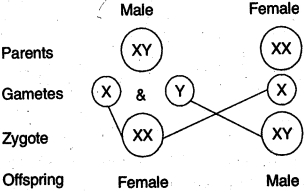
"It is a matter of chance whether a couple will give birth to a male child or a female child." Justify this statement with the help of a flow chart showing the fusion of sex chromosomes.
Solution
(N/A) The sex of a child is determined by the type of sperm that fertilizes the egg. Human males have $XY$ sex chromosomes, while females have $XX$ sex chromosomes.
During gametogenesis, males produce two types of sperms: $50\%$ carrying the $X$ chromosome and $50\%$ carrying the $Y$ chromosome. Females produce only one type of egg, all carrying the $X$ chromosome.
If a sperm carrying the $X$ chromosome fertilizes the egg, the zygote will be $XX$, resulting in a female child.
If a sperm carrying the $Y$ chromosome fertilizes the egg, the zygote will be $XY$, resulting in a male child.
Since there is an equal $(50-50)$ probability of either an $X$-carrying sperm or a $Y$-carrying sperm fertilizing the egg, it is purely a matter of chance whether the offspring will be male or female.
Flow Chart:
Parents: Male $(XY)$ $\times$ Female $(XX)$
Gametes: $(X)$ and $(Y)$ $\times$ $(X)$
Zygote: $(XX)$ [Female] and $(XY)$ [Male]
During gametogenesis, males produce two types of sperms: $50\%$ carrying the $X$ chromosome and $50\%$ carrying the $Y$ chromosome. Females produce only one type of egg, all carrying the $X$ chromosome.
If a sperm carrying the $X$ chromosome fertilizes the egg, the zygote will be $XX$, resulting in a female child.
If a sperm carrying the $Y$ chromosome fertilizes the egg, the zygote will be $XY$, resulting in a male child.
Since there is an equal $(50-50)$ probability of either an $X$-carrying sperm or a $Y$-carrying sperm fertilizing the egg, it is purely a matter of chance whether the offspring will be male or female.
Flow Chart:
Parents: Male $(XY)$ $\times$ Female $(XX)$
Gametes: $(X)$ and $(Y)$ $\times$ $(X)$
Zygote: $(XX)$ [Female] and $(XY)$ [Male]
0 likes
View Solution85
Medium
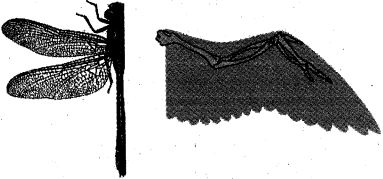
$(a)$ Which type of organs are shown in the figure below?
$(b)$ What is the origin and structure of these organs?
$(b)$ What is the origin and structure of these organs?
Solution
(N/A) The figure shows the wings of an insect and the wings of a bird,which are examples of analogous organs.
$(b)$ These organs have different evolutionary origins and different basic structural designs (e.g.,the bird's wing has bones,while the insect's wing is a membranous extension). However,they perform a similar function,which is flying. Such organs that have different origins but perform similar functions are called analogous organs.
$(b)$ These organs have different evolutionary origins and different basic structural designs (e.g.,the bird's wing has bones,while the insect's wing is a membranous extension). However,they perform a similar function,which is flying. Such organs that have different origins but perform similar functions are called analogous organs.
0 likes
View Solution86
Medium
$(a)$ "Each organism has its own identity". Explain.
$(b)$ What is speciation?
$(b)$ What is speciation?
Solution
(N/A) $(i)$ The $DNA$ of each organism is unique, which provides a distinct genetic blueprint.
$(ii)$ Within the same species, while the fundamental $DNA$ structure is similar, variations in the sequence of genes and the specific number of chromosomes contribute to individual identity.
$(b)$ Speciation is the evolutionary process by which new, distinct biological species arise from pre-existing populations through mechanisms such as natural selection, genetic drift, geographical isolation, or reproductive isolation.
$(ii)$ Within the same species, while the fundamental $DNA$ structure is similar, variations in the sequence of genes and the specific number of chromosomes contribute to individual identity.
$(b)$ Speciation is the evolutionary process by which new, distinct biological species arise from pre-existing populations through mechanisms such as natural selection, genetic drift, geographical isolation, or reproductive isolation.
0 likes
View Solution87
EasyMCQ
An organ like a wing in birds is an advantage to an organism. Did they appear in different stages or were they formed due to a single sudden change?
A
They appeared in a single sudden change.
B
They appeared in different stages.
C
They were acquired through inheritance of acquired characters.
D
They are vestigial organs.
Solution
(B) Feathers in dinosaurs were long,but they could not fly using them. These feathers initially provided protection from cold weather and helped in maintaining body warmth. Later,birds adapted these feathers for the purpose of flight. This indicates that the evolution of wings occurred in different stages rather than a single sudden change.
0 likes
View Solution88
Medium
Explain analogous organs and homologous organs. Identify the analogous and homologous organs amongst the following:
Wings of an insect,wings of a bat,forelimbs of frog,forelimbs of a human.
Wings of an insect,wings of a bat,forelimbs of frog,forelimbs of a human.
Solution
(N/A) Analogous organs: These are organs that perform similar functions but have different evolutionary origins and anatomical structures. They represent convergent evolution.
Homologous organs: These are organs that share a common anatomical structure and evolutionary origin,even if they perform different functions. They represent divergent evolution and indicate a common ancestor.
Identification:
Homologous organs: Forelimbs of a frog and forelimbs of a human (both share a similar pentadactyl limb structure).
Analogous organs: Wings of an insect and wings of a bat (both are used for flight but have different structural origins).
Homologous organs: These are organs that share a common anatomical structure and evolutionary origin,even if they perform different functions. They represent divergent evolution and indicate a common ancestor.
Identification:
Homologous organs: Forelimbs of a frog and forelimbs of a human (both share a similar pentadactyl limb structure).
Analogous organs: Wings of an insect and wings of a bat (both are used for flight but have different structural origins).
0 likes
View Solution89
Medium
$A$ cross was carried out between a pure-bred tall pea plant and a pure-bred dwarf pea plant,and $F_{1}$ progeny was obtained. Later,the $F_{1}$ progeny was selfed to obtain $F_{2}$ progeny. Answer the following questions:
$(a)$ What is the phenotype of the $F_{1}$ progeny and why?
$(b)$ Give the phenotypic ratio of the $F_{2}$ progeny.
$(c)$ Why is the $F_{2}$ progeny different from the $F_{1}$ progeny?
$(a)$ What is the phenotype of the $F_{1}$ progeny and why?
$(b)$ Give the phenotypic ratio of the $F_{2}$ progeny.
$(c)$ Why is the $F_{2}$ progeny different from the $F_{1}$ progeny?
Solution
(N/A) The phenotype of the $F_{1}$ progeny is tall. This is because the allele for tallness $(T)$ is dominant over the allele for dwarfness $(t)$. In the $F_{1}$ generation,all plants have the genotype $Tt$,where the dominant trait masks the expression of the recessive trait.
$(b)$ The phenotypic ratio of the $F_{2}$ progeny is $3:1$ (Tall : Dwarf).
$(c)$ The $F_{2}$ progeny is different from the $F_{1}$ progeny because,in the $F_{2}$ generation,the recessive alleles segregate and pair up in the homozygous condition $(tt)$,allowing the dwarf phenotype to be expressed,which was hidden in the $F_{1}$ generation.
$(b)$ The phenotypic ratio of the $F_{2}$ progeny is $3:1$ (Tall : Dwarf).
$(c)$ The $F_{2}$ progeny is different from the $F_{1}$ progeny because,in the $F_{2}$ generation,the recessive alleles segregate and pair up in the homozygous condition $(tt)$,allowing the dwarf phenotype to be expressed,which was hidden in the $F_{1}$ generation.
0 likes
View Solution90
Medium
$(a)$ State any two factors that could lead to the rise of a new species.
$(b)$ How do analogous organs provide evidence in favour of evolution?
$(b)$ How do analogous organs provide evidence in favour of evolution?
Solution
(N/A) Two factors that lead to the rise of a new species (speciation) are:
$1$. Genetic drift: Changes in allele frequencies due to chance events in small populations.
$2$. Natural selection: The process where organisms better adapted to their environment tend to survive and produce more offspring.
$(b)$ Analogous organs are those that perform similar functions but have different structural origins and developmental patterns. For example,the wings of a butterfly and the wings of a bird both serve the purpose of flight,but their internal structures are completely different. This provides evidence for evolution by showing that different species can evolve similar adaptations independently to survive in similar environments,a process known as convergent evolution.
$1$. Genetic drift: Changes in allele frequencies due to chance events in small populations.
$2$. Natural selection: The process where organisms better adapted to their environment tend to survive and produce more offspring.
$(b)$ Analogous organs are those that perform similar functions but have different structural origins and developmental patterns. For example,the wings of a butterfly and the wings of a bird both serve the purpose of flight,but their internal structures are completely different. This provides evidence for evolution by showing that different species can evolve similar adaptations independently to survive in similar environments,a process known as convergent evolution.
0 likes
View Solution91
Medium
$(a)$ Why traits such as intelligence and knowledge cannot be passed on to the next generation?
$(b)$ How can we say that birds are closely related to reptiles and have evolved from them?
$(b)$ How can we say that birds are closely related to reptiles and have evolved from them?
Solution
(N/A) Traits such as intelligence and knowledge are acquired traits,not heritable traits. These do not cause any changes in the $DNA$ of the germ cells; therefore,they cannot be passed on to the progeny.
$(b)$ We can say that birds are closely related to reptiles because fossils show that some dinosaurs,which were reptiles,possessed feathers. Initially,these feathers likely provided insulation in cold weather rather than aiding in flight. Later,birds adapted these feathers for flight. This evolutionary link confirms that birds are closely related to reptiles.
$(b)$ We can say that birds are closely related to reptiles because fossils show that some dinosaurs,which were reptiles,possessed feathers. Initially,these feathers likely provided insulation in cold weather rather than aiding in flight. Later,birds adapted these feathers for flight. This evolutionary link confirms that birds are closely related to reptiles.
0 likes
View Solution92
Medium
$(a)$ Differentiate between:
$(i)$ Homologous organs and Analogous organs
$(ii)$ Pollination and Fertilisation
$(b)$ What do fossils tell us about the process of evolution?
$(i)$ Homologous organs and Analogous organs
$(ii)$ Pollination and Fertilisation
$(b)$ What do fossils tell us about the process of evolution?
Solution
(N/A) $(i)$ Homologous organs are those which have the same basic structural design and developmental origin but perform different functions. Analogous organs are those which have different structural origins but perform similar functions.
$(ii)$ Pollination is the process of transfer of pollen grains from the anther to the stigma of a flower. Fertilisation is the process of fusion of the male gamete with the female gamete to form a zygote.
$(b)$ Fossils provide direct evidence for evolution. They help in establishing evolutionary relationships between organisms,show the sequence of evolutionary changes over time,and act as connecting links between different groups of organisms.
$(ii)$ Pollination is the process of transfer of pollen grains from the anther to the stigma of a flower. Fertilisation is the process of fusion of the male gamete with the female gamete to form a zygote.
$(b)$ Fossils provide direct evidence for evolution. They help in establishing evolutionary relationships between organisms,show the sequence of evolutionary changes over time,and act as connecting links between different groups of organisms.
0 likes
View Solution93
Medium
$(a)$ Explain,giving examples,how artificial selection has helped in the formation of newer varieties of cauliflower.
$(b)$ List the steps involved in the formation of new species.
$(c)$ How do different races of human beings belong to the same species?
$(b)$ List the steps involved in the formation of new species.
$(c)$ How do different races of human beings belong to the same species?
Solution
(N/A) Artificial selection is the process by which humans breed plants or animals for particular traits. Over thousands of years,humans have selected different traits from the wild cabbage plant ($Brassica$ $oleracea$) to create various vegetables. For example,by selecting for sterile flowers,we developed cauliflower; by selecting for arrested flower development,we developed broccoli; and by selecting for swollen parts,we developed kohlrabi.
$(b)$ The formation of new species,known as speciation,involves the following steps:
$1$. Genetic variation within a population.
$2$. Geographical isolation (separation of populations by physical barriers).
$3$. Genetic drift and natural selection acting on isolated populations.
$4$. Reproductive isolation,preventing interbreeding between populations.
$(c)$ Different races of human beings belong to the same species ($Homo$ $sapiens$) because they share a common ancestor,have similar genetic makeup,and are capable of interbreeding to produce fertile offspring.
$(b)$ The formation of new species,known as speciation,involves the following steps:
$1$. Genetic variation within a population.
$2$. Geographical isolation (separation of populations by physical barriers).
$3$. Genetic drift and natural selection acting on isolated populations.
$4$. Reproductive isolation,preventing interbreeding between populations.
$(c)$ Different races of human beings belong to the same species ($Homo$ $sapiens$) because they share a common ancestor,have similar genetic makeup,and are capable of interbreeding to produce fertile offspring.
0 likes
View Solution94
Medium
$(a)$ Explain why the wing of a bat and the wing of a bird are considered to be analogous organs.
$(b)$ List two factors that lead to the formation of a new species.
$(b)$ List two factors that lead to the formation of a new species.
Solution
(N/A) The wings of a bat and a bird are considered analogous organs because they perform the same function (flight) but have different anatomical structures and embryonic origins. The wing of a bat is a skin fold stretched between elongated fingers,whereas the wing of a bird is a feathered structure supported by the bones of the forelimb.
$(b)$ Two factors that lead to the formation of a new species (speciation) are:
$1$. Genetic drift: Changes in allele frequencies due to random chance in small populations.
$2$. Natural selection: The process where organisms better adapted to their environment tend to survive and produce more offspring,leading to evolutionary change.
$(b)$ Two factors that lead to the formation of a new species (speciation) are:
$1$. Genetic drift: Changes in allele frequencies due to random chance in small populations.
$2$. Natural selection: The process where organisms better adapted to their environment tend to survive and produce more offspring,leading to evolutionary change.
0 likes
View Solution95
Medium
$(i)$ Name the scientist who proposed the theory of evolution of species by natural selection.
$(ii)$ What conclusion did Mendel draw from his experiments regarding traits?
$(iii)$ Arrange the following organisms in the order of their evolutionary complexity: Cockroach,Mango tree,Gorilla,Fish.
$(ii)$ What conclusion did Mendel draw from his experiments regarding traits?
$(iii)$ Arrange the following organisms in the order of their evolutionary complexity: Cockroach,Mango tree,Gorilla,Fish.
Solution
(N/A) $(i)$ Charles Darwin proposed the theory of evolution by natural selection.
$(ii)$ Mendel concluded that traits are inherited independently,which is known as the Law of Independent Assortment.
$(iii)$ The evolutionary order from simplest to most complex is: Mango tree (Plant) $-$ Cockroach (Invertebrate) $-$ Fish (Lower Vertebrate) $-$ Gorilla (Higher Vertebrate/Mammal).
$(ii)$ Mendel concluded that traits are inherited independently,which is known as the Law of Independent Assortment.
$(iii)$ The evolutionary order from simplest to most complex is: Mango tree (Plant) $-$ Cockroach (Invertebrate) $-$ Fish (Lower Vertebrate) $-$ Gorilla (Higher Vertebrate/Mammal).
0 likes
View Solution96
Medium
$(a)$ What are fossils?
$(b)$ Explain the importance of fossils in evolutionary relationships.
$(b)$ Explain the importance of fossils in evolutionary relationships.
Solution
(N/A) Fossils are the preserved remains,impressions,or traces of organisms that lived in the past,found within sedimentary rock layers.
$(b)$ Fossils provide direct evidence of evolution by showing the existence of organisms that lived millions of years ago but are now extinct. They help in establishing evolutionary relationships by revealing the transition between different groups of organisms (connecting links) and demonstrating how modern species evolved from more primitive ancestral forms over geological time.
$(b)$ Fossils provide direct evidence of evolution by showing the existence of organisms that lived millions of years ago but are now extinct. They help in establishing evolutionary relationships by revealing the transition between different groups of organisms (connecting links) and demonstrating how modern species evolved from more primitive ancestral forms over geological time.
0 likes
View Solution97
Medium
$(a)$ "Evolution has occurred in stages." Justify the statement.
$(b)$ Differentiate between eye and eyespots. Which animal possesses eyespots?
$(b)$ Differentiate between eye and eyespots. Which animal possesses eyespots?
Solution
(N/A) The statement "Evolution has occurred in stages" is justified because evolutionary processes take place over vast periods of time, leading to the gradual development of complex organs bit-by-bit across generations. For instance, the eye evolved from simple light-sensing structures known as eyespots into the highly complex organs seen in higher animals today. Furthermore, the presence of vestigial organs, such as the nictitating membrane, vermiform appendix, and wisdom teeth, provides evidence that structures have been reduced or modified over time. These changes demonstrate that evolution is a cumulative, step-by-step process.
$(b)$ An eye is a complex sensory organ composed of various tissues capable of forming images and detecting light. In contrast, an eyespot is a simple, dot-like structure primarily used for sensing light intensity and direction. The animal $Planaria$ (a flatworm) possesses eyespots.
$(b)$ An eye is a complex sensory organ composed of various tissues capable of forming images and detecting light. In contrast, an eyespot is a simple, dot-like structure primarily used for sensing light intensity and direction. The animal $Planaria$ (a flatworm) possesses eyespots.
0 likes
View Solution98
Difficult
$(a)$ What are monohybrid and dihybrid crosses?
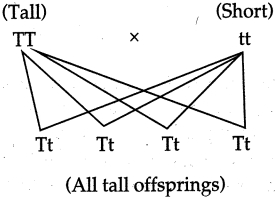
$(b)$ How did Mendel prove that tallness is the dominant trait and dwarfness is the recessive trait in a pea plant? Explain with the help of a monohybrid cross.
$(b)$ How did Mendel prove that tallness is the dominant trait and dwarfness is the recessive trait in a pea plant? Explain with the help of a monohybrid cross.
Solution
(N/A) monohybrid cross is a cross between two parents that differ in only one pair of contrasting traits. It results in a phenotypic ratio of $3:1$ in the $F_{2}$ generation. $A$ dihybrid cross is a cross between two parents that differ in two pairs of contrasting traits. It results in a phenotypic ratio of $9:3:3:1$ in the $F_{2}$ generation.
$(b)$ Mendel performed a monohybrid cross by taking a pure-breeding tall pea plant $(TT)$ and a pure-breeding dwarf pea plant $(tt)$.
When these plants were cross-pollinated,all the offspring in the $F_{1}$ generation were found to be tall $(Tt)$.
Since the $F_{1}$ generation only expressed the tall trait despite carrying the gene for dwarfness,Mendel concluded that tallness is the dominant trait and dwarfness is the recessive trait.
$(b)$ Mendel performed a monohybrid cross by taking a pure-breeding tall pea plant $(TT)$ and a pure-breeding dwarf pea plant $(tt)$.
When these plants were cross-pollinated,all the offspring in the $F_{1}$ generation were found to be tall $(Tt)$.
Since the $F_{1}$ generation only expressed the tall trait despite carrying the gene for dwarfness,Mendel concluded that tallness is the dominant trait and dwarfness is the recessive trait.
0 likes
View Solution99
Difficult
What are fossils? How are they formed? Describe in brief two methods of determining the age of fossils. State any one role of fossils in the study of the process of evolution.
Solution
(N/A) Fossils are the preserved remains or impressions of prehistoric organisms found in the different strata of the Earth's crust.
Fossils are formed when dead organisms are not completely decomposed. When organisms get trapped in substances like tree resin,volcanic lava,or hot mud,these materials harden over time and preserve the body parts or impressions of the organism.
Two methods of determining the age of fossils:
$(a)$ Relative method: This involves estimating the age of the sedimentary rock layer where the fossil is found. Fossils found in layers closer to the surface are more recent,while those found in deeper layers are more ancient.
$(b)$ Radio-carbon dating method: This involves detecting the ratios of different isotopes of carbon (specifically $C^{14}$) present in the fossil to calculate its age.
Role of fossils in evolution: Fossils provide evidence of evolutionary history and help in identifying connecting links between different groups of organisms,such as $Archaeopteryx$,which acts as a link between reptiles and birds.
Fossils are formed when dead organisms are not completely decomposed. When organisms get trapped in substances like tree resin,volcanic lava,or hot mud,these materials harden over time and preserve the body parts or impressions of the organism.
Two methods of determining the age of fossils:
$(a)$ Relative method: This involves estimating the age of the sedimentary rock layer where the fossil is found. Fossils found in layers closer to the surface are more recent,while those found in deeper layers are more ancient.
$(b)$ Radio-carbon dating method: This involves detecting the ratios of different isotopes of carbon (specifically $C^{14}$) present in the fossil to calculate its age.
Role of fossils in evolution: Fossils provide evidence of evolutionary history and help in identifying connecting links between different groups of organisms,such as $Archaeopteryx$,which acts as a link between reptiles and birds.
0 likes
View Solution100
Medium
$(a)$ Why do we say that homozygous plants produce pure progeny?
$(b)$ Define heterozygous.
$(c)$ Explain how the process of speciation takes place.
$(b)$ Define heterozygous.
$(c)$ Explain how the process of speciation takes place.
Solution
(N/A) Homozygous plants possess identical alleles for a particular trait (e.g.,$TT$ or $tt$). During gamete formation,all gametes carry the same allele,ensuring that all offspring inherit the same genetic makeup,thus producing pure progeny.
$(b)$ An organism is called heterozygous if it possesses two different alleles for a specific trait (e.g.,$Tt$).
$(c)$ Speciation occurs due to the following factors:
$(i)$ Natural selection: Differential survival and reproduction based on environmental pressures.
$(ii)$ Geographical isolation: Physical barriers preventing gene flow between populations.
$(iii)$ Genetic drift: Random changes in allele frequencies in a small population.
$(iv)$ Reproductive isolation: Accumulated variations in $DNA$ or chromosome numbers prevent interbreeding between groups,leading to the formation of a new species.
$(b)$ An organism is called heterozygous if it possesses two different alleles for a specific trait (e.g.,$Tt$).
$(c)$ Speciation occurs due to the following factors:
$(i)$ Natural selection: Differential survival and reproduction based on environmental pressures.
$(ii)$ Geographical isolation: Physical barriers preventing gene flow between populations.
$(iii)$ Genetic drift: Random changes in allele frequencies in a small population.
$(iv)$ Reproductive isolation: Accumulated variations in $DNA$ or chromosome numbers prevent interbreeding between groups,leading to the formation of a new species.
0 likes
View SolutionHeredity — Mix Examples - Heredity and Evolution · Frequently Asked Questions
1Are these Heredity questions useful for JEE and NEET?
Yes. All questions in this section are mapped to JEE Main and NEET exam patterns. Previous year questions from JEE Main, NEET, GUJCET and state-level exams are included with full solutions.
2Can I switch to Hindi or Gujarati for these questions?
Yes. Use the language tabs in the hero section or the sidebar to view the same questions and solutions in English, Hindi or Gujarati.
3How do I generate a question paper from this subtopic?
Use the Vedclass Exam Paper Generator — select the chapter and subtopic, set difficulty, and generate Sets A, B, C, D automatically. First 3 chapters of every subject are free.
Vedclass Products
For Students
Vedclass Test Series
Mock tests in real JEE/NEET style with performance analysis. 5-day free trial.
Start Free TrialFor Teachers
Exam Paper Generator
Generate Set A/B/C/D papers from this chapter in 2 minutes. 3 chapters free.
Try FreeFor Institutes
Online Exam Module
Live online exams with unlimited students, 360° analytics & white-label branding.
See DemoFor Teachers & Institutes
Generate a Heredity Exam Paper in 2 Minutes
Select subtopic & difficulty — Sets A, B, C, D auto-generated with No Repeat logic.
First 3 chapters of every subject are free — no payment required.