
A English
Mix Examples - Control and Coordination Questions in English
Class 10 Science · Control and Coordination · Mix Examples - Control and Coordination
230+
Questions
English
Language
100%
With Solutions
Showing 50 of 230 questions in English
101
Medium
$(a)$ Name the hormone which is injected to a diabetic patient.
$(b)$ Why should we use iodised salt in our diet?
$(c)$ If iodine is insufficient in one's diet,what might be the deficiency disease and its symptoms?
$(b)$ Why should we use iodised salt in our diet?
$(c)$ If iodine is insufficient in one's diet,what might be the deficiency disease and its symptoms?
Solution
(A) The hormone injected into a diabetic patient is $Insulin$.
$(b)$ We should use iodised salt in our diet because iodine is essential for the thyroid gland to synthesize and secrete the hormone $Thyroxine$. $Thyroxine$ plays a crucial role in regulating the metabolism of carbohydrates,proteins,and fats in the body,ensuring a balanced growth and development.
$(c)$ If iodine is insufficient in one's diet,it leads to a deficiency disease known as $Goitre$. The primary symptom of $Goitre$ is a swollen neck,caused by the enlargement of the thyroid gland as it attempts to produce more $Thyroxine$ in response to low iodine levels.
$(b)$ We should use iodised salt in our diet because iodine is essential for the thyroid gland to synthesize and secrete the hormone $Thyroxine$. $Thyroxine$ plays a crucial role in regulating the metabolism of carbohydrates,proteins,and fats in the body,ensuring a balanced growth and development.
$(c)$ If iodine is insufficient in one's diet,it leads to a deficiency disease known as $Goitre$. The primary symptom of $Goitre$ is a swollen neck,caused by the enlargement of the thyroid gland as it attempts to produce more $Thyroxine$ in response to low iodine levels.
0 likes
View Solution102
Medium
$(a)$ Name the part of the brain which controls:
$(i)$ voluntary actions,
$(ii)$ involuntary actions.
$(b)$ What is the significance of the peripheral nervous system? Name the components of this nervous system and distinguish between the origin of the two.
$(i)$ voluntary actions,
$(ii)$ involuntary actions.
$(b)$ What is the significance of the peripheral nervous system? Name the components of this nervous system and distinguish between the origin of the two.
Solution
(N/A) $(i)$ Voluntary actions are controlled by the cerebrum (specifically the motor cortex).
$(ii)$ Involuntary actions (such as blood pressure,salivation,and vomiting) are controlled by the medulla oblongata.
$(b)$ The peripheral nervous system $(PNS)$ facilitates communication between the central nervous system $(CNS)$ and the rest of the body.
The components of the $PNS$ are cranial nerves and spinal nerves.
Distinction in origin:
$1$. Cranial nerves arise directly from the brain.
$2$. Spinal nerves arise from the spinal cord.
$(ii)$ Involuntary actions (such as blood pressure,salivation,and vomiting) are controlled by the medulla oblongata.
$(b)$ The peripheral nervous system $(PNS)$ facilitates communication between the central nervous system $(CNS)$ and the rest of the body.
The components of the $PNS$ are cranial nerves and spinal nerves.
Distinction in origin:
$1$. Cranial nerves arise directly from the brain.
$2$. Spinal nerves arise from the spinal cord.
0 likes
View Solution103
Medium
$(a)$ Name the diseases by which a person is likely to suffer due to the deficiency of:
$(i)$ Iodine
$(ii)$ Insulin
$(b)$ How are the timing and amount of hormone secretion regulated in the human system? Explain with an example.
$(i)$ Iodine
$(ii)$ Insulin
$(b)$ How are the timing and amount of hormone secretion regulated in the human system? Explain with an example.
Solution
(N/A) $(i)$ Iodine deficiency leads to Goitre.
$(ii)$ Insulin deficiency leads to Diabetes.
$(b)$ The timing and amount of hormone release are regulated by feedback mechanisms.
For example,if the blood sugar level rises,the cells of the pancreas detect this change and respond by secreting more insulin.
As the blood sugar level falls back to the normal range,the secretion of insulin is reduced or inhibited.
This self-regulating system ensures that hormones are secreted only in the required quantity at the appropriate time.
$(ii)$ Insulin deficiency leads to Diabetes.
$(b)$ The timing and amount of hormone release are regulated by feedback mechanisms.
For example,if the blood sugar level rises,the cells of the pancreas detect this change and respond by secreting more insulin.
As the blood sugar level falls back to the normal range,the secretion of insulin is reduced or inhibited.
This self-regulating system ensures that hormones are secreted only in the required quantity at the appropriate time.
0 likes
View Solution104
Medium
Give the function$(s)$ of the following plant hormones:
$(i)$ Auxins $(ii)$ Gibberellins $(iii)$ Cytokinins $(iv)$ Abscisic acid $(v)$ Ethylene
$(i)$ Auxins $(ii)$ Gibberellins $(iii)$ Cytokinins $(iv)$ Abscisic acid $(v)$ Ethylene
Solution
(N/A) $(i)$ Auxins: Promote cell elongation,root formation,and cell division. They also promote fruit growth.
$(ii)$ Gibberellins: Stimulate stem elongation,seed germination,and flowering.
$(iii)$ Cytokinins: Help in breaking the dormancy of seeds and buds. They delay ageing in leaves and promote the opening of stomata.
$(iv)$ Abscisic acid: Promotes the abscission (falling) of leaves and fruits.
$(v)$ Ethylene: Promotes the ripening of fruits.
$(ii)$ Gibberellins: Stimulate stem elongation,seed germination,and flowering.
$(iii)$ Cytokinins: Help in breaking the dormancy of seeds and buds. They delay ageing in leaves and promote the opening of stomata.
$(iv)$ Abscisic acid: Promotes the abscission (falling) of leaves and fruits.
$(v)$ Ethylene: Promotes the ripening of fruits.
0 likes
View Solution105
Medium
$(a)$ Name one organ each where growth hormone is synthesized in man and plant.
$(b)$ List the sequence of events that occur when a plant is exposed to unidirectional light,leading to bending of a growing shoot. Also,name the hormone and the type of movement.
$(b)$ List the sequence of events that occur when a plant is exposed to unidirectional light,leading to bending of a growing shoot. Also,name the hormone and the type of movement.
Solution
(N/A) In humans,growth hormone is synthesized in the anterior lobe of the $Pituitary$ $gland$. In plants,growth hormones (auxins) are synthesized in the shoot tips (apical meristems).
$(b)$ The sequence of events is as follows:
$1$. When a plant is exposed to unidirectional light,the hormone $Auxin$ is synthesized at the shoot tip.
$2$. $Auxin$ diffuses towards the shaded side of the shoot,away from the light source.
$3$. The higher concentration of $Auxin$ on the shaded side stimulates the cells to elongate more rapidly compared to the cells on the illuminated side.
$4$. This differential growth causes the shoot to bend towards the light source.
$Name$ $of$ $the$ $hormone$: $Auxin$.
$Type$ $of$ $movement$: $Phototropic$ $movement$ (or $Phototropism$).
$(b)$ The sequence of events is as follows:
$1$. When a plant is exposed to unidirectional light,the hormone $Auxin$ is synthesized at the shoot tip.
$2$. $Auxin$ diffuses towards the shaded side of the shoot,away from the light source.
$3$. The higher concentration of $Auxin$ on the shaded side stimulates the cells to elongate more rapidly compared to the cells on the illuminated side.
$4$. This differential growth causes the shoot to bend towards the light source.
$Name$ $of$ $the$ $hormone$: $Auxin$.
$Type$ $of$ $movement$: $Phototropic$ $movement$ (or $Phototropism$).
0 likes
View Solution106
Medium
$(a)$ Define reflex arc. Draw a flow chart showing the sequence of events which occur during sneezing.
$(b)$ List four plant hormones. Write one function of each.
$(b)$ List four plant hormones. Write one function of each.
Solution
(N/A) reflex arc is the neural pathway that controls a reflex action. It is the path taken by nerve impulses in a reflex action,from the receptor to the effector.
Flow chart for sneezing:
Unwanted particles in the nostril $\to$ Receptors $\to$ Sensory neuron $\to$ Spinal cord $\to$ Motor neuron $\to$ Effectors (muscles of the respiratory system) $\to$ Sneezing.
$(b)$ Four plant hormones and their functions:
$1$. Auxins: Promote cell elongation and growth.
$2$. Gibberellins: Promote stem elongation and seed germination.
$3$. Cytokinins: Promote cell division.
$4$. Abscisic acid: Inhibits growth and promotes seed dormancy or leaf wilting.
Flow chart for sneezing:
Unwanted particles in the nostril $\to$ Receptors $\to$ Sensory neuron $\to$ Spinal cord $\to$ Motor neuron $\to$ Effectors (muscles of the respiratory system) $\to$ Sneezing.
$(b)$ Four plant hormones and their functions:
$1$. Auxins: Promote cell elongation and growth.
$2$. Gibberellins: Promote stem elongation and seed germination.
$3$. Cytokinins: Promote cell division.
$4$. Abscisic acid: Inhibits growth and promotes seed dormancy or leaf wilting.
0 likes
View Solution107
Medium
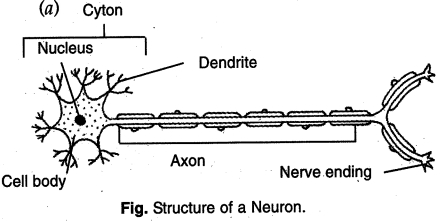
$(a)$ Draw the structure of a neuron and label the following on it:
Nucleus,Dendrite,Cell body,and Axon.
$(b)$ Name the part of the neuron:
$(i)$ Where information is acquired.
$(ii)$ Through which information travels as an electrical impulse.
Nucleus,Dendrite,Cell body,and Axon.
$(b)$ Name the part of the neuron:
$(i)$ Where information is acquired.
$(ii)$ Through which information travels as an electrical impulse.
Solution
(N/A) The structure of a neuron consists of a cell body (cyton) containing the nucleus,dendrites that receive signals,and an axon that transmits electrical impulses.
$(b)$ $(i)$ Dendrite: This part of the neuron acts as the receptor site where information from the environment or other neurons is acquired.
$(ii)$ Axon: This is the long,fiber-like extension of the neuron through which information travels in the form of an electrical impulse toward the nerve endings.
$(b)$ $(i)$ Dendrite: This part of the neuron acts as the receptor site where information from the environment or other neurons is acquired.
$(ii)$ Axon: This is the long,fiber-like extension of the neuron through which information travels in the form of an electrical impulse toward the nerve endings.
0 likes
View Solution108
Medium
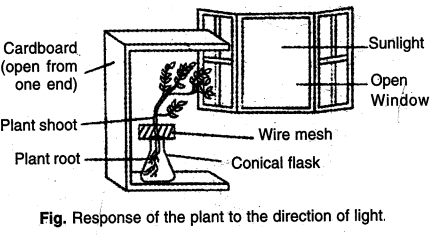
Describe an activity to illustrate the phenomenon of phototropism and explain why this occurs.
Solution
(N/A) Activity:
$(i)$ Take a potted plant and place it in a cardboard box that is open from one side. Position the box such that the open side faces a window,allowing the plant to receive light from one direction.
$(ii)$ Observe the plant for a few days. You will notice that the shoot bends towards the light source.
$(iii)$ Now,rotate the plant so that the shoot is facing away from the light. Leave it undisturbed for a few days.
$(iv)$ Observe the plant again; the shoot will gradually bend back towards the light source.
Explanation:
When growing plants detect light,a hormone called auxin,which is synthesized at the shoot tip,plays a crucial role. Auxin always diffuses towards the shady side of the shoot. This higher concentration of auxin on the shady side stimulates the cells to grow longer than those on the side facing the light. Consequently,the unequal growth causes the plant shoot to bend towards the light,a phenomenon known as phototropism.
$(i)$ Take a potted plant and place it in a cardboard box that is open from one side. Position the box such that the open side faces a window,allowing the plant to receive light from one direction.
$(ii)$ Observe the plant for a few days. You will notice that the shoot bends towards the light source.
$(iii)$ Now,rotate the plant so that the shoot is facing away from the light. Leave it undisturbed for a few days.
$(iv)$ Observe the plant again; the shoot will gradually bend back towards the light source.
Explanation:
When growing plants detect light,a hormone called auxin,which is synthesized at the shoot tip,plays a crucial role. Auxin always diffuses towards the shady side of the shoot. This higher concentration of auxin on the shady side stimulates the cells to grow longer than those on the side facing the light. Consequently,the unequal growth causes the plant shoot to bend towards the light,a phenomenon known as phototropism.
0 likes
View Solution109
Medium
Write the main functions of the following :
$(a)$ Sensory neuron
$(b)$ Cranium
$(c)$ Vertebral column
$(d)$ Motor neuron
$(a)$ Sensory neuron
$(b)$ Cranium
$(c)$ Vertebral column
$(d)$ Motor neuron
Solution
(N/A) Sensory neuron: It carries sensory impulses from receptors,such as the skin,to the central nervous system.
$(b)$ Cranium: It is the bony case surrounding the brain,which protects it from mechanical injury and shock.
$(c)$ Vertebral column: It is the protective bony covering surrounding the spinal cord. It also provides mechanical support to the body.
$(d)$ Motor neuron: It carries motor impulses from the central nervous system to specific effectors,such as muscle fibers or gland cells.
$(b)$ Cranium: It is the bony case surrounding the brain,which protects it from mechanical injury and shock.
$(c)$ Vertebral column: It is the protective bony covering surrounding the spinal cord. It also provides mechanical support to the body.
$(d)$ Motor neuron: It carries motor impulses from the central nervous system to specific effectors,such as muscle fibers or gland cells.
0 likes
View Solution110
Easy
How is the timing and the amount of hormone secreted by a gland regulated? Explain with an example.
Solution
(N/A) The timing and amount of hormone secretion are regulated by a feedback mechanism.
This mechanism ensures that hormones are released only when required and in the appropriate quantity.
Example: Regulation of blood sugar levels.
When the blood sugar level rises,the cells of the pancreas detect this change.
In response,the pancreas secretes more insulin to facilitate the uptake and oxidation of glucose by body cells,thereby lowering the blood sugar level.
Conversely,when the blood sugar level drops,the secretion of insulin is reduced to prevent hypoglycemia.
This mechanism ensures that hormones are released only when required and in the appropriate quantity.
Example: Regulation of blood sugar levels.
When the blood sugar level rises,the cells of the pancreas detect this change.
In response,the pancreas secretes more insulin to facilitate the uptake and oxidation of glucose by body cells,thereby lowering the blood sugar level.
Conversely,when the blood sugar level drops,the secretion of insulin is reduced to prevent hypoglycemia.
0 likes
View Solution111
Easy
Mention any four reflex actions of the body.
Solution
(N/A) Reflex actions are rapid,involuntary responses to stimuli. Four examples of reflex actions are:
$(i)$ Sneezing: $A$ sudden,involuntary expulsion of air from the nose and mouth.
$(ii)$ Coughing: $A$ rapid expulsion of air from the lungs to clear the airways.
$(iii)$ Knee-jerk reflex: $A$ sudden involuntary kicking movement of the lower leg in response to a sharp tap on the patellar tendon.
$(iv)$ Blinking of eyes: $A$ rapid closing and opening of the eyelids to protect the eyes from foreign objects or bright light.
$(i)$ Sneezing: $A$ sudden,involuntary expulsion of air from the nose and mouth.
$(ii)$ Coughing: $A$ rapid expulsion of air from the lungs to clear the airways.
$(iii)$ Knee-jerk reflex: $A$ sudden involuntary kicking movement of the lower leg in response to a sharp tap on the patellar tendon.
$(iv)$ Blinking of eyes: $A$ rapid closing and opening of the eyelids to protect the eyes from foreign objects or bright light.
0 likes
View Solution112
Medium
State in brief how the communication between the central nervous system and the other parts of the body is facilitated.
Solution
(N/A) $(i)$ The brain sends messages to muscles to respond accordingly.
$(ii)$ The communication between the central nervous system and other parts of the body is facilitated by the peripheral nervous system,which consists of cranial nerves arising from the brain and spinal nerves arising from the spinal cord.
$(iii)$ The brain thus allows us to think and take actions accordingly based on that thinking.
$(ii)$ The communication between the central nervous system and other parts of the body is facilitated by the peripheral nervous system,which consists of cranial nerves arising from the brain and spinal nerves arising from the spinal cord.
$(iii)$ The brain thus allows us to think and take actions accordingly based on that thinking.
0 likes
View Solution113
Medium
What are voluntary and involuntary actions? Give one example of each.
Solution
(N/A) Involuntary actions: These are actions that occur automatically without our conscious control or choice. They are essential for maintaining the internal physiological processes of the body.
Example: The beating of the heart.
Voluntary actions: These are actions that are performed consciously and are under our control. These actions allow us to respond differently to various stimuli based on our decision.
Example: Walking or picking up a book.
Example: The beating of the heart.
Voluntary actions: These are actions that are performed consciously and are under our control. These actions allow us to respond differently to various stimuli based on our decision.
Example: Walking or picking up a book.
0 likes
View Solution114
Medium
Explain the mechanism of reflex action.
Solution
(N/A) $(i)$ Receptor organs like skin receive the stimulus and activate a sensory nerve impulse that travels to the spinal cord.
$(ii)$ The neurons in the spinal cord process this information and transmit the impulse to a motor neuron.
$(iii)$ The motor nerve conducts these impulses to effector organs like muscles,which respond accordingly to the stimulus.
$(ii)$ The neurons in the spinal cord process this information and transmit the impulse to a motor neuron.
$(iii)$ The motor nerve conducts these impulses to effector organs like muscles,which respond accordingly to the stimulus.
0 likes
View Solution115
Medium
Explain how the human body responds when adrenaline is secreted into the blood.
Solution
(N/A) When the organism confronts any stressful or scary situation,adrenaline is secreted from the adrenal gland and released directly into the blood. It is then circulated to various parts of the body,resulting in the following responses:
$(a)$ The heart beats faster to supply more oxygen to the muscles.
$(b)$ Blood supply to the digestive system and skin is reduced due to the contraction of muscles around small arteries. This diverts more blood to the skeletal muscles.
$(c)$ The breathing rate increases due to the contractions of the diaphragm and rib muscles,which allows for more oxygen intake.
$(a)$ The heart beats faster to supply more oxygen to the muscles.
$(b)$ Blood supply to the digestive system and skin is reduced due to the contraction of muscles around small arteries. This diverts more blood to the skeletal muscles.
$(c)$ The breathing rate increases due to the contractions of the diaphragm and rib muscles,which allows for more oxygen intake.
0 likes
View Solution116
EasyMCQ
How does the plant detect the touch,and how do the leaves move in response?
A
By using specialized nerve cells.
B
By using electrical-chemical signals to convey information.
C
By using hormonal signals only.
D
By using mechanical pressure sensors.
Solution
(B) Plants use electrical-chemical signals to detect touch and to convey information from cell to cell,despite lacking specialized nervous tissue.
The cells in the leaves change their shape by altering the amount of water within them (turgor pressure).
This change in water content causes the cells to swell or shrink,which results in the movement of the leaves in response to the stimulus.
The cells in the leaves change their shape by altering the amount of water within them (turgor pressure).
This change in water content causes the cells to swell or shrink,which results in the movement of the leaves in response to the stimulus.
0 likes
View Solution117
Medium
Name the system which facilitates communication between the central nervous system and the other parts of the body. Mention two types of nerves it consists of along with their organ of origin.
Solution
(N/A) The system that facilitates communication between the central nervous system and other parts of the body is the Peripheral Nervous System $(PNS)$.
It consists of two types of nerves:
$(i)$ Cranial Nerves: There are $12$ pairs of cranial nerves,which arise from the brain.
$(ii)$ Spinal Nerves: There are $31$ pairs of spinal nerves,which arise from the spinal cord.
It consists of two types of nerves:
$(i)$ Cranial Nerves: There are $12$ pairs of cranial nerves,which arise from the brain.
$(ii)$ Spinal Nerves: There are $31$ pairs of spinal nerves,which arise from the spinal cord.
0 likes
View Solution118
Medium
State how the concentration of auxin stimulates the cells to grow longer on the side of the shoot that is away from light.
Solution
(N/A) When growing plants detect light,a hormone called auxin,which is synthesized at the shoot tip,helps the cells to grow longer.
When light falls on one side of the plant,auxin diffuses towards the shady side of the shoot.
This higher concentration of auxin on the shady side stimulates the cells to elongate more rapidly compared to the side facing the light,causing the shoot to bend towards the light source.
When light falls on one side of the plant,auxin diffuses towards the shady side of the shoot.
This higher concentration of auxin on the shady side stimulates the cells to elongate more rapidly compared to the side facing the light,causing the shoot to bend towards the light source.
0 likes
View Solution119
Medium
Differentiate between estrogen and testosterone.
Solution
(N/A)
| Estrogen | Testosterone |
|---|---|
| $(i)$ It is the female sex hormone. | $(i)$ It is the male sex hormone. |
| $(ii)$ It is secreted by female gonads (ovaries). | $(ii)$ It is secreted by male gonads (testes). |
| $(iii)$ It helps in the development of female reproductive organs and also imparts female secondary sexual characteristics. | $(iii)$ It helps in the development of male reproductive organs and also imparts male secondary sexual characteristics. |
0 likes
View Solution120
Medium
Which is the main thinking part of the brain? State how it functions.
Solution
(N/A) $(i)$ The forebrain is the main thinking part of the brain,consisting of specialized thinking tissues.
(ii) It contains distinct regions that receive sensory impulses from various receptors,such as the skin,eyes,ears,tongue,and nose.
(iii) It includes separate association areas where sensory information is interpreted by integrating it with data from other receptors and information already stored in the brain. Based on this analysis,a decision is made regarding the appropriate response.
(ii) It contains distinct regions that receive sensory impulses from various receptors,such as the skin,eyes,ears,tongue,and nose.
(iii) It includes separate association areas where sensory information is interpreted by integrating it with data from other receptors and information already stored in the brain. Based on this analysis,a decision is made regarding the appropriate response.
0 likes
View Solution121
Medium
Explain how the movement of leaves of a sensitive plant is different from the movement of shoots towards light.
Solution
(N/A) The movement of the leaves of a sensitive plant (e.g.,$Mimosa$ $pudica$) is known as a nastic movement. This movement is independent of the direction of the stimulus and occurs due to a rapid loss of water (turgor pressure) in the cells upon touch.
In contrast,the movement of a shoot towards light is a phototropic movement. This is a directional growth movement that occurs due to the unequal distribution of plant hormones,specifically auxins,in response to light.
While nastic movements are rapid and reversible,tropic movements are generally slower and involve actual growth of the plant part.
In contrast,the movement of a shoot towards light is a phototropic movement. This is a directional growth movement that occurs due to the unequal distribution of plant hormones,specifically auxins,in response to light.
While nastic movements are rapid and reversible,tropic movements are generally slower and involve actual growth of the plant part.
0 likes
View Solution122
Medium
$(a)$ Define hormone. Write four characteristics of hormones in humans.
$(b)$ Name the disorder caused by the following situations:
$(i)$ Under secretion of growth hormone
$(ii)$ Over secretion of growth hormone
$(iii)$ Under secretion of insulin
$(iv)$ Deficiency of iodine
$(b)$ Name the disorder caused by the following situations:
$(i)$ Under secretion of growth hormone
$(ii)$ Over secretion of growth hormone
$(iii)$ Under secretion of insulin
$(iv)$ Deficiency of iodine
Solution
(A-D) Hormones: Hormones are chemical messengers that regulate biological processes in living organisms.
Characteristics of Hormones:
$1$. They are produced by ductless glands,meaning their secretion is released directly into the blood.
$2$. They are released in trace amounts,i.e.,in very small quantities.
$3$. They act on specific tissues or organs known as target organs.
$4$. They are generally slow in action.
$5$. They act away from the site of production.
$(b)$ $(i)$ Dwarfism
$(ii)$ Gigantism
$(iii)$ Diabetes mellitus
$(iv)$ Goitre
Characteristics of Hormones:
$1$. They are produced by ductless glands,meaning their secretion is released directly into the blood.
$2$. They are released in trace amounts,i.e.,in very small quantities.
$3$. They act on specific tissues or organs known as target organs.
$4$. They are generally slow in action.
$5$. They act away from the site of production.
$(b)$ $(i)$ Dwarfism
$(ii)$ Gigantism
$(iii)$ Diabetes mellitus
$(iv)$ Goitre
0 likes
View Solution123
Easy
What is cerebrospinal fluid? What is its function?
Solution
(N/A) Cerebrospinal fluid $(CSF)$ is a clear,colorless body fluid found in the brain and spinal cord.
It occupies the subarachnoid space and the ventricular system around and inside the brain and spinal cord.
Function: It acts as a cushion or shock absorber,protecting the brain and spinal cord from mechanical injury and sudden impacts.
It occupies the subarachnoid space and the ventricular system around and inside the brain and spinal cord.
Function: It acts as a cushion or shock absorber,protecting the brain and spinal cord from mechanical injury and sudden impacts.
0 likes
View Solution124
Medium
Define 'nerve impulse'. Which structure in a neuron helps to conduct a nerve impulse:
$(i)$ towards the cell body?
$(ii)$ away from the cell body?
$(i)$ towards the cell body?
$(ii)$ away from the cell body?
Solution
(N/A) nerve impulse is an electrical signal that travels along the membrane of a neuron,facilitating the transmission of information throughout the nervous system.
$(i)$ Dendrites are the branched structures that receive signals and conduct nerve impulses towards the cell body.
$(ii)$ The axon is a long,slender projection of a nerve cell that conducts nerve impulses away from the cell body towards other neurons or effector organs.
$(i)$ Dendrites are the branched structures that receive signals and conduct nerve impulses towards the cell body.
$(ii)$ The axon is a long,slender projection of a nerve cell that conducts nerve impulses away from the cell body towards other neurons or effector organs.
0 likes
View Solution125
Medium
Give a reason to explain why:
$(i)$ Adrenaline helps in dealing with emergency situations?
$(ii)$ Secretions of growth hormone should be specific in the human body?
$(iii)$ Some patients of diabetes are treated by giving injections of insulin?
$(i)$ Adrenaline helps in dealing with emergency situations?
$(ii)$ Secretions of growth hormone should be specific in the human body?
$(iii)$ Some patients of diabetes are treated by giving injections of insulin?
Solution
(N/A) $(i)$ Adrenaline increases the heartbeat and breathing rate,which results in the supply of more oxygen to muscles. It reduces blood flow to the digestive system and skin; as a result,blood is diverted to skeletal muscles. All these responses together prepare the body to deal with emergency situations.
$(ii)$ If growth hormone is secreted in excess during childhood,it leads to $\text{gigantism}$,while less secretion of this hormone during childhood causes $\text{dwarfism}$.
$(iii)$ Patients suffering from diabetes have a high blood sugar level because insulin is not secreted in a sufficient amount by the pancreas to lower the blood sugar level. Therefore,to regulate the blood sugar level,insulin hormone is injected into such patients.
$(ii)$ If growth hormone is secreted in excess during childhood,it leads to $\text{gigantism}$,while less secretion of this hormone during childhood causes $\text{dwarfism}$.
$(iii)$ Patients suffering from diabetes have a high blood sugar level because insulin is not secreted in a sufficient amount by the pancreas to lower the blood sugar level. Therefore,to regulate the blood sugar level,insulin hormone is injected into such patients.
0 likes
View Solution126
MediumMCQ
What is the correct direction of flow of electrical impulses?
A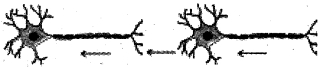
B
C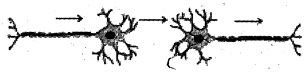
D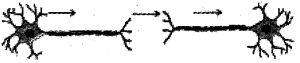
Solution
(A) In a neuron,electrical impulses are received by the dendrites.
From the dendrites,the impulse travels to the cell body (cyton).
Then,it moves along the axon towards the nerve endings (axon terminals).
At the synapse,the impulse is converted into a chemical signal to be transmitted to the dendrites of the next neuron.
Therefore,the correct direction is: Dendrites $\rightarrow$ Cell body $\rightarrow$ Axon $\rightarrow$ Nerve endings.
From the dendrites,the impulse travels to the cell body (cyton).
Then,it moves along the axon towards the nerve endings (axon terminals).
At the synapse,the impulse is converted into a chemical signal to be transmitted to the dendrites of the next neuron.
Therefore,the correct direction is: Dendrites $\rightarrow$ Cell body $\rightarrow$ Axon $\rightarrow$ Nerve endings.
0 likes
View Solution127
EasyMCQ
Which statement is not true about thyroxine?
A
Thyroid gland requires iodine to synthesise thyroxine.
B
It regulates carbohydrate,protein and fat metabolism in the body.
C
Iron is essential for the synthesis of thyroxine.
D
Thyroxine is also called thyroid hormone.
Solution
(C) Thyroxine is a hormone produced by the thyroid gland.
Iodine is essential for the synthesis of thyroxine,not iron.
Therefore,the statement that 'Iron is essential for the synthesis of thyroxine' is incorrect.
Thyroxine regulates the metabolism of carbohydrates,proteins,and fats in the body.
Iodine is essential for the synthesis of thyroxine,not iron.
Therefore,the statement that 'Iron is essential for the synthesis of thyroxine' is incorrect.
Thyroxine regulates the metabolism of carbohydrates,proteins,and fats in the body.
0 likes
View Solution128
EasyMCQ
Dwarfism results due to :
A
Excess secretion of thyroxins.
B
Excess secretion of growth hormone.
C
Less secretion of adrenaline.
D
Less secretion of growth hormone.
Solution
(D) Dwarfism is a condition characterized by abnormally short stature.
It is primarily caused by the deficiency or reduced secretion of the $Growth$ $Hormone$ $(GH)$,also known as somatotropin,during the childhood growth phase.
$GH$ is secreted by the anterior pituitary gland and is essential for the growth of bones and tissues.
Excess secretion of $GH$ leads to gigantism,while its deficiency leads to dwarfism.
It is primarily caused by the deficiency or reduced secretion of the $Growth$ $Hormone$ $(GH)$,also known as somatotropin,during the childhood growth phase.
$GH$ is secreted by the anterior pituitary gland and is essential for the growth of bones and tissues.
Excess secretion of $GH$ leads to gigantism,while its deficiency leads to dwarfism.
0 likes
View Solution129
MediumMCQ
Dramatic changes of body features associated with puberty are mainly because of the secretion of:
A
Testosterone from testes and estrogen from ovary.
B
Estrogen from adrenal gland and testosterone from pituitary gland.
C
Oestrogen from testes and testosterone from ovary.
D
Testosterone from thyroid gland and estrogen from pituitary gland.
Solution
(A) During puberty,the human body undergoes significant physiological and physical changes.
These changes are primarily regulated by sex hormones.
In males,the testes secrete $Testosterone$,which is responsible for the development of secondary sexual characteristics such as facial hair,deepening of the voice,and muscle growth.
In females,the ovaries secrete $Estrogen$,which is responsible for the development of secondary sexual characteristics such as breast development and the onset of the menstrual cycle.
Therefore,the correct combination is $Testosterone$ from the testes and $Estrogen$ from the ovary.
These changes are primarily regulated by sex hormones.
In males,the testes secrete $Testosterone$,which is responsible for the development of secondary sexual characteristics such as facial hair,deepening of the voice,and muscle growth.
In females,the ovaries secrete $Estrogen$,which is responsible for the development of secondary sexual characteristics such as breast development and the onset of the menstrual cycle.
Therefore,the correct combination is $Testosterone$ from the testes and $Estrogen$ from the ovary.
0 likes
View Solution130
EasyMCQ
Iodine is necessary for the synthesis of which hormone?
A
Adrenaline
B
Thyroxine
C
Auxin
D
Insulin
Solution
(B) Iodine is an essential mineral required by the thyroid gland to produce the hormone $Thyroxine$.
$Thyroxine$ regulates the metabolism of carbohydrates,proteins,and fats in the body.
$A$ deficiency of iodine in the diet can lead to a condition called goiter,where the thyroid gland enlarges due to its inability to synthesize sufficient $Thyroxine$.
$Thyroxine$ regulates the metabolism of carbohydrates,proteins,and fats in the body.
$A$ deficiency of iodine in the diet can lead to a condition called goiter,where the thyroid gland enlarges due to its inability to synthesize sufficient $Thyroxine$.
0 likes
View Solution131
MediumMCQ
Choose the incorrect statement about insulin:
A
It is produced from the pancreas.
B
It regulates blood sugar levels.
C
It regulates the growth and development of the body.
D
Insufficient secretion of insulin will cause diabetes.
Solution
(C) Insulin is a peptide hormone produced by the beta cells of the pancreas.
Its primary function is to regulate blood glucose levels by facilitating the uptake of glucose into cells.
When insulin secretion is insufficient,blood sugar levels rise,leading to a condition known as diabetes mellitus.
Growth and development of the body are primarily regulated by the growth hormone $(GH)$ secreted by the pituitary gland,not by insulin.
Therefore,the statement that insulin regulates the growth and development of the body is incorrect.
Its primary function is to regulate blood glucose levels by facilitating the uptake of glucose into cells.
When insulin secretion is insufficient,blood sugar levels rise,leading to a condition known as diabetes mellitus.
Growth and development of the body are primarily regulated by the growth hormone $(GH)$ secreted by the pituitary gland,not by insulin.
Therefore,the statement that insulin regulates the growth and development of the body is incorrect.
0 likes
View Solution132
EasyMCQ
Select the mismatched pair:
A
Thyroxine : Thyroid gland
B
Testosterone : Testes
C
Estrogen : Ovary
D
Adrenaline : Pituitary gland
Solution
(D) The correct answer is $D$.
$A$. Thyroxine is secreted by the thyroid gland. This is a correctly matched pair.
$B$. Testosterone is the primary male sex hormone secreted by the testes. This is a correctly matched pair.
$C$. Estrogen is the primary female sex hormone secreted by the ovaries. This is a correctly matched pair.
$D$. Adrenaline is secreted by the adrenal glands,not the pituitary gland. The pituitary gland secretes hormones like growth hormone,$TSH$,etc. Therefore,this is the mismatched pair.
$A$. Thyroxine is secreted by the thyroid gland. This is a correctly matched pair.
$B$. Testosterone is the primary male sex hormone secreted by the testes. This is a correctly matched pair.
$C$. Estrogen is the primary female sex hormone secreted by the ovaries. This is a correctly matched pair.
$D$. Adrenaline is secreted by the adrenal glands,not the pituitary gland. The pituitary gland secretes hormones like growth hormone,$TSH$,etc. Therefore,this is the mismatched pair.
0 likes
View Solution133
MediumMCQ
The shape of guard cells changes due to change in the :
A
Amount of water in cells.
B
Temperature of cells.
C
Protein composition of cells.
D
Position of nucleus in the cells.
Solution
(A) The shape of guard cells is regulated by the turgor pressure within them.
When water enters the guard cells through osmosis,they become turgid and swell,causing the stomatal pore to open.
Conversely,when water leaves the guard cells,they become flaccid and shrink,causing the stomatal pore to close.
Therefore,the change in the shape of guard cells is primarily due to the amount of water present in the cells.
When water enters the guard cells through osmosis,they become turgid and swell,causing the stomatal pore to open.
Conversely,when water leaves the guard cells,they become flaccid and shrink,causing the stomatal pore to close.
Therefore,the change in the shape of guard cells is primarily due to the amount of water present in the cells.
0 likes
View Solution134
MediumMCQ
The growth of tendril in pea plants is due to:
A
Effect of light.
B
Rapid cell divisions in tendrillar cells that are away from the support.
C
Effect of gravity.
D
Rapid cell divisions in tendrillar cells in contact with the support.
Solution
(B) Tendrils in pea plants exhibit thigmotropism,which is a growth response to touch.
When a tendril comes in contact with a support,the cells in contact with the support do not grow as rapidly as the cells on the side away from the support.
This differential growth rate causes the tendril to coil around the support.
Therefore,the rapid cell division occurs in the cells that are away from the support.
When a tendril comes in contact with a support,the cells in contact with the support do not grow as rapidly as the cells on the side away from the support.
This differential growth rate causes the tendril to coil around the support.
Therefore,the rapid cell division occurs in the cells that are away from the support.
0 likes
View Solution135
EasyMCQ
The growth of pollen tubes towards ovules is due to:
A
Hydrotropism
B
Geotropism
C
Chemotropism
D
Phototropism
Solution
(C) The growth of the pollen tube towards the ovule is a classic example of $Chemotropism$.
This occurs because the ovule secretes specific chemical substances (sugars and other compounds) that attract the pollen tube.
The pollen tube senses these chemical gradients and grows towards the source,which is the ovule,to facilitate fertilization.
Therefore,the correct option is $C$.
This occurs because the ovule secretes specific chemical substances (sugars and other compounds) that attract the pollen tube.
The pollen tube senses these chemical gradients and grows towards the source,which is the ovule,to facilitate fertilization.
Therefore,the correct option is $C$.
0 likes
View Solution136
MediumMCQ
Which of the following statements about the transmission of a nerve impulse is incorrect?
A
Nerve impulse travels from the dendritic end towards the axonal end.
B
$A$ neuron transmits electrical impulses not only to another neuron but also to muscle and gland cells.
C
The chemicals released from the axonal end of one neuron cross the synapse and generate a similar electrical impulse in a dendrite of another neuron.
D
At the dendritic end,electrical impulses bring about the release of some chemicals which generate an electrical impulse at the axonal end of another neuron.
Solution
(D) The transmission of a nerve impulse follows a specific direction: from the dendrites to the cell body and then along the axon to the axonal terminal. At the synapse,the electrical impulse triggers the release of neurotransmitters (chemicals) from the axonal end of the presynaptic neuron. These chemicals diffuse across the synaptic cleft and bind to receptors on the dendrites of the postsynaptic neuron,where they generate a new electrical impulse. Therefore,statement $D$ is incorrect because it reverses the direction of transmission,claiming that chemicals are released at the dendritic end to trigger an impulse at the axonal end.
0 likes
View Solution137
EasyMCQ
Involuntary actions in the body are controlled by:
A
Medulla in hindbrain.
B
Medulla in midbrain.
C
Medulla in forebrain.
D
Medulla in spinal cord.
Solution
(A) Involuntary actions,such as blood pressure,salivation,and vomiting,are controlled by the medulla oblongata.
The medulla oblongata is a part of the hindbrain.
Therefore,the correct option is $A$.
The medulla oblongata is a part of the hindbrain.
Therefore,the correct option is $A$.
0 likes
View Solution138
EasyMCQ
Which of the following is not an involuntary action?
A
Vomiting
B
Chewing
C
Heartbeat
D
Salivation
Solution
(B) An involuntary action is a movement that occurs without conscious control.
$A$,$C$,and $D$ (Vomiting,Heartbeat,and Salivation) are controlled by the medulla in the hindbrain and occur automatically.
$B$ (Chewing) is a voluntary action because it is under the conscious control of the individual,involving the skeletal muscles of the jaw.
$A$,$C$,and $D$ (Vomiting,Heartbeat,and Salivation) are controlled by the medulla in the hindbrain and occur automatically.
$B$ (Chewing) is a voluntary action because it is under the conscious control of the individual,involving the skeletal muscles of the jaw.
0 likes
View Solution139
MediumMCQ
When a person is suffering from severe cold,he or she cannot :
A
Differentiate the taste of an apple from that of an ice cream.
B
Differentiate red light from green light.
C
Differentiate the smell of a perfume from that of an agarbatti.
D
Differentiate a hot object from a cold object.
Solution
(A) The sense of smell (olfaction) and the sense of taste (gustation) are closely linked. When a person suffers from a severe cold,the nasal passages become congested with mucus. This blockage prevents odor molecules from reaching the olfactory receptors in the nose. Since a significant portion of what we perceive as 'taste' is actually the aroma of food,the inability to smell makes it difficult to distinguish between different flavors,such as an apple and an ice cream. Therefore,the correct option is $A$.
0 likes
View Solution140
MediumMCQ
Which of the following statements are true?
$(i)$ Sudden action in response to something in the environment is called reflex action.
$(ii)$ Sensory neurons carry signals from spinal cord to muscles.
$(iii)$ Motor neurons carry signals from receptors to spinal cord.
$(iv)$ The path through which signals are transmitted from a receptor to a muscle or a gland is called reflex arc.
$(i)$ Sudden action in response to something in the environment is called reflex action.
$(ii)$ Sensory neurons carry signals from spinal cord to muscles.
$(iii)$ Motor neurons carry signals from receptors to spinal cord.
$(iv)$ The path through which signals are transmitted from a receptor to a muscle or a gland is called reflex arc.
A
$(i)$ and $(ii)$
B
$(i)$ and $(iii)$
C
$(i), (ii)$ and $(iii)$
D
$(i)$ and $(iv)$
Solution
(D) Statement $(i)$ is true: $A$ reflex action is a rapid,automatic,and involuntary response to a stimulus.
Statement $(ii)$ is false: Sensory neurons carry signals from receptors to the spinal cord,not from the spinal cord to muscles.
Statement $(iii)$ is false: Motor neurons carry signals from the spinal cord to the effectors (muscles or glands),not from receptors to the spinal cord.
Statement $(iv)$ is true: The reflex arc is the neural pathway that controls a reflex action,consisting of a receptor,sensory neuron,integration center (spinal cord),motor neuron,and effector.
Therefore,statements $(i)$ and $(iv)$ are correct.
Statement $(ii)$ is false: Sensory neurons carry signals from receptors to the spinal cord,not from the spinal cord to muscles.
Statement $(iii)$ is false: Motor neurons carry signals from the spinal cord to the effectors (muscles or glands),not from receptors to the spinal cord.
Statement $(iv)$ is true: The reflex arc is the neural pathway that controls a reflex action,consisting of a receptor,sensory neuron,integration center (spinal cord),motor neuron,and effector.
Therefore,statements $(i)$ and $(iv)$ are correct.
0 likes
View Solution141
MediumMCQ
Which of the following statements are true about the brain?
$(i)$ The main thinking part of the brain is the hindbrain.
$(ii)$ Centres of hearing,smell,memory,sight,etc.,are located in the forebrain.
$(iii)$ Involuntary actions like salivation,vomiting,and blood pressure are controlled by the medulla in the hindbrain.
$(iv)$ The cerebellum does not control posture and balance of the body.
$(i)$ The main thinking part of the brain is the hindbrain.
$(ii)$ Centres of hearing,smell,memory,sight,etc.,are located in the forebrain.
$(iii)$ Involuntary actions like salivation,vomiting,and blood pressure are controlled by the medulla in the hindbrain.
$(iv)$ The cerebellum does not control posture and balance of the body.
A
$(ii)$ and $(iii)$
B
$(i), (ii)$ and $(iii)$
C
$(i)$ and $(ii)$
D
$(iii)$ and $(iv)$
Solution
(A) Statement $(i)$ is false because the forebrain is the main thinking part of the brain,not the hindbrain.
Statement $(ii)$ is true because the forebrain contains specialized regions for sensory processing such as hearing,smell,memory,and sight.
Statement $(iii)$ is true because the medulla oblongata,located in the hindbrain,regulates involuntary actions like salivation,vomiting,and blood pressure.
Statement $(iv)$ is false because the cerebellum is specifically responsible for maintaining posture and balance of the body.
Therefore,statements $(ii)$ and $(iii)$ are correct.
Statement $(ii)$ is true because the forebrain contains specialized regions for sensory processing such as hearing,smell,memory,and sight.
Statement $(iii)$ is true because the medulla oblongata,located in the hindbrain,regulates involuntary actions like salivation,vomiting,and blood pressure.
Statement $(iv)$ is false because the cerebellum is specifically responsible for maintaining posture and balance of the body.
Therefore,statements $(ii)$ and $(iii)$ are correct.
0 likes
View Solution142
EasyMCQ
Posture and balance of the body is controlled by:
A
Cerebrum
B
Cerebellum
C
Medulla
D
Pons
Solution
(B) The $Cerebellum$ is a part of the hindbrain responsible for maintaining the posture and balance of the body.
It also coordinates voluntary muscle movements and ensures precision and accuracy in motor activities.
$Cerebrum$ is responsible for thinking and intelligence.
$Medulla$ controls involuntary actions like blood pressure,salivation,and vomiting.
$Pons$ acts as a relay station between different parts of the brain.
It also coordinates voluntary muscle movements and ensures precision and accuracy in motor activities.
$Cerebrum$ is responsible for thinking and intelligence.
$Medulla$ controls involuntary actions like blood pressure,salivation,and vomiting.
$Pons$ acts as a relay station between different parts of the brain.
0 likes
View Solution143
EasyMCQ
Spinal cord originates from:
A
Cerebrum
B
Pons
C
Medulla
D
Cerebellum
Solution
(C) The spinal cord is a long, thin, tubular structure made of nervous tissue that extends from the brain.
Specifically, the spinal cord originates from the $Medulla$ $oblongata$, which is the lower part of the brainstem.
The $Medulla$ connects the brain to the spinal cord and controls vital autonomic functions such as breathing, heart rate, and blood pressure.
Specifically, the spinal cord originates from the $Medulla$ $oblongata$, which is the lower part of the brainstem.
The $Medulla$ connects the brain to the spinal cord and controls vital autonomic functions such as breathing, heart rate, and blood pressure.
0 likes
View Solution144
EasyMCQ
Which of the following statements is correct about receptors?
A
Olfactory receptors detect taste and gustatory receptors detect smell.
B
Both gustatory and olfactory receptors detect smell.
C
Auditory receptors detect smell and olfactory receptors detect taste.
D
Gustatory receptors detect taste while,olfactory receptors detect smell.
Solution
(D) Receptors are specialized cells or groups of cells that detect stimuli in the environment.
$1$. Gustatory receptors are specialized sensory receptors located in the taste buds of the tongue that detect taste.
$2$. Olfactory receptors are specialized sensory receptors located in the nasal cavity that detect smell.
Therefore,the statement that gustatory receptors detect taste and olfactory receptors detect smell is correct.
$1$. Gustatory receptors are specialized sensory receptors located in the taste buds of the tongue that detect taste.
$2$. Olfactory receptors are specialized sensory receptors located in the nasal cavity that detect smell.
Therefore,the statement that gustatory receptors detect taste and olfactory receptors detect smell is correct.
0 likes
View Solution145
EasyMCQ
Electrical impulse travels in a neuron from :
A
Dendrite $\rightarrow$ cell body $\rightarrow$ axon $\rightarrow$ axonal end
B
Cell body $\rightarrow$ dendrite $\rightarrow$ axon $\rightarrow$ axonal end
C
Dendrite $\rightarrow$ axon $\rightarrow$ axonal end $\rightarrow$ cell body
D
Axonal end $\rightarrow$ axon $\rightarrow$ cell body $\rightarrow$ dendrite
Solution
(A) In a neuron, the electrical impulse is initiated at the dendrites, which receive information from the environment or other neurons.
From the dendrites, the impulse travels to the cell body (cyton).
Then, it passes through the axon.
Finally, it reaches the axonal end (nerve ending), where it triggers the release of neurotransmitters to pass the signal to the next neuron or effector organ.
Therefore, the correct pathway is: $Dendrite \rightarrow Cell \ body \rightarrow Axon \rightarrow Axonal \ end$.
From the dendrites, the impulse travels to the cell body (cyton).
Then, it passes through the axon.
Finally, it reaches the axonal end (nerve ending), where it triggers the release of neurotransmitters to pass the signal to the next neuron or effector organ.
Therefore, the correct pathway is: $Dendrite \rightarrow Cell \ body \rightarrow Axon \rightarrow Axonal \ end$.
0 likes
View Solution146
MediumMCQ
In a synapse,chemical signal is transmitted from :
A
Dendritic end of one neuron to axonal end of another neuron.
B
Axonal end of one neuron to dendritic end of another neuron.
C
Cell body to axonal end of the same neuron.
D
Axon to cell body of the same neuron.
Solution
(B) synapse is the junction between two neurons where information is transmitted.
In this process,the electrical impulse reaching the axonal end (axon terminal) of the first neuron triggers the release of chemical messengers called neurotransmitters.
These chemicals diffuse across the synaptic cleft and bind to receptors on the dendritic end of the next neuron.
Therefore,the chemical signal is transmitted from the axonal end of one neuron to the dendritic end of another neuron.
In this process,the electrical impulse reaching the axonal end (axon terminal) of the first neuron triggers the release of chemical messengers called neurotransmitters.
These chemicals diffuse across the synaptic cleft and bind to receptors on the dendritic end of the next neuron.
Therefore,the chemical signal is transmitted from the axonal end of one neuron to the dendritic end of another neuron.
0 likes
View Solution147
MediumMCQ
In a neuron,conversion of electrical signal to a chemical signal occurs at/in:
A
Cell body
B
Dendritic end
C
Axonal end
D
Axon
Solution
(C) In a neuron,the electrical signal travels along the axon towards the axonal end (synaptic knob).
At the axonal end,the electrical impulse triggers the release of neurotransmitters into the synaptic cleft.
These neurotransmitters are chemical substances that carry the signal across the synapse to the next neuron.
Therefore,the conversion of an electrical signal into a chemical signal takes place at the axonal end.
At the axonal end,the electrical impulse triggers the release of neurotransmitters into the synaptic cleft.
These neurotransmitters are chemical substances that carry the signal across the synapse to the next neuron.
Therefore,the conversion of an electrical signal into a chemical signal takes place at the axonal end.
0 likes
View Solution148
EasyMCQ
Which is the correct sequence of the components of a reflex arc?
A
Receptors $\rightarrow$ Muscles $\rightarrow$ Sensory neuron $\rightarrow$ Motor neuron $\rightarrow$ Spinal cord
B
Receptors $\rightarrow$ Motor neuron $\rightarrow$ Spinal cord $\rightarrow$ Sensory neuron $\rightarrow$ Muscles
C
Receptors $\rightarrow$ Spinal cord $\rightarrow$ Sensory neuron $\rightarrow$ Motor neuron $\rightarrow$ Muscles
D
Receptors $\rightarrow$ Sensory neuron $\rightarrow$ Spinal cord $\rightarrow$ Motor neuron $\rightarrow$ Muscles
Solution
(D) reflex arc is the neural pathway that controls a reflex action.
The sequence of components involved in a reflex arc is as follows:
$1$. Receptors: These detect the stimulus.
$2$. Sensory neuron: This carries the signal from the receptor to the central nervous system (spinal cord).
$3$. Spinal cord: This acts as the processing center for the reflex action.
$4$. Motor neuron: This carries the response signal from the spinal cord to the effector.
$5$. Muscles (Effectors): These perform the action in response to the stimulus.
Therefore,the correct sequence is: Receptors $\rightarrow$ Sensory neuron $\rightarrow$ Spinal cord $\rightarrow$ Motor neuron $\rightarrow$ Muscles.
The sequence of components involved in a reflex arc is as follows:
$1$. Receptors: These detect the stimulus.
$2$. Sensory neuron: This carries the signal from the receptor to the central nervous system (spinal cord).
$3$. Spinal cord: This acts as the processing center for the reflex action.
$4$. Motor neuron: This carries the response signal from the spinal cord to the effector.
$5$. Muscles (Effectors): These perform the action in response to the stimulus.
Therefore,the correct sequence is: Receptors $\rightarrow$ Sensory neuron $\rightarrow$ Spinal cord $\rightarrow$ Motor neuron $\rightarrow$ Muscles.
0 likes
View Solution149
EasyMCQ
Which of the following endocrine glands is unpaired?
A
Pituitary
B
Testes
C
Adrenal
D
Ovary
Solution
(A) The endocrine system consists of several glands.
$A$. The pituitary gland is a single,unpaired gland located at the base of the brain.
$B$. Testes are a pair of male reproductive glands.
$C$. Adrenal glands are a pair of glands located on top of the kidneys.
$D$. Ovaries are a pair of female reproductive glands.
Therefore,the pituitary gland is the only unpaired gland among the given options.
$A$. The pituitary gland is a single,unpaired gland located at the base of the brain.
$B$. Testes are a pair of male reproductive glands.
$C$. Adrenal glands are a pair of glands located on top of the kidneys.
$D$. Ovaries are a pair of female reproductive glands.
Therefore,the pituitary gland is the only unpaired gland among the given options.
0 likes
View Solution150
EasyMCQ
The junction between two neurons is called:
A
Cell junction
B
Synapse
C
Neural joint
D
Neuromuscular junction
Solution
(B) synapse is the specialized junction between two neurons,or between a neuron and a target cell (such as a muscle or gland cell).
At this junction,the electrical signal (action potential) is converted into a chemical signal via neurotransmitters to bridge the gap between the neurons.
Therefore,the correct term for the junction between two neurons is a synapse.
At this junction,the electrical signal (action potential) is converted into a chemical signal via neurotransmitters to bridge the gap between the neurons.
Therefore,the correct term for the junction between two neurons is a synapse.
0 likes
View SolutionControl and Coordination — Mix Examples - Control and Coordination · Frequently Asked Questions
1Are these Control and Coordination questions useful for JEE and NEET?
Yes. All questions in this section are mapped to JEE Main and NEET exam patterns. Previous year questions from JEE Main, NEET, GUJCET and state-level exams are included with full solutions.
2Can I switch to Hindi or Gujarati for these questions?
Yes. Use the language tabs in the hero section or the sidebar to view the same questions and solutions in English, Hindi or Gujarati.
3How do I generate a question paper from this subtopic?
Use the Vedclass Exam Paper Generator — select the chapter and subtopic, set difficulty, and generate Sets A, B, C, D automatically. First 3 chapters of every subject are free.
Vedclass Products
For Students
Vedclass Test Series
Mock tests in real JEE/NEET style with performance analysis. 5-day free trial.
Start Free TrialFor Teachers
Exam Paper Generator
Generate Set A/B/C/D papers from this chapter in 2 minutes. 3 chapters free.
Try FreeFor Institutes
Online Exam Module
Live online exams with unlimited students, 360° analytics & white-label branding.
See DemoFor Teachers & Institutes
Generate a Control and Coordination Exam Paper in 2 Minutes
Select subtopic & difficulty — Sets A, B, C, D auto-generated with No Repeat logic.
First 3 chapters of every subject are free — no payment required.