
A English
Mix Examples - Control and Coordination Questions in English
Class 10 Science · Control and Coordination · Mix Examples - Control and Coordination
230+
Questions
English
Language
100%
With Solutions
Showing 50 of 230 questions in English
1
EasyMCQ
Which of the following statements is correct about receptors?
A
Gustatory receptors detect taste while olfactory receptors detect smell
B
Both gustatory and olfactory receptors detect smell
C
Auditory receptors detect smell and olfactory receptors detect taste
D
Olfactory receptors detect taste and gustatory receptors smell
Solution
(A) Receptors are specialized cells or groups of cells that detect stimuli in the environment.
$1$. Gustatory receptors are specialized sensory receptors located in the taste buds of the tongue that detect taste.
$2$. Olfactory receptors are specialized sensory receptors located in the nasal cavity that detect smell.
Therefore,the statement that gustatory receptors detect taste and olfactory receptors detect smell is correct.
$1$. Gustatory receptors are specialized sensory receptors located in the taste buds of the tongue that detect taste.
$2$. Olfactory receptors are specialized sensory receptors located in the nasal cavity that detect smell.
Therefore,the statement that gustatory receptors detect taste and olfactory receptors detect smell is correct.
0 likes
View Solution2
MediumMCQ
Electrical impulse travels in a neuron from
A
Dendrite $\to$ axon $\to$ axonal end $\to$ cell body
B
Dendrite $\to$ cell body $\to$ axon $\to$ axonal end
C
Cell body $\to$ dendrite $\to$ axon $\to$ axonal end
D
Axonal end $\to$ axon $\to$ cell body $\to$ dendrite
Solution
(B) In a neuron,the electrical impulse is received by the dendrites.
From the dendrites,the impulse travels to the cell body (cyton).
Then,it moves along the axon to the axonal end (nerve ending).
Therefore,the correct sequence is: Dendrite $\to$ cell body $\to$ axon $\to$ axonal end.
From the dendrites,the impulse travels to the cell body (cyton).
Then,it moves along the axon to the axonal end (nerve ending).
Therefore,the correct sequence is: Dendrite $\to$ cell body $\to$ axon $\to$ axonal end.
0 likes
View Solution3
EasyMCQ
In a synapse,chemical signal is transmitted from
A
dendritic end of one neuron to axonal end of another neuron
B
axon to cell body of the same neuron
C
axonal end of one neuron to dendritic end of another neuron
D
cell body to axonal end of the same neuron
Solution
(C) synapse is the junction between two neurons.
In a synapse,the chemical signal (neurotransmitter) is released from the axonal end (axon terminal) of the presynaptic neuron.
These neurotransmitters diffuse across the synaptic cleft and bind to the receptors present on the dendritic end (dendrites) of the postsynaptic neuron.
Therefore,the transmission occurs from the axonal end of one neuron to the dendritic end of another neuron.
In a synapse,the chemical signal (neurotransmitter) is released from the axonal end (axon terminal) of the presynaptic neuron.
These neurotransmitters diffuse across the synaptic cleft and bind to the receptors present on the dendritic end (dendrites) of the postsynaptic neuron.
Therefore,the transmission occurs from the axonal end of one neuron to the dendritic end of another neuron.
0 likes
View Solution4
MediumMCQ
In a neuron,conversion of electrical signal to a chemical signal occurs at/in
A
cell body
B
axon
C
dendritic end
D
axonal end
Solution
(D) In a neuron,the electrical signal (nerve impulse) travels along the axon to the axon terminal (axonal end).
At the axonal end,the electrical signal triggers the release of chemical messengers known as neurotransmitters into the synaptic cleft.
This process effectively converts the electrical signal into a chemical signal,which then diffuses across the synapse to the next neuron or target cell.
Therefore,the conversion occurs at the axonal end.
At the axonal end,the electrical signal triggers the release of chemical messengers known as neurotransmitters into the synaptic cleft.
This process effectively converts the electrical signal into a chemical signal,which then diffuses across the synapse to the next neuron or target cell.
Therefore,the conversion occurs at the axonal end.
0 likes
View Solution5
MediumMCQ
Which is the correct sequence of the components of a reflex arc?
A
Receptors $\to$ Sensory neuron $\to$ Spinal cord $\to$ Motor neuron $\to$ Muscle
B
Receptors $\to$ Motor neuron $\to$ Spinal cord $\to$ Sensory neuron $\to$ Muscle
C
Receptors $\to$ Spinal cord $\to$ Sensory neuron $\to$ Motor neuron $\to$ Muscle
D
Receptors $\to$ Muscles $\to$ Sensory neuron $\to$ Motor neuron $\to$ Spinal cord
Solution
(A) reflex arc is the pathway taken by nerve impulses in a reflex action.
$1$. The process begins when receptors detect a stimulus.
$2$. The sensory neuron carries the signal from the receptor to the spinal cord (central nervous system).
$3$. Within the spinal cord,the signal is processed,often involving an interneuron.
$4$. The motor neuron then carries the response signal from the spinal cord to the effector organ (muscle or gland).
$5$. Finally,the muscle contracts or the gland secretes,resulting in the reflex action.
Therefore,the correct sequence is: Receptors $\to$ Sensory neuron $\to$ Spinal cord $\to$ Motor neuron $\to$ Muscle.
$1$. The process begins when receptors detect a stimulus.
$2$. The sensory neuron carries the signal from the receptor to the spinal cord (central nervous system).
$3$. Within the spinal cord,the signal is processed,often involving an interneuron.
$4$. The motor neuron then carries the response signal from the spinal cord to the effector organ (muscle or gland).
$5$. Finally,the muscle contracts or the gland secretes,resulting in the reflex action.
Therefore,the correct sequence is: Receptors $\to$ Sensory neuron $\to$ Spinal cord $\to$ Motor neuron $\to$ Muscle.
0 likes
View Solution6
DifficultMCQ
Which of the following statements are true?
$(i)$ Sudden action in response to something in the environment is called reflex action.
$(ii)$ Sensory neurons carry signals from the spinal cord to muscles.
$(iii)$ Motor neurons carry signals from receptors to the spinal cord.
$(iv)$ The path through which signals are transmitted from a receptor to a muscle or a gland is called a reflex arc.
$(i)$ Sudden action in response to something in the environment is called reflex action.
$(ii)$ Sensory neurons carry signals from the spinal cord to muscles.
$(iii)$ Motor neurons carry signals from receptors to the spinal cord.
$(iv)$ The path through which signals are transmitted from a receptor to a muscle or a gland is called a reflex arc.
A
$(i)$ and $(ii)$
B
$(i)$ and $(iv)$
C
$(i)$ and $(iii)$
D
$(i), (ii)$ and $(iii)$
Solution
(B) Statement $(i)$ is true: $A$ reflex action is an automatic,rapid,and involuntary response to a stimulus.
Statement $(ii)$ is false: Sensory neurons carry signals from receptors to the central nervous system (spinal cord/brain),not from the spinal cord to muscles.
Statement $(iii)$ is false: Motor neurons carry signals from the central nervous system to effectors (muscles or glands),not from receptors to the spinal cord.
Statement $(iv)$ is true: The pathway taken by nerve impulses in a reflex action is known as a reflex arc,connecting the receptor to the effector.
Therefore,statements $(i)$ and $(iv)$ are correct.
Statement $(ii)$ is false: Sensory neurons carry signals from receptors to the central nervous system (spinal cord/brain),not from the spinal cord to muscles.
Statement $(iii)$ is false: Motor neurons carry signals from the central nervous system to effectors (muscles or glands),not from receptors to the spinal cord.
Statement $(iv)$ is true: The pathway taken by nerve impulses in a reflex action is known as a reflex arc,connecting the receptor to the effector.
Therefore,statements $(i)$ and $(iv)$ are correct.
0 likes
View Solution7
MediumMCQ
Which of the following statements are true about the brain?
$(i)$ The main thinking part of the brain is the hindbrain.
$(ii)$ Centres of hearing,smell,memory,sight,etc.,are located in the forebrain.
$(iii)$ Involuntary actions like salivation,vomiting,and blood pressure are controlled by the medulla in the hindbrain.
$(iv)$ Cerebellum does not control posture and balance of the body.
$(i)$ The main thinking part of the brain is the hindbrain.
$(ii)$ Centres of hearing,smell,memory,sight,etc.,are located in the forebrain.
$(iii)$ Involuntary actions like salivation,vomiting,and blood pressure are controlled by the medulla in the hindbrain.
$(iv)$ Cerebellum does not control posture and balance of the body.
A
$(i)$ and $(ii)$
B
$(i), (ii)$ and $(iii)$
C
$(ii)$ and $(iii)$
D
$(iii)$ and $(iv)$
Solution
(C) Statement $(i)$ is false because the forebrain is the main thinking part of the brain.
Statement $(ii)$ is true because the forebrain (cerebrum) contains specialized regions for sensory processing like hearing,smell,memory,and sight.
Statement $(iii)$ is true because the medulla oblongata,located in the hindbrain,controls involuntary actions such as salivation,vomiting,and blood pressure.
Statement $(iv)$ is false because the cerebellum is specifically responsible for maintaining the posture and balance of the body.
Therefore,statements $(ii)$ and $(iii)$ are correct.
Statement $(ii)$ is true because the forebrain (cerebrum) contains specialized regions for sensory processing like hearing,smell,memory,and sight.
Statement $(iii)$ is true because the medulla oblongata,located in the hindbrain,controls involuntary actions such as salivation,vomiting,and blood pressure.
Statement $(iv)$ is false because the cerebellum is specifically responsible for maintaining the posture and balance of the body.
Therefore,statements $(ii)$ and $(iii)$ are correct.
0 likes
View Solution8
EasyMCQ
Posture and balance of the body is controlled by
A
cerebrum
B
medulla
C
pons
D
cerebellum
Solution
(D) The $cerebellum$ is a part of the hindbrain responsible for maintaining the posture and balance of the body.
It also coordinates voluntary muscle movements and ensures precision and accuracy in motor activities.
Therefore, the correct option is $D$.
It also coordinates voluntary muscle movements and ensures precision and accuracy in motor activities.
Therefore, the correct option is $D$.
1 likes
View Solution9
EasyMCQ
The spinal cord originates from:
A
Medulla
B
Cerebrum
C
Pons
D
Cerebellum
Solution
(A) The spinal cord is a long,thin,tubular structure made of nervous tissue that extends from the brain.
Specifically,the spinal cord originates from the medulla oblongata,which is the lower part of the brainstem.
The medulla connects the brain to the spinal cord and controls autonomic functions such as breathing,heart rate,and blood pressure.
Therefore,the correct option is $A$.
Specifically,the spinal cord originates from the medulla oblongata,which is the lower part of the brainstem.
The medulla connects the brain to the spinal cord and controls autonomic functions such as breathing,heart rate,and blood pressure.
Therefore,the correct option is $A$.
0 likes
View Solution10
EasyMCQ
The movement of shoot towards light is
A
geotropism
B
phototropism
C
chemotropism
D
hydrotropism
Solution
(B) The movement of a plant part in response to light is known as phototropism.
Shoots exhibit positive phototropism as they grow towards the light source.
Geotropism is the growth in response to gravity.
Chemotropism is the growth in response to chemical stimuli.
Hydrotropism is the growth in response to water.
Shoots exhibit positive phototropism as they grow towards the light source.
Geotropism is the growth in response to gravity.
Chemotropism is the growth in response to chemical stimuli.
Hydrotropism is the growth in response to water.
0 likes
View Solution11
MediumMCQ
The main function of abscisic acid in plants is to
A
increase the length of cells
B
promote cell division
C
inhibit growth
D
promote growth of stem
Solution
(C) Abscisic acid $(ABA)$ is a plant hormone known as a growth inhibitor.
Its primary functions include inducing dormancy in seeds and buds,promoting the closure of stomata during water stress,and inhibiting overall plant growth.
Unlike auxins or gibberellins,which promote growth,$ABA$ acts to slow down or stop physiological processes to help the plant survive unfavorable conditions.
Therefore,the correct option is $C$.
Its primary functions include inducing dormancy in seeds and buds,promoting the closure of stomata during water stress,and inhibiting overall plant growth.
Unlike auxins or gibberellins,which promote growth,$ABA$ acts to slow down or stop physiological processes to help the plant survive unfavorable conditions.
Therefore,the correct option is $C$.
0 likes
View Solution12
MediumMCQ
Which of the following is not associated with the growth of a plant?
A
Auxin
B
Gibberellins
C
Cytokinins
D
Abscisic acid
Solution
(D) Plant hormones are chemical substances that regulate plant growth and development.
$1$. $Auxin$, $Gibberellins$, and $Cytokinins$ are known as plant growth promoters because they stimulate cell division, cell enlargement, and other growth-related processes.
$2$. $Abscisic$ $acid$ $(ABA)$ is known as a plant growth inhibitor.
$3$. It inhibits plant growth, promotes seed dormancy, and causes the closing of stomata during water stress.
Therefore, $Abscisic$ $acid$ is not associated with the promotion of plant growth.
$1$. $Auxin$, $Gibberellins$, and $Cytokinins$ are known as plant growth promoters because they stimulate cell division, cell enlargement, and other growth-related processes.
$2$. $Abscisic$ $acid$ $(ABA)$ is known as a plant growth inhibitor.
$3$. It inhibits plant growth, promotes seed dormancy, and causes the closing of stomata during water stress.
Therefore, $Abscisic$ $acid$ is not associated with the promotion of plant growth.
0 likes
View Solution13
EasyMCQ
Iodine is necessary for the synthesis of which hormone?
A
Thyroxin
B
Adrenaline
C
Auxin
D
Insulin
Solution
(A) Iodine is an essential mineral required for the synthesis of the hormone $Thyroxin$ by the thyroid gland.
$Thyroxin$ regulates carbohydrate,protein,and fat metabolism in the body.
$A$ deficiency of iodine in the diet leads to a condition known as goiter,which is characterized by the enlargement of the thyroid gland.
$Thyroxin$ regulates carbohydrate,protein,and fat metabolism in the body.
$A$ deficiency of iodine in the diet leads to a condition known as goiter,which is characterized by the enlargement of the thyroid gland.
0 likes
View Solution14
EasyMCQ
Choose the incorrect statement about insulin.
A
It is produced from the pancreas.
B
It regulates the growth and development of the body.
C
It regulates blood sugar levels.
D
Insufficient secretion of insulin will cause diabetes.
Solution
(B) Insulin is a hormone produced by the pancreas that regulates blood glucose levels by facilitating the uptake of glucose into cells.
Insufficient secretion of insulin leads to high blood sugar levels,a condition known as diabetes mellitus.
Growth and development of the body are primarily regulated by the growth hormone $(GH)$ secreted by the pituitary gland,not by insulin.
Therefore,the statement that insulin regulates the growth and development of the body is incorrect.
Insufficient secretion of insulin leads to high blood sugar levels,a condition known as diabetes mellitus.
Growth and development of the body are primarily regulated by the growth hormone $(GH)$ secreted by the pituitary gland,not by insulin.
Therefore,the statement that insulin regulates the growth and development of the body is incorrect.
0 likes
View Solution15
MediumMCQ
Select the mis-matched pair.
A
Estrogen : Ovary
B
Testosterone : Testes
C
Adrenaline : Pituitary gland
D
Thyroxin : Thyroid gland
Solution
(C) The correct answer is $C$.
$1$. Estrogen is a female sex hormone produced by the ovaries.
$2$. Testosterone is a male sex hormone produced by the testes.
$3$. Adrenaline is a hormone secreted by the adrenal glands, not the pituitary gland.
$4$. Thyroxin is a hormone secreted by the thyroid gland.
Therefore, the pair $Adrenaline : Pituitary \text{ gland}$ is mis-matched.
$1$. Estrogen is a female sex hormone produced by the ovaries.
$2$. Testosterone is a male sex hormone produced by the testes.
$3$. Adrenaline is a hormone secreted by the adrenal glands, not the pituitary gland.
$4$. Thyroxin is a hormone secreted by the thyroid gland.
Therefore, the pair $Adrenaline : Pituitary \text{ gland}$ is mis-matched.
0 likes
View Solution16
EasyMCQ
The shape of guard cells changes due to change in the
A
protein composition of cells
B
temperature of cells
C
position of nucleus in the cells
D
amount of water in cells
Solution
(D) The shape of guard cells is regulated by the turgor pressure within them.
When water enters the guard cells through osmosis,they become turgid and swell,causing the stomatal pore to open.
Conversely,when water leaves the guard cells,they lose turgor pressure and become flaccid,causing the stomatal pore to close.
Therefore,the change in the amount of water in the cells is the primary factor responsible for the change in their shape.
When water enters the guard cells through osmosis,they become turgid and swell,causing the stomatal pore to open.
Conversely,when water leaves the guard cells,they lose turgor pressure and become flaccid,causing the stomatal pore to close.
Therefore,the change in the amount of water in the cells is the primary factor responsible for the change in their shape.
0 likes
View Solution17
MediumMCQ
The growth of tendril in pea plants is due to
A
rapid cell divisions in tendrillar cells that are away from the support
B
effect of gravity
C
effect of light
D
rapid cell divisions in tendrillar cells in contact with the support
Solution
(A) Tendrils are thigmotropic,meaning they exhibit growth in response to touch. When a pea plant tendril comes into contact with a support,the cells on the side in contact with the support do not grow as rapidly as the cells on the side away from the support. This differential growth rate causes the tendril to coil around the object,providing support to the plant.
0 likes
View Solution18
MediumMCQ
The growth of pollen tubes towards ovules is due to
A
hydrotropism
B
chemotropism
C
geotropism
D
phototropism
Solution
(B) The growth of a pollen tube towards the ovule is a classic example of chemotropism.
This movement occurs because the ovule secretes specific chemical substances that attract the pollen tube.
The pollen tube senses these chemicals and grows towards the source,which is the ovule,to facilitate fertilization.
This movement occurs because the ovule secretes specific chemical substances that attract the pollen tube.
The pollen tube senses these chemicals and grows towards the source,which is the ovule,to facilitate fertilization.
0 likes
View Solution19
EasyMCQ
The movement of sunflower in accordance with the path of sun is due to
A
chemotropism
B
geotropism
C
phototropism
D
hydrotropism
Solution
(C) The movement of plant parts in response to light is known as phototropism.
Sunflower plants exhibit heliotropism,which is a type of phototropism where the flower head tracks the movement of the sun across the sky from east to west during the day.
This movement is caused by the differential growth of cells on the shaded side of the stem compared to the illuminated side,which is mediated by the plant hormone auxin.
Therefore,the correct answer is phototropism.
Sunflower plants exhibit heliotropism,which is a type of phototropism where the flower head tracks the movement of the sun across the sky from east to west during the day.
This movement is caused by the differential growth of cells on the shaded side of the stem compared to the illuminated side,which is mediated by the plant hormone auxin.
Therefore,the correct answer is phototropism.
0 likes
View Solution20
MediumMCQ
The substance that triggers the fall of mature leaves and fruits from plants is due to
A
auxin
B
gibberellin
C
cytokinin
D
abscisic acid
Solution
(D) Abscisic acid $(ABA)$ is a plant hormone that acts as a growth inhibitor.
It is primarily responsible for the abscission of leaves,flowers,and fruits,which is the process of shedding these parts from the plant.
It promotes the formation of an abscission layer at the base of the petiole or fruit stalk,leading to their detachment.
Therefore,the correct option is $D$.
It is primarily responsible for the abscission of leaves,flowers,and fruits,which is the process of shedding these parts from the plant.
It promotes the formation of an abscission layer at the base of the petiole or fruit stalk,leading to their detachment.
Therefore,the correct option is $D$.
0 likes
View Solution21
MediumMCQ
Which of the following statements about the transmission of a nerve impulse is incorrect?
A
At the dendritic end,electrical impulses bring about the release of some chemicals which generate an electrical impulse at the axonal end of another neuron.
B
Nerve impulse travels from the dendritic end towards the axonal end.
C
The chemicals released from the axonal end of one neuron cross the synapse and generate a similar electrical impulse in a dendrite of another neuron.
D
$A$ neuron transmits electrical impulses not only to another neuron but also to muscle and gland cells.
Solution
(A) The correct answer is $A$.
In a neuron,the nerve impulse travels from the dendritic end towards the axonal end.
At the axonal end (synaptic knob),the electrical impulse triggers the release of neurotransmitters (chemicals) into the synapse.
These chemicals diffuse across the synapse and bind to receptors on the dendrite of the next neuron,where they generate a new electrical impulse.
Option $A$ is incorrect because it states that the electrical impulse at the dendritic end releases chemicals to generate an impulse at the axonal end of another neuron,which reverses the actual direction of signal transmission.
In a neuron,the nerve impulse travels from the dendritic end towards the axonal end.
At the axonal end (synaptic knob),the electrical impulse triggers the release of neurotransmitters (chemicals) into the synapse.
These chemicals diffuse across the synapse and bind to receptors on the dendrite of the next neuron,where they generate a new electrical impulse.
Option $A$ is incorrect because it states that the electrical impulse at the dendritic end releases chemicals to generate an impulse at the axonal end of another neuron,which reverses the actual direction of signal transmission.
0 likes
View Solution22
MediumMCQ
Involuntary actions in the body are controlled by
A
medulla in fore brain
B
medulla in hind brain
C
medulla in mid brain
D
medulla in spinal cord
Solution
(B) Involuntary actions,such as blood pressure,salivation,and vomiting,are controlled by the medulla oblongata.
The medulla oblongata is a part of the hindbrain.
Therefore,the correct option is $B$.
The medulla oblongata is a part of the hindbrain.
Therefore,the correct option is $B$.
0 likes
View Solution23
EasyMCQ
Which of the following is not an involuntary action?
A
Vomiting
B
Salivation
C
Chewing
D
Heart beat
Solution
(C) Involuntary actions are those that occur without conscious control,such as heart beat,salivation,and vomiting. These are controlled by the medulla in the hindbrain.
Chewing (mastication) is a voluntary action because it is controlled by our conscious will and involves the skeletal muscles of the jaw.
Chewing (mastication) is a voluntary action because it is controlled by our conscious will and involves the skeletal muscles of the jaw.
0 likes
View Solution24
EasyMCQ
When a person is suffering from severe cold,he or she cannot
A
differentiate the taste of an apple from that of an ice cream
B
differentiate a hot object from a cold object
C
differentiate red light from green light
D
differentiate the smell of a perfume from that of an agarbatti
Solution
(A) The sense of taste and the sense of smell are closely linked.
When a person suffers from a severe cold,the nasal passages become congested with mucus,which blocks the olfactory receptors responsible for detecting odors.
Since a significant portion of what we perceive as 'taste' is actually the aroma of food,the inability to smell prevents the brain from fully distinguishing between different flavors,such as an apple and an ice cream.
Therefore,the correct answer is $A$.
When a person suffers from a severe cold,the nasal passages become congested with mucus,which blocks the olfactory receptors responsible for detecting odors.
Since a significant portion of what we perceive as 'taste' is actually the aroma of food,the inability to smell prevents the brain from fully distinguishing between different flavors,such as an apple and an ice cream.
Therefore,the correct answer is $A$.
0 likes
View Solution25
MediumMCQ
What is the correct direction of flow of electrical impulses?
A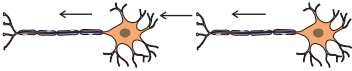
B
C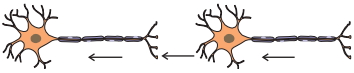
D
Solution
(A) In a neuron,electrical impulses are received by the dendrites.
From the dendrites,the impulse travels to the cell body (cyton).
Then,the impulse is transmitted along the axon towards the axon terminals.
This unidirectional flow ensures that signals are processed and transmitted correctly through the nervous system.
Therefore,the correct direction is: Dendrites $\rightarrow$ Cell Body $\rightarrow$ Axon $\rightarrow$ Axon Terminals.
From the dendrites,the impulse travels to the cell body (cyton).
Then,the impulse is transmitted along the axon towards the axon terminals.
This unidirectional flow ensures that signals are processed and transmitted correctly through the nervous system.
Therefore,the correct direction is: Dendrites $\rightarrow$ Cell Body $\rightarrow$ Axon $\rightarrow$ Axon Terminals.
0 likes
View Solution26
EasyMCQ
Which statement is not true about thyroxin?
A
It regulates carbohydrates,protein and fat metabolism in the body.
B
Iron is essential for the synthesis of thyroxin.
C
Thyroid gland requires iodine to synthesise thyroxin.
D
Thyroxin is also called thyroid hormone.
Solution
(B) Thyroxin is a hormone produced by the thyroid gland.
It plays a crucial role in regulating the metabolism of carbohydrates,proteins,and fats in the body.
Iodine is an essential element required by the thyroid gland for the synthesis of thyroxin.
Therefore,the statement that 'Iron is essential for the synthesis of thyroxin' is incorrect,as iodine is the required element,not iron.
It plays a crucial role in regulating the metabolism of carbohydrates,proteins,and fats in the body.
Iodine is an essential element required by the thyroid gland for the synthesis of thyroxin.
Therefore,the statement that 'Iron is essential for the synthesis of thyroxin' is incorrect,as iodine is the required element,not iron.
0 likes
View Solution27
EasyMCQ
Dwarfism results due to
A
Excess secretion of thyroxin
B
Less secretion of adrenaline
C
Less secretion of growth hormone
D
Excess secretion of growth hormone
Solution
(C) Dwarfism is a condition characterized by stunted growth. It is primarily caused by the hyposecretion (less secretion) of growth hormone $(GH)$,also known as somatotropin,from the anterior pituitary gland during childhood. When the body does not produce enough growth hormone,the bones and tissues do not grow to their full potential,resulting in a significantly shorter stature.
0 likes
View Solution28
MediumMCQ
Dramatic changes of body features associated with puberty are mainly because of the secretion of:
A
oestrogen from testes and testosterone from ovary
B
estrogen from adrenal gland and testosterone from pituitary gland
C
testosterone from thyroid gland and estrogen from pituitary gland
D
testosterone from testes and estrogen from ovary
Solution
(D) Puberty is the period during which adolescents reach sexual maturity and become capable of reproduction.
These changes are primarily driven by sex hormones.
In males,the testes secrete $testosterone$,which is responsible for the development of secondary sexual characteristics such as facial hair,deepening of the voice,and muscle growth.
In females,the ovaries secrete $estrogen$ (and progesterone),which is responsible for the development of secondary sexual characteristics such as breast development and the onset of the menstrual cycle.
Therefore,the correct answer is $D$.
These changes are primarily driven by sex hormones.
In males,the testes secrete $testosterone$,which is responsible for the development of secondary sexual characteristics such as facial hair,deepening of the voice,and muscle growth.
In females,the ovaries secrete $estrogen$ (and progesterone),which is responsible for the development of secondary sexual characteristics such as breast development and the onset of the menstrual cycle.
Therefore,the correct answer is $D$.
0 likes
View Solution29
EasyMCQ
$A$ doctor advised a person to take an injection of insulin because
A
his sugar level in blood was high
B
his heart was beating slowly
C
he was suffering from goitre
D
his blood pressure was low
Solution
(A) $Insulin$ is a hormone produced by the pancreas that regulates the amount of glucose in the blood.
When the blood sugar level becomes abnormally high (a condition known as hyperglycemia),the body may not produce enough $insulin$ to manage it.
Therefore,a doctor advises an $insulin$ injection to help lower the blood sugar level to a normal range.
When the blood sugar level becomes abnormally high (a condition known as hyperglycemia),the body may not produce enough $insulin$ to manage it.
Therefore,a doctor advises an $insulin$ injection to help lower the blood sugar level to a normal range.
0 likes
View Solution30
EasyMCQ
The hormone which increases fertility in males is called:
A
oestrogen
B
testosterone
C
insulin
D
growth hormone
Solution
(B) Testosterone is the primary male sex hormone.
It is produced mainly in the testes.
It plays a crucial role in the development of male reproductive tissues such as the testes and prostate,as well as promoting secondary sexual characteristics like increased muscle and bone mass,and the growth of body hair.
Most importantly,it is essential for spermatogenesis,which is the process of sperm production,thereby directly increasing fertility in males.
It is produced mainly in the testes.
It plays a crucial role in the development of male reproductive tissues such as the testes and prostate,as well as promoting secondary sexual characteristics like increased muscle and bone mass,and the growth of body hair.
Most importantly,it is essential for spermatogenesis,which is the process of sperm production,thereby directly increasing fertility in males.
0 likes
View Solution31
MediumMCQ
Which of the following endocrine glands is unpaired?
A
Adrenal
B
Testes
C
Pituitary
D
Ovary
Solution
(C) The endocrine system consists of various glands that secrete hormones.
$1$. Adrenal glands are paired glands located on top of the kidneys.
$2$. Testes are paired reproductive glands found in males.
$3$. Pituitary gland is a single,unpaired gland located at the base of the brain,often referred to as the master gland.
$4$. Ovaries are paired reproductive glands found in females.
Therefore,the pituitary gland is the correct answer.
$1$. Adrenal glands are paired glands located on top of the kidneys.
$2$. Testes are paired reproductive glands found in males.
$3$. Pituitary gland is a single,unpaired gland located at the base of the brain,often referred to as the master gland.
$4$. Ovaries are paired reproductive glands found in females.
Therefore,the pituitary gland is the correct answer.
0 likes
View Solution32
EasyMCQ
The junction between two neurons is called:
A
cell junction
B
neuromuscular junction
C
neural joint
D
synapse
Solution
(D) synapse is the specialized junction between two neurons,or between a neuron and a target cell (such as a muscle or gland cell),where information is transmitted from one cell to another.
At the synapse,the plasma membranes of the neurons are separated by a narrow space called the synaptic cleft.
Neurotransmitters are released from the presynaptic neuron into the synaptic cleft to transmit the signal to the postsynaptic neuron.
At the synapse,the plasma membranes of the neurons are separated by a narrow space called the synaptic cleft.
Neurotransmitters are released from the presynaptic neuron into the synaptic cleft to transmit the signal to the postsynaptic neuron.
0 likes
View Solution33
EasyMCQ
In humans,the life processes are controlled and regulated by
A
nervous and endocrine systems
B
endocrine and digestive systems
C
respiratory and nervous systems
D
reproductive and endocrine systems
Solution
(A) In humans,the life processes are controlled and regulated by the nervous system and the endocrine system.
The nervous system uses electrical impulses (nerve impulses) for rapid communication and coordination.
The endocrine system uses chemical messengers called hormones,which are secreted into the blood to regulate slower,long-term physiological processes.
Together,these two systems ensure homeostasis and proper functioning of the body.
The nervous system uses electrical impulses (nerve impulses) for rapid communication and coordination.
The endocrine system uses chemical messengers called hormones,which are secreted into the blood to regulate slower,long-term physiological processes.
Together,these two systems ensure homeostasis and proper functioning of the body.
0 likes
View Solution34
Medium
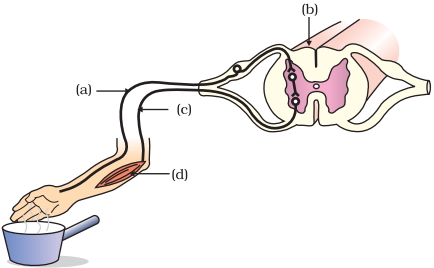
Label the parts $(a)$,$(b)$,$(c)$ and $(d)$ and show the direction of flow of electrical signals in the figure.
Solution
(N/A) The given figure represents a reflex arc,which is the pathway taken by nerve impulses in a reflex action.
$(a)$ Sensory neuron: It carries the electrical signal from the receptor (skin) to the central nervous system.
$(b)$ Spinal cord: It acts as the processing center for the reflex action.
$(c)$ Motor neuron: It carries the response signal from the spinal cord to the effector.
$(d)$ Effector: It is the muscle in the arm that contracts to pull the hand away from the hot object.
The direction of the flow of electrical signals is from the receptor (hand) $\rightarrow$ sensory neuron $(a)$ $\rightarrow$ spinal cord $(b)$ $\rightarrow$ motor neuron $(c)$ $\rightarrow$ effector $(d)$ (muscle).
$(a)$ Sensory neuron: It carries the electrical signal from the receptor (skin) to the central nervous system.
$(b)$ Spinal cord: It acts as the processing center for the reflex action.
$(c)$ Motor neuron: It carries the response signal from the spinal cord to the effector.
$(d)$ Effector: It is the muscle in the arm that contracts to pull the hand away from the hot object.
The direction of the flow of electrical signals is from the receptor (hand) $\rightarrow$ sensory neuron $(a)$ $\rightarrow$ spinal cord $(b)$ $\rightarrow$ motor neuron $(c)$ $\rightarrow$ effector $(d)$ (muscle).
0 likes
View Solution35
Easy
Name the plant hormones responsible for the following:
$(a)$ Elongation of cells
$(b)$ Growth of stem
$(c)$ Promotion of cell division
$(d)$ Falling of senescent leaves.
$(a)$ Elongation of cells
$(b)$ Growth of stem
$(c)$ Promotion of cell division
$(d)$ Falling of senescent leaves.
Solution
(N/A) Auxin is responsible for cell elongation.
$(b)$ Gibberellin is responsible for the growth of the stem.
$(c)$ Cytokinin is responsible for the promotion of cell division.
$(d)$ Abscisic acid is responsible for the falling of senescent leaves.
$(b)$ Gibberellin is responsible for the growth of the stem.
$(c)$ Cytokinin is responsible for the promotion of cell division.
$(d)$ Abscisic acid is responsible for the falling of senescent leaves.
0 likes
View Solution36
Medium
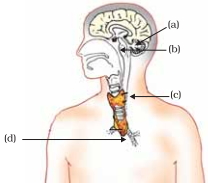
Label the endocrine glands in the figure.
Solution
(N/A) Pineal gland
$(b)$ Pituitary gland
$(c)$ Thyroid gland
$(d)$ Thymus gland
$(b)$ Pituitary gland
$(c)$ Thyroid gland
$(d)$ Thymus gland
0 likes
View Solution37
Easy
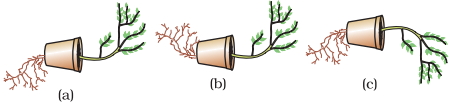
In figures $(a)$,$(b)$ and $(c)$,which appears more accurate and why?
Solution
(A) Figure $(a)$ is the most accurate representation.
This is because plant shoots exhibit negative geotropism (they grow away from the gravitational pull of the Earth,i.e.,upwards).
Conversely,plant roots exhibit positive geotropism (they grow towards the gravitational pull of the Earth,i.e.,downwards).
Therefore,in a horizontally placed pot,the shoot will bend upwards and the roots will bend downwards to align with these natural tropisms.
This is because plant shoots exhibit negative geotropism (they grow away from the gravitational pull of the Earth,i.e.,upwards).
Conversely,plant roots exhibit positive geotropism (they grow towards the gravitational pull of the Earth,i.e.,downwards).
Therefore,in a horizontally placed pot,the shoot will bend upwards and the roots will bend downwards to align with these natural tropisms.
0 likes
View Solution38
Easy
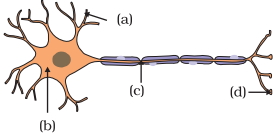
Label the parts of a neuron in the given figure.
Solution
(N/A) Dendrite: These are branch-like structures that receive information from other neurons.
$(b)$ Cell body (Cyton): It contains the nucleus and cytoplasm and is responsible for processing information.
$(c)$ Axon: It is a long fiber that conducts electrical impulses away from the cell body.
$(d)$ Nerve ending (Axon terminal): These are the branched ends of the axon that transmit signals to the next neuron or target cell.
$(b)$ Cell body (Cyton): It contains the nucleus and cytoplasm and is responsible for processing information.
$(c)$ Axon: It is a long fiber that conducts electrical impulses away from the cell body.
$(d)$ Nerve ending (Axon terminal): These are the branched ends of the axon that transmit signals to the next neuron or target cell.
0 likes
View Solution39
Easy
Match the terms of Column $(A)$ with those of Column $(B)$.
| < strong>Column $(A)$ | < strong>Column $(B)$ |
| $(a)$ Olfactory receptors | $(i)$ Tongue |
| $(b)$ Thermoreceptors (temperature receptors) | $(ii)$ Eye |
| $(c)$ Gustatoreceptors | $(iii)$ Nose |
| $(d)$ Photoreceptors | $(iv)$ Skin |
Solution
(A) The correct matches are as follows:
$(a)$ Olfactory receptors are sensory receptors for smell,located in the $(iii)$ Nose.
$(b)$ Thermoreceptors are sensory receptors for temperature,located in the $(iv)$ Skin.
$(c)$ Gustatoreceptors are sensory receptors for taste,located in the $(i)$ Tongue.
$(d)$ Photoreceptors are sensory receptors for light,located in the $(ii)$ Eye.
Therefore,the correct sequence is: $(a-iii, b-iv, c-i, d-ii)$.
$(a)$ Olfactory receptors are sensory receptors for smell,located in the $(iii)$ Nose.
$(b)$ Thermoreceptors are sensory receptors for temperature,located in the $(iv)$ Skin.
$(c)$ Gustatoreceptors are sensory receptors for taste,located in the $(i)$ Tongue.
$(d)$ Photoreceptors are sensory receptors for light,located in the $(ii)$ Eye.
Therefore,the correct sequence is: $(a-iii, b-iv, c-i, d-ii)$.
0 likes
View Solution40
Easy
What is a tropic movement? Explain with an example.
Solution
(N/A) Tropic movement is the directional growth movement of a plant part in response to an external stimulus. These movements are dependent on the direction of the stimulus and can be either towards the stimulus (positive tropism) or away from it (negative tropism).
For example,in phototropism,the shoot of a plant shows positive phototropism by bending towards the light source,whereas the roots show negative phototropism by growing away from the light.
For example,in phototropism,the shoot of a plant shows positive phototropism by bending towards the light source,whereas the roots show negative phototropism by growing away from the light.
0 likes
View Solution41
EasyMCQ
What will happen if the intake of iodine in our diet is low?
A
Thyroxin production increases
B
Metabolism of carbohydrates,proteins,and fats is affected
C
Goitre occurs due to thyroid gland enlargement
D
Both $(b)$ and $(c)$
Solution
(D) If the intake of iodine in our diet is low,the thyroid gland cannot synthesize enough thyroxin hormone.
$(a)$ Since thyroxin regulates the metabolism of carbohydrates,proteins,and fats in the body,a deficiency leads to an imbalance in these metabolic processes.
$(b)$ The thyroid gland enlarges in an attempt to produce more thyroxin,leading to a condition known as goitre.
$(a)$ Since thyroxin regulates the metabolism of carbohydrates,proteins,and fats in the body,a deficiency leads to an imbalance in these metabolic processes.
$(b)$ The thyroid gland enlarges in an attempt to produce more thyroxin,leading to a condition known as goitre.
0 likes
View Solution42
MediumMCQ
What happens at the synapse between two neurons?
A
Electrical impulses are converted into chemical signals.
B
Chemical signals are converted into electrical impulses.
C
Both $A$ and $B$.
D
None of the above.
Solution
(C) At the synapse,the electrical impulse reaching the axon terminal of one neuron triggers the release of neurotransmitters (chemical substances).
These chemical substances cross the synaptic cleft and bind to receptors on the dendrite of the next neuron.
This process converts the chemical signal back into an electrical impulse in the next neuron,allowing the signal to propagate through the nervous system.
These chemical substances cross the synaptic cleft and bind to receptors on the dendrite of the next neuron.
This process converts the chemical signal back into an electrical impulse in the next neuron,allowing the signal to propagate through the nervous system.
0 likes
View Solution43
Medium
Answer the following:
$(a)$ Which hormone is responsible for the changes noticed in females at puberty?
$(b)$ Dwarfism results due to deficiency of which hormone?
$(c)$ Blood sugar level rises due to deficiency of which hormone?
$(d)$ Iodine is necessary for the synthesis of which hormone?
$(a)$ Which hormone is responsible for the changes noticed in females at puberty?
$(b)$ Dwarfism results due to deficiency of which hormone?
$(c)$ Blood sugar level rises due to deficiency of which hormone?
$(d)$ Iodine is necessary for the synthesis of which hormone?
Solution
(N/A) Oestrogen is the hormone responsible for the development of secondary sexual characteristics in females at puberty.
$(b)$ Dwarfism is caused by the deficiency of Growth Hormone $(GH)$,which is secreted by the pituitary gland.
$(c)$ Blood sugar level rises (hyperglycemia) due to the deficiency of Insulin,which is secreted by the pancreas.
$(d)$ Iodine is essential for the synthesis of Thyroxin,which is produced by the thyroid gland.
$(b)$ Dwarfism is caused by the deficiency of Growth Hormone $(GH)$,which is secreted by the pituitary gland.
$(c)$ Blood sugar level rises (hyperglycemia) due to the deficiency of Insulin,which is secreted by the pancreas.
$(d)$ Iodine is essential for the synthesis of Thyroxin,which is produced by the thyroid gland.
0 likes
View Solution44
Medium
Answer the following:
$(a)$ Name the endocrine gland associated with the brain.
$(b)$ Which gland secretes digestive enzymes as well as hormones?
$(c)$ Name the endocrine gland associated with the kidneys.
$(d)$ Which endocrine gland is present in males but not in females?
$(a)$ Name the endocrine gland associated with the brain.
$(b)$ Which gland secretes digestive enzymes as well as hormones?
$(c)$ Name the endocrine gland associated with the kidneys.
$(d)$ Which endocrine gland is present in males but not in females?
Solution
(N/A) The pituitary gland is located at the base of the brain.
$(b)$ The pancreas acts as a heterocrine (mixed) gland,secreting digestive enzymes into the duodenum and hormones like insulin and glucagon into the blood.
$(c)$ The adrenal glands are located on top of each kidney.
$(d)$ The testes are the primary sex organs in males that function as endocrine glands by secreting testosterone.
$(b)$ The pancreas acts as a heterocrine (mixed) gland,secreting digestive enzymes into the duodenum and hormones like insulin and glucagon into the blood.
$(c)$ The adrenal glands are located on top of each kidney.
$(d)$ The testes are the primary sex organs in males that function as endocrine glands by secreting testosterone.
0 likes
View Solution45
Easy
Draw the structure of a neuron and explain its function.
Solution
(N/A) neuron (nerve cell) is the structural and functional unit of the nervous system. Its structure consists of three main parts:
$1$. Cell Body (Cyton): It contains the nucleus and cytoplasm (Nissl granules). It is responsible for the metabolic activities of the cell.
$2$. Dendrites: These are short,branched extensions that receive electrical impulses from other neurons or sensory receptors and transmit them towards the cell body.
$3$. Axon: This is a long,single fiber that carries electrical impulses away from the cell body to other neurons,muscles,or glands. It is often covered by a myelin sheath for faster signal transmission.
Function: Neurons are specialized to detect,receive,and conduct nerve impulses (electrical signals) throughout the body,enabling communication between different parts of the body and the brain.
$1$. Cell Body (Cyton): It contains the nucleus and cytoplasm (Nissl granules). It is responsible for the metabolic activities of the cell.
$2$. Dendrites: These are short,branched extensions that receive electrical impulses from other neurons or sensory receptors and transmit them towards the cell body.
$3$. Axon: This is a long,single fiber that carries electrical impulses away from the cell body to other neurons,muscles,or glands. It is often covered by a myelin sheath for faster signal transmission.
Function: Neurons are specialized to detect,receive,and conduct nerve impulses (electrical signals) throughout the body,enabling communication between different parts of the body and the brain.
0 likes
View Solution46
Medium
What are the major parts of the brain? Mention the functions of different parts.
Solution
(N/A) The human brain is divided into three major parts:
$1$. Forebrain: It is the main thinking part of the brain. It controls voluntary actions,stores information (memory),and processes sensory information like sight,smell,and hearing.
$2$. Midbrain: It connects the forebrain to the hindbrain and controls reflex movements of the head,neck,and eyes in response to visual and auditory stimuli.
$3$. Hindbrain: It consists of the cerebellum,pons,and medulla. The cerebellum controls posture,balance,and precision of voluntary movements. The medulla controls involuntary actions like blood pressure,salivation,and vomiting.
$1$. Forebrain: It is the main thinking part of the brain. It controls voluntary actions,stores information (memory),and processes sensory information like sight,smell,and hearing.
$2$. Midbrain: It connects the forebrain to the hindbrain and controls reflex movements of the head,neck,and eyes in response to visual and auditory stimuli.
$3$. Hindbrain: It consists of the cerebellum,pons,and medulla. The cerebellum controls posture,balance,and precision of voluntary movements. The medulla controls involuntary actions like blood pressure,salivation,and vomiting.
0 likes
View Solution47
Medium
What constitutes the central and peripheral nervous systems? How are the components of the central nervous system protected?
Solution
(N/A) The central nervous system $(CNS)$ is composed of the brain and the spinal cord.
The peripheral nervous system $(PNS)$ consists of all the nerves that branch out from the $CNS$ and connect to the rest of the body,including cranial nerves and spinal nerves.
The components of the $CNS$ are protected as follows:
$1$. The brain is protected by a bony box called the cranium (brain box),which contains cerebrospinal fluid for shock absorption.
$2$. The spinal cord is protected by the vertebral column (backbone).
The peripheral nervous system $(PNS)$ consists of all the nerves that branch out from the $CNS$ and connect to the rest of the body,including cranial nerves and spinal nerves.
The components of the $CNS$ are protected as follows:
$1$. The brain is protected by a bony box called the cranium (brain box),which contains cerebrospinal fluid for shock absorption.
$2$. The spinal cord is protected by the vertebral column (backbone).
0 likes
View Solution48
Medium
Mention one function for each of these hormones:
$(a)$ Thyroxin
$(b)$ Insulin
$(c)$ Adrenaline
$(d)$ Growth hormone
$(e)$ Testosterone.
$(a)$ Thyroxin
$(b)$ Insulin
$(c)$ Adrenaline
$(d)$ Growth hormone
$(e)$ Testosterone.
Solution
(N/A) Thyroxin: Regulates carbohydrate,fat,and protein metabolism in the body.
$(b)$ Insulin: Regulates blood sugar levels by facilitating the uptake of glucose into cells.
$(c)$ Adrenaline: Increases heart rate and blood supply to essential organs during stress or emergency situations.
$(d)$ Growth hormone: Regulates the growth and development of bones and tissues in the body.
$(e)$ Testosterone: Controls the development of secondary sexual characteristics associated with puberty in males.
$(b)$ Insulin: Regulates blood sugar levels by facilitating the uptake of glucose into cells.
$(c)$ Adrenaline: Increases heart rate and blood supply to essential organs during stress or emergency situations.
$(d)$ Growth hormone: Regulates the growth and development of bones and tissues in the body.
$(e)$ Testosterone: Controls the development of secondary sexual characteristics associated with puberty in males.
0 likes
View Solution49
Medium
Name various plant hormones and describe their physiological effects on plant growth and development.
Solution
(N/A) The major plant hormones (phytohormones) and their physiological effects are as follows:
$1$. $Auxins$: These promote cell enlargement and cell differentiation. They are responsible for apical dominance,root initiation in stem cuttings,and preventing fruit and leaf drop at early stages.
$2$. $Gibberellins$: These promote stem elongation,seed germination,and flowering. They are also involved in breaking seed dormancy and increasing the size of fruits like grapes.
$3$. $Cytokinins$: These promote cell division (cytokinesis). They help in delaying senescence (aging) in leaves,promoting lateral bud growth,and overcoming apical dominance.
$4$. $Abscisic \ acid$ $(ABA)$: This is a growth inhibitor. It promotes dormancy in seeds and buds,induces leaf abscission (falling of leaves),and causes closure of stomata during water stress.
$5$. $Ethylene$: This is a gaseous hormone that promotes fruit ripening and senescence of flowers and leaves.
$1$. $Auxins$: These promote cell enlargement and cell differentiation. They are responsible for apical dominance,root initiation in stem cuttings,and preventing fruit and leaf drop at early stages.
$2$. $Gibberellins$: These promote stem elongation,seed germination,and flowering. They are also involved in breaking seed dormancy and increasing the size of fruits like grapes.
$3$. $Cytokinins$: These promote cell division (cytokinesis). They help in delaying senescence (aging) in leaves,promoting lateral bud growth,and overcoming apical dominance.
$4$. $Abscisic \ acid$ $(ABA)$: This is a growth inhibitor. It promotes dormancy in seeds and buds,induces leaf abscission (falling of leaves),and causes closure of stomata during water stress.
$5$. $Ethylene$: This is a gaseous hormone that promotes fruit ripening and senescence of flowers and leaves.
0 likes
View Solution50
Medium
What are reflex actions? Give two examples. Explain a reflex arc.
Solution
(N/A) Reflex actions are rapid,automatic,and involuntary responses to a stimulus that do not involve conscious thought by the brain.
Examples:
$1$. Sudden withdrawal of the hand upon touching a hot object.
$2$. Blinking of eyes when a bright light or object suddenly approaches them.
Reflex Arc:
$A$ reflex arc is the neural pathway that mediates a reflex action. The pathway consists of the following components:
$1$. Receptor: Detects the stimulus.
$2$. Sensory Neuron: Carries the signal from the receptor to the spinal cord.
$3$. Relay Neuron (Interneuron): Processes the signal within the spinal cord.
$4$. Motor Neuron: Carries the response signal from the spinal cord to the effector.
$5$. Effector: $A$ muscle or gland that performs the action.
Examples:
$1$. Sudden withdrawal of the hand upon touching a hot object.
$2$. Blinking of eyes when a bright light or object suddenly approaches them.
Reflex Arc:
$A$ reflex arc is the neural pathway that mediates a reflex action. The pathway consists of the following components:
$1$. Receptor: Detects the stimulus.
$2$. Sensory Neuron: Carries the signal from the receptor to the spinal cord.
$3$. Relay Neuron (Interneuron): Processes the signal within the spinal cord.
$4$. Motor Neuron: Carries the response signal from the spinal cord to the effector.
$5$. Effector: $A$ muscle or gland that performs the action.
0 likes
View SolutionControl and Coordination — Mix Examples - Control and Coordination · Frequently Asked Questions
1Are these Control and Coordination questions useful for JEE and NEET?
Yes. All questions in this section are mapped to JEE Main and NEET exam patterns. Previous year questions from JEE Main, NEET, GUJCET and state-level exams are included with full solutions.
2Can I switch to Hindi or Gujarati for these questions?
Yes. Use the language tabs in the hero section or the sidebar to view the same questions and solutions in English, Hindi or Gujarati.
3How do I generate a question paper from this subtopic?
Use the Vedclass Exam Paper Generator — select the chapter and subtopic, set difficulty, and generate Sets A, B, C, D automatically. First 3 chapters of every subject are free.
Vedclass Products
For Students
Vedclass Test Series
Mock tests in real JEE/NEET style with performance analysis. 5-day free trial.
Start Free TrialFor Teachers
Exam Paper Generator
Generate Set A/B/C/D papers from this chapter in 2 minutes. 3 chapters free.
Try FreeFor Institutes
Online Exam Module
Live online exams with unlimited students, 360° analytics & white-label branding.
See DemoFor Teachers & Institutes
Generate a Control and Coordination Exam Paper in 2 Minutes
Select subtopic & difficulty — Sets A, B, C, D auto-generated with No Repeat logic.
First 3 chapters of every subject are free — no payment required.