
A English
Textbook - Control and Coordination Questions in English
Class 10 Science · Control and Coordination · Textbook - Control and Coordination
26+
Questions
English
Language
100%
With Solutions
Showing 26 of 26 questions in English
1
MediumMCQ
What is the difference between a reflex action and walking?
A
Reflex action is voluntary,walking is involuntary.
B
Reflex action is involuntary,walking is voluntary.
C
Both are voluntary actions.
D
Both are involuntary actions.
Solution
(B) reflex action is a rapid,automatic,and involuntary response to a stimulus that does not involve conscious thinking. It is controlled by the spinal cord. For example,withdrawing a hand upon touching a hot object.
Walking,on the other hand,is a voluntary action. It is under our conscious control and involves the brain (cerebrum) for planning and execution.
Walking,on the other hand,is a voluntary action. It is under our conscious control and involves the brain (cerebrum) for planning and execution.
0 likes
View Solution2
Difficult
What happens at the synapse between two neurons?
Solution
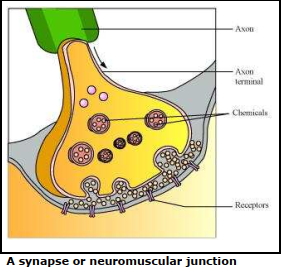
(N/A) synapse is a microscopic gap between the axon terminal of one neuron and the dendrite of the next neuron.
It functions as a one-way valve,ensuring that nerve impulses travel in only one direction.
This unidirectional transmission occurs because chemical messengers (neurotransmitters) are stored only in the axon terminals of the presynaptic neuron.
When an electrical impulse reaches the axon terminal,these chemicals are released into the synaptic cleft.
They diffuse across the gap and bind to specific receptors on the dendrite of the postsynaptic neuron,where they trigger a new electrical impulse.
It functions as a one-way valve,ensuring that nerve impulses travel in only one direction.
This unidirectional transmission occurs because chemical messengers (neurotransmitters) are stored only in the axon terminals of the presynaptic neuron.
When an electrical impulse reaches the axon terminal,these chemicals are released into the synaptic cleft.
They diffuse across the gap and bind to specific receptors on the dendrite of the postsynaptic neuron,where they trigger a new electrical impulse.
0 likes
View Solution3
EasyMCQ
Which part of the brain maintains posture and equilibrium of the body?
A
Cerebrum
B
Cerebellum
C
Medulla
D
Pons
Solution
(B) The $Cerebellum$, which is a part of the $Hindbrain$, is responsible for maintaining the posture, balance, and equilibrium of the body. It also coordinates voluntary muscular movements.
0 likes
View Solution4
DifficultMCQ
How do we detect the smell of an agarbatti (incense stick)?
A
Through the hindbrain
B
Through the forebrain
C
Through the midbrain
D
Through the spinal cord
Solution
(B) The thinking part of our brain is the forebrain.
It has separate areas that are specialized for hearing,smelling,sight,taste,touch,etc.
The forebrain also has regions that collect information or impulses from the various receptors.
When the smell of an incense stick reaches us,our forebrain detects it.
Then,the forebrain interprets it by putting it together with the information received from other receptors and also with the information already stored in the brain.
It has separate areas that are specialized for hearing,smelling,sight,taste,touch,etc.
The forebrain also has regions that collect information or impulses from the various receptors.
When the smell of an incense stick reaches us,our forebrain detects it.
Then,the forebrain interprets it by putting it together with the information received from other receptors and also with the information already stored in the brain.
0 likes
View Solution5
Difficult
What is the role of the brain in reflex action?
Solution
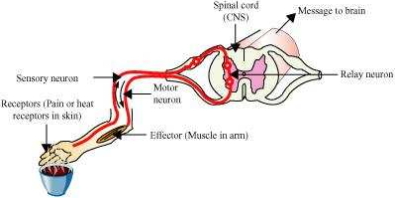
(N/A) Reflex actions are sudden,involuntary responses to stimuli that do not involve conscious thinking.
For example,when we touch a hot object,we withdraw our hand immediately without thinking,as the time taken for conscious processing could cause severe burns.
The sensory nerves that detect the heat are connected to the motor nerves that move the muscles of the hand.
Such a connection of detecting the signal from the nerves (input) and responding to it quickly (output) is called a reflex arc.
The reflex arcs—connections present between the input and output nerves—meet in a bundle in the spinal cord.
Reflex arcs are formed in the spinal cord,and the information (input) simultaneously reaches the brain.
The brain is only made aware of the signal and the response that has taken place.
However,the brain plays no role in the initiation or creation of the reflex response itself.
For example,when we touch a hot object,we withdraw our hand immediately without thinking,as the time taken for conscious processing could cause severe burns.
The sensory nerves that detect the heat are connected to the motor nerves that move the muscles of the hand.
Such a connection of detecting the signal from the nerves (input) and responding to it quickly (output) is called a reflex arc.
The reflex arcs—connections present between the input and output nerves—meet in a bundle in the spinal cord.
Reflex arcs are formed in the spinal cord,and the information (input) simultaneously reaches the brain.
The brain is only made aware of the signal and the response that has taken place.
However,the brain plays no role in the initiation or creation of the reflex response itself.
0 likes
View Solution6
Medium
What are plant hormones?
Solution
(N/A) Plant hormones,also known as phytohormones,are naturally occurring organic substances. They are synthesized in minute quantities in specific parts of the plant body and are translocated to other parts where they are required to regulate physiological processes. The five major types of phytohormones are auxins,gibberellins,cytokinins,abscisic acid,and ethylene.
0 likes
View Solution7
EasyMCQ
How is the movement of leaves of the sensitive plant different from the movement of a shoot towards light?
A
The movement of leaves is growth-dependent,while the movement of the shoot is growth-independent.
B
The movement of leaves is independent of growth,whereas the movement of the shoot is growth-dependent.
C
Both movements are growth-dependent.
D
Both movements are growth-independent.
Solution
(B) The movement of leaves of the sensitive plant,$Mimosa$ $pudica$ (touch-me-not),occurs in response to touch or contact stimuli (thigmonasty). This movement is independent of growth and is reversible.
The movement of a shoot towards light is known as phototropism. This type of movement is directional and is growth-dependent,meaning it involves the differential growth of cells on different sides of the stem.
The movement of a shoot towards light is known as phototropism. This type of movement is directional and is growth-dependent,meaning it involves the differential growth of cells on different sides of the stem.
0 likes
View Solution8
EasyMCQ
Give an example of a plant hormone that promotes growth.
A
Auxin
B
Abscisic acid
C
Ethylene
D
Cytokinin
Solution
(A) Auxin is a primary example of a growth-promoting plant hormone. It is responsible for cell elongation,apical dominance,and root initiation in plants.
0 likes
View Solution9
EasyMCQ
How do auxins promote the growth of a tendril around a support?
A
By inhibiting cell division on the side touching the support.
B
By stimulating faster cell elongation on the side away from the support.
C
By causing the tendril to wither upon contact.
D
By increasing the thickness of the tendril uniformly.
Solution
(B) Auxin is a plant hormone synthesized at the shoot tip that promotes cell elongation.
When a tendril comes in contact with a support,the concentration of auxin decreases on the side touching the support and remains higher on the side away from the support.
This higher concentration of auxin on the side away from the support stimulates faster cell growth and elongation on that side.
As a result,the side away from the support grows longer than the side in contact,causing the tendril to coil around the support.
When a tendril comes in contact with a support,the concentration of auxin decreases on the side touching the support and remains higher on the side away from the support.
This higher concentration of auxin on the side away from the support stimulates faster cell growth and elongation on that side.
As a result,the side away from the support grows longer than the side in contact,causing the tendril to coil around the support.
0 likes
View Solution10
Difficult
Design an experiment to demonstrate hydrotropism.
Solution
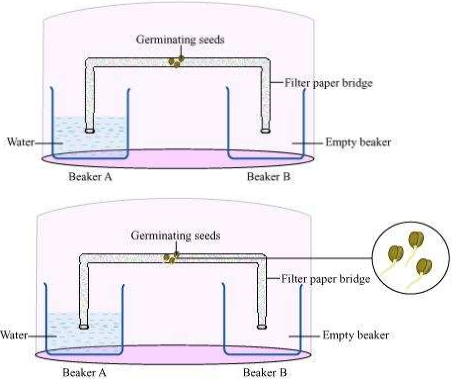
(N/A) $1$. Take two small beakers and label them as $A$ and $B$.
$2$. Fill beaker $A$ with water and leave beaker $B$ empty.
$3$. Make a cylindrical-shaped roll from a filter paper and place it as a bridge between beaker $A$ and beaker $B$.
$4$. Place a few germinating seeds in the middle of the filter paper bridge.
$5$. Cover the entire set-up with a transparent plastic container to maintain humidity.
Observation:
After a few days,it is observed that the roots of the germinating seeds grow towards beaker $A$ (the source of water).
Conclusion:
This growth of plant roots towards water is known as hydrotropism. It demonstrates that roots are positively hydrotropic.
$2$. Fill beaker $A$ with water and leave beaker $B$ empty.
$3$. Make a cylindrical-shaped roll from a filter paper and place it as a bridge between beaker $A$ and beaker $B$.
$4$. Place a few germinating seeds in the middle of the filter paper bridge.
$5$. Cover the entire set-up with a transparent plastic container to maintain humidity.
Observation:
After a few days,it is observed that the roots of the germinating seeds grow towards beaker $A$ (the source of water).
Conclusion:
This growth of plant roots towards water is known as hydrotropism. It demonstrates that roots are positively hydrotropic.
0 likes
View Solution11
Medium
How does chemical coordination take place in animals?
Solution
(N/A) Chemical coordination in animals is mediated by hormones.
Hormones are chemical messengers that regulate various physiological processes in living organisms.
These substances are secreted by endocrine glands directly into the bloodstream.
The regulation of physiological processes,as well as control and coordination via hormones,is collectively known as the endocrine system.
In animals,the nervous system works in conjunction with the endocrine system to effectively control and coordinate complex physiological activities.
Hormones are chemical messengers that regulate various physiological processes in living organisms.
These substances are secreted by endocrine glands directly into the bloodstream.
The regulation of physiological processes,as well as control and coordination via hormones,is collectively known as the endocrine system.
In animals,the nervous system works in conjunction with the endocrine system to effectively control and coordinate complex physiological activities.
0 likes
View Solution12
MediumMCQ
Why is the use of iodised salt advisable?
A
To prevent diabetes
B
To prevent goitre
C
To increase blood pressure
D
To improve eyesight
Solution
(B) Iodine is essential for the thyroid gland to produce the hormone thyroxin.
Thyroxin regulates the metabolism of carbohydrates,fats,and proteins in the body.
$A$ deficiency of iodine leads to a deficiency of thyroxin,which causes the thyroid gland to enlarge,a condition known as goitre.
Therefore,the use of iodised salt is advised to ensure the normal functioning of the thyroid gland and to prevent goitre.
Thyroxin regulates the metabolism of carbohydrates,fats,and proteins in the body.
$A$ deficiency of iodine leads to a deficiency of thyroxin,which causes the thyroid gland to enlarge,a condition known as goitre.
Therefore,the use of iodised salt is advised to ensure the normal functioning of the thyroid gland and to prevent goitre.
0 likes
View Solution13
MediumMCQ
How does our body respond when adrenaline is secreted into the blood?
A
It decreases the heart rate.
B
It increases the heart rate and breathing rate.
C
It slows down the digestion process.
D
It has no effect on the body.
Solution
(B) Adrenaline is a hormone secreted by the adrenal glands in response to danger,emergency,or stress.
It is secreted directly into the blood and transported to various target organs.
When secreted in large amounts,it increases the heartbeat to supply more oxygen to the muscles.
The breathing rate also increases due to the contraction of the diaphragm and rib muscles.
Additionally,it increases blood pressure and diverts blood flow to essential organs.
All these physiological responses prepare the body to deal with stressful or emergency situations.
It is secreted directly into the blood and transported to various target organs.
When secreted in large amounts,it increases the heartbeat to supply more oxygen to the muscles.
The breathing rate also increases due to the contraction of the diaphragm and rib muscles.
Additionally,it increases blood pressure and diverts blood flow to essential organs.
All these physiological responses prepare the body to deal with stressful or emergency situations.
0 likes
View Solution14
Easy
Why are some patients of diabetes treated by giving injections of insulin?
Solution
(N/A) Diabetes is a metabolic disorder characterized by high blood sugar levels (hyperglycemia).
Insulin is a hormone produced by the $\beta$-cells of the pancreas that facilitates the uptake of glucose into cells,thereby lowering blood sugar levels.
In patients with diabetes,the pancreas either does not produce enough insulin or the body cannot effectively use the insulin it produces.
Therefore,external injections of insulin are administered to maintain blood glucose levels within the normal physiological range.
Insulin is a hormone produced by the $\beta$-cells of the pancreas that facilitates the uptake of glucose into cells,thereby lowering blood sugar levels.
In patients with diabetes,the pancreas either does not produce enough insulin or the body cannot effectively use the insulin it produces.
Therefore,external injections of insulin are administered to maintain blood glucose levels within the normal physiological range.
0 likes
View Solution15
EasyMCQ
Which of the following is a plant hormone?
A
Insulin
B
Thyroxin
C
Cytokinin
D
Estrogen
Solution
(C) Cytokinin is a plant hormone that promotes cell division in plants.
Insulin,Thyroxin,and Estrogen are hormones found in animals.
Insulin,Thyroxin,and Estrogen are hormones found in animals.
0 likes
View Solution16
EasyMCQ
The gap between two neurons is called a
A
impulse
B
axon
C
dendrite
D
synapse
Solution
(D) The gap between two neurons is called a synapse. It is the site where the terminal end of the axon of one neuron comes in close proximity to the dendrite of another neuron,allowing for the transmission of nerve impulses via chemical neurotransmitters.
0 likes
View Solution17
EasyMCQ
The brain is responsible for
A
all of the above
B
thinking
C
regulating the heart beat
D
balancing the body
Solution
(A) The brain is the main coordinating centre of the body.
It is responsible for complex processes like thinking,processing information,and memory.
It also controls involuntary actions such as regulating the heart beat through the medulla oblongata.
Furthermore,it is responsible for maintaining the posture and balancing the body,a function primarily performed by the cerebellum.
Therefore,all the given options are correct.
It is responsible for complex processes like thinking,processing information,and memory.
It also controls involuntary actions such as regulating the heart beat through the medulla oblongata.
Furthermore,it is responsible for maintaining the posture and balancing the body,a function primarily performed by the cerebellum.
Therefore,all the given options are correct.
0 likes
View Solution18
Difficult
What is the function of receptors in our body? Think of situations where receptors do not work properly. What problems are likely to arise?
Solution
(N/A) Receptors are specialized sensory structures (organs,tissues,or cells) present throughout the body. They are either grouped together,as in the case of the eye or ear,or scattered,as in the case of the skin.
Functions of receptors:
$(i)$ They detect external stimuli such as heat,light,sound,or pain.
$(ii)$ They trigger an electrical impulse in the sensory neurons,which transmits the information to the central nervous system (spinal cord or brain).
Problems when receptors do not work properly:
If receptors are damaged,the body fails to perceive external stimuli. For example,if the heat receptors in the skin are damaged,a person might accidentally touch a hot object and suffer severe burns because the brain does not receive the warning signal of pain or heat. This lack of sensory feedback can lead to serious injuries or accidents.
Functions of receptors:
$(i)$ They detect external stimuli such as heat,light,sound,or pain.
$(ii)$ They trigger an electrical impulse in the sensory neurons,which transmits the information to the central nervous system (spinal cord or brain).
Problems when receptors do not work properly:
If receptors are damaged,the body fails to perceive external stimuli. For example,if the heat receptors in the skin are damaged,a person might accidentally touch a hot object and suffer severe burns because the brain does not receive the warning signal of pain or heat. This lack of sensory feedback can lead to serious injuries or accidents.
0 likes
View Solution19
Medium
Draw the structure of a neuron and explain its functions.
Solution
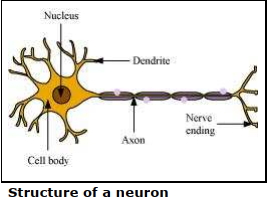
(N/A) Neurons are the functional units of the nervous system. The three main parts of a neuron are the axon,dendrite,and cell body.
Functions of the three parts of a neuron:
$1$. Dendrite: It receives information from the axon of another cell and conducts the messages towards the cell body.
$2$. Cell body: It contains the nucleus,mitochondria,and other organelles. It is mainly concerned with the maintenance and growth of the cell.
$3$. Axon: It conducts messages away from the cell body towards the nerve endings.
Functions of the three parts of a neuron:
$1$. Dendrite: It receives information from the axon of another cell and conducts the messages towards the cell body.
$2$. Cell body: It contains the nucleus,mitochondria,and other organelles. It is mainly concerned with the maintenance and growth of the cell.
$3$. Axon: It conducts messages away from the cell body towards the nerve endings.
3 likes
View Solution20
Medium
How does phototropism occur in plants?
.jpg)
Solution
(N/A) Phototropism is the directional growth of a plant in response to light.
$1$. When plants are exposed to light coming from one side,a plant hormone called $Auxin$ is synthesized at the shoot tip.
$2$. $Auxin$ helps the cells grow longer.
$3$. When light falls on the shoot from one side,$Auxin$ diffuses towards the shady side of the shoot.
$4$. This concentration of $Auxin$ stimulates the cells on the shady side to grow longer than those on the side receiving light.
$5$. As a result,the plant appears to bend towards the source of light.
$1$. When plants are exposed to light coming from one side,a plant hormone called $Auxin$ is synthesized at the shoot tip.
$2$. $Auxin$ helps the cells grow longer.
$3$. When light falls on the shoot from one side,$Auxin$ diffuses towards the shady side of the shoot.
$4$. This concentration of $Auxin$ stimulates the cells on the shady side to grow longer than those on the side receiving light.
$5$. As a result,the plant appears to bend towards the source of light.
1 likes
View Solution21
EasyMCQ
Which signals will get disrupted in case of a spinal cord injury?
A
Signals coming from the brain
B
Signals coming from the receptors
C
Both $(A)$ and $(B)$
D
None of the above
Solution
(C) The reflex arc connections between the input and output nerves meet in a bundle in the spinal cord.
In fact,nerves from all over the body meet in a bundle in the spinal cord on their way to the brain.
In case of any injury to the spinal cord,the signals coming from the nerves as well as the signals coming to the receptors will be disrupted.
In fact,nerves from all over the body meet in a bundle in the spinal cord on their way to the brain.
In case of any injury to the spinal cord,the signals coming from the nerves as well as the signals coming to the receptors will be disrupted.
0 likes
View Solution22
Easy
How does chemical coordination occur in plants?
Solution
(N/A) In animals,control and coordination occur with the help of the nervous system. However,plants do not have a nervous system.
Plants respond to stimuli by showing movements. The growth,development,and responses to the environment in plants are controlled and coordinated by a special class of chemical substances known as hormones or phytohormones.
These hormones are produced in one part of the plant body and are translocated to other parts where they are required.
For example,a hormone produced in the roots is translocated to other parts when needed.
The five major types of phytohormones are auxins,gibberellins,cytokinins,abscisic acid,and ethylene.
These phytohormones are either growth promoters (such as auxins,gibberellins,cytokinins,and ethylene) or growth inhibitors (such as abscisic acid).
Plants respond to stimuli by showing movements. The growth,development,and responses to the environment in plants are controlled and coordinated by a special class of chemical substances known as hormones or phytohormones.
These hormones are produced in one part of the plant body and are translocated to other parts where they are required.
For example,a hormone produced in the roots is translocated to other parts when needed.
The five major types of phytohormones are auxins,gibberellins,cytokinins,abscisic acid,and ethylene.
These phytohormones are either growth promoters (such as auxins,gibberellins,cytokinins,and ethylene) or growth inhibitors (such as abscisic acid).
0 likes
View Solution23
Medium
What is the need for a system of control and coordination in an organism?
Solution
(N/A) The maintenance of body functions in response to changes in the environment by the integrated working of various body systems is known as coordination.
All movements that occur in response to stimuli are carefully coordinated and controlled.
In animals,control and coordination are provided by the nervous and muscular systems.
The nervous system sends messages to and from the brain,while the spinal cord plays a crucial role in relaying these signals.
Without a system of control and coordination,the body would not be able to function as a unified whole.
For example,when we accidentally touch a hot object,we immediately withdraw our hand due to a reflex action.
In the absence of this system,we would not perceive the danger or react,leading to severe injury or burns.
All movements that occur in response to stimuli are carefully coordinated and controlled.
In animals,control and coordination are provided by the nervous and muscular systems.
The nervous system sends messages to and from the brain,while the spinal cord plays a crucial role in relaying these signals.
Without a system of control and coordination,the body would not be able to function as a unified whole.
For example,when we accidentally touch a hot object,we immediately withdraw our hand due to a reflex action.
In the absence of this system,we would not perceive the danger or react,leading to severe injury or burns.
0 likes
View Solution24
Medium
How are involuntary actions and reflex actions different from each other?
Solution
(N/A) Involuntary actions are those that cannot be consciously controlled,such as the movement of food in the alimentary canal or the beating of the heart. These actions are directly regulated by the brain.
Reflex actions are sudden,automatic,and involuntary responses to a stimulus that do not involve conscious thought or processing by the brain. For example,closing eyes immediately when exposed to bright light. Unlike involuntary actions,reflex actions are primarily controlled by the spinal cord,allowing for a faster response.
Reflex actions are sudden,automatic,and involuntary responses to a stimulus that do not involve conscious thought or processing by the brain. For example,closing eyes immediately when exposed to bright light. Unlike involuntary actions,reflex actions are primarily controlled by the spinal cord,allowing for a faster response.
0 likes
View Solution25
Medium
Compare and contrast the nervous and hormonal mechanisms for control and coordination in animals.
Solution
(N/A)
| Nervous system mechanism | Hormonal system mechanism |
|---|---|
| $1.$ Information is conveyed as electrical impulses. | $1.$ Information is conveyed as chemical messengers (hormones). |
| $2.$ Information is transmitted through neurons (axons and dendrites). | $2.$ Information is transported through the blood. |
| $3.$ The flow of information is rapid,and the response is quick. | $3.$ The flow of information is slow,and the response is gradual. |
| $4.$ The effects are short-lived. | $4.$ The effects are prolonged and sustained. |
0 likes
View Solution26
Medium
What is the difference between the manner in which movement takes place in a sensitive plant and the movement in our legs?
Solution
(N/A)
| Movement in sensitive plants | Movement in our legs |
|---|---|
| $1$. The movement that takes place in a sensitive plant such as $Mimosa \text{ } pudica$ occurs in response to touch (stimulus). | $1$. Movement in our legs is an example of voluntary actions. |
| $2$. For this movement, the information is transmitted from cell to cell by electrochemical signals as plants do not have any specialised tissue for conduction of impulses. | $2$. The signals or messages for these actions are passed to the brain and hence are consciously controlled. |
| $3$. For this movement to occur, the plant cells change shape by changing the amount of water in them. | $3$. In animal muscle cells, specialized proteins are found which allow the movement to occur upon contraction. |
0 likes
View SolutionControl and Coordination — Textbook - Control and Coordination · Frequently Asked Questions
1Are these Control and Coordination questions useful for JEE and NEET?
Yes. All questions in this section are mapped to JEE Main and NEET exam patterns. Previous year questions from JEE Main, NEET, GUJCET and state-level exams are included with full solutions.
2Can I switch to Hindi or Gujarati for these questions?
Yes. Use the language tabs in the hero section or the sidebar to view the same questions and solutions in English, Hindi or Gujarati.
3How do I generate a question paper from this subtopic?
Use the Vedclass Exam Paper Generator — select the chapter and subtopic, set difficulty, and generate Sets A, B, C, D automatically. First 3 chapters of every subject are free.
Vedclass Products
For Students
Vedclass Test Series
Mock tests in real JEE/NEET style with performance analysis. 5-day free trial.
Start Free TrialFor Teachers
Exam Paper Generator
Generate Set A/B/C/D papers from this chapter in 2 minutes. 3 chapters free.
Try FreeFor Institutes
Online Exam Module
Live online exams with unlimited students, 360° analytics & white-label branding.
See DemoFor Teachers & Institutes
Generate a Control and Coordination Exam Paper in 2 Minutes
Select subtopic & difficulty — Sets A, B, C, D auto-generated with No Repeat logic.
First 3 chapters of every subject are free — no payment required.