
A English
Mix Examples - Control and Coordination Questions in English
Class 10 Science · Control and Coordination · Mix Examples - Control and Coordination
230+
Questions
English
Language
100%
With Solutions
Showing 50 of 230 questions in English
51
Medium
"Nervous and hormonal systems together perform the function of control and coordination in human beings." Justify the statement.
Solution
(N/A) The nervous system and the endocrine system work in tandem to maintain homeostasis and respond to stimuli in the human body.
$1$. Nervous System: It uses electrical signals called nerve impulses to transmit information rapidly between the brain, spinal cord, and various body parts. This allows for quick, reflex actions and immediate responses to environmental changes.
$2$. Hormonal System: It uses chemical messengers called hormones, which are secreted by endocrine glands directly into the blood. These hormones travel to target organs to regulate slow, long-term processes like growth, metabolism, and reproduction.
$3$. Integration: While the nervous system provides rapid, short-lived responses, the hormonal system provides slower, sustained responses. Together, they ensure that the body functions as a coordinated unit, where the nervous system can even trigger the endocrine system (e.g., the hypothalamus stimulating the pituitary gland) to maintain overall balance.
$1$. Nervous System: It uses electrical signals called nerve impulses to transmit information rapidly between the brain, spinal cord, and various body parts. This allows for quick, reflex actions and immediate responses to environmental changes.
$2$. Hormonal System: It uses chemical messengers called hormones, which are secreted by endocrine glands directly into the blood. These hormones travel to target organs to regulate slow, long-term processes like growth, metabolism, and reproduction.
$3$. Integration: While the nervous system provides rapid, short-lived responses, the hormonal system provides slower, sustained responses. Together, they ensure that the body functions as a coordinated unit, where the nervous system can even trigger the endocrine system (e.g., the hypothalamus stimulating the pituitary gland) to maintain overall balance.
0 likes
View Solution52
EasyMCQ
How does chemical coordination take place in animals?
A
Through the nervous system
B
Through the endocrine system using hormones
C
Through the digestive system
D
Through the respiratory system
Solution
(B) Chemical coordination in animals is mediated by the endocrine system.
$1$. Different endocrine glands secrete specific chemical messengers known as hormones.
$2$. These hormones are released directly into the bloodstream.
$3$. The blood transports these hormones to specific target tissues or organs.
$4$. Upon reaching the target,the hormone binds to specific receptors and triggers a particular biochemical or physiological response.
$1$. Different endocrine glands secrete specific chemical messengers known as hormones.
$2$. These hormones are released directly into the bloodstream.
$3$. The blood transports these hormones to specific target tissues or organs.
$4$. Upon reaching the target,the hormone binds to specific receptors and triggers a particular biochemical or physiological response.
0 likes
View Solution53
MediumMCQ
Why is the flow of signals in a synapse from the axonal end of one neuron to the dendritic end of another neuron,but not in the reverse direction?
A
Because dendrites are not capable of releasing chemicals.
B
Because axons are not capable of receiving chemicals.
C
Because neurotransmitters are only present at the axonal end.
D
All of the above.
Solution
(D) When an electrical impulse reaches the axonal end (synaptic knob) of a neuron,it triggers the release of chemical substances known as neurotransmitters into the synaptic cleft.
These chemicals diffuse across the synapse towards the dendritic end of the adjacent neuron.
At the dendritic end,these chemicals bind to specific receptors to generate a new electrical impulse.
Since the neurotransmitters are stored only in the synaptic vesicles at the axonal end and the receptors are located only on the dendritic membrane,the signal can only flow in one direction: from the axon of one neuron to the dendrite of another.
These chemicals diffuse across the synapse towards the dendritic end of the adjacent neuron.
At the dendritic end,these chemicals bind to specific receptors to generate a new electrical impulse.
Since the neurotransmitters are stored only in the synaptic vesicles at the axonal end and the receptors are located only on the dendritic membrane,the signal can only flow in one direction: from the axon of one neuron to the dendrite of another.
0 likes
View Solution54
Medium
Name two specialised tissues that provide control and coordination in multicellular organisms.
Solution
(N/A) The two specialised tissues that provide control and coordination in multicellular organisms are:
$1$. Nervous tissue: It is responsible for the transmission of electrical impulses and the processing of information.
$2$. Muscular tissue: It is responsible for the movement of body parts in response to the signals received from the nervous system.
$1$. Nervous tissue: It is responsible for the transmission of electrical impulses and the processing of information.
$2$. Muscular tissue: It is responsible for the movement of body parts in response to the signals received from the nervous system.
0 likes
View Solution55
Easy
List two body functions that will be affected if the cerebellum gets damaged.
Solution
(N/A) The cerebellum is responsible for maintaining posture,balance,and the coordination of voluntary muscle movements.
$(i)$ Walking in a straight line: The cerebellum coordinates the precise muscle movements required to maintain balance while walking.
$(ii)$ Picking up an object from the ground: This requires precise coordination between the eyes and the hands,as well as maintaining body balance while bending,which is controlled by the cerebellum.
$(i)$ Walking in a straight line: The cerebellum coordinates the precise muscle movements required to maintain balance while walking.
$(ii)$ Picking up an object from the ground: This requires precise coordination between the eyes and the hands,as well as maintaining body balance while bending,which is controlled by the cerebellum.
0 likes
View Solution56
Easy
What is the role of motor areas in the brain?
Solution
(N/A) The motor areas of the brain are responsible for the conscious control and coordination of voluntary muscle movements. These regions receive information from other parts of the brain and send signals through the spinal cord to the skeletal muscles,enabling precise actions such as walking,writing,and speaking.
0 likes
View Solution57
Medium
Give the scientific names of the following regions of the human brain:
$(i)$ Region for sight.
$(ii)$ Region which controls salivation.
$(i)$ Region for sight.
$(ii)$ Region which controls salivation.
Solution
(N/A) $(i)$ The region responsible for sight is the Occipital lobe (located in the cerebrum of the forebrain).
$(ii)$ The region which controls salivation is the Medulla oblongata (located in the hindbrain).
$(ii)$ The region which controls salivation is the Medulla oblongata (located in the hindbrain).
0 likes
View Solution58
Medium
All information from our environment is detected by specialised tips of some nerve cells. Write the name given to such tips and also mention where they are located.
Solution
(N/A) The specialised tips of some nerve cells that detect information from the environment are called $Receptors$.
These $Receptors$ are located in our sense organs,such as the inner ear,the nose,the tongue,the skin,and the eyes.
These $Receptors$ are located in our sense organs,such as the inner ear,the nose,the tongue,the skin,and the eyes.
0 likes
View Solution59
Medium
State the function of: $(i)$ gustatory receptors,and $(ii)$ olfactory receptors.
Solution
(N/A) $(i)$ Gustatory receptors are specialized sensory receptors located in the taste buds of the tongue that function to detect taste.
$(ii)$ Olfactory receptors are specialized sensory receptors located in the nasal cavity that function to detect smell.
$(ii)$ Olfactory receptors are specialized sensory receptors located in the nasal cavity that function to detect smell.
0 likes
View Solution60
EasyMCQ
Which part of the nervous system controls reflex arcs?
A
Brain
B
Spinal cord
C
Cerebellum
D
Medulla oblongata
Solution
(B) The reflex arc is a neural pathway that controls a reflex action. In most cases,the sensory neurons transmit the signal to the spinal cord,which processes the information and sends an immediate response through motor neurons to the effector organ. This process bypasses the brain to ensure a rapid reaction to stimuli,making the spinal cord the primary control center for reflex arcs.
0 likes
View Solution61
EasyMCQ
What type of movement is shown by $Mimosa$ $pudica$ (touch-me-not) plant leaves when touched with a finger?
A
Thigmonasty
B
Phototropism
C
Geotropism
D
Chemotropism
Solution
(A) The movement shown by $Mimosa$ $pudica$ leaves upon being touched is known as $Thigmonasty$ or $Seismonasty$.
This is a type of $Nastic$ $movement$,which is a non-directional response to a stimulus (in this case,touch).
When the leaves are touched,the cells at the base of the leaflets (pulvini) lose water due to a change in turgor pressure,causing the leaves to fold inward.
This is a type of $Nastic$ $movement$,which is a non-directional response to a stimulus (in this case,touch).
When the leaves are touched,the cells at the base of the leaflets (pulvini) lose water due to a change in turgor pressure,causing the leaves to fold inward.
0 likes
View Solution62
EasyMCQ
Which tropic movement is responsible for the growth of pollen tubes towards ovules?
A
Phototropism
B
Geotropism
C
Chemotropism
D
Hydrotropism
Solution
(C) The growth of pollen tubes towards the ovules is a classic example of chemotropism.
In this process,the pollen tube grows towards the ovule in response to chemical signals (specifically,calcium gradients and other chemical substances) released by the synergid cells within the ovule.
In this process,the pollen tube grows towards the ovule in response to chemical signals (specifically,calcium gradients and other chemical substances) released by the synergid cells within the ovule.
0 likes
View Solution63
EasyMCQ
Why do endocrine glands release their secretions into the blood?
A
They are ductless glands.
B
They have ducts.
C
They are located near blood vessels.
D
They require blood for the synthesis of hormones.
Solution
(A) Endocrine glands are known as ductless glands. Because they lack ducts to transport their secretions (hormones) directly to the target organs,they release them directly into the surrounding blood capillaries. The blood then carries these hormones to the specific target tissues or organs throughout the body.
0 likes
View Solution64
EasyMCQ
At the time of puberty,both boys and girls show many changes in their appearance. Name the hormones responsible for these changes.
A
Testosterone and Oestrogen
B
Insulin and Glucagon
C
Thyroxine and Adrenaline
D
Growth Hormone and Prolactin
Solution
(A) At the time of puberty,the body undergoes significant developmental changes.
In boys,the testes begin to secrete the hormone $Testosterone$,which is responsible for the development of secondary sexual characteristics such as facial hair,deepening of the voice,and muscle growth.
In girls,the ovaries begin to secrete the hormone $Oestrogen$,which is responsible for the development of secondary sexual characteristics such as breast development,widening of the pelvis,and the onset of the menstrual cycle.
In boys,the testes begin to secrete the hormone $Testosterone$,which is responsible for the development of secondary sexual characteristics such as facial hair,deepening of the voice,and muscle growth.
In girls,the ovaries begin to secrete the hormone $Oestrogen$,which is responsible for the development of secondary sexual characteristics such as breast development,widening of the pelvis,and the onset of the menstrual cycle.
0 likes
View Solution65
EasyMCQ
Which system facilitates the communication between the central nervous system and other parts of the body?
A
Endocrine system
B
Digestive system
C
Respiratory system
D
Excretory system
Solution
(A) The $Peripheral \ Nervous \ System$ $(PNS)$ facilitates communication between the $Central \ Nervous \ System$ $(CNS)$ and other parts of the body. However, in the context of general biological coordination, the $Endocrine \ System$ also plays a crucial role in chemical communication. Given the options provided, the $Endocrine \ System$ is the intended answer for chemical signaling, while the $Peripheral \ Nervous \ System$ is the primary structural link.
0 likes
View Solution66
MediumMCQ
Which gland secretes growth hormone in human beings?
A
Thyroid gland
B
Pituitary gland
C
Adrenal gland
D
Pancreas
Solution
(B) The $Pituitary$ gland is known as the master gland of the human body.
It is located at the base of the brain.
This gland secretes the growth hormone $(GH)$,which is essential for the growth and development of bones and tissues in the human body.
It is located at the base of the brain.
This gland secretes the growth hormone $(GH)$,which is essential for the growth and development of bones and tissues in the human body.
0 likes
View Solution67
EasyMCQ
Which mechanism controls the timing and amount of hormone released?
A
Positive feedback mechanism
B
Negative feedback mechanism
C
Feedback mechanism
D
Neural control mechanism
Solution
(C) The timing and amount of hormone released are regulated by the feedback mechanism.
In this system,the level of hormones in the blood acts as a signal to the endocrine glands to either increase or decrease the production of that specific hormone,ensuring homeostasis within the body.
In this system,the level of hormones in the blood acts as a signal to the endocrine glands to either increase or decrease the production of that specific hormone,ensuring homeostasis within the body.
0 likes
View Solution68
Easy
Define 'Chemotropism'.
Solution
(N/A) Chemotropism is the growth or movement of a plant part in response to a chemical stimulus. $A$ classic example is the growth of the pollen tube towards the ovule,which is triggered by chemical substances secreted by the stigma and style.
0 likes
View Solution69
EasyMCQ
What are hormones?
A
Chemical substances secreted by exocrine glands.
B
Chemical substances secreted by endocrine glands in trace amounts.
C
Proteins that act as catalysts in biochemical reactions.
D
Nerve impulses transmitted through neurons.
Solution
(B) Hormones are chemical substances that act as intercellular messenger molecules. They are secreted in trace amounts by specialized tissues known as endocrine glands directly into the bloodstream to regulate various physiological processes in the body.
0 likes
View Solution70
Easy
Name two tissues that provide control and coordination in multicellular animals.
Solution
(N/A) The two tissues (or systems) that provide control and coordination in multicellular animals are:
$(i)$ Nervous tissue: It consists of neurons that transmit electrical impulses to coordinate body activities rapidly.
$(ii)$ Endocrine tissue (or Glandular tissue): It consists of endocrine glands that secrete hormones directly into the blood to regulate physiological processes slowly and steadily.
$(i)$ Nervous tissue: It consists of neurons that transmit electrical impulses to coordinate body activities rapidly.
$(ii)$ Endocrine tissue (or Glandular tissue): It consists of endocrine glands that secrete hormones directly into the blood to regulate physiological processes slowly and steadily.
0 likes
View Solution71
EasyMCQ
What is a synapse?
A
$A$ junction between two muscles.
B
$A$ junction between two neurons.
C
$A$ type of nerve cell.
D
$A$ chemical released by the brain.
Solution
(B) synapse is the functional junction between two neurons,or between a neuron and an effector cell (like a muscle or gland),where information is transmitted from one cell to another.
0 likes
View Solution72
Easy
Define 'reflex action'.
Solution
(N/A) Reflex action is a sudden,involuntary,and spontaneous response to a stimulus. It is usually helpful in protecting the body from potential harm or injury by bypassing the conscious thought process of the brain.
0 likes
View Solution73
EasyMCQ
Name the plant hormone responsible for the promotion of cell division.
A
Auxin
B
Gibberellin
C
Cytokinin
D
Abscisic acid
Solution
(C) The plant hormone responsible for the promotion of cell division is $Cytokinin$. It promotes cell division (cytokinesis) in plants and also helps in delaying the aging of leaves.
0 likes
View Solution74
Easy
Name the sensory receptors found in the nose and on the tongue.
Solution
(N/A) The sensory receptors found in the nose are called olfactory receptors,which detect smell.
The sensory receptors found on the tongue are called gustatory receptors,which detect taste.
The sensory receptors found on the tongue are called gustatory receptors,which detect taste.
0 likes
View Solution75
Easy
Give one example of chemotropism.
Solution
(N/A) Chemotropism is the growth or movement of a plant part in response to a chemical stimulus. $A$ classic example is the growth of the pollen tube towards the ovule during fertilization in flowering plants. The ovule secretes specific chemical substances that guide the pollen tube to grow through the style and reach the ovary.
0 likes
View Solution76
Medium
Define neuron. Name the parts of the neuron where:
$(i)$ information is acquired?
$(ii)$ impulse must be converted into a chemical signal for onward transmission?
$(i)$ information is acquired?
$(ii)$ impulse must be converted into a chemical signal for onward transmission?
Solution
(N/A) neuron is the functional and structural unit of the nervous system,which consists of cells specialized for conducting information via electrical impulses from one part of the body to another.
$(i)$ Information is acquired at the dendrites.
$(ii)$ The impulse is converted into a chemical signal at the axon terminals (end of the axon) to facilitate transmission across the synapse.
$(i)$ Information is acquired at the dendrites.
$(ii)$ The impulse is converted into a chemical signal at the axon terminals (end of the axon) to facilitate transmission across the synapse.
0 likes
View Solution77
Medium
Write two differences between the response of the plants and the response of the animals to stimuli.
Solution
(N/A)
| Plants | Animals |
|---|---|
| $(i)$ No specific specialized tissue is present for the conduction of information. | $(i)$ Specialized tissues (nervous system) are present in the body for the conduction of information. |
| $(ii)$ Plant cells change shape by changing the amount of water in them (turgor pressure). | $(ii)$ Specialized proteins are found in muscle cells that help in changing shape for movement. |
0 likes
View Solution78
Easy
Trace the sequence of events through a reflex arc that occurs when a bright light is focused on your eyes.
Solution
(N/A) When a bright light is focused on the eyes,the following sequence of events occurs in the reflex arc:
$1$. Photo receptors (in the retina of the eye) detect the stimulus (bright light).
$2$. Sensory neurons transmit the nerve impulse from the eye to the central nervous system (spinal cord/brain).
$3$. The relay neuron (interneuron) in the central nervous system processes the signal.
$4$. Motor neurons transmit the response signal from the central nervous system to the effector muscles.
$5$. The effector muscles (eyelid muscles) contract,causing the eye to blink.
Sequence: $\text{Photo receptors} \to \text{Sensory neuron} \to \text{Central nervous system} \to \text{Motor neuron} \to \text{Effector (eyelid muscles)} \to \text{Response (blinking)}$.
$1$. Photo receptors (in the retina of the eye) detect the stimulus (bright light).
$2$. Sensory neurons transmit the nerve impulse from the eye to the central nervous system (spinal cord/brain).
$3$. The relay neuron (interneuron) in the central nervous system processes the signal.
$4$. Motor neurons transmit the response signal from the central nervous system to the effector muscles.
$5$. The effector muscles (eyelid muscles) contract,causing the eye to blink.
Sequence: $\text{Photo receptors} \to \text{Sensory neuron} \to \text{Central nervous system} \to \text{Motor neuron} \to \text{Effector (eyelid muscles)} \to \text{Response (blinking)}$.
0 likes
View Solution79
Medium
How does the feedback mechanism regulate hormone secretion?
Solution
(N/A) The feedback mechanism regulates the timing and amount of hormone to be secreted.
For example,if a person has high blood sugar levels,this is detected by the cells of the pancreas.
As a result,more insulin is secreted to facilitate the uptake and metabolism of glucose.
Conversely,if blood sugar levels are low,the secretion of insulin is reduced to prevent hypoglycemia.
For example,if a person has high blood sugar levels,this is detected by the cells of the pancreas.
As a result,more insulin is secreted to facilitate the uptake and metabolism of glucose.
Conversely,if blood sugar levels are low,the secretion of insulin is reduced to prevent hypoglycemia.
0 likes
View Solution80
Easy
What is meant by hydrotropism? Give an example.
Solution
(N/A) Hydrotropism is the growth or movement of a plant part in response to a water stimulus.
Plants exhibit positive hydrotropism,meaning their roots grow towards the source of water.
Example: When a plant is grown in a pot with a porous pot containing water buried on one side,the roots of the plant will be found to bend towards the source of water.
Plants exhibit positive hydrotropism,meaning their roots grow towards the source of water.
Example: When a plant is grown in a pot with a porous pot containing water buried on one side,the roots of the plant will be found to bend towards the source of water.
0 likes
View Solution81
Easy
Define phototropism and give one example.
Solution
(N/A) Phototropism is defined as the growth or movement of a plant part in response to a light stimulus.
Plants exhibit positive phototropism in their shoots,meaning the stem grows towards the source of light.
Example: The bending of a sunflower or a potted plant stem towards the direction of sunlight.
Plants exhibit positive phototropism in their shoots,meaning the stem grows towards the source of light.
Example: The bending of a sunflower or a potted plant stem towards the direction of sunlight.
0 likes
View Solution82
Easy
Differentiate between the nervous system and the hormonal system.
Solution
(N/A)
| Nervous System | Hormonal System |
| $1$. Immediate effect is observed in the nervous system,as seen in reflex actions. | $1$. Hormonal effect is slow and delayed. The effects of hormones are observed after some time. |
| $2$. Nerve impulses are carried along neurons. | $2$. Hormones are transported through the bloodstream. |
| $3$. The nervous system does not directly regulate growth. | $3$. Hormones play a significant role in regulating growth and development. |
0 likes
View Solution83
Medium
Tendrils encircle or coil around the object in contact with it. Elaborate.
Solution
(N/A) Tendrils are sensitive to touch,a phenomenon known as thigmotropism. When they come in contact with any support,the part of the tendril in contact with the object grows more slowly than the part of the tendril away from the object. This differential growth rate causes the tendril to coil around the object,allowing the plant to climb and gain support.
0 likes
View Solution84
EasyMCQ
Name the part of the neuron:
$(i)$ where information is acquired.
$(ii)$ through which information travels as an electrical impulse.
$(i)$ where information is acquired.
$(ii)$ through which information travels as an electrical impulse.
A
Dendrite tip,Axon
B
Axon,Dendrite tip
C
Cell body,Axon
D
Dendrite tip,Cell body
Solution
(A) $(i)$ The information is acquired at the end of the dendrite tip of a nerve cell.
$(ii)$ The information travels as an electrical impulse from the dendrite to the cell body and then along the axon to its end.
$(ii)$ The information travels as an electrical impulse from the dendrite to the cell body and then along the axon to its end.
0 likes
View Solution85
Medium
How does chemical coordination occur in plants? Explain with the help of three examples.
Solution
(N/A) In plants,chemical coordination occurs through various phytohormones (plant hormones).
$(i)$ Auxins: These are secreted by growing tissues and promote the growth of plants.
$(ii)$ Gibberellins: These hormones are responsible for stem elongation,seed germination,and flowering.
$(iii)$ Cytokinins: These are present in areas of actively dividing cells,such as fruits and seeds,and they promote cell division.
$(iv)$ Abscisic acid: This hormone inhibits growth and helps the plant respond to environmental stress.
(Any three of the above examples explain chemical coordination in plants.)
$(i)$ Auxins: These are secreted by growing tissues and promote the growth of plants.
$(ii)$ Gibberellins: These hormones are responsible for stem elongation,seed germination,and flowering.
$(iii)$ Cytokinins: These are present in areas of actively dividing cells,such as fruits and seeds,and they promote cell division.
$(iv)$ Abscisic acid: This hormone inhibits growth and helps the plant respond to environmental stress.
(Any three of the above examples explain chemical coordination in plants.)
0 likes
View Solution86
Medium
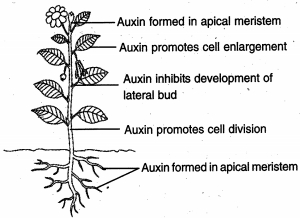
Illustrate with the help of a diagram,the effect of auxins in different parts of a plant.
Solution
(N/A) Auxins are a group of plant hormones that play a crucial role in plant growth and development. Their effects in different parts of a plant are as follows:
$1$. Auxin is synthesized in the apical meristems of both the shoot and the root.
$2$. In the shoot,auxin promotes cell enlargement,which contributes to the elongation of the stem.
$3$. Auxin is responsible for apical dominance,where it inhibits the development of lateral buds,ensuring the plant grows primarily in height.
$4$. Auxin also promotes cell division in certain tissues,facilitating overall plant growth.
[Diagram Description: The diagram shows a plant with labels indicating that auxin is formed in the apical meristems of the shoot and root,promotes cell enlargement and cell division,and inhibits the development of lateral buds.]
$1$. Auxin is synthesized in the apical meristems of both the shoot and the root.
$2$. In the shoot,auxin promotes cell enlargement,which contributes to the elongation of the stem.
$3$. Auxin is responsible for apical dominance,where it inhibits the development of lateral buds,ensuring the plant grows primarily in height.
$4$. Auxin also promotes cell division in certain tissues,facilitating overall plant growth.
[Diagram Description: The diagram shows a plant with labels indicating that auxin is formed in the apical meristems of the shoot and root,promotes cell enlargement and cell division,and inhibits the development of lateral buds.]
0 likes
View Solution87
Medium
$(a)$ An old man is advised by his doctor to take less sugar in his diet. Name the disease from which the man is suffering. Mention the hormone due to imbalance of which he is suffering from this disease. Which endocrine gland secretes this hormone?
$(b)$ Name the endocrine gland which secretes growth hormone. What will be its effect on a person of:
$(i)$ Deficiency of growth hormones?
$(ii)$ Excess secretion of growth hormones?
$(b)$ Name the endocrine gland which secretes growth hormone. What will be its effect on a person of:
$(i)$ Deficiency of growth hormones?
$(ii)$ Excess secretion of growth hormones?
Solution
(N/A) The man is suffering from Diabetes Mellitus. Insulin is the hormone whose imbalance leads to this disease. The pancreas is the endocrine gland that secretes insulin.
$(b)$ The pituitary gland secretes the growth hormone.
$(i)$ Deficiency of growth hormone leads to Dwarfism.
$(ii)$ Excess secretion of growth hormone leads to Gigantism.
$(b)$ The pituitary gland secretes the growth hormone.
$(i)$ Deficiency of growth hormone leads to Dwarfism.
$(ii)$ Excess secretion of growth hormone leads to Gigantism.
0 likes
View Solution88
Medium
$(a)$ Give the functions of cerebellum. (any two)
$(b)$ Name the components of central nervous system.
$(b)$ Name the components of central nervous system.
Solution
(N/A) $(i)$ Cerebellum is responsible for the precision of voluntary actions.
$(ii)$ It maintains the posture and balance of the body.
$(b)$ The components of the central nervous system are:
$(i)$ Brain
$(ii)$ Spinal cord
$(ii)$ It maintains the posture and balance of the body.
$(b)$ The components of the central nervous system are:
$(i)$ Brain
$(ii)$ Spinal cord
0 likes
View Solution89
Medium
$(a)$ Identify the phytohormone used by plants while performing the following functions:
$(i)$ Cell division in shoot tip.
$(ii)$ Inhibiting growth on approach of unfavourable conditions.
$(b)$ List in tabular form two differences between the movement in 'touch me not' plant and movement of shoot towards light.
$(i)$ Cell division in shoot tip.
$(ii)$ Inhibiting growth on approach of unfavourable conditions.
$(b)$ List in tabular form two differences between the movement in 'touch me not' plant and movement of shoot towards light.
Solution
(A) $(i)$ Auxin,
$(ii)$ Abscisic acid.
$(b)$
$(ii)$ Abscisic acid.
$(b)$
| Movement of shoot towards light (Tropism) | Movement in 'touch me not' plant (Nastic movement) |
| $(i)$ It is a slow response towards a stimulus. | $(i)$ It is an immediate response towards a stimulus. |
| $(ii)$ It is directional. | $(ii)$ It is non-directional. |
| $(iii)$ It is growth-dependent. | $(iii)$ It is growth-independent. |
0 likes
View Solution90
Medium
$(a)$ How are the movement of leaves of touch-me-not and the growth of a stem towards light different?
$(b)$ What is chemotropism? Give one example.
$(c)$ What is tropism?
$(b)$ What is chemotropism? Give one example.
$(c)$ What is tropism?
Solution
$(N/A)$ The movement of leaves of the touch-me-not plant $(Mimosa \, pudica)$ is a nastic movement, which is fast and non-directional. In contrast, the growth of a stem towards light (phototropism) is a tropic movement, which is slow and directional.
$(b)$ Chemotropism: It is the growth or movement of a plant part in response to a chemical stimulus.
Example: The growth of the pollen tube towards the ovule during fertilization.
$(c)$ Tropism: It is a directional growth movement of a plant part in response to an external stimulus.
$(b)$ Chemotropism: It is the growth or movement of a plant part in response to a chemical stimulus.
Example: The growth of the pollen tube towards the ovule during fertilization.
$(c)$ Tropism: It is a directional growth movement of a plant part in response to an external stimulus.
0 likes
View Solution91
Medium
List the names of hormones secreted by the following endocrine glands and mention their functions:
$(i)$ Thyroid gland $(ii)$ Pituitary gland $(iii)$ Adrenal gland.
$(i)$ Thyroid gland $(ii)$ Pituitary gland $(iii)$ Adrenal gland.
Solution
(N/A) The hormones secreted by the specified endocrine glands and their primary functions are summarized in the table below:
| Gland | Hormone | Function |
|---|---|---|
| $(i)$ Thyroid gland | Thyroxine | Regulates the metabolism of carbohydrates,fats,and proteins in the body. |
| $(ii)$ Pituitary gland | Growth hormone $(GH)$ | Regulates the overall growth and development of the body. |
| $(iii)$ Adrenal gland | Adrenaline | Helps the body manage stress and prepares it for 'fight or flight' responses. |
0 likes
View Solution92
Medium
Answer the following:
$(i)$ Name the endocrine gland associated with the brain.
$(ii)$ Which gland secretes digestive enzymes as well as hormones?
$(iii)$ Name the endocrine gland associated with the kidneys.
$(iv)$ Which endocrine gland is present in males but not in females?
$(v)$ Which hormone is responsible for changes in females during puberty?
$(vi)$ Iodine is necessary for the synthesis of which hormone?
$(i)$ Name the endocrine gland associated with the brain.
$(ii)$ Which gland secretes digestive enzymes as well as hormones?
$(iii)$ Name the endocrine gland associated with the kidneys.
$(iv)$ Which endocrine gland is present in males but not in females?
$(v)$ Which hormone is responsible for changes in females during puberty?
$(vi)$ Iodine is necessary for the synthesis of which hormone?
Solution
(N/A) $(i)$ Pituitary gland.
$(ii)$ Pancreas (it acts as both an exocrine gland by secreting digestive enzymes and an endocrine gland by secreting insulin and glucagon).
$(iii)$ Adrenal gland (located on top of the kidneys).
$(iv)$ Testes (these are male gonads that function as endocrine glands).
$(v)$ Oestrogen (or Estrogen).
$(vi)$ Thyroxine (produced by the thyroid gland).
$(ii)$ Pancreas (it acts as both an exocrine gland by secreting digestive enzymes and an endocrine gland by secreting insulin and glucagon).
$(iii)$ Adrenal gland (located on top of the kidneys).
$(iv)$ Testes (these are male gonads that function as endocrine glands).
$(v)$ Oestrogen (or Estrogen).
$(vi)$ Thyroxine (produced by the thyroid gland).
0 likes
View Solution93
Medium
Give reasons :
$(a)$ Pituitary is often termed as master endocrine gland.
$(b)$ Pancreas helps in digestion and also regulates blood sugar level.
$(c)$ Adrenals are known as glands of emergency.
$(a)$ Pituitary is often termed as master endocrine gland.
$(b)$ Pancreas helps in digestion and also regulates blood sugar level.
$(c)$ Adrenals are known as glands of emergency.
Solution
(N/A) The pituitary gland is often called the master endocrine gland because it secretes hormones that control and coordinate the activities of most other endocrine glands.
$(b)$ The pancreas acts as a heterocrine (mixed) gland. It secretes pancreatic juice containing enzymes into the small intestine for digestion,and it also secretes hormones like insulin and glucagon directly into the blood to regulate blood sugar levels.
$(c)$ The adrenal glands are known as glands of emergency because they secrete the hormone adrenaline (epinephrine) during stressful situations. Adrenaline prepares the body for 'fight or flight' by increasing heart rate,breathing rate,and blood flow to skeletal muscles,allowing the body to respond rapidly to emergencies.
$(b)$ The pancreas acts as a heterocrine (mixed) gland. It secretes pancreatic juice containing enzymes into the small intestine for digestion,and it also secretes hormones like insulin and glucagon directly into the blood to regulate blood sugar levels.
$(c)$ The adrenal glands are known as glands of emergency because they secrete the hormone adrenaline (epinephrine) during stressful situations. Adrenaline prepares the body for 'fight or flight' by increasing heart rate,breathing rate,and blood flow to skeletal muscles,allowing the body to respond rapidly to emergencies.
0 likes
View Solution94
Easy
'Brain and spinal cord are two vital organs of our body'. How is our body designed to protect them?
Solution
(N/A) The brain is protected by a bony box called the cranium (skull),which provides a hard outer covering. Inside the skull,the brain is cushioned by a fluid-filled balloon known as the cerebrospinal fluid $(CSF)$,which absorbs mechanical shocks and protects the brain from injury.
The spinal cord is protected by the vertebral column (backbone),which provides structural support and shields it from physical damage.
Additionally,both the brain and the spinal cord are covered by three protective membranes known as the meninges,which provide further insulation and protection.
The spinal cord is protected by the vertebral column (backbone),which provides structural support and shields it from physical damage.
Additionally,both the brain and the spinal cord are covered by three protective membranes known as the meninges,which provide further insulation and protection.
0 likes
View Solution95
Medium
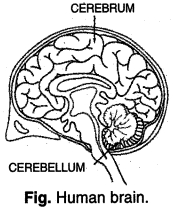
$(a)$ Draw a diagram of the human brain.
$(b)$ Label the Cerebrum and Cerebellum on it.
$(c)$ What is the role of the Cerebellum?
$(b)$ Label the Cerebrum and Cerebellum on it.
$(c)$ What is the role of the Cerebellum?
Solution
(N/A) and $(b)$ Refer to the provided diagram of the human brain.
$(c)$ Role of the Cerebellum: It is responsible for the precision of voluntary actions and for maintaining the posture and balance of the body.
$(c)$ Role of the Cerebellum: It is responsible for the precision of voluntary actions and for maintaining the posture and balance of the body.
0 likes
View Solution96
Medium
Name the hormones secreted by the thyroid,parathyroid,and pancreas.
Solution
(N/A) $(i)$ Thyroid gland: It secretes thyroxine hormone.
$(ii)$ Parathyroid gland: It secretes parathormone $(PTH)$. Note: Calcitonin is secreted by the thyroid gland ($C$-cells),while the parathyroid gland secretes parathormone.
$(iii)$ Pancreas: It secretes two main hormones: Insulin and Glucagon.
$(ii)$ Parathyroid gland: It secretes parathormone $(PTH)$. Note: Calcitonin is secreted by the thyroid gland ($C$-cells),while the parathyroid gland secretes parathormone.
$(iii)$ Pancreas: It secretes two main hormones: Insulin and Glucagon.
0 likes
View Solution97
Medium
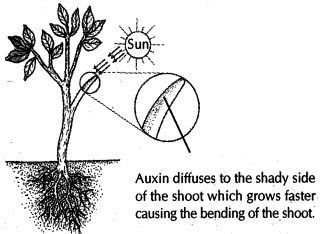
Name the hormone synthesized at the shoot tips. How does it help the plant to respond to light?
Solution
(N/A) The hormone synthesized at the shoot tips is $Auxin$.
When a growing plant detects light,$Auxin$ is produced at the shoot tip and helps the cells to grow longer.
When light falls on the plant from one side,$Auxin$ diffuses towards the shady side of the shoot.
This higher concentration of $Auxin$ on the shady side stimulates the cells to grow longer compared to the cells on the illuminated side.
As a result,the shoot bends towards the light,a phenomenon known as phototropism.
When a growing plant detects light,$Auxin$ is produced at the shoot tip and helps the cells to grow longer.
When light falls on the plant from one side,$Auxin$ diffuses towards the shady side of the shoot.
This higher concentration of $Auxin$ on the shady side stimulates the cells to grow longer compared to the cells on the illuminated side.
As a result,the shoot bends towards the light,a phenomenon known as phototropism.
0 likes
View Solution98
Medium
$(i)$ Differentiate between sensory neurons and motor neurons.
$(ii)$ How is the brain protected in our body?
$(iii)$ Name the part of the brain responsible for the precision of voluntary actions and maintaining body posture and balance of the body.
$(ii)$ How is the brain protected in our body?
$(iii)$ Name the part of the brain responsible for the precision of voluntary actions and maintaining body posture and balance of the body.
Solution
(N/A) $(i)$ Sensory neurons carry impulses from receptors to the central nervous system. Motor neurons carry impulses from the central nervous system to effectors (muscles or glands).
$(ii)$ The brain is protected inside a bony box called the cranium (skull). Inside this skull,the brain is cushioned within a fluid-filled space containing Cerebrospinal Fluid $(CSF)$,which acts as a shock absorber to protect the brain from mechanical injury.
$(iii)$ The part of the hindbrain responsible for the precision of voluntary actions and maintaining body posture and balance is the cerebellum.
$(ii)$ The brain is protected inside a bony box called the cranium (skull). Inside this skull,the brain is cushioned within a fluid-filled space containing Cerebrospinal Fluid $(CSF)$,which acts as a shock absorber to protect the brain from mechanical injury.
$(iii)$ The part of the hindbrain responsible for the precision of voluntary actions and maintaining body posture and balance is the cerebellum.
0 likes
View Solution99
Medium
$(a)$ What is reflex arc?
$(b)$ What are the components of reflex arc?
$(c)$ How do muscle cells move?
$(b)$ What are the components of reflex arc?
$(c)$ How do muscle cells move?
Solution
(N/A) The pathway taken by nerve impulses in a reflex action is called a reflex arc. It is the process of detecting a signal (stimulus) and responding to it by an output action quickly.
$(b)$ The components of a reflex arc are: $\text{Stimulus} \rightarrow \text{Receptors} \rightarrow \text{Sensory neurons} \rightarrow \text{Spinal cord (Central Nervous System)} \rightarrow \text{Motor neurons} \rightarrow \text{Effector (Muscle/Gland)}$.
$(c)$ Muscle cells contain special contractile proteins that change their shape and arrangement in the cell in response to electrical impulses received from the nervous system. This change causes the muscle cells to shorten,resulting in movement.
$(b)$ The components of a reflex arc are: $\text{Stimulus} \rightarrow \text{Receptors} \rightarrow \text{Sensory neurons} \rightarrow \text{Spinal cord (Central Nervous System)} \rightarrow \text{Motor neurons} \rightarrow \text{Effector (Muscle/Gland)}$.
$(c)$ Muscle cells contain special contractile proteins that change their shape and arrangement in the cell in response to electrical impulses received from the nervous system. This change causes the muscle cells to shorten,resulting in movement.
0 likes
View Solution100
Medium
$(a)$ If the cerebellum is not functioning properly,what are the activities of our body affected?
$(b)$ How do muscle cells move?
$(b)$ How do muscle cells move?
Solution
(N/A) If the cerebellum is not functioning properly,the voluntary actions of our body will be affected,specifically those related to maintaining the posture and balance of the body.
$(b)$ Muscle cells move by changing their shape through the contraction of specialized proteins,which causes the cells to shorten.
$(b)$ Muscle cells move by changing their shape through the contraction of specialized proteins,which causes the cells to shorten.
0 likes
View SolutionControl and Coordination — Mix Examples - Control and Coordination · Frequently Asked Questions
1Are these Control and Coordination questions useful for JEE and NEET?
Yes. All questions in this section are mapped to JEE Main and NEET exam patterns. Previous year questions from JEE Main, NEET, GUJCET and state-level exams are included with full solutions.
2Can I switch to Hindi or Gujarati for these questions?
Yes. Use the language tabs in the hero section or the sidebar to view the same questions and solutions in English, Hindi or Gujarati.
3How do I generate a question paper from this subtopic?
Use the Vedclass Exam Paper Generator — select the chapter and subtopic, set difficulty, and generate Sets A, B, C, D automatically. First 3 chapters of every subject are free.
Vedclass Products
For Students
Vedclass Test Series
Mock tests in real JEE/NEET style with performance analysis. 5-day free trial.
Start Free TrialFor Teachers
Exam Paper Generator
Generate Set A/B/C/D papers from this chapter in 2 minutes. 3 chapters free.
Try FreeFor Institutes
Online Exam Module
Live online exams with unlimited students, 360° analytics & white-label branding.
See DemoFor Teachers & Institutes
Generate a Control and Coordination Exam Paper in 2 Minutes
Select subtopic & difficulty — Sets A, B, C, D auto-generated with No Repeat logic.
First 3 chapters of every subject are free — no payment required.