
A English
Textbook - Triangles Questions in English
Class 10 Mathematics · Triangles · Textbook - Triangles
101+
Questions
English
Language
100%
With Solutions
Showing 50 of 101 questions in English
51
Difficult
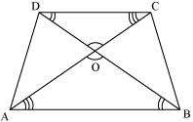
Diagonals of a trapezium $ABCD$ with $AB \parallel DC$ intersect each other at the point $O$. If $AB = 2 CD$,find the ratio of the areas of triangles $AOB$ and $COD$.
Solution
(4:1) Since $AB \parallel CD,$
$\therefore \angle OAB = \angle OCD$ and $\angle OBA = \angle ODC$ (Alternate interior angles).
In $\triangle AOB$ and $\triangle COD,$
$\angle AOB = \angle COD$ (Vertically opposite angles).
$\angle OAB = \angle OCD$ (Alternate interior angles).
$\angle OBA = \angle ODC$ (Alternate interior angles).
$\therefore \triangle AOB \sim \triangle COD$ (By $AAA$ similarity criterion).
We know that the ratio of the areas of two similar triangles is equal to the square of the ratio of their corresponding sides.
$\therefore \frac{\operatorname{ar}(\triangle AOB)}{\operatorname{ar}(\triangle COD)} = \left(\frac{AB}{CD}\right)^2$.
Given $AB = 2 CD,$
$\therefore \frac{\operatorname{ar}(\triangle AOB)}{\operatorname{ar}(\triangle COD)} = \left(\frac{2 CD}{CD}\right)^2 = \left(\frac{2}{1}\right)^2 = \frac{4}{1} = 4:1$.
Thus,the ratio of the areas of triangles $AOB$ and $COD$ is $4:1$.
$\therefore \angle OAB = \angle OCD$ and $\angle OBA = \angle ODC$ (Alternate interior angles).
In $\triangle AOB$ and $\triangle COD,$
$\angle AOB = \angle COD$ (Vertically opposite angles).
$\angle OAB = \angle OCD$ (Alternate interior angles).
$\angle OBA = \angle ODC$ (Alternate interior angles).
$\therefore \triangle AOB \sim \triangle COD$ (By $AAA$ similarity criterion).
We know that the ratio of the areas of two similar triangles is equal to the square of the ratio of their corresponding sides.
$\therefore \frac{\operatorname{ar}(\triangle AOB)}{\operatorname{ar}(\triangle COD)} = \left(\frac{AB}{CD}\right)^2$.
Given $AB = 2 CD,$
$\therefore \frac{\operatorname{ar}(\triangle AOB)}{\operatorname{ar}(\triangle COD)} = \left(\frac{2 CD}{CD}\right)^2 = \left(\frac{2}{1}\right)^2 = \frac{4}{1} = 4:1$.
Thus,the ratio of the areas of triangles $AOB$ and $COD$ is $4:1$.
0 likes
View Solution52
Difficult
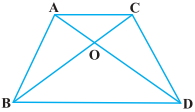
In the figure,$ABC$ and $DBC$ are two triangles on the same base $BC$. If $AD$ intersects $BC$ at $O$,show that $\frac{\operatorname{ar}(ABC)}{\operatorname{ar}(DBC)} = \frac{AO}{DO}$.
Solution
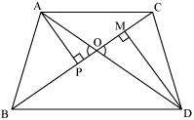
(N/A) Let us draw two perpendiculars $AP$ and $DM$ on line $BC$.
We know that the area of a triangle $= \frac{1}{2} \times \text{Base} \times \text{Height}$.
Therefore,$\frac{\operatorname{ar}(\Delta ABC)}{\operatorname{ar}(\Delta DBC)} = \frac{\frac{1}{2} \times BC \times AP}{\frac{1}{2} \times BC \times DM} = \frac{AP}{DM}$.
In $\triangle APO$ and $\triangle DMO$:
$\angle APO = \angle DMO = 90^{\circ}$ (By construction).
$\angle AOP = \angle DOM$ (Vertically opposite angles).
Therefore,$\triangle APO \sim \triangle DMO$ (By $AA$ similarity criterion).
Since the triangles are similar,the ratio of their corresponding sides is equal:
$\frac{AP}{DM} = \frac{AO}{DO}$.
Substituting this into our area ratio equation:
$\frac{\operatorname{ar}(\Delta ABC)}{\operatorname{ar}(\Delta DBC)} = \frac{AO}{DO}$.
We know that the area of a triangle $= \frac{1}{2} \times \text{Base} \times \text{Height}$.
Therefore,$\frac{\operatorname{ar}(\Delta ABC)}{\operatorname{ar}(\Delta DBC)} = \frac{\frac{1}{2} \times BC \times AP}{\frac{1}{2} \times BC \times DM} = \frac{AP}{DM}$.
In $\triangle APO$ and $\triangle DMO$:
$\angle APO = \angle DMO = 90^{\circ}$ (By construction).
$\angle AOP = \angle DOM$ (Vertically opposite angles).
Therefore,$\triangle APO \sim \triangle DMO$ (By $AA$ similarity criterion).
Since the triangles are similar,the ratio of their corresponding sides is equal:
$\frac{AP}{DM} = \frac{AO}{DO}$.
Substituting this into our area ratio equation:
$\frac{\operatorname{ar}(\Delta ABC)}{\operatorname{ar}(\Delta DBC)} = \frac{AO}{DO}$.
0 likes
View Solution53
Medium
If the areas of two similar triangles are equal,prove that they are congruent.
Solution
(N/A) Let us assume two similar triangles as $\triangle ABC \sim \triangle PQR$.
According to the theorem of areas of similar triangles:
$\frac{\text{ar}(\triangle ABC)}{\text{ar}(\triangle PQR)} = \left(\frac{AB}{PQ}\right)^2 = \left(\frac{BC}{QR}\right)^2 = \left(\frac{AC}{PR}\right)^2$ $...(1)$
Given that,$\text{ar}(\triangle ABC) = \text{ar}(\triangle PQR)$.
Therefore,$\frac{\text{ar}(\triangle ABC)}{\text{ar}(\triangle PQR)} = 1$.
Substituting this value in equation $(1)$,we get:
$1 = \left(\frac{AB}{PQ}\right)^2 = \left(\frac{BC}{QR}\right)^2 = \left(\frac{AC}{PR}\right)^2$.
This implies:
$\left(\frac{AB}{PQ}\right)^2 = 1 \Rightarrow AB^2 = PQ^2 \Rightarrow AB = PQ$
$\left(\frac{BC}{QR}\right)^2 = 1 \Rightarrow BC^2 = QR^2 \Rightarrow BC = QR$
$\left(\frac{AC}{PR}\right)^2 = 1 \Rightarrow AC^2 = PR^2 \Rightarrow AC = PR$
Since all three corresponding sides are equal,by the $SSS$ (Side-Side-Side) congruence criterion,$\triangle ABC \cong \triangle PQR$.
According to the theorem of areas of similar triangles:
$\frac{\text{ar}(\triangle ABC)}{\text{ar}(\triangle PQR)} = \left(\frac{AB}{PQ}\right)^2 = \left(\frac{BC}{QR}\right)^2 = \left(\frac{AC}{PR}\right)^2$ $...(1)$
Given that,$\text{ar}(\triangle ABC) = \text{ar}(\triangle PQR)$.
Therefore,$\frac{\text{ar}(\triangle ABC)}{\text{ar}(\triangle PQR)} = 1$.
Substituting this value in equation $(1)$,we get:
$1 = \left(\frac{AB}{PQ}\right)^2 = \left(\frac{BC}{QR}\right)^2 = \left(\frac{AC}{PR}\right)^2$.
This implies:
$\left(\frac{AB}{PQ}\right)^2 = 1 \Rightarrow AB^2 = PQ^2 \Rightarrow AB = PQ$
$\left(\frac{BC}{QR}\right)^2 = 1 \Rightarrow BC^2 = QR^2 \Rightarrow BC = QR$
$\left(\frac{AC}{PR}\right)^2 = 1 \Rightarrow AC^2 = PR^2 \Rightarrow AC = PR$
Since all three corresponding sides are equal,by the $SSS$ (Side-Side-Side) congruence criterion,$\triangle ABC \cong \triangle PQR$.
0 likes
View Solution54
Medium
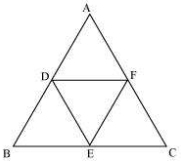
$D, E$ and $F$ are respectively the mid-points of sides $AB, BC$ and $CA$ of $\Delta ABC$. Find the ratio of the areas of $\Delta DEF$ and $\Delta ABC$.
Solution
(1:4) Given that $D, E$ and $F$ are the mid-points of sides $AB, BC$ and $CA$ respectively in $\Delta ABC$.
By the Mid-point Theorem,the line segment joining the mid-points of two sides of a triangle is parallel to the third side and is half of it.
Therefore,$DE \parallel AC$ and $DE = \frac{1}{2} AC$.
Similarly,$EF \parallel AB$ and $EF = \frac{1}{2} AB$,and $DF \parallel BC$ and $DF = \frac{1}{2} BC$.
In $\Delta DEF$ and $\Delta ABC$:
$\frac{DE}{AC} = \frac{EF}{AB} = \frac{DF}{BC} = \frac{1}{2}$.
By $SSS$ similarity criterion,$\Delta DEF \sim \Delta ABC$.
The ratio of the areas of two similar triangles is equal to the square of the ratio of their corresponding sides.
Therefore,$\frac{\operatorname{ar}(\Delta DEF)}{\operatorname{ar}(\Delta ABC)} = \left(\frac{DE}{AC}\right)^2 = \left(\frac{1}{2}\right)^2 = \frac{1}{4}$.
Thus,the ratio of the areas of $\Delta DEF$ and $\Delta ABC$ is $1:4$.
By the Mid-point Theorem,the line segment joining the mid-points of two sides of a triangle is parallel to the third side and is half of it.
Therefore,$DE \parallel AC$ and $DE = \frac{1}{2} AC$.
Similarly,$EF \parallel AB$ and $EF = \frac{1}{2} AB$,and $DF \parallel BC$ and $DF = \frac{1}{2} BC$.
In $\Delta DEF$ and $\Delta ABC$:
$\frac{DE}{AC} = \frac{EF}{AB} = \frac{DF}{BC} = \frac{1}{2}$.
By $SSS$ similarity criterion,$\Delta DEF \sim \Delta ABC$.
The ratio of the areas of two similar triangles is equal to the square of the ratio of their corresponding sides.
Therefore,$\frac{\operatorname{ar}(\Delta DEF)}{\operatorname{ar}(\Delta ABC)} = \left(\frac{DE}{AC}\right)^2 = \left(\frac{1}{2}\right)^2 = \frac{1}{4}$.
Thus,the ratio of the areas of $\Delta DEF$ and $\Delta ABC$ is $1:4$.
0 likes
View Solution55
Medium
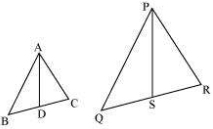
Prove that the ratio of the areas of two similar triangles is equal to the square of the ratio of their corresponding medians.
Solution
(N/A) Let us assume two similar triangles $\Delta ABC \sim \Delta PQR$. Let $AD$ and $PS$ be the medians of these triangles.
Since $\Delta ABC \sim \Delta PQR$,we have:
$\frac{AB}{PQ} = \frac{BC}{QR} = \frac{AC}{PR} \quad ...(1)$
And $\angle B = \angle Q \quad ...(2)$
Since $AD$ and $PS$ are medians,$D$ and $S$ are midpoints of $BC$ and $QR$ respectively.
Therefore,$BD = \frac{BC}{2}$ and $QS = \frac{QR}{2}$.
Substituting these into equation $(1)$:
$\frac{AB}{PQ} = \frac{2BD}{2QS} = \frac{BD}{QS} \quad ...(3)$
In $\triangle ABD$ and $\triangle PQS$:
$\angle B = \angle Q$ [From $(2)$]
$\frac{AB}{PQ} = \frac{BD}{QS}$ [From $(3)$]
Therefore,$\triangle ABD \sim \triangle PQS$ by $SAS$ similarity criterion.
This implies that $\frac{AB}{PQ} = \frac{AD}{PS} \quad ...(4)$
We know that the ratio of the areas of two similar triangles is equal to the square of the ratio of their corresponding sides:
$\frac{\text{ar}(\Delta ABC)}{\text{ar}(\Delta PQR)} = \left(\frac{AB}{PQ}\right)^2$
From equation $(4)$,substituting $\frac{AB}{PQ} = \frac{AD}{PS}$:
$\frac{\text{ar}(\Delta ABC)}{\text{ar}(\Delta PQR)} = \left(\frac{AD}{PS}\right)^2$
Hence proved.
Since $\Delta ABC \sim \Delta PQR$,we have:
$\frac{AB}{PQ} = \frac{BC}{QR} = \frac{AC}{PR} \quad ...(1)$
And $\angle B = \angle Q \quad ...(2)$
Since $AD$ and $PS$ are medians,$D$ and $S$ are midpoints of $BC$ and $QR$ respectively.
Therefore,$BD = \frac{BC}{2}$ and $QS = \frac{QR}{2}$.
Substituting these into equation $(1)$:
$\frac{AB}{PQ} = \frac{2BD}{2QS} = \frac{BD}{QS} \quad ...(3)$
In $\triangle ABD$ and $\triangle PQS$:
$\angle B = \angle Q$ [From $(2)$]
$\frac{AB}{PQ} = \frac{BD}{QS}$ [From $(3)$]
Therefore,$\triangle ABD \sim \triangle PQS$ by $SAS$ similarity criterion.
This implies that $\frac{AB}{PQ} = \frac{AD}{PS} \quad ...(4)$
We know that the ratio of the areas of two similar triangles is equal to the square of the ratio of their corresponding sides:
$\frac{\text{ar}(\Delta ABC)}{\text{ar}(\Delta PQR)} = \left(\frac{AB}{PQ}\right)^2$
From equation $(4)$,substituting $\frac{AB}{PQ} = \frac{AD}{PS}$:
$\frac{\text{ar}(\Delta ABC)}{\text{ar}(\Delta PQR)} = \left(\frac{AD}{PS}\right)^2$
Hence proved.
0 likes
View Solution56
Medium
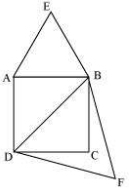
Prove that the area of an equilateral triangle described on one side of a square is equal to half the area of the equilateral triangle described on one of its diagonals.
Solution
(N/A) Let $ABCD$ be a square of side $a$.
Therefore,its diagonal $= \sqrt{2} a$.
Two equilateral triangles are formed: $\Delta ABE$ (on side $AB$) and $\Delta DBF$ (on diagonal $DB$).
Side of equilateral triangle $\Delta ABE$ described on side $AB = a$.
Side of equilateral triangle $\Delta DBF$ described on diagonal $DB = \sqrt{2} a$.
Since all equilateral triangles are similar,the ratio of their areas is equal to the square of the ratio of their corresponding sides.
$\frac{\text{Area of } \Delta ABE}{\text{Area of } \Delta DBF} = \left( \frac{a}{\sqrt{2} a} \right)^2 = \left( \frac{1}{\sqrt{2}} \right)^2 = \frac{1}{2}$.
Thus,$\text{Area of } \Delta ABE = \frac{1}{2} \times \text{Area of } \Delta DBF$.
Therefore,its diagonal $= \sqrt{2} a$.
Two equilateral triangles are formed: $\Delta ABE$ (on side $AB$) and $\Delta DBF$ (on diagonal $DB$).
Side of equilateral triangle $\Delta ABE$ described on side $AB = a$.
Side of equilateral triangle $\Delta DBF$ described on diagonal $DB = \sqrt{2} a$.
Since all equilateral triangles are similar,the ratio of their areas is equal to the square of the ratio of their corresponding sides.
$\frac{\text{Area of } \Delta ABE}{\text{Area of } \Delta DBF} = \left( \frac{a}{\sqrt{2} a} \right)^2 = \left( \frac{1}{\sqrt{2}} \right)^2 = \frac{1}{2}$.
Thus,$\text{Area of } \Delta ABE = \frac{1}{2} \times \text{Area of } \Delta DBF$.
0 likes
View Solution57
Medium
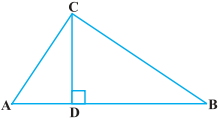
In the figure,$\angle ACB = 90^{\circ}$ and $CD \perp AB$. Prove that $\frac{BC^{2}}{AC^{2}} = \frac{BD}{AD}$.
Solution
(N/A) In $\Delta ACD$ and $\Delta ABC$:
$\angle ADC = \angle ACB = 90^{\circ}$
$\angle CAD = \angle CAB$ (Common angle)
Therefore,$\Delta ACD \sim \Delta ABC$ (by $AA$ similarity criterion).
This implies $\frac{AC}{AB} = \frac{AD}{AC}$,so $AC^{2} = AB \cdot AD$ $...(1)$
In $\Delta BCD$ and $\Delta BAC$:
$\angle BDC = \angle BCA = 90^{\circ}$
$\angle CBD = \angle ABC$ (Common angle)
Therefore,$\Delta BCD \sim \Delta BAC$ (by $AA$ similarity criterion).
This implies $\frac{BC}{BA} = \frac{BD}{BC}$,so $BC^{2} = BA \cdot BD$ $...(2)$
Dividing equation $(2)$ by equation $(1)$:
$\frac{BC^{2}}{AC^{2}} = \frac{BA \cdot BD}{AB \cdot AD}$
Since $BA = AB$,we get:
$\frac{BC^{2}}{AC^{2}} = \frac{BD}{AD}$
$\angle ADC = \angle ACB = 90^{\circ}$
$\angle CAD = \angle CAB$ (Common angle)
Therefore,$\Delta ACD \sim \Delta ABC$ (by $AA$ similarity criterion).
This implies $\frac{AC}{AB} = \frac{AD}{AC}$,so $AC^{2} = AB \cdot AD$ $...(1)$
In $\Delta BCD$ and $\Delta BAC$:
$\angle BDC = \angle BCA = 90^{\circ}$
$\angle CBD = \angle ABC$ (Common angle)
Therefore,$\Delta BCD \sim \Delta BAC$ (by $AA$ similarity criterion).
This implies $\frac{BC}{BA} = \frac{BD}{BC}$,so $BC^{2} = BA \cdot BD$ $...(2)$
Dividing equation $(2)$ by equation $(1)$:
$\frac{BC^{2}}{AC^{2}} = \frac{BA \cdot BD}{AB \cdot AD}$
Since $BA = AB$,we get:
$\frac{BC^{2}}{AC^{2}} = \frac{BD}{AD}$
0 likes
View Solution58
DifficultMCQ
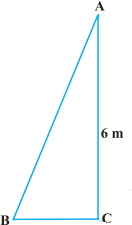
$A$ ladder is placed against a wall such that its foot is at a distance of $2.5\, m$ from the wall and its top reaches a window $6\, m$ above the ground. Find the length of the ladder in $m$.
A
$7$
B
$6.5$
C
$5.9$
D
$8.0$
Solution
(B) Let $AB$ be the ladder and $CA$ be the wall with the window at $A$. The wall and the ground form a right angle at $C$. Thus,$\triangle ABC$ is a right-angled triangle with $\angle C = 90^\circ$.
Given: $BC = 2.5\, m$ (distance of the foot of the ladder from the wall) and $CA = 6\, m$ (height of the window from the ground).
According to the Pythagoras Theorem,in a right-angled triangle,the square of the hypotenuse is equal to the sum of the squares of the other two sides:
$AB^2 = BC^2 + CA^2$
$AB^2 = (2.5)^2 + (6)^2$
$AB^2 = 6.25 + 36$
$AB^2 = 42.25$
$AB = \sqrt{42.25}$
$AB = 6.5\, m$
Therefore,the length of the ladder is $6.5\, m$.
Given: $BC = 2.5\, m$ (distance of the foot of the ladder from the wall) and $CA = 6\, m$ (height of the window from the ground).
According to the Pythagoras Theorem,in a right-angled triangle,the square of the hypotenuse is equal to the sum of the squares of the other two sides:
$AB^2 = BC^2 + CA^2$
$AB^2 = (2.5)^2 + (6)^2$
$AB^2 = 6.25 + 36$
$AB^2 = 42.25$
$AB = \sqrt{42.25}$
$AB = 6.5\, m$
Therefore,the length of the ladder is $6.5\, m$.
0 likes
View Solution59
Medium
In the figure,if $AD \perp BC$,prove that $AB^2 + CD^2 = BD^2 + AC^2$.
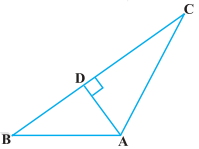
Solution
(N/A) Given: In $\Delta ABC$,$AD \perp BC$.
To prove: $AB^2 + CD^2 = BD^2 + AC^2$.
Proof:
In right-angled $\Delta ADB$,by Pythagoras theorem:
$AB^2 = AD^2 + BD^2$ --- $(1)$
In right-angled $\Delta ADC$,by Pythagoras theorem:
$AC^2 = AD^2 + CD^2$ --- $(2)$
Subtracting equation $(2)$ from equation $(1)$:
$AB^2 - AC^2 = (AD^2 + BD^2) - (AD^2 + CD^2)$
$AB^2 - AC^2 = AD^2 + BD^2 - AD^2 - CD^2$
$AB^2 - AC^2 = BD^2 - CD^2$
Rearranging the terms,we get:
$AB^2 + CD^2 = BD^2 + AC^2$
Hence proved.
To prove: $AB^2 + CD^2 = BD^2 + AC^2$.
Proof:
In right-angled $\Delta ADB$,by Pythagoras theorem:
$AB^2 = AD^2 + BD^2$ --- $(1)$
In right-angled $\Delta ADC$,by Pythagoras theorem:
$AC^2 = AD^2 + CD^2$ --- $(2)$
Subtracting equation $(2)$ from equation $(1)$:
$AB^2 - AC^2 = (AD^2 + BD^2) - (AD^2 + CD^2)$
$AB^2 - AC^2 = AD^2 + BD^2 - AD^2 - CD^2$
$AB^2 - AC^2 = BD^2 - CD^2$
Rearranging the terms,we get:
$AB^2 + CD^2 = BD^2 + AC^2$
Hence proved.
0 likes
View Solution60
Medium
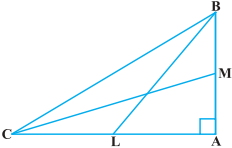
$BL$ and $CM$ are medians of a triangle $ABC$ right-angled at $A$. Prove that $4(BL^2 + CM^2) = 5BC^2$.
Solution
(N/A) $BL$ and $CM$ are medians of $\Delta ABC$ in which $\angle A = 90^{\circ}$.
From $\Delta ABC$,by Pythagoras theorem:
$BC^2 = AB^2 + AC^2$ $...(1)$
From $\Delta ABL$,since $L$ is the midpoint of $AC$,$AL = AC/2$:
$BL^2 = AB^2 + AL^2 = AB^2 + (AC/2)^2 = AB^2 + AC^2/4$
$4BL^2 = 4AB^2 + AC^2$ $...(2)$
From $\Delta CMA$,since $M$ is the midpoint of $AB$,$AM = AB/2$:
$CM^2 = AC^2 + AM^2 = AC^2 + (AB/2)^2 = AC^2 + AB^2/4$
$4CM^2 = 4AC^2 + AB^2$ $...(3)$
Adding $(2)$ and $(3)$:
$4(BL^2 + CM^2) = 4AB^2 + AC^2 + 4AC^2 + AB^2$
$4(BL^2 + CM^2) = 5AB^2 + 5AC^2$
$4(BL^2 + CM^2) = 5(AB^2 + AC^2)$
Using equation $(1)$,$AB^2 + AC^2 = BC^2$,so:
$4(BL^2 + CM^2) = 5BC^2$.
From $\Delta ABC$,by Pythagoras theorem:
$BC^2 = AB^2 + AC^2$ $...(1)$
From $\Delta ABL$,since $L$ is the midpoint of $AC$,$AL = AC/2$:
$BL^2 = AB^2 + AL^2 = AB^2 + (AC/2)^2 = AB^2 + AC^2/4$
$4BL^2 = 4AB^2 + AC^2$ $...(2)$
From $\Delta CMA$,since $M$ is the midpoint of $AB$,$AM = AB/2$:
$CM^2 = AC^2 + AM^2 = AC^2 + (AB/2)^2 = AC^2 + AB^2/4$
$4CM^2 = 4AC^2 + AB^2$ $...(3)$
Adding $(2)$ and $(3)$:
$4(BL^2 + CM^2) = 4AB^2 + AC^2 + 4AC^2 + AB^2$
$4(BL^2 + CM^2) = 5AB^2 + 5AC^2$
$4(BL^2 + CM^2) = 5(AB^2 + AC^2)$
Using equation $(1)$,$AB^2 + AC^2 = BC^2$,so:
$4(BL^2 + CM^2) = 5BC^2$.
0 likes
View Solution61
Medium
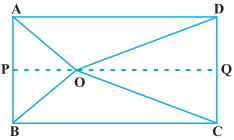
$O$ is any point inside a rectangle $ABCD$ (see Figure). Prove that $OB^{2} + OD^{2} = OA^{2} + OC^{2}$.
Solution
(N/A) Through $O$,draw $PQ \parallel BC$ such that $P$ lies on $AB$ and $Q$ lies on $DC$.
Now,$PQ \parallel BC$.
Therefore,$PQ \perp AB$ and $PQ \perp DC$ (since $\angle B = 90^{\circ}$ and $\angle C = 90^{\circ}$).
So,$\angle BPQ = 90^{\circ}$ and $\angle CQP = 90^{\circ}$.
Therefore,$BPQC$ and $APQD$ are both rectangles.
Now,from $\Delta OPB$,by Pythagoras theorem:
$OB^{2} = BP^{2} + OP^{2}$ $...(1)$
Similarly,from $\Delta OQD$:
$OD^{2} = OQ^{2} + DQ^{2}$ $...(2)$
From $\Delta OQC$,we have:
$OC^{2} = OQ^{2} + CQ^{2}$ $...(3)$
And from $\Delta OAP$,we have:
$OA^{2} = AP^{2} + OP^{2}$ $...(4)$
Adding $(1)$ and $(2)$:
$OB^{2} + OD^{2} = BP^{2} + OP^{2} + OQ^{2} + DQ^{2}$
Since $BP = CQ$ and $DQ = AP$ (opposite sides of rectangles $BPQC$ and $APQD$):
$OB^{2} + OD^{2} = CQ^{2} + OP^{2} + OQ^{2} + AP^{2}$
Rearranging the terms:
$OB^{2} + OD^{2} = (CQ^{2} + OQ^{2}) + (AP^{2} + OP^{2})$
Using equations $(3)$ and $(4)$:
$OB^{2} + OD^{2} = OC^{2} + OA^{2}$.
Now,$PQ \parallel BC$.
Therefore,$PQ \perp AB$ and $PQ \perp DC$ (since $\angle B = 90^{\circ}$ and $\angle C = 90^{\circ}$).
So,$\angle BPQ = 90^{\circ}$ and $\angle CQP = 90^{\circ}$.
Therefore,$BPQC$ and $APQD$ are both rectangles.
Now,from $\Delta OPB$,by Pythagoras theorem:
$OB^{2} = BP^{2} + OP^{2}$ $...(1)$
Similarly,from $\Delta OQD$:
$OD^{2} = OQ^{2} + DQ^{2}$ $...(2)$
From $\Delta OQC$,we have:
$OC^{2} = OQ^{2} + CQ^{2}$ $...(3)$
And from $\Delta OAP$,we have:
$OA^{2} = AP^{2} + OP^{2}$ $...(4)$
Adding $(1)$ and $(2)$:
$OB^{2} + OD^{2} = BP^{2} + OP^{2} + OQ^{2} + DQ^{2}$
Since $BP = CQ$ and $DQ = AP$ (opposite sides of rectangles $BPQC$ and $APQD$):
$OB^{2} + OD^{2} = CQ^{2} + OP^{2} + OQ^{2} + AP^{2}$
Rearranging the terms:
$OB^{2} + OD^{2} = (CQ^{2} + OQ^{2}) + (AP^{2} + OP^{2})$
Using equations $(3)$ and $(4)$:
$OB^{2} + OD^{2} = OC^{2} + OA^{2}$.
0 likes
View Solution62
DifficultMCQ
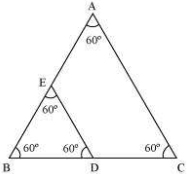
$ABC$ and $BDE$ are two equilateral triangles such that $D$ is the mid-point of $BC$. The ratio of the areas of triangles $ABC$ and $BDE$ is
A
$2:1$
B
$4:1$
C
$1:2$
D
$1:4$
Solution
(B) We know that all equilateral triangles have all their angles equal to $60^{\circ}$ and all their sides of the same length. Therefore,all equilateral triangles are similar to each other.
The ratio of the areas of two similar triangles is equal to the square of the ratio of their corresponding sides.
Let the side length of $\triangle ABC$ be $x$.
Since $D$ is the mid-point of $BC$,the side length of $\triangle BDE$ is $\frac{x}{2}$.
Therefore,the ratio of the areas is:
$\frac{\text{Area}(\triangle ABC)}{\text{Area}(\triangle BDE)} = \left(\frac{x}{\frac{x}{2}}\right)^{2} = (2)^{2} = \frac{4}{1}$.
Hence,the ratio is $4:1$,and the correct answer is $(B)$.
The ratio of the areas of two similar triangles is equal to the square of the ratio of their corresponding sides.
Let the side length of $\triangle ABC$ be $x$.
Since $D$ is the mid-point of $BC$,the side length of $\triangle BDE$ is $\frac{x}{2}$.
Therefore,the ratio of the areas is:
$\frac{\text{Area}(\triangle ABC)}{\text{Area}(\triangle BDE)} = \left(\frac{x}{\frac{x}{2}}\right)^{2} = (2)^{2} = \frac{4}{1}$.
Hence,the ratio is $4:1$,and the correct answer is $(B)$.
0 likes
View Solution63
MediumMCQ
Sides of two similar triangles are in the ratio $4:9$. Areas of these triangles are in the ratio
A
$2:3$
B
$4:9$
C
$16:81$
D
$81:16$
Solution
(C) If two triangles are similar to each other,then the ratio of the areas of these triangles is equal to the square of the ratio of their corresponding sides.
Given that the ratio of the sides is $4:9$.
Therefore,the ratio of the areas of these triangles $= (4/9)^2 = 16/81$.
Hence,the correct answer is $(C)$.
Given that the ratio of the sides is $4:9$.
Therefore,the ratio of the areas of these triangles $= (4/9)^2 = 16/81$.
Hence,the correct answer is $(C)$.
0 likes
View Solution64
Easy
Sides of triangles are given below. Determine which of them are right triangles. In case of a right triangle,write the length of its hypotenuse.
$7 \, cm, 24 \, cm, 25 \, cm$
$7 \, cm, 24 \, cm, 25 \, cm$
Solution
(A) The given sides of the triangle are $7 \, cm, 24 \, cm,$ and $25 \, cm$.
To check if it is a right-angled triangle,we use the converse of the Pythagoras theorem,which states that if the square of the longest side is equal to the sum of the squares of the other two sides,then the triangle is a right-angled triangle.
First,we calculate the squares of the given sides:
$7^2 = 49$
$24^2 = 576$
$25^2 = 625$
Now,we check if the sum of the squares of the two smaller sides equals the square of the largest side:
$49 + 576 = 625$
Since $7^2 + 24^2 = 25^2$,the given sides satisfy the Pythagoras theorem.
Therefore,the triangle is a right-angled triangle.
The longest side of a right-angled triangle is its hypotenuse. Thus,the length of the hypotenuse is $25 \, cm$.
To check if it is a right-angled triangle,we use the converse of the Pythagoras theorem,which states that if the square of the longest side is equal to the sum of the squares of the other two sides,then the triangle is a right-angled triangle.
First,we calculate the squares of the given sides:
$7^2 = 49$
$24^2 = 576$
$25^2 = 625$
Now,we check if the sum of the squares of the two smaller sides equals the square of the largest side:
$49 + 576 = 625$
Since $7^2 + 24^2 = 25^2$,the given sides satisfy the Pythagoras theorem.
Therefore,the triangle is a right-angled triangle.
The longest side of a right-angled triangle is its hypotenuse. Thus,the length of the hypotenuse is $25 \, cm$.
0 likes
View Solution65
Medium
Sides of a triangle are given below. Determine whether it is a right triangle. In case of a right triangle,write the length of its hypotenuse.
$3 \text{ cm}, 8 \text{ cm}, 6 \text{ cm}$
$3 \text{ cm}, 8 \text{ cm}, 6 \text{ cm}$
Solution
(N/A) The given sides of the triangle are $3 \text{ cm}, 8 \text{ cm},$ and $6 \text{ cm}$.
According to the converse of the Pythagoras theorem,a triangle is a right triangle if the sum of the squares of the two smaller sides is equal to the square of the longest side.
Here,the squares of the sides are:
$3^2 = 9$
$6^2 = 36$
$8^2 = 64$
Checking the sum of the squares of the two smaller sides:
$3^2 + 6^2 = 9 + 36 = 45$
Since $45 \neq 64$ (i.e.,$3^2 + 6^2 \neq 8^2$),the condition for a right triangle is not satisfied.
Therefore,the given triangle is not a right triangle.
According to the converse of the Pythagoras theorem,a triangle is a right triangle if the sum of the squares of the two smaller sides is equal to the square of the longest side.
Here,the squares of the sides are:
$3^2 = 9$
$6^2 = 36$
$8^2 = 64$
Checking the sum of the squares of the two smaller sides:
$3^2 + 6^2 = 9 + 36 = 45$
Since $45 \neq 64$ (i.e.,$3^2 + 6^2 \neq 8^2$),the condition for a right triangle is not satisfied.
Therefore,the given triangle is not a right triangle.
0 likes
View Solution66
Medium
Sides of triangles are given below. Determine which of them are right triangles. In case of a right triangle,write the length of its hypotenuse.
$50 \text{ cm}, 80 \text{ cm}, 100 \text{ cm}$
$50 \text{ cm}, 80 \text{ cm}, 100 \text{ cm}$
Solution
(NONE) Given that the sides of the triangle are $50 \text{ cm}, 80 \text{ cm},$ and $100 \text{ cm}.$
To check if it is a right-angled triangle,we apply the converse of the Pythagoras theorem,which states that in a triangle,if the square of the length of the longest side is equal to the sum of the squares of the lengths of the other two sides,then it is a right-angled triangle.
Calculate the squares of the sides:
$50^2 = 2500$
$80^2 = 6400$
$100^2 = 10000$
Now,check the sum of the squares of the two smaller sides:
$50^2 + 80^2 = 2500 + 6400 = 8900$
Comparing this with the square of the longest side:
$8900 \neq 10000$
Since $50^2 + 80^2 \neq 100^2$,the given triangle does not satisfy the Pythagoras theorem.
Therefore,the given triangle is not a right-angled triangle.
To check if it is a right-angled triangle,we apply the converse of the Pythagoras theorem,which states that in a triangle,if the square of the length of the longest side is equal to the sum of the squares of the lengths of the other two sides,then it is a right-angled triangle.
Calculate the squares of the sides:
$50^2 = 2500$
$80^2 = 6400$
$100^2 = 10000$
Now,check the sum of the squares of the two smaller sides:
$50^2 + 80^2 = 2500 + 6400 = 8900$
Comparing this with the square of the longest side:
$8900 \neq 10000$
Since $50^2 + 80^2 \neq 100^2$,the given triangle does not satisfy the Pythagoras theorem.
Therefore,the given triangle is not a right-angled triangle.
0 likes
View Solution67
Medium
Sides of triangles are given below. Determine which of them are right triangles. In case of a right triangle,write the length of its hypotenuse.
$13\, cm, 12\, cm, 5\, cm$
$13\, cm, 12\, cm, 5\, cm$
Solution
(A) Given that the sides are $13\, cm, 12\, cm,$ and $5\, cm$.
Squaring the lengths of these sides,we obtain $169, 144,$ and $25$.
Clearly,$144 + 25 = 169$.
Or,$12^2 + 5^2 = 13^2$.
The sides of the given triangle satisfy the Pythagoras theorem.
Therefore,it is a right triangle.
We know that the longest side of a right triangle is the hypotenuse.
Therefore,the length of the hypotenuse of this triangle is $13\, cm$.
Squaring the lengths of these sides,we obtain $169, 144,$ and $25$.
Clearly,$144 + 25 = 169$.
Or,$12^2 + 5^2 = 13^2$.
The sides of the given triangle satisfy the Pythagoras theorem.
Therefore,it is a right triangle.
We know that the longest side of a right triangle is the hypotenuse.
Therefore,the length of the hypotenuse of this triangle is $13\, cm$.
0 likes
View Solution68
Difficult
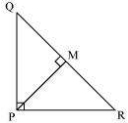
$PQR$ is a triangle right-angled at $P$ and $M$ is a point on $QR$ such that $PM \perp QR$. Show that $PM^{2} = QM \cdot MR$.
Solution
(N/A) Let $\angle MPR = x$.
In $\Delta MPR$,
$\angle MRP = 180^{\circ} - 90^{\circ} - x = 90^{\circ} - x$.
Similarly,in $\Delta MPQ$,
$\angle MPQ = 90^{\circ} - \angle MPR = 90^{\circ} - x$.
In $\Delta MPQ$,
$\angle MQP = 180^{\circ} - 90^{\circ} - (90^{\circ} - x) = x$.
Now,in $\Delta QMP$ and $\Delta PMR$:
$\angle MPQ = \angle MRP = 90^{\circ} - x$
$\angle MQP = \angle MPR = x$
$\angle PMQ = \angle RMP = 90^{\circ}$
Therefore,$\Delta QMP \sim \Delta PMR$ (by $AA$ similarity criterion).
Since the triangles are similar,the ratios of their corresponding sides are equal:
$\frac{QM}{PM} = \frac{PM}{MR}$
$\Rightarrow PM^{2} = QM \cdot MR$.
In $\Delta MPR$,
$\angle MRP = 180^{\circ} - 90^{\circ} - x = 90^{\circ} - x$.
Similarly,in $\Delta MPQ$,
$\angle MPQ = 90^{\circ} - \angle MPR = 90^{\circ} - x$.
In $\Delta MPQ$,
$\angle MQP = 180^{\circ} - 90^{\circ} - (90^{\circ} - x) = x$.
Now,in $\Delta QMP$ and $\Delta PMR$:
$\angle MPQ = \angle MRP = 90^{\circ} - x$
$\angle MQP = \angle MPR = x$
$\angle PMQ = \angle RMP = 90^{\circ}$
Therefore,$\Delta QMP \sim \Delta PMR$ (by $AA$ similarity criterion).
Since the triangles are similar,the ratios of their corresponding sides are equal:
$\frac{QM}{PM} = \frac{PM}{MR}$
$\Rightarrow PM^{2} = QM \cdot MR$.
0 likes
View Solution69
Difficult
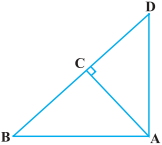
In the figure,$ABD$ is a triangle right-angled at $A$ and $AC \perp BD$. Show that $AB^2 = BC \cdot BD$.
Solution
(N/A) Given: In $\triangle ABD$,$\angle BAD = 90^\circ$ and $AC \perp BD$.
To prove: $AB^2 = BC \cdot BD$.
Proof: Consider $\triangle BCA$ and $\triangle BAD$.
In $\triangle BCA$ and $\triangle BAD$:
$\angle BCA = \angle BAD = 90^\circ$ (Given $AC \perp BD$ and $\angle BAD = 90^\circ$)
$\angle B = \angle B$ (Common angle)
Therefore,by $AA$ similarity criterion,$\triangle BCA \sim \triangle BAD$.
Since the triangles are similar,the ratios of their corresponding sides are equal:
$\frac{BC}{BA} = \frac{BA}{BD}$
Cross-multiplying gives:
$BA \cdot BA = BC \cdot BD$
$AB^2 = BC \cdot BD$.
Hence proved.
To prove: $AB^2 = BC \cdot BD$.
Proof: Consider $\triangle BCA$ and $\triangle BAD$.
In $\triangle BCA$ and $\triangle BAD$:
$\angle BCA = \angle BAD = 90^\circ$ (Given $AC \perp BD$ and $\angle BAD = 90^\circ$)
$\angle B = \angle B$ (Common angle)
Therefore,by $AA$ similarity criterion,$\triangle BCA \sim \triangle BAD$.
Since the triangles are similar,the ratios of their corresponding sides are equal:
$\frac{BC}{BA} = \frac{BA}{BD}$
Cross-multiplying gives:
$BA \cdot BA = BC \cdot BD$
$AB^2 = BC \cdot BD$.
Hence proved.
0 likes
View Solution70
Difficult
In the figure,$ABD$ is a triangle right-angled at $A$ and $AC \perp BD$. Show that $AC^{2} = BC \cdot DC$.
Solution
(N/A) Given: In $\triangle ABD$,$\angle A = 90^{\circ}$ and $AC \perp BD$.
To prove: $AC^{2} = BC \cdot DC$.
Proof:
In $\triangle BCA$ and $\triangle ACD$:
$\angle BCA = \angle ACD = 90^{\circ}$ (Since $AC \perp BD$)
$\angle CBA = 90^{\circ} - \angle CAB$ (In $\triangle ABC$,$\angle B + \angle CAB = 90^{\circ}$)
Also,$\angle CAD = 90^{\circ} - \angle CAB$ (Since $\angle A = 90^{\circ}$,$\angle CAD + \angle CAB = 90^{\circ}$)
Therefore,$\angle CBA = \angle CAD$.
By $AA$ similarity criterion,$\triangle BCA \sim \triangle ACD$.
Since the triangles are similar,the ratios of their corresponding sides are equal:
$\frac{BC}{AC} = \frac{AC}{DC}$
Cross-multiplying,we get:
$AC^{2} = BC \cdot DC$.
Hence proved.
To prove: $AC^{2} = BC \cdot DC$.
Proof:
In $\triangle BCA$ and $\triangle ACD$:
$\angle BCA = \angle ACD = 90^{\circ}$ (Since $AC \perp BD$)
$\angle CBA = 90^{\circ} - \angle CAB$ (In $\triangle ABC$,$\angle B + \angle CAB = 90^{\circ}$)
Also,$\angle CAD = 90^{\circ} - \angle CAB$ (Since $\angle A = 90^{\circ}$,$\angle CAD + \angle CAB = 90^{\circ}$)
Therefore,$\angle CBA = \angle CAD$.
By $AA$ similarity criterion,$\triangle BCA \sim \triangle ACD$.
Since the triangles are similar,the ratios of their corresponding sides are equal:
$\frac{BC}{AC} = \frac{AC}{DC}$
Cross-multiplying,we get:
$AC^{2} = BC \cdot DC$.
Hence proved.
0 likes
View Solution71
Difficult
In the figure,$ABD$ is a triangle right-angled at $A$ and $AC \perp BD$. Show that $AD^{2} = BD \cdot CD$.
Solution
(N/A) Given: In $\triangle ABD$,$\angle A = 90^{\circ}$ and $AC \perp BD$.
To prove: $AD^{2} = BD \cdot CD$.
Proof: Consider $\triangle ACD$ and $\triangle BCA$.
In $\triangle ACD$ and $\triangle BCA$:
$\angle ACD = \angle BCA = 90^{\circ}$ (Since $AC \perp BD$ and $\angle A = 90^{\circ}$).
$\angle CAD = \angle CBA$ (Since both are complementary to $\angle BAD$ or $\angle BDA$).
Therefore,by $AA$ similarity criterion,$\triangle ACD \sim \triangle BCA$.
Since the triangles are similar,the ratio of their corresponding sides is equal:
$\frac{CD}{AC} = \frac{AC}{BC} = \frac{AD}{AB}$.
Wait,let us consider $\triangle ACD$ and $\triangle BAD$.
In $\triangle ACD$ and $\triangle BAD$:
$\angle ACD = \angle BAD = 90^{\circ}$.
$\angle D = \angle D$ (Common angle).
Therefore,by $AA$ similarity criterion,$\triangle ACD \sim \triangle BAD$.
Since the triangles are similar,the ratio of their corresponding sides is equal:
$\frac{AC}{BA} = \frac{CD}{AD} = \frac{AD}{BD}$.
Taking the last two parts of the ratio:
$\frac{CD}{AD} = \frac{AD}{BD}$.
Cross-multiplying gives:
$AD^{2} = BD \cdot CD$.
Hence proved.
To prove: $AD^{2} = BD \cdot CD$.
Proof: Consider $\triangle ACD$ and $\triangle BCA$.
In $\triangle ACD$ and $\triangle BCA$:
$\angle ACD = \angle BCA = 90^{\circ}$ (Since $AC \perp BD$ and $\angle A = 90^{\circ}$).
$\angle CAD = \angle CBA$ (Since both are complementary to $\angle BAD$ or $\angle BDA$).
Therefore,by $AA$ similarity criterion,$\triangle ACD \sim \triangle BCA$.
Since the triangles are similar,the ratio of their corresponding sides is equal:
$\frac{CD}{AC} = \frac{AC}{BC} = \frac{AD}{AB}$.
Wait,let us consider $\triangle ACD$ and $\triangle BAD$.
In $\triangle ACD$ and $\triangle BAD$:
$\angle ACD = \angle BAD = 90^{\circ}$.
$\angle D = \angle D$ (Common angle).
Therefore,by $AA$ similarity criterion,$\triangle ACD \sim \triangle BAD$.
Since the triangles are similar,the ratio of their corresponding sides is equal:
$\frac{AC}{BA} = \frac{CD}{AD} = \frac{AD}{BD}$.
Taking the last two parts of the ratio:
$\frac{CD}{AD} = \frac{AD}{BD}$.
Cross-multiplying gives:
$AD^{2} = BD \cdot CD$.
Hence proved.
0 likes
View Solution72
Difficult
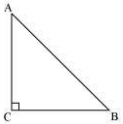
$ABC$ is an isosceles triangle right-angled at $C$. Prove that $AB^{2} = 2AC^{2}$.
Solution
(N/A) Given that $\triangle ABC$ is an isosceles triangle with $\angle C = 90^{\circ}$.
Since it is an isosceles triangle,the two legs must be equal,so $AC = CB$.
Applying the Pythagoras theorem in $\triangle ABC$ (which is right-angled at point $C$),we have:
$AC^{2} + CB^{2} = AB^{2}$
Since $AC = CB$,we can substitute $CB$ with $AC$ in the equation:
$AC^{2} + AC^{2} = AB^{2}$
$2AC^{2} = AB^{2}$
Hence,it is proved that $AB^{2} = 2AC^{2}$.
Since it is an isosceles triangle,the two legs must be equal,so $AC = CB$.
Applying the Pythagoras theorem in $\triangle ABC$ (which is right-angled at point $C$),we have:
$AC^{2} + CB^{2} = AB^{2}$
Since $AC = CB$,we can substitute $CB$ with $AC$ in the equation:
$AC^{2} + AC^{2} = AB^{2}$
$2AC^{2} = AB^{2}$
Hence,it is proved that $AB^{2} = 2AC^{2}$.
0 likes
View Solution73
Medium
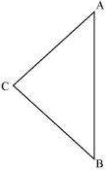
$ABC$ is an isosceles triangle with $AC = BC$. If $AB^2 = 2 AC^2$,prove that $ABC$ is a right triangle.
Solution
(N/A) Given that,
$AB^2 = 2 AC^2$
We can rewrite this as:
$AB^2 = AC^2 + AC^2$
Since it is given that $AC = BC$,we can substitute $BC$ for one of the $AC$ terms:
$AB^2 = AC^2 + BC^2$
This equation satisfies the converse of the Pythagoras theorem,which states that if the square of one side of a triangle is equal to the sum of the squares of the other two sides,then the angle opposite the first side is a right angle.
Therefore,$\triangle ABC$ is a right-angled triangle with the right angle at $C$.
$AB^2 = 2 AC^2$
We can rewrite this as:
$AB^2 = AC^2 + AC^2$
Since it is given that $AC = BC$,we can substitute $BC$ for one of the $AC$ terms:
$AB^2 = AC^2 + BC^2$
This equation satisfies the converse of the Pythagoras theorem,which states that if the square of one side of a triangle is equal to the sum of the squares of the other two sides,then the angle opposite the first side is a right angle.
Therefore,$\triangle ABC$ is a right-angled triangle with the right angle at $C$.
0 likes
View Solution74
Difficult
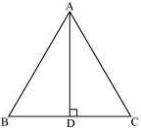
$ABC$ is an equilateral triangle of side $2a$. Find each of its altitudes.
Solution
(N/A) Let $AD$ be the altitude in the given equilateral triangle,$\triangle ABC$.
We know that an altitude in an equilateral triangle bisects the opposite side.
$\therefore BD = DC = a$
In $\triangle ADB$,we have $\angle ADB = 90^{\circ}$.
Applying the Pythagoras theorem,we obtain:
$AD^2 + DB^2 = AB^2$
$\Rightarrow AD^2 + a^2 = (2a)^2$
$\Rightarrow AD^2 + a^2 = 4a^2$
$\Rightarrow AD^2 = 3a^2$
$\Rightarrow AD = a\sqrt{3}$
In an equilateral triangle,all the altitudes are equal in length.
Therefore,the length of each altitude is $a\sqrt{3}$.
We know that an altitude in an equilateral triangle bisects the opposite side.
$\therefore BD = DC = a$
In $\triangle ADB$,we have $\angle ADB = 90^{\circ}$.
Applying the Pythagoras theorem,we obtain:
$AD^2 + DB^2 = AB^2$
$\Rightarrow AD^2 + a^2 = (2a)^2$
$\Rightarrow AD^2 + a^2 = 4a^2$
$\Rightarrow AD^2 = 3a^2$
$\Rightarrow AD = a\sqrt{3}$
In an equilateral triangle,all the altitudes are equal in length.
Therefore,the length of each altitude is $a\sqrt{3}$.
0 likes
View Solution75
Difficult
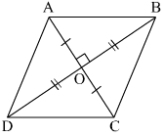
Prove that the sum of the squares of the sides of a rhombus is equal to the sum of the squares of its diagonals.
Solution
(N/A) Let $ABCD$ be a rhombus with diagonals $AC$ and $BD$ intersecting at $O$.
In $\Delta AOB, \Delta BOC, \Delta COD,$ and $\Delta AOD,$
Applying the Pythagoras theorem,we obtain:
$AB^2 = AO^2 + OB^2$ $...(1)$
$BC^2 = BO^2 + OC^2$ $...(2)$
$CD^2 = CO^2 + OD^2$ $...(3)$
$AD^2 = AO^2 + OD^2$ $...(4)$
Adding all these equations,we obtain:
$AB^2 + BC^2 + CD^2 + AD^2 = 2(AO^2 + OB^2 + OC^2 + OD^2)$
Since the diagonals of a rhombus bisect each other at right angles,$AO = OC = AC/2$ and $BO = OD = BD/2$.
Substituting these values:
$= 2((AC/2)^2 + (BD/2)^2 + (AC/2)^2 + (BD/2)^2)$
$= 2(2(AC/2)^2 + 2(BD/2)^2)$
$= 2(AC^2/2 + BD^2/2)$
$= AC^2 + BD^2$
Thus,the sum of the squares of the sides of a rhombus is equal to the sum of the squares of its diagonals.
In $\Delta AOB, \Delta BOC, \Delta COD,$ and $\Delta AOD,$
Applying the Pythagoras theorem,we obtain:
$AB^2 = AO^2 + OB^2$ $...(1)$
$BC^2 = BO^2 + OC^2$ $...(2)$
$CD^2 = CO^2 + OD^2$ $...(3)$
$AD^2 = AO^2 + OD^2$ $...(4)$
Adding all these equations,we obtain:
$AB^2 + BC^2 + CD^2 + AD^2 = 2(AO^2 + OB^2 + OC^2 + OD^2)$
Since the diagonals of a rhombus bisect each other at right angles,$AO = OC = AC/2$ and $BO = OD = BD/2$.
Substituting these values:
$= 2((AC/2)^2 + (BD/2)^2 + (AC/2)^2 + (BD/2)^2)$
$= 2(2(AC/2)^2 + 2(BD/2)^2)$
$= 2(AC^2/2 + BD^2/2)$
$= AC^2 + BD^2$
Thus,the sum of the squares of the sides of a rhombus is equal to the sum of the squares of its diagonals.
0 likes
View Solution76
Difficult
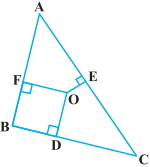
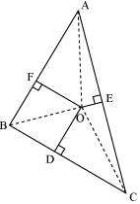
In the figure,$O$ is a point in the interior of a triangle $ABC$,$OD \perp BC$,$OE \perp AC$,and $OF \perp AB$. Show that $OA^{2} + OB^{2} + OC^{2} - OD^{2} - OE^{2} - OF^{2} = AF^{2} + BD^{2} + CE^{2}$.
Solution
(N/A) Join $OA$,$OB$,and $OC$.
Applying the Pythagoras theorem in $\triangle AOF$,we obtain:
$OA^{2} = OF^{2} + AF^{2}$ --- $(i)$
Similarly,in $\triangle BOD$:
$OB^{2} = OD^{2} + BD^{2}$ --- $(ii)$
Similarly,in $\triangle COE$:
$OC^{2} = OE^{2} + CE^{2}$ --- $(iii)$
Adding equations $(i)$,$(ii)$,and $(iii)$,we get:
$OA^{2} + OB^{2} + OC^{2} = OF^{2} + AF^{2} + OD^{2} + BD^{2} + OE^{2} + CE^{2}$
Rearranging the terms,we get:
$OA^{2} + OB^{2} + OC^{2} - OD^{2} - OE^{2} - OF^{2} = AF^{2} + BD^{2} + CE^{2}$
Hence,the result is proved.
Applying the Pythagoras theorem in $\triangle AOF$,we obtain:
$OA^{2} = OF^{2} + AF^{2}$ --- $(i)$
Similarly,in $\triangle BOD$:
$OB^{2} = OD^{2} + BD^{2}$ --- $(ii)$
Similarly,in $\triangle COE$:
$OC^{2} = OE^{2} + CE^{2}$ --- $(iii)$
Adding equations $(i)$,$(ii)$,and $(iii)$,we get:
$OA^{2} + OB^{2} + OC^{2} = OF^{2} + AF^{2} + OD^{2} + BD^{2} + OE^{2} + CE^{2}$
Rearranging the terms,we get:
$OA^{2} + OB^{2} + OC^{2} - OD^{2} - OE^{2} - OF^{2} = AF^{2} + BD^{2} + CE^{2}$
Hence,the result is proved.
0 likes
View Solution77
Difficult
In the figure,$O$ is a point in the interior of a triangle $ABC$,$OD \perp BC$,$OE \perp AC$,and $OF \perp AB$. Show that $AF^{2} + BD^{2} + CE^{2} = AE^{2} + CD^{2} + BF^{2}$.
Solution
(N/A) Join $OA$,$OB$,and $OC$.
In right-angled triangles $\triangle AFO$,$\triangle BDO$,and $\triangle CEO$,by applying the Pythagoras theorem:
$OA^{2} = AF^{2} + OF^{2} \implies AF^{2} = OA^{2} - OF^{2}$ ... $(i)$
$OB^{2} = BD^{2} + OD^{2} \implies BD^{2} = OB^{2} - OD^{2}$ ... $(ii)$
$OC^{2} = CE^{2} + OE^{2} \implies CE^{2} = OC^{2} - OE^{2}$ ... $(iii)$
Adding $(i)$,$(ii)$,and $(iii)$,we get:
$AF^{2} + BD^{2} + CE^{2} = (OA^{2} - OF^{2}) + (OB^{2} - OD^{2}) + (OC^{2} - OE^{2})$ ... $(iv)$
Similarly,in right-angled triangles $\triangle AEO$,$\triangle CDO$,and $\triangle BFO$:
$OA^{2} = AE^{2} + OE^{2} \implies AE^{2} = OA^{2} - OE^{2}$
$OC^{2} = CD^{2} + OD^{2} \implies CD^{2} = OC^{2} - OD^{2}$
$OB^{2} = BF^{2} + OF^{2} \implies BF^{2} = OB^{2} - OF^{2}$
Adding these,we get:
$AE^{2} + CD^{2} + BF^{2} = (OA^{2} - OE^{2}) + (OC^{2} - OD^{2}) + (OB^{2} - OF^{2})$
Rearranging the terms,this is equal to the right-hand side of equation $(iv)$.
Thus,$AF^{2} + BD^{2} + CE^{2} = AE^{2} + CD^{2} + BF^{2}$.
In right-angled triangles $\triangle AFO$,$\triangle BDO$,and $\triangle CEO$,by applying the Pythagoras theorem:
$OA^{2} = AF^{2} + OF^{2} \implies AF^{2} = OA^{2} - OF^{2}$ ... $(i)$
$OB^{2} = BD^{2} + OD^{2} \implies BD^{2} = OB^{2} - OD^{2}$ ... $(ii)$
$OC^{2} = CE^{2} + OE^{2} \implies CE^{2} = OC^{2} - OE^{2}$ ... $(iii)$
Adding $(i)$,$(ii)$,and $(iii)$,we get:
$AF^{2} + BD^{2} + CE^{2} = (OA^{2} - OF^{2}) + (OB^{2} - OD^{2}) + (OC^{2} - OE^{2})$ ... $(iv)$
Similarly,in right-angled triangles $\triangle AEO$,$\triangle CDO$,and $\triangle BFO$:
$OA^{2} = AE^{2} + OE^{2} \implies AE^{2} = OA^{2} - OE^{2}$
$OC^{2} = CD^{2} + OD^{2} \implies CD^{2} = OC^{2} - OD^{2}$
$OB^{2} = BF^{2} + OF^{2} \implies BF^{2} = OB^{2} - OF^{2}$
Adding these,we get:
$AE^{2} + CD^{2} + BF^{2} = (OA^{2} - OE^{2}) + (OC^{2} - OD^{2}) + (OB^{2} - OF^{2})$
Rearranging the terms,this is equal to the right-hand side of equation $(iv)$.
Thus,$AF^{2} + BD^{2} + CE^{2} = AE^{2} + CD^{2} + BF^{2}$.
0 likes
View Solution78
MediumMCQ
$A$ ladder $10\, m$ long reaches a window $8\, m$ above the ground. Find the distance of the foot of the ladder from the base of the wall. (in $, m$)
A
$6$
B
$8$
C
$10$
D
$14$
Solution
(A) Let $OA$ be the wall and $AB$ be the ladder,where $OA = 8\, m$ and $AB = 10\, m$.
Since the wall is perpendicular to the ground,$\triangle AOB$ is a right-angled triangle with $\angle AOB = 90^\circ$.
By Pythagoras theorem,$AB^2 = OA^2 + OB^2$.
Substituting the values: $(10)^2 = (8)^2 + OB^2$.
$100 = 64 + OB^2$.
$OB^2 = 100 - 64 = 36$.
$OB = \sqrt{36} = 6\, m$.
Therefore,the distance of the foot of the ladder from the base of the wall is $6\, m$.
Since the wall is perpendicular to the ground,$\triangle AOB$ is a right-angled triangle with $\angle AOB = 90^\circ$.
By Pythagoras theorem,$AB^2 = OA^2 + OB^2$.
Substituting the values: $(10)^2 = (8)^2 + OB^2$.
$100 = 64 + OB^2$.
$OB^2 = 100 - 64 = 36$.
$OB = \sqrt{36} = 6\, m$.
Therefore,the distance of the foot of the ladder from the base of the wall is $6\, m$.
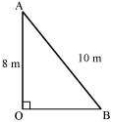
0 likes
View Solution79
Medium
$A$ guy wire attached to a vertical pole of height $18\, m$ is $24\, m$ long and has a stake attached to the other end. How far from the base of the pole should the stake be driven so that the wire will be taut?
Solution
(N/A) Let $OB$ be the pole and $AB$ be the wire. The pole is vertical,so $\triangle AOB$ is a right-angled triangle with $\angle AOB = 90^{\circ}$.
By Pythagoras theorem,
$AB^{2} = OB^{2} + OA^{2}$
$(24\, m)^{2} = (18\, m)^{2} + OA^{2}$
$576\, m^{2} = 324\, m^{2} + OA^{2}$
$OA^{2} = (576 - 324)\, m^{2} = 252\, m^{2}$
$OA = \sqrt{252}\, m = \sqrt{36 \times 7}\, m = 6\sqrt{7}\, m$
Therefore,the distance from the base is $6\sqrt{7}\, m$ (approximately $15.87\, m$).
By Pythagoras theorem,
$AB^{2} = OB^{2} + OA^{2}$
$(24\, m)^{2} = (18\, m)^{2} + OA^{2}$
$576\, m^{2} = 324\, m^{2} + OA^{2}$
$OA^{2} = (576 - 324)\, m^{2} = 252\, m^{2}$
$OA = \sqrt{252}\, m = \sqrt{36 \times 7}\, m = 6\sqrt{7}\, m$
Therefore,the distance from the base is $6\sqrt{7}\, m$ (approximately $15.87\, m$).
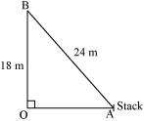
0 likes
View Solution80
Difficult
An aeroplane leaves an airport and flies due north at a speed of $1000\, km/h$. At the same time,another aeroplane leaves the same airport and flies due west at a speed of $1200\, km/h$. How far apart will be the two planes after $1 \frac{1}{2}$ hours?
Solution
(N/A) Distance travelled by the plane flying towards north in $1 \frac{1}{2}$ hours $= 1000 \times 1.5 = 1500\, km$.
Distance travelled by the plane flying towards west in $1 \frac{1}{2}$ hours $= 1200 \times 1.5 = 1800\, km$.
Let the airport be at the origin $O$. The plane flying north reaches point $A$ and the plane flying west reaches point $B$.
Since north and west directions are perpendicular,$\triangle AOB$ is a right-angled triangle with $\angle AOB = 90^\circ$.
By Pythagoras theorem,the distance between the two planes is the hypotenuse $AB = \sqrt{OA^2 + OB^2}$.
$AB = \sqrt{1500^2 + 1800^2} = \sqrt{2250000 + 3240000} = \sqrt{5490000}$.
$AB = \sqrt{90000 \times 61} = 300\sqrt{61}\, km$.
Thus,the distance between the two planes after $1 \frac{1}{2}$ hours is $300\sqrt{61}\, km$.
Distance travelled by the plane flying towards west in $1 \frac{1}{2}$ hours $= 1200 \times 1.5 = 1800\, km$.
Let the airport be at the origin $O$. The plane flying north reaches point $A$ and the plane flying west reaches point $B$.
Since north and west directions are perpendicular,$\triangle AOB$ is a right-angled triangle with $\angle AOB = 90^\circ$.
By Pythagoras theorem,the distance between the two planes is the hypotenuse $AB = \sqrt{OA^2 + OB^2}$.
$AB = \sqrt{1500^2 + 1800^2} = \sqrt{2250000 + 3240000} = \sqrt{5490000}$.
$AB = \sqrt{90000 \times 61} = 300\sqrt{61}\, km$.
Thus,the distance between the two planes after $1 \frac{1}{2}$ hours is $300\sqrt{61}\, km$.
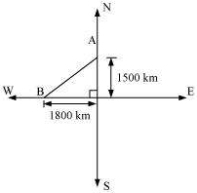
0 likes
View Solution81
Difficult
Two poles of heights $6 \, m$ and $11 \, m$ stand on a plane ground. If the distance between the feet of the poles is $12 \, m$,find the distance between their tops.
Solution
(13 M) Let $CD$ and $AB$ be the poles of height $11 \, m$ and $6 \, m$ respectively.
Draw a line segment $AP$ parallel to $BD$ such that $P$ lies on $CD$. Then $AP = BD = 12 \, m$ and $PD = AB = 6 \, m$.
Now,$CP = CD - PD = 11 \, m - 6 \, m = 5 \, m$.
In the right-angled triangle $\triangle APC$,by applying the Pythagoras theorem:
$AC^2 = AP^2 + CP^2$
$AC^2 = (12 \, m)^2 + (5 \, m)^2$
$AC^2 = 144 \, m^2 + 25 \, m^2 = 169 \, m^2$
$AC = \sqrt{169} \, m = 13 \, m$.
Therefore,the distance between their tops is $13 \, m$.
Draw a line segment $AP$ parallel to $BD$ such that $P$ lies on $CD$. Then $AP = BD = 12 \, m$ and $PD = AB = 6 \, m$.
Now,$CP = CD - PD = 11 \, m - 6 \, m = 5 \, m$.
In the right-angled triangle $\triangle APC$,by applying the Pythagoras theorem:
$AC^2 = AP^2 + CP^2$
$AC^2 = (12 \, m)^2 + (5 \, m)^2$
$AC^2 = 144 \, m^2 + 25 \, m^2 = 169 \, m^2$
$AC = \sqrt{169} \, m = 13 \, m$.
Therefore,the distance between their tops is $13 \, m$.
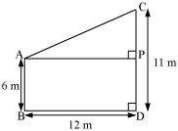
1 likes
View Solution82
Difficult
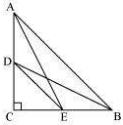
$D$ and $E$ are points on the sides $CA$ and $CB$ respectively of a triangle $ABC$ right-angled at $C$. Prove that $AE^{2} + BD^{2} = AB^{2} + DE^{2}$.
Solution
(N/A) Applying the Pythagoras theorem in $\triangle ACE$,we obtain:
$AC^{2} + CE^{2} = AE^{2}$ $...(1)$
Applying the Pythagoras theorem in $\triangle BCD$,we obtain:
$BC^{2} + CD^{2} = BD^{2}$ $...(2)$
Adding equation $(1)$ and equation $(2)$,we obtain:
$AC^{2} + CE^{2} + BC^{2} + CD^{2} = AE^{2} + BD^{2}$ $...(3)$
Applying the Pythagoras theorem in $\triangle CDE$,we obtain:
$DE^{2} = CD^{2} + CE^{2}$ $...(4)$
Applying the Pythagoras theorem in $\triangle ABC$,we obtain:
$AB^{2} = AC^{2} + BC^{2}$ $...(5)$
Substituting the values from equation $(4)$ and equation $(5)$ into equation $(3)$,we obtain:
$AB^{2} + DE^{2} = AE^{2} + BD^{2}$
Hence,$AE^{2} + BD^{2} = AB^{2} + DE^{2}$.
$AC^{2} + CE^{2} = AE^{2}$ $...(1)$
Applying the Pythagoras theorem in $\triangle BCD$,we obtain:
$BC^{2} + CD^{2} = BD^{2}$ $...(2)$
Adding equation $(1)$ and equation $(2)$,we obtain:
$AC^{2} + CE^{2} + BC^{2} + CD^{2} = AE^{2} + BD^{2}$ $...(3)$
Applying the Pythagoras theorem in $\triangle CDE$,we obtain:
$DE^{2} = CD^{2} + CE^{2}$ $...(4)$
Applying the Pythagoras theorem in $\triangle ABC$,we obtain:
$AB^{2} = AC^{2} + BC^{2}$ $...(5)$
Substituting the values from equation $(4)$ and equation $(5)$ into equation $(3)$,we obtain:
$AB^{2} + DE^{2} = AE^{2} + BD^{2}$
Hence,$AE^{2} + BD^{2} = AB^{2} + DE^{2}$.
0 likes
View Solution83
Difficult
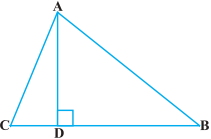
The perpendicular from $A$ on side $BC$ of a $\Delta ABC$ intersects $BC$ at $D$ such that $DB = 3CD$ (see Figure). Prove that $2AB^{2} = 2AC^{2} + BC^{2}$.
Solution
(N/A) Applying the Pythagoras theorem for $\triangle ACD$,we obtain:
$AC^{2} = AD^{2} + DC^{2}$
$AD^{2} = AC^{2} - DC^{2}$ $...(1)$
Applying the Pythagoras theorem for $\triangle ABD$,we obtain:
$AB^{2} = AD^{2} + DB^{2}$
$AD^{2} = AB^{2} - DB^{2}$ $...(2)$
From equation $(1)$ and equation $(2)$,we obtain:
$AC^{2} - DC^{2} = AB^{2} - DB^{2}$ $...(3)$
It is given that $DB = 3CD$. Since $BC = DB + CD$,we have $BC = 3CD + CD = 4CD$.
$\therefore CD = \frac{BC}{4}$ and $DB = 3CD = \frac{3BC}{4}$.
Substituting these values into equation $(3)$,we obtain:
$AC^{2} - \left(\frac{BC}{4}\right)^{2} = AB^{2} - \left(\frac{3BC}{4}\right)^{2}$
$AC^{2} - \frac{BC^{2}}{16} = AB^{2} - \frac{9BC^{2}}{16}$
$16AC^{2} - BC^{2} = 16AB^{2} - 9BC^{2}$
$16AB^{2} - 16AC^{2} = 8BC^{2}$
Dividing by $8$,we get:
$2AB^{2} = 2AC^{2} + BC^{2}$
$AC^{2} = AD^{2} + DC^{2}$
$AD^{2} = AC^{2} - DC^{2}$ $...(1)$
Applying the Pythagoras theorem for $\triangle ABD$,we obtain:
$AB^{2} = AD^{2} + DB^{2}$
$AD^{2} = AB^{2} - DB^{2}$ $...(2)$
From equation $(1)$ and equation $(2)$,we obtain:
$AC^{2} - DC^{2} = AB^{2} - DB^{2}$ $...(3)$
It is given that $DB = 3CD$. Since $BC = DB + CD$,we have $BC = 3CD + CD = 4CD$.
$\therefore CD = \frac{BC}{4}$ and $DB = 3CD = \frac{3BC}{4}$.
Substituting these values into equation $(3)$,we obtain:
$AC^{2} - \left(\frac{BC}{4}\right)^{2} = AB^{2} - \left(\frac{3BC}{4}\right)^{2}$
$AC^{2} - \frac{BC^{2}}{16} = AB^{2} - \frac{9BC^{2}}{16}$
$16AC^{2} - BC^{2} = 16AB^{2} - 9BC^{2}$
$16AB^{2} - 16AC^{2} = 8BC^{2}$
Dividing by $8$,we get:
$2AB^{2} = 2AC^{2} + BC^{2}$
0 likes
View Solution84
Difficult
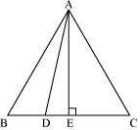
In an equilateral triangle $ABC$,$D$ is a point on side $BC$ such that $BD = \frac{1}{3} BC$. Prove that $9 AD^{2} = 7 AB^{2}$.
Solution
(N/A) Let the side of the equilateral triangle be $a$,and $AE$ be the altitude of $\Delta ABC$ drawn to $BC$.
Since $AE$ is the altitude of an equilateral triangle,it bisects the base $BC$.
$\therefore BE = EC = \frac{BC}{2} = \frac{a}{2}$.
In the right-angled triangle $\Delta ABE$,by Pythagoras theorem:
$AE^{2} = AB^{2} - BE^{2} = a^{2} - (\frac{a}{2})^{2} = a^{2} - \frac{a^{2}}{4} = \frac{3a^{2}}{4}$.
So,$AE = \frac{a\sqrt{3}}{2}$.
Given that $BD = \frac{1}{3} BC = \frac{a}{3}$.
Now,$DE = BE - BD = \frac{a}{2} - \frac{a}{3} = \frac{3a - 2a}{6} = \frac{a}{6}$.
In the right-angled triangle $\Delta ADE$,by Pythagoras theorem:
$AD^{2} = AE^{2} + DE^{2}$.
Substituting the values:
$AD^{2} = (\frac{a\sqrt{3}}{2})^{2} + (\frac{a}{6})^{2} = \frac{3a^{2}}{4} + \frac{a^{2}}{36}$.
Taking $LCM$ as $36$:
$AD^{2} = \frac{27a^{2} + a^{2}}{36} = \frac{28a^{2}}{36} = \frac{7a^{2}}{9}$.
Since $a = AB$,we have $AD^{2} = \frac{7 AB^{2}}{9}$.
Therefore,$9 AD^{2} = 7 AB^{2}$.
Hence proved.
Since $AE$ is the altitude of an equilateral triangle,it bisects the base $BC$.
$\therefore BE = EC = \frac{BC}{2} = \frac{a}{2}$.
In the right-angled triangle $\Delta ABE$,by Pythagoras theorem:
$AE^{2} = AB^{2} - BE^{2} = a^{2} - (\frac{a}{2})^{2} = a^{2} - \frac{a^{2}}{4} = \frac{3a^{2}}{4}$.
So,$AE = \frac{a\sqrt{3}}{2}$.
Given that $BD = \frac{1}{3} BC = \frac{a}{3}$.
Now,$DE = BE - BD = \frac{a}{2} - \frac{a}{3} = \frac{3a - 2a}{6} = \frac{a}{6}$.
In the right-angled triangle $\Delta ADE$,by Pythagoras theorem:
$AD^{2} = AE^{2} + DE^{2}$.
Substituting the values:
$AD^{2} = (\frac{a\sqrt{3}}{2})^{2} + (\frac{a}{6})^{2} = \frac{3a^{2}}{4} + \frac{a^{2}}{36}$.
Taking $LCM$ as $36$:
$AD^{2} = \frac{27a^{2} + a^{2}}{36} = \frac{28a^{2}}{36} = \frac{7a^{2}}{9}$.
Since $a = AB$,we have $AD^{2} = \frac{7 AB^{2}}{9}$.
Therefore,$9 AD^{2} = 7 AB^{2}$.
Hence proved.
0 likes
View Solution85
Difficult
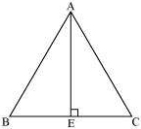
In an equilateral triangle,prove that three times the square of one side is equal to four times the square of one of its altitudes.
Solution
(N/A) Let the side of the equilateral triangle be $a$,and $AE$ be the altitude of $\triangle ABC$.
Since the altitude of an equilateral triangle bisects the base,
$BE = EC = \frac{BC}{2} = \frac{a}{2}$
Applying the Pythagoras theorem in the right-angled $\triangle ABE$,we obtain:
$AB^2 = AE^2 + BE^2$
Substituting the values $AB = a$ and $BE = \frac{a}{2}$:
$a^2 = AE^2 + (\frac{a}{2})^2$
$a^2 = AE^2 + \frac{a^2}{4}$
Rearranging the terms to solve for $AE^2$:
$AE^2 = a^2 - \frac{a^2}{4}$
$AE^2 = \frac{4a^2 - a^2}{4}$
$AE^2 = \frac{3a^2}{4}$
Multiplying both sides by $4$:
$4AE^2 = 3a^2$
Thus,it is proved that $4 \times$ (square of altitude) $= 3 \times$ (square of one side).
Since the altitude of an equilateral triangle bisects the base,
$BE = EC = \frac{BC}{2} = \frac{a}{2}$
Applying the Pythagoras theorem in the right-angled $\triangle ABE$,we obtain:
$AB^2 = AE^2 + BE^2$
Substituting the values $AB = a$ and $BE = \frac{a}{2}$:
$a^2 = AE^2 + (\frac{a}{2})^2$
$a^2 = AE^2 + \frac{a^2}{4}$
Rearranging the terms to solve for $AE^2$:
$AE^2 = a^2 - \frac{a^2}{4}$
$AE^2 = \frac{4a^2 - a^2}{4}$
$AE^2 = \frac{3a^2}{4}$
Multiplying both sides by $4$:
$4AE^2 = 3a^2$
Thus,it is proved that $4 \times$ (square of altitude) $= 3 \times$ (square of one side).
0 likes
View Solution86
DifficultMCQ
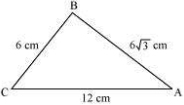
In $\Delta ABC$,$AB = 6\sqrt{3} \text{ cm}$,$AC = 12 \text{ cm}$,and $BC = 6 \text{ cm}$. The angle $B$ is (in $^o$):
A
$120$
B
$90$
C
$60$
D
$45$
Solution
(B) Given that,$AB = 6\sqrt{3} \text{ cm}$,$AC = 12 \text{ cm}$,and $BC = 6 \text{ cm}$.
Calculating the squares of the sides:
$AB^2 = (6\sqrt{3})^2 = 36 \times 3 = 108$
$BC^2 = (6)^2 = 36$
$AC^2 = (12)^2 = 144$
Now,observe that:
$AB^2 + BC^2 = 108 + 36 = 144$
Since $AB^2 + BC^2 = AC^2$,the triangle satisfies the converse of the Pythagoras theorem.
Therefore,$\triangle ABC$ is a right-angled triangle,with the right angle opposite to the hypotenuse $AC$.
Thus,$\angle B = 90^\circ$.
Hence,the correct answer is $(B)$.
Calculating the squares of the sides:
$AB^2 = (6\sqrt{3})^2 = 36 \times 3 = 108$
$BC^2 = (6)^2 = 36$
$AC^2 = (12)^2 = 144$
Now,observe that:
$AB^2 + BC^2 = 108 + 36 = 144$
Since $AB^2 + BC^2 = AC^2$,the triangle satisfies the converse of the Pythagoras theorem.
Therefore,$\triangle ABC$ is a right-angled triangle,with the right angle opposite to the hypotenuse $AC$.
Thus,$\angle B = 90^\circ$.
Hence,the correct answer is $(B)$.
0 likes
View Solution87
Difficult
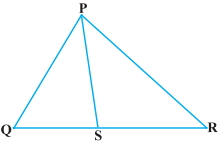
In the figure,$PS$ is the bisector of $\angle QPR$ of $\Delta PQR$. Prove that $\frac{QS}{SR} = \frac{PQ}{PR}$.
Solution
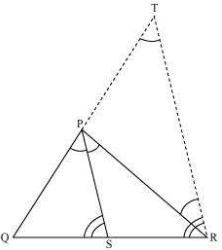
(N/A) Construction: Draw a line segment $RT$ parallel to $PS$ which intersects the extended line segment $QP$ at point $T$.
Given that,$PS$ is the angle bisector of $\angle QPR$.
Therefore,$\angle QPS = \angle SPR \quad \dots(1)$
By construction,$PS \parallel TR$ and $QT$ is a transversal.
Therefore,$\angle QPS = \angle QTR$ (Corresponding angles) $\quad \dots(2)$
Also,$PS \parallel TR$ and $PR$ is a transversal.
Therefore,$\angle SPR = \angle PRT$ (Alternate interior angles) $\quad \dots(3)$
From equations $(1)$,$(2)$,and $(3)$,we get:
$\angle QTR = \angle PRT$
In $\Delta PTR$,since $\angle QTR = \angle PRT$,the sides opposite to these angles are equal.
Therefore,$PT = PR \quad \dots(4)$
In $\Delta QTR$,since $PS \parallel TR$,by the Basic Proportionality Theorem $(BPT)$:
$\frac{QS}{SR} = \frac{QP}{PT}$
Substituting $PT = PR$ from equation $(4)$ into the above expression:
$\frac{QS}{SR} = \frac{PQ}{PR}$
Hence,it is proved.
Given that,$PS$ is the angle bisector of $\angle QPR$.
Therefore,$\angle QPS = \angle SPR \quad \dots(1)$
By construction,$PS \parallel TR$ and $QT$ is a transversal.
Therefore,$\angle QPS = \angle QTR$ (Corresponding angles) $\quad \dots(2)$
Also,$PS \parallel TR$ and $PR$ is a transversal.
Therefore,$\angle SPR = \angle PRT$ (Alternate interior angles) $\quad \dots(3)$
From equations $(1)$,$(2)$,and $(3)$,we get:
$\angle QTR = \angle PRT$
In $\Delta PTR$,since $\angle QTR = \angle PRT$,the sides opposite to these angles are equal.
Therefore,$PT = PR \quad \dots(4)$
In $\Delta QTR$,since $PS \parallel TR$,by the Basic Proportionality Theorem $(BPT)$:
$\frac{QS}{SR} = \frac{QP}{PT}$
Substituting $PT = PR$ from equation $(4)$ into the above expression:
$\frac{QS}{SR} = \frac{PQ}{PR}$
Hence,it is proved.
0 likes
View Solution88
Difficult
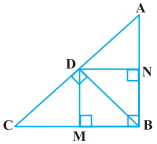
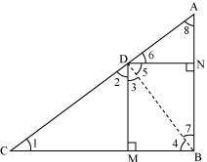
In the figure,$D$ is a point on the hypotenuse $AC$ of $\Delta ABC,$ such that $BD \perp AC,$ $DM \perp BC,$ and $DN \perp AB.$ Prove that $DM^{2} = DN \cdot MC.$
Solution
(N/A) Join $DB.$
We have $DN \parallel CB,$ $DM \parallel AB,$ and $\angle B = 90^{\circ}.$
Therefore,$DMBN$ is a rectangle.
Thus,$DN = MB$ and $DM = NB.$
Since $D$ is the foot of the perpendicular drawn from $B$ to $AC,$ we have $\angle CDB = 90^{\circ}.$
$\angle 2 + \angle 3 = 90^{\circ} \dots(1)$
In $\Delta CDM, \angle 1 + \angle 2 + \angle DMC = 180^{\circ} \Rightarrow \angle 1 + \angle 2 = 90^{\circ} \dots(2)$
In $\Delta DMB, \angle 3 + \angle DMB + \angle 4 = 180^{\circ} \Rightarrow \angle 3 + \angle 4 = 90^{\circ} \dots(3)$
From $(1)$ and $(2),$ we get $\angle 1 = \angle 3.$
From $(1)$ and $(3),$ we get $\angle 2 = \angle 4.$
In $\Delta DCM$ and $\Delta BDM,$
$\angle 1 = \angle 3$ (Proved above)
$\angle 2 = \angle 4$ (Proved above)
Therefore,$\Delta DCM \sim \Delta BDM$ ($AA$ similarity criterion).
Thus,$\frac{BM}{DM} = \frac{DM}{MC}.$
Since $BM = DN,$ we have $\frac{DN}{DM} = \frac{DM}{MC}.$
Therefore,$DM^{2} = DN \cdot MC.$
We have $DN \parallel CB,$ $DM \parallel AB,$ and $\angle B = 90^{\circ}.$
Therefore,$DMBN$ is a rectangle.
Thus,$DN = MB$ and $DM = NB.$
Since $D$ is the foot of the perpendicular drawn from $B$ to $AC,$ we have $\angle CDB = 90^{\circ}.$
$\angle 2 + \angle 3 = 90^{\circ} \dots(1)$
In $\Delta CDM, \angle 1 + \angle 2 + \angle DMC = 180^{\circ} \Rightarrow \angle 1 + \angle 2 = 90^{\circ} \dots(2)$
In $\Delta DMB, \angle 3 + \angle DMB + \angle 4 = 180^{\circ} \Rightarrow \angle 3 + \angle 4 = 90^{\circ} \dots(3)$
From $(1)$ and $(2),$ we get $\angle 1 = \angle 3.$
From $(1)$ and $(3),$ we get $\angle 2 = \angle 4.$
In $\Delta DCM$ and $\Delta BDM,$
$\angle 1 = \angle 3$ (Proved above)
$\angle 2 = \angle 4$ (Proved above)
Therefore,$\Delta DCM \sim \Delta BDM$ ($AA$ similarity criterion).
Thus,$\frac{BM}{DM} = \frac{DM}{MC}.$
Since $BM = DN,$ we have $\frac{DN}{DM} = \frac{DM}{MC}.$
Therefore,$DM^{2} = DN \cdot MC.$
0 likes
View Solution89
Difficult
In the figure,$D$ is a point on the hypotenuse $AC$ of $\Delta ABC,$ such that $BD \perp AC,$ $DM \perp BC,$ and $DN \perp AB.$ Prove that $DN^{2} = DM \cdot AN.$
Solution
(N/A) In quadrilateral $DMBN,$ since $\angle DMB = 90^{\circ},$ $\angle DNB = 90^{\circ},$ and $\angle MBN = 90^{\circ}$ (given $\angle ABC = 90^{\circ}$),the fourth angle $\angle MDN$ must also be $90^{\circ}.$ Thus,$DMBN$ is a rectangle.
Therefore,$DM = NB$ and $DN = MB.$
In $\Delta ABC,$ $BD \perp AC.$ By the property of similar triangles in a right triangle,$\Delta ADN \sim \Delta ABD$ and $\Delta BDC \sim \Delta ABD.$
More directly,in $\Delta DNB$ and $\Delta ADN:$
$\angle DNB = \angle DNA = 90^{\circ}.$
$\angle ND B = \angle DAN$ (since both are complementary to $\angle ADN$).
Thus,$\Delta DNB \sim \Delta ADN$ by $AA$ similarity.
Therefore,$\frac{DN}{AN} = \frac{NB}{DN}.$
$DN^{2} = AN \cdot NB.$
Since $NB = DM,$ we have $DN^{2} = AN \cdot DM.$
Therefore,$DM = NB$ and $DN = MB.$
In $\Delta ABC,$ $BD \perp AC.$ By the property of similar triangles in a right triangle,$\Delta ADN \sim \Delta ABD$ and $\Delta BDC \sim \Delta ABD.$
More directly,in $\Delta DNB$ and $\Delta ADN:$
$\angle DNB = \angle DNA = 90^{\circ}.$
$\angle ND B = \angle DAN$ (since both are complementary to $\angle ADN$).
Thus,$\Delta DNB \sim \Delta ADN$ by $AA$ similarity.
Therefore,$\frac{DN}{AN} = \frac{NB}{DN}.$
$DN^{2} = AN \cdot NB.$
Since $NB = DM,$ we have $DN^{2} = AN \cdot DM.$
0 likes
View Solution90
Medium
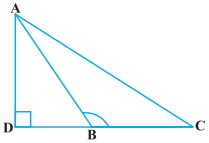
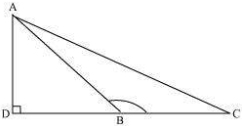
In the figure,$ABC$ is a triangle in which $\angle ABC > 90^{\circ}$ and $AD \perp CB$ produced. Prove that $AC^{2} = AB^{2} + BC^{2} + 2BC \cdot BD$.
Solution
(N/A) In $\triangle ADB$,applying the Pythagoras theorem,we have:
$AB^{2} = AD^{2} + BD^{2} \quad \dots(1)$
In $\triangle ADC$,applying the Pythagoras theorem,we have:
$AC^{2} = AD^{2} + DC^{2}$
Since $DC = DB + BC$,we can write:
$AC^{2} = AD^{2} + (DB + BC)^{2}$
$AC^{2} = AD^{2} + DB^{2} + BC^{2} + 2DB \cdot BC$
Substituting $AD^{2} + DB^{2} = AB^{2}$ from equation $(1)$:
$AC^{2} = AB^{2} + BC^{2} + 2BC \cdot BD$
$AB^{2} = AD^{2} + BD^{2} \quad \dots(1)$
In $\triangle ADC$,applying the Pythagoras theorem,we have:
$AC^{2} = AD^{2} + DC^{2}$
Since $DC = DB + BC$,we can write:
$AC^{2} = AD^{2} + (DB + BC)^{2}$
$AC^{2} = AD^{2} + DB^{2} + BC^{2} + 2DB \cdot BC$
Substituting $AD^{2} + DB^{2} = AB^{2}$ from equation $(1)$:
$AC^{2} = AB^{2} + BC^{2} + 2BC \cdot BD$
0 likes
View Solution91
Medium
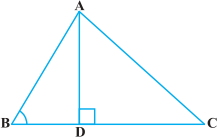
In the figure,$ABC$ is a triangle in which $\angle ABC < 90^{\circ}$ and $AD \perp BC$. Prove that $AC^{2} = AB^{2} + BC^{2} - 2BC \cdot BD$.
Solution
(N/A) Applying the Pythagoras theorem in $\triangle ADB$,we obtain:
$AD^{2} + DB^{2} = AB^{2}$
$\Rightarrow AD^{2} = AB^{2} - DB^{2} \dots(1)$
Applying the Pythagoras theorem in $\triangle ADC$,we obtain:
$AD^{2} + DC^{2} = AC^{2}$
Substituting the value of $AD^{2}$ from equation $(1)$:
$(AB^{2} - BD^{2}) + DC^{2} = AC^{2}$
Since $D$ lies on $BC$,we have $DC = BC - BD$. Substituting this into the equation:
$AB^{2} - BD^{2} + (BC - BD)^{2} = AC^{2}$
$AB^{2} - BD^{2} + (BC^{2} + BD^{2} - 2BC \cdot BD) = AC^{2}$
$AB^{2} + BC^{2} - 2BC \cdot BD = AC^{2}$
Thus,$AC^{2} = AB^{2} + BC^{2} - 2BC \cdot BD$.
$AD^{2} + DB^{2} = AB^{2}$
$\Rightarrow AD^{2} = AB^{2} - DB^{2} \dots(1)$
Applying the Pythagoras theorem in $\triangle ADC$,we obtain:
$AD^{2} + DC^{2} = AC^{2}$
Substituting the value of $AD^{2}$ from equation $(1)$:
$(AB^{2} - BD^{2}) + DC^{2} = AC^{2}$
Since $D$ lies on $BC$,we have $DC = BC - BD$. Substituting this into the equation:
$AB^{2} - BD^{2} + (BC - BD)^{2} = AC^{2}$
$AB^{2} - BD^{2} + (BC^{2} + BD^{2} - 2BC \cdot BD) = AC^{2}$
$AB^{2} + BC^{2} - 2BC \cdot BD = AC^{2}$
Thus,$AC^{2} = AB^{2} + BC^{2} - 2BC \cdot BD$.
0 likes
View Solution92
Medium
In the figure,$AD$ is a median of a triangle $ABC$ and $AM \perp BC$. Prove that $AC^{2} = AD^{2} + BC \cdot DM + \left(\frac{BC}{2}\right)^{2}$.
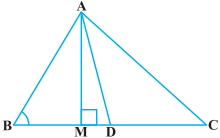
Solution
(N/A) Applying Pythagoras theorem in $\Delta AMD$,we obtain:
$AM^{2} + MD^{2} = AD^{2} \dots(1)$
Applying Pythagoras theorem in $\Delta AMC$,we obtain:
$AM^{2} + MC^{2} = AC^{2}$
Since $MC = MD + DC$,we have:
$AM^{2} + (MD + DC)^{2} = AC^{2}$
$AM^{2} + MD^{2} + DC^{2} + 2MD \cdot DC = AC^{2}$
Substituting $AM^{2} + MD^{2} = AD^{2}$ from equation $(1)$:
$AD^{2} + DC^{2} + 2MD \cdot DC = AC^{2}$
Since $AD$ is a median,$DC = \frac{BC}{2}$. Substituting this value:
$AD^{2} + \left(\frac{BC}{2}\right)^{2} + 2MD \cdot \left(\frac{BC}{2}\right) = AC^{2}$
$AD^{2} + \left(\frac{BC}{2}\right)^{2} + BC \cdot DM = AC^{2}$
Thus,$AC^{2} = AD^{2} + BC \cdot DM + \left(\frac{BC}{2}\right)^{2}$.
$AM^{2} + MD^{2} = AD^{2} \dots(1)$
Applying Pythagoras theorem in $\Delta AMC$,we obtain:
$AM^{2} + MC^{2} = AC^{2}$
Since $MC = MD + DC$,we have:
$AM^{2} + (MD + DC)^{2} = AC^{2}$
$AM^{2} + MD^{2} + DC^{2} + 2MD \cdot DC = AC^{2}$
Substituting $AM^{2} + MD^{2} = AD^{2}$ from equation $(1)$:
$AD^{2} + DC^{2} + 2MD \cdot DC = AC^{2}$
Since $AD$ is a median,$DC = \frac{BC}{2}$. Substituting this value:
$AD^{2} + \left(\frac{BC}{2}\right)^{2} + 2MD \cdot \left(\frac{BC}{2}\right) = AC^{2}$
$AD^{2} + \left(\frac{BC}{2}\right)^{2} + BC \cdot DM = AC^{2}$
Thus,$AC^{2} = AD^{2} + BC \cdot DM + \left(\frac{BC}{2}\right)^{2}$.
0 likes
View Solution93
Medium
In the figure,$AD$ is a median of a triangle $ABC$ and $AM \perp BC$. Prove that:
$AB^{2} = AD^{2} - BC \cdot DM + \left(\frac{BC}{2}\right)^{2}$
$AB^{2} = AD^{2} - BC \cdot DM + \left(\frac{BC}{2}\right)^{2}$
Solution
(N/A) Given: $AD$ is the median of $\Delta ABC$,so $BD = DC = \frac{BC}{2}$.
Also,$AM \perp BC$.
In right-angled $\Delta ABM$,by Pythagoras theorem:
$AB^{2} = AM^{2} + BM^{2}$
In right-angled $\Delta ADM$,by Pythagoras theorem:
$AD^{2} = AM^{2} + DM^{2} \implies AM^{2} = AD^{2} - DM^{2}$
Substituting $AM^{2}$ in the first equation:
$AB^{2} = (AD^{2} - DM^{2}) + BM^{2}$
Since $BM = BD - DM$,we have:
$AB^{2} = AD^{2} - DM^{2} + (BD - DM)^{2}$
$AB^{2} = AD^{2} - DM^{2} + BD^{2} + DM^{2} - 2 \cdot BD \cdot DM$
$AB^{2} = AD^{2} + BD^{2} - 2 \cdot BD \cdot DM$
Since $BD = \frac{BC}{2}$,substituting this value:
$AB^{2} = AD^{2} + \left(\frac{BC}{2}\right)^{2} - 2 \cdot \left(\frac{BC}{2}\right) \cdot DM$
$AB^{2} = AD^{2} + \left(\frac{BC}{2}\right)^{2} - BC \cdot DM$
Also,$AM \perp BC$.
In right-angled $\Delta ABM$,by Pythagoras theorem:
$AB^{2} = AM^{2} + BM^{2}$
In right-angled $\Delta ADM$,by Pythagoras theorem:
$AD^{2} = AM^{2} + DM^{2} \implies AM^{2} = AD^{2} - DM^{2}$
Substituting $AM^{2}$ in the first equation:
$AB^{2} = (AD^{2} - DM^{2}) + BM^{2}$
Since $BM = BD - DM$,we have:
$AB^{2} = AD^{2} - DM^{2} + (BD - DM)^{2}$
$AB^{2} = AD^{2} - DM^{2} + BD^{2} + DM^{2} - 2 \cdot BD \cdot DM$
$AB^{2} = AD^{2} + BD^{2} - 2 \cdot BD \cdot DM$
Since $BD = \frac{BC}{2}$,substituting this value:
$AB^{2} = AD^{2} + \left(\frac{BC}{2}\right)^{2} - 2 \cdot \left(\frac{BC}{2}\right) \cdot DM$
$AB^{2} = AD^{2} + \left(\frac{BC}{2}\right)^{2} - BC \cdot DM$
0 likes
View Solution94
Difficult
In the figure,$AD$ is a median of a triangle $ABC$ and $AM \perp BC$. Prove that $AC^2 + AB^2 = 2AD^2 + \frac{1}{2} BC^2$.
Solution
(N/A) Applying Pythagoras theorem in $\Delta ABM$,we obtain:
$AM^2 + MB^2 = AB^2 \quad \dots(1)$
Applying Pythagoras theorem in $\Delta AMC$,we obtain:
$AM^2 + MC^2 = AC^2 \quad \dots(2)$
Adding equations $(1)$ and $(2)$,we obtain:
$2AM^2 + MB^2 + MC^2 = AB^2 + AC^2$
Since $AD$ is a median,$BD = DC = \frac{BC}{2}$.
We can write $MB = BD - DM$ and $MC = DC + DM = BD + DM$.
Substituting these in the equation:
$2AM^2 + (BD - DM)^2 + (BD + DM)^2 = AB^2 + AC^2$
$2AM^2 + (BD^2 + DM^2 - 2BD \cdot DM) + (BD^2 + DM^2 + 2BD \cdot DM) = AB^2 + AC^2$
$2AM^2 + 2BD^2 + 2DM^2 = AB^2 + AC^2$
$2(AM^2 + DM^2) + 2BD^2 = AB^2 + AC^2$
In $\Delta ADM$,by Pythagoras theorem,$AM^2 + DM^2 = AD^2$.
So,$2AD^2 + 2(\frac{BC}{2})^2 = AB^2 + AC^2$
$2AD^2 + 2(\frac{BC^2}{4}) = AB^2 + AC^2$
$2AD^2 + \frac{BC^2}{2} = AB^2 + AC^2$
$AM^2 + MB^2 = AB^2 \quad \dots(1)$
Applying Pythagoras theorem in $\Delta AMC$,we obtain:
$AM^2 + MC^2 = AC^2 \quad \dots(2)$
Adding equations $(1)$ and $(2)$,we obtain:
$2AM^2 + MB^2 + MC^2 = AB^2 + AC^2$
Since $AD$ is a median,$BD = DC = \frac{BC}{2}$.
We can write $MB = BD - DM$ and $MC = DC + DM = BD + DM$.
Substituting these in the equation:
$2AM^2 + (BD - DM)^2 + (BD + DM)^2 = AB^2 + AC^2$
$2AM^2 + (BD^2 + DM^2 - 2BD \cdot DM) + (BD^2 + DM^2 + 2BD \cdot DM) = AB^2 + AC^2$
$2AM^2 + 2BD^2 + 2DM^2 = AB^2 + AC^2$
$2(AM^2 + DM^2) + 2BD^2 = AB^2 + AC^2$
In $\Delta ADM$,by Pythagoras theorem,$AM^2 + DM^2 = AD^2$.
So,$2AD^2 + 2(\frac{BC}{2})^2 = AB^2 + AC^2$
$2AD^2 + 2(\frac{BC^2}{4}) = AB^2 + AC^2$
$2AD^2 + \frac{BC^2}{2} = AB^2 + AC^2$
0 likes
View Solution95
Difficult
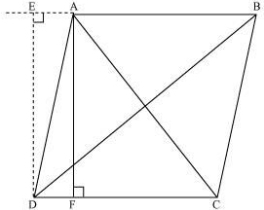
Prove that the sum of the squares of the diagonals of a parallelogram is equal to the sum of the squares of its sides.
Solution
(A) Let $ABCD$ be a parallelogram.
Let us draw perpendicular $DE$ on the extended side $AB$,and $AF$ on side $DC$.
Applying Pythagoras theorem in $\triangle DEA$,we obtain:
$DE^{2} + EA^{2} = DA^{2} \dots (i)$
Applying Pythagoras theorem in $\triangle DEB$,we obtain:
$DE^{2} + EB^{2} = DB^{2}$
$DE^{2} + (EA + AB)^{2} = DB^{2}$
$(DE^{2} + EA^{2}) + AB^{2} + 2EA \times AB = DB^{2}$
$DA^{2} + AB^{2} + 2EA \times AB = DB^{2} \dots (ii)$
Applying Pythagoras theorem in $\triangle AFC$,we obtain:
$AC^{2} = AF^{2} + FC^{2}$
$AC^{2} = AF^{2} + (DC - FD)^{2}$
$AC^{2} = AF^{2} + DC^{2} + FD^{2} - 2DC \times FD$
$AC^{2} = (AF^{2} + FD^{2}) + DC^{2} - 2DC \times FD$
$AC^{2} = AD^{2} + DC^{2} - 2DC \times FD \dots (iii)$
Since $ABCD$ is a parallelogram,$AB = CD \dots (iv)$ and $BC = AD \dots (v)$.
In $\triangle DEA$ and $\triangle AFD$:
$\angle DEA = \angle AFD = 90^{\circ}$
$\angle EAD = \angle ADF$ (since $EA \parallel DF$)
$AD = AD$ (Common side)
Therefore,$\triangle EAD \cong \triangle FDA$ ($AAS$ congruence criterion).
This implies $EA = DF \dots (vi)$.
Adding equations $(ii)$ and $(iii)$:
$DB^{2} + AC^{2} = DA^{2} + AB^{2} + 2EA \times AB + AD^{2} + DC^{2} - 2DC \times FD$
Using $AB = DC$ and $EA = DF$:
$DB^{2} + AC^{2} = AD^{2} + AB^{2} + 2EA \times AB + AD^{2} + AB^{2} - 2AB \times EA$
$DB^{2} + AC^{2} = 2AD^{2} + 2AB^{2}$
Since $AD = BC$ and $AB = CD$:
$AC^{2} + BD^{2} = AB^{2} + BC^{2} + CD^{2} + DA^{2}$.
Let us draw perpendicular $DE$ on the extended side $AB$,and $AF$ on side $DC$.
Applying Pythagoras theorem in $\triangle DEA$,we obtain:
$DE^{2} + EA^{2} = DA^{2} \dots (i)$
Applying Pythagoras theorem in $\triangle DEB$,we obtain:
$DE^{2} + EB^{2} = DB^{2}$
$DE^{2} + (EA + AB)^{2} = DB^{2}$
$(DE^{2} + EA^{2}) + AB^{2} + 2EA \times AB = DB^{2}$
$DA^{2} + AB^{2} + 2EA \times AB = DB^{2} \dots (ii)$
Applying Pythagoras theorem in $\triangle AFC$,we obtain:
$AC^{2} = AF^{2} + FC^{2}$
$AC^{2} = AF^{2} + (DC - FD)^{2}$
$AC^{2} = AF^{2} + DC^{2} + FD^{2} - 2DC \times FD$
$AC^{2} = (AF^{2} + FD^{2}) + DC^{2} - 2DC \times FD$
$AC^{2} = AD^{2} + DC^{2} - 2DC \times FD \dots (iii)$
Since $ABCD$ is a parallelogram,$AB = CD \dots (iv)$ and $BC = AD \dots (v)$.
In $\triangle DEA$ and $\triangle AFD$:
$\angle DEA = \angle AFD = 90^{\circ}$
$\angle EAD = \angle ADF$ (since $EA \parallel DF$)
$AD = AD$ (Common side)
Therefore,$\triangle EAD \cong \triangle FDA$ ($AAS$ congruence criterion).
This implies $EA = DF \dots (vi)$.
Adding equations $(ii)$ and $(iii)$:
$DB^{2} + AC^{2} = DA^{2} + AB^{2} + 2EA \times AB + AD^{2} + DC^{2} - 2DC \times FD$
Using $AB = DC$ and $EA = DF$:
$DB^{2} + AC^{2} = AD^{2} + AB^{2} + 2EA \times AB + AD^{2} + AB^{2} - 2AB \times EA$
$DB^{2} + AC^{2} = 2AD^{2} + 2AB^{2}$
Since $AD = BC$ and $AB = CD$:
$AC^{2} + BD^{2} = AB^{2} + BC^{2} + CD^{2} + DA^{2}$.
0 likes
View Solution96
Medium
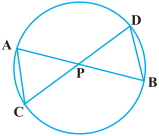
In the figure,two chords $AB$ and $CD$ intersect each other at the point $P$. Prove that $\Delta APC \sim \Delta DPB$.
Solution
(N/A) To prove that $\Delta APC \sim \Delta DPB$,we follow these steps:
$1$. Join $CB$ and $AD$.
$2$. Consider $\Delta APC$ and $\Delta DPB$.
$3$. $\angle APC = \angle DPB$ (Vertically opposite angles).
$4$. $\angle CAP = \angle BDP$ (Angles subtended by the same arc $CB$ in the same segment of the circle are equal).
$5$. Therefore,by the $AA$ (Angle-Angle) similarity criterion,$\Delta APC \sim \Delta DPB$.
$1$. Join $CB$ and $AD$.
$2$. Consider $\Delta APC$ and $\Delta DPB$.
$3$. $\angle APC = \angle DPB$ (Vertically opposite angles).
$4$. $\angle CAP = \angle BDP$ (Angles subtended by the same arc $CB$ in the same segment of the circle are equal).
$5$. Therefore,by the $AA$ (Angle-Angle) similarity criterion,$\Delta APC \sim \Delta DPB$.
0 likes
View Solution97
Medium
In the figure,two chords $AB$ and $CD$ intersect each other at the point $P$. Prove that $AP \cdot PB = CP \cdot DP$.
Solution
(N/A) To prove $AP \cdot PB = CP \cdot DP$,we consider the triangles $\Delta APC$ and $\Delta DPB$.
$1$. $\angle APC = \angle DPB$ (Vertically opposite angles).
$2$. $\angle CAP = \angle BDP$ (Angles in the same segment of a circle are equal).
By the $AA$ (Angle-Angle) similarity criterion,$\Delta APC \sim \Delta DPB$.
Since the corresponding sides of similar triangles are proportional,we have:
$\frac{AP}{DP} = \frac{PC}{PB} = \frac{AC}{DB}$
Taking the first two ratios:
$\frac{AP}{DP} = \frac{PC}{PB}$
By cross-multiplying,we get:
$AP \cdot PB = PC \cdot DP$ (or $AP \cdot PB = CP \cdot DP$).
$1$. $\angle APC = \angle DPB$ (Vertically opposite angles).
$2$. $\angle CAP = \angle BDP$ (Angles in the same segment of a circle are equal).
By the $AA$ (Angle-Angle) similarity criterion,$\Delta APC \sim \Delta DPB$.
Since the corresponding sides of similar triangles are proportional,we have:
$\frac{AP}{DP} = \frac{PC}{PB} = \frac{AC}{DB}$
Taking the first two ratios:
$\frac{AP}{DP} = \frac{PC}{PB}$
By cross-multiplying,we get:
$AP \cdot PB = PC \cdot DP$ (or $AP \cdot PB = CP \cdot DP$).
0 likes
View Solution98
Medium
In the figure,two chords $AB$ and $CD$ of a circle intersect each other at point $P$ (when produced) outside the circle. Prove that $\Delta PAC \sim \Delta PDB$.
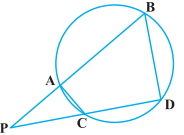
Solution
(N/A) Consider $\Delta PAC$ and $\Delta PDB$.
$1$. $\angle P = \angle P$ (Common angle).
$2$. In a cyclic quadrilateral $ABDC$,the exterior angle is equal to the interior opposite angle. Therefore,$\angle PAC = \angle PDB$ (Since $\angle PAC + \angle CAB = 180^{\circ}$ and $\angle PDB + \angle CAB = 180^{\circ}$).
$3$. By the $AA$ (Angle-Angle) similarity criterion,$\Delta PAC \sim \Delta PDB$.
$1$. $\angle P = \angle P$ (Common angle).
$2$. In a cyclic quadrilateral $ABDC$,the exterior angle is equal to the interior opposite angle. Therefore,$\angle PAC = \angle PDB$ (Since $\angle PAC + \angle CAB = 180^{\circ}$ and $\angle PDB + \angle CAB = 180^{\circ}$).
$3$. By the $AA$ (Angle-Angle) similarity criterion,$\Delta PAC \sim \Delta PDB$.
0 likes
View Solution99
Easy
In the figure,two chords $AB$ and $CD$ of a circle are produced to intersect each other at point $P$ outside the circle. Prove that $PA \cdot PB = PC \cdot PD$.
Solution
(N/A) To prove $PA \cdot PB = PC \cdot PD$,consider $\triangle PAD$ and $\triangle PCB$.
$1$. $\angle P = \angle P$ (Common angle).
$2$. $\angle PDA = \angle PBC$ (Exterior angle of a cyclic quadrilateral is equal to the interior opposite angle,or since $\angle PAD + \angle DAB = 180^{\circ}$ and $\angle BCD + \angle DAB = 180^{\circ}$,we have $\angle PAD = \angle BCD$,and thus $\triangle PAD \sim \triangle PCB$ by $AA$ similarity).
Since $\triangle PAD \sim \triangle PCB$,the ratios of their corresponding sides are equal:
$\frac{PA}{PC} = \frac{PD}{PB} = \frac{AD}{CB}$.
Taking the first two parts:
$\frac{PA}{PC} = \frac{PD}{PB}$
By cross-multiplying,we get:
$PA \cdot PB = PC \cdot PD$.
$1$. $\angle P = \angle P$ (Common angle).
$2$. $\angle PDA = \angle PBC$ (Exterior angle of a cyclic quadrilateral is equal to the interior opposite angle,or since $\angle PAD + \angle DAB = 180^{\circ}$ and $\angle BCD + \angle DAB = 180^{\circ}$,we have $\angle PAD = \angle BCD$,and thus $\triangle PAD \sim \triangle PCB$ by $AA$ similarity).
Since $\triangle PAD \sim \triangle PCB$,the ratios of their corresponding sides are equal:
$\frac{PA}{PC} = \frac{PD}{PB} = \frac{AD}{CB}$.
Taking the first two parts:
$\frac{PA}{PC} = \frac{PD}{PB}$
By cross-multiplying,we get:
$PA \cdot PB = PC \cdot PD$.
0 likes
View Solution100
Difficult
In the figure,$D$ is a point on side $BC$ of $\Delta ABC$ such that $\frac{BD}{CD} = \frac{AB}{AC}$. Prove that $AD$ is the bisector of $\angle BAC$.
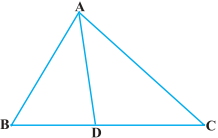
Solution
(N/A) Let us extend $BA$ to $P$ such that $AP = AC$. Join $PC$.
It is given that,
$\frac{BD}{CD} = \frac{AB}{AC}$
Since $AP = AC$,we can substitute $AP$ for $AC$:
$\frac{BD}{CD} = \frac{AB}{AP}$
By using the converse of the Basic Proportionality Theorem $(BPT)$ in $\Delta BPC$,we obtain:
$AD \parallel PC$
Therefore,$\angle BAD = \angle APC$ (Corresponding angles) $\dots(1)$
And,$\angle DAC = \angle ACP$ (Alternate interior angles) $\dots(2)$
By construction,we have $AP = AC$,which implies that in $\Delta APC$,the angles opposite to equal sides are equal:
$\angle APC = \angle ACP \dots(3)$
From equations $(1), (2),$ and $(3)$,we get:
$\angle BAD = \angle DAC$
Thus,$AD$ is the bisector of $\angle BAC$.
It is given that,
$\frac{BD}{CD} = \frac{AB}{AC}$
Since $AP = AC$,we can substitute $AP$ for $AC$:
$\frac{BD}{CD} = \frac{AB}{AP}$
By using the converse of the Basic Proportionality Theorem $(BPT)$ in $\Delta BPC$,we obtain:
$AD \parallel PC$
Therefore,$\angle BAD = \angle APC$ (Corresponding angles) $\dots(1)$
And,$\angle DAC = \angle ACP$ (Alternate interior angles) $\dots(2)$
By construction,we have $AP = AC$,which implies that in $\Delta APC$,the angles opposite to equal sides are equal:
$\angle APC = \angle ACP \dots(3)$
From equations $(1), (2),$ and $(3)$,we get:
$\angle BAD = \angle DAC$
Thus,$AD$ is the bisector of $\angle BAC$.
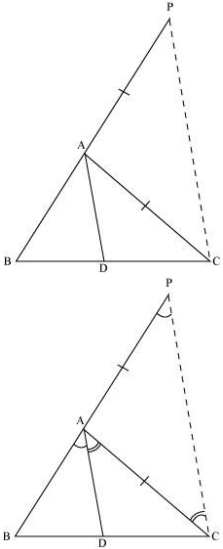
0 likes
View SolutionTriangles — Textbook - Triangles · Frequently Asked Questions
1Are these Triangles questions useful for JEE and NEET?
Yes. All questions in this section are mapped to JEE Main and NEET exam patterns. Previous year questions from JEE Main, NEET, GUJCET and state-level exams are included with full solutions.
2Can I switch to Hindi or Gujarati for these questions?
Yes. Use the language tabs in the hero section or the sidebar to view the same questions and solutions in English, Hindi or Gujarati.
3How do I generate a question paper from this subtopic?
Use the Vedclass Exam Paper Generator — select the chapter and subtopic, set difficulty, and generate Sets A, B, C, D automatically. First 3 chapters of every subject are free.
Vedclass Products
For Students
Vedclass Test Series
Mock tests in real JEE/NEET style with performance analysis. 5-day free trial.
Start Free TrialFor Teachers
Exam Paper Generator
Generate Set A/B/C/D papers from this chapter in 2 minutes. 3 chapters free.
Try FreeFor Institutes
Online Exam Module
Live online exams with unlimited students, 360° analytics & white-label branding.
See DemoFor Teachers & Institutes
Generate a Triangles Exam Paper in 2 Minutes
Select subtopic & difficulty — Sets A, B, C, D auto-generated with No Repeat logic.
First 3 chapters of every subject are free — no payment required.