
A English
Mix Examples - Triangles Questions in English
Class 10 Mathematics · Triangles · Mix Examples - Triangles
549+
Questions
English
Language
100%
With Solutions
Showing 49 of 549 questions in English
501
MediumMCQ
In $\Delta ABC$,$m \angle A = 90^{\circ}$ and $\overline{AD}$ is an altitude to the hypotenuse $BC$. Then,$AD^{2} = \ldots$
A
$AB^{2} + BC^{2}$
B
$BD^{2} + DC^{2}$
C
$BD \cdot DC$
D
$BD \cdot BC$
Solution
(C) In a right-angled triangle $\Delta ABC$ where $m \angle A = 90^{\circ}$ and $\overline{AD} \perp \overline{BC}$,the triangle is divided into two triangles $\Delta ABD$ and $\Delta CAD$ which are similar to the original triangle $\Delta ABC$ and to each other.
By the property of similarity,$\Delta ABD \sim \Delta CAD$.
Therefore,the ratio of their corresponding sides is equal: $\frac{AD}{BD} = \frac{CD}{AD}$.
Cross-multiplying gives $AD^{2} = BD \cdot CD$ or $AD^{2} = BD \cdot DC$.
By the property of similarity,$\Delta ABD \sim \Delta CAD$.
Therefore,the ratio of their corresponding sides is equal: $\frac{AD}{BD} = \frac{CD}{AD}$.
Cross-multiplying gives $AD^{2} = BD \cdot CD$ or $AD^{2} = BD \cdot DC$.
0 likes
View Solution502
EasyMCQ
In $\Delta ABC$,if $\ldots \ldots \ldots \ldots$,then by Apollonius' theorem,$AB^{2} + AC^{2} = 2(AD^{2} + BD^{2})$ holds good.
A
$\overline{AD}$ is a median
B
$\overline{AD}$ is an altitude
C
$\overline{CD}$ is a median
D
$\overline{BD}$ is a median
Solution
(A) Apollonius' theorem states that for any triangle $\Delta ABC$,if $\overline{AD}$ is the median to the side $\overline{BC}$,then the sum of the squares of the two sides is equal to twice the sum of the square of the median and the square of half the side bisected by the median.
Mathematically,this is expressed as $AB^{2} + AC^{2} = 2(AD^{2} + BD^{2})$,where $BD = DC = \frac{1}{2}BC$.
Comparing this with the given equation $AB^{2} + AC^{2} = 2(AD^{2} + BD^{2})$,it is clear that $\overline{AD}$ must be the median to side $\overline{BC}$.
Mathematically,this is expressed as $AB^{2} + AC^{2} = 2(AD^{2} + BD^{2})$,where $BD = DC = \frac{1}{2}BC$.
Comparing this with the given equation $AB^{2} + AC^{2} = 2(AD^{2} + BD^{2})$,it is clear that $\overline{AD}$ must be the median to side $\overline{BC}$.
0 likes
View Solution503
EasyMCQ
In $\Delta ABC$,$m \angle B = 90$ and $D$ is the midpoint of $\overline{AC}$. Then,$BD = \dots$
A
$\frac{1}{2} AC$
B
$AB$
C
$BC$
D
$AD \cdot DC$
Solution
(A) In $\Delta ABC$,$m \angle B = 90$ and $D$ is the midpoint of the hypotenuse $\overline{AC}$.
According to the theorem of the median to the hypotenuse in a right-angled triangle,the length of the median to the hypotenuse is half the length of the hypotenuse.
Therefore,$BD = \frac{1}{2} AC$.
According to the theorem of the median to the hypotenuse in a right-angled triangle,the length of the median to the hypotenuse is half the length of the hypotenuse.
Therefore,$BD = \frac{1}{2} AC$.
0 likes
View Solution504
EasyMCQ
In $\Delta ABC$,$m \angle A = 90^{\circ}$ and $m \angle B = 30^{\circ}$. Then,which of the following holds true?
A
$AC = \frac{1}{2} AB$
B
$AC = \frac{1}{2} BC$
C
$AB = \frac{1}{2} BC$
D
$AB = \frac{1}{2} AC$
Solution
(B) In $\Delta ABC$,we are given $m \angle A = 90^{\circ}$ and $m \angle B = 30^{\circ}$.
Since the sum of angles in a triangle is $180^{\circ}$,$m \angle C = 180^{\circ} - (90^{\circ} + 30^{\circ}) = 60^{\circ}$.
In a right-angled triangle,the side opposite to the $30^{\circ}$ angle is half the length of the hypotenuse.
The side opposite to $\angle B$ $(30^{\circ})$ is $AC$,and the hypotenuse is $BC$.
Therefore,$AC = \frac{1}{2} BC$.
Since the sum of angles in a triangle is $180^{\circ}$,$m \angle C = 180^{\circ} - (90^{\circ} + 30^{\circ}) = 60^{\circ}$.
In a right-angled triangle,the side opposite to the $30^{\circ}$ angle is half the length of the hypotenuse.
The side opposite to $\angle B$ $(30^{\circ})$ is $AC$,and the hypotenuse is $BC$.
Therefore,$AC = \frac{1}{2} BC$.
0 likes
View Solution505
EasyMCQ
In $\Delta ABC$,$m \angle B = 90^{\circ}$ and $m \angle A = 60^{\circ}$. If $AC = 10$,then $AB = \dots$
A
$5$
B
$5\sqrt{3}$
C
$10$
D
$20$
Solution
(A) In $\Delta ABC$,the sum of angles is $180^{\circ}$.
Given $m \angle B = 90^{\circ}$ and $m \angle A = 60^{\circ}$,then $m \angle C = 180^{\circ} - (90^{\circ} + 60^{\circ}) = 30^{\circ}$.
In a $30^{\circ}-60^{\circ}-90^{\circ}$ triangle,the side opposite to the $30^{\circ}$ angle is half the length of the hypotenuse.
Here,$AB$ is the side opposite to $\angle C$ $(30^{\circ})$,and $AC$ is the hypotenuse.
Therefore,$AB = \frac{1}{2} \times AC = \frac{1}{2} \times 10 = 5$.
Given $m \angle B = 90^{\circ}$ and $m \angle A = 60^{\circ}$,then $m \angle C = 180^{\circ} - (90^{\circ} + 60^{\circ}) = 30^{\circ}$.
In a $30^{\circ}-60^{\circ}-90^{\circ}$ triangle,the side opposite to the $30^{\circ}$ angle is half the length of the hypotenuse.
Here,$AB$ is the side opposite to $\angle C$ $(30^{\circ})$,and $AC$ is the hypotenuse.
Therefore,$AB = \frac{1}{2} \times AC = \frac{1}{2} \times 10 = 5$.
0 likes
View Solution506
MediumMCQ
In $\Delta ABC$,$m \angle B = 90^{\circ}$ and $\overline{BD}$ is an altitude to the hypotenuse $\overline{AC}$. Then,the correspondence $ABC \leftrightarrow \ldots$ between $\Delta ABC$ and $\Delta ADB$ is a similarity.
A
$ABD$
B
$BDA$
C
$ADB$
D
$BAD$
Solution
(C) In $\Delta ABC$ and $\Delta ADB$:
$1$. $m \angle ABC = m \angle ADB = 90^{\circ}$ (Given).
$2$. $m \angle BAC = m \angle DAB$ (Common angle).
By the $AA$ (Angle-Angle) similarity criterion,the triangles are similar.
Therefore,the correspondence $ABC \leftrightarrow ADB$ is a similarity.
$1$. $m \angle ABC = m \angle ADB = 90^{\circ}$ (Given).
$2$. $m \angle BAC = m \angle DAB$ (Common angle).
By the $AA$ (Angle-Angle) similarity criterion,the triangles are similar.
Therefore,the correspondence $ABC \leftrightarrow ADB$ is a similarity.

0 likes
View Solution507
MediumMCQ
In $\Delta ABC$,$m \angle A = 90^{\circ}$,$AB = 8$ and $AC = 15$. Then,$BC = \ldots$.
A
$23/2$
B
$19$
C
$17$
D
$20$
Solution
(C) In $\triangle ABC$,since $m \angle A = 90^{\circ}$,the triangle is a right-angled triangle.
By the Pythagoras theorem,the square of the hypotenuse is equal to the sum of the squares of the other two sides.
$BC^{2} = AB^{2} + AC^{2}$
$BC^{2} = 8^{2} + 15^{2}$
$BC^{2} = 64 + 225$
$BC^{2} = 289$
Taking the square root on both sides,$BC = \sqrt{289} = 17$.
By the Pythagoras theorem,the square of the hypotenuse is equal to the sum of the squares of the other two sides.
$BC^{2} = AB^{2} + AC^{2}$
$BC^{2} = 8^{2} + 15^{2}$
$BC^{2} = 64 + 225$
$BC^{2} = 289$
Taking the square root on both sides,$BC = \sqrt{289} = 17$.
0 likes
View Solution508
MediumMCQ
In $\Delta PQR$,$PQ = 25$ and $QR = 24$. If $PR = \dots$,then $\angle R$ is a right angle.
A
$7$
B
$9$
C
$10$
D
$15$
Solution
(A) In $\Delta PQR$,for $\angle R$ to be a right angle,the triangle must satisfy the Pythagorean theorem: $PR^2 + QR^2 = PQ^2$.
Given $PQ = 25$ and $QR = 24$.
Substituting the values: $PR^2 + 24^2 = 25^2$.
$PR^2 + 576 = 625$.
$PR^2 = 625 - 576 = 49$.
$PR = \sqrt{49} = 7$.
Given $PQ = 25$ and $QR = 24$.
Substituting the values: $PR^2 + 24^2 = 25^2$.
$PR^2 + 576 = 625$.
$PR^2 = 625 - 576 = 49$.
$PR = \sqrt{49} = 7$.
0 likes
View Solution509
MediumMCQ
In $\Delta PQR$,$m \angle Q = 90^{\circ}$ and $\overline{QM}$ is an altitude. If $PM = 8$ and $RM = 12$,then $QM = \dots$
A
$4 \sqrt{6}$
B
$8 \sqrt{3}$
C
$10$
D
$18$
Solution
(A) In a right-angled triangle $\Delta PQR$,where $\angle Q = 90^{\circ}$ and $\overline{QM}$ is the altitude to the hypotenuse $\overline{PR}$,the geometric mean theorem states that the altitude to the hypotenuse divides the triangle into two triangles that are similar to the original triangle and to each other.
According to the property of the altitude to the hypotenuse in a right triangle:
$QM^{2} = PM \cdot RM$
Given $PM = 8$ and $RM = 12$:
$QM^{2} = 8 \times 12$
$QM^{2} = 96$
Taking the square root of both sides:
$QM = \sqrt{96}$
$QM = \sqrt{16 \times 6}$
$QM = 4 \sqrt{6}$
According to the property of the altitude to the hypotenuse in a right triangle:
$QM^{2} = PM \cdot RM$
Given $PM = 8$ and $RM = 12$:
$QM^{2} = 8 \times 12$
$QM^{2} = 96$
Taking the square root of both sides:
$QM = \sqrt{96}$
$QM = \sqrt{16 \times 6}$
$QM = 4 \sqrt{6}$
0 likes
View Solution510
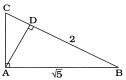
MediumMCQ
In $\Delta ABC$,$m \angle A = 90^{\circ}$ and $\overline{AD}$ is an altitude. If $AB = \sqrt{5}$ and $BD = 2$,then the length of hypotenuse $\overline{BC}$ is.........
A
$2\sqrt{5}$
B
$3$
C
$\sqrt{10}$
D
$2.5$
Solution
(D) In $\Delta ABC$,$m \angle A = 90^{\circ}$ and $\overline{AD}$ is an altitude to the hypotenuse $\overline{BC}$.
According to the geometric mean theorem for right-angled triangles,$AB^{2} = BD \cdot BC$.
Substituting the given values: $(\sqrt{5})^{2} = 2 \cdot BC$.
$5 = 2 \cdot BC$.
$BC = \frac{5}{2} = 2.5$.
Therefore,the length of the hypotenuse $\overline{BC}$ is $2.5$.
According to the geometric mean theorem for right-angled triangles,$AB^{2} = BD \cdot BC$.
Substituting the given values: $(\sqrt{5})^{2} = 2 \cdot BC$.
$5 = 2 \cdot BC$.
$BC = \frac{5}{2} = 2.5$.
Therefore,the length of the hypotenuse $\overline{BC}$ is $2.5$.
0 likes
View Solution511
MediumMCQ
In $\Delta ABC$,$m \angle B = 90^\circ$ and $\overline{BM}$ is an altitude to the hypotenuse $AC$. If $AM = BM = 8$,then $AC = \ldots$
A
$10$
B
$12$
C
$8\sqrt{2}$
D
$16$
Solution
(D) In $\Delta ABC$,$m \angle B = 90^\circ$ and $\overline{BM}$ is an altitude to the hypotenuse $AC$.
According to the geometric mean theorem for right-angled triangles,the altitude to the hypotenuse divides the triangle into two triangles similar to the original triangle and to each other.
Specifically,$BM^2 = AM \cdot CM$.
Given $AM = 8$ and $BM = 8$,we substitute these values into the equation:
$8^2 = 8 \cdot CM$
$64 = 8 \cdot CM$
$CM = \frac{64}{8} = 8$.
Now,the length of the hypotenuse $AC$ is the sum of the segments $AM$ and $CM$:
$AC = AM + CM = 8 + 8 = 16$.
Therefore,the correct option is $D$.
According to the geometric mean theorem for right-angled triangles,the altitude to the hypotenuse divides the triangle into two triangles similar to the original triangle and to each other.
Specifically,$BM^2 = AM \cdot CM$.
Given $AM = 8$ and $BM = 8$,we substitute these values into the equation:
$8^2 = 8 \cdot CM$
$64 = 8 \cdot CM$
$CM = \frac{64}{8} = 8$.
Now,the length of the hypotenuse $AC$ is the sum of the segments $AM$ and $CM$:
$AC = AM + CM = 8 + 8 = 16$.
Therefore,the correct option is $D$.

0 likes
View Solution512
DifficultMCQ
In $\Delta ABC$,$m \angle B = 90^{\circ}$ and $\overline{BD}$ is an altitude to the hypotenuse $\overline{AC}$. If $BD = 2 \sqrt{30}$ and $CD = 6$,then $AC = \ldots$
A
$20$
B
$26$
C
$14$
D
$2 \sqrt{39}$
Solution
(B) In a right-angled triangle,the altitude to the hypotenuse divides the triangle into two triangles that are similar to the original triangle and to each other.
According to the geometric mean theorem,$BD^2 = AD \cdot CD$.
Given $BD = 2 \sqrt{30}$ and $CD = 6$.
Substituting the values: $(2 \sqrt{30})^2 = AD \cdot 6$.
$4 \cdot 30 = 6 \cdot AD$.
$120 = 6 \cdot AD$.
$AD = 20$.
Since $AC = AD + CD$,we have $AC = 20 + 6 = 26$.
According to the geometric mean theorem,$BD^2 = AD \cdot CD$.
Given $BD = 2 \sqrt{30}$ and $CD = 6$.
Substituting the values: $(2 \sqrt{30})^2 = AD \cdot 6$.
$4 \cdot 30 = 6 \cdot AD$.
$120 = 6 \cdot AD$.
$AD = 20$.
Since $AC = AD + CD$,we have $AC = 20 + 6 = 26$.

0 likes
View Solution513
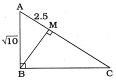
MediumMCQ
In $\Delta ABC$,$m \angle B = 90^{\circ}$ and $\overline{BM}$ is an altitude. If $AB = \sqrt{10}$ and $AM = 2.5$,then $MC = \ldots$
A
$1.5$
B
$4$
C
$7.5$
D
$5$
Solution
(A) In $\Delta ABC$,$m \angle B = 90^{\circ}$ and $\overline{BM}$ is an altitude to the hypotenuse $AC$.
According to the geometric mean theorem for right-angled triangles,$AB^2 = AM \cdot AC$.
Given $AB = \sqrt{10}$ and $AM = 2.5$.
Substituting the values: $(\sqrt{10})^2 = 2.5 \cdot AC$.
$10 = 2.5 \cdot AC$.
$AC = \frac{10}{2.5} = 4$.
Since $AC = AM + MC$,we have $4 = 2.5 + MC$.
$MC = 4 - 2.5 = 1.5$.
According to the geometric mean theorem for right-angled triangles,$AB^2 = AM \cdot AC$.
Given $AB = \sqrt{10}$ and $AM = 2.5$.
Substituting the values: $(\sqrt{10})^2 = 2.5 \cdot AC$.
$10 = 2.5 \cdot AC$.
$AC = \frac{10}{2.5} = 4$.
Since $AC = AM + MC$,we have $4 = 2.5 + MC$.
$MC = 4 - 2.5 = 1.5$.
0 likes
View Solution514
DifficultMCQ
In $\Delta PQR$,$m\angle Q = 90^{\circ}$,$PR = a^{2} + b^{2}$ and $QR = a^{2} - b^{2}$. Then,$PQ = \ldots$ $(a, b \in R^{+}; a > b)$
A
$a$
B
$b$
C
$2ab$
D
$4ab$
Solution
(C) In $\Delta PQR$,since $m\angle Q = 90^{\circ}$,the triangle is a right-angled triangle.
By the Pythagoras theorem,$PR^{2} = PQ^{2} + QR^{2}$.
Therefore,$PQ^{2} = PR^{2} - QR^{2}$.
Substituting the given values:
$PQ^{2} = (a^{2} + b^{2})^{2} - (a^{2} - b^{2})^{2}$.
Using the algebraic identity $(x + y)^{2} - (x - y)^{2} = 4xy$,where $x = a^{2}$ and $y = b^{2}$:
$PQ^{2} = 4(a^{2})(b^{2}) = 4a^{2}b^{2}$.
Taking the square root on both sides:
$PQ = \sqrt{4a^{2}b^{2}} = 2ab$.
By the Pythagoras theorem,$PR^{2} = PQ^{2} + QR^{2}$.
Therefore,$PQ^{2} = PR^{2} - QR^{2}$.
Substituting the given values:
$PQ^{2} = (a^{2} + b^{2})^{2} - (a^{2} - b^{2})^{2}$.
Using the algebraic identity $(x + y)^{2} - (x - y)^{2} = 4xy$,where $x = a^{2}$ and $y = b^{2}$:
$PQ^{2} = 4(a^{2})(b^{2}) = 4a^{2}b^{2}$.
Taking the square root on both sides:
$PQ = \sqrt{4a^{2}b^{2}} = 2ab$.

0 likes
View Solution515
DifficultMCQ
In $\Delta ABC$,$AB = AC$ and $m \angle A = 90^\circ$. If $BC = \sqrt{2} a$,then the area of $\Delta ABC$ is $\ldots \ldots \ldots \ldots$ $(a \in R^+)$.
A
$2a$
B
$\frac{1}{2} a^2$
C
$2a^2$
D
$a^2$
Solution
(B) Let $AB = AC = x$.
In $\Delta ABC$,$m \angle A = 90^\circ$.
By the Pythagorean theorem,$AB^2 + AC^2 = BC^2$.
Substituting the given values: $x^2 + x^2 = (\sqrt{2} a)^2$.
$2x^2 = 2a^2$.
$x^2 = a^2$,so $x = a$ (since $a \in R^+$).
Thus,$AB = AC = a$.
The area of $\Delta ABC = \frac{1}{2} \times \text{base} \times \text{height} = \frac{1}{2} \times AB \times AC$.
Area $= \frac{1}{2} \times a \times a = \frac{1}{2} a^2$.
In $\Delta ABC$,$m \angle A = 90^\circ$.
By the Pythagorean theorem,$AB^2 + AC^2 = BC^2$.
Substituting the given values: $x^2 + x^2 = (\sqrt{2} a)^2$.
$2x^2 = 2a^2$.
$x^2 = a^2$,so $x = a$ (since $a \in R^+$).
Thus,$AB = AC = a$.
The area of $\Delta ABC = \frac{1}{2} \times \text{base} \times \text{height} = \frac{1}{2} \times AB \times AC$.
Area $= \frac{1}{2} \times a \times a = \frac{1}{2} a^2$.

0 likes
View Solution516
MediumMCQ
In $\Delta ABC$,$m \angle B = 90^{\circ}$ and $\overline{BM}$ is an altitude to the hypotenuse $\overline{AC}$. If $AM - MC = 7$ and $AB^{2} - BC^{2} = 175$,then $AC = \ldots$
A
$\sqrt{224}$
B
$\sqrt{216}$
C
$25$
D
$20$
Solution
(C) In $\Delta ABC$,$m \angle B = 90^{\circ}$ and $\overline{BM}$ is an altitude to the hypotenuse $\overline{AC}$.
By the properties of right-angled triangles with an altitude to the hypotenuse,we have:
$AB^{2} = AM \cdot AC$ and $BC^{2} = MC \cdot AC$
Subtracting these two equations:
$AB^{2} - BC^{2} = AM \cdot AC - MC \cdot AC$
$AB^{2} - BC^{2} = AC(AM - MC)$
Given that $AB^{2} - BC^{2} = 175$ and $AM - MC = 7$,we substitute these values:
$175 = AC(7)$
$AC = \frac{175}{7}$
$AC = 25$
By the properties of right-angled triangles with an altitude to the hypotenuse,we have:
$AB^{2} = AM \cdot AC$ and $BC^{2} = MC \cdot AC$
Subtracting these two equations:
$AB^{2} - BC^{2} = AM \cdot AC - MC \cdot AC$
$AB^{2} - BC^{2} = AC(AM - MC)$
Given that $AB^{2} - BC^{2} = 175$ and $AM - MC = 7$,we substitute these values:
$175 = AC(7)$
$AC = \frac{175}{7}$
$AC = 25$

0 likes
View Solution517
DifficultMCQ
In $\Delta PQR$,$m \angle Q = 90^{\circ}$ and $\overline{QS}$ is an altitude. If $PS - SR = 10$ and $PQ^2 - QR^2 = 260$,then $PR = \dots$
A
$\sqrt{360}$
B
$\sqrt{160}$
C
$24$
D
$26$
Solution
(D) In $\Delta PQR$,since $m \angle Q = 90^{\circ}$ and $\overline{QS} \perp \overline{PR}$,by the properties of right-angled triangles,we have $PQ^2 = PS \cdot PR$ and $QR^2 = SR \cdot PR$.
Subtracting these two equations: $PQ^2 - QR^2 = (PS - SR) \cdot PR$.
Given $PQ^2 - QR^2 = 260$ and $PS - SR = 10$.
Substituting these values: $260 = 10 \cdot PR$.
Therefore,$PR = \frac{260}{10} = 26$.
Subtracting these two equations: $PQ^2 - QR^2 = (PS - SR) \cdot PR$.
Given $PQ^2 - QR^2 = 260$ and $PS - SR = 10$.
Substituting these values: $260 = 10 \cdot PR$.
Therefore,$PR = \frac{260}{10} = 26$.
0 likes
View Solution518
DifficultMCQ
$\square PQRS$ is a rectangle. $PQ + QR = 7$ and the area of $\square PQRS$ is $12$. Then,$PR = \ldots$
A
$5$
B
$4$
C
$3$
D
$6$
Solution
(A) Given that $\square PQRS$ is a rectangle.
Area of rectangle $PQRS = PQ \cdot QR = 12$.
Sum of adjacent sides $PQ + QR = 7$.
In $\triangle PQR$,$\angle Q = 90^\circ$.
By Pythagoras theorem,$PR^2 = PQ^2 + QR^2$.
We know that $(PQ + QR)^2 = PQ^2 + QR^2 + 2(PQ \cdot QR)$.
Therefore,$PQ^2 + QR^2 = (PQ + QR)^2 - 2(PQ \cdot QR)$.
Substituting the given values: $PR^2 = (7)^2 - 2(12)$.
$PR^2 = 49 - 24 = 25$.
Taking the square root on both sides,$PR = 5$.
Area of rectangle $PQRS = PQ \cdot QR = 12$.
Sum of adjacent sides $PQ + QR = 7$.
In $\triangle PQR$,$\angle Q = 90^\circ$.
By Pythagoras theorem,$PR^2 = PQ^2 + QR^2$.
We know that $(PQ + QR)^2 = PQ^2 + QR^2 + 2(PQ \cdot QR)$.
Therefore,$PQ^2 + QR^2 = (PQ + QR)^2 - 2(PQ \cdot QR)$.
Substituting the given values: $PR^2 = (7)^2 - 2(12)$.
$PR^2 = 49 - 24 = 25$.
Taking the square root on both sides,$PR = 5$.

0 likes
View Solution519
DifficultMCQ
In rectangle $ABCD$,$AB + BC = 23$ and its area is $120$. If $AB > BC$,then $AB = \ldots$
A
$15$
B
$20$
C
$12$
D
$10$
Solution
(A) Let $AB = x$ and $BC = y$.
Given that $x + y = 23$ and $xy = 120$.
We can form a quadratic equation $t^2 - (x+y)t + xy = 0$,which becomes $t^2 - 23t + 120 = 0$.
Factoring the quadratic equation: $t^2 - 15t - 8t + 120 = 0$.
$t(t - 15) - 8(t - 15) = 0$.
$(t - 15)(t - 8) = 0$.
So,the roots are $t = 15$ and $t = 8$.
Since $AB > BC$,we assign $AB = 15$ and $BC = 8$.
Therefore,$AB = 15$.
Given that $x + y = 23$ and $xy = 120$.
We can form a quadratic equation $t^2 - (x+y)t + xy = 0$,which becomes $t^2 - 23t + 120 = 0$.
Factoring the quadratic equation: $t^2 - 15t - 8t + 120 = 0$.
$t(t - 15) - 8(t - 15) = 0$.
$(t - 15)(t - 8) = 0$.
So,the roots are $t = 15$ and $t = 8$.
Since $AB > BC$,we assign $AB = 15$ and $BC = 8$.
Therefore,$AB = 15$.
0 likes
View Solution520
MediumMCQ
In $\Delta ABC$,$m \angle A = m \angle B + m \angle C$. If $AB = 7$ and $BC = 25$,the perimeter of $\Delta ABC = ........$
A
$24$
B
$56$
C
$64$
D
$48$
Solution
(B) Given that in $\Delta ABC$,$m \angle A = m \angle B + m \angle C$.
We know that the sum of angles in a triangle is $180^{\circ}$,so $m \angle A + m \angle B + m \angle C = 180^{\circ}$.
Substituting $m \angle B + m \angle C$ with $m \angle A$,we get $m \angle A + m \angle A = 180^{\circ}$,which implies $2 m \angle A = 180^{\circ}$,so $m \angle A = 90^{\circ}$.
Since $\Delta ABC$ is a right-angled triangle with the right angle at $A$,$BC$ is the hypotenuse.
By the Pythagorean theorem,$BC^2 = AB^2 + AC^2$.
Given $AB = 7$ and $BC = 25$,we have $25^2 = 7^2 + AC^2$.
$625 = 49 + AC^2$,so $AC^2 = 625 - 49 = 576$.
Thus,$AC = \sqrt{576} = 24$.
The perimeter of $\Delta ABC = AB + BC + AC = 7 + 25 + 24 = 56$.
We know that the sum of angles in a triangle is $180^{\circ}$,so $m \angle A + m \angle B + m \angle C = 180^{\circ}$.
Substituting $m \angle B + m \angle C$ with $m \angle A$,we get $m \angle A + m \angle A = 180^{\circ}$,which implies $2 m \angle A = 180^{\circ}$,so $m \angle A = 90^{\circ}$.
Since $\Delta ABC$ is a right-angled triangle with the right angle at $A$,$BC$ is the hypotenuse.
By the Pythagorean theorem,$BC^2 = AB^2 + AC^2$.
Given $AB = 7$ and $BC = 25$,we have $25^2 = 7^2 + AC^2$.
$625 = 49 + AC^2$,so $AC^2 = 625 - 49 = 576$.
Thus,$AC = \sqrt{576} = 24$.
The perimeter of $\Delta ABC = AB + BC + AC = 7 + 25 + 24 = 56$.
0 likes
View Solution521
DifficultMCQ
$A$ $6.5 \, m$ long ladder leans on a wall to reach a height of $6 \, m$ on the wall. Then,the lower end of the ladder remains $\ldots \ldots \ldots \ldots \, m$ away from the wall.
A
$5$
B
$4$
C
$3.5$
D
$2.5$
Solution
(D) Let $\overline{AC}$ represent the ladder and $\overline{AB}$ represent the height of the wall.
In $\Delta ABC$,$\angle B = 90^{\circ}$.
By the Pythagorean theorem,$AC^2 = AB^2 + BC^2$.
Given $AC = 6.5 \, m$ and $AB = 6 \, m$.
$6.5^2 = 6^2 + BC^2$
$42.25 = 36 + BC^2$
$BC^2 = 42.25 - 36 = 6.25$
$BC = \sqrt{6.25} = 2.5 \, m$.
Thus,the lower end of the ladder is $2.5 \, m$ away from the wall.
In $\Delta ABC$,$\angle B = 90^{\circ}$.
By the Pythagorean theorem,$AC^2 = AB^2 + BC^2$.
Given $AC = 6.5 \, m$ and $AB = 6 \, m$.
$6.5^2 = 6^2 + BC^2$
$42.25 = 36 + BC^2$
$BC^2 = 42.25 - 36 = 6.25$
$BC = \sqrt{6.25} = 2.5 \, m$.
Thus,the lower end of the ladder is $2.5 \, m$ away from the wall.

0 likes
View Solution522
DifficultMCQ
In $\Delta ABC$,$D$ is the midpoint of $\overline{BC}$,$AB = 7$,$AC = 5$ and $AD = 5$. Then $BC = \ldots$
A
$6$
B
$5$
C
$4 \sqrt{3}$
D
$5 \sqrt{2}$
Solution
(C) In $\Delta ABC$,$D$ is the midpoint of $\overline{BC}$. Therefore,$\overline{AD}$ is a median.
By Apollonius' theorem:
$AB^2 + AC^2 = 2(AD^2 + BD^2)$
$7^2 + 5^2 = 2(5^2 + BD^2)$
$49 + 25 = 2(25 + BD^2)$
$74 = 2(25 + BD^2)$
$37 = 25 + BD^2$
$BD^2 = 12$
$BD = \sqrt{12} = 2\sqrt{3}$
Since $D$ is the midpoint of $\overline{BC}$,$BC = 2 \times BD = 2 \times 2\sqrt{3} = 4\sqrt{3}$.
By Apollonius' theorem:
$AB^2 + AC^2 = 2(AD^2 + BD^2)$
$7^2 + 5^2 = 2(5^2 + BD^2)$
$49 + 25 = 2(25 + BD^2)$
$74 = 2(25 + BD^2)$
$37 = 25 + BD^2$
$BD^2 = 12$
$BD = \sqrt{12} = 2\sqrt{3}$
Since $D$ is the midpoint of $\overline{BC}$,$BC = 2 \times BD = 2 \times 2\sqrt{3} = 4\sqrt{3}$.

0 likes
View Solution523
MediumMCQ
In $\Delta ABC$,$AB = 17$,$BC = 15$,and $AC = 8$. Then,the length of the median on the longest side of the triangle is $\ldots$.
A
$8.5$
B
$7.5$
C
$4$
D
$12.5$
Solution
(A) Given sides of $\Delta ABC$ are $AB = 17$,$BC = 15$,and $AC = 8$.
First,check if the triangle is a right-angled triangle using the converse of the Pythagorean theorem.
$BC^2 + AC^2 = 15^2 + 8^2 = 225 + 64 = 289$.
$AB^2 = 17^2 = 289$.
Since $BC^2 + AC^2 = AB^2$,$\Delta ABC$ is a right-angled triangle with the hypotenuse $AB = 17$.
The longest side of a right-angled triangle is its hypotenuse.
According to the property of a right-angled triangle,the length of the median drawn to the hypotenuse is half the length of the hypotenuse.
Length of median = $\frac{1}{2} \times AB = \frac{1}{2} \times 17 = 8.5$.
First,check if the triangle is a right-angled triangle using the converse of the Pythagorean theorem.
$BC^2 + AC^2 = 15^2 + 8^2 = 225 + 64 = 289$.
$AB^2 = 17^2 = 289$.
Since $BC^2 + AC^2 = AB^2$,$\Delta ABC$ is a right-angled triangle with the hypotenuse $AB = 17$.
The longest side of a right-angled triangle is its hypotenuse.
According to the property of a right-angled triangle,the length of the median drawn to the hypotenuse is half the length of the hypotenuse.
Length of median = $\frac{1}{2} \times AB = \frac{1}{2} \times 17 = 8.5$.
0 likes
View Solution524
MediumMCQ
In $\Delta ABC$,$\overline{AD}$ is a median and $AB^2 + AC^2 = 148$. If $AD = 7$,then $BC = \ldots$
A
$5$
B
$7$
C
$10$
D
$14$
Solution
(C) In $\Delta ABC$,$\overline{AD}$ is a median to side $\overline{BC}$.
According to Apollonius's Theorem,$AB^2 + AC^2 = 2(AD^2 + BD^2)$.
Given $AB^2 + AC^2 = 148$ and $AD = 7$.
Substituting the values: $148 = 2(7^2 + BD^2)$.
$148 = 2(49 + BD^2)$.
$74 = 49 + BD^2$.
$BD^2 = 74 - 49 = 25$.
$BD = \sqrt{25} = 5$.
Since $\overline{AD}$ is a median,$D$ is the midpoint of $\overline{BC}$,so $BC = 2 \times BD$.
$BC = 2 \times 5 = 10$.
According to Apollonius's Theorem,$AB^2 + AC^2 = 2(AD^2 + BD^2)$.
Given $AB^2 + AC^2 = 148$ and $AD = 7$.
Substituting the values: $148 = 2(7^2 + BD^2)$.
$148 = 2(49 + BD^2)$.
$74 = 49 + BD^2$.
$BD^2 = 74 - 49 = 25$.
$BD = \sqrt{25} = 5$.
Since $\overline{AD}$ is a median,$D$ is the midpoint of $\overline{BC}$,so $BC = 2 \times BD$.
$BC = 2 \times 5 = 10$.
0 likes
View Solution525
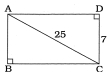
MediumMCQ
In rectangle $ABCD$,$AC = 25$ and $CD = 7$. Then,the perimeter of the rectangle is........
A
$64$
B
$62$
C
$49$
D
$56$
Solution
(B) In $\Delta ADC$,$\angle D = 90^{\circ}$.
By Pythagoras theorem,$AC^{2} = AD^{2} + CD^{2}$.
$25^{2} = AD^{2} + 7^{2}$.
$625 = AD^{2} + 49$.
$AD^{2} = 625 - 49 = 576$.
$AD = \sqrt{576} = 24$.
The perimeter of rectangle $ABCD = 2(AD + CD) = 2(24 + 7) = 2(31) = 62$.
By Pythagoras theorem,$AC^{2} = AD^{2} + CD^{2}$.
$25^{2} = AD^{2} + 7^{2}$.
$625 = AD^{2} + 49$.
$AD^{2} = 625 - 49 = 576$.
$AD = \sqrt{576} = 24$.
The perimeter of rectangle $ABCD = 2(AD + CD) = 2(24 + 7) = 2(31) = 62$.
0 likes
View Solution526
MediumMCQ
In rhombus $XYZW$,$XZ = 14$ and $YW = 48$. Then,$XY = \ldots \ldots \ldots$.
A
$31$
B
$25$
C
$50$
D
$24$
Solution
(B) In rhombus $XYZW$,let the diagonals $XZ$ and $YW$ intersect at point $O$.
The diagonals of a rhombus bisect each other at right angles.
Therefore,$OX = \frac{1}{2} XZ = \frac{1}{2} \times 14 = 7$ and $OY = \frac{1}{2} YW = \frac{1}{2} \times 48 = 24$.
In the right-angled triangle $\Delta XOY$,by the Pythagorean theorem:
$XY^2 = OX^2 + OY^2$
$XY^2 = 7^2 + 24^2$
$XY^2 = 49 + 576 = 625$
$XY = \sqrt{625} = 25$.
The diagonals of a rhombus bisect each other at right angles.
Therefore,$OX = \frac{1}{2} XZ = \frac{1}{2} \times 14 = 7$ and $OY = \frac{1}{2} YW = \frac{1}{2} \times 48 = 24$.
In the right-angled triangle $\Delta XOY$,by the Pythagorean theorem:
$XY^2 = OX^2 + OY^2$
$XY^2 = 7^2 + 24^2$
$XY^2 = 49 + 576 = 625$
$XY = \sqrt{625} = 25$.

0 likes
View Solution527
DifficultMCQ
The lengths of the diagonals of a rhombus are $10$ and $24$. Then,the length of each side of the rhombus is $\ldots \ldots \ldots \ldots . .$
A
$26$
B
$13$
C
$52$
D
$34$
Solution
(B) Let the rhombus be $ABCD$ with diagonals $d_1 = 10$ and $d_2 = 24$.
In a rhombus,the diagonals bisect each other at right angles $(90^{\circ})$.
Let the diagonals intersect at point $O$. Then,the segments of the diagonals are $d_1/2 = 5$ and $d_2/2 = 12$.
These segments form a right-angled triangle with the side of the rhombus as the hypotenuse.
Using the Pythagorean theorem: $side^2 = (d_1/2)^2 + (d_2/2)^2$.
$side^2 = 5^2 + 12^2 = 25 + 144 = 169$.
$side = \sqrt{169} = 13$.
Therefore,the length of each side of the rhombus is $13$.
In a rhombus,the diagonals bisect each other at right angles $(90^{\circ})$.
Let the diagonals intersect at point $O$. Then,the segments of the diagonals are $d_1/2 = 5$ and $d_2/2 = 12$.
These segments form a right-angled triangle with the side of the rhombus as the hypotenuse.
Using the Pythagorean theorem: $side^2 = (d_1/2)^2 + (d_2/2)^2$.
$side^2 = 5^2 + 12^2 = 25 + 144 = 169$.
$side = \sqrt{169} = 13$.
Therefore,the length of each side of the rhombus is $13$.
0 likes
View Solution528
DifficultMCQ
In $\Delta PQR$,$m \angle Q : m \angle R : m \angle P = 1 : 2 : 1$. If $PQ = 2 \sqrt{6}$,then $PR = \ldots$
A
$\sqrt{6}$
B
$2 \sqrt{6}$
C
$2 \sqrt{3}$
D
$2 \sqrt{2}$
Solution
(C) Given that in $\Delta PQR$,$m \angle Q : m \angle R : m \angle P = 1 : 2 : 1$.
Let the angles be $x, 2x, x$.
Since the sum of angles in a triangle is $180^{\circ}$,we have $x + 2x + x = 180^{\circ}$,which gives $4x = 180^{\circ}$,so $x = 45^{\circ}$.
Thus,$m \angle Q = 45^{\circ}$,$m \angle R = 90^{\circ}$,and $m \angle P = 45^{\circ}$.
Since $m \angle P = m \angle Q$,the sides opposite to these angles are equal,so $QR = PR$.
In the right-angled $\Delta PQR$ (where $m \angle R = 90^{\circ}$),by the Pythagorean theorem:
$PQ^2 = PR^2 + QR^2$
Since $QR = PR$,we have $PQ^2 = PR^2 + PR^2 = 2PR^2$.
Given $PQ = 2 \sqrt{6}$,so $PQ^2 = (2 \sqrt{6})^2 = 4 \times 6 = 24$.
Therefore,$24 = 2PR^2$,which implies $PR^2 = 12$.
Taking the square root,$PR = \sqrt{12} = 2 \sqrt{3}$.
Let the angles be $x, 2x, x$.
Since the sum of angles in a triangle is $180^{\circ}$,we have $x + 2x + x = 180^{\circ}$,which gives $4x = 180^{\circ}$,so $x = 45^{\circ}$.
Thus,$m \angle Q = 45^{\circ}$,$m \angle R = 90^{\circ}$,and $m \angle P = 45^{\circ}$.
Since $m \angle P = m \angle Q$,the sides opposite to these angles are equal,so $QR = PR$.
In the right-angled $\Delta PQR$ (where $m \angle R = 90^{\circ}$),by the Pythagorean theorem:
$PQ^2 = PR^2 + QR^2$
Since $QR = PR$,we have $PQ^2 = PR^2 + PR^2 = 2PR^2$.
Given $PQ = 2 \sqrt{6}$,so $PQ^2 = (2 \sqrt{6})^2 = 4 \times 6 = 24$.
Therefore,$24 = 2PR^2$,which implies $PR^2 = 12$.
Taking the square root,$PR = \sqrt{12} = 2 \sqrt{3}$.

0 likes
View Solution529
MediumMCQ
In $\Delta ABC$,$\overline{AB} \cong \overline{AC}$ and $\overline{AD}$ is a median. If $AD = 12$ and $BC = 18$,then the area of $\Delta ABC$ is.............
A
$90$
B
$96$
C
$105$
D
$108$
Solution
(D) In $\Delta ABC$,$\overline{AB} \cong \overline{AC}$,which means $\Delta ABC$ is an isosceles triangle.
In an isosceles triangle,the median to the base is also the altitude to the base.
Therefore,$\overline{AD} \perp \overline{BC}$,so $\overline{AD}$ is the height of the triangle with respect to base $\overline{BC}$.
Area of $\Delta ABC = \frac{1}{2} \times \text{base} \times \text{height}$
Area $= \frac{1}{2} \times BC \times AD$
Area $= \frac{1}{2} \times 18 \times 12$
Area $= 9 \times 12 = 108$.
In an isosceles triangle,the median to the base is also the altitude to the base.
Therefore,$\overline{AD} \perp \overline{BC}$,so $\overline{AD}$ is the height of the triangle with respect to base $\overline{BC}$.
Area of $\Delta ABC = \frac{1}{2} \times \text{base} \times \text{height}$
Area $= \frac{1}{2} \times BC \times AD$
Area $= \frac{1}{2} \times 18 \times 12$
Area $= 9 \times 12 = 108$.

0 likes
View Solution530
DifficultMCQ
In $\Delta ABC$,$m \angle A + m \angle C = m \angle B$ and $AC : AB = 17 : 15$. If $BC = 8$,then the area of $\Delta ABC$ is.............
A
$60$
B
$90$
C
$180$
D
$102$
Solution
(A) In $\Delta ABC$,the sum of angles is $m \angle A + m \angle B + m \angle C = 180^\circ$.
Given $m \angle A + m \angle C = m \angle B$,substituting this into the sum gives $m \angle B + m \angle B = 180^\circ$,so $2 m \angle B = 180^\circ$,which means $m \angle B = 90^\circ$.
Since $\Delta ABC$ is a right-angled triangle at $B$,by the Pythagorean theorem,$AC^2 = AB^2 + BC^2$.
Let $AC = 17x$ and $AB = 15x$. Given $BC = 8$,we have $(17x)^2 = (15x)^2 + 8^2$.
$289x^2 = 225x^2 + 64$.
$64x^2 = 64$,so $x^2 = 1$,which gives $x = 1$.
Thus,$AB = 15(1) = 15$ and $AC = 17(1) = 17$.
The area of the right-angled triangle is $\frac{1}{2} \times \text{base} \times \text{height} = \frac{1}{2} \times BC \times AB$.
Area $= \frac{1}{2} \times 8 \times 15 = 4 \times 15 = 60$.
Given $m \angle A + m \angle C = m \angle B$,substituting this into the sum gives $m \angle B + m \angle B = 180^\circ$,so $2 m \angle B = 180^\circ$,which means $m \angle B = 90^\circ$.
Since $\Delta ABC$ is a right-angled triangle at $B$,by the Pythagorean theorem,$AC^2 = AB^2 + BC^2$.
Let $AC = 17x$ and $AB = 15x$. Given $BC = 8$,we have $(17x)^2 = (15x)^2 + 8^2$.
$289x^2 = 225x^2 + 64$.
$64x^2 = 64$,so $x^2 = 1$,which gives $x = 1$.
Thus,$AB = 15(1) = 15$ and $AC = 17(1) = 17$.
The area of the right-angled triangle is $\frac{1}{2} \times \text{base} \times \text{height} = \frac{1}{2} \times BC \times AB$.
Area $= \frac{1}{2} \times 8 \times 15 = 4 \times 15 = 60$.
0 likes
View Solution531
MediumMCQ
The perimeter of an equilateral triangle is $12$. Then,its area is............
A
$4 \sqrt{2}$
B
$4 \sqrt{3}$
C
$6$
D
$6 \sqrt{3}$
Solution
(B) The perimeter of an equilateral triangle is given by the formula: $P = 3 \times \text{side}$.
Given $P = 12$,we have $12 = 3 \times \text{side}$.
Therefore,the side length is $\text{side} = \frac{12}{3} = 4$.
The area of an equilateral triangle is given by the formula: $\text{Area} = \frac{\sqrt{3}}{4} \times \text{side}^2$.
Substituting the side length: $\text{Area} = \frac{\sqrt{3}}{4} \times 4^2 = \frac{\sqrt{3}}{4} \times 16 = 4\sqrt{3}$.
Given $P = 12$,we have $12 = 3 \times \text{side}$.
Therefore,the side length is $\text{side} = \frac{12}{3} = 4$.
The area of an equilateral triangle is given by the formula: $\text{Area} = \frac{\sqrt{3}}{4} \times \text{side}^2$.
Substituting the side length: $\text{Area} = \frac{\sqrt{3}}{4} \times 4^2 = \frac{\sqrt{3}}{4} \times 16 = 4\sqrt{3}$.
0 likes
View Solution532
MediumMCQ
In $\Delta PQR$,$m \angle P = 90^{\circ}$ and $\overline{PM}$ is an altitude. If $QM = 2x^{2}$ and $RM = 8x^{2}$,then $PM = \ldots \ldots$
A
$4 \sqrt{5} x^{2}$
B
$4x^{2}$
C
$6x^{2}$
D
$10x^{2}$
Solution
(B) In a right-angled triangle $\Delta PQR$,where $\angle P = 90^{\circ}$ and $\overline{PM}$ is the altitude to the hypotenuse $\overline{QR}$,the geometric mean theorem states that the altitude to the hypotenuse is the geometric mean of the segments of the hypotenuse.
Therefore,the relationship is given by $PM^{2} = QM \cdot RM$.
Substituting the given values:
$PM^{2} = (2x^{2}) \cdot (8x^{2})$
$PM^{2} = 16x^{4}$
Taking the square root of both sides:
$PM = \sqrt{16x^{4}}$
$PM = 4x^{2}$
Therefore,the relationship is given by $PM^{2} = QM \cdot RM$.
Substituting the given values:
$PM^{2} = (2x^{2}) \cdot (8x^{2})$
$PM^{2} = 16x^{4}$
Taking the square root of both sides:
$PM = \sqrt{16x^{4}}$
$PM = 4x^{2}$
0 likes
View Solution533
MediumMCQ
In $\Delta ABC$,$m\angle B = 90^{\circ}$ and $\overline{BM}$ is an altitude. If $AC = 13$ and $CM = 9$,then $BM = \ldots \ldots$
A
$6$
B
$\sqrt{91}$
C
$2\sqrt{13}$
D
$9$
Solution
(A) In $\Delta ABC$,$m\angle B = 90^{\circ}$ and $\overline{BM}$ is an altitude to the hypotenuse $AC$.
According to the geometric mean theorem for right-angled triangles,the altitude to the hypotenuse divides the triangle into two triangles similar to the original and to each other.
Thus,$BM^2 = AM \cdot CM$.
Given $AC = 13$ and $CM = 9$,we have $AM = AC - CM = 13 - 9 = 4$.
Substituting these values into the formula: $BM^2 = 4 \cdot 9 = 36$.
Therefore,$BM = \sqrt{36} = 6$.
According to the geometric mean theorem for right-angled triangles,the altitude to the hypotenuse divides the triangle into two triangles similar to the original and to each other.
Thus,$BM^2 = AM \cdot CM$.
Given $AC = 13$ and $CM = 9$,we have $AM = AC - CM = 13 - 9 = 4$.
Substituting these values into the formula: $BM^2 = 4 \cdot 9 = 36$.
Therefore,$BM = \sqrt{36} = 6$.
0 likes
View Solution534
MediumMCQ
In $\Delta PQR$,$m \angle P = m \angle Q + m \angle R$. If $PQ = 20$ and $QR = 25$,then the perimeter of $\Delta PQR$ is............
A
$75$
B
$50$
C
$60$
D
$70$
Solution
(C) In $\Delta PQR$,we are given $m \angle P = m \angle Q + m \angle R$.
We know that the sum of all angles in a triangle is $180^{\circ}$,so $m \angle P + m \angle Q + m \angle R = 180^{\circ}$.
Substituting $m \angle Q + m \angle R$ with $m \angle P$,we get $m \angle P + m \angle P = 180^{\circ}$,which implies $2 \cdot m \angle P = 180^{\circ}$,so $m \angle P = 90^{\circ}$.
Since $\Delta PQR$ is a right-angled triangle with the right angle at $P$,$QR$ is the hypotenuse.
By the Pythagorean theorem,$QR^2 = PQ^2 + PR^2$.
Substituting the given values,$25^2 = 20^2 + PR^2$.
$625 = 400 + PR^2$,so $PR^2 = 625 - 400 = 225$.
Thus,$PR = \sqrt{225} = 15$.
The perimeter of $\Delta PQR = PQ + QR + PR = 20 + 25 + 15 = 60$.
We know that the sum of all angles in a triangle is $180^{\circ}$,so $m \angle P + m \angle Q + m \angle R = 180^{\circ}$.
Substituting $m \angle Q + m \angle R$ with $m \angle P$,we get $m \angle P + m \angle P = 180^{\circ}$,which implies $2 \cdot m \angle P = 180^{\circ}$,so $m \angle P = 90^{\circ}$.
Since $\Delta PQR$ is a right-angled triangle with the right angle at $P$,$QR$ is the hypotenuse.
By the Pythagorean theorem,$QR^2 = PQ^2 + PR^2$.
Substituting the given values,$25^2 = 20^2 + PR^2$.
$625 = 400 + PR^2$,so $PR^2 = 625 - 400 = 225$.
Thus,$PR = \sqrt{225} = 15$.
The perimeter of $\Delta PQR = PQ + QR + PR = 20 + 25 + 15 = 60$.
0 likes
View Solution535
EasyMCQ
The length of a diagonal of a square is $8 \sqrt{2}$. Then,the perimeter of the square is..............
A
$32 \sqrt{2}$
B
$32$
C
$64$
D
$128$
Solution
(B) Let the side of the square be $a$.
We know that the length of the diagonal of a square is given by the formula $d = a \sqrt{2}$.
Given that the diagonal $d = 8 \sqrt{2}$.
Equating the two,we get $a \sqrt{2} = 8 \sqrt{2}$.
Dividing both sides by $\sqrt{2}$,we find the side length $a = 8$.
The perimeter of a square is given by the formula $P = 4 \times a$.
Substituting the value of $a$,we get $P = 4 \times 8 = 32$.
We know that the length of the diagonal of a square is given by the formula $d = a \sqrt{2}$.
Given that the diagonal $d = 8 \sqrt{2}$.
Equating the two,we get $a \sqrt{2} = 8 \sqrt{2}$.
Dividing both sides by $\sqrt{2}$,we find the side length $a = 8$.
The perimeter of a square is given by the formula $P = 4 \times a$.
Substituting the value of $a$,we get $P = 4 \times 8 = 32$.
0 likes
View Solution536
EasyMCQ
The length of a diagonal of a square is $6$. Then,its area is............
A
$36$
B
$30$
C
$24$
D
$18$
Solution
(D) The area of a square can be calculated using the length of its diagonal $d$ with the formula: $\text{Area} = \frac{d^2}{2}$.
Given the length of the diagonal $d = 6$.
Substituting the value into the formula:
$\text{Area} = \frac{6^2}{2} = \frac{36}{2} = 18$.
Given the length of the diagonal $d = 6$.
Substituting the value into the formula:
$\text{Area} = \frac{6^2}{2} = \frac{36}{2} = 18$.
0 likes
View Solution537
EasyMCQ
In $\Delta ABC$,$m \angle B = 90^{\circ}$. If $a = 9$ and $c = 12$,then $b = \dots$
A
$16$
B
$18$
C
$20$
D
$15$
Solution
(D) In $\Delta ABC$,since $m \angle B = 90^{\circ}$,the triangle is a right-angled triangle.
According to the Pythagorean theorem,the square of the hypotenuse is equal to the sum of the squares of the other two sides.
Here,$b$ is the hypotenuse (side opposite to $\angle B$).
Therefore,$b^{2} = a^{2} + c^{2}$.
Substituting the given values: $b^{2} = 9^{2} + 12^{2}$.
$b^{2} = 81 + 144 = 225$.
Taking the square root on both sides,$b = \sqrt{225} = 15$.
According to the Pythagorean theorem,the square of the hypotenuse is equal to the sum of the squares of the other two sides.
Here,$b$ is the hypotenuse (side opposite to $\angle B$).
Therefore,$b^{2} = a^{2} + c^{2}$.
Substituting the given values: $b^{2} = 9^{2} + 12^{2}$.
$b^{2} = 81 + 144 = 225$.
Taking the square root on both sides,$b = \sqrt{225} = 15$.
0 likes
View Solution538
EasyMCQ
In $\Delta ABC$,$m \angle A = 90^{\circ}$. If $a = 20$ and $b = 12$,then $c = \dots$
A
$8$
B
$16$
C
$24$
D
$15$
Solution
(B) In a right-angled triangle $\Delta ABC$ where $m \angle A = 90^{\circ}$,the side $a$ is the hypotenuse,and $b$ and $c$ are the other two sides.
According to the Pythagorean theorem: $a^2 = b^2 + c^2$.
Given $a = 20$ and $b = 12$,we substitute these values into the equation:
$20^2 = 12^2 + c^2$
$400 = 144 + c^2$
$c^2 = 400 - 144$
$c^2 = 256$
Taking the square root of both sides,we get $c = \sqrt{256} = 16$.
According to the Pythagorean theorem: $a^2 = b^2 + c^2$.
Given $a = 20$ and $b = 12$,we substitute these values into the equation:
$20^2 = 12^2 + c^2$
$400 = 144 + c^2$
$c^2 = 400 - 144$
$c^2 = 256$
Taking the square root of both sides,we get $c = \sqrt{256} = 16$.
0 likes
View Solution539
DifficultMCQ
In rectangle $ABCD$,$AB^{2} + BC^{2} + CD^{2} + DA^{2} = 338$,then $AC = \ldots$
A
$13$
B
$5$
C
$12$
D
$26$
Solution
(A) In rectangle $ABCD$,we know that opposite sides are equal,so $CD = AB$ and $DA = BC$.
Also,$\angle B = 90^{\circ}$.
Given the equation: $AB^{2} + BC^{2} + CD^{2} + DA^{2} = 338$.
Substituting the equal sides: $AB^{2} + BC^{2} + AB^{2} + BC^{2} = 338$.
$2(AB^{2} + BC^{2}) = 338$.
$AB^{2} + BC^{2} = 169$.
In $\triangle ABC$,by Pythagoras theorem: $AC^{2} = AB^{2} + BC^{2}$.
Therefore,$AC^{2} = 169$.
$AC = \sqrt{169} = 13$.
Also,$\angle B = 90^{\circ}$.
Given the equation: $AB^{2} + BC^{2} + CD^{2} + DA^{2} = 338$.
Substituting the equal sides: $AB^{2} + BC^{2} + AB^{2} + BC^{2} = 338$.
$2(AB^{2} + BC^{2}) = 338$.
$AB^{2} + BC^{2} = 169$.
In $\triangle ABC$,by Pythagoras theorem: $AC^{2} = AB^{2} + BC^{2}$.
Therefore,$AC^{2} = 169$.
$AC = \sqrt{169} = 13$.
0 likes
View Solution540
DifficultMCQ
In $\Delta ABC$,$m \angle B = 90^{\circ}$ and $\overline{BM}$ is an altitude. If $AB = 8$ and $BC = 6$,then $BM = \dots$
A
$2.4$
B
$4.8$
C
$6$
D
$7$
Solution
(B) In $\Delta ABC$,$m \angle B = 90^{\circ}$.
Using the Pythagorean theorem,$AC^2 = AB^2 + BC^2 = 8^2 + 6^2 = 64 + 36 = 100$.
Therefore,$AC = \sqrt{100} = 10$.
The area of $\Delta ABC$ can be calculated in two ways: $\text{Area} = \frac{1}{2} \times AB \times BC$ or $\text{Area} = \frac{1}{2} \times AC \times BM$.
Equating the two expressions: $\frac{1}{2} \times AB \times BC = \frac{1}{2} \times AC \times BM$.
$AB \times BC = AC \times BM$.
$8 \times 6 = 10 \times BM$.
$48 = 10 \times BM$.
$BM = \frac{48}{10} = 4.8$.
Using the Pythagorean theorem,$AC^2 = AB^2 + BC^2 = 8^2 + 6^2 = 64 + 36 = 100$.
Therefore,$AC = \sqrt{100} = 10$.
The area of $\Delta ABC$ can be calculated in two ways: $\text{Area} = \frac{1}{2} \times AB \times BC$ or $\text{Area} = \frac{1}{2} \times AC \times BM$.
Equating the two expressions: $\frac{1}{2} \times AB \times BC = \frac{1}{2} \times AC \times BM$.
$AB \times BC = AC \times BM$.
$8 \times 6 = 10 \times BM$.
$48 = 10 \times BM$.
$BM = \frac{48}{10} = 4.8$.
0 likes
View Solution541
DifficultMCQ
In $\Delta ABC$,$m \angle B = 45^{\circ}$ and $\overline{AM}$ is an altitude,$M \in \overline{BC}$. If $BC = 7$ and $AM = 4$,then $AC = \ldots$
A
$4$
B
$2.5$
C
$5$
D
$10$
Solution
(C) In $\Delta AMB$,$m \angle M = 90^{\circ}$ and $m \angle B = 45^{\circ}$.
Since the sum of angles in a triangle is $180^{\circ}$,$m \angle MAB = 180^{\circ} - 90^{\circ} - 45^{\circ} = 45^{\circ}$.
Since $m \angle MAB = m \angle B = 45^{\circ}$,$\Delta AMB$ is an isosceles right triangle.
Therefore,$AM = BM = 4$.
Given $M \in \overline{BC}$,we have $BC = BM + MC$.
$7 = 4 + MC$,which implies $MC = 7 - 4 = 3$.
In right-angled $\Delta AMC$,by the Pythagorean theorem:
$AC^{2} = AM^{2} + MC^{2}$
$AC^{2} = 4^{2} + 3^{2} = 16 + 9 = 25$
$AC = \sqrt{25} = 5$.
Since the sum of angles in a triangle is $180^{\circ}$,$m \angle MAB = 180^{\circ} - 90^{\circ} - 45^{\circ} = 45^{\circ}$.
Since $m \angle MAB = m \angle B = 45^{\circ}$,$\Delta AMB$ is an isosceles right triangle.
Therefore,$AM = BM = 4$.
Given $M \in \overline{BC}$,we have $BC = BM + MC$.
$7 = 4 + MC$,which implies $MC = 7 - 4 = 3$.
In right-angled $\Delta AMC$,by the Pythagorean theorem:
$AC^{2} = AM^{2} + MC^{2}$
$AC^{2} = 4^{2} + 3^{2} = 16 + 9 = 25$
$AC = \sqrt{25} = 5$.

0 likes
View Solution542
MediumMCQ
.......... are not the measures of sides of a right-angled triangle.
A
$5, 12, 13$
B
$3, 4, 5$
C
$7, 24, 25$
D
$8, 24, 26$
Solution
(D) triangle is right-angled if the square of the longest side is equal to the sum of the squares of the other two sides (Pythagoras theorem).
For option $A$: $5^{2} + 12^{2} = 25 + 144 = 169 = 13^{2}$. This is a right-angled triangle.
For option $B$: $3^{2} + 4^{2} = 9 + 16 = 25 = 5^{2}$. This is a right-angled triangle.
For option $C$: $7^{2} + 24^{2} = 49 + 576 = 625 = 25^{2}$. This is a right-angled triangle.
For option $D$: $8^{2} + 24^{2} = 64 + 576 = 640$,while $26^{2} = 676$. Since $640 \neq 676$,these are not the sides of a right-angled triangle.
For option $A$: $5^{2} + 12^{2} = 25 + 144 = 169 = 13^{2}$. This is a right-angled triangle.
For option $B$: $3^{2} + 4^{2} = 9 + 16 = 25 = 5^{2}$. This is a right-angled triangle.
For option $C$: $7^{2} + 24^{2} = 49 + 576 = 625 = 25^{2}$. This is a right-angled triangle.
For option $D$: $8^{2} + 24^{2} = 64 + 576 = 640$,while $26^{2} = 676$. Since $640 \neq 676$,these are not the sides of a right-angled triangle.
0 likes
View Solution543
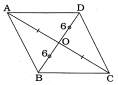
DifficultMCQ
In parallelogram $ABCD$,$AB^{2} + AD^{2} = 200$ and $BD = 12$. Then $AC = \ldots$
A
$12$
B
$8$
C
$16$
D
$20$
Solution
(C) In parallelogram $ABCD$,let $\overline{AC} \cap \overline{BD} = \{O\}$.
Since the diagonals of a parallelogram bisect each other,$O$ is the midpoint of $\overline{AC}$ and $\overline{BD}$.
Therefore,$BO = \frac{1}{2} BD = \frac{1}{2}(12) = 6$.
In $\Delta ABD$,$\overline{AO}$ is the median to side $\overline{BD}$.
By Apollonius' theorem,$AB^{2} + AD^{2} = 2(AO^{2} + BO^{2})$.
Substituting the given values: $200 = 2(AO^{2} + 6^{2})$.
$100 = AO^{2} + 36$.
$AO^{2} = 100 - 36 = 64$.
$AO = \sqrt{64} = 8$.
Since $O$ is the midpoint of $\overline{AC}$,$AC = 2 AO = 2 \times 8 = 16$.
Since the diagonals of a parallelogram bisect each other,$O$ is the midpoint of $\overline{AC}$ and $\overline{BD}$.
Therefore,$BO = \frac{1}{2} BD = \frac{1}{2}(12) = 6$.
In $\Delta ABD$,$\overline{AO}$ is the median to side $\overline{BD}$.
By Apollonius' theorem,$AB^{2} + AD^{2} = 2(AO^{2} + BO^{2})$.
Substituting the given values: $200 = 2(AO^{2} + 6^{2})$.
$100 = AO^{2} + 36$.
$AO^{2} = 100 - 36 = 64$.
$AO = \sqrt{64} = 8$.
Since $O$ is the midpoint of $\overline{AC}$,$AC = 2 AO = 2 \times 8 = 16$.
0 likes
View Solution544
MediumMCQ
In parallelogram $ABCD$,$AB^{2} + BC^{2} = 260$ and $AC = 18$. Then $BD = \ldots$
A
$7$
B
$14$
C
$18$
D
$14 \sqrt{2}$
Solution
(B) In a parallelogram $ABCD$,the sum of the squares of the diagonals is equal to the sum of the squares of its four sides.
This is known as the Parallelogram Law: $AC^{2} + BD^{2} = 2(AB^{2} + BC^{2})$.
Given $AB^{2} + BC^{2} = 260$ and $AC = 18$.
Substituting the values into the formula: $18^{2} + BD^{2} = 2(260)$.
$324 + BD^{2} = 520$.
$BD^{2} = 520 - 324$.
$BD^{2} = 196$.
$BD = \sqrt{196} = 14$.
This is known as the Parallelogram Law: $AC^{2} + BD^{2} = 2(AB^{2} + BC^{2})$.
Given $AB^{2} + BC^{2} = 260$ and $AC = 18$.
Substituting the values into the formula: $18^{2} + BD^{2} = 2(260)$.
$324 + BD^{2} = 520$.
$BD^{2} = 520 - 324$.
$BD^{2} = 196$.
$BD = \sqrt{196} = 14$.
0 likes
View Solution545
MediumMCQ
In square $ABCD$,$AB = 4 \sqrt{2}$. Then,the length of a diagonal of the square is......
A
$4$
B
$8 \sqrt{2}$
C
$8$
D
$5 \sqrt{2}$
Solution
(C) In a square,the length of a diagonal is given by the formula: $\text{Diagonal} = \sqrt{2} \times \text{side}$.
Given the side length $AB = 4 \sqrt{2}$.
Substituting the value of the side into the formula:
$\text{Diagonal} = \sqrt{2} \times (4 \sqrt{2})$
$= 4 \times (\sqrt{2} \times \sqrt{2})$
$= 4 \times 2 = 8$.
Therefore,the length of the diagonal is $8$.
Given the side length $AB = 4 \sqrt{2}$.
Substituting the value of the side into the formula:
$\text{Diagonal} = \sqrt{2} \times (4 \sqrt{2})$
$= 4 \times (\sqrt{2} \times \sqrt{2})$
$= 4 \times 2 = 8$.
Therefore,the length of the diagonal is $8$.
0 likes
View Solution546
MediumMCQ
The perimeter of an equilateral triangle is $18$. Then,the length of its altitude is $\ldots \ldots \ldots$
A
$6$
B
$3$
C
$6 \sqrt{3}$
D
$3 \sqrt{3}$
Solution
(D) The perimeter of an equilateral triangle is given by the formula $P = 3 \times \text{side}$.
Given $P = 18$,we have $18 = 3 \times \text{side}$,which implies $\text{side} = 6$.
The altitude $(h)$ of an equilateral triangle is given by the formula $h = \frac{\sqrt{3}}{2} \times \text{side}$.
Substituting the value of the side,we get $h = \frac{\sqrt{3}}{2} \times 6 = 3 \sqrt{3}$.
Given $P = 18$,we have $18 = 3 \times \text{side}$,which implies $\text{side} = 6$.
The altitude $(h)$ of an equilateral triangle is given by the formula $h = \frac{\sqrt{3}}{2} \times \text{side}$.
Substituting the value of the side,we get $h = \frac{\sqrt{3}}{2} \times 6 = 3 \sqrt{3}$.
0 likes
View Solution547
MediumMCQ
In $\Delta ABC$,$\overline{AD}$ is a median. Then,by Apollonius' theorem,$\ldots \ldots \ldots \ldots$ holds good.
A
$AB^2 + AC^2 = 2(AD^2 + BC^2)$
B
$AB^2 + AC^2 = 2(BD^2 + DC^2)$
C
$AB^2 + AC^2 = 2(AD^2 + DC^2)$
D
$AB^2 + AC^2 = 2(BD^2 + BC^2)$
Solution
(C) Apollonius' theorem states that for any triangle $\Delta ABC$ with median $\overline{AD}$ to side $\overline{BC}$,the sum of the squares of the two sides is equal to twice the sum of the square of the median and the square of half the third side.
Mathematically,this is expressed as: $AB^2 + AC^2 = 2(AD^2 + BD^2)$.
Since $\overline{AD}$ is a median,$D$ is the midpoint of $\overline{BC}$,so $BD = DC$.
Substituting $DC$ for $BD$,we get $AB^2 + AC^2 = 2(AD^2 + DC^2)$.
Mathematically,this is expressed as: $AB^2 + AC^2 = 2(AD^2 + BD^2)$.
Since $\overline{AD}$ is a median,$D$ is the midpoint of $\overline{BC}$,so $BD = DC$.
Substituting $DC$ for $BD$,we get $AB^2 + AC^2 = 2(AD^2 + DC^2)$.
0 likes
View Solution548
EasyMCQ
Out of the following triplets,$\ldots \ldots \ldots \ldots$ is not a Pythagorean triplet.
A
$7, 24, 25$
B
$20, 21, 29$
C
$11, 60, 61$
D
$13, 35, 37$
Solution
(D) triplet $(a, b, c)$ is a Pythagorean triplet if it satisfies the condition $a^2 + b^2 = c^2$,where $c$ is the largest number.
For option $A$: $7^2 + 24^2 = 49 + 576 = 625 = 25^2$. This is a Pythagorean triplet.
For option $B$: $20^2 + 21^2 = 400 + 441 = 841 = 29^2$. This is a Pythagorean triplet.
For option $C$: $11^2 + 60^2 = 121 + 3600 = 3721 = 61^2$. This is a Pythagorean triplet.
For option $D$: $13^2 + 35^2 = 169 + 1225 = 1394$,while $37^2 = 1369$. Since $1394 \neq 1369$,this is not a Pythagorean triplet.
For option $A$: $7^2 + 24^2 = 49 + 576 = 625 = 25^2$. This is a Pythagorean triplet.
For option $B$: $20^2 + 21^2 = 400 + 441 = 841 = 29^2$. This is a Pythagorean triplet.
For option $C$: $11^2 + 60^2 = 121 + 3600 = 3721 = 61^2$. This is a Pythagorean triplet.
For option $D$: $13^2 + 35^2 = 169 + 1225 = 1394$,while $37^2 = 1369$. Since $1394 \neq 1369$,this is not a Pythagorean triplet.
0 likes
View Solution549
MediumMCQ
Which of the following correctly matches the information in Part $I$ and Part $II$?
| Part $I$ | Part $II$ |
|---|---|
| $1.$ In $\Delta ABC$,$\angle B$ is a right angle and $\overline{BM}$ is a median. | $a. AB^2 + BC^2 = 2(BD^2 + CD^2)$ |
| $2.$ In $\Delta ABC$,$\angle A$ is a right angle and $\overline{AD}$ is an altitude. | $b. BC = \frac{1}{2} AB$ |
| $3.$ In $\Delta ABC$,$m\angle C = 90^\circ$ and $m\angle A = 30^\circ$. | $c. AC^2 = CD \cdot BC$ |
| $4.$ In $\Delta ABC$,$\overline{BD}$ is a median. | $d. BM = \frac{1}{2} AC$ |
A
$(1-d), (2-a), (3-c), (4-b)$
B
$(1-d), (2-c), (3-b), (4-a)$
C
$(1-c), (2-d), (3-b), (4-a)$
D
$(1-b), (2-c), (3-a), (4-d)$
Solution
(B) $1.$ In a right-angled triangle,the length of the median to the hypotenuse is half the length of the hypotenuse. Thus,$BM = \frac{1}{2} AC$ $(1-d)$.
$2.$ In a right-angled triangle $\Delta ABC$ with altitude $\overline{AD}$ to the hypotenuse,by Apollonius theorem or properties of similar triangles,the relation $AC^2 = CD \cdot BC$ is derived from $\Delta ACD \sim \Delta BCA$ $(2-c)$.
$3.$ In a $30^\circ-60^\circ-90^\circ$ triangle,the side opposite to $30^\circ$ is half the hypotenuse. Here,$BC$ is opposite to $30^\circ$,so $BC = \frac{1}{2} AB$ $(3-b)$.
$4.$ Apollonius theorem states that for any triangle $\Delta ABC$ with median $\overline{BD}$,$AB^2 + BC^2 = 2(BD^2 + CD^2)$ $(4-a)$.
Therefore,the correct match is $(1-d), (2-c), (3-b), (4-a)$.
$2.$ In a right-angled triangle $\Delta ABC$ with altitude $\overline{AD}$ to the hypotenuse,by Apollonius theorem or properties of similar triangles,the relation $AC^2 = CD \cdot BC$ is derived from $\Delta ACD \sim \Delta BCA$ $(2-c)$.
$3.$ In a $30^\circ-60^\circ-90^\circ$ triangle,the side opposite to $30^\circ$ is half the hypotenuse. Here,$BC$ is opposite to $30^\circ$,so $BC = \frac{1}{2} AB$ $(3-b)$.
$4.$ Apollonius theorem states that for any triangle $\Delta ABC$ with median $\overline{BD}$,$AB^2 + BC^2 = 2(BD^2 + CD^2)$ $(4-a)$.
Therefore,the correct match is $(1-d), (2-c), (3-b), (4-a)$.
0 likes
View SolutionTriangles — Mix Examples - Triangles · Frequently Asked Questions
1Are these Triangles questions useful for JEE and NEET?
Yes. All questions in this section are mapped to JEE Main and NEET exam patterns. Previous year questions from JEE Main, NEET, GUJCET and state-level exams are included with full solutions.
2Can I switch to Hindi or Gujarati for these questions?
Yes. Use the language tabs in the hero section or the sidebar to view the same questions and solutions in English, Hindi or Gujarati.
3How do I generate a question paper from this subtopic?
Use the Vedclass Exam Paper Generator — select the chapter and subtopic, set difficulty, and generate Sets A, B, C, D automatically. First 3 chapters of every subject are free.
Vedclass Products
For Students
Vedclass Test Series
Mock tests in real JEE/NEET style with performance analysis. 5-day free trial.
Start Free TrialFor Teachers
Exam Paper Generator
Generate Set A/B/C/D papers from this chapter in 2 minutes. 3 chapters free.
Try FreeFor Institutes
Online Exam Module
Live online exams with unlimited students, 360° analytics & white-label branding.
See DemoFor Teachers & Institutes
Generate a Triangles Exam Paper in 2 Minutes
Select subtopic & difficulty — Sets A, B, C, D auto-generated with No Repeat logic.
First 3 chapters of every subject are free — no payment required.