
A English
Mix Examples - Triangles Questions in English
Class 10 Mathematics · Triangles · Mix Examples - Triangles
549+
Questions
English
Language
100%
With Solutions
Showing 50 of 549 questions in English
51
Medium
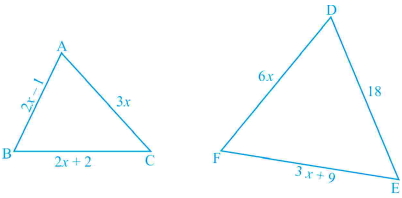
In the figure,if $\triangle ABC \sim \triangle DEF$ and their side lengths (in $cm$) are as marked,find the lengths of the sides of each triangle.
Solution
(N/A) Given that $\triangle ABC \sim \triangle DEF$.
Therefore,the ratios of their corresponding sides are equal:
$\frac{AB}{DE} = \frac{BC}{EF} = \frac{CA}{FD}$
Substituting the given expressions:
$\frac{2x - 1}{18} = \frac{2x + 2}{3x + 9} = \frac{3x}{6x}$
Taking the first and third ratios:
$\frac{2x - 1}{18} = \frac{3x}{6x}$
$\frac{2x - 1}{18} = \frac{1}{2}$
Cross-multiplying:
$2(2x - 1) = 18$
$4x - 2 = 18$
$4x = 20$
$x = 5$
Now,calculating the side lengths:
For $\triangle ABC$:
$AB = 2(5) - 1 = 9 \, cm$
$BC = 2(5) + 2 = 12 \, cm$
$CA = 3(5) = 15 \, cm$
For $\triangle DEF$:
$DE = 18 \, cm$
$EF = 3(5) + 9 = 24 \, cm$
$FD = 6(5) = 30 \, cm$
Therefore,the ratios of their corresponding sides are equal:
$\frac{AB}{DE} = \frac{BC}{EF} = \frac{CA}{FD}$
Substituting the given expressions:
$\frac{2x - 1}{18} = \frac{2x + 2}{3x + 9} = \frac{3x}{6x}$
Taking the first and third ratios:
$\frac{2x - 1}{18} = \frac{3x}{6x}$
$\frac{2x - 1}{18} = \frac{1}{2}$
Cross-multiplying:
$2(2x - 1) = 18$
$4x - 2 = 18$
$4x = 20$
$x = 5$
Now,calculating the side lengths:
For $\triangle ABC$:
$AB = 2(5) - 1 = 9 \, cm$
$BC = 2(5) + 2 = 12 \, cm$
$CA = 3(5) = 15 \, cm$
For $\triangle DEF$:
$DE = 18 \, cm$
$EF = 3(5) + 9 = 24 \, cm$
$FD = 6(5) = 30 \, cm$
0 likes
View Solution52
DifficultMCQ
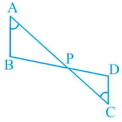
In the figure,if $\angle A = \angle C$,$AB = 6 \, cm$,$BP = 15 \, cm$,$AP = 12 \, cm$,and $CP = 4 \, cm$,then find the lengths of $PD$ and $CD$ (in $cm$).
A
$6, 7$
B
$4, 5$
C
$2, 3$
D
$5, 2$
Solution
(D) Given,$\angle A = \angle C$,$AB = 6 \, cm$,$BP = 15 \, cm$,$AP = 12 \, cm$,and $CP = 4 \, cm$.
In $\triangle APB$ and $\triangle CPD$:
$\angle A = \angle C$ [Given]
$\angle APB = \angle CPD$ [Vertically opposite angles]
Therefore,$\triangle APB \sim \triangle CPD$ [By $AA$ similarity criterion]
Since the triangles are similar,the ratios of their corresponding sides are equal:
$\frac{AP}{CP} = \frac{BP}{PD} = \frac{AB}{CD}$
Substituting the given values:
$\frac{12}{4} = \frac{15}{PD} = \frac{6}{CD}$
Taking the first two terms:
$\frac{12}{4} = \frac{15}{PD} \implies 3 = \frac{15}{PD} \implies PD = \frac{15}{3} = 5 \, cm$
Taking the first and last terms:
$\frac{12}{4} = \frac{6}{CD} \implies 3 = \frac{6}{CD} \implies CD = \frac{6}{3} = 2 \, cm$
Hence,the length of $PD = 5 \, cm$ and the length of $CD = 2 \, cm$.
In $\triangle APB$ and $\triangle CPD$:
$\angle A = \angle C$ [Given]
$\angle APB = \angle CPD$ [Vertically opposite angles]
Therefore,$\triangle APB \sim \triangle CPD$ [By $AA$ similarity criterion]
Since the triangles are similar,the ratios of their corresponding sides are equal:
$\frac{AP}{CP} = \frac{BP}{PD} = \frac{AB}{CD}$
Substituting the given values:
$\frac{12}{4} = \frac{15}{PD} = \frac{6}{CD}$
Taking the first two terms:
$\frac{12}{4} = \frac{15}{PD} \implies 3 = \frac{15}{PD} \implies PD = \frac{15}{3} = 5 \, cm$
Taking the first and last terms:
$\frac{12}{4} = \frac{6}{CD} \implies 3 = \frac{6}{CD} \implies CD = \frac{6}{3} = 2 \, cm$
Hence,the length of $PD = 5 \, cm$ and the length of $CD = 2 \, cm$.
0 likes
View Solution53
Difficult
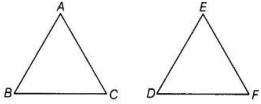
It is given that $\triangle ABC \sim \triangle EDF$ such that $AB = 5 \, cm$,$AC = 7 \, cm$,$DF = 15 \, cm$,and $DE = 12 \, cm$. Find the lengths of the remaining sides of the triangles.
Solution
(N/A) Given,$\triangle ABC \sim \triangle EDF$. Since the triangles are similar,their corresponding sides are in the same ratio.
i.e.,$\frac{AB}{ED} = \frac{AC}{EF} = \frac{BC}{DF}$ ...... $(i)$
Given values are $AB = 5 \, cm$,$AC = 7 \, cm$,$DF = 15 \, cm$,and $DE = 12 \, cm$.
Substituting these values in Eq. $(i)$,we get:
$\frac{5}{12} = \frac{7}{EF} = \frac{BC}{15}$
Taking the first and second terms:
$\frac{5}{12} = \frac{7}{EF}$
$\Rightarrow EF = \frac{7 \times 12}{5} = \frac{84}{5} = 16.8 \, cm$
Taking the first and third terms:
$\frac{5}{12} = \frac{BC}{15}$
$\Rightarrow BC = \frac{5 \times 15}{12} = \frac{75}{12} = 6.25 \, cm$
Hence,the lengths of the remaining sides are $EF = 16.8 \, cm$ and $BC = 6.25 \, cm$.
i.e.,$\frac{AB}{ED} = \frac{AC}{EF} = \frac{BC}{DF}$ ...... $(i)$
Given values are $AB = 5 \, cm$,$AC = 7 \, cm$,$DF = 15 \, cm$,and $DE = 12 \, cm$.
Substituting these values in Eq. $(i)$,we get:
$\frac{5}{12} = \frac{7}{EF} = \frac{BC}{15}$
Taking the first and second terms:
$\frac{5}{12} = \frac{7}{EF}$
$\Rightarrow EF = \frac{7 \times 12}{5} = \frac{84}{5} = 16.8 \, cm$
Taking the first and third terms:
$\frac{5}{12} = \frac{BC}{15}$
$\Rightarrow BC = \frac{5 \times 15}{12} = \frac{75}{12} = 6.25 \, cm$
Hence,the lengths of the remaining sides are $EF = 16.8 \, cm$ and $BC = 6.25 \, cm$.
0 likes
View Solution54
Difficult
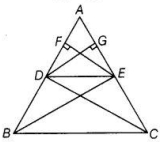
Prove that if a line is drawn parallel to one side of a triangle to intersect the other two sides,then the two sides are divided in the same ratio.
Solution
(N/A) Let a $\triangle ABC$ in which a line $DE$ parallel to $BC$ intersects $AB$ at $D$ and $AC$ at $E$. To prove: $DE$ divides the two sides in the same ratio,i.e.,$\frac{AD}{DB} = \frac{AE}{EC}$.
Construction: Join $BE, CD$ and draw $EF \perp AB$ and $DG \perp AC$.
Proof: Here,$\frac{\text{ar}(\triangle ADE)}{\text{ar}(\triangle BDE)} = \frac{\frac{1}{2} \times AD \times EF}{\frac{1}{2} \times DB \times EF} = \frac{AD}{DB}$ ......$(i)$ [Since,area of triangle $= \frac{1}{2} \times \text{base} \times \text{height}$]
Similarly,$\frac{\text{ar}(\triangle ADE)}{\text{ar}(\triangle DEC)} = \frac{\frac{1}{2} \times AE \times DG}{\frac{1}{2} \times EC \times DG} = \frac{AE}{EC}$ ......$(ii)$
Now,since $\triangle BDE$ and $\triangle DEC$ lie between the same parallel lines $DE$ and $BC$ and on the same base $DE$,therefore,$\text{ar}(\triangle BDE) = \text{ar}(\triangle DEC)$ ......$(iii)$
From Eqs. $(i), (ii)$ and $(iii)$,we get $\frac{AD}{DB} = \frac{AE}{EC}$.
Hence proved.
Construction: Join $BE, CD$ and draw $EF \perp AB$ and $DG \perp AC$.
Proof: Here,$\frac{\text{ar}(\triangle ADE)}{\text{ar}(\triangle BDE)} = \frac{\frac{1}{2} \times AD \times EF}{\frac{1}{2} \times DB \times EF} = \frac{AD}{DB}$ ......$(i)$ [Since,area of triangle $= \frac{1}{2} \times \text{base} \times \text{height}$]
Similarly,$\frac{\text{ar}(\triangle ADE)}{\text{ar}(\triangle DEC)} = \frac{\frac{1}{2} \times AE \times DG}{\frac{1}{2} \times EC \times DG} = \frac{AE}{EC}$ ......$(ii)$
Now,since $\triangle BDE$ and $\triangle DEC$ lie between the same parallel lines $DE$ and $BC$ and on the same base $DE$,therefore,$\text{ar}(\triangle BDE) = \text{ar}(\triangle DEC)$ ......$(iii)$
From Eqs. $(i), (ii)$ and $(iii)$,we get $\frac{AD}{DB} = \frac{AE}{EC}$.
Hence proved.
0 likes
View Solution55
Difficult
In the given figure,if $PQRS$ is a parallelogram and $AB \parallel PS$,then prove that $OC \parallel SR$.
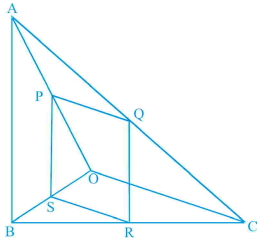
Solution
(N/A) Given: $PQRS$ is a parallelogram,so $PQ \parallel SR$ and $PS \parallel QR$. Also,$AB \parallel PS$.
To prove: $OC \parallel SR$.
Proof: In $\triangle OPS$ and $\triangle OAB$,since $PS \parallel AB$:
$\angle POS = \angle AOB$ (Common angle)
$\angle OSP = \angle OBA$ (Corresponding angles)
Therefore,$\triangle OPS \sim \triangle OAB$ (by $AAA$ similarity criterion).
Thus,$\frac{PS}{AB} = \frac{OS}{OB}$ ..........$(i)$
In $\triangle CQR$ and $\triangle CAB$,since $QR \parallel PS \parallel AB$:
$\angle QCR = \angle ACB$ (Common angle)
$\angle CQR = \angle CAB$ (Corresponding angles)
Therefore,$\triangle CQR \sim \triangle CAB$ (by $AA$ similarity criterion).
Thus,$\frac{QR}{AB} = \frac{CR}{CB}$.
Since $PQRS$ is a parallelogram,$PS = QR$. Substituting this,we get:
$\frac{PS}{AB} = \frac{CR}{CB}$ ..........$(ii)$
From equations $(i)$ and $(ii)$:
$\frac{OS}{OB} = \frac{CR}{CB} \Rightarrow \frac{OB}{OS} = \frac{CB}{CR}$.
Subtracting $1$ from both sides:
$\frac{OB}{OS} - 1 = \frac{CB}{CR} - 1$
$\frac{OB - OS}{OS} = \frac{CB - CR}{CR}$
$\frac{BS}{OS} = \frac{BR}{CR}$.
By the converse of the Basic Proportionality Theorem $(BPT)$,$SR \parallel OC$ (or $OC \parallel SR$). Hence proved.
To prove: $OC \parallel SR$.
Proof: In $\triangle OPS$ and $\triangle OAB$,since $PS \parallel AB$:
$\angle POS = \angle AOB$ (Common angle)
$\angle OSP = \angle OBA$ (Corresponding angles)
Therefore,$\triangle OPS \sim \triangle OAB$ (by $AAA$ similarity criterion).
Thus,$\frac{PS}{AB} = \frac{OS}{OB}$ ..........$(i)$
In $\triangle CQR$ and $\triangle CAB$,since $QR \parallel PS \parallel AB$:
$\angle QCR = \angle ACB$ (Common angle)
$\angle CQR = \angle CAB$ (Corresponding angles)
Therefore,$\triangle CQR \sim \triangle CAB$ (by $AA$ similarity criterion).
Thus,$\frac{QR}{AB} = \frac{CR}{CB}$.
Since $PQRS$ is a parallelogram,$PS = QR$. Substituting this,we get:
$\frac{PS}{AB} = \frac{CR}{CB}$ ..........$(ii)$
From equations $(i)$ and $(ii)$:
$\frac{OS}{OB} = \frac{CR}{CB} \Rightarrow \frac{OB}{OS} = \frac{CB}{CR}$.
Subtracting $1$ from both sides:
$\frac{OB}{OS} - 1 = \frac{CB}{CR} - 1$
$\frac{OB - OS}{OS} = \frac{CB - CR}{CR}$
$\frac{BS}{OS} = \frac{BR}{CR}$.
By the converse of the Basic Proportionality Theorem $(BPT)$,$SR \parallel OC$ (or $OC \parallel SR$). Hence proved.
0 likes
View Solution56
DifficultMCQ
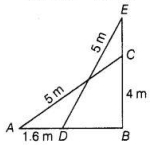
$A$ $5\, m$ long ladder is placed leaning against a vertical wall such that it reaches the wall at a point $4 \,m$ high. If the foot of the ladder is moved $1.6 \,m$ towards the wall,find the distance by which the top of the ladder would slide upwards on the wall (in $m$).
A
$1$
B
$0.7$
C
$0.9$
D
$0.8$
Solution
(D) Let $AC$ be the ladder of length $5\,m$ and $BC = 4\,m$ be the height of the wall where the ladder is placed. If the foot of the ladder is moved $1.6\,m$ towards the wall,i.e.,$AD = 1.6\,m$,then the ladder slides upward to a new position $ED$.
In right-angled $\triangle ABC$,by Pythagoras theorem:
$AC^2 = AB^2 + BC^2$
$5^2 = AB^2 + 4^2$
$25 = AB^2 + 16$
$AB^2 = 9 \Rightarrow AB = 3\,m$.
Now,the new distance of the foot from the wall is $DB = AB - AD = 3 - 1.6 = 1.4\,m$.
In right-angled $\triangle EBD$,by Pythagoras theorem:
$ED^2 = EB^2 + DB^2$
$5^2 = EB^2 + (1.4)^2$
$25 = EB^2 + 1.96$
$EB^2 = 25 - 1.96 = 23.04$
$EB = \sqrt{23.04} = 4.8\,m$.
The distance by which the top of the ladder slides upwards is $EC = EB - BC = 4.8 - 4 = 0.8\,m$.
In right-angled $\triangle ABC$,by Pythagoras theorem:
$AC^2 = AB^2 + BC^2$
$5^2 = AB^2 + 4^2$
$25 = AB^2 + 16$
$AB^2 = 9 \Rightarrow AB = 3\,m$.
Now,the new distance of the foot from the wall is $DB = AB - AD = 3 - 1.6 = 1.4\,m$.
In right-angled $\triangle EBD$,by Pythagoras theorem:
$ED^2 = EB^2 + DB^2$
$5^2 = EB^2 + (1.4)^2$
$25 = EB^2 + 1.96$
$EB^2 = 25 - 1.96 = 23.04$
$EB = \sqrt{23.04} = 4.8\,m$.
The distance by which the top of the ladder slides upwards is $EC = EB - BC = 4.8 - 4 = 0.8\,m$.
0 likes
View Solution57
DifficultMCQ
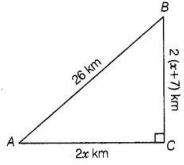
For going to a city $B$ from city $A$,there is a route via city $C$ such that $AC \perp CB$,$AC = 2x \, km$ and $CB = 2(x+7) \, km$. It is proposed to construct a $26 \, km$ highway which directly connects the two cities $A$ and $B$. Find how much distance will be saved in reaching city $B$ from city $A$ after the construction of the highway (in $km$).
A
$8$
B
$10$
C
$12$
D
$25$
Solution
(A) Given,$AC \perp CB$,$AC = 2x \, km$,$CB = 2(x+7) \, km$ and $AB = 26 \, km$.
From the figure,we have a right-angled $\triangle ACB$ with the right angle at $C$.
In $\triangle ACB$,by the Pythagoras theorem:
$AB^2 = AC^2 + BC^2$
$(26)^2 = (2x)^2 + \{2(x+7)\}^2$
$676 = 4x^2 + 4(x^2 + 49 + 14x)$
$676 = 4x^2 + 4x^2 + 196 + 56x$
$676 = 8x^2 + 56x + 196$
$8x^2 + 56x - 480 = 0$
Dividing by $8$,we get:
$x^2 + 7x - 60 = 0$
$x^2 + 12x - 5x - 60 = 0$
$x(x + 12) - 5(x + 12) = 0$
$(x + 12)(x - 5) = 0$
$x = -12$ or $x = 5$.
Since distance cannot be negative,$x = 5$ (as $x \neq -12$).
Now,$AC = 2x = 2(5) = 10 \, km$ and $BC = 2(x+7) = 2(5+7) = 24 \, km$.
The distance covered to reach city $B$ from city $A$ via city $C$ is $AC + BC = 10 + 24 = 34 \, km$.
The distance covered to reach city $B$ from city $A$ after the construction of the highway is $AB = 26 \, km$.
Therefore,the distance saved is $34 - 26 = 8 \, km$.
From the figure,we have a right-angled $\triangle ACB$ with the right angle at $C$.
In $\triangle ACB$,by the Pythagoras theorem:
$AB^2 = AC^2 + BC^2$
$(26)^2 = (2x)^2 + \{2(x+7)\}^2$
$676 = 4x^2 + 4(x^2 + 49 + 14x)$
$676 = 4x^2 + 4x^2 + 196 + 56x$
$676 = 8x^2 + 56x + 196$
$8x^2 + 56x - 480 = 0$
Dividing by $8$,we get:
$x^2 + 7x - 60 = 0$
$x^2 + 12x - 5x - 60 = 0$
$x(x + 12) - 5(x + 12) = 0$
$(x + 12)(x - 5) = 0$
$x = -12$ or $x = 5$.
Since distance cannot be negative,$x = 5$ (as $x \neq -12$).
Now,$AC = 2x = 2(5) = 10 \, km$ and $BC = 2(x+7) = 2(5+7) = 24 \, km$.
The distance covered to reach city $B$ from city $A$ via city $C$ is $AC + BC = 10 + 24 = 34 \, km$.
The distance covered to reach city $B$ from city $A$ after the construction of the highway is $AB = 26 \, km$.
Therefore,the distance saved is $34 - 26 = 8 \, km$.
0 likes
View Solution58
MediumMCQ
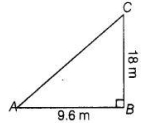
$A$ flag pole $18 \, m$ high casts a shadow $9.6 \, m$ long. Find the distance of the top of the pole from the far end of the shadow. (in $m$)
A
$10.4$
B
$20.4$
C
$20.6$
D
$30.4$
Solution
(B) Let $BC = 18 \, m$ be the flag pole and its shadow be $AB = 9.6 \, m$. The distance of the top of the pole $(C)$ from the far end of the shadow $(A)$ is $AC$.
In right-angled $\triangle ABC$,by Pythagoras theorem:
$AC^2 = AB^2 + BC^2$
$AC^2 = (9.6)^2 + (18)^2$
$AC^2 = 92.16 + 324$
$AC^2 = 416.16$
$AC = \sqrt{416.16} = 20.4 \, m$
Hence,the required distance is $20.4 \, m$.
In right-angled $\triangle ABC$,by Pythagoras theorem:
$AC^2 = AB^2 + BC^2$
$AC^2 = (9.6)^2 + (18)^2$
$AC^2 = 92.16 + 324$
$AC^2 = 416.16$
$AC = \sqrt{416.16} = 20.4 \, m$
Hence,the required distance is $20.4 \, m$.
0 likes
View Solution59
DifficultMCQ
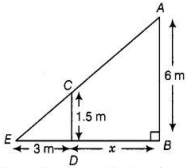
$A$ street light bulb is fixed on a pole $6 \, m$ above the level of the street. If a woman of height $1.5 \, m$ casts a shadow of $3 \, m$,find how far she is away from the base of the pole. (in $m$)
A
$11$
B
$10$
C
$9$
D
$8$
Solution
(C) Let $A$ be the position of the street bulb fixed on a pole $AB = 6 \, m$ and $CD = 1.5 \, m$ be the height of a woman and her shadow be $ED = 3 \, m$. Let the distance between the pole and the woman be $x \, m$.
Here,the woman and the pole are both standing vertically.
So,$CD \parallel AB$.
In $\triangle CDE$ and $\triangle ABE$,$\angle E = \angle E$ [common angle].
$\angle ABE = \angle CDE = 90^{\circ}$ [each equal to $90^{\circ}$].
Therefore,$\triangle CDE \sim \triangle ABE$ [by $AAA$ similarity criterion].
Then,$\frac{ED}{EB} = \frac{CD}{AB}$.
$\frac{3}{3 + x} = \frac{1.5}{6}$.
$3 \times 6 = 1.5(3 + x)$.
$18 = 4.5 + 1.5x$.
$1.5x = 18 - 4.5$.
$1.5x = 13.5$.
$x = \frac{13.5}{1.5} = 9 \, m$.
Hence,she is at a distance of $9 \, m$ from the base of the pole.
Here,the woman and the pole are both standing vertically.
So,$CD \parallel AB$.
In $\triangle CDE$ and $\triangle ABE$,$\angle E = \angle E$ [common angle].
$\angle ABE = \angle CDE = 90^{\circ}$ [each equal to $90^{\circ}$].
Therefore,$\triangle CDE \sim \triangle ABE$ [by $AAA$ similarity criterion].
Then,$\frac{ED}{EB} = \frac{CD}{AB}$.
$\frac{3}{3 + x} = \frac{1.5}{6}$.
$3 \times 6 = 1.5(3 + x)$.
$18 = 4.5 + 1.5x$.
$1.5x = 18 - 4.5$.
$1.5x = 13.5$.
$x = \frac{13.5}{1.5} = 9 \, m$.
Hence,she is at a distance of $9 \, m$ from the base of the pole.
0 likes
View Solution60
Difficult
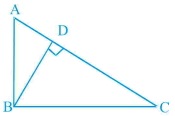
In the figure,$ABC$ is a triangle right-angled at $B$ and $BD \perp AC$. If $AD = 4 \, cm$ and $CD = 5 \, cm$,find $BD$ and $AB$.
Solution
(N/A) Given,$\triangle ABC$ in which $\angle B = 90^{\circ}$ and $BD \perp AC$.
Also,$AD = 4 \, cm$ and $CD = 5 \, cm$.
In $\triangle ADB$ and $\triangle CDB$,$\angle ADB = \angle CDB = 90^{\circ}$.
Also,$\angle BAD = \angle DBC$ (since both are equal to $90^{\circ} - \angle C$).
Therefore,$\triangle ADB \sim \triangle CDB$ by $AA$ similarity criterion.
Thus,$\frac{BD}{AD} = \frac{CD}{BD}$.
$\Rightarrow BD^2 = AD \times CD = 4 \times 5 = 20$.
$\Rightarrow BD = \sqrt{20} = 2\sqrt{5} \, cm$.
Now,in right-angled $\triangle ADB$,by Pythagoras theorem:
$AB^2 = AD^2 + BD^2 = 4^2 + (2\sqrt{5})^2 = 16 + 20 = 36$.
$\Rightarrow AB = \sqrt{36} = 6 \, cm$.
Hence,$BD = 2\sqrt{5} \, cm$ and $AB = 6 \, cm$.
Also,$AD = 4 \, cm$ and $CD = 5 \, cm$.
In $\triangle ADB$ and $\triangle CDB$,$\angle ADB = \angle CDB = 90^{\circ}$.
Also,$\angle BAD = \angle DBC$ (since both are equal to $90^{\circ} - \angle C$).
Therefore,$\triangle ADB \sim \triangle CDB$ by $AA$ similarity criterion.
Thus,$\frac{BD}{AD} = \frac{CD}{BD}$.
$\Rightarrow BD^2 = AD \times CD = 4 \times 5 = 20$.
$\Rightarrow BD = \sqrt{20} = 2\sqrt{5} \, cm$.
Now,in right-angled $\triangle ADB$,by Pythagoras theorem:
$AB^2 = AD^2 + BD^2 = 4^2 + (2\sqrt{5})^2 = 16 + 20 = 36$.
$\Rightarrow AB = \sqrt{36} = 6 \, cm$.
Hence,$BD = 2\sqrt{5} \, cm$ and $AB = 6 \, cm$.
0 likes
View Solution61
Difficult
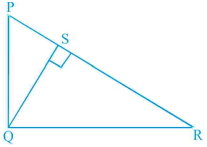
In the figure,$PQR$ is a right triangle right-angled at $Q$ and $QS \perp PR$. If $PQ = 6 \, cm$ and $PS = 4 \, cm$,find $QS$,$RS$,and $QR$.
Solution
(N/A) Given,$\Delta PQR$ in which $\angle Q = 90^{\circ}$,$QS \perp PR$,$PQ = 6 \, cm$,and $PS = 4 \, cm$.
In right-angled $\Delta PSQ$,by Pythagoras theorem:
$PQ^2 = PS^2 + QS^2$
$6^2 = 4^2 + QS^2$
$36 = 16 + QS^2$
$QS^2 = 20$
$QS = \sqrt{20} = 2\sqrt{5} \, cm$.
Since $\Delta PSQ \sim \Delta QSR$,we have:
$\frac{PS}{QS} = \frac{QS}{RS}$
$QS^2 = PS \times RS$
$20 = 4 \times RS$
$RS = 5 \, cm$.
In right-angled $\Delta QSR$,by Pythagoras theorem:
$QR^2 = QS^2 + RS^2$
$QR^2 = 20 + 5^2$
$QR^2 = 20 + 25 = 45$
$QR = \sqrt{45} = 3\sqrt{5} \, cm$.
Thus,$QS = 2\sqrt{5} \, cm$,$RS = 5 \, cm$,and $QR = 3\sqrt{5} \, cm$.
In right-angled $\Delta PSQ$,by Pythagoras theorem:
$PQ^2 = PS^2 + QS^2$
$6^2 = 4^2 + QS^2$
$36 = 16 + QS^2$
$QS^2 = 20$
$QS = \sqrt{20} = 2\sqrt{5} \, cm$.
Since $\Delta PSQ \sim \Delta QSR$,we have:
$\frac{PS}{QS} = \frac{QS}{RS}$
$QS^2 = PS \times RS$
$20 = 4 \times RS$
$RS = 5 \, cm$.
In right-angled $\Delta QSR$,by Pythagoras theorem:
$QR^2 = QS^2 + RS^2$
$QR^2 = 20 + 5^2$
$QR^2 = 20 + 25 = 45$
$QR = \sqrt{45} = 3\sqrt{5} \, cm$.
Thus,$QS = 2\sqrt{5} \, cm$,$RS = 5 \, cm$,and $QR = 3\sqrt{5} \, cm$.
0 likes
View Solution62
Difficult
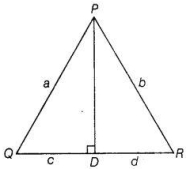
In $\triangle PQR$,$PD \perp QR$ such that $D$ lies on $QR$. If $PQ = a$,$PR = b$,$QD = c$,and $DR = d$,prove that $(a+b)(a-b) = (c+d)(c-d)$.
Solution
(N/A) Given: In $\triangle PQR$,$PD \perp QR$,$PQ = a$,$PR = b$,$QD = c$,and $DR = d$.
To prove: $(a+b)(a-b) = (c+d)(c-d)$.
Proof: In right-angled $\triangle PDQ$,by Pythagoras theorem:
$PQ^2 = PD^2 + QD^2$
$a^2 = PD^2 + c^2$
$PD^2 = a^2 - c^2$ ...... $(i)$
In right-angled $\triangle PDR$,by Pythagoras theorem:
$PR^2 = PD^2 + DR^2$
$b^2 = PD^2 + d^2$
$PD^2 = b^2 - d^2$ ...... $(ii)$
From equations $(i)$ and $(ii)$:
$a^2 - c^2 = b^2 - d^2$
$a^2 - b^2 = c^2 - d^2$
$(a - b)(a + b) = (c - d)(c + d)$
Hence,$(a + b)(a - b) = (c + d)(c - d)$ is proved.
To prove: $(a+b)(a-b) = (c+d)(c-d)$.
Proof: In right-angled $\triangle PDQ$,by Pythagoras theorem:
$PQ^2 = PD^2 + QD^2$
$a^2 = PD^2 + c^2$
$PD^2 = a^2 - c^2$ ...... $(i)$
In right-angled $\triangle PDR$,by Pythagoras theorem:
$PR^2 = PD^2 + DR^2$
$b^2 = PD^2 + d^2$
$PD^2 = b^2 - d^2$ ...... $(ii)$
From equations $(i)$ and $(ii)$:
$a^2 - c^2 = b^2 - d^2$
$a^2 - b^2 = c^2 - d^2$
$(a - b)(a + b) = (c - d)(c + d)$
Hence,$(a + b)(a - b) = (c + d)(c - d)$ is proved.
0 likes
View Solution63
Difficult
In a quadrilateral $ABCD$,$\angle A + \angle D = 90^{\circ}$. Prove that $AC^{2} + BD^{2} = AD^{2} + BC^{2}$.
Solution
(N/A) Given: $A$ quadrilateral $ABCD$ in which $\angle A + \angle D = 90^{\circ}$.
To prove: $AC^{2} + BD^{2} = AD^{2} + BC^{2}$.
Construction: Produce $AB$ and $DC$ to meet at point $E$.
Proof: In $\triangle AED$,$\angle A + \angle D = 90^{\circ}$ (given).
Since the sum of angles in a triangle is $180^{\circ}$,we have $\angle E = 180^{\circ} - (\angle A + \angle D) = 180^{\circ} - 90^{\circ} = 90^{\circ}$.
In right-angled $\triangle AED$,by Pythagoras theorem: $AD^{2} = AE^{2} + DE^{2}$ ... $(i)$
In right-angled $\triangle BEC$,by Pythagoras theorem: $BC^{2} = BE^{2} + CE^{2}$ ... $(ii)$
Adding $(i)$ and $(ii)$,we get: $AD^{2} + BC^{2} = AE^{2} + DE^{2} + BE^{2} + CE^{2}$ ... $(iii)$
In right-angled $\triangle AEC$,by Pythagoras theorem: $AC^{2} = AE^{2} + CE^{2}$ ... $(iv)$
In right-angled $\triangle BED$,by Pythagoras theorem: $BD^{2} = BE^{2} + DE^{2}$ ... $(v)$
Adding $(iv)$ and $(v)$,we get: $AC^{2} + BD^{2} = AE^{2} + CE^{2} + BE^{2} + DE^{2}$ ... $(vi)$
Comparing $(iii)$ and $(vi)$,we get: $AC^{2} + BD^{2} = AD^{2} + BC^{2}$.
Hence proved.
To prove: $AC^{2} + BD^{2} = AD^{2} + BC^{2}$.
Construction: Produce $AB$ and $DC$ to meet at point $E$.
Proof: In $\triangle AED$,$\angle A + \angle D = 90^{\circ}$ (given).
Since the sum of angles in a triangle is $180^{\circ}$,we have $\angle E = 180^{\circ} - (\angle A + \angle D) = 180^{\circ} - 90^{\circ} = 90^{\circ}$.
In right-angled $\triangle AED$,by Pythagoras theorem: $AD^{2} = AE^{2} + DE^{2}$ ... $(i)$
In right-angled $\triangle BEC$,by Pythagoras theorem: $BC^{2} = BE^{2} + CE^{2}$ ... $(ii)$
Adding $(i)$ and $(ii)$,we get: $AD^{2} + BC^{2} = AE^{2} + DE^{2} + BE^{2} + CE^{2}$ ... $(iii)$
In right-angled $\triangle AEC$,by Pythagoras theorem: $AC^{2} = AE^{2} + CE^{2}$ ... $(iv)$
In right-angled $\triangle BED$,by Pythagoras theorem: $BD^{2} = BE^{2} + DE^{2}$ ... $(v)$
Adding $(iv)$ and $(v)$,we get: $AC^{2} + BD^{2} = AE^{2} + CE^{2} + BE^{2} + DE^{2}$ ... $(vi)$
Comparing $(iii)$ and $(vi)$,we get: $AC^{2} + BD^{2} = AD^{2} + BC^{2}$.
Hence proved.
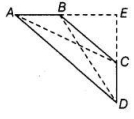
0 likes
View Solution64
Difficult
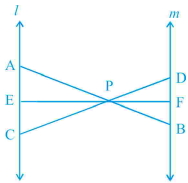
In the figure,$l \parallel m$ and line segments $AB, CD$ and $EF$ are concurrent at point $P$. Prove that $\frac{AE}{BF} = \frac{AC}{BD} = \frac{CE}{FD}$.
Solution
(N/A) Given $l \parallel m$ and line segments $AB, CD$ and $EF$ are concurrent at point $P$.
To prove: $\frac{AE}{BF} = \frac{AC}{BD} = \frac{CE}{FD}$.
Proof:
In $\triangle APC$ and $\triangle BPD$,
$\angle APC = \angle BPD$ [Vertically opposite angles]
$\angle PAC = \angle PBD$ [Alternate interior angles,as $l \parallel m$]
Therefore,$\triangle APC \sim \triangle BPD$ [By $AA$ similarity criterion]
Then,$\frac{AP}{PB} = \frac{AC}{BD} = \frac{PC}{PD}$ ......$(i)$
In $\triangle APE$ and $\triangle BPF$,
$\angle APE = \angle BPF$ [Vertically opposite angles]
$\angle PAE = \angle PBF$ [Alternate interior angles]
Therefore,$\triangle APE \sim \triangle BPF$ [By $AA$ similarity criterion]
Then,$\frac{AP}{PB} = \frac{AE}{BF} = \frac{PE}{PF}$ ......$(ii)$
In $\triangle PEC$ and $\triangle PFD$,
$\angle EPC = \angle FPD$ [Vertically opposite angles]
$\angle PCE = \angle PDF$ [Alternate interior angles]
Therefore,$\triangle PEC \sim \triangle PFD$ [By $AA$ similarity criterion]
Then,$\frac{PE}{PF} = \frac{PC}{PD} = \frac{CE}{FD}$ ......$(iii)$
From equations $(i), (ii)$ and $(iii)$,
$\frac{AP}{PB} = \frac{AC}{BD} = \frac{AE}{BF} = \frac{PE}{PF} = \frac{CE}{FD}$
Thus,$\frac{AE}{BF} = \frac{AC}{BD} = \frac{CE}{FD}$. Hence proved.
To prove: $\frac{AE}{BF} = \frac{AC}{BD} = \frac{CE}{FD}$.
Proof:
In $\triangle APC$ and $\triangle BPD$,
$\angle APC = \angle BPD$ [Vertically opposite angles]
$\angle PAC = \angle PBD$ [Alternate interior angles,as $l \parallel m$]
Therefore,$\triangle APC \sim \triangle BPD$ [By $AA$ similarity criterion]
Then,$\frac{AP}{PB} = \frac{AC}{BD} = \frac{PC}{PD}$ ......$(i)$
In $\triangle APE$ and $\triangle BPF$,
$\angle APE = \angle BPF$ [Vertically opposite angles]
$\angle PAE = \angle PBF$ [Alternate interior angles]
Therefore,$\triangle APE \sim \triangle BPF$ [By $AA$ similarity criterion]
Then,$\frac{AP}{PB} = \frac{AE}{BF} = \frac{PE}{PF}$ ......$(ii)$
In $\triangle PEC$ and $\triangle PFD$,
$\angle EPC = \angle FPD$ [Vertically opposite angles]
$\angle PCE = \angle PDF$ [Alternate interior angles]
Therefore,$\triangle PEC \sim \triangle PFD$ [By $AA$ similarity criterion]
Then,$\frac{PE}{PF} = \frac{PC}{PD} = \frac{CE}{FD}$ ......$(iii)$
From equations $(i), (ii)$ and $(iii)$,
$\frac{AP}{PB} = \frac{AC}{BD} = \frac{AE}{BF} = \frac{PE}{PF} = \frac{CE}{FD}$
Thus,$\frac{AE}{BF} = \frac{AC}{BD} = \frac{CE}{FD}$. Hence proved.
0 likes
View Solution65
Difficult
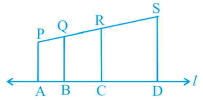
In the figure,$PA$,$QB$,$RC$,and $SD$ are all perpendiculars to a line $l$. Given $AB = 6 \, cm$,$BC = 9 \, cm$,$CD = 12 \, cm$,and $PS = 36 \, cm$. Find $PQ$,$QR$,and $RS$.
Solution
(N/A) Given: $AB = 6 \, cm$,$BC = 9 \, cm$,$CD = 12 \, cm$,and $PS = 36 \, cm$.
Also,$PA$,$QB$,$RC$,and $SD$ are all perpendiculars to line $l$,which implies $PA \parallel QB \parallel RC \parallel SD$.
By the intercept theorem (or Thales' theorem application for parallel lines),the ratio of intercepts on one transversal is equal to the ratio of intercepts on another transversal:
$PQ : QR : RS = AB : BC : CD$
$PQ : QR : RS = 6 : 9 : 12$
Let $PQ = 6x$,$QR = 9x$,and $RS = 12x$.
Since the total length $PS = 36 \, cm$:
$PQ + QR + RS = 36$
$6x + 9x + 12x = 36$
$27x = 36$
$x = \frac{36}{27} = \frac{4}{3}$
Now,calculating the lengths:
$PQ = 6x = 6 \times \frac{4}{3} = 8 \, cm$
$QR = 9x = 9 \times \frac{4}{3} = 12 \, cm$
$RS = 12x = 12 \times \frac{4}{3} = 16 \, cm$
Also,$PA$,$QB$,$RC$,and $SD$ are all perpendiculars to line $l$,which implies $PA \parallel QB \parallel RC \parallel SD$.
By the intercept theorem (or Thales' theorem application for parallel lines),the ratio of intercepts on one transversal is equal to the ratio of intercepts on another transversal:
$PQ : QR : RS = AB : BC : CD$
$PQ : QR : RS = 6 : 9 : 12$
Let $PQ = 6x$,$QR = 9x$,and $RS = 12x$.
Since the total length $PS = 36 \, cm$:
$PQ + QR + RS = 36$
$6x + 9x + 12x = 36$
$27x = 36$
$x = \frac{36}{27} = \frac{4}{3}$
Now,calculating the lengths:
$PQ = 6x = 6 \times \frac{4}{3} = 8 \, cm$
$QR = 9x = 9 \times \frac{4}{3} = 12 \, cm$
$RS = 12x = 12 \times \frac{4}{3} = 16 \, cm$
0 likes
View Solution66
Difficult
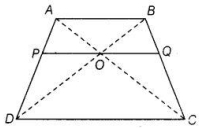
$O$ is the point of intersection of the diagonals $AC$ and $BD$ of a trapezium $ABCD$ with $AB \parallel DC$. Through $O$,a line segment $PQ$ is drawn parallel to $AB$ meeting $AD$ in $P$ and $BC$ in $Q$. Prove that $PO = QO$.
Solution
(N/A) Given: $ABCD$ is a trapezium with $AB \parallel DC$. Diagonals $AC$ and $BD$ intersect at $O$. $PQ \parallel AB \parallel DC$.
To prove: $PO = QO$.
Proof: In $\triangle ADC$,$PO \parallel DC$ (since $PQ \parallel DC$).
By the Basic Proportionality Theorem $(BPT)$,we have:
$\frac{AP}{PD} = \frac{AO}{OC}$ ........$(i)$
In $\triangle ABC$,$OQ \parallel AB$.
By $BPT$,we have:
$\frac{BQ}{QC} = \frac{AO}{OC}$ ........$(ii)$
From $(i)$ and $(ii)$,we get:
$\frac{AP}{PD} = \frac{BQ}{QC}$
Adding $1$ to both sides:
$\frac{AP}{PD} + 1 = \frac{BQ}{QC} + 1$
$\frac{AP + PD}{PD} = \frac{BQ + QC}{QC}$
$\frac{AD}{PD} = \frac{BC}{QC}$
$\Rightarrow \frac{PD}{AD} = \frac{QC}{BC}$ ........$(iii)$
Now,in $\triangle ABD$,$PO \parallel AB$. Therefore,$\triangle POD \sim \triangle ABD$ (by $AA$ similarity).
So,$\frac{PO}{AB} = \frac{PD}{AD}$ ........$(iv)$
In $\triangle ABC$,$OQ \parallel AB$. Therefore,$\triangle OQC \sim \triangle ABC$ (by $AA$ similarity).
So,$\frac{OQ}{AB} = \frac{QC}{BC}$ ........$(v)$
From $(iii)$,$(iv)$,and $(v)$,we get:
$\frac{PO}{AB} = \frac{OQ}{AB}$
$\Rightarrow PO = OQ$. Hence proved.
To prove: $PO = QO$.
Proof: In $\triangle ADC$,$PO \parallel DC$ (since $PQ \parallel DC$).
By the Basic Proportionality Theorem $(BPT)$,we have:
$\frac{AP}{PD} = \frac{AO}{OC}$ ........$(i)$
In $\triangle ABC$,$OQ \parallel AB$.
By $BPT$,we have:
$\frac{BQ}{QC} = \frac{AO}{OC}$ ........$(ii)$
From $(i)$ and $(ii)$,we get:
$\frac{AP}{PD} = \frac{BQ}{QC}$
Adding $1$ to both sides:
$\frac{AP}{PD} + 1 = \frac{BQ}{QC} + 1$
$\frac{AP + PD}{PD} = \frac{BQ + QC}{QC}$
$\frac{AD}{PD} = \frac{BC}{QC}$
$\Rightarrow \frac{PD}{AD} = \frac{QC}{BC}$ ........$(iii)$
Now,in $\triangle ABD$,$PO \parallel AB$. Therefore,$\triangle POD \sim \triangle ABD$ (by $AA$ similarity).
So,$\frac{PO}{AB} = \frac{PD}{AD}$ ........$(iv)$
In $\triangle ABC$,$OQ \parallel AB$. Therefore,$\triangle OQC \sim \triangle ABC$ (by $AA$ similarity).
So,$\frac{OQ}{AB} = \frac{QC}{BC}$ ........$(v)$
From $(iii)$,$(iv)$,and $(v)$,we get:
$\frac{PO}{AB} = \frac{OQ}{AB}$
$\Rightarrow PO = OQ$. Hence proved.
0 likes
View Solution67
Difficult
In $Fig.$,line segment $DF$ intersects the side $AC$ of a triangle $ABC$ at the point $E$ such that $E$ is the mid-point of $CA$ and $\angle AEF = \angle AFE$. Prove that
$\frac{BD}{CD} = \frac{BF}{CE}$
$\frac{BD}{CD} = \frac{BF}{CE}$
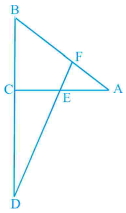
Solution
(N/A) Given: In $\triangle ABC$,$E$ is the mid-point of $CA$ and $\angle AEF = \angle AFE$.
To prove: $\frac{BD}{CD} = \frac{BF}{CE}$.
Construction: Draw a line $CG$ parallel to $EF$ such that $G$ lies on $AB$.
Proof: Since $E$ is the mid-point of $CA$,we have $CE = AE$ $(i)$.
In $\triangle ACG$,since $CG \parallel EF$ and $E$ is the mid-point of $CA$,by the converse of the Mid-point Theorem,$F$ is the mid-point of $AG$. Thus,$GF = AF$ $(ii)$.
Also,in $\triangle ACG$,since $CG \parallel EF$,by the Mid-point Theorem,$EF = \frac{1}{2} CG$. However,this is not needed here. Instead,consider $\triangle BDF$ and $\triangle BCG$. Since $CG \parallel EF$,by the Basic Proportionality Theorem in $\triangle BDF$,we have $\frac{BD}{CD} = \frac{BF}{GF}$.
Since $\angle AEF = \angle AFE$,in $\triangle AEF$,we have $AE = AF$. From $(i)$ and $(ii)$,$CE = AE = AF = GF$. Therefore,$CE = GF$.
Substituting $GF = CE$ in the ratio $\frac{BD}{CD} = \frac{BF}{GF}$,we get $\frac{BD}{CD} = \frac{BF}{CE}$.
Hence proved.
To prove: $\frac{BD}{CD} = \frac{BF}{CE}$.
Construction: Draw a line $CG$ parallel to $EF$ such that $G$ lies on $AB$.
Proof: Since $E$ is the mid-point of $CA$,we have $CE = AE$ $(i)$.
In $\triangle ACG$,since $CG \parallel EF$ and $E$ is the mid-point of $CA$,by the converse of the Mid-point Theorem,$F$ is the mid-point of $AG$. Thus,$GF = AF$ $(ii)$.
Also,in $\triangle ACG$,since $CG \parallel EF$,by the Mid-point Theorem,$EF = \frac{1}{2} CG$. However,this is not needed here. Instead,consider $\triangle BDF$ and $\triangle BCG$. Since $CG \parallel EF$,by the Basic Proportionality Theorem in $\triangle BDF$,we have $\frac{BD}{CD} = \frac{BF}{GF}$.
Since $\angle AEF = \angle AFE$,in $\triangle AEF$,we have $AE = AF$. From $(i)$ and $(ii)$,$CE = AE = AF = GF$. Therefore,$CE = GF$.
Substituting $GF = CE$ in the ratio $\frac{BD}{CD} = \frac{BF}{GF}$,we get $\frac{BD}{CD} = \frac{BF}{CE}$.
Hence proved.
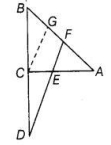
0 likes
View Solution68
Difficult
Prove that the area of the semicircle drawn on the hypotenuse of a right-angled triangle is equal to the sum of the areas of the semicircles drawn on the other two sides of the triangle.
Solution
(N/A) Let $ABC$ be a right triangle,right-angled at $B$ with $AB = y$ and $BC = x$.
Three semicircles are drawn on the sides $AB$,$BC$,and $AC$ respectively,with diameters $AB$,$BC$,and $AC$.
Let the areas of the semicircles with diameters $AB$,$BC$,and $AC$ be $A_1$,$A_2$,and $A_3$ respectively.
To prove: $A_3 = A_1 + A_2$.
Proof: In $\triangle ABC$,by the Pythagoras theorem,
$AC^2 = AB^2 + BC^2$
$AC^2 = y^2 + x^2$
$AC = \sqrt{y^2 + x^2}$
We know that the area of a semicircle with diameter $d$ is $\frac{\pi}{2} \left(\frac{d}{2}\right)^2 = \frac{\pi d^2}{8}$.
Therefore,the area of the semicircle drawn on $AC$ is:
$A_3 = \frac{\pi (AC)^2}{8} = \frac{\pi (y^2 + x^2)}{8}$ .....$(i)$
Now,the area of the semicircle drawn on $AB$ is:
$A_1 = \frac{\pi (AB)^2}{8} = \frac{\pi y^2}{8}$ .....$(ii)$
And the area of the semicircle drawn on $BC$ is:
$A_2 = \frac{\pi (BC)^2}{8} = \frac{\pi x^2}{8}$ .....$(iii)$
Adding equations $(ii)$ and $(iii)$:
$A_1 + A_2 = \frac{\pi y^2}{8} + \frac{\pi x^2}{8} = \frac{\pi (y^2 + x^2)}{8}$
From equation $(i)$,we see that $A_1 + A_2 = A_3$.
Hence,the area of the semicircle on the hypotenuse is equal to the sum of the areas of the semicircles on the other two sides.
Three semicircles are drawn on the sides $AB$,$BC$,and $AC$ respectively,with diameters $AB$,$BC$,and $AC$.
Let the areas of the semicircles with diameters $AB$,$BC$,and $AC$ be $A_1$,$A_2$,and $A_3$ respectively.
To prove: $A_3 = A_1 + A_2$.
Proof: In $\triangle ABC$,by the Pythagoras theorem,
$AC^2 = AB^2 + BC^2$
$AC^2 = y^2 + x^2$
$AC = \sqrt{y^2 + x^2}$
We know that the area of a semicircle with diameter $d$ is $\frac{\pi}{2} \left(\frac{d}{2}\right)^2 = \frac{\pi d^2}{8}$.
Therefore,the area of the semicircle drawn on $AC$ is:
$A_3 = \frac{\pi (AC)^2}{8} = \frac{\pi (y^2 + x^2)}{8}$ .....$(i)$
Now,the area of the semicircle drawn on $AB$ is:
$A_1 = \frac{\pi (AB)^2}{8} = \frac{\pi y^2}{8}$ .....$(ii)$
And the area of the semicircle drawn on $BC$ is:
$A_2 = \frac{\pi (BC)^2}{8} = \frac{\pi x^2}{8}$ .....$(iii)$
Adding equations $(ii)$ and $(iii)$:
$A_1 + A_2 = \frac{\pi y^2}{8} + \frac{\pi x^2}{8} = \frac{\pi (y^2 + x^2)}{8}$
From equation $(i)$,we see that $A_1 + A_2 = A_3$.
Hence,the area of the semicircle on the hypotenuse is equal to the sum of the areas of the semicircles on the other two sides.
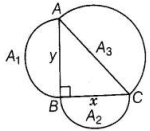
0 likes
View Solution69
Difficult
Prove that the area of the equilateral triangle drawn on the hypotenuse of a right-angled triangle is equal to the sum of the areas of the equilateral triangles drawn on the other two sides of the triangle.
Solution
(N/A) Let $\triangle ABC$ be a right-angled triangle with $\angle A = 90^\circ$,$AC = y$,and $AB = x$.
Three equilateral triangles $\triangle AEC$,$\triangle AFB$,and $\triangle CBD$ are drawn on sides $AC$,$AB$,and $BC$ respectively.
Let the areas of these equilateral triangles be $A_1$,$A_2$,and $A_3$ respectively.
We need to prove that $A_3 = A_1 + A_2$.
In $\triangle ABC$,by Pythagoras theorem: $BC^2 = AC^2 + AB^2 = y^2 + x^2$.
The area of an equilateral triangle with side $s$ is given by $\frac{\sqrt{3}}{4} s^2$.
$A_1 = \text{Area}(\triangle AEC) = \frac{\sqrt{3}}{4} AC^2 = \frac{\sqrt{3}}{4} y^2$ ... $(i)$
$A_2 = \text{Area}(\triangle AFB) = \frac{\sqrt{3}}{4} AB^2 = \frac{\sqrt{3}}{4} x^2$ ... $(ii)$
$A_3 = \text{Area}(\triangle CBD) = \frac{\sqrt{3}}{4} BC^2 = \frac{\sqrt{3}}{4} (y^2 + x^2)$ ... $(iii)$
From $(i)$,$(ii)$,and $(iii)$:
$A_3 = \frac{\sqrt{3}}{4} y^2 + \frac{\sqrt{3}}{4} x^2 = A_1 + A_2$.
Hence,the area of the equilateral triangle on the hypotenuse is equal to the sum of the areas of the equilateral triangles on the other two sides.
Three equilateral triangles $\triangle AEC$,$\triangle AFB$,and $\triangle CBD$ are drawn on sides $AC$,$AB$,and $BC$ respectively.
Let the areas of these equilateral triangles be $A_1$,$A_2$,and $A_3$ respectively.
We need to prove that $A_3 = A_1 + A_2$.
In $\triangle ABC$,by Pythagoras theorem: $BC^2 = AC^2 + AB^2 = y^2 + x^2$.
The area of an equilateral triangle with side $s$ is given by $\frac{\sqrt{3}}{4} s^2$.
$A_1 = \text{Area}(\triangle AEC) = \frac{\sqrt{3}}{4} AC^2 = \frac{\sqrt{3}}{4} y^2$ ... $(i)$
$A_2 = \text{Area}(\triangle AFB) = \frac{\sqrt{3}}{4} AB^2 = \frac{\sqrt{3}}{4} x^2$ ... $(ii)$
$A_3 = \text{Area}(\triangle CBD) = \frac{\sqrt{3}}{4} BC^2 = \frac{\sqrt{3}}{4} (y^2 + x^2)$ ... $(iii)$
From $(i)$,$(ii)$,and $(iii)$:
$A_3 = \frac{\sqrt{3}}{4} y^2 + \frac{\sqrt{3}}{4} x^2 = A_1 + A_2$.
Hence,the area of the equilateral triangle on the hypotenuse is equal to the sum of the areas of the equilateral triangles on the other two sides.
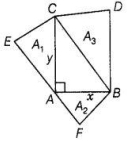
0 likes
View Solution70
Medium
The correspondence $ABC \leftrightarrow QPR$ between $\Delta ABC$ and $\Delta PQR$ is a similarity. If $m \angle A : m \angle B : m \angle C = 15 : 8 : 7$,find the measures of all the angles of $\Delta PQR$.
Solution
(N/A) In $\Delta ABC$,the ratio of the angles is $m \angle A : m \angle B : m \angle C = 15 : 8 : 7$.
Let the angles be $15t$,$8t$,and $7t$ respectively.
Since the sum of angles in a triangle is $180^\circ$,we have $15t + 8t + 7t = 180^\circ$.
$30t = 180^\circ$,which gives $t = 6^\circ$.
Therefore,$m \angle A = 15 \times 6^\circ = 90^\circ$,$m \angle B = 8 \times 6^\circ = 48^\circ$,and $m \angle C = 7 \times 6^\circ = 42^\circ$.
Given the similarity correspondence $ABC \leftrightarrow QPR$,the corresponding angles are equal.
Thus,$m \angle Q = m \angle A = 90^\circ$,$m \angle P = m \angle B = 48^\circ$,and $m \angle R = m \angle C = 42^\circ$.
Hence,the angles of $\Delta PQR$ are $m \angle P = 48^\circ$,$m \angle Q = 90^\circ$,and $m \angle R = 42^\circ$.
Let the angles be $15t$,$8t$,and $7t$ respectively.
Since the sum of angles in a triangle is $180^\circ$,we have $15t + 8t + 7t = 180^\circ$.
$30t = 180^\circ$,which gives $t = 6^\circ$.
Therefore,$m \angle A = 15 \times 6^\circ = 90^\circ$,$m \angle B = 8 \times 6^\circ = 48^\circ$,and $m \angle C = 7 \times 6^\circ = 42^\circ$.
Given the similarity correspondence $ABC \leftrightarrow QPR$,the corresponding angles are equal.
Thus,$m \angle Q = m \angle A = 90^\circ$,$m \angle P = m \angle B = 48^\circ$,and $m \angle R = m \angle C = 42^\circ$.
Hence,the angles of $\Delta PQR$ are $m \angle P = 48^\circ$,$m \angle Q = 90^\circ$,and $m \angle R = 42^\circ$.
0 likes
View Solution71
MediumMCQ
The correspondence $ABC \leftrightarrow XYZ$ between $\Delta ABC$ and $\Delta XYZ$ is a similarity. If $4AB = 5XY$ and $BC = 12$,find $YZ$. (in $.6$)
A
$7$
B
$8$
C
$9$
D
$3$
Solution
(C) Given that the correspondence $ABC \leftrightarrow XYZ$ between $\Delta ABC$ and $\Delta XYZ$ is a similarity.
Therefore,the ratios of their corresponding sides are equal:
$\frac{AB}{XY} = \frac{BC}{YZ} = \frac{AC}{XZ}$
From the given equation $4AB = 5XY$,we can write:
$\frac{AB}{XY} = \frac{5}{4}$
Since the triangles are similar,we have:
$\frac{AB}{XY} = \frac{BC}{YZ}$
Substituting the known values:
$\frac{5}{4} = \frac{12}{YZ}$
Solving for $YZ$:
$YZ = \frac{12 \times 4}{5} = \frac{48}{5} = 9.6$
Thus,$YZ = 9.6$.
Therefore,the ratios of their corresponding sides are equal:
$\frac{AB}{XY} = \frac{BC}{YZ} = \frac{AC}{XZ}$
From the given equation $4AB = 5XY$,we can write:
$\frac{AB}{XY} = \frac{5}{4}$
Since the triangles are similar,we have:
$\frac{AB}{XY} = \frac{BC}{YZ}$
Substituting the known values:
$\frac{5}{4} = \frac{12}{YZ}$
Solving for $YZ$:
$YZ = \frac{12 \times 4}{5} = \frac{48}{5} = 9.6$
Thus,$YZ = 9.6$.
0 likes
View Solution72
MediumMCQ
Given $\Delta ABC \sim \Delta PQR$ for the correspondence $ABC \leftrightarrow PQR$. If $2 m \angle P = 3 m \angle Q$ and $m \angle C = 100^{\circ}$,find $m \angle B$. (in $^{\circ}$)
A
$45$
B
$40$
C
$35$
D
$32$
Solution
(D) Since $\Delta ABC \sim \Delta PQR$,the corresponding angles are equal: $m \angle A = m \angle P$,$m \angle B = m \angle Q$,and $m \angle C = m \angle R = 100^{\circ}$.
In $\Delta ABC$,the sum of angles is $180^{\circ}$,so $m \angle A + m \angle B + m \angle C = 180^{\circ}$.
Substituting $m \angle C = 100^{\circ}$,we get $m \angle A + m \angle B = 80^{\circ}$.
Given $2 m \angle P = 3 m \angle Q$,and since $m \angle P = m \angle A$ and $m \angle Q = m \angle B$,we have $2 m \angle A = 3 m \angle B$,which implies $m \angle A = 1.5 m \angle B$.
Substitute this into $m \angle A + m \angle B = 80^{\circ}$:
$1.5 m \angle B + m \angle B = 80^{\circ}$
$2.5 m \angle B = 80^{\circ}$
$m \angle B = 80 / 2.5 = 32^{\circ}$.
In $\Delta ABC$,the sum of angles is $180^{\circ}$,so $m \angle A + m \angle B + m \angle C = 180^{\circ}$.
Substituting $m \angle C = 100^{\circ}$,we get $m \angle A + m \angle B = 80^{\circ}$.
Given $2 m \angle P = 3 m \angle Q$,and since $m \angle P = m \angle A$ and $m \angle Q = m \angle B$,we have $2 m \angle A = 3 m \angle B$,which implies $m \angle A = 1.5 m \angle B$.
Substitute this into $m \angle A + m \angle B = 80^{\circ}$:
$1.5 m \angle B + m \angle B = 80^{\circ}$
$2.5 m \angle B = 80^{\circ}$
$m \angle B = 80 / 2.5 = 32^{\circ}$.
0 likes
View Solution73
MediumMCQ
The correspondence $PQR \leftrightarrow ZYX$ between $\Delta PQR$ and $\Delta XYZ$ is a similarity. If $PQ : ZY = 5 : 3$ and $PR = 10$,find $ZX$.
A
$6$
B
$7$
C
$8$
D
$9$
Solution
(A) Given that the correspondence $PQR \leftrightarrow ZYX$ is a similarity,we have $\Delta PQR \sim \Delta ZYX$.
From the property of similar triangles,the ratios of corresponding sides are equal:
$\frac{PQ}{ZY} = \frac{QR}{YX} = \frac{PR}{ZX}$.
We are given $\frac{PQ}{ZY} = \frac{5}{3}$ and $PR = 10$.
Substituting these values into the ratio $\frac{PQ}{ZY} = \frac{PR}{ZX}$,we get:
$\frac{5}{3} = \frac{10}{ZX}$.
Cross-multiplying,we get $5 \times ZX = 3 \times 10$.
$5 \times ZX = 30$.
$ZX = \frac{30}{5} = 6$.
Therefore,the length of $ZX$ is $6$.
From the property of similar triangles,the ratios of corresponding sides are equal:
$\frac{PQ}{ZY} = \frac{QR}{YX} = \frac{PR}{ZX}$.
We are given $\frac{PQ}{ZY} = \frac{5}{3}$ and $PR = 10$.
Substituting these values into the ratio $\frac{PQ}{ZY} = \frac{PR}{ZX}$,we get:
$\frac{5}{3} = \frac{10}{ZX}$.
Cross-multiplying,we get $5 \times ZX = 3 \times 10$.
$5 \times ZX = 30$.
$ZX = \frac{30}{5} = 6$.
Therefore,the length of $ZX$ is $6$.
0 likes
View Solution74
MediumMCQ
$\Delta ABC \sim \Delta PQR$ for the correspondence $ABC \leftrightarrow QRP$. If $m \angle A = 80^{\circ}, m \angle B = 40^{\circ}$ and $m \angle C = 60^{\circ}$,find the measures of all the angles of $\Delta PQR$.
A
$m \angle P = 60^{\circ}, m \angle Q = 80^{\circ}, m \angle R = 40^{\circ}$
B
$m \angle P = 80^{\circ}, m \angle Q = 40^{\circ}, m \angle R = 60^{\circ}$
C
$m \angle P = 40^{\circ}, m \angle Q = 60^{\circ}, m \angle R = 80^{\circ}$
D
$m \angle P = 60^{\circ}, m \angle Q = 40^{\circ}, m \angle R = 80^{\circ}$
Solution
(A) Given that $\Delta ABC \sim \Delta PQR$ under the correspondence $ABC \leftrightarrow QRP$.
This implies that the corresponding angles are equal:
$m \angle A = m \angle Q$
$m \angle B = m \angle R$
$m \angle C = m \angle P$
Given $m \angle A = 80^{\circ}, m \angle B = 40^{\circ}, m \angle C = 60^{\circ}$.
Substituting these values:
$m \angle Q = 80^{\circ}$
$m \angle R = 40^{\circ}$
$m \angle P = 60^{\circ}$
Thus,the angles of $\Delta PQR$ are $m \angle P = 60^{\circ}, m \angle Q = 80^{\circ}, m \angle R = 40^{\circ}$.
This implies that the corresponding angles are equal:
$m \angle A = m \angle Q$
$m \angle B = m \angle R$
$m \angle C = m \angle P$
Given $m \angle A = 80^{\circ}, m \angle B = 40^{\circ}, m \angle C = 60^{\circ}$.
Substituting these values:
$m \angle Q = 80^{\circ}$
$m \angle R = 40^{\circ}$
$m \angle P = 60^{\circ}$
Thus,the angles of $\Delta PQR$ are $m \angle P = 60^{\circ}, m \angle Q = 80^{\circ}, m \angle R = 40^{\circ}$.
0 likes
View Solution75
MediumMCQ
$\Delta XYZ \sim \Delta DEF$ for the correspondence $XYZ \leftrightarrow EDF$. If $XY = 3, YZ = 4, ZX = 6$ and $DF = 12$,find the perimeter of $\Delta DEF$.
A
$50$
B
$45$
C
$39$
D
$60$
Solution
(C) Given that $\Delta XYZ \sim \Delta DEF$ with the correspondence $XYZ \leftrightarrow EDF$.
This implies the ratio of corresponding sides is equal: $\frac{XY}{ED} = \frac{YZ}{DF} = \frac{ZX}{FE} = k$.
Given $XY = 3, YZ = 4, ZX = 6$ and $DF = 12$.
From the ratio $\frac{YZ}{DF} = \frac{4}{12} = \frac{1}{3}$,the scale factor $k = \frac{1}{3}$.
Thus,$\frac{XY}{ED} = \frac{1}{3} \implies \frac{3}{ED} = \frac{1}{3} \implies ED = 9$.
And $\frac{ZX}{FE} = \frac{1}{3} \implies \frac{6}{FE} = \frac{1}{3} \implies FE = 18$.
The perimeter of $\Delta DEF = ED + DF + FE = 9 + 12 + 18 = 39$.
This implies the ratio of corresponding sides is equal: $\frac{XY}{ED} = \frac{YZ}{DF} = \frac{ZX}{FE} = k$.
Given $XY = 3, YZ = 4, ZX = 6$ and $DF = 12$.
From the ratio $\frac{YZ}{DF} = \frac{4}{12} = \frac{1}{3}$,the scale factor $k = \frac{1}{3}$.
Thus,$\frac{XY}{ED} = \frac{1}{3} \implies \frac{3}{ED} = \frac{1}{3} \implies ED = 9$.
And $\frac{ZX}{FE} = \frac{1}{3} \implies \frac{6}{FE} = \frac{1}{3} \implies FE = 18$.
The perimeter of $\Delta DEF = ED + DF + FE = 9 + 12 + 18 = 39$.
0 likes
View Solution76
MediumMCQ
$\Delta ABC \sim \Delta XYZ$ for the correspondence $ABC \leftrightarrow ZYX$. If $AB = 3, BC = 5, CA = 6$ and $XY = 6$,find the perimeter of $\Delta XYZ$. (in $.8$)
A
$19$
B
$18$
C
$17$
D
$16$
Solution
(D) Given that $\Delta ABC \sim \Delta XYZ$ under the correspondence $ABC \leftrightarrow ZYX$.
This implies that the ratios of corresponding sides are equal: $\frac{AB}{ZY} = \frac{BC}{YX} = \frac{CA}{XZ} = k$.
From the given values,$AB = 3, BC = 5, CA = 6$ and $XY = 6$.
Using the correspondence $ABC \leftrightarrow ZYX$,we have the ratios: $\frac{AB}{ZY} = \frac{BC}{YX} = \frac{CA}{XZ}$.
Substituting the known values: $\frac{3}{ZY} = \frac{5}{6} = \frac{6}{XZ}$.
From $\frac{5}{6} = \frac{3}{ZY}$,we get $ZY = \frac{3 \times 6}{5} = \frac{18}{5} = 3.6$.
From $\frac{5}{6} = \frac{6}{XZ}$,we get $XZ = \frac{6 \times 6}{5} = \frac{36}{5} = 7.2$.
The perimeter of $\Delta XYZ = XY + YZ + ZX = 6 + 3.6 + 7.2 = 16.8$.
This implies that the ratios of corresponding sides are equal: $\frac{AB}{ZY} = \frac{BC}{YX} = \frac{CA}{XZ} = k$.
From the given values,$AB = 3, BC = 5, CA = 6$ and $XY = 6$.
Using the correspondence $ABC \leftrightarrow ZYX$,we have the ratios: $\frac{AB}{ZY} = \frac{BC}{YX} = \frac{CA}{XZ}$.
Substituting the known values: $\frac{3}{ZY} = \frac{5}{6} = \frac{6}{XZ}$.
From $\frac{5}{6} = \frac{3}{ZY}$,we get $ZY = \frac{3 \times 6}{5} = \frac{18}{5} = 3.6$.
From $\frac{5}{6} = \frac{6}{XZ}$,we get $XZ = \frac{6 \times 6}{5} = \frac{36}{5} = 7.2$.
The perimeter of $\Delta XYZ = XY + YZ + ZX = 6 + 3.6 + 7.2 = 16.8$.
1 likes
View Solution77
MediumMCQ
If $\Delta ABC \sim \Delta PQR$ under the correspondence $ABC \leftrightarrow QPR$,and given $m \angle A + m \angle B = 130^{\circ}$ and $m \angle B + m \angle C = 125^{\circ}$,find $m \angle Q$. (in $^{\circ}$)
A
$55$
B
$60$
C
$65$
D
$70$
Solution
(A) In $\Delta ABC$,the sum of angles is $m \angle A + m \angle B + m \angle C = 180^{\circ}$.
Given $m \angle A + m \angle B = 130^{\circ}$,substituting this into the sum gives $130^{\circ} + m \angle C = 180^{\circ}$,so $m \angle C = 50^{\circ}$.
Given $m \angle B + m \angle C = 125^{\circ}$,substituting $m \angle C = 50^{\circ}$ gives $m \angle B + 50^{\circ} = 125^{\circ}$,so $m \angle B = 75^{\circ}$.
Since $m \angle A + m \angle B = 130^{\circ}$,we have $m \angle A + 75^{\circ} = 130^{\circ}$,so $m \angle A = 55^{\circ}$.
Given the correspondence $ABC \leftrightarrow QPR$,the corresponding angles are $\angle A \leftrightarrow \angle Q$,$\angle B \leftrightarrow \angle P$,and $\angle C \leftrightarrow \angle R$.
Therefore,$m \angle Q = m \angle A = 55^{\circ}$.
Given $m \angle A + m \angle B = 130^{\circ}$,substituting this into the sum gives $130^{\circ} + m \angle C = 180^{\circ}$,so $m \angle C = 50^{\circ}$.
Given $m \angle B + m \angle C = 125^{\circ}$,substituting $m \angle C = 50^{\circ}$ gives $m \angle B + 50^{\circ} = 125^{\circ}$,so $m \angle B = 75^{\circ}$.
Since $m \angle A + m \angle B = 130^{\circ}$,we have $m \angle A + 75^{\circ} = 130^{\circ}$,so $m \angle A = 55^{\circ}$.
Given the correspondence $ABC \leftrightarrow QPR$,the corresponding angles are $\angle A \leftrightarrow \angle Q$,$\angle B \leftrightarrow \angle P$,and $\angle C \leftrightarrow \angle R$.
Therefore,$m \angle Q = m \angle A = 55^{\circ}$.
0 likes
View Solution78
Easy
State the necessary conditions,as per definition,for two triangles to be similar.
Solution
(N/A) Two triangles are said to be similar if:
$1$. Their corresponding angles are equal.
$2$. Their corresponding sides are in the same ratio (or proportion).
$1$. Their corresponding angles are equal.
$2$. Their corresponding sides are in the same ratio (or proportion).
0 likes
View Solution79
MediumMCQ
If $\Delta ABC \sim \Delta PQR$ under the correspondence $ABC \leftrightarrow RPQ$,and $m\angle A = 35^{\circ}$ and $m\angle B = 50^{\circ}$,find $m\angle Q$. (in $^{\circ}$)
A
$55$
B
$50$
C
$95$
D
$70$
Solution
(C) Given that $\Delta ABC \sim \Delta RPQ$.
By the property of similar triangles,the corresponding angles are equal.
The correspondence is $A \leftrightarrow R$,$B \leftrightarrow P$,and $C \leftrightarrow Q$.
Therefore,$m\angle A = m\angle R = 35^{\circ}$ and $m\angle B = m\angle P = 50^{\circ}$.
In $\Delta ABC$,the sum of angles is $180^{\circ}$.
$m\angle C = 180^{\circ} - (m\angle A + m\angle B) = 180^{\circ} - (35^{\circ} + 50^{\circ}) = 180^{\circ} - 85^{\circ} = 95^{\circ}$.
Since $C \leftrightarrow Q$,we have $m\angle C = m\angle Q$.
Thus,$m\angle Q = 95^{\circ}$.
By the property of similar triangles,the corresponding angles are equal.
The correspondence is $A \leftrightarrow R$,$B \leftrightarrow P$,and $C \leftrightarrow Q$.
Therefore,$m\angle A = m\angle R = 35^{\circ}$ and $m\angle B = m\angle P = 50^{\circ}$.
In $\Delta ABC$,the sum of angles is $180^{\circ}$.
$m\angle C = 180^{\circ} - (m\angle A + m\angle B) = 180^{\circ} - (35^{\circ} + 50^{\circ}) = 180^{\circ} - 85^{\circ} = 95^{\circ}$.
Since $C \leftrightarrow Q$,we have $m\angle C = m\angle Q$.
Thus,$m\angle Q = 95^{\circ}$.
0 likes
View Solution80
MediumMCQ
If $\Delta ABC \sim \Delta XYZ$ under the correspondence $ABC \leftrightarrow XZY$,and the perimeter of $\Delta ABC$ is $45$,the perimeter of $\Delta XYZ$ is $30$,and $AB = 21$,find the length of $XZ$.
A
$25$
B
$20$
C
$15$
D
$14$
Solution
(D) Given that $\Delta ABC \sim \Delta XYZ$ under the correspondence $ABC \leftrightarrow XZY$.
This implies that the ratio of the corresponding sides is equal to the ratio of their perimeters.
Therefore,$\frac{AB}{XZ} = \frac{BC}{ZY} = \frac{AC}{XY} = \frac{\text{Perimeter of } \Delta ABC}{\text{Perimeter of } \Delta XYZ}$.
Given: $\text{Perimeter of } \Delta ABC = 45$,$\text{Perimeter of } \Delta XYZ = 30$,and $AB = 21$.
Substituting the values into the ratio: $\frac{21}{XZ} = \frac{45}{30}$.
Simplifying the fraction $\frac{45}{30}$ gives $\frac{3}{2}$.
So,$\frac{21}{XZ} = \frac{3}{2}$.
Cross-multiplying gives $3 \times XZ = 21 \times 2$.
$3 \times XZ = 42$.
$XZ = \frac{42}{3} = 14$.
Thus,the length of $XZ$ is $14$.
This implies that the ratio of the corresponding sides is equal to the ratio of their perimeters.
Therefore,$\frac{AB}{XZ} = \frac{BC}{ZY} = \frac{AC}{XY} = \frac{\text{Perimeter of } \Delta ABC}{\text{Perimeter of } \Delta XYZ}$.
Given: $\text{Perimeter of } \Delta ABC = 45$,$\text{Perimeter of } \Delta XYZ = 30$,and $AB = 21$.
Substituting the values into the ratio: $\frac{21}{XZ} = \frac{45}{30}$.
Simplifying the fraction $\frac{45}{30}$ gives $\frac{3}{2}$.
So,$\frac{21}{XZ} = \frac{3}{2}$.
Cross-multiplying gives $3 \times XZ = 21 \times 2$.
$3 \times XZ = 42$.
$XZ = \frac{42}{3} = 14$.
Thus,the length of $XZ$ is $14$.
0 likes
View Solution81
MediumMCQ
Given $\Delta PQR \sim \Delta XYZ$ for the correspondence $PQR \leftrightarrow XYZ$. If $\frac{PQ}{3} = \frac{XY}{5}$ and $QR = 9$,find the length of $YZ$.
A
$15$
B
$18$
C
$20$
D
$25$
Solution
(A) Since $\Delta PQR \sim \Delta XYZ$,the ratios of their corresponding sides are equal:
$\frac{PQ}{XY} = \frac{QR}{YZ} = \frac{PR}{XZ}$.
From the given equation $\frac{PQ}{3} = \frac{XY}{5}$,we can rearrange it to get $\frac{PQ}{XY} = \frac{3}{5}$.
Substituting this ratio into the similarity condition $\frac{PQ}{XY} = \frac{QR}{YZ}$,we get:
$\frac{3}{5} = \frac{9}{YZ}$.
Cross-multiplying,we find $3 \times YZ = 5 \times 9$,which simplifies to $3 \times YZ = 45$.
Therefore,$YZ = \frac{45}{3} = 15$.
$\frac{PQ}{XY} = \frac{QR}{YZ} = \frac{PR}{XZ}$.
From the given equation $\frac{PQ}{3} = \frac{XY}{5}$,we can rearrange it to get $\frac{PQ}{XY} = \frac{3}{5}$.
Substituting this ratio into the similarity condition $\frac{PQ}{XY} = \frac{QR}{YZ}$,we get:
$\frac{3}{5} = \frac{9}{YZ}$.
Cross-multiplying,we find $3 \times YZ = 5 \times 9$,which simplifies to $3 \times YZ = 45$.
Therefore,$YZ = \frac{45}{3} = 15$.
0 likes
View Solution82
MediumMCQ
$\Delta ABC \sim \Delta PQR$ for the correspondence $ABC \leftrightarrow PQR$. If $AB = 3, BC = 4, AC = 5$ and $QR = 6$,find $PQ$ and $PR$.
A
$PQ = 4.5, PR = 7.5$
B
$PQ = 7.5, PR = 4.5$
C
$PQ = 5.0, PR = 6.0$
D
$PQ = 6.0, PR = 5.0$
Solution
(A) Given that $\Delta ABC \sim \Delta PQR$.
Since the triangles are similar,the ratios of their corresponding sides are equal:
$\frac{AB}{PQ} = \frac{BC}{QR} = \frac{AC}{PR}$.
Substituting the given values:
$\frac{3}{PQ} = \frac{4}{6} = \frac{5}{PR}$.
First,solve for $PQ$:
$\frac{3}{PQ} = \frac{4}{6} \implies \frac{3}{PQ} = \frac{2}{3} \implies 2 \cdot PQ = 9 \implies PQ = 4.5$.
Next,solve for $PR$:
$\frac{4}{6} = \frac{5}{PR} \implies \frac{2}{3} = \frac{5}{PR} \implies 2 \cdot PR = 15 \implies PR = 7.5$.
Thus,$PQ = 4.5$ and $PR = 7.5$.
Since the triangles are similar,the ratios of their corresponding sides are equal:
$\frac{AB}{PQ} = \frac{BC}{QR} = \frac{AC}{PR}$.
Substituting the given values:
$\frac{3}{PQ} = \frac{4}{6} = \frac{5}{PR}$.
First,solve for $PQ$:
$\frac{3}{PQ} = \frac{4}{6} \implies \frac{3}{PQ} = \frac{2}{3} \implies 2 \cdot PQ = 9 \implies PQ = 4.5$.
Next,solve for $PR$:
$\frac{4}{6} = \frac{5}{PR} \implies \frac{2}{3} = \frac{5}{PR} \implies 2 \cdot PR = 15 \implies PR = 7.5$.
Thus,$PQ = 4.5$ and $PR = 7.5$.
0 likes
View Solution83
MediumMCQ
If $\Delta ABC \sim \Delta DEF$ for the correspondence $ABC \leftrightarrow DEF$,and given $AB = 8$,$AC = 10$,$DE = 12$,and $EF = 18$,find the perimeter of $\Delta DEF$.
A
$55$
B
$60$
C
$45$
D
$50$
Solution
(C) Since $\Delta ABC \sim \Delta DEF$,the ratios of their corresponding sides are equal:
$\frac{AB}{DE} = \frac{AC}{DF} = \frac{BC}{EF} = k$
Given $AB = 8$,$DE = 12$,$AC = 10$,and $EF = 18$.
The ratio of similarity $k = \frac{AB}{DE} = \frac{8}{12} = \frac{2}{3}$.
Now,find the remaining sides of $\Delta DEF$:
$\frac{AC}{DF} = \frac{2}{3} \implies \frac{10}{DF} = \frac{2}{3} \implies DF = \frac{10 \times 3}{2} = 15$.
$\frac{BC}{EF} = \frac{2}{3} \implies \frac{BC}{18} = \frac{2}{3} \implies BC = \frac{18 \times 2}{3} = 12$.
Now,find the perimeter of $\Delta DEF = DE + EF + DF = 12 + 18 + 15 = 45$.
$\frac{AB}{DE} = \frac{AC}{DF} = \frac{BC}{EF} = k$
Given $AB = 8$,$DE = 12$,$AC = 10$,and $EF = 18$.
The ratio of similarity $k = \frac{AB}{DE} = \frac{8}{12} = \frac{2}{3}$.
Now,find the remaining sides of $\Delta DEF$:
$\frac{AC}{DF} = \frac{2}{3} \implies \frac{10}{DF} = \frac{2}{3} \implies DF = \frac{10 \times 3}{2} = 15$.
$\frac{BC}{EF} = \frac{2}{3} \implies \frac{BC}{18} = \frac{2}{3} \implies BC = \frac{18 \times 2}{3} = 12$.
Now,find the perimeter of $\Delta DEF = DE + EF + DF = 12 + 18 + 15 = 45$.
0 likes
View Solution84
DifficultMCQ
$\Delta ABC$ and $\Delta XYZ$ are similar under the correspondence $ABC \leftrightarrow XZY$. If $AB = 6$,$XY = 12$,$YZ = 6$,and $ZX = 9$,find the perimeter of $\Delta ABC$.
A
$15$
B
$20$
C
$8$
D
$18$
Solution
(D) Given the correspondence $ABC \leftrightarrow XZY$,the triangles are similar,i.e.,$\Delta ABC \sim \Delta XZY$.
From the property of similar triangles,the ratio of corresponding sides is equal:
$\frac{AB}{XZ} = \frac{BC}{ZY} = \frac{AC}{XY}$.
Given $AB = 6$,$XY = 12$,$YZ = 6$,and $ZX = 9$.
Using the correspondence $ABC \leftrightarrow XZY$,the sides are proportional as follows:
$\frac{AB}{XZ} = \frac{BC}{ZY} = \frac{AC}{XY}$
$\frac{6}{9} = \frac{BC}{6} = \frac{AC}{12}$
First,find $BC$: $\frac{6}{9} = \frac{BC}{6} \implies BC = \frac{6 \times 6}{9} = \frac{36}{9} = 4$.
Next,find $AC$: $\frac{6}{9} = \frac{AC}{12} \implies AC = \frac{6 \times 12}{9} = \frac{72}{9} = 8$.
The perimeter of $\Delta ABC = AB + BC + AC = 6 + 4 + 8 = 18$.
From the property of similar triangles,the ratio of corresponding sides is equal:
$\frac{AB}{XZ} = \frac{BC}{ZY} = \frac{AC}{XY}$.
Given $AB = 6$,$XY = 12$,$YZ = 6$,and $ZX = 9$.
Using the correspondence $ABC \leftrightarrow XZY$,the sides are proportional as follows:
$\frac{AB}{XZ} = \frac{BC}{ZY} = \frac{AC}{XY}$
$\frac{6}{9} = \frac{BC}{6} = \frac{AC}{12}$
First,find $BC$: $\frac{6}{9} = \frac{BC}{6} \implies BC = \frac{6 \times 6}{9} = \frac{36}{9} = 4$.
Next,find $AC$: $\frac{6}{9} = \frac{AC}{12} \implies AC = \frac{6 \times 12}{9} = \frac{72}{9} = 8$.
The perimeter of $\Delta ABC = AB + BC + AC = 6 + 4 + 8 = 18$.
0 likes
View Solution85
MediumMCQ
$\Delta ABC \sim \Delta PQR$ for the correspondence $ABC \leftrightarrow PQR.$ The perimeter of $\Delta ABC$ is $16$ and the perimeter of $\Delta PQR$ is $24.$ If $AB = 6$,find $PQ$.
A
$9$
B
$10$
C
$15$
D
$20$
Solution
(A) Given that $\Delta ABC \sim \Delta PQR.$
According to the properties of similar triangles,the ratio of their perimeters is equal to the ratio of their corresponding sides.
Therefore,$\frac{\text{Perimeter of } \Delta ABC}{\text{Perimeter of } \Delta PQR} = \frac{AB}{PQ}.$
Substituting the given values: $\frac{16}{24} = \frac{6}{PQ}.$
Simplifying the ratio $\frac{16}{24}$ gives $\frac{2}{3}.$
So,$\frac{2}{3} = \frac{6}{PQ}.$
Cross-multiplying gives $2 \times PQ = 18.$
Thus,$PQ = \frac{18}{2} = 9.$
The correct option is $A$.
According to the properties of similar triangles,the ratio of their perimeters is equal to the ratio of their corresponding sides.
Therefore,$\frac{\text{Perimeter of } \Delta ABC}{\text{Perimeter of } \Delta PQR} = \frac{AB}{PQ}.$
Substituting the given values: $\frac{16}{24} = \frac{6}{PQ}.$
Simplifying the ratio $\frac{16}{24}$ gives $\frac{2}{3}.$
So,$\frac{2}{3} = \frac{6}{PQ}.$
Cross-multiplying gives $2 \times PQ = 18.$
Thus,$PQ = \frac{18}{2} = 9.$
The correct option is $A$.
0 likes
View Solution86
MediumMCQ
If $\Delta PQR \sim \Delta XYZ$ under the correspondence $PQR \leftrightarrow YZX$,and $m \angle P = 80^{\circ}$ and $m \angle Q = 40^{\circ}$,find $m \angle Z$. (in $^{\circ}$)
A
$30$
B
$40$
C
$60$
D
$80$
Solution
(B) In $\Delta PQR$,the sum of angles is $180^{\circ}$.
$m \angle P + m \angle Q + m \angle R = 180^{\circ}$.
$80^{\circ} + 40^{\circ} + m \angle R = 180^{\circ}$.
$120^{\circ} + m \angle R = 180^{\circ} \implies m \angle R = 60^{\circ}$.
Given the correspondence $PQR \leftrightarrow YZX$,the corresponding angles are equal:
$m \angle P = m \angle Y = 80^{\circ}$,
$m \angle Q = m \angle Z = 40^{\circ}$,
$m \angle R = m \angle X = 60^{\circ}$.
Therefore,$m \angle Z = m \angle Q = 40^{\circ}$.
$m \angle P + m \angle Q + m \angle R = 180^{\circ}$.
$80^{\circ} + 40^{\circ} + m \angle R = 180^{\circ}$.
$120^{\circ} + m \angle R = 180^{\circ} \implies m \angle R = 60^{\circ}$.
Given the correspondence $PQR \leftrightarrow YZX$,the corresponding angles are equal:
$m \angle P = m \angle Y = 80^{\circ}$,
$m \angle Q = m \angle Z = 40^{\circ}$,
$m \angle R = m \angle X = 60^{\circ}$.
Therefore,$m \angle Z = m \angle Q = 40^{\circ}$.
0 likes
View Solution87
MediumMCQ
If $\Delta XYZ \sim \Delta DEF$ for the correspondence $XYZ \leftrightarrow DEF$,and $2 m \angle X = 3 m \angle Y$ with $m \angle Z = 30^{\circ}$,find $m \angle E$. (in $^{\circ}$)
A
$40$
B
$20$
C
$60$
D
$30$
Solution
(C) Given that $\Delta XYZ \sim \Delta DEF$,the corresponding angles are equal: $m \angle X = m \angle D$,$m \angle Y = m \angle E$,and $m \angle Z = m \angle F$.
In $\Delta XYZ$,the sum of angles is $180^{\circ}$,so $m \angle X + m \angle Y + m \angle Z = 180^{\circ}$.
Given $2 m \angle X = 3 m \angle Y$,we have $m \angle X = 1.5 m \angle Y$.
Substituting the values into the sum equation: $1.5 m \angle Y + m \angle Y + 30^{\circ} = 180^{\circ}$.
$2.5 m \angle Y = 150^{\circ}$.
$m \angle Y = 150^{\circ} / 2.5 = 60^{\circ}$.
Since $\Delta XYZ \sim \Delta DEF$,$m \angle E = m \angle Y = 60^{\circ}$.
In $\Delta XYZ$,the sum of angles is $180^{\circ}$,so $m \angle X + m \angle Y + m \angle Z = 180^{\circ}$.
Given $2 m \angle X = 3 m \angle Y$,we have $m \angle X = 1.5 m \angle Y$.
Substituting the values into the sum equation: $1.5 m \angle Y + m \angle Y + 30^{\circ} = 180^{\circ}$.
$2.5 m \angle Y = 150^{\circ}$.
$m \angle Y = 150^{\circ} / 2.5 = 60^{\circ}$.
Since $\Delta XYZ \sim \Delta DEF$,$m \angle E = m \angle Y = 60^{\circ}$.
0 likes
View Solution88
MediumMCQ
If $\Delta PQR \sim \Delta XYZ$ for the correspondence $PQR \leftrightarrow ZYX$,and given $PQ = 6$,$QR = 8$,and $XY = 12$,find the length of $YZ$.
A
$1$
B
$3$
C
$5$
D
$16$
Solution
(D) Given that $\Delta PQR \sim \Delta XYZ$ under the correspondence $PQR \leftrightarrow ZYX$,the ratios of their corresponding sides are equal.
This implies that $\frac{PQ}{ZY} = \frac{QR}{YX} = \frac{PR}{ZX}$.
We are given $PQ = 6$,$QR = 8$,and $XY = 12$.
From the correspondence $PQR \leftrightarrow ZYX$,the side $QR$ corresponds to $YX$.
Thus,$\frac{PQ}{ZY} = \frac{QR}{YX}$.
Substituting the given values: $\frac{6}{YZ} = \frac{8}{12}$.
Simplifying the fraction $\frac{8}{12}$ gives $\frac{2}{3}$.
So,$\frac{6}{YZ} = \frac{2}{3}$.
Cross-multiplying gives $2 \times YZ = 6 \times 3$,which means $2 \times YZ = 18$.
Therefore,$YZ = \frac{18}{2} = 9$.
This implies that $\frac{PQ}{ZY} = \frac{QR}{YX} = \frac{PR}{ZX}$.
We are given $PQ = 6$,$QR = 8$,and $XY = 12$.
From the correspondence $PQR \leftrightarrow ZYX$,the side $QR$ corresponds to $YX$.
Thus,$\frac{PQ}{ZY} = \frac{QR}{YX}$.
Substituting the given values: $\frac{6}{YZ} = \frac{8}{12}$.
Simplifying the fraction $\frac{8}{12}$ gives $\frac{2}{3}$.
So,$\frac{6}{YZ} = \frac{2}{3}$.
Cross-multiplying gives $2 \times YZ = 6 \times 3$,which means $2 \times YZ = 18$.
Therefore,$YZ = \frac{18}{2} = 9$.
0 likes
View Solution89
Medium
$\Delta PQR \sim \Delta DEF$ for the correspondence $PQR \leftrightarrow DEF$. If $3 PQ = 2 DE$,$EF = 6$,and $PR = 8$,find $QR$ and $DF$.
Solution
(N/A) Given that $\Delta PQR \sim \Delta DEF$.
Since the triangles are similar,the ratios of their corresponding sides are equal:
$\frac{PQ}{DE} = \frac{QR}{EF} = \frac{PR}{DF}$.
From the given equation $3 PQ = 2 DE$,we get $\frac{PQ}{DE} = \frac{2}{3}$.
Now,using the ratio $\frac{PQ}{DE} = \frac{QR}{EF}$:
$\frac{2}{3} = \frac{QR}{6} \implies QR = \frac{2 \times 6}{3} = 4$.
Next,using the ratio $\frac{PQ}{DE} = \frac{PR}{DF}$:
$\frac{2}{3} = \frac{8}{DF} \implies DF = \frac{8 \times 3}{2} = 12$.
Thus,$QR = 4$ and $DF = 12$.
Since the triangles are similar,the ratios of their corresponding sides are equal:
$\frac{PQ}{DE} = \frac{QR}{EF} = \frac{PR}{DF}$.
From the given equation $3 PQ = 2 DE$,we get $\frac{PQ}{DE} = \frac{2}{3}$.
Now,using the ratio $\frac{PQ}{DE} = \frac{QR}{EF}$:
$\frac{2}{3} = \frac{QR}{6} \implies QR = \frac{2 \times 6}{3} = 4$.
Next,using the ratio $\frac{PQ}{DE} = \frac{PR}{DF}$:
$\frac{2}{3} = \frac{8}{DF} \implies DF = \frac{8 \times 3}{2} = 12$.
Thus,$QR = 4$ and $DF = 12$.
0 likes
View Solution90
MediumMCQ
$\Delta ABC \sim \Delta PQR$ for the correspondence $ABC \leftrightarrow PQR$. If $AB : PQ = 3 : 4$ and the perimeter of $\Delta PQR$ is $24$,find the perimeter of $\Delta ABC$.
A
$15$
B
$18$
C
$20$
D
$25$
Solution
(B) Given that $\Delta ABC \sim \Delta PQR$.
According to the properties of similar triangles,the ratio of their perimeters is equal to the ratio of their corresponding sides.
Therefore,$\frac{\text{Perimeter of } \Delta ABC}{\text{Perimeter of } \Delta PQR} = \frac{AB}{PQ}$.
We are given that $\frac{AB}{PQ} = \frac{3}{4}$ and the perimeter of $\Delta PQR = 24$.
Let the perimeter of $\Delta ABC$ be $x$.
Substituting the values,we get $\frac{x}{24} = \frac{3}{4}$.
$x = \frac{3}{4} \times 24$.
$x = 3 \times 6 = 18$.
Thus,the perimeter of $\Delta ABC$ is $18$.
According to the properties of similar triangles,the ratio of their perimeters is equal to the ratio of their corresponding sides.
Therefore,$\frac{\text{Perimeter of } \Delta ABC}{\text{Perimeter of } \Delta PQR} = \frac{AB}{PQ}$.
We are given that $\frac{AB}{PQ} = \frac{3}{4}$ and the perimeter of $\Delta PQR = 24$.
Let the perimeter of $\Delta ABC$ be $x$.
Substituting the values,we get $\frac{x}{24} = \frac{3}{4}$.
$x = \frac{3}{4} \times 24$.
$x = 3 \times 6 = 18$.
Thus,the perimeter of $\Delta ABC$ is $18$.
0 likes
View Solution91
MediumMCQ
If $\Delta PQR \sim \Delta XYZ$ under the correspondence $PQR \leftrightarrow XYZ$,and given that $3 QR = 4 YZ$ and $PR = 8$,find the length of $XZ$.
A
$10$
B
$15$
C
$6$
D
$20$
Solution
(C) Given that $\Delta PQR \sim \Delta XYZ$,the ratios of their corresponding sides are equal.
Therefore,$\frac{PQ}{XY} = \frac{QR}{YZ} = \frac{PR}{XZ}$.
From the given equation $3 QR = 4 YZ$,we can write the ratio $\frac{QR}{YZ} = \frac{4}{3}$.
Since the triangles are similar,the ratio of corresponding sides is constant,so $\frac{PR}{XZ} = \frac{QR}{YZ} = \frac{4}{3}$.
Substituting the given value $PR = 8$ into the equation,we get $\frac{8}{XZ} = \frac{4}{3}$.
Solving for $XZ$: $4 XZ = 8 \times 3$,which means $4 XZ = 24$.
Thus,$XZ = \frac{24}{4} = 6$.
Therefore,$\frac{PQ}{XY} = \frac{QR}{YZ} = \frac{PR}{XZ}$.
From the given equation $3 QR = 4 YZ$,we can write the ratio $\frac{QR}{YZ} = \frac{4}{3}$.
Since the triangles are similar,the ratio of corresponding sides is constant,so $\frac{PR}{XZ} = \frac{QR}{YZ} = \frac{4}{3}$.
Substituting the given value $PR = 8$ into the equation,we get $\frac{8}{XZ} = \frac{4}{3}$.
Solving for $XZ$: $4 XZ = 8 \times 3$,which means $4 XZ = 24$.
Thus,$XZ = \frac{24}{4} = 6$.
0 likes
View Solution92
MediumMCQ
Given $\Delta ABC \sim \Delta XYZ$ for the correspondence $ABC \leftrightarrow XYZ$. If $AB : XY = 4 : 5$ and $YZ = 20$,find $BC$.
A
$30$
B
$25$
C
$20$
D
$16$
Solution
(D) Since $\Delta ABC \sim \Delta XYZ$,the ratio of their corresponding sides is equal.
Therefore,$\frac{AB}{XY} = \frac{BC}{YZ} = \frac{AC}{XZ}$.
Given that $\frac{AB}{XY} = \frac{4}{5}$ and $YZ = 20$.
Substituting the values into the ratio $\frac{AB}{XY} = \frac{BC}{YZ}$,we get:
$\frac{4}{5} = \frac{BC}{20}$.
Multiplying both sides by $20$,we get:
$BC = \frac{4}{5} \times 20$.
$BC = 4 \times 4 = 16$.
Thus,the length of $BC$ is $16$.
Therefore,$\frac{AB}{XY} = \frac{BC}{YZ} = \frac{AC}{XZ}$.
Given that $\frac{AB}{XY} = \frac{4}{5}$ and $YZ = 20$.
Substituting the values into the ratio $\frac{AB}{XY} = \frac{BC}{YZ}$,we get:
$\frac{4}{5} = \frac{BC}{20}$.
Multiplying both sides by $20$,we get:
$BC = \frac{4}{5} \times 20$.
$BC = 4 \times 4 = 16$.
Thus,the length of $BC$ is $16$.
0 likes
View Solution93
MediumMCQ
If $\Delta ABC \sim \Delta PQR$ for the correspondence $ABC \leftrightarrow PQR$,and given $AB + BC = 12$,$PQ + QR = 15$,and $AC = 8$,find the length of $PR$.
A
$10$
B
$20$
C
$30$
D
$40$
Solution
(A) Since $\Delta ABC \sim \Delta PQR$,the ratio of their corresponding sides is equal.
Therefore,$\frac{AB}{PQ} = \frac{BC}{QR} = \frac{AC}{PR} = k$ (where $k$ is the scale factor).
From the properties of ratios,if $\frac{a}{b} = \frac{c}{d} = k$,then $\frac{a+c}{b+d} = k$.
Thus,$\frac{AB + BC}{PQ + QR} = \frac{AC}{PR}$.
Substituting the given values: $\frac{12}{15} = \frac{8}{PR}$.
Simplifying the fraction: $\frac{4}{5} = \frac{8}{PR}$.
Cross-multiplying gives: $4 \times PR = 5 \times 8$.
$4 \times PR = 40$.
$PR = \frac{40}{4} = 10$.
Hence,the length of $PR$ is $10$.
Therefore,$\frac{AB}{PQ} = \frac{BC}{QR} = \frac{AC}{PR} = k$ (where $k$ is the scale factor).
From the properties of ratios,if $\frac{a}{b} = \frac{c}{d} = k$,then $\frac{a+c}{b+d} = k$.
Thus,$\frac{AB + BC}{PQ + QR} = \frac{AC}{PR}$.
Substituting the given values: $\frac{12}{15} = \frac{8}{PR}$.
Simplifying the fraction: $\frac{4}{5} = \frac{8}{PR}$.
Cross-multiplying gives: $4 \times PR = 5 \times 8$.
$4 \times PR = 40$.
$PR = \frac{40}{4} = 10$.
Hence,the length of $PR$ is $10$.
1 likes
View Solution94
Medium
$\Delta ABC \sim \Delta DEF$ for the correspondence $ABC \leftrightarrow EFD$. $AB : BC : CA = 4 : 3 : 5$. If the perimeter of $\Delta DEF$ is $36$,find the measures of all the sides of $\Delta DEF$.
Solution
(D) Given the similarity $\Delta ABC \sim \Delta DEF$ with the correspondence $ABC \leftrightarrow EFD$,the ratio of corresponding sides is equal.
Thus,$\frac{AB}{EF} = \frac{BC}{FD} = \frac{CA}{DE} = k$.
Given $AB : BC : CA = 4 : 3 : 5$,let $AB = 4x, BC = 3x, CA = 5x$.
From the correspondence $ABC \leftrightarrow EFD$,we have $EF = BC = 3x$,$FD = CA = 5x$,and $DE = AB = 4x$.
The perimeter of $\Delta DEF = EF + FD + DE = 3x + 5x + 4x = 12x$.
Given the perimeter is $36$,we have $12x = 36$,which implies $x = 3$.
Therefore,the sides are $EF = 3(3) = 9$,$FD = 5(3) = 15$,and $DE = 4(3) = 12$.
Thus,the sides of $\Delta DEF$ are $12, 9, 15$.
Thus,$\frac{AB}{EF} = \frac{BC}{FD} = \frac{CA}{DE} = k$.
Given $AB : BC : CA = 4 : 3 : 5$,let $AB = 4x, BC = 3x, CA = 5x$.
From the correspondence $ABC \leftrightarrow EFD$,we have $EF = BC = 3x$,$FD = CA = 5x$,and $DE = AB = 4x$.
The perimeter of $\Delta DEF = EF + FD + DE = 3x + 5x + 4x = 12x$.
Given the perimeter is $36$,we have $12x = 36$,which implies $x = 3$.
Therefore,the sides are $EF = 3(3) = 9$,$FD = 5(3) = 15$,and $DE = 4(3) = 12$.
Thus,the sides of $\Delta DEF$ are $12, 9, 15$.
0 likes
View Solution95
MediumMCQ
If $\Delta ABC \sim \Delta PQR$ for the correspondence $ABC \leftrightarrow PQR$,and the perimeter of $\Delta ABC$ is $48$ while the perimeter of $\Delta PQR$ is $60$,find the ratios $\frac{AB}{PQ}$ and $\frac{AB + BC}{PQ + QR}$.
A
$\frac{1}{2} ; \frac{3}{5}$
B
$\frac{8}{3} ; \frac{3}{5}$
C
$\frac{4}{5} ; \frac{4}{5}$
D
$\frac{6}{5} ; \frac{7}{5}$
Solution
(C) Given that $\Delta ABC \sim \Delta PQR$,the ratio of their corresponding sides is equal to the ratio of their perimeters.
Let the perimeter of $\Delta ABC$ be $P_1 = 48$ and the perimeter of $\Delta PQR$ be $P_2 = 60$.
The ratio of corresponding sides is $\frac{AB}{PQ} = \frac{BC}{QR} = \frac{AC}{PR} = \frac{P_1}{P_2} = \frac{48}{60} = \frac{4}{5}$.
Thus,$\frac{AB}{PQ} = \frac{4}{5}$.
For the second ratio,using the property of equal ratios: if $\frac{a}{b} = \frac{c}{d} = k$,then $\frac{a+c}{b+d} = k$.
Therefore,$\frac{AB + BC}{PQ + QR} = \frac{AB}{PQ} = \frac{4}{5}$.
Both ratios are equal to $\frac{4}{5}$.
Let the perimeter of $\Delta ABC$ be $P_1 = 48$ and the perimeter of $\Delta PQR$ be $P_2 = 60$.
The ratio of corresponding sides is $\frac{AB}{PQ} = \frac{BC}{QR} = \frac{AC}{PR} = \frac{P_1}{P_2} = \frac{48}{60} = \frac{4}{5}$.
Thus,$\frac{AB}{PQ} = \frac{4}{5}$.
For the second ratio,using the property of equal ratios: if $\frac{a}{b} = \frac{c}{d} = k$,then $\frac{a+c}{b+d} = k$.
Therefore,$\frac{AB + BC}{PQ + QR} = \frac{AB}{PQ} = \frac{4}{5}$.
Both ratios are equal to $\frac{4}{5}$.
0 likes
View Solution96
Easy
With the help of the definition of the similarity of triangles,prove that all equilateral triangles are similar.
Solution
(N/A) Two triangles are said to be similar if:
$1$. Their corresponding angles are equal.
$2$. Their corresponding sides are in the same ratio (or proportion).
Let there be two equilateral triangles,$\triangle ABC$ and $\triangle PQR$.
In an equilateral triangle,all angles are equal to $60^{\circ}$ and all sides are equal.
Therefore,for $\triangle ABC$: $\angle A = \angle B = \angle C = 60^{\circ}$ and $AB = BC = CA = a$.
For $\triangle PQR$: $\angle P = \angle Q = \angle R = 60^{\circ}$ and $PQ = QR = RP = b$.
Step $1$: Comparing angles:
$\angle A = \angle P = 60^{\circ}$,$\angle B = \angle Q = 60^{\circ}$,and $\angle C = \angle R = 60^{\circ}$.
Thus,the corresponding angles are equal.
Step $2$: Comparing sides:
$\frac{AB}{PQ} = \frac{a}{b}$,$\frac{BC}{QR} = \frac{a}{b}$,and $\frac{CA}{RP} = \frac{a}{b}$.
Thus,$\frac{AB}{PQ} = \frac{BC}{QR} = \frac{CA}{RP} = \frac{a}{b}$.
Since the corresponding angles are equal and the corresponding sides are in the same ratio,by the definition of similarity,$\triangle ABC \sim \triangle PQR$.
Hence,all equilateral triangles are similar.
$1$. Their corresponding angles are equal.
$2$. Their corresponding sides are in the same ratio (or proportion).
Let there be two equilateral triangles,$\triangle ABC$ and $\triangle PQR$.
In an equilateral triangle,all angles are equal to $60^{\circ}$ and all sides are equal.
Therefore,for $\triangle ABC$: $\angle A = \angle B = \angle C = 60^{\circ}$ and $AB = BC = CA = a$.
For $\triangle PQR$: $\angle P = \angle Q = \angle R = 60^{\circ}$ and $PQ = QR = RP = b$.
Step $1$: Comparing angles:
$\angle A = \angle P = 60^{\circ}$,$\angle B = \angle Q = 60^{\circ}$,and $\angle C = \angle R = 60^{\circ}$.
Thus,the corresponding angles are equal.
Step $2$: Comparing sides:
$\frac{AB}{PQ} = \frac{a}{b}$,$\frac{BC}{QR} = \frac{a}{b}$,and $\frac{CA}{RP} = \frac{a}{b}$.
Thus,$\frac{AB}{PQ} = \frac{BC}{QR} = \frac{CA}{RP} = \frac{a}{b}$.
Since the corresponding angles are equal and the corresponding sides are in the same ratio,by the definition of similarity,$\triangle ABC \sim \triangle PQR$.
Hence,all equilateral triangles are similar.
0 likes
View Solution97
Difficult
In $\Delta ABC$,$A-P-B$,$A-Q-C$ and $\overleftrightarrow{PQ} \parallel \overleftrightarrow{BC}$. If $AP = 3$,$PB = 5$ and $AQ = 6$,find $QC$ and $AC$.
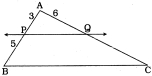
Solution
(N/A) In $\Delta ABC$,$A-P-B$,$A-Q-C$ and $\overleftrightarrow{PQ} \parallel \overleftrightarrow{BC}$.
By the Basic Proportionality Theorem (Thales Theorem):
$\frac{AP}{PB} = \frac{AQ}{QC}$
Given $AP = 3$,$PB = 5$,$AQ = 6$.
$\frac{3}{5} = \frac{6}{QC}$
$QC = \frac{6 \times 5}{3} = 10$.
Now,to find $AC$:
$AC = AQ + QC = 6 + 10 = 16$.
Alternatively,using the corollary $\frac{AP}{AB} = \frac{AQ}{AC}$:
$\frac{3}{3+5} = \frac{6}{AC}$
$\frac{3}{8} = \frac{6}{AC}$
$AC = \frac{6 \times 8}{3} = 16$.
By the Basic Proportionality Theorem (Thales Theorem):
$\frac{AP}{PB} = \frac{AQ}{QC}$
Given $AP = 3$,$PB = 5$,$AQ = 6$.
$\frac{3}{5} = \frac{6}{QC}$
$QC = \frac{6 \times 5}{3} = 10$.
Now,to find $AC$:
$AC = AQ + QC = 6 + 10 = 16$.
Alternatively,using the corollary $\frac{AP}{AB} = \frac{AQ}{AC}$:
$\frac{3}{3+5} = \frac{6}{AC}$
$\frac{3}{8} = \frac{6}{AC}$
$AC = \frac{6 \times 8}{3} = 16$.
0 likes
View Solution98
MediumMCQ
In $\Delta XYZ$,the bisector of $\angle X$ intersects $\overline{YZ}$ at $M$. If $XY = 6$,$XZ = 8$ and $YM = 4.2$,find $YZ$.
A
$3.2$
B
$9.8$
C
$4.6$
D
$7.8$
Solution
(B) In $\Delta XYZ$,$XM$ is the bisector of $\angle X$,which intersects $\overline{YZ}$ at $M$.
According to the Angle Bisector Theorem,the ratio of the sides forming the angle is equal to the ratio of the segments of the opposite side.
$\therefore \frac{XY}{XZ} = \frac{YM}{MZ}$
Substituting the given values:
$\therefore \frac{6}{8} = \frac{4.2}{MZ}$
$\therefore MZ = \frac{4.2 \times 8}{6}$
$\therefore MZ = 0.7 \times 8 = 5.6$
Now,$YZ = YM + MZ$ (since $Y-M-Z$ are collinear).
$YZ = 4.2 + 5.6 = 9.8$.
According to the Angle Bisector Theorem,the ratio of the sides forming the angle is equal to the ratio of the segments of the opposite side.
$\therefore \frac{XY}{XZ} = \frac{YM}{MZ}$
Substituting the given values:
$\therefore \frac{6}{8} = \frac{4.2}{MZ}$
$\therefore MZ = \frac{4.2 \times 8}{6}$
$\therefore MZ = 0.7 \times 8 = 5.6$
Now,$YZ = YM + MZ$ (since $Y-M-Z$ are collinear).
$YZ = 4.2 + 5.6 = 9.8$.
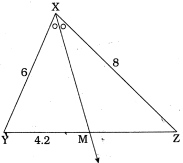
0 likes
View Solution99
MediumMCQ
In $\Delta ABC$,the bisector of $\angle A$ intersects $\overline{BC}$ at $D$. If $\frac{AB}{5} = \frac{AC}{3}$ and $BD = 4.5$,find $BC$.
A
$4.5$
B
$3.6$
C
$7.2$
D
$6.2$
Solution
(C) In $\Delta ABC$,the bisector of $\angle A$ intersects $\overline{BC}$ at $D$. According to the Angle Bisector Theorem:
$\frac{AB}{AC} = \frac{BD}{DC}$
Given $\frac{AB}{5} = \frac{AC}{3}$,we have $\frac{AB}{AC} = \frac{5}{3}$.
Substituting the values:
$\frac{5}{3} = \frac{4.5}{DC}$
$DC = \frac{4.5 \times 3}{5} = 0.9 \times 3 = 2.7$
Since $D$ lies on $BC$,$BC = BD + DC$.
$BC = 4.5 + 2.7 = 7.2$.
$\frac{AB}{AC} = \frac{BD}{DC}$
Given $\frac{AB}{5} = \frac{AC}{3}$,we have $\frac{AB}{AC} = \frac{5}{3}$.
Substituting the values:
$\frac{5}{3} = \frac{4.5}{DC}$
$DC = \frac{4.5 \times 3}{5} = 0.9 \times 3 = 2.7$
Since $D$ lies on $BC$,$BC = BD + DC$.
$BC = 4.5 + 2.7 = 7.2$.
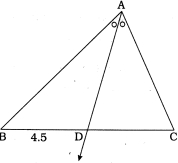
0 likes
View Solution100
Difficult
In $\Delta ABC$,the bisector of $\angle A$ intersects $\overline{BC}$ at $D$. Prove that $BD = \frac{BC \times AB}{AB + AC}$ and $DC = \frac{BC \times AC}{AB + AC}$.
Solution
(N/A) In $\Delta ABC$,the bisector of $\angle A$ intersects $\overline{BC}$ at $D$.
By the Angle Bisector Theorem,we have:
$\frac{AB}{AC} = \frac{BD}{DC}$
To find $BD$:
$\frac{AB}{AC} = \frac{BD}{DC}$
Using the property of Componendo,$\frac{AB + AC}{AC} = \frac{BD + DC}{DC} = \frac{BC}{DC}$
This does not directly give $BD$. Let's use $\frac{AB}{AC} = \frac{BD}{DC} \implies \frac{AB}{AB + AC} = \frac{BD}{BD + DC} = \frac{BD}{BC}$
$\therefore BD = \frac{BC \times AB}{AB + AC}$
To find $DC$:
$\frac{AB}{AC} = \frac{BD}{DC} \implies \frac{AC}{AB} = \frac{DC}{BD}$
Using Componendo,$\frac{AC + AB}{AB} = \frac{DC + BD}{BD} = \frac{BC}{BD}$
$\implies \frac{AC}{AC + AB} = \frac{DC}{BC}$
$\therefore DC = \frac{BC \times AC}{AB + AC}$
By the Angle Bisector Theorem,we have:
$\frac{AB}{AC} = \frac{BD}{DC}$
To find $BD$:
$\frac{AB}{AC} = \frac{BD}{DC}$
Using the property of Componendo,$\frac{AB + AC}{AC} = \frac{BD + DC}{DC} = \frac{BC}{DC}$
This does not directly give $BD$. Let's use $\frac{AB}{AC} = \frac{BD}{DC} \implies \frac{AB}{AB + AC} = \frac{BD}{BD + DC} = \frac{BD}{BC}$
$\therefore BD = \frac{BC \times AB}{AB + AC}$
To find $DC$:
$\frac{AB}{AC} = \frac{BD}{DC} \implies \frac{AC}{AB} = \frac{DC}{BD}$
Using Componendo,$\frac{AC + AB}{AB} = \frac{DC + BD}{BD} = \frac{BC}{BD}$
$\implies \frac{AC}{AC + AB} = \frac{DC}{BC}$
$\therefore DC = \frac{BC \times AC}{AB + AC}$
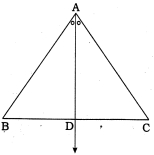
0 likes
View SolutionTriangles — Mix Examples - Triangles · Frequently Asked Questions
1Are these Triangles questions useful for JEE and NEET?
Yes. All questions in this section are mapped to JEE Main and NEET exam patterns. Previous year questions from JEE Main, NEET, GUJCET and state-level exams are included with full solutions.
2Can I switch to Hindi or Gujarati for these questions?
Yes. Use the language tabs in the hero section or the sidebar to view the same questions and solutions in English, Hindi or Gujarati.
3How do I generate a question paper from this subtopic?
Use the Vedclass Exam Paper Generator — select the chapter and subtopic, set difficulty, and generate Sets A, B, C, D automatically. First 3 chapters of every subject are free.
Vedclass Products
For Students
Vedclass Test Series
Mock tests in real JEE/NEET style with performance analysis. 5-day free trial.
Start Free TrialFor Teachers
Exam Paper Generator
Generate Set A/B/C/D papers from this chapter in 2 minutes. 3 chapters free.
Try FreeFor Institutes
Online Exam Module
Live online exams with unlimited students, 360° analytics & white-label branding.
See DemoFor Teachers & Institutes
Generate a Triangles Exam Paper in 2 Minutes
Select subtopic & difficulty — Sets A, B, C, D auto-generated with No Repeat logic.
First 3 chapters of every subject are free — no payment required.