
A English
Mix Examples - Probability Questions in English
Class 10 Mathematics · Probability · Mix Examples - Probability
199+
Questions
English
Language
100%
With Solutions
Showing 50 of 199 questions in English
51
MediumMCQ
Find the probability of getting number $2$ on a die when a fair die is thrown.
A
$\frac{1}{4}$
B
$\frac{1}{2}$
C
$\frac{1}{6}$
D
$\frac{1}{3}$
Solution
(C) In the experiment of throwing a fair die,the possible equally likely outcomes are $1, 2, 3, 4, 5,$ and $6.$
Let event $A$ be the event of 'getting $2$ on the die.' Then,the number of outcomes favourable to $A$ is only $1.$
$\therefore P(A) = \text{P(getting } 2 \text{ on the die)}$
$= \frac{\text{Number of outcomes favourable to } A}{\text{Number of all possible outcomes}}$
$= \frac{1}{6}$
Thus,the probability of getting number $2$ on the die is $\frac{1}{6}$.
Let event $A$ be the event of 'getting $2$ on the die.' Then,the number of outcomes favourable to $A$ is only $1.$
$\therefore P(A) = \text{P(getting } 2 \text{ on the die)}$
$= \frac{\text{Number of outcomes favourable to } A}{\text{Number of all possible outcomes}}$
$= \frac{1}{6}$
Thus,the probability of getting number $2$ on the die is $\frac{1}{6}$.
0 likes
View Solution52
MediumMCQ
$A$ balanced die is thrown once. Find the probability of getting a prime number.
A
$\frac{1}{8}$
B
$\frac{1}{4}$
C
$\frac{1}{3}$
D
$\frac{1}{2}$
Solution
(D) There are six elementary outcomes in the experiment of throwing a balanced die once: $1, 2, 3, 4, 5, 6$.
Let event $A$ be: 'The number on the die is a prime number'.
The prime numbers among the outcomes are $2, 3, 5$.
Thus,the number of outcomes favourable to event $A$ is $3$.
The total number of possible outcomes is $6$.
Therefore,the probability of event $A$ is $P(A) = \frac{\text{Number of favourable outcomes}}{\text{Total number of possible outcomes}} = \frac{3}{6} = \frac{1}{2}$.
Thus,the probability of getting a prime number on the die is $\frac{1}{2}$.
Let event $A$ be: 'The number on the die is a prime number'.
The prime numbers among the outcomes are $2, 3, 5$.
Thus,the number of outcomes favourable to event $A$ is $3$.
The total number of possible outcomes is $6$.
Therefore,the probability of event $A$ is $P(A) = \frac{\text{Number of favourable outcomes}}{\text{Total number of possible outcomes}} = \frac{3}{6} = \frac{1}{2}$.
Thus,the probability of getting a prime number on the die is $\frac{1}{2}$.
0 likes
View Solution53
MediumMCQ
$A$ balanced die is thrown once. Find the probability of getting a number greater than $4$.
A
$\frac{1}{3}$
B
$\frac{1}{2}$
C
$\frac{1}{4}$
D
$\frac{1}{6}$
Solution
(A) There are six elementary outcomes in the experiment of throwing a balanced die once: $1, 2, 3, 4, 5, 6$.
Let event $A$ be: 'The number on the die is greater than $4$.'
The outcomes favourable to event $A$ are $5$ and $6$.
Hence,the number of outcomes favourable to event $A$ is $2$.
$\therefore P(A) = P(\text{The number on the die is greater than } 4) = \frac{\text{Number of outcomes favourable to } A}{\text{Number of all possible outcomes}}$.
$P(A) = \frac{2}{6} = \frac{1}{3}$.
Thus,the probability of getting a number greater than $4$ is $\frac{1}{3}$.
Let event $A$ be: 'The number on the die is greater than $4$.'
The outcomes favourable to event $A$ are $5$ and $6$.
Hence,the number of outcomes favourable to event $A$ is $2$.
$\therefore P(A) = P(\text{The number on the die is greater than } 4) = \frac{\text{Number of outcomes favourable to } A}{\text{Number of all possible outcomes}}$.
$P(A) = \frac{2}{6} = \frac{1}{3}$.
Thus,the probability of getting a number greater than $4$ is $\frac{1}{3}$.
0 likes
View Solution54
MediumMCQ
$A$ balanced die is thrown once. Find the probability of getting a number smaller than $4$.
A
$\frac{1}{4}$
B
$\frac{1}{2}$
C
$\frac{1}{3}$
D
$\frac{1}{5}$
Solution
(B) There are six elementary outcomes in the experiment of throwing a balanced die once: $1, 2, 3, 4, 5, 6$.
Let event $B$ be: 'The number on the die is smaller than $4$.'
The outcomes favourable to event $B$ are $1, 2,$ and $3$.
Hence,the number of outcomes favourable to event $B$ is $3$.
Therefore,the probability $P(B)$ is given by:
$P(B) = \frac{\text{Number of outcomes favourable to } B}{\text{Total number of possible outcomes}}$
$P(B) = \frac{3}{6}$
$P(B) = \frac{1}{2}$
Thus,the probability of getting a number smaller than $4$ is $\frac{1}{2}$.
Let event $B$ be: 'The number on the die is smaller than $4$.'
The outcomes favourable to event $B$ are $1, 2,$ and $3$.
Hence,the number of outcomes favourable to event $B$ is $3$.
Therefore,the probability $P(B)$ is given by:
$P(B) = \frac{\text{Number of outcomes favourable to } B}{\text{Total number of possible outcomes}}$
$P(B) = \frac{3}{6}$
$P(B) = \frac{1}{2}$
Thus,the probability of getting a number smaller than $4$ is $\frac{1}{2}$.
0 likes
View Solution55
MediumMCQ
$A$ card is selected at random from a well-shuffled pack of $52$ cards. Find the probability that the selected card is a seven.
A
$\frac{1}{33}$
B
$\frac{1}{23}$
C
$\frac{1}{13}$
D
$\frac{1}{18}$
Solution
(C) In the experiment of selecting a card at random from a well-shuffled pack of $52$ cards,
the total number of elementary outcomes is $52$.
Let event $A$ be: "The selected card is a seven."
The number of outcomes favourable to event $A$ is $4$,as there are $4$ sevens in a standard pack of cards (one for each suit: Hearts,Diamonds,Clubs,and Spades).
Therefore,the probability $P(A)$ is given by the ratio of favourable outcomes to total outcomes:
$P(A) = \frac{4}{52} = \frac{1}{13}$.
Thus,the probability that the selected card is a seven is $\frac{1}{13}$.
the total number of elementary outcomes is $52$.
Let event $A$ be: "The selected card is a seven."
The number of outcomes favourable to event $A$ is $4$,as there are $4$ sevens in a standard pack of cards (one for each suit: Hearts,Diamonds,Clubs,and Spades).
Therefore,the probability $P(A)$ is given by the ratio of favourable outcomes to total outcomes:
$P(A) = \frac{4}{52} = \frac{1}{13}$.
Thus,the probability that the selected card is a seven is $\frac{1}{13}$.
0 likes
View Solution56
MediumMCQ
$A$ card is selected at random from a well-shuffled pack of $52$ cards. Find the probability that the selected card is that of spades.
A
$1/8$
B
$1/2$
C
$1/3$
D
$1/4$
Solution
(D) In the experiment of selecting a card at random from a well-shuffled pack of $52$ cards,the total number of elementary outcomes is $52$.
Let event $B$ be: "The selected card is a spade."
The number of outcomes favourable to event $B$ is $13$,as there are $13$ cards of spades in a standard pack of $52$ cards.
Therefore,the probability $P(B)$ is given by:
$P(B) = \frac{\text{Number of favourable outcomes}}{\text{Total number of outcomes}} = \frac{13}{52} = \frac{1}{4}$.
Thus,the probability that the selected card is a spade is $\frac{1}{4}$.
Let event $B$ be: "The selected card is a spade."
The number of outcomes favourable to event $B$ is $13$,as there are $13$ cards of spades in a standard pack of $52$ cards.
Therefore,the probability $P(B)$ is given by:
$P(B) = \frac{\text{Number of favourable outcomes}}{\text{Total number of outcomes}} = \frac{13}{52} = \frac{1}{4}$.
Thus,the probability that the selected card is a spade is $\frac{1}{4}$.
0 likes
View Solution57
MediumMCQ
$A$ card is selected at random from a well-shuffled pack of $52$ cards. Find the probability that the selected card is of a black suit.
A
$1/2$
B
$1/4$
C
$1/6$
D
$1/3$
Solution
(A) In the experiment of selecting a card at random from a well-shuffled pack of $52$ cards,the total number of elementary outcomes is $52$.
Let event $C$ be the event that the selected card is of a black suit.
$A$ pack of $52$ cards contains two black suits: Spades ($13$ cards) and Clubs ($13$ cards).
Therefore,the number of outcomes favourable to event $C$ is $13 + 13 = 26$.
The probability of event $C$ is given by $P(C) = \frac{\text{Number of favourable outcomes}}{\text{Total number of outcomes}}$.
$P(C) = \frac{26}{52} = \frac{1}{2}$.
Thus,the probability that the selected card is of a black suit is $1/2$.
Let event $C$ be the event that the selected card is of a black suit.
$A$ pack of $52$ cards contains two black suits: Spades ($13$ cards) and Clubs ($13$ cards).
Therefore,the number of outcomes favourable to event $C$ is $13 + 13 = 26$.
The probability of event $C$ is given by $P(C) = \frac{\text{Number of favourable outcomes}}{\text{Total number of outcomes}}$.
$P(C) = \frac{26}{52} = \frac{1}{2}$.
Thus,the probability that the selected card is of a black suit is $1/2$.
0 likes
View Solution58
MediumMCQ
$A$ card is selected at random from a well-shuffled pack of $52$ cards. Find the probability that the selected card is not a king.
A
$\frac{13}{18}$
B
$\frac{12}{13}$
C
$\frac{19}{23}$
D
$\frac{11}{13}$
Solution
(B) In the experiment of selecting a card at random from a well-shuffled pack of $52$ cards,the total number of elementary outcomes is $52$.
Let event $D$ be the event that the selected card is not a king.
Let event $\bar{D}$ be the event that the selected card is a king.
The number of outcomes favourable to event $\bar{D}$ is $4$,as there are $4$ kings in a standard pack of cards.
Therefore,$P(\bar{D}) = \frac{4}{52} = \frac{1}{13}$.
Using the complement rule,$P(D) = 1 - P(\bar{D})$.
Therefore,$P(D) = 1 - \frac{1}{13} = \frac{12}{13}$.
Thus,the probability that the selected card is not a king is $\frac{12}{13}$.
Let event $D$ be the event that the selected card is not a king.
Let event $\bar{D}$ be the event that the selected card is a king.
The number of outcomes favourable to event $\bar{D}$ is $4$,as there are $4$ kings in a standard pack of cards.
Therefore,$P(\bar{D}) = \frac{4}{52} = \frac{1}{13}$.
Using the complement rule,$P(D) = 1 - P(\bar{D})$.
Therefore,$P(D) = 1 - \frac{1}{13} = \frac{12}{13}$.
Thus,the probability that the selected card is not a king is $\frac{12}{13}$.
0 likes
View Solution59
EasyMCQ
$A$ card is selected at random from a well-shuffled pack of $52$ cards. Find the probability that the selected card is the queen of hearts.
A
$1/92$
B
$1/45$
C
$1/52$
D
$1/22$
Solution
(C) In the experiment of selecting a card at random from a well-shuffled pack of $52$ cards,the total number of elementary outcomes is $52$.
Let event $E$ be: 'The selected card is the queen of hearts.'
The number of outcomes favourable to event $E$ is $1$,as there is only one queen of hearts in a standard pack of $52$ cards.
The probability of an event is given by the formula: $P(E) = \frac{\text{Number of favourable outcomes}}{\text{Total number of possible outcomes}}$.
Therefore,$P(E) = \frac{1}{52}$.
Thus,the probability that the selected card is the queen of hearts is $\frac{1}{52}$.
Let event $E$ be: 'The selected card is the queen of hearts.'
The number of outcomes favourable to event $E$ is $1$,as there is only one queen of hearts in a standard pack of $52$ cards.
The probability of an event is given by the formula: $P(E) = \frac{\text{Number of favourable outcomes}}{\text{Total number of possible outcomes}}$.
Therefore,$P(E) = \frac{1}{52}$.
Thus,the probability that the selected card is the queen of hearts is $\frac{1}{52}$.
0 likes
View Solution60
DifficultMCQ
Two unbiased dice are thrown once. Write all the possible outcomes of this experiment. What is the probability that the sum of numbers on two dice is $8$?
A
$\frac{2}{33}$
B
$\frac{3}{36}$
C
$\frac{4}{36}$
D
$\frac{5}{36}$
Solution
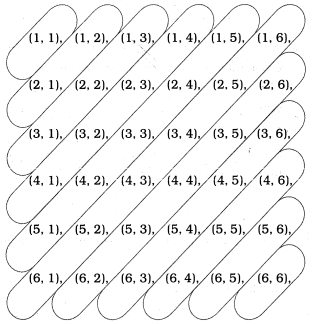
(D) When two unbiased dice are thrown,the total number of possible outcomes is $6 \times 6 = 36$. The sample space $S$ is given by:
$S = \{(1,1), (1,2), (1,3), (1,4), (1,5), (1,6), (2,1), (2,2), (2,3), (2,4), (2,5), (2,6), (3,1), (3,2), (3,3), (3,4), (3,5), (3,6), (4,1), (4,2), (4,3), (4,4), (4,5), (4,6), (5,1), (5,2), (5,3), (5,4), (5,5), (5,6), (6,1), (6,2), (6,3), (6,4), (6,5), (6,6)\}$
Let $A$ be the event that the sum of the numbers on the two dice is $8$.
The outcomes favourable to event $A$ are $(2,6), (3,5), (4,4), (5,3), (6,2)$.
The number of favourable outcomes is $n(A) = 5$.
The probability of event $A$ is given by $P(A) = \frac{n(A)}{n(S)} = \frac{5}{36}$.
$S = \{(1,1), (1,2), (1,3), (1,4), (1,5), (1,6), (2,1), (2,2), (2,3), (2,4), (2,5), (2,6), (3,1), (3,2), (3,3), (3,4), (3,5), (3,6), (4,1), (4,2), (4,3), (4,4), (4,5), (4,6), (5,1), (5,2), (5,3), (5,4), (5,5), (5,6), (6,1), (6,2), (6,3), (6,4), (6,5), (6,6)\}$
Let $A$ be the event that the sum of the numbers on the two dice is $8$.
The outcomes favourable to event $A$ are $(2,6), (3,5), (4,4), (5,3), (6,2)$.
The number of favourable outcomes is $n(A) = 5$.
The probability of event $A$ is given by $P(A) = \frac{n(A)}{n(S)} = \frac{5}{36}$.
0 likes
View Solution61
MediumMCQ
Two unbiased dice are thrown once. Write all the possible outcomes of this experiment. What is the probability that the sum of numbers on two dice is $4$?
A
$\frac{1}{12}$
B
$\frac{1}{8}$
C
$\frac{1}{6}$
D
$\frac{1}{22}$
Solution
(A) When two unbiased dice are thrown,the sample space $S$ consists of all possible ordered pairs $(x, y)$ where $x, y \in \{1, 2, 3, 4, 5, 6\}$.
The total number of elementary outcomes is $6 \times 6 = 36$.
The sample space is:
$S = \{(1,1), (1,2), (1,3), (1,4), (1,5), (1,6), (2,1), (2,2), (2,3), (2,4), (2,5), (2,6), (3,1), (3,2), (3,3), (3,4), (3,5), (3,6), (4,1), (4,2), (4,3), (4,4), (4,5), (4,6), (5,1), (5,2), (5,3), (5,4), (5,5), (5,6), (6,1), (6,2), (6,3), (6,4), (6,5), (6,6)\}$
Let $B$ be the event that the sum of the numbers on the two dice is $4$.
The outcomes favourable to event $B$ are $(1,3), (2,2), (3,1)$.
The number of favourable outcomes is $n(B) = 3$.
The probability of event $B$ is given by $P(B) = \frac{n(B)}{n(S)} = \frac{3}{36} = \frac{1}{12}$.
The total number of elementary outcomes is $6 \times 6 = 36$.
The sample space is:
$S = \{(1,1), (1,2), (1,3), (1,4), (1,5), (1,6), (2,1), (2,2), (2,3), (2,4), (2,5), (2,6), (3,1), (3,2), (3,3), (3,4), (3,5), (3,6), (4,1), (4,2), (4,3), (4,4), (4,5), (4,6), (5,1), (5,2), (5,3), (5,4), (5,5), (5,6), (6,1), (6,2), (6,3), (6,4), (6,5), (6,6)\}$
Let $B$ be the event that the sum of the numbers on the two dice is $4$.
The outcomes favourable to event $B$ are $(1,3), (2,2), (3,1)$.
The number of favourable outcomes is $n(B) = 3$.
The probability of event $B$ is given by $P(B) = \frac{n(B)}{n(S)} = \frac{3}{36} = \frac{1}{12}$.
0 likes
View Solution62
MediumMCQ
Two unbiased dice are thrown once. Write all the possible outcomes of this experiment. What is the probability that the sum of numbers on two dice is greater than $9$?
A
$\frac{1}{5}$
B
$\frac{1}{6}$
C
$\frac{1}{4}$
D
$\frac{1}{3}$
Solution
(B) When two unbiased dice are thrown,the total number of possible outcomes is $6 \times 6 = 36$. The sample space $S$ is given by:
$S = \{(1,1), (1,2), (1,3), (1,4), (1,5), (1,6), (2,1), (2,2), (2,3), (2,4), (2,5), (2,6), (3,1), (3,2), (3,3), (3,4), (3,5), (3,6), (4,1), (4,2), (4,3), (4,4), (4,5), (4,6), (5,1), (5,2), (5,3), (5,4), (5,5), (5,6), (6,1), (6,2), (6,3), (6,4), (6,5), (6,6)\}$
Let event $C$ be the event that the sum of the numbers on the two dice is greater than $9$. This means the sum can be $10, 11,$ or $12$.
The outcomes favourable to event $C$ are:
Sum $= 10: (4,6), (5,5), (6,4)$
Sum $= 11: (5,6), (6,5)$
Sum $= 12: (6,6)$
Thus,the number of favourable outcomes is $n(C) = 3 + 2 + 1 = 6$.
The probability of event $C$ is given by $P(C) = \frac{n(C)}{n(S)} = \frac{6}{36} = \frac{1}{6}$.
$S = \{(1,1), (1,2), (1,3), (1,4), (1,5), (1,6), (2,1), (2,2), (2,3), (2,4), (2,5), (2,6), (3,1), (3,2), (3,3), (3,4), (3,5), (3,6), (4,1), (4,2), (4,3), (4,4), (4,5), (4,6), (5,1), (5,2), (5,3), (5,4), (5,5), (5,6), (6,1), (6,2), (6,3), (6,4), (6,5), (6,6)\}$
Let event $C$ be the event that the sum of the numbers on the two dice is greater than $9$. This means the sum can be $10, 11,$ or $12$.
The outcomes favourable to event $C$ are:
Sum $= 10: (4,6), (5,5), (6,4)$
Sum $= 11: (5,6), (6,5)$
Sum $= 12: (6,6)$
Thus,the number of favourable outcomes is $n(C) = 3 + 2 + 1 = 6$.
The probability of event $C$ is given by $P(C) = \frac{n(C)}{n(S)} = \frac{6}{36} = \frac{1}{6}$.
0 likes
View Solution63
MediumMCQ
Two unbiased dice are thrown once. Write all the possible outcomes of this experiment. What is the probability that the sum of numbers on two dice is smaller than $5$?
A
$\frac{1}{7}$
B
$\frac{1}{3}$
C
$\frac{1}{6}$
D
$\frac{1}{4}$
Solution
(C) When two unbiased dice are thrown,the sample space $S$ consists of $6 \times 6 = 36$ possible outcomes:
$S = \{(1,1), (1,2), (1,3), (1,4), (1,5), (1,6), (2,1), (2,2), (2,3), (2,4), (2,5), (2,6), (3,1), (3,2), (3,3), (3,4), (3,5), (3,6), (4,1), (4,2), (4,3), (4,4), (4,5), (4,6), (5,1), (5,2), (5,3), (5,4), (5,5), (5,6), (6,1), (6,2), (6,3), (6,4), (6,5), (6,6)\}$
Total number of outcomes $n(S) = 36$.
Let $E$ be the event that the sum of the numbers on the two dice is smaller than $5$.
The possible sums smaller than $5$ are $2, 3,$ and $4$.
The outcomes favourable to event $E$ are:
Sum $= 2: (1,1)$
Sum $= 3: (1,2), (2,1)$
Sum $= 4: (1,3), (2,2), (3,1)$
Thus,the number of favourable outcomes $n(E) = 1 + 2 + 3 = 6$.
The probability $P(E) = \frac{n(E)}{n(S)} = \frac{6}{36} = \frac{1}{6}$.
$S = \{(1,1), (1,2), (1,3), (1,4), (1,5), (1,6), (2,1), (2,2), (2,3), (2,4), (2,5), (2,6), (3,1), (3,2), (3,3), (3,4), (3,5), (3,6), (4,1), (4,2), (4,3), (4,4), (4,5), (4,6), (5,1), (5,2), (5,3), (5,4), (5,5), (5,6), (6,1), (6,2), (6,3), (6,4), (6,5), (6,6)\}$
Total number of outcomes $n(S) = 36$.
Let $E$ be the event that the sum of the numbers on the two dice is smaller than $5$.
The possible sums smaller than $5$ are $2, 3,$ and $4$.
The outcomes favourable to event $E$ are:
Sum $= 2: (1,1)$
Sum $= 3: (1,2), (2,1)$
Sum $= 4: (1,3), (2,2), (3,1)$
Thus,the number of favourable outcomes $n(E) = 1 + 2 + 3 = 6$.
The probability $P(E) = \frac{n(E)}{n(S)} = \frac{6}{36} = \frac{1}{6}$.
0 likes
View Solution64
MediumMCQ
Two unbiased dice are thrown once. Write all the possible outcomes of this experiment. What is the probability that the sum of numbers on two dice is a multiple of $3$ or $4$?
A
$\frac{5}{7}$
B
$\frac{1}{9}$
C
$\frac{7}{9}$
D
$\frac{5}{9}$
Solution
(D) When two unbiased dice are thrown,the total number of possible outcomes is $6 \times 6 = 36$. The sample space $S$ is given by:
$S = \{(1,1), (1,2), (1,3), (1,4), (1,5), (1,6), (2,1), (2,2), (2,3), (2,4), (2,5), (2,6), (3,1), (3,2), (3,3), (3,4), (3,5), (3,6), (4,1), (4,2), (4,3), (4,4), (4,5), (4,6), (5,1), (5,2), (5,3), (5,4), (5,5), (5,6), (6,1), (6,2), (6,3), (6,4), (6,5), (6,6)\}$
Let $E$ be the event that the sum of the numbers on the two dice is a multiple of $3$ or $4$. The possible sums range from $2$ to $12$. Multiples of $3$ are $3, 6, 9, 12$. Multiples of $4$ are $4, 8, 12$.
Thus,we need the sum to be in the set $\{3, 4, 6, 8, 9, 12\}$.
Outcomes with sum $3$: $(1,2), (2,1)$
Outcomes with sum $4$: $(1,3), (2,2), (3,1)$
Outcomes with sum $6$: $(1,5), (2,4), (3,3), (4,2), (5,1)$
Outcomes with sum $8$: $(2,6), (3,5), (4,4), (5,3), (6,2)$
Outcomes with sum $9$: $(3,6), (4,5), (5,4), (6,3)$
Outcomes with sum $12$: $(6,6)$
Total favorable outcomes = $2 + 3 + 5 + 5 + 4 + 1 = 20$.
Probability $P(E) = \frac{\text{Number of favorable outcomes}}{\text{Total number of outcomes}} = \frac{20}{36} = \frac{5}{9}$.
$S = \{(1,1), (1,2), (1,3), (1,4), (1,5), (1,6), (2,1), (2,2), (2,3), (2,4), (2,5), (2,6), (3,1), (3,2), (3,3), (3,4), (3,5), (3,6), (4,1), (4,2), (4,3), (4,4), (4,5), (4,6), (5,1), (5,2), (5,3), (5,4), (5,5), (5,6), (6,1), (6,2), (6,3), (6,4), (6,5), (6,6)\}$
Let $E$ be the event that the sum of the numbers on the two dice is a multiple of $3$ or $4$. The possible sums range from $2$ to $12$. Multiples of $3$ are $3, 6, 9, 12$. Multiples of $4$ are $4, 8, 12$.
Thus,we need the sum to be in the set $\{3, 4, 6, 8, 9, 12\}$.
Outcomes with sum $3$: $(1,2), (2,1)$
Outcomes with sum $4$: $(1,3), (2,2), (3,1)$
Outcomes with sum $6$: $(1,5), (2,4), (3,3), (4,2), (5,1)$
Outcomes with sum $8$: $(2,6), (3,5), (4,4), (5,3), (6,2)$
Outcomes with sum $9$: $(3,6), (4,5), (5,4), (6,3)$
Outcomes with sum $12$: $(6,6)$
Total favorable outcomes = $2 + 3 + 5 + 5 + 4 + 1 = 20$.
Probability $P(E) = \frac{\text{Number of favorable outcomes}}{\text{Total number of outcomes}} = \frac{20}{36} = \frac{5}{9}$.
0 likes
View Solution65
MediumMCQ
Two unbiased dice are thrown once. Write all the possible outcomes of this experiment. What is the probability that the sum of the numbers on the two dice is a multiple of $3$ and $4$?
A
$\frac{1}{36}$
B
$\frac{1}{6}$
C
$\frac{3}{36}$
D
$\frac{5}{36}$
Solution
(A) When two unbiased dice are thrown,the total number of possible outcomes is $6 \times 6 = 36$. The sample space $S$ is given by:
$S = \{(1,1), (1,2), (1,3), (1,4), (1,5), (1,6), (2,1), (2,2), (2,3), (2,4), (2,5), (2,6), (3,1), (3,2), (3,3), (3,4), (3,5), (3,6), (4,1), (4,2), (4,3), (4,4), (4,5), (4,6), (5,1), (5,2), (5,3), (5,4), (5,5), (5,6), (6,1), (6,2), (6,3), (6,4), (6,5), (6,6)\}$
We need the sum of the numbers on the two dice to be a multiple of both $3$ and $4$. The least common multiple of $3$ and $4$ is $12$. Thus,we are looking for outcomes where the sum is $12$.
The only outcome where the sum is $12$ is $(6,6)$.
Number of favorable outcomes $= 1$.
Probability $P(E) = \frac{\text{Number of favorable outcomes}}{\text{Total number of outcomes}} = \frac{1}{36}$.
$S = \{(1,1), (1,2), (1,3), (1,4), (1,5), (1,6), (2,1), (2,2), (2,3), (2,4), (2,5), (2,6), (3,1), (3,2), (3,3), (3,4), (3,5), (3,6), (4,1), (4,2), (4,3), (4,4), (4,5), (4,6), (5,1), (5,2), (5,3), (5,4), (5,5), (5,6), (6,1), (6,2), (6,3), (6,4), (6,5), (6,6)\}$
We need the sum of the numbers on the two dice to be a multiple of both $3$ and $4$. The least common multiple of $3$ and $4$ is $12$. Thus,we are looking for outcomes where the sum is $12$.
The only outcome where the sum is $12$ is $(6,6)$.
Number of favorable outcomes $= 1$.
Probability $P(E) = \frac{\text{Number of favorable outcomes}}{\text{Total number of outcomes}} = \frac{1}{36}$.
0 likes
View Solution66
MediumMCQ
Two unbiased dice are thrown once. Write all the possible outcomes of this experiment. What is the probability that the sum of numbers on two dice is a prime number?
A
$\frac{5}{7}$
B
$\frac{5}{12}$
C
$\frac{5}{8}$
D
$\frac{5}{11}$
Solution
(B) When two unbiased dice are thrown,the total number of possible outcomes is $6 \times 6 = 36$. The sample space $S$ is given by:
$S = \{(1, 1), (1, 2), (1, 3), (1, 4), (1, 5), (1, 6), (2, 1), (2, 2), (2, 3), (2, 4), (2, 5), (2, 6), (3, 1), (3, 2), (3, 3), (3, 4), (3, 5), (3, 6), (4, 1), (4, 2), (4, 3), (4, 4), (4, 5), (4, 6), (5, 1), (5, 2), (5, 3), (5, 4), (5, 5), (5, 6), (6, 1), (6, 2), (6, 3), (6, 4), (6, 5), (6, 6)\}$
Let $E$ be the event that the sum of the numbers on the two dice is a prime number. The possible prime sums are $2, 3, 5, 7,$ and $11$.
The outcomes favorable to event $E$ are:
Sum $= 2: (1, 1)$
Sum $= 3: (1, 2), (2, 1)$
Sum $= 5: (1, 4), (2, 3), (3, 2), (4, 1)$
Sum $= 7: (1, 6), (2, 5), (3, 4), (4, 3), (5, 2), (6, 1)$
Sum $= 11: (5, 6), (6, 5)$
Total number of favorable outcomes $= 1 + 2 + 4 + 6 + 2 = 15$.
Therefore,the probability $P(E) = \frac{\text{Number of favorable outcomes}}{\text{Total number of outcomes}} = \frac{15}{36} = \frac{5}{12}$.
$S = \{(1, 1), (1, 2), (1, 3), (1, 4), (1, 5), (1, 6), (2, 1), (2, 2), (2, 3), (2, 4), (2, 5), (2, 6), (3, 1), (3, 2), (3, 3), (3, 4), (3, 5), (3, 6), (4, 1), (4, 2), (4, 3), (4, 4), (4, 5), (4, 6), (5, 1), (5, 2), (5, 3), (5, 4), (5, 5), (5, 6), (6, 1), (6, 2), (6, 3), (6, 4), (6, 5), (6, 6)\}$
Let $E$ be the event that the sum of the numbers on the two dice is a prime number. The possible prime sums are $2, 3, 5, 7,$ and $11$.
The outcomes favorable to event $E$ are:
Sum $= 2: (1, 1)$
Sum $= 3: (1, 2), (2, 1)$
Sum $= 5: (1, 4), (2, 3), (3, 2), (4, 1)$
Sum $= 7: (1, 6), (2, 5), (3, 4), (4, 3), (5, 2), (6, 1)$
Sum $= 11: (5, 6), (6, 5)$
Total number of favorable outcomes $= 1 + 2 + 4 + 6 + 2 = 15$.
Therefore,the probability $P(E) = \frac{\text{Number of favorable outcomes}}{\text{Total number of outcomes}} = \frac{15}{36} = \frac{5}{12}$.
0 likes
View Solution67
MediumMCQ
Two unbiased dice are thrown once. Write all the possible outcomes of this experiment. What is the probability that the sum of numbers on two dice is a factor of $18$?
A
$\frac{2}{3}$
B
$\frac{1}{7}$
C
$\frac{1}{3}$
D
$\frac{1}{5}$
Solution
(C) When two unbiased dice are thrown,the total number of possible outcomes is $6 \times 6 = 36$.
The possible outcomes are:
$(1,1), (1,2), (1,3), (1,4), (1,5), (1,6)$
$(2,1), (2,2), (2,3), (2,4), (2,5), (2,6)$
$(3,1), (3,2), (3,3), (3,4), (3,5), (3,6)$
$(4,1), (4,2), (4,3), (4,4), (4,5), (4,6)$
$(5,1), (5,2), (5,3), (5,4), (5,5), (5,6)$
$(6,1), (6,2), (6,3), (6,4), (6,5), (6,6)$
Let $H$ be the event that the sum of the numbers on the two dice is a factor of $18$. The factors of $18$ are $1, 2, 3, 6, 9, 18$. Since the minimum sum is $2$ and the maximum sum is $12$,the possible sums that are factors of $18$ are $2, 3, 6, 9$.
Favorable outcomes for each sum:
Sum $= 2: (1,1)$
Sum $= 3: (1,2), (2,1)$
Sum $= 6: (1,5), (2,4), (3,3), (4,2), (5,1)$
Sum $= 9: (3,6), (4,5), (5,4), (6,3)$
Total number of favorable outcomes $= 1 + 2 + 5 + 4 = 12$.
Probability $P(H) = \frac{\text{Number of favorable outcomes}}{\text{Total number of outcomes}} = \frac{12}{36} = \frac{1}{3}$.
The possible outcomes are:
$(1,1), (1,2), (1,3), (1,4), (1,5), (1,6)$
$(2,1), (2,2), (2,3), (2,4), (2,5), (2,6)$
$(3,1), (3,2), (3,3), (3,4), (3,5), (3,6)$
$(4,1), (4,2), (4,3), (4,4), (4,5), (4,6)$
$(5,1), (5,2), (5,3), (5,4), (5,5), (5,6)$
$(6,1), (6,2), (6,3), (6,4), (6,5), (6,6)$
Let $H$ be the event that the sum of the numbers on the two dice is a factor of $18$. The factors of $18$ are $1, 2, 3, 6, 9, 18$. Since the minimum sum is $2$ and the maximum sum is $12$,the possible sums that are factors of $18$ are $2, 3, 6, 9$.
Favorable outcomes for each sum:
Sum $= 2: (1,1)$
Sum $= 3: (1,2), (2,1)$
Sum $= 6: (1,5), (2,4), (3,3), (4,2), (5,1)$
Sum $= 9: (3,6), (4,5), (5,4), (6,3)$
Total number of favorable outcomes $= 1 + 2 + 5 + 4 = 12$.
Probability $P(H) = \frac{\text{Number of favorable outcomes}}{\text{Total number of outcomes}} = \frac{12}{36} = \frac{1}{3}$.
0 likes
View Solution68
MediumMCQ
Two unbiased dice are thrown once. Write all the possible outcomes of this experiment. What is the probability that the sum of numbers on two dice is smaller than $13$?
A
$0$
B
$-1$
C
$\frac{1}{2}$
D
$1$
Solution
(D) The sample space $S$ for throwing two unbiased dice is given by the set of all possible ordered pairs $(x, y)$ where $x, y \in \{1, 2, 3, 4, 5, 6\}$.
There are $6 \times 6 = 36$ possible outcomes:
$S = \{(1, 1), (1, 2), (1, 3), (1, 4), (1, 5), (1, 6), (2, 1), (2, 2), (2, 3), (2, 4), (2, 5), (2, 6), (3, 1), (3, 2), (3, 3), (3, 4), (3, 5), (3, 6), (4, 1), (4, 2), (4, 3), (4, 4), (4, 5), (4, 6), (5, 1), (5, 2), (5, 3), (5, 4), (5, 5), (5, 6), (6, 1), (6, 2), (6, 3), (6, 4), (6, 5), (6, 6)\}$
Let $E$ be the event that the sum of the numbers on the two dice is smaller than $13$.
The minimum sum is $1 + 1 = 2$ and the maximum sum is $6 + 6 = 12$.
Since the maximum possible sum is $12$,which is always less than $13$,every outcome in the sample space satisfies the condition.
Thus,$E = S$ and the number of favorable outcomes is $36$.
The probability $P(E) = \frac{\text{Number of favorable outcomes}}{\text{Total number of outcomes}} = \frac{36}{36} = 1$.
Therefore,the probability is $1$.
There are $6 \times 6 = 36$ possible outcomes:
$S = \{(1, 1), (1, 2), (1, 3), (1, 4), (1, 5), (1, 6), (2, 1), (2, 2), (2, 3), (2, 4), (2, 5), (2, 6), (3, 1), (3, 2), (3, 3), (3, 4), (3, 5), (3, 6), (4, 1), (4, 2), (4, 3), (4, 4), (4, 5), (4, 6), (5, 1), (5, 2), (5, 3), (5, 4), (5, 5), (5, 6), (6, 1), (6, 2), (6, 3), (6, 4), (6, 5), (6, 6)\}$
Let $E$ be the event that the sum of the numbers on the two dice is smaller than $13$.
The minimum sum is $1 + 1 = 2$ and the maximum sum is $6 + 6 = 12$.
Since the maximum possible sum is $12$,which is always less than $13$,every outcome in the sample space satisfies the condition.
Thus,$E = S$ and the number of favorable outcomes is $36$.
The probability $P(E) = \frac{\text{Number of favorable outcomes}}{\text{Total number of outcomes}} = \frac{36}{36} = 1$.
Therefore,the probability is $1$.
0 likes
View Solution69
MediumMCQ
Two unbiased dice are thrown once. Write all the possible outcomes of this experiment. What is the probability that the sum of numbers on two dice is smaller than $2$?
A
$0$
B
$1$
C
$-1$
D
$0.5$
Solution
(A) All the possible outcomes in the experiment of throwing two unbiased dice are as follows:
$(1, 1), (1, 2), (1, 3), (1, 4), (1, 5), (1, 6)$
$(2, 1), (2, 2), (2, 3), (2, 4), (2, 5), (2, 6)$
$(3, 1), (3, 2), (3, 3), (3, 4), (3, 5), (3, 6)$
$(4, 1), (4, 2), (4, 3), (4, 4), (4, 5), (4, 6)$
$(5, 1), (5, 2), (5, 3), (5, 4), (5, 5), (5, 6)$
$(6, 1), (6, 2), (6, 3), (6, 4), (6, 5), (6, 6)$
Hence,the total number of elementary outcomes is $36$.
Let event $J$ be: 'The sum of numbers on two dice is smaller than $2$.'
The minimum sum of numbers on two dice is $1 + 1 = 2$.
Since the sum of numbers on two dice is always from $2$ to $12$,it is never smaller than $2$.
Therefore,event $J$ is an impossible event.
The probability of an impossible event is $0$.
Thus,$P(J) = 0$.
$(1, 1), (1, 2), (1, 3), (1, 4), (1, 5), (1, 6)$
$(2, 1), (2, 2), (2, 3), (2, 4), (2, 5), (2, 6)$
$(3, 1), (3, 2), (3, 3), (3, 4), (3, 5), (3, 6)$
$(4, 1), (4, 2), (4, 3), (4, 4), (4, 5), (4, 6)$
$(5, 1), (5, 2), (5, 3), (5, 4), (5, 5), (5, 6)$
$(6, 1), (6, 2), (6, 3), (6, 4), (6, 5), (6, 6)$
Hence,the total number of elementary outcomes is $36$.
Let event $J$ be: 'The sum of numbers on two dice is smaller than $2$.'
The minimum sum of numbers on two dice is $1 + 1 = 2$.
Since the sum of numbers on two dice is always from $2$ to $12$,it is never smaller than $2$.
Therefore,event $J$ is an impossible event.
The probability of an impossible event is $0$.
Thus,$P(J) = 0$.
0 likes
View Solution70
MediumMCQ
In a carton of $20$ bulbs,$4$ bulbs are defective. Find the probability that a bulb selected at random is non-defective.
A
$\frac{3}{5}$
B
$\frac{4}{5}$
C
$\frac{1}{5}$
D
$\frac{2}{5}$
Solution
(B) The total number of elementary outcomes in the experiment of selecting a bulb at random from a carton carrying $20$ bulbs is $20$.
Total number of bulbs in the carton $= 20$.
Number of defective bulbs in the carton $= 4$.
Therefore,the number of non-defective bulbs in the carton $= 20 - 4 = 16$.
Let event $A$ be the event that the bulb selected at random is non-defective.
The number of outcomes favourable to event $A = 16$.
The probability of event $A$ is given by $P(A) = \frac{\text{Number of favourable outcomes}}{\text{Total number of outcomes}}$.
$P(A) = \frac{16}{20} = \frac{4}{5}$.
Thus,the probability that the bulb selected at random is non-defective is $\frac{4}{5}$.
Total number of bulbs in the carton $= 20$.
Number of defective bulbs in the carton $= 4$.
Therefore,the number of non-defective bulbs in the carton $= 20 - 4 = 16$.
Let event $A$ be the event that the bulb selected at random is non-defective.
The number of outcomes favourable to event $A = 16$.
The probability of event $A$ is given by $P(A) = \frac{\text{Number of favourable outcomes}}{\text{Total number of outcomes}}$.
$P(A) = \frac{16}{20} = \frac{4}{5}$.
Thus,the probability that the bulb selected at random is non-defective is $\frac{4}{5}$.
0 likes
View Solution71
MediumMCQ
$A$ box contains $5$ red,$8$ white,and $4$ green balls. If a ball is drawn at random from the box,find the probability that the ball drawn is red.
A
$\frac{7}{17}$
B
$\frac{3}{17}$
C
$\frac{5}{17}$
D
$\frac{5}{11}$
Solution
(C) Total number of balls in the box $= 5 + 8 + 4 = 17$.
Therefore,the total number of possible outcomes in the experiment of drawing a ball from the box $= 17$.
Let event $A$ be the event that the ball drawn is red.
There are $5$ red balls in the box.
Therefore,the number of outcomes favourable to event $A = 5$.
The probability of an event is given by the formula: $P(A) = \frac{\text{Number of favourable outcomes}}{\text{Total number of possible outcomes}}$.
Thus,$P(A) = \frac{5}{17}$.
Therefore,the total number of possible outcomes in the experiment of drawing a ball from the box $= 17$.
Let event $A$ be the event that the ball drawn is red.
There are $5$ red balls in the box.
Therefore,the number of outcomes favourable to event $A = 5$.
The probability of an event is given by the formula: $P(A) = \frac{\text{Number of favourable outcomes}}{\text{Total number of possible outcomes}}$.
Thus,$P(A) = \frac{5}{17}$.
0 likes
View Solution72
MediumMCQ
There are $5$ red,$8$ white,and $4$ green balls in a box. If one ball is drawn at random from the box,find the probability that the ball drawn is white.
A
$\frac{5}{17}$
B
$\frac{4}{17}$
C
$\frac{8}{16}$
D
$\frac{8}{17}$
Solution
(D) Total number of balls in the box $= 5 + 8 + 4 = 17$.
Therefore,the total number of elementary outcomes in the experiment of drawing a ball from the box $= 17$.
Let event $B$ be the event that the ball drawn is white.
There are $8$ white balls in the box.
Therefore,the number of outcomes favourable to event $B = 8$.
The probability of an event is given by the formula: $P(E) = \frac{\text{Number of favourable outcomes}}{\text{Total number of possible outcomes}}$.
Thus,$P(B) = \frac{8}{17}$.
Therefore,the total number of elementary outcomes in the experiment of drawing a ball from the box $= 17$.
Let event $B$ be the event that the ball drawn is white.
There are $8$ white balls in the box.
Therefore,the number of outcomes favourable to event $B = 8$.
The probability of an event is given by the formula: $P(E) = \frac{\text{Number of favourable outcomes}}{\text{Total number of possible outcomes}}$.
Thus,$P(B) = \frac{8}{17}$.
0 likes
View Solution73
MediumMCQ
There are $5$ red,$8$ white,and $4$ green balls in a box. $A$ ball is drawn at random from the box. Find the probability that the ball drawn is not green.
A
$\frac{13}{17}$
B
$\frac{15}{17}$
C
$\frac{4}{17}$
D
$\frac{3}{17}$
Solution
(A) Total number of balls in the box $= 5 + 8 + 4 = 17$.
Therefore,the total number of elementary outcomes in the experiment of drawing a ball from the box $= 17$.
Let event $C$ be the event that the ball drawn is not green.
Let event $\overline{C}$ be the event that the ball drawn is green.
There are $4$ green balls in the box.
Therefore,the number of outcomes favourable to event $\overline{C} = 4$.
Thus,$P(\overline{C}) = \frac{4}{17}$.
Using the property of complementary events,$P(C) = 1 - P(\overline{C})$.
Therefore,$P(C) = 1 - \frac{4}{17} = \frac{17 - 4}{17} = \frac{13}{17}$.
Therefore,the total number of elementary outcomes in the experiment of drawing a ball from the box $= 17$.
Let event $C$ be the event that the ball drawn is not green.
Let event $\overline{C}$ be the event that the ball drawn is green.
There are $4$ green balls in the box.
Therefore,the number of outcomes favourable to event $\overline{C} = 4$.
Thus,$P(\overline{C}) = \frac{4}{17}$.
Using the property of complementary events,$P(C) = 1 - P(\overline{C})$.
Therefore,$P(C) = 1 - \frac{4}{17} = \frac{17 - 4}{17} = \frac{13}{17}$.
0 likes
View Solution74
DifficultMCQ
Find the probability that the month of July in any year has $5$ Sundays.
A
$\frac{4}{7}$
B
$\frac{3}{7}$
C
$\frac{1}{7}$
D
$\frac{2}{7}$
Solution
(B) The month of July in any year has $31$ days.
These $31$ days consist of $4$ complete weeks and $3$ additional days.
Therefore,every day of the week will occur at least $4$ times.
The remaining $3$ days can be any of the following $7$ possible triplets:
$1$. (Sunday,Monday,Tuesday)
$2$. (Monday,Tuesday,Wednesday)
$3$. (Tuesday,Wednesday,Thursday)
$4$. (Wednesday,Thursday,Friday)
$5$. (Thursday,Friday,Saturday)
$6$. (Friday,Saturday,Sunday)
$7$. (Saturday,Sunday,Monday)
Total number of elementary outcomes $= 7$.
The outcomes that contain a Sunday are:
$1$. (Sunday,Monday,Tuesday)
$6$. (Friday,Saturday,Sunday)
$7$. (Saturday,Sunday,Monday)
Number of favourable outcomes $= 3$.
Therefore,the required probability $= \frac{\text{Number of favourable outcomes}}{\text{Total number of outcomes}} = \frac{3}{7}$.
These $31$ days consist of $4$ complete weeks and $3$ additional days.
Therefore,every day of the week will occur at least $4$ times.
The remaining $3$ days can be any of the following $7$ possible triplets:
$1$. (Sunday,Monday,Tuesday)
$2$. (Monday,Tuesday,Wednesday)
$3$. (Tuesday,Wednesday,Thursday)
$4$. (Wednesday,Thursday,Friday)
$5$. (Thursday,Friday,Saturday)
$6$. (Friday,Saturday,Sunday)
$7$. (Saturday,Sunday,Monday)
Total number of elementary outcomes $= 7$.
The outcomes that contain a Sunday are:
$1$. (Sunday,Monday,Tuesday)
$6$. (Friday,Saturday,Sunday)
$7$. (Saturday,Sunday,Monday)
Number of favourable outcomes $= 3$.
Therefore,the required probability $= \frac{\text{Number of favourable outcomes}}{\text{Total number of outcomes}} = \frac{3}{7}$.
0 likes
View Solution75
DifficultMCQ
Find the probability that a leap year has $53$ Thursdays.
A
$\frac{4}{7}$
B
$\frac{3}{7}$
C
$\frac{2}{7}$
D
$\frac{1}{7}$
Solution
(C) leap year has $366$ days,which is equivalent to $52$ complete weeks and $2$ extra days.
Since $52$ weeks contain $52$ Thursdays,the occurrence of a $53$rd Thursday depends on the remaining $2$ days.
The possible pairs for these $2$ days are:
(Sunday,Monday),(Monday,Tuesday),(Tuesday,Wednesday),(Wednesday,Thursday),(Thursday,Friday),(Friday,Saturday),(Saturday,Sunday).
There are $7$ total possible outcomes.
The outcomes that include a Thursday are (Wednesday,Thursday) and (Thursday,Friday).
Thus,there are $2$ favorable outcomes.
The probability is calculated as $\frac{\text{Number of favorable outcomes}}{\text{Total number of outcomes}} = \frac{2}{7}$.
Since $52$ weeks contain $52$ Thursdays,the occurrence of a $53$rd Thursday depends on the remaining $2$ days.
The possible pairs for these $2$ days are:
(Sunday,Monday),(Monday,Tuesday),(Tuesday,Wednesday),(Wednesday,Thursday),(Thursday,Friday),(Friday,Saturday),(Saturday,Sunday).
There are $7$ total possible outcomes.
The outcomes that include a Thursday are (Wednesday,Thursday) and (Thursday,Friday).
Thus,there are $2$ favorable outcomes.
The probability is calculated as $\frac{\text{Number of favorable outcomes}}{\text{Total number of outcomes}} = \frac{2}{7}$.
0 likes
View Solution76
DifficultMCQ
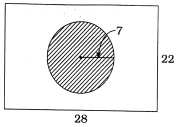
$A$ circle with radius $7 \, cm$ is drawn at the centre of a rectangle $28 \, cm$ long and $22 \, cm$ broad. Find the probability that a ball hitting the rectangle hits the circle.
A
$\frac{1}{11}$
B
$\frac{1}{2}$
C
$\frac{1}{3}$
D
$\frac{1}{4}$
Solution
(D) Area of the rectangle $=$ Length $\times$ Breadth
$= 28 \, cm \times 22 \, cm = 616 \, cm^2$
For the circle,radius $r = 7 \, cm$
Area of the circle $= \pi r^2 = \frac{22}{7} \times 7 \times 7 = 154 \, cm^2$
The probability that a ball hitting the rectangle hits the circle is given by the ratio of the area of the circle to the area of the rectangle.
Required Probability $= \frac{\text{Area of the circle}}{\text{Area of the rectangle}}$
$= \frac{154}{616} = \frac{1}{4}$
Thus,the probability is $\frac{1}{4}$.
$= 28 \, cm \times 22 \, cm = 616 \, cm^2$
For the circle,radius $r = 7 \, cm$
Area of the circle $= \pi r^2 = \frac{22}{7} \times 7 \times 7 = 154 \, cm^2$
The probability that a ball hitting the rectangle hits the circle is given by the ratio of the area of the circle to the area of the rectangle.
Required Probability $= \frac{\text{Area of the circle}}{\text{Area of the rectangle}}$
$= \frac{154}{616} = \frac{1}{4}$
Thus,the probability is $\frac{1}{4}$.
0 likes
View Solution77
MediumMCQ
Three balanced coins are tossed simultaneously. Find the probability of receiving at least two heads.
A
$\frac{1}{2}$
B
$\frac{2}{3}$
C
$\frac{1}{3}$
D
$\frac{1}{4}$
Solution
(A) In the experiment of tossing three balanced coins simultaneously,the sample space $S$ consists of the following elementary outcomes:
$S = \{(HHH), (HHT), (HTH), (THH), (HTT), (THT), (TTH), (TTT)\}$
where $H$ represents head and $T$ represents tail.
Total number of elementary outcomes $= 8$.
Let event $A$ be the event of receiving at least two heads (i.e.,$2$ or $3$ heads).
The outcomes favourable to event $A$ are: $(HHH), (HHT), (HTH), (THH)$.
Number of favourable outcomes $= 4$.
The probability of event $A$ is given by $P(A) = \frac{\text{Number of favourable outcomes}}{\text{Total number of outcomes}}$.
$P(A) = \frac{4}{8} = \frac{1}{2}$.
Thus,the probability of receiving at least two heads is $\frac{1}{2}$.
$S = \{(HHH), (HHT), (HTH), (THH), (HTT), (THT), (TTH), (TTT)\}$
where $H$ represents head and $T$ represents tail.
Total number of elementary outcomes $= 8$.
Let event $A$ be the event of receiving at least two heads (i.e.,$2$ or $3$ heads).
The outcomes favourable to event $A$ are: $(HHH), (HHT), (HTH), (THH)$.
Number of favourable outcomes $= 4$.
The probability of event $A$ is given by $P(A) = \frac{\text{Number of favourable outcomes}}{\text{Total number of outcomes}}$.
$P(A) = \frac{4}{8} = \frac{1}{2}$.
Thus,the probability of receiving at least two heads is $\frac{1}{2}$.
0 likes
View Solution78
EasyMCQ
$A$ balanced die is thrown. Find the probability that the number on the die is even.
A
$1/3$
B
$1/2$
C
$1/4$
D
$1/7$
Solution
(B) The total number of possible outcomes when a balanced die is thrown is $S = \{1, 2, 3, 4, 5, 6\}$,so the total number of outcomes $n(S) = 6$.
Let $E$ be the event of getting an even number on the die.
The even numbers on a die are $\{2, 4, 6\}$,so the number of favorable outcomes $n(E) = 3$.
The probability of the event $E$ is given by $P(E) = \frac{n(E)}{n(S)} = \frac{3}{6} = \frac{1}{2}$.
Let $E$ be the event of getting an even number on the die.
The even numbers on a die are $\{2, 4, 6\}$,so the number of favorable outcomes $n(E) = 3$.
The probability of the event $E$ is given by $P(E) = \frac{n(E)}{n(S)} = \frac{3}{6} = \frac{1}{2}$.
0 likes
View Solution79
EasyMCQ
$A$ balanced die is thrown. Find the probability that the number on the die is a multiple of $3$.
A
$1/8$
B
$1/2$
C
$1/3$
D
$1/4$
Solution
(C) When a balanced die is thrown,the sample space $S$ is given by $S = \{1, 2, 3, 4, 5, 6\}$.
The total number of possible outcomes is $n(S) = 6$.
Let $E$ be the event that the number on the die is a multiple of $3$.
The multiples of $3$ in the sample space are $3$ and $6$.
Thus,the favorable outcomes are $E = \{3, 6\}$.
The number of favorable outcomes is $n(E) = 2$.
The probability $P(E)$ is given by the formula $P(E) = \frac{n(E)}{n(S)}$.
Substituting the values,$P(E) = \frac{2}{6} = \frac{1}{3}$.
The total number of possible outcomes is $n(S) = 6$.
Let $E$ be the event that the number on the die is a multiple of $3$.
The multiples of $3$ in the sample space are $3$ and $6$.
Thus,the favorable outcomes are $E = \{3, 6\}$.
The number of favorable outcomes is $n(E) = 2$.
The probability $P(E)$ is given by the formula $P(E) = \frac{n(E)}{n(S)}$.
Substituting the values,$P(E) = \frac{2}{6} = \frac{1}{3}$.
0 likes
View Solution80
EasyMCQ
$A$ balanced die is thrown. Find the probability that the number on the die is smaller than $3$.
A
$1/2$
B
$1/4$
C
$1/5$
D
$1/3$
Solution
(D) When a balanced die is thrown,the total number of possible outcomes is $S = \{1, 2, 3, 4, 5, 6\}$.
Thus,the total number of outcomes $n(S) = 6$.
Let $E$ be the event that the number on the die is smaller than $3$.
The favorable outcomes are $E = \{1, 2\}$.
Thus,the number of favorable outcomes $n(E) = 2$.
The probability $P(E)$ is given by the formula $P(E) = \frac{n(E)}{n(S)}$.
$P(E) = \frac{2}{6} = \frac{1}{3}$.
Thus,the total number of outcomes $n(S) = 6$.
Let $E$ be the event that the number on the die is smaller than $3$.
The favorable outcomes are $E = \{1, 2\}$.
Thus,the number of favorable outcomes $n(E) = 2$.
The probability $P(E)$ is given by the formula $P(E) = \frac{n(E)}{n(S)}$.
$P(E) = \frac{2}{6} = \frac{1}{3}$.
0 likes
View Solution81
EasyMCQ
Two balanced dice are rolled. Find the probability that the sum of numbers on two dice is even.
A
$\frac{1}{2}$
B
$\frac{1}{3}$
C
$\frac{1}{4}$
D
$\frac{1}{5}$
Solution
(A) When two dice are rolled,the total number of possible outcomes is $6 \times 6 = 36$.
Let the outcomes be $(x, y)$ where $x$ and $y$ are the numbers on the first and second die respectively.
The sum $(x + y)$ is even if:
$1.$ Both $x$ and $y$ are odd: There are $3$ choices for $x$ $(1, 3, 5)$ and $3$ choices for $y$ $(1, 3, 5)$. Total outcomes = $3 \times 3 = 9$.
$2.$ Both $x$ and $y$ are even: There are $3$ choices for $x$ $(2, 4, 6)$ and $3$ choices for $y$ $(2, 4, 6)$. Total outcomes = $3 \times 3 = 9$.
Total favorable outcomes = $9 + 9 = 18$.
Probability = $\frac{\text{Favorable outcomes}}{\text{Total outcomes}} = \frac{18}{36} = \frac{1}{2}$.
Let the outcomes be $(x, y)$ where $x$ and $y$ are the numbers on the first and second die respectively.
The sum $(x + y)$ is even if:
$1.$ Both $x$ and $y$ are odd: There are $3$ choices for $x$ $(1, 3, 5)$ and $3$ choices for $y$ $(1, 3, 5)$. Total outcomes = $3 \times 3 = 9$.
$2.$ Both $x$ and $y$ are even: There are $3$ choices for $x$ $(2, 4, 6)$ and $3$ choices for $y$ $(2, 4, 6)$. Total outcomes = $3 \times 3 = 9$.
Total favorable outcomes = $9 + 9 = 18$.
Probability = $\frac{\text{Favorable outcomes}}{\text{Total outcomes}} = \frac{18}{36} = \frac{1}{2}$.
0 likes
View Solution82
MediumMCQ
Two balanced dice are rolled. Find the probability that the sum of numbers on two dice is odd.
A
$1/7$
B
$1/2$
C
$1/4$
D
$1/3$
Solution
(B) When two balanced dice are rolled,the total number of possible outcomes is $6 \times 6 = 36$.
The sum of the numbers on the two dice is odd if one die shows an even number and the other shows an odd number.
Let $E$ be the event that the sum is odd.
Possible outcomes for (Odd,Even) are: $(1,2), (1,4), (1,6), (3,2), (3,4), (3,6), (5,2), (5,4), (5,6)$ (Total $9$ outcomes).
Possible outcomes for (Even,Odd) are: $(2,1), (2,3), (2,5), (4,1), (4,3), (4,5), (6,1), (6,3), (6,5)$ (Total $9$ outcomes).
Total favorable outcomes = $9 + 9 = 18$.
Probability $P(E) = \frac{\text{Favorable outcomes}}{\text{Total outcomes}} = \frac{18}{36} = \frac{1}{2}$.
The sum of the numbers on the two dice is odd if one die shows an even number and the other shows an odd number.
Let $E$ be the event that the sum is odd.
Possible outcomes for (Odd,Even) are: $(1,2), (1,4), (1,6), (3,2), (3,4), (3,6), (5,2), (5,4), (5,6)$ (Total $9$ outcomes).
Possible outcomes for (Even,Odd) are: $(2,1), (2,3), (2,5), (4,1), (4,3), (4,5), (6,1), (6,3), (6,5)$ (Total $9$ outcomes).
Total favorable outcomes = $9 + 9 = 18$.
Probability $P(E) = \frac{\text{Favorable outcomes}}{\text{Total outcomes}} = \frac{18}{36} = \frac{1}{2}$.
0 likes
View Solution83
MediumMCQ
Two balanced dice are rolled. Find the probability that the sum of numbers on two dice is a multiple of $5$.
A
$\frac{11}{36}$
B
$\frac{5}{36}$
C
$\frac{7}{36}$
D
$\frac{7}{33}$
Solution
(C) When two balanced dice are rolled,the total number of possible outcomes is $6 \times 6 = 36$.
Let $S$ be the sum of the numbers on the two dice. The possible values for $S$ range from $2$ to $12$.
The multiples of $5$ in this range are $5$ and $10$.
We identify the pairs $(d_1, d_2)$ that result in these sums:
For $S = 5$: $(1, 4), (2, 3), (3, 2), (4, 1)$ (Total $4$ outcomes).
For $S = 10$: $(4, 6), (5, 5), (6, 4)$ (Total $3$ outcomes).
The total number of favorable outcomes is $4 + 3 = 7$.
Therefore,the probability $P = \frac{\text{Favorable outcomes}}{\text{Total outcomes}} = \frac{7}{36}$.
Let $S$ be the sum of the numbers on the two dice. The possible values for $S$ range from $2$ to $12$.
The multiples of $5$ in this range are $5$ and $10$.
We identify the pairs $(d_1, d_2)$ that result in these sums:
For $S = 5$: $(1, 4), (2, 3), (3, 2), (4, 1)$ (Total $4$ outcomes).
For $S = 10$: $(4, 6), (5, 5), (6, 4)$ (Total $3$ outcomes).
The total number of favorable outcomes is $4 + 3 = 7$.
Therefore,the probability $P = \frac{\text{Favorable outcomes}}{\text{Total outcomes}} = \frac{7}{36}$.
0 likes
View Solution84
MediumMCQ
Two balanced dice are rolled. Find the probability that the sum of numbers on two dice is a multiple of $6$.
A
$1/3$
B
$1/4$
C
$1/5$
D
$1/6$
Solution
(D) When two balanced dice are rolled,the total number of possible outcomes is $6 \times 6 = 36$.
The possible sums of the numbers on the two dice range from $2$ to $12$.
The sums that are multiples of $6$ are $6$ and $12$.
For a sum of $6$,the possible outcomes are $(1, 5), (2, 4), (3, 3), (4, 2), (5, 1)$. There are $5$ such outcomes.
For a sum of $12$,the only possible outcome is $(6, 6)$. There is $1$ such outcome.
Total favorable outcomes = $5 + 1 = 6$.
Probability = $\frac{\text{Number of favorable outcomes}}{\text{Total number of outcomes}} = \frac{6}{36} = \frac{1}{6}$.
The possible sums of the numbers on the two dice range from $2$ to $12$.
The sums that are multiples of $6$ are $6$ and $12$.
For a sum of $6$,the possible outcomes are $(1, 5), (2, 4), (3, 3), (4, 2), (5, 1)$. There are $5$ such outcomes.
For a sum of $12$,the only possible outcome is $(6, 6)$. There is $1$ such outcome.
Total favorable outcomes = $5 + 1 = 6$.
Probability = $\frac{\text{Number of favorable outcomes}}{\text{Total number of outcomes}} = \frac{6}{36} = \frac{1}{6}$.
0 likes
View Solution85
MediumMCQ
Two balanced dice are rolled. Find the probability that the sum of numbers on two dice is greater than $8$. (in $/18$)
A
$5$
B
$2$
C
$3$
D
$4$
Solution
(A) When two balanced dice are rolled,the total number of possible outcomes is $6 \times 6 = 36$.
We need to find the probability that the sum of the numbers on the two dice is greater than $8$.
The possible sums greater than $8$ are $9, 10, 11,$ and $12$.
The outcomes resulting in these sums are:
Sum $= 9: (3, 6), (4, 5), (5, 4), (6, 3)$ ($4$ outcomes)
Sum $= 10: (4, 6), (5, 5), (6, 4)$ ($3$ outcomes)
Sum $= 11: (5, 6), (6, 5)$ ($2$ outcomes)
Sum $= 12: (6, 6)$ ($1$ outcome)
Total favorable outcomes $= 4 + 3 + 2 + 1 = 10$.
The probability is $\frac{\text{Number of favorable outcomes}}{\text{Total number of outcomes}} = \frac{10}{36} = \frac{5}{18}$.
We need to find the probability that the sum of the numbers on the two dice is greater than $8$.
The possible sums greater than $8$ are $9, 10, 11,$ and $12$.
The outcomes resulting in these sums are:
Sum $= 9: (3, 6), (4, 5), (5, 4), (6, 3)$ ($4$ outcomes)
Sum $= 10: (4, 6), (5, 5), (6, 4)$ ($3$ outcomes)
Sum $= 11: (5, 6), (6, 5)$ ($2$ outcomes)
Sum $= 12: (6, 6)$ ($1$ outcome)
Total favorable outcomes $= 4 + 3 + 2 + 1 = 10$.
The probability is $\frac{\text{Number of favorable outcomes}}{\text{Total number of outcomes}} = \frac{10}{36} = \frac{5}{18}$.
0 likes
View Solution86
MediumMCQ
Two balanced dice are rolled. Find the probability that the sum of numbers on two dice is smaller than $7$.
A
$\frac{4}{12}$
B
$\frac{5}{12}$
C
$\frac{1}{12}$
D
$\frac{11}{12}$
Solution
(B) When two balanced dice are rolled,the total number of possible outcomes is $6 \times 6 = 36$.
We need to find the probability that the sum of the numbers on the two dice is less than $7$.
The possible outcomes where the sum is less than $7$ are:
Sum $= 2$: $(1, 1)$ ($1$ outcome)
Sum $= 3$: $(1, 2), (2, 1)$ ($2$ outcomes)
Sum $= 4$: $(1, 3), (2, 2), (3, 1)$ ($3$ outcomes)
Sum $= 5$: $(1, 4), (2, 3), (3, 2), (4, 1)$ ($4$ outcomes)
Sum $= 6$: $(1, 5), (2, 4), (3, 3), (4, 2), (5, 1)$ ($5$ outcomes)
Total favorable outcomes $= 1 + 2 + 3 + 4 + 5 = 15$.
The probability is given by $\frac{\text{Number of favorable outcomes}}{\text{Total number of outcomes}} = \frac{15}{36}$.
Simplifying the fraction by dividing both numerator and denominator by $3$,we get $\frac{15 \div 3}{36 \div 3} = \frac{5}{12}$.
We need to find the probability that the sum of the numbers on the two dice is less than $7$.
The possible outcomes where the sum is less than $7$ are:
Sum $= 2$: $(1, 1)$ ($1$ outcome)
Sum $= 3$: $(1, 2), (2, 1)$ ($2$ outcomes)
Sum $= 4$: $(1, 3), (2, 2), (3, 1)$ ($3$ outcomes)
Sum $= 5$: $(1, 4), (2, 3), (3, 2), (4, 1)$ ($4$ outcomes)
Sum $= 6$: $(1, 5), (2, 4), (3, 3), (4, 2), (5, 1)$ ($5$ outcomes)
Total favorable outcomes $= 1 + 2 + 3 + 4 + 5 = 15$.
The probability is given by $\frac{\text{Number of favorable outcomes}}{\text{Total number of outcomes}} = \frac{15}{36}$.
Simplifying the fraction by dividing both numerator and denominator by $3$,we get $\frac{15 \div 3}{36 \div 3} = \frac{5}{12}$.
0 likes
View Solution87
EasyMCQ
$A$ card is drawn at random from a well-shuffled pack of $52$ cards. Find the probability that the card drawn is a queen.
A
$\frac{5}{13}$
B
$\frac{3}{13}$
C
$\frac{1}{13}$
D
$\frac{2}{13}$
Solution
(C) The total number of cards in a well-shuffled pack is $52$.
Therefore,the total number of possible outcomes is $n(S) = 52$.
In a standard deck of cards,there are $4$ queens (one for each suit: hearts,diamonds,clubs,and spades).
Therefore,the number of favorable outcomes for drawing a queen is $n(E) = 4$.
The probability $P(E)$ of an event $E$ is given by the formula:
$P(E) = \frac{n(E)}{n(S)}$
Substituting the values:
$P(E) = \frac{4}{52} = \frac{1}{13}$
Thus,the probability of drawing a queen is $\frac{1}{13}$.
Therefore,the total number of possible outcomes is $n(S) = 52$.
In a standard deck of cards,there are $4$ queens (one for each suit: hearts,diamonds,clubs,and spades).
Therefore,the number of favorable outcomes for drawing a queen is $n(E) = 4$.
The probability $P(E)$ of an event $E$ is given by the formula:
$P(E) = \frac{n(E)}{n(S)}$
Substituting the values:
$P(E) = \frac{4}{52} = \frac{1}{13}$
Thus,the probability of drawing a queen is $\frac{1}{13}$.
0 likes
View Solution88
EasyMCQ
$A$ card is drawn at random from a well-shuffled pack of $52$ cards. Find the probability that the card drawn is a face card.
A
$\frac{4}{11}$
B
$\frac{3}{33}$
C
$\frac{2}{13}$
D
$\frac{3}{13}$
Solution
(D) The total number of cards in a well-shuffled pack is $52$.
Face cards are the cards that have faces on them,which are Kings,Queens,and Jacks.
In each suit,there are $3$ face cards (one King,one Queen,and one Jack).
Since there are $4$ suits in a deck (Hearts,Diamonds,Clubs,and Spades),the total number of face cards is $4 \times 3 = 12$.
The probability of drawing a face card is given by the ratio of the number of favorable outcomes to the total number of possible outcomes.
Probability $P = \frac{\text{Number of face cards}}{\text{Total number of cards}} = \frac{12}{52}$.
Simplifying the fraction by dividing both the numerator and the denominator by $4$,we get $P = \frac{3}{13}$.
Face cards are the cards that have faces on them,which are Kings,Queens,and Jacks.
In each suit,there are $3$ face cards (one King,one Queen,and one Jack).
Since there are $4$ suits in a deck (Hearts,Diamonds,Clubs,and Spades),the total number of face cards is $4 \times 3 = 12$.
The probability of drawing a face card is given by the ratio of the number of favorable outcomes to the total number of possible outcomes.
Probability $P = \frac{\text{Number of face cards}}{\text{Total number of cards}} = \frac{12}{52}$.
Simplifying the fraction by dividing both the numerator and the denominator by $4$,we get $P = \frac{3}{13}$.
0 likes
View Solution89
EasyMCQ
$A$ card is drawn at random from a well-shuffled pack of $52$ cards. Find the probability that the card drawn is that of diamonds.
A
$1/4$
B
$1/3$
C
$3/4$
D
$7/11$
Solution
(A) The total number of cards in a well-shuffled pack is $52$.
There are $4$ suits in a deck of cards: hearts,diamonds,clubs,and spades.
Each suit contains $13$ cards.
Therefore,the number of diamond cards is $13$.
The probability of drawing a diamond card is given by the ratio of the number of favorable outcomes to the total number of possible outcomes.
Probability $P = \frac{\text{Number of diamond cards}}{\text{Total number of cards}} = \frac{13}{52} = \frac{1}{4}$.
There are $4$ suits in a deck of cards: hearts,diamonds,clubs,and spades.
Each suit contains $13$ cards.
Therefore,the number of diamond cards is $13$.
The probability of drawing a diamond card is given by the ratio of the number of favorable outcomes to the total number of possible outcomes.
Probability $P = \frac{\text{Number of diamond cards}}{\text{Total number of cards}} = \frac{13}{52} = \frac{1}{4}$.
0 likes
View Solution90
EasyMCQ
$A$ card is drawn at random from a well-shuffled pack of $52$ cards. Find the probability that the card drawn is a king of a black suit.
A
$\frac{1}{13}$
B
$\frac{1}{26}$
C
$\frac{1}{39}$
D
$\frac{1}{50}$
Solution
(B) The total number of cards in a well-shuffled pack is $n(S) = 52$.
There are two black suits in a deck of cards: Spades and Clubs.
Each suit contains exactly one king.
Therefore,the number of kings of a black suit is $n(E) = 2$ (one King of Spades and one King of Clubs).
The probability $P(E)$ of drawing a king of a black suit is given by the formula $P(E) = \frac{n(E)}{n(S)}$.
Substituting the values,we get $P(E) = \frac{2}{52} = \frac{1}{26}$.
There are two black suits in a deck of cards: Spades and Clubs.
Each suit contains exactly one king.
Therefore,the number of kings of a black suit is $n(E) = 2$ (one King of Spades and one King of Clubs).
The probability $P(E)$ of drawing a king of a black suit is given by the formula $P(E) = \frac{n(E)}{n(S)}$.
Substituting the values,we get $P(E) = \frac{2}{52} = \frac{1}{26}$.
0 likes
View Solution91
EasyMCQ
$A$ student attends a $50$ mark test. No negative marks are given in the test. Find the probability that he scores $30$ or $35$ marks.
A
$\frac{3}{83}$
B
$\frac{4}{31}$
C
$\frac{2}{51}$
D
$\frac{2}{11}$
Solution
(C) In a test of $50$ marks,the possible scores a student can obtain range from $0$ to $50$ inclusive.
Total number of possible outcomes = $50 - 0 + 1 = 51$.
The student can score any integer value from $0, 1, 2, \dots, 50$.
The favorable outcomes are scoring $30$ marks or $35$ marks.
Number of favorable outcomes = $2$ (specifically the scores $30$ and $35$).
Probability = $\frac{\text{Number of favorable outcomes}}{\text{Total number of possible outcomes}} = \frac{2}{51}$.
Total number of possible outcomes = $50 - 0 + 1 = 51$.
The student can score any integer value from $0, 1, 2, \dots, 50$.
The favorable outcomes are scoring $30$ marks or $35$ marks.
Number of favorable outcomes = $2$ (specifically the scores $30$ and $35$).
Probability = $\frac{\text{Number of favorable outcomes}}{\text{Total number of possible outcomes}} = \frac{2}{51}$.
0 likes
View Solution92
EasyMCQ
$A$ class consists of $35$ boys and $25$ girls. One student is selected at random to be the class monitor. Find the probability that the selected student is a girl. (in $/12$)
A
$11$
B
$7$
C
$3$
D
$5$
Solution
(D) Total number of students in the class = $35 \text{ (boys)} + 25 \text{ (girls)} = 60$.
Number of favorable outcomes (selecting a girl) = $25$.
The probability $P$ of an event is given by the formula: $P(\text{Girl}) = \frac{\text{Number of girls}}{\text{Total number of students}}$.
$P(\text{Girl}) = \frac{25}{60}$.
Simplifying the fraction by dividing both numerator and denominator by $5$, we get: $P(\text{Girl}) = \frac{5}{12}$.
Number of favorable outcomes (selecting a girl) = $25$.
The probability $P$ of an event is given by the formula: $P(\text{Girl}) = \frac{\text{Number of girls}}{\text{Total number of students}}$.
$P(\text{Girl}) = \frac{25}{60}$.
Simplifying the fraction by dividing both numerator and denominator by $5$, we get: $P(\text{Girl}) = \frac{5}{12}$.
0 likes
View Solution93
EasyMCQ
$12$ defective ballpens are mixed with $132$ non-defective ballpens. They all look alike. $A$ ballpen is selected at random from that lot. Find the probability that a defective ballpen is selected.
A
$1/12$
B
$1/11$
C
$1/121$
D
$1/132$
Solution
(A) Total number of defective ballpens = $12$.
Total number of non-defective ballpens = $132$.
Total number of ballpens in the lot = $12 + 132 = 144$.
The probability of selecting a defective ballpen is given by the ratio of the number of defective ballpens to the total number of ballpens.
$P(\text{defective}) = \frac{\text{Number of defective ballpens}}{\text{Total number of ballpens}} = \frac{12}{144} = \frac{1}{12}$.
Thus,the probability is $\frac{1}{12}$.
Total number of non-defective ballpens = $132$.
Total number of ballpens in the lot = $12 + 132 = 144$.
The probability of selecting a defective ballpen is given by the ratio of the number of defective ballpens to the total number of ballpens.
$P(\text{defective}) = \frac{\text{Number of defective ballpens}}{\text{Total number of ballpens}} = \frac{12}{144} = \frac{1}{12}$.
Thus,the probability is $\frac{1}{12}$.
0 likes
View Solution94
MediumMCQ
In a shop, there are $50$ packets of tea out of which $5$ are under-weight. One packet is selected at random from the lot. Find the probability that an under-weight packet is selected.
A
$0.1$
B
$0.01$
C
$1$
D
$0.2$
Solution
(A) Total number of tea packets = $50$.
Number of under-weight packets = $5$.
The probability $P(E)$ of an event $E$ is given by the formula: $P(E) = \frac{\text{Number of favorable outcomes}}{\text{Total number of possible outcomes}}$.
Here, the favorable outcome is selecting an under-weight packet.
Therefore, $P(\text{under-weight}) = \frac{5}{50} = \frac{1}{10} = 0.1$.
Thus, the probability of selecting an under-weight packet is $0.1$.
Number of under-weight packets = $5$.
The probability $P(E)$ of an event $E$ is given by the formula: $P(E) = \frac{\text{Number of favorable outcomes}}{\text{Total number of possible outcomes}}$.
Here, the favorable outcome is selecting an under-weight packet.
Therefore, $P(\text{under-weight}) = \frac{5}{50} = \frac{1}{10} = 0.1$.
Thus, the probability of selecting an under-weight packet is $0.1$.
0 likes
View Solution95
EasyMCQ
There are $5$ white,$7$ red,$4$ black,and $2$ blue identical balls in a box. One ball is selected at random from the box. Find the probability that the selected ball is either white or blue.
A
$\frac{5}{18}$
B
$\frac{7}{18}$
C
$\frac{10}{18}$
D
$\frac{7}{11}$
Solution
(B) Total number of balls = $5 + 7 + 4 + 2 = 18$.
Let $E$ be the event of selecting a white or blue ball.
Number of white balls = $5$.
Number of blue balls = $2$.
Number of favorable outcomes = $5 + 2 = 7$.
Probability $P(E) = \frac{\text{Number of favorable outcomes}}{\text{Total number of outcomes}} = \frac{7}{18}$.
Let $E$ be the event of selecting a white or blue ball.
Number of white balls = $5$.
Number of blue balls = $2$.
Number of favorable outcomes = $5 + 2 = 7$.
Probability $P(E) = \frac{\text{Number of favorable outcomes}}{\text{Total number of outcomes}} = \frac{7}{18}$.
0 likes
View Solution96
MediumMCQ
There are $5$ white,$7$ red,$4$ black and $2$ blue identical balls in a box. One ball is selected at random from the box. Find the probability that the selected ball is either red or black. (in $/18$)
A
$11$
B
$13$
C
$7$
D
$4$
Solution
(A) Total number of balls $= 5 + 7 + 4 + 2 = 18$.
Number of red balls $= 7$.
Number of black balls $= 4$.
Number of favorable outcomes (red or black) $= 7 + 4 = 11$.
Probability $= \frac{\text{Number of favorable outcomes}}{\text{Total number of outcomes}} = \frac{11}{18}$.
Number of red balls $= 7$.
Number of black balls $= 4$.
Number of favorable outcomes (red or black) $= 7 + 4 = 11$.
Probability $= \frac{\text{Number of favorable outcomes}}{\text{Total number of outcomes}} = \frac{11}{18}$.
0 likes
View Solution97
EasyMCQ
There are $5$ white,$7$ red,$4$ black,and $2$ blue identical balls in a box. One ball is selected at random from the box. Find the probability that the selected ball is not white.
A
$9/13$
B
$11/18$
C
$15/18$
D
$13/18$
Solution
(D) Total number of balls = $5 + 7 + 4 + 2 = 18$.
Number of white balls = $5$.
Number of balls that are not white = Total balls - White balls = $18 - 5 = 13$.
Probability of selecting a ball that is not white = $\frac{\text{Number of non-white balls}}{\text{Total number of balls}} = \frac{13}{18}$.
Number of white balls = $5$.
Number of balls that are not white = Total balls - White balls = $18 - 5 = 13$.
Probability of selecting a ball that is not white = $\frac{\text{Number of non-white balls}}{\text{Total number of balls}} = \frac{13}{18}$.
0 likes
View Solution98
MediumMCQ
There are $5$ white,$7$ red,$4$ black and $2$ blue identical balls in a box. One ball is selected at random from the box. Find the probability that the selected ball is neither white nor black.
A
$1/2$
B
$1/3$
C
$1/4$
D
$1/12$
Solution
(A) Total number of balls = $5 + 7 + 4 + 2 = 18$.
Number of white balls = $5$.
Number of black balls = $4$.
Number of balls that are neither white nor black = Total balls - (White balls + Black balls) = $18 - (5 + 4) = 18 - 9 = 9$.
The balls that are neither white nor black are the red and blue balls,which are $7 + 2 = 9$.
Probability = $\frac{\text{Number of favorable outcomes}}{\text{Total number of outcomes}} = \frac{9}{18} = \frac{1}{2}$.
Number of white balls = $5$.
Number of black balls = $4$.
Number of balls that are neither white nor black = Total balls - (White balls + Black balls) = $18 - (5 + 4) = 18 - 9 = 9$.
The balls that are neither white nor black are the red and blue balls,which are $7 + 2 = 9$.
Probability = $\frac{\text{Number of favorable outcomes}}{\text{Total number of outcomes}} = \frac{9}{18} = \frac{1}{2}$.
0 likes
View Solution99
MediumMCQ
Two balanced dice are rolled. Find the probability that the sum of numbers on two dice lies between $5$ and $9$.
A
$\frac{2}{9}$
B
$\frac{4}{9}$
C
$\frac{4}{5}$
D
$\frac{4}{7}$
Solution
(B) When two dice are rolled,the total number of possible outcomes is $6 \times 6 = 36$.
We need to find the probability that the sum $S$ of the numbers on the two dice lies between $5$ and $9$,which means $5 < S < 9$.
This implies the sum $S$ can be $6, 7,$ or $8$.
- For $S = 6$,the possible outcomes are $(1, 5), (2, 4), (3, 3), (4, 2), (5, 1)$,which are $5$ outcomes.
- For $S = 7$,the possible outcomes are $(1, 6), (2, 5), (3, 4), (4, 3), (5, 2), (6, 1)$,which are $6$ outcomes.
- For $S = 8$,the possible outcomes are $(2, 6), (3, 5), (4, 4), (5, 3), (6, 2)$,which are $5$ outcomes.
Total favorable outcomes = $5 + 6 + 5 = 16$.
Probability = $\frac{\text{Favorable outcomes}}{\text{Total outcomes}} = \frac{16}{36} = \frac{4}{9}$.
We need to find the probability that the sum $S$ of the numbers on the two dice lies between $5$ and $9$,which means $5 < S < 9$.
This implies the sum $S$ can be $6, 7,$ or $8$.
- For $S = 6$,the possible outcomes are $(1, 5), (2, 4), (3, 3), (4, 2), (5, 1)$,which are $5$ outcomes.
- For $S = 7$,the possible outcomes are $(1, 6), (2, 5), (3, 4), (4, 3), (5, 2), (6, 1)$,which are $6$ outcomes.
- For $S = 8$,the possible outcomes are $(2, 6), (3, 5), (4, 4), (5, 3), (6, 2)$,which are $5$ outcomes.
Total favorable outcomes = $5 + 6 + 5 = 16$.
Probability = $\frac{\text{Favorable outcomes}}{\text{Total outcomes}} = \frac{16}{36} = \frac{4}{9}$.
0 likes
View Solution100
MediumMCQ
Two balanced dice are rolled. Find the probability that the product of numbers on two dice is odd.
A
$\frac{7}{11}$
B
$\frac{2}{5}$
C
$\frac{1}{4}$
D
$\frac{1}{3}$
Solution
(C) When two balanced dice are rolled,the total number of possible outcomes is $6 \times 6 = 36$.
For the product of the numbers on the two dice to be odd,both numbers must be odd.
The odd numbers on a die are $\{1, 3, 5\}$.
Thus,the number of favorable outcomes is $3 \times 3 = 9$.
The favorable outcomes are: $(1,1), (1,3), (1,5), (3,1), (3,3), (3,5), (5,1), (5,3), (5,5)$.
The probability $P$ is given by the ratio of favorable outcomes to total outcomes:
$P = \frac{9}{36} = \frac{1}{4}$.
For the product of the numbers on the two dice to be odd,both numbers must be odd.
The odd numbers on a die are $\{1, 3, 5\}$.
Thus,the number of favorable outcomes is $3 \times 3 = 9$.
The favorable outcomes are: $(1,1), (1,3), (1,5), (3,1), (3,3), (3,5), (5,1), (5,3), (5,5)$.
The probability $P$ is given by the ratio of favorable outcomes to total outcomes:
$P = \frac{9}{36} = \frac{1}{4}$.
0 likes
View SolutionProbability — Mix Examples - Probability · Frequently Asked Questions
1Are these Probability questions useful for JEE and NEET?
Yes. All questions in this section are mapped to JEE Main and NEET exam patterns. Previous year questions from JEE Main, NEET, GUJCET and state-level exams are included with full solutions.
2Can I switch to Hindi or Gujarati for these questions?
Yes. Use the language tabs in the hero section or the sidebar to view the same questions and solutions in English, Hindi or Gujarati.
3How do I generate a question paper from this subtopic?
Use the Vedclass Exam Paper Generator — select the chapter and subtopic, set difficulty, and generate Sets A, B, C, D automatically. First 3 chapters of every subject are free.
Vedclass Products
For Students
Vedclass Test Series
Mock tests in real JEE/NEET style with performance analysis. 5-day free trial.
Start Free TrialFor Teachers
Exam Paper Generator
Generate Set A/B/C/D papers from this chapter in 2 minutes. 3 chapters free.
Try FreeFor Institutes
Online Exam Module
Live online exams with unlimited students, 360° analytics & white-label branding.
See DemoFor Teachers & Institutes
Generate a Probability Exam Paper in 2 Minutes
Select subtopic & difficulty — Sets A, B, C, D auto-generated with No Repeat logic.
First 3 chapters of every subject are free — no payment required.