
A English
Mix Examples - Probability Questions in English
Class 10 Mathematics · Probability · Mix Examples - Probability
199+
Questions
English
Language
100%
With Solutions
Showing 50 of 199 questions in English
1
EasyMCQ
If an event cannot occur,then its probability is
A
$1$
B
$0$
C
$\frac{3}{4}$
D
$\frac{1}{2}$
Solution
(B) An event that cannot occur is called an impossible event.
The probability of an impossible event is always $0$.
The probability of an impossible event is always $0$.
0 likes
View Solution2
EasyMCQ
Which of the following cannot be the probability of an event?
A
$1/2$
B
$0.1$
C
$17/16$
D
$0.3$
Solution
(C) The probability of any event $E$,denoted by $P(E)$,always satisfies the condition $0 \le P(E) \le 1$.
Since $17/16 = 1.0625$,which is greater than $1$,it cannot be the probability of an event.
Therefore,the correct option is $C$.
Since $17/16 = 1.0625$,which is greater than $1$,it cannot be the probability of an event.
Therefore,the correct option is $C$.
0 likes
View Solution3
EasyMCQ
An event is very unlikely to happen. Its probability is closest to
A
$0.1$
B
$0.01$
C
$0.001$
D
$0.0001$
Solution
(D) The probability of an event that is very unlikely to happen is closest to $0$.
Comparing the given options:
$0.1 > 0.01 > 0.001 > 0.0001$.
Among the given choices,$0.0001$ is the smallest value and is closest to $0$.
Comparing the given options:
$0.1 > 0.01 > 0.001 > 0.0001$.
Among the given choices,$0.0001$ is the smallest value and is closest to $0$.
0 likes
View Solution4
EasyMCQ
If the probability of an event is $p$,the probability of its complementary event will be
A
$1-p$
B
$p$
C
$1-\frac{1}{p}$
D
$p-1$
Solution
(A) The sum of the probability of an event and the probability of its complementary event is always $1$.
Let $E$ be an event and $E'$ be its complementary event.
Then,$P(E) + P(E') = 1$.
Given that the probability of the event is $p$,we have $P(E) = p$.
Substituting this into the equation,we get $p + P(E') = 1$.
Therefore,the probability of its complementary event is $P(E') = 1 - p$.
Let $E$ be an event and $E'$ be its complementary event.
Then,$P(E) + P(E') = 1$.
Given that the probability of the event is $p$,we have $P(E) = p$.
Substituting this into the equation,we get $p + P(E') = 1$.
Therefore,the probability of its complementary event is $P(E') = 1 - p$.
0 likes
View Solution5
EasyMCQ
The probability expressed as a percentage of a particular occurrence can never be
A
less than $100$
B
less than $0$
C
greater than $1$
D
anything but a whole number
Solution
(B) The probability of any event $E$,denoted by $P(E)$,always lies in the range $0 \le P(E) \le 1$.
When expressed as a percentage,the probability range becomes $0\% \le P(E) \le 100\%$.
Therefore,the probability of a particular occurrence,when expressed as a percentage,can never be less than $0\%$.
When expressed as a percentage,the probability range becomes $0\% \le P(E) \le 100\%$.
Therefore,the probability of a particular occurrence,when expressed as a percentage,can never be less than $0\%$.
0 likes
View Solution6
EasyMCQ
If $P(A)$ denotes the probability of an event $A$,then
A
$P(A) < 0$
B
$P(A) > 1$
C
$0 \leq P(A) \leq 1$
D
$-1 \leq P(A) \leq 1$
Solution
(C) The probability of any event $A$,denoted by $P(A)$,is defined as the ratio of the number of favorable outcomes to the total number of possible outcomes in a sample space.
Since the number of favorable outcomes cannot be negative and cannot exceed the total number of possible outcomes,the value of $P(A)$ must satisfy the condition $0 \leq P(A) \leq 1$.
Since the number of favorable outcomes cannot be negative and cannot exceed the total number of possible outcomes,the value of $P(A)$ must satisfy the condition $0 \leq P(A) \leq 1$.
0 likes
View Solution7
EasyMCQ
$A$ card is selected from a deck of $52$ cards. The probability of its being a red face card is
A
$\frac{2}{13}$
B
$\frac{3}{13}$
C
$\frac{1}{2}$
D
$\frac{3}{26}$
Solution
(D) standard deck of cards contains $52$ cards in total.
Face cards are defined as Kings,Queens,and Jacks.
There are $4$ suits in a deck: Hearts,Diamonds,Spades,and Clubs.
Hearts and Diamonds are red suits,while Spades and Clubs are black suits.
Each suit has $3$ face cards (King,Queen,Jack).
Therefore,the total number of red face cards is $3$ (from Hearts) $+ 3$ (from Diamonds) $= 6$.
The probability of selecting a red face card is given by the ratio of the number of favorable outcomes to the total number of possible outcomes.
Probability $= \frac{\text{Number of red face cards}}{\text{Total number of cards}} = \frac{6}{52}$.
Simplifying the fraction,we get $\frac{6}{52} = \frac{3}{26}$.
Face cards are defined as Kings,Queens,and Jacks.
There are $4$ suits in a deck: Hearts,Diamonds,Spades,and Clubs.
Hearts and Diamonds are red suits,while Spades and Clubs are black suits.
Each suit has $3$ face cards (King,Queen,Jack).
Therefore,the total number of red face cards is $3$ (from Hearts) $+ 3$ (from Diamonds) $= 6$.
The probability of selecting a red face card is given by the ratio of the number of favorable outcomes to the total number of possible outcomes.
Probability $= \frac{\text{Number of red face cards}}{\text{Total number of cards}} = \frac{6}{52}$.
Simplifying the fraction,we get $\frac{6}{52} = \frac{3}{26}$.
0 likes
View Solution8
EasyMCQ
The probability that a non-leap year selected at random will contain $53$ Sundays is
A
$\frac{1}{7}$
B
$\frac{2}{7}$
C
$\frac{3}{7}$
D
$\frac{5}{7}$
Solution
(A) non-leap year has $365$ days,which is equivalent to $52$ weeks and $1$ extra day.
This extra day can be any one of the $7$ days of the week: Sunday,Monday,Tuesday,Wednesday,Thursday,Friday,or Saturday.
For the year to have $53$ Sundays,this extra day must be a Sunday.
Since there is only $1$ favorable outcome (Sunday) out of $7$ possible outcomes,the probability is $\frac{1}{7}$.
This extra day can be any one of the $7$ days of the week: Sunday,Monday,Tuesday,Wednesday,Thursday,Friday,or Saturday.
For the year to have $53$ Sundays,this extra day must be a Sunday.
Since there is only $1$ favorable outcome (Sunday) out of $7$ possible outcomes,the probability is $\frac{1}{7}$.
0 likes
View Solution9
EasyMCQ
When a die is thrown,the probability of getting an odd number less than $3$ is
A
$\frac{1}{3}$
B
$\frac{1}{6}$
C
$\frac{1}{2}$
D
$0$
Solution
(B) When a die is thrown,the total number of possible outcomes is $6$,which are $\{1, 2, 3, 4, 5, 6\}$.
The odd numbers on a die are $\{1, 3, 5\}$.
The odd numbers less than $3$ is only $\{1\}$.
Therefore,the number of favorable outcomes is $1$.
The probability of an event is given by the formula: $\text{Probability} = \frac{\text{Number of favorable outcomes}}{\text{Total number of outcomes}}$.
Required probability $= \frac{1}{6}$.
The odd numbers on a die are $\{1, 3, 5\}$.
The odd numbers less than $3$ is only $\{1\}$.
Therefore,the number of favorable outcomes is $1$.
The probability of an event is given by the formula: $\text{Probability} = \frac{\text{Number of favorable outcomes}}{\text{Total number of outcomes}}$.
Required probability $= \frac{1}{6}$.
0 likes
View Solution10
EasyMCQ
$A$ card is drawn from a deck of $52$ cards. The event $E$ is that the card is not an ace of hearts. The number of outcomes favourable to $E$ is
A
$4$
B
$13$
C
$51$
D
$48$
Solution
(C) standard deck of cards contains $52$ cards in total.
There is only $1$ card that is the ace of hearts.
The event $E$ is defined as the card drawn is not an ace of hearts.
To find the number of outcomes favourable to $E$,we subtract the number of ace of hearts from the total number of cards.
Number of favourable outcomes = Total cards - Number of ace of hearts
Number of favourable outcomes = $52 - 1 = 51$.
There is only $1$ card that is the ace of hearts.
The event $E$ is defined as the card drawn is not an ace of hearts.
To find the number of outcomes favourable to $E$,we subtract the number of ace of hearts from the total number of cards.
Number of favourable outcomes = Total cards - Number of ace of hearts
Number of favourable outcomes = $52 - 1 = 51$.
0 likes
View Solution11
MediumMCQ
The probability of getting a bad egg in a lot of $400$ eggs is $0.035$. The number of bad eggs in the lot is:
A
$7$
B
$21$
C
$28$
D
$14$
Solution
(D) Given,total number of eggs $= 400$.
Probability of getting a bad egg $= 0.035$.
We know that,$\text{Probability} = \frac{\text{Number of favorable outcomes}}{\text{Total number of outcomes}}$.
Therefore,$\frac{\text{Number of bad eggs}}{400} = 0.035$.
Number of bad eggs $= 0.035 \times 400$.
Number of bad eggs $= 14$.
Probability of getting a bad egg $= 0.035$.
We know that,$\text{Probability} = \frac{\text{Number of favorable outcomes}}{\text{Total number of outcomes}}$.
Therefore,$\frac{\text{Number of bad eggs}}{400} = 0.035$.
Number of bad eggs $= 0.035 \times 400$.
Number of bad eggs $= 14$.
0 likes
View Solution12
MediumMCQ
$A$ girl calculates that the probability of her winning the first prize in a lottery is $0.08$. If $6000$ tickets are sold,how many tickets has she bought?
A
$480$
B
$40$
C
$240$
D
$750$
Solution
(A) Given,total number of tickets sold $= 6000$.
Let the number of tickets she bought be $x$.
The probability of winning the first prize is given by the ratio of the number of tickets she bought to the total number of tickets sold.
Therefore,$\frac{x}{6000} = 0.08$.
Multiplying both sides by $6000$,we get $x = 0.08 \times 6000$.
$x = 480$.
Hence,she bought $480$ tickets.
Let the number of tickets she bought be $x$.
The probability of winning the first prize is given by the ratio of the number of tickets she bought to the total number of tickets sold.
Therefore,$\frac{x}{6000} = 0.08$.
Multiplying both sides by $6000$,we get $x = 0.08 \times 6000$.
$x = 480$.
Hence,she bought $480$ tickets.
0 likes
View Solution13
EasyMCQ
One ticket is drawn at random from a bag containing tickets numbered $1$ to $40$. The probability that the selected ticket has a number which is a multiple of $5$ is
A
$\frac{3}{5}$
B
$\frac{1}{5}$
C
$\frac{4}{5}$
D
$\frac{1}{3}$
Solution
(B) The total number of tickets in the bag is $40$,so the total number of possible outcomes is $40$.
The tickets numbered from $1$ to $40$ that are multiples of $5$ are: $5, 10, 15, 20, 25, 30, 35, 40$.
Counting these,we find there are $8$ such tickets.
Therefore,the number of favorable outcomes is $8$.
The probability of an event is given by the formula: $P(E) = \frac{\text{Number of favorable outcomes}}{\text{Total number of possible outcomes}}$.
Substituting the values,we get: $P(E) = \frac{8}{40} = \frac{1}{5}$.
The tickets numbered from $1$ to $40$ that are multiples of $5$ are: $5, 10, 15, 20, 25, 30, 35, 40$.
Counting these,we find there are $8$ such tickets.
Therefore,the number of favorable outcomes is $8$.
The probability of an event is given by the formula: $P(E) = \frac{\text{Number of favorable outcomes}}{\text{Total number of possible outcomes}}$.
Substituting the values,we get: $P(E) = \frac{8}{40} = \frac{1}{5}$.
0 likes
View Solution14
EasyMCQ
Someone is asked to take a number from $1$ to $100$. The probability that it is a prime number is
A
$\frac{1}{5}$
B
$\frac{6}{25}$
C
$\frac{1}{4}$
D
$\frac{13}{50}$
Solution
(C) The total number of possible outcomes when selecting a number from $1$ to $100$ is $100$.
The prime numbers between $1$ and $100$ are: $2, 3, 5, 7, 11, 13, 17, 19, 23, 29, 31, 37, 41, 43, 47, 53, 59, 61, 67, 71, 73, 79, 83, 89, 97$.
Counting these,we find there are $25$ prime numbers in total.
The probability of an event is given by the formula: $P(E) = \frac{\text{Number of favorable outcomes}}{\text{Total number of possible outcomes}}$.
Therefore,the required probability is $\frac{25}{100} = \frac{1}{4}$.
The prime numbers between $1$ and $100$ are: $2, 3, 5, 7, 11, 13, 17, 19, 23, 29, 31, 37, 41, 43, 47, 53, 59, 61, 67, 71, 73, 79, 83, 89, 97$.
Counting these,we find there are $25$ prime numbers in total.
The probability of an event is given by the formula: $P(E) = \frac{\text{Number of favorable outcomes}}{\text{Total number of possible outcomes}}$.
Therefore,the required probability is $\frac{25}{100} = \frac{1}{4}$.
0 likes
View Solution15
MediumMCQ
$A$ school has five houses $A, B, C, D$ and $E$. $A$ class has $23$ students: $4$ from house $A$,$8$ from house $B$,$5$ from house $C$,$2$ from house $D$,and the rest from house $E$. $A$ single student is selected at random to be the class monitor. The probability that the selected student is not from house $A, B$,or $C$ is: (in $/23$)
A
$4$
B
$5$
C
$17$
D
$6$
Solution
(D) Total number of students $= 23$.
Number of students in houses $A, B$,and $C = 4 + 8 + 5 = 17$.
Number of students not in houses $A, B$,or $C$ (i.e.,from houses $D$ and $E$) $= 23 - 17 = 6$.
Alternatively,students from house $D = 2$,and students from house $E = 23 - (4 + 8 + 5 + 2) = 23 - 19 = 4$. Total $= 2 + 4 = 6$.
The probability that the selected student is not from $A, B$,or $C = \frac{\text{Number of favorable outcomes}}{\text{Total number of outcomes}} = \frac{6}{23}$.
Number of students in houses $A, B$,and $C = 4 + 8 + 5 = 17$.
Number of students not in houses $A, B$,or $C$ (i.e.,from houses $D$ and $E$) $= 23 - 17 = 6$.
Alternatively,students from house $D = 2$,and students from house $E = 23 - (4 + 8 + 5 + 2) = 23 - 19 = 4$. Total $= 2 + 4 = 6$.
The probability that the selected student is not from $A, B$,or $C = \frac{\text{Number of favorable outcomes}}{\text{Total number of outcomes}} = \frac{6}{23}$.
0 likes
View Solution16
EasyMCQ
In any situation that has only two possible outcomes,each outcome will have a probability of $\frac{1}{2}$. True or false? Why?
A
True
B
False
C
Cannot be determined
D
Depends on the experiment
Solution
(B) The statement is False.
Probability of an outcome is $\frac{1}{2}$ only if the two outcomes are equally likely.
For example,if you toss a biased coin,the probability of getting heads or tails is not necessarily $\frac{1}{2}$ even though there are only two possible outcomes.
Probability of an outcome is $\frac{1}{2}$ only if the two outcomes are equally likely.
For example,if you toss a biased coin,the probability of getting heads or tails is not necessarily $\frac{1}{2}$ even though there are only two possible outcomes.
0 likes
View Solution17
Medium
In a family having three children,there may be no girl,one girl,two girls,or three girls. So,the probability of each is $\frac{1}{4}$. Is this correct? Justify your answer.
Solution
(B) No,the statement is incorrect because the outcomes are not equally likely.
Justification:
For a family with three children,the sample space $S$ consists of $2^3 = 8$ equally likely outcomes: $S = \{BBB, BBG, BGB, GBB, BGG, GBG, GGB, GGG\}$,where $B$ represents a boy and $G$ represents a girl.
Let $X$ be the number of girls. The possible values for $X$ are $0, 1, 2, 3$.
- $P(X=0) = P(\{BBB\}) = \frac{1}{8}$
- $P(X=1) = P(\{BBG, BGB, GBB\}) = \frac{3}{8}$
- $P(X=2) = P(\{BGG, GBG, GGB\}) = \frac{3}{8}$
- $P(X=3) = P(\{GGG\}) = \frac{1}{8}$
Since the probabilities are $\frac{1}{8}, \frac{3}{8}, \frac{3}{8}, \text{ and } \frac{1}{8}$ respectively,they are not equal to $\frac{1}{4}$.
Justification:
For a family with three children,the sample space $S$ consists of $2^3 = 8$ equally likely outcomes: $S = \{BBB, BBG, BGB, GBB, BGG, GBG, GGB, GGG\}$,where $B$ represents a boy and $G$ represents a girl.
Let $X$ be the number of girls. The possible values for $X$ are $0, 1, 2, 3$.
- $P(X=0) = P(\{BBB\}) = \frac{1}{8}$
- $P(X=1) = P(\{BBG, BGB, GBB\}) = \frac{3}{8}$
- $P(X=2) = P(\{BGG, GBG, GGB\}) = \frac{3}{8}$
- $P(X=3) = P(\{GGG\}) = \frac{1}{8}$
Since the probabilities are $\frac{1}{8}, \frac{3}{8}, \frac{3}{8}, \text{ and } \frac{1}{8}$ respectively,they are not equal to $\frac{1}{4}$.
0 likes
View Solution18
Medium
$A$ game consists of spinning an arrow which comes to rest pointing at one of the regions ($1, 2$ or $3$). Are the outcomes $1, 2$ and $3$ equally likely to occur? Give reasons.
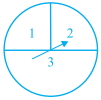
Solution
(N/A) No,the outcomes are not equally likely.
In the given figure,the circle is divided into three regions $1, 2,$ and $3$.
The region $3$ covers half of the circle (an area of $180^{\circ}$),while regions $1$ and $2$ each cover one-fourth of the circle (an area of $90^{\circ}$ each).
Since the areas of the regions are not equal,the probability of the arrow pointing to each region is not the same.
Therefore,the outcomes $1, 2,$ and $3$ are not equally likely.
In the given figure,the circle is divided into three regions $1, 2,$ and $3$.
The region $3$ covers half of the circle (an area of $180^{\circ}$),while regions $1$ and $2$ each cover one-fourth of the circle (an area of $90^{\circ}$ each).
Since the areas of the regions are not equal,the probability of the arrow pointing to each region is not the same.
Therefore,the outcomes $1, 2,$ and $3$ are not equally likely.
0 likes
View Solution19
DifficultMCQ
Apoorv throws two dice once and computes the product of the numbers appearing on the dice. Peehu throws one die and squares the number that appears on it. Who has the better chance of getting the number $36$? Why?
A
Apoorv
B
Peehu
C
Both have equal chances
D
None of them
Solution
(B) Apoorv throws two dice once.
Total number of outcomes $= 6 \times 6 = 36$.
The only way to get a product of $36$ is $(6, 6)$.
Number of favorable outcomes $= 1$.
Probability for Apoorv $= \frac{1}{36}$.
Peehu throws one die.
Total number of outcomes $= 6$.
The only way to get a square of $36$ is by rolling a $6$ $(6^2 = 36)$.
Number of favorable outcomes $= 1$.
Probability for Peehu $= \frac{1}{6} = \frac{6}{36}$.
Comparing the probabilities,$\frac{6}{36} > \frac{1}{36}$.
Therefore,Peehu has a better chance of getting the number $36$.
Total number of outcomes $= 6 \times 6 = 36$.
The only way to get a product of $36$ is $(6, 6)$.
Number of favorable outcomes $= 1$.
Probability for Apoorv $= \frac{1}{36}$.
Peehu throws one die.
Total number of outcomes $= 6$.
The only way to get a square of $36$ is by rolling a $6$ $(6^2 = 36)$.
Number of favorable outcomes $= 1$.
Probability for Peehu $= \frac{1}{6} = \frac{6}{36}$.
Comparing the probabilities,$\frac{6}{36} > \frac{1}{36}$.
Therefore,Peehu has a better chance of getting the number $36$.
0 likes
View Solution20
Medium
When we toss a coin,there are two possible outcomes - Head or Tail. Therefore,the probability of each outcome is $\frac{1}{2}$. Justify your answer.
Solution
(A) The total number of possible outcomes when tossing a coin is $2$ (Head and Tail).
Since the coin is fair,both outcomes are equally likely.
The probability of an event $E$ is given by the formula: $P(E) = \frac{\text{Number of favorable outcomes}}{\text{Total number of possible outcomes}}$.
For Head: $P(H) = \frac{1}{2}$.
For Tail: $P(T) = \frac{1}{2}$.
Thus,the probability of each outcome is $\frac{1}{2}$ because they are equally likely events.
Since the coin is fair,both outcomes are equally likely.
The probability of an event $E$ is given by the formula: $P(E) = \frac{\text{Number of favorable outcomes}}{\text{Total number of possible outcomes}}$.
For Head: $P(H) = \frac{1}{2}$.
For Tail: $P(T) = \frac{1}{2}$.
Thus,the probability of each outcome is $\frac{1}{2}$ because they are equally likely events.
0 likes
View Solution21
Medium
$A$ student says that if you throw a die,it will show up $1$ or not $1$. Therefore,the probability of getting $1$ and the probability of getting 'not $1$' each is equal to $\frac{1}{2}$. Is this correct? Give reasons.
Solution
(B) No,this is not correct.
When a fair die is thrown,the total number of possible outcomes is $6$,which are ${1, 2, 3, 4, 5, 6}$.
The probability of getting $1$ is $P(1) = \frac{\text{Number of favorable outcomes}}{\text{Total number of outcomes}} = \frac{1}{6}$.
The probability of getting 'not $1$' is $P(\text{not } 1) = 1 - P(1) = 1 - \frac{1}{6} = \frac{5}{6}$.
Since $\frac{1}{6} \neq \frac{5}{6}$,the student's claim that each probability is $\frac{1}{2}$ is incorrect.
When a fair die is thrown,the total number of possible outcomes is $6$,which are ${1, 2, 3, 4, 5, 6}$.
The probability of getting $1$ is $P(1) = \frac{\text{Number of favorable outcomes}}{\text{Total number of outcomes}} = \frac{1}{6}$.
The probability of getting 'not $1$' is $P(\text{not } 1) = 1 - P(1) = 1 - \frac{1}{6} = \frac{5}{6}$.
Since $\frac{1}{6} \neq \frac{5}{6}$,the student's claim that each probability is $\frac{1}{2}$ is incorrect.
0 likes
View Solution22
MediumMCQ
$I$ toss three coins together. The possible outcomes are no heads,$1$ head,$2$ heads and $3$ heads. So,$I$ say that probability of no heads is $\frac{1}{4}$. What is wrong with this conclusion?
A
The total number of outcomes is not $4$.
B
The outcomes are not equally likely.
C
The probability of no heads is $\frac{1}{8}$,not $\frac{1}{4}$.
D
Both $A$ and $C$.
Solution
$(D)$ When tossing three coins together,the total number of possible outcomes is $2^3 = 8$.
These outcomes are: $(HHH), (HHT), (HTH), (THH), (HTT), (THT), (TTH), (TTT)$.
Each of these $8$ outcomes is equally likely.
The event of getting 'no heads' corresponds to only one outcome: $(TTT)$.
Therefore,the probability of getting no heads is $\frac{1}{8}$.
The conclusion that the probability is $\frac{1}{4}$ is incorrect because it assumes that the four outcomes (no heads,$1$ head,$2$ heads,$3$ heads) are equally likely,which is not true.
These outcomes are: $(HHH), (HHT), (HTH), (THH), (HTT), (THT), (TTH), (TTT)$.
Each of these $8$ outcomes is equally likely.
The event of getting 'no heads' corresponds to only one outcome: $(TTT)$.
Therefore,the probability of getting no heads is $\frac{1}{8}$.
The conclusion that the probability is $\frac{1}{4}$ is incorrect because it assumes that the four outcomes (no heads,$1$ head,$2$ heads,$3$ heads) are equally likely,which is not true.
0 likes
View Solution23
Medium
If you toss a coin $6$ times and it comes down heads on each occasion,can you say that the probability of getting a head is $1$? Give reasons.
Solution
(N/A) No,we cannot say that the probability of getting a head is $1$.
When tossing a fair coin,the two possible outcomes (head and tail) are equally likely.
The probability of getting a head in a single toss is $P(\text{Head}) = \frac{1}{2}$.
Even if a head appears $6$ times in a row,each toss is an independent event.
The probability of getting a head remains $\frac{1}{2}$ for every individual toss,regardless of the previous outcomes.
When tossing a fair coin,the two possible outcomes (head and tail) are equally likely.
The probability of getting a head in a single toss is $P(\text{Head}) = \frac{1}{2}$.
Even if a head appears $6$ times in a row,each toss is an independent event.
The probability of getting a head remains $\frac{1}{2}$ for every individual toss,regardless of the previous outcomes.
0 likes
View Solution24
Easy
Sushma tosses a coin $3$ times and gets tail each time. Do you think that the outcome of next toss will be a tail? Give reasons.
Solution
(N/A) The outcome of the next toss may or may not be a tail. This is because tossing a coin is a random experiment where the occurrence of a head or a tail are equally likely events. Each toss is an independent event,meaning the result of the previous tosses does not influence the outcome of the next toss. Therefore,the probability of getting a tail in the next toss remains $1/2$.
0 likes
View Solution25
Easy
If $I$ toss a coin $3$ times and get a head each time,should $I$ expect a tail to have a higher chance in the $4^{th}$ toss? Give a reason in support of your answer.
Solution
(N/A) No,the outcome of each coin toss is an independent event. When we toss a fair coin,the probability of getting a head or a tail is equally likely,i.e.,$P(\text{Head}) = \frac{1}{2}$ and $P(\text{Tail}) = \frac{1}{2}$. Since the coin has no memory of previous outcomes,the probability of getting a tail in the $4^{th}$ toss remains $\frac{1}{2}$,which is the same as any other toss. Therefore,there is no reason to expect a higher chance for a tail.
0 likes
View Solution26
Medium
$A$ bag contains slips numbered from $1$ to $100$. If Fatima chooses a slip at random from the bag,it will either be an odd number or an even number. Since this situation has only two possible outcomes,the probability of each is $\frac{1}{2}$. Justify.
Solution
(A) We know that,between $1$ to $100$,half the numbers are even and half are odd. Specifically,$50$ numbers $(2, 4, 6, 8, \dots, 96, 98, 100)$ are even and $50$ numbers $(1, 3, 5, 7, \dots, 97, 99)$ are odd.
Since the total number of slips is $100$,the number of favorable outcomes for an even number is $50$,and for an odd number is $50$.
Probability of getting an even number $= \frac{\text{Number of even slips}}{\text{Total number of slips}} = \frac{50}{100} = \frac{1}{2}$.
Probability of getting an odd number $= \frac{\text{Number of odd slips}}{\text{Total number of slips}} = \frac{50}{100} = \frac{1}{2}$.
Since both events have an equal number of favorable outcomes,they are equally likely,and the probability of each is indeed $\frac{1}{2}$.
Since the total number of slips is $100$,the number of favorable outcomes for an even number is $50$,and for an odd number is $50$.
Probability of getting an even number $= \frac{\text{Number of even slips}}{\text{Total number of slips}} = \frac{50}{100} = \frac{1}{2}$.
Probability of getting an odd number $= \frac{\text{Number of odd slips}}{\text{Total number of slips}} = \frac{50}{100} = \frac{1}{2}$.
Since both events have an equal number of favorable outcomes,they are equally likely,and the probability of each is indeed $\frac{1}{2}$.
0 likes
View Solution27
Medium
Two dice are thrown at the same time. Find the probability of getting:
$(i)$ same number on both dice.
$(ii)$ different numbers on both dice.
$(i)$ same number on both dice.
$(ii)$ different numbers on both dice.
Solution
(A) When two dice are thrown at the same time,the total number of possible outcomes is $6 \times 6 = 36$.
$(i)$ Let $E_1$ be the event of getting the same number on both dice.
The favorable outcomes are $(1, 1), (2, 2), (3, 3), (4, 4), (5, 5), (6, 6)$.
Number of favorable outcomes $= 6$.
Probability $P(E_1) = \frac{6}{36} = \frac{1}{6}$.
$(ii)$ Let $E_2$ be the event of getting different numbers on both dice.
This is the complement of event $E_1$.
Number of favorable outcomes $= 36 - 6 = 30$.
Probability $P(E_2) = \frac{30}{36} = \frac{5}{6}$.
$(i)$ Let $E_1$ be the event of getting the same number on both dice.
The favorable outcomes are $(1, 1), (2, 2), (3, 3), (4, 4), (5, 5), (6, 6)$.
Number of favorable outcomes $= 6$.
Probability $P(E_1) = \frac{6}{36} = \frac{1}{6}$.
$(ii)$ Let $E_2$ be the event of getting different numbers on both dice.
This is the complement of event $E_1$.
Number of favorable outcomes $= 36 - 6 = 30$.
Probability $P(E_2) = \frac{30}{36} = \frac{5}{6}$.
0 likes
View Solution28
Medium
Two dice are thrown simultaneously. What is the probability that the sum of the numbers appearing on the dice is
$(i)$ $7 ?$
$(ii)$ a prime number?
$(iii)$ $1 ?$
$(i)$ $7 ?$
$(ii)$ a prime number?
$(iii)$ $1 ?$
Solution
(A-D) When two dice are thrown simultaneously,the total number of possible outcomes is $6 \times 6 = 36$.
$(i)$ Sum of the numbers appearing on the dice is $7$. The favorable outcomes are $(1, 6), (2, 5), (3, 4), (4, 3), (5, 2), (6, 1)$.
Number of favorable outcomes $= 6$.
$\text{Probability} = \frac{6}{36} = \frac{1}{6}$.
$(ii)$ Sum of the numbers appearing on the dice is a prime number. The possible prime sums are $2, 3, 5, 7, 11$.
- Sum $= 2: (1, 1) \rightarrow 1$ outcome
- Sum $= 3: (1, 2), (2, 1) \rightarrow 2$ outcomes
- Sum $= 5: (1, 4), (2, 3), (3, 2), (4, 1) \rightarrow 4$ outcomes
- Sum $= 7: (1, 6), (2, 5), (3, 4), (4, 3), (5, 2), (6, 1) \rightarrow 6$ outcomes
- Sum $= 11: (5, 6), (6, 5) \rightarrow 2$ outcomes
Total favorable outcomes $= 1 + 2 + 4 + 6 + 2 = 15$.
$\text{Probability} = \frac{15}{36} = \frac{5}{12}$.
$(iii)$ Sum of the numbers appearing on the dice is $1$. Since the minimum sum of two dice is $1 + 1 = 2$,it is impossible to get a sum of $1$.
Number of favorable outcomes $= 0$.
$\text{Probability} = \frac{0}{36} = 0$.
$(i)$ Sum of the numbers appearing on the dice is $7$. The favorable outcomes are $(1, 6), (2, 5), (3, 4), (4, 3), (5, 2), (6, 1)$.
Number of favorable outcomes $= 6$.
$\text{Probability} = \frac{6}{36} = \frac{1}{6}$.
$(ii)$ Sum of the numbers appearing on the dice is a prime number. The possible prime sums are $2, 3, 5, 7, 11$.
- Sum $= 2: (1, 1) \rightarrow 1$ outcome
- Sum $= 3: (1, 2), (2, 1) \rightarrow 2$ outcomes
- Sum $= 5: (1, 4), (2, 3), (3, 2), (4, 1) \rightarrow 4$ outcomes
- Sum $= 7: (1, 6), (2, 5), (3, 4), (4, 3), (5, 2), (6, 1) \rightarrow 6$ outcomes
- Sum $= 11: (5, 6), (6, 5) \rightarrow 2$ outcomes
Total favorable outcomes $= 1 + 2 + 4 + 6 + 2 = 15$.
$\text{Probability} = \frac{15}{36} = \frac{5}{12}$.
$(iii)$ Sum of the numbers appearing on the dice is $1$. Since the minimum sum of two dice is $1 + 1 = 2$,it is impossible to get a sum of $1$.
Number of favorable outcomes $= 0$.
$\text{Probability} = \frac{0}{36} = 0$.
0 likes
View Solution29
Medium
Two dice are thrown together. Find the probability that the product of the numbers on the top of the dice is
$(i) \, 6$
$(ii) \, 12$
$(iii) \, 7$
$(i) \, 6$
$(ii) \, 12$
$(iii) \, 7$
Solution
(N/A) The total number of outcomes when two dice are thrown is $6 \times 6 = 36$.
$(i)$ For the product to be $6$,the possible outcomes are $(1, 6), (2, 3), (3, 2), (6, 1)$.
Number of favorable outcomes $= 4$.
Probability $= \frac{4}{36} = \frac{1}{9}$.
$(ii)$ For the product to be $12$,the possible outcomes are $(2, 6), (3, 4), (4, 3), (6, 2)$.
Number of favorable outcomes $= 4$.
Probability $= \frac{4}{36} = \frac{1}{9}$.
$(iii)$ For the product to be $7$,there are no possible outcomes since $7$ is a prime number and cannot be formed by the product of two numbers from $1$ to $6$ (except $1 \times 7$,but $7$ is not on a die).
Number of favorable outcomes $= 0$.
Probability $= \frac{0}{36} = 0$.
$(i)$ For the product to be $6$,the possible outcomes are $(1, 6), (2, 3), (3, 2), (6, 1)$.
Number of favorable outcomes $= 4$.
Probability $= \frac{4}{36} = \frac{1}{9}$.
$(ii)$ For the product to be $12$,the possible outcomes are $(2, 6), (3, 4), (4, 3), (6, 2)$.
Number of favorable outcomes $= 4$.
Probability $= \frac{4}{36} = \frac{1}{9}$.
$(iii)$ For the product to be $7$,there are no possible outcomes since $7$ is a prime number and cannot be formed by the product of two numbers from $1$ to $6$ (except $1 \times 7$,but $7$ is not on a die).
Number of favorable outcomes $= 0$.
Probability $= \frac{0}{36} = 0$.
0 likes
View Solution30
MediumMCQ
Two dice are thrown at the same time and the product of numbers appearing on them is noted. Find the probability that the product is less than $9$.
A
$\frac{1}{9}$
B
$\frac{2}{9}$
C
$\frac{4}{9}$
D
$\frac{5}{9}$
Solution
(C) When two dice are thrown,the total number of possible outcomes is $6 \times 6 = 36$.
We need to find the outcomes where the product of the two numbers is less than $9$.
The favorable outcomes are:
For $1$ on the first die: $(1,1), (1,2), (1,3), (1,4), (1,5), (1,6)$ (Products: $1, 2, 3, 4, 5, 6$)
For $2$ on the first die: $(2,1), (2,2), (2,3), (2,4)$ (Products: $2, 4, 6, 8$)
For $3$ on the first die: $(3,1), (3,2)$ (Products: $3, 6$)
For $4$ on the first die: $(4,1), (4,2)$ (Products: $4, 8$)
For $5$ on the first die: $(5,1)$ (Product: $5$)
For $6$ on the first die: $(6,1)$ (Product: $6$)
Counting these,we have $6 + 4 + 2 + 2 + 1 + 1 = 16$ favorable outcomes.
The probability is $\frac{\text{Number of favorable outcomes}}{\text{Total number of outcomes}} = \frac{16}{36} = \frac{4}{9}$.
We need to find the outcomes where the product of the two numbers is less than $9$.
The favorable outcomes are:
For $1$ on the first die: $(1,1), (1,2), (1,3), (1,4), (1,5), (1,6)$ (Products: $1, 2, 3, 4, 5, 6$)
For $2$ on the first die: $(2,1), (2,2), (2,3), (2,4)$ (Products: $2, 4, 6, 8$)
For $3$ on the first die: $(3,1), (3,2)$ (Products: $3, 6$)
For $4$ on the first die: $(4,1), (4,2)$ (Products: $4, 8$)
For $5$ on the first die: $(5,1)$ (Product: $5$)
For $6$ on the first die: $(6,1)$ (Product: $6$)
Counting these,we have $6 + 4 + 2 + 2 + 1 + 1 = 16$ favorable outcomes.
The probability is $\frac{\text{Number of favorable outcomes}}{\text{Total number of outcomes}} = \frac{16}{36} = \frac{4}{9}$.
0 likes
View Solution31
Difficult
Two dice are numbered $1, 2, 3, 4, 5, 6$ and $1, 1, 2, 2, 3, 3$ respectively. They are thrown and the sum of the numbers on them is noted. Find the probability of getting each sum from $2$ to $9$ separately.
Solution
(N/A) Total number of outcomes $= 6 \times 6 = 36$.
$(i)$ Event $E_1$ (sum $= 2$): Outcomes are $\{(1, 1), (1, 1)\}$. $n(E_1) = 2$. $P(E_1) = \frac{2}{36} = \frac{1}{18}$.
$(ii)$ Event $E_2$ (sum $= 3$): Outcomes are $\{(1, 2), (1, 2), (2, 1), (2, 1)\}$. $n(E_2) = 4$. $P(E_2) = \frac{4}{36} = \frac{1}{9}$.
$(iii)$ Event $E_3$ (sum $= 4$): Outcomes are $\{(1, 3), (1, 3), (2, 2), (2, 2), (3, 1), (3, 1)\}$. $n(E_3) = 6$. $P(E_3) = \frac{6}{36} = \frac{1}{6}$.
$(iv)$ Event $E_4$ (sum $= 5$): Outcomes are $\{(2, 3), (2, 3), (3, 2), (3, 2), (4, 1), (4, 1)\}$. $n(E_4) = 6$. $P(E_4) = \frac{6}{36} = \frac{1}{6}$.
$(v)$ Event $E_5$ (sum $= 6$): Outcomes are $\{(3, 3), (3, 3), (4, 2), (4, 2), (5, 1), (5, 1)\}$. $n(E_5) = 6$. $P(E_5) = \frac{6}{36} = \frac{1}{6}$.
$(vi)$ Event $E_6$ (sum $= 7$): Outcomes are $\{(4, 3), (4, 3), (5, 2), (5, 2), (6, 1), (6, 1)\}$. $n(E_6) = 6$. $P(E_6) = \frac{6}{36} = \frac{1}{6}$.
$(vii)$ Event $E_7$ (sum $= 8$): Outcomes are $\{(5, 3), (5, 3), (6, 2), (6, 2)\}$. $n(E_7) = 4$. $P(E_7) = \frac{4}{36} = \frac{1}{9}$.
$(viii)$ Event $E_8$ (sum $= 9$): Outcomes are $\{(6, 3), (6, 3)\}$. $n(E_8) = 2$. $P(E_8) = \frac{2}{36} = \frac{1}{18}$.
$(i)$ Event $E_1$ (sum $= 2$): Outcomes are $\{(1, 1), (1, 1)\}$. $n(E_1) = 2$. $P(E_1) = \frac{2}{36} = \frac{1}{18}$.
$(ii)$ Event $E_2$ (sum $= 3$): Outcomes are $\{(1, 2), (1, 2), (2, 1), (2, 1)\}$. $n(E_2) = 4$. $P(E_2) = \frac{4}{36} = \frac{1}{9}$.
$(iii)$ Event $E_3$ (sum $= 4$): Outcomes are $\{(1, 3), (1, 3), (2, 2), (2, 2), (3, 1), (3, 1)\}$. $n(E_3) = 6$. $P(E_3) = \frac{6}{36} = \frac{1}{6}$.
$(iv)$ Event $E_4$ (sum $= 5$): Outcomes are $\{(2, 3), (2, 3), (3, 2), (3, 2), (4, 1), (4, 1)\}$. $n(E_4) = 6$. $P(E_4) = \frac{6}{36} = \frac{1}{6}$.
$(v)$ Event $E_5$ (sum $= 6$): Outcomes are $\{(3, 3), (3, 3), (4, 2), (4, 2), (5, 1), (5, 1)\}$. $n(E_5) = 6$. $P(E_5) = \frac{6}{36} = \frac{1}{6}$.
$(vi)$ Event $E_6$ (sum $= 7$): Outcomes are $\{(4, 3), (4, 3), (5, 2), (5, 2), (6, 1), (6, 1)\}$. $n(E_6) = 6$. $P(E_6) = \frac{6}{36} = \frac{1}{6}$.
$(vii)$ Event $E_7$ (sum $= 8$): Outcomes are $\{(5, 3), (5, 3), (6, 2), (6, 2)\}$. $n(E_7) = 4$. $P(E_7) = \frac{4}{36} = \frac{1}{9}$.
$(viii)$ Event $E_8$ (sum $= 9$): Outcomes are $\{(6, 3), (6, 3)\}$. $n(E_8) = 2$. $P(E_8) = \frac{2}{36} = \frac{1}{18}$.
0 likes
View Solution32
MediumMCQ
$A$ coin is tossed two times. Find the probability of getting at most one head.
A
$\frac{3}{4}$
B
$\frac{1}{4}$
C
$\frac{1}{3}$
D
$1$
Solution
(A) The possible outcomes when a coin is tossed $2$ times are:
$S = \{(H, H), (H, T), (T, H), (T, T)\}$
Therefore,the total number of outcomes $n(S) = 4$.
Let $E$ be the event of getting at most one head.
This means getting zero heads or one head.
The outcomes favorable to event $E$ are $\{(T, T), (H, T), (T, H)\}$.
Therefore,the number of favorable outcomes $n(E) = 3$.
The probability of the event $E$ is given by $P(E) = \frac{n(E)}{n(S)}$.
Thus,$P(E) = \frac{3}{4}$.
$S = \{(H, H), (H, T), (T, H), (T, T)\}$
Therefore,the total number of outcomes $n(S) = 4$.
Let $E$ be the event of getting at most one head.
This means getting zero heads or one head.
The outcomes favorable to event $E$ are $\{(T, T), (H, T), (T, H)\}$.
Therefore,the number of favorable outcomes $n(E) = 3$.
The probability of the event $E$ is given by $P(E) = \frac{n(E)}{n(S)}$.
Thus,$P(E) = \frac{3}{4}$.
0 likes
View Solution33
MediumMCQ
$A$ coin is tossed $3$ times. List the possible outcomes. Find the probability of getting:
$(i)$ all heads
$(ii)$ at least $2$ heads
$(i)$ all heads
$(ii)$ at least $2$ heads
A
$\frac{1}{8}, \frac{1}{7}$
B
$\frac{1}{8}, \frac{1}{2}$
C
$\frac{1}{7}, \frac{1}{2}$
D
$\frac{1}{7}, \frac{1}{7}$
Solution
(B) The sample space $S$ for tossing a coin $3$ times is:
$S = \{(HHH), (HHT), (HTH), (HTT), (THH), (THT), (TTH), (TTT)\}$
Total number of outcomes $n(S) = 8$.
$(i)$ Let $E_1$ be the event of getting all heads.
$E_1 = \{(HHH)\}$
Number of favorable outcomes $n(E_1) = 1$.
Probability $P(E_1) = \frac{n(E_1)}{n(S)} = \frac{1}{8}$.
$(ii)$ Let $E_2$ be the event of getting at least $2$ heads.
$E_2 = \{(HHH), (HHT), (HTH), (THH)\}$
Number of favorable outcomes $n(E_2) = 4$.
Probability $P(E_2) = \frac{n(E_2)}{n(S)} = \frac{4}{8} = \frac{1}{2}$.
$S = \{(HHH), (HHT), (HTH), (HTT), (THH), (THT), (TTH), (TTT)\}$
Total number of outcomes $n(S) = 8$.
$(i)$ Let $E_1$ be the event of getting all heads.
$E_1 = \{(HHH)\}$
Number of favorable outcomes $n(E_1) = 1$.
Probability $P(E_1) = \frac{n(E_1)}{n(S)} = \frac{1}{8}$.
$(ii)$ Let $E_2$ be the event of getting at least $2$ heads.
$E_2 = \{(HHH), (HHT), (HTH), (THH)\}$
Number of favorable outcomes $n(E_2) = 4$.
Probability $P(E_2) = \frac{n(E_2)}{n(S)} = \frac{4}{8} = \frac{1}{2}$.
0 likes
View Solution34
EasyMCQ
Two dice are thrown at the same time. Determine the probability that the difference of the numbers on the two dice is $2$.
A
$\frac{8}{9}$
B
$\frac{7}{9}$
C
$\frac{2}{9}$
D
$\frac{4}{9}$
Solution
(C) The total number of outcomes in the sample space when two dice are thrown is $n(S) = 6 \times 6 = 36$.
Let $E$ be the event of getting numbers whose difference is $2$.
The favorable outcomes are:
$E = \{(1, 3), (2, 4), (3, 5), (4, 6), (3, 1), (4, 2), (5, 3), (6, 4)\}$.
Therefore,the number of favorable outcomes is $n(E) = 8$.
The probability of the event $E$ is given by $P(E) = \frac{n(E)}{n(S)}$.
$P(E) = \frac{8}{36} = \frac{2}{9}$.
Let $E$ be the event of getting numbers whose difference is $2$.
The favorable outcomes are:
$E = \{(1, 3), (2, 4), (3, 5), (4, 6), (3, 1), (4, 2), (5, 3), (6, 4)\}$.
Therefore,the number of favorable outcomes is $n(E) = 8$.
The probability of the event $E$ is given by $P(E) = \frac{n(E)}{n(S)}$.
$P(E) = \frac{8}{36} = \frac{2}{9}$.
0 likes
View Solution35
Medium
$A$ bag contains $10$ red,$5$ blue and $7$ green balls. $A$ ball is drawn at random. Find the probability of this ball being a
$(i)$ red ball
$(ii)$ green ball
$(iii)$ not a blue ball
$(i)$ red ball
$(ii)$ green ball
$(iii)$ not a blue ball
Solution
(N/A) The total number of balls in the bag is $10 + 5 + 7 = 22$.
Thus,the total number of possible outcomes is $n(S) = 22$.
$(i)$ Let $E_1$ be the event of drawing a red ball. The number of red balls is $n(E_1) = 10$.
Therefore,the probability $P(E_1) = \frac{n(E_1)}{n(S)} = \frac{10}{22} = \frac{5}{11}$.
$(ii)$ Let $E_2$ be the event of drawing a green ball. The number of green balls is $n(E_2) = 7$.
Therefore,the probability $P(E_2) = \frac{n(E_2)}{n(S)} = \frac{7}{22}$.
$(iii)$ Let $E_3$ be the event of not drawing a blue ball. This means drawing either a red or a green ball.
The number of favorable outcomes is $n(E_3) = 10 + 7 = 17$.
Therefore,the probability $P(E_3) = \frac{n(E_3)}{n(S)} = \frac{17}{22}$.
Thus,the total number of possible outcomes is $n(S) = 22$.
$(i)$ Let $E_1$ be the event of drawing a red ball. The number of red balls is $n(E_1) = 10$.
Therefore,the probability $P(E_1) = \frac{n(E_1)}{n(S)} = \frac{10}{22} = \frac{5}{11}$.
$(ii)$ Let $E_2$ be the event of drawing a green ball. The number of green balls is $n(E_2) = 7$.
Therefore,the probability $P(E_2) = \frac{n(E_2)}{n(S)} = \frac{7}{22}$.
$(iii)$ Let $E_3$ be the event of not drawing a blue ball. This means drawing either a red or a green ball.
The number of favorable outcomes is $n(E_3) = 10 + 7 = 17$.
Therefore,the probability $P(E_3) = \frac{n(E_3)}{n(S)} = \frac{17}{22}$.
0 likes
View Solution36
Medium
The king,queen,and jack of clubs are removed from a deck of $52$ playing cards and then well shuffled. Now,one card is drawn at random from the remaining cards. Determine the probability that the card is:
$(i)$ a heart
$(ii)$ a king
$(i)$ a heart
$(ii)$ a king
Solution
(A) Total number of cards in a deck = $52$.
After removing the king,queen,and jack of clubs,the number of remaining cards is $n(S) = 52 - 3 = 49$.
$(i)$ Let $E_1$ be the event of getting a heart.
Since there are $13$ hearts in a deck and none were removed,$n(E_1) = 13$.
Therefore,the probability $P(E_1) = \frac{n(E_1)}{n(S)} = \frac{13}{49}$.
$(ii)$ Let $E_2$ be the event of getting a king.
There are $4$ kings in a deck. Since the king of clubs was removed,the number of remaining kings is $n(E_2) = 4 - 1 = 3$.
Therefore,the probability $P(E_2) = \frac{n(E_2)}{n(S)} = \frac{3}{49}$.
After removing the king,queen,and jack of clubs,the number of remaining cards is $n(S) = 52 - 3 = 49$.
$(i)$ Let $E_1$ be the event of getting a heart.
Since there are $13$ hearts in a deck and none were removed,$n(E_1) = 13$.
Therefore,the probability $P(E_1) = \frac{n(E_1)}{n(S)} = \frac{13}{49}$.
$(ii)$ Let $E_2$ be the event of getting a king.
There are $4$ kings in a deck. Since the king of clubs was removed,the number of remaining kings is $n(E_2) = 4 - 1 = 3$.
Therefore,the probability $P(E_2) = \frac{n(E_2)}{n(S)} = \frac{3}{49}$.
0 likes
View Solution37
Medium
The king,queen,and jack of clubs are removed from a deck of $52$ playing cards and then well shuffled. Now,one card is drawn at random from the remaining cards. What is the probability that the card is:
$(i)$ a club
$(ii)$ $10$ of hearts
$(i)$ a club
$(ii)$ $10$ of hearts
Solution
(A) $(i)$ Let $E_1$ be the event of getting a club.
Total cards remaining $= 52 - 3 = 49$.
Number of clubs remaining $= 13 - 3 = 10$.
$\therefore$ Probability $= \frac{10}{49}$.
$(ii)$ Let $E_2$ be the event of getting $10$ of hearts.
There is only one $10$ of hearts in the deck.
$\therefore$ Probability $= \frac{1}{49}$.
Total cards remaining $= 52 - 3 = 49$.
Number of clubs remaining $= 13 - 3 = 10$.
$\therefore$ Probability $= \frac{10}{49}$.
$(ii)$ Let $E_2$ be the event of getting $10$ of hearts.
There is only one $10$ of hearts in the deck.
$\therefore$ Probability $= \frac{1}{49}$.
0 likes
View Solution38
Difficult
All the jacks,queens,and kings are removed from a deck of $52$ playing cards. The remaining cards are well shuffled,and then one card is drawn at random. Giving ace a value of $1$ and similar values for other cards,find the probability that the card has a value:
$(i)$ $7$
$(ii)$ greater than $7$
$(iii)$ less than $7$
$(i)$ $7$
$(ii)$ greater than $7$
$(iii)$ less than $7$
Solution
(N/A) Total cards in a deck = $52$.
Number of jacks = $4$,queens = $4$,kings = $4$. Total removed = $4 + 4 + 4 = 12$.
Remaining cards $n(S) = 52 - 12 = 40$.
$(i)$ Let $E_1$ be the event of getting a card with value $7$. There are $4$ such cards (one of each suit).
$P(E_1) = \frac{n(E_1)}{n(S)} = \frac{4}{40} = \frac{1}{10}$.
$(ii)$ Let $E_2$ be the event of getting a card with a value greater than $7$. The possible values are $8, 9, 10$. There are $3$ values,each with $4$ suits,so $n(E_2) = 3 \times 4 = 12$.
$P(E_2) = \frac{n(E_2)}{n(S)} = \frac{12}{40} = \frac{3}{10}$.
$(iii)$ Let $E_3$ be the event of getting a card with a value less than $7$. The possible values are $1, 2, 3, 4, 5, 6$. There are $6$ values,each with $4$ suits,so $n(E_3) = 6 \times 4 = 24$.
$P(E_3) = \frac{n(E_3)}{n(S)} = \frac{24}{40} = \frac{3}{5}$.
Number of jacks = $4$,queens = $4$,kings = $4$. Total removed = $4 + 4 + 4 = 12$.
Remaining cards $n(S) = 52 - 12 = 40$.
$(i)$ Let $E_1$ be the event of getting a card with value $7$. There are $4$ such cards (one of each suit).
$P(E_1) = \frac{n(E_1)}{n(S)} = \frac{4}{40} = \frac{1}{10}$.
$(ii)$ Let $E_2$ be the event of getting a card with a value greater than $7$. The possible values are $8, 9, 10$. There are $3$ values,each with $4$ suits,so $n(E_2) = 3 \times 4 = 12$.
$P(E_2) = \frac{n(E_2)}{n(S)} = \frac{12}{40} = \frac{3}{10}$.
$(iii)$ Let $E_3$ be the event of getting a card with a value less than $7$. The possible values are $1, 2, 3, 4, 5, 6$. There are $6$ values,each with $4$ suits,so $n(E_3) = 6 \times 4 = 24$.
$P(E_3) = \frac{n(E_3)}{n(S)} = \frac{24}{40} = \frac{3}{5}$.
0 likes
View Solution39
DifficultMCQ
An integer is chosen between $0$ and $100$. What is the probability that it is
$(i)$ divisible by $7?$
$(ii)$ not divisible by $7?$
$(i)$ divisible by $7?$
$(ii)$ not divisible by $7?$
A
$\frac{14}{99}, \frac{15}{99}$
B
$\frac{86}{99}, \frac{85}{99}$
C
$\frac{99}{14}, \frac{85}{99}$
D
$\frac{14}{99}, \frac{85}{99}$
Solution
(D) The total number of integers between $0$ and $100$ is $99$ (i.e.,${1, 2, 3, \dots, 99}$).
$n(S) = 99$
$(i)$ Let $E_1$ be the event of choosing an integer which is divisible by $7$.
The multiples of $7$ between $0$ and $100$ are ${7, 14, 21, 28, 35, 42, 49, 56, 63, 70, 77, 84, 91, 98}$.
$n(E_1) = 14$
$P(E_1) = \frac{n(E_1)}{n(S)} = \frac{14}{99}$
$(ii)$ Let $E_2$ be the event of choosing an integer which is not divisible by $7$.
$n(E_2) = n(S) - n(E_1) = 99 - 14 = 85$
$P(E_2) = \frac{n(E_2)}{n(S)} = \frac{85}{99}$
$n(S) = 99$
$(i)$ Let $E_1$ be the event of choosing an integer which is divisible by $7$.
The multiples of $7$ between $0$ and $100$ are ${7, 14, 21, 28, 35, 42, 49, 56, 63, 70, 77, 84, 91, 98}$.
$n(E_1) = 14$
$P(E_1) = \frac{n(E_1)}{n(S)} = \frac{14}{99}$
$(ii)$ Let $E_2$ be the event of choosing an integer which is not divisible by $7$.
$n(E_2) = n(S) - n(E_1) = 99 - 14 = 85$
$P(E_2) = \frac{n(E_2)}{n(S)} = \frac{85}{99}$
0 likes
View Solution40
MediumMCQ
Cards with numbers $2$ to $101$ are placed in a box. $A$ card is selected at random. Find the probability that the card has
$(i)$ an even number
$(ii)$ a square number
$(i)$ an even number
$(ii)$ a square number
A
$\frac{1}{2} , \frac{9}{100}$
B
$\frac{1}{3} , \frac{91}{100}$
C
$\frac{1}{4} , \frac{9}{100}$
D
$\frac{1}{2} , \frac{81}{100}$
Solution
(A) Total number of outcomes with numbers $2$ to $101$ is $n(S) = 101 - 2 + 1 = 100$.
$(i)$ Let $E_1$ be the event of selecting a card which is an even number. The even numbers are $\{2, 4, 6, \dots, 100\}$.
This is an arithmetic progression where $a = 2$,$d = 2$,and $l = 100$.
Using $l = a + (n - 1)d$,we get $100 = 2 + (n - 1)2$,which implies $98 = 2(n - 1)$,so $n - 1 = 49$,and $n = 50$.
Thus,$n(E_1) = 50$.
The probability $P(E_1) = \frac{n(E_1)}{n(S)} = \frac{50}{100} = \frac{1}{2}$.
$(ii)$ Let $E_2$ be the event of selecting a card which is a square number.
The square numbers between $2$ and $101$ are $\{4, 9, 16, 25, 36, 49, 64, 81, 100\}$.
These correspond to $\{2^2, 3^2, 4^2, 5^2, 6^2, 7^2, 8^2, 9^2, 10^2\}$.
Thus,$n(E_2) = 9$.
The probability $P(E_2) = \frac{n(E_2)}{n(S)} = \frac{9}{100}$.
$(i)$ Let $E_1$ be the event of selecting a card which is an even number. The even numbers are $\{2, 4, 6, \dots, 100\}$.
This is an arithmetic progression where $a = 2$,$d = 2$,and $l = 100$.
Using $l = a + (n - 1)d$,we get $100 = 2 + (n - 1)2$,which implies $98 = 2(n - 1)$,so $n - 1 = 49$,and $n = 50$.
Thus,$n(E_1) = 50$.
The probability $P(E_1) = \frac{n(E_1)}{n(S)} = \frac{50}{100} = \frac{1}{2}$.
$(ii)$ Let $E_2$ be the event of selecting a card which is a square number.
The square numbers between $2$ and $101$ are $\{4, 9, 16, 25, 36, 49, 64, 81, 100\}$.
These correspond to $\{2^2, 3^2, 4^2, 5^2, 6^2, 7^2, 8^2, 9^2, 10^2\}$.
Thus,$n(E_2) = 9$.
The probability $P(E_2) = \frac{n(E_2)}{n(S)} = \frac{9}{100}$.
0 likes
View Solution41
EasyMCQ
$A$ letter of English alphabets is chosen at random. Determine the probability that the letter is a consonant.
A
$\frac{22}{26}$
B
$\frac{21}{26}$
C
$\frac{23}{26}$
D
$\frac{25}{26}$
Solution
(B) We know that in the English alphabet,there are $5$ vowels and $21$ consonants,making a total of $26$ letters.
The total number of possible outcomes is $n(S) = 26$.
Let $E$ be the event of choosing a consonant from the English alphabet.
The set of consonants is ${b, c, d, f, g, h, j, k, l, m, n, p, q, r, s, t, v, w, x, y, z}$.
Therefore,the number of favorable outcomes is $n(E) = 21$.
The probability of an event is given by $P(E) = \frac{n(E)}{n(S)}$.
Thus,the required probability is $\frac{21}{26}$.
The total number of possible outcomes is $n(S) = 26$.
Let $E$ be the event of choosing a consonant from the English alphabet.
The set of consonants is ${b, c, d, f, g, h, j, k, l, m, n, p, q, r, s, t, v, w, x, y, z}$.
Therefore,the number of favorable outcomes is $n(E) = 21$.
The probability of an event is given by $P(E) = \frac{n(E)}{n(S)}$.
Thus,the required probability is $\frac{21}{26}$.
0 likes
View Solution42
EasyMCQ
There are $1000$ sealed envelopes in a box,$10$ of them contain a cash prize of $Rs. 100$ each,$100$ of them contain a cash prize of $Rs. 50$ each,$200$ of them contain a cash prize of $Rs. 10$ each,and the rest do not contain any cash prize. If they are well shuffled and an envelope is picked out,what is the probability that it contains no cash prize?
A
$0.39$
B
$0.49$
C
$0.69$
D
$0.59$
Solution
(C) Total number of sealed envelopes in a box,$n(S) = 1000$.
Number of envelopes containing a cash prize $= 10 + 100 + 200 = 310$.
Number of envelopes containing no cash prize,$n(E) = 1000 - 310 = 690$.
The probability $P(E)$ that the envelope contains no cash prize is given by the ratio of the number of favorable outcomes to the total number of outcomes.
$P(E) = \frac{n(E)}{n(S)} = \frac{690}{1000} = 0.69$.
Number of envelopes containing a cash prize $= 10 + 100 + 200 = 310$.
Number of envelopes containing no cash prize,$n(E) = 1000 - 310 = 690$.
The probability $P(E)$ that the envelope contains no cash prize is given by the ratio of the number of favorable outcomes to the total number of outcomes.
$P(E) = \frac{n(E)}{n(S)} = \frac{690}{1000} = 0.69$.
0 likes
View Solution43
MediumMCQ
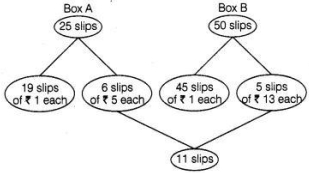
Box $A$ contains $25$ slips of which $19$ are marked $Rs. 1$ and others are marked $Rs. 5$ each. Box $B$ contains $50$ slips of which $45$ are marked $Rs. 1$ each and others are marked $Rs. 13$ each. Slips of both boxes are poured into a third box and reshuffled. $A$ slip is drawn at random. What is the probability that it is marked other than $Rs. 1$?
A
$\frac{45}{75}$
B
$\frac{35}{75}$
C
$\frac{15}{75}$
D
$\frac{11}{75}$
Solution
(D) Total number of slips in the third box,$n(S) = 25 + 50 = 75$.
From the given information:
Number of slips marked $Rs. 1$ in Box $A = 19$.
Number of slips marked $Rs. 5$ in Box $A = 25 - 19 = 6$.
Number of slips marked $Rs. 1$ in Box $B = 45$.
Number of slips marked $Rs. 13$ in Box $B = 50 - 45 = 5$.
Total number of slips marked other than $Rs. 1 = 6 + 5 = 11$.
Therefore,the required probability $= \frac{\text{Number of slips marked other than } Rs. 1}{\text{Total number of slips}} = \frac{11}{75}$.
From the given information:
Number of slips marked $Rs. 1$ in Box $A = 19$.
Number of slips marked $Rs. 5$ in Box $A = 25 - 19 = 6$.
Number of slips marked $Rs. 1$ in Box $B = 45$.
Number of slips marked $Rs. 13$ in Box $B = 50 - 45 = 5$.
Total number of slips marked other than $Rs. 1 = 6 + 5 = 11$.
Therefore,the required probability $= \frac{\text{Number of slips marked other than } Rs. 1}{\text{Total number of slips}} = \frac{11}{75}$.
0 likes
View Solution44
Easy
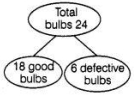
$A$ carton of $24$ bulbs contains $6$ defective bulbs. One bulb is drawn at random. What is the probability that the bulb is not defective? If the bulb selected is defective and it is not replaced, and a second bulb is selected at random from the rest, what is the probability that the second bulb is defective?
Solution
(N/A) Total number of bulbs, $n(S) = 24$.
Number of defective bulbs $= 6$.
Number of non-defective (good) bulbs $= 24 - 6 = 18$.
Part $1$: Probability that the bulb is not defective:
$P(\text{not defective}) = \frac{\text{Number of good bulbs}}{\text{Total number of bulbs}} = \frac{18}{24} = \frac{3}{4}$.
Part $2$: If the first bulb selected is defective and not replaced:
Remaining total number of bulbs $= 24 - 1 = 23$.
Remaining number of defective bulbs $= 6 - 1 = 5$.
Probability that the second bulb is defective $= \frac{\text{Remaining defective bulbs}}{\text{Remaining total bulbs}} = \frac{5}{23}$.
Number of defective bulbs $= 6$.
Number of non-defective (good) bulbs $= 24 - 6 = 18$.
Part $1$: Probability that the bulb is not defective:
$P(\text{not defective}) = \frac{\text{Number of good bulbs}}{\text{Total number of bulbs}} = \frac{18}{24} = \frac{3}{4}$.
Part $2$: If the first bulb selected is defective and not replaced:
Remaining total number of bulbs $= 24 - 1 = 23$.
Remaining number of defective bulbs $= 6 - 1 = 5$.
Probability that the second bulb is defective $= \frac{\text{Remaining defective bulbs}}{\text{Remaining total bulbs}} = \frac{5}{23}$.
0 likes
View Solution45
Medium
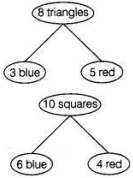
$A$ child's game has $8$ triangles of which $3$ are blue and the rest are red,and $10$ squares of which $6$ are blue and the rest are red. One piece is lost at random. Find the probability that it is a
$(i)$ triangle
$(ii)$ square
$(iii)$ square of blue colour
$(iv)$ triangle of red colour
$(i)$ triangle
$(ii)$ square
$(iii)$ square of blue colour
$(iv)$ triangle of red colour
Solution
(N/A) Total number of pieces $= 8 \text{ triangles} + 10 \text{ squares} = 18$.
$(i)$ Probability that the lost piece is a triangle $= \frac{8}{18} = \frac{4}{9}$.
$(ii)$ Probability that the lost piece is a square $= \frac{10}{18} = \frac{5}{9}$.
$(iii)$ Number of blue squares $= 6$. Probability that the lost piece is a blue square $= \frac{6}{18} = \frac{1}{3}$.
$(iv)$ Number of red triangles $= 8 - 3 = 5$. Probability that the lost piece is a red triangle $= \frac{5}{18}$.
$(i)$ Probability that the lost piece is a triangle $= \frac{8}{18} = \frac{4}{9}$.
$(ii)$ Probability that the lost piece is a square $= \frac{10}{18} = \frac{5}{9}$.
$(iii)$ Number of blue squares $= 6$. Probability that the lost piece is a blue square $= \frac{6}{18} = \frac{1}{3}$.
$(iv)$ Number of red triangles $= 8 - 3 = 5$. Probability that the lost piece is a red triangle $= \frac{5}{18}$.
0 likes
View Solution46
Difficult
In a game,the entry fee is $Rs. 5$. The game consists of tossing a coin $3$ times. If one or two heads show,Sweta gets her entry fee back. If she throws $3$ heads,she receives double the entry fee. Otherwise,she will lose. For tossing a coin three times,find the probability that she:
$(i)$ loses the entry fee.
$(ii)$ gets double the entry fee.
$(iii)$ just gets her entry fee back.
$(i)$ loses the entry fee.
$(ii)$ gets double the entry fee.
$(iii)$ just gets her entry fee back.
Solution
(A) Total possible outcomes of tossing a coin $3$ times:
$S = \{(HHH), (TTT), (HTT), (THT), (TTH), (THH), (HTH), (HHT)\}$
$\therefore n(S) = 8$
$(i)$ Let $E_1$ be the event that Sweta loses the entry fee.
This happens if she gets zero heads (i.e.,$TTT$).
$E_1 = \{(TTT)\}$,so $n(E_1) = 1$.
$P(E_1) = \frac{n(E_1)}{n(S)} = \frac{1}{8}$.
$(ii)$ Let $E_2$ be the event that Sweta gets double the entry fee.
This happens if she gets $3$ heads (i.e.,$HHH$).
$E_2 = \{(HHH)\}$,so $n(E_2) = 1$.
$P(E_2) = \frac{n(E_2)}{n(S)} = \frac{1}{8}$.
$(iii)$ Let $E_3$ be the event that Sweta gets her entry fee back.
This happens if she gets one or two heads.
$E_3 = \{(HTT), (THT), (TTH), (HHT), (HTH), (THH)\}$,so $n(E_3) = 6$.
$P(E_3) = \frac{n(E_3)}{n(S)} = \frac{6}{8} = \frac{3}{4}$.
$S = \{(HHH), (TTT), (HTT), (THT), (TTH), (THH), (HTH), (HHT)\}$
$\therefore n(S) = 8$
$(i)$ Let $E_1$ be the event that Sweta loses the entry fee.
This happens if she gets zero heads (i.e.,$TTT$).
$E_1 = \{(TTT)\}$,so $n(E_1) = 1$.
$P(E_1) = \frac{n(E_1)}{n(S)} = \frac{1}{8}$.
$(ii)$ Let $E_2$ be the event that Sweta gets double the entry fee.
This happens if she gets $3$ heads (i.e.,$HHH$).
$E_2 = \{(HHH)\}$,so $n(E_2) = 1$.
$P(E_2) = \frac{n(E_2)}{n(S)} = \frac{1}{8}$.
$(iii)$ Let $E_3$ be the event that Sweta gets her entry fee back.
This happens if she gets one or two heads.
$E_3 = \{(HTT), (THT), (TTH), (HHT), (HTH), (THH)\}$,so $n(E_3) = 6$.
$P(E_3) = \frac{n(E_3)}{n(S)} = \frac{6}{8} = \frac{3}{4}$.
0 likes
View Solution47
Medium
$A$ die has its six faces marked ${0, 1, 1, 1, 6, 6}$. Two such dice are thrown together and the total score is recorded.
$(i)$ How many different scores are possible?
$(ii)$ What is the probability of getting a total of $7$?
$(i)$ How many different scores are possible?
$(ii)$ What is the probability of getting a total of $7$?
Solution
(C) Given,a die has its six faces marked ${0, 1, 1, 1, 6, 6}$.
Total sample space,$n(S) = 6^2 = 36$.
$(i)$ The possible sums are obtained by adding the values on the two dice:
$0+0=0, 0+1=1, 0+6=6, 1+1=2, 1+6=7, 6+6=12$.
Thus,the different scores possible are ${0, 1, 2, 6, 7, 12}$. There are $6$ possible scores.
$(ii)$ Let $E$ be the event of getting a sum of $7$.
The pairs $(d_1, d_2)$ that result in a sum of $7$ are:
$(1, 6)$ occurs $3 \times 2 = 6$ times.
$(6, 1)$ occurs $2 \times 3 = 6$ times.
Total favorable outcomes $n(E) = 6 + 6 = 12$.
$P(E) = \frac{n(E)}{n(S)} = \frac{12}{36} = \frac{1}{3}$.
Total sample space,$n(S) = 6^2 = 36$.
$(i)$ The possible sums are obtained by adding the values on the two dice:
$0+0=0, 0+1=1, 0+6=6, 1+1=2, 1+6=7, 6+6=12$.
Thus,the different scores possible are ${0, 1, 2, 6, 7, 12}$. There are $6$ possible scores.
$(ii)$ Let $E$ be the event of getting a sum of $7$.
The pairs $(d_1, d_2)$ that result in a sum of $7$ are:
$(1, 6)$ occurs $3 \times 2 = 6$ times.
$(6, 1)$ occurs $2 \times 3 = 6$ times.
Total favorable outcomes $n(E) = 6 + 6 = 12$.
$P(E) = \frac{n(E)}{n(S)} = \frac{12}{36} = \frac{1}{3}$.
0 likes
View Solution48
Medium
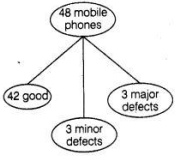
$A$ lot consists of $48$ mobile phones of which $42$ are good,$3$ have only minor defects,and $3$ have major defects. Varnika will buy a phone if it is good,but the trader will only buy a mobile if it has no major defect. One phone is selected at random from the lot. What is the probability that it is
$(i)$ acceptable to Varnika?
$(ii)$ acceptable to the trader?
$(i)$ acceptable to Varnika?
$(ii)$ acceptable to the trader?
Solution
(N/A) Given,total number of mobile phones $n(S) = 48$.
$(i)$ Let $E_{1}$ be the event that Varnika will buy a mobile phone.
Varnika buys only if it is a good mobile.
Therefore,$n(E_{1}) = 42$.
$P(E_{1}) = \frac{n(E_{1})}{n(S)} = \frac{42}{48} = \frac{7}{8}$.
$(ii)$ Let $E_{2}$ be the event that the trader will buy a mobile phone.
The trader will buy only if it has no major defects.
This means the trader will buy the $42$ good phones and the $3$ phones with minor defects.
Therefore,$n(E_{2}) = 42 + 3 = 45$.
$P(E_{2}) = \frac{n(E_{2})}{n(S)} = \frac{45}{48} = \frac{15}{16}$.
$(i)$ Let $E_{1}$ be the event that Varnika will buy a mobile phone.
Varnika buys only if it is a good mobile.
Therefore,$n(E_{1}) = 42$.
$P(E_{1}) = \frac{n(E_{1})}{n(S)} = \frac{42}{48} = \frac{7}{8}$.
$(ii)$ Let $E_{2}$ be the event that the trader will buy a mobile phone.
The trader will buy only if it has no major defects.
This means the trader will buy the $42$ good phones and the $3$ phones with minor defects.
Therefore,$n(E_{2}) = 42 + 3 = 45$.
$P(E_{2}) = \frac{n(E_{2})}{n(S)} = \frac{45}{48} = \frac{15}{16}$.
0 likes
View Solution49
Medium
$A$ bag contains $24$ balls of which $x$ are red,$2x$ are white,and $3x$ are blue. $A$ ball is selected at random. What is the probability that it is:
$(i)$ not red?
$(ii)$ white?
$(i)$ not red?
$(ii)$ white?
Solution
(A) Given that,the total number of balls in the bag $= 24$.
Number of red balls $= x$,number of white balls $= 2x$,and number of blue balls $= 3x$.
According to the condition,$x + 2x + 3x = 24$.
$6x = 24$,which gives $x = 4$.
Therefore,the number of red balls $= 4$,the number of white balls $= 2 \times 4 = 8$,and the number of blue balls $= 3 \times 4 = 12$.
The total number of outcomes $n(S) = 24$.
$(i)$ Let $E_1$ be the event of selecting a ball which is not red. This means the ball can be white or blue.
$n(E_1) = \text{Number of white balls} + \text{Number of blue balls} = 8 + 12 = 20$.
Required probability $P(E_1) = \frac{n(E_1)}{n(S)} = \frac{20}{24} = \frac{5}{6}$.
$(ii)$ Let $E_2$ be the event of selecting a ball which is white.
$n(E_2) = \text{Number of white balls} = 8$.
Required probability $P(E_2) = \frac{n(E_2)}{n(S)} = \frac{8}{24} = \frac{1}{3}$.
Number of red balls $= x$,number of white balls $= 2x$,and number of blue balls $= 3x$.
According to the condition,$x + 2x + 3x = 24$.
$6x = 24$,which gives $x = 4$.
Therefore,the number of red balls $= 4$,the number of white balls $= 2 \times 4 = 8$,and the number of blue balls $= 3 \times 4 = 12$.
The total number of outcomes $n(S) = 24$.
$(i)$ Let $E_1$ be the event of selecting a ball which is not red. This means the ball can be white or blue.
$n(E_1) = \text{Number of white balls} + \text{Number of blue balls} = 8 + 12 = 20$.
Required probability $P(E_1) = \frac{n(E_1)}{n(S)} = \frac{20}{24} = \frac{5}{6}$.
$(ii)$ Let $E_2$ be the event of selecting a ball which is white.
$n(E_2) = \text{Number of white balls} = 8$.
Required probability $P(E_2) = \frac{n(E_2)}{n(S)} = \frac{8}{24} = \frac{1}{3}$.
0 likes
View Solution50
Medium
At a fete, cards bearing numbers $1$ to $1000$, one number on one card, are put in a box. Each player selects one card at random and that card is not replaced. If the selected card has a perfect square greater than $500$, the player wins a prize. What is the probability that:
$(i)$ the first player wins a prize?
$(ii)$ the second player wins a prize, if the first has won?
$(i)$ the first player wins a prize?
$(ii)$ the second player wins a prize, if the first has won?
Solution
(A) Total number of cards in the box is $n(S) = 1000$.
$(i)$ Let $E_1$ be the event that the first player wins a prize. This happens if the player selects a perfect square greater than $500$.
The perfect squares between $1$ and $1000$ are $1^2, 2^2, \dots, 31^2 = 961$.
The perfect squares greater than $500$ are $23^2=529, 24^2=576, 25^2=625, 26^2=676, 27^2=729, 28^2=784, 29^2=841, 30^2=900, 31^2=961$.
There are $9$ such cards.
Thus, $n(E_1) = 9$.
The probability that the first player wins is $P(E_1) = \frac{n(E_1)}{n(S)} = \frac{9}{1000} = 0.009$.
$(ii)$ If the first player has won, one card (which is a perfect square $> 500$) is removed from the box.
The remaining number of cards is $n(S') = 1000 - 1 = 999$.
The number of remaining perfect squares greater than $500$ is $n(E_2) = 9 - 1 = 8$.
The probability that the second player wins given the first has won is $P(E_2|E_1) = \frac{n(E_2)}{n(S')} = \frac{8}{999}$.
$(i)$ Let $E_1$ be the event that the first player wins a prize. This happens if the player selects a perfect square greater than $500$.
The perfect squares between $1$ and $1000$ are $1^2, 2^2, \dots, 31^2 = 961$.
The perfect squares greater than $500$ are $23^2=529, 24^2=576, 25^2=625, 26^2=676, 27^2=729, 28^2=784, 29^2=841, 30^2=900, 31^2=961$.
There are $9$ such cards.
Thus, $n(E_1) = 9$.
The probability that the first player wins is $P(E_1) = \frac{n(E_1)}{n(S)} = \frac{9}{1000} = 0.009$.
$(ii)$ If the first player has won, one card (which is a perfect square $> 500$) is removed from the box.
The remaining number of cards is $n(S') = 1000 - 1 = 999$.
The number of remaining perfect squares greater than $500$ is $n(E_2) = 9 - 1 = 8$.
The probability that the second player wins given the first has won is $P(E_2|E_1) = \frac{n(E_2)}{n(S')} = \frac{8}{999}$.
0 likes
View SolutionProbability — Mix Examples - Probability · Frequently Asked Questions
1Are these Probability questions useful for JEE and NEET?
Yes. All questions in this section are mapped to JEE Main and NEET exam patterns. Previous year questions from JEE Main, NEET, GUJCET and state-level exams are included with full solutions.
2Can I switch to Hindi or Gujarati for these questions?
Yes. Use the language tabs in the hero section or the sidebar to view the same questions and solutions in English, Hindi or Gujarati.
3How do I generate a question paper from this subtopic?
Use the Vedclass Exam Paper Generator — select the chapter and subtopic, set difficulty, and generate Sets A, B, C, D automatically. First 3 chapters of every subject are free.
Vedclass Products
For Students
Vedclass Test Series
Mock tests in real JEE/NEET style with performance analysis. 5-day free trial.
Start Free TrialFor Teachers
Exam Paper Generator
Generate Set A/B/C/D papers from this chapter in 2 minutes. 3 chapters free.
Try FreeFor Institutes
Online Exam Module
Live online exams with unlimited students, 360° analytics & white-label branding.
See DemoFor Teachers & Institutes
Generate a Probability Exam Paper in 2 Minutes
Select subtopic & difficulty — Sets A, B, C, D auto-generated with No Repeat logic.
First 3 chapters of every subject are free — no payment required.