
A English
Mix Examples - Constructions Questions in English
Class 10 Mathematics · Constructions · Mix Examples - Constructions
60+
Questions
English
Language
100%
With Solutions
Showing 50 of 60 questions in English
1
MediumMCQ
To divide a line segment $AB$ in the ratio $p: q$ ($p, q$ are positive integers),draw a ray $AX$ so that $\angle BAX$ is an acute angle and then mark points on ray $AX$ at equal distances such that the minimum number of these points is
A
$p+q$
B
greater of $p$ and $q$
C
$p+q-1$
D
$pq$
Solution
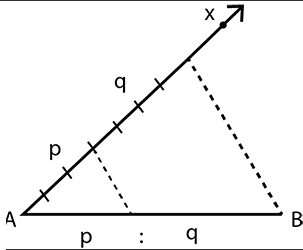
(A) To divide a line segment $AB$ in the ratio $p:q$,we draw a ray $AX$ making an acute angle with $AB$.
We then mark $p+q$ points on the ray $AX$ at equal distances,say $A_1, A_2, \dots, A_{p+q}$,such that $AA_1 = A_1A_2 = \dots = A_{p+q-1}A_{p+q}$.
We join the last point $A_{p+q}$ to $B$.
Then,we draw a line parallel to $A_{p+q}B$ through the point $A_p$ to intersect $AB$ at a point $P$.
This point $P$ divides the line segment $AB$ in the ratio $p:q$.
Therefore,the minimum number of points to be marked on the ray $AX$ is $p+q$.
We then mark $p+q$ points on the ray $AX$ at equal distances,say $A_1, A_2, \dots, A_{p+q}$,such that $AA_1 = A_1A_2 = \dots = A_{p+q-1}A_{p+q}$.
We join the last point $A_{p+q}$ to $B$.
Then,we draw a line parallel to $A_{p+q}B$ through the point $A_p$ to intersect $AB$ at a point $P$.
This point $P$ divides the line segment $AB$ in the ratio $p:q$.
Therefore,the minimum number of points to be marked on the ray $AX$ is $p+q$.
0 likes
View Solution2
EasyMCQ
To draw a pair of tangents to a circle which are inclined to each other at an angle of $35^{\circ},$ it is required to draw tangents at the end points of those two radii of the circle,the angle between which is (in $^{\circ}$)
A
$105$
B
$145$
C
$70$
D
$140$
Solution
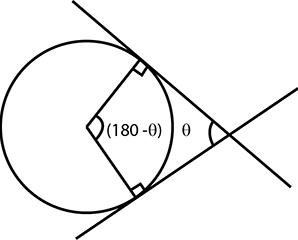
(B) Let the angle between the two tangents be $\theta = 35^{\circ}.$
In the quadrilateral formed by the center of the circle,the two points of contact,and the intersection point of the tangents,the angles at the points of contact are $90^{\circ}$ each (since the radius is perpendicular to the tangent).
Thus,the sum of the angles in the quadrilateral is $360^{\circ}.$
Let the angle between the radii be $\alpha.$
Then,$\alpha + 90^{\circ} + \theta + 90^{\circ} = 360^{\circ}.$
$\alpha + \theta = 180^{\circ}.$
$\alpha = 180^{\circ} - 35^{\circ} = 145^{\circ}.$
In the quadrilateral formed by the center of the circle,the two points of contact,and the intersection point of the tangents,the angles at the points of contact are $90^{\circ}$ each (since the radius is perpendicular to the tangent).
Thus,the sum of the angles in the quadrilateral is $360^{\circ}.$
Let the angle between the radii be $\alpha.$
Then,$\alpha + 90^{\circ} + \theta + 90^{\circ} = 360^{\circ}.$
$\alpha + \theta = 180^{\circ}.$
$\alpha = 180^{\circ} - 35^{\circ} = 145^{\circ}.$
0 likes
View Solution3
MediumMCQ
To divide a line segment $AB$ in the ratio $5:7,$ first a ray $AX$ is drawn so that $\angle BAX$ is an acute angle and then at equal distances points are marked on the ray $AX$ such that the minimum number of these points is
A
$8$
B
$10$
C
$12$
D
$11$
Solution
(C) We know that,to divide a line segment $AB$ in the ratio $m:n,$ first draw a ray $AX$ which makes an acute angle $\angle BAX$,then mark $m+n$ points at equal distances.
Here,$m=5$ and $n=7$.
So,the minimum number of these points $= m+n = 5+7 = 12$.
Here,$m=5$ and $n=7$.
So,the minimum number of these points $= m+n = 5+7 = 12$.
0 likes
View Solution4
EasyMCQ
To divide a line segment $AB$ in the ratio $4:7,$ a ray $AX$ is drawn first such that $\angle BAX$ is an acute angle and then points $A_1, A_2, A_3, \dots$ are located at equal distances on the ray $AX$ and the point $B$ is joined to:
A
$A_{12}$
B
$A_{13}$
C
$A_9$
D
$A_{11}$
Solution
(D) To divide a line segment in the ratio $m:n,$ we first draw a ray making an acute angle with the segment.
Then,we mark $m+n$ points at equal distances on the ray.
Here,the ratio is $4:7,$ so the total number of points required is $4+7 = 11$.
Therefore,we mark points $A_1, A_2, \dots, A_{11}$ on the ray $AX$.
The last point $A_{11}$ is joined to point $B$ to complete the construction.
Then,we mark $m+n$ points at equal distances on the ray.
Here,the ratio is $4:7,$ so the total number of points required is $4+7 = 11$.
Therefore,we mark points $A_1, A_2, \dots, A_{11}$ on the ray $AX$.
The last point $A_{11}$ is joined to point $B$ to complete the construction.
0 likes
View Solution5
DifficultMCQ
To divide a line segment $AB$ in the ratio $5: 6,$ draw a ray $AX$ such that $\angle BAX$ is an acute angle,then draw a ray $BY$ parallel to $AX$ and the points $A_{1}, A_{2}, A_{3}, \ldots$ and $B_{1}, B_{2}, B_{3}, \ldots$ are located at equal distances on ray $AX$ and $BY,$ respectively. Then the points joined are
A
$A_{5}$ and $B_{6}$
B
$A_{6}$ and $B_{5}$
C
$A_{4}$ and $B_{5}$
D
$A_{5}$ and $B_{4}$
Solution
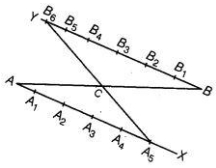
(A) To divide a line segment $AB$ in the ratio $m: n$ (here $5: 6$),we follow these steps:
$1$. Draw a ray $AX$ making an acute angle $\angle BAX$ with $AB$.
$2$. Draw a ray $BY$ parallel to $AX$ by making $\angle ABY = \angle BAX$.
$3$. Locate $m$ points $(A_{1}, A_{2}, \ldots, A_{5})$ on $AX$ and $n$ points $(B_{1}, B_{2}, \ldots, B_{6})$ on $BY$ such that $AA_{1} = A_{1}A_{2} = \ldots = A_{4}A_{5}$ and $BB_{1} = B_{1}B_{2} = \ldots = B_{5}B_{6}$.
$4$. Join the point $A_{m}$ (which is $A_{5}$) to the point $B_{n}$ (which is $B_{6}$). The line segment $A_{5}B_{6}$ intersects $AB$ at point $C$,dividing $AB$ in the ratio $5: 6$.
$1$. Draw a ray $AX$ making an acute angle $\angle BAX$ with $AB$.
$2$. Draw a ray $BY$ parallel to $AX$ by making $\angle ABY = \angle BAX$.
$3$. Locate $m$ points $(A_{1}, A_{2}, \ldots, A_{5})$ on $AX$ and $n$ points $(B_{1}, B_{2}, \ldots, B_{6})$ on $BY$ such that $AA_{1} = A_{1}A_{2} = \ldots = A_{4}A_{5}$ and $BB_{1} = B_{1}B_{2} = \ldots = B_{5}B_{6}$.
$4$. Join the point $A_{m}$ (which is $A_{5}$) to the point $B_{n}$ (which is $B_{6}$). The line segment $A_{5}B_{6}$ intersects $AB$ at point $C$,dividing $AB$ in the ratio $5: 6$.
0 likes
View Solution6
MediumMCQ
To construct a triangle similar to a given $\triangle ABC$ with its sides $\frac{3}{7}$ of the corresponding sides of $\triangle ABC$,first draw a ray $BX$ such that $\angle CBX$ is an acute angle and $X$ lies on the opposite side of $A$ with respect to $BC$. Then locate points $B_{1}, B_{2}, B_{3}, \dots$ on $BX$ at equal distances and the next step is to join
A
$B_{10}$ to $C$
B
$B_{7}$ to $C$
C
$B_{13}$ to $C$
D
$B_{4}$ to $C$
Solution
(B) To construct a triangle similar to a given $\triangle ABC$ with a scale factor of $\frac{3}{7}$,we follow these steps:
$1$. Draw a ray $BX$ making an acute angle with $BC$.
$2$. Locate $7$ points $(B_{1}, B_{2}, B_{3}, B_{4}, B_{5}, B_{6}, B_{7})$ on $BX$ at equal distances because the denominator of the fraction $\frac{3}{7}$ is $7$.
$3$. The next step is to join the last point,$B_{7}$,to $C$ to establish the base line for the construction.
$1$. Draw a ray $BX$ making an acute angle with $BC$.
$2$. Locate $7$ points $(B_{1}, B_{2}, B_{3}, B_{4}, B_{5}, B_{6}, B_{7})$ on $BX$ at equal distances because the denominator of the fraction $\frac{3}{7}$ is $7$.
$3$. The next step is to join the last point,$B_{7}$,to $C$ to establish the base line for the construction.
0 likes
View Solution7
MediumMCQ
To construct a triangle similar to a given $\triangle ABC$ with its sides being $\frac{8}{5}$ of the corresponding sides of $\triangle ABC$,a ray $BX$ is drawn such that $\angle CBX$ is an acute angle and $X$ is on the opposite side of $A$ with respect to $BC$. The minimum number of points to be located at equal distances on ray $BX$ is
A
$5$
B
$13$
C
$8$
D
$3$
Solution
(C) To construct a triangle similar to a given triangle with a scale factor of $\frac{m}{n}$,where $m$ and $n$ are positive integers,the number of points to be marked on the ray $BX$ is equal to the greater of $m$ and $n$.
In this problem,the scale factor is $\frac{8}{5}$.
Comparing the numerator $m = 8$ and the denominator $n = 5$,the greater value is $8$.
Therefore,the minimum number of points to be located at equal distances on ray $BX$ is $8$.
In this problem,the scale factor is $\frac{8}{5}$.
Comparing the numerator $m = 8$ and the denominator $n = 5$,the greater value is $8$.
Therefore,the minimum number of points to be located at equal distances on ray $BX$ is $8$.
0 likes
View Solution8
EasyMCQ
To draw a pair of tangents to a circle which are inclined to each other at an angle of $60^{\circ},$ it is required to draw tangents at the endpoints of those two radii of the circle,the angle between which should be: (in $^{\circ}$)
A
$135$
B
$90$
C
$60$
D
$120$
Solution
(D) Let the center of the circle be $O$ and the intersection point of the two tangents be $P$. Let the points of contact of the tangents be $A$ and $B$.
In the quadrilateral $OAPB$,the angles at the points of contact $A$ and $B$ are $90^{\circ}$ each (since the tangent is perpendicular to the radius at the point of contact).
The sum of the angles in a quadrilateral is $360^{\circ}$.
Therefore,$\angle AOB + \angle OAP + \angle APB + \angle OBP = 360^{\circ}$.
Substituting the known values: $\angle AOB + 90^{\circ} + 60^{\circ} + 90^{\circ} = 360^{\circ}$.
$\angle AOB + 240^{\circ} = 360^{\circ}$.
$\angle AOB = 360^{\circ} - 240^{\circ} = 120^{\circ}$.
Thus,the angle between the two radii should be $120^{\circ}$.
In the quadrilateral $OAPB$,the angles at the points of contact $A$ and $B$ are $90^{\circ}$ each (since the tangent is perpendicular to the radius at the point of contact).
The sum of the angles in a quadrilateral is $360^{\circ}$.
Therefore,$\angle AOB + \angle OAP + \angle APB + \angle OBP = 360^{\circ}$.
Substituting the known values: $\angle AOB + 90^{\circ} + 60^{\circ} + 90^{\circ} = 360^{\circ}$.
$\angle AOB + 240^{\circ} = 360^{\circ}$.
$\angle AOB = 360^{\circ} - 240^{\circ} = 120^{\circ}$.
Thus,the angle between the two radii should be $120^{\circ}$.
0 likes
View Solution9
Easy
Write True or False and give reasons for your answer.
By geometrical construction,it is possible to divide a line segment in the ratio $2 \sqrt{3} : 2 \sqrt{3}$.
By geometrical construction,it is possible to divide a line segment in the ratio $2 \sqrt{3} : 2 \sqrt{3}$.
Solution
(B) False.
The ratio $2 \sqrt{3} : 2 \sqrt{3}$ simplifies to $1 : 1$.
However,the standard geometrical construction method for dividing a line segment in a given ratio $m : n$ requires $m$ and $n$ to be positive integers.
Since $2 \sqrt{3}$ is an irrational number and not a positive integer,it is not possible to divide a line segment in this ratio using the standard ruler and compass construction method.
The ratio $2 \sqrt{3} : 2 \sqrt{3}$ simplifies to $1 : 1$.
However,the standard geometrical construction method for dividing a line segment in a given ratio $m : n$ requires $m$ and $n$ to be positive integers.
Since $2 \sqrt{3}$ is an irrational number and not a positive integer,it is not possible to divide a line segment in this ratio using the standard ruler and compass construction method.
0 likes
View Solution10
Easy
Write True or False and give reasons for your answer.
By geometrical construction,it is possible to divide a line segment in the ratio $\sqrt{3}: \frac{1}{\sqrt{3}}$.
By geometrical construction,it is possible to divide a line segment in the ratio $\sqrt{3}: \frac{1}{\sqrt{3}}$.
Solution
(A) True.
Given ratio $= \sqrt{3} : \frac{1}{\sqrt{3}}$.
To simplify this ratio,multiply both terms by $\sqrt{3}$:
$\sqrt{3} \times \sqrt{3} : \frac{1}{\sqrt{3}} \times \sqrt{3} = 3 : 1$.
Since $3 : 1$ is a ratio of two positive integers,it is always possible to divide a line segment in this ratio using a ruler and compass by constructing $3 + 1 = 4$ equal parts on an auxiliary ray.
Therefore,the statement is True.
Given ratio $= \sqrt{3} : \frac{1}{\sqrt{3}}$.
To simplify this ratio,multiply both terms by $\sqrt{3}$:
$\sqrt{3} \times \sqrt{3} : \frac{1}{\sqrt{3}} \times \sqrt{3} = 3 : 1$.
Since $3 : 1$ is a ratio of two positive integers,it is always possible to divide a line segment in this ratio using a ruler and compass by constructing $3 + 1 = 4$ equal parts on an auxiliary ray.
Therefore,the statement is True.
0 likes
View Solution11
Difficult
Write True or False and give reasons for your answer.
To construct a triangle similar to a given $\triangle ABC$ with its sides $\frac{7}{3}$ of the corresponding sides of $\triangle ABC$,draw a ray $BX$ making an acute angle with $BC$ and $X$ lies on the opposite side of $A$ with respect to $BC$. The points $B_{1}, B_{2}, \dots, B_{7}$ are located at equal distances on $BX$,$B_{3}$ is joined to $C$ and then a line segment $B_{6}C'$ is drawn parallel to $B_{3}C$ where $C'$ lies on $BC$ produced. Finally,line segment $A'C'$ is drawn parallel to $AC$.
To construct a triangle similar to a given $\triangle ABC$ with its sides $\frac{7}{3}$ of the corresponding sides of $\triangle ABC$,draw a ray $BX$ making an acute angle with $BC$ and $X$ lies on the opposite side of $A$ with respect to $BC$. The points $B_{1}, B_{2}, \dots, B_{7}$ are located at equal distances on $BX$,$B_{3}$ is joined to $C$ and then a line segment $B_{6}C'$ is drawn parallel to $B_{3}C$ where $C'$ lies on $BC$ produced. Finally,line segment $A'C'$ is drawn parallel to $AC$.
Solution
(B) False.
To construct a triangle similar to $\triangle ABC$ with a scale factor of $\frac{7}{3}$,we must divide the ray $BX$ into $7$ equal parts (since $7 > 3$).
Steps of construction:
$1.$ Draw a ray $BX$ making an acute angle with $BC$.
$2.$ Locate $7$ points $B_{1}, B_{2}, \dots, B_{7}$ on $BX$ such that $BB_{1} = B_{1}B_{2} = \dots = B_{6}B_{7}$.
$3.$ Join $B_{3}$ to $C$ (since the denominator is $3$).
$4.$ Draw a line through $B_{7}$ parallel to $B_{3}C$ intersecting the extended line segment $BC$ at $C'$.
$5.$ Draw a line through $C'$ parallel to $AC$ intersecting the extended line segment $BA$ at $A'$.
The given statement claims that $B_{6}C'$ is drawn parallel to $B_{3}C$,which is incorrect because the scale factor is $\frac{7}{3}$,requiring the parallel line to be drawn from $B_{7}$,not $B_{6}$.
To construct a triangle similar to $\triangle ABC$ with a scale factor of $\frac{7}{3}$,we must divide the ray $BX$ into $7$ equal parts (since $7 > 3$).
Steps of construction:
$1.$ Draw a ray $BX$ making an acute angle with $BC$.
$2.$ Locate $7$ points $B_{1}, B_{2}, \dots, B_{7}$ on $BX$ such that $BB_{1} = B_{1}B_{2} = \dots = B_{6}B_{7}$.
$3.$ Join $B_{3}$ to $C$ (since the denominator is $3$).
$4.$ Draw a line through $B_{7}$ parallel to $B_{3}C$ intersecting the extended line segment $BC$ at $C'$.
$5.$ Draw a line through $C'$ parallel to $AC$ intersecting the extended line segment $BA$ at $A'$.
The given statement claims that $B_{6}C'$ is drawn parallel to $B_{3}C$,which is incorrect because the scale factor is $\frac{7}{3}$,requiring the parallel line to be drawn from $B_{7}$,not $B_{6}$.
0 likes
View Solution12
Medium
Write True or False and give reasons for your answer.
$A$ pair of tangents can be constructed from a point $P$ to a circle of radius $3.5 \, cm$ situated at a distance of $3 \, cm$ from the centre.
$A$ pair of tangents can be constructed from a point $P$ to a circle of radius $3.5 \, cm$ situated at a distance of $3 \, cm$ from the centre.
Solution
(B) False.
The radius of the circle is $r = 3.5 \, cm$ and the distance of point $P$ from the centre is $d = 3 \, cm$.
Since $d < r$ $(3 \, cm < 3.5 \, cm)$,the point $P$ lies inside the circle.
$A$ tangent to a circle is a line that touches the circle at exactly one point. If a point lies inside the circle,no tangent can be drawn from that point to the circle.
The radius of the circle is $r = 3.5 \, cm$ and the distance of point $P$ from the centre is $d = 3 \, cm$.
Since $d < r$ $(3 \, cm < 3.5 \, cm)$,the point $P$ lies inside the circle.
$A$ tangent to a circle is a line that touches the circle at exactly one point. If a point lies inside the circle,no tangent can be drawn from that point to the circle.
0 likes
View Solution13
Easy
State whether the following statement is True or False and provide a reason for your answer:
$A$ pair of tangents can be constructed to a circle inclined at an angle of $170^{\circ}$.
$A$ pair of tangents can be constructed to a circle inclined at an angle of $170^{\circ}$.
Solution
(A) True.
In a circle,the angle between the two tangents drawn from an external point and the angle subtended by the line segments joining the points of contact to the center are supplementary (i.e.,they add up to $180^{\circ}$).
Let the angle between the tangents be $\theta$ and the angle at the center be $\phi$.
We know that $\theta + \phi = 180^{\circ}$.
Since the angle between the tangents is given as $170^{\circ}$,the angle at the center would be $180^{\circ} - 170^{\circ} = 10^{\circ}$.
Since $10^{\circ} > 0^{\circ}$,it is geometrically possible to construct such a pair of tangents.
In a circle,the angle between the two tangents drawn from an external point and the angle subtended by the line segments joining the points of contact to the center are supplementary (i.e.,they add up to $180^{\circ}$).
Let the angle between the tangents be $\theta$ and the angle at the center be $\phi$.
We know that $\theta + \phi = 180^{\circ}$.
Since the angle between the tangents is given as $170^{\circ}$,the angle at the center would be $180^{\circ} - 170^{\circ} = 10^{\circ}$.
Since $10^{\circ} > 0^{\circ}$,it is geometrically possible to construct such a pair of tangents.
0 likes
View Solution14
EasyMCQ
Draw an equilateral triangle $ABC$ with each side $4\, cm$. Construct a triangle similar to it with a scale factor of $\frac{3}{5}$. Is the new triangle also equilateral?
A
Yes,it is equilateral.
B
No,it is isosceles.
C
No,it is scalene.
D
No,it is a right-angled triangle.
Solution
(A) $1$. First,draw an equilateral triangle $ABC$ where $AB = BC = CA = 4\, cm$.
$2$. Draw a ray $AX$ making an acute angle with $AB$ on the side opposite to vertex $C$.
$3$. Locate $5$ points $A_1, A_2, A_3, A_4, A_5$ on $AX$ such that $AA_1 = A_1A_2 = A_2A_3 = A_3A_4 = A_4A_5$.
$4$. Join $A_5$ to $B$. Draw a line through $A_3$ parallel to $A_5B$ intersecting $AB$ at $B'$.
$5$. Draw a line through $B'$ parallel to $BC$ intersecting $AC$ at $C'$.
$6$. The triangle $AB'C'$ is the required triangle similar to $\triangle ABC$ with a scale factor of $\frac{3}{5}$.
$7$. Since the ratio of corresponding sides is equal,the angles remain the same ($60^{\circ}$ each). Therefore,the new triangle is also equilateral.
$2$. Draw a ray $AX$ making an acute angle with $AB$ on the side opposite to vertex $C$.
$3$. Locate $5$ points $A_1, A_2, A_3, A_4, A_5$ on $AX$ such that $AA_1 = A_1A_2 = A_2A_3 = A_3A_4 = A_4A_5$.
$4$. Join $A_5$ to $B$. Draw a line through $A_3$ parallel to $A_5B$ intersecting $AB$ at $B'$.
$5$. Draw a line through $B'$ parallel to $BC$ intersecting $AC$ at $C'$.
$6$. The triangle $AB'C'$ is the required triangle similar to $\triangle ABC$ with a scale factor of $\frac{3}{5}$.
$7$. Since the ratio of corresponding sides is equal,the angles remain the same ($60^{\circ}$ each). Therefore,the new triangle is also equilateral.
0 likes
View Solution15
Medium
Draw a line segment of length $7 \, cm$. Find a point $P$ on it which divides it in the ratio $3: 5$.
Solution
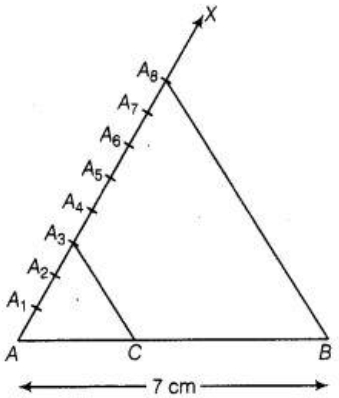
(N/A) $1.$ Draw a line segment $AB = 7 \, cm$.
$2.$ Draw a ray $AX$ making an acute angle $\angle BAX$.
$3.$ Along $AX,$ mark $3 + 5 = 8$ points $A_1, A_2, A_3, A_4, A_5, A_6, A_7, A_8$ such that $AA_1 = A_1A_2 = A_2A_3 = A_3A_4 = A_4A_5 = A_5A_6 = A_6A_7 = A_7A_8$.
$4.$ Join $A_8B$.
$5.$ From $A_3,$ draw $A_3P \parallel A_8B$ meeting $AB$ at $P$ (by making an angle equal to $\angle BA_8A$ at $A_3$).
Then,$P$ is the point on $AB$ which divides it in the ratio $3: 5.$
Thus,$AP: PB = 3: 5.$
Justification:
Let $AA_1 = A_1A_2 = A_2A_3 = A_3A_4 = \dots = A_7A_8 = x.$
In $\triangle ABA_8,$ we have $A_3P \parallel A_8B.$
By Basic Proportionality Theorem,$\frac{AP}{PB} = \frac{AA_3}{A_3A_8} = \frac{3x}{5x} = \frac{3}{5}.$
Hence,$AP: PB = 3: 5.$
$2.$ Draw a ray $AX$ making an acute angle $\angle BAX$.
$3.$ Along $AX,$ mark $3 + 5 = 8$ points $A_1, A_2, A_3, A_4, A_5, A_6, A_7, A_8$ such that $AA_1 = A_1A_2 = A_2A_3 = A_3A_4 = A_4A_5 = A_5A_6 = A_6A_7 = A_7A_8$.
$4.$ Join $A_8B$.
$5.$ From $A_3,$ draw $A_3P \parallel A_8B$ meeting $AB$ at $P$ (by making an angle equal to $\angle BA_8A$ at $A_3$).
Then,$P$ is the point on $AB$ which divides it in the ratio $3: 5.$
Thus,$AP: PB = 3: 5.$
Justification:
Let $AA_1 = A_1A_2 = A_2A_3 = A_3A_4 = \dots = A_7A_8 = x.$
In $\triangle ABA_8,$ we have $A_3P \parallel A_8B.$
By Basic Proportionality Theorem,$\frac{AP}{PB} = \frac{AA_3}{A_3A_8} = \frac{3x}{5x} = \frac{3}{5}.$
Hence,$AP: PB = 3: 5.$
0 likes
View Solution16
Difficult
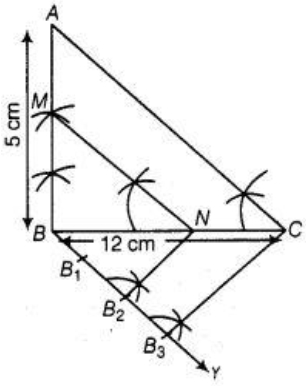
Draw a right triangle $ABC$ in which $BC = 12 \, cm$,$AB = 5 \, cm$ and $\angle B = 90^{\circ}$. Construct a triangle similar to it with a scale factor of $\frac{2}{3}$. Is the new triangle also a right triangle?
Solution
(A) Steps of construction:
$1.$ Draw a line segment $BC = 12 \, cm$.
$2.$ From point $B$,draw a line $AB = 5 \, cm$ perpendicular to $BC$ such that $\angle B = 90^{\circ}$.
$3.$ Join $AC$. Thus,$\triangle ABC$ is the given right triangle.
$4.$ From $B$,draw an acute angle $\angle CBY$ downwards.
$5.$ On ray $BY$,mark three points $B_1, B_2$ and $B_3$ such that $BB_1 = B_1B_2 = B_2B_3$.
$6.$ Join $B_3C$.
$7.$ From point $B_2$,draw $B_2N \parallel B_3C$ to intersect $BC$ at $N$.
$8.$ From point $N$,draw $NM \parallel CA$ to intersect $BA$ at $M$. Thus,$\triangle MBN$ is the required triangle.
$9.$ Since $NM \parallel CA$ and $BC$ is a transversal,the corresponding angles are equal. Therefore,$\angle MNB = \angle ACB$. Since $\angle B = 90^{\circ}$ in both triangles,$\triangle MBN$ is also a right-angled triangle at $B$.
$1.$ Draw a line segment $BC = 12 \, cm$.
$2.$ From point $B$,draw a line $AB = 5 \, cm$ perpendicular to $BC$ such that $\angle B = 90^{\circ}$.
$3.$ Join $AC$. Thus,$\triangle ABC$ is the given right triangle.
$4.$ From $B$,draw an acute angle $\angle CBY$ downwards.
$5.$ On ray $BY$,mark three points $B_1, B_2$ and $B_3$ such that $BB_1 = B_1B_2 = B_2B_3$.
$6.$ Join $B_3C$.
$7.$ From point $B_2$,draw $B_2N \parallel B_3C$ to intersect $BC$ at $N$.
$8.$ From point $N$,draw $NM \parallel CA$ to intersect $BA$ at $M$. Thus,$\triangle MBN$ is the required triangle.
$9.$ Since $NM \parallel CA$ and $BC$ is a transversal,the corresponding angles are equal. Therefore,$\angle MNB = \angle ACB$. Since $\angle B = 90^{\circ}$ in both triangles,$\triangle MBN$ is also a right-angled triangle at $B$.
0 likes
View Solution17
Medium
Draw a triangle $ABC$ in which $BC = 6 \, cm$,$CA = 5 \, cm$,and $AB = 4 \, cm$. Construct a triangle similar to it with a scale factor of $\frac{5}{3}$.
Solution
(A) $1.$ Draw a line segment $BC = 6 \, cm$.
$2.$ Taking $B$ and $C$ as centers,draw two arcs of radii $4 \, cm$ and $5 \, cm$ respectively,intersecting each other at $A$.
$3.$ Join $BA$ and $CA$. $\triangle ABC$ is the required triangle.
$4.$ From $B$,draw any ray $BX$ downwards making an acute angle with $BC$.
$5.$ Mark five points $B_1, B_2, B_3, B_4,$ and $B_5$ on $BX$ such that $BB_1 = B_1B_2 = B_2B_3 = B_3B_4 = B_4B_5$.
$6.$ Join $B_3C$. From $B_5$,draw $B_5M \parallel B_3C$ intersecting the extended line segment $BC$ at $M$.
$7.$ From point $M$,draw $MN \parallel CA$ intersecting the extended line segment $BA$ at $N$. Then,$\triangle NBM$ is the required triangle whose sides are $\frac{5}{3}$ times the corresponding sides of $\triangle ABC$.
$2.$ Taking $B$ and $C$ as centers,draw two arcs of radii $4 \, cm$ and $5 \, cm$ respectively,intersecting each other at $A$.
$3.$ Join $BA$ and $CA$. $\triangle ABC$ is the required triangle.
$4.$ From $B$,draw any ray $BX$ downwards making an acute angle with $BC$.
$5.$ Mark five points $B_1, B_2, B_3, B_4,$ and $B_5$ on $BX$ such that $BB_1 = B_1B_2 = B_2B_3 = B_3B_4 = B_4B_5$.
$6.$ Join $B_3C$. From $B_5$,draw $B_5M \parallel B_3C$ intersecting the extended line segment $BC$ at $M$.
$7.$ From point $M$,draw $MN \parallel CA$ intersecting the extended line segment $BA$ at $N$. Then,$\triangle NBM$ is the required triangle whose sides are $\frac{5}{3}$ times the corresponding sides of $\triangle ABC$.
0 likes
View Solution18
Medium
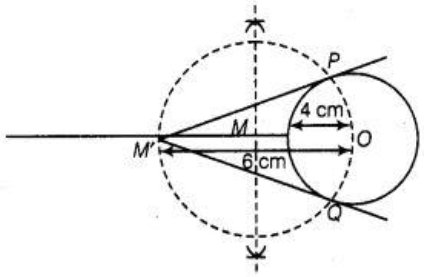
Construct a tangent to a circle of radius $4\, cm$ from a point which is at a distance of $6\, cm$ from its centre.
Solution
(N/A) Given,a point $M^{\prime}$ is at a distance of $6\, cm$ from the centre of a circle of radius $4\, cm$.
Steps of construction:
$1.$ Draw a circle of radius $4\, cm$. Let the centre of this circle be $O$.
$2.$ Join $OM^{\prime}$ and bisect it. Let $M$ be the mid-point of $OM^{\prime}$.
$3.$ Taking $M$ as the centre and $MO$ as the radius,draw a circle to intersect the circle $(O, 4\, cm)$ at two points,$P$ and $Q$.
$4.$ Join $PM^{\prime}$ and $QM^{\prime}$. $PM^{\prime}$ and $QM^{\prime}$ are the required tangents from $M^{\prime}$ to the circle $C(O, 4\, cm)$.
Steps of construction:
$1.$ Draw a circle of radius $4\, cm$. Let the centre of this circle be $O$.
$2.$ Join $OM^{\prime}$ and bisect it. Let $M$ be the mid-point of $OM^{\prime}$.
$3.$ Taking $M$ as the centre and $MO$ as the radius,draw a circle to intersect the circle $(O, 4\, cm)$ at two points,$P$ and $Q$.
$4.$ Join $PM^{\prime}$ and $QM^{\prime}$. $PM^{\prime}$ and $QM^{\prime}$ are the required tangents from $M^{\prime}$ to the circle $C(O, 4\, cm)$.
0 likes
View Solution19
Medium
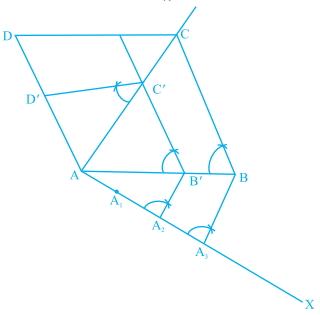
Given a rhombus $ABCD$ in which $AB = 4 \, cm$ and $\angle ABC = 60^{\circ}$,divide it into two triangles,$ABC$ and $ADC$. Construct a triangle $AB'C'$ similar to $\triangle ABC$ with a scale factor of $\frac{2}{3}$. Draw a line segment $C'D'$ parallel to $CD$,where $D'$ lies on $AD$. Is $AB'C'D'$ a rhombus? Give reasons.
Solution
(N/A) First,draw the rhombus $ABCD$ in which $AB = 4 \, cm$ and $\angle ABC = 60^{\circ}$ as shown in the figure,and join $AC$.
Construct the triangle $AB'C'$ similar to $\triangle ABC$ with a scale factor of $\frac{2}{3}$ as instructed in the Mathematics Textbook for Class $X$.
Finally,draw the line segment $C'D'$ parallel to $CD$ such that $D'$ lies on $AD$.
Since $\triangle AB'C' \sim \triangle ABC$,we have $\frac{AB'}{AB} = \frac{AC'}{AC} = \frac{B'C'}{BC} = \frac{2}{3}$.
Since $C'D' \parallel CD$,$\triangle AD'C' \sim \triangle ADC$. Thus,$\frac{AD'}{AD} = \frac{AC'}{AC} = \frac{C'D'}{CD} = \frac{2}{3}$.
Since $ABCD$ is a rhombus,$AB = BC = CD = AD$.
Therefore,$AB' = B'C' = C'D' = AD' = \frac{2}{3} AB$.
Since all four sides of the quadrilateral $AB'C'D'$ are equal,$AB'C'D'$ is a rhombus.
Construct the triangle $AB'C'$ similar to $\triangle ABC$ with a scale factor of $\frac{2}{3}$ as instructed in the Mathematics Textbook for Class $X$.
Finally,draw the line segment $C'D'$ parallel to $CD$ such that $D'$ lies on $AD$.
Since $\triangle AB'C' \sim \triangle ABC$,we have $\frac{AB'}{AB} = \frac{AC'}{AC} = \frac{B'C'}{BC} = \frac{2}{3}$.
Since $C'D' \parallel CD$,$\triangle AD'C' \sim \triangle ADC$. Thus,$\frac{AD'}{AD} = \frac{AC'}{AC} = \frac{C'D'}{CD} = \frac{2}{3}$.
Since $ABCD$ is a rhombus,$AB = BC = CD = AD$.
Therefore,$AB' = B'C' = C'D' = AD' = \frac{2}{3} AB$.
Since all four sides of the quadrilateral $AB'C'D'$ are equal,$AB'C'D'$ is a rhombus.
0 likes
View Solution20
Difficult
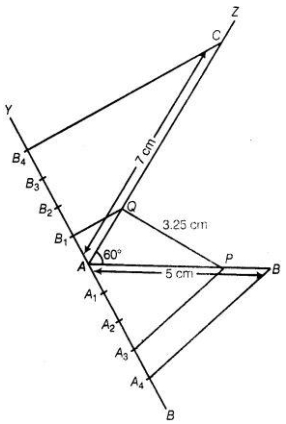
Two line segments $AB$ and $AC$ include an angle of $60^{\circ}$ where $AB = 5 \, cm$ and $AC = 7 \, cm$. Locate points $P$ and $Q$ on $AB$ and $AC$,respectively,such that $AP = \frac{3}{4} AB$ and $AQ = \frac{1}{4} AC$. Join $P$ and $Q$ and measure the length $PQ$.
Solution
(D) Given: $AB = 5 \, cm$ and $AC = 7 \, cm$.
Also,$AP = \frac{3}{4} AB$ and $AQ = \frac{1}{4} AC$.
Calculation of lengths:
$AP = \frac{3}{4} \times 5 = 3.75 \, cm$.
$AQ = \frac{1}{4} \times 7 = 1.75 \, cm$.
Construction Steps:
$1$. Draw $AB = 5 \, cm$.
$2$. Draw a ray $AZ$ making an angle of $60^{\circ}$ with $AB$.
$3$. Mark point $C$ on $AZ$ such that $AC = 7 \, cm$.
$4$. To locate $P$ on $AB$ such that $AP = \frac{3}{4} AB$,divide $AB$ in the ratio $3:1$ using the standard division of a line segment method.
$5$. To locate $Q$ on $AC$ such that $AQ = \frac{1}{4} AC$,divide $AC$ in the ratio $1:3$ using the standard division of a line segment method.
$6$. Join $PQ$.
$7$. By measurement,the length $PQ \approx 3.25 \, cm$.
Also,$AP = \frac{3}{4} AB$ and $AQ = \frac{1}{4} AC$.
Calculation of lengths:
$AP = \frac{3}{4} \times 5 = 3.75 \, cm$.
$AQ = \frac{1}{4} \times 7 = 1.75 \, cm$.
Construction Steps:
$1$. Draw $AB = 5 \, cm$.
$2$. Draw a ray $AZ$ making an angle of $60^{\circ}$ with $AB$.
$3$. Mark point $C$ on $AZ$ such that $AC = 7 \, cm$.
$4$. To locate $P$ on $AB$ such that $AP = \frac{3}{4} AB$,divide $AB$ in the ratio $3:1$ using the standard division of a line segment method.
$5$. To locate $Q$ on $AC$ such that $AQ = \frac{1}{4} AC$,divide $AC$ in the ratio $1:3$ using the standard division of a line segment method.
$6$. Join $PQ$.
$7$. By measurement,the length $PQ \approx 3.25 \, cm$.
0 likes
View Solution21
Difficult
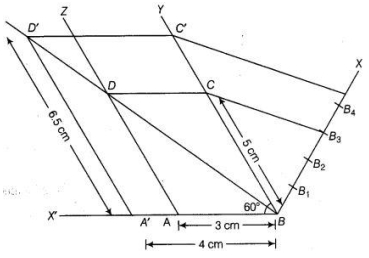
Draw a parallelogram $ABCD$ in which $BC = 5 \, cm$,$AB = 3 \, cm$ and $\angle ABC = 60^{\circ}$. Divide it into triangles $BCD$ and $ABD$ by the diagonal $BD$. Construct the triangle $BD'C'$ similar to $\triangle BDC$ with a scale factor of $\frac{4}{3}$. Draw the line segment $D'A'$ parallel to $DA$,where $A'$ lies on the extended side $BA$. Is $A'BCD'$ a parallelogram?
Solution
(A) $1.$ Draw a line segment $AB = 3 \, cm$.
$2.$ Draw a ray $BY$ making an angle $\angle ABY = 60^{\circ}$.
$3.$ With $B$ as the center and a radius of $5 \, cm$,draw an arc to cut the ray $BY$ at point $C$.
$4.$ Draw a ray $AZ$ parallel to $BY$ such that $\angle BAZ = 120^{\circ}$ (since $ABCD$ is a parallelogram,$\angle ABC + \angle BCD = 180^{\circ}$).
$5.$ With $A$ as the center and a radius of $5 \, cm$,draw an arc to cut the ray $AZ$ at point $D$.
$6.$ Join $CD$ to complete the parallelogram $ABCD$.
$7.$ Join $BD$,which is a diagonal of the parallelogram $ABCD$.
$8.$ From $B$,draw any ray $BX$ downwards making an acute angle $\angle CBX$.
$9.$ Locate $4$ points $B_1, B_2, B_3, B_4$ on $BX$ such that $BB_1 = B_1B_2 = B_2B_3 = B_3B_4$.
$10.$ Join $B_3C$ and draw a line through $B_4$ parallel to $B_3C$ intersecting the extended line segment $BC$ at $C'$.
$11.$ From point $C'$,draw $C'D' \parallel CD$ intersecting the extended line segment $BD$ at $D'$.
$12.$ Draw a line segment $D'A'$ parallel to $DA$,where $A'$ lies on the extended side $BA$.
$13.$ Yes,$A'BCD'$ is a parallelogram because by construction,$A'D' \parallel BC$ and $A'B \parallel D'C'$.
$2.$ Draw a ray $BY$ making an angle $\angle ABY = 60^{\circ}$.
$3.$ With $B$ as the center and a radius of $5 \, cm$,draw an arc to cut the ray $BY$ at point $C$.
$4.$ Draw a ray $AZ$ parallel to $BY$ such that $\angle BAZ = 120^{\circ}$ (since $ABCD$ is a parallelogram,$\angle ABC + \angle BCD = 180^{\circ}$).
$5.$ With $A$ as the center and a radius of $5 \, cm$,draw an arc to cut the ray $AZ$ at point $D$.
$6.$ Join $CD$ to complete the parallelogram $ABCD$.
$7.$ Join $BD$,which is a diagonal of the parallelogram $ABCD$.
$8.$ From $B$,draw any ray $BX$ downwards making an acute angle $\angle CBX$.
$9.$ Locate $4$ points $B_1, B_2, B_3, B_4$ on $BX$ such that $BB_1 = B_1B_2 = B_2B_3 = B_3B_4$.
$10.$ Join $B_3C$ and draw a line through $B_4$ parallel to $B_3C$ intersecting the extended line segment $BC$ at $C'$.
$11.$ From point $C'$,draw $C'D' \parallel CD$ intersecting the extended line segment $BD$ at $D'$.
$12.$ Draw a line segment $D'A'$ parallel to $DA$,where $A'$ lies on the extended side $BA$.
$13.$ Yes,$A'BCD'$ is a parallelogram because by construction,$A'D' \parallel BC$ and $A'B \parallel D'C'$.
0 likes
View Solution22
Difficult
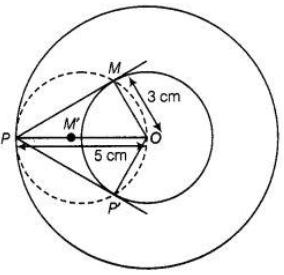
Draw two concentric circles of radii $3\, cm$ and $5\, cm$. Taking a point on the outer circle,construct a pair of tangents to the other circle. Measure the length of a tangent and verify it by actual calculation.
Solution
(N/A) Given: Two concentric circles with centre $O$ and radii $3\, cm$ and $5\, cm$. We need to draw a pair of tangents from a point $P$ on the outer circle to the inner circle.
Steps of construction:
$1.$ Draw two concentric circles with centre $O$ and radii $3\, cm$ and $5\, cm$.
$2.$ Take any point $P$ on the outer circle. Join $OP$.
$3.$ Bisect $OP$. Let $M'$ be the midpoint of $OP$.
$4.$ Taking $M'$ as the centre and $OM'$ as the radius,draw a dotted circle which intersects the inner circle at points $M$ and $P'$.
$5.$ Join $PM$ and $PP'$. Thus,$PM$ and $PP'$ are the required tangents.
$6.$ On measuring $PM$ and $PP'$,we find that $PM = PP' = 4\, cm$.
Actual calculation:
In right-angled $\triangle OMP$,$\angle PMO = 90^{\circ}$.
By Pythagoras theorem: $OP^2 = PM^2 + OM^2$
$PM^2 = OP^2 - OM^2$
$PM^2 = (5)^2 - (3)^2 = 25 - 9 = 16$
$PM = \sqrt{16} = 4\, cm$.
Hence,the length of both tangents is $4\, cm$.
Steps of construction:
$1.$ Draw two concentric circles with centre $O$ and radii $3\, cm$ and $5\, cm$.
$2.$ Take any point $P$ on the outer circle. Join $OP$.
$3.$ Bisect $OP$. Let $M'$ be the midpoint of $OP$.
$4.$ Taking $M'$ as the centre and $OM'$ as the radius,draw a dotted circle which intersects the inner circle at points $M$ and $P'$.
$5.$ Join $PM$ and $PP'$. Thus,$PM$ and $PP'$ are the required tangents.
$6.$ On measuring $PM$ and $PP'$,we find that $PM = PP' = 4\, cm$.
Actual calculation:
In right-angled $\triangle OMP$,$\angle PMO = 90^{\circ}$.
By Pythagoras theorem: $OP^2 = PM^2 + OM^2$
$PM^2 = OP^2 - OM^2$
$PM^2 = (5)^2 - (3)^2 = 25 - 9 = 16$
$PM = \sqrt{16} = 4\, cm$.
Hence,the length of both tangents is $4\, cm$.
0 likes
View Solution23
Difficult
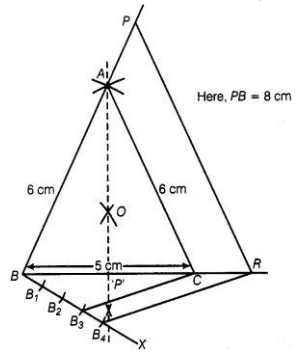
Draw an isosceles triangle $ABC$ in which $AB = AC = 6 \, cm$ and $BC = 5 \, cm$. Construct a triangle $PQR$ similar to $ABC$ in which $PQ = 8 \, cm$. Also,justify the construction.
Solution
(N/A) Let $\triangle PQR$ and $\triangle ABC$ be similar triangles. The scale factor between the corresponding sides is $\frac{PQ}{AB} = \frac{8}{6} = \frac{4}{3}$.
Steps of construction:
$1.$ Draw a line segment $BC = 5 \, cm$.
$2.$ Taking $B$ and $C$ as centers,draw two arcs of radius $6 \, cm$ intersecting each other at $A$.
$3.$ Join $BA$ and $CA$. Thus,$\triangle ABC$ is the required isosceles triangle.
$4.$ From $B$,draw any ray $BX$ making an acute $\angle CBX$.
$5.$ Locate four points $B_1, B_2, B_3,$ and $B_4$ on $BX$ such that $BB_1 = B_1B_2 = B_2B_3 = B_3B_4$.
$6.$ Join $B_3C$ and from $B_4$,draw a line $B_4R \parallel B_3C$ intersecting the extended line segment $BC$ at $R$.
$7.$ From point $R$,draw $RP \parallel CA$ meeting the extended line segment $BA$ at $P$.
Then,$\triangle PBR$ is the required triangle.
Justification:
Since $B_4R \parallel B_3C$ (by construction),
$\therefore \frac{BC}{CR} = \frac{3}{1}$.
Now,$\frac{BR}{BC} = \frac{BC + CR}{BC} = 1 + \frac{CR}{BC} = 1 + \frac{1}{3} = \frac{4}{3}$.
Also,$RP \parallel CA$,therefore $\triangle ABC \sim \triangle PBR$.
And $\frac{PB}{AB} = \frac{RP}{CA} = \frac{BR}{BC} = \frac{4}{3}$.
Hence,the new triangle is similar to the given triangle with sides $\frac{4}{3}$ times the corresponding sides of the isosceles $\triangle ABC$.
Steps of construction:
$1.$ Draw a line segment $BC = 5 \, cm$.
$2.$ Taking $B$ and $C$ as centers,draw two arcs of radius $6 \, cm$ intersecting each other at $A$.
$3.$ Join $BA$ and $CA$. Thus,$\triangle ABC$ is the required isosceles triangle.
$4.$ From $B$,draw any ray $BX$ making an acute $\angle CBX$.
$5.$ Locate four points $B_1, B_2, B_3,$ and $B_4$ on $BX$ such that $BB_1 = B_1B_2 = B_2B_3 = B_3B_4$.
$6.$ Join $B_3C$ and from $B_4$,draw a line $B_4R \parallel B_3C$ intersecting the extended line segment $BC$ at $R$.
$7.$ From point $R$,draw $RP \parallel CA$ meeting the extended line segment $BA$ at $P$.
Then,$\triangle PBR$ is the required triangle.
Justification:
Since $B_4R \parallel B_3C$ (by construction),
$\therefore \frac{BC}{CR} = \frac{3}{1}$.
Now,$\frac{BR}{BC} = \frac{BC + CR}{BC} = 1 + \frac{CR}{BC} = 1 + \frac{1}{3} = \frac{4}{3}$.
Also,$RP \parallel CA$,therefore $\triangle ABC \sim \triangle PBR$.
And $\frac{PB}{AB} = \frac{RP}{CA} = \frac{BR}{BC} = \frac{4}{3}$.
Hence,the new triangle is similar to the given triangle with sides $\frac{4}{3}$ times the corresponding sides of the isosceles $\triangle ABC$.
0 likes
View Solution24
Medium
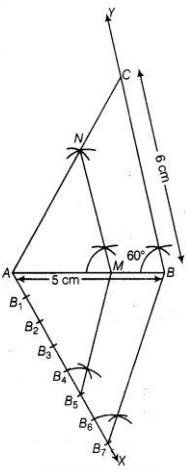
Draw a triangle $ABC$ in which $AB = 5 \, cm$,$BC = 6 \, cm$ and $\angle ABC = 60^{\circ}$. Construct a triangle similar to $\triangle ABC$ with a scale factor of $\frac{5}{7}$. Justify the construction.
Solution
(N/A) Steps of construction:
$1.$ Draw a line segment $AB = 5 \, cm$.
$2.$ At point $B$,construct $\angle ABY = 60^{\circ}$ and cut off $BC = 6 \, cm$ on $BY$.
$3.$ Join $AC$. Thus,$\triangle ABC$ is the required triangle.
$4.$ Draw any ray $AX$ making an acute angle with $AB$ on the side opposite to vertex $C$.
$5.$ Locate $7$ points $B_1, B_2, B_3, B_4, B_5, B_6, B_7$ on $AX$ such that $AB_1 = B_1B_2 = B_2B_3 = B_3B_4 = B_4B_5 = B_5B_6 = B_6B_7$.
$6.$ Join $B_7B$. Through $B_5$,draw a line parallel to $B_7B$ intersecting $AB$ at $M$.
$7.$ Through $M$,draw a line parallel to $BC$ intersecting $AC$ at $N$.
Then,$\triangle AMN$ is the required triangle whose sides are $\frac{5}{7}$ of the corresponding sides of $\triangle ABC$.
Justification:
Since $MN \parallel BC$,by Basic Proportionality Theorem,$\triangle AMN \sim \triangle ABC$.
By construction,$B_5M \parallel B_7B$. In $\triangle ABB_7$,by Thales theorem:
$\frac{AM}{AB} = \frac{AB_5}{AB_7} = \frac{5}{7}$.
Since $\triangle AMN \sim \triangle ABC$,the ratio of their corresponding sides is $\frac{AM}{AB} = \frac{AN}{AC} = \frac{MN}{BC} = \frac{5}{7}$.
$1.$ Draw a line segment $AB = 5 \, cm$.
$2.$ At point $B$,construct $\angle ABY = 60^{\circ}$ and cut off $BC = 6 \, cm$ on $BY$.
$3.$ Join $AC$. Thus,$\triangle ABC$ is the required triangle.
$4.$ Draw any ray $AX$ making an acute angle with $AB$ on the side opposite to vertex $C$.
$5.$ Locate $7$ points $B_1, B_2, B_3, B_4, B_5, B_6, B_7$ on $AX$ such that $AB_1 = B_1B_2 = B_2B_3 = B_3B_4 = B_4B_5 = B_5B_6 = B_6B_7$.
$6.$ Join $B_7B$. Through $B_5$,draw a line parallel to $B_7B$ intersecting $AB$ at $M$.
$7.$ Through $M$,draw a line parallel to $BC$ intersecting $AC$ at $N$.
Then,$\triangle AMN$ is the required triangle whose sides are $\frac{5}{7}$ of the corresponding sides of $\triangle ABC$.
Justification:
Since $MN \parallel BC$,by Basic Proportionality Theorem,$\triangle AMN \sim \triangle ABC$.
By construction,$B_5M \parallel B_7B$. In $\triangle ABB_7$,by Thales theorem:
$\frac{AM}{AB} = \frac{AB_5}{AB_7} = \frac{5}{7}$.
Since $\triangle AMN \sim \triangle ABC$,the ratio of their corresponding sides is $\frac{AM}{AB} = \frac{AN}{AC} = \frac{MN}{BC} = \frac{5}{7}$.
0 likes
View Solution25
Difficult
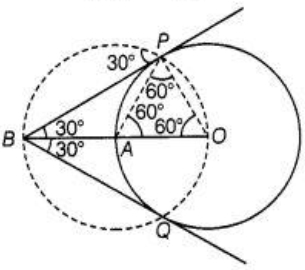
Draw a circle of radius $4 \, cm$. Construct a pair of tangents to it,the angle between which is $60^{\circ}$. Also,justify the construction. Measure the distance between the centre of the circle and the point of intersection of tangents.
Solution
(N/A) Steps of construction:
$1.$ Draw a circle with centre $O$ and radius $4 \, cm$.
$2.$ Draw a radius $OA$ and extend it to $B$ such that $OA = AB = 4 \, cm$. Thus,$OB = 8 \, cm$.
$3.$ Draw a circle with centre $A$ and radius $AO = 4 \, cm$. Let this circle intersect the original circle at points $P$ and $Q$.
$4.$ Join $BP$ and $BQ$. $BP$ and $BQ$ are the required tangents.
Justification:
In $\triangle OAP$,$OA = OP = 4 \, cm$ (radii) and $AP = 4 \, cm$ (radius of circle with centre $A$).
Since all sides are equal,$\triangle OAP$ is an equilateral triangle.
Therefore,$\angle OAP = 60^{\circ}$.
Since $OAB$ is a straight line,$\angle BAP = 180^{\circ} - 60^{\circ} = 120^{\circ}$.
In $\triangle BAP$,$BA = AP = 4 \, cm$. Thus,$\triangle BAP$ is an isosceles triangle.
Therefore,$\angle ABP = \angle APB = (180^{\circ} - 120^{\circ}) / 2 = 30^{\circ}$.
Similarly,$\angle ABQ = 30^{\circ}$.
Thus,$\angle PBQ = \angle ABP + \angle ABQ = 30^{\circ} + 30^{\circ} = 60^{\circ}$.
Measurement:
The distance between the centre $O$ and the point of intersection $B$ is $OB = OA + AB = 4 \, cm + 4 \, cm = 8 \, cm$.
$1.$ Draw a circle with centre $O$ and radius $4 \, cm$.
$2.$ Draw a radius $OA$ and extend it to $B$ such that $OA = AB = 4 \, cm$. Thus,$OB = 8 \, cm$.
$3.$ Draw a circle with centre $A$ and radius $AO = 4 \, cm$. Let this circle intersect the original circle at points $P$ and $Q$.
$4.$ Join $BP$ and $BQ$. $BP$ and $BQ$ are the required tangents.
Justification:
In $\triangle OAP$,$OA = OP = 4 \, cm$ (radii) and $AP = 4 \, cm$ (radius of circle with centre $A$).
Since all sides are equal,$\triangle OAP$ is an equilateral triangle.
Therefore,$\angle OAP = 60^{\circ}$.
Since $OAB$ is a straight line,$\angle BAP = 180^{\circ} - 60^{\circ} = 120^{\circ}$.
In $\triangle BAP$,$BA = AP = 4 \, cm$. Thus,$\triangle BAP$ is an isosceles triangle.
Therefore,$\angle ABP = \angle APB = (180^{\circ} - 120^{\circ}) / 2 = 30^{\circ}$.
Similarly,$\angle ABQ = 30^{\circ}$.
Thus,$\angle PBQ = \angle ABP + \angle ABQ = 30^{\circ} + 30^{\circ} = 60^{\circ}$.
Measurement:
The distance between the centre $O$ and the point of intersection $B$ is $OB = OA + AB = 4 \, cm + 4 \, cm = 8 \, cm$.
0 likes
View Solution26
Difficult
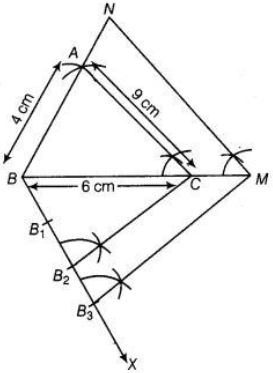
Draw a triangle $ABC$ in which $AB = 4 \, cm$,$BC = 6 \, cm$,and $AC = 9 \, cm$. Construct a triangle similar to $\triangle ABC$ with a scale factor of $\frac{3}{2}$. Justify the construction. Are the two triangles congruent? Note that all three angles of the two triangles are equal,but the sides are not.
Solution
(N/A) Steps of construction:
$1.$ Draw a line segment $BC = 6 \, cm$.
$2.$ Taking $B$ and $C$ as centers,draw two arcs of radii $4 \, cm$ and $9 \, cm$ respectively,intersecting each other at $A$.
$3.$ Join $BA$ and $CA$. $\triangle ABC$ is the required triangle.
$4.$ From $B$,draw any ray $BX$ downwards making an acute angle.
$5.$ Mark three points $B_1, B_2, B_3$ on $BX$ such that $BB_1 = B_1B_2 = B_2B_3$.
$6.$ Join $B_2C$ and from $B_3$,draw $B_3M \parallel B_2C$ intersecting the extended line segment $BC$ at $M$.
$7.$ From point $M$,draw $MN \parallel CA$ intersecting the extended line segment $BA$ at $N$.
Then,$\triangle NBM$ is the required triangle whose sides are $\frac{3}{2}$ times the corresponding sides of $\triangle ABC$.
The two triangles are not congruent because congruent triangles must have the same shape and size. Here,the triangles are similar (same shape),but their sizes are different.
Justification:
Since $B_3M \parallel B_2C$,by Basic Proportionality Theorem:
$\frac{BC}{CM} = \frac{BB_2}{B_2B_3} = \frac{2}{1}$.
Now,$\frac{BM}{BC} = \frac{BC + CM}{BC} = 1 + \frac{CM}{BC} = 1 + \frac{1}{2} = \frac{3}{2}$.
Also,$MN \parallel CA$,therefore $\triangle ABC \sim \triangle NBM$.
Thus,$\frac{NB}{AB} = \frac{NM}{AC} = \frac{BM}{BC} = \frac{3}{2}$.
$1.$ Draw a line segment $BC = 6 \, cm$.
$2.$ Taking $B$ and $C$ as centers,draw two arcs of radii $4 \, cm$ and $9 \, cm$ respectively,intersecting each other at $A$.
$3.$ Join $BA$ and $CA$. $\triangle ABC$ is the required triangle.
$4.$ From $B$,draw any ray $BX$ downwards making an acute angle.
$5.$ Mark three points $B_1, B_2, B_3$ on $BX$ such that $BB_1 = B_1B_2 = B_2B_3$.
$6.$ Join $B_2C$ and from $B_3$,draw $B_3M \parallel B_2C$ intersecting the extended line segment $BC$ at $M$.
$7.$ From point $M$,draw $MN \parallel CA$ intersecting the extended line segment $BA$ at $N$.
Then,$\triangle NBM$ is the required triangle whose sides are $\frac{3}{2}$ times the corresponding sides of $\triangle ABC$.
The two triangles are not congruent because congruent triangles must have the same shape and size. Here,the triangles are similar (same shape),but their sizes are different.
Justification:
Since $B_3M \parallel B_2C$,by Basic Proportionality Theorem:
$\frac{BC}{CM} = \frac{BB_2}{B_2B_3} = \frac{2}{1}$.
Now,$\frac{BM}{BC} = \frac{BC + CM}{BC} = 1 + \frac{CM}{BC} = 1 + \frac{1}{2} = \frac{3}{2}$.
Also,$MN \parallel CA$,therefore $\triangle ABC \sim \triangle NBM$.
Thus,$\frac{NB}{AB} = \frac{NM}{AC} = \frac{BM}{BC} = \frac{3}{2}$.
0 likes
View Solution27
Medium
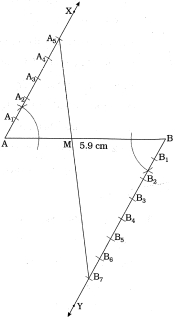
Draw $\overline{ AB }$ of length $5.9\,cm$ and divide it in the ratio $5: 7$ from $A$.
Solution
(N/A) Data: $\overline{ AB }$ of length $5.9\,cm$ is given.
To construct: $\overline{ AB }$ is to be divided in the ratio $5: 7$ from $A$.
Steps of construction:
$(1)$ In different half-planes of $\overleftrightarrow{ AB }$ containing $\overline{ AB }$,draw $\overrightarrow{ AX }$ and $\overrightarrow{ BY }$ such that $\angle XAB$ and $\angle YBA$ are congruent acute angles.
$(2)$ With some appropriate radius and centre $A$,draw an arc to intersect $\overrightarrow{ AX }$ at $A_{1}$. Similarly,with centre $A_{1}$ and the same radius,draw an arc to intersect $\overrightarrow{ AX }$ at $A_{2}$ such that $A-A_{1}-A_{2}$. Similarly,draw an arc with the same radius and centre $A_{k}$ to intersect $\overrightarrow{ AX }$ at $A_{k+1}$ such that $A_{k-1}-A_{k}-A_{k+1}$,where $k=2, 3, 4$. Thus,we obtain five points $A_{1}, A_{2}, A_{3}, A_{4}$ and $A_{5}$ on $\overrightarrow{ AX }$ such that $AA_{1} = A_{1}A_{2} = A_{2}A_{3} = A_{3}A_{4} = A_{4}A_{5}$.
$(3)$ Now,with the same radius and beginning with point $B$ as centre,obtain seven points $B_{1}, B_{2}, B_{3}, B_{4}, B_{5}, B_{6}$ and $B_{7}$ on $\overrightarrow{ BY }$ such that $BB_{1} = B_{1}B_{2} = \dots = B_{6}B_{7}$.
$(4)$ Draw $\overline{A_{5}B_{7}}$ to intersect $\overline{ AB }$ at $M$.
Thus,$M \in \overline{ AB }$ is the point which divides $\overline{ AB }$ in the ratio $5: 7$.
Justification: Here $\frac{AA_{5}}{BB_{7}} = \frac{5}{7}$. Since $\overrightarrow{AX} \parallel \overrightarrow{BY}$,the correspondence $AA_{5}M \leftrightarrow BB_{7}M$ between $\Delta AA_{5}M$ and $\Delta BB_{7}M$ is a similarity.
$\therefore \frac{AM}{BM} = \frac{AA_{5}}{BB_{7}} = \frac{5}{7}$.
To construct: $\overline{ AB }$ is to be divided in the ratio $5: 7$ from $A$.
Steps of construction:
$(1)$ In different half-planes of $\overleftrightarrow{ AB }$ containing $\overline{ AB }$,draw $\overrightarrow{ AX }$ and $\overrightarrow{ BY }$ such that $\angle XAB$ and $\angle YBA$ are congruent acute angles.
$(2)$ With some appropriate radius and centre $A$,draw an arc to intersect $\overrightarrow{ AX }$ at $A_{1}$. Similarly,with centre $A_{1}$ and the same radius,draw an arc to intersect $\overrightarrow{ AX }$ at $A_{2}$ such that $A-A_{1}-A_{2}$. Similarly,draw an arc with the same radius and centre $A_{k}$ to intersect $\overrightarrow{ AX }$ at $A_{k+1}$ such that $A_{k-1}-A_{k}-A_{k+1}$,where $k=2, 3, 4$. Thus,we obtain five points $A_{1}, A_{2}, A_{3}, A_{4}$ and $A_{5}$ on $\overrightarrow{ AX }$ such that $AA_{1} = A_{1}A_{2} = A_{2}A_{3} = A_{3}A_{4} = A_{4}A_{5}$.
$(3)$ Now,with the same radius and beginning with point $B$ as centre,obtain seven points $B_{1}, B_{2}, B_{3}, B_{4}, B_{5}, B_{6}$ and $B_{7}$ on $\overrightarrow{ BY }$ such that $BB_{1} = B_{1}B_{2} = \dots = B_{6}B_{7}$.
$(4)$ Draw $\overline{A_{5}B_{7}}$ to intersect $\overline{ AB }$ at $M$.
Thus,$M \in \overline{ AB }$ is the point which divides $\overline{ AB }$ in the ratio $5: 7$.
Justification: Here $\frac{AA_{5}}{BB_{7}} = \frac{5}{7}$. Since $\overrightarrow{AX} \parallel \overrightarrow{BY}$,the correspondence $AA_{5}M \leftrightarrow BB_{7}M$ between $\Delta AA_{5}M$ and $\Delta BB_{7}M$ is a similarity.
$\therefore \frac{AM}{BM} = \frac{AA_{5}}{BB_{7}} = \frac{5}{7}$.
0 likes
View Solution28
Difficult
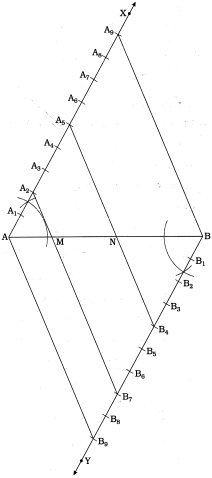
Divide a line segment into three parts in the ratio $2: 3: 4$ in the same order.
Solution
(N/A) Data: $\overline{AB}$ is given.
To construct: $\overline{AB}$ is to be divided into three parts in the ratio $2: 3: 4$ from $A$.
Steps of construction:
$(1)$ In different half-planes of $\overleftrightarrow{AB}$ containing $\overline{AB}$,draw $\overrightarrow{AX}$ and $\overrightarrow{BY}$ such that $\angle XAB$ and $\angle YBA$ are congruent acute angles.
$(2)$ With some appropriate radius and centre $A$,draw an arc to intersect $\overrightarrow{AX}$ at $A_1$. Similarly,with centre $A_1$ and the same radius,draw an arc to intersect $\overrightarrow{AX}$ at $A_2$ such that $A-A_1-A_2$. Similarly,draw an arc with the same radius and centre $A_k$ to intersect $\overrightarrow{AX}$ at $A_{k+1}$ such that $A_{k-1}-A_k-A_{k+1}$,where $k=2, 3, 4, \dots, 8$. Thus,we obtain nine points $A_1, A_2, \dots, A_9$ on $\overrightarrow{AX}$ such that $AA_1 = A_1A_2 = \dots = A_8A_9$.
$(3)$ Now,with the same radius and beginning with point $B$ as centre,obtain nine points $B_1, B_2, \dots, B_9$ on $\overrightarrow{BY}$ such that $BB_1 = B_1B_2 = \dots = B_8B_9$.
$(4)$ Draw $\overline{AB_9}$,$\overline{A_2B_7}$,$\overline{A_5B_4}$,and $\overline{A_9B}$ so that $\overline{A_2B_7}$ intersects $\overline{AB}$ at $M$ and $\overline{A_5B_4}$ intersects $\overline{AB}$ at $N$.
Thus,we obtain points $M$ and $N$ which divide $\overline{AB}$ in the ratio $2: 3: 4$ from $A$,i.e.,$AM : MN : NB = 2: 3: 4$.
Justification: Here,the intercepts made on transversals $\overleftrightarrow{AX}$,$\overleftrightarrow{AB}$,and $\overleftrightarrow{BY}$ by $\overline{A_2B_7} \parallel \overline{A_5B_4}$ are proportionate.
Hence,$AM : MN : NB = AA_2 : A_2A_5 : A_5A_9 = B_9B_7 : B_7B_4 : B_4B = 2: 3: 4$.
To construct: $\overline{AB}$ is to be divided into three parts in the ratio $2: 3: 4$ from $A$.
Steps of construction:
$(1)$ In different half-planes of $\overleftrightarrow{AB}$ containing $\overline{AB}$,draw $\overrightarrow{AX}$ and $\overrightarrow{BY}$ such that $\angle XAB$ and $\angle YBA$ are congruent acute angles.
$(2)$ With some appropriate radius and centre $A$,draw an arc to intersect $\overrightarrow{AX}$ at $A_1$. Similarly,with centre $A_1$ and the same radius,draw an arc to intersect $\overrightarrow{AX}$ at $A_2$ such that $A-A_1-A_2$. Similarly,draw an arc with the same radius and centre $A_k$ to intersect $\overrightarrow{AX}$ at $A_{k+1}$ such that $A_{k-1}-A_k-A_{k+1}$,where $k=2, 3, 4, \dots, 8$. Thus,we obtain nine points $A_1, A_2, \dots, A_9$ on $\overrightarrow{AX}$ such that $AA_1 = A_1A_2 = \dots = A_8A_9$.
$(3)$ Now,with the same radius and beginning with point $B$ as centre,obtain nine points $B_1, B_2, \dots, B_9$ on $\overrightarrow{BY}$ such that $BB_1 = B_1B_2 = \dots = B_8B_9$.
$(4)$ Draw $\overline{AB_9}$,$\overline{A_2B_7}$,$\overline{A_5B_4}$,and $\overline{A_9B}$ so that $\overline{A_2B_7}$ intersects $\overline{AB}$ at $M$ and $\overline{A_5B_4}$ intersects $\overline{AB}$ at $N$.
Thus,we obtain points $M$ and $N$ which divide $\overline{AB}$ in the ratio $2: 3: 4$ from $A$,i.e.,$AM : MN : NB = 2: 3: 4$.
Justification: Here,the intercepts made on transversals $\overleftrightarrow{AX}$,$\overleftrightarrow{AB}$,and $\overleftrightarrow{BY}$ by $\overline{A_2B_7} \parallel \overline{A_5B_4}$ are proportionate.
Hence,$AM : MN : NB = AA_2 : A_2A_5 : A_5A_9 = B_9B_7 : B_7B_4 : B_4B = 2: 3: 4$.
0 likes
View Solution29
Medium
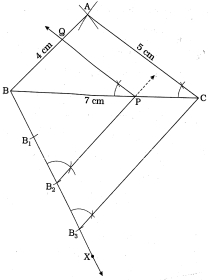
Construct a triangle with sides $4 \, cm$,$5 \, cm$,and $7 \, cm$. Then,construct a triangle similar to it whose sides have lengths in the ratio $2:3$ to the lengths of the corresponding sides of the first triangle.
Solution
(N/A) Data: Construct $\Delta ABC$ in which $AB = 4 \, cm$,$BC = 7 \, cm$,and $AC = 5 \, cm$.
To construct: Construct $\Delta BPQ$ similar to $\Delta ABC$ such that the ratio of their corresponding sides is $2:3$.
Steps of construction:
$(1)$ Construct $\Delta ABC$ in which $AB = 4 \, cm$,$BC = 7 \, cm$,and $AC = 5 \, cm$.
$(2)$ In the half-plane of $\overleftrightarrow{BC}$ that does not contain $A$,draw a ray $\overrightarrow{BX}$ such that $\angle CBX$ is an acute angle.
$(3)$ With an appropriate radius and center $B$,draw an arc to intersect $\overrightarrow{BX}$ at $B_1$. Similarly,with center $B_1$ and the same radius,draw an arc to intersect $\overrightarrow{BX}$ at $B_2$ such that $B-B_1-B_2$. Again,with the same radius and center $B_2$,draw an arc to intersect $\overrightarrow{BX}$ at $B_3$ such that $B_1-B_2-B_3$.
$(4)$ Draw the line segment $\overline{B_3C}$.
$(5)$ Through $B_2$,draw a line parallel to $\overline{B_3C}$ to intersect $\overline{BC}$ at $P$.
$(6)$ Through $P$,draw a line parallel to $\overline{CA}$ to intersect $\overline{AB}$ at $Q$.
Thus,$\Delta BPQ$ is the required triangle.
Justification: $\overleftrightarrow{BX}$ and $\overleftrightarrow{BC}$ are transversals to $\overleftrightarrow{B_3C} \parallel \overleftrightarrow{B_2P}$.
Therefore,$BP:BC = BB_2:BB_3 = 2:3$.
Similarly,$\overleftrightarrow{BC}$ and $\overleftrightarrow{BA}$ are transversals to $\overleftrightarrow{CA} \parallel \overleftrightarrow{PQ}$.
Therefore,$BQ:BA = BP:BC = 2:3$.
To construct: Construct $\Delta BPQ$ similar to $\Delta ABC$ such that the ratio of their corresponding sides is $2:3$.
Steps of construction:
$(1)$ Construct $\Delta ABC$ in which $AB = 4 \, cm$,$BC = 7 \, cm$,and $AC = 5 \, cm$.
$(2)$ In the half-plane of $\overleftrightarrow{BC}$ that does not contain $A$,draw a ray $\overrightarrow{BX}$ such that $\angle CBX$ is an acute angle.
$(3)$ With an appropriate radius and center $B$,draw an arc to intersect $\overrightarrow{BX}$ at $B_1$. Similarly,with center $B_1$ and the same radius,draw an arc to intersect $\overrightarrow{BX}$ at $B_2$ such that $B-B_1-B_2$. Again,with the same radius and center $B_2$,draw an arc to intersect $\overrightarrow{BX}$ at $B_3$ such that $B_1-B_2-B_3$.
$(4)$ Draw the line segment $\overline{B_3C}$.
$(5)$ Through $B_2$,draw a line parallel to $\overline{B_3C}$ to intersect $\overline{BC}$ at $P$.
$(6)$ Through $P$,draw a line parallel to $\overline{CA}$ to intersect $\overline{AB}$ at $Q$.
Thus,$\Delta BPQ$ is the required triangle.
Justification: $\overleftrightarrow{BX}$ and $\overleftrightarrow{BC}$ are transversals to $\overleftrightarrow{B_3C} \parallel \overleftrightarrow{B_2P}$.
Therefore,$BP:BC = BB_2:BB_3 = 2:3$.
Similarly,$\overleftrightarrow{BC}$ and $\overleftrightarrow{BA}$ are transversals to $\overleftrightarrow{CA} \parallel \overleftrightarrow{PQ}$.
Therefore,$BQ:BA = BP:BC = 2:3$.
0 likes
View Solution30
Medium
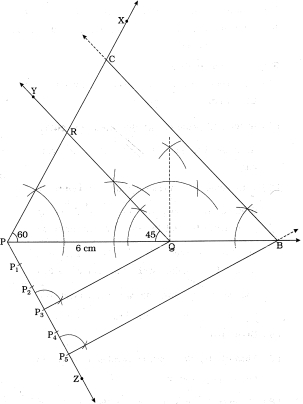
Draw $\Delta PQR$ with $m \angle P=60^{\circ}, m \angle Q=45^{\circ}$ and $PQ =6 \text{ cm}$. Then construct $\Delta PBC$ similar to $\Delta PQR$ whose sides have lengths $\frac{5}{3}$ times the lengths of the corresponding sides of $\Delta PQR$.
Solution
(N/A) Data: Construct $\Delta PQR$ with $m \angle P = 60^{\circ}, m \angle Q = 45^{\circ}$ and $PQ = 6 \text{ cm}$.
To construct: Construct $\Delta PBC$ similar to $\Delta PQR$ such that the ratio of their corresponding sides is $5:3$.
Steps of construction:
$(1)$ Construct $\Delta PQR$ with $m \angle P=60^{\circ}, m \angle Q=45^{\circ}$ and $PQ = 6 \text{ cm}$.
$(2)$ In the half-plane of $\overleftrightarrow{PQ}$ that does not contain $R$,draw a ray $\overrightarrow{PZ}$ such that $\angle QPZ$ is an acute angle.
$(3)$ With some appropriate radius and center $P$,draw an arc to intersect $\overrightarrow{PZ}$ at $P_1$. With the same radius and center $P_1$,draw an arc to intersect $\overrightarrow{PZ}$ at $P_2$ such that $P-P_1-P_2$. Similarly,with the same radius and center $P_k$,draw an arc to intersect $\overrightarrow{PZ}$ at $P_{k+1}$ such that $P_{k-1}-P_k-P_{k+1}$,where $k=2, 3, 4$.
$(4)$ Draw $\overline{P_3Q}$.
$(5)$ Through $P_5$,draw a ray parallel to $\overline{P_3Q}$ to intersect the extended ray $\overrightarrow{PQ}$ at $B$.
$(6)$ Through $B$,draw a ray parallel to $\overline{QR}$ to intersect the extended ray $\overrightarrow{PR}$ at $C$.
Thus,$\Delta PBC$ is the required triangle.
Justification: In $\Delta PP_5B$,$P-P_3-P_5$,$P-Q-B$ and $\overline{P_3Q} \parallel \overline{P_5B}$.
$\therefore \frac{PB}{PQ} = \frac{PP_5}{PP_3} = \frac{5}{3}$.
Similarly,in $\Delta PBC$,$P-Q-B$,$P-R-C$ and $\overline{QR} \parallel \overline{BC}$.
$\therefore \frac{PC}{PR} = \frac{PB}{PQ} = \frac{5}{3}$.
To construct: Construct $\Delta PBC$ similar to $\Delta PQR$ such that the ratio of their corresponding sides is $5:3$.
Steps of construction:
$(1)$ Construct $\Delta PQR$ with $m \angle P=60^{\circ}, m \angle Q=45^{\circ}$ and $PQ = 6 \text{ cm}$.
$(2)$ In the half-plane of $\overleftrightarrow{PQ}$ that does not contain $R$,draw a ray $\overrightarrow{PZ}$ such that $\angle QPZ$ is an acute angle.
$(3)$ With some appropriate radius and center $P$,draw an arc to intersect $\overrightarrow{PZ}$ at $P_1$. With the same radius and center $P_1$,draw an arc to intersect $\overrightarrow{PZ}$ at $P_2$ such that $P-P_1-P_2$. Similarly,with the same radius and center $P_k$,draw an arc to intersect $\overrightarrow{PZ}$ at $P_{k+1}$ such that $P_{k-1}-P_k-P_{k+1}$,where $k=2, 3, 4$.
$(4)$ Draw $\overline{P_3Q}$.
$(5)$ Through $P_5$,draw a ray parallel to $\overline{P_3Q}$ to intersect the extended ray $\overrightarrow{PQ}$ at $B$.
$(6)$ Through $B$,draw a ray parallel to $\overline{QR}$ to intersect the extended ray $\overrightarrow{PR}$ at $C$.
Thus,$\Delta PBC$ is the required triangle.
Justification: In $\Delta PP_5B$,$P-P_3-P_5$,$P-Q-B$ and $\overline{P_3Q} \parallel \overline{P_5B}$.
$\therefore \frac{PB}{PQ} = \frac{PP_5}{PP_3} = \frac{5}{3}$.
Similarly,in $\Delta PBC$,$P-Q-B$,$P-R-C$ and $\overline{QR} \parallel \overline{BC}$.
$\therefore \frac{PC}{PR} = \frac{PB}{PQ} = \frac{5}{3}$.
0 likes
View Solution31
Difficult
Draw a line segment $\overline{PQ}$ of length $8.2 \, cm$ and divide it in the ratio $3:7$ from point $P$. Write the steps of construction.
Solution
(N/A) Steps of construction:
$1$. Draw a line segment $\overline{PQ} = 8.2 \, cm$ using a ruler.
$2$. Draw an acute angle $\angle QPX$ at point $P$ below the line segment $\overline{PQ}$.
$3$. Starting from $P$,mark $3 + 7 = 10$ points $A_1, A_2, A_3, \dots, A_{10}$ on the ray $PX$ such that $PA_1 = A_1A_2 = A_2A_3 = \dots = A_9A_{10}$.
$4$. Join the point $A_{10}$ to $Q$.
$5$. Through point $A_3$,draw a line parallel to $A_{10}Q$ intersecting $\overline{PQ}$ at point $R$.
$6$. The point $R$ divides $\overline{PQ}$ in the ratio $3:7$ such that $PR:RQ = 3:7$.
$1$. Draw a line segment $\overline{PQ} = 8.2 \, cm$ using a ruler.
$2$. Draw an acute angle $\angle QPX$ at point $P$ below the line segment $\overline{PQ}$.
$3$. Starting from $P$,mark $3 + 7 = 10$ points $A_1, A_2, A_3, \dots, A_{10}$ on the ray $PX$ such that $PA_1 = A_1A_2 = A_2A_3 = \dots = A_9A_{10}$.
$4$. Join the point $A_{10}$ to $Q$.
$5$. Through point $A_3$,draw a line parallel to $A_{10}Q$ intersecting $\overline{PQ}$ at point $R$.
$6$. The point $R$ divides $\overline{PQ}$ in the ratio $3:7$ such that $PR:RQ = 3:7$.
0 likes
View Solution32
Difficult
Draw $\overline{AB}$ of length $10 \,cm$ and divide it in the ratio $3:8$ from $A$. Write the steps of construction.
Solution
(N/A) Steps of construction:
$1$. Draw a line segment $\overline{AB}$ of length $10 \,cm$ using a ruler.
$2$. Draw any ray $AX$ making an acute angle with $\overline{AB}$.
$3$. Locate $3 + 8 = 11$ points $A_1, A_2, ..., A_{11}$ on ray $AX$ such that $AA_1 = A_1A_2 = ... = A_{10}A_{11}$.
$4$. Join $B$ to $A_{11}$.
$5$. Through the point $A_3$,draw a line parallel to $A_{11}B$ (by making an angle equal to $\angle AA_{11}B$) intersecting $\overline{AB}$ at point $P$.
$6$. Thus,$P$ is the point dividing $\overline{AB}$ in the ratio $3:8$.
$1$. Draw a line segment $\overline{AB}$ of length $10 \,cm$ using a ruler.
$2$. Draw any ray $AX$ making an acute angle with $\overline{AB}$.
$3$. Locate $3 + 8 = 11$ points $A_1, A_2, ..., A_{11}$ on ray $AX$ such that $AA_1 = A_1A_2 = ... = A_{10}A_{11}$.
$4$. Join $B$ to $A_{11}$.
$5$. Through the point $A_3$,draw a line parallel to $A_{11}B$ (by making an angle equal to $\angle AA_{11}B$) intersecting $\overline{AB}$ at point $P$.
$6$. Thus,$P$ is the point dividing $\overline{AB}$ in the ratio $3:8$.
0 likes
View Solution33
Difficult
Draw $\overline{XY}$ of length $9\, cm$ and divide it in the ratio $2:5$ from $X$. Write the steps of construction.
Solution
(N/A) Steps of construction:
$1$. Draw a line segment $\overline{XY}$ of length $9\, cm$ using a ruler.
$2$. Draw a ray $XP$ making an acute angle with $\overline{XY}$ at point $X$.
$3$. Locate $2 + 5 = 7$ points $A_1, A_2, A_3, A_4, A_5, A_6, A_7$ on ray $XP$ such that $XA_1 = A_1A_2 = A_2A_3 = A_3A_4 = A_4A_5 = A_5A_6 = A_6A_7$.
$4$. Join $A_7$ to $Y$.
$5$. Through point $A_2$,draw a line parallel to $A_7Y$ (by making corresponding angles equal) intersecting $\overline{XY}$ at point $Z$.
$6$. Thus,point $Z$ divides $\overline{XY}$ in the ratio $2:5$.
$1$. Draw a line segment $\overline{XY}$ of length $9\, cm$ using a ruler.
$2$. Draw a ray $XP$ making an acute angle with $\overline{XY}$ at point $X$.
$3$. Locate $2 + 5 = 7$ points $A_1, A_2, A_3, A_4, A_5, A_6, A_7$ on ray $XP$ such that $XA_1 = A_1A_2 = A_2A_3 = A_3A_4 = A_4A_5 = A_5A_6 = A_6A_7$.
$4$. Join $A_7$ to $Y$.
$5$. Through point $A_2$,draw a line parallel to $A_7Y$ (by making corresponding angles equal) intersecting $\overline{XY}$ at point $Z$.
$6$. Thus,point $Z$ divides $\overline{XY}$ in the ratio $2:5$.
0 likes
View Solution34
MediumMCQ
Draw $\overline{ AB }$ of length $7 \,cm$ and obtain point $M$ on $\overline{ AB }$ such that $AM : MB = 3 : 5$. Write the steps of construction.
A
Step $1$: Draw a line segment $AB = 7 \,cm$.
B
Step $2$: Draw an acute angle $\angle BAX$ at point $A$.
C
Step $3$: Mark $3 + 5 = 8$ points on $AX$ at equal distances.
D
Step $4$: Join $A_8$ to $B$ and draw a line through $A_3$ parallel to $A_8B$ to intersect $AB$ at $M$.
Solution
(N/A) Steps of construction:
$1$. Draw a line segment $AB$ of length $7 \,cm$ using a ruler.
$2$. Draw a ray $AX$ making an acute angle with $AB$.
$3$. Locate $3 + 5 = 8$ points $A_1, A_2, A_3, A_4, A_5, A_6, A_7, A_8$ on ray $AX$ such that $AA_1 = A_1A_2 = A_2A_3 = A_3A_4 = A_4A_5 = A_5A_6 = A_6A_7 = A_7A_8$.
$4$. Join the point $A_8$ to $B$.
$5$. Through the point $A_3$,draw a line parallel to $A_8B$ (by making corresponding angles equal) to intersect $AB$ at point $M$.
$6$. Thus,$M$ is the point on $AB$ which divides it in the ratio $3 : 5$.
$1$. Draw a line segment $AB$ of length $7 \,cm$ using a ruler.
$2$. Draw a ray $AX$ making an acute angle with $AB$.
$3$. Locate $3 + 5 = 8$ points $A_1, A_2, A_3, A_4, A_5, A_6, A_7, A_8$ on ray $AX$ such that $AA_1 = A_1A_2 = A_2A_3 = A_3A_4 = A_4A_5 = A_5A_6 = A_6A_7 = A_7A_8$.
$4$. Join the point $A_8$ to $B$.
$5$. Through the point $A_3$,draw a line parallel to $A_8B$ (by making corresponding angles equal) to intersect $AB$ at point $M$.
$6$. Thus,$M$ is the point on $AB$ which divides it in the ratio $3 : 5$.
0 likes
View Solution35
Medium
Draw a line segment $\overline{XY}$ of length $7.5\, cm$ and divide it in the ratio $3:4:5$ starting from $X$. Write the steps of construction.
Solution
(N/A) Steps of construction:
$1$. Draw a line segment $\overline{XY} = 7.5\, cm$ using a ruler.
$2$. Draw an acute angle $\angle YXA$ at point $X$ below the segment $\overline{XY}$.
$3$. Starting from $X$,mark $3 + 4 + 5 = 12$ points $X_1, X_2, ..., X_{12}$ on the ray $XA$ such that $XX_1 = X_1X_2 = ... = X_{11}X_{12}$ using a compass.
$4$. Join the point $X_{12}$ to $Y$.
$5$. Through points $X_3$ and $X_7$ (since $3$ and $3+4=7$),draw lines parallel to $X_{12}Y$ intersecting $\overline{XY}$ at points $P$ and $Q$ respectively.
$6$. The points $P$ and $Q$ divide the segment $\overline{XY}$ in the ratio $3:4:5$.
$1$. Draw a line segment $\overline{XY} = 7.5\, cm$ using a ruler.
$2$. Draw an acute angle $\angle YXA$ at point $X$ below the segment $\overline{XY}$.
$3$. Starting from $X$,mark $3 + 4 + 5 = 12$ points $X_1, X_2, ..., X_{12}$ on the ray $XA$ such that $XX_1 = X_1X_2 = ... = X_{11}X_{12}$ using a compass.
$4$. Join the point $X_{12}$ to $Y$.
$5$. Through points $X_3$ and $X_7$ (since $3$ and $3+4=7$),draw lines parallel to $X_{12}Y$ intersecting $\overline{XY}$ at points $P$ and $Q$ respectively.
$6$. The points $P$ and $Q$ divide the segment $\overline{XY}$ in the ratio $3:4:5$.
0 likes
View Solution36
Difficult
Draw $\overline{PQ}$ of length $8.5 \text{ cm}$ and obtain point $X$ on $\overline{PQ}$ such that $PX : XQ = 4 : 7$. Write the steps of construction.
Solution
(N/A) Steps of construction:
$1$. Draw a line segment $\overline{PQ}$ of length $8.5 \text{ cm}$ using a ruler.
$2$. Draw any ray $PY$ making an acute angle with $\overline{PQ}$.
$3$. Locate $4 + 7 = 11$ points $A_1, A_2, \dots, A_{11}$ on ray $PY$ such that $PA_1 = A_1A_2 = A_2A_3 = \dots = A_{10}A_{11}$.
$4$. Join $A_{11}$ to $Q$.
$5$. Through the point $A_4$ (since the ratio is $4:7$),draw a line parallel to $A_{11}Q$ intersecting $\overline{PQ}$ at point $X$.
$6$. Thus,$X$ is the point on $\overline{PQ}$ which divides it in the ratio $4 : 7$.
$1$. Draw a line segment $\overline{PQ}$ of length $8.5 \text{ cm}$ using a ruler.
$2$. Draw any ray $PY$ making an acute angle with $\overline{PQ}$.
$3$. Locate $4 + 7 = 11$ points $A_1, A_2, \dots, A_{11}$ on ray $PY$ such that $PA_1 = A_1A_2 = A_2A_3 = \dots = A_{10}A_{11}$.
$4$. Join $A_{11}$ to $Q$.
$5$. Through the point $A_4$ (since the ratio is $4:7$),draw a line parallel to $A_{11}Q$ intersecting $\overline{PQ}$ at point $X$.
$6$. Thus,$X$ is the point on $\overline{PQ}$ which divides it in the ratio $4 : 7$.
0 likes
View Solution37
Medium
Draw $\overline{ AB }$ of length $7 \,cm$ and obtain a point $M$ on $\overline{ AB }$ such that $AM : AB = 2 : 5$. Write the steps of construction.
Solution
(N/A) Steps of construction:
$1$. Draw a line segment $\overline{ AB }$ of length $7 \,cm$ using a ruler.
$2$. Draw an acute angle $\angle BAX$ at point $A$ with the line segment $\overline{ AB }$.
$3$. Mark $5$ points $A_1, A_2, A_3, A_4, A_5$ on the ray $AX$ such that $AA_1 = A_1A_2 = A_2A_3 = A_3A_4 = A_4A_5$ using a compass.
$4$. Join $A_5$ to $B$.
$5$. Through point $A_2$,draw a line parallel to $A_5B$ intersecting $\overline{ AB }$ at point $M$.
$6$. Thus,$M$ is the required point on $\overline{ AB }$ such that $AM : AB = 2 : 5$.
$1$. Draw a line segment $\overline{ AB }$ of length $7 \,cm$ using a ruler.
$2$. Draw an acute angle $\angle BAX$ at point $A$ with the line segment $\overline{ AB }$.
$3$. Mark $5$ points $A_1, A_2, A_3, A_4, A_5$ on the ray $AX$ such that $AA_1 = A_1A_2 = A_2A_3 = A_3A_4 = A_4A_5$ using a compass.
$4$. Join $A_5$ to $B$.
$5$. Through point $A_2$,draw a line parallel to $A_5B$ intersecting $\overline{ AB }$ at point $M$.
$6$. Thus,$M$ is the required point on $\overline{ AB }$ such that $AM : AB = 2 : 5$.
0 likes
View Solution38
Difficult
Draw a line segment $\overline{AB}$ of length $8\, cm$ and divide it in the ratio $2:3:5$ starting from point $A$. Write the steps of construction.
Solution
(N/A) Step $1$: Draw a line segment $\overline{AB} = 8\, cm$ using a ruler.
Step $2$: Draw an acute angle $\angle BAX$ at point $A$ with the line segment $\overline{AB}$.
Step $3$: Mark $2 + 3 + 5 = 10$ points $A_1, A_2, A_3, \dots, A_{10}$ on the ray $AX$ such that $AA_1 = A_1A_2 = A_2A_3 = \dots = A_9A_{10}$ using a compass.
Step $4$: Join the last point $A_{10}$ to point $B$.
Step $5$: Through points $A_2$ and $A_5$ (since $2$ and $2+3=5$),draw lines parallel to $A_{10}B$ intersecting $\overline{AB}$ at points $P$ and $Q$ respectively.
Step $6$: The points $P$ and $Q$ divide the line segment $\overline{AB}$ in the ratio $2:3:5$.
Step $2$: Draw an acute angle $\angle BAX$ at point $A$ with the line segment $\overline{AB}$.
Step $3$: Mark $2 + 3 + 5 = 10$ points $A_1, A_2, A_3, \dots, A_{10}$ on the ray $AX$ such that $AA_1 = A_1A_2 = A_2A_3 = \dots = A_9A_{10}$ using a compass.
Step $4$: Join the last point $A_{10}$ to point $B$.
Step $5$: Through points $A_2$ and $A_5$ (since $2$ and $2+3=5$),draw lines parallel to $A_{10}B$ intersecting $\overline{AB}$ at points $P$ and $Q$ respectively.
Step $6$: The points $P$ and $Q$ divide the line segment $\overline{AB}$ in the ratio $2:3:5$.
0 likes
View Solution39
Medium
Construct $\Delta ABC$ with $AB = 3 \, cm$,$BC = 6 \, cm$,and $AC = 5 \, cm$. Then,construct $\Delta BPQ$ similar to $\Delta ABC$ such that each side of $\Delta BPQ$ is $\frac{3}{4}$ of the corresponding sides of $\Delta ABC$. Write the steps of construction.
Solution
(N/A) Steps of construction:
$1$. Draw a line segment $BC = 6 \, cm$.
$2$. With $B$ as the center and radius $3 \, cm$,draw an arc. With $C$ as the center and radius $5 \, cm$,draw another arc intersecting the first arc at $A$.
$3$. Join $AB$ and $AC$ to obtain $\Delta ABC$.
$4$. Draw a ray $BX$ making an acute angle with $BC$ on the side opposite to vertex $A$.
$5$. Locate $4$ points $B_1, B_2, B_3, B_4$ on $BX$ such that $BB_1 = B_1B_2 = B_2B_3 = B_3B_4$.
$6$. Join $B_4C$.
$7$. Draw a line through $B_3$ parallel to $B_4C$ intersecting $BC$ at $Q$.
$8$. Draw a line through $Q$ parallel to $AC$ intersecting $AB$ at $P$.
$9$. $\Delta BPQ$ is the required triangle.
$1$. Draw a line segment $BC = 6 \, cm$.
$2$. With $B$ as the center and radius $3 \, cm$,draw an arc. With $C$ as the center and radius $5 \, cm$,draw another arc intersecting the first arc at $A$.
$3$. Join $AB$ and $AC$ to obtain $\Delta ABC$.
$4$. Draw a ray $BX$ making an acute angle with $BC$ on the side opposite to vertex $A$.
$5$. Locate $4$ points $B_1, B_2, B_3, B_4$ on $BX$ such that $BB_1 = B_1B_2 = B_2B_3 = B_3B_4$.
$6$. Join $B_4C$.
$7$. Draw a line through $B_3$ parallel to $B_4C$ intersecting $BC$ at $Q$.
$8$. Draw a line through $Q$ parallel to $AC$ intersecting $AB$ at $P$.
$9$. $\Delta BPQ$ is the required triangle.
0 likes
View Solution40
Difficult
Construct $\Delta ABC$ with $AB = 6 \text{ cm}$,$BC = 7 \text{ cm}$,and $AC = 5 \text{ cm}$. Then,construct $\Delta BXY$ similar to $\Delta ABC$ such that its sides are $\frac{4}{5}$ of the corresponding sides of $\Delta ABC$. Write the steps of construction.
Solution
(N/A) Steps of construction:
$1$. Draw a line segment $BC = 7 \text{ cm}$.
$2$. With $B$ as the center and radius $6 \text{ cm}$,draw an arc. With $C$ as the center and radius $5 \text{ cm}$,draw another arc intersecting the first arc at $A$.
$3$. Join $AB$ and $AC$ to form $\Delta ABC$.
$4$. Draw a ray $BX$ making an acute angle with $BC$ on the side opposite to vertex $A$.
$5$. Locate $5$ points $B_1, B_2, B_3, B_4, B_5$ on $BX$ such that $BB_1 = B_1B_2 = B_2B_3 = B_3B_4 = B_4B_5$.
$6$. Join $B_5C$.
$7$. From $B_4$,draw $B_4Y \parallel B_5C$ meeting $BC$ at $Y$.
$8$. From $Y$,draw $YX \parallel CA$ meeting $AB$ at $X$. Then $\Delta BXY$ is the required triangle.
$1$. Draw a line segment $BC = 7 \text{ cm}$.
$2$. With $B$ as the center and radius $6 \text{ cm}$,draw an arc. With $C$ as the center and radius $5 \text{ cm}$,draw another arc intersecting the first arc at $A$.
$3$. Join $AB$ and $AC$ to form $\Delta ABC$.
$4$. Draw a ray $BX$ making an acute angle with $BC$ on the side opposite to vertex $A$.
$5$. Locate $5$ points $B_1, B_2, B_3, B_4, B_5$ on $BX$ such that $BB_1 = B_1B_2 = B_2B_3 = B_3B_4 = B_4B_5$.
$6$. Join $B_5C$.
$7$. From $B_4$,draw $B_4Y \parallel B_5C$ meeting $BC$ at $Y$.
$8$. From $Y$,draw $YX \parallel CA$ meeting $AB$ at $X$. Then $\Delta BXY$ is the required triangle.
0 likes
View Solution41
Difficult
Draw $\Delta PQR$ with $QR = 7 \, cm$,$m\angle Q = 45^{\circ}$ and $m\angle R = 60^{\circ}$. Then construct $\Delta QAB$ similar to $\Delta PQR$ whose sides have lengths $\frac{4}{3}$ times the lengths of corresponding sides of $\Delta PQR$. Write the steps of construction.
Solution
(N/A) Steps of construction:
$1$. Draw a line segment $QR = 7 \, cm$.
$2$. At point $Q$,construct an angle of $45^{\circ}$ using a protractor or compass.
$3$. At point $R$,construct an angle of $60^{\circ}$ using a compass.
$4$. Let the intersection of these two rays be point $P$. Thus,$\Delta PQR$ is formed.
$5$. Draw an acute angle $\angle RQX$ below the base $QR$.
$6$. Locate $4$ points $Q_1, Q_2, Q_3, Q_4$ on ray $QX$ such that $QQ_1 = Q_1Q_2 = Q_2Q_3 = Q_3Q_4$.
$7$. Join $Q_3$ to $R$. Draw a line through $Q_4$ parallel to $Q_3R$ intersecting the extended line segment $QR$ at $R'$.
$8$. Draw a line through $R'$ parallel to $RP$ intersecting the extended line segment $QP$ at $P'$.
$9$. $\Delta P'QR'$ is the required triangle similar to $\Delta PQR$ with a scale factor of $\frac{4}{3}$.
$1$. Draw a line segment $QR = 7 \, cm$.
$2$. At point $Q$,construct an angle of $45^{\circ}$ using a protractor or compass.
$3$. At point $R$,construct an angle of $60^{\circ}$ using a compass.
$4$. Let the intersection of these two rays be point $P$. Thus,$\Delta PQR$ is formed.
$5$. Draw an acute angle $\angle RQX$ below the base $QR$.
$6$. Locate $4$ points $Q_1, Q_2, Q_3, Q_4$ on ray $QX$ such that $QQ_1 = Q_1Q_2 = Q_2Q_3 = Q_3Q_4$.
$7$. Join $Q_3$ to $R$. Draw a line through $Q_4$ parallel to $Q_3R$ intersecting the extended line segment $QR$ at $R'$.
$8$. Draw a line through $R'$ parallel to $RP$ intersecting the extended line segment $QP$ at $P'$.
$9$. $\Delta P'QR'$ is the required triangle similar to $\Delta PQR$ with a scale factor of $\frac{4}{3}$.
0 likes
View Solution42
Difficult
Draw $\Delta XYZ$ with $XY = YZ = ZX = 6\, cm$. Then construct $\Delta YMN$ similar to $\Delta XYZ$ whose sides have lengths $\frac{5}{4}$ times the lengths of corresponding sides of $\Delta XYZ$. Write the steps of construction.
Solution
(N/A) Steps of construction:
$1$. Draw an equilateral triangle $\Delta XYZ$ with each side equal to $6\, cm$.
$2$. Draw a ray $XS$ making an acute angle with $XY$ at vertex $X$ on the side opposite to $Z$.
$3$. Locate $5$ points $X_1, X_2, X_3, X_4, X_5$ on ray $XS$ such that $XX_1 = X_1X_2 = X_2X_3 = X_3X_4 = X_4X_5$.
$4$. Join $X_4$ to $Y$. Draw a line through $X_5$ parallel to $X_4Y$ intersecting the extended line segment $XY$ at point $M$.
$5$. Draw a line through $M$ parallel to $YZ$ intersecting the extended line segment $XZ$ at point $N$.
$6$. Thus,$\Delta XMN$ is the required triangle similar to $\Delta XYZ$ with scale factor $\frac{5}{4}$.
$1$. Draw an equilateral triangle $\Delta XYZ$ with each side equal to $6\, cm$.
$2$. Draw a ray $XS$ making an acute angle with $XY$ at vertex $X$ on the side opposite to $Z$.
$3$. Locate $5$ points $X_1, X_2, X_3, X_4, X_5$ on ray $XS$ such that $XX_1 = X_1X_2 = X_2X_3 = X_3X_4 = X_4X_5$.
$4$. Join $X_4$ to $Y$. Draw a line through $X_5$ parallel to $X_4Y$ intersecting the extended line segment $XY$ at point $M$.
$5$. Draw a line through $M$ parallel to $YZ$ intersecting the extended line segment $XZ$ at point $N$.
$6$. Thus,$\Delta XMN$ is the required triangle similar to $\Delta XYZ$ with scale factor $\frac{5}{4}$.
0 likes
View Solution43
Medium
Draw $\Delta ABC$ with $AB = 5 \text{ cm}$,$BC = 6 \text{ cm}$,and $m\angle B = 90^{\circ}$. Then,construct $\Delta BPQ$ similar to $\Delta ABC$ such that its sides are $\frac{3}{2}$ times the corresponding sides of $\Delta ABC$. Write the steps of construction.
Solution
(N/A) Steps of construction:
$1$. Draw a line segment $BC = 6 \text{ cm}$.
$2$. At point $B$,construct an angle of $90^{\circ}$ using a protractor or compass.
$3$. Cut an arc of $5 \text{ cm}$ on the ray from $B$ to mark point $A$. Join $AC$ to complete $\Delta ABC$.
$4$. Draw an acute angle $\angle CBX$ below $BC$.
$5$. Mark $3$ points $B_1, B_2, B_3$ on $BX$ such that $BB_1 = B_1B_2 = B_2B_3$.
$6$. Join $B_2$ to $C$. Draw a line through $B_3$ parallel to $B_2C$ intersecting the extended line $BC$ at $Q$.
$7$. Draw a line through $Q$ parallel to $AC$ intersecting the extended line $BA$ at $P$.
$8$. $\Delta BPQ$ is the required triangle.
$1$. Draw a line segment $BC = 6 \text{ cm}$.
$2$. At point $B$,construct an angle of $90^{\circ}$ using a protractor or compass.
$3$. Cut an arc of $5 \text{ cm}$ on the ray from $B$ to mark point $A$. Join $AC$ to complete $\Delta ABC$.
$4$. Draw an acute angle $\angle CBX$ below $BC$.
$5$. Mark $3$ points $B_1, B_2, B_3$ on $BX$ such that $BB_1 = B_1B_2 = B_2B_3$.
$6$. Join $B_2$ to $C$. Draw a line through $B_3$ parallel to $B_2C$ intersecting the extended line $BC$ at $Q$.
$7$. Draw a line through $Q$ parallel to $AC$ intersecting the extended line $BA$ at $P$.
$8$. $\Delta BPQ$ is the required triangle.
0 likes
View Solution44
Medium
Draw $\Delta ABC$ with $AB = 6 \, cm$,$BC = 8 \, cm$,and $m\angle B = 60^\circ$. Then,construct $\Delta BXY$ similar to $\Delta ABC$ whose sides have lengths $\frac{4}{5}$ times the lengths of the corresponding sides of $\Delta ABC$. Write the steps of construction.
Solution
(N/A) Steps of construction:
$1$. Draw a line segment $BC = 8 \, cm$.
$2$. At point $B$,construct an angle of $60^\circ$ using a compass and ruler.
$3$. From point $B$,cut an arc of $6 \, cm$ on the ray making $60^\circ$ to mark point $A$. Join $AC$ to complete $\Delta ABC$.
$4$. Draw an acute angle $\angle CBZ$ below the line segment $BC$.
$5$. Mark $5$ points $B_1, B_2, B_3, B_4, B_5$ on ray $BZ$ such that $BB_1 = B_1B_2 = B_2B_3 = B_3B_4 = B_4B_5$.
$6$. Join $B_5$ to $C$.
$7$. Draw a line from $B_4$ parallel to $B_5C$ intersecting $BC$ at $Y$.
$8$. Draw a line from $Y$ parallel to $AC$ intersecting $AB$ at $X$.
$9$. $\Delta BXY$ is the required triangle similar to $\Delta ABC$ with a scale factor of $\frac{4}{5}$.
$1$. Draw a line segment $BC = 8 \, cm$.
$2$. At point $B$,construct an angle of $60^\circ$ using a compass and ruler.
$3$. From point $B$,cut an arc of $6 \, cm$ on the ray making $60^\circ$ to mark point $A$. Join $AC$ to complete $\Delta ABC$.
$4$. Draw an acute angle $\angle CBZ$ below the line segment $BC$.
$5$. Mark $5$ points $B_1, B_2, B_3, B_4, B_5$ on ray $BZ$ such that $BB_1 = B_1B_2 = B_2B_3 = B_3B_4 = B_4B_5$.
$6$. Join $B_5$ to $C$.
$7$. Draw a line from $B_4$ parallel to $B_5C$ intersecting $BC$ at $Y$.
$8$. Draw a line from $Y$ parallel to $AC$ intersecting $AB$ at $X$.
$9$. $\Delta BXY$ is the required triangle similar to $\Delta ABC$ with a scale factor of $\frac{4}{5}$.
0 likes
View Solution45
Difficult
Draw $\Delta XYZ$ with $XY = 4\, cm$,$YZ = 6\, cm$,and $XZ = 7\, cm$. Then,construct $\Delta YMN$ similar to $\Delta XYZ$ with a scale factor of $\frac{4}{3}$. Write the steps of construction.
Solution
(N/A) Steps of construction:
$1$. Draw a line segment $YZ = 6\, cm$.
$2$. With $Y$ as the center and radius $4\, cm$,draw an arc.
$3$. With $Z$ as the center and radius $7\, cm$,draw another arc intersecting the previous arc at point $X$.
$4$. Join $XY$ and $XZ$ to form $\Delta XYZ$.
$5$. Draw an acute angle $\angle ZYA$ at vertex $Y$ below the line $YZ$.
$6$. Mark $4$ points $Y_1, Y_2, Y_3, Y_4$ on $YA$ such that $YY_1 = Y_1Y_2 = Y_2Y_3 = Y_3Y_4$.
$7$. Join $Y_3$ to $Z$.
$8$. Draw a line through $Y_4$ parallel to $Y_3Z$ intersecting the extended line $YZ$ at $N$.
$9$. Draw a line through $N$ parallel to $XZ$ intersecting the extended line $YX$ at $M$.
$10$. $\Delta YMN$ is the required triangle.
$1$. Draw a line segment $YZ = 6\, cm$.
$2$. With $Y$ as the center and radius $4\, cm$,draw an arc.
$3$. With $Z$ as the center and radius $7\, cm$,draw another arc intersecting the previous arc at point $X$.
$4$. Join $XY$ and $XZ$ to form $\Delta XYZ$.
$5$. Draw an acute angle $\angle ZYA$ at vertex $Y$ below the line $YZ$.
$6$. Mark $4$ points $Y_1, Y_2, Y_3, Y_4$ on $YA$ such that $YY_1 = Y_1Y_2 = Y_2Y_3 = Y_3Y_4$.
$7$. Join $Y_3$ to $Z$.
$8$. Draw a line through $Y_4$ parallel to $Y_3Z$ intersecting the extended line $YZ$ at $N$.
$9$. Draw a line through $N$ parallel to $XZ$ intersecting the extended line $YX$ at $M$.
$10$. $\Delta YMN$ is the required triangle.
0 likes
View Solution46
Medium
Draw a circle of radius $5 \, cm$. From a point $8 \, cm$ away from the centre,construct two tangents to the circle. Measure their lengths.
Solution
(N/A) Data: Draw a circle with centre $A$ and radius $5 \, cm$. Take a point $B$ in its exterior such that $AB = 8 \, cm$.
To construct: Through point $B$,draw two tangents to the circle with centre $A$ and radius $5 \, cm$.
Steps of construction:
$1$. Draw a circle with centre $A$ and radius $5 \, cm$ and mark a point $B$ outside the circle such that $AB = 8 \, cm$.
$2$. Draw the line segment $\overline{AB}$.
$3$. Find the midpoint $M$ of $\overline{AB}$ by constructing its perpendicular bisector.
$4$. With $M$ as the centre and $MA$ as the radius,draw a circle that intersects the original circle at points $X$ and $Y$.
$5$. Draw the rays $\overrightarrow{BX}$ and $\overrightarrow{BY}$.
Thus,$\overleftrightarrow{BX}$ and $\overleftrightarrow{BY}$ are the required tangents.
Calculation: In $\triangle AXB$,$\angle AXB = 90^\circ$ (angle in a semicircle). By Pythagoras theorem,$AB^2 = AX^2 + BX^2$.
$8^2 = 5^2 + BX^2 \implies 64 = 25 + BX^2 \implies BX^2 = 39 \implies BX = \sqrt{39} \approx 6.24 \, cm$.
Therefore,the length of the tangents is approximately $6.24 \, cm$.
To construct: Through point $B$,draw two tangents to the circle with centre $A$ and radius $5 \, cm$.
Steps of construction:
$1$. Draw a circle with centre $A$ and radius $5 \, cm$ and mark a point $B$ outside the circle such that $AB = 8 \, cm$.
$2$. Draw the line segment $\overline{AB}$.
$3$. Find the midpoint $M$ of $\overline{AB}$ by constructing its perpendicular bisector.
$4$. With $M$ as the centre and $MA$ as the radius,draw a circle that intersects the original circle at points $X$ and $Y$.
$5$. Draw the rays $\overrightarrow{BX}$ and $\overrightarrow{BY}$.
Thus,$\overleftrightarrow{BX}$ and $\overleftrightarrow{BY}$ are the required tangents.
Calculation: In $\triangle AXB$,$\angle AXB = 90^\circ$ (angle in a semicircle). By Pythagoras theorem,$AB^2 = AX^2 + BX^2$.
$8^2 = 5^2 + BX^2 \implies 64 = 25 + BX^2 \implies BX^2 = 39 \implies BX = \sqrt{39} \approx 6.24 \, cm$.
Therefore,the length of the tangents is approximately $6.24 \, cm$.
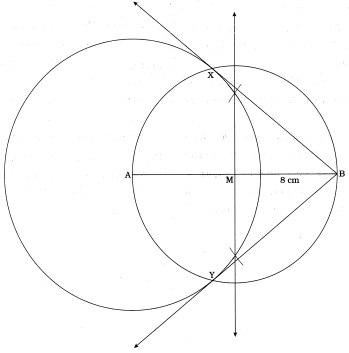
0 likes
View Solution47
Difficult
Draw a circle with the help of a circular bangle. Construct two tangents to this circle from a point in the exterior of the circle.
Solution
(N/A) Data: Draw a circle with the help of a circular bangle and take point $A$ in the exterior of the circle.
To construct: Through $A$,tangents are to be drawn to the circle.
$(1)$ Draw a circle with the help of a circular bangle and take point $A$ in the exterior of the circle.
$(2)$ Draw two non-parallel chords $\overline{PQ}$ and $\overline{RS}$ in this circle.
$(3)$ Draw the perpendicular bisectors of $\overline{PQ}$ and $\overline{RS}$ to intersect each other at $O$. Here,$O$ is the centre of the circle drawn with the help of the circular bangle.
$(4)$ Draw $\overline{OA}$.
$(5)$ Obtain the midpoint $M$ of $\overline{OA}$ by constructing the perpendicular bisector of $\overline{OA}$.
$(6)$ Draw a circle with centre $M$ and radius $MA$ to intersect the first circle at $X$ and $Y$.
$(7)$ Draw rays $\overrightarrow{AX}$ and $\overrightarrow{AY}$.
Thus,$\overleftrightarrow{AX}$ and $\overleftrightarrow{AY}$ are the required tangents.
To construct: Through $A$,tangents are to be drawn to the circle.
$(1)$ Draw a circle with the help of a circular bangle and take point $A$ in the exterior of the circle.
$(2)$ Draw two non-parallel chords $\overline{PQ}$ and $\overline{RS}$ in this circle.
$(3)$ Draw the perpendicular bisectors of $\overline{PQ}$ and $\overline{RS}$ to intersect each other at $O$. Here,$O$ is the centre of the circle drawn with the help of the circular bangle.
$(4)$ Draw $\overline{OA}$.
$(5)$ Obtain the midpoint $M$ of $\overline{OA}$ by constructing the perpendicular bisector of $\overline{OA}$.
$(6)$ Draw a circle with centre $M$ and radius $MA$ to intersect the first circle at $X$ and $Y$.
$(7)$ Draw rays $\overrightarrow{AX}$ and $\overrightarrow{AY}$.
Thus,$\overleftrightarrow{AX}$ and $\overleftrightarrow{AY}$ are the required tangents.
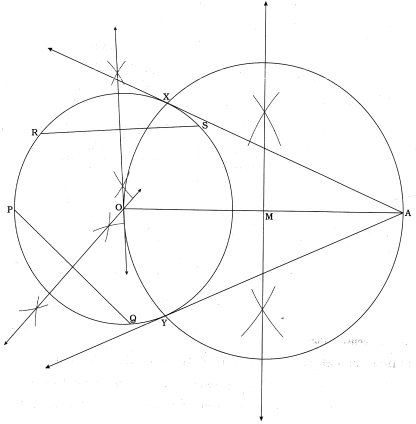
0 likes
View Solution48
Medium
Draw $\overline{AB}$ such that $AB = 10 \, cm$. Draw $\odot(A, 3)$ and $\odot(B, 4)$. Construct tangents to each circle through the centre of the other circle.
Solution
(N/A) Data: Draw $\overline{AB}$ such that $AB = 10 \, cm$. Draw $\odot(A, 3 \, cm)$ and $\odot(B, 4 \, cm)$.
To construct: From the centre of each circle,tangents are to be drawn to the other circle.
Steps of construction:
$(1)$ Draw $\overline{AB}$ such that $AB = 10 \, cm$. Draw $\odot(A, 3 \, cm)$ and $\odot(B, 4 \, cm)$.
$(2)$ Obtain the midpoint $M$ of $\overline{AB}$ by constructing its perpendicular bisector.
$(3)$ Draw $\odot(M, MA)$ to intersect $\odot(A, 3 \, cm)$ at $S$ and $T$,and $\odot(B, 4 \, cm)$ at $X$ and $Y$.
$(4)$ Draw $\overrightarrow{AX}$ and $\overrightarrow{AY}$ as well as $\overrightarrow{BS}$ and $\overrightarrow{BT}$.
Thus,$\overleftrightarrow{AX}$ and $\overleftrightarrow{AY}$ are the tangents from $A$ to $\odot(B, 4 \, cm)$ and $\overleftrightarrow{BS}$ and $\overleftrightarrow{BT}$ are the tangents from $B$ to $\odot(A, 3 \, cm)$.
To construct: From the centre of each circle,tangents are to be drawn to the other circle.
Steps of construction:
$(1)$ Draw $\overline{AB}$ such that $AB = 10 \, cm$. Draw $\odot(A, 3 \, cm)$ and $\odot(B, 4 \, cm)$.
$(2)$ Obtain the midpoint $M$ of $\overline{AB}$ by constructing its perpendicular bisector.
$(3)$ Draw $\odot(M, MA)$ to intersect $\odot(A, 3 \, cm)$ at $S$ and $T$,and $\odot(B, 4 \, cm)$ at $X$ and $Y$.
$(4)$ Draw $\overrightarrow{AX}$ and $\overrightarrow{AY}$ as well as $\overrightarrow{BS}$ and $\overrightarrow{BT}$.
Thus,$\overleftrightarrow{AX}$ and $\overleftrightarrow{AY}$ are the tangents from $A$ to $\odot(B, 4 \, cm)$ and $\overleftrightarrow{BS}$ and $\overleftrightarrow{BT}$ are the tangents from $B$ to $\odot(A, 3 \, cm)$.
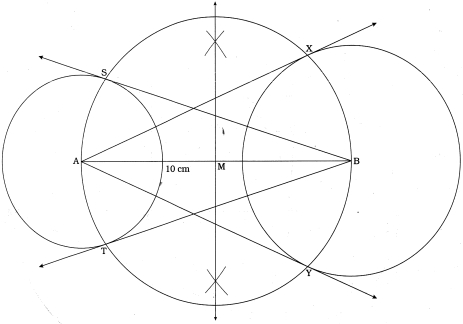
0 likes
View Solution49
Medium
$A$ circle $\odot(P, 4)$ is given. Draw a pair of tangents such that the measure of the angle between the tangents at their point of intersection $A$ is $60^\circ$.
Solution
(N/A) Data: Draw $\odot(P, 4 \text{ cm})$.
To construct: Draw a pair of tangents to $\odot(P, 4 \text{ cm})$ such that the measure of the angle between the tangents at their point of intersection $A$ is $60^\circ$.
$(1)$ Draw $\odot(P, 4 \text{ cm})$ and two radii $\overline{PR}$ and $\overline{PQ}$ such that $m\angle RPQ = 180^\circ - 60^\circ = 120^\circ$.
$(2)$ Through $R$,draw a line perpendicular to $\overline{PR}$.
$(3)$ Through $Q$,draw a line perpendicular to $\overline{PQ}$.
$(4)$ Let the lines drawn in step $(2)$ and step $(3)$ intersect at $A$.
Thus,$\overleftrightarrow{AR}$ and $\overleftrightarrow{AQ}$ are the required tangents such that the measure of the angle between them is $60^\circ$.
To construct: Draw a pair of tangents to $\odot(P, 4 \text{ cm})$ such that the measure of the angle between the tangents at their point of intersection $A$ is $60^\circ$.
$(1)$ Draw $\odot(P, 4 \text{ cm})$ and two radii $\overline{PR}$ and $\overline{PQ}$ such that $m\angle RPQ = 180^\circ - 60^\circ = 120^\circ$.
$(2)$ Through $R$,draw a line perpendicular to $\overline{PR}$.
$(3)$ Through $Q$,draw a line perpendicular to $\overline{PQ}$.
$(4)$ Let the lines drawn in step $(2)$ and step $(3)$ intersect at $A$.
Thus,$\overleftrightarrow{AR}$ and $\overleftrightarrow{AQ}$ are the required tangents such that the measure of the angle between them is $60^\circ$.
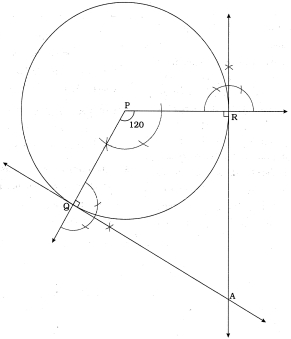
0 likes
View Solution50
Difficult
Draw $\odot(P, 3\, cm)$ and take a point $R$ in its exterior such that $PR = 6\, cm$. Draw two tangents to $\odot(P, 3\, cm)$ from $R$. Write the steps of construction.
Solution
(N/A) Steps of construction:
$1$. Draw a circle with center $P$ and radius $3\, cm$.
$2$. Mark a point $R$ outside the circle such that the distance $PR = 6\, cm$.
$3$. Find the midpoint $M$ of the line segment $PR$ by drawing its perpendicular bisector.
$4$. With $M$ as the center and $MP$ (or $MR$) as the radius,draw a second circle.
$5$. Let this circle intersect the original circle at points $A$ and $B$.
$6$. Join $RA$ and $RB$. These are the required tangents to the circle $\odot(P, 3\, cm)$ from point $R$.
$1$. Draw a circle with center $P$ and radius $3\, cm$.
$2$. Mark a point $R$ outside the circle such that the distance $PR = 6\, cm$.
$3$. Find the midpoint $M$ of the line segment $PR$ by drawing its perpendicular bisector.
$4$. With $M$ as the center and $MP$ (or $MR$) as the radius,draw a second circle.
$5$. Let this circle intersect the original circle at points $A$ and $B$.
$6$. Join $RA$ and $RB$. These are the required tangents to the circle $\odot(P, 3\, cm)$ from point $R$.
0 likes
View SolutionConstructions — Mix Examples - Constructions · Frequently Asked Questions
1Are these Constructions questions useful for JEE and NEET?
Yes. All questions in this section are mapped to JEE Main and NEET exam patterns. Previous year questions from JEE Main, NEET, GUJCET and state-level exams are included with full solutions.
2Can I switch to Hindi or Gujarati for these questions?
Yes. Use the language tabs in the hero section or the sidebar to view the same questions and solutions in English, Hindi or Gujarati.
3How do I generate a question paper from this subtopic?
Use the Vedclass Exam Paper Generator — select the chapter and subtopic, set difficulty, and generate Sets A, B, C, D automatically. First 3 chapters of every subject are free.
Vedclass Products
For Students
Vedclass Test Series
Mock tests in real JEE/NEET style with performance analysis. 5-day free trial.
Start Free TrialFor Teachers
Exam Paper Generator
Generate Set A/B/C/D papers from this chapter in 2 minutes. 3 chapters free.
Try FreeFor Institutes
Online Exam Module
Live online exams with unlimited students, 360° analytics & white-label branding.
See DemoFor Teachers & Institutes
Generate a Constructions Exam Paper in 2 Minutes
Select subtopic & difficulty — Sets A, B, C, D auto-generated with No Repeat logic.
First 3 chapters of every subject are free — no payment required.