
A English
Textbook - Constructions Questions in English
Class 10 Mathematics · Constructions · Textbook - Constructions
16+
Questions
English
Language
100%
With Solutions
Showing 16 of 16 questions in English
1
Easy
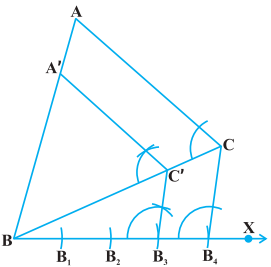
Construct a triangle similar to a given triangle $ABC$ with its sides equal to $\frac{3}{4}$ of the corresponding sides of the triangle $ABC$ (i.e.,of scale factor $\frac{3}{4}$).
Solution
(N/A) Given a triangle $ABC$,we are required to construct another triangle whose sides are $\frac{3}{4}$ of the corresponding sides of the triangle $ABC$.
Steps of Construction:
$1.$ Draw any ray $BX$ making an acute angle with $BC$ on the side opposite to the vertex $A$.
$2.$ Locate $4$ (the greater of $3$ and $4$ in $\frac{3}{4}$) points $B_1, B_2, B_3$ and $B_4$ on $BX$ so that $BB_1 = B_1B_2 = B_2B_3 = B_3B_4$.
$3.$ Join $B_4C$ and draw a line through $B_3$ (the $3rd$ point,$3$ being smaller of $3$ and $4$ in $\frac{3}{4}$) parallel to $B_4C$ to intersect $BC$ at $C'$.
$4.$ Draw a line through $C'$ parallel to the line $CA$ to intersect $BA$ at $A'$.
Then,$\Delta A'BC'$ is the required triangle.
Let us now see how this construction gives the required triangle.
Since $B_3C' \parallel B_4C$,by Basic Proportionality Theorem,$\frac{BC'}{C'C} = \frac{BB_3}{B_3B_4} = \frac{3}{1}$.
Therefore,$\frac{BC}{BC'} = \frac{BC' + C'C}{BC'} = 1 + \frac{C'C}{BC'} = 1 + \frac{1}{3} = \frac{4}{3}$,i.e.,$\frac{BC'}{BC} = \frac{3}{4}$.
Also,$C'A' \parallel CA$. Therefore,$\Delta A'BC' \sim \Delta ABC$.
So,$\frac{A'B}{AB} = \frac{A'C'}{AC} = \frac{BC'}{BC} = \frac{3}{4}$.
Steps of Construction:
$1.$ Draw any ray $BX$ making an acute angle with $BC$ on the side opposite to the vertex $A$.
$2.$ Locate $4$ (the greater of $3$ and $4$ in $\frac{3}{4}$) points $B_1, B_2, B_3$ and $B_4$ on $BX$ so that $BB_1 = B_1B_2 = B_2B_3 = B_3B_4$.
$3.$ Join $B_4C$ and draw a line through $B_3$ (the $3rd$ point,$3$ being smaller of $3$ and $4$ in $\frac{3}{4}$) parallel to $B_4C$ to intersect $BC$ at $C'$.
$4.$ Draw a line through $C'$ parallel to the line $CA$ to intersect $BA$ at $A'$.
Then,$\Delta A'BC'$ is the required triangle.
Let us now see how this construction gives the required triangle.
Since $B_3C' \parallel B_4C$,by Basic Proportionality Theorem,$\frac{BC'}{C'C} = \frac{BB_3}{B_3B_4} = \frac{3}{1}$.
Therefore,$\frac{BC}{BC'} = \frac{BC' + C'C}{BC'} = 1 + \frac{C'C}{BC'} = 1 + \frac{1}{3} = \frac{4}{3}$,i.e.,$\frac{BC'}{BC} = \frac{3}{4}$.
Also,$C'A' \parallel CA$. Therefore,$\Delta A'BC' \sim \Delta ABC$.
So,$\frac{A'B}{AB} = \frac{A'C'}{AC} = \frac{BC'}{BC} = \frac{3}{4}$.
0 likes
View Solution2
Easy
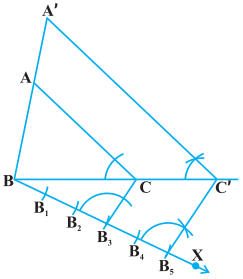
Construct a triangle similar to a given triangle $ABC$ with its sides equal to $\frac{5}{3}$ of the corresponding sides of the triangle $ABC$ (i.e.,of scale factor $\frac{5}{3}$).
Solution
(N/A) Given a triangle $ABC$,we are required to construct a triangle whose sides are $\frac{5}{3}$ of the corresponding sides of $\Delta ABC$.
Steps of Construction:
$1.$ Draw any ray $BX$ making an acute angle with $BC$ on the side opposite to the vertex $A$.
$2.$ Locate $5$ points (the greater of $5$ and $3$ in $\frac{5}{3}$) $B_{1}, B_{2}, B_{3}, B_{4}$ and $B_{5}$ on $BX$ so that $BB_{1} = B_{1}B_{2} = B_{2}B_{3} = B_{3}B_{4} = B_{4}B_{5}$.
$3.$ Join $B_{3}$ (the $3$rd point,$3$ being smaller of $3$ and $5$ in $\frac{5}{3}$) to $C$ and draw a line through $B_{5}$ parallel to $B_{3}C$,intersecting the extended line segment $BC$ at $C^{\prime}$.
$4.$ Draw a line through $C^{\prime}$ parallel to $CA$ intersecting the extended line segment $BA$ at $A^{\prime}$.
Then $\Delta A^{\prime}BC^{\prime}$ is the required triangle.
For justification of the construction,note that $\Delta ABC \sim \Delta A^{\prime}BC^{\prime}$.
Therefore,$\frac{AB}{A^{\prime}B} = \frac{AC}{A^{\prime}C^{\prime}} = \frac{BC}{BC^{\prime}}$.
But,$\frac{BC}{BC^{\prime}} = \frac{BB_{3}}{BB_{5}} = \frac{3}{5}$.
So,$\frac{BC^{\prime}}{BC} = \frac{5}{3}$,and therefore,$\frac{A^{\prime}B}{AB} = \frac{A^{\prime}C^{\prime}}{AC} = \frac{BC^{\prime}}{BC} = \frac{5}{3}$.
Steps of Construction:
$1.$ Draw any ray $BX$ making an acute angle with $BC$ on the side opposite to the vertex $A$.
$2.$ Locate $5$ points (the greater of $5$ and $3$ in $\frac{5}{3}$) $B_{1}, B_{2}, B_{3}, B_{4}$ and $B_{5}$ on $BX$ so that $BB_{1} = B_{1}B_{2} = B_{2}B_{3} = B_{3}B_{4} = B_{4}B_{5}$.
$3.$ Join $B_{3}$ (the $3$rd point,$3$ being smaller of $3$ and $5$ in $\frac{5}{3}$) to $C$ and draw a line through $B_{5}$ parallel to $B_{3}C$,intersecting the extended line segment $BC$ at $C^{\prime}$.
$4.$ Draw a line through $C^{\prime}$ parallel to $CA$ intersecting the extended line segment $BA$ at $A^{\prime}$.
Then $\Delta A^{\prime}BC^{\prime}$ is the required triangle.
For justification of the construction,note that $\Delta ABC \sim \Delta A^{\prime}BC^{\prime}$.
Therefore,$\frac{AB}{A^{\prime}B} = \frac{AC}{A^{\prime}C^{\prime}} = \frac{BC}{BC^{\prime}}$.
But,$\frac{BC}{BC^{\prime}} = \frac{BB_{3}}{BB_{5}} = \frac{3}{5}$.
So,$\frac{BC^{\prime}}{BC} = \frac{5}{3}$,and therefore,$\frac{A^{\prime}B}{AB} = \frac{A^{\prime}C^{\prime}}{AC} = \frac{BC^{\prime}}{BC} = \frac{5}{3}$.
0 likes
View Solution3
Medium
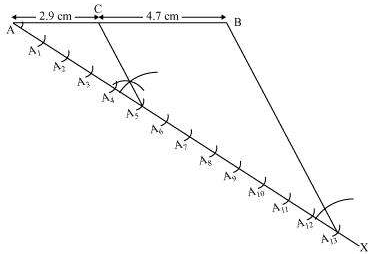
Draw a line segment of length $7.6 \, cm$ and divide it in the ratio $5: 8$. Measure the two parts and give the justification of the construction.
Solution
(N/A) line segment of length $7.6 \, cm$ can be divided in the ratio of $5: 8$ as follows:
$1.$ Draw a line segment $AB$ of $7.6 \, cm$ and draw a ray $AX$ making an acute angle with line segment $AB$.
$2.$ Locate $13 (= 5 + 8)$ points,$A_1, A_2, A_3, \dots, A_{13}$,on $AX$ such that $AA_1 = A_1A_2 = A_2A_3 = \dots = A_{12}A_{13}$.
$3.$ Join $BA_{13}$.
$4.$ Through the point $A_5$,draw a line parallel to $BA_{13}$ (by making an angle equal to $\angle AA_{13}B$) at $A_5$ intersecting $AB$ at point $C$.
$C$ is the point dividing line segment $AB$ of $7.6 \, cm$ in the required ratio of $5: 8$.
The lengths of $AC$ and $CB$ can be measured. They are $2.9 \, cm$ and $4.7 \, cm$ respectively.
Justification:
By construction,we have $A_5C \parallel A_{13}B$. By applying the Basic Proportionality Theorem $(BPT)$ for the triangle $AA_{13}B$,we obtain:
$\frac{AC}{CB} = \frac{AA_5}{A_5A_{13}}$
From the construction,$AA_5$ contains $5$ equal divisions and $A_5A_{13}$ contains $8$ equal divisions.
Therefore,$\frac{AA_5}{A_5A_{13}} = \frac{5}{8}$.
Thus,$\frac{AC}{CB} = \frac{5}{8}$. This justifies the construction.
$1.$ Draw a line segment $AB$ of $7.6 \, cm$ and draw a ray $AX$ making an acute angle with line segment $AB$.
$2.$ Locate $13 (= 5 + 8)$ points,$A_1, A_2, A_3, \dots, A_{13}$,on $AX$ such that $AA_1 = A_1A_2 = A_2A_3 = \dots = A_{12}A_{13}$.
$3.$ Join $BA_{13}$.
$4.$ Through the point $A_5$,draw a line parallel to $BA_{13}$ (by making an angle equal to $\angle AA_{13}B$) at $A_5$ intersecting $AB$ at point $C$.
$C$ is the point dividing line segment $AB$ of $7.6 \, cm$ in the required ratio of $5: 8$.
The lengths of $AC$ and $CB$ can be measured. They are $2.9 \, cm$ and $4.7 \, cm$ respectively.
Justification:
By construction,we have $A_5C \parallel A_{13}B$. By applying the Basic Proportionality Theorem $(BPT)$ for the triangle $AA_{13}B$,we obtain:
$\frac{AC}{CB} = \frac{AA_5}{A_5A_{13}}$
From the construction,$AA_5$ contains $5$ equal divisions and $A_5A_{13}$ contains $8$ equal divisions.
Therefore,$\frac{AA_5}{A_5A_{13}} = \frac{5}{8}$.
Thus,$\frac{AC}{CB} = \frac{5}{8}$. This justifies the construction.
0 likes
View Solution4
Medium
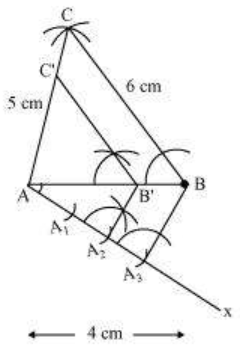
Construct a triangle of sides $4 \, cm$,$5 \, cm$ and $6 \, cm$ and then a triangle similar to it whose sides are $\frac{2}{3}$ of the corresponding sides of the first triangle. Also,give the justification of the construction.
Solution
(N/A) $1.$ Draw a line segment $AB = 4 \, cm$. Taking point $A$ as centre,draw an arc of $5 \, cm$ radius. Similarly,taking point $B$ as its centre,draw an arc of $6 \, cm$ radius. These arcs will intersect each other at point $C$. Now,$AC = 5 \, cm$ and $BC = 6 \, cm$,and $\triangle ABC$ is the required triangle.
$2.$ Draw a ray $AX$ making an acute angle with line $AB$ on the opposite side of vertex $C$.
$3.$ Locate $3$ points $A_1, A_2, A_3$ on line $AX$ such that $AA_1 = A_1A_2 = A_2A_3$.
$4.$ Join $BA_3$ and draw a line through $A_2$ parallel to $BA_3$ to intersect $AB$ at point $B'$.
$5.$ Draw a line through $B'$ parallel to the line $BC$ to intersect $AC$ at $C'$.
$\triangle AB'C'$ is the required triangle.
The construction can be justified by proving that $\frac{AB'}{AB} = \frac{B'C'}{BC} = \frac{AC'}{AC} = \frac{2}{3}$.
By construction,we have $B'C' \parallel BC$.
$\therefore \angle AB'C' = \angle ABC$ (Corresponding angles).
In $\triangle AB'C'$ and $\triangle ABC$,
$\angle AB'C' = \angle ABC$ (Proved above),
$\angle B'AC' = \angle BAC$ (Common angle).
$\triangle AB'C' \sim \triangle ABC$ ($AA$ similarity criterion).
$\Rightarrow \frac{AB'}{AB} = \frac{B'C'}{BC} = \frac{AC'}{AC}$ .......... $(1)$
In $\triangle AA_2B'$ and $\triangle AA_3B$,
$\angle A_2AB' = \angle A_3AB$ (Common angle),
$\angle AA_2B' = \angle AA_3B$ (Corresponding angles).
$\therefore \triangle AA_2B' \sim \triangle AA_3B$ ($AA$ similarity criterion).
$\Rightarrow \frac{AB'}{AB} = \frac{AA_2}{AA_3} = \frac{2}{3}$ ......... $(2)$
From equations $(1)$ and $(2)$,we obtain $\frac{AB'}{AB} = \frac{B'C'}{BC} = \frac{AC'}{AC} = \frac{2}{3}$.
This justifies the construction.
$2.$ Draw a ray $AX$ making an acute angle with line $AB$ on the opposite side of vertex $C$.
$3.$ Locate $3$ points $A_1, A_2, A_3$ on line $AX$ such that $AA_1 = A_1A_2 = A_2A_3$.
$4.$ Join $BA_3$ and draw a line through $A_2$ parallel to $BA_3$ to intersect $AB$ at point $B'$.
$5.$ Draw a line through $B'$ parallel to the line $BC$ to intersect $AC$ at $C'$.
$\triangle AB'C'$ is the required triangle.
The construction can be justified by proving that $\frac{AB'}{AB} = \frac{B'C'}{BC} = \frac{AC'}{AC} = \frac{2}{3}$.
By construction,we have $B'C' \parallel BC$.
$\therefore \angle AB'C' = \angle ABC$ (Corresponding angles).
In $\triangle AB'C'$ and $\triangle ABC$,
$\angle AB'C' = \angle ABC$ (Proved above),
$\angle B'AC' = \angle BAC$ (Common angle).
$\triangle AB'C' \sim \triangle ABC$ ($AA$ similarity criterion).
$\Rightarrow \frac{AB'}{AB} = \frac{B'C'}{BC} = \frac{AC'}{AC}$ .......... $(1)$
In $\triangle AA_2B'$ and $\triangle AA_3B$,
$\angle A_2AB' = \angle A_3AB$ (Common angle),
$\angle AA_2B' = \angle AA_3B$ (Corresponding angles).
$\therefore \triangle AA_2B' \sim \triangle AA_3B$ ($AA$ similarity criterion).
$\Rightarrow \frac{AB'}{AB} = \frac{AA_2}{AA_3} = \frac{2}{3}$ ......... $(2)$
From equations $(1)$ and $(2)$,we obtain $\frac{AB'}{AB} = \frac{B'C'}{BC} = \frac{AC'}{AC} = \frac{2}{3}$.
This justifies the construction.
0 likes
View Solution5
Difficult
Give the justification of the construction also:
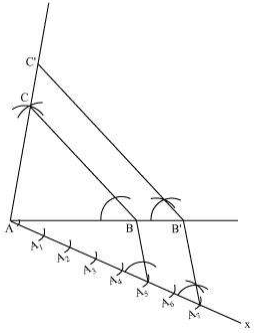
Construct a triangle with sides $5\, cm$,$6\, cm$,and $7\, cm$ and then another triangle whose sides are $\frac{7}{5}$ of the corresponding sides of the first triangle.
Construct a triangle with sides $5\, cm$,$6\, cm$,and $7\, cm$ and then another triangle whose sides are $\frac{7}{5}$ of the corresponding sides of the first triangle.
Solution
(N/A) $1.$ Draw a line segment $AB$ of $5\, cm$. Taking $A$ and $B$ as centers,draw arcs of $6\, cm$ and $7\, cm$ radius respectively. Let these arcs intersect each other at point $C$. $\triangle ABC$ is the required triangle having side lengths of $5\, cm$,$6\, cm$,and $7\, cm$ respectively.
$2.$ Draw a ray $AX$ making an acute angle with line $AB$ on the opposite side of vertex $C$.
$3.$ Locate $7$ points,$A_1, A_2, A_3, A_4, A_5, A_6, A_7$ (as $7$ is greater between $5$ and $7$) on line $AX$ such that $AA_1 = A_1A_2 = A_2A_3 = A_3A_4 = A_4A_5 = A_5A_6 = A_6A_7$.
$4.$ Join $BA_5$ and draw a line through $A_7$ parallel to $BA_5$ to intersect the extended line segment $AB$ at point $B'$.
$5.$ Draw a line through $B'$ parallel to $BC$ intersecting the extended line segment $AC$ at $C'$. $\triangle AB'C'$ is the required triangle.
Justification:
The construction can be justified by proving that $AB' = \frac{7}{5} AB$,$B'C' = \frac{7}{5} BC$,and $AC' = \frac{7}{5} AC$.
In $\triangle ABC$ and $\triangle AB'C'$:
$\angle ABC = \angle AB'C'$ (Corresponding angles)
$\angle BAC = \angle B'AC'$ (Common)
$\triangle ABC \sim \triangle AB'C'$ ($AA$ similarity criterion)
$\Rightarrow \frac{AB}{AB'} = \frac{BC}{B'C'} = \frac{AC}{AC'} = \frac{5}{7}$ (Equation $1$)
In $\triangle AA_5B$ and $\triangle AA_7B'$:
$\angle A_5AB = \angle A_7AB'$ (Common)
$\angle AA_5B = \angle AA_7B'$ (Corresponding angles)
$\triangle AA_5B \sim \triangle AA_7B'$ ($AA$ similarity criterion)
$\Rightarrow \frac{AB}{AB'} = \frac{AA_5}{AA_7} = \frac{5}{7}$ (Equation $2$)
On comparing equations $1$ and $2$,we obtain:
$\frac{AB}{AB'} = \frac{BC}{B'C'} = \frac{AC}{AC'} = \frac{5}{7}$
$\Rightarrow AB' = \frac{7}{5} AB, B'C' = \frac{7}{5} BC, AC' = \frac{7}{5} AC$.
This justifies the construction.
$2.$ Draw a ray $AX$ making an acute angle with line $AB$ on the opposite side of vertex $C$.
$3.$ Locate $7$ points,$A_1, A_2, A_3, A_4, A_5, A_6, A_7$ (as $7$ is greater between $5$ and $7$) on line $AX$ such that $AA_1 = A_1A_2 = A_2A_3 = A_3A_4 = A_4A_5 = A_5A_6 = A_6A_7$.
$4.$ Join $BA_5$ and draw a line through $A_7$ parallel to $BA_5$ to intersect the extended line segment $AB$ at point $B'$.
$5.$ Draw a line through $B'$ parallel to $BC$ intersecting the extended line segment $AC$ at $C'$. $\triangle AB'C'$ is the required triangle.
Justification:
The construction can be justified by proving that $AB' = \frac{7}{5} AB$,$B'C' = \frac{7}{5} BC$,and $AC' = \frac{7}{5} AC$.
In $\triangle ABC$ and $\triangle AB'C'$:
$\angle ABC = \angle AB'C'$ (Corresponding angles)
$\angle BAC = \angle B'AC'$ (Common)
$\triangle ABC \sim \triangle AB'C'$ ($AA$ similarity criterion)
$\Rightarrow \frac{AB}{AB'} = \frac{BC}{B'C'} = \frac{AC}{AC'} = \frac{5}{7}$ (Equation $1$)
In $\triangle AA_5B$ and $\triangle AA_7B'$:
$\angle A_5AB = \angle A_7AB'$ (Common)
$\angle AA_5B = \angle AA_7B'$ (Corresponding angles)
$\triangle AA_5B \sim \triangle AA_7B'$ ($AA$ similarity criterion)
$\Rightarrow \frac{AB}{AB'} = \frac{AA_5}{AA_7} = \frac{5}{7}$ (Equation $2$)
On comparing equations $1$ and $2$,we obtain:
$\frac{AB}{AB'} = \frac{BC}{B'C'} = \frac{AC}{AC'} = \frac{5}{7}$
$\Rightarrow AB' = \frac{7}{5} AB, B'C' = \frac{7}{5} BC, AC' = \frac{7}{5} AC$.
This justifies the construction.
0 likes
View Solution6
Difficult
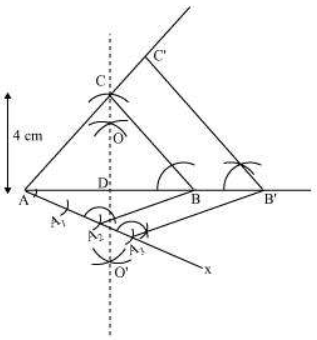
Construct an isosceles triangle whose base is $8\, cm$ and altitude is $4\, cm$. Then,construct another triangle whose sides are $1 \frac{1}{2}$ times the corresponding sides of the isosceles triangle. Also,provide the justification for the construction.
Solution
(N/A) Let us assume that $\triangle ABC$ is an isosceles triangle having $CA = CB$,base $AB = 8\, cm$,and altitude $AD = 4\, cm$ (where $D$ is the midpoint of $AB$).
$A$ $\triangle AB'C'$ whose sides are $\frac{3}{2}$ times those of $\triangle ABC$ can be drawn as follows:
$1.$ Draw a line segment $AB = 8\, cm$. Construct the perpendicular bisector of $AB$ to find the midpoint $D$. Let the perpendicular line be $OO'$.
$2.$ Taking $D$ as the centre,draw an arc of radius $4\, cm$ on the perpendicular line to intersect at point $C$. Join $AC$ and $BC$ to form the isosceles $\triangle ABC$.
$3.$ Draw a ray $AX$ making an acute angle with $AB$ on the side opposite to vertex $C$.
$4.$ Locate $3$ points $A_1, A_2,$ and $A_3$ on $AX$ such that $AA_1 = A_1A_2 = A_2A_3$.
$5.$ Join $BA_2$. Draw a line through $A_3$ parallel to $BA_2$ to intersect the extended line segment $AB$ at $B'$.
$6.$ Draw a line through $B'$ parallel to $BC$ to intersect the extended line segment $AC$ at $C'$. $\triangle AB'C'$ is the required triangle.
Justification:
Since $A_2B \parallel A_3B'$,by Basic Proportionality Theorem in $\triangle AA_3B'$,we have $\frac{AB}{AB'} = \frac{AA_2}{AA_3} = \frac{2}{3}$. Thus,$AB' = \frac{3}{2}AB$.
Since $BC \parallel B'C'$,$\triangle ABC \sim \triangle AB'C'$. Therefore,$\frac{AB}{AB'} = \frac{BC}{B'C'} = \frac{AC}{AC'} = \frac{2}{3}$,which implies $B'C' = \frac{3}{2}BC$ and $AC' = \frac{3}{2}AC$. This justifies the construction.
$A$ $\triangle AB'C'$ whose sides are $\frac{3}{2}$ times those of $\triangle ABC$ can be drawn as follows:
$1.$ Draw a line segment $AB = 8\, cm$. Construct the perpendicular bisector of $AB$ to find the midpoint $D$. Let the perpendicular line be $OO'$.
$2.$ Taking $D$ as the centre,draw an arc of radius $4\, cm$ on the perpendicular line to intersect at point $C$. Join $AC$ and $BC$ to form the isosceles $\triangle ABC$.
$3.$ Draw a ray $AX$ making an acute angle with $AB$ on the side opposite to vertex $C$.
$4.$ Locate $3$ points $A_1, A_2,$ and $A_3$ on $AX$ such that $AA_1 = A_1A_2 = A_2A_3$.
$5.$ Join $BA_2$. Draw a line through $A_3$ parallel to $BA_2$ to intersect the extended line segment $AB$ at $B'$.
$6.$ Draw a line through $B'$ parallel to $BC$ to intersect the extended line segment $AC$ at $C'$. $\triangle AB'C'$ is the required triangle.
Justification:
Since $A_2B \parallel A_3B'$,by Basic Proportionality Theorem in $\triangle AA_3B'$,we have $\frac{AB}{AB'} = \frac{AA_2}{AA_3} = \frac{2}{3}$. Thus,$AB' = \frac{3}{2}AB$.
Since $BC \parallel B'C'$,$\triangle ABC \sim \triangle AB'C'$. Therefore,$\frac{AB}{AB'} = \frac{BC}{B'C'} = \frac{AC}{AC'} = \frac{2}{3}$,which implies $B'C' = \frac{3}{2}BC$ and $AC' = \frac{3}{2}AC$. This justifies the construction.
0 likes
View Solution7
Medium
Give the justification of the construction also:
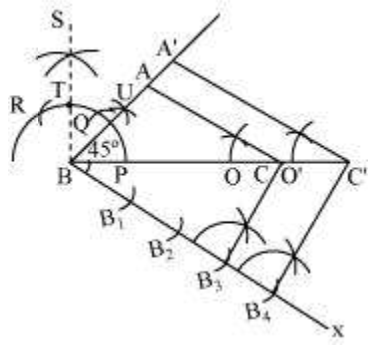
Draw a triangle $ABC$ with side $BC = 7 \, cm$,$\angle B = 45^{\circ}$,$\angle A = 105^{\circ}$. Then,construct a triangle whose sides are $\frac{4}{3}$ times the corresponding sides of $\triangle ABC$.
Draw a triangle $ABC$ with side $BC = 7 \, cm$,$\angle B = 45^{\circ}$,$\angle A = 105^{\circ}$. Then,construct a triangle whose sides are $\frac{4}{3}$ times the corresponding sides of $\triangle ABC$.
Solution
(A) $\angle B = 45^{\circ}, \angle A = 105^{\circ}$
The sum of all interior angles in a triangle is $180^{\circ}$.
$\angle A + \angle B + \angle C = 180^{\circ}$
$105^{\circ} + 45^{\circ} + \angle C = 180^{\circ}$
$\angle C = 180^{\circ} - 150^{\circ} = 30^{\circ}$
The required triangle can be drawn as follows:
$1.$ Draw a $\triangle ABC$ with side $BC = 7 \, cm$,$\angle B = 45^{\circ}$,$\angle C = 30^{\circ}$.
$2.$ Draw a ray $BX$ making an acute angle with $BC$ on the opposite side of vertex $A$.
$3.$ Locate $4$ points $B_1, B_2, B_3, B_4$ on $BX$ such that $BB_1 = B_1B_2 = B_2B_3 = B_3B_4$.
$4.$ Join $B_3C$. Draw a line through $B_4$ parallel to $B_3C$ intersecting the extended $BC$ at $C'$.
$5.$ Through $C'$,draw a line parallel to $AC$ intersecting the extended line segment $BA$ at $A'$. $\triangle A'BC'$ is the required triangle.
Justification:
In $\triangle ABC$ and $\triangle A'BC'$,
$\angle ABC = \angle A'BC'$ (Common)
$\angle ACB = \angle A'C'B$ (Corresponding angles)
$\triangle ABC \sim \triangle A'BC'$ ($AA$ similarity criterion)
$\Rightarrow \frac{AB}{A'B} = \frac{BC}{BC'} = \frac{AC}{A'C'} \dots(1)$
In $\triangle BB_3C$ and $\triangle BB_4C'$,
$\angle B_3BC = \angle B_4BC'$ (Common)
$\angle BB_3C = \angle BB_4C'$ (Corresponding angles)
$\triangle BB_3C \sim \triangle BB_4C'$ ($AA$ similarity criterion)
$\Rightarrow \frac{BC}{BC'} = \frac{BB_3}{BB_4} = \frac{3}{4} \dots(2)$
From $(1)$ and $(2)$,we get $\frac{AB}{A'B} = \frac{BC}{BC'} = \frac{AC}{A'C'} = \frac{3}{4}$.
Thus,$A'B = \frac{4}{3} AB$,$BC' = \frac{4}{3} BC$,and $A'C' = \frac{4}{3} AC$. This justifies the construction.
The sum of all interior angles in a triangle is $180^{\circ}$.
$\angle A + \angle B + \angle C = 180^{\circ}$
$105^{\circ} + 45^{\circ} + \angle C = 180^{\circ}$
$\angle C = 180^{\circ} - 150^{\circ} = 30^{\circ}$
The required triangle can be drawn as follows:
$1.$ Draw a $\triangle ABC$ with side $BC = 7 \, cm$,$\angle B = 45^{\circ}$,$\angle C = 30^{\circ}$.
$2.$ Draw a ray $BX$ making an acute angle with $BC$ on the opposite side of vertex $A$.
$3.$ Locate $4$ points $B_1, B_2, B_3, B_4$ on $BX$ such that $BB_1 = B_1B_2 = B_2B_3 = B_3B_4$.
$4.$ Join $B_3C$. Draw a line through $B_4$ parallel to $B_3C$ intersecting the extended $BC$ at $C'$.
$5.$ Through $C'$,draw a line parallel to $AC$ intersecting the extended line segment $BA$ at $A'$. $\triangle A'BC'$ is the required triangle.
Justification:
In $\triangle ABC$ and $\triangle A'BC'$,
$\angle ABC = \angle A'BC'$ (Common)
$\angle ACB = \angle A'C'B$ (Corresponding angles)
$\triangle ABC \sim \triangle A'BC'$ ($AA$ similarity criterion)
$\Rightarrow \frac{AB}{A'B} = \frac{BC}{BC'} = \frac{AC}{A'C'} \dots(1)$
In $\triangle BB_3C$ and $\triangle BB_4C'$,
$\angle B_3BC = \angle B_4BC'$ (Common)
$\angle BB_3C = \angle BB_4C'$ (Corresponding angles)
$\triangle BB_3C \sim \triangle BB_4C'$ ($AA$ similarity criterion)
$\Rightarrow \frac{BC}{BC'} = \frac{BB_3}{BB_4} = \frac{3}{4} \dots(2)$
From $(1)$ and $(2)$,we get $\frac{AB}{A'B} = \frac{BC}{BC'} = \frac{AC}{A'C'} = \frac{3}{4}$.
Thus,$A'B = \frac{4}{3} AB$,$BC' = \frac{4}{3} BC$,and $A'C' = \frac{4}{3} AC$. This justifies the construction.
0 likes
View Solution8
Medium
Give the justification of the construction also:
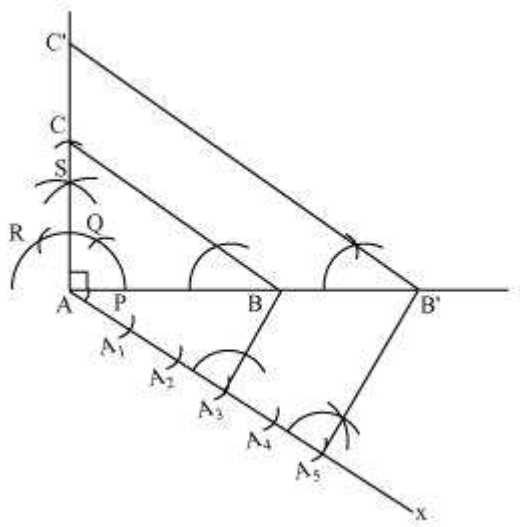
Draw a right triangle in which the sides (other than hypotenuse) are of lengths $4 \,cm$ and $3 \,cm$. Then construct another triangle whose sides are $\frac{5}{3}$ times the corresponding sides of the given triangle.
Draw a right triangle in which the sides (other than hypotenuse) are of lengths $4 \,cm$ and $3 \,cm$. Then construct another triangle whose sides are $\frac{5}{3}$ times the corresponding sides of the given triangle.
Solution
(N/A) It is given that sides other than hypotenuse are of lengths $4 \,cm$ and $3 \,cm$. Clearly,these will be perpendicular to each other.
The required triangle can be drawn as follows:
$1.$ Draw a line segment $AB = 4 \,cm$. Draw a ray $AX$ making $90^{\circ}$ with it at $A$.
$2.$ Draw an arc of $3 \,cm$ radius while taking $A$ as its centre to intersect the ray at $C$. Join $BC$. $\triangle ABC$ is the required triangle.
$3.$ Draw a ray $AY$ making an acute angle with $AB$,opposite to vertex $C$.
$4.$ Locate $5$ points $A_1, A_2, A_3, A_4, A_5$ on $AY$ such that $AA_1 = A_1A_2 = A_2A_3 = A_3A_4 = A_4A_5$.
$5.$ Join $A_3B$. Draw a line through $A_5$ parallel to $A_3B$ intersecting the extended line segment $AB$ at $B'$.
$6.$ Through $B'$,draw a line parallel to $BC$ intersecting the extended line segment $AC$ at $C'$. $\triangle AB'C'$ is the required triangle.
Justification:
The construction can be justified by proving that $AB' = \frac{5}{3} AB, B'C' = \frac{5}{3} BC, AC' = \frac{5}{3} AC$.
In $\triangle ABC$ and $\triangle AB'C'$,
$\angle ABC = \angle AB'C'$ (Corresponding angles)
$\angle BAC = \angle B'AC'$ (Common)
$\therefore \triangle ABC \sim \triangle AB'C'$ ($AA$ similarity criterion)
$\Rightarrow \frac{AB}{AB'} = \frac{BC}{B'C'} = \frac{AC}{AC'}$ .......$(1)$
In $\triangle AA_3B$ and $\triangle AA_5B'$,
$\angle A_3AB = \angle A_5AB'$ (Common)
$\angle AA_3B = \angle AA_5B'$ (Corresponding angles)
$\therefore \triangle AA_3B \sim \triangle AA_5B'$ ($AA$ similarity criterion)
$\Rightarrow \frac{AB}{AB'} = \frac{AA_3}{AA_5} = \frac{3}{5}$ .........$(2)$
On comparing equations $(1)$ and $(2)$,we obtain
$\frac{AB}{AB'} = \frac{BC}{B'C'} = \frac{AC}{AC'} = \frac{3}{5}$
$AB' = \frac{5}{3} AB, B'C' = \frac{5}{3} BC, AC' = \frac{5}{3} AC$
This justifies the construction.
The required triangle can be drawn as follows:
$1.$ Draw a line segment $AB = 4 \,cm$. Draw a ray $AX$ making $90^{\circ}$ with it at $A$.
$2.$ Draw an arc of $3 \,cm$ radius while taking $A$ as its centre to intersect the ray at $C$. Join $BC$. $\triangle ABC$ is the required triangle.
$3.$ Draw a ray $AY$ making an acute angle with $AB$,opposite to vertex $C$.
$4.$ Locate $5$ points $A_1, A_2, A_3, A_4, A_5$ on $AY$ such that $AA_1 = A_1A_2 = A_2A_3 = A_3A_4 = A_4A_5$.
$5.$ Join $A_3B$. Draw a line through $A_5$ parallel to $A_3B$ intersecting the extended line segment $AB$ at $B'$.
$6.$ Through $B'$,draw a line parallel to $BC$ intersecting the extended line segment $AC$ at $C'$. $\triangle AB'C'$ is the required triangle.
Justification:
The construction can be justified by proving that $AB' = \frac{5}{3} AB, B'C' = \frac{5}{3} BC, AC' = \frac{5}{3} AC$.
In $\triangle ABC$ and $\triangle AB'C'$,
$\angle ABC = \angle AB'C'$ (Corresponding angles)
$\angle BAC = \angle B'AC'$ (Common)
$\therefore \triangle ABC \sim \triangle AB'C'$ ($AA$ similarity criterion)
$\Rightarrow \frac{AB}{AB'} = \frac{BC}{B'C'} = \frac{AC}{AC'}$ .......$(1)$
In $\triangle AA_3B$ and $\triangle AA_5B'$,
$\angle A_3AB = \angle A_5AB'$ (Common)
$\angle AA_3B = \angle AA_5B'$ (Corresponding angles)
$\therefore \triangle AA_3B \sim \triangle AA_5B'$ ($AA$ similarity criterion)
$\Rightarrow \frac{AB}{AB'} = \frac{AA_3}{AA_5} = \frac{3}{5}$ .........$(2)$
On comparing equations $(1)$ and $(2)$,we obtain
$\frac{AB}{AB'} = \frac{BC}{B'C'} = \frac{AC}{AC'} = \frac{3}{5}$
$AB' = \frac{5}{3} AB, B'C' = \frac{5}{3} BC, AC' = \frac{5}{3} AC$
This justifies the construction.
0 likes
View Solution9
Medium
Give also the justification of the construction:
Draw a circle of radius $6 \, cm$. From a point $10 \, cm$ away from its centre,construct the pair of tangents to the circle and measure their lengths.
Draw a circle of radius $6 \, cm$. From a point $10 \, cm$ away from its centre,construct the pair of tangents to the circle and measure their lengths.
Solution
(N/A) pair of tangents to the given circle can be constructed as follows:
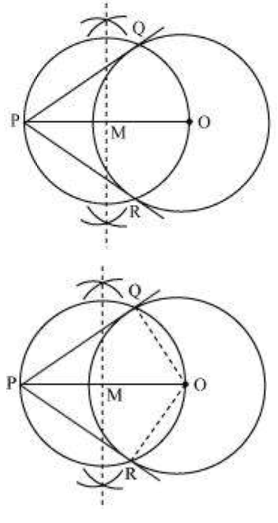
$1.$ Taking any point $O$ of the given plane as centre,draw a circle of $6 \, cm$ radius. Locate a point $P$,$10 \, cm$ away from $O$.
Join $OP$.
$2.$ Bisect $OP$. Let $M$ be the mid-point of $PO$.
$3.$ Taking $M$ as centre and $MO$ as radius,draw a circle.
$4.$ Let this circle intersect the previous circle at points $Q$ and $R$.
$5.$ Join $PQ$ and $PR$. $PQ$ and $PR$ are the required tangents.
The lengths of tangents $PQ$ and $PR$ are $8 \, cm$ each.
Justification:
The construction can be justified by proving that $PQ$ and $PR$ are the tangents to the circle (whose centre is $O$ and radius is $6 \, cm$). For this,join $OQ$ and $OR$.
$\angle PQO$ is an angle in the semi-circle. We know that an angle in a semi-circle is a right angle.
$\therefore \angle PQO = 90^{\circ}$
$\Rightarrow OQ \perp PQ$
Since $OQ$ is the radius of the circle,$PQ$ has to be a tangent to the circle. Similarly,$PR$ is a tangent to the circle.
$1.$ Taking any point $O$ of the given plane as centre,draw a circle of $6 \, cm$ radius. Locate a point $P$,$10 \, cm$ away from $O$.
Join $OP$.
$2.$ Bisect $OP$. Let $M$ be the mid-point of $PO$.
$3.$ Taking $M$ as centre and $MO$ as radius,draw a circle.
$4.$ Let this circle intersect the previous circle at points $Q$ and $R$.
$5.$ Join $PQ$ and $PR$. $PQ$ and $PR$ are the required tangents.
The lengths of tangents $PQ$ and $PR$ are $8 \, cm$ each.
Justification:
The construction can be justified by proving that $PQ$ and $PR$ are the tangents to the circle (whose centre is $O$ and radius is $6 \, cm$). For this,join $OQ$ and $OR$.
$\angle PQO$ is an angle in the semi-circle. We know that an angle in a semi-circle is a right angle.
$\therefore \angle PQO = 90^{\circ}$
$\Rightarrow OQ \perp PQ$
Since $OQ$ is the radius of the circle,$PQ$ has to be a tangent to the circle. Similarly,$PR$ is a tangent to the circle.
0 likes
View Solution10
Difficult
Construct a tangent to a circle of radius $4 \, cm$ from a point on the concentric circle of radius $6 \, cm$ and measure its length. Also,provide the justification for the construction and verify the measurement by actual calculation.
Solution
(N/A) Tangents on the given circle can be drawn as follows:
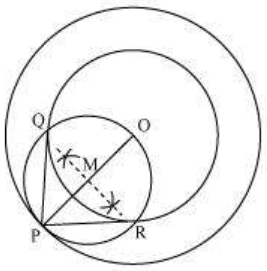
$1.$ Draw a circle of $4 \, cm$ radius with centre as $O$ on the given plane.
$2.$ Draw a circle of $6 \, cm$ radius taking $O$ as its centre. Locate a point $P$ on this circle and join $OP.$
$3.$ Bisect $OP.$ Let $M$ be the mid-point of $PO.$
$4.$ Taking $M$ as its centre and $MO$ as its radius,draw a circle. Let it intersect the given circle at the points $Q$ and $R$.
$5.$ Join $PQ$ and $PR.$ $PQ$ and $PR$ are the required tangents.
It can be observed that $PQ$ and $PR$ are of length $4.47 \, cm$ each.
In $\triangle PQO$:
Since $PQ$ is a tangent,$\angle PQO = 90^{\circ}$.
$PO = 6 \, cm$ (hypotenuse),
$QO = 4 \, cm$ (radius).
Applying the Pythagoras theorem in $\triangle PQO$,we obtain:
$PQ^2 + QO^2 = PO^2$
$PQ^2 + (4)^2 = (6)^2$
$PQ^2 + 16 = 36$
$PQ^2 = 36 - 16$
$PQ^2 = 20$
$PQ = \sqrt{20} = 2\sqrt{5} \approx 4.47 \, cm$.
Justification:
The construction can be justified by proving that $PQ$ and $PR$ are the tangents to the circle (whose centre is $O$ and radius is $4 \, cm$). For this,join $OQ$ and $OR$.
Since $\angle OQP$ is an angle in a semi-circle,$\angle OQP = 90^{\circ}$.
$\Rightarrow OQ \perp PQ$.
Since $OQ$ is the radius of the circle,$PQ$ must be a tangent to the circle. Similarly,$PR$ is a tangent to the circle.
$1.$ Draw a circle of $4 \, cm$ radius with centre as $O$ on the given plane.
$2.$ Draw a circle of $6 \, cm$ radius taking $O$ as its centre. Locate a point $P$ on this circle and join $OP.$
$3.$ Bisect $OP.$ Let $M$ be the mid-point of $PO.$
$4.$ Taking $M$ as its centre and $MO$ as its radius,draw a circle. Let it intersect the given circle at the points $Q$ and $R$.
$5.$ Join $PQ$ and $PR.$ $PQ$ and $PR$ are the required tangents.
It can be observed that $PQ$ and $PR$ are of length $4.47 \, cm$ each.
In $\triangle PQO$:
Since $PQ$ is a tangent,$\angle PQO = 90^{\circ}$.
$PO = 6 \, cm$ (hypotenuse),
$QO = 4 \, cm$ (radius).
Applying the Pythagoras theorem in $\triangle PQO$,we obtain:
$PQ^2 + QO^2 = PO^2$
$PQ^2 + (4)^2 = (6)^2$
$PQ^2 + 16 = 36$
$PQ^2 = 36 - 16$
$PQ^2 = 20$
$PQ = \sqrt{20} = 2\sqrt{5} \approx 4.47 \, cm$.
Justification:
The construction can be justified by proving that $PQ$ and $PR$ are the tangents to the circle (whose centre is $O$ and radius is $4 \, cm$). For this,join $OQ$ and $OR$.
Since $\angle OQP$ is an angle in a semi-circle,$\angle OQP = 90^{\circ}$.
$\Rightarrow OQ \perp PQ$.
Since $OQ$ is the radius of the circle,$PQ$ must be a tangent to the circle. Similarly,$PR$ is a tangent to the circle.
0 likes
View Solution11
Medium
Draw a circle of radius $3 \, cm$. Take two points $P$ and $Q$ on one of its extended diameters,each at a distance of $7 \, cm$ from its centre. Draw tangents to the circle from these two points $P$ and $Q$. Also,provide the justification for the construction.
Solution
(N/A) The tangents can be constructed on the given circle as follows:
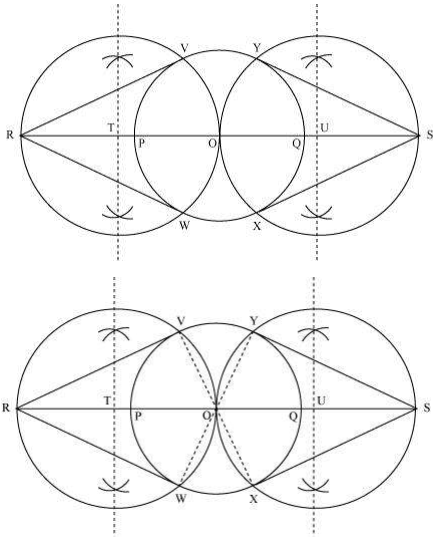
$1.$ Taking any point $O$ on the given plane as the centre,draw a circle of $3 \, cm$ radius.
$2.$ Take one of its diameters and extend it on both sides. Locate two points $P$ and $Q$ on this diameter such that $OP = OQ = 7 \, cm$.
$3.$ Bisect $OP$ and $OQ$. Let $T$ and $U$ be the mid-points of $OP$ and $OQ$ respectively.
$4.$ Taking $T$ and $U$ as centres and $TO$ and $UO$ as radii,draw two circles. These two circles will intersect the original circle at points $V, W$ and $X, Y$ respectively. Join $PV, PW, QX,$ and $QY$. These are the required tangents.
Justification:
The construction can be justified by proving that $PV, PW, QX,$ and $QY$ are the tangents to the circle (whose centre is $O$ and radius is $3 \, cm$). For this,join $OV, OW, OX,$ and $OY$.
$\angle PVO$ is an angle in the semi-circle. We know that an angle in a semi-circle is a right angle.
$\therefore \angle PVO = 90^{\circ}$
$\Rightarrow OV \perp PV$
Since $OV$ is the radius of the circle,$PV$ must be a tangent to the circle.
Similarly,it can be shown that $PW, QX,$ and $QY$ are the tangents to the circle.
$1.$ Taking any point $O$ on the given plane as the centre,draw a circle of $3 \, cm$ radius.
$2.$ Take one of its diameters and extend it on both sides. Locate two points $P$ and $Q$ on this diameter such that $OP = OQ = 7 \, cm$.
$3.$ Bisect $OP$ and $OQ$. Let $T$ and $U$ be the mid-points of $OP$ and $OQ$ respectively.
$4.$ Taking $T$ and $U$ as centres and $TO$ and $UO$ as radii,draw two circles. These two circles will intersect the original circle at points $V, W$ and $X, Y$ respectively. Join $PV, PW, QX,$ and $QY$. These are the required tangents.
Justification:
The construction can be justified by proving that $PV, PW, QX,$ and $QY$ are the tangents to the circle (whose centre is $O$ and radius is $3 \, cm$). For this,join $OV, OW, OX,$ and $OY$.
$\angle PVO$ is an angle in the semi-circle. We know that an angle in a semi-circle is a right angle.
$\therefore \angle PVO = 90^{\circ}$
$\Rightarrow OV \perp PV$
Since $OV$ is the radius of the circle,$PV$ must be a tangent to the circle.
Similarly,it can be shown that $PW, QX,$ and $QY$ are the tangents to the circle.
0 likes
View Solution12
Difficult
Draw a pair of tangents to a circle of radius $5\, cm$ which are inclined to each other at an angle of $60^{\circ}$. Also,provide the justification for the construction.
Solution
(N/A) The tangents can be constructed in the following manner:
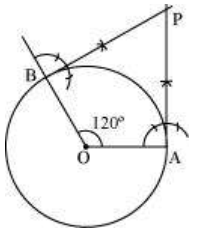
$1.$ Draw a circle of radius $5\, cm$ with center $O$.
$2.$ Take a point $A$ on the circumference of the circle and join $OA$. Draw a perpendicular to $OA$ at point $A$.
$3.$ Draw a radius $OB$ making an angle of $120^{\circ} (180^{\circ} - 60^{\circ})$ with $OA$.
$4.$ Draw a perpendicular to $OB$ at point $B$. Let both the perpendiculars intersect at point $P$. $PA$ and $PB$ are the required tangents inclined at an angle of $60^{\circ}$.
Justification:
The construction can be justified by proving that $\angle APB = 60^{\circ}$.
By our construction:
$\angle OAP = 90^{\circ}$ (Tangent is perpendicular to the radius at the point of contact)
$\angle OBP = 90^{\circ}$ (Tangent is perpendicular to the radius at the point of contact)
And $\angle AOB = 120^{\circ}$
We know that the sum of all interior angles of a quadrilateral is $360^{\circ}$.
In quadrilateral $OAPB$:
$\angle OAP + \angle AOB + \angle OBP + \angle APB = 360^{\circ}$
$90^{\circ} + 120^{\circ} + 90^{\circ} + \angle APB = 360^{\circ}$
$300^{\circ} + \angle APB = 360^{\circ}$
$\angle APB = 360^{\circ} - 300^{\circ} = 60^{\circ}$
This justifies the construction.
$1.$ Draw a circle of radius $5\, cm$ with center $O$.
$2.$ Take a point $A$ on the circumference of the circle and join $OA$. Draw a perpendicular to $OA$ at point $A$.
$3.$ Draw a radius $OB$ making an angle of $120^{\circ} (180^{\circ} - 60^{\circ})$ with $OA$.
$4.$ Draw a perpendicular to $OB$ at point $B$. Let both the perpendiculars intersect at point $P$. $PA$ and $PB$ are the required tangents inclined at an angle of $60^{\circ}$.
Justification:
The construction can be justified by proving that $\angle APB = 60^{\circ}$.
By our construction:
$\angle OAP = 90^{\circ}$ (Tangent is perpendicular to the radius at the point of contact)
$\angle OBP = 90^{\circ}$ (Tangent is perpendicular to the radius at the point of contact)
And $\angle AOB = 120^{\circ}$
We know that the sum of all interior angles of a quadrilateral is $360^{\circ}$.
In quadrilateral $OAPB$:
$\angle OAP + \angle AOB + \angle OBP + \angle APB = 360^{\circ}$
$90^{\circ} + 120^{\circ} + 90^{\circ} + \angle APB = 360^{\circ}$
$300^{\circ} + \angle APB = 360^{\circ}$
$\angle APB = 360^{\circ} - 300^{\circ} = 60^{\circ}$
This justifies the construction.
0 likes
View Solution13
Easy
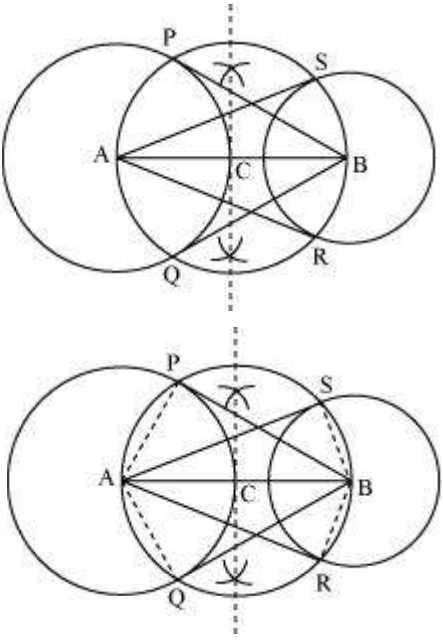
Draw a line segment $AB$ of length $8 \, cm$. Taking $A$ as centre,draw a circle of radius $4 \, cm$ and taking $B$ as centre,draw another circle of radius $3 \, cm$. Construct tangents to each circle from the centre of the other circle. Also,provide the justification for the construction.
Solution
(N/A) The tangents can be constructed on the given circles as follows:
$1.$ Draw a line segment $AB$ of $8 \, cm$. Taking $A$ and $B$ as centres,draw two circles of $4 \, cm$ and $3 \, cm$ radius respectively.
$2.$ Bisect the line $AB$. Let the mid-point of $AB$ be $C$. Taking $C$ as centre,draw a circle of radius $AC$ (or $BC$),which will intersect the circles at points $P, Q, R,$ and $S$. Join $BP, BQ, AS,$ and $AR$. These are the required tangents.
Justification:
The construction can be justified by proving that $AS$ and $AR$ are the tangents to the circle (whose centre is $B$ and radius is $3 \, cm$) and $BP$ and $BQ$ are the tangents to the circle (whose centre is $A$ and radius is $4 \, cm$). For this,join $AP, AQ, BS,$ and $BR$.
$\angle ASB$ is an angle in the semi-circle. We know that an angle in a semi-circle is a right angle.
$\therefore \angle ASB = 90^{\circ}$
$\Rightarrow BS \perp AS$
Since $BS$ is the radius of the circle,$AS$ must be a tangent to the circle. Similarly,$AR, BP,$ and $BQ$ are the tangents.
$1.$ Draw a line segment $AB$ of $8 \, cm$. Taking $A$ and $B$ as centres,draw two circles of $4 \, cm$ and $3 \, cm$ radius respectively.
$2.$ Bisect the line $AB$. Let the mid-point of $AB$ be $C$. Taking $C$ as centre,draw a circle of radius $AC$ (or $BC$),which will intersect the circles at points $P, Q, R,$ and $S$. Join $BP, BQ, AS,$ and $AR$. These are the required tangents.
Justification:
The construction can be justified by proving that $AS$ and $AR$ are the tangents to the circle (whose centre is $B$ and radius is $3 \, cm$) and $BP$ and $BQ$ are the tangents to the circle (whose centre is $A$ and radius is $4 \, cm$). For this,join $AP, AQ, BS,$ and $BR$.
$\angle ASB$ is an angle in the semi-circle. We know that an angle in a semi-circle is a right angle.
$\therefore \angle ASB = 90^{\circ}$
$\Rightarrow BS \perp AS$
Since $BS$ is the radius of the circle,$AS$ must be a tangent to the circle. Similarly,$AR, BP,$ and $BQ$ are the tangents.
0 likes
View Solution14
Difficult
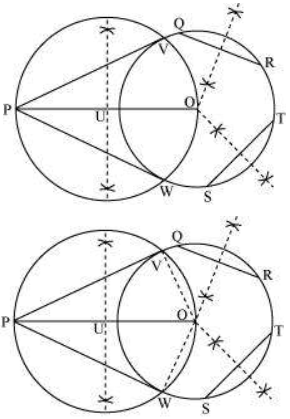
Let $ABC$ be a right triangle in which $AB = 6 \, cm$,$BC = 8 \, cm$ and $\angle B = 90^{\circ}$. $BD$ is the perpendicular from $B$ on $AC$. The circle through $B, C, D$ is drawn. Construct the tangents from $A$ to this circle and provide the justification for the construction.
Solution
(N/A) Construction steps:
$1$. Construct $\triangle ABC$ with $AB = 6 \, cm$,$BC = 8 \, cm$ and $\angle B = 90^{\circ}$.
$2$. Draw $BD \perp AC$. Since $\angle BDC = 90^{\circ}$,the circle passing through $B, C, D$ will have $BC$ as its diameter because $\angle BDC = 90^{\circ}$ subtends a right angle at $D$.
$3$. Let $O$ be the midpoint of $BC$. Draw a circle with center $O$ and radius $OB = OC = 4 \, cm$. This circle passes through $B, C$ and $D$ (since $\angle BDC = 90^{\circ}$).
$4$. To construct tangents from $A$ to this circle,join $AO$. Bisect $AO$ at $M$. Taking $M$ as center and $MA$ as radius,draw a circle. Let this circle intersect the circle with center $O$ at $B$ and $E$. Join $AE$. Thus,$AB$ and $AE$ are the required tangents.
Justification:
Join $OE$. Since $AB$ is a tangent to the circle at $B$,$\angle ABO = 90^{\circ}$. Since $AE$ is a tangent to the circle at $E$,$\angle AEO = 90^{\circ}$. In the circle with center $O$,$OB$ and $OE$ are radii. Since $AB$ and $AE$ are tangents from an external point $A$,$AB = AE$.
$1$. Construct $\triangle ABC$ with $AB = 6 \, cm$,$BC = 8 \, cm$ and $\angle B = 90^{\circ}$.
$2$. Draw $BD \perp AC$. Since $\angle BDC = 90^{\circ}$,the circle passing through $B, C, D$ will have $BC$ as its diameter because $\angle BDC = 90^{\circ}$ subtends a right angle at $D$.
$3$. Let $O$ be the midpoint of $BC$. Draw a circle with center $O$ and radius $OB = OC = 4 \, cm$. This circle passes through $B, C$ and $D$ (since $\angle BDC = 90^{\circ}$).
$4$. To construct tangents from $A$ to this circle,join $AO$. Bisect $AO$ at $M$. Taking $M$ as center and $MA$ as radius,draw a circle. Let this circle intersect the circle with center $O$ at $B$ and $E$. Join $AE$. Thus,$AB$ and $AE$ are the required tangents.
Justification:
Join $OE$. Since $AB$ is a tangent to the circle at $B$,$\angle ABO = 90^{\circ}$. Since $AE$ is a tangent to the circle at $E$,$\angle AEO = 90^{\circ}$. In the circle with center $O$,$OB$ and $OE$ are radii. Since $AB$ and $AE$ are tangents from an external point $A$,$AB = AE$.
0 likes
View Solution15
Medium
Give also the justification of the construction:
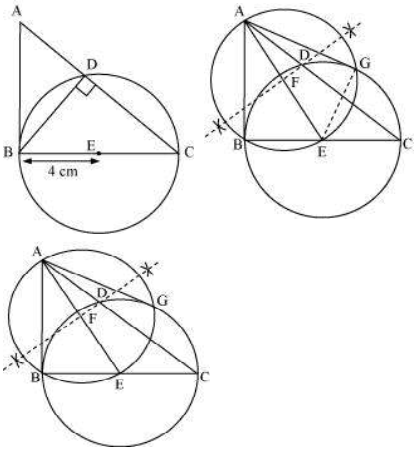
Draw a circle with the help of a bangle. Take a point outside the circle. Construct the pair of tangents from this point to the circle.
Draw a circle with the help of a bangle. Take a point outside the circle. Construct the pair of tangents from this point to the circle.
Solution
(N/A) To construct tangents to a circle drawn with a bangle (where the centre is unknown):
$1$. Draw two non-parallel chords $BC$ and $CD$.
$2$. Draw the perpendicular bisectors of $BC$ and $CD$. The point where these bisectors intersect is the centre $E$ of the circle.
$3$. Take a point $A$ outside the circle. Join $AE$.
$4$. Bisect $AE$ at point $F$. With $F$ as the centre and $FA$ as the radius,draw a circle.
$5$. Let this circle intersect the original circle at points $B$ and $G$. Join $AB$ and $AG$.
$AB$ and $AG$ are the required tangents.
Justification:
Join $EB$ and $EG$. $\angle ABE$ is an angle in a semi-circle,so $\angle ABE = 90^{\circ}$. Since $EB$ is a radius,$AB$ must be a tangent. Similarly,$\angle AGE = 90^{\circ}$,so $AG$ is a tangent.
$1$. Draw two non-parallel chords $BC$ and $CD$.
$2$. Draw the perpendicular bisectors of $BC$ and $CD$. The point where these bisectors intersect is the centre $E$ of the circle.
$3$. Take a point $A$ outside the circle. Join $AE$.
$4$. Bisect $AE$ at point $F$. With $F$ as the centre and $FA$ as the radius,draw a circle.
$5$. Let this circle intersect the original circle at points $B$ and $G$. Join $AB$ and $AG$.
$AB$ and $AG$ are the required tangents.
Justification:
Join $EB$ and $EG$. $\angle ABE$ is an angle in a semi-circle,so $\angle ABE = 90^{\circ}$. Since $EB$ is a radius,$AB$ must be a tangent. Similarly,$\angle AGE = 90^{\circ}$,so $AG$ is a tangent.
0 likes
View Solution16
Difficult
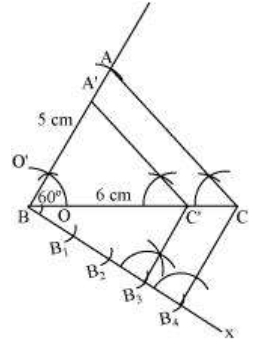
Draw a triangle $ABC$ with side $BC = 6 \, cm$,$AB = 5 \, cm$ and $\angle ABC = 60^{\circ}$. Then construct a triangle whose sides are $\frac{3}{4}$ of the corresponding sides of the triangle $ABC$.
Solution
(N/A) $\triangle A'BC'$ whose sides are $\frac{3}{4}$ of the corresponding sides of $\triangle ABC$ can be drawn as follows:
$1.$ Draw a $\triangle ABC$ with side $BC = 6 \, cm$,$AB = 5 \, cm$ and $\angle ABC = 60^{\circ}$.
$2.$ Draw a ray $BX$ making an acute angle with $BC$ on the opposite side of vertex $A$.
$3.$ Locate $4$ points (as $4$ is the greater number in $\frac{3}{4}$),$B_1, B_2, B_3, B_4$,on line segment $BX$ such that $BB_1 = B_1B_2 = B_2B_3 = B_3B_4$.
$4.$ Join $B_4C$ and draw a line through $B_3$ parallel to $B_4C$ intersecting $BC$ at $C'$.
$5.$ Draw a line through $C'$ parallel to $AC$ intersecting $AB$ at $A'$. $\triangle A'BC'$ is the required triangle.
Justification:
The construction can be justified by proving $A'B = \frac{3}{4} AB$,$BC' = \frac{3}{4} BC$,$A'C' = \frac{3}{4} AC$.
In $\triangle A'BC'$ and $\triangle ABC$:
$\angle A'C'B = \angle ACB$ (Corresponding angles)
$\angle A'BC' = \angle ABC$ (Common)
$\therefore \triangle A'BC' \sim \triangle ABC$ ($AA$ similarity criterion)
$\Rightarrow \frac{A'B}{AB} = \frac{BC'}{BC} = \frac{A'C'}{AC}$ ........$(1)$
In $\triangle BB_3C'$ and $\triangle BB_4C$:
$\angle B_3BC' = \angle B_4BC$ (Common)
$\angle BB_3C' = \angle BB_4C$ (Corresponding angles)
$\therefore \triangle BB_3C' \sim \triangle BB_4C$ ($AA$ similarity criterion)
$\Rightarrow \frac{BC'}{BC} = \frac{BB_3}{BB_4} = \frac{3}{4}$ ........$(2)$
From equations $(1)$ and $(2)$,we obtain:
$\frac{A'B}{AB} = \frac{BC'}{BC} = \frac{A'C'}{AC} = \frac{3}{4}$
$A'B = \frac{3}{4} AB, BC' = \frac{3}{4} BC, A'C' = \frac{3}{4} AC$.
This justifies the construction.
$1.$ Draw a $\triangle ABC$ with side $BC = 6 \, cm$,$AB = 5 \, cm$ and $\angle ABC = 60^{\circ}$.
$2.$ Draw a ray $BX$ making an acute angle with $BC$ on the opposite side of vertex $A$.
$3.$ Locate $4$ points (as $4$ is the greater number in $\frac{3}{4}$),$B_1, B_2, B_3, B_4$,on line segment $BX$ such that $BB_1 = B_1B_2 = B_2B_3 = B_3B_4$.
$4.$ Join $B_4C$ and draw a line through $B_3$ parallel to $B_4C$ intersecting $BC$ at $C'$.
$5.$ Draw a line through $C'$ parallel to $AC$ intersecting $AB$ at $A'$. $\triangle A'BC'$ is the required triangle.
Justification:
The construction can be justified by proving $A'B = \frac{3}{4} AB$,$BC' = \frac{3}{4} BC$,$A'C' = \frac{3}{4} AC$.
In $\triangle A'BC'$ and $\triangle ABC$:
$\angle A'C'B = \angle ACB$ (Corresponding angles)
$\angle A'BC' = \angle ABC$ (Common)
$\therefore \triangle A'BC' \sim \triangle ABC$ ($AA$ similarity criterion)
$\Rightarrow \frac{A'B}{AB} = \frac{BC'}{BC} = \frac{A'C'}{AC}$ ........$(1)$
In $\triangle BB_3C'$ and $\triangle BB_4C$:
$\angle B_3BC' = \angle B_4BC$ (Common)
$\angle BB_3C' = \angle BB_4C$ (Corresponding angles)
$\therefore \triangle BB_3C' \sim \triangle BB_4C$ ($AA$ similarity criterion)
$\Rightarrow \frac{BC'}{BC} = \frac{BB_3}{BB_4} = \frac{3}{4}$ ........$(2)$
From equations $(1)$ and $(2)$,we obtain:
$\frac{A'B}{AB} = \frac{BC'}{BC} = \frac{A'C'}{AC} = \frac{3}{4}$
$A'B = \frac{3}{4} AB, BC' = \frac{3}{4} BC, A'C' = \frac{3}{4} AC$.
This justifies the construction.
0 likes
View SolutionConstructions — Textbook - Constructions · Frequently Asked Questions
1Are these Constructions questions useful for JEE and NEET?
Yes. All questions in this section are mapped to JEE Main and NEET exam patterns. Previous year questions from JEE Main, NEET, GUJCET and state-level exams are included with full solutions.
2Can I switch to Hindi or Gujarati for these questions?
Yes. Use the language tabs in the hero section or the sidebar to view the same questions and solutions in English, Hindi or Gujarati.
3How do I generate a question paper from this subtopic?
Use the Vedclass Exam Paper Generator — select the chapter and subtopic, set difficulty, and generate Sets A, B, C, D automatically. First 3 chapters of every subject are free.
Vedclass Products
For Students
Vedclass Test Series
Mock tests in real JEE/NEET style with performance analysis. 5-day free trial.
Start Free TrialFor Teachers
Exam Paper Generator
Generate Set A/B/C/D papers from this chapter in 2 minutes. 3 chapters free.
Try FreeFor Institutes
Online Exam Module
Live online exams with unlimited students, 360° analytics & white-label branding.
See DemoFor Teachers & Institutes
Generate a Constructions Exam Paper in 2 Minutes
Select subtopic & difficulty — Sets A, B, C, D auto-generated with No Repeat logic.
First 3 chapters of every subject are free — no payment required.