
A English
Mix Examples - Circles Questions in English
Class 10 Mathematics · Circles · Mix Examples - Circles
138+
Questions
English
Language
100%
With Solutions
Showing 38 of 138 questions in English
101
EasyMCQ
$A$ tangent to a circle forms an angle of measure $\ldots \ldots \ldots \ldots$ with the radius drawn at the point of contact. (in $^{\circ}$)
A
$30$
B
$60$
C
$45$
D
$90$
Solution
(D) According to the theorem of circles,the tangent at any point of a circle is perpendicular to the radius through the point of contact.
Therefore,the angle formed between the tangent and the radius at the point of contact is $90^{\circ}$.
Therefore,the angle formed between the tangent and the radius at the point of contact is $90^{\circ}$.
0 likes
View Solution102
EasyMCQ
$\overline{ PA }$ and $\overline{ PB }$ are tangents to the $\odot( O , r)$ drawn from a point $P$ outside the circle,then ..... .
A
$PA > PB$
B
$PA < PB$
C
$PA = PB$
D
$PA = PB = r$
Solution
(C) According to the theorem of tangents drawn from an external point to a circle,the lengths of tangents drawn from an external point to a circle are equal.
Since $P$ is an external point and $\overline{ PA }$ and $\overline{ PB }$ are tangents to the circle $\odot( O , r)$,it follows that $PA = PB$.
Since $P$ is an external point and $\overline{ PA }$ and $\overline{ PB }$ are tangents to the circle $\odot( O , r)$,it follows that $PA = PB$.
0 likes
View Solution103
EasyMCQ
$AB$ is a diameter of a circle. $l_{1}$ and $l_{2}$ are tangents to the circle drawn at points $A$ and $B$ respectively. Then,which of the following is true?
A
$l_{1} \parallel l_{2}$
B
$l_{1} \perp l_{2}$
C
$l_{1} = l_{2}$
D
$l_{1} < l_{2}$
Solution
(A) Let $O$ be the center of the circle. Since $AB$ is the diameter,$OA$ and $OB$ are radii of the circle.
By the property of tangents,a tangent at any point of a circle is perpendicular to the radius through the point of contact.
Therefore,$l_{1} \perp OA$ and $l_{2} \perp OB$.
Since $A, O,$ and $B$ are collinear (as $AB$ is a diameter),the lines $OA$ and $OB$ form a single straight line $AB$.
If two lines ($l_{1}$ and $l_{2}$) are perpendicular to the same line $(AB)$,then they must be parallel to each other.
Thus,$l_{1} \parallel l_{2}$.
By the property of tangents,a tangent at any point of a circle is perpendicular to the radius through the point of contact.
Therefore,$l_{1} \perp OA$ and $l_{2} \perp OB$.
Since $A, O,$ and $B$ are collinear (as $AB$ is a diameter),the lines $OA$ and $OB$ form a single straight line $AB$.
If two lines ($l_{1}$ and $l_{2}$) are perpendicular to the same line $(AB)$,then they must be parallel to each other.
Thus,$l_{1} \parallel l_{2}$.
0 likes
View Solution104
MediumMCQ
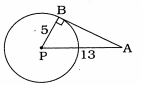
$A$ tangent line drawn from a point $A$ outside $\odot(P, 5)$ touches the circle at $B.$ If $PA = 13$,then $AB = \dots$
A
$10$
B
$7.5$
C
$12$
D
$20$
Solution
(C) The radius of the circle is $PB = 5$. The tangent at any point of a circle is perpendicular to the radius through the point of contact. Therefore,$\angle PBA = 90^\circ$.
In the right-angled triangle $\triangle PBA$,by the Pythagoras theorem:
$PA^2 = PB^2 + AB^2$
$13^2 = 5^2 + AB^2$
$169 = 25 + AB^2$
$AB^2 = 169 - 25 = 144$
$AB = \sqrt{144} = 12$.
In the right-angled triangle $\triangle PBA$,by the Pythagoras theorem:
$PA^2 = PB^2 + AB^2$
$13^2 = 5^2 + AB^2$
$169 = 25 + AB^2$
$AB^2 = 169 - 25 = 144$
$AB = \sqrt{144} = 12$.
0 likes
View Solution105
MediumMCQ
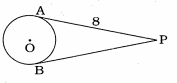
The tangents drawn from a point $P$ outside $\odot(O, 5)$ touch the circle at $A$ and $B$. If $PA = 8$,then $PB = \ldots$
A
$4$
B
$8$
C
$12$
D
$16$
Solution
(B) According to the theorem,the lengths of tangents drawn from an external point to a circle are equal.
Therefore,$PA = PB$.
Given that $PA = 8$,it follows that $PB = 8$.
Therefore,$PA = PB$.
Given that $PA = 8$,it follows that $PB = 8$.
0 likes
View Solution106
MediumMCQ
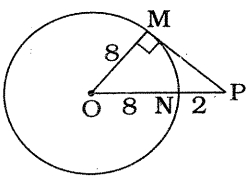
$A$ tangent $\overline{PM}$ is drawn from a point $P$ outside $\odot(O, 8)$. $\overline{OP}$ intersects the circle at $N$. If $NP = 2$,then $PM = \ldots$
A
$2$
B
$8$
C
$6$
D
$10$
Solution
(C) Given that the radius of the circle $OM = 8$ and $NP = 2$.
Since $ON$ is the radius,$ON = 8$.
Therefore,the distance $OP = ON + NP = 8 + 2 = 10$.
In the right-angled triangle $\Delta OMP$,the angle $\angle OMP = 90^{\circ}$ because the tangent is perpendicular to the radius at the point of contact.
Using the Pythagorean theorem: $OP^2 = OM^2 + PM^2$.
$10^2 = 8^2 + PM^2$.
$100 = 64 + PM^2$.
$PM^2 = 100 - 64 = 36$.
$PM = \sqrt{36} = 6$.
Since $ON$ is the radius,$ON = 8$.
Therefore,the distance $OP = ON + NP = 8 + 2 = 10$.
In the right-angled triangle $\Delta OMP$,the angle $\angle OMP = 90^{\circ}$ because the tangent is perpendicular to the radius at the point of contact.
Using the Pythagorean theorem: $OP^2 = OM^2 + PM^2$.
$10^2 = 8^2 + PM^2$.
$100 = 64 + PM^2$.
$PM^2 = 100 - 64 = 36$.
$PM = \sqrt{36} = 6$.
0 likes
View Solution107
MediumMCQ
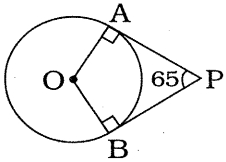
$\overline{ PA }$ and $\overline{ PB }$ are the tangents to $\odot( O , r)$ drawn from a point $P$ outside a circle. If $m \angle APB = 65^{\circ}$,then $m \angle AOB = \ldots \ldots \ldots . .$ (in $^{\circ}$)
A
$65$
B
$35$
C
$70$
D
$115$
Solution
(D) In the quadrilateral $OAPB$,the radius is perpendicular to the tangent at the point of contact.
Therefore,$\angle OAP = 90^{\circ}$ and $\angle OBP = 90^{\circ}$.
The sum of the angles in a quadrilateral is $360^{\circ}$.
Thus,$\angle AOB + \angle OAP + \angle APB + \angle OBP = 360^{\circ}$.
Substituting the known values: $\angle AOB + 90^{\circ} + 65^{\circ} + 90^{\circ} = 360^{\circ}$.
$\angle AOB + 245^{\circ} = 360^{\circ}$.
$\angle AOB = 360^{\circ} - 245^{\circ} = 115^{\circ}$.
Therefore,$\angle OAP = 90^{\circ}$ and $\angle OBP = 90^{\circ}$.
The sum of the angles in a quadrilateral is $360^{\circ}$.
Thus,$\angle AOB + \angle OAP + \angle APB + \angle OBP = 360^{\circ}$.
Substituting the known values: $\angle AOB + 90^{\circ} + 65^{\circ} + 90^{\circ} = 360^{\circ}$.
$\angle AOB + 245^{\circ} = 360^{\circ}$.
$\angle AOB = 360^{\circ} - 245^{\circ} = 115^{\circ}$.
0 likes
View Solution108
MediumMCQ
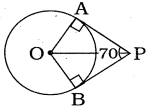
$\overline{PA}$ and $\overline{PB}$ are the tangents to $\odot(O, r)$ drawn from a point $P$ outside a circle. If $m \angle APB = 70^\circ$,then $m \angle POB = \dots$ (in $^\circ$)
A
$35$
B
$70$
C
$20$
D
$55$
Solution
(D) The line segment $OP$ bisects the angle $\angle APB$.
Therefore,$m \angle OPB = \frac{1}{2} m \angle APB = \frac{1}{2} (70^\circ) = 35^\circ$.
Since $PB$ is a tangent to the circle at point $B$,the radius $OB$ is perpendicular to the tangent $PB$.
Thus,$m \angle OBP = 90^\circ$.
In the right-angled triangle $\Delta OBP$,the sum of the angles is $180^\circ$.
$m \angle POB + m \angle OBP + m \angle OPB = 180^\circ$.
$m \angle POB + 90^\circ + 35^\circ = 180^\circ$.
$m \angle POB + 125^\circ = 180^\circ$.
$m \angle POB = 180^\circ - 125^\circ = 55^\circ$.
Therefore,$m \angle OPB = \frac{1}{2} m \angle APB = \frac{1}{2} (70^\circ) = 35^\circ$.
Since $PB$ is a tangent to the circle at point $B$,the radius $OB$ is perpendicular to the tangent $PB$.
Thus,$m \angle OBP = 90^\circ$.
In the right-angled triangle $\Delta OBP$,the sum of the angles is $180^\circ$.
$m \angle POB + m \angle OBP + m \angle OPB = 180^\circ$.
$m \angle POB + 90^\circ + 35^\circ = 180^\circ$.
$m \angle POB + 125^\circ = 180^\circ$.
$m \angle POB = 180^\circ - 125^\circ = 55^\circ$.
0 likes
View Solution109
MediumMCQ
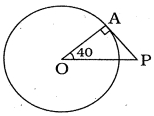
$\overline{PA}$ is a tangent to $\odot(O, r)$ drawn from a point $P$ outside a circle. If $m\angle AOP = 40^\circ$,then $m\angle OPA = \ldots$ (in $^\circ$)
A
$20$
B
$50$
C
$90$
D
$45$
Solution
(B) In $\Delta OAP$,the radius $OA$ is perpendicular to the tangent $PA$ at the point of contact $A$.
Therefore,$m\angle OAP = 90^\circ$.
In $\Delta OAP$,the sum of the angles is $180^\circ$.
$m\angle OAP + m\angle AOP + m\angle OPA = 180^\circ$
$90^\circ + 40^\circ + m\angle OPA = 180^\circ$
$130^\circ + m\angle OPA = 180^\circ$
$m\angle OPA = 180^\circ - 130^\circ = 50^\circ$
Therefore,$m\angle OAP = 90^\circ$.
In $\Delta OAP$,the sum of the angles is $180^\circ$.
$m\angle OAP + m\angle AOP + m\angle OPA = 180^\circ$
$90^\circ + 40^\circ + m\angle OPA = 180^\circ$
$130^\circ + m\angle OPA = 180^\circ$
$m\angle OPA = 180^\circ - 130^\circ = 50^\circ$
0 likes
View Solution110
MediumMCQ
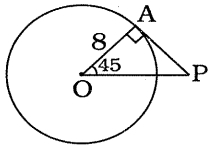
$\overline{PA}$ is a tangent to $\odot(O, 8)$ drawn from a point $P$ outside the circle. If $m\angle AOP = 45^\circ$,then $AP = \ldots$
A
$3$
B
$9$
C
$6$
D
$8$
Solution
(D) In $\Delta OAP$,the radius $OA$ is perpendicular to the tangent $PA$ at the point of contact $A$. Therefore,$m\angle OAP = 90^\circ$.
Given $m\angle AOP = 45^\circ$.
In $\Delta OAP$,the sum of angles is $180^\circ$.
$m\angle OPA = 180^\circ - (90^\circ + 45^\circ) = 180^\circ - 135^\circ = 45^\circ$.
Since $m\angle AOP = m\angle OPA = 45^\circ$,$\Delta OAP$ is an isosceles triangle.
Therefore,the sides opposite to equal angles are equal: $AP = OA$.
Since $OA$ is the radius of the circle,$OA = 8$.
Thus,$AP = 8$.
Given $m\angle AOP = 45^\circ$.
In $\Delta OAP$,the sum of angles is $180^\circ$.
$m\angle OPA = 180^\circ - (90^\circ + 45^\circ) = 180^\circ - 135^\circ = 45^\circ$.
Since $m\angle AOP = m\angle OPA = 45^\circ$,$\Delta OAP$ is an isosceles triangle.
Therefore,the sides opposite to equal angles are equal: $AP = OA$.
Since $OA$ is the radius of the circle,$OA = 8$.
Thus,$AP = 8$.
0 likes
View Solution111
MediumMCQ
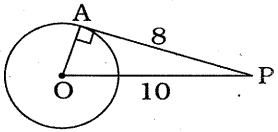
$\overline{PA}$ is a tangent to $\odot(O, r)$ drawn from a point $P$ outside a circle. If $OP = 10$ and $AP = 8$,then the diameter of the circle is equal to $\ldots \ldots \ldots \ldots .$
A
$18$
B
$6$
C
$12$
D
$9$
Solution
(C) Since the tangent at any point of a circle is perpendicular to the radius through the point of contact,$\angle OAP = 90^{\circ}$.
In right-angled triangle $\triangle OAP$,by Pythagoras theorem:
$OP^{2} = OA^{2} + AP^{2}$
Given $OP = 10$ and $AP = 8$,we have:
$10^{2} = OA^{2} + 8^{2}$
$100 = OA^{2} + 64$
$OA^{2} = 100 - 64 = 36$
$OA = \sqrt{36} = 6$
Here,$OA$ is the radius $(r)$ of the circle.
Diameter of the circle $= 2 \times \text{radius} = 2 \times 6 = 12$.
In right-angled triangle $\triangle OAP$,by Pythagoras theorem:
$OP^{2} = OA^{2} + AP^{2}$
Given $OP = 10$ and $AP = 8$,we have:
$10^{2} = OA^{2} + 8^{2}$
$100 = OA^{2} + 64$
$OA^{2} = 100 - 64 = 36$
$OA = \sqrt{36} = 6$
Here,$OA$ is the radius $(r)$ of the circle.
Diameter of the circle $= 2 \times \text{radius} = 2 \times 6 = 12$.
0 likes
View Solution112
MediumMCQ
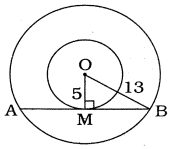
Two concentric circles having radii $5$ and $13$ are given. The chord of the circle with larger radius touches the circle with smaller radius. Then the length of the chord is $\ldots \ldots \ldots \ldots.$
A
$6$
B
$12$
C
$24$
D
$18$
Solution
(C) Let $O$ be the common center of the two concentric circles.
Let $AB$ be the chord of the larger circle which touches the smaller circle at point $M$.
$OM$ is the radius of the smaller circle,so $OM = 5$.
$OB$ is the radius of the larger circle,so $OB = 13$.
Since the radius is perpendicular to the tangent at the point of contact,$\angle OMB = 90^{\circ}$.
In right-angled $\Delta OMB$,by Pythagoras theorem:
$OB^2 = OM^2 + MB^2$
$13^2 = 5^2 + MB^2$
$169 = 25 + MB^2$
$MB^2 = 169 - 25 = 144$
$MB = \sqrt{144} = 12$.
The perpendicular from the center to a chord bisects the chord.
Therefore,$AB = 2 \times MB = 2 \times 12 = 24$.
Let $AB$ be the chord of the larger circle which touches the smaller circle at point $M$.
$OM$ is the radius of the smaller circle,so $OM = 5$.
$OB$ is the radius of the larger circle,so $OB = 13$.
Since the radius is perpendicular to the tangent at the point of contact,$\angle OMB = 90^{\circ}$.
In right-angled $\Delta OMB$,by Pythagoras theorem:
$OB^2 = OM^2 + MB^2$
$13^2 = 5^2 + MB^2$
$169 = 25 + MB^2$
$MB^2 = 169 - 25 = 144$
$MB = \sqrt{144} = 12$.
The perpendicular from the center to a chord bisects the chord.
Therefore,$AB = 2 \times MB = 2 \times 12 = 24$.
0 likes
View Solution113
DifficultMCQ
For $\Delta ABC$,$a=5$,$b=12$ and $c=13$. The radius of a circle touching all the three sides of $\Delta ABC$ is ..... .
A
$5.5$
B
$6.5$
C
$6$
D
$2$
Solution
(D) The sides of $\Delta ABC$ are $a=5$,$b=12$,and $c=13$.
Since $5^2 + 12^2 = 25 + 144 = 169 = 13^2$,$\Delta ABC$ is a right-angled triangle where the hypotenuse is $13$.
The radius $r$ of the incircle of a right-angled triangle is given by the formula $r = \frac{a+b-c}{2}$,where $a$ and $b$ are the legs and $c$ is the hypotenuse.
Substituting the values: $r = \frac{5+12-13}{2} = \frac{17-13}{2} = \frac{4}{2} = 2$.
Thus,the radius of the circle touching all three sides is $2$.
Since $5^2 + 12^2 = 25 + 144 = 169 = 13^2$,$\Delta ABC$ is a right-angled triangle where the hypotenuse is $13$.
The radius $r$ of the incircle of a right-angled triangle is given by the formula $r = \frac{a+b-c}{2}$,where $a$ and $b$ are the legs and $c$ is the hypotenuse.
Substituting the values: $r = \frac{5+12-13}{2} = \frac{17-13}{2} = \frac{4}{2} = 2$.
Thus,the radius of the circle touching all three sides is $2$.
0 likes
View Solution114
DifficultMCQ
In $\Delta PQR$,$\angle Q$ is a right angle. If $PQ = 8$ and $QR = 15$,then the radius of a circle touching all the three sides of $\Delta PQR$ is $\ldots \ldots.$
A
$7$
B
$10$
C
$17$
D
$3$
Solution
(D) In $\Delta PQR$,$\angle Q = 90^{\circ}$.
Therefore,$\overline{PR}$ is the hypotenuse.
By Pythagoras theorem,$PR^2 = PQ^2 + QR^2$.
$PR^2 = 8^2 + 15^2 = 64 + 225 = 289$.
$PR = \sqrt{289} = 17$.
The radius $(r)$ of the incircle of a right-angled triangle is given by the formula $r = \frac{PQ + QR - PR}{2}$.
$r = \frac{8 + 15 - 17}{2} = \frac{23 - 17}{2} = \frac{6}{2} = 3$.
Therefore,$\overline{PR}$ is the hypotenuse.
By Pythagoras theorem,$PR^2 = PQ^2 + QR^2$.
$PR^2 = 8^2 + 15^2 = 64 + 225 = 289$.
$PR = \sqrt{289} = 17$.
The radius $(r)$ of the incircle of a right-angled triangle is given by the formula $r = \frac{PQ + QR - PR}{2}$.
$r = \frac{8 + 15 - 17}{2} = \frac{23 - 17}{2} = \frac{6}{2} = 3$.
0 likes
View Solution115
EasyMCQ
If $P$ is a point in the exterior of the circle,then maximum $\ldots \ldots \ldots \ldots$ tangents can be drawn to a circle from $P.$
A
one
B
two
C
four
D
infinite
Solution
(B) tangent to a circle is a line that intersects the circle at exactly one point.
From any point $P$ lying in the exterior of a circle,exactly two tangents can be drawn to the circle.
These two tangents touch the circle at two distinct points.
Therefore,the maximum number of tangents that can be drawn from an external point to a circle is $2$.
From any point $P$ lying in the exterior of a circle,exactly two tangents can be drawn to the circle.
These two tangents touch the circle at two distinct points.
Therefore,the maximum number of tangents that can be drawn from an external point to a circle is $2$.
0 likes
View Solution116
DifficultMCQ
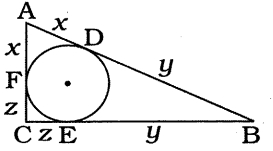
$A$ circle touches the sides $\overline{AB}$,$\overline{BC}$,and $\overline{CA}$ of $\Delta ABC$ at the points $D, E, F$ respectively. If $AB=13$,$BC=12$,and $CA=5$,then $AD = \ldots$
A
$2$
B
$5$
C
$3$
D
$10$
Solution
(C) Let the lengths of the tangents from vertices $A, B, C$ to the circle be $x, y, z$ respectively.
Since tangents drawn from an external point to a circle are equal in length,we have:
$AD = AF = x$
$BD = BE = y$
$CE = CF = z$
Given the side lengths of $\Delta ABC$:
$AB = x + y = 13$
$BC = y + z = 12$
$CA = z + x = 5$
Adding these three equations:
$(x + y) + (y + z) + (z + x) = 13 + 12 + 5$
$2(x + y + z) = 30$
$x + y + z = 15$
We need to find $AD = x$. Using $y + z = 12$:
$x + (y + z) = 15$
$x + 12 = 15$
$x = 15 - 12 = 3$
Therefore,$AD = 3$.
Since tangents drawn from an external point to a circle are equal in length,we have:
$AD = AF = x$
$BD = BE = y$
$CE = CF = z$
Given the side lengths of $\Delta ABC$:
$AB = x + y = 13$
$BC = y + z = 12$
$CA = z + x = 5$
Adding these three equations:
$(x + y) + (y + z) + (z + x) = 13 + 12 + 5$
$2(x + y + z) = 30$
$x + y + z = 15$
We need to find $AD = x$. Using $y + z = 12$:
$x + (y + z) = 15$
$x + 12 = 15$
$x = 15 - 12 = 3$
Therefore,$AD = 3$.
0 likes
View Solution117
MediumMCQ
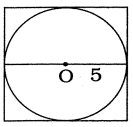
If $\odot(O, 5)$ touches all the sides of a square,then the perimeter of the square is .... .
A
$5$
B
$10$
C
$20$
D
$40$
Solution
(D) The circle $\odot(O, 5)$ has a radius $r = 5$.
Since the circle touches all sides of the square,the diameter of the circle is equal to the side length of the square.
Side length of the square $= 2 \times r = 2 \times 5 = 10$.
The perimeter of a square $= 4 \times \text{side length} = 4 \times 10 = 40$.
Since the circle touches all sides of the square,the diameter of the circle is equal to the side length of the square.
Side length of the square $= 2 \times r = 2 \times 5 = 10$.
The perimeter of a square $= 4 \times \text{side length} = 4 \times 10 = 40$.
0 likes
View Solution118
MediumMCQ
If $\odot(P, r)$ touches all the sides of a quadrilateral $ABCD$,then $ABCD$ is a $\ldots \ldots \ldots \ldots$
A
Square
B
Rectangle
C
Cyclic quadrilateral
D
Tangential quadrilateral
Solution
(D) quadrilateral that circumscribes a circle is known as a tangential quadrilateral. According to the Pitot theorem,for a quadrilateral $ABCD$ that touches a circle on all four sides,the sums of the lengths of opposite sides are equal. That is,$AB + CD = BC + DA$. Since the question asks for the classification of such a quadrilateral,the most general term is a tangential quadrilateral. If the options provided are limited,note that while a square and a rhombus are specific types of tangential quadrilaterals,the property of touching all sides defines a tangential quadrilateral.
0 likes
View Solution119
EasyMCQ
If $\square ABCD$ is a cyclic quadrilateral and also a rectangle,and if $AB = 5$ and $BC = 12$,then $AC = \ldots$
A
$10$
B
$18$
C
$13$
D
$15$
Solution
(C) cyclic quadrilateral that is also a rectangle implies that its vertices lie on a circle and its interior angles are $90^{\circ}$.
In a rectangle $ABCD$,$\Delta ABC$ is a right-angled triangle with $\angle B = 90^{\circ}$.
According to the Pythagorean theorem,$AC^{2} = AB^{2} + BC^{2}$.
Substituting the given values: $AC^{2} = 5^{2} + 12^{2}$.
$AC^{2} = 25 + 144 = 169$.
Therefore,$AC = \sqrt{169} = 13$.
In a rectangle $ABCD$,$\Delta ABC$ is a right-angled triangle with $\angle B = 90^{\circ}$.
According to the Pythagorean theorem,$AC^{2} = AB^{2} + BC^{2}$.
Substituting the given values: $AC^{2} = 5^{2} + 12^{2}$.
$AC^{2} = 25 + 144 = 169$.
Therefore,$AC = \sqrt{169} = 13$.
0 likes
View Solution120
DifficultMCQ
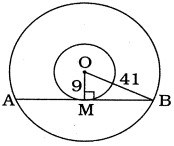
$\odot(O, 41)$ and $\odot(O, 9)$ are concentric circles. The chord $\overline{AB}$ of $\odot(O, 41)$ touches $\odot(O, 9)$ at point $M$. Then $AB = \ldots$
A
$20$
B
$40$
C
$60$
D
$80$
Solution
(D) Let $O$ be the common center of the two concentric circles. The radius of the larger circle is $OB = 41$ and the radius of the smaller circle is $OM = 9$.
Since the chord $\overline{AB}$ of the larger circle is tangent to the smaller circle at $M$,the radius $OM$ is perpendicular to the chord $AB$ at the point of tangency $M$.
Thus,in the right-angled triangle $\Delta OMB$,by the Pythagorean theorem:
$OB^2 = OM^2 + MB^2$
$41^2 = 9^2 + MB^2$
$1681 = 81 + MB^2$
$MB^2 = 1681 - 81 = 1600$
$MB = \sqrt{1600} = 40$.
Since the perpendicular from the center to a chord bisects the chord,$AB = 2 \times MB = 2 \times 40 = 80$.
Since the chord $\overline{AB}$ of the larger circle is tangent to the smaller circle at $M$,the radius $OM$ is perpendicular to the chord $AB$ at the point of tangency $M$.
Thus,in the right-angled triangle $\Delta OMB$,by the Pythagorean theorem:
$OB^2 = OM^2 + MB^2$
$41^2 = 9^2 + MB^2$
$1681 = 81 + MB^2$
$MB^2 = 1681 - 81 = 1600$
$MB = \sqrt{1600} = 40$.
Since the perpendicular from the center to a chord bisects the chord,$AB = 2 \times MB = 2 \times 40 = 80$.
0 likes
View Solution121
DifficultMCQ
$\odot(O, 17)$ and $\odot(O, 15)$ are concentric circles. The chord $\overline{AB}$ of $\odot(O, 17)$ touches $\odot(O, 15)$. Then $AB = \ldots$
A
$4$
B
$8$
C
$16$
D
$32$
Solution
(C) Let $O$ be the common center of the two concentric circles.
Let $R = 17$ be the radius of the outer circle and $r = 15$ be the radius of the inner circle.
The chord $\overline{AB}$ of the outer circle is tangent to the inner circle at point $M$.
Since the radius is perpendicular to the tangent at the point of contact,$OM \perp AB$.
In $\triangle OMA$,by the Pythagorean theorem: $OA^2 = OM^2 + AM^2$.
Substituting the values: $17^2 = 15^2 + AM^2$.
$289 = 225 + AM^2$.
$AM^2 = 289 - 225 = 64$.
$AM = \sqrt{64} = 8$.
Since the perpendicular from the center to a chord bisects the chord,$AB = 2 \times AM$.
$AB = 2 \times 8 = 16$.
Let $R = 17$ be the radius of the outer circle and $r = 15$ be the radius of the inner circle.
The chord $\overline{AB}$ of the outer circle is tangent to the inner circle at point $M$.
Since the radius is perpendicular to the tangent at the point of contact,$OM \perp AB$.
In $\triangle OMA$,by the Pythagorean theorem: $OA^2 = OM^2 + AM^2$.
Substituting the values: $17^2 = 15^2 + AM^2$.
$289 = 225 + AM^2$.
$AM^2 = 289 - 225 = 64$.
$AM = \sqrt{64} = 8$.
Since the perpendicular from the center to a chord bisects the chord,$AB = 2 \times AM$.
$AB = 2 \times 8 = 16$.
0 likes
View Solution122
DifficultMCQ
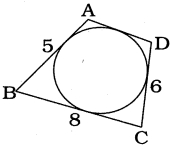
$A$ circle touches all four sides of $\square ABCD$. If $AB = 5, BC = 8$ and $CD = 6$,then $AD = .......$
A
$9$
B
$3$
C
$7$
D
$4$
Solution
(B) circle touches all the four sides of $\square ABCD$. According to the property of a tangential quadrilateral,the sums of opposite sides are equal.
$\therefore AB + CD = AD + BC$
Substituting the given values:
$\therefore 5 + 6 = AD + 8$
$\therefore 11 = AD + 8$
$\therefore AD = 11 - 8 = 3$
$\therefore AB + CD = AD + BC$
Substituting the given values:
$\therefore 5 + 6 = AD + 8$
$\therefore 11 = AD + 8$
$\therefore AD = 11 - 8 = 3$
0 likes
View Solution123
DifficultMCQ
$\square PQRS$ is a cyclic quadrilateral. If $m \angle P = 30^{\circ}$, then $m \angle R = \dots$ (in $^{\circ}$)
A
$30$
B
$60$
C
$150$
D
$120$
Solution
(C) $\square PQRS$ is a cyclic quadrilateral.
In a cyclic quadrilateral, the sum of the measures of opposite angles is $180^{\circ}$.
Therefore, $m \angle P + m \angle R = 180^{\circ}$.
Given that $m \angle P = 30^{\circ}$.
Substituting the value, we get $30^{\circ} + m \angle R = 180^{\circ}$.
Thus, $m \angle R = 180^{\circ} - 30^{\circ} = 150^{\circ}$.
In a cyclic quadrilateral, the sum of the measures of opposite angles is $180^{\circ}$.
Therefore, $m \angle P + m \angle R = 180^{\circ}$.
Given that $m \angle P = 30^{\circ}$.
Substituting the value, we get $30^{\circ} + m \angle R = 180^{\circ}$.
Thus, $m \angle R = 180^{\circ} - 30^{\circ} = 150^{\circ}$.
0 likes
View Solution124
DifficultMCQ
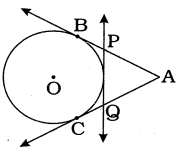
As shown in the figure,$\overleftrightarrow{AB}$,$\overleftrightarrow{AC}$ and $\overleftrightarrow{PQ}$ are the tangents to $\odot(O, r)$. Then the perimeter of $\Delta APQ = \ldots$
A
$2 AB$
B
$2 AP$
C
$2 AQ$
D
$2 AC$
Solution
(A) Let the tangent $\overleftrightarrow{PQ}$ touch the circle at point $R$.
Since tangents drawn from an external point to a circle are equal in length,we have:
$AB = AC$ (tangents from point $A$)
$PB = PR$ (tangents from point $P$)
$QC = QR$ (tangents from point $Q$)
The perimeter of $\Delta APQ = AP + PQ + AQ$.
Substituting $PQ = PR + QR$,we get:
Perimeter $= AP + (PR + QR) + AQ$.
Using the equalities $PR = PB$ and $QR = QC$:
Perimeter $= AP + PB + QC + AQ$.
Since $AP + PB = AB$ and $AQ + QC = AC$:
Perimeter $= AB + AC$.
Since $AB = AC$,the perimeter $= AB + AB = 2 AB$ (or $2 AC$).
Thus,the correct option is $2 AB$.
Since tangents drawn from an external point to a circle are equal in length,we have:
$AB = AC$ (tangents from point $A$)
$PB = PR$ (tangents from point $P$)
$QC = QR$ (tangents from point $Q$)
The perimeter of $\Delta APQ = AP + PQ + AQ$.
Substituting $PQ = PR + QR$,we get:
Perimeter $= AP + (PR + QR) + AQ$.
Using the equalities $PR = PB$ and $QR = QC$:
Perimeter $= AP + PB + QC + AQ$.
Since $AP + PB = AB$ and $AQ + QC = AC$:
Perimeter $= AB + AC$.
Since $AB = AC$,the perimeter $= AB + AB = 2 AB$ (or $2 AC$).
Thus,the correct option is $2 AB$.
0 likes
View Solution125
MediumMCQ
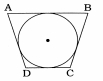
$A$ circle touches all the sides of $\square ABCD$. If the largest side of $\square ABCD$ is $\overline{AB}$,then the smallest side is:
A
$\overline{CD}$
B
$\overline{BC}$
C
$\overline{AD}$
D
Both $\overline{BC}$ and $\overline{AD}$
Solution
(A) For a quadrilateral circumscribing a circle,the sum of opposite sides is equal,i.e.,$AB + CD = BC + AD$.
Given that $\overline{AB}$ is the largest side,let $AB = x$.
Since the circle is tangent to all sides,the lengths of the tangents from the vertices to the circle are equal. Let the lengths of the tangents from vertices $A, B, C, D$ be $a, b, c, d$ respectively.
Then $AB = a + b$,$BC = b + c$,$CD = c + d$,and $AD = a + d$.
Since $AB$ is the largest side,$a+b$ is the maximum value.
In a tangential quadrilateral,the side opposite to the largest side is generally the smallest side. Thus,$\overline{CD}$ is the smallest side.
Given that $\overline{AB}$ is the largest side,let $AB = x$.
Since the circle is tangent to all sides,the lengths of the tangents from the vertices to the circle are equal. Let the lengths of the tangents from vertices $A, B, C, D$ be $a, b, c, d$ respectively.
Then $AB = a + b$,$BC = b + c$,$CD = c + d$,and $AD = a + d$.
Since $AB$ is the largest side,$a+b$ is the maximum value.
In a tangential quadrilateral,the side opposite to the largest side is generally the smallest side. Thus,$\overline{CD}$ is the smallest side.
0 likes
View Solution126
MediumMCQ
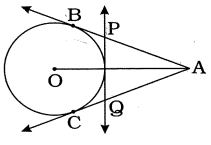
As shown in the figure,$AB$,$AC$ and $\overleftrightarrow{PQ}$ are tangents to the circle. If $AB = 6$,then the perimeter of $\Delta APQ = \ldots \ldots \ldots$.
A
$6$
B
$9$
C
$12$
D
$3$
Solution
(C) Let the tangent $\overleftrightarrow{PQ}$ touch the circle at point $R$.
Since the lengths of tangents drawn from an external point to a circle are equal,we have:
$PB = PR$ and $QC = QR$.
The perimeter of $\Delta APQ = AP + PQ + AQ$.
$= AP + (PR + RQ) + AQ$.
$= AP + PB + QC + AQ$ (since $PR = PB$ and $RQ = QC$).
$= (AP + PB) + (AQ + QC)$.
$= AB + AC$.
Since $AB = AC$ (tangents from an external point $A$),we have $AB = AC = 6$.
Therefore,the perimeter of $\Delta APQ = 6 + 6 = 12$.
Since the lengths of tangents drawn from an external point to a circle are equal,we have:
$PB = PR$ and $QC = QR$.
The perimeter of $\Delta APQ = AP + PQ + AQ$.
$= AP + (PR + RQ) + AQ$.
$= AP + PB + QC + AQ$ (since $PR = PB$ and $RQ = QC$).
$= (AP + PB) + (AQ + QC)$.
$= AB + AC$.
Since $AB = AC$ (tangents from an external point $A$),we have $AB = AC = 6$.
Therefore,the perimeter of $\Delta APQ = 6 + 6 = 12$.
0 likes
View Solution127
EasyMCQ
In the figure,$\overrightarrow{ PA }$ and $\overrightarrow{ PB }$ are tangents to $\odot( O , r)$. If $m \angle PAB = 60^{\circ}$,then $m \angle PBA = \ldots$ (in $^{\circ}$)
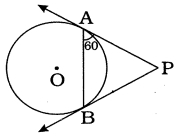
A
$30$
B
$45$
C
$60$
D
$75$
Solution
(C) Given that $\overline{ PA }$ and $\overline{ PB }$ are tangents to the circle $\odot( O , r)$ from an external point $P$.
According to the theorem,the lengths of tangents drawn from an external point to a circle are equal.
Therefore,$\overline{ PA } = \overline{ PB }$.
In $\Delta PAB$,since $\overline{ PA } = \overline{ PB }$,the triangle is an isosceles triangle.
In an isosceles triangle,the angles opposite to the equal sides are equal.
Thus,$m \angle PAB = m \angle PBA$.
Given that $m \angle PAB = 60^{\circ}$,it follows that $m \angle PBA = 60^{\circ}$.
According to the theorem,the lengths of tangents drawn from an external point to a circle are equal.
Therefore,$\overline{ PA } = \overline{ PB }$.
In $\Delta PAB$,since $\overline{ PA } = \overline{ PB }$,the triangle is an isosceles triangle.
In an isosceles triangle,the angles opposite to the equal sides are equal.
Thus,$m \angle PAB = m \angle PBA$.
Given that $m \angle PAB = 60^{\circ}$,it follows that $m \angle PBA = 60^{\circ}$.
0 likes
View Solution128
EasyMCQ
In the figure,$\stackrel{\leftrightarrow}{ AB }$,$\stackrel{\leftrightarrow}{ AC }$ and $\stackrel{\leftrightarrow}{ PQ }$ are tangents to $\odot( O , r)$. If the perimeter of $\Delta APQ$ is $16$,then $AB = \ldots$
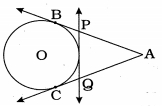
A
$2$
B
$4$
C
$8$
D
$16$
Solution
(C) Let the tangents from point $A$ to the circle be $AB$ and $AC$. By the theorem,lengths of tangents drawn from an external point to a circle are equal,so $AB = AC$.
Let the tangent $PQ$ touch the circle at point $M$. Then $PM = PB$ and $QM = QC$ (tangents from points $P$ and $Q$ respectively).
The perimeter of $\Delta APQ = AP + PQ + AQ = AP + (PM + MQ) + AQ$.
Substituting the equal tangent lengths: Perimeter $= AP + PB + QC + AQ = (AP + PB) + (AQ + QC) = AB + AC$.
Since $AB = AC$,the perimeter $= 2 AB$.
Given that the perimeter is $16$,we have $2 AB = 16$,which implies $AB = 8$.
Let the tangent $PQ$ touch the circle at point $M$. Then $PM = PB$ and $QM = QC$ (tangents from points $P$ and $Q$ respectively).
The perimeter of $\Delta APQ = AP + PQ + AQ = AP + (PM + MQ) + AQ$.
Substituting the equal tangent lengths: Perimeter $= AP + PB + QC + AQ = (AP + PB) + (AQ + QC) = AB + AC$.
Since $AB = AC$,the perimeter $= 2 AB$.
Given that the perimeter is $16$,we have $2 AB = 16$,which implies $AB = 8$.
0 likes
View Solution129
MediumMCQ
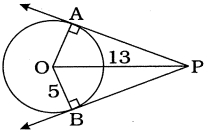
$\overrightarrow{ PA }$ and $\overrightarrow{ PB }$ are tangents to $\odot( O , 5) .$ If $OP = 13,$ then $PB = \ldots \ldots \ldots \ldots$
A
$5$
B
$10$
C
$12$
D
$13$
Solution
(C) In the given circle,$\overline{ OB }$ is the radius and $\overline{ PB }$ is the tangent at point $B$.
Since the radius is perpendicular to the tangent at the point of contact,$\angle OBP = 90^{\circ}$.
Thus,$\Delta POB$ is a right-angled triangle with hypotenuse $OP$.
By the Pythagorean theorem:
$OP^{2} = OB^{2} + PB^{2}$
$13^{2} = 5^{2} + PB^{2}$
$169 = 25 + PB^{2}$
$PB^{2} = 169 - 25 = 144$
$PB = \sqrt{144} = 12$
Therefore,$PB = 12$.
Since the radius is perpendicular to the tangent at the point of contact,$\angle OBP = 90^{\circ}$.
Thus,$\Delta POB$ is a right-angled triangle with hypotenuse $OP$.
By the Pythagorean theorem:
$OP^{2} = OB^{2} + PB^{2}$
$13^{2} = 5^{2} + PB^{2}$
$169 = 25 + PB^{2}$
$PB^{2} = 169 - 25 = 144$
$PB = \sqrt{144} = 12$
Therefore,$PB = 12$.
0 likes
View Solution130
MediumMCQ
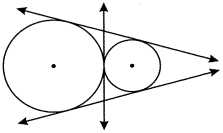
If two circles touch each other externally,then $\ldots \ldots \ldots \ldots$ common tangents can be drawn to them.
A
two
B
three
C
four
D
one
Solution
(B) When two circles touch each other externally,they have one direct common tangent passing through the point of contact and two transverse common tangents.
Therefore,a total of $3$ common tangents can be drawn to the two circles.
Therefore,a total of $3$ common tangents can be drawn to the two circles.
0 likes
View Solution131
EasyMCQ
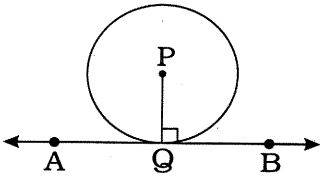
$A$ tangent $\stackrel{\leftrightarrow}{AB}$ of $\odot(P, r)$ touches the circle at $Q$. If a perpendicular is drawn from $P$ onto $AB$,then the foot of the perpendicular is ....
A
$A$
B
$B$
C
$Q$
D
$P$
Solution
(C) tangent to a circle is perpendicular to the radius at the point of contact.
Here,$\stackrel{\leftrightarrow}{AB}$ is a tangent to the circle $\odot(P, r)$ at point $Q$.
Therefore,the radius $PQ$ is perpendicular to the tangent $\stackrel{\leftrightarrow}{AB}$ at $Q$.
Since $PQ \perp AB$,the foot of the perpendicular drawn from $P$ to the line $AB$ is $Q$.
Here,$\stackrel{\leftrightarrow}{AB}$ is a tangent to the circle $\odot(P, r)$ at point $Q$.
Therefore,the radius $PQ$ is perpendicular to the tangent $\stackrel{\leftrightarrow}{AB}$ at $Q$.
Since $PQ \perp AB$,the foot of the perpendicular drawn from $P$ to the line $AB$ is $Q$.
0 likes
View Solution132
MediumMCQ
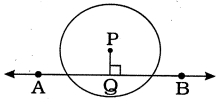
Let $P$ be the centre of a circle and $AB$ be a line in the same plane. If $Q$ is the foot of the perpendicular drawn from $P$ to the line $AB$,and $Q$ lies in the interior of the circle,then the line $AB$ ..... .
A
does not intersect the circle
B
touches the circle in one point
C
intersects the circle in two points
D
intersects the circle in three points
Solution
(C) The distance from the centre $P$ of the circle to the line $AB$ is the length of the perpendicular segment $PQ$.
Given that $Q$ lies in the interior of the circle,the length of $PQ$ must be less than the radius $r$ of the circle (i.e.,$PQ < r$).
According to the properties of a circle,if the perpendicular distance from the centre to a line is less than the radius of the circle,then the line is a secant line and intersects the circle at two distinct points.
Given that $Q$ lies in the interior of the circle,the length of $PQ$ must be less than the radius $r$ of the circle (i.e.,$PQ < r$).
According to the properties of a circle,if the perpendicular distance from the centre to a line is less than the radius of the circle,then the line is a secant line and intersects the circle at two distinct points.
0 likes
View Solution133
EasyMCQ
In $\Delta ABC$,$\angle B = 90^{\circ}$. The radius of the incircle touching all three sides of the triangle is $\ldots \ldots \ldots \ldots$
A
$\frac{AB + BC + AC}{2}$
B
$\frac{AB + BC - AC}{2}$
C
$\frac{AC + AB - BC}{2}$
D
$\frac{AC + BC - AB}{2}$
Solution
(B) Let the sides of the right-angled triangle be $a = BC$,$c = AB$,and the hypotenuse $b = AC$.
Let the radius of the incircle be $r$.
The center of the incircle $(O)$ forms a square with the vertices at the point of tangency on sides $AB$ and $BC$ and the vertex $B$ because the radii are perpendicular to the sides.
Thus,the distance from $B$ to the points of tangency on $AB$ and $BC$ is $r$.
The remaining segments of the sides $AB$ and $BC$ are $(c - r)$ and $(a - r)$ respectively.
By the property of tangents drawn from an external point to a circle,these segments are equal to the distances from vertices $A$ and $C$ to the points of tangency on the hypotenuse.
Therefore,the hypotenuse $b = (c - r) + (a - r)$.
$b = a + c - 2r$.
$2r = a + c - b$.
$r = \frac{a + c - b}{2}$.
Substituting the side lengths: $r = \frac{BC + AB - AC}{2}$.
Let the radius of the incircle be $r$.
The center of the incircle $(O)$ forms a square with the vertices at the point of tangency on sides $AB$ and $BC$ and the vertex $B$ because the radii are perpendicular to the sides.
Thus,the distance from $B$ to the points of tangency on $AB$ and $BC$ is $r$.
The remaining segments of the sides $AB$ and $BC$ are $(c - r)$ and $(a - r)$ respectively.
By the property of tangents drawn from an external point to a circle,these segments are equal to the distances from vertices $A$ and $C$ to the points of tangency on the hypotenuse.
Therefore,the hypotenuse $b = (c - r) + (a - r)$.
$b = a + c - 2r$.
$2r = a + c - b$.
$r = \frac{a + c - b}{2}$.
Substituting the side lengths: $r = \frac{BC + AB - AC}{2}$.
0 likes
View Solution134
DifficultMCQ
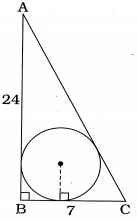
In $\Delta ABC$,$\angle B$ is a right angle. If $AB = 24$ and $BC = 7$,then the radius of the circle touching all three sides of $\Delta ABC$ is $\ldots \ldots \ldots \ldots$.
A
$4$
B
$3$
C
$5$
D
$2$
Solution
(B) In $\Delta ABC$,$m\angle B = 90^{\circ}$,$AB = 24$,and $BC = 7$.
Using the Pythagoras theorem:
$AC^2 = AB^2 + BC^2$
$AC^2 = (24)^2 + (7)^2$
$AC^2 = 576 + 49$
$AC^2 = 625$
$AC = \sqrt{625} = 25$.
The radius $r$ of the incircle of a right-angled triangle is given by the formula:
$r = \frac{AB + BC - AC}{2}$
$r = \frac{24 + 7 - 25}{2}$
$r = \frac{31 - 25}{2}$
$r = \frac{6}{2} = 3$.
Therefore,the radius of the circle is $3$.
Using the Pythagoras theorem:
$AC^2 = AB^2 + BC^2$
$AC^2 = (24)^2 + (7)^2$
$AC^2 = 576 + 49$
$AC^2 = 625$
$AC = \sqrt{625} = 25$.
The radius $r$ of the incircle of a right-angled triangle is given by the formula:
$r = \frac{AB + BC - AC}{2}$
$r = \frac{24 + 7 - 25}{2}$
$r = \frac{31 - 25}{2}$
$r = \frac{6}{2} = 3$.
Therefore,the radius of the circle is $3$.
0 likes
View Solution135
MediumMCQ
$A$ circle touches all the sides of a quadrilateral $ABCD$. Then, the quadrilateral $ABCD$ is a:
A
rectangle
B
square
C
trapezium
D
rhombus
Solution
(D) quadrilateral that circumscribes a circle is known as a tangential quadrilateral.
According to the properties of tangents drawn from an external point to a circle, the lengths of tangents are equal.
Let the circle touch the sides $AB$, $BC$, $CD$, and $DA$ at points $P$, $Q$, $R$, and $S$ respectively.
Then, $AP = AS$, $BP = BQ$, $CQ = CR$, and $DR = DS$.
Adding these equations: $(AP + BP) + (CR + DR) = (AS + DS) + (BQ + CQ)$ implies $AB + CD = AD + BC$.
This property is satisfied by any tangential quadrilateral.
However, among the given options, a rhombus is a specific type of quadrilateral where all sides are equal and it can circumscribe a circle.
While a square is also a rhombus, the most general classification for a quadrilateral whose sides are tangent to a circle is a tangential quadrilateral, but in the context of standard geometry problems of this type, the property $AB + CD = AD + BC$ is the defining characteristic.
Given the options, a rhombus is the most appropriate geometric figure that satisfies the condition of having an incircle.
According to the properties of tangents drawn from an external point to a circle, the lengths of tangents are equal.
Let the circle touch the sides $AB$, $BC$, $CD$, and $DA$ at points $P$, $Q$, $R$, and $S$ respectively.
Then, $AP = AS$, $BP = BQ$, $CQ = CR$, and $DR = DS$.
Adding these equations: $(AP + BP) + (CR + DR) = (AS + DS) + (BQ + CQ)$ implies $AB + CD = AD + BC$.
This property is satisfied by any tangential quadrilateral.
However, among the given options, a rhombus is a specific type of quadrilateral where all sides are equal and it can circumscribe a circle.
While a square is also a rhombus, the most general classification for a quadrilateral whose sides are tangent to a circle is a tangential quadrilateral, but in the context of standard geometry problems of this type, the property $AB + CD = AD + BC$ is the defining characteristic.
Given the options, a rhombus is the most appropriate geometric figure that satisfies the condition of having an incircle.
0 likes
View Solution136
MediumMCQ
In $\triangle ABC$,$m \angle B = 90^\circ$,$AB = 4$ and $BC = 3$. Find the radius of the incircle of the triangle.
A
$4$
B
$1$
C
$2$
D
$3$
Solution
(B) In a right-angled triangle,the radius $r$ of the incircle is given by the formula $r = \frac{AB + BC - AC}{2}$.
First,we find the hypotenuse $AC$ using the Pythagorean theorem: $AC = \sqrt{AB^2 + BC^2} = \sqrt{4^2 + 3^2} = \sqrt{16 + 9} = \sqrt{25} = 5$.
Now,substitute the values into the formula: $r = \frac{4 + 3 - 5}{2} = \frac{7 - 5}{2} = \frac{2}{2} = 1$.
Therefore,the radius of the incircle is $1$.
First,we find the hypotenuse $AC$ using the Pythagorean theorem: $AC = \sqrt{AB^2 + BC^2} = \sqrt{4^2 + 3^2} = \sqrt{16 + 9} = \sqrt{25} = 5$.
Now,substitute the values into the formula: $r = \frac{4 + 3 - 5}{2} = \frac{7 - 5}{2} = \frac{2}{2} = 1$.
Therefore,the radius of the incircle is $1$.
0 likes
View Solution137
MediumMCQ
If a rhombus $ABCD$ is inscribed in a circle with center $O$ and radius $r$,then the rhombus $ABCD$ is $\ldots \ldots$
A
a square
B
a rectangle
C
a trapezium
D
none of the above
Solution
(A) rhombus is a quadrilateral with all sides equal.
If a rhombus is inscribed in a circle,all its vertices lie on the circumference of the circle.
$A$ quadrilateral inscribed in a circle is called a cyclic quadrilateral.
In a cyclic quadrilateral,the sum of opposite angles is $180^{\circ}$.
For a rhombus $ABCD$,the opposite angles are equal,i.e.,$\angle A = \angle C$ and $\angle B = \angle D$.
Since $\angle A + \angle C = 180^{\circ}$,we have $2\angle A = 180^{\circ}$,which implies $\angle A = 90^{\circ}$.
$A$ rhombus with an angle of $90^{\circ}$ is a square.
Therefore,the rhombus $ABCD$ must be a square.
If a rhombus is inscribed in a circle,all its vertices lie on the circumference of the circle.
$A$ quadrilateral inscribed in a circle is called a cyclic quadrilateral.
In a cyclic quadrilateral,the sum of opposite angles is $180^{\circ}$.
For a rhombus $ABCD$,the opposite angles are equal,i.e.,$\angle A = \angle C$ and $\angle B = \angle D$.
Since $\angle A + \angle C = 180^{\circ}$,we have $2\angle A = 180^{\circ}$,which implies $\angle A = 90^{\circ}$.
$A$ rhombus with an angle of $90^{\circ}$ is a square.
Therefore,the rhombus $ABCD$ must be a square.
0 likes
View Solution138
DifficultMCQ
Which of the following groups correctly matches the data of Part $I$ with the data of Part $II$?
| Part $I$ | Part $II$ |
| $1.$ In $\Delta ABC, AB=3, BC=4, AC=5$ | $a.$ In-radius $= 1$ |
| $2.$ In $\Delta PQR, PQ=5, QR=12, PR=13$ | $b.$ In-radius $= 2$ |
| $3.$ In $\Delta XYZ, XY=8, YZ=15, XZ=17$ | $c.$ In-radius $= 3$ |
| $4.$ In $\Delta MNP, MN=20, NP=21, MP=29$ | $d.$ In-radius $= 6$ |
A
$(1-a), (2-b), (3-c), (4-d)$
B
$(1-c), (2-d), (3-a), (4-b)$
C
$(1-d), (2-c), (3-b), (4-a)$
D
$(1-b), (2-a), (3-d), (4-c)$
Solution
(D) For a right-angled triangle with sides $a, b$ and hypotenuse $c$,the in-radius $r$ is given by the formula $r = \frac{a+b-c}{2}$.
$1.$ For $\Delta ABC$ with sides $3, 4, 5$: $r = \frac{3+4-5}{2} = \frac{2}{2} = 1$. Matches $(b)$.
$2.$ For $\Delta PQR$ with sides $5, 12, 13$: $r = \frac{5+12-13}{2} = \frac{4}{2} = 2$. Matches $(a)$.
$3.$ For $\Delta XYZ$ with sides $8, 15, 17$: $r = \frac{8+15-17}{2} = \frac{6}{2} = 3$. Matches $(d)$.
$4.$ For $\Delta MNP$ with sides $20, 21, 29$: $r = \frac{20+21-29}{2} = \frac{12}{2} = 6$. Matches $(c)$.
Thus,the correct matching is $(1-b), (2-a), (3-d), (4-c)$.
$1.$ For $\Delta ABC$ with sides $3, 4, 5$: $r = \frac{3+4-5}{2} = \frac{2}{2} = 1$. Matches $(b)$.
$2.$ For $\Delta PQR$ with sides $5, 12, 13$: $r = \frac{5+12-13}{2} = \frac{4}{2} = 2$. Matches $(a)$.
$3.$ For $\Delta XYZ$ with sides $8, 15, 17$: $r = \frac{8+15-17}{2} = \frac{6}{2} = 3$. Matches $(d)$.
$4.$ For $\Delta MNP$ with sides $20, 21, 29$: $r = \frac{20+21-29}{2} = \frac{12}{2} = 6$. Matches $(c)$.
Thus,the correct matching is $(1-b), (2-a), (3-d), (4-c)$.
0 likes
View SolutionCircles — Mix Examples - Circles · Frequently Asked Questions
1Are these Circles questions useful for JEE and NEET?
Yes. All questions in this section are mapped to JEE Main and NEET exam patterns. Previous year questions from JEE Main, NEET, GUJCET and state-level exams are included with full solutions.
2Can I switch to Hindi or Gujarati for these questions?
Yes. Use the language tabs in the hero section or the sidebar to view the same questions and solutions in English, Hindi or Gujarati.
3How do I generate a question paper from this subtopic?
Use the Vedclass Exam Paper Generator — select the chapter and subtopic, set difficulty, and generate Sets A, B, C, D automatically. First 3 chapters of every subject are free.
Vedclass Products
For Students
Vedclass Test Series
Mock tests in real JEE/NEET style with performance analysis. 5-day free trial.
Start Free TrialFor Teachers
Exam Paper Generator
Generate Set A/B/C/D papers from this chapter in 2 minutes. 3 chapters free.
Try FreeFor Institutes
Online Exam Module
Live online exams with unlimited students, 360° analytics & white-label branding.
See DemoFor Teachers & Institutes
Generate a Circles Exam Paper in 2 Minutes
Select subtopic & difficulty — Sets A, B, C, D auto-generated with No Repeat logic.
First 3 chapters of every subject are free — no payment required.