
A English
Textbook - Circles Questions in English
Class 10 Mathematics · Circles · Textbook - Circles
21+
Questions
English
Language
100%
With Solutions
Showing 21 of 21 questions in English
1
EasyMCQ
How many tangents can a circle have?
A
Infinite
B
$0$
C
$1$
D
$10$
Solution
(A) circle is a collection of infinite points on a plane that are at a constant distance from a fixed point called the center. Since a tangent to a circle touches the circle at exactly one point,and there are infinite points on the circumference of a circle,there can be infinite tangents to a circle.
0 likes
View Solution2
Easy
Fill in the blanks:
$(i)$ $A$ tangent to a circle intersects it in $.........$ point$(s)$.
$(ii)$ $A$ line intersecting a circle in two points is called a $.........$
$(i)$ $A$ tangent to a circle intersects it in $.........$ point$(s)$.
$(ii)$ $A$ line intersecting a circle in two points is called a $.........$
Solution
(A) $(i)$ $A$ tangent to a circle touches the circle at exactly one point. Therefore,it intersects the circle in $1$ point.
$(ii)$ $A$ line that intersects a circle at two distinct points is known as a secant of the circle.
$(ii)$ $A$ line that intersects a circle at two distinct points is known as a secant of the circle.
0 likes
View Solution3
Medium
Fill in the blanks:
$(i)$ $A$ circle can have $......$ parallel tangents at the most.
$(ii)$ The common point of a tangent to a circle and the circle is called $......$
$(i)$ $A$ circle can have $......$ parallel tangents at the most.
$(ii)$ The common point of a tangent to a circle and the circle is called $......$
Solution
(A-D) $(i)$ $A$ circle can have at most $2$ parallel tangents. These tangents are parallel to each other and pass through the endpoints of a diameter.
$(ii)$ The common point of a tangent to a circle and the circle is called the point of contact.
$(ii)$ The common point of a tangent to a circle and the circle is called the point of contact.
0 likes
View Solution4
MediumMCQ
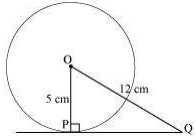
$A$ tangent $PQ$ at a point $P$ of a circle of radius $5 \, cm$ meets a line through the centre $O$ at a point $Q$ so that $OQ = 12 \, cm$. The length of $PQ$ is (in $cm$):
A
$12$
B
$13$
C
$8.5$
D
$\sqrt{119}$
Solution
(D) We know that the radius of a circle is perpendicular to the tangent at the point of contact.
Therefore,$OP \perp PQ$.
This forms a right-angled triangle $\triangle OPQ$,where $OP = 5 \, cm$ (radius) and $OQ = 12 \, cm$ (hypotenuse).
By applying the Pythagoras theorem in $\triangle OPQ$:
$OP^2 + PQ^2 = OQ^2$
$5^2 + PQ^2 = 12^2$
$25 + PQ^2 = 144$
$PQ^2 = 144 - 25$
$PQ^2 = 119$
$PQ = \sqrt{119} \, cm$.
Therefore,$OP \perp PQ$.
This forms a right-angled triangle $\triangle OPQ$,where $OP = 5 \, cm$ (radius) and $OQ = 12 \, cm$ (hypotenuse).
By applying the Pythagoras theorem in $\triangle OPQ$:
$OP^2 + PQ^2 = OQ^2$
$5^2 + PQ^2 = 12^2$
$25 + PQ^2 = 144$
$PQ^2 = 144 - 25$
$PQ^2 = 119$
$PQ = \sqrt{119} \, cm$.
0 likes
View Solution5
Medium
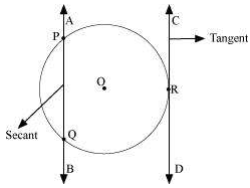
Draw a circle and two lines parallel to a given line such that one is a tangent and the other is a secant to the circle.
Solution
(N/A) It can be observed from the figure that $AB$ and $CD$ are two parallel lines.
Line $AB$ intersects the circle at exactly two points,$P$ and $Q$. Therefore,line $AB$ is the secant of this circle.
Since line $CD$ intersects the circle at exactly one point,$R$,line $CD$ is the tangent to the circle.
Line $AB$ intersects the circle at exactly two points,$P$ and $Q$. Therefore,line $AB$ is the secant of this circle.
Since line $CD$ intersects the circle at exactly one point,$R$,line $CD$ is the tangent to the circle.
0 likes
View Solution6
Easy
Prove that in two concentric circles,the chord of the larger circle,which touches the smaller circle,is bisected at the point of contact.
Solution
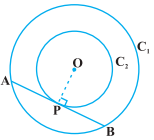
(N/A) We are given two concentric circles $C_1$ and $C_2$ with centre $O$ and a chord $AB$ of the larger circle $C_1$ which touches the smaller circle $C_2$ at the point $P$. We need to prove that $AP = BP$.
Let us join $OP$. Then,$AB$ is a tangent to $C_2$ at $P$ and $OP$ is its radius.
Since the tangent at any point of a circle is perpendicular to the radius through the point of contact,we have:
$OP \perp AB$
Now,$AB$ is a chord of the circle $C_1$ and $OP \perp AB$. We know that the perpendicular drawn from the centre of a circle to a chord bisects the chord.
Therefore,$OP$ is the bisector of the chord $AB$,which implies:
$AP = BP$
Let us join $OP$. Then,$AB$ is a tangent to $C_2$ at $P$ and $OP$ is its radius.
Since the tangent at any point of a circle is perpendicular to the radius through the point of contact,we have:
$OP \perp AB$
Now,$AB$ is a chord of the circle $C_1$ and $OP \perp AB$. We know that the perpendicular drawn from the centre of a circle to a chord bisects the chord.
Therefore,$OP$ is the bisector of the chord $AB$,which implies:
$AP = BP$
0 likes
View Solution7
Difficult
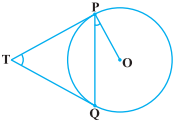
Two tangents $TP$ and $TQ$ are drawn to a circle with centre $O$ from an external point $T$. Prove that $\angle PTQ = 2 \angle OPQ$.
Solution
(N/A) We are given a circle with centre $O$,an external point $T$,and two tangents $TP$ and $TQ$ to the circle,where $P$ and $Q$ are the points of contact (see figure).
We need to prove that $\angle PTQ = 2 \angle OPQ$.
Let $\angle PTQ = \theta$.
Now,$TP = TQ$ (tangents from an external point are equal in length). So,$\triangle TPQ$ is an isosceles triangle.
Therefore,$\angle TPQ = \angle TQP = \frac{1}{2} (180^{\circ} - \theta) = 90^{\circ} - \frac{1}{2} \theta$.
Also,the radius is perpendicular to the tangent at the point of contact,so $\angle OPT = 90^{\circ}$.
Thus,$\angle OPQ = \angle OPT - \angle TPQ = 90^{\circ} - (90^{\circ} - \frac{1}{2} \theta)$.
$\angle OPQ = \frac{1}{2} \theta = \frac{1}{2} \angle PTQ$.
This gives $\angle PTQ = 2 \angle OPQ$.
We need to prove that $\angle PTQ = 2 \angle OPQ$.
Let $\angle PTQ = \theta$.
Now,$TP = TQ$ (tangents from an external point are equal in length). So,$\triangle TPQ$ is an isosceles triangle.
Therefore,$\angle TPQ = \angle TQP = \frac{1}{2} (180^{\circ} - \theta) = 90^{\circ} - \frac{1}{2} \theta$.
Also,the radius is perpendicular to the tangent at the point of contact,so $\angle OPT = 90^{\circ}$.
Thus,$\angle OPQ = \angle OPT - \angle TPQ = 90^{\circ} - (90^{\circ} - \frac{1}{2} \theta)$.
$\angle OPQ = \frac{1}{2} \theta = \frac{1}{2} \angle PTQ$.
This gives $\angle PTQ = 2 \angle OPQ$.
0 likes
View Solution8
Difficult
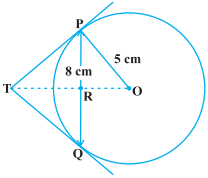
$PQ$ is a chord of length $8 \, cm$ of a circle of radius $5 \, cm$. The tangents at $P$ and $Q$ intersect at a point $T$ (see figure). Find the length $TP$.
Solution
(D) Join $OT$. Let it intersect $PQ$ at the point $R$. Then $\triangle TPQ$ is isosceles and $TO$ is the angle bisector of $\angle PTQ$. So,$OT \perp PQ$ and therefore,$OT$ bisects $PQ$ which gives $PR = RQ = 4 \, cm$.
Also,$OR = \sqrt{OP^2 - PR^2} = \sqrt{5^2 - 4^2} \, cm = \sqrt{25 - 16} \, cm = \sqrt{9} \, cm = 3 \, cm$.
Now,$\angle TPR + \angle RPO = 90^{\circ}$ and $\angle TPR + \angle PTR = 90^{\circ}$ (since $\triangle TRP$ is a right triangle).
So,$\angle RPO = \angle PTR$.
Therefore,right triangle $TRP$ is similar to the right triangle $PRO$ by $AA$ similarity.
This gives $\frac{TP}{PO} = \frac{RP}{RO}$,i.e.,$\frac{TP}{5} = \frac{4}{3}$ or $TP = \frac{20}{3} \, cm$.
Also,$OR = \sqrt{OP^2 - PR^2} = \sqrt{5^2 - 4^2} \, cm = \sqrt{25 - 16} \, cm = \sqrt{9} \, cm = 3 \, cm$.
Now,$\angle TPR + \angle RPO = 90^{\circ}$ and $\angle TPR + \angle PTR = 90^{\circ}$ (since $\triangle TRP$ is a right triangle).
So,$\angle RPO = \angle PTR$.
Therefore,right triangle $TRP$ is similar to the right triangle $PRO$ by $AA$ similarity.
This gives $\frac{TP}{PO} = \frac{RP}{RO}$,i.e.,$\frac{TP}{5} = \frac{4}{3}$ or $TP = \frac{20}{3} \, cm$.
0 likes
View Solution9
DifficultMCQ
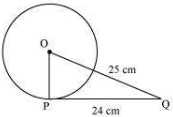
From a point $Q$,the length of the tangent to a circle is $24 \, cm$ and the distance of $Q$ from the centre is $25 \, cm$. The radius of the circle is (in $cm$)
A
$7$
B
$12$
C
$15$
D
$24.5$
Solution
(A) Let $O$ be the centre of the circle.
Given that,
$OQ = 25 \, cm$ and $PQ = 24 \, cm$.
As the radius is perpendicular to the tangent at the point of contact,therefore $OP \perp PQ$.
Applying Pythagoras theorem in $\triangle OPQ$,we obtain:
$OP^2 + PQ^2 = OQ^2$
$OP^2 + 24^2 = 25^2$
$OP^2 + 576 = 625$
$OP^2 = 625 - 576$
$OP^2 = 49$
$OP = 7 \, cm$.
Therefore,the radius of the circle is $7 \, cm$.
Given that,
$OQ = 25 \, cm$ and $PQ = 24 \, cm$.
As the radius is perpendicular to the tangent at the point of contact,therefore $OP \perp PQ$.
Applying Pythagoras theorem in $\triangle OPQ$,we obtain:
$OP^2 + PQ^2 = OQ^2$
$OP^2 + 24^2 = 25^2$
$OP^2 + 576 = 625$
$OP^2 = 625 - 576$
$OP^2 = 49$
$OP = 7 \, cm$.
Therefore,the radius of the circle is $7 \, cm$.
0 likes
View Solution10
DifficultMCQ
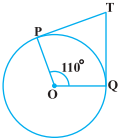
In the figure,if $TP$ and $TQ$ are the two tangents to a circle with centre $O$ such that $\angle POQ = 110^{\circ}$,then $\angle PTQ$ is equal to: (in $^{\circ}$)
A
$60$
B
$70$
C
$80$
D
$90$
Solution
(B) It is given that $TP$ and $TQ$ are tangents to the circle from an external point $T$.
The radius of a circle is perpendicular to the tangent at the point of contact.
Therefore,$OP \perp TP$ and $OQ \perp TQ$.
This implies $\angle OPT = 90^{\circ}$ and $\angle OQT = 90^{\circ}$.
In the quadrilateral $POQT$,the sum of all interior angles is $360^{\circ}$.
$\angle OPT + \angle POQ + \angle OQT + \angle PTQ = 360^{\circ}$
Substituting the known values:
$90^{\circ} + 110^{\circ} + 90^{\circ} + \angle PTQ = 360^{\circ}$
$290^{\circ} + \angle PTQ = 360^{\circ}$
$\angle PTQ = 360^{\circ} - 290^{\circ} = 70^{\circ}$
The radius of a circle is perpendicular to the tangent at the point of contact.
Therefore,$OP \perp TP$ and $OQ \perp TQ$.
This implies $\angle OPT = 90^{\circ}$ and $\angle OQT = 90^{\circ}$.
In the quadrilateral $POQT$,the sum of all interior angles is $360^{\circ}$.
$\angle OPT + \angle POQ + \angle OQT + \angle PTQ = 360^{\circ}$
Substituting the known values:
$90^{\circ} + 110^{\circ} + 90^{\circ} + \angle PTQ = 360^{\circ}$
$290^{\circ} + \angle PTQ = 360^{\circ}$
$\angle PTQ = 360^{\circ} - 290^{\circ} = 70^{\circ}$
0 likes
View Solution11
DifficultMCQ
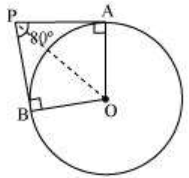
If tangents $PA$ and $PB$ from a point $P$ to a circle with centre $O$ are inclined to each other at an angle of $80^{\circ}$,then $\angle POA$ is equal to ......$^{\circ}$
A
$70$
B
$60$
C
$50$
D
$80$
Solution
(C) Given that $PA$ and $PB$ are tangents to the circle from an external point $P$.
The radius drawn to the point of contact is perpendicular to the tangent.
Therefore,$OA \perp PA$ and $OB \perp PB$,which implies $\angle OAP = 90^{\circ}$ and $\angle OBP = 90^{\circ}$.
In the quadrilateral $OAPB$,the sum of interior angles is $360^{\circ}$.
$\angle OAP + \angle APB + \angle OBP + \angle AOB = 360^{\circ}$
$90^{\circ} + 80^{\circ} + 90^{\circ} + \angle AOB = 360^{\circ}$
$260^{\circ} + \angle AOB = 360^{\circ}$
$\angle AOB = 100^{\circ}$
In $\triangle OPA$ and $\triangle OPB$:
$OA = OB$ (Radii of the same circle)
$PA = PB$ (Tangents from an external point are equal)
$OP = OP$ (Common side)
By $SSS$ congruence criterion,$\triangle OPA \cong \triangle OPB$.
By $CPCT$,$\angle POA = \angle POB$.
Since $\angle POA + \angle POB = \angle AOB = 100^{\circ}$,we have $2 \angle POA = 100^{\circ}$.
Therefore,$\angle POA = 50^{\circ}$.
The radius drawn to the point of contact is perpendicular to the tangent.
Therefore,$OA \perp PA$ and $OB \perp PB$,which implies $\angle OAP = 90^{\circ}$ and $\angle OBP = 90^{\circ}$.
In the quadrilateral $OAPB$,the sum of interior angles is $360^{\circ}$.
$\angle OAP + \angle APB + \angle OBP + \angle AOB = 360^{\circ}$
$90^{\circ} + 80^{\circ} + 90^{\circ} + \angle AOB = 360^{\circ}$
$260^{\circ} + \angle AOB = 360^{\circ}$
$\angle AOB = 100^{\circ}$
In $\triangle OPA$ and $\triangle OPB$:
$OA = OB$ (Radii of the same circle)
$PA = PB$ (Tangents from an external point are equal)
$OP = OP$ (Common side)
By $SSS$ congruence criterion,$\triangle OPA \cong \triangle OPB$.
By $CPCT$,$\angle POA = \angle POB$.
Since $\angle POA + \angle POB = \angle AOB = 100^{\circ}$,we have $2 \angle POA = 100^{\circ}$.
Therefore,$\angle POA = 50^{\circ}$.
0 likes
View Solution12
Medium
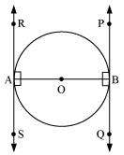
Prove that the tangents drawn at the ends of a diameter of a circle are parallel.
Solution
(N/A) Let $AB$ be a diameter of the circle with center $O$. Two tangents $PQ$ and $RS$ are drawn at points $A$ and $B$ respectively.
Since the radius is perpendicular to the tangent at the point of contact,we have:
$OA \perp RS$ and $OB \perp PQ$
Therefore:
$\angle OAR = 90^{\circ}$
$\angle OAS = 90^{\circ}$
$\angle OBP = 90^{\circ}$
$\angle OBQ = 90^{\circ}$
From the above,we can observe that:
$\angle OAR = \angle OBQ = 90^{\circ}$ (These are alternate interior angles)
$\angle OAS = \angle OBP = 90^{\circ}$ (These are alternate interior angles)
Since the alternate interior angles are equal,the lines $PQ$ and $RS$ must be parallel.
Since the radius is perpendicular to the tangent at the point of contact,we have:
$OA \perp RS$ and $OB \perp PQ$
Therefore:
$\angle OAR = 90^{\circ}$
$\angle OAS = 90^{\circ}$
$\angle OBP = 90^{\circ}$
$\angle OBQ = 90^{\circ}$
From the above,we can observe that:
$\angle OAR = \angle OBQ = 90^{\circ}$ (These are alternate interior angles)
$\angle OAS = \angle OBP = 90^{\circ}$ (These are alternate interior angles)
Since the alternate interior angles are equal,the lines $PQ$ and $RS$ must be parallel.
0 likes
View Solution13
Difficult
Prove that the perpendicular at the point of contact to the tangent to a circle passes through the centre.
Solution
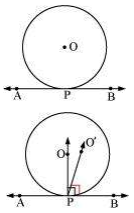
(N/A) Let us consider a circle with centre $O$. Let $AB$ be a tangent which touches the circle at $P$.
We have to prove that the line perpendicular to $AB$ at $P$ passes through the centre $O$. We shall prove this by the contradiction method.
Let us assume that the perpendicular to $AB$ at $P$ does not pass through the centre $O$. Let it pass through another point $O'$.
Join $OP$ and $O'P$.
As the perpendicular to $AB$ at $P$ passes through $O'$,therefore,
$\angle O'PB = 90^{\circ} \dots(1)$
$O$ is the centre of the circle and $P$ is the point of contact. We know that the radius through the point of contact is perpendicular to the tangent.
$\therefore \angle OPB = 90^{\circ} \dots(2)$
Comparing equations $(1)$ and $(2)$,we obtain
$\angle O'PB = \angle OPB \dots(3)$
From the figure,it can be observed that,
$\angle O'PB < \angle OPB \dots(4)$
Therefore,$\angle O'PB = \angle OPB$ is not possible.
It is only possible when the line $O'P$ coincides with $OP$.
Therefore,the perpendicular to $AB$ through $P$ passes through the centre $O$.
We have to prove that the line perpendicular to $AB$ at $P$ passes through the centre $O$. We shall prove this by the contradiction method.
Let us assume that the perpendicular to $AB$ at $P$ does not pass through the centre $O$. Let it pass through another point $O'$.
Join $OP$ and $O'P$.
As the perpendicular to $AB$ at $P$ passes through $O'$,therefore,
$\angle O'PB = 90^{\circ} \dots(1)$
$O$ is the centre of the circle and $P$ is the point of contact. We know that the radius through the point of contact is perpendicular to the tangent.
$\therefore \angle OPB = 90^{\circ} \dots(2)$
Comparing equations $(1)$ and $(2)$,we obtain
$\angle O'PB = \angle OPB \dots(3)$
From the figure,it can be observed that,
$\angle O'PB < \angle OPB \dots(4)$
Therefore,$\angle O'PB = \angle OPB$ is not possible.
It is only possible when the line $O'P$ coincides with $OP$.
Therefore,the perpendicular to $AB$ through $P$ passes through the centre $O$.
1 likes
View Solution14
DifficultMCQ
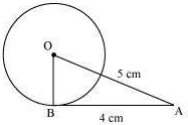
The length of a tangent from a point $A$ at a distance of $5 \, cm$ from the centre of the circle is $4 \, cm$. Find the radius of the circle. (in $, cm$)
A
$16$
B
$3$
C
$9$
D
$25$
Solution
(B) Let the centre of the circle be $O$ and the point from which the tangent is drawn be $A$.
Let $B$ be the point of contact of the tangent on the circle.
Given that the distance of point $A$ from the centre $O$ is $OA = 5 \, cm$.
The length of the tangent $AB = 4 \, cm$.
We know that the radius of a circle is perpendicular to the tangent at the point of contact.
Therefore,$OB \perp AB$,which makes $\triangle ABO$ a right-angled triangle with $\angle OBA = 90^\circ$.
Applying the Pythagoras theorem in $\triangle ABO$:
$OA^2 = AB^2 + OB^2$
$5^2 = 4^2 + OB^2$
$25 = 16 + OB^2$
$OB^2 = 25 - 16$
$OB^2 = 9$
$OB = \sqrt{9} = 3 \, cm$.
Thus,the radius of the circle is $3 \, cm$.
Let $B$ be the point of contact of the tangent on the circle.
Given that the distance of point $A$ from the centre $O$ is $OA = 5 \, cm$.
The length of the tangent $AB = 4 \, cm$.
We know that the radius of a circle is perpendicular to the tangent at the point of contact.
Therefore,$OB \perp AB$,which makes $\triangle ABO$ a right-angled triangle with $\angle OBA = 90^\circ$.
Applying the Pythagoras theorem in $\triangle ABO$:
$OA^2 = AB^2 + OB^2$
$5^2 = 4^2 + OB^2$
$25 = 16 + OB^2$
$OB^2 = 25 - 16$
$OB^2 = 9$
$OB = \sqrt{9} = 3 \, cm$.
Thus,the radius of the circle is $3 \, cm$.
0 likes
View Solution15
MediumMCQ
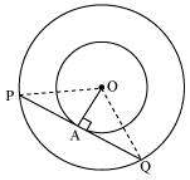
Two concentric circles are of radii $5 \, cm$ and $3 \, cm$. Find the length of the chord of the larger circle which touches the smaller circle.
A
$16$
B
$4$
C
$8$
D
$64$
Solution
(C) Let the two concentric circles be centered at point $O$. Let $PQ$ be the chord of the larger circle which touches the smaller circle at point $A$. Therefore,$PQ$ is tangent to the smaller circle at point $A$.
Since $OA$ is the radius of the smaller circle and $PQ$ is the tangent,$OA \perp PQ$.
Applying the Pythagoras theorem in $\triangle OAP$,we have:
$OA^2 + AP^2 = OP^2$
$3^2 + AP^2 = 5^2$
$9 + AP^2 = 25$
$AP^2 = 25 - 9 = 16$
$AP = \sqrt{16} = 4 \, cm$.
Since the perpendicular from the center of a circle to a chord bisects the chord,we have $AP = AQ$.
Therefore,the length of the chord $PQ = AP + AQ = 2 \times AP = 2 \times 4 = 8 \, cm$.
Since $OA$ is the radius of the smaller circle and $PQ$ is the tangent,$OA \perp PQ$.
Applying the Pythagoras theorem in $\triangle OAP$,we have:
$OA^2 + AP^2 = OP^2$
$3^2 + AP^2 = 5^2$
$9 + AP^2 = 25$
$AP^2 = 25 - 9 = 16$
$AP = \sqrt{16} = 4 \, cm$.
Since the perpendicular from the center of a circle to a chord bisects the chord,we have $AP = AQ$.
Therefore,the length of the chord $PQ = AP + AQ = 2 \times AP = 2 \times 4 = 8 \, cm$.
0 likes
View Solution16
Easy
$A$ quadrilateral $ABCD$ is drawn to circumscribe a circle (see figure). Prove that $AB + CD = AD + BC$.
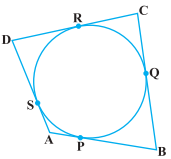
Solution
(N/A) We know that the lengths of tangents drawn from an external point to a circle are equal.
From point $D$,$DR = DS$ ... $(1)$
From point $C$,$CR = CQ$ ... $(2)$
From point $B$,$BP = BQ$ ... $(3)$
From point $A$,$AP = AS$ ... $(4)$
Adding equations $(1), (2), (3),$ and $(4)$,we get:
$DR + CR + BP + AP = DS + CQ + BQ + AS$
Rearranging the terms,we get:
$(DR + CR) + (BP + AP) = (DS + AS) + (CQ + BQ)$
Since $DR + CR = CD$,$BP + AP = AB$,$DS + AS = AD$,and $CQ + BQ = BC$,we have:
$CD + AB = AD + BC$
Hence,$AB + CD = AD + BC$.
From point $D$,$DR = DS$ ... $(1)$
From point $C$,$CR = CQ$ ... $(2)$
From point $B$,$BP = BQ$ ... $(3)$
From point $A$,$AP = AS$ ... $(4)$
Adding equations $(1), (2), (3),$ and $(4)$,we get:
$DR + CR + BP + AP = DS + CQ + BQ + AS$
Rearranging the terms,we get:
$(DR + CR) + (BP + AP) = (DS + AS) + (CQ + BQ)$
Since $DR + CR = CD$,$BP + AP = AB$,$DS + AS = AD$,and $CQ + BQ = BC$,we have:
$CD + AB = AD + BC$
Hence,$AB + CD = AD + BC$.
0 likes
View Solution17
Medium
In $Fig.$,$XY$ and $X'Y'$ are two parallel tangents to a circle with centre $O$ and another tangent $AB$ with point of contact $C$ intersecting $XY$ at $A$ and $X'Y'$ at $B$. Prove that $\angle AOB = 90^{\circ}$.
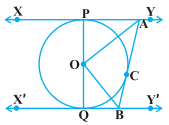
Solution
(N/A) Join point $O$ to $C$.
In $\triangle OPA$ and $\triangle OCA$:
$OP = OC$ (Radii of the same circle)
$AP = AC$ (Tangents drawn from an external point $A$ are equal in length)
$AO = AO$ (Common side)
Therefore,$\triangle OPA \cong \triangle OCA$ by $SSS$ congruence criterion.
This implies $\angle POA = \angle COA$ ... $(i)$
Similarly,in $\triangle OQB$ and $\triangle OCB$:
$OQ = OC$ (Radii of the same circle)
$BQ = BC$ (Tangents drawn from an external point $B$ are equal in length)
$OB = OB$ (Common side)
Therefore,$\triangle OQB \cong \triangle OCB$ by $SSS$ congruence criterion.
This implies $\angle QOB = \angle COB$ ... $(ii)$
Since $POQ$ is a diameter of the circle,it is a straight line,so the sum of angles on one side is $180^{\circ}$:
$\angle POA + \angle COA + \angle COB + \angle QOB = 180^{\circ}$
Using equations $(i)$ and $(ii)$:
$2 \angle COA + 2 \angle COB = 180^{\circ}$
$2(\angle COA + \angle COB) = 180^{\circ}$
$\angle COA + \angle COB = 90^{\circ}$
Therefore,$\angle AOB = 90^{\circ}$.
In $\triangle OPA$ and $\triangle OCA$:
$OP = OC$ (Radii of the same circle)
$AP = AC$ (Tangents drawn from an external point $A$ are equal in length)
$AO = AO$ (Common side)
Therefore,$\triangle OPA \cong \triangle OCA$ by $SSS$ congruence criterion.
This implies $\angle POA = \angle COA$ ... $(i)$
Similarly,in $\triangle OQB$ and $\triangle OCB$:
$OQ = OC$ (Radii of the same circle)
$BQ = BC$ (Tangents drawn from an external point $B$ are equal in length)
$OB = OB$ (Common side)
Therefore,$\triangle OQB \cong \triangle OCB$ by $SSS$ congruence criterion.
This implies $\angle QOB = \angle COB$ ... $(ii)$
Since $POQ$ is a diameter of the circle,it is a straight line,so the sum of angles on one side is $180^{\circ}$:
$\angle POA + \angle COA + \angle COB + \angle QOB = 180^{\circ}$
Using equations $(i)$ and $(ii)$:
$2 \angle COA + 2 \angle COB = 180^{\circ}$
$2(\angle COA + \angle COB) = 180^{\circ}$
$\angle COA + \angle COB = 90^{\circ}$
Therefore,$\angle AOB = 90^{\circ}$.
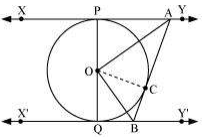
0 likes
View Solution18
Difficult
Prove that the angle between the two tangents drawn from an external point to a circle is supplementary to the angle subtended by the line segment joining the points of contact at the centre.
Solution
(N/A) Let us consider a circle centered at point $O$. Let $P$ be an external point from which two tangents $PA$ and $PB$ are drawn to the circle,touching the circle at points $A$ and $B$ respectively. $AB$ is the line segment joining the points of contact $A$ and $B$,which subtends $\angle AOB$ at the center $O$ of the circle.
It can be observed that:
$OA$ (radius) $\perp PA$ (tangent)
Therefore,$\angle OAP = 90^{\circ}$
Similarly,$OB$ (radius) $\perp PB$ (tangent)
Therefore,$\angle OBP = 90^{\circ}$
In the quadrilateral $OAPB$,the sum of all interior angles is $360^{\circ}$.
$\angle OAP + \angle APB + \angle PBO + \angle BOA = 360^{\circ}$
$90^{\circ} + \angle APB + 90^{\circ} + \angle BOA = 360^{\circ}$
$\angle APB + \angle BOA = 180^{\circ}$
Hence,it is proved that the angle between the two tangents drawn from an external point to a circle is supplementary to the angle subtended by the line segment joining the points of contact at the center.
It can be observed that:
$OA$ (radius) $\perp PA$ (tangent)
Therefore,$\angle OAP = 90^{\circ}$
Similarly,$OB$ (radius) $\perp PB$ (tangent)
Therefore,$\angle OBP = 90^{\circ}$
In the quadrilateral $OAPB$,the sum of all interior angles is $360^{\circ}$.
$\angle OAP + \angle APB + \angle PBO + \angle BOA = 360^{\circ}$
$90^{\circ} + \angle APB + 90^{\circ} + \angle BOA = 360^{\circ}$
$\angle APB + \angle BOA = 180^{\circ}$
Hence,it is proved that the angle between the two tangents drawn from an external point to a circle is supplementary to the angle subtended by the line segment joining the points of contact at the center.
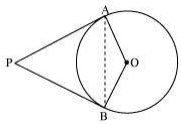
0 likes
View Solution19
Difficult
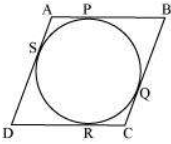
Prove that the parallelogram circumscribing a circle is a rhombus.
Solution
(N/A) Since $ABCD$ is a parallelogram,
$AB = CD \dots(1)$
$BC = AD \dots(2)$
It can be observed that:
$DR = DS$ (Tangents on the circle from point $D$)
$CR = CQ$ (Tangents on the circle from point $C$)
$BP = BQ$ (Tangents on the circle from point $B$)
$AP = AS$ (Tangents on the circle from point $A$)
Adding all these equations,we obtain:
$DR + CR + BP + AP = DS + CQ + BQ + AS$
$(DR + CR) + (BP + AP) = (DS + AS) + (CQ + BQ)$
$CD + AB = AD + BC$
On putting the values of equations $(1)$ and $(2)$ in this equation,we obtain:
$2AB = 2BC$
$AB = BC \dots(3)$
Comparing equations $(1), (2),$ and $(3),$ we obtain:
$AB = BC = CD = DA$
Hence,$ABCD$ is a rhombus.
$AB = CD \dots(1)$
$BC = AD \dots(2)$
It can be observed that:
$DR = DS$ (Tangents on the circle from point $D$)
$CR = CQ$ (Tangents on the circle from point $C$)
$BP = BQ$ (Tangents on the circle from point $B$)
$AP = AS$ (Tangents on the circle from point $A$)
Adding all these equations,we obtain:
$DR + CR + BP + AP = DS + CQ + BQ + AS$
$(DR + CR) + (BP + AP) = (DS + AS) + (CQ + BQ)$
$CD + AB = AD + BC$
On putting the values of equations $(1)$ and $(2)$ in this equation,we obtain:
$2AB = 2BC$
$AB = BC \dots(3)$
Comparing equations $(1), (2),$ and $(3),$ we obtain:
$AB = BC = CD = DA$
Hence,$ABCD$ is a rhombus.
0 likes
View Solution20
DifficultMCQ
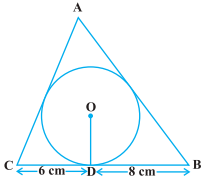
$A$ triangle $ABC$ is drawn to circumscribe a circle of radius $4 \, cm$ such that the segments $BD$ and $DC$ into which $BC$ is divided by the point of contact $D$ are of lengths $8 \, cm$ and $6 \, cm$ respectively (see figure). Find the sides $AB$ and $AC$ (in $cm$).
A
$7, 14$
B
$20, 22$
C
$95, 97$
D
$15, 13$
Solution
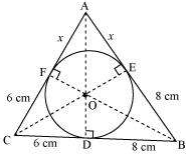
(D) Let the circle touch the sides $AB$ and $AC$ of the triangle at points $E$ and $F$ respectively. Let the length of the tangent $AF$ be $x \, cm$.
Since tangents drawn from an external point to a circle are equal in length:
$CF = CD = 6 \, cm$
$BE = BD = 8 \, cm$
$AE = AF = x \, cm$
Thus,the sides of the triangle are:
$AB = AE + EB = x + 8$
$BC = BD + DC = 8 + 6 = 14 \, cm$
$AC = AF + FC = x + 6$
Semi-perimeter $s = \frac{(x+8) + 14 + (x+6)}{2} = \frac{2x + 28}{2} = x + 14$.
Using Heron's formula,Area of $\triangle ABC = \sqrt{s(s-a)(s-b)(s-c)}$
$= \sqrt{(x+14)(x+14-14)(x+14-(x+6))(x+14-(x+8))}$
$= \sqrt{(x+14)(x)(8)(6)} = \sqrt{48x(x+14)} = 4\sqrt{3x(x+14)}$.
Also,Area of $\triangle ABC = \text{Area}(\triangle OBC) + \text{Area}(\triangle OCA) + \text{Area}(\triangle OAB)$
$= \frac{1}{2} \times 4 \times 14 + \frac{1}{2} \times 4 \times (x+6) + \frac{1}{2} \times 4 \times (x+8)$
$= 28 + 2(x+6) + 2(x+8) = 28 + 2x + 12 + 2x + 16 = 56 + 4x = 4(14+x)$.
Equating the areas: $4\sqrt{3x(x+14)} = 4(14+x)$
$\sqrt{3x(x+14)} = 14+x$
Squaring both sides: $3x(x+14) = (14+x)^2$
$3x^2 + 42x = 196 + x^2 + 28x$
$2x^2 + 14x - 196 = 0 \Rightarrow x^2 + 7x - 98 = 0$
$(x+14)(x-7) = 0$. Since $x > 0$,$x = 7$.
Therefore,$AB = 7+8 = 15 \, cm$ and $AC = 7+6 = 13 \, cm$.
Since tangents drawn from an external point to a circle are equal in length:
$CF = CD = 6 \, cm$
$BE = BD = 8 \, cm$
$AE = AF = x \, cm$
Thus,the sides of the triangle are:
$AB = AE + EB = x + 8$
$BC = BD + DC = 8 + 6 = 14 \, cm$
$AC = AF + FC = x + 6$
Semi-perimeter $s = \frac{(x+8) + 14 + (x+6)}{2} = \frac{2x + 28}{2} = x + 14$.
Using Heron's formula,Area of $\triangle ABC = \sqrt{s(s-a)(s-b)(s-c)}$
$= \sqrt{(x+14)(x+14-14)(x+14-(x+6))(x+14-(x+8))}$
$= \sqrt{(x+14)(x)(8)(6)} = \sqrt{48x(x+14)} = 4\sqrt{3x(x+14)}$.
Also,Area of $\triangle ABC = \text{Area}(\triangle OBC) + \text{Area}(\triangle OCA) + \text{Area}(\triangle OAB)$
$= \frac{1}{2} \times 4 \times 14 + \frac{1}{2} \times 4 \times (x+6) + \frac{1}{2} \times 4 \times (x+8)$
$= 28 + 2(x+6) + 2(x+8) = 28 + 2x + 12 + 2x + 16 = 56 + 4x = 4(14+x)$.
Equating the areas: $4\sqrt{3x(x+14)} = 4(14+x)$
$\sqrt{3x(x+14)} = 14+x$
Squaring both sides: $3x(x+14) = (14+x)^2$
$3x^2 + 42x = 196 + x^2 + 28x$
$2x^2 + 14x - 196 = 0 \Rightarrow x^2 + 7x - 98 = 0$
$(x+14)(x-7) = 0$. Since $x > 0$,$x = 7$.
Therefore,$AB = 7+8 = 15 \, cm$ and $AC = 7+6 = 13 \, cm$.
0 likes
View Solution21
Difficult
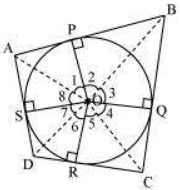
Prove that opposite sides of a quadrilateral circumscribing a circle subtend supplementary angles at the centre of the circle.
Solution
(N/A) Let $ABCD$ be a quadrilateral circumscribing a circle centered at $O$ such that it touches the circle at points $P, Q, R, S$. Let us join the vertices of the quadrilateral $ABCD$ to the center of the circle.
Consider $\triangle OAP$ and $\triangle OAS$:
$AP = AS$ (Tangents from the same point)
$OP = OS$ (Radii of the same circle)
$OA = OA$ (Common side)
Therefore,$\triangle OAP \cong \triangle OAS$ ($SSS$ congruence criterion).
Thus,$\angle POA = \angle AOS$,which implies $\angle 1 = \angle 8$.
Similarly,we can show that:
$\angle 2 = \angle 3$
$\angle 4 = \angle 5$
$\angle 6 = \angle 7$
Since the sum of angles around the center is $360^{\circ}$:
$\angle 1 + \angle 2 + \angle 3 + \angle 4 + \angle 5 + \angle 6 + \angle 7 + \angle 8 = 360^{\circ}$
Substituting the equal angles:
$(\angle 1 + \angle 8) + (\angle 2 + \angle 3) + (\angle 4 + \angle 5) + (\angle 6 + \angle 7) = 360^{\circ}$
$2\angle 1 + 2\angle 2 + 2\angle 5 + 2\angle 6 = 360^{\circ}$
$2(\angle 1 + \angle 2) + 2(\angle 5 + \angle 6) = 360^{\circ}$
$(\angle 1 + \angle 2) + (\angle 5 + \angle 6) = 180^{\circ}$
Thus,$\angle AOB + \angle COD = 180^{\circ}$.
Similarly,we can prove that $\angle BOC + \angle DOA = 180^{\circ}$.
Hence,opposite sides of a quadrilateral circumscribing a circle subtend supplementary angles at the center of the circle.
Consider $\triangle OAP$ and $\triangle OAS$:
$AP = AS$ (Tangents from the same point)
$OP = OS$ (Radii of the same circle)
$OA = OA$ (Common side)
Therefore,$\triangle OAP \cong \triangle OAS$ ($SSS$ congruence criterion).
Thus,$\angle POA = \angle AOS$,which implies $\angle 1 = \angle 8$.
Similarly,we can show that:
$\angle 2 = \angle 3$
$\angle 4 = \angle 5$
$\angle 6 = \angle 7$
Since the sum of angles around the center is $360^{\circ}$:
$\angle 1 + \angle 2 + \angle 3 + \angle 4 + \angle 5 + \angle 6 + \angle 7 + \angle 8 = 360^{\circ}$
Substituting the equal angles:
$(\angle 1 + \angle 8) + (\angle 2 + \angle 3) + (\angle 4 + \angle 5) + (\angle 6 + \angle 7) = 360^{\circ}$
$2\angle 1 + 2\angle 2 + 2\angle 5 + 2\angle 6 = 360^{\circ}$
$2(\angle 1 + \angle 2) + 2(\angle 5 + \angle 6) = 360^{\circ}$
$(\angle 1 + \angle 2) + (\angle 5 + \angle 6) = 180^{\circ}$
Thus,$\angle AOB + \angle COD = 180^{\circ}$.
Similarly,we can prove that $\angle BOC + \angle DOA = 180^{\circ}$.
Hence,opposite sides of a quadrilateral circumscribing a circle subtend supplementary angles at the center of the circle.
0 likes
View SolutionCircles — Textbook - Circles · Frequently Asked Questions
1Are these Circles questions useful for JEE and NEET?
Yes. All questions in this section are mapped to JEE Main and NEET exam patterns. Previous year questions from JEE Main, NEET, GUJCET and state-level exams are included with full solutions.
2Can I switch to Hindi or Gujarati for these questions?
Yes. Use the language tabs in the hero section or the sidebar to view the same questions and solutions in English, Hindi or Gujarati.
3How do I generate a question paper from this subtopic?
Use the Vedclass Exam Paper Generator — select the chapter and subtopic, set difficulty, and generate Sets A, B, C, D automatically. First 3 chapters of every subject are free.
Vedclass Products
For Students
Vedclass Test Series
Mock tests in real JEE/NEET style with performance analysis. 5-day free trial.
Start Free TrialFor Teachers
Exam Paper Generator
Generate Set A/B/C/D papers from this chapter in 2 minutes. 3 chapters free.
Try FreeFor Institutes
Online Exam Module
Live online exams with unlimited students, 360° analytics & white-label branding.
See DemoFor Teachers & Institutes
Generate a Circles Exam Paper in 2 Minutes
Select subtopic & difficulty — Sets A, B, C, D auto-generated with No Repeat logic.
First 3 chapters of every subject are free — no payment required.