
MathematicsQ51–64 of 114 questions
Page 2 of 2 · English
51
MathematicsMediumMCQTS EAMCET · 2001
The equation $16 x^2+y^2+8 x y-74 x-78 y+212=0$ represents
A
a circle
B
a parabola
C
a hyperbola
D
an ellipse
Solution
(B) The given equation is $16 x^2+y^2+8 x y-74 x-78 y+212=0$.
Comparing this with the general second-degree equation $a x^2+2 h x y+b y^2+2 g x+2 f y+c=0$,we get:
$a=16, b=1, h=4, g=-37, f=-39, c=212$.
Now,we calculate the discriminant $D = a b-h^2$:
$D = (16)(1)-(4)^2 = 16-16 = 0$.
Since $a b-h^2=0$,the given equation represents a parabola.
Comparing this with the general second-degree equation $a x^2+2 h x y+b y^2+2 g x+2 f y+c=0$,we get:
$a=16, b=1, h=4, g=-37, f=-39, c=212$.
Now,we calculate the discriminant $D = a b-h^2$:
$D = (16)(1)-(4)^2 = 16-16 = 0$.
Since $a b-h^2=0$,the given equation represents a parabola.
0 likesView Solution
52
MathematicsDifficultMCQTS EAMCET · 2001
The equation of a curve in polar coordinates is $\frac{l}{r} = 2 \sin^2 \frac{\theta}{2}$. This equation represents:
A
a straight line
B
a parabola
C
a circle
D
an ellipse
Solution
(B) Given the equation $\frac{l}{r} = 2 \sin^2 \frac{\theta}{2}$.
Using the trigonometric identity $2 \sin^2 \frac{\theta}{2} = 1 - \cos \theta$,we get $\frac{l}{r} = 1 - \cos \theta$.
Rearranging,$l = r(1 - \cos \theta) = r - r \cos \theta$.
Since $x = r \cos \theta$ and $r = \sqrt{x^2 + y^2}$,we have $l = \sqrt{x^2 + y^2} - x$.
Thus,$\sqrt{x^2 + y^2} = x + l$.
Squaring both sides,$x^2 + y^2 = (x + l)^2 = x^2 + 2lx + l^2$.
Simplifying,$y^2 = 2lx + l^2 = 2l(x + \frac{l}{2})$.
This is the standard form of a parabola $Y^2 = 4AX$ with vertex at $(-\frac{l}{2}, 0)$.
Using the trigonometric identity $2 \sin^2 \frac{\theta}{2} = 1 - \cos \theta$,we get $\frac{l}{r} = 1 - \cos \theta$.
Rearranging,$l = r(1 - \cos \theta) = r - r \cos \theta$.
Since $x = r \cos \theta$ and $r = \sqrt{x^2 + y^2}$,we have $l = \sqrt{x^2 + y^2} - x$.
Thus,$\sqrt{x^2 + y^2} = x + l$.
Squaring both sides,$x^2 + y^2 = (x + l)^2 = x^2 + 2lx + l^2$.
Simplifying,$y^2 = 2lx + l^2 = 2l(x + \frac{l}{2})$.
This is the standard form of a parabola $Y^2 = 4AX$ with vertex at $(-\frac{l}{2}, 0)$.
0 likesView Solution
53
MathematicsEasyMCQTS EAMCET · 2001
$\lim _{x \rightarrow 0} \frac{\sin x \sin ^{-1} x}{x^2}$ is equal to
A
$0$
B
$1$
C
$-1$
D
$\infty$
Solution
(B) We are given the limit: $\lim _{x \rightarrow 0} \frac{\sin x \sin ^{-1} x}{x^2}$
We can rewrite the expression as: $\lim _{x \rightarrow 0} \left(\frac{\sin x}{x}\right) \left(\frac{\sin ^{-1} x}{x}\right)$
Using the standard limits $\lim _{x \rightarrow 0} \frac{\sin x}{x} = 1$ and $\lim _{x \rightarrow 0} \frac{\sin ^{-1} x}{x} = 1$,we get:
$1 \times 1 = 1$
We can rewrite the expression as: $\lim _{x \rightarrow 0} \left(\frac{\sin x}{x}\right) \left(\frac{\sin ^{-1} x}{x}\right)$
Using the standard limits $\lim _{x \rightarrow 0} \frac{\sin x}{x} = 1$ and $\lim _{x \rightarrow 0} \frac{\sin ^{-1} x}{x} = 1$,we get:
$1 \times 1 = 1$
0 likesView Solution
54
MathematicsDifficultMCQTS EAMCET · 2001
$\lim _{x \rightarrow 0} \left( \frac{x \cdot 10^x - x}{1 - \cos x} \right)$ is equal to
A
$\log 10$
B
$2 \log 10$
C
$3 \log 10$
D
$4 \log 10$
Solution
(B) Given limit: $L = \lim _{x \rightarrow 0} \frac{x(10^x - 1)}{1 - \cos x}$.
Since this is a $\frac{0}{0}$ form,we apply $L$-Hospital's rule:
$L = \lim _{x \rightarrow 0} \frac{x \cdot 10^x \ln 10 + (10^x - 1)}{\sin x}$.
Again,this is a $\frac{0}{0}$ form,so we apply $L$-Hospital's rule again:
$L = \lim _{x \rightarrow 0} \frac{x \cdot 10^x (\ln 10)^2 + 10^x \ln 10 + 10^x \ln 10}{\cos x}$.
Substituting $x = 0$:
$L = \frac{0 \cdot 10^0 (\ln 10)^2 + 10^0 \ln 10 + 10^0 \ln 10}{\cos 0} = \frac{0 + \ln 10 + \ln 10}{1} = 2 \ln 10$.
Since $\log 10$ usually denotes $\log_{10} 10 = 1$ or $\ln 10$ depending on context,and given the options,the result is $2 \log 10$.
Since this is a $\frac{0}{0}$ form,we apply $L$-Hospital's rule:
$L = \lim _{x \rightarrow 0} \frac{x \cdot 10^x \ln 10 + (10^x - 1)}{\sin x}$.
Again,this is a $\frac{0}{0}$ form,so we apply $L$-Hospital's rule again:
$L = \lim _{x \rightarrow 0} \frac{x \cdot 10^x (\ln 10)^2 + 10^x \ln 10 + 10^x \ln 10}{\cos x}$.
Substituting $x = 0$:
$L = \frac{0 \cdot 10^0 (\ln 10)^2 + 10^0 \ln 10 + 10^0 \ln 10}{\cos 0} = \frac{0 + \ln 10 + \ln 10}{1} = 2 \ln 10$.
Since $\log 10$ usually denotes $\log_{10} 10 = 1$ or $\ln 10$ depending on context,and given the options,the result is $2 \log 10$.
0 likesView Solution
55
MathematicsMediumMCQTS EAMCET · 2001
$\lim _{x \rightarrow \infty} \left(\frac{x+a}{x+b}\right)^{x}$ is equal to
A
$e^{a-b}$
B
$e^{b-a}$
C
$1$
D
$e^{a+b}$
Solution
(A) We evaluate the limit $L = \lim _{x \rightarrow \infty} \left(\frac{x+a}{x+b}\right)^{x}$.
This is of the form $1^{\infty}$.
We can rewrite the expression as:
$L = \lim _{x \rightarrow \infty} \left(1 + \frac{a-b}{x+b}\right)^{x}$.
Using the standard limit formula $\lim _{x \rightarrow \infty} (1 + \frac{k}{x})^x = e^k$,we have:
$L = \lim _{x \rightarrow \infty} \left(1 + \frac{a-b}{x+b}\right)^{\frac{x+b}{a-b} \cdot \frac{x(a-b)}{x+b}}$.
$L = e^{\lim _{x \rightarrow \infty} \frac{x(a-b)}{x+b}} = e^{a-b}$.
This is of the form $1^{\infty}$.
We can rewrite the expression as:
$L = \lim _{x \rightarrow \infty} \left(1 + \frac{a-b}{x+b}\right)^{x}$.
Using the standard limit formula $\lim _{x \rightarrow \infty} (1 + \frac{k}{x})^x = e^k$,we have:
$L = \lim _{x \rightarrow \infty} \left(1 + \frac{a-b}{x+b}\right)^{\frac{x+b}{a-b} \cdot \frac{x(a-b)}{x+b}}$.
$L = e^{\lim _{x \rightarrow \infty} \frac{x(a-b)}{x+b}} = e^{a-b}$.
0 likesView Solution
56
MathematicsEasyMCQTS EAMCET · 2001
In a $\triangle ABC$,if $\frac{a}{b^2-c^2} + \frac{c}{b^2-a^2} = 0$,then $B$ is equal to
A
$\frac{\pi}{2}$
B
$\frac{\pi}{4}$
C
$\frac{2\pi}{3}$
D
$\frac{\pi}{3}$
Solution
(D) Given,$\frac{a}{b^2-c^2} + \frac{c}{b^2-a^2} = 0$.
Using the sine rule $a = 2R \sin A$,$b = 2R \sin B$,and $c = 2R \sin C$:
$\frac{2R \sin A}{4R^2(\sin^2 B - \sin^2 C)} + \frac{2R \sin C}{4R^2(\sin^2 B - \sin^2 A)} = 0$
$\Rightarrow \frac{\sin A}{\sin(B+C)\sin(B-C)} + \frac{\sin C}{\sin(B+A)\sin(B-A)} = 0$
Since $A+B+C = \pi$,we have $\sin(B+C) = \sin A$ and $\sin(B+A) = \sin C$.
$\Rightarrow \frac{\sin A}{\sin A \sin(B-C)} + \frac{\sin C}{\sin C \sin(B-A)} = 0$
$\Rightarrow \frac{1}{\sin(B-C)} + \frac{1}{\sin(B-A)} = 0$
$\Rightarrow \sin(B-A) + \sin(B-C) = 0$
$\Rightarrow 2 \sin\left(\frac{2B-A-C}{2}\right) \cos\left(\frac{A-C}{2}\right) = 0$
Assuming $\cos\left(\frac{A-C}{2}\right) \neq 0$,we get $\sin\left(\frac{2B-(A+C)}{2}\right) = 0$.
Since $A+C = \pi - B$,we have $\frac{2B-(\pi-B)}{2} = 0$ $\Rightarrow 3B = \pi$ $\Rightarrow B = \frac{\pi}{3}$.
Using the sine rule $a = 2R \sin A$,$b = 2R \sin B$,and $c = 2R \sin C$:
$\frac{2R \sin A}{4R^2(\sin^2 B - \sin^2 C)} + \frac{2R \sin C}{4R^2(\sin^2 B - \sin^2 A)} = 0$
$\Rightarrow \frac{\sin A}{\sin(B+C)\sin(B-C)} + \frac{\sin C}{\sin(B+A)\sin(B-A)} = 0$
Since $A+B+C = \pi$,we have $\sin(B+C) = \sin A$ and $\sin(B+A) = \sin C$.
$\Rightarrow \frac{\sin A}{\sin A \sin(B-C)} + \frac{\sin C}{\sin C \sin(B-A)} = 0$
$\Rightarrow \frac{1}{\sin(B-C)} + \frac{1}{\sin(B-A)} = 0$
$\Rightarrow \sin(B-A) + \sin(B-C) = 0$
$\Rightarrow 2 \sin\left(\frac{2B-A-C}{2}\right) \cos\left(\frac{A-C}{2}\right) = 0$
Assuming $\cos\left(\frac{A-C}{2}\right) \neq 0$,we get $\sin\left(\frac{2B-(A+C)}{2}\right) = 0$.
Since $A+C = \pi - B$,we have $\frac{2B-(\pi-B)}{2} = 0$ $\Rightarrow 3B = \pi$ $\Rightarrow B = \frac{\pi}{3}$.
0 likesView Solution
57
MathematicsEasyMCQTS EAMCET · 2001
In a $\triangle ABC$,the expression $\frac{\cos C+\cos A}{c+a}+\frac{\cos B}{b}$ is equal to
A
$\frac{1}{a}$
B
$\frac{1}{b}$
C
$\frac{c+a}{b}$
D
$1$
Solution
(B) Using the sine rule,we have $a = 2R \sin A$,$b = 2R \sin B$,and $c = 2R \sin C$.
Consider the first term:
$\frac{\cos C+\cos A}{c+a} = \frac{2 \cos \frac{C+A}{2} \cos \frac{C-A}{2}}{2R(\sin C+\sin A)} = \frac{2 \cos \frac{C+A}{2} \cos \frac{C-A}{2}}{2R \cdot 2 \sin \frac{C+A}{2} \cos \frac{C-A}{2}} = \frac{1}{2R} \cot \frac{C+A}{2} = \frac{1}{2R} \tan \frac{B}{2}$.
Consider the second term:
$\frac{\cos B}{b} = \frac{\cos B}{2R \sin B} = \frac{1}{2R} \cot B$.
Adding them together:
$\frac{1}{2R} \left( \tan \frac{B}{2} + \cot B \right) = \frac{1}{2R} \left( \tan \frac{B}{2} + \frac{1-\tan^2 \frac{B}{2}}{2 \tan \frac{B}{2}} \right) = \frac{1}{2R} \left( \frac{2 \tan^2 \frac{B}{2} + 1 - \tan^2 \frac{B}{2}}{2 \tan \frac{B}{2}} \right) = \frac{1}{2R} \left( \frac{1 + \tan^2 \frac{B}{2}}{2 \tan \frac{B}{2}} \right) = \frac{1}{2R} \cdot \frac{1}{\sin B} = \frac{1}{b}$.
Consider the first term:
$\frac{\cos C+\cos A}{c+a} = \frac{2 \cos \frac{C+A}{2} \cos \frac{C-A}{2}}{2R(\sin C+\sin A)} = \frac{2 \cos \frac{C+A}{2} \cos \frac{C-A}{2}}{2R \cdot 2 \sin \frac{C+A}{2} \cos \frac{C-A}{2}} = \frac{1}{2R} \cot \frac{C+A}{2} = \frac{1}{2R} \tan \frac{B}{2}$.
Consider the second term:
$\frac{\cos B}{b} = \frac{\cos B}{2R \sin B} = \frac{1}{2R} \cot B$.
Adding them together:
$\frac{1}{2R} \left( \tan \frac{B}{2} + \cot B \right) = \frac{1}{2R} \left( \tan \frac{B}{2} + \frac{1-\tan^2 \frac{B}{2}}{2 \tan \frac{B}{2}} \right) = \frac{1}{2R} \left( \frac{2 \tan^2 \frac{B}{2} + 1 - \tan^2 \frac{B}{2}}{2 \tan \frac{B}{2}} \right) = \frac{1}{2R} \left( \frac{1 + \tan^2 \frac{B}{2}}{2 \tan \frac{B}{2}} \right) = \frac{1}{2R} \cdot \frac{1}{\sin B} = \frac{1}{b}$.
0 likesView Solution
58
MathematicsMediumMCQTS EAMCET · 2001
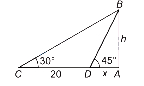
The shadow of a tower standing on a level ground is found to be $60 \ m$ longer when the Sun's altitude is $30^{\circ}$ than when it is $45^{\circ}$. The height of the tower is
A
$30 \ m$
B
$90 \ m$
C
$60 \sqrt{3} \ m$
D
$30(\sqrt{3}+1) \ m$
Solution
(D) Let the height of the tower be $h$ and the length of the shadow when the Sun's altitude is $45^{\circ}$ be $x$.
In $\triangle BAD$,$\tan 45^{\circ} = \frac{h}{x}$ $\Rightarrow 1 = \frac{h}{x}$ $\Rightarrow x = h$.
When the Sun's altitude is $30^{\circ}$,the shadow length is $x + 60$.
In $\triangle BAC$,$\tan 30^{\circ} = \frac{h}{x+60} \Rightarrow \frac{1}{\sqrt{3}} = \frac{h}{h+60}$.
$\Rightarrow h + 60 = h\sqrt{3}$
$\Rightarrow h(\sqrt{3} - 1) = 60$
$\Rightarrow h = \frac{60}{\sqrt{3}-1} \times \frac{\sqrt{3}+1}{\sqrt{3}+1}$
$\Rightarrow h = \frac{60(\sqrt{3}+1)}{3-1} = \frac{60(\sqrt{3}+1)}{2} = 30(\sqrt{3}+1) \ m$.
In $\triangle BAD$,$\tan 45^{\circ} = \frac{h}{x}$ $\Rightarrow 1 = \frac{h}{x}$ $\Rightarrow x = h$.
When the Sun's altitude is $30^{\circ}$,the shadow length is $x + 60$.
In $\triangle BAC$,$\tan 30^{\circ} = \frac{h}{x+60} \Rightarrow \frac{1}{\sqrt{3}} = \frac{h}{h+60}$.
$\Rightarrow h + 60 = h\sqrt{3}$
$\Rightarrow h(\sqrt{3} - 1) = 60$
$\Rightarrow h = \frac{60}{\sqrt{3}-1} \times \frac{\sqrt{3}+1}{\sqrt{3}+1}$
$\Rightarrow h = \frac{60(\sqrt{3}+1)}{3-1} = \frac{60(\sqrt{3}+1)}{2} = 30(\sqrt{3}+1) \ m$.
0 likesView Solution
59
MathematicsEasyMCQTS EAMCET · 2001
In a $\triangle ABC$, $a^2 \sin 2C + c^2 \sin 2A$ is equal to (in $\Delta$)
A
$2\Delta$
B
$4\Delta$
C
$6\Delta$
D
$8\Delta$
Solution
(B) Using the sine rule, $a = 2R \sin A$ and $c = 2R \sin C$.
Substituting these into the expression:
$a^2 \sin 2C + c^2 \sin 2A = (2R \sin A)^2 (2 \sin C \cos C) + (2R \sin C)^2 (2 \sin A \cos A)$
$= 8R^2 \sin^2 A \sin C \cos C + 8R^2 \sin^2 C \sin A \cos A$
$= 8R^2 \sin A \sin C (\sin A \cos C + \cos A \sin C)$
$= 8R^2 \sin A \sin C \sin(A + C)$
Since $A + B + C = 180^{\circ}$, $\sin(A + C) = \sin B$.
$= 8R^2 \sin A \sin B \sin C$
Using the area formula $\Delta = \frac{abc}{4R}$, we know $abc = 4R\Delta$.
Also, $\sin A = \frac{a}{2R}$, $\sin B = \frac{b}{2R}$, $\sin C = \frac{c}{2R}$.
So, $8R^2 \cdot \frac{a}{2R} \cdot \frac{b}{2R} \cdot \frac{c}{2R} = \frac{abc}{R} = \frac{4R\Delta}{R} = 4\Delta$.
Substituting these into the expression:
$a^2 \sin 2C + c^2 \sin 2A = (2R \sin A)^2 (2 \sin C \cos C) + (2R \sin C)^2 (2 \sin A \cos A)$
$= 8R^2 \sin^2 A \sin C \cos C + 8R^2 \sin^2 C \sin A \cos A$
$= 8R^2 \sin A \sin C (\sin A \cos C + \cos A \sin C)$
$= 8R^2 \sin A \sin C \sin(A + C)$
Since $A + B + C = 180^{\circ}$, $\sin(A + C) = \sin B$.
$= 8R^2 \sin A \sin B \sin C$
Using the area formula $\Delta = \frac{abc}{4R}$, we know $abc = 4R\Delta$.
Also, $\sin A = \frac{a}{2R}$, $\sin B = \frac{b}{2R}$, $\sin C = \frac{c}{2R}$.
So, $8R^2 \cdot \frac{a}{2R} \cdot \frac{b}{2R} \cdot \frac{c}{2R} = \frac{abc}{R} = \frac{4R\Delta}{R} = 4\Delta$.
0 likesView Solution
60
MathematicsEasyMCQTS EAMCET · 2001
If $\left|\begin{array}{cc}1-i & i \\ 1+2 i & -i\end{array}\right|=x+i y$,then $x$ is equal to
A
$-2$
B
$-1$
C
$1$
D
$2$
Solution
(C) Given the determinant: $\left|\begin{array}{cc}1-i & i \\ 1+2 i & -i\end{array}\right|=x+i y$
Expanding the determinant: $(1-i)(-i) - (i)(1+2i) = x+iy$
$-i + i^2 - (i + 2i^2) = x+iy$
Since $i^2 = -1$,we substitute: $-i - 1 - (i - 2) = x+iy$
$-i - 1 - i + 2 = x+iy$
$1 - 2i = x+iy$
Comparing the real and imaginary parts,we get $x = 1$ and $y = -2$.
Expanding the determinant: $(1-i)(-i) - (i)(1+2i) = x+iy$
$-i + i^2 - (i + 2i^2) = x+iy$
Since $i^2 = -1$,we substitute: $-i - 1 - (i - 2) = x+iy$
$-i - 1 - i + 2 = x+iy$
$1 - 2i = x+iy$
Comparing the real and imaginary parts,we get $x = 1$ and $y = -2$.
0 likesView Solution
61
MathematicsMediumMCQTS EAMCET · 2001
If $x = \log_{0.1} 0.001$ and $y = \log_9 81$,then $\sqrt{x - 2\sqrt{y}}$ is equal to
A
$3 - \sqrt{2}$
B
$\sqrt{3} - 2$
C
$\sqrt{2} - 1$
D
$\sqrt{2} - 2$
Solution
(C) Given $x = \log_{0.1} 0.001$. Since $0.001 = (0.1)^3$,we have $x = \log_{0.1} (0.1)^3 = 3 \log_{0.1} 0.1 = 3(1) = 3$.
Given $y = \log_9 81$. Since $81 = 9^2$,we have $y = \log_9 9^2 = 2 \log_9 9 = 2(1) = 2$.
Now,we need to evaluate $\sqrt{x - 2\sqrt{y}}$.
Substituting the values of $x$ and $y$,we get $\sqrt{3 - 2\sqrt{2}}$.
We can write $3 - 2\sqrt{2}$ as $(\sqrt{2})^2 + (1)^2 - 2(\sqrt{2})(1) = (\sqrt{2} - 1)^2$.
Therefore,$\sqrt{3 - 2\sqrt{2}} = \sqrt{(\sqrt{2} - 1)^2} = \sqrt{2} - 1$.
Given $y = \log_9 81$. Since $81 = 9^2$,we have $y = \log_9 9^2 = 2 \log_9 9 = 2(1) = 2$.
Now,we need to evaluate $\sqrt{x - 2\sqrt{y}}$.
Substituting the values of $x$ and $y$,we get $\sqrt{3 - 2\sqrt{2}}$.
We can write $3 - 2\sqrt{2}$ as $(\sqrt{2})^2 + (1)^2 - 2(\sqrt{2})(1) = (\sqrt{2} - 1)^2$.
Therefore,$\sqrt{3 - 2\sqrt{2}} = \sqrt{(\sqrt{2} - 1)^2} = \sqrt{2} - 1$.
0 likesView Solution
62
MathematicsMediumMCQTS EAMCET · 2001
$\frac{\sqrt{8+\sqrt{28}}+\sqrt{8-\sqrt{28}}}{\sqrt{8+\sqrt{28}}-\sqrt{8-\sqrt{28}}}$ is equal to
A
$2$
B
$7$
C
$\sqrt{7}$
D
$\sqrt{2}$
Solution
(C) Let $x = \frac{\sqrt{8+\sqrt{28}}+\sqrt{8-\sqrt{28}}}{\sqrt{8+\sqrt{28}}-\sqrt{8-\sqrt{28}}}$.
Rationalizing the denominator:
$x = \frac{(\sqrt{8+\sqrt{28}}+\sqrt{8-\sqrt{28}})^2}{(\sqrt{8+\sqrt{28}})^2 - (\sqrt{8-\sqrt{28}})^2}$
$x = \frac{(8+\sqrt{28}) + (8-\sqrt{28}) + 2\sqrt{(8+\sqrt{28})(8-\sqrt{28})}}{(8+\sqrt{28}) - (8-\sqrt{28})}$
$x = \frac{16 + 2\sqrt{64-28}}{2\sqrt{28}}$
$x = \frac{16 + 2\sqrt{36}}{2\sqrt{4 \times 7}}$
$x = \frac{16 + 2(6)}{2(2\sqrt{7})}$
$x = \frac{16 + 12}{4\sqrt{7}} = \frac{28}{4\sqrt{7}} = \frac{7}{\sqrt{7}} = \sqrt{7}$.
Rationalizing the denominator:
$x = \frac{(\sqrt{8+\sqrt{28}}+\sqrt{8-\sqrt{28}})^2}{(\sqrt{8+\sqrt{28}})^2 - (\sqrt{8-\sqrt{28}})^2}$
$x = \frac{(8+\sqrt{28}) + (8-\sqrt{28}) + 2\sqrt{(8+\sqrt{28})(8-\sqrt{28})}}{(8+\sqrt{28}) - (8-\sqrt{28})}$
$x = \frac{16 + 2\sqrt{64-28}}{2\sqrt{28}}$
$x = \frac{16 + 2\sqrt{36}}{2\sqrt{4 \times 7}}$
$x = \frac{16 + 2(6)}{2(2\sqrt{7})}$
$x = \frac{16 + 12}{4\sqrt{7}} = \frac{28}{4\sqrt{7}} = \frac{7}{\sqrt{7}} = \sqrt{7}$.
0 likesView Solution
63
MathematicsMediumMCQTS EAMCET · 2001
The events $A$ and $B$ have probabilities $0.25$ and $0.50$,respectively. The probability that both $A$ and $B$ occur simultaneously is $0.14$. Then,the probability that neither $A$ nor $B$ occurs is:
A
$0.39$
B
$0.29$
C
$0.11$
D
$0.25$
Solution
(A) Given that,$P(A) = 0.25$ and $P(B) = 0.50$.
The probability of both events occurring is $P(A \cap B) = 0.14$.
Using the addition rule for probability,the probability that at least one of the events occurs is:
$P(A \cup B) = P(A) + P(B) - P(A \cap B)$
$P(A \cup B) = 0.25 + 0.50 - 0.14 = 0.61$.
The probability that neither $A$ nor $B$ occurs is given by $P(\bar{A} \cap \bar{B})$,which is equal to $P(\overline{A \cup B})$.
$P(\overline{A \cup B}) = 1 - P(A \cup B) = 1 - 0.61 = 0.39$.
The probability of both events occurring is $P(A \cap B) = 0.14$.
Using the addition rule for probability,the probability that at least one of the events occurs is:
$P(A \cup B) = P(A) + P(B) - P(A \cap B)$
$P(A \cup B) = 0.25 + 0.50 - 0.14 = 0.61$.
The probability that neither $A$ nor $B$ occurs is given by $P(\bar{A} \cap \bar{B})$,which is equal to $P(\overline{A \cup B})$.
$P(\overline{A \cup B}) = 1 - P(A \cup B) = 1 - 0.61 = 0.39$.
0 likesView Solution
64
MathematicsDifficultMCQTS EAMCET · 2001
Find the binomial probability distribution whose mean is $3$ and variance is $2$.
A
$\left(\frac{2}{3}+\frac{1}{3}\right)^9$
B
$\left(\frac{5}{3}+\frac{2}{3}\right)^9$
C
$\left(\frac{3}{3}+\frac{1}{2}\right)^9$
D
None of these
Solution
(A) For a binomial distribution,the mean is given by $E(X) = np = 3$ and the variance is given by $Var(X) = npq = 2$.
Dividing the variance by the mean,we get $\frac{npq}{np} = \frac{2}{3}$,which implies $q = \frac{2}{3}$.
Since $p + q = 1$,we have $p = 1 - q = 1 - \frac{2}{3} = \frac{1}{3}$.
Substituting $p = \frac{1}{3}$ into $np = 3$,we get $n \times \frac{1}{3} = 3$,which implies $n = 9$.
The binomial distribution is given by $(q + p)^n = \left(\frac{2}{3} + \frac{1}{3}\right)^9$.
Dividing the variance by the mean,we get $\frac{npq}{np} = \frac{2}{3}$,which implies $q = \frac{2}{3}$.
Since $p + q = 1$,we have $p = 1 - q = 1 - \frac{2}{3} = \frac{1}{3}$.
Substituting $p = \frac{1}{3}$ into $np = 3$,we get $n \times \frac{1}{3} = 3$,which implies $n = 9$.
The binomial distribution is given by $(q + p)^n = \left(\frac{2}{3} + \frac{1}{3}\right)^9$.
0 likesView Solution
Vedclass Products
For Students
Vedclass Test Series
Mock tests in real TS EAMCET style covering Mathematics with performance analysis. 5-day free trial.
Start Free TrialFor Teachers
Exam Paper Generator
Generate Set A/B/C/D Mathematics papers from 7.5L+ questions in 2 minutes. 3 chapters free.
Try FreeFor Institutes
Online Exam Module
Run live TS EAMCET mock exams with unlimited students, 360° analytics & white-label branding.
See DemoFrequently Asked Questions
How many Mathematics questions are in TS EAMCET 2001?
There are 114 Mathematics questions from the TS EAMCET 2001 paper on Vedclass, each with a detailed step-by-step solution in English.
Are TS EAMCET 2001 Mathematics solutions available in English?
Yes. All solutions on this page are in English. You can also switch to English or Hindi using the language buttons above the questions.
Can I practice TS EAMCET 2001 Mathematics as a timed test?
Yes. Use the Vedclass Test Series to attempt a full TS EAMCET mock test covering Mathematics with time limits and instant score analysis.
Can teachers create Mathematics papers from TS EAMCET previous year questions?
Yes. The Vedclass Exam Paper Generator lets teachers mix TS EAMCET Mathematics questions and generate Set A/B/C/D papers in minutes.
For Teachers & Institutes
Build a Custom Mathematics Paper
Pick TS EAMCET 2001 Mathematics questions, set difficulty, and generate Set A/B/C/D in 2 minutes.