
A English
Time and Distances Questions in English
Competitive Exam Quantitative Aptitude · Time and Distances · Time and Distances
349+
Questions
English
Language
100%
With Solutions
Showing 50 of 349 questions in English
51
EasyMCQ
Two trains of equal length take $10 \, s$ and $15 \, s$ respectively to cross a telegraph post. If the length of each train is $120 \, m$,in what time (in $s$) will they cross each other while travelling in the same direction?
A
$16$
B
$15$
C
$12$
D
$60$
Solution
(D) Speed of the first train $(S_1) = \frac{120 \, m}{10 \, s} = 12 \, m/s$.
Speed of the second train $(S_2) = \frac{120 \, m}{15 \, s} = 8 \, m/s$.
When travelling in the same direction,the relative speed is $(S_1 - S_2) = 12 - 8 = 4 \, m/s$.
To cross each other,the total distance to be covered is the sum of the lengths of both trains: $120 \, m + 120 \, m = 240 \, m$.
Required time $= \frac{\text{Total Distance}}{\text{Relative Speed}} = \frac{240 \, m}{4 \, m/s} = 60 \, s$.
Speed of the second train $(S_2) = \frac{120 \, m}{15 \, s} = 8 \, m/s$.
When travelling in the same direction,the relative speed is $(S_1 - S_2) = 12 - 8 = 4 \, m/s$.
To cross each other,the total distance to be covered is the sum of the lengths of both trains: $120 \, m + 120 \, m = 240 \, m$.
Required time $= \frac{\text{Total Distance}}{\text{Relative Speed}} = \frac{240 \, m}{4 \, m/s} = 60 \, s$.
0 likes
View Solution52
DifficultMCQ
$A$ person travels $600 \, km$ by train at $80 \, km/hr$,$800 \, km$ by ship at $40 \, km/hr$,$500 \, km$ by aeroplane at $400 \, km/hr$,and $100 \, km$ by car at $50 \, km/hr$. What is the average speed for the entire distance? (in $km/hr$)
A
$65 \frac{5}{123}$
B
$60$
C
$60 \frac{5}{123}$
D
$62$
Solution
(A) Average speed is defined as the total distance traveled divided by the total time taken.
Total distance $= 600 + 800 + 500 + 100 = 2000 \, km$.
Time taken for each part:
Train: $t_1 = \frac{600}{80} = 7.5 \, hr$.
Ship: $t_2 = \frac{800}{40} = 20 \, hr$.
Aeroplane: $t_3 = \frac{500}{400} = 1.25 \, hr$.
Car: $t_4 = \frac{100}{50} = 2 \, hr$.
Total time $= 7.5 + 20 + 1.25 + 2 = 30.75 \, hr$.
Average speed $= \frac{2000}{30.75} = \frac{200000}{3075} = \frac{8000}{123} = 65 \frac{5}{123} \, km/hr$.
Total distance $= 600 + 800 + 500 + 100 = 2000 \, km$.
Time taken for each part:
Train: $t_1 = \frac{600}{80} = 7.5 \, hr$.
Ship: $t_2 = \frac{800}{40} = 20 \, hr$.
Aeroplane: $t_3 = \frac{500}{400} = 1.25 \, hr$.
Car: $t_4 = \frac{100}{50} = 2 \, hr$.
Total time $= 7.5 + 20 + 1.25 + 2 = 30.75 \, hr$.
Average speed $= \frac{2000}{30.75} = \frac{200000}{3075} = \frac{8000}{123} = 65 \frac{5}{123} \, km/hr$.
0 likes
View Solution53
DifficultMCQ
One third of a certain journey is covered at the rate of $25 \, km/hr$,one-fourth at the rate of $30 \, km/hr$,and the rest at $50 \, km/hr$. The average speed for the whole journey is (in $km/hr$):
A
$35$
B
$33\frac{1}{3}$
C
$30$
D
$37\frac{1}{12}$
Solution
(B) Let the total distance be $d \, km$.
The journey is divided into three parts:
$1$. First part: Distance $= \frac{d}{3}$,Speed $= 25 \, km/hr$. Time $t_1 = \frac{d/3}{25} = \frac{d}{75} \, hr$.
$2$. Second part: Distance $= \frac{d}{4}$,Speed $= 30 \, km/hr$. Time $t_2 = \frac{d/4}{30} = \frac{d}{120} \, hr$.
$3$. Third part: Distance $= d - (\frac{d}{3} + \frac{d}{4}) = d - \frac{7d}{12} = \frac{5d}{12}$,Speed $= 50 \, km/hr$. Time $t_3 = \frac{5d/12}{50} = \frac{d}{120} \, hr$.
Total time $T = t_1 + t_2 + t_3 = \frac{d}{75} + \frac{d}{120} + \frac{d}{120} = \frac{d}{75} + \frac{2d}{120} = \frac{d}{75} + \frac{d}{60}$.
Taking $LCM$ of $75$ and $60$ as $300$,$T = \frac{4d + 5d}{300} = \frac{9d}{300} = \frac{3d}{100} \, hr$.
Average speed $= \frac{\text{Total distance}}{\text{Total time}} = \frac{d}{3d/100} = \frac{100}{3} = 33\frac{1}{3} \, km/hr$.
The journey is divided into three parts:
$1$. First part: Distance $= \frac{d}{3}$,Speed $= 25 \, km/hr$. Time $t_1 = \frac{d/3}{25} = \frac{d}{75} \, hr$.
$2$. Second part: Distance $= \frac{d}{4}$,Speed $= 30 \, km/hr$. Time $t_2 = \frac{d/4}{30} = \frac{d}{120} \, hr$.
$3$. Third part: Distance $= d - (\frac{d}{3} + \frac{d}{4}) = d - \frac{7d}{12} = \frac{5d}{12}$,Speed $= 50 \, km/hr$. Time $t_3 = \frac{5d/12}{50} = \frac{d}{120} \, hr$.
Total time $T = t_1 + t_2 + t_3 = \frac{d}{75} + \frac{d}{120} + \frac{d}{120} = \frac{d}{75} + \frac{2d}{120} = \frac{d}{75} + \frac{d}{60}$.
Taking $LCM$ of $75$ and $60$ as $300$,$T = \frac{4d + 5d}{300} = \frac{9d}{300} = \frac{3d}{100} \, hr$.
Average speed $= \frac{\text{Total distance}}{\text{Total time}} = \frac{d}{3d/100} = \frac{100}{3} = 33\frac{1}{3} \, km/hr$.
0 likes
View Solution54
MediumMCQ
In covering a certain distance,the speeds of $A$ and $B$ are in the ratio of $3:4$. $A$ takes $30 \text{ minutes}$ more than $B$ to reach the destination. The time taken by $A$ to reach the destination is (in $\text{hours}$):
A
$1$
B
$1\frac{1}{2}$
C
$2$
D
$2\frac{1}{2}$
Solution
(C) Let the speed of $A$ be $3x$ and the speed of $B$ be $4x$.
Let the distance be $D$.
Time taken by $A$ is $T_A = D / 3x$ and time taken by $B$ is $T_B = D / 4x$.
Given that $A$ takes $30 \text{ minutes}$ $(0.5 \text{ hours})$ more than $B$,we have $T_A - T_B = 0.5$.
Substituting the values: $D / 3x - D / 4x = 0.5$.
Taking $D/x$ as common: $(D/x) \times (1/3 - 1/4) = 0.5$.
$(D/x) \times (1/12) = 0.5 \Rightarrow D/x = 6$.
Now,the time taken by $A$ is $T_A = D / 3x = (1/3) \times (D/x) = (1/3) \times 6 = 2 \text{ hours}$.
Let the distance be $D$.
Time taken by $A$ is $T_A = D / 3x$ and time taken by $B$ is $T_B = D / 4x$.
Given that $A$ takes $30 \text{ minutes}$ $(0.5 \text{ hours})$ more than $B$,we have $T_A - T_B = 0.5$.
Substituting the values: $D / 3x - D / 4x = 0.5$.
Taking $D/x$ as common: $(D/x) \times (1/3 - 1/4) = 0.5$.
$(D/x) \times (1/12) = 0.5 \Rightarrow D/x = 6$.
Now,the time taken by $A$ is $T_A = D / 3x = (1/3) \times (D/x) = (1/3) \times 6 = 2 \text{ hours}$.
0 likes
View Solution55
MediumMCQ
$A$ car starts with a speed of $70 \, km/h$ and its speed increases by $10 \, km/h$ every two hours. In how many hours will it cover $345 \, km$?
A
$2\frac{1}{4}$
B
$4$
C
$4\frac{1}{2}$
D
$3$
Solution
(C) The car travels at $70 \, km/h$ for the first $2 \, hours$. Distance covered $= 70 \times 2 = 140 \, km$.
Next,the speed increases by $10 \, km/h$,so the new speed is $70 + 10 = 80 \, km/h$. The car travels at this speed for the next $2 \, hours$. Distance covered $= 80 \times 2 = 160 \, km$.
Total distance covered in $4 \, hours = 140 + 160 = 300 \, km$.
Remaining distance to cover $= 345 - 300 = 45 \, km$.
The speed for the next interval is $80 + 10 = 90 \, km/h$.
Time taken to cover the remaining $45 \, km = \frac{45}{90} = 0.5 \, hours$ (or $\frac{1}{2} \, hour$).
Total time $= 4 + 0.5 = 4.5 \, hours$ (or $4\frac{1}{2} \, hours$).
Next,the speed increases by $10 \, km/h$,so the new speed is $70 + 10 = 80 \, km/h$. The car travels at this speed for the next $2 \, hours$. Distance covered $= 80 \times 2 = 160 \, km$.
Total distance covered in $4 \, hours = 140 + 160 = 300 \, km$.
Remaining distance to cover $= 345 - 300 = 45 \, km$.
The speed for the next interval is $80 + 10 = 90 \, km/h$.
Time taken to cover the remaining $45 \, km = \frac{45}{90} = 0.5 \, hours$ (or $\frac{1}{2} \, hour$).
Total time $= 4 + 0.5 = 4.5 \, hours$ (or $4\frac{1}{2} \, hours$).
0 likes
View Solution56
EasyMCQ
Aditya rides a cycle at the speed of $15\, km/h$ but stops for $10\, minutes$ to take rest every $20\, km$. How much time will he take to cover a distance of $150\, km$?
A
$11\, hours\, 10\, minutes$
B
$11\, hours$
C
$12\, hours\, 10\, minutes$
D
$15\, hours$
Solution
(A) $1$. Calculate the total travel time without stops: $\text{Time} = \frac{\text{Distance}}{\text{Speed}} = \frac{150\, km}{15\, km/h} = 10\, hours$.
$2$. Calculate the number of stops: He stops every $20\, km$. The number of stops is $\lfloor \frac{150}{20} \rfloor = 7$ stops. (Note: He does not stop after reaching the final destination at $150\, km$).
$3$. Calculate the total rest time: $7\, \text{stops} \times 10\, \text{minutes/stop} = 70\, \text{minutes} = 1\, hour\, 10\, minutes$.
$4$. Calculate the total time: $10\, hours + 1\, hour\, 10\, minutes = 11\, hours\, 10\, minutes$.
$2$. Calculate the number of stops: He stops every $20\, km$. The number of stops is $\lfloor \frac{150}{20} \rfloor = 7$ stops. (Note: He does not stop after reaching the final destination at $150\, km$).
$3$. Calculate the total rest time: $7\, \text{stops} \times 10\, \text{minutes/stop} = 70\, \text{minutes} = 1\, hour\, 10\, minutes$.
$4$. Calculate the total time: $10\, hours + 1\, hour\, 10\, minutes = 11\, hours\, 10\, minutes$.
0 likes
View Solution57
DifficultMCQ
The ratio between the speed of a bike and a train is $15:27$ respectively. Also,a bus covers a distance of $720 \, km$ in $9 \, hours$. The speed of the bike is three-fourths the speed of the bus. How much distance will the train cover in $7 \, hours$? (in $km$)
A
$756$
B
$760$
C
$740$
D
Cannot be determined
Solution
(A) Let the speed of the bike be $15x$ and the speed of the train be $27x$.
The speed of the bus is calculated as $\text{Speed} = \frac{\text{Distance}}{\text{Time}} = \frac{720 \, km}{9 \, hours} = 80 \, km/hr$.
According to the problem,the speed of the bike is three-fourths the speed of the bus:
$15x = \frac{3}{4} \times 80$
$15x = 60$
$x = 4$.
Now,calculate the speed of the train:
$\text{Speed of train} = 27x = 27 \times 4 = 108 \, km/hr$.
The distance covered by the train in $7 \, hours$ is:
$\text{Distance} = \text{Speed} \times \text{Time} = 108 \, km/hr \times 7 \, hours = 756 \, km$.
The speed of the bus is calculated as $\text{Speed} = \frac{\text{Distance}}{\text{Time}} = \frac{720 \, km}{9 \, hours} = 80 \, km/hr$.
According to the problem,the speed of the bike is three-fourths the speed of the bus:
$15x = \frac{3}{4} \times 80$
$15x = 60$
$x = 4$.
Now,calculate the speed of the train:
$\text{Speed of train} = 27x = 27 \times 4 = 108 \, km/hr$.
The distance covered by the train in $7 \, hours$ is:
$\text{Distance} = \text{Speed} \times \text{Time} = 108 \, km/hr \times 7 \, hours = 756 \, km$.
0 likes
View Solution58
EasyMCQ
$A$ bus started its journey from Bettiah and reached Motihari in $44 \, \text{min}$ with an average speed of $50 \, \text{km/h}$. If the average speed of the bus is increased by $5 \, \text{km/h}$, how much time will it take to cover the same distance? (in $\text{min}$)
A
$31$
B
$36$
C
$38$
D
$40$
Solution
(D) Step $1$: Calculate the distance between Bettiah and Motihari.
Distance = $\text{Speed} \times \text{Time}$.
Given, $\text{Speed} = 50 \, \text{km/h}$ and $\text{Time} = 44 \, \text{min} = \frac{44}{60} \, \text{h}$.
Distance = $50 \times \frac{44}{60} = \frac{50 \times 44}{60} = \frac{220}{6} \, \text{km} = \frac{110}{3} \, \text{km}$.
Step $2$: Calculate the new speed.
New Speed = $50 + 5 = 55 \, \text{km/h}$.
Step $3$: Calculate the new time required to cover the same distance.
$\text{New Time} = \frac{\text{Distance}}{\text{New Speed}} = \frac{110/3}{55} \, \text{h}$.
$\text{New Time} = \frac{110}{3 \times 55} = \frac{2}{3} \, \text{h}$.
Step $4$: Convert the time into minutes.
$\text{New Time in minutes} = \frac{2}{3} \times 60 = 40 \, \text{min}$.
Distance = $\text{Speed} \times \text{Time}$.
Given, $\text{Speed} = 50 \, \text{km/h}$ and $\text{Time} = 44 \, \text{min} = \frac{44}{60} \, \text{h}$.
Distance = $50 \times \frac{44}{60} = \frac{50 \times 44}{60} = \frac{220}{6} \, \text{km} = \frac{110}{3} \, \text{km}$.
Step $2$: Calculate the new speed.
New Speed = $50 + 5 = 55 \, \text{km/h}$.
Step $3$: Calculate the new time required to cover the same distance.
$\text{New Time} = \frac{\text{Distance}}{\text{New Speed}} = \frac{110/3}{55} \, \text{h}$.
$\text{New Time} = \frac{110}{3 \times 55} = \frac{2}{3} \, \text{h}$.
Step $4$: Convert the time into minutes.
$\text{New Time in minutes} = \frac{2}{3} \times 60 = 40 \, \text{min}$.
0 likes
View Solution59
MediumMCQ
$A$ train can travel $50\%$ faster than a bus. Both start from point $A$ at the same time and reach point $B$ at the same time. Point $B$ is $75 \, km$ away from point $A$. On the way, the train stops for $12.5 \, minutes$. The speed of the bus is (in $km/h$):
A
$110$
B
$120$
C
$55$
D
$60$
Solution
(B) Let the speed of the bus be $v_b = v \, km/h$.
Since the train is $50\%$ faster than the bus, the speed of the train is $v_t = v + 0.5v = 1.5v \, km/h$.
The distance between point $A$ and point $B$ is $d = 75 \, km$.
The time taken by the bus is $t_b = \frac{75}{v}$.
The time taken by the train is $t_t = \frac{75}{1.5v} = \frac{50}{v}$.
The train stops for $12.5 \, minutes$, which is $\frac{12.5}{60} = \frac{125}{600} = \frac{5}{24} \, hours$.
Since both reach at the same time, the difference in travel time is equal to the stoppage time:
$t_b - t_t = \text{stoppage time}$
$\frac{75}{v} - \frac{50}{v} = \frac{5}{24}$
$\frac{25}{v} = \frac{5}{24}$
$v = \frac{25 \times 24}{5} = 5 \times 24 = 120 \, km/h$.
Thus, the speed of the bus is $120 \, km/h$.
Since the train is $50\%$ faster than the bus, the speed of the train is $v_t = v + 0.5v = 1.5v \, km/h$.
The distance between point $A$ and point $B$ is $d = 75 \, km$.
The time taken by the bus is $t_b = \frac{75}{v}$.
The time taken by the train is $t_t = \frac{75}{1.5v} = \frac{50}{v}$.
The train stops for $12.5 \, minutes$, which is $\frac{12.5}{60} = \frac{125}{600} = \frac{5}{24} \, hours$.
Since both reach at the same time, the difference in travel time is equal to the stoppage time:
$t_b - t_t = \text{stoppage time}$
$\frac{75}{v} - \frac{50}{v} = \frac{5}{24}$
$\frac{25}{v} = \frac{5}{24}$
$v = \frac{25 \times 24}{5} = 5 \times 24 = 120 \, km/h$.
Thus, the speed of the bus is $120 \, km/h$.
0 likes
View Solution60
MediumMCQ
$A$ train crosses a pole in $10 \, s$ and a platform,which is $40 \%$ longer than the length of the train,in $24 \, s$. If the length of the platform is $140 \, m$,what is the speed of the train in $m/s$?
A
$36$
B
$5$
C
$10$
D
$15$
Solution
(C) Let the length of the train be $L \, m$.
Given that the platform is $40 \%$ longer than the train,the length of the platform is $L + 0.4L = 1.4L$.
Given the length of the platform is $140 \, m$,we have $1.4L = 140$,which gives $L = 100 \, m$.
The train crosses a pole in $10 \, s$,so the speed of the train $v = \frac{\text{Distance}}{\text{Time}} = \frac{L}{10} = \frac{100}{10} = 10 \, m/s$.
Verification: The train crosses the platform in $24 \, s$. The total distance covered is $L + 1.4L = 2.4L = 240 \, m$. Speed $v = \frac{240}{24} = 10 \, m/s$. The speed is consistent.
Given that the platform is $40 \%$ longer than the train,the length of the platform is $L + 0.4L = 1.4L$.
Given the length of the platform is $140 \, m$,we have $1.4L = 140$,which gives $L = 100 \, m$.
The train crosses a pole in $10 \, s$,so the speed of the train $v = \frac{\text{Distance}}{\text{Time}} = \frac{L}{10} = \frac{100}{10} = 10 \, m/s$.
Verification: The train crosses the platform in $24 \, s$. The total distance covered is $L + 1.4L = 2.4L = 240 \, m$. Speed $v = \frac{240}{24} = 10 \, m/s$. The speed is consistent.
0 likes
View Solution61
DifficultMCQ
It takes $8 \, \text{hours}$ for a $600 \, \text{km}$ journey if $120 \, \text{km}$ is covered by train and the rest by car. It takes $20 \, \text{minutes}$ more if $200 \, \text{km}$ is covered by train and the rest by car. The ratio of the speed of the train to that of the car is:
A
$2:3$
B
$3:2$
C
$4:3$
D
$3:4$
Solution
(D) Let the speed of the train be $x \, \text{km/h}$ and the speed of the car be $y \, \text{km/h}$.
According to the problem:
Case $1$: $\frac{120}{x} + \frac{480}{y} = 8$ --- $(i)$
Case $2$: $\frac{200}{x} + \frac{400}{y} = 8 + \frac{20}{60} = 8 + \frac{1}{3} = \frac{25}{3}$ --- $(ii)$
Multiply equation $(i)$ by $5$ and equation $(ii)$ by $3$:
$5 \times (\frac{120}{x} + \frac{480}{y}) = 5 \times 8 \Rightarrow \frac{600}{x} + \frac{2400}{y} = 40$ --- $(iii)$
$3 \times (\frac{200}{x} + \frac{400}{y}) = 3 \times \frac{25}{3} \Rightarrow \frac{600}{x} + \frac{1200}{y} = 25$ --- $(iv)$
Subtracting equation $(iv)$ from $(iii)$:
$(\frac{600}{x} - \frac{600}{x}) + (\frac{2400}{y} - \frac{1200}{y}) = 40 - 25$
$\frac{1200}{y} = 15 \Rightarrow y = \frac{1200}{15} = 80 \, \text{km/h}$.
Substitute $y = 80$ into equation $(i)$:
$\frac{120}{x} + \frac{480}{80} = 8 \Rightarrow \frac{120}{x} + 6 = 8$
$\frac{120}{x} = 2 \Rightarrow x = 60 \, \text{km/h}$.
The ratio of the speed of the train to that of the car is $x:y = 60:80 = 3:4$.
According to the problem:
Case $1$: $\frac{120}{x} + \frac{480}{y} = 8$ --- $(i)$
Case $2$: $\frac{200}{x} + \frac{400}{y} = 8 + \frac{20}{60} = 8 + \frac{1}{3} = \frac{25}{3}$ --- $(ii)$
Multiply equation $(i)$ by $5$ and equation $(ii)$ by $3$:
$5 \times (\frac{120}{x} + \frac{480}{y}) = 5 \times 8 \Rightarrow \frac{600}{x} + \frac{2400}{y} = 40$ --- $(iii)$
$3 \times (\frac{200}{x} + \frac{400}{y}) = 3 \times \frac{25}{3} \Rightarrow \frac{600}{x} + \frac{1200}{y} = 25$ --- $(iv)$
Subtracting equation $(iv)$ from $(iii)$:
$(\frac{600}{x} - \frac{600}{x}) + (\frac{2400}{y} - \frac{1200}{y}) = 40 - 25$
$\frac{1200}{y} = 15 \Rightarrow y = \frac{1200}{15} = 80 \, \text{km/h}$.
Substitute $y = 80$ into equation $(i)$:
$\frac{120}{x} + \frac{480}{80} = 8 \Rightarrow \frac{120}{x} + 6 = 8$
$\frac{120}{x} = 2 \Rightarrow x = 60 \, \text{km/h}$.
The ratio of the speed of the train to that of the car is $x:y = 60:80 = 3:4$.
0 likes
View Solution62
MediumMCQ
Aditya is travelling on his cycle and has calculated that he will reach point $A$ at $2\, pm$, if he travels at $10\, km/h$. He will reach there at $12\, noon$, if he travels at $15\, km/h$. At what speed must he travel to reach $A$ at $1\, pm$? (in $km/h$)
A
$10$
B
$11$
C
$12$
D
$13$
Solution
(C) Let the distance to point $A$ be $d\, km$.
Let $T$ be the time taken to reach $A$ at $1\, pm$.
When speed is $10\, km/h$, time taken is $T+1$ hours.
When speed is $15\, km/h$, time taken is $T-1$ hours.
Since distance $d = \text{speed} \times \text{time}$, we have:
$d = 10(T+1) = 15(T-1)$
$10T + 10 = 15T - 15$
$5T = 25 \Rightarrow T = 5\, \text{hours}$.
Distance $d = 10(5+1) = 60\, km$.
To reach at $1\, pm$, he needs to travel for $T = 5\, \text{hours}$.
Required speed $= \frac{d}{T} = \frac{60}{5} = 12\, km/h$.
Let $T$ be the time taken to reach $A$ at $1\, pm$.
When speed is $10\, km/h$, time taken is $T+1$ hours.
When speed is $15\, km/h$, time taken is $T-1$ hours.
Since distance $d = \text{speed} \times \text{time}$, we have:
$d = 10(T+1) = 15(T-1)$
$10T + 10 = 15T - 15$
$5T = 25 \Rightarrow T = 5\, \text{hours}$.
Distance $d = 10(5+1) = 60\, km$.
To reach at $1\, pm$, he needs to travel for $T = 5\, \text{hours}$.
Required speed $= \frac{d}{T} = \frac{60}{5} = 12\, km/h$.
0 likes
View Solution63
MediumMCQ
$A$ train running at a speed of $40 \, m/s$ crosses a pole in $21 \, s$ less than the time it requires to cross a bridge $3.5$ times its length at the same speed. What is the length of the bridge (in $m$)?
A
$1080$
B
$240$
C
$840$
D
$560$
Solution
(C) Let the length of the train be $x \, m$.
Then,the length of the bridge is $3.5x \, m$.
Time taken to cross the pole $= \frac{\text{Length of train}}{\text{Speed}} = \frac{x}{40} \, s$.
Time taken to cross the bridge $= \frac{\text{Length of train} + \text{Length of bridge}}{\text{Speed}} = \frac{x + 3.5x}{40} = \frac{4.5x}{40} \, s$.
According to the problem,the difference in time is $21 \, s$:
$\frac{4.5x}{40} - \frac{x}{40} = 21$
$\frac{3.5x}{40} = 21$
$3.5x = 21 \times 40 = 840$
$x = \frac{840}{3.5} = 240 \, m$.
Length of the bridge $= 3.5x = 3.5 \times 240 = 840 \, m$.
Then,the length of the bridge is $3.5x \, m$.
Time taken to cross the pole $= \frac{\text{Length of train}}{\text{Speed}} = \frac{x}{40} \, s$.
Time taken to cross the bridge $= \frac{\text{Length of train} + \text{Length of bridge}}{\text{Speed}} = \frac{x + 3.5x}{40} = \frac{4.5x}{40} \, s$.
According to the problem,the difference in time is $21 \, s$:
$\frac{4.5x}{40} - \frac{x}{40} = 21$
$\frac{3.5x}{40} = 21$
$3.5x = 21 \times 40 = 840$
$x = \frac{840}{3.5} = 240 \, m$.
Length of the bridge $= 3.5x = 3.5 \times 240 = 840 \, m$.
0 likes
View Solution64
MediumMCQ
Two trains $A$ and $B$ start at the same time from Delhi and Patna respectively towards each other. They meet after $16 \, h$. If the distance between Delhi and Patna is $1872 \, km$ and train $B$ runs $27 \, km/h$ faster than train $A$,what is the speed of train $A$ in $km/h$?
A
$45$
B
$72$
C
$48$
D
$60$
Solution
(A) Let the speed of train $A$ be $x \, km/h$.
Then,the speed of train $B$ is $(x + 27) \, km/h$.
Since they are moving towards each other,their relative speed is the sum of their individual speeds: $(x + x + 27) \, km/h = (2x + 27) \, km/h$.
The total distance covered by both trains in $16 \, h$ is $1872 \, km$.
Using the formula $\text{Distance} = \text{Speed} \times \text{Time}$,we have:
$16(2x + 27) = 1872$
Divide both sides by $16$:
$2x + 27 = 117$
$2x = 117 - 27$
$2x = 90$
$x = 45 \, km/h$.
Thus,the speed of train $A$ is $45 \, km/h$.
Then,the speed of train $B$ is $(x + 27) \, km/h$.
Since they are moving towards each other,their relative speed is the sum of their individual speeds: $(x + x + 27) \, km/h = (2x + 27) \, km/h$.
The total distance covered by both trains in $16 \, h$ is $1872 \, km$.
Using the formula $\text{Distance} = \text{Speed} \times \text{Time}$,we have:
$16(2x + 27) = 1872$
Divide both sides by $16$:
$2x + 27 = 117$
$2x = 117 - 27$
$2x = 90$
$x = 45 \, km/h$.
Thus,the speed of train $A$ is $45 \, km/h$.
0 likes
View Solution65
MediumMCQ
Two trains $M$ and $N$ cross a pole in $25 \text{ seconds}$ and $1 \text{ minute } 15 \text{ seconds}$ respectively. The length of train $M$ is half the length of train $N$. What is the respective ratio between the speed of train $M$ and train $N$?
A
$2:3$
B
$1:2$
C
$2:1$
D
$3:2$
Solution
(D) Let the length of train $N = x \text{ meters}$.
Then,the length of train $M = \frac{x}{2} \text{ meters}$.
Time taken by train $M = 25 \text{ seconds}$.
Time taken by train $N = 1 \text{ minute } 15 \text{ seconds} = 75 \text{ seconds}$.
Speed of train $M = \frac{\text{Distance}}{\text{Time}} = \frac{x/2}{25} = \frac{x}{50} \text{ m/s}$.
Speed of train $N = \frac{\text{Distance}}{\text{Time}} = \frac{x}{75} \text{ m/s}$.
Ratio of speed of train $M$ to train $N = \frac{x/50}{x/75} = \frac{75}{50} = \frac{3}{2} = 3:2$.
Then,the length of train $M = \frac{x}{2} \text{ meters}$.
Time taken by train $M = 25 \text{ seconds}$.
Time taken by train $N = 1 \text{ minute } 15 \text{ seconds} = 75 \text{ seconds}$.
Speed of train $M = \frac{\text{Distance}}{\text{Time}} = \frac{x/2}{25} = \frac{x}{50} \text{ m/s}$.
Speed of train $N = \frac{\text{Distance}}{\text{Time}} = \frac{x}{75} \text{ m/s}$.
Ratio of speed of train $M$ to train $N = \frac{x/50}{x/75} = \frac{75}{50} = \frac{3}{2} = 3:2$.
0 likes
View Solution66
MediumMCQ
$A$ truck covers a distance of $396 \, km$ in $5 \, hours \, 30 \, minutes$. The average speed of a bike is $\frac{4}{3}$ of the average speed of the truck. What is the time taken by the bike to cover a distance of $12 \, km$ less than the distance covered by the truck?
A
$4 \, hours$
B
$3 \, hours$
C
$5 \, hours$
D
$4 \, hours \, 15 \, minutes$
Solution
(A) Time taken by truck $= 5 \, hours \, 30 \, minutes = 5.5 \, hours = \frac{11}{2} \, hours$.
Average speed of truck $= \frac{\text{Distance}}{\text{Time}} = \frac{396}{11/2} = \frac{396 \times 2}{11} = 36 \times 2 = 72 \, km/h$.
Average speed of bike $= \frac{4}{3} \times 72 = 4 \times 24 = 96 \, km/h$.
Distance to be covered by bike $= 396 - 12 = 384 \, km$.
Time taken by bike $= \frac{\text{Distance}}{\text{Speed}} = \frac{384}{96} = 4 \, hours$.
Average speed of truck $= \frac{\text{Distance}}{\text{Time}} = \frac{396}{11/2} = \frac{396 \times 2}{11} = 36 \times 2 = 72 \, km/h$.
Average speed of bike $= \frac{4}{3} \times 72 = 4 \times 24 = 96 \, km/h$.
Distance to be covered by bike $= 396 - 12 = 384 \, km$.
Time taken by bike $= \frac{\text{Distance}}{\text{Speed}} = \frac{384}{96} = 4 \, hours$.
0 likes
View Solution67
EasyMCQ
Train $A$ starts its journey from Patna to Hazipur while train $B$ starts from Hazipur to Patna. After crossing each other, they finish their journey in $81\, \text{hours}$ and $121\, \text{hours}$ respectively. What will be the speed of train $B$ if the speed of train $A$ is $44\, \text{km/h}$?
A
$44$
B
$55$
C
$36$
D
$46$
Solution
(C) Let the speeds of train $A$ and train $B$ be $v_A$ and $v_B$ respectively.
Let the time taken by train $A$ and train $B$ to reach their destinations after crossing each other be $t_A = 81\, \text{hours}$ and $t_B = 121\, \text{hours}$.
The relationship between speeds and times after crossing is given by the formula: $\frac{v_A}{v_B} = \sqrt{\frac{t_B}{t_A}}$.
Substituting the given values: $\frac{44}{v_B} = \sqrt{\frac{121}{81}}$.
$\frac{44}{v_B} = \frac{11}{9}$.
$v_B = \frac{44 \times 9}{11} = 4 \times 9 = 36\, \text{km/h}$.
Let the time taken by train $A$ and train $B$ to reach their destinations after crossing each other be $t_A = 81\, \text{hours}$ and $t_B = 121\, \text{hours}$.
The relationship between speeds and times after crossing is given by the formula: $\frac{v_A}{v_B} = \sqrt{\frac{t_B}{t_A}}$.
Substituting the given values: $\frac{44}{v_B} = \sqrt{\frac{121}{81}}$.
$\frac{44}{v_B} = \frac{11}{9}$.
$v_B = \frac{44 \times 9}{11} = 4 \times 9 = 36\, \text{km/h}$.
0 likes
View Solution68
MediumMCQ
Two trains start at the same time from Delhi and Mumbai and move towards each other at the rate of $85 \, km/h$ and $65 \, km/h$ respectively. When they meet,it is found that one train has travelled $20 \, km$ more than the other. Find the distance between Delhi and Mumbai (in $km$).
A
$140$
B
$75$
C
$150$
D
Cannot be determined
Solution
(C) Let the time taken by both trains to meet be $t$ hours.
Since they start at the same time and meet at the same time,the time $t$ is constant for both.
Let the distance travelled by the second train (speed $65 \, km/h$) be $d \, km$.
Then the distance travelled by the first train (speed $85 \, km/h$) is $(d + 20) \, km$.
Using the formula $\text{Time} = \frac{\text{Distance}}{\text{Speed}}$,we have:
$t = \frac{d}{65} = \frac{d + 20}{85}$
Cross-multiplying gives: $85d = 65(d + 20)$
$85d = 65d + 1300$
$20d = 1300$
$d = 65 \, km$.
Distance travelled by the first train $= 65 + 20 = 85 \, km$.
Total distance between Delhi and Mumbai $= 85 + 65 = 150 \, km$.
Since they start at the same time and meet at the same time,the time $t$ is constant for both.
Let the distance travelled by the second train (speed $65 \, km/h$) be $d \, km$.
Then the distance travelled by the first train (speed $85 \, km/h$) is $(d + 20) \, km$.
Using the formula $\text{Time} = \frac{\text{Distance}}{\text{Speed}}$,we have:
$t = \frac{d}{65} = \frac{d + 20}{85}$
Cross-multiplying gives: $85d = 65(d + 20)$
$85d = 65d + 1300$
$20d = 1300$
$d = 65 \, km$.
Distance travelled by the first train $= 65 + 20 = 85 \, km$.
Total distance between Delhi and Mumbai $= 85 + 65 = 150 \, km$.
0 likes
View Solution69
MediumMCQ
$A$ train starts from Delhi on Sunday at $9 \, am$ with a speed of $25 \, km/h$. Another train starts from the same place on the same day at $3 \, pm$ with a speed of $40 \, km/h$ in the same direction. Find at what distance from Delhi both trains will meet? (in $km$)
A
$200$
B
$300$
C
$400$
D
Cannot be determined
Solution
(C) Let the time taken by the first train be $t$ hours.
Since the second train starts at $3 \, pm$, which is $6$ hours after $9 \, am$, the time taken by the second train is $(t - 6)$ hours.
Both trains cover the same distance from Delhi when they meet.
Distance = $\text{Speed} \times \text{Time}$.
So, $25t = 40(t - 6)$.
$25t = 40t - 240$.
$15t = 240$.
$t = 16 \, \text{hours}$.
Required distance = $16 \times 25 = 400 \, km$.
Since the second train starts at $3 \, pm$, which is $6$ hours after $9 \, am$, the time taken by the second train is $(t - 6)$ hours.
Both trains cover the same distance from Delhi when they meet.
Distance = $\text{Speed} \times \text{Time}$.
So, $25t = 40(t - 6)$.
$25t = 40t - 240$.
$15t = 240$.
$t = 16 \, \text{hours}$.
Required distance = $16 \times 25 = 400 \, km$.
0 likes
View Solution70
EasyMCQ
An aeroplane covers a certain distance at a speed of $240 \text{ km/h}$ in $5 \text{ hours}$. To cover the same distance in $1 \frac{2}{3} \text{ hours}$,it must travel at a speed of (in $\text{km/h}$):
A
$300$
B
$360$
C
$600$
D
$720$
Solution
(D) Step $1$: Calculate the total distance covered.
Distance = $\text{Speed} \times \text{Time} = 240 \text{ km/h} \times 5 \text{ h} = 1200 \text{ km}$.
Step $2$: Convert the new time into an improper fraction.
New time = $1 \frac{2}{3} \text{ h} = \frac{5}{3} \text{ h}$.
Step $3$: Calculate the required speed to cover the same distance in the new time.
Required speed = $\frac{\text{Distance}}{\text{New time}} = \frac{1200}{\frac{5}{3}} = 1200 \times \frac{3}{5} = 240 \times 3 = 720 \text{ km/h}$.
Distance = $\text{Speed} \times \text{Time} = 240 \text{ km/h} \times 5 \text{ h} = 1200 \text{ km}$.
Step $2$: Convert the new time into an improper fraction.
New time = $1 \frac{2}{3} \text{ h} = \frac{5}{3} \text{ h}$.
Step $3$: Calculate the required speed to cover the same distance in the new time.
Required speed = $\frac{\text{Distance}}{\text{New time}} = \frac{1200}{\frac{5}{3}} = 1200 \times \frac{3}{5} = 240 \times 3 = 720 \text{ km/h}$.
0 likes
View Solution71
EasyMCQ
$A$ boy goes to his school from his house at a speed of $3 \text{ km/hr}$. If he takes $5 \text{ hours}$ in total for going and coming back,the distance between his house and school is (in $\text{km}$):
A
$6$
B
$5$
C
$5.5$
D
$7.5$
Solution
(D) Let the distance between the house and the school be $d \text{ km}$.
The time taken to go to school is $t_1 = \frac{d}{3} \text{ hours}$.
The time taken to return from school is $t_2 = \frac{d}{3} \text{ hours}$.
The total time taken is $t_1 + t_2 = 5 \text{ hours}$.
Therefore,$\frac{d}{3} + \frac{d}{3} = 5$.
$\frac{2d}{3} = 5$.
$2d = 15$.
$d = 7.5 \text{ km}$.
Thus,the distance between his house and school is $7.5 \text{ km}$.
The time taken to go to school is $t_1 = \frac{d}{3} \text{ hours}$.
The time taken to return from school is $t_2 = \frac{d}{3} \text{ hours}$.
The total time taken is $t_1 + t_2 = 5 \text{ hours}$.
Therefore,$\frac{d}{3} + \frac{d}{3} = 5$.
$\frac{2d}{3} = 5$.
$2d = 15$.
$d = 7.5 \text{ km}$.
Thus,the distance between his house and school is $7.5 \text{ km}$.
0 likes
View Solution72
DifficultMCQ
If a train runs at $40 \text{ km/h}$,it reaches its destination late by $11 \text{ minutes}$. But if it runs at $50 \text{ km/h}$,it is late by $5 \text{ minutes}$ only. The correct time (in $\text{minutes}$) for the train to complete the journey is
A
$13$
B
$15$
C
$19$
D
$21$
Solution
(C) Let the correct time be $t$ hours and the distance be $d$ km.
Case $1$: Speed $= 40 \text{ km/h}$,Time taken $= (t + \frac{11}{60}) \text{ hours}$.
So,$d = 40(t + \frac{11}{60}) \dots (i)$
Case $2$: Speed $= 50 \text{ km/h}$,Time taken $= (t + \frac{5}{60}) \text{ hours}$.
So,$d = 50(t + \frac{5}{60}) \dots (ii)$
Equating $(i)$ and $(ii)$:
$40(t + \frac{11}{60}) = 50(t + \frac{5}{60})$
$4(t + \frac{11}{60}) = 5(t + \frac{5}{60})$
$4t + \frac{44}{60} = 5t + \frac{25}{60}$
$t = \frac{44}{60} - \frac{25}{60} = \frac{19}{60} \text{ hours}$.
Since $1 \text{ hour} = 60 \text{ minutes}$,$t = \frac{19}{60} \times 60 = 19 \text{ minutes}$.
Case $1$: Speed $= 40 \text{ km/h}$,Time taken $= (t + \frac{11}{60}) \text{ hours}$.
So,$d = 40(t + \frac{11}{60}) \dots (i)$
Case $2$: Speed $= 50 \text{ km/h}$,Time taken $= (t + \frac{5}{60}) \text{ hours}$.
So,$d = 50(t + \frac{5}{60}) \dots (ii)$
Equating $(i)$ and $(ii)$:
$40(t + \frac{11}{60}) = 50(t + \frac{5}{60})$
$4(t + \frac{11}{60}) = 5(t + \frac{5}{60})$
$4t + \frac{44}{60} = 5t + \frac{25}{60}$
$t = \frac{44}{60} - \frac{25}{60} = \frac{19}{60} \text{ hours}$.
Since $1 \text{ hour} = 60 \text{ minutes}$,$t = \frac{19}{60} \times 60 = 19 \text{ minutes}$.
0 likes
View Solution73
EasyMCQ
$A$ train $800 \, m$ long is running at a speed of $78 \, km/h$. If it crosses a tunnel in $1 \, minute$,then the length of the tunnel (in $m$) is:
A
$772$
B
$500$
C
$1300$
D
$13$
Solution
(B) The length of the train is $800 \, m$.
The speed of the train is $78 \, km/h$. To convert this into $m/s$,we multiply by $\frac{5}{18}$:
$Speed = 78 \times \frac{5}{18} = \frac{390}{18} = \frac{65}{3} \, m/s$.
The time taken to cross the tunnel is $1 \, minute = 60 \, seconds$.
Let the length of the tunnel be $L \, m$.
The total distance covered by the train to cross the tunnel is $(800 + L) \, m$.
Using the formula $Distance = Speed \times Time$:
$800 + L = (\frac{65}{3}) \times 60$
$800 + L = 65 \times 20$
$800 + L = 1300$
$L = 1300 - 800 = 500 \, m$.
Thus,the length of the tunnel is $500 \, m$.
The speed of the train is $78 \, km/h$. To convert this into $m/s$,we multiply by $\frac{5}{18}$:
$Speed = 78 \times \frac{5}{18} = \frac{390}{18} = \frac{65}{3} \, m/s$.
The time taken to cross the tunnel is $1 \, minute = 60 \, seconds$.
Let the length of the tunnel be $L \, m$.
The total distance covered by the train to cross the tunnel is $(800 + L) \, m$.
Using the formula $Distance = Speed \times Time$:
$800 + L = (\frac{65}{3}) \times 60$
$800 + L = 65 \times 20$
$800 + L = 1300$
$L = 1300 - 800 = 500 \, m$.
Thus,the length of the tunnel is $500 \, m$.
0 likes
View Solution74
EasyMCQ
$A$ cyclist,after cycling a distance of $70 \,km$ on the second day,finds that the ratio of distance covered by him on the first two days is $4:5$. If he travels a distance of $42 \,km$ on the third day,then the ratio of distances travelled on the third day and the first day is:
A
$3:4$
B
$5:2$
C
$9:4$
D
$9:13$
Solution
(A) Let the distance covered on the first day be $d_1$ and on the second day be $d_2$.
Given that $d_2 = 70 \,km$ and the ratio $d_1 : d_2 = 4 : 5$.
Therefore,$\frac{d_1}{70} = \frac{4}{5}$.
$d_1 = \frac{4 \times 70}{5} = 4 \times 14 = 56 \,km$.
The distance travelled on the third day is $d_3 = 42 \,km$.
The ratio of the distance travelled on the third day to the first day is $d_3 : d_1 = 42 : 56$.
Dividing both by their greatest common divisor $14$,we get $42 \div 14 = 3$ and $56 \div 14 = 4$.
Thus,the required ratio is $3:4$.
Given that $d_2 = 70 \,km$ and the ratio $d_1 : d_2 = 4 : 5$.
Therefore,$\frac{d_1}{70} = \frac{4}{5}$.
$d_1 = \frac{4 \times 70}{5} = 4 \times 14 = 56 \,km$.
The distance travelled on the third day is $d_3 = 42 \,km$.
The ratio of the distance travelled on the third day to the first day is $d_3 : d_1 = 42 : 56$.
Dividing both by their greatest common divisor $14$,we get $42 \div 14 = 3$ and $56 \div 14 = 4$.
Thus,the required ratio is $3:4$.
0 likes
View Solution75
MediumMCQ
$A$ thief is noticed by a policeman from a distance of $200\, m$. The thief starts running and the policeman chases him. The thief and the policeman run at the speed of $10\, km/h$ and $11\, km/h$ respectively. What is the distance between them after $6\, minutes$? (in $m$)
A
$100$
B
$190$
C
$200$
D
$150$
Solution
(A) The relative speed of the policeman with respect to the thief is $(11 - 10)\, km/h = 1\, km/h$.
To convert the relative speed into $m/s$,we multiply by $\frac{5}{18}$:
Relative speed $= 1 \times \frac{5}{18} = \frac{5}{18}\, m/s$.
The time given is $6\, minutes$,which is $6 \times 60 = 360\, seconds$.
The distance covered by the policeman relative to the thief in $360\, seconds$ is:
Distance $= \text{Relative speed} \times \text{Time} = \frac{5}{18} \times 360 = 5 \times 20 = 100\, m$.
The initial distance between them was $200\, m$. After $6\, minutes$,the policeman has closed the gap by $100\, m$.
Therefore,the remaining distance between them is $(200 - 100)\, m = 100\, m$.
To convert the relative speed into $m/s$,we multiply by $\frac{5}{18}$:
Relative speed $= 1 \times \frac{5}{18} = \frac{5}{18}\, m/s$.
The time given is $6\, minutes$,which is $6 \times 60 = 360\, seconds$.
The distance covered by the policeman relative to the thief in $360\, seconds$ is:
Distance $= \text{Relative speed} \times \text{Time} = \frac{5}{18} \times 360 = 5 \times 20 = 100\, m$.
The initial distance between them was $200\, m$. After $6\, minutes$,the policeman has closed the gap by $100\, m$.
Therefore,the remaining distance between them is $(200 - 100)\, m = 100\, m$.
0 likes
View Solution76
MediumMCQ
$A$ boy started from his house by bicycle at $10:00\, a.m.$ at a speed of $12\, km/hr$. His elder brother started after $1\, hr\, 15\, mins$ by scooter along the same path and caught him at $1:30\, p.m.$ The speed of the scooter will be (in $km/hr$):
A
$4.5$
B
$36$
C
$18\frac{2}{3}$
D
$9$
Solution
(C) The boy started at $10:00\, a.m.$ and was caught at $1:30\, p.m.$ The total time taken by the boy is $3\, hours\, 30\, minutes = 3.5\, hours = \frac{7}{2}\, hours$.
Distance covered by the boy $= \text{Speed} \times \text{Time} = 12\, km/hr \times \frac{7}{2}\, hr = 42\, km$.
The elder brother started $1\, hr\, 15\, mins$ later,which is $1.25\, hours = \frac{5}{4}\, hours$ after $10:00\, a.m.$
The time taken by the scooter to cover the same distance is $\frac{7}{2} - \frac{5}{4} = \frac{14-5}{4} = \frac{9}{4}\, hours$.
Let the speed of the scooter be $x\, km/hr$.
Since distance is the same,$x \times \frac{9}{4} = 42$.
$x = \frac{42 \times 4}{9} = \frac{14 \times 4}{3} = \frac{56}{3} = 18\frac{2}{3}\, km/hr$.
Distance covered by the boy $= \text{Speed} \times \text{Time} = 12\, km/hr \times \frac{7}{2}\, hr = 42\, km$.
The elder brother started $1\, hr\, 15\, mins$ later,which is $1.25\, hours = \frac{5}{4}\, hours$ after $10:00\, a.m.$
The time taken by the scooter to cover the same distance is $\frac{7}{2} - \frac{5}{4} = \frac{14-5}{4} = \frac{9}{4}\, hours$.
Let the speed of the scooter be $x\, km/hr$.
Since distance is the same,$x \times \frac{9}{4} = 42$.
$x = \frac{42 \times 4}{9} = \frac{14 \times 4}{3} = \frac{56}{3} = 18\frac{2}{3}\, km/hr$.
0 likes
View Solution77
EasyMCQ
$A$ student walks from his house at a speed of $2 \, km/h$ and reaches his school $6 \, minutes$ late. The next day,he increases his speed by $1 \, km/h$ and reaches $6 \, minutes$ before school time. How far is the school from his house? (in $km$)
A
$5/4$
B
$6/5$
C
$9/4$
D
$11/4$
Solution
(B) Let the distance between the house and the school be $x \, km$.
Case $1$: Speed $= 2 \, km/h$. Time taken $= x/2 \, hours$.
Since he is $6 \, minutes$ late,the actual time required is $(x/2 - 6/60) \, hours$.
Case $2$: Speed $= 2 + 1 = 3 \, km/h$. Time taken $= x/3 \, hours$.
Since he is $6 \, minutes$ early,the actual time required is $(x/3 + 6/60) \, hours$.
Equating the actual time:
$x/2 - 1/10 = x/3 + 1/10$
$x/2 - x/3 = 1/10 + 1/10$
$(3x - 2x) / 6 = 2/10$
$x/6 = 1/5$
$x = 6/5 \, km$.
Case $1$: Speed $= 2 \, km/h$. Time taken $= x/2 \, hours$.
Since he is $6 \, minutes$ late,the actual time required is $(x/2 - 6/60) \, hours$.
Case $2$: Speed $= 2 + 1 = 3 \, km/h$. Time taken $= x/3 \, hours$.
Since he is $6 \, minutes$ early,the actual time required is $(x/3 + 6/60) \, hours$.
Equating the actual time:
$x/2 - 1/10 = x/3 + 1/10$
$x/2 - x/3 = 1/10 + 1/10$
$(3x - 2x) / 6 = 2/10$
$x/6 = 1/5$
$x = 6/5 \, km$.
0 likes
View Solution78
MediumMCQ
$A$ moving train crosses a man standing on a platform and a bridge of $300 \, \text{metres}$ long in $10 \, \text{seconds}$ and $25 \, \text{seconds}$ respectively. What will be the time taken by the train to cross a platform $200 \, \text{metres}$ long? (in $\text{seconds}$)
A
$16\frac{2}{3}$
B
$18$
C
$20$
D
$22$
Solution
(C) Let the length of the train be $L$ and its speed be $s$.
When the train crosses a man, the distance covered is the length of the train $(L)$:
$s = \frac{L}{10} \implies L = 10s$ ....$(i)$
When the train crosses a bridge of $300 \, \text{m}$, the distance covered is $(L + 300)$:
$s = \frac{L + 300}{25} \implies 25s = L + 300$ ....$(ii)$
Substitute equation $(i)$ into equation $(ii)$:
$25s = 10s + 300$
$15s = 300$
$s = 20 \, \text{m/s}$
Now, find the length of the train $L$:
$L = 10 \times 20 = 200 \, \text{m}$
To cross a platform of $200 \, \text{m}$, the total distance to be covered is $(L + 200) = 200 + 200 = 400 \, \text{m}$.
Time taken $= \frac{\text{Total Distance}}{\text{Speed}} = \frac{400}{20} = 20 \, \text{seconds}$.
When the train crosses a man, the distance covered is the length of the train $(L)$:
$s = \frac{L}{10} \implies L = 10s$ ....$(i)$
When the train crosses a bridge of $300 \, \text{m}$, the distance covered is $(L + 300)$:
$s = \frac{L + 300}{25} \implies 25s = L + 300$ ....$(ii)$
Substitute equation $(i)$ into equation $(ii)$:
$25s = 10s + 300$
$15s = 300$
$s = 20 \, \text{m/s}$
Now, find the length of the train $L$:
$L = 10 \times 20 = 200 \, \text{m}$
To cross a platform of $200 \, \text{m}$, the total distance to be covered is $(L + 200) = 200 + 200 = 400 \, \text{m}$.
Time taken $= \frac{\text{Total Distance}}{\text{Speed}} = \frac{400}{20} = 20 \, \text{seconds}$.
0 likes
View Solution79
MediumMCQ
$A, B$ and $C$ start at the same time in the same direction to run around a circular stadium. $A$ completes a round in $252 \text{ seconds}$,$B$ in $308 \text{ seconds}$ and $C$ in $198 \text{ seconds}$,all starting at the same point. After what time will they next meet at the starting point again?
A
$46 \text{ minutes } 12 \text{ seconds}$
B
$45 \text{ minutes}$
C
$42 \text{ minutes } 36 \text{ seconds}$
D
$26 \text{ minutes } 18 \text{ seconds}$
Solution
(A) To find the time when they will next meet at the starting point,we need to calculate the Least Common Multiple $(LCM)$ of the times taken by $A, B$ and $C$.
Prime factorization of the times:
$A = 252 = 2^2 \times 3^2 \times 7$
$B = 308 = 2^2 \times 7 \times 11$
$C = 198 = 2 \times 3^2 \times 11$
$LCM = 2^2 \times 3^2 \times 7 \times 11 = 4 \times 9 \times 77 = 2772 \text{ seconds}$.
Converting seconds to minutes:
$2772 \div 60 = 46 \text{ minutes and } 12 \text{ seconds}$ $(2772 = 46 \times 60 + 12)$.
Prime factorization of the times:
$A = 252 = 2^2 \times 3^2 \times 7$
$B = 308 = 2^2 \times 7 \times 11$
$C = 198 = 2 \times 3^2 \times 11$
$LCM = 2^2 \times 3^2 \times 7 \times 11 = 4 \times 9 \times 77 = 2772 \text{ seconds}$.
Converting seconds to minutes:
$2772 \div 60 = 46 \text{ minutes and } 12 \text{ seconds}$ $(2772 = 46 \times 60 + 12)$.
0 likes
View Solution80
EasyMCQ
$A$ and $B$ run a kilometer and $A$ wins by $25 \text{ sec}$. $A$ and $C$ run a kilometer and $A$ wins by $275 \text{ m}$. When $B$ and $C$ run the same distance,$B$ wins by $30 \text{ sec}$. The time taken by $A$ to run a kilometer is
A
$2 \text{ min } 25 \text{ sec}$
B
$2 \text{ min } 50 \text{ sec}$
C
$3 \text{ min } 20 \text{ sec}$
D
$3 \text{ min } 30 \text{ sec}$
Solution
(A) Let $T_A, T_B, T_C$ be the time taken by $A, B, C$ to run $1000 \text{ m}$.
From the problem: $T_B - T_A = 25 \text{ sec} \implies T_B = T_A + 25$.
$A$ beats $C$ by $275 \text{ m}$,meaning in time $T_A$,$C$ covers $1000 - 275 = 725 \text{ m}$.
Speed of $C = \frac{725}{T_A}$.
Time taken by $C$ to run $1000 \text{ m}$ is $T_C = \frac{1000}{725/T_A} = \frac{1000}{725} T_A = \frac{40}{29} T_A$.
Given $T_C - T_B = 30 \text{ sec}$.
Substituting values: $\frac{40}{29} T_A - (T_A + 25) = 30$.
$\frac{11}{29} T_A = 55 \implies T_A = 55 \times \frac{29}{11} = 5 \times 29 = 145 \text{ sec}$.
Wait,re-evaluating: The problem states $B$ wins by $30 \text{ sec}$ over $C$. $T_C - T_B = 30$.
Using $T_A = 145 \text{ sec}$,$T_B = 170 \text{ sec}$,$T_C = 200 \text{ sec}$.
$T_A = 145 \text{ sec} = 2 \text{ min } 25 \text{ sec}$.
From the problem: $T_B - T_A = 25 \text{ sec} \implies T_B = T_A + 25$.
$A$ beats $C$ by $275 \text{ m}$,meaning in time $T_A$,$C$ covers $1000 - 275 = 725 \text{ m}$.
Speed of $C = \frac{725}{T_A}$.
Time taken by $C$ to run $1000 \text{ m}$ is $T_C = \frac{1000}{725/T_A} = \frac{1000}{725} T_A = \frac{40}{29} T_A$.
Given $T_C - T_B = 30 \text{ sec}$.
Substituting values: $\frac{40}{29} T_A - (T_A + 25) = 30$.
$\frac{11}{29} T_A = 55 \implies T_A = 55 \times \frac{29}{11} = 5 \times 29 = 145 \text{ sec}$.
Wait,re-evaluating: The problem states $B$ wins by $30 \text{ sec}$ over $C$. $T_C - T_B = 30$.
Using $T_A = 145 \text{ sec}$,$T_B = 170 \text{ sec}$,$T_C = 200 \text{ sec}$.
$T_A = 145 \text{ sec} = 2 \text{ min } 25 \text{ sec}$.
0 likes
View Solution81
MediumMCQ
Aditya covered a certain distance at some speed. Had he moved $3 \text{ km/h}$ faster, he would have taken $40 \text{ minutes}$ less. If he had moved $2 \text{ km/h}$ slower, he would have taken $40 \text{ minutes}$ more. The distance is: (in $\text{ km}$)
A
$40$
B
$35$
C
$49$
D
$45$
Solution
(A) Let the distance be $d \text{ km}$ and the usual speed be $s \text{ km/h}$.
According to the first condition:
$\frac{d}{s} - \frac{d}{s+3} = \frac{40}{60} = \frac{2}{3}$
$\frac{d(s+3) - ds}{s(s+3)} = \frac{2}{3} \implies \frac{3d}{s(s+3)} = \frac{2}{3} \implies 9d = 2s(s+3)$ .....$(i)$
According to the second condition:
$\frac{d}{s-2} - \frac{d}{s} = \frac{40}{60} = \frac{2}{3}$
$\frac{ds - d(s-2)}{s(s-2)} = \frac{2}{3} \implies \frac{2d}{s(s-2)} = \frac{2}{3} \implies 3d = s(s-2)$ .....$(ii)$
From $(ii)$, $d = \frac{s(s-2)}{3}$. Substituting this into $(i)$:
$9 \left( \frac{s(s-2)}{3} \right) = 2s(s+3)$
$3s(s-2) = 2s(s+3)$
Since $s \neq 0$, divide by $s$:
$3s - 6 = 2s + 6$
$s = 12 \text{ km/h}$
Now, substitute $s = 12$ into $(ii)$:
$d = \frac{12(12-2)}{3} = \frac{12 \times 10}{3} = 40 \text{ km}$.
According to the first condition:
$\frac{d}{s} - \frac{d}{s+3} = \frac{40}{60} = \frac{2}{3}$
$\frac{d(s+3) - ds}{s(s+3)} = \frac{2}{3} \implies \frac{3d}{s(s+3)} = \frac{2}{3} \implies 9d = 2s(s+3)$ .....$(i)$
According to the second condition:
$\frac{d}{s-2} - \frac{d}{s} = \frac{40}{60} = \frac{2}{3}$
$\frac{ds - d(s-2)}{s(s-2)} = \frac{2}{3} \implies \frac{2d}{s(s-2)} = \frac{2}{3} \implies 3d = s(s-2)$ .....$(ii)$
From $(ii)$, $d = \frac{s(s-2)}{3}$. Substituting this into $(i)$:
$9 \left( \frac{s(s-2)}{3} \right) = 2s(s+3)$
$3s(s-2) = 2s(s+3)$
Since $s \neq 0$, divide by $s$:
$3s - 6 = 2s + 6$
$s = 12 \text{ km/h}$
Now, substitute $s = 12$ into $(ii)$:
$d = \frac{12(12-2)}{3} = \frac{12 \times 10}{3} = 40 \text{ km}$.
0 likes
View Solution82
EasyMCQ
$A$ bus takes $15\, hours$ to travel from Delhi to Chandigarh. The bus travels for one-third of the total time at a speed of $80\, km/h$. It travels for $40\%$ of the remaining time at a speed of $70\, km/h$. It travels for $\frac{2}{3}$ of the remaining time at a speed of $85\, km/h$,and the rest of the time at a speed of $100\, km/h$. What is the total distance covered by the bus?
A
$1200$
B
$860$
C
$1120$
D
$1220$
Solution
(D) Total time $= 15\, hours$.
$1$. First part: Time $= \frac{1}{3} \times 15 = 5\, hours$. Distance $= 5 \times 80 = 400\, km$.
Remaining time $= 15 - 5 = 10\, hours$.
$2$. Second part: Time $= 40\% \text{ of } 10 = 0.4 \times 10 = 4\, hours$. Distance $= 4 \times 70 = 280\, km$.
Remaining time $= 10 - 4 = 6\, hours$.
$3$. Third part: Time $= \frac{2}{3} \times 6 = 4\, hours$. Distance $= 4 \times 85 = 340\, km$.
Remaining time $= 6 - 4 = 2\, hours$.
$4$. Fourth part: Time $= 2\, hours$. Distance $= 2 \times 100 = 200\, km$.
Total distance $= 400 + 280 + 340 + 200 = 1220\, km$.
$1$. First part: Time $= \frac{1}{3} \times 15 = 5\, hours$. Distance $= 5 \times 80 = 400\, km$.
Remaining time $= 15 - 5 = 10\, hours$.
$2$. Second part: Time $= 40\% \text{ of } 10 = 0.4 \times 10 = 4\, hours$. Distance $= 4 \times 70 = 280\, km$.
Remaining time $= 10 - 4 = 6\, hours$.
$3$. Third part: Time $= \frac{2}{3} \times 6 = 4\, hours$. Distance $= 4 \times 85 = 340\, km$.
Remaining time $= 6 - 4 = 2\, hours$.
$4$. Fourth part: Time $= 2\, hours$. Distance $= 2 \times 100 = 200\, km$.
Total distance $= 400 + 280 + 340 + 200 = 1220\, km$.
0 likes
View Solution83
DifficultMCQ
In a race of $1 \, km$,$A$ gives $B$ a start of $100 \, m$ and still wins by $20 \, s$. But if $A$ gives $B$ a start of $25 \, s$,$B$ wins by $50 \, m$. The time taken by $A$ to run $1 \, km$ is (in $s$):
A
$\frac{500}{29}$
B
$\frac{1200}{29}$
C
$\frac{800}{29}$
D
$\frac{700}{29}$
Solution
(A) Let $A$ take $x$ seconds to cover $1000 \, m$ and $B$ take $y$ seconds to cover $1000 \, m$.
In the first case,$A$ runs $1000 \, m$ in $x$ seconds,while $B$ runs $900 \, m$ in $(x + 20)$ seconds.
So,the speed of $B$ is $v_B = \frac{900}{x + 20}$.
In the second case,$A$ runs $950 \, m$ in $(y - 25)$ seconds,while $B$ runs $1000 \, m$ in $y$ seconds.
So,the speed of $B$ is $v_B = \frac{1000}{y}$.
Equating the speeds: $\frac{900}{x + 20} = \frac{1000}{y} \Rightarrow y = \frac{10}{9}(x + 20) = \frac{10x + 200}{9} \dots (i)$.
Also,$A$'s speed is $v_A = \frac{1000}{x}$. In the second case,$A$ covers $950 \, m$ in $(y - 25)$ seconds: $\frac{950}{y - 25} = \frac{1000}{x} \Rightarrow \frac{19}{y - 25} = \frac{20}{x} \Rightarrow 19x = 20y - 500 \dots (ii)$.
Substituting $(i)$ into $(ii)$: $19x = 20(\frac{10x + 200}{9}) - 500$.
$171x = 200x + 4000 - 4500$.
$29x = 500 \Rightarrow x = \frac{500}{29} \, s$.
In the first case,$A$ runs $1000 \, m$ in $x$ seconds,while $B$ runs $900 \, m$ in $(x + 20)$ seconds.
So,the speed of $B$ is $v_B = \frac{900}{x + 20}$.
In the second case,$A$ runs $950 \, m$ in $(y - 25)$ seconds,while $B$ runs $1000 \, m$ in $y$ seconds.
So,the speed of $B$ is $v_B = \frac{1000}{y}$.
Equating the speeds: $\frac{900}{x + 20} = \frac{1000}{y} \Rightarrow y = \frac{10}{9}(x + 20) = \frac{10x + 200}{9} \dots (i)$.
Also,$A$'s speed is $v_A = \frac{1000}{x}$. In the second case,$A$ covers $950 \, m$ in $(y - 25)$ seconds: $\frac{950}{y - 25} = \frac{1000}{x} \Rightarrow \frac{19}{y - 25} = \frac{20}{x} \Rightarrow 19x = 20y - 500 \dots (ii)$.
Substituting $(i)$ into $(ii)$: $19x = 20(\frac{10x + 200}{9}) - 500$.
$171x = 200x + 4000 - 4500$.
$29x = 500 \Rightarrow x = \frac{500}{29} \, s$.
0 likes
View Solution84
EasyMCQ
$A$ man covers a certain distance between his house and office on a scooter. With an average speed of $30 \, km/hr$,he is late by $10 \, min$. However,with a speed of $40 \, km/hr$,he reaches his office $5 \, min$ earlier. Find the distance between his house and office in $km$.
A
$20$
B
$25$
C
$30$
D
$35$
Solution
(C) Let the distance between the house and the office be $x \, km$.
Let the scheduled time to reach the office be $t \, hours$.
When the speed is $30 \, km/hr$,the time taken is $(t + 10/60) \, hours$. Thus,$x/30 = t + 1/6$.
When the speed is $40 \, km/hr$,the time taken is $(t - 5/60) \, hours$. Thus,$x/40 = t - 1/12$.
Subtracting the two equations: $x/30 - x/40 = (t + 1/6) - (t - 1/12)$.
$(4x - 3x) / 120 = 1/6 + 1/12$.
$x / 120 = (2 + 1) / 12 = 3/12 = 1/4$.
$x = 120 / 4 = 30 \, km$.
Therefore,the distance is $30 \, km$.
Let the scheduled time to reach the office be $t \, hours$.
When the speed is $30 \, km/hr$,the time taken is $(t + 10/60) \, hours$. Thus,$x/30 = t + 1/6$.
When the speed is $40 \, km/hr$,the time taken is $(t - 5/60) \, hours$. Thus,$x/40 = t - 1/12$.
Subtracting the two equations: $x/30 - x/40 = (t + 1/6) - (t - 1/12)$.
$(4x - 3x) / 120 = 1/6 + 1/12$.
$x / 120 = (2 + 1) / 12 = 3/12 = 1/4$.
$x = 120 / 4 = 30 \, km$.
Therefore,the distance is $30 \, km$.
0 likes
View Solution85
MediumMCQ
The distance between two stations,Delhi and Amritsar,is $450 \, km$. $A$ train starts at $4 \, p.m.$ from Delhi and moves towards Amritsar at an average speed of $60 \, km/hr$. Another train starts from Amritsar at $3:20 \, p.m.$ and moves towards Delhi at an average speed of $80 \, km/hr$. At what time will the two trains meet?
A
$5:30 \, p.m.$
B
$5:50 \, a.m.$
C
$6:50 \, p.m.$
D
$6:30 \, a.m.$
Solution
(C) Let the time elapsed after $3:20 \, p.m.$ be $t$ hours.
Since the train from Delhi starts at $4:00 \, p.m.$,it has been traveling for $(t - 40/60)$ hours,which is $(t - 2/3)$ hours.
The train from Amritsar travels for $t$ hours.
The sum of the distances covered by both trains equals the total distance between the stations:
$60(t - 2/3) + 80t = 450$
$60t - 40 + 80t = 450$
$140t = 490$
$t = 490 / 140 = 3.5 \, \text{hours}$.
$3.5 \, \text{hours}$ is $3 \, \text{hours}$ and $30 \, \text{minutes}$.
Adding this to the start time of the second train $(3:20 \, p.m.)$:
$3:20 \, p.m. + 3 \, \text{hours} \, 30 \, \text{minutes} = 6:50 \, p.m.$
Since the train from Delhi starts at $4:00 \, p.m.$,it has been traveling for $(t - 40/60)$ hours,which is $(t - 2/3)$ hours.
The train from Amritsar travels for $t$ hours.
The sum of the distances covered by both trains equals the total distance between the stations:
$60(t - 2/3) + 80t = 450$
$60t - 40 + 80t = 450$
$140t = 490$
$t = 490 / 140 = 3.5 \, \text{hours}$.
$3.5 \, \text{hours}$ is $3 \, \text{hours}$ and $30 \, \text{minutes}$.
Adding this to the start time of the second train $(3:20 \, p.m.)$:
$3:20 \, p.m. + 3 \, \text{hours} \, 30 \, \text{minutes} = 6:50 \, p.m.$
0 likes
View Solution86
DifficultMCQ
$A, B$ and $C$ can walk at the rates of $3, 4$ and $5 \text{ km/h}$ respectively. They start from Pune at $1, 2$ and $3 \text{ o'clock}$ respectively. When $B$ catches $A$,$B$ sends him back with a message to $C$. When will $C$ get the message?
A
$4:15 \text{ o'clock}$
B
$5:15 \text{ o'clock}$
C
$6:25 \text{ o'clock}$
D
Cannot be determined
Solution
(B) Let $t$ be the time taken by $B$ to catch $A$ after $B$ starts at $2 \text{ o'clock}$.
$A$ starts at $1 \text{ o'clock}$,so at $2 \text{ o'clock}$,$A$ has already covered $3 \text{ km}$.
Relative speed of $B$ with respect to $A = 4 - 3 = 1 \text{ km/h}$.
Time taken by $B$ to catch $A = \frac{\text{Distance}}{\text{Relative Speed}} = \frac{3 \text{ km}}{1 \text{ km/h}} = 3 \text{ hours}$.
So,$B$ catches $A$ at $2 + 3 = 5 \text{ o'clock}$.
At $5 \text{ o'clock}$,the distance from Pune is $4 \times 3 = 12 \text{ km}$.
Now,$B$ sends a message back to $C$ from this point ($12 \text{ km}$ from Pune).
At $5 \text{ o'clock}$,$C$ has been walking for $5 - 3 = 2 \text{ hours}$.
Distance covered by $C$ at $5 \text{ o'clock} = 5 \times 2 = 10 \text{ km}$ from Pune.
Distance between $B$ (at $12 \text{ km}$) and $C$ (at $10 \text{ km}$) = $12 - 10 = 2 \text{ km}$.
Since they are moving towards each other,their relative speed = $4 + 5 = 9 \text{ km/h}$.
Time taken for them to meet = $\frac{\text{Distance}}{\text{Relative Speed}} = \frac{2}{9} \text{ hours} = \frac{2}{9} \times 60 \text{ minutes} = 13.33 \text{ minutes}$.
This calculation suggests a discrepancy in the provided options. Re-evaluating: If $B$ sends $A$ back,$A$ travels at $3 \text{ km/h}$ towards $C$. $C$ travels at $5 \text{ km/h}$ towards $A$. Distance between them at $5 \text{ o'clock}$ is $2 \text{ km}$. Relative speed = $3 + 5 = 8 \text{ km/h}$.
Time = $\frac{2}{8} \text{ hours} = \frac{1}{4} \text{ hour} = 15 \text{ minutes}$.
Therefore,$C$ receives the message at $5:15 \text{ o'clock}$.
$A$ starts at $1 \text{ o'clock}$,so at $2 \text{ o'clock}$,$A$ has already covered $3 \text{ km}$.
Relative speed of $B$ with respect to $A = 4 - 3 = 1 \text{ km/h}$.
Time taken by $B$ to catch $A = \frac{\text{Distance}}{\text{Relative Speed}} = \frac{3 \text{ km}}{1 \text{ km/h}} = 3 \text{ hours}$.
So,$B$ catches $A$ at $2 + 3 = 5 \text{ o'clock}$.
At $5 \text{ o'clock}$,the distance from Pune is $4 \times 3 = 12 \text{ km}$.
Now,$B$ sends a message back to $C$ from this point ($12 \text{ km}$ from Pune).
At $5 \text{ o'clock}$,$C$ has been walking for $5 - 3 = 2 \text{ hours}$.
Distance covered by $C$ at $5 \text{ o'clock} = 5 \times 2 = 10 \text{ km}$ from Pune.
Distance between $B$ (at $12 \text{ km}$) and $C$ (at $10 \text{ km}$) = $12 - 10 = 2 \text{ km}$.
Since they are moving towards each other,their relative speed = $4 + 5 = 9 \text{ km/h}$.
Time taken for them to meet = $\frac{\text{Distance}}{\text{Relative Speed}} = \frac{2}{9} \text{ hours} = \frac{2}{9} \times 60 \text{ minutes} = 13.33 \text{ minutes}$.
This calculation suggests a discrepancy in the provided options. Re-evaluating: If $B$ sends $A$ back,$A$ travels at $3 \text{ km/h}$ towards $C$. $C$ travels at $5 \text{ km/h}$ towards $A$. Distance between them at $5 \text{ o'clock}$ is $2 \text{ km}$. Relative speed = $3 + 5 = 8 \text{ km/h}$.
Time = $\frac{2}{8} \text{ hours} = \frac{1}{4} \text{ hour} = 15 \text{ minutes}$.
Therefore,$C$ receives the message at $5:15 \text{ o'clock}$.
0 likes
View Solution87
MediumMCQ
Two trains start at the same time from two stations and proceed towards each other at the speeds of $20 \, km/h$ and $25 \, km/h$ respectively. When they meet,it is found that one train has travelled $80 \, km$ more than the other. Find the distance between the two stations (in $km$).
A
$720$
B
$740$
C
$760$
D
$780$
Solution
(A) Let the time taken by both trains to meet be $t$ hours.
Since they start at the same time,the time $t$ is the same for both.
Distance travelled by the first train: $d_1 = 20t$.
Distance travelled by the second train: $d_2 = 25t$.
According to the problem,the second train has travelled $80 \, km$ more than the first: $25t = 20t + 80$.
$5t = 80 \Rightarrow t = 16 \, hours$.
The distance between the two stations is the sum of the distances travelled by both trains: $D = d_1 + d_2 = 20t + 25t = 45t$.
$D = 45 \times 16 = 720 \, km$.
Since they start at the same time,the time $t$ is the same for both.
Distance travelled by the first train: $d_1 = 20t$.
Distance travelled by the second train: $d_2 = 25t$.
According to the problem,the second train has travelled $80 \, km$ more than the first: $25t = 20t + 80$.
$5t = 80 \Rightarrow t = 16 \, hours$.
The distance between the two stations is the sum of the distances travelled by both trains: $D = d_1 + d_2 = 20t + 25t = 45t$.
$D = 45 \times 16 = 720 \, km$.
0 likes
View Solution88
DifficultMCQ
$A$ goods train and a passenger train are running on parallel tracks in the same direction. The driver of the goods train observes that the passenger train coming from behind overtakes and crosses his train completely in $60 \, s$. Whereas a passenger on the passenger train marks that he crossed the goods train in $40 \, s$. If the speeds of the trains are in the ratio of $1:2$,find the ratio of their lengths.
A
$1:2$
B
$2:1$
C
$3:2$
D
$2:3$
Solution
(B) Let the length of the goods train be $L_1$ and its speed be $S_1$.
Let the length of the passenger train be $L_2$ and its speed be $S_2$.
Given the ratio of speeds $S_1 : S_2 = 1 : 2$,so $S_2 = 2S_1$.
When the passenger train overtakes the goods train,the relative speed is $(S_2 - S_1)$. The total distance covered to cross completely is $(L_1 + L_2)$.
$(S_2 - S_1) = \frac{L_1 + L_2}{60} \implies S_1 = \frac{L_1 + L_2}{60} \dots (i)$
When a passenger on the passenger train crosses the goods train,the distance covered is only the length of the goods train $(L_1)$.
$(S_2 - S_1) = \frac{L_1}{40} \implies S_1 = \frac{L_1}{40} \dots (ii)$
Equating $(i)$ and $(ii)$:
$\frac{L_1 + L_2}{60} = \frac{L_1}{40}$
$\frac{L_1 + L_2}{3} = \frac{L_1}{2}$
$2(L_1 + L_2) = 3L_1$
$2L_1 + 2L_2 = 3L_1$
$2L_2 = L_1$
Therefore,the ratio of their lengths $L_1 : L_2 = 2 : 1$.
Let the length of the passenger train be $L_2$ and its speed be $S_2$.
Given the ratio of speeds $S_1 : S_2 = 1 : 2$,so $S_2 = 2S_1$.
When the passenger train overtakes the goods train,the relative speed is $(S_2 - S_1)$. The total distance covered to cross completely is $(L_1 + L_2)$.
$(S_2 - S_1) = \frac{L_1 + L_2}{60} \implies S_1 = \frac{L_1 + L_2}{60} \dots (i)$
When a passenger on the passenger train crosses the goods train,the distance covered is only the length of the goods train $(L_1)$.
$(S_2 - S_1) = \frac{L_1}{40} \implies S_1 = \frac{L_1}{40} \dots (ii)$
Equating $(i)$ and $(ii)$:
$\frac{L_1 + L_2}{60} = \frac{L_1}{40}$
$\frac{L_1 + L_2}{3} = \frac{L_1}{2}$
$2(L_1 + L_2) = 3L_1$
$2L_1 + 2L_2 = 3L_1$
$2L_2 = L_1$
Therefore,the ratio of their lengths $L_1 : L_2 = 2 : 1$.
0 likes
View Solution89
DifficultMCQ
$A$ train,after travelling $50 \, km$,meets with an accident and then proceeds at $\frac{3}{4}$ of its former speed and arrives at its destination $35 \, minutes$ late. Had the accident occurred $72 \, km$ further,it would have reached the destination only $15 \, minutes$ late. The normal speed of the train (in $km/hr$) is:
A
$36$
B
$38$
C
$46$
D
$72$
Solution
(D) Let the normal speed of the train be $v \, km/hr$.
Let the distance between the point of the first accident $(C)$ and the destination $(B)$ be $d \, km$.
When the accident occurs at $C$,the train travels the remaining distance $d$ at $\frac{3}{4}v$ speed. The time taken is $\frac{d}{\frac{3}{4}v} = \frac{4d}{3v}$.
The time that would have been taken at normal speed is $\frac{d}{v}$.
The delay is $\frac{4d}{3v} - \frac{d}{v} = \frac{d}{3v} = 35 \, minutes = \frac{35}{60} \, hours = \frac{7}{12} \, hours$. So,$\frac{d}{v} = \frac{7}{12} \times 3 = \frac{7}{4} \, hours \dots (1)$.
When the accident occurs $72 \, km$ further at $D$,the remaining distance is $(d - 72) \, km$.
The delay is $\frac{d-72}{\frac{3}{4}v} - \frac{d-72}{v} = 15 \, minutes = \frac{15}{60} \, hours = \frac{1}{4} \, hours$.
$\frac{d-72}{v} (\frac{4}{3} - 1) = \frac{1}{4} \implies \frac{d-72}{v} \times \frac{1}{3} = \frac{1}{4} \implies \frac{d-72}{v} = \frac{3}{4} \dots (2)$.
Subtracting $(2)$ from $(1)$: $\frac{d}{v} - \frac{d-72}{v} = \frac{7}{4} - \frac{3}{4} = 1 \implies \frac{72}{v} = 1 \implies v = 72 \, km/hr$.
Let the distance between the point of the first accident $(C)$ and the destination $(B)$ be $d \, km$.
When the accident occurs at $C$,the train travels the remaining distance $d$ at $\frac{3}{4}v$ speed. The time taken is $\frac{d}{\frac{3}{4}v} = \frac{4d}{3v}$.
The time that would have been taken at normal speed is $\frac{d}{v}$.
The delay is $\frac{4d}{3v} - \frac{d}{v} = \frac{d}{3v} = 35 \, minutes = \frac{35}{60} \, hours = \frac{7}{12} \, hours$. So,$\frac{d}{v} = \frac{7}{12} \times 3 = \frac{7}{4} \, hours \dots (1)$.
When the accident occurs $72 \, km$ further at $D$,the remaining distance is $(d - 72) \, km$.
The delay is $\frac{d-72}{\frac{3}{4}v} - \frac{d-72}{v} = 15 \, minutes = \frac{15}{60} \, hours = \frac{1}{4} \, hours$.
$\frac{d-72}{v} (\frac{4}{3} - 1) = \frac{1}{4} \implies \frac{d-72}{v} \times \frac{1}{3} = \frac{1}{4} \implies \frac{d-72}{v} = \frac{3}{4} \dots (2)$.
Subtracting $(2)$ from $(1)$: $\frac{d}{v} - \frac{d-72}{v} = \frac{7}{4} - \frac{3}{4} = 1 \implies \frac{72}{v} = 1 \implies v = 72 \, km/hr$.
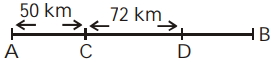
0 likes
View Solution90
MediumMCQ
Two trains measuring $100\, m$ and $80\, m$ respectively,run on parallel tracks. When travelling in opposite directions,they are observed to pass each other in $9\, s$. When they are running in the same direction at the same speeds as before,the faster train passes the other in $18\, s$. Find the speeds of the two trains in $km/h$.
A
$12, 5$
B
$14, 18$
C
$16, 54$
D
$54, 18$
Solution
(D) Let the speeds of the two trains be $S_1$ and $S_2$ in $m/s$,where $S_1 > S_2$.
When moving in opposite directions,the relative speed is $(S_1 + S_2)$. The total distance covered to pass each other is the sum of their lengths: $100 + 80 = 180\, m$.
Given time $= 9\, s$,so $S_1 + S_2 = 180 / 9 = 20\, m/s$ ... $(i)$.
When moving in the same direction,the relative speed is $(S_1 - S_2)$. The total distance covered is still $180\, m$.
Given time $= 18\, s$,so $S_1 - S_2 = 180 / 18 = 10\, m/s$ ... $(ii)$.
Adding equations $(i)$ and $(ii)$:
$2S_1 = 30 \implies S_1 = 15\, m/s$.
Subtracting $(ii)$ from $(i)$:
$2S_2 = 10 \implies S_2 = 5\, m/s$.
Converting to $km/h$ by multiplying by $18/5$:
$S_1 = 15 \times (18/5) = 54\, km/h$.
$S_2 = 5 \times (18/5) = 18\, km/h$.
When moving in opposite directions,the relative speed is $(S_1 + S_2)$. The total distance covered to pass each other is the sum of their lengths: $100 + 80 = 180\, m$.
Given time $= 9\, s$,so $S_1 + S_2 = 180 / 9 = 20\, m/s$ ... $(i)$.
When moving in the same direction,the relative speed is $(S_1 - S_2)$. The total distance covered is still $180\, m$.
Given time $= 18\, s$,so $S_1 - S_2 = 180 / 18 = 10\, m/s$ ... $(ii)$.
Adding equations $(i)$ and $(ii)$:
$2S_1 = 30 \implies S_1 = 15\, m/s$.
Subtracting $(ii)$ from $(i)$:
$2S_2 = 10 \implies S_2 = 5\, m/s$.
Converting to $km/h$ by multiplying by $18/5$:
$S_1 = 15 \times (18/5) = 54\, km/h$.
$S_2 = 5 \times (18/5) = 18\, km/h$.
0 likes
View Solution91
MediumMCQ
$A$ $300 \, m$ long train is travelling with a speed of $45 \, km/hr$ when it passes point $A$ completely. At the same time,a motorbike starts from point $A$ with a speed of $70 \, km/hr$. When it exactly reaches the middle point of the train,the train increases its speed to $60 \, km/hr$ and the motorbike reduces its speed to $65 \, km/hr$. How much distance will the motorbike travel while passing the train completely? (in $km$)
A
$3.8$
B
$3.2$
C
$2.37$
D
$2.2$
Solution
(C) Step $1$: Time taken to reach the middle point of the train.
Distance to cover $= 150 \, m = 0.15 \, km$.
Relative speed $= 70 - 45 = 25 \, km/hr$.
Time $t_1 = \frac{0.15}{25} \, hr = 0.006 \, hr$.
Distance covered by the motorbike in $t_1 = 70 \times 0.006 = 0.42 \, km = 420 \, m$.
Step $2$: Time taken to cover the remaining half of the train.
Remaining distance to cover $= 150 \, m = 0.15 \, km$.
New relative speed $= 65 - 60 = 5 \, km/hr$.
Time $t_2 = \frac{0.15}{5} \, hr = 0.03 \, hr$.
Distance covered by the motorbike in $t_2 = 65 \times 0.03 = 1.95 \, km = 1950 \, m$.
Step $3$: Total distance covered by the motorbike.
Total distance $= 0.42 + 1.95 = 2.37 \, km$.
Distance to cover $= 150 \, m = 0.15 \, km$.
Relative speed $= 70 - 45 = 25 \, km/hr$.
Time $t_1 = \frac{0.15}{25} \, hr = 0.006 \, hr$.
Distance covered by the motorbike in $t_1 = 70 \times 0.006 = 0.42 \, km = 420 \, m$.
Step $2$: Time taken to cover the remaining half of the train.
Remaining distance to cover $= 150 \, m = 0.15 \, km$.
New relative speed $= 65 - 60 = 5 \, km/hr$.
Time $t_2 = \frac{0.15}{5} \, hr = 0.03 \, hr$.
Distance covered by the motorbike in $t_2 = 65 \times 0.03 = 1.95 \, km = 1950 \, m$.
Step $3$: Total distance covered by the motorbike.
Total distance $= 0.42 + 1.95 = 2.37 \, km$.
0 likes
View Solution92
MediumMCQ
Two trains,Kanpur Mail and Delhi Mail,start at the same time from stations Kanpur and Delhi respectively towards each other. After passing each other,they take $12\, \text{hours}$ and $3\, \text{hours}$ to reach Delhi and Kanpur respectively. If the Kanpur Mail is moving at the speed of $48\, \text{km/hr}$,the speed of the Delhi Mail is (in $\text{km/hr}$):
A
$90$
B
$96$
C
$86$
D
$84$
Solution
(B) Let the speed of Kanpur Mail be $S_1$ and the speed of Delhi Mail be $S_2$.
Let the time taken by Kanpur Mail to reach its destination after meeting be $t_1 = 12\, \text{hours}$.
Let the time taken by Delhi Mail to reach its destination after meeting be $t_2 = 3\, \text{hours}$.
The relationship between speeds and times after crossing is given by the formula: $\frac{S_1}{S_2} = \sqrt{\frac{t_2}{t_1}}$.
Given $S_1 = 48\, \text{km/hr}$,$t_1 = 12\, \text{hours}$,and $t_2 = 3\, \text{hours}$.
Substituting the values: $\frac{48}{S_2} = \sqrt{\frac{3}{12}}$.
$\frac{48}{S_2} = \sqrt{\frac{1}{4}} = \frac{1}{2}$.
$S_2 = 48 \times 2 = 96\, \text{km/hr}$.
Let the time taken by Kanpur Mail to reach its destination after meeting be $t_1 = 12\, \text{hours}$.
Let the time taken by Delhi Mail to reach its destination after meeting be $t_2 = 3\, \text{hours}$.
The relationship between speeds and times after crossing is given by the formula: $\frac{S_1}{S_2} = \sqrt{\frac{t_2}{t_1}}$.
Given $S_1 = 48\, \text{km/hr}$,$t_1 = 12\, \text{hours}$,and $t_2 = 3\, \text{hours}$.
Substituting the values: $\frac{48}{S_2} = \sqrt{\frac{3}{12}}$.
$\frac{48}{S_2} = \sqrt{\frac{1}{4}} = \frac{1}{2}$.
$S_2 = 48 \times 2 = 96\, \text{km/hr}$.
0 likes
View Solution93
MediumMCQ
Heena and Renu are competing in a $100\, m$ race. Initially,Heena runs at twice the speed of Renu for the first $50\, m$. After the $50\, m$ mark,Heena runs at $\frac{1}{4}$ of her initial speed,while Renu continues to run at her original speed. If Renu catches up with Heena at a distance of $N$ meters from the finish line,then $N$ is equal to (in meters).
A
$75$
B
$55$
C
$25$
D
$30$
Solution
(C) Let the initial speed of Renu be $v$ and the initial speed of Heena be $2v$.
For the first $50\, m$:
Time taken by Heena $t_{H1} = \frac{50}{2v} = \frac{25}{v}$.
Time taken by Renu $t_{R1} = \frac{50}{v}$.
After $50\, m$,Heena's speed becomes $\frac{1}{4} \times 2v = 0.5v$.
Renu continues at speed $v$.
Let $d$ be the additional distance covered by both until Renu catches Heena.
Time taken by Heena for distance $d$ is $t_{H2} = \frac{d}{0.5v} = \frac{2d}{v}$.
Time taken by Renu for distance $d$ is $t_{R2} = \frac{d}{v}$.
Since Renu catches Heena,the total time taken by both must be equal:
$t_{R1} + t_{R2} = t_{H1} + t_{H2}$
$\frac{50}{v} + \frac{d}{v} = \frac{25}{v} + \frac{2d}{v}$
$50 + d = 25 + 2d$
$d = 25\, m$.
The total distance covered from the start is $50 + 25 = 75\, m$.
The distance from the finish line $N = 100 - 75 = 25\, m$.
For the first $50\, m$:
Time taken by Heena $t_{H1} = \frac{50}{2v} = \frac{25}{v}$.
Time taken by Renu $t_{R1} = \frac{50}{v}$.
After $50\, m$,Heena's speed becomes $\frac{1}{4} \times 2v = 0.5v$.
Renu continues at speed $v$.
Let $d$ be the additional distance covered by both until Renu catches Heena.
Time taken by Heena for distance $d$ is $t_{H2} = \frac{d}{0.5v} = \frac{2d}{v}$.
Time taken by Renu for distance $d$ is $t_{R2} = \frac{d}{v}$.
Since Renu catches Heena,the total time taken by both must be equal:
$t_{R1} + t_{R2} = t_{H1} + t_{H2}$
$\frac{50}{v} + \frac{d}{v} = \frac{25}{v} + \frac{2d}{v}$
$50 + d = 25 + 2d$
$d = 25\, m$.
The total distance covered from the start is $50 + 25 = 75\, m$.
The distance from the finish line $N = 100 - 75 = 25\, m$.
0 likes
View Solution94
MediumMCQ
$A$ horse rider travels on horseback from Bhopal to Chandigarh at a constant speed. If the horse increased its speed by $6 \, km/h$,it would take the rider $4 \, hours$ less to cover that distance. If the horse travelled at a speed $6 \, km/h$ lower than the initial speed,it would take him $10 \, hours$ more than the time he would have taken if he had travelled at a speed $6 \, km/h$ higher than the initial speed. Find the distance between Bhopal and Chandigarh in $km$.
A
$720$
B
$680$
C
$560$
D
$480$
Solution
(A) Let the distance be $d \, km$ and the initial speed be $s \, km/h$.
From the first condition: $\frac{d}{s} - \frac{d}{s+6} = 4 \implies \frac{6d}{s(s+6)} = 4 \implies \frac{d}{s(s+6)} = \frac{2}{3} \implies d = \frac{2s(s+6)}{3} \dots (i)$
From the second condition: $\frac{d}{s-6} - \frac{d}{s+6} = 10 \implies d \left( \frac{(s+6) - (s-6)}{(s-6)(s+6)} \right) = 10 \implies d \left( \frac{12}{s^2-36} \right) = 10 \implies d = \frac{10(s^2-36)}{12} = \frac{5(s^2-36)}{6} \dots (ii)$
Equating $(i)$ and $(ii)$: $\frac{2s^2+12s}{3} = \frac{5s^2-180}{6} \implies 4s^2 + 24s = 5s^2 - 180 \implies s^2 - 24s - 180 = 0$.
Solving the quadratic equation: $(s-30)(s+6) = 0$. Since speed cannot be negative,$s = 30 \, km/h$.
Substituting $s = 30$ into $(i)$: $d = \frac{2(30)(36)}{3} = 20 \times 36 = 720 \, km$.
From the first condition: $\frac{d}{s} - \frac{d}{s+6} = 4 \implies \frac{6d}{s(s+6)} = 4 \implies \frac{d}{s(s+6)} = \frac{2}{3} \implies d = \frac{2s(s+6)}{3} \dots (i)$
From the second condition: $\frac{d}{s-6} - \frac{d}{s+6} = 10 \implies d \left( \frac{(s+6) - (s-6)}{(s-6)(s+6)} \right) = 10 \implies d \left( \frac{12}{s^2-36} \right) = 10 \implies d = \frac{10(s^2-36)}{12} = \frac{5(s^2-36)}{6} \dots (ii)$
Equating $(i)$ and $(ii)$: $\frac{2s^2+12s}{3} = \frac{5s^2-180}{6} \implies 4s^2 + 24s = 5s^2 - 180 \implies s^2 - 24s - 180 = 0$.
Solving the quadratic equation: $(s-30)(s+6) = 0$. Since speed cannot be negative,$s = 30 \, km/h$.
Substituting $s = 30$ into $(i)$: $d = \frac{2(30)(36)}{3} = 20 \times 36 = 720 \, km$.
0 likes
View Solution95
DifficultMCQ
Seeta and Geeta cycled towards each other,one from point $A$ and the other from point $B$,respectively. Seeta left point $A$ $6 \, hours$ later than Geeta left point $B$,and it turned out on their meeting that Seeta had travelled $12 \, km$ less than Geeta. After their meeting,they kept cycling with the same speed,and Seeta arrived at $B$ $8 \, hours$ later and Geeta arrived at $A$ $9 \, hours$ later. Find the speed of the faster cyclist in $km/hr$.
A
$3$
B
$6$
C
$9$
D
$12$
Solution
(B) Let the speeds of Seeta and Geeta be $v_S$ and $v_G$ respectively. Let $t$ be the time taken by Geeta to reach the meeting point $M$ from $B$. Then Seeta takes $(t-6)$ hours to reach $M$ from $A$.
Let $d_S$ and $d_G$ be the distances travelled by Seeta and Geeta respectively until they meet at $M$. We have $d_S = v_S(t-6)$ and $d_G = v_G t$.
Given $d_G - d_S = 12$,so $v_G t - v_S(t-6) = 12$.
After meeting,Seeta travels the remaining distance to $B$ in $8$ hours,so $d_G = v_S \times 8$. Geeta travels the remaining distance to $A$ in $9$ hours,so $d_S = v_G \times 9$.
Substituting these into the distance equations: $v_S(t-6) = 9 v_G$ and $v_G t = 8 v_S$.
From $v_G t = 8 v_S$,we get $v_S/v_G = t/8$. Also from $v_S(t-6) = 9 v_G$,we get $v_S/v_G = 9/(t-6)$.
Equating the two: $t/8 = 9/(t-6) \Rightarrow t(t-6) = 72 \Rightarrow t^2 - 6t - 72 = 0$.
Solving the quadratic: $(t-12)(t+6) = 0$. Since $t > 0$,$t = 12$.
Then $v_S/v_G = 12/8 = 3/2$. Let $v_S = 3k$ and $v_G = 2k$.
Substitute into $v_G t - v_S(t-6) = 12$: $(2k)(12) - (3k)(12-6) = 12 \Rightarrow 24k - 18k = 12 \Rightarrow 6k = 12 \Rightarrow k = 2$.
Thus,$v_S = 3(2) = 6 \, km/hr$ and $v_G = 2(2) = 4 \, km/hr$.
The speed of the faster cyclist is $6 \, km/hr$.
Let $d_S$ and $d_G$ be the distances travelled by Seeta and Geeta respectively until they meet at $M$. We have $d_S = v_S(t-6)$ and $d_G = v_G t$.
Given $d_G - d_S = 12$,so $v_G t - v_S(t-6) = 12$.
After meeting,Seeta travels the remaining distance to $B$ in $8$ hours,so $d_G = v_S \times 8$. Geeta travels the remaining distance to $A$ in $9$ hours,so $d_S = v_G \times 9$.
Substituting these into the distance equations: $v_S(t-6) = 9 v_G$ and $v_G t = 8 v_S$.
From $v_G t = 8 v_S$,we get $v_S/v_G = t/8$. Also from $v_S(t-6) = 9 v_G$,we get $v_S/v_G = 9/(t-6)$.
Equating the two: $t/8 = 9/(t-6) \Rightarrow t(t-6) = 72 \Rightarrow t^2 - 6t - 72 = 0$.
Solving the quadratic: $(t-12)(t+6) = 0$. Since $t > 0$,$t = 12$.
Then $v_S/v_G = 12/8 = 3/2$. Let $v_S = 3k$ and $v_G = 2k$.
Substitute into $v_G t - v_S(t-6) = 12$: $(2k)(12) - (3k)(12-6) = 12 \Rightarrow 24k - 18k = 12 \Rightarrow 6k = 12 \Rightarrow k = 2$.
Thus,$v_S = 3(2) = 6 \, km/hr$ and $v_G = 2(2) = 4 \, km/hr$.
The speed of the faster cyclist is $6 \, km/hr$.
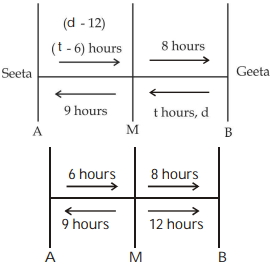
0 likes
View Solution96
EasyMCQ
Two cyclists started simultaneously towards each other and meet each other $3$ hours $20$ minutes later. How much time will it take the slower cyclist to cover the whole distance if the first arrived at the place of departure of the second $5$ hours later than the second arrived at the point of departure of the first? (in hours)
A
$5$
B
$10$
C
$15$
D
$20$
Solution
(B) Let the speeds of the two cyclists be $v_1$ and $v_2$ km/h,and the total distance be $D$ km. Let $v_1 > v_2$.
They meet after $t = 3$ hours $20$ minutes $= 3 + 1/3 = 10/3$ hours.
Thus,$D = (v_1 + v_2) \times (10/3)$.
The time taken by the first cyclist to cover the distance is $T_1 = D/v_1$ and by the second is $T_2 = D/v_2$.
We are given $T_1 - T_2 = 5$ hours.
Substituting $D$,we get $(10/3) \times (v_1 + v_2) / v_1 - (10/3) \times (v_1 + v_2) / v_2 = 5$.
Let $x = v_1/v_2$. Then $(10/3) \times (x + 1) / x - (10/3) \times (x + 1) = 5$ is incorrect; rather,$(10/3)(1 + v_2/v_1) = T_1$ and $(10/3)(1 + v_1/v_2) = T_2$.
Using $T_1 = D/v_1$ and $T_2 = D/v_2$,we have $D = v_1 T_1 = v_2 T_2$.
From $D = (v_1 + v_2)(10/3)$,we get $v_1/v_2 + 1 = D / (v_2 \times 10/3) = (3/10) T_2$.
Also $v_2/v_1 + 1 = (3/10) T_1$.
Since $T_2 - T_1 = 5$,we solve the quadratic equation to find $T_2 = 10$ hours.
They meet after $t = 3$ hours $20$ minutes $= 3 + 1/3 = 10/3$ hours.
Thus,$D = (v_1 + v_2) \times (10/3)$.
The time taken by the first cyclist to cover the distance is $T_1 = D/v_1$ and by the second is $T_2 = D/v_2$.
We are given $T_1 - T_2 = 5$ hours.
Substituting $D$,we get $(10/3) \times (v_1 + v_2) / v_1 - (10/3) \times (v_1 + v_2) / v_2 = 5$.
Let $x = v_1/v_2$. Then $(10/3) \times (x + 1) / x - (10/3) \times (x + 1) = 5$ is incorrect; rather,$(10/3)(1 + v_2/v_1) = T_1$ and $(10/3)(1 + v_1/v_2) = T_2$.
Using $T_1 = D/v_1$ and $T_2 = D/v_2$,we have $D = v_1 T_1 = v_2 T_2$.
From $D = (v_1 + v_2)(10/3)$,we get $v_1/v_2 + 1 = D / (v_2 \times 10/3) = (3/10) T_2$.
Also $v_2/v_1 + 1 = (3/10) T_1$.
Since $T_2 - T_1 = 5$,we solve the quadratic equation to find $T_2 = 10$ hours.
0 likes
View Solution97
EasyMCQ
$A$ dog finds a cat at $25$ leaps away. The cat sees the dog coming towards it and starts running with the dog in hot pursuit. In every minute, the dog makes $5$ leaps and the cat makes $6$ leaps, and one leap of the dog is equal to $2$ leaps of the cat. Find the time in which the dog will catch the cat (in minutes).
A
$12.5$
B
$13$
C
$11.5$
D
$10.5$
Solution
(A) Initial distance between the dog and the cat $= 25$ dog leaps.
In one minute, the dog makes $5$ leaps.
In one minute, the cat makes $6$ leaps. Since $1$ dog leap $= 2$ cat leaps, $6$ cat leaps $= 3$ dog leaps.
Therefore, the relative speed of the dog with respect to the cat $= 5 - 3 = 2$ dog leaps per minute.
Time taken to catch the cat $= \frac{\text{Initial distance}}{\text{Relative speed}} = \frac{25}{2} = 12.5$ minutes.
In one minute, the dog makes $5$ leaps.
In one minute, the cat makes $6$ leaps. Since $1$ dog leap $= 2$ cat leaps, $6$ cat leaps $= 3$ dog leaps.
Therefore, the relative speed of the dog with respect to the cat $= 5 - 3 = 2$ dog leaps per minute.
Time taken to catch the cat $= \frac{\text{Initial distance}}{\text{Relative speed}} = \frac{25}{2} = 12.5$ minutes.
0 likes
View Solution98
MediumMCQ
Two guns were fired from the same place at an interval of $13 \text{ minutes}$,but a person in a train approaching the place hears the second shot $12 \text{ minutes } 30 \text{ seconds}$ after the first. Find the speed of the train,assuming that sound travels at $330 \text{ m/s}$ (in $\text{km/hr}$).
A
$47 \frac{13}{25}$
B
$47 \frac{11}{25}$
C
$47 \frac{9}{25}$
D
$47 \frac{12}{25}$
Solution
(A) Let the speed of the train be $v_t \text{ m/s}$.
The time interval between the two gunshots is $13 \text{ minutes} = 780 \text{ seconds}$.
The time interval at which the person hears the shots is $12 \text{ minutes } 30 \text{ seconds} = 750 \text{ seconds}$.
In the time the train travels for $750 \text{ seconds}$,the sound of the second shot covers the distance that the train would have covered in the remaining $30 \text{ seconds}$ $(780 - 750 = 30 \text{ seconds})$.
Distance covered by sound in $30 \text{ seconds} = 330 \times 30 = 9900 \text{ meters}$.
This distance is covered by the train in $750 \text{ seconds}$.
Speed of the train $v_t = \frac{9900}{750} \text{ m/s} = 13.2 \text{ m/s}$.
To convert $\text{m/s}$ to $\text{km/hr}$,multiply by $\frac{18}{5}$:
$v_t = 13.2 \times \frac{18}{5} = \frac{132}{10} \times \frac{18}{5} = \frac{2376}{50} = \frac{1188}{25} \text{ km/hr}$.
$v_t = 47 \frac{13}{25} \text{ km/hr}$.
The time interval between the two gunshots is $13 \text{ minutes} = 780 \text{ seconds}$.
The time interval at which the person hears the shots is $12 \text{ minutes } 30 \text{ seconds} = 750 \text{ seconds}$.
In the time the train travels for $750 \text{ seconds}$,the sound of the second shot covers the distance that the train would have covered in the remaining $30 \text{ seconds}$ $(780 - 750 = 30 \text{ seconds})$.
Distance covered by sound in $30 \text{ seconds} = 330 \times 30 = 9900 \text{ meters}$.
This distance is covered by the train in $750 \text{ seconds}$.
Speed of the train $v_t = \frac{9900}{750} \text{ m/s} = 13.2 \text{ m/s}$.
To convert $\text{m/s}$ to $\text{km/hr}$,multiply by $\frac{18}{5}$:
$v_t = 13.2 \times \frac{18}{5} = \frac{132}{10} \times \frac{18}{5} = \frac{2376}{50} = \frac{1188}{25} \text{ km/hr}$.
$v_t = 47 \frac{13}{25} \text{ km/hr}$.
0 likes
View Solution99
MediumMCQ
$A$ man walks from $A$ to $B$ and back in a certain time at the rate of $3.5 \text{ km/h}$. If he had walked from $A$ to $B$ at the rate of $3 \text{ km/h}$ and back from $B$ to $A$ at the rate of $4 \text{ km/h}$,he would have taken $5 \text{ minutes}$ longer. Find the distance between $A$ and $B$ (in $\text{km}$).
A
$14$
B
$12$
C
$6$
D
$7$
Solution
(D) Let the distance between $A$ and $B$ be $x \text{ km}$.
In the first case,the total time taken is $T_1 = \frac{x}{3.5} + \frac{x}{3.5} = \frac{2x}{3.5} = \frac{2x}{7/2} = \frac{4x}{7} \text{ hours}$.
In the second case,the total time taken is $T_2 = \frac{x}{3} + \frac{x}{4} = \frac{4x + 3x}{12} = \frac{7x}{12} \text{ hours}$.
According to the problem,the difference in time is $5 \text{ minutes}$,which is $\frac{5}{60} = \frac{1}{12} \text{ hours}$.
So,$T_2 - T_1 = \frac{1}{12}$.
$\frac{7x}{12} - \frac{4x}{7} = \frac{1}{12}$.
Taking the common denominator $(84)$:
$\frac{49x - 48x}{84} = \frac{1}{12}$.
$\frac{x}{84} = \frac{1}{12}$.
$x = \frac{84}{12} = 7 \text{ km}$.
Therefore,the distance between $A$ and $B$ is $7 \text{ km}$.
In the first case,the total time taken is $T_1 = \frac{x}{3.5} + \frac{x}{3.5} = \frac{2x}{3.5} = \frac{2x}{7/2} = \frac{4x}{7} \text{ hours}$.
In the second case,the total time taken is $T_2 = \frac{x}{3} + \frac{x}{4} = \frac{4x + 3x}{12} = \frac{7x}{12} \text{ hours}$.
According to the problem,the difference in time is $5 \text{ minutes}$,which is $\frac{5}{60} = \frac{1}{12} \text{ hours}$.
So,$T_2 - T_1 = \frac{1}{12}$.
$\frac{7x}{12} - \frac{4x}{7} = \frac{1}{12}$.
Taking the common denominator $(84)$:
$\frac{49x - 48x}{84} = \frac{1}{12}$.
$\frac{x}{84} = \frac{1}{12}$.
$x = \frac{84}{12} = 7 \text{ km}$.
Therefore,the distance between $A$ and $B$ is $7 \text{ km}$.
0 likes
View Solution100
DifficultMCQ
$A$ carriage driving in a fog passed a man who was walking at the rate of $3 \text{ km/h}$ in the same direction. He could see the carriage for $4 \text{ minutes}$ and it was visible to him up to a distance of $100 \text{ m}$. What was the speed of the carriage in $\text{km/h}$?
A
$5\frac{1}{2}$
B
$4\frac{1}{2}$
C
$3\frac{1}{2}$
D
$8\frac{1}{2}$
Solution
(B) Let the speed of the carriage be $v \text{ km/h}$.
Relative speed of the carriage with respect to the man is $(v - 3) \text{ km/h}$.
In $4 \text{ minutes}$,the distance covered by the carriage relative to the man is $100 \text{ m} = 0.1 \text{ km}$.
Time $t = 4 \text{ minutes} = \frac{4}{60} \text{ hours} = \frac{1}{15} \text{ hours}$.
Using the formula $\text{Distance} = \text{Relative Speed} \times \text{Time}$:
$0.1 = (v - 3) \times \frac{1}{15}$
$v - 3 = 0.1 \times 15 = 1.5$
$v = 1.5 + 3 = 4.5 \text{ km/h}$.
Thus,the speed of the carriage is $4\frac{1}{2} \text{ km/h}$.
Relative speed of the carriage with respect to the man is $(v - 3) \text{ km/h}$.
In $4 \text{ minutes}$,the distance covered by the carriage relative to the man is $100 \text{ m} = 0.1 \text{ km}$.
Time $t = 4 \text{ minutes} = \frac{4}{60} \text{ hours} = \frac{1}{15} \text{ hours}$.
Using the formula $\text{Distance} = \text{Relative Speed} \times \text{Time}$:
$0.1 = (v - 3) \times \frac{1}{15}$
$v - 3 = 0.1 \times 15 = 1.5$
$v = 1.5 + 3 = 4.5 \text{ km/h}$.
Thus,the speed of the carriage is $4\frac{1}{2} \text{ km/h}$.
0 likes
View SolutionTime and Distances — Time and Distances · Frequently Asked Questions
1Are these Time and Distances questions useful for JEE and NEET?
Yes. All questions in this section are mapped to JEE Main and NEET exam patterns. Previous year questions from JEE Main, NEET, GUJCET and state-level exams are included with full solutions.
2Can I switch to Hindi or Gujarati for these questions?
Yes. Use the language tabs in the hero section or the sidebar to view the same questions and solutions in English, Hindi or Gujarati.
3How do I generate a question paper from this subtopic?
Use the Vedclass Exam Paper Generator — select the chapter and subtopic, set difficulty, and generate Sets A, B, C, D automatically. First 3 chapters of every subject are free.
Vedclass Products
For Students
Vedclass Test Series
Mock tests in real JEE/NEET style with performance analysis. 5-day free trial.
Start Free TrialFor Teachers
Exam Paper Generator
Generate Set A/B/C/D papers from this chapter in 2 minutes. 3 chapters free.
Try FreeFor Institutes
Online Exam Module
Live online exams with unlimited students, 360° analytics & white-label branding.
See DemoFor Teachers & Institutes
Generate a Time and Distances Exam Paper in 2 Minutes
Select subtopic & difficulty — Sets A, B, C, D auto-generated with No Repeat logic.
First 3 chapters of every subject are free — no payment required.