
A English
Number Series Questions in English
Competitive Exam Quantitative Aptitude · Number Series · Number Series
473+
Questions
English
Language
100%
With Solutions
Showing 50 of 473 questions in English
401
EasyMCQ
Find the next term in the series: $15, 18, 16, 19, 17, 20, ?$
A
$23$
B
$22$
C
$16$
D
$18$
Solution
(D) The given series is an alternating series consisting of two interleaved sequences.
Sequence $1$: $15, 16, 17, ...$
Here,each term increases by $1$ ($15 + 1 = 16$,$16 + 1 = 17$,$17 + 1 = 18$).
Sequence $2$: $18, 19, 20, ...$
Here,each term increases by $1$ ($18 + 1 = 19$,$19 + 1 = 20$).
The series follows the pattern: $15 (+3), 18 (-2), 16 (+3), 19 (-2), 17 (+3), 20 (-2), ?$
Following the pattern,the next term after $20$ is $17 + 3 = 20$ (if continuing sequence $1$) or $20 - 2 = 18$ (if continuing sequence $2$).
However,looking at the alternating pattern: $15, 18, 16, 19, 17, 20, 18$.
The next term is $18$.
Sequence $1$: $15, 16, 17, ...$
Here,each term increases by $1$ ($15 + 1 = 16$,$16 + 1 = 17$,$17 + 1 = 18$).
Sequence $2$: $18, 19, 20, ...$
Here,each term increases by $1$ ($18 + 1 = 19$,$19 + 1 = 20$).
The series follows the pattern: $15 (+3), 18 (-2), 16 (+3), 19 (-2), 17 (+3), 20 (-2), ?$
Following the pattern,the next term after $20$ is $17 + 3 = 20$ (if continuing sequence $1$) or $20 - 2 = 18$ (if continuing sequence $2$).
However,looking at the alternating pattern: $15, 18, 16, 19, 17, 20, 18$.
The next term is $18$.
0 likes
View Solution402
EasyMCQ
$1050, 420, 168, 67.2, 26.88, 10.752, ?$
A
$4.3008$
B
$6.5038$
C
$4.4015$
D
$5.6002$
Solution
(A) To find the next number in the series,we observe the pattern between consecutive terms:
$1050 \div 2.5 = 420$
$420 \div 2.5 = 168$
$168 \div 2.5 = 67.2$
$67.2 \div 2.5 = 26.88$
$26.88 \div 2.5 = 10.752$
Following this pattern,the next term is:
$10.752 \div 2.5 = 4.3008$
Therefore,the correct option is $A$.
$1050 \div 2.5 = 420$
$420 \div 2.5 = 168$
$168 \div 2.5 = 67.2$
$67.2 \div 2.5 = 26.88$
$26.88 \div 2.5 = 10.752$
Following this pattern,the next term is:
$10.752 \div 2.5 = 4.3008$
Therefore,the correct option is $A$.
0 likes
View Solution403
MediumMCQ
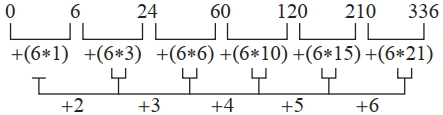
Find the next number in the series: $0, 6, 24, 60, 120, 210, ?$
A
$343$
B
$280$
C
$335$
D
$336$
Solution
(D) The given series is $0, 6, 24, 60, 120, 210, ?$.
This series can be expressed as $n^3 - n$ for $n = 1, 2, 3, 4, 5, 6, 7, ...$:
For $n=1: 1^3 - 1 = 0$
For $n=2: 2^3 - 2 = 8 - 2 = 6$
For $n=3: 3^3 - 3 = 27 - 3 = 24$
For $n=4: 4^3 - 4 = 64 - 4 = 60$
For $n=5: 5^3 - 5 = 125 - 5 = 120$
For $n=6: 6^3 - 6 = 216 - 6 = 210$
For $n=7: 7^3 - 7 = 343 - 7 = 336$
Therefore,the next number is $336$.
This series can be expressed as $n^3 - n$ for $n = 1, 2, 3, 4, 5, 6, 7, ...$:
For $n=1: 1^3 - 1 = 0$
For $n=2: 2^3 - 2 = 8 - 2 = 6$
For $n=3: 3^3 - 3 = 27 - 3 = 24$
For $n=4: 4^3 - 4 = 64 - 4 = 60$
For $n=5: 5^3 - 5 = 125 - 5 = 120$
For $n=6: 6^3 - 6 = 216 - 6 = 210$
For $n=7: 7^3 - 7 = 343 - 7 = 336$
Therefore,the next number is $336$.
0 likes
View Solution404
EasyMCQ
Find the next number in the series: $7, 9, 13, 21, 37, ?$
A
$58$
B
$63$
C
$69$
D
$72$
Solution
(C) The pattern in the series is based on the addition of consecutive powers of $2$ or doubling the difference between consecutive terms.
Step $1$: $9 - 7 = 2$
Step $2$: $13 - 9 = 4$
Step $3$: $21 - 13 = 8$
Step $4$: $37 - 21 = 16$
The differences are $2, 4, 8, 16$,which follow the pattern $2^1, 2^2, 2^3, 2^4$.
The next difference should be $2^5 = 32$.
Therefore,the next term is $37 + 32 = 69$.
Step $1$: $9 - 7 = 2$
Step $2$: $13 - 9 = 4$
Step $3$: $21 - 13 = 8$
Step $4$: $37 - 21 = 16$
The differences are $2, 4, 8, 16$,which follow the pattern $2^1, 2^2, 2^3, 2^4$.
The next difference should be $2^5 = 32$.
Therefore,the next term is $37 + 32 = 69$.
0 likes
View Solution405
MediumMCQ
Find the missing number in the series: $36, 28, 24, 22, ?$
A
$18$
B
$19$
C
$21$
D
$22$
Solution
(C) The pattern in the series is determined by subtracting consecutive powers of $2$ in the denominator of the difference,or simply halving the difference each time:
$36 - 8 = 28$
$28 - 4 = 24$
$24 - 2 = 22$
$22 - 1 = 21$
Thus,the next number in the series is $21$.
$36 - 8 = 28$
$28 - 4 = 24$
$24 - 2 = 22$
$22 - 1 = 21$
Thus,the next number in the series is $21$.
0 likes
View Solution406
DifficultMCQ
$0, 4, 18, 48, ?, 180$
A
$58$
B
$68$
C
$84$
D
$100$
Solution
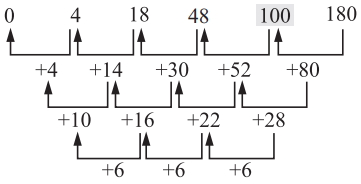
(D) The given series is $0, 4, 18, 48, ?, 180$.
We can observe the pattern by finding the differences between consecutive terms:
$4 - 0 = 4$
$18 - 4 = 14$
$48 - 18 = 30$
The differences are $4, 14, 30, ...$
Now,find the second-level differences:
$14 - 4 = 10$
$30 - 14 = 16$
The difference between these is $16 - 10 = 6$.
Following this pattern,the next second-level difference should be $16 + 6 = 22$.
So,the next first-level difference should be $30 + 22 = 52$.
Therefore,the missing term is $48 + 52 = 100$.
Alternatively,the series follows the pattern $n^2(n-1)$ for $n = 1, 2, 3, 4, 5, 6$:
For $n=1: 1^2(0) = 0$
For $n=2: 2^2(1) = 4$
For $n=3: 3^2(2) = 18$
For $n=4: 4^2(3) = 48$
For $n=5: 5^2(4) = 100$
For $n=6: 6^2(5) = 180$
Thus,the missing term is $100$.
We can observe the pattern by finding the differences between consecutive terms:
$4 - 0 = 4$
$18 - 4 = 14$
$48 - 18 = 30$
The differences are $4, 14, 30, ...$
Now,find the second-level differences:
$14 - 4 = 10$
$30 - 14 = 16$
The difference between these is $16 - 10 = 6$.
Following this pattern,the next second-level difference should be $16 + 6 = 22$.
So,the next first-level difference should be $30 + 22 = 52$.
Therefore,the missing term is $48 + 52 = 100$.
Alternatively,the series follows the pattern $n^2(n-1)$ for $n = 1, 2, 3, 4, 5, 6$:
For $n=1: 1^2(0) = 0$
For $n=2: 2^2(1) = 4$
For $n=3: 3^2(2) = 18$
For $n=4: 4^2(3) = 48$
For $n=5: 5^2(4) = 100$
For $n=6: 6^2(5) = 180$
Thus,the missing term is $100$.
0 likes
View Solution407
MediumMCQ
$987:IHG :: 654:?$
A
$FDE$
B
$FED$
C
$EFD$
D
$DEF$
Solution
(B) The relationship is based on the alphabetical position of the digits where $9$ corresponds to $I$ (the $9^{th}$ letter),$8$ corresponds to $H$ (the $8^{th}$ letter),and $7$ corresponds to $G$ (the $7^{th}$ letter).
Following the same pattern for $654$:
$6$ corresponds to $F$ (the $6^{th}$ letter).
$5$ corresponds to $E$ (the $5^{th}$ letter).
$4$ corresponds to $D$ (the $4^{th}$ letter).
Therefore,$654$ corresponds to $FED$.
Following the same pattern for $654$:
$6$ corresponds to $F$ (the $6^{th}$ letter).
$5$ corresponds to $E$ (the $5^{th}$ letter).
$4$ corresponds to $D$ (the $4^{th}$ letter).
Therefore,$654$ corresponds to $FED$.
0 likes
View Solution408
MediumMCQ
$24 : 126 :: 48 : ?$
A
$433$
B
$192$
C
$240$
D
$344$
Solution
(D) The pattern follows the relationship $(n^{2} - 1) : (n^{3} + 1)$.
For the first pair: $5^{2} - 1 = 25 - 1 = 24$ and $5^{3} + 1 = 125 + 1 = 126$.
For the second pair,we observe $48 = 7^{2} - 1$.
Following the same logic,the next term is $7^{3} + 1 = 343 + 1 = 344$.
Therefore,the correct option is $D$.
For the first pair: $5^{2} - 1 = 25 - 1 = 24$ and $5^{3} + 1 = 125 + 1 = 126$.
For the second pair,we observe $48 = 7^{2} - 1$.
Following the same logic,the next term is $7^{3} + 1 = 343 + 1 = 344$.
Therefore,the correct option is $D$.
0 likes
View Solution409
MediumMCQ
$1 : 8 :: 27 : ?$
A
$37$
B
$47$
C
$57$
D
$64$
Solution
(D) The given pattern is based on the cubes of consecutive natural numbers.
$(1)^3 = 1$
$(2)^3 = 8$
Following the same pattern for the second pair:
$(3)^3 = 27$
$(4)^3 = 64$
Therefore,the missing number is $64$.
$(1)^3 = 1$
$(2)^3 = 8$
Following the same pattern for the second pair:
$(3)^3 = 27$
$(4)^3 = 64$
Therefore,the missing number is $64$.
0 likes
View Solution410
EasyMCQ
Find out the odd number from the given sequence: $142, 119, 100, 83, 65, 59, 52$.
A
$65$
B
$100$
C
$59$
D
$119$
Solution
(A) Analyze the differences between consecutive terms in the sequence:
$142 - 119 = 23$
$119 - 100 = 19$
$100 - 83 = 17$
$83 - 65 = 18$ (This does not follow the pattern of prime numbers: $23, 19, 17, 13, 11, 7$)
If we subtract $13$ from $83$,we get $83 - 13 = 70$.
Then,$70 - 11 = 59$ and $59 - 7 = 52$.
Since $70$ fits the pattern and $65$ does not,the odd number in the sequence is $65$.
$142 - 119 = 23$
$119 - 100 = 19$
$100 - 83 = 17$
$83 - 65 = 18$ (This does not follow the pattern of prime numbers: $23, 19, 17, 13, 11, 7$)
If we subtract $13$ from $83$,we get $83 - 13 = 70$.
Then,$70 - 11 = 59$ and $59 - 7 = 52$.
Since $70$ fits the pattern and $65$ does not,the odd number in the sequence is $65$.
0 likes
View Solution411
MediumMCQ
Find the odd number in the given sequence: $8, 12, 24, 46, 72, 108, 152$.
A
$12$
B
$24$
C
$46$
D
$72$
Solution
(C) Analyze the pattern of the sequence: $8, 12, 24, 46, 72, 108, 152$.
Step $1$: $8 \times 1.5 = 12$
Step $2$: $12 \times 2 = 24$
Step $3$: $24 \times 1.5 = 36$ (The given number is $46$,which is incorrect).
Step $4$: $36 \times 2 = 72$
Step $5$: $72 \times 1.5 = 108$
Step $6$: $108 \times 2 = 216$ (The given number is $152$,which is also incorrect based on the pattern).
However,looking at the sequence $8, 12, 24, 46, 72, 108, 152$,the number $46$ is the first point of deviation from the pattern $\times 1.5, \times 2, \times 1.5, \times 2, \dots$
Therefore,the odd number is $46$.
Step $1$: $8 \times 1.5 = 12$
Step $2$: $12 \times 2 = 24$
Step $3$: $24 \times 1.5 = 36$ (The given number is $46$,which is incorrect).
Step $4$: $36 \times 2 = 72$
Step $5$: $72 \times 1.5 = 108$
Step $6$: $108 \times 2 = 216$ (The given number is $152$,which is also incorrect based on the pattern).
However,looking at the sequence $8, 12, 24, 46, 72, 108, 152$,the number $46$ is the first point of deviation from the pattern $\times 1.5, \times 2, \times 1.5, \times 2, \dots$
Therefore,the odd number is $46$.
0 likes
View Solution412
MediumMCQ
Find out the odd number from the given sequence: $13, 25, 40, 57, 79, 103, 130$.
A
$25$
B
$40$
C
$57$
D
$79$
Solution
(C) Let us analyze the differences between consecutive terms in the sequence:
$25 - 13 = 12$
$40 - 25 = 15$
$57 - 40 = 17$
$79 - 57 = 22$
$103 - 79 = 24$
$130 - 103 = 27$
Observing the pattern of differences: $12, 15, 18, 21, 24, 27$ (multiples of $3$).
If we follow this pattern:
$13 + 12 = 25$
$25 + 15 = 40$
$40 + 18 = 58$ (instead of $57$)
$58 + 21 = 79$
$79 + 24 = 103$
$103 + 27 = 130$
Thus,the odd number in the sequence is $57$.
$25 - 13 = 12$
$40 - 25 = 15$
$57 - 40 = 17$
$79 - 57 = 22$
$103 - 79 = 24$
$130 - 103 = 27$
Observing the pattern of differences: $12, 15, 18, 21, 24, 27$ (multiples of $3$).
If we follow this pattern:
$13 + 12 = 25$
$25 + 15 = 40$
$40 + 18 = 58$ (instead of $57$)
$58 + 21 = 79$
$79 + 24 = 103$
$103 + 27 = 130$
Thus,the odd number in the sequence is $57$.
0 likes
View Solution413
MediumMCQ
Find the odd number from the given sequence: $2, 10, 18, 54, 162, 486, 1458$.
A
$18$
B
$54$
C
$162$
D
$10$
Solution
(D) Analyze the pattern of the sequence: $2, 10, 18, 54, 162, 486, 1458$.
Starting from the third term,each term is obtained by multiplying the previous term by $3$.
$18 \times 3 = 54$
$54 \times 3 = 162$
$162 \times 3 = 486$
$486 \times 3 = 1458$
If we apply this rule backwards from $18$,the term before $18$ should be $18 / 3 = 6$.
However,the sequence provides $10$ instead of $6$.
Therefore,$10$ is the odd number in the sequence.
Starting from the third term,each term is obtained by multiplying the previous term by $3$.
$18 \times 3 = 54$
$54 \times 3 = 162$
$162 \times 3 = 486$
$486 \times 3 = 1458$
If we apply this rule backwards from $18$,the term before $18$ should be $18 / 3 = 6$.
However,the sequence provides $10$ instead of $6$.
Therefore,$10$ is the odd number in the sequence.
0 likes
View Solution414
MediumMCQ
Find out the odd number from the given sequence: $850, 600, 550, 500, 475, 462.5, 456.25$.
A
$600$
B
$550$
C
$500$
D
$462.5$
Solution
(A) Let us analyze the pattern of the sequence:
$850 - 200 = 650$
$650 - 100 = 550$
$550 - 50 = 500$
$500 - 25 = 475$
$475 - 12.5 = 462.5$
$462.5 - 6.25 = 456.25$
In the given sequence,the second term is $600$,but according to the pattern of subtracting half of the previous difference,it should be $650$. Therefore,$600$ is the odd number in the sequence.
$850 - 200 = 650$
$650 - 100 = 550$
$550 - 50 = 500$
$500 - 25 = 475$
$475 - 12.5 = 462.5$
$462.5 - 6.25 = 456.25$
In the given sequence,the second term is $600$,but according to the pattern of subtracting half of the previous difference,it should be $650$. Therefore,$600$ is the odd number in the sequence.
0 likes
View Solution415
MediumMCQ
Find the next number in the series: $12, 12, 18, 36, 90, 270, ?$
A
$945$
B
$810$
C
$1080$
D
$1215$
Solution
(A) The pattern of the series is as follows:
$12 \times 1 = 12$
$12 \times 1.5 = 18$
$18 \times 2 = 36$
$36 \times 2.5 = 90$
$90 \times 3 = 270$
Following this pattern,the next multiplier is $3.5$.
$270 \times 3.5 = 945$
Therefore,the next number in the series is $945$.
$12 \times 1 = 12$
$12 \times 1.5 = 18$
$18 \times 2 = 36$
$36 \times 2.5 = 90$
$90 \times 3 = 270$
Following this pattern,the next multiplier is $3.5$.
$270 \times 3.5 = 945$
Therefore,the next number in the series is $945$.
0 likes
View Solution416
MediumMCQ
$1015, 508, 255, 129, 66.5, ?, 20.875$
A
$34.50$
B
$35$
C
$35.50$
D
$35.75$
Solution
(D) The pattern followed in the series is:
$1015 \div 2 + 0.5 = 508$
$508 \div 2 + 1 = 255$
$255 \div 2 + 1.5 = 129$
$129 \div 2 + 2 = 66.5$
$66.5 \div 2 + 2.5 = 35.75$
$35.75 \div 2 + 3 = 20.875$
Thus,the missing number is $35.75$.
$1015 \div 2 + 0.5 = 508$
$508 \div 2 + 1 = 255$
$255 \div 2 + 1.5 = 129$
$129 \div 2 + 2 = 66.5$
$66.5 \div 2 + 2.5 = 35.75$
$35.75 \div 2 + 3 = 20.875$
Thus,the missing number is $35.75$.
0 likes
View Solution417
MediumMCQ
$8, 9, 20, 63, 256, 1285, ?$
A
$6430$
B
$7450$
C
$7716$
D
$7746$
Solution
(C) The pattern in the series is as follows:
$8 \times 1 + 1 = 9$
$9 \times 2 + 2 = 20$
$20 \times 3 + 3 = 63$
$63 \times 4 + 4 = 256$
$256 \times 5 + 5 = 1285$
Following this pattern,the next term is:
$1285 \times 6 + 6 = 7710 + 6 = 7716$
$8 \times 1 + 1 = 9$
$9 \times 2 + 2 = 20$
$20 \times 3 + 3 = 63$
$63 \times 4 + 4 = 256$
$256 \times 5 + 5 = 1285$
Following this pattern,the next term is:
$1285 \times 6 + 6 = 7710 + 6 = 7716$
0 likes
View Solution418
MediumMCQ
$980, 484, 236, 112, 50, ?, 3.5$
A
$25$
B
$17$
C
$21$
D
$19$
Solution
(D) The pattern followed in the series is: divide the previous number by $2$ and then subtract $6$ from the result.
$980 \div 2 - 6 = 490 - 6 = 484$
$484 \div 2 - 6 = 242 - 6 = 236$
$236 \div 2 - 6 = 118 - 6 = 112$
$112 \div 2 - 6 = 56 - 6 = 50$
$50 \div 2 - 6 = 25 - 6 = 19$
$19 \div 2 - 6 = 9.5 - 6 = 3.5$
Thus,the missing number is $19$.
$980 \div 2 - 6 = 490 - 6 = 484$
$484 \div 2 - 6 = 242 - 6 = 236$
$236 \div 2 - 6 = 118 - 6 = 112$
$112 \div 2 - 6 = 56 - 6 = 50$
$50 \div 2 - 6 = 25 - 6 = 19$
$19 \div 2 - 6 = 9.5 - 6 = 3.5$
Thus,the missing number is $19$.
0 likes
View Solution419
MediumMCQ
Find out the odd number from the given sequence: $484, 240, 120, 57, 26.5, 11.25, 3.625$.
A
$240$
B
$120$
C
$57$
D
$26.5$
Solution
(B) The pattern followed in the sequence is: divide by $2$ and subtract $2$ $(x_{n+1} = \frac{x_n}{2} - 2)$.
$484 \div 2 - 2 = 242 - 2 = 240$
$240 \div 2 - 2 = 120 - 2 = 118$
$118 \div 2 - 2 = 59 - 2 = 57$
$57 \div 2 - 2 = 28.5 - 2 = 26.5$
$26.5 \div 2 - 2 = 13.25 - 2 = 11.25$
$11.25 \div 2 - 2 = 5.625 - 2 = 3.625$
Comparing this with the given sequence,the term $120$ is incorrect as it should be $118$.
$484 \div 2 - 2 = 242 - 2 = 240$
$240 \div 2 - 2 = 120 - 2 = 118$
$118 \div 2 - 2 = 59 - 2 = 57$
$57 \div 2 - 2 = 28.5 - 2 = 26.5$
$26.5 \div 2 - 2 = 13.25 - 2 = 11.25$
$11.25 \div 2 - 2 = 5.625 - 2 = 3.625$
Comparing this with the given sequence,the term $120$ is incorrect as it should be $118$.
0 likes
View Solution420
DifficultMCQ
Find out the odd number from the given sequence:
$3, 5, 13, 43, 176, 891, 5353$
$3, 5, 13, 43, 176, 891, 5353$
A
$5$
B
$13$
C
$43$
D
$176$
Solution
(D) The pattern of the sequence is as follows:
$3 \times 1 + 2 = 5$
$5 \times 2 + 3 = 13$
$13 \times 3 + 4 = 43$
$43 \times 4 + 5 = 177$ (but the given number is $176$)
$177 \times 5 + 6 = 891$
$891 \times 6 + 7 = 5353$
Since the term $176$ does not follow the pattern and should be $177$,the odd number in the sequence is $176$.
$3 \times 1 + 2 = 5$
$5 \times 2 + 3 = 13$
$13 \times 3 + 4 = 43$
$43 \times 4 + 5 = 177$ (but the given number is $176$)
$177 \times 5 + 6 = 891$
$891 \times 6 + 7 = 5353$
Since the term $176$ does not follow the pattern and should be $177$,the odd number in the sequence is $176$.
0 likes
View Solution421
DifficultMCQ
Find out the odd number from the given sequence: $6, 7, 16, 41, 90, 154, 292$.
A
$7$
B
$16$
C
$41$
D
$154$
Solution
(D) The sequence follows the pattern of adding consecutive odd squares:
$6 + 1^2 = 6 + 1 = 7$
$7 + 3^2 = 7 + 9 = 16$
$16 + 5^2 = 16 + 25 = 41$
$41 + 7^2 = 41 + 49 = 90$
$90 + 9^2 = 90 + 81 = 171$
$171 + 11^2 = 171 + 121 = 292$
Comparing this with the given sequence,the term $154$ is incorrect as it should be $171$.
$6 + 1^2 = 6 + 1 = 7$
$7 + 3^2 = 7 + 9 = 16$
$16 + 5^2 = 16 + 25 = 41$
$41 + 7^2 = 41 + 49 = 90$
$90 + 9^2 = 90 + 81 = 171$
$171 + 11^2 = 171 + 121 = 292$
Comparing this with the given sequence,the term $154$ is incorrect as it should be $171$.
0 likes
View Solution422
DifficultMCQ
Find out the odd number from the given sequence: $5, 7, 16, 57, 244, 1245, 7506$.
A
$7$
B
$16$
C
$57$
D
$244$
Solution
(A) The pattern of the sequence is as follows:
$5 \times 1 + 1^2 = 6$
$6 \times 2 + 2^2 = 16$
$16 \times 3 + 3^2 = 57$
$57 \times 4 + 4^2 = 244$
$244 \times 5 + 5^2 = 1245$
$1245 \times 6 + 6^2 = 7506$
In the given sequence,the second term is $7$,but according to the pattern,it should be $6$. Therefore,$7$ is the odd (wrong) number.
$5 \times 1 + 1^2 = 6$
$6 \times 2 + 2^2 = 16$
$16 \times 3 + 3^2 = 57$
$57 \times 4 + 4^2 = 244$
$244 \times 5 + 5^2 = 1245$
$1245 \times 6 + 6^2 = 7506$
In the given sequence,the second term is $7$,but according to the pattern,it should be $6$. Therefore,$7$ is the odd (wrong) number.
0 likes
View Solution423
DifficultMCQ
Find the wrong number in the given sequence:
$4, 2.5, 3.5, 6.5, 15.5, 41.25, 126.75$ (in $.5$)
$4, 2.5, 3.5, 6.5, 15.5, 41.25, 126.75$ (in $.5$)
A
$2$
B
$3$
C
$6$
D
$15$
Solution
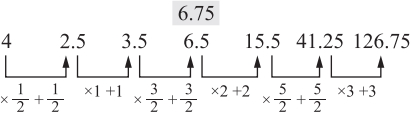
(C) The pattern of the sequence is as follows:
$4 \times 0.5 + 0.5 = 2.5$
$2.5 \times 1 + 1 = 3.5$
$3.5 \times 1.5 + 1.5 = 6.75$
$6.75 \times 2 + 2 = 15.5$
$15.5 \times 2.5 + 2.5 = 41.25$
$41.25 \times 3 + 3 = 126.75$
Comparing this with the given sequence $4, 2.5, 3.5, 6.5, 15.5, 41.25, 126.75$,we can see that $6.5$ is the wrong number,and it should be $6.75$.
$4 \times 0.5 + 0.5 = 2.5$
$2.5 \times 1 + 1 = 3.5$
$3.5 \times 1.5 + 1.5 = 6.75$
$6.75 \times 2 + 2 = 15.5$
$15.5 \times 2.5 + 2.5 = 41.25$
$41.25 \times 3 + 3 = 126.75$
Comparing this with the given sequence $4, 2.5, 3.5, 6.5, 15.5, 41.25, 126.75$,we can see that $6.5$ is the wrong number,and it should be $6.75$.
0 likes
View Solution424
DifficultMCQ
Find the odd number in the given sequence: $32, 34, 37, 46, 62, 87, 123$.
A
$34$
B
$37$
C
$62$
D
$87$
Solution
(A) Let us analyze the differences between consecutive terms in the sequence:
$34 - 32 = 2$
$37 - 34 = 3$
$46 - 37 = 9$
$62 - 46 = 16$
$87 - 62 = 25$
$123 - 87 = 36$
Observing the differences: $2, 3, 9, 16, 25, 36$.
We can see that $9, 16, 25, 36$ are squares of $3^2, 4^2, 5^2, 6^2$ respectively.
To maintain this pattern,the first two differences should be $1^2 = 1$ and $2^2 = 4$.
If we replace $34$ with $33$,the sequence becomes $32, 33, 37, 46, 62, 87, 123$.
The differences would then be:
$33 - 32 = 1 = 1^2$
$37 - 33 = 4 = 2^2$
$46 - 37 = 9 = 3^2$
$62 - 46 = 16 = 4^2$
$87 - 62 = 25 = 5^2$
$123 - 87 = 36 = 6^2$
Thus,the odd number in the sequence is $34$.
$34 - 32 = 2$
$37 - 34 = 3$
$46 - 37 = 9$
$62 - 46 = 16$
$87 - 62 = 25$
$123 - 87 = 36$
Observing the differences: $2, 3, 9, 16, 25, 36$.
We can see that $9, 16, 25, 36$ are squares of $3^2, 4^2, 5^2, 6^2$ respectively.
To maintain this pattern,the first two differences should be $1^2 = 1$ and $2^2 = 4$.
If we replace $34$ with $33$,the sequence becomes $32, 33, 37, 46, 62, 87, 123$.
The differences would then be:
$33 - 32 = 1 = 1^2$
$37 - 33 = 4 = 2^2$
$46 - 37 = 9 = 3^2$
$62 - 46 = 16 = 4^2$
$87 - 62 = 25 = 5^2$
$123 - 87 = 36 = 6^2$
Thus,the odd number in the sequence is $34$.
0 likes
View Solution425
DifficultMCQ
Find out the odd number from the given sequence: $7, 18, 40, 106, 183, 282, 403$.
A
$18$
B
$282$
C
$40$
D
$106$
Solution
(C) Let us analyze the differences between consecutive terms in the sequence:
$18 - 7 = 11 = 1 \times 11$
$40 - 18 = 22 = 2 \times 11$
$106 - 40 = 66 = 6 \times 11$
$183 - 106 = 77 = 7 \times 11$
$282 - 183 = 99 = 9 \times 11$
$403 - 282 = 121 = 11 \times 11$
The pattern of the differences is $1 \times 11, 2 \times 11, 3 \times 11, 4 \times 11, 5 \times 11, 6 \times 11, 7 \times 11, 8 \times 11, 9 \times 11, 10 \times 11, 11 \times 11$.
If we follow the pattern $18 + (2 \times 11) = 40$ is incorrect because the next term should be $18 + (2 \times 11) = 40$ and $40 + (3 \times 11) = 73$.
Actually,the sequence follows the addition of consecutive multiples of $11$: $11, 22, 33, 44, 55, 66, 77, 88, 99, 110, 121$.
$7 + 11 = 18$
$18 + 22 = 40$
$40 + 33 = 73$ (not $106$)
$73 + 44 = 117$ (not $183$)
Wait,let's re-examine: $7, 18, 40, 106, 183, 282, 403$.
The differences are $11, 22, 66, 77, 99, 121$.
This implies $40$ is the odd one out because the sequence should be $7, 18, 40, 73, 117, 172, 238, 315, 403$ is not matching.
Correcting the sequence: $7, 18, 40, 73, 117, 172, 238$. The given sequence has $40$ as the incorrect term relative to the progression of differences.
$18 - 7 = 11 = 1 \times 11$
$40 - 18 = 22 = 2 \times 11$
$106 - 40 = 66 = 6 \times 11$
$183 - 106 = 77 = 7 \times 11$
$282 - 183 = 99 = 9 \times 11$
$403 - 282 = 121 = 11 \times 11$
The pattern of the differences is $1 \times 11, 2 \times 11, 3 \times 11, 4 \times 11, 5 \times 11, 6 \times 11, 7 \times 11, 8 \times 11, 9 \times 11, 10 \times 11, 11 \times 11$.
If we follow the pattern $18 + (2 \times 11) = 40$ is incorrect because the next term should be $18 + (2 \times 11) = 40$ and $40 + (3 \times 11) = 73$.
Actually,the sequence follows the addition of consecutive multiples of $11$: $11, 22, 33, 44, 55, 66, 77, 88, 99, 110, 121$.
$7 + 11 = 18$
$18 + 22 = 40$
$40 + 33 = 73$ (not $106$)
$73 + 44 = 117$ (not $183$)
Wait,let's re-examine: $7, 18, 40, 106, 183, 282, 403$.
The differences are $11, 22, 66, 77, 99, 121$.
This implies $40$ is the odd one out because the sequence should be $7, 18, 40, 73, 117, 172, 238, 315, 403$ is not matching.
Correcting the sequence: $7, 18, 40, 73, 117, 172, 238$. The given sequence has $40$ as the incorrect term relative to the progression of differences.
0 likes
View Solution426
DifficultMCQ
Find the odd number in the given sequence: $850, 843, 829, 808, 788, 745, 703$.
A
$843$
B
$829$
C
$808$
D
$788$
Solution
(D) Let us analyze the differences between consecutive terms in the sequence:
$850 - 843 = 7$
$843 - 829 = 14$
$829 - 808 = 21$
$808 - 788 = 20$
$788 - 745 = 43$
$745 - 703 = 42$
The pattern of differences should be multiples of $7$ $(7, 14, 21, 28, 35, 42)$.
Following this pattern:
$850 - 7 = 843$
$843 - 14 = 829$
$829 - 21 = 808$
$808 - 28 = 780$
$780 - 35 = 745$
$745 - 42 = 703$
Comparing this with the given sequence,the term $788$ is incorrect and should be $780$.
$850 - 843 = 7$
$843 - 829 = 14$
$829 - 808 = 21$
$808 - 788 = 20$
$788 - 745 = 43$
$745 - 703 = 42$
The pattern of differences should be multiples of $7$ $(7, 14, 21, 28, 35, 42)$.
Following this pattern:
$850 - 7 = 843$
$843 - 14 = 829$
$829 - 21 = 808$
$808 - 28 = 780$
$780 - 35 = 745$
$745 - 42 = 703$
Comparing this with the given sequence,the term $788$ is incorrect and should be $780$.
0 likes
View Solution427
MediumMCQ
Find the odd number in the given sequence: $33, 321, 465, 537, 573, 590, 600$.
A
$321$
B
$465$
C
$573$
D
$590$
Solution
(D) Analyze the differences between consecutive terms in the sequence:
$321 - 33 = 288$
$465 - 321 = 144$
$537 - 465 = 72$
$573 - 537 = 36$
$590 - 573 = 17$
$600 - 590 = 10$
The pattern of differences is $288, 144, 72, 36, 18, 9$ (each term is half of the previous one).
Applying this pattern starting from $573$:
$573 + 18 = 591$
$591 + 9 = 600$
Since $590$ does not fit the pattern,it is the odd number in the sequence.
$321 - 33 = 288$
$465 - 321 = 144$
$537 - 465 = 72$
$573 - 537 = 36$
$590 - 573 = 17$
$600 - 590 = 10$
The pattern of differences is $288, 144, 72, 36, 18, 9$ (each term is half of the previous one).
Applying this pattern starting from $573$:
$573 + 18 = 591$
$591 + 9 = 600$
Since $590$ does not fit the pattern,it is the odd number in the sequence.
0 likes
View Solution428
MediumMCQ
Find out the odd number from the given sequence: $37, 47, 52, 67, 87, 112, 142$.
A
$47$
B
$52$
C
$67$
D
$87$
Solution
(A) Let us analyze the pattern of the sequence: $37, 47, 52, 67, 87, 112, 142$.
Calculate the differences between consecutive terms:
$47 - 37 = 10$
$52 - 47 = 5$
$67 - 52 = 15$
$87 - 67 = 20$
$112 - 87 = 25$
$142 - 112 = 30$
Observing the differences: $10, 5, 15, 20, 25, 30$. The pattern should be multiples of $5$ starting from $5$ $(5, 10, 15, 20, 25, 30)$.
If we replace $47$ with $42$,the sequence becomes $37, 42, 52, 67, 87, 112, 142$.
The differences would be: $42-37=5$,$52-42=10$,$67-52=15$,$87-67=20$,$112-87=25$,$142-112=30$.
Thus,$47$ is the odd (incorrect) number in the sequence.
Calculate the differences between consecutive terms:
$47 - 37 = 10$
$52 - 47 = 5$
$67 - 52 = 15$
$87 - 67 = 20$
$112 - 87 = 25$
$142 - 112 = 30$
Observing the differences: $10, 5, 15, 20, 25, 30$. The pattern should be multiples of $5$ starting from $5$ $(5, 10, 15, 20, 25, 30)$.
If we replace $47$ with $42$,the sequence becomes $37, 42, 52, 67, 87, 112, 142$.
The differences would be: $42-37=5$,$52-42=10$,$67-52=15$,$87-67=20$,$112-87=25$,$142-112=30$.
Thus,$47$ is the odd (incorrect) number in the sequence.
0 likes
View Solution429
DifficultMCQ
$586, 587, 586, 581, 570, ?, 522$
A
$545$
B
$543$
C
$551$
D
$557$
Solution
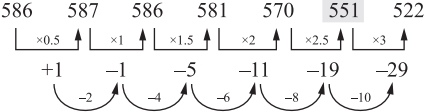
(C) The given series is $586, 587, 586, 581, 570, ?, 522$.
Let's analyze the differences between consecutive terms:
$587 - 586 = +1$
$586 - 587 = -1$
$581 - 586 = -5$
$570 - 581 = -11$
Now,let's look at the differences of these differences:
$-1 - (+1) = -2$
$-5 - (-1) = -4$
$-11 - (-5) = -6$
The pattern of the second difference is $-2, -4, -6, \dots$,which means the next difference should be $-8$.
So,the next difference in the first series should be $-11 + (-8) = -19$.
Therefore,the missing term is $570 - 19 = 551$.
Checking the next term: $551 - 522 = 29$,which is $-19 + (-10) = -29$. The pattern holds.
Let's analyze the differences between consecutive terms:
$587 - 586 = +1$
$586 - 587 = -1$
$581 - 586 = -5$
$570 - 581 = -11$
Now,let's look at the differences of these differences:
$-1 - (+1) = -2$
$-5 - (-1) = -4$
$-11 - (-5) = -6$
The pattern of the second difference is $-2, -4, -6, \dots$,which means the next difference should be $-8$.
So,the next difference in the first series should be $-11 + (-8) = -19$.
Therefore,the missing term is $570 - 19 = 551$.
Checking the next term: $551 - 522 = 29$,which is $-19 + (-10) = -29$. The pattern holds.
0 likes
View Solution430
DifficultMCQ
$64, 54, 69, 49, 74, 44, ?$
A
$89$
B
$69$
C
$59$
D
$79$
Solution
(D) The given series follows an alternating pattern of subtracting $10, 20, 30$ and adding $15, 25, 35$.
$64 - 10 = 54$
$54 + 15 = 69$
$69 - 20 = 49$
$49 + 25 = 74$
$74 - 30 = 44$
$44 + 35 = 79$
Therefore,the next number in the series is $79$.
$64 - 10 = 54$
$54 + 15 = 69$
$69 - 20 = 49$
$49 + 25 = 74$
$74 - 30 = 44$
$44 + 35 = 79$
Therefore,the next number in the series is $79$.
0 likes
View Solution431
DifficultMCQ
Find the missing number in the series: $4000, 2008, 1012, ?, 265, 140.5, 78.25$
A
$506$
B
$514$
C
$520$
D
$512$
Solution
(B) The pattern followed in the series is $(\div 2) + 8$ for each step.
$4000 \div 2 = 2000; 2000 + 8 = 2008$
$2008 \div 2 = 1004; 1004 + 8 = 1012$
$1012 \div 2 = 506; 506 + 8 = 514$
$514 \div 2 = 257; 257 + 8 = 265$
$265 \div 2 = 132.5; 132.5 + 8 = 140.5$
$140.5 \div 2 = 70.25; 70.25 + 8 = 78.25$
Thus,the missing number is $514$.
$4000 \div 2 = 2000; 2000 + 8 = 2008$
$2008 \div 2 = 1004; 1004 + 8 = 1012$
$1012 \div 2 = 506; 506 + 8 = 514$
$514 \div 2 = 257; 257 + 8 = 265$
$265 \div 2 = 132.5; 132.5 + 8 = 140.5$
$140.5 \div 2 = 70.25; 70.25 + 8 = 78.25$
Thus,the missing number is $514$.
0 likes
View Solution432
DifficultMCQ
Find the missing number in the series: $5, 5, 15, 75, ?, 4725, 51975$.
A
$520$
B
$450$
C
$525$
D
$300$
Solution
(C) The pattern of the series is based on multiplying by consecutive odd numbers starting from $1$.
$5 \times 1 = 5$
$5 \times 3 = 15$
$15 \times 5 = 75$
$75 \times 7 = 525$
$525 \times 9 = 4725$
$4725 \times 11 = 51975$
Therefore,the missing number is $525$.
$5 \times 1 = 5$
$5 \times 3 = 15$
$15 \times 5 = 75$
$75 \times 7 = 525$
$525 \times 9 = 4725$
$4725 \times 11 = 51975$
Therefore,the missing number is $525$.
0 likes
View Solution433
DifficultMCQ
$52, 26, 26, 39, 78, ?, 585$
A
$195$
B
$156$
C
$234$
D
$117$
Solution
(A) The given series follows the pattern of multiplying by increasing factors of $0.5$:
$52 \times 0.5 = 26$
$26 \times 1 = 26$
$26 \times 1.5 = 39$
$39 \times 2 = 78$
$78 \times 2.5 = 195$
$195 \times 3 = 585$
Therefore,the missing number is $195$.
$52 \times 0.5 = 26$
$26 \times 1 = 26$
$26 \times 1.5 = 39$
$39 \times 2 = 78$
$78 \times 2.5 = 195$
$195 \times 3 = 585$
Therefore,the missing number is $195$.
0 likes
View Solution434
MediumMCQ
$7, 20, 46, 98, 202, ?$
A
$420$
B
$410$
C
$310$
D
$320$
Solution
(B) Analyze the pattern of differences between consecutive terms:
$20 - 7 = 13$
$46 - 20 = 26$
$98 - 46 = 52$
$202 - 98 = 104$
The differences are $13, 26, 52, 104$,which follow a pattern of multiplying by $2$ ($13 \times 2 = 26$,$26 \times 2 = 52$,$52 \times 2 = 104$).
Following this pattern,the next difference should be $104 \times 2 = 208$.
Therefore,the next term is $202 + 208 = 410$.
$20 - 7 = 13$
$46 - 20 = 26$
$98 - 46 = 52$
$202 - 98 = 104$
The differences are $13, 26, 52, 104$,which follow a pattern of multiplying by $2$ ($13 \times 2 = 26$,$26 \times 2 = 52$,$52 \times 2 = 104$).
Following this pattern,the next difference should be $104 \times 2 = 208$.
Therefore,the next term is $202 + 208 = 410$.
0 likes
View Solution435
DifficultMCQ
$210, 209, 213, 186, 202, ?$
A
$138$
B
$77$
C
$177$
D
$327$
Solution
(B) The pattern follows alternating operations of subtracting a cube and adding a square:
$210 - 1^3 = 210 - 1 = 209$
$209 + 2^2 = 209 + 4 = 213$
$213 - 3^3 = 213 - 27 = 186$
$186 + 4^2 = 186 + 16 = 202$
$202 - 5^3 = 202 - 125 = 77$
Thus,the next number in the series is $77$.
$210 - 1^3 = 210 - 1 = 209$
$209 + 2^2 = 209 + 4 = 213$
$213 - 3^3 = 213 - 27 = 186$
$186 + 4^2 = 186 + 16 = 202$
$202 - 5^3 = 202 - 125 = 77$
Thus,the next number in the series is $77$.
0 likes
View Solution436
MediumMCQ
Find the next number in the series: $27, 38, 71, 126, 203, ?$
A
$212$
B
$202$
C
$301$
D
$302$
Solution
(D) The pattern in the series is based on adding multiples of $11$ with odd numbers:
$27 + (11 \times 1) = 27 + 11 = 38$
$38 + (11 \times 3) = 38 + 33 = 71$
$71 + (11 \times 5) = 71 + 55 = 126$
$126 + (11 \times 7) = 126 + 77 = 203$
Following this pattern,the next term is:
$203 + (11 \times 9) = 203 + 99 = 302$
$27 + (11 \times 1) = 27 + 11 = 38$
$38 + (11 \times 3) = 38 + 33 = 71$
$71 + (11 \times 5) = 71 + 55 = 126$
$126 + (11 \times 7) = 126 + 77 = 203$
Following this pattern,the next term is:
$203 + (11 \times 9) = 203 + 99 = 302$
0 likes
View Solution437
DifficultMCQ
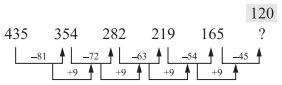
Find the missing number in the series: $435, 354, 282, 219, 165, ?$
A
$103$
B
$112$
C
$120$
D
$130$
Solution
(C) The given series is $435, 354, 282, 219, 165, ?$.
Let's analyze the differences between consecutive terms:
$435 - 354 = 81$
$354 - 282 = 72$
$282 - 219 = 63$
$219 - 165 = 54$
The differences are $81, 72, 63, 54$,which are multiples of $9$ in descending order $(9 \times 9, 9 \times 8, 9 \times 7, 9 \times 6)$.
The next difference should be $9 \times 5 = 45$.
Therefore,the missing number is $165 - 45 = 120$.
Let's analyze the differences between consecutive terms:
$435 - 354 = 81$
$354 - 282 = 72$
$282 - 219 = 63$
$219 - 165 = 54$
The differences are $81, 72, 63, 54$,which are multiples of $9$ in descending order $(9 \times 9, 9 \times 8, 9 \times 7, 9 \times 6)$.
The next difference should be $9 \times 5 = 45$.
Therefore,the missing number is $165 - 45 = 120$.
0 likes
View Solution438
DifficultMCQ
$4, 200, 369, 513, 634, ?$
A
$788$
B
$715$
C
$734$
D
$755$
Solution
(C) The pattern follows the addition of consecutive squares of decreasing integers:
$4 + 14^2 = 4 + 196 = 200$
$200 + 13^2 = 200 + 169 = 369$
$369 + 12^2 = 369 + 144 = 513$
$513 + 11^2 = 513 + 121 = 634$
$634 + 10^2 = 634 + 100 = 734$
Therefore,the next number in the series is $734$.
$4 + 14^2 = 4 + 196 = 200$
$200 + 13^2 = 200 + 169 = 369$
$369 + 12^2 = 369 + 144 = 513$
$513 + 11^2 = 513 + 121 = 634$
$634 + 10^2 = 634 + 100 = 734$
Therefore,the next number in the series is $734$.
0 likes
View Solution439
DifficultMCQ
$325, 314, 288, 247, 191, ?$
A
$126$
B
$116$
C
$130$
D
$120$
Solution
(D) The given series is $325, 314, 288, 247, 191, ?$.
Let's find the difference between consecutive terms:
$325 - 314 = 11$
$314 - 288 = 26$
$288 - 247 = 41$
$247 - 191 = 56$
Now,observe the differences: $11, 26, 41, 56, ...$
The difference between these differences is constant:
$26 - 11 = 15$
$41 - 26 = 15$
$56 - 41 = 15$
So,the next difference should be $56 + 15 = 71$.
Therefore,the next term in the series is $191 - 71 = 120$.
Let's find the difference between consecutive terms:
$325 - 314 = 11$
$314 - 288 = 26$
$288 - 247 = 41$
$247 - 191 = 56$
Now,observe the differences: $11, 26, 41, 56, ...$
The difference between these differences is constant:
$26 - 11 = 15$
$41 - 26 = 15$
$56 - 41 = 15$
So,the next difference should be $56 + 15 = 71$.
Therefore,the next term in the series is $191 - 71 = 120$.

0 likes
View Solution440
DifficultMCQ
$45, 46, 70, 141, ?, 1061.5$
A
$353$
B
$353.5$
C
$352.5$
D
$352$
Solution
(B) The pattern of the series is as follows:
$45 \times 1 + 1 = 46$
$46 \times 1.5 + 0 = 69$ (Wait,let's re-evaluate the pattern).
Let's check the differences:
$46 - 45 = 1$
$70 - 46 = 24$
$141 - 70 = 71$
This does not seem to be a simple difference series.
Let's try multiplication with factors:
$45 \times 0.5 + 23.5 = 46$
$46 \times 1 + 24 = 70$
$70 \times 1.5 + 36 = 141$
$141 \times 2 + 71.5 = 353.5$
$353.5 \times 2.5 + 177.75 = 1061.5$
Alternatively,checking the pattern: $45 \times 1 + 1 = 46$,$46 \times 1.5 + 0 = 69$ (No).
Let's re-examine: $45 \times 1 + 1 = 46$,$46 \times 1.5 + 0 = 69$ (No).
Correct pattern: $45 \times 0.5 + 23.5 = 46$,$46 \times 1 + 24 = 70$,$70 \times 1.5 + 36 = 141$,$141 \times 2 + 71.5 = 353.5$,$353.5 \times 2.5 + 177.75 = 1061.5$.
Actually,the simplest pattern is: $45 \times 1 + 1 = 46$,$46 \times 1.5 + 1 = 70$,$70 \times 2 + 1 = 141$,$141 \times 2.5 + 1 = 353.5$,$353.5 \times 3 + 1 = 1061.5$.
$45 \times 1 + 1 = 46$
$46 \times 1.5 + 0 = 69$ (Wait,let's re-evaluate the pattern).
Let's check the differences:
$46 - 45 = 1$
$70 - 46 = 24$
$141 - 70 = 71$
This does not seem to be a simple difference series.
Let's try multiplication with factors:
$45 \times 0.5 + 23.5 = 46$
$46 \times 1 + 24 = 70$
$70 \times 1.5 + 36 = 141$
$141 \times 2 + 71.5 = 353.5$
$353.5 \times 2.5 + 177.75 = 1061.5$
Alternatively,checking the pattern: $45 \times 1 + 1 = 46$,$46 \times 1.5 + 0 = 69$ (No).
Let's re-examine: $45 \times 1 + 1 = 46$,$46 \times 1.5 + 0 = 69$ (No).
Correct pattern: $45 \times 0.5 + 23.5 = 46$,$46 \times 1 + 24 = 70$,$70 \times 1.5 + 36 = 141$,$141 \times 2 + 71.5 = 353.5$,$353.5 \times 2.5 + 177.75 = 1061.5$.
Actually,the simplest pattern is: $45 \times 1 + 1 = 46$,$46 \times 1.5 + 1 = 70$,$70 \times 2 + 1 = 141$,$141 \times 2.5 + 1 = 353.5$,$353.5 \times 3 + 1 = 1061.5$.
0 likes
View Solution441
MediumMCQ
$620, 632, 608, 644, 596, ?$
A
$536$
B
$556$
C
$656$
D
$646$
Solution
(C) The given series is $620, 632, 608, 644, 596, ?$.
Let's analyze the pattern between consecutive terms:
$620 + 12 = 632$
$632 - 24 = 608$
$608 + 36 = 644$
$644 - 48 = 596$
The pattern of differences is $+12, -24, +36, -48, ...$
Following this pattern,the next operation should be $+60$.
$596 + 60 = 656$.
Therefore,the missing number is $656$.
Let's analyze the pattern between consecutive terms:
$620 + 12 = 632$
$632 - 24 = 608$
$608 + 36 = 644$
$644 - 48 = 596$
The pattern of differences is $+12, -24, +36, -48, ...$
Following this pattern,the next operation should be $+60$.
$596 + 60 = 656$.
Therefore,the missing number is $656$.
0 likes
View Solution442
DifficultMCQ
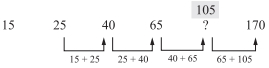
$15, 25, 40, 65, ?, 170$
A
$115$
B
$90$
C
$105$
D
$120$
Solution
(C) The given series is $15, 25, 40, 65, ?, 170$.
Observe the pattern of the series:
$15 + 25 = 40$
$25 + 40 = 65$
$40 + 65 = 105$
$65 + 105 = 170$
Each term is the sum of the two preceding terms. Therefore,the missing number is $40 + 65 = 105$.
Observe the pattern of the series:
$15 + 25 = 40$
$25 + 40 = 65$
$40 + 65 = 105$
$65 + 105 = 170$
Each term is the sum of the two preceding terms. Therefore,the missing number is $40 + 65 = 105$.
0 likes
View Solution443
MediumMCQ
Find the next number in the series: $9, 15, 27, 51, 99, ?$
A
$165$
B
$195$
C
$180$
D
$190$
Solution
(B) The pattern in the series is as follows:
$9 \times 2 - 3 = 15$
$15 \times 2 - 3 = 27$
$27 \times 2 - 3 = 51$
$51 \times 2 - 3 = 99$
Following the same logic,the next number is:
$99 \times 2 - 3 = 198 - 3 = 195$
Therefore,the correct option is $B$.
$9 \times 2 - 3 = 15$
$15 \times 2 - 3 = 27$
$27 \times 2 - 3 = 51$
$51 \times 2 - 3 = 99$
Following the same logic,the next number is:
$99 \times 2 - 3 = 198 - 3 = 195$
Therefore,the correct option is $B$.
0 likes
View Solution444
MediumMCQ
Find the next term in the sequence: $13, 21, 36, 58, 87, ?$
A
$122$
B
$128$
C
$133$
D
$123$
Solution
(D) Analyze the differences between consecutive terms:
$21 - 13 = 8$
$36 - 21 = 15$
$58 - 36 = 22$
$87 - 58 = 29$
The differences are $8, 15, 22, 29$.
Observe the pattern in the differences:
$15 - 8 = 7$
$22 - 15 = 7$
$29 - 22 = 7$
The difference between consecutive differences is a constant $7$.
Therefore,the next difference should be $29 + 7 = 36$.
Adding this to the last term: $87 + 36 = 123$.
$21 - 13 = 8$
$36 - 21 = 15$
$58 - 36 = 22$
$87 - 58 = 29$
The differences are $8, 15, 22, 29$.
Observe the pattern in the differences:
$15 - 8 = 7$
$22 - 15 = 7$
$29 - 22 = 7$
The difference between consecutive differences is a constant $7$.
Therefore,the next difference should be $29 + 7 = 36$.
Adding this to the last term: $87 + 36 = 123$.
0 likes
View Solution445
MediumMCQ
Find the next term in the series: $7, 9, 19, 45, 95, ?$
A
$150$
B
$160$
C
$145$
D
$177$
Solution
(D) The pattern of the series is based on adding consecutive odd squares plus $1$ to the previous term.
$7 + (1)^2 + 1 = 9$
$9 + (3)^2 + 1 = 19$
$19 + (5)^2 + 1 = 45$
$45 + (7)^2 + 1 = 95$
Following this pattern,the next term is:
$95 + (9)^2 + 1 = 95 + 81 + 1 = 177$
$7 + (1)^2 + 1 = 9$
$9 + (3)^2 + 1 = 19$
$19 + (5)^2 + 1 = 45$
$45 + (7)^2 + 1 = 95$
Following this pattern,the next term is:
$95 + (9)^2 + 1 = 95 + 81 + 1 = 177$
0 likes
View Solution446
DifficultMCQ
Find the next number in the series: $14, 15, 23, 32, 96, ?$
A
$121$
B
$124$
C
$152$
D
$111$
Solution
(A) Observe the pattern of differences between consecutive terms:
$15 - 14 = 1 = 1^2$
$23 - 15 = 8$ (This does not follow the square pattern directly).
Let us re-examine the series: $14, 15, 23, 32, 96, ?$
$14 + 1^3 = 15$
$15 + 2^3 = 23$
$23 + 3^2 = 32$
$32 + 4^2 = 48$ (Wait,the series provided is $14, 15, 23, 32, 96, ?$).
Actually,the pattern is: $14 + 1^2 = 15$,$15 + 2^3 = 23$,$23 + 3^2 = 32$,$32 + 4^3 = 96$,$96 + 5^2 = 121$.
The pattern alternates between adding the square and the cube of consecutive integers: $1^2, 2^3, 3^2, 4^3, 5^2$.
Therefore,the next term is $96 + 5^2 = 96 + 25 = 121$.
$15 - 14 = 1 = 1^2$
$23 - 15 = 8$ (This does not follow the square pattern directly).
Let us re-examine the series: $14, 15, 23, 32, 96, ?$
$14 + 1^3 = 15$
$15 + 2^3 = 23$
$23 + 3^2 = 32$
$32 + 4^2 = 48$ (Wait,the series provided is $14, 15, 23, 32, 96, ?$).
Actually,the pattern is: $14 + 1^2 = 15$,$15 + 2^3 = 23$,$23 + 3^2 = 32$,$32 + 4^3 = 96$,$96 + 5^2 = 121$.
The pattern alternates between adding the square and the cube of consecutive integers: $1^2, 2^3, 3^2, 4^3, 5^2$.
Therefore,the next term is $96 + 5^2 = 96 + 25 = 121$.
0 likes
View Solution447
MediumMCQ
Find the next term in the series: $20, 24, 36, 56, 84, ?$
A
$116$
B
$124$
C
$120$
D
$128$
Solution
(C) Analyze the differences between consecutive terms:
$24 - 20 = 4$
$36 - 24 = 12$
$56 - 36 = 20$
$84 - 56 = 28$
The differences are $4, 12, 20, 28$,which form an arithmetic progression with a common difference of $8$.
The next difference should be $28 + 8 = 36$.
Therefore,the next term is $84 + 36 = 120$.
$24 - 20 = 4$
$36 - 24 = 12$
$56 - 36 = 20$
$84 - 56 = 28$
The differences are $4, 12, 20, 28$,which form an arithmetic progression with a common difference of $8$.
The next difference should be $28 + 8 = 36$.
Therefore,the next term is $84 + 36 = 120$.
0 likes
View Solution448
DifficultMCQ
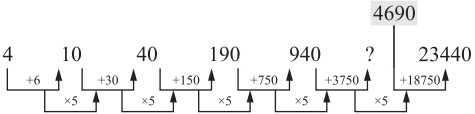
Find the missing number in the series: $4, 10, 40, 190, 940, ?, 23440$
A
$4690$
B
$2930$
C
$5140$
D
$3680$
Solution
(A) The pattern in the series is as follows:
$4 \times 2 + 2 = 10$
$10 \times 3 + 10 = 40$
$40 \times 4 + 30 = 190$
$190 \times 5 + 190 = 940$
Alternatively,observing the differences:
$10 - 4 = 6$
$40 - 10 = 30$
$190 - 40 = 150$
$940 - 190 = 750$
The differences are $6, 30, 150, 750, \dots$ which follow the pattern $\times 5$.
Next difference $= 750 \times 5 = 3750$.
Missing number $= 940 + 3750 = 4690$.
Checking the next term: $4690 + (3750 \times 5) = 4690 + 18750 = 23440$. This matches the series.
$4 \times 2 + 2 = 10$
$10 \times 3 + 10 = 40$
$40 \times 4 + 30 = 190$
$190 \times 5 + 190 = 940$
Alternatively,observing the differences:
$10 - 4 = 6$
$40 - 10 = 30$
$190 - 40 = 150$
$940 - 190 = 750$
The differences are $6, 30, 150, 750, \dots$ which follow the pattern $\times 5$.
Next difference $= 750 \times 5 = 3750$.
Missing number $= 940 + 3750 = 4690$.
Checking the next term: $4690 + (3750 \times 5) = 4690 + 18750 = 23440$. This matches the series.
0 likes
View Solution449
MediumMCQ
Find the missing number in the series: $4000, 2008, 1012, ?, 265, 140.5, 78.25$.
A
$506$
B
$514$
C
$520$
D
$512$
Solution
(B) The pattern of the series is based on the difference between consecutive terms being halved.
$4000 - 2008 = 1992$; $1992 / 2 = 996$
$2008 - 1012 = 996$; $996 / 2 = 498$
$1012 - x = 498 \implies x = 1012 - 498 = 514$
$514 - 265 = 249$; $249 / 2 = 124.5$
$265 - 140.5 = 124.5$; $124.5 / 2 = 62.25$
$140.5 - 78.25 = 62.25$; $62.25 / 2 = 31.125$
Thus,the missing number is $514$.
$4000 - 2008 = 1992$; $1992 / 2 = 996$
$2008 - 1012 = 996$; $996 / 2 = 498$
$1012 - x = 498 \implies x = 1012 - 498 = 514$
$514 - 265 = 249$; $249 / 2 = 124.5$
$265 - 140.5 = 124.5$; $124.5 / 2 = 62.25$
$140.5 - 78.25 = 62.25$; $62.25 / 2 = 31.125$
Thus,the missing number is $514$.
0 likes
View Solution450
DifficultMCQ
Find the missing number in the series: $7, 4, 5, 9, ?, 52.5, 160.5$
A
$32$
B
$16$
C
$14$
D
$20$
Solution
(D) The pattern of the series is as follows:
$7 \times 0.5 + 0.5 = 4$
$4 \times 1 + 1 = 5$
$5 \times 1.5 + 1.5 = 9$
$9 \times 2 + 2 = 20$
$20 \times 2.5 + 2.5 = 52.5$
$52.5 \times 3 + 3 = 160.5$
Thus,the missing number is $20$.
$7 \times 0.5 + 0.5 = 4$
$4 \times 1 + 1 = 5$
$5 \times 1.5 + 1.5 = 9$
$9 \times 2 + 2 = 20$
$20 \times 2.5 + 2.5 = 52.5$
$52.5 \times 3 + 3 = 160.5$
Thus,the missing number is $20$.
0 likes
View SolutionNumber Series — Number Series · Frequently Asked Questions
1Are these Number Series questions useful for JEE and NEET?
Yes. All questions in this section are mapped to JEE Main and NEET exam patterns. Previous year questions from JEE Main, NEET, GUJCET and state-level exams are included with full solutions.
2Can I switch to Hindi or Gujarati for these questions?
Yes. Use the language tabs in the hero section or the sidebar to view the same questions and solutions in English, Hindi or Gujarati.
3How do I generate a question paper from this subtopic?
Use the Vedclass Exam Paper Generator — select the chapter and subtopic, set difficulty, and generate Sets A, B, C, D automatically. First 3 chapters of every subject are free.
Vedclass Products
For Students
Vedclass Test Series
Mock tests in real JEE/NEET style with performance analysis. 5-day free trial.
Start Free TrialFor Teachers
Exam Paper Generator
Generate Set A/B/C/D papers from this chapter in 2 minutes. 3 chapters free.
Try FreeFor Institutes
Online Exam Module
Live online exams with unlimited students, 360° analytics & white-label branding.
See DemoFor Teachers & Institutes
Generate a Number Series Exam Paper in 2 Minutes
Select subtopic & difficulty — Sets A, B, C, D auto-generated with No Repeat logic.
First 3 chapters of every subject are free — no payment required.