
A English
Number Series Questions in English
Competitive Exam Quantitative Aptitude · Number Series · Number Series
473+
Questions
English
Language
100%
With Solutions
Showing 50 of 473 questions in English
301
EasyMCQ
Find out the odd number from the given sequence: $7, 9, 17, 42, 91, 172, 293$.
A
$16$
B
$25$
C
$36$
D
$9$
Solution
(D) Let us analyze the differences between consecutive terms in the sequence: $7, 9, 17, 42, 91, 172, 293$.
$9 - 7 = 2$
$17 - 9 = 8$
$42 - 17 = 25$
$91 - 42 = 49$
$172 - 91 = 81$
$293 - 172 = 121$
The differences are $2, 8, 25, 49, 81, 121$. We observe that $49 = 7^2$,$81 = 9^2$,and $121 = 11^2$. The pattern of differences should be squares of odd numbers: $1^2, 3^2, 5^2, 7^2, 9^2, 11^2$,which are $1, 9, 25, 49, 81, 121$.
If the first term is $8$ instead of $7$,the sequence becomes $8, 9, 18, 43, 92, 173, 294$. However,looking at the original sequence $7, 9, 17, 42, 91, 172, 293$,the term $9$ is the odd one out because replacing it with $8$ makes the differences $1^2, 3^2, 5^2, 7^2, 9^2, 11^2$. Thus,$9$ is the incorrect term.
$9 - 7 = 2$
$17 - 9 = 8$
$42 - 17 = 25$
$91 - 42 = 49$
$172 - 91 = 81$
$293 - 172 = 121$
The differences are $2, 8, 25, 49, 81, 121$. We observe that $49 = 7^2$,$81 = 9^2$,and $121 = 11^2$. The pattern of differences should be squares of odd numbers: $1^2, 3^2, 5^2, 7^2, 9^2, 11^2$,which are $1, 9, 25, 49, 81, 121$.
If the first term is $8$ instead of $7$,the sequence becomes $8, 9, 18, 43, 92, 173, 294$. However,looking at the original sequence $7, 9, 17, 42, 91, 172, 293$,the term $9$ is the odd one out because replacing it with $8$ makes the differences $1^2, 3^2, 5^2, 7^2, 9^2, 11^2$. Thus,$9$ is the incorrect term.
0 likes
View Solution302
EasyMCQ
Find out the odd number from the given sequence: $8, 14, 26, 48, 98, 194, 386$.
A
$60$
B
$50$
C
$72$
D
$96$
Solution
(B) Let us analyze the pattern of the sequence: $8, 14, 26, 48, 98, 194, 386$.
$14 = (8 \times 2) - 2 = 16 - 2 = 14$.
$26 = (14 \times 2) - 2 = 28 - 2 = 26$.
$50 = (26 \times 2) - 2 = 52 - 2 = 50$.
$98 = (50 \times 2) - 2 = 100 - 2 = 98$.
$194 = (98 \times 2) - 2 = 196 - 2 = 194$.
$386 = (194 \times 2) - 2 = 388 - 2 = 386$.
In the given sequence,$48$ does not follow the pattern $(x_{n} = 2x_{n-1} - 2)$. If we replace $48$ with $50$,the sequence becomes consistent. Thus,$48$ is the odd number in the sequence. Since the question asks to identify the odd number and provides $50$ as an option to replace it,option $(b)$ is the correct choice.
$14 = (8 \times 2) - 2 = 16 - 2 = 14$.
$26 = (14 \times 2) - 2 = 28 - 2 = 26$.
$50 = (26 \times 2) - 2 = 52 - 2 = 50$.
$98 = (50 \times 2) - 2 = 100 - 2 = 98$.
$194 = (98 \times 2) - 2 = 196 - 2 = 194$.
$386 = (194 \times 2) - 2 = 388 - 2 = 386$.
In the given sequence,$48$ does not follow the pattern $(x_{n} = 2x_{n-1} - 2)$. If we replace $48$ with $50$,the sequence becomes consistent. Thus,$48$ is the odd number in the sequence. Since the question asks to identify the odd number and provides $50$ as an option to replace it,option $(b)$ is the correct choice.
0 likes
View Solution303
EasyMCQ
Find out the odd number from the given sequence: $95, 86, 73, 62, 47, 30, 11$.
A
$90$
B
$75$
C
$64$
D
$35$
Solution
(B) Let us analyze the differences between consecutive terms in the sequence:
$95 - 86 = 9$
$86 - 73 = 13$
$73 - 62 = 11$
$62 - 47 = 15$
$47 - 30 = 17$
$30 - 11 = 19$
Observing the pattern of differences: $9, 13, 11, 15, 17, 19$.
If we replace $73$ with $75$,the sequence becomes $95, 86, 75, 62, 47, 30, 11$.
The new differences are:
$95 - 86 = 9$
$86 - 75 = 11$
$75 - 62 = 13$
$62 - 47 = 15$
$47 - 30 = 17$
$30 - 11 = 19$
The differences are now in the sequence $9, 11, 13, 15, 17, 19$,which follows a consistent pattern.
Thus,$73$ is the odd number in the sequence.
Therefore,option $(b)$ is the correct answer.
$95 - 86 = 9$
$86 - 73 = 13$
$73 - 62 = 11$
$62 - 47 = 15$
$47 - 30 = 17$
$30 - 11 = 19$
Observing the pattern of differences: $9, 13, 11, 15, 17, 19$.
If we replace $73$ with $75$,the sequence becomes $95, 86, 75, 62, 47, 30, 11$.
The new differences are:
$95 - 86 = 9$
$86 - 75 = 11$
$75 - 62 = 13$
$62 - 47 = 15$
$47 - 30 = 17$
$30 - 11 = 19$
The differences are now in the sequence $9, 11, 13, 15, 17, 19$,which follows a consistent pattern.
Thus,$73$ is the odd number in the sequence.
Therefore,option $(b)$ is the correct answer.
0 likes
View Solution304
MediumMCQ
Find out the odd number from the given sequence.
$7, 14, 56, 168, 336, 1344, 2688, 8064$
$7, 14, 56, 168, 336, 1344, 2688, 8064$
A
$3032$
B
$5032$
C
$4032$
D
$2680$
Solution
(C) Let us analyze the pattern of the given series:
$7 \times 2 = 14$
$14 \times 4 = 56$
$56 \times 3 = 168$
$168 \times 2 = 336$
$336 \times 4 = 1344$
$1344 \times 3 = 4032$
$4032 \times 2 = 8064$
The pattern follows the multiplication sequence of $\times 2, \times 4, \times 3, \times 2, \times 4, \times 3, \times 2$.
In the given sequence,the term $2688$ is incorrect and should be $4032$.
Therefore,the odd number in the sequence is $2688$,and the correct term that should be in its place is $4032$.
Hence,option $(c)$ is the correct alternative.
$7 \times 2 = 14$
$14 \times 4 = 56$
$56 \times 3 = 168$
$168 \times 2 = 336$
$336 \times 4 = 1344$
$1344 \times 3 = 4032$
$4032 \times 2 = 8064$
The pattern follows the multiplication sequence of $\times 2, \times 4, \times 3, \times 2, \times 4, \times 3, \times 2$.
In the given sequence,the term $2688$ is incorrect and should be $4032$.
Therefore,the odd number in the sequence is $2688$,and the correct term that should be in its place is $4032$.
Hence,option $(c)$ is the correct alternative.
0 likes
View Solution305
MediumMCQ
Find the odd number in the given sequence: $11, 15, 17, 19, 23, 25$.
A
$11$
B
$15$
C
$17$
D
$25$
Solution
(B) The given sequence is $11, 15, 17, 19, 23, 25$.
Observing the prime numbers,we see that $11, 13, 17, 19, 23$ are consecutive prime numbers.
In the given sequence,$15$ and $25$ are composite numbers,while $11, 17, 19, 23$ are prime numbers.
However,if we look at the pattern of prime numbers starting from $11$,the sequence should be $11, 13, 17, 19, 23, 29$.
Among the given options,$15$ is the most distinct outlier as it breaks the sequence of consecutive prime numbers.
Therefore,$15$ is the odd number in the sequence.
Observing the prime numbers,we see that $11, 13, 17, 19, 23$ are consecutive prime numbers.
In the given sequence,$15$ and $25$ are composite numbers,while $11, 17, 19, 23$ are prime numbers.
However,if we look at the pattern of prime numbers starting from $11$,the sequence should be $11, 13, 17, 19, 23, 29$.
Among the given options,$15$ is the most distinct outlier as it breaks the sequence of consecutive prime numbers.
Therefore,$15$ is the odd number in the sequence.
0 likes
View Solution306
MediumMCQ
| $1$ | $9$ | $65$ | $393$ | ||
| $2$ | $(a)$ | $(b)$ | $(c)$ | $(d)$ | $(e)$ |
Which of the following numbers will come in place of $(c)$?
A
$490$
B
$729$
C
$854$
D
$734$
Solution
(B) The pattern followed by the numbers of the given series is:
$9 = 8 \times 1 + 1$
$65 = 7 \times 9 + 2$
$393 = 6 \times 65 + 3$
Following the same logic for the second row:
$(a) = 8 \times 2 + 1 = 17$
$(b) = 7 \times 17 + 2 = 121$
$(c) = 6 \times 121 + 3 = 729$
$(d) = 5 \times 729 + 4 = 3649$
$(e) = 4 \times 3649 + 5 = 14601$
Therefore,the number in place of $(c)$ is $729$.
$9 = 8 \times 1 + 1$
$65 = 7 \times 9 + 2$
$393 = 6 \times 65 + 3$
Following the same logic for the second row:
$(a) = 8 \times 2 + 1 = 17$
$(b) = 7 \times 17 + 2 = 121$
$(c) = 6 \times 121 + 3 = 729$
$(d) = 5 \times 729 + 4 = 3649$
$(e) = 4 \times 3649 + 5 = 14601$
Therefore,the number in place of $(c)$ is $729$.
0 likes
View Solution307
DifficultMCQ
| $616$ | $496$ | $397$ | $317$ | $254$ | |
| $838$ | $(A)$ | $(B)$ | $(C)$ | $(D)$ | $(E)$ |
Which of the following numbers will come in place of $(E)$?
A
$428$
B
$608$
C
$426$
D
$529$
Solution
(A) The pattern in the first row is as follows:
$616 - 496 = 120 = 12 \times 10$
$496 - 397 = 99 = 11 \times 9$
$397 - 317 = 80 = 10 \times 8$
$317 - 254 = 63 = 9 \times 7$
Following the same pattern for the second row:
$(A) = 838 - 120 = 718$
$(B) = 718 - 99 = 619$
$(C) = 619 - 80 = 539$
$(D) = 539 - 63 = 476$
$(E) = 476 - (8 \times 6) = 476 - 48 = 428$
$616 - 496 = 120 = 12 \times 10$
$496 - 397 = 99 = 11 \times 9$
$397 - 317 = 80 = 10 \times 8$
$317 - 254 = 63 = 9 \times 7$
Following the same pattern for the second row:
$(A) = 838 - 120 = 718$
$(B) = 718 - 99 = 619$
$(C) = 619 - 80 = 539$
$(D) = 539 - 63 = 476$
$(E) = 476 - (8 \times 6) = 476 - 48 = 428$
0 likes
View Solution308
DifficultMCQ
| $434$ | $353$ | $417$ | $368$ | $404$ | $379$ |
| $108$ | $(A)$ | $(B)$ | $(C)$ | $(D)$ | $(E)$ |
Which of the following numbers will come in place of $(E)$?
A
$27$
B
$91$
C
$42$
D
$53$
Solution
(D) The pattern follows the difference between consecutive terms in the top row:
$434 - 353 = 81 = 9^2$
$353 - 417 = -64 = -8^2$
$417 - 368 = 49 = 7^2$
$368 - 404 = -36 = -6^2$
$404 - 379 = 25 = 5^2$
Applying the same logic to the bottom row:
$108 - (A) = 9^2 = 81 \Rightarrow (A) = 108 - 81 = 27$
$27 - (B) = -8^2 = -64 \Rightarrow (B) = 27 + 64 = 91$
$91 - (C) = 7^2 = 49 \Rightarrow (C) = 91 - 49 = 42$
$42 - (D) = -6^2 = -36 \Rightarrow (D) = 42 + 36 = 78$
$78 - (E) = 5^2 = 25 \Rightarrow (E) = 78 - 25 = 53$
Thus,the value of $(E)$ is $53$.
$434 - 353 = 81 = 9^2$
$353 - 417 = -64 = -8^2$
$417 - 368 = 49 = 7^2$
$368 - 404 = -36 = -6^2$
$404 - 379 = 25 = 5^2$
Applying the same logic to the bottom row:
$108 - (A) = 9^2 = 81 \Rightarrow (A) = 108 - 81 = 27$
$27 - (B) = -8^2 = -64 \Rightarrow (B) = 27 + 64 = 91$
$91 - (C) = 7^2 = 49 \Rightarrow (C) = 91 - 49 = 42$
$42 - (D) = -6^2 = -36 \Rightarrow (D) = 42 + 36 = 78$
$78 - (E) = 5^2 = 25 \Rightarrow (E) = 78 - 25 = 53$
Thus,the value of $(E)$ is $53$.
0 likes
View Solution309
MediumMCQ
| $4$ | $16$ | $48$ | $120$ | $272$ | |
| $124$ | $(A)$ | $(B)$ | $(C)$ | $(D)$ | $(E)$ |
Which of the following numbers will come in place of $(C)$?
A
$4424$
B
$256$
C
$528$
D
$1080$
Solution
(D) The pattern followed in the first row is: $x_{n} = 2 \times x_{n-1} + 8 \times (n-1)$,where $n$ is the position index starting from $2$.
For the second row,we start with $124$ and apply the same logic:
$(A) = 2 \times 124 + 8 \times 1 = 248 + 8 = 256$
$(B) = 2 \times 256 + 8 \times 2 = 512 + 16 = 528$
$(C) = 2 \times 528 + 8 \times 3 = 1056 + 24 = 1080$
$(D) = 2 \times 1080 + 8 \times 4 = 2160 + 32 = 2192$
$(E) = 2 \times 2192 + 8 \times 5 = 4384 + 40 = 4424$
Therefore,the value at $(C)$ is $1080$.
For the second row,we start with $124$ and apply the same logic:
$(A) = 2 \times 124 + 8 \times 1 = 248 + 8 = 256$
$(B) = 2 \times 256 + 8 \times 2 = 512 + 16 = 528$
$(C) = 2 \times 528 + 8 \times 3 = 1056 + 24 = 1080$
$(D) = 2 \times 1080 + 8 \times 4 = 2160 + 32 = 2192$
$(E) = 2 \times 2192 + 8 \times 5 = 4384 + 40 = 4424$
Therefore,the value at $(C)$ is $1080$.
0 likes
View Solution310
MediumMCQ
| $1$ | $9$ | $65$ | $393$ |
| $2$ | $(A)$ | $(B)$ | $(C)$ |
Which of the following numbers will come in place of $(C)$?
A
$490$
B
$729$
C
$854$
D
$734$
Solution
(B) The pattern followed by the numbers in the first row is:
$9 = (8 \times 1) + 1$
$65 = (7 \times 9) + 2$
$393 = (6 \times 65) + 3$
Applying the same pattern to the second row:
$(A) = (8 \times 2) + 1 = 17$
$(B) = (7 \times 17) + 2 = 119 + 2 = 121$
$(C) = (6 \times 121) + 3 = 726 + 3 = 729$
Thus,the number in place of $(C)$ is $729$.
$9 = (8 \times 1) + 1$
$65 = (7 \times 9) + 2$
$393 = (6 \times 65) + 3$
Applying the same pattern to the second row:
$(A) = (8 \times 2) + 1 = 17$
$(B) = (7 \times 17) + 2 = 119 + 2 = 121$
$(C) = (6 \times 121) + 3 = 726 + 3 = 729$
Thus,the number in place of $(C)$ is $729$.
0 likes
View Solution311
DifficultMCQ
Observe the following table and determine which number will come in place of $(D)$:
| $848$ | $420$ | $206$ | $99$ | $45.5$ | |
| $664$ | $(A)$ | $(B)$ | $(C)$ | $(D)$ | $(E)$ |
A
$32$
B
$34$
C
$160$
D
$328$
Solution
(B) The pattern in the first row is: $x_{n+1} = \frac{x_n - 8}{2}$.
Checking the first row:
$420 = (848 - 8) / 2$
$206 = (420 - 8) / 2$
$99 = (206 - 8) / 2$
$45.5 = (99 - 8) / 2$
Applying the same logic to the second row starting with $664$:
$(A) = (664 - 8) / 2 = 328$
$(B) = (328 - 8) / 2 = 160$
$(C) = (160 - 8) / 2 = 76$
$(D) = (76 - 8) / 2 = 34$
Thus,the value of $(D)$ is $34$.
Checking the first row:
$420 = (848 - 8) / 2$
$206 = (420 - 8) / 2$
$99 = (206 - 8) / 2$
$45.5 = (99 - 8) / 2$
Applying the same logic to the second row starting with $664$:
$(A) = (664 - 8) / 2 = 328$
$(B) = (328 - 8) / 2 = 160$
$(C) = (160 - 8) / 2 = 76$
$(D) = (76 - 8) / 2 = 34$
Thus,the value of $(D)$ is $34$.
0 likes
View Solution312
MediumMCQ
Observe the pattern in the table below and determine which number will come in place of $(E)$:
| $8$ | $8$ | $12$ | $24$ | ||
| $36$ | $(A)$ | $(B)$ | $(C)$ | $(D)$ | $(E)$ |
A
$108$
B
$36$
C
$810$
D
$54$
Solution
(C) The pattern in the first row is:
$8 \times 1 = 8$
$8 \times 1.5 = 12$
$12 \times 2 = 24$
$24 \times 2.5 = 60$
$60 \times 3 = 180$
Applying the same logic to the second row starting with $36$:
$(A) = 36 \times 1 = 36$
$(B) = 36 \times 1.5 = 54$
$(C) = 54 \times 2 = 108$
$(D) = 108 \times 2.5 = 270$
$(E) = 270 \times 3 = 810$
$8 \times 1 = 8$
$8 \times 1.5 = 12$
$12 \times 2 = 24$
$24 \times 2.5 = 60$
$60 \times 3 = 180$
Applying the same logic to the second row starting with $36$:
$(A) = 36 \times 1 = 36$
$(B) = 36 \times 1.5 = 54$
$(C) = 54 \times 2 = 108$
$(D) = 108 \times 2.5 = 270$
$(E) = 270 \times 3 = 810$
0 likes
View Solution313
MediumMCQ
| $6$ | $14$ | $35$ | $111$ | $449$ | |
| $3$ | $(A)$ | $(B)$ | $(C)$ | $(D)$ | $(E)$ |
A
$93$
B
$377$
C
$1892$
D
$29$
Solution
(D) Observe the pattern in the first row:
$14 = 1 \times 6 + 8$
$35 = 2 \times 14 + 7$
$111 = 3 \times 35 + 6$
$449 = 4 \times 111 + 5$
Following the same logic for the second row:
$(A) = 1 \times 3 + 8 = 11$
$(B) = 2 \times 11 + 7 = 29$
$(C) = 3 \times 29 + 6 = 93$
$(D) = 4 \times 93 + 5 = 377$
$(E) = 5 \times 377 + 4 = 1889$
Therefore,the value in place of $(B)$ is $29$.
$14 = 1 \times 6 + 8$
$35 = 2 \times 14 + 7$
$111 = 3 \times 35 + 6$
$449 = 4 \times 111 + 5$
Following the same logic for the second row:
$(A) = 1 \times 3 + 8 = 11$
$(B) = 2 \times 11 + 7 = 29$
$(C) = 3 \times 29 + 6 = 93$
$(D) = 4 \times 93 + 5 = 377$
$(E) = 5 \times 377 + 4 = 1889$
Therefore,the value in place of $(B)$ is $29$.
0 likes
View Solution314
MediumMCQ
| $8$ | $49$ | $288$ | $1435$ | $5736$ | |
| $5$ | $(A)$ | $(B)$ | $(C)$ | $(D)$ | $(E)$ |
Which of the following numbers will come in place of $(E)$?
A
$162$
B
$805$
C
$9645$
D
$3216$
Solution
(C) The pattern in the first row is:
$49 = (8 \times 7) - 7$
$288 = (49 \times 6) - 6$
$1435 = (288 \times 5) - 5$
$5736 = (1435 \times 4) - 4$
Applying the same logic to the second row starting with $5$:
$(A) = (5 \times 7) - 7 = 35 - 7 = 28$
$(B) = (28 \times 6) - 6 = 168 - 6 = 162$
$(C) = (162 \times 5) - 5 = 810 - 5 = 805$
$(D) = (805 \times 4) - 4 = 3220 - 4 = 3216$
$(E) = (3216 \times 3) - 3 = 9648 - 3 = 9645$
$49 = (8 \times 7) - 7$
$288 = (49 \times 6) - 6$
$1435 = (288 \times 5) - 5$
$5736 = (1435 \times 4) - 4$
Applying the same logic to the second row starting with $5$:
$(A) = (5 \times 7) - 7 = 35 - 7 = 28$
$(B) = (28 \times 6) - 6 = 168 - 6 = 162$
$(C) = (162 \times 5) - 5 = 810 - 5 = 805$
$(D) = (805 \times 4) - 4 = 3220 - 4 = 3216$
$(E) = (3216 \times 3) - 3 = 9648 - 3 = 9645$
0 likes
View Solution315
MediumMCQ
If $A = \left(\frac{1}{0.4}\right) + \left(\frac{1}{0.04}\right) + \left(\frac{1}{0.004}\right) + \dots$ up to $8$ terms,then what is the value of $A$ (in $.5$)?
A
$27272727$
B
$25252525$
C
$27777777$
D
$25555555$
Solution
(C) The given series is $A = \frac{1}{0.4} + \frac{1}{0.04} + \frac{1}{0.004} + \dots$ up to $8$ terms.
We can rewrite the terms as:
$A = 2.5 + 25 + 250 + 2500 + \dots$ up to $8$ terms.
This is a Geometric Progression $(GP)$ where the first term $a = 2.5$ and the common ratio $r = 10$.
The sum of the first $n$ terms of a $GP$ is given by $S_n = \frac{a(r^n - 1)}{r - 1}$.
Here,$n = 8$,$a = 2.5$,and $r = 10$.
$A = \frac{2.5(10^8 - 1)}{10 - 1} = \frac{2.5(100000000 - 1)}{9} = \frac{2.5 \times 99999999}{9}$.
$A = 2.5 \times 11111111 = 27777777.5$.
We can rewrite the terms as:
$A = 2.5 + 25 + 250 + 2500 + \dots$ up to $8$ terms.
This is a Geometric Progression $(GP)$ where the first term $a = 2.5$ and the common ratio $r = 10$.
The sum of the first $n$ terms of a $GP$ is given by $S_n = \frac{a(r^n - 1)}{r - 1}$.
Here,$n = 8$,$a = 2.5$,and $r = 10$.
$A = \frac{2.5(10^8 - 1)}{10 - 1} = \frac{2.5(100000000 - 1)}{9} = \frac{2.5 \times 99999999}{9}$.
$A = 2.5 \times 11111111 = 27777777.5$.
0 likes
View Solution316
EasyMCQ
What is the unit digit of the sum of the first $111$ whole numbers?
A
$4$
B
$6$
C
$5$
D
$0$
Solution
(C) The first $111$ whole numbers are $0, 1, 2, \dots, 110$.
This is an arithmetic progression where the first term $a = 0$,the last term $l = 110$,and the number of terms $n = 111$.
The sum of an arithmetic progression is given by $S_n = \frac{n}{2}(a + l)$.
Substituting the values: $S_{111} = \frac{111}{2}(0 + 110)$.
$S_{111} = \frac{111}{2} \times 110$.
$S_{111} = 111 \times 55$.
$S_{111} = 6105$.
The unit digit of $6105$ is $5$.
This is an arithmetic progression where the first term $a = 0$,the last term $l = 110$,and the number of terms $n = 111$.
The sum of an arithmetic progression is given by $S_n = \frac{n}{2}(a + l)$.
Substituting the values: $S_{111} = \frac{111}{2}(0 + 110)$.
$S_{111} = \frac{111}{2} \times 110$.
$S_{111} = 111 \times 55$.
$S_{111} = 6105$.
The unit digit of $6105$ is $5$.
0 likes
View Solution317
MediumMCQ
What is the value of $S = \frac{1}{1 \times 3 \times 5} + \frac{1}{1 \times 4} + \frac{1}{3 \times 5 \times 7} + \frac{1}{4 \times 7} + \frac{1}{5 \times 7 \times 9} + \frac{1}{7 \times 10} + \dots$ up to $20$ terms?
A
$\frac{6179}{15275}$
B
$\frac{6070}{14973}$
C
$\frac{7191}{15174}$
D
$\frac{5183}{16423}$
Solution
(B) The series consists of $20$ terms,which can be grouped into two separate series,each having $10$ terms.
Let $S = S_1 + S_2$,where $S_1 = \sum_{n=1}^{10} \frac{1}{(2n-1)(2n+1)(2n+3)}$ and $S_2 = \sum_{n=1}^{10} \frac{1}{(3n-2)(3n+1)}$.
For $S_1$,the general term is $a_n = \frac{1}{(2n-1)(2n+1)(2n+3)} = \frac{1}{4} [\frac{1}{(2n-1)(2n+1)} - \frac{1}{(2n+1)(2n+3)}]$.
Summing $S_1$ from $n=1$ to $10$: $S_1 = \frac{1}{4} [(\frac{1}{1 \times 3} - \frac{1}{3 \times 5}) + (\frac{1}{3 \times 5} - \frac{1}{5 \times 7}) + \dots + (\frac{1}{19 \times 21} - \frac{1}{21 \times 23})] = \frac{1}{4} [\frac{1}{3} - \frac{1}{483}] = \frac{1}{4} [\frac{161-1}{483}] = \frac{160}{4 \times 483} = \frac{40}{483}$.
For $S_2$,the general term is $b_n = \frac{1}{(3n-2)(3n+1)} = \frac{1}{3} [\frac{1}{3n-2} - \frac{1}{3n+1}]$.
Summing $S_2$ from $n=1$ to $10$: $S_2 = \frac{1}{3} [(1 - \frac{1}{4}) + (\frac{1}{4} - \frac{1}{7}) + \dots + (\frac{1}{28} - \frac{1}{31})] = \frac{1}{3} [1 - \frac{1}{31}] = \frac{1}{3} [\frac{30}{31}] = \frac{10}{31}$.
Total sum $S = S_1 + S_2 = \frac{40}{483} + \frac{10}{31} = \frac{40 \times 31 + 10 \times 483}{483 \times 31} = \frac{1240 + 4830}{14973} = \frac{6070}{14973}$.
Let $S = S_1 + S_2$,where $S_1 = \sum_{n=1}^{10} \frac{1}{(2n-1)(2n+1)(2n+3)}$ and $S_2 = \sum_{n=1}^{10} \frac{1}{(3n-2)(3n+1)}$.
For $S_1$,the general term is $a_n = \frac{1}{(2n-1)(2n+1)(2n+3)} = \frac{1}{4} [\frac{1}{(2n-1)(2n+1)} - \frac{1}{(2n+1)(2n+3)}]$.
Summing $S_1$ from $n=1$ to $10$: $S_1 = \frac{1}{4} [(\frac{1}{1 \times 3} - \frac{1}{3 \times 5}) + (\frac{1}{3 \times 5} - \frac{1}{5 \times 7}) + \dots + (\frac{1}{19 \times 21} - \frac{1}{21 \times 23})] = \frac{1}{4} [\frac{1}{3} - \frac{1}{483}] = \frac{1}{4} [\frac{161-1}{483}] = \frac{160}{4 \times 483} = \frac{40}{483}$.
For $S_2$,the general term is $b_n = \frac{1}{(3n-2)(3n+1)} = \frac{1}{3} [\frac{1}{3n-2} - \frac{1}{3n+1}]$.
Summing $S_2$ from $n=1$ to $10$: $S_2 = \frac{1}{3} [(1 - \frac{1}{4}) + (\frac{1}{4} - \frac{1}{7}) + \dots + (\frac{1}{28} - \frac{1}{31})] = \frac{1}{3} [1 - \frac{1}{31}] = \frac{1}{3} [\frac{30}{31}] = \frac{10}{31}$.
Total sum $S = S_1 + S_2 = \frac{40}{483} + \frac{10}{31} = \frac{40 \times 31 + 10 \times 483}{483 \times 31} = \frac{1240 + 4830}{14973} = \frac{6070}{14973}$.
0 likes
View Solution318
DifficultMCQ
What is the value of $14^{3} + 16^{3} + 18^{3} + \ldots + 30^{3}$?
A
$133848$
B
$120212$
C
$115624$
D
$111672$
Solution
(D) The given series is $14^{3} + 16^{3} + 18^{3} + \ldots + 30^{3}$.
This can be written as $\sum_{k=7}^{15} (2k)^{3} = 8 \sum_{k=7}^{15} k^{3}$.
Using the formula for the sum of cubes,$\sum_{k=1}^{n} k^{3} = [\frac{n(n+1)}{2}]^{2}$.
We need to calculate $8 [(\sum_{k=1}^{15} k^{3}) - (\sum_{k=1}^{6} k^{3})]$.
$\sum_{k=1}^{15} k^{3} = [\frac{15 \times 16}{2}]^{2} = (120)^{2} = 14400$.
$\sum_{k=1}^{6} k^{3} = [\frac{6 \times 7}{2}]^{2} = (21)^{2} = 441$.
Sum $= 8 \times (14400 - 441) = 8 \times 13959 = 111672$.
This can be written as $\sum_{k=7}^{15} (2k)^{3} = 8 \sum_{k=7}^{15} k^{3}$.
Using the formula for the sum of cubes,$\sum_{k=1}^{n} k^{3} = [\frac{n(n+1)}{2}]^{2}$.
We need to calculate $8 [(\sum_{k=1}^{15} k^{3}) - (\sum_{k=1}^{6} k^{3})]$.
$\sum_{k=1}^{15} k^{3} = [\frac{15 \times 16}{2}]^{2} = (120)^{2} = 14400$.
$\sum_{k=1}^{6} k^{3} = [\frac{6 \times 7}{2}]^{2} = (21)^{2} = 441$.
Sum $= 8 \times (14400 - 441) = 8 \times 13959 = 111672$.
0 likes
View Solution319
EasyMCQ
What is the sum of the first $17$ terms of an arithmetic progression if the first term is $20$ and the last term is $28$?
A
$408$
B
$156$
C
$142$
D
$242$
Solution
(NONE) Given:
First term $(a)$ = $20$
Last term $(l)$ = $28$
Number of terms $(n)$ = $17$
The formula for the sum of an arithmetic progression when the first and last terms are known is:
$S_n = \frac{n}{2} (a + l)$
Substituting the values:
$S_{17} = \frac{17}{2} (20 + 28)$
$S_{17} = \frac{17}{2} (48)$
$S_{17} = 17 \times 24$
$S_{17} = 408$
First term $(a)$ = $20$
Last term $(l)$ = $28$
Number of terms $(n)$ = $17$
The formula for the sum of an arithmetic progression when the first and last terms are known is:
$S_n = \frac{n}{2} (a + l)$
Substituting the values:
$S_{17} = \frac{17}{2} (20 + 28)$
$S_{17} = \frac{17}{2} (48)$
$S_{17} = 17 \times 24$
$S_{17} = 408$
0 likes
View Solution320
EasyMCQ
What is the sum of the first $9$ terms of an arithmetic progression if the first term is $7$ and the last term is $55$?
A
$219$
B
$137$
C
$231$
D
$279$
Solution
(D) Given:
First term $(a)$ = $7$
Last term $(l)$ = $55$
Number of terms $(n)$ = $9$
The formula for the sum of the first $n$ terms of an arithmetic progression when the first and last terms are known is:
$S_n = \frac{n}{2}(a + l)$
Substituting the given values:
$S_9 = \frac{9}{2}(7 + 55)$
$S_9 = \frac{9}{2}(62)$
$S_9 = 9 \times 31$
$S_9 = 279$
First term $(a)$ = $7$
Last term $(l)$ = $55$
Number of terms $(n)$ = $9$
The formula for the sum of the first $n$ terms of an arithmetic progression when the first and last terms are known is:
$S_n = \frac{n}{2}(a + l)$
Substituting the given values:
$S_9 = \frac{9}{2}(7 + 55)$
$S_9 = \frac{9}{2}(62)$
$S_9 = 9 \times 31$
$S_9 = 279$
0 likes
View Solution321
EasyMCQ
What is the sum of the first $13$ terms of an arithmetic progression if the first term is $-10$ and the last term is $26$?
A
$104$
B
$140$
C
$84$
D
$98$
Solution
(A) Given: The first term $a = -10$,the last term $l = 26$,and the number of terms $n = 13$.
The formula for the sum of the first $n$ terms of an arithmetic progression when the first and last terms are known is $S_n = \frac{n}{2}(a + l)$.
Substituting the given values into the formula:
$S_{13} = \frac{13}{2}(-10 + 26)$
$S_{13} = \frac{13}{2}(16)$
$S_{13} = 13 \times 8$
$S_{13} = 104$.
Therefore,the sum of the first $13$ terms is $104$.
The formula for the sum of the first $n$ terms of an arithmetic progression when the first and last terms are known is $S_n = \frac{n}{2}(a + l)$.
Substituting the given values into the formula:
$S_{13} = \frac{13}{2}(-10 + 26)$
$S_{13} = \frac{13}{2}(16)$
$S_{13} = 13 \times 8$
$S_{13} = 104$.
Therefore,the sum of the first $13$ terms is $104$.
0 likes
View Solution322
MediumMCQ
The $3^{rd}$ and $7^{th}$ term of an arithmetic progression are $-9$ and $11$ respectively. What is the $15^{th}$ term?
A
$28$
B
$87$
C
$51$
D
$17$
Solution
(C) Let the first term be $a$ and the common difference be $d$. The $n^{th}$ term of an arithmetic progression is given by $t_n = a + (n-1)d$.
Given:
$t_3 = a + 2d = -9$ --- (Equation $1$)
$t_7 = a + 6d = 11$ --- (Equation $2$)
Subtracting Equation $1$ from Equation $2$:
$(a + 6d) - (a + 2d) = 11 - (-9)$
$4d = 20$
$d = 5$
Substituting $d = 5$ into Equation $1$:
$a + 2(5) = -9$
$a + 10 = -9$
$a = -19$
Now,finding the $15^{th}$ term $(t_{15})$:
$t_{15} = a + 14d$
$t_{15} = -19 + 14(5)$
$t_{15} = -19 + 70$
$t_{15} = 51$
Given:
$t_3 = a + 2d = -9$ --- (Equation $1$)
$t_7 = a + 6d = 11$ --- (Equation $2$)
Subtracting Equation $1$ from Equation $2$:
$(a + 6d) - (a + 2d) = 11 - (-9)$
$4d = 20$
$d = 5$
Substituting $d = 5$ into Equation $1$:
$a + 2(5) = -9$
$a + 10 = -9$
$a = -19$
Now,finding the $15^{th}$ term $(t_{15})$:
$t_{15} = a + 14d$
$t_{15} = -19 + 14(5)$
$t_{15} = -19 + 70$
$t_{15} = 51$
0 likes
View Solution323
EasyMCQ
Find the wrong number in the following number series: $3, 7, 16, 35, 70, 153$.
A
$70$
B
$16$
C
$153$
D
$35$
Solution
(A) The given series is $3, 7, 16, 35, 70, 153$.
Let's analyze the pattern:
$3 \times 2 + 1 = 7$
$7 \times 2 + 2 = 16$
$16 \times 2 + 3 = 35$
$35 \times 2 + 4 = 74$
$74 \times 2 + 5 = 153$
Comparing this with the given series,the term $70$ is incorrect because the pattern requires $74$ at that position.
Therefore,the wrong number is $70$.
Let's analyze the pattern:
$3 \times 2 + 1 = 7$
$7 \times 2 + 2 = 16$
$16 \times 2 + 3 = 35$
$35 \times 2 + 4 = 74$
$74 \times 2 + 5 = 153$
Comparing this with the given series,the term $70$ is incorrect because the pattern requires $74$ at that position.
Therefore,the wrong number is $70$.
0 likes
View Solution324
MediumMCQ
$123 \quad 140 \quad 106 \quad 157 \quad 89 \quad ?$
A
$216$
B
$139$
C
$198$
D
$174$
Solution
(D) The given series is an alternating series consisting of two interleaved sequences.
Sequence $1$: $123, 106, 89, \dots$
Pattern: $123 - 17 = 106$,$106 - 17 = 89$.
Sequence $2$: $140, 157, ?$
Pattern: $140 + 17 = 157$,$157 + 17 = 174$.
Therefore,the missing number is $174$.
Sequence $1$: $123, 106, 89, \dots$
Pattern: $123 - 17 = 106$,$106 - 17 = 89$.
Sequence $2$: $140, 157, ?$
Pattern: $140 + 17 = 157$,$157 + 17 = 174$.
Therefore,the missing number is $174$.
0 likes
View Solution325
EasyMCQ
$190, 94, 46, 22, ?, 4$
A
$19$
B
$15$
C
$10$
D
$8$
Solution
(C) The pattern in the given series is that each term is obtained by dividing the previous term by $2$ and then subtracting $1$.
$190 \div 2 - 1 = 95 - 1 = 94$
$94 \div 2 - 1 = 47 - 1 = 46$
$46 \div 2 - 1 = 23 - 1 = 22$
$22 \div 2 - 1 = 11 - 1 = 10$
To verify,$10 \div 2 - 1 = 5 - 1 = 4$,which matches the last term.
Therefore,the missing number is $10$.
$190 \div 2 - 1 = 95 - 1 = 94$
$94 \div 2 - 1 = 47 - 1 = 46$
$46 \div 2 - 1 = 23 - 1 = 22$
$22 \div 2 - 1 = 11 - 1 = 10$
To verify,$10 \div 2 - 1 = 5 - 1 = 4$,which matches the last term.
Therefore,the missing number is $10$.
0 likes
View Solution326
EasyMCQ
$320, 320, 314, 290, 230, ?$
A
$114$
B
$110$
C
$50$
D
$98$
Solution
(B) The pattern follows the subtraction of $6 \times n$ where $n$ is a sequence of differences.
$320 - 6 \times 0 = 320$
$320 - 6 \times 1 = 314$
$314 - 6 \times 4 = 290$
$290 - 6 \times 10 = 230$
The sequence of multipliers is $0, 1, 4, 10, 20$. The differences between these multipliers are $1, 3, 6, 10$,which are triangular numbers.
Next term in the sequence of multipliers is $10 + 10 = 20$.
Therefore,the next term is $230 - 6 \times 20 = 230 - 120 = 110$.
$320 - 6 \times 0 = 320$
$320 - 6 \times 1 = 314$
$314 - 6 \times 4 = 290$
$290 - 6 \times 10 = 230$
The sequence of multipliers is $0, 1, 4, 10, 20$. The differences between these multipliers are $1, 3, 6, 10$,which are triangular numbers.
Next term in the sequence of multipliers is $10 + 10 = 20$.
Therefore,the next term is $230 - 6 \times 20 = 230 - 120 = 110$.
0 likes
View Solution327
MediumMCQ
$3, 4, 9, 28, 113, ?$
A
$782$
B
$424$
C
$646$
D
$566$
Solution
(D) The pattern followed in the series is as follows:
$3 \times 1 + 1 = 4$
$4 \times 2 + 1 = 9$
$9 \times 3 + 1 = 28$
$28 \times 4 + 1 = 113$
Following the same logic,the next term is:
$113 \times 5 + 1 = 565 + 1 = 566$
Thus,the missing number is $566$.
$3 \times 1 + 1 = 4$
$4 \times 2 + 1 = 9$
$9 \times 3 + 1 = 28$
$28 \times 4 + 1 = 113$
Following the same logic,the next term is:
$113 \times 5 + 1 = 565 + 1 = 566$
Thus,the missing number is $566$.
0 likes
View Solution328
EasyMCQ
$8, 4, 6, 15, ?, 236.25$
A
$64.5$
B
$84$
C
$52.5$
D
$36$
Solution
(C) The pattern follows the multiplication of consecutive odd numbers divided by $2$:
$8 \times 0.5 = 4$
$4 \times 1.5 = 6$
$6 \times 2.5 = 15$
$15 \times 3.5 = 52.5$
$52.5 \times 4.5 = 236.25$
Thus,the missing number is $52.5$.
$8 \times 0.5 = 4$
$4 \times 1.5 = 6$
$6 \times 2.5 = 15$
$15 \times 3.5 = 52.5$
$52.5 \times 4.5 = 236.25$
Thus,the missing number is $52.5$.
0 likes
View Solution329
MediumMCQ
$3, 5, 13, 49, 241, ?$
A
$1210$
B
$1451$
C
$1221$
D
$1441$
Solution
(D) The given series is $3, 5, 13, 49, 241, ?$.
Observe the pattern between consecutive terms:
$3 \times 2 - 1 = 5$
$5 \times 3 - 2 = 13$
$13 \times 4 - 3 = 49$
$49 \times 5 - 4 = 241$
The pattern follows the rule: $(\text{Previous term} \times n) - (n - 1)$,where $n$ starts from $2$ and increases by $1$ for each step.
Following this pattern for the next term:
$241 \times 6 - 5 = 1446 - 5 = 1441$.
Therefore,the missing number is $1441$.
Observe the pattern between consecutive terms:
$3 \times 2 - 1 = 5$
$5 \times 3 - 2 = 13$
$13 \times 4 - 3 = 49$
$49 \times 5 - 4 = 241$
The pattern follows the rule: $(\text{Previous term} \times n) - (n - 1)$,where $n$ starts from $2$ and increases by $1$ for each step.
Following this pattern for the next term:
$241 \times 6 - 5 = 1446 - 5 = 1441$.
Therefore,the missing number is $1441$.
0 likes
View Solution330
MediumMCQ
$7, 13, 31, 85, 247, ?$
A
$409$
B
$727$
C
$733$
D
$649$
Solution
(C) The given series is $7, 13, 31, 85, 247, ?$.
Observe the pattern between consecutive terms:
$7 \times 3 - 8 = 13$
$13 \times 3 - 8 = 31$
$31 \times 3 - 8 = 85$
$85 \times 3 - 8 = 247$
Following the same pattern,the next term is:
$247 \times 3 - 8 = 741 - 8 = 733$
Thus,the missing number is $733$.
Observe the pattern between consecutive terms:
$7 \times 3 - 8 = 13$
$13 \times 3 - 8 = 31$
$31 \times 3 - 8 = 85$
$85 \times 3 - 8 = 247$
Following the same pattern,the next term is:
$247 \times 3 - 8 = 741 - 8 = 733$
Thus,the missing number is $733$.
0 likes
View Solution331
EasyMCQ
$5, 7, 17, 47, 115, ?$
A
$285$
B
$245$
C
$225$
D
$235$
Solution
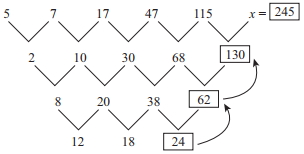
(B) Let the given series be $5, 7, 17, 47, 115, x$.
Calculate the differences between consecutive terms:
$7 - 5 = 2$
$17 - 7 = 10$
$47 - 17 = 30$
$115 - 47 = 68$
Now,find the second level of differences:
$10 - 2 = 8$
$30 - 10 = 20$
$68 - 30 = 38$
Now,find the third level of differences:
$20 - 8 = 12$
$38 - 20 = 18$
Observe the pattern in the third level of differences: $12, 18$. The difference increases by $6$ each time. So,the next difference in the third level should be $18 + 6 = 24$.
Now,work backwards to find $x$:
Next second level difference $= 38 + 24 = 62$.
Next first level difference $= 68 + 62 = 130$.
Therefore,$x = 115 + 130 = 245$.
Calculate the differences between consecutive terms:
$7 - 5 = 2$
$17 - 7 = 10$
$47 - 17 = 30$
$115 - 47 = 68$
Now,find the second level of differences:
$10 - 2 = 8$
$30 - 10 = 20$
$68 - 30 = 38$
Now,find the third level of differences:
$20 - 8 = 12$
$38 - 20 = 18$
Observe the pattern in the third level of differences: $12, 18$. The difference increases by $6$ each time. So,the next difference in the third level should be $18 + 6 = 24$.
Now,work backwards to find $x$:
Next second level difference $= 38 + 24 = 62$.
Next first level difference $= 68 + 62 = 130$.
Therefore,$x = 115 + 130 = 245$.
0 likes
View Solution332
MediumMCQ
$508, 256, 130, 67, 35.5, ?$
A
$18.25$
B
$19.75$
C
$17.25$
D
$15.75$
Solution
(B) The given series is $508, 256, 130, 67, 35.5, ?$.
Observe the pattern:
$508 \div 2 + 2 = 254 + 2 = 256$
$256 \div 2 + 2 = 128 + 2 = 130$
$130 \div 2 + 2 = 65 + 2 = 67$
$67 \div 2 + 2 = 33.5 + 2 = 35.5$
Following the same logic for the next term:
$35.5 \div 2 + 2 = 17.75 + 2 = 19.75$
Therefore,the missing number is $19.75$.
Observe the pattern:
$508 \div 2 + 2 = 254 + 2 = 256$
$256 \div 2 + 2 = 128 + 2 = 130$
$130 \div 2 + 2 = 65 + 2 = 67$
$67 \div 2 + 2 = 33.5 + 2 = 35.5$
Following the same logic for the next term:
$35.5 \div 2 + 2 = 17.75 + 2 = 19.75$
Therefore,the missing number is $19.75$.
0 likes
View Solution333
EasyMCQ
Find the next term in the series: $17, 9, 15, 40, 143.5, ?$
A
$505.75$
B
$578.5$
C
$650.25$
D
$578$
Solution
(C) The pattern follows the rule: $(n + 1) \times \frac{k}{2}$,where $k$ is an increasing odd number sequence $(1, 3, 5, 7, 9, \dots)$.
Step $1$: $(17 + 1) \times \frac{1}{2} = 18 \times 0.5 = 9$
Step $2$: $(9 + 1) \times \frac{3}{2} = 10 \times 1.5 = 15$
Step $3$: $(15 + 1) \times \frac{5}{2} = 16 \times 2.5 = 40$
Step $4$: $(40 + 1) \times \frac{7}{2} = 41 \times 3.5 = 143.5$
Step $5$: $(143.5 + 1) \times \frac{9}{2} = 144.5 \times 4.5 = 650.25$
Step $1$: $(17 + 1) \times \frac{1}{2} = 18 \times 0.5 = 9$
Step $2$: $(9 + 1) \times \frac{3}{2} = 10 \times 1.5 = 15$
Step $3$: $(15 + 1) \times \frac{5}{2} = 16 \times 2.5 = 40$
Step $4$: $(40 + 1) \times \frac{7}{2} = 41 \times 3.5 = 143.5$
Step $5$: $(143.5 + 1) \times \frac{9}{2} = 144.5 \times 4.5 = 650.25$
0 likes
View Solution334
MediumMCQ
Find out the wrong number in the sequence:
$40960, 10240, 2560, 640, 200, 40, 10$
$40960, 10240, 2560, 640, 200, 40, 10$
A
$2560$
B
$200$
C
$640$
D
$40$
Solution
(B) The given sequence is $40960, 10240, 2560, 640, 200, 40, 10$.
Observe the pattern between consecutive terms:
$40960 \div 4 = 10240$
$10240 \div 4 = 2560$
$2560 \div 4 = 640$
$640 \div 4 = 160$
Comparing this with the given sequence,the term $200$ is incorrect,as the expected value is $160$.
Continuing the pattern with $160$:
$160 \div 4 = 40$
$40 \div 4 = 10$
Therefore,the wrong number in the sequence is $200$.
Observe the pattern between consecutive terms:
$40960 \div 4 = 10240$
$10240 \div 4 = 2560$
$2560 \div 4 = 640$
$640 \div 4 = 160$
Comparing this with the given sequence,the term $200$ is incorrect,as the expected value is $160$.
Continuing the pattern with $160$:
$160 \div 4 = 40$
$40 \div 4 = 10$
Therefore,the wrong number in the sequence is $200$.
0 likes
View Solution335
EasyMCQ
Find out the odd number from the given sequence: $41, 45, 61, 97, 181, 261, 405$.
A
$181$
B
$97$
C
$261$
D
$61$
Solution
(A) Let us analyze the differences between consecutive terms in the sequence:
$45 - 41 = 4 = 2^2$
$61 - 45 = 16 = 4^2$
$97 - 61 = 36 = 6^2$
$181 - 97 = 84$ (This is not $8^2 = 64$)
$261 - 181 = 80$
$405 - 261 = 144 = 12^2$
If we follow the pattern of adding squares of even numbers $(2^2, 4^2, 6^2, 8^2, 10^2, 12^2)$:
$41 + 4 = 45$
$45 + 16 = 61$
$61 + 36 = 97$
$97 + 64 = 161$
$161 + 100 = 261$
$261 + 144 = 405$
Comparing this with the given sequence,$181$ is the incorrect term and should be $161$.
$45 - 41 = 4 = 2^2$
$61 - 45 = 16 = 4^2$
$97 - 61 = 36 = 6^2$
$181 - 97 = 84$ (This is not $8^2 = 64$)
$261 - 181 = 80$
$405 - 261 = 144 = 12^2$
If we follow the pattern of adding squares of even numbers $(2^2, 4^2, 6^2, 8^2, 10^2, 12^2)$:
$41 + 4 = 45$
$45 + 16 = 61$
$61 + 36 = 97$
$97 + 64 = 161$
$161 + 100 = 261$
$261 + 144 = 405$
Comparing this with the given sequence,$181$ is the incorrect term and should be $161$.
0 likes
View Solution336
MediumMCQ
Find out the odd number from the given sequence: $16, 30, 58, 114, 226, 496, 898$.
A
$58$
B
$226$
C
$30$
D
$496$
Solution
(D) Let us analyze the differences between consecutive terms in the sequence:
$30 - 16 = 14$
$58 - 30 = 28$
$114 - 58 = 56$
$226 - 114 = 112$
$496 - 226 = 270$
$898 - 496 = 402$
The pattern of differences is $14, 28, 56, 112, 224, 448, \dots$ (each difference is double the previous one).
If we follow this pattern starting from $226$,the next difference should be $224$.
$226 + 224 = 450$.
Then,the next difference should be $448$.
$450 + 448 = 898$.
Since $898$ is correct,the term $496$ is the odd one out,as it should be $450$.
$30 - 16 = 14$
$58 - 30 = 28$
$114 - 58 = 56$
$226 - 114 = 112$
$496 - 226 = 270$
$898 - 496 = 402$
The pattern of differences is $14, 28, 56, 112, 224, 448, \dots$ (each difference is double the previous one).
If we follow this pattern starting from $226$,the next difference should be $224$.
$226 + 224 = 450$.
Then,the next difference should be $448$.
$450 + 448 = 898$.
Since $898$ is correct,the term $496$ is the odd one out,as it should be $450$.
0 likes
View Solution337
MediumMCQ
Find out the odd number from the given sequence: $15, 21.5, 46.5, 145, 585.5, 2933, 17603.5$.
A
$583.5$
B
$2933$
C
$46.5$
D
$21.5$
Solution
(D) The pattern of the series is $\times 1 + 5.5, \times 2 + 5.5, \times 3 + 5.5, \times 4 + 5.5, \times 5 + 5.5, \times 6 + 5.5$.
Calculating the terms:
$15 \times 1 + 5.5 = 20.5$
$20.5 \times 2 + 5.5 = 46.5$
$46.5 \times 3 + 5.5 = 145$
$145 \times 4 + 5.5 = 585.5$
$585.5 \times 5 + 5.5 = 2933$
$2933 \times 6 + 5.5 = 17603.5$
Comparing this with the given sequence,the term $21.5$ is incorrect and should be $20.5$.
Calculating the terms:
$15 \times 1 + 5.5 = 20.5$
$20.5 \times 2 + 5.5 = 46.5$
$46.5 \times 3 + 5.5 = 145$
$145 \times 4 + 5.5 = 585.5$
$585.5 \times 5 + 5.5 = 2933$
$2933 \times 6 + 5.5 = 17603.5$
Comparing this with the given sequence,the term $21.5$ is incorrect and should be $20.5$.
0 likes
View Solution338
EasyMCQ
Find out the odd number from the given sequence: $5, 6, 16, 57, 246, 1245, 7506$.
A
$16$
B
$6$
C
$1245$
D
$246$
Solution
(D) The pattern of the series is $\times 1 + 1^2, \times 2 + 2^2, \times 3 + 3^2, \times 4 + 4^2, \times 5 + 5^2, \times 6 + 6^2$.
Step-by-step calculation:
$5 \times 1 + 1^2 = 5 + 1 = 6$
$6 \times 2 + 2^2 = 12 + 4 = 16$
$16 \times 3 + 3^2 = 48 + 9 = 57$
$57 \times 4 + 4^2 = 228 + 16 = 244$
$244 \times 5 + 5^2 = 1220 + 25 = 1245$
$1245 \times 6 + 6^2 = 7470 + 36 = 7506$
Comparing this with the given sequence,$246$ is incorrect and should be $244$.
Step-by-step calculation:
$5 \times 1 + 1^2 = 5 + 1 = 6$
$6 \times 2 + 2^2 = 12 + 4 = 16$
$16 \times 3 + 3^2 = 48 + 9 = 57$
$57 \times 4 + 4^2 = 228 + 16 = 244$
$244 \times 5 + 5^2 = 1220 + 25 = 1245$
$1245 \times 6 + 6^2 = 7470 + 36 = 7506$
Comparing this with the given sequence,$246$ is incorrect and should be $244$.
0 likes
View Solution339
EasyMCQ
Find out the odd number from the given sequence: $2, 13, 46, 145, 452, 1333, 4006$.
A
$1333$
B
$452$
C
$46$
D
$145$
Solution
(B) The pattern of the series is based on adding multiples of $3$ to the previous difference:
$13 - 2 = 11$
$46 - 13 = 33$ $(11 \times 3)$
$145 - 46 = 99$ $(33 \times 3)$
$442 - 145 = 297$ $(99 \times 3)$
$1333 - 442 = 891$ $(297 \times 3)$
$4006 - 1333 = 2673$ $(891 \times 3)$
Comparing this with the given sequence,$452$ is incorrect because the difference $452 - 145 = 307$,which does not follow the pattern. The correct term should be $442$.
$13 - 2 = 11$
$46 - 13 = 33$ $(11 \times 3)$
$145 - 46 = 99$ $(33 \times 3)$
$442 - 145 = 297$ $(99 \times 3)$
$1333 - 442 = 891$ $(297 \times 3)$
$4006 - 1333 = 2673$ $(891 \times 3)$
Comparing this with the given sequence,$452$ is incorrect because the difference $452 - 145 = 307$,which does not follow the pattern. The correct term should be $442$.
0 likes
View Solution340
MediumMCQ
Find out the odd number from the given sequence: $0, 7, 26, 63, 124, 217$.
A
$217$
B
$7$
C
$26$
D
$63$
Solution
(A) The given sequence follows the pattern $n^{3} - 1$,where $n$ is a natural number starting from $1$.
For $n=1$: $1^{3} - 1 = 1 - 1 = 0$
For $n=2$: $2^{3} - 1 = 8 - 1 = 7$
For $n=3$: $3^{3} - 1 = 27 - 1 = 26$
For $n=4$: $4^{3} - 1 = 64 - 1 = 63$
For $n=5$: $5^{3} - 1 = 125 - 1 = 124$
For $n=6$: $6^{3} - 1 = 216 - 1 = 215$
Comparing this with the given sequence,the last term is $217$,but according to the pattern,it should be $215$. Therefore,$217$ is the odd number in the sequence.
For $n=1$: $1^{3} - 1 = 1 - 1 = 0$
For $n=2$: $2^{3} - 1 = 8 - 1 = 7$
For $n=3$: $3^{3} - 1 = 27 - 1 = 26$
For $n=4$: $4^{3} - 1 = 64 - 1 = 63$
For $n=5$: $5^{3} - 1 = 125 - 1 = 124$
For $n=6$: $6^{3} - 1 = 216 - 1 = 215$
Comparing this with the given sequence,the last term is $217$,but according to the pattern,it should be $215$. Therefore,$217$ is the odd number in the sequence.
0 likes
View Solution341
EasyMCQ
Find the next number in the series: $7, 8, 18, 57, ?$
A
$232$
B
$228$
C
$234$
D
$226$
Solution
(A) The pattern in the series is as follows:
$7 \times 1 + 1 = 8$
$8 \times 2 + 2 = 18$
$18 \times 3 + 3 = 57$
Following the same logic,the next term is:
$57 \times 4 + 4 = 228 + 4 = 232$
Therefore,the missing number is $232$.
$7 \times 1 + 1 = 8$
$8 \times 2 + 2 = 18$
$18 \times 3 + 3 = 57$
Following the same logic,the next term is:
$57 \times 4 + 4 = 228 + 4 = 232$
Therefore,the missing number is $232$.
0 likes
View Solution342
EasyMCQ
Find the next term in the series: $7, 11, 19, 35, ?$
A
$71$
B
$69$
C
$65$
D
$67$
Solution
(D) The pattern in the series is as follows:
$7 + 4 = 11$
$11 + 8 = 19$
$19 + 16 = 35$
$35 + 32 = 67$
The differences between consecutive terms are powers of $2$ $(4, 8, 16, 32)$.
Thus,the next term is $35 + 32 = 67$.
$7 + 4 = 11$
$11 + 8 = 19$
$19 + 16 = 35$
$35 + 32 = 67$
The differences between consecutive terms are powers of $2$ $(4, 8, 16, 32)$.
Thus,the next term is $35 + 32 = 67$.
0 likes
View Solution343
MediumMCQ
$5, 11, 23, ?, 95$
A
$45$
B
$49$
C
$47$
D
$46$
Solution
(C) The given series follows the pattern: $x_{n+1} = (x_n \times 2) + 1$.
Step $1$: $5 \times 2 + 1 = 11$.
Step $2$: $11 \times 2 + 1 = 23$.
Step $3$: $23 \times 2 + 1 = 47$.
Step $4$: $47 \times 2 + 1 = 95$.
Therefore,the missing number is $47$.
Step $1$: $5 \times 2 + 1 = 11$.
Step $2$: $11 \times 2 + 1 = 23$.
Step $3$: $23 \times 2 + 1 = 47$.
Step $4$: $47 \times 2 + 1 = 95$.
Therefore,the missing number is $47$.
0 likes
View Solution344
MediumMCQ
$17, 22, 52, 165, ?$
A
$648$
B
$468$
C
$334$
D
$668$
Solution
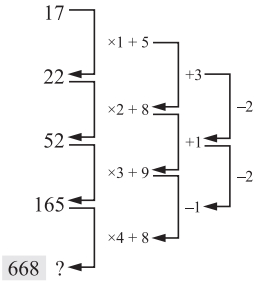
(D) To find the next number in the series $17, 22, 52, 165, ?$,we analyze the pattern between consecutive terms:
$17 \times 1 + 5 = 22$
$22 \times 2 + 8 = 52$
$52 \times 3 + 9 = 165$
$165 \times 4 + 8 = 668$
Alternatively,looking at the pattern of the additions $(5, 8, 9, 8)$:
The multipliers are $1, 2, 3, 4$.
The additions follow a pattern where the second difference is constant $(-2)$:
$5 \xrightarrow{+3} 8 \xrightarrow{+1} 9 \xrightarrow{-1} 8$
Differences: $3, 1, -1$. The difference between these is $-2$.
Following this logic,the next term is $165 \times 4 + 8 = 660 + 8 = 668$.
$17 \times 1 + 5 = 22$
$22 \times 2 + 8 = 52$
$52 \times 3 + 9 = 165$
$165 \times 4 + 8 = 668$
Alternatively,looking at the pattern of the additions $(5, 8, 9, 8)$:
The multipliers are $1, 2, 3, 4$.
The additions follow a pattern where the second difference is constant $(-2)$:
$5 \xrightarrow{+3} 8 \xrightarrow{+1} 9 \xrightarrow{-1} 8$
Differences: $3, 1, -1$. The difference between these is $-2$.
Following this logic,the next term is $165 \times 4 + 8 = 660 + 8 = 668$.
0 likes
View Solution345
EasyMCQ
Find the missing term $x$ in the series: $2, 6, 30, 210, x, 30030, .....$
A
$2310$
B
$1890$
C
$2520$
D
$2730$
Solution
(A) The pattern of the series is based on multiplying by consecutive prime numbers:
$2 \times 3 = 6$
$6 \times 5 = 30$
$30 \times 7 = 210$
$210 \times 11 = 2310$
$2310 \times 13 = 30030$
Thus,the missing term $x$ is $2310$.
$2 \times 3 = 6$
$6 \times 5 = 30$
$30 \times 7 = 210$
$210 \times 11 = 2310$
$2310 \times 13 = 30030$
Thus,the missing term $x$ is $2310$.
0 likes
View Solution346
MediumMCQ
$3, 18, 12, 72, 66, 396, ?$
A
$300$
B
$380$
C
$350$
D
$390$
Solution
(D) The given series follows a specific alternating pattern of multiplication and subtraction:
$3 \times 6 = 18$
$18 - 6 = 12$
$12 \times 6 = 72$
$72 - 6 = 66$
$66 \times 6 = 396$
Following this pattern,the next step is to subtract $6$ from the last number:
$396 - 6 = 390$
Therefore,the missing number is $390$.
$3 \times 6 = 18$
$18 - 6 = 12$
$12 \times 6 = 72$
$72 - 6 = 66$
$66 \times 6 = 396$
Following this pattern,the next step is to subtract $6$ from the last number:
$396 - 6 = 390$
Therefore,the missing number is $390$.
0 likes
View Solution347
EasyMCQ
Find the odd number in the given sequence: $5531, 5506, 5425, 5344, 5135, 4910, 4621$.
A
$5531$
B
$5425$
C
$4621$
D
$5135$
Solution
(A) Let us analyze the differences between consecutive terms in the sequence:
$5555 - 5506 = 49 = 7^2$
$5506 - 5425 = 81 = 9^2$
$5425 - 5344 = 81$ (This pattern seems inconsistent).
Let us re-examine the sequence: $5555, 5506, 5425, 5344, 5135, 4910, 4621$.
Differences:
$5555 - 5506 = 49 = 7^2$
$5506 - 5425 = 81 = 9^2$
$5425 - 5304 = 121 = 11^2$
$5304 - 5135 = 169 = 13^2$
$5135 - 4910 = 225 = 15^2$
$4910 - 4621 = 289 = 17^2$
Comparing the original sequence $5531, 5506, 5425, 5344, 5135, 4910, 4621$ with the pattern,the term $5531$ is incorrect and should be $5555$,and $5344$ is the correct term instead of $534$. Thus,$5531$ is the odd one out.
$5555 - 5506 = 49 = 7^2$
$5506 - 5425 = 81 = 9^2$
$5425 - 5344 = 81$ (This pattern seems inconsistent).
Let us re-examine the sequence: $5555, 5506, 5425, 5344, 5135, 4910, 4621$.
Differences:
$5555 - 5506 = 49 = 7^2$
$5506 - 5425 = 81 = 9^2$
$5425 - 5304 = 121 = 11^2$
$5304 - 5135 = 169 = 13^2$
$5135 - 4910 = 225 = 15^2$
$4910 - 4621 = 289 = 17^2$
Comparing the original sequence $5531, 5506, 5425, 5344, 5135, 4910, 4621$ with the pattern,the term $5531$ is incorrect and should be $5555$,and $5344$ is the correct term instead of $534$. Thus,$5531$ is the odd one out.
0 likes
View Solution348
MediumMCQ
Find out the odd number from the given sequence: $6, 7, 9, 13, 26, 37, 69$.
A
$7$
B
$26$
C
$69$
D
$37$
Solution
(B) The given sequence is $6, 7, 9, 13, 26, 37, 69$.
Let's analyze the differences between consecutive terms:
$7 - 6 = 1$
$9 - 7 = 2$
$13 - 9 = 4$
$21 - 13 = 8$
$37 - 21 = 16$
$69 - 37 = 32$
The pattern of differences is $1, 2, 4, 8, 16, 32$,which corresponds to powers of $2$ $(2^0, 2^1, 2^2, 2^3, 2^4, 2^5)$.
In the original sequence,$26$ is present instead of $21$. Therefore,$26$ is the odd number in the sequence.
Let's analyze the differences between consecutive terms:
$7 - 6 = 1$
$9 - 7 = 2$
$13 - 9 = 4$
$21 - 13 = 8$
$37 - 21 = 16$
$69 - 37 = 32$
The pattern of differences is $1, 2, 4, 8, 16, 32$,which corresponds to powers of $2$ $(2^0, 2^1, 2^2, 2^3, 2^4, 2^5)$.
In the original sequence,$26$ is present instead of $21$. Therefore,$26$ is the odd number in the sequence.
0 likes
View Solution349
EasyMCQ
Find out the odd number from the given sequence: $1, 3, 10, 36, 152, 760, 4632$.
A
$3$
B
$36$
C
$4632$
D
$760$
Solution
(D) Let us analyze the pattern in the sequence:
$1 \times 1 + 2 = 3$
$3 \times 2 + 4 = 10$
$10 \times 3 + 6 = 36$
$36 \times 4 + 8 = 152$
$152 \times 5 + 10 = 770$
$770 \times 6 + 12 = 4632$
Comparing this with the given sequence,the number $760$ is incorrect and should be $770$.
$1 \times 1 + 2 = 3$
$3 \times 2 + 4 = 10$
$10 \times 3 + 6 = 36$
$36 \times 4 + 8 = 152$
$152 \times 5 + 10 = 770$
$770 \times 6 + 12 = 4632$
Comparing this with the given sequence,the number $760$ is incorrect and should be $770$.
0 likes
View Solution350
EasyMCQ
Find out the odd number from the given sequence: $4, 3, 9, 34, 96, 219, 435$.
A
$4$
B
$9$
C
$34$
D
$435$
Solution
(D) Let us analyze the differences between consecutive terms:
$3 - 4 = -1$
$9 - 3 = 6$
$34 - 9 = 25$
$96 - 34 = 62$
$219 - 96 = 123$
$435 - 219 = 216$
Now,let us look at the differences of the differences:
$6 - (-1) = 7$
$25 - 6 = 19$
$62 - 25 = 37$
$123 - 62 = 61$
$216 - 123 = 93$
Looking at the second differences: $7, 19, 37, 61, 93$. The third differences are:
$19 - 7 = 12$
$37 - 19 = 18$
$61 - 37 = 24$
$93 - 61 = 32$
The third differences are $12, 18, 24, 32$. The pattern should be $12, 18, 24, 30$. If the last difference was $30$ instead of $32$,then the second difference would be $61 + 30 = 91$,and the first difference would be $123 + 91 = 214$. Thus,$219 + 214 = 433$. Therefore,$435$ is the odd number.
$3 - 4 = -1$
$9 - 3 = 6$
$34 - 9 = 25$
$96 - 34 = 62$
$219 - 96 = 123$
$435 - 219 = 216$
Now,let us look at the differences of the differences:
$6 - (-1) = 7$
$25 - 6 = 19$
$62 - 25 = 37$
$123 - 62 = 61$
$216 - 123 = 93$
Looking at the second differences: $7, 19, 37, 61, 93$. The third differences are:
$19 - 7 = 12$
$37 - 19 = 18$
$61 - 37 = 24$
$93 - 61 = 32$
The third differences are $12, 18, 24, 32$. The pattern should be $12, 18, 24, 30$. If the last difference was $30$ instead of $32$,then the second difference would be $61 + 30 = 91$,and the first difference would be $123 + 91 = 214$. Thus,$219 + 214 = 433$. Therefore,$435$ is the odd number.
0 likes
View SolutionNumber Series — Number Series · Frequently Asked Questions
1Are these Number Series questions useful for JEE and NEET?
Yes. All questions in this section are mapped to JEE Main and NEET exam patterns. Previous year questions from JEE Main, NEET, GUJCET and state-level exams are included with full solutions.
2Can I switch to Hindi or Gujarati for these questions?
Yes. Use the language tabs in the hero section or the sidebar to view the same questions and solutions in English, Hindi or Gujarati.
3How do I generate a question paper from this subtopic?
Use the Vedclass Exam Paper Generator — select the chapter and subtopic, set difficulty, and generate Sets A, B, C, D automatically. First 3 chapters of every subject are free.
Vedclass Products
For Students
Vedclass Test Series
Mock tests in real JEE/NEET style with performance analysis. 5-day free trial.
Start Free TrialFor Teachers
Exam Paper Generator
Generate Set A/B/C/D papers from this chapter in 2 minutes. 3 chapters free.
Try FreeFor Institutes
Online Exam Module
Live online exams with unlimited students, 360° analytics & white-label branding.
See DemoFor Teachers & Institutes
Generate a Number Series Exam Paper in 2 Minutes
Select subtopic & difficulty — Sets A, B, C, D auto-generated with No Repeat logic.
First 3 chapters of every subject are free — no payment required.