
A English
Set Theory Questions in English
Competitive Exam Quantitative Aptitude · Algebra · Set Theory
202+
Questions
English
Language
100%
With Solutions
Showing 50 of 202 questions in English
151
MediumMCQ
Which of the following pairs of sets are not equivalent?
A
$A=\{2, 4, 6, 8\}, B=\{u, v, w, x\}$
B
$A=\{a, b, c\}, B=\{\alpha, \beta, \gamma, \delta\}$
C
$A=\{\}, B=\phi$
D
$A=\{x: x=2n, n \in N, n \le 3\}, B=\{x: x=2n+1, n \in N, n \le 3\}$
Solution
(B) Two sets are said to be equivalent if they have the same number of elements,i.e.,their cardinal numbers are equal.
In option $A$: $n(A) = 4$ and $n(B) = 4$. Since $n(A) = n(B)$,they are equivalent.
In option $B$: $n(A) = 3$ and $n(B) = 4$. Since $n(A) \neq n(B)$,they are not equivalent.
In option $C$: $n(A) = 0$ and $n(B) = 0$. Since $n(A) = n(B)$,they are equivalent.
In option $D$: $n(A) = 3$ and $n(B) = 3$. Since $n(A) = n(B)$,they are equivalent.
Therefore,the pair in option $B$ is not equivalent.
In option $A$: $n(A) = 4$ and $n(B) = 4$. Since $n(A) = n(B)$,they are equivalent.
In option $B$: $n(A) = 3$ and $n(B) = 4$. Since $n(A) \neq n(B)$,they are not equivalent.
In option $C$: $n(A) = 0$ and $n(B) = 0$. Since $n(A) = n(B)$,they are equivalent.
In option $D$: $n(A) = 3$ and $n(B) = 3$. Since $n(A) = n(B)$,they are equivalent.
Therefore,the pair in option $B$ is not equivalent.
0 likes
View Solution152
EasyMCQ
Find the cardinal number of the following set: $\{x: x \text{ is a letter of the word } 'ASSASSINATION' \}$
A
$4$
B
$6$
C
$8$
D
$2$
Solution
(B) To find the cardinal number of the set,we first list the unique letters present in the word '$ASSASSINATION$'.
The letters are: $A, S, S, A, S, S, I, N, A, T, I, O, N$.
The distinct letters are: $A, S, I, N, T, O$.
The set is $\{A, S, I, N, T, O\}$.
The number of elements in this set is $6$.
Therefore,the cardinal number is $6$.
The letters are: $A, S, S, A, S, S, I, N, A, T, I, O, N$.
The distinct letters are: $A, S, I, N, T, O$.
The set is $\{A, S, I, N, T, O\}$.
The number of elements in this set is $6$.
Therefore,the cardinal number is $6$.
0 likes
View Solution153
EasyMCQ
Find the cardinal number of the following set $\{x: x\}$ is a natural number $\leq 30$ and is divisible by $7$ or $\{11\}$
A
$4$
B
$8$
C
$6$
D
$2$
Solution
(C) Let $A$ be the set of natural numbers $\leq 30$ that are divisible by $7$ or $11$.
Numbers divisible by $7$ up to $30$ are: $7, 14, 21, 28$.
Numbers divisible by $11$ up to $30$ are: $11, 22$.
Combining these,the set $A = \{7, 11, 14, 21, 22, 28\}$.
The cardinal number of a set is the number of elements in the set.
Counting the elements in set $A$,we get $n(A) = 6$.
Numbers divisible by $7$ up to $30$ are: $7, 14, 21, 28$.
Numbers divisible by $11$ up to $30$ are: $11, 22$.
Combining these,the set $A = \{7, 11, 14, 21, 22, 28\}$.
The cardinal number of a set is the number of elements in the set.
Counting the elements in set $A$,we get $n(A) = 6$.
0 likes
View Solution154
EasyMCQ
Find the cardinal number of the following set ${x: x = 2n, n \in N, 4 \leq x \leq 11}$.
A
$3$
B
$4$
C
$5$
D
$6$
Solution
(B) The set is defined as $S = \{x: x = 2n, n \in N, 4 \leq x \leq 11\}$.
Since $n \in N$ (natural numbers),we test values of $n$ such that $4 \leq 2n \leq 11$.
Dividing the inequality by $2$,we get $2 \leq n \leq 5.5$.
Since $n$ must be a natural number,the possible values for $n$ are $2, 3, 4, 5$.
For $n = 2, x = 2(2) = 4$.
For $n = 3, x = 2(3) = 6$.
For $n = 4, x = 2(4) = 8$.
For $n = 5, x = 2(5) = 10$.
The set is $S = \{4, 6, 8, 10\}$.
The cardinal number of a set is the number of elements in the set.
Therefore,the cardinal number is $4$.
Since $n \in N$ (natural numbers),we test values of $n$ such that $4 \leq 2n \leq 11$.
Dividing the inequality by $2$,we get $2 \leq n \leq 5.5$.
Since $n$ must be a natural number,the possible values for $n$ are $2, 3, 4, 5$.
For $n = 2, x = 2(2) = 4$.
For $n = 3, x = 2(3) = 6$.
For $n = 4, x = 2(4) = 8$.
For $n = 5, x = 2(5) = 10$.
The set is $S = \{4, 6, 8, 10\}$.
The cardinal number of a set is the number of elements in the set.
Therefore,the cardinal number is $4$.
0 likes
View Solution155
EasyMCQ
Which of the following sets is finite?
A
$\{x \in \mathbb{N} \mid x \text{ is a prime number}\}$
B
$\{x \mid x \text{ is a quadrilateral on a plane}\}$
C
$\{x \in \mathbb{N} \mid x^2 - 25 \le 0\}$
D
$\{x \in \mathbb{N} \mid x \text{ is a multiple of } 3\}$
Solution
(C) To determine which set is finite,we analyze each option:
$A$: The set of all prime numbers is infinite.
$B$: There are infinitely many quadrilaterals that can be drawn on a plane.
$C$: We are given the condition $x \in N$ (natural numbers) and $x^2 - 25 \leq 0$. Solving $x^2 \leq 25$ gives $-5 \leq x \leq 5$. Since $x \in N$,the possible values for $x$ are ${1, 2, 3, 4, 5}$. This set contains $5$ elements,so it is finite.
$D$: The set of multiples of $3$ in natural numbers is ${3, 6, 9, 12, \dots}$,which is infinite.
Therefore,the correct set is ${x: x \in N \text{ and } x^2 - 25 \leq 0}$.
$A$: The set of all prime numbers is infinite.
$B$: There are infinitely many quadrilaterals that can be drawn on a plane.
$C$: We are given the condition $x \in N$ (natural numbers) and $x^2 - 25 \leq 0$. Solving $x^2 \leq 25$ gives $-5 \leq x \leq 5$. Since $x \in N$,the possible values for $x$ are ${1, 2, 3, 4, 5}$. This set contains $5$ elements,so it is finite.
$D$: The set of multiples of $3$ in natural numbers is ${3, 6, 9, 12, \dots}$,which is infinite.
Therefore,the correct set is ${x: x \in N \text{ and } x^2 - 25 \leq 0}$.
0 likes
View Solution156
MediumMCQ
For which of the following cases are sets $A$ and $B$ equivalent?
A
$A=\{a, b, c, \dots, z\}, B=\{1, 2, 3, \dots, 24\}$
B
$A=\{\frac{1}{3}, \frac{1}{2}, \frac{3}{5}\}, B=\{x: x=\frac{n}{n+2}, n \in N\}$
C
$A=\{2, 4, 6\}, B=\{(2, 4), (4, 6), (2, 6)\}$
D
$A=\{x: x=\frac{n^{3}-1}{n^{3}+1}, n \in W, n \leq 3\}, B=\{0, \frac{7}{9}, \frac{26}{28}, \frac{63}{65}\}$
Solution
(C) Two sets $A$ and $B$ are said to be equivalent if they have the same number of elements,i.e.,$n(A) = n(B)$.
For option $A$: $n(A) = 26$ (letters in English alphabet) and $n(B) = 24$. Since $26 \neq 24$,they are not equivalent.
For option $B$: $n(A) = 3$. Set $B$ is an infinite set as $n \in N$,so $n(B) = \infty$. They are not equivalent.
For option $C$: $n(A) = 3$. Set $B$ contains ordered pairs,$n(B) = 3$. Since $n(A) = n(B) = 3$,sets $A$ and $B$ are equivalent.
For option $D$: $n(A) = 4$ (for $n = 0, 1, 2, 3$) and $n(B) = 3$. Since $4 \neq 3$,they are not equivalent.
Thus,the correct case is $C$.
For option $A$: $n(A) = 26$ (letters in English alphabet) and $n(B) = 24$. Since $26 \neq 24$,they are not equivalent.
For option $B$: $n(A) = 3$. Set $B$ is an infinite set as $n \in N$,so $n(B) = \infty$. They are not equivalent.
For option $C$: $n(A) = 3$. Set $B$ contains ordered pairs,$n(B) = 3$. Since $n(A) = n(B) = 3$,sets $A$ and $B$ are equivalent.
For option $D$: $n(A) = 4$ (for $n = 0, 1, 2, 3$) and $n(B) = 3$. Since $4 \neq 3$,they are not equivalent.
Thus,the correct case is $C$.
0 likes
View Solution157
EasyMCQ
In which of the following cases,$A=B$?
A
$A=\{12, 14, 16\}, B=\{16, 18, 20\}$
B
$A=\phi, B=\{\}$
C
$A=\{x: x \in W \text{ and } x < 1\}, B=\phi$
D
$A=\{x: x \text{ is a day of the week beginning with } S\}, B=\{\text{Sunday}\}$
Solution
(B) Two sets $A$ and $B$ are said to be equal if they contain exactly the same elements.
Option $A$: $A=\{12, 14, 16\}$ and $B=\{16, 18, 20\}$. Since $12 \in A$ but $12 \notin B$,$A \neq B$.
Option $B$: $A=\phi$ (empty set) and $B=\{\}$ (empty set). Both sets contain no elements,so $A=B$.
Option $C$: $A=\{x: x \in W \text{ and } x < 1\}$. Since $W$ (whole numbers) starts from $0$,the only element is $0$. Thus $A=\{0\}$,while $B=\phi$. Since $\{0\} \neq \phi$,$A \neq B$.
Option $D$: $A=\{x: x \text{ is a day of the week beginning with } S\} = \{\text{Sunday, Saturday}\}$. $B=\{\text{Sunday}\}$. Since $\{\text{Sunday, Saturday}\} \neq \{\text{Sunday}\}$,$A \neq B$.
Therefore,both $B$ and $C$ (if interpreted as empty) are technically equal,but $A=\phi$ and $B=\{\}$ is the standard definition of equality for empty sets.
Option $A$: $A=\{12, 14, 16\}$ and $B=\{16, 18, 20\}$. Since $12 \in A$ but $12 \notin B$,$A \neq B$.
Option $B$: $A=\phi$ (empty set) and $B=\{\}$ (empty set). Both sets contain no elements,so $A=B$.
Option $C$: $A=\{x: x \in W \text{ and } x < 1\}$. Since $W$ (whole numbers) starts from $0$,the only element is $0$. Thus $A=\{0\}$,while $B=\phi$. Since $\{0\} \neq \phi$,$A \neq B$.
Option $D$: $A=\{x: x \text{ is a day of the week beginning with } S\} = \{\text{Sunday, Saturday}\}$. $B=\{\text{Sunday}\}$. Since $\{\text{Sunday, Saturday}\} \neq \{\text{Sunday}\}$,$A \neq B$.
Therefore,both $B$ and $C$ (if interpreted as empty) are technically equal,but $A=\phi$ and $B=\{\}$ is the standard definition of equality for empty sets.
0 likes
View Solution158
EasyMCQ
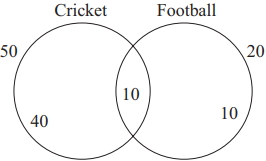
In a class,$50$ students play cricket,$20$ students play football and $10$ play both cricket and football. How many students play at least one of these two games?
A
$60$
B
$45$
C
$55$
D
$65$
Solution
(A) Let $C$ be the set of students who play cricket and $F$ be the set of students who play football.
Given:
$n(C) = 50$
$n(F) = 20$
$n(C \cap F) = 10$
We need to find the number of students who play at least one of these two games,which is $n(C \cup F)$.
Using the formula: $n(C \cup F) = n(C) + n(F) - n(C \cap F)$
$n(C \cup F) = 50 + 20 - 10 = 60$
Alternatively,from the Venn diagram:
Students playing only cricket = $50 - 10 = 40$
Students playing only football = $20 - 10 = 10$
Students playing both = $10$
Total students playing at least one game = $40 + 10 + 10 = 60$.
Given:
$n(C) = 50$
$n(F) = 20$
$n(C \cap F) = 10$
We need to find the number of students who play at least one of these two games,which is $n(C \cup F)$.
Using the formula: $n(C \cup F) = n(C) + n(F) - n(C \cap F)$
$n(C \cup F) = 50 + 20 - 10 = 60$
Alternatively,from the Venn diagram:
Students playing only cricket = $50 - 10 = 40$
Students playing only football = $20 - 10 = 10$
Students playing both = $10$
Total students playing at least one game = $40 + 10 + 10 = 60$.
0 likes
View Solution159
EasyMCQ
Write down the power set of the set ${0}.$
A
$\phi$
B
${0}$
C
${\phi}$
D
${\phi, {0}}$
Solution
(D) Let $A = {0}.$ The power set of a set $A,$ denoted by $P(A),$ is the set of all possible subsets of $A.$
For the set $A = {0},$ the subsets are the empty set $\phi$ and the set itself ${0}.$
Therefore,the power set $P(A) = {\phi, {0}}.$
For the set $A = {0},$ the subsets are the empty set $\phi$ and the set itself ${0}.$
Therefore,the power set $P(A) = {\phi, {0}}.$
0 likes
View Solution160
EasyMCQ
Find the power set of $A = \{\{a, b\}, c\}$.
A
$\{\phi, \{a, b\}, \{c\}\}$
B
$\{A, \{a, b\}, \{c\}\}$
C
$\{\phi, A, \{\{a, b\}\}, \{c\}\}$
D
None of these
Solution
(D) Let $A = \{\{a, b\}, c\}$.
To determine the power set $P(A)$,we note that the set $A$ contains two elements: $x = \{a, b\}$ and $y = c$.
The number of elements in the power set $P(A)$ is given by $2^n$,where $n$ is the number of elements in $A$.
Here,$n = 2$,so $P(A)$ will contain $2^2 = 4$ elements.
The elements of the power set $P(A)$ are the subsets of $A$,which are:
$1$. The empty set: $\phi$
$2$. The set containing the first element: $\{\{a, b\}\}$
$3$. The set containing the second element: $\{c\}$
$4$. The set $A$ itself: $\{\{a, b\}, c\}$
Therefore,$P(A) = \{\phi, \{\{a, b\}\}, \{c\}, A\}$.
To determine the power set $P(A)$,we note that the set $A$ contains two elements: $x = \{a, b\}$ and $y = c$.
The number of elements in the power set $P(A)$ is given by $2^n$,where $n$ is the number of elements in $A$.
Here,$n = 2$,so $P(A)$ will contain $2^2 = 4$ elements.
The elements of the power set $P(A)$ are the subsets of $A$,which are:
$1$. The empty set: $\phi$
$2$. The set containing the first element: $\{\{a, b\}\}$
$3$. The set containing the second element: $\{c\}$
$4$. The set $A$ itself: $\{\{a, b\}, c\}$
Therefore,$P(A) = \{\phi, \{\{a, b\}\}, \{c\}, A\}$.
0 likes
View Solution161
MediumMCQ
Which of the following pairs of sets are comparable?
A
$A=\{1, 3, 5\}$ and $B=\{3, 2, 5, 6\}$
B
$A=\{x: x \in N \text{ and } x \leq 10\}$ and $B=\{1, 2, 3, \dots, 10, 11\}$
C
$A=\{1, 2, 3, \{4, 5\}\}$ and $B=\{1, 2, 3, 4, 5\}$
D
None of these
Solution
(B) Two sets $A$ and $B$ are said to be comparable if $A \subseteq B$ or $B \subseteq A$.
$(a)$ $1 \in A$ but $1 \notin B$ and $6 \in B$ but $6 \notin A$. Thus,$A \not\subseteq B$ and $B \not\subseteq A$. Therefore,they are not comparable.
$(b)$ $A = \{1, 2, 3, 4, 5, 6, 7, 8, 9, 10\}$ and $B = \{1, 2, 3, 4, 5, 6, 7, 8, 9, 10, 11\}$. Since every element of $A$ is in $B$,$A \subset B$. Therefore,$A$ and $B$ are comparable.
$(c)$ $\{4, 5\} \in A$ but $\{4, 5\} \notin B$ and $4 \in B$ but $4 \notin A$. Thus,$A \not\subseteq B$ and $B \not\subseteq A$. Therefore,they are not comparable.
$(a)$ $1 \in A$ but $1 \notin B$ and $6 \in B$ but $6 \notin A$. Thus,$A \not\subseteq B$ and $B \not\subseteq A$. Therefore,they are not comparable.
$(b)$ $A = \{1, 2, 3, 4, 5, 6, 7, 8, 9, 10\}$ and $B = \{1, 2, 3, 4, 5, 6, 7, 8, 9, 10, 11\}$. Since every element of $A$ is in $B$,$A \subset B$. Therefore,$A$ and $B$ are comparable.
$(c)$ $\{4, 5\} \in A$ but $\{4, 5\} \notin B$ and $4 \in B$ but $4 \notin A$. Thus,$A \not\subseteq B$ and $B \not\subseteq A$. Therefore,they are not comparable.
0 likes
View Solution162
EasyMCQ
Let $A = \{\phi, \{\phi\}, 1, \{1, \phi\}, 7\}$. Which of the following is false?
A
$\phi \in A$
B
$\{\phi\} \in A$
C
$\{1\} \in A$
D
$\{7, \phi\} \subset A$
Solution
(C) Given the set $A = \{\phi, \{\phi\}, 1, \{1, \phi\}, 7\}$.
$1$. $\phi \in A$: The empty set $\phi$ is an element of $A$,so this is true.
$2$. $\{\phi\} \in A$: The set containing the empty set $\{\phi\}$ is an element of $A$,so this is true.
$3$. $\{1\} \in A$: The set $\{1\}$ is not an element of $A$. The elements of $A$ are $\phi, \{\phi\}, 1, \{1, \phi\},$ and $7$. Since $\{1\}$ is not listed as an element,this statement is false.
$4$. $\{7, \phi\} \subset A$: Since both $7 \in A$ and $\phi \in A$,the set $\{7, \phi\}$ is a subset of $A$,so this is true.
Therefore,the false statement is $\{1\} \in A$.
$1$. $\phi \in A$: The empty set $\phi$ is an element of $A$,so this is true.
$2$. $\{\phi\} \in A$: The set containing the empty set $\{\phi\}$ is an element of $A$,so this is true.
$3$. $\{1\} \in A$: The set $\{1\}$ is not an element of $A$. The elements of $A$ are $\phi, \{\phi\}, 1, \{1, \phi\},$ and $7$. Since $\{1\}$ is not listed as an element,this statement is false.
$4$. $\{7, \phi\} \subset A$: Since both $7 \in A$ and $\phi \in A$,the set $\{7, \phi\}$ is a subset of $A$,so this is true.
Therefore,the false statement is $\{1\} \in A$.
0 likes
View Solution163
EasyMCQ
Let $A = \{1, 2, \{3, 4\}, 5\}$. Which of the following statements is true?
A
$\{3, 4\} \subset A$
B
$\{3, 4\} \in A$
C
$1 \subset A$
D
$\{1, 2, 5\} \in A$
Solution
(B) Given the set $A = \{1, 2, \{3, 4\}, 5\}$.
$1$. The elements of set $A$ are $1$,$2$,${3, 4}$,and $5$.
$2$. Since ${3, 4}$ is listed as an element within the set $A$,the statement ${3, 4} \in A$ is true.
$3$. The statement ${3, 4} \subset A$ is false because the elements of the set ${3, 4}$ are $3$ and $4$,which are not elements of $A$.
$4$. The statement $1 \subset A$ is false because $1$ is an element of $A$,not a subset ($1 \in A$ is true).
$5$. The statement ${1, 2, 5} \in A$ is false because the set ${1, 2, 5}$ is not an element of $A$ (though it is a subset of $A$).
$1$. The elements of set $A$ are $1$,$2$,${3, 4}$,and $5$.
$2$. Since ${3, 4}$ is listed as an element within the set $A$,the statement ${3, 4} \in A$ is true.
$3$. The statement ${3, 4} \subset A$ is false because the elements of the set ${3, 4}$ are $3$ and $4$,which are not elements of $A$.
$4$. The statement $1 \subset A$ is false because $1$ is an element of $A$,not a subset ($1 \in A$ is true).
$5$. The statement ${1, 2, 5} \in A$ is false because the set ${1, 2, 5}$ is not an element of $A$ (though it is a subset of $A$).
0 likes
View Solution164
EasyMCQ
Let $A = \{1, 3, 5\}$ and $B = \{x : x \text{ is an odd natural number } < 6\}$. Which of the following is false?
A
$A \subset B$
B
$B \subset A$
C
$A = B$
D
None of these
Solution
(D) Given sets are $A = \{1, 3, 5\}$ and $B = \{x : x \text{ is an odd natural number } < 6\}$.
Since the odd natural numbers less than $6$ are $1, 3, 5$,we have $B = \{1, 3, 5\}$.
Comparing the two sets,we observe that $A = B$.
By the definition of subsets,if $A = B$,then $A \subseteq B$ and $B \subseteq A$. Since $A$ and $B$ are equal,the statements $A \subset B$ (improperly used as subset),$B \subset A$,and $A = B$ are all mathematically consistent with the set equality.
Therefore,none of the given options $A, B, C$ are false.
Thus,the correct choice is $D$.
Since the odd natural numbers less than $6$ are $1, 3, 5$,we have $B = \{1, 3, 5\}$.
Comparing the two sets,we observe that $A = B$.
By the definition of subsets,if $A = B$,then $A \subseteq B$ and $B \subseteq A$. Since $A$ and $B$ are equal,the statements $A \subset B$ (improperly used as subset),$B \subset A$,and $A = B$ are all mathematically consistent with the set equality.
Therefore,none of the given options $A, B, C$ are false.
Thus,the correct choice is $D$.
0 likes
View Solution165
EasyMCQ
Let $A = \{1, 2, \{3, 4\}, 5\}$. Which of the following statements are true?
A
$\{3, 4\} \subset A$
B
$\{3, 4\} \in A$
C
$\{\{3, 4\}\} \subset A$
D
$\{1, 3, 5\} \subset A$
Solution
(B, C) Given the set $A = \{1, 2, \{3, 4\}, 5\}$.
$1$. The elements of $A$ are $1$,$2$,$\{3, 4\}$,and $5$.
$2$. Since $\{3, 4\}$ is an element of $A$,the statement $\{3, 4\} \in A$ is true.
$3$. Since $\{3, 4\}$ is an element of $A$,the set containing this element,which is $\{\{3, 4\}\}$,is a subset of $A$. Therefore,$\{\{3, 4\}\} \subset A$ is also true.
$4$. The elements $3$ and $4$ are not individual elements of $A$; they are part of the set $\{3, 4\}$. Thus,$\{3, 4\} \subset A$ is false,and $\{1, 3, 5\} \subset A$ is false.
$1$. The elements of $A$ are $1$,$2$,$\{3, 4\}$,and $5$.
$2$. Since $\{3, 4\}$ is an element of $A$,the statement $\{3, 4\} \in A$ is true.
$3$. Since $\{3, 4\}$ is an element of $A$,the set containing this element,which is $\{\{3, 4\}\}$,is a subset of $A$. Therefore,$\{\{3, 4\}\} \subset A$ is also true.
$4$. The elements $3$ and $4$ are not individual elements of $A$; they are part of the set $\{3, 4\}$. Thus,$\{3, 4\} \subset A$ is false,and $\{1, 3, 5\} \subset A$ is false.
0 likes
View Solution166
EasyMCQ
Write down the power set of $A = \{8, 9\}$.
A
$\{\phi, \{8\}, \{9\}, \{8, 9\}\}$
B
$\{\phi, \{8\}, \{9\}\}$
C
$\{\phi, \{8\}, \{9\}, \{8, 9\}\}$
D
None of these
Solution
(A) The power set of a set $A$,denoted by $P(A)$,is the set of all possible subsets of $A$.
Given the set $A = \{8, 9\}$.
The number of elements in $A$ is $n = 2$.
The number of elements in the power set $P(A)$ is $2^n = 2^2 = 4$.
The subsets of $A$ are: $\phi$ (the empty set),$\{8\}$,$\{9\}$,and $\{8, 9\}$.
Therefore,the power set is $P(A) = \{\phi, \{8\}, \{9\}, \{8, 9\}\}$.
Given the set $A = \{8, 9\}$.
The number of elements in $A$ is $n = 2$.
The number of elements in the power set $P(A)$ is $2^n = 2^2 = 4$.
The subsets of $A$ are: $\phi$ (the empty set),$\{8\}$,$\{9\}$,and $\{8, 9\}$.
Therefore,the power set is $P(A) = \{\phi, \{8\}, \{9\}, \{8, 9\}\}$.
0 likes
View Solution167
EasyMCQ
Write down the power set of $C = \{1, \{2\}\}$.
A
$\{\phi, \{1\}, \{\{2\}\}\}$
B
$\{\phi, \{1\}, \{\{2\}\}, \{1, \{2\}\}\}$
C
$\{\{1\}, \{\{2\}\}, \{1, \{2\}\}\}$
D
None of these
Solution
(B) The power set of a set $C$,denoted by $P(C)$,is the set of all subsets of $C$.
Given $C = \{1, \{2\}\}$.
The elements of $C$ are $1$ and $\{2\}$.
The subsets of $C$ are:
$1$. The empty set: $\phi$
$2$. The set containing the first element: $\{1\}$
$3$. The set containing the second element: $\{\{2\}\}$
$4$. The set containing both elements: $\{1, \{2\}\}$
Therefore,the power set $P(C) = \{\phi, \{1\}, \{\{2\}\}, \{1, \{2\}\}\}$.
Given $C = \{1, \{2\}\}$.
The elements of $C$ are $1$ and $\{2\}$.
The subsets of $C$ are:
$1$. The empty set: $\phi$
$2$. The set containing the first element: $\{1\}$
$3$. The set containing the second element: $\{\{2\}\}$
$4$. The set containing both elements: $\{1, \{2\}\}$
Therefore,the power set $P(C) = \{\phi, \{1\}, \{\{2\}\}, \{1, \{2\}\}\}$.
0 likes
View Solution168
EasyMCQ
If $A = \{x : x = \frac{n-1}{n+1}, n \in W\}$ and $\{n \leq 10\}$,point out the correct statement from the following:
A
$0 \in A$
B
$0 \subset A$
C
$0 \supset A$
D
$\frac{1}{3} \notin A$
Solution
(A) Given the set $A = \{x : x = \frac{n-1}{n+1},\ n \in W,\ n \le 10\}$.
Since $n \in W$ (whole numbers), the possible values for $n$ are:
$\{0,1,2,3,4,5,6,7,8,9,10\}$
For $n = 0$:
$x = \frac{0-1}{0+1} = -1$
For $n = 1$:
$x = \frac{1-1}{1+1} = 0$
Since $1 \in W$ and $1 \le 10$, we get $x = 0$ is obtained.
Therefore, $0 \in A$ is a correct statement.
Since $n \in W$ (whole numbers), the possible values for $n$ are:
$\{0,1,2,3,4,5,6,7,8,9,10\}$
For $n = 0$:
$x = \frac{0-1}{0+1} = -1$
For $n = 1$:
$x = \frac{1-1}{1+1} = 0$
Since $1 \in W$ and $1 \le 10$, we get $x = 0$ is obtained.
Therefore, $0 \in A$ is a correct statement.
0 likes
View Solution169
MediumMCQ
Which of the following statements is false for the sets $A, B$ and $C,$ where
$A = \{x \mid x \text{ is a letter of the word } 'BOWL'\}$
$B = \{x \mid x \text{ is a letter of the word } 'ELBOW'\}$
$C = \{x \mid x \text{ is a letter of the word } 'BELLOW'\}$
$A = \{x \mid x \text{ is a letter of the word } 'BOWL'\}$
$B = \{x \mid x \text{ is a letter of the word } 'ELBOW'\}$
$C = \{x \mid x \text{ is a letter of the word } 'BELLOW'\}$
A
$A \subset B$
B
$B \supset C$
C
$B = C$
D
$B$ is a proper subset of $C$
Solution
(D) First,we list the elements of each set by identifying the unique letters in the given words:
$A = \{B, O, W, L\}$
$B = \{E, L, B, O, W\}$
$C = \{B, E, L, O, W\}$
Comparing the sets,we see that $A = \{B, O, W, L\}$ and $B = \{B, O, W, L, E\}$. Since all elements of $A$ are in $B$,$A \subset B$ is true.
Comparing $B$ and $C$,we see that $B = \{B, E, L, O, W\}$ and $C = \{B, E, L, O, W\}$. Thus,$B = C$.
Since $B = C$,the statement $B \supset C$ is true (as every set is a subset of itself).
The statement $B$ is a proper subset of $C$ is false because $B$ is equal to $C$,and a set cannot be a proper subset of itself.
$A = \{B, O, W, L\}$
$B = \{E, L, B, O, W\}$
$C = \{B, E, L, O, W\}$
Comparing the sets,we see that $A = \{B, O, W, L\}$ and $B = \{B, O, W, L, E\}$. Since all elements of $A$ are in $B$,$A \subset B$ is true.
Comparing $B$ and $C$,we see that $B = \{B, E, L, O, W\}$ and $C = \{B, E, L, O, W\}$. Thus,$B = C$.
Since $B = C$,the statement $B \supset C$ is true (as every set is a subset of itself).
The statement $B$ is a proper subset of $C$ is false because $B$ is equal to $C$,and a set cannot be a proper subset of itself.
0 likes
View Solution170
EasyMCQ
Which of the following statements is true?
A
Every subset of a finite set is finite.
B
Every subset of an infinite set is infinite.
C
Every subset of an infinite set is finite.
D
$A$ proper subset of a finite set is equivalent to the set itself.
Solution
(A) set is called finite if it has a finite number of elements. If a set $A$ is finite,then any subset $B$ of $A$ (where $B \subseteq A$) must also contain a finite number of elements,because the number of elements in $B$ cannot exceed the number of elements in $A$. Therefore,every subset of a finite set is finite. Option $B$ is false because a subset of an infinite set can be finite (e.g.,the set ${1}$ is a subset of the infinite set of natural numbers $\mathbb{N}$). Option $C$ is false because a subset of an infinite set can also be infinite (e.g.,the set of even numbers is a subset of $\mathbb{N}$). Option $D$ is false because a proper subset of a finite set always has fewer elements than the set itself,so it cannot be equivalent to the set.
0 likes
View Solution171
MediumMCQ
Let $A = \{x : x \in N \text{ and } x \text{ is a multiple of } 2\}$,$B = \{x : x \in N \text{ and } x \text{ is a multiple of } 5\}$,and $C = \{x : x \in N \text{ and } x \text{ is a multiple of } 10\}$. Describe the set $(A \cap B) \cap C$.
A
$A$
B
$B$
C
$A \cap B$
D
$C$
Solution
(D) Given sets are:
$A = \{2, 4, 6, 8, 10, 12, \dots\}$
$B = \{5, 10, 15, 20, 25, \dots\}$
$C = \{10, 20, 30, 40, \dots\}$
First,find the intersection of $A$ and $B$:
$A \cap B$ represents the set of numbers that are multiples of both $2$ and $5$. Since the least common multiple of $2$ and $5$ is $10$,$A \cap B = \{10, 20, 30, \dots\}$.
Comparing this with set $C$,we see that $A \cap B = C$.
Now,find $(A \cap B) \cap C$:
$(A \cap B) \cap C = C \cap C = C$.
Therefore,the set $(A \cap B) \cap C$ is equal to $C$.
$A = \{2, 4, 6, 8, 10, 12, \dots\}$
$B = \{5, 10, 15, 20, 25, \dots\}$
$C = \{10, 20, 30, 40, \dots\}$
First,find the intersection of $A$ and $B$:
$A \cap B$ represents the set of numbers that are multiples of both $2$ and $5$. Since the least common multiple of $2$ and $5$ is $10$,$A \cap B = \{10, 20, 30, \dots\}$.
Comparing this with set $C$,we see that $A \cap B = C$.
Now,find $(A \cap B) \cap C$:
$(A \cap B) \cap C = C \cap C = C$.
Therefore,the set $(A \cap B) \cap C$ is equal to $C$.
0 likes
View Solution172
EasyMCQ
Let $A = \{x : x \in N \text{ and } x \text{ is a multiple of } 2\}$,$B = \{x : x \in N \text{ and } x \text{ is a multiple of } 5\}$,and $C = \{x : x \in N \text{ and } x \text{ is a multiple of } 10\}$. Describe the set $A \cap (B \cup C)$.
A
$A$
B
$B$
C
$C$
D
None of these
Solution
(C) Given sets are $A = \{2, 4, 6, 8, 10, \dots\}$,$B = \{5, 10, 15, 20, \dots\}$,and $C = \{10, 20, 30, \dots\}$.
Since $C \subset B$,the union $B \cup C$ is simply $B$.
Therefore,$B \cup C = \{5, 10, 15, 20, 25, 30, \dots\} = B$.
Now,we find the intersection $A \cap (B \cup C) = A \cap B$.
$A \cap B$ represents the set of numbers that are multiples of both $2$ and $5$.
The least common multiple of $2$ and $5$ is $10$.
Thus,$A \cap B = \{10, 20, 30, \dots\} = C$.
Since $C \subset B$,the union $B \cup C$ is simply $B$.
Therefore,$B \cup C = \{5, 10, 15, 20, 25, 30, \dots\} = B$.
Now,we find the intersection $A \cap (B \cup C) = A \cap B$.
$A \cap B$ represents the set of numbers that are multiples of both $2$ and $5$.
The least common multiple of $2$ and $5$ is $10$.
Thus,$A \cap B = \{10, 20, 30, \dots\} = C$.
0 likes
View Solution173
EasyMCQ
If $U = \{2, 3, 4, 5, 6, 7, 8, 9, 10, 11\}$,$A = \{2, 4, 7\}$,$B = \{3, 5, 7, 9, 11\}$,and $C = \{7, 8, 9, 10, 11\}$,compute: $(A \cap U) \cap (B \cup C)$.
A
$\{7\}$
B
$\{9\}$
C
$\{6\}$
D
$\{5\}$
Solution
(A) Step $1$: Find $A \cap U$.
Since $A = \{2, 4, 7\}$ and $U = \{2, 3, 4, 5, 6, 7, 8, 9, 10, 11\}$,the intersection $A \cap U$ is the set of elements common to both,which is $\{2, 4, 7\}$.
Step $2$: Find $B \cup C$.
Since $B = \{3, 5, 7, 9, 11\}$ and $C = \{7, 8, 9, 10, 11\}$,the union $B \cup C$ is the set of all elements present in either $B$ or $C$,which is $\{3, 5, 7, 8, 9, 10, 11\}$.
Step $3$: Compute $(A \cap U) \cap (B \cup C)$.
We need to find the intersection of $\{2, 4, 7\}$ and $\{3, 5, 7, 8, 9, 10, 11\}$.
The only common element is $7$.
Therefore,$(A \cap U) \cap (B \cup C) = \{7\}$.
Since $A = \{2, 4, 7\}$ and $U = \{2, 3, 4, 5, 6, 7, 8, 9, 10, 11\}$,the intersection $A \cap U$ is the set of elements common to both,which is $\{2, 4, 7\}$.
Step $2$: Find $B \cup C$.
Since $B = \{3, 5, 7, 9, 11\}$ and $C = \{7, 8, 9, 10, 11\}$,the union $B \cup C$ is the set of all elements present in either $B$ or $C$,which is $\{3, 5, 7, 8, 9, 10, 11\}$.
Step $3$: Compute $(A \cap U) \cap (B \cup C)$.
We need to find the intersection of $\{2, 4, 7\}$ and $\{3, 5, 7, 8, 9, 10, 11\}$.
The only common element is $7$.
Therefore,$(A \cap U) \cap (B \cup C) = \{7\}$.
0 likes
View Solution174
EasyMCQ
If $U = \{a, b, c, d, e, f\}$ and $A = \{a, b, c\}$,find $(U \cup A^{\prime})$.
A
$U$
B
$A$
C
$\phi$
D
None of these
Solution
(A) Given $U = \{a, b, c, d, e, f\}$ and $A = \{a, b, c\}$.
First,find the complement of $A$,denoted as $A^{\prime}$.
$A^{\prime} = U - A = \{d, e, f\}$.
Now,find the union of $U$ and $A^{\prime}$.
$U \cup A^{\prime} = \{a, b, c, d, e, f\} \cup \{d, e, f\}$.
Since $\{d, e, f\}$ is a subset of $U$,the union is simply $U$.
$U \cup A^{\prime} = \{a, b, c, d, e, f\} = U$.
First,find the complement of $A$,denoted as $A^{\prime}$.
$A^{\prime} = U - A = \{d, e, f\}$.
Now,find the union of $U$ and $A^{\prime}$.
$U \cup A^{\prime} = \{a, b, c, d, e, f\} \cup \{d, e, f\}$.
Since $\{d, e, f\}$ is a subset of $U$,the union is simply $U$.
$U \cup A^{\prime} = \{a, b, c, d, e, f\} = U$.
0 likes
View Solution175
EasyMCQ
If $U = \{a, b, c, d, e, f\}$,$A = \{a, b, c\}$,$B = \{c, d, e, f\}$,and $C = \{c, d, e\}$,find $(A \cup B) \cup C$.
A
$A$
B
$B$
C
$C$
D
$U$
Solution
(D) First,find the union of sets $A$ and $B$:
$A \cup B = \{a, b, c\} \cup \{c, d, e, f\} = \{a, b, c, d, e, f\}$
Next,find the union of the result with set $C$:
$(A \cup B) \cup C = \{a, b, c, d, e, f\} \cup \{c, d, e\}$
Combining all unique elements from both sets,we get:
$(A \cup B) \cup C = \{a, b, c, d, e, f\}$
Since this set is equal to the universal set $U$,the final answer is $U$.
$A \cup B = \{a, b, c\} \cup \{c, d, e, f\} = \{a, b, c, d, e, f\}$
Next,find the union of the result with set $C$:
$(A \cup B) \cup C = \{a, b, c, d, e, f\} \cup \{c, d, e\}$
Combining all unique elements from both sets,we get:
$(A \cup B) \cup C = \{a, b, c, d, e, f\}$
Since this set is equal to the universal set $U$,the final answer is $U$.
0 likes
View Solution176
MediumMCQ
If $U = \{a, b, c, d, e, f\}$,$A = \{a, b, c\}$,$B = \{c, d, e, f\}$,and $C = \{c, d, e\}$,find $(A \cap B) \cup (A \cap C)$.
A
$\{c\}$
B
$\{a, b, c\}$
C
$\{b\}$
D
$\{d\}$
Solution
(A) First,find the intersection of sets $A$ and $B$:
$A \cap B = \{a, b, c\} \cap \{c, d, e, f\} = \{c\}$
Next,find the intersection of sets $A$ and $C$:
$A \cap C = \{a, b, c\} \cap \{c, d, e\} = \{c\}$
Finally,find the union of the two resulting sets:
$(A \cap B) \cup (A \cap C) = \{c\} \cup \{c\} = \{c\}$
$A \cap B = \{a, b, c\} \cap \{c, d, e, f\} = \{c\}$
Next,find the intersection of sets $A$ and $C$:
$A \cap C = \{a, b, c\} \cap \{c, d, e\} = \{c\}$
Finally,find the union of the two resulting sets:
$(A \cap B) \cup (A \cap C) = \{c\} \cup \{c\} = \{c\}$
0 likes
View Solution177
MediumMCQ
Which of the following pairs of sets are disjoint?
$(i)$ ${1, 2, 3, 4}$ and ${x : x in mathbb{N}, 4 leq x leq 6}$
$(ii)$ ${a, e, i, o, u}$ and ${c, d, e, f}$
$(iii)$ ${x : x \text{ is an even integer}}$ and ${x : x \text{ is an odd integer}}$
$(i)$ ${1, 2, 3, 4}$ and ${x : x in mathbb{N}, 4 leq x leq 6}$
$(ii)$ ${a, e, i, o, u}$ and ${c, d, e, f}$
$(iii)$ ${x : x \text{ is an even integer}}$ and ${x : x \text{ is an odd integer}}$
A
$(i)$
B
$(ii)$
C
$(iii)$
D
None of these
Solution
(C) Two sets are disjoint if their intersection is an empty set,i.e.,they have no common elements.
$(i)$ The set ${x : x in mathbb{N}, 4 leq x leq 6} = {4, 5, 6}$. The intersection of ${1, 2, 3, 4}$ and ${4, 5, 6}$ is ${4}$. Since they have a common element,they are not disjoint.
$(ii)$ The sets ${a, e, i, o, u}$ and ${c, d, e, f}$ have the element $e$ in common. Thus,they are not disjoint.
$(iii)$ The set of even integers and the set of odd integers have no common elements because an integer cannot be both even and odd simultaneously. Therefore,their intersection is $emptyset$. Thus,they are disjoint sets.
$(i)$ The set ${x : x in mathbb{N}, 4 leq x leq 6} = {4, 5, 6}$. The intersection of ${1, 2, 3, 4}$ and ${4, 5, 6}$ is ${4}$. Since they have a common element,they are not disjoint.
$(ii)$ The sets ${a, e, i, o, u}$ and ${c, d, e, f}$ have the element $e$ in common. Thus,they are not disjoint.
$(iii)$ The set of even integers and the set of odd integers have no common elements because an integer cannot be both even and odd simultaneously. Therefore,their intersection is $emptyset$. Thus,they are disjoint sets.
0 likes
View Solution178
EasyMCQ
If $U = \{2, 3, 4, 5, 6, 7, 8, 9, 10, 11\}$,$A = \{3, 5, 7, 11\}$ and $B = \{7, 8, 9, 10, 11\}$,compute $(A - B)'$.
A
$\{2, 3, 5, 7, 9, 11, 12\}$
B
$\{2, 4, 6, 8, 10, 11, 12\}$
C
$\{2, 4, 6, 8, 9, 10, 11\}$
D
None of these
Solution
(D) The set $A - B$ consists of elements that belong to $A$ but do not belong to $B$.
Given $A = \{3, 5, 7, 11\}$ and $B = \{7, 8, 9, 10, 11\}$.
Removing elements of $B$ from $A$,we get $A - B = \{3, 5\}$.
The complement $(A - B)'$ is defined as $U - (A - B)$.
$U = \{2, 3, 4, 5, 6, 7, 8, 9, 10, 11\}$.
$(A - B)' = \{2, 3, 4, 5, 6, 7, 8, 9, 10, 11\} - \{3, 5\} = \{2, 4, 6, 7, 8, 9, 10, 11\}$.
Since this result is not present in the given options,the correct choice is $D$.
Given $A = \{3, 5, 7, 11\}$ and $B = \{7, 8, 9, 10, 11\}$.
Removing elements of $B$ from $A$,we get $A - B = \{3, 5\}$.
The complement $(A - B)'$ is defined as $U - (A - B)$.
$U = \{2, 3, 4, 5, 6, 7, 8, 9, 10, 11\}$.
$(A - B)' = \{2, 3, 4, 5, 6, 7, 8, 9, 10, 11\} - \{3, 5\} = \{2, 4, 6, 7, 8, 9, 10, 11\}$.
Since this result is not present in the given options,the correct choice is $D$.
0 likes
View Solution179
DifficultMCQ
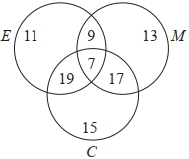
In a class of $100$ students, the number of students who passed in English only is $46$, in Maths only is $46$, and in Commerce only is $58$. The number of students who passed in English and Maths is $16$, in Maths and Commerce is $24$, and in English and Commerce is $26$. The number of students who passed in all three subjects is $7$. Find the number of students who failed in all the subjects.
A
$9$
B
$8$
C
$10$
D
None of these
Solution
(A) Let $E$, $M$, and $C$ represent the sets of students who passed in English, Maths, and Commerce, respectively.
Given:
Students passed in English only $= 46$
Students passed in Maths only $= 46$
Students passed in Commerce only $= 58$
Students passed in English and Maths (including all three) $= 16$. So, English and Maths only $= 16 - 7 = 9$.
Students passed in Maths and Commerce (including all three) $= 24$. So, Maths and Commerce only $= 24 - 7 = 17$.
Students passed in English and Commerce (including all three) $= 26$. So, English and Commerce only $= 26 - 7 = 19$.
Students passed in all three subjects $= 7$.
Total students who passed in at least one subject $= (\text{Only } E) + (\text{Only } M) + (\text{Only } C) + (\text{Only } E \cap M) + (\text{Only } M \cap C) + (\text{Only } E \cap C) + (E \cap M \cap C)$
$= 46 + 46 + 58 + 9 + 17 + 19 + 7 = 202$.
Since the total number of students is $100$, and the calculated sum of students who passed is $202$, which exceeds the total class size, there is an inconsistency in the provided problem data. However, based on the provided Venn diagram image, the values are: Only $E=11$, Only $M=13$, Only $C=15$, $E \cap M \text{ only}=9$, $M \cap C \text{ only}=17$, $E \cap C \text{ only}=19$, and All three $=7$.
Total passed $= 11 + 13 + 15 + 9 + 17 + 19 + 7 = 91$.
Students who failed in all subjects $= 100 - 91 = 9$.
Given:
Students passed in English only $= 46$
Students passed in Maths only $= 46$
Students passed in Commerce only $= 58$
Students passed in English and Maths (including all three) $= 16$. So, English and Maths only $= 16 - 7 = 9$.
Students passed in Maths and Commerce (including all three) $= 24$. So, Maths and Commerce only $= 24 - 7 = 17$.
Students passed in English and Commerce (including all three) $= 26$. So, English and Commerce only $= 26 - 7 = 19$.
Students passed in all three subjects $= 7$.
Total students who passed in at least one subject $= (\text{Only } E) + (\text{Only } M) + (\text{Only } C) + (\text{Only } E \cap M) + (\text{Only } M \cap C) + (\text{Only } E \cap C) + (E \cap M \cap C)$
$= 46 + 46 + 58 + 9 + 17 + 19 + 7 = 202$.
Since the total number of students is $100$, and the calculated sum of students who passed is $202$, which exceeds the total class size, there is an inconsistency in the provided problem data. However, based on the provided Venn diagram image, the values are: Only $E=11$, Only $M=13$, Only $C=15$, $E \cap M \text{ only}=9$, $M \cap C \text{ only}=17$, $E \cap C \text{ only}=19$, and All three $=7$.
Total passed $= 11 + 13 + 15 + 9 + 17 + 19 + 7 = 91$.
Students who failed in all subjects $= 100 - 91 = 9$.
0 likes
View Solution180
MediumMCQ
If $X$ and $Y$ are two sets such that $X \cup Y$ has $18$ elements,$X$ has $8$ elements,and $Y$ has $15$ elements,how many elements does $X \cap Y$ have?
A
$5$
B
$7$
C
$9$
D
$11$
Solution
(A) We are given that $n(X \cup Y) = 18$,$n(X) = 8$,and $n(Y) = 15$.
Using the set theory formula for the union of two sets:
$n(X \cup Y) = n(X) + n(Y) - n(X \cap Y)$
Rearranging the formula to solve for $n(X \cap Y)$:
$n(X \cap Y) = n(X) + n(Y) - n(X \cup Y)$
Substituting the given values:
$n(X \cap Y) = 8 + 15 - 18$
$n(X \cap Y) = 23 - 18$
$n(X \cap Y) = 5$
Therefore,the number of elements in $X \cap Y$ is $5$.
Using the set theory formula for the union of two sets:
$n(X \cup Y) = n(X) + n(Y) - n(X \cap Y)$
Rearranging the formula to solve for $n(X \cap Y)$:
$n(X \cap Y) = n(X) + n(Y) - n(X \cup Y)$
Substituting the given values:
$n(X \cap Y) = 8 + 15 - 18$
$n(X \cap Y) = 23 - 18$
$n(X \cap Y) = 5$
Therefore,the number of elements in $X \cap Y$ is $5$.
0 likes
View Solution181
MediumMCQ
If $A$ and $B$ are two sets such that $A$ has $40$ elements,$A \cup B$ has $60$ elements and $A \cap B$ has $10$ elements,how many elements does $B$ have?
A
$40$
B
$30$
C
$45$
D
$50$
Solution
(B) Given that $n(A) = 40$,$n(A \cup B) = 60$,and $n(A \cap B) = 10$.
We use the formula for the number of elements in the union of two sets:
$n(A \cup B) = n(A) + n(B) - n(A \cap B)$
Substituting the given values into the formula:
$60 = 40 + n(B) - 10$
$60 = 30 + n(B)$
$n(B) = 60 - 30$
$n(B) = 30$
Therefore,set $B$ has $30$ elements.
We use the formula for the number of elements in the union of two sets:
$n(A \cup B) = n(A) + n(B) - n(A \cap B)$
Substituting the given values into the formula:
$60 = 40 + n(B) - 10$
$60 = 30 + n(B)$
$n(B) = 60 - 30$
$n(B) = 30$
Therefore,set $B$ has $30$ elements.
0 likes
View Solution182
MediumMCQ
If $S$ and $T$ are two sets such that $S$ has $21$ elements,$T$ has $32$ elements,and $S \cap T$ has $11$ elements,how many elements does $S \cup T$ have?
A
$52$
B
$32$
C
$42$
D
None of these
Solution
(C) Given:
$n(S) = 21$
$n(T) = 32$
$n(S \cap T) = 11$
We use the formula for the number of elements in the union of two sets:
$n(S \cup T) = n(S) + n(T) - n(S \cap T)$
Substituting the given values:
$n(S \cup T) = 21 + 32 - 11$
$n(S \cup T) = 53 - 11$
$n(S \cup T) = 42$
Therefore,the set $S \cup T$ has $42$ elements.
$n(S) = 21$
$n(T) = 32$
$n(S \cap T) = 11$
We use the formula for the number of elements in the union of two sets:
$n(S \cup T) = n(S) + n(T) - n(S \cap T)$
Substituting the given values:
$n(S \cup T) = 21 + 32 - 11$
$n(S \cup T) = 53 - 11$
$n(S \cup T) = 42$
Therefore,the set $S \cup T$ has $42$ elements.
0 likes
View Solution183
MediumMCQ
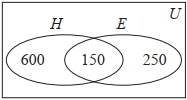
In a group of $1000$ people,there are $750$ people who can speak Hindi and $400$ who can speak English. How many can speak Hindi only?
A
$600$
B
$650$
C
$750$
D
$800$
Solution
(A) Let $H$ be the set of people who speak Hindi and $E$ be the set of people who speak English.
Given: $n(H \cup E) = 1000$,$n(H) = 750$,$n(E) = 400$.
Using the formula: $n(H \cup E) = n(H) + n(E) - n(H \cap E)$.
Substituting the values: $1000 = 750 + 400 - n(H \cap E)$.
$1000 = 1150 - n(H \cap E)$.
$n(H \cap E) = 1150 - 1000 = 150$.
Number of people who can speak Hindi only is given by $n(H) - n(H \cap E)$.
$= 750 - 150 = 600$.
Given: $n(H \cup E) = 1000$,$n(H) = 750$,$n(E) = 400$.
Using the formula: $n(H \cup E) = n(H) + n(E) - n(H \cap E)$.
Substituting the values: $1000 = 750 + 400 - n(H \cap E)$.
$1000 = 1150 - n(H \cap E)$.
$n(H \cap E) = 1150 - 1000 = 150$.
Number of people who can speak Hindi only is given by $n(H) - n(H \cap E)$.
$= 750 - 150 = 600$.
0 likes
View Solution184
MediumMCQ
In a class of $50$ students,$35$ opted for Mathematics and $37$ opted for Biology. How many have opted for both Mathematics and Biology? How many have opted for only Mathematics? (Assume that each student has to opt for at least one of the subjects).
A
$22, 13$
B
$22, 15$
C
$18, 17$
D
$20, 15$
Solution
(A) Let $M$ be the set of students who opted for Mathematics and $B$ be the set of students who opted for Biology.
Given: $n(M \cup B) = 50$,$n(M) = 35$,$n(B) = 37$.
Using the formula $n(M \cup B) = n(M) + n(B) - n(M \cap B)$:
$50 = 35 + 37 - n(M \cap B)$
$50 = 72 - n(M \cap B)$
$n(M \cap B) = 72 - 50 = 22$.
So,$22$ students have opted for both Mathematics and Biology.
Number of students who have opted for only Mathematics $= n(M) - n(M \cap B) = 35 - 22 = 13$.
Given: $n(M \cup B) = 50$,$n(M) = 35$,$n(B) = 37$.
Using the formula $n(M \cup B) = n(M) + n(B) - n(M \cap B)$:
$50 = 35 + 37 - n(M \cap B)$
$50 = 72 - n(M \cap B)$
$n(M \cap B) = 72 - 50 = 22$.
So,$22$ students have opted for both Mathematics and Biology.
Number of students who have opted for only Mathematics $= n(M) - n(M \cap B) = 35 - 22 = 13$.
0 likes
View Solution185
DifficultMCQ
In a group of $70$ people,$37$ like coffee,$52$ like tea and each person likes at least one of the two drinks. How many people like both coffee and tea?
A
$19$
B
$17$
C
$23$
D
$21$
Solution
(A) Let $A$ be the set of people who like coffee and $B$ be the set of people who like tea.
Given that each person likes at least one of the two drinks,the total number of people is represented by the union of the two sets: $n(A \cup B) = 70$.
We are given $n(A) = 37$ and $n(B) = 52$.
We use the formula for the union of two sets: $n(A \cup B) = n(A) + n(B) - n(A \cap B)$.
Substituting the known values into the formula:
$70 = 37 + 52 - n(A \cap B)$
$70 = 89 - n(A \cap B)$
$n(A \cap B) = 89 - 70 = 19$.
Therefore,$19$ people like both coffee and tea.
Given that each person likes at least one of the two drinks,the total number of people is represented by the union of the two sets: $n(A \cup B) = 70$.
We are given $n(A) = 37$ and $n(B) = 52$.
We use the formula for the union of two sets: $n(A \cup B) = n(A) + n(B) - n(A \cap B)$.
Substituting the known values into the formula:
$70 = 37 + 52 - n(A \cap B)$
$70 = 89 - n(A \cap B)$
$n(A \cap B) = 89 - 70 = 19$.
Therefore,$19$ people like both coffee and tea.
0 likes
View Solution186
DifficultMCQ
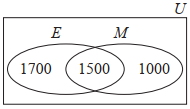
In a town with a population of $5000$,$3200$ people are egg-eaters,$2500$ are meat-eaters,and $1500$ eat both egg and meat. How many are pure vegetarians?
A
$600$
B
$800$
C
$900$
D
$850$
Solution
(B) Let $E$ be the set of people who are egg-eaters and $M$ be the set of people who are meat-eaters.
We are given:
$n(U) = 5000$ (Total population)
$n(E) = 3200$
$n(M) = 2500$
$n(E \cap M) = 1500$
Using the formula for the union of two sets:
$n(E \cup M) = n(E) + n(M) - n(E \cap M)$
$n(E \cup M) = 3200 + 2500 - 1500$
$n(E \cup M) = 5700 - 1500 = 4200$
This represents the number of people who eat either egg or meat or both.
The number of pure vegetarians is the total population minus those who eat egg or meat:
$\text{Pure vegetarians} = n(U) - n(E \cup M)$
$= 5000 - 4200 = 800$
We are given:
$n(U) = 5000$ (Total population)
$n(E) = 3200$
$n(M) = 2500$
$n(E \cap M) = 1500$
Using the formula for the union of two sets:
$n(E \cup M) = n(E) + n(M) - n(E \cap M)$
$n(E \cup M) = 3200 + 2500 - 1500$
$n(E \cup M) = 5700 - 1500 = 4200$
This represents the number of people who eat either egg or meat or both.
The number of pure vegetarians is the total population minus those who eat egg or meat:
$\text{Pure vegetarians} = n(U) - n(E \cup M)$
$= 5000 - 4200 = 800$
0 likes
View Solution187
MediumMCQ
Let $A = \{1, 2\}, B = \{2, 3\}$. Evaluate $A \times B$.
A
$\{(2, 1), (3, 1), (2, 3)\}$
B
$\{(1, 2), (1, 3), (2, 3)\}$
C
$\{(1, 2), (1, 3), (2, 2), (2, 3)\}$
D
None of these
Solution
(C) The Cartesian product $A \times B$ is defined as the set of all ordered pairs $(a, b)$ such that $a \in A$ and $b \in B$.
Given $A = \{1, 2\}$ and $B = \{2, 3\}$.
$A \times B = \{1, 2\} \times \{2, 3\}$
$= \{(1, 2), (1, 3), (2, 2), (2, 3)\}$
Given $A = \{1, 2\}$ and $B = \{2, 3\}$.
$A \times B = \{1, 2\} \times \{2, 3\}$
$= \{(1, 2), (1, 3), (2, 2), (2, 3)\}$
0 likes
View Solution188
MediumMCQ
If $A = \{a, b\}$,$B = \{2, 3, 5, 6, 7\}$ and $C = \{5, 6, 7, 8, 9\}$,find $A \times (B \cap C)$.
A
$A$
B
$\phi$
C
$\{(5, a), (6, a), (7, a), (5, b), (6, b), (7, b)\}$
D
$\{(a, 5), (a, 6), (a, 7), (b, 5), (b, 6), (b, 7)\}$
Solution
(D) First,find the intersection of sets $B$ and $C$:
$(B \cap C) = \{2, 3, 5, 6, 7\} \cap \{5, 6, 7, 8, 9\} = \{5, 6, 7\}$.
Next,find the Cartesian product of set $A$ and the resulting set $(B \cap C)$:
$A \times (B \cap C) = \{a, b\} \times \{5, 6, 7\}$.
By pairing each element of $A$ with each element of the intersection set,we get:
$A \times (B \cap C) = \{(a, 5), (a, 6), (a, 7), (b, 5), (b, 6), (b, 7)\}$.
$(B \cap C) = \{2, 3, 5, 6, 7\} \cap \{5, 6, 7, 8, 9\} = \{5, 6, 7\}$.
Next,find the Cartesian product of set $A$ and the resulting set $(B \cap C)$:
$A \times (B \cap C) = \{a, b\} \times \{5, 6, 7\}$.
By pairing each element of $A$ with each element of the intersection set,we get:
$A \times (B \cap C) = \{(a, 5), (a, 6), (a, 7), (b, 5), (b, 6), (b, 7)\}$.
0 likes
View Solution189
MediumMCQ
If $A = \{a, d\}, B = \{b, c, e\}$ and $C = \{b, c, f\},$ then $A \times (B \cup C) =$
A
$\phi$
B
$(A \times B) \cap (A \times C)$
C
$(A \times B) \cup (A \times C)$
D
None of these
Solution
(C) First,find the union of sets $B$ and $C$:
$(B \cup C) = \{b, c, e\} \cup \{b, c, f\} = \{b, c, e, f\}$.
Now,calculate the Cartesian product $A \times (B \cup C)$:
$A \times (B \cup C) = \{a, d\} \times \{b, c, e, f\} = \{(a, b), (a, c), (a, e), (a, f), (d, b), (d, c), (d, e), (d, f)\}$.
According to the distributive property of Cartesian product over union,$A \times (B \cup C) = (A \times B) \cup (A \times C)$.
Therefore,the correct option is $(A \times B) \cup (A \times C)$.
$(B \cup C) = \{b, c, e\} \cup \{b, c, f\} = \{b, c, e, f\}$.
Now,calculate the Cartesian product $A \times (B \cup C)$:
$A \times (B \cup C) = \{a, d\} \times \{b, c, e, f\} = \{(a, b), (a, c), (a, e), (a, f), (d, b), (d, c), (d, e), (d, f)\}$.
According to the distributive property of Cartesian product over union,$A \times (B \cup C) = (A \times B) \cup (A \times C)$.
Therefore,the correct option is $(A \times B) \cup (A \times C)$.
0 likes
View Solution190
DifficultMCQ
If $A = \{a, d\}, B = \{b, c, e\}$ and $C = \{b, c, f\},$ then $A \times (B \cap C) =$
A
$\phi$
B
$(A \times B) \cap (A \times C)$
C
$(A \times B) \cup (A \times C)$
D
None of these
Solution
(B) First,find the intersection of sets $B$ and $C$:
$(B \cap C) = \{b, c, e\} \cap \{b, c, f\} = \{b, c\}$
Next,find the Cartesian product of $A$ and $(B \cap C)$:
$A \times (B \cap C) = \{a, d\} \times \{b, c\} = \{(a, b), (a, c), (d, b), (d, c)\}$
According to the distributive property of Cartesian product over intersection,$A \times (B \cap C) = (A \times B) \cap (A \times C)$.
Thus,the correct option is $(A \times B) \cap (A \times C)$.
$(B \cap C) = \{b, c, e\} \cap \{b, c, f\} = \{b, c\}$
Next,find the Cartesian product of $A$ and $(B \cap C)$:
$A \times (B \cap C) = \{a, d\} \times \{b, c\} = \{(a, b), (a, c), (d, b), (d, c)\}$
According to the distributive property of Cartesian product over intersection,$A \times (B \cap C) = (A \times B) \cap (A \times C)$.
Thus,the correct option is $(A \times B) \cap (A \times C)$.
0 likes
View Solution191
EasyMCQ
If $A = \{a, d\}, B = \{b, c, e\}$ and $C = \{b, c, f\},$ then $A \times (B - C) =$
A
$(A \times B) - (A \times C)$
B
$A \times B$
C
$A \times C$
D
None of these
Solution
(A) Given sets are $A = \{a, d\}, B = \{b, c, e\}$ and $C = \{b, c, f\}$.
First,calculate the set difference $(B - C)$:
$(B - C) = \{b, c, e\} - \{b, c, f\} = \{e\}$.
Now,find the Cartesian product $A \times (B - C)$:
$A \times (B - C) = \{a, d\} \times \{e\} = \{(a, e), (d, e)\}$.
Next,calculate $(A \times B) - (A \times C)$:
$A \times B = \{(a, b), (a, c), (a, e), (d, b), (d, c), (d, e)\}$.
$A \times C = \{(a, b), (a, c), (a, f), (d, b), (d, c), (d, f)\}$.
$(A \times B) - (A \times C) = \{(a, e), (d, e)\}$.
Since both results are equal,$A \times (B - C) = (A \times B) - (A \times C)$.
First,calculate the set difference $(B - C)$:
$(B - C) = \{b, c, e\} - \{b, c, f\} = \{e\}$.
Now,find the Cartesian product $A \times (B - C)$:
$A \times (B - C) = \{a, d\} \times \{e\} = \{(a, e), (d, e)\}$.
Next,calculate $(A \times B) - (A \times C)$:
$A \times B = \{(a, b), (a, c), (a, e), (d, b), (d, c), (d, e)\}$.
$A \times C = \{(a, b), (a, c), (a, f), (d, b), (d, c), (d, f)\}$.
$(A \times B) - (A \times C) = \{(a, e), (d, e)\}$.
Since both results are equal,$A \times (B - C) = (A \times B) - (A \times C)$.
0 likes
View Solution192
DifficultMCQ
If $A=\{1,2,3\}, B=\{2,3,4\}, C=\{1,3,4\}$ and $D=\{2,4,5\},$ then $(A \times B) \cap (C \times D) =$
A
$(A \cap D) \times (B \cap C)$
B
$(A \cap C) \times (B \cap D)$
C
$\phi$
D
None of these
Solution
(B) Given sets are $A=\{1,2,3\}, B=\{2,3,4\}, C=\{1,3,4\},$ and $D=\{2,4,5\}.$
First,we find the Cartesian products:
$(A \times B) = \{(1,2), (1,3), (1,4), (2,2), (2,3), (2,4), (3,2), (3,3), (3,4)\}$
$(C \times D) = \{(1,2), (1,4), (1,5), (3,2), (3,4), (3,5), (4,2), (4,4), (4,5)\}$
Now,find the intersection of these two sets:
$(A \times B) \cap (C \times D) = \{(1,2), (1,4), (3,2), (3,4)\}$
Next,evaluate the expression in option $B$:
$(A \cap C) = \{1,3\} \cap \{1,3,4\} = \{1,3\}$
$(B \cap D) = \{2,3,4\} \cap \{2,4,5\} = \{2,4\}$
$(A \cap C) \times (B \cap D) = \{1,3\} \times \{2,4\} = \{(1,2), (1,4), (3,2), (3,4)\}$
Since both results are identical,the correct option is $(A \cap C) \times (B \cap D).$
First,we find the Cartesian products:
$(A \times B) = \{(1,2), (1,3), (1,4), (2,2), (2,3), (2,4), (3,2), (3,3), (3,4)\}$
$(C \times D) = \{(1,2), (1,4), (1,5), (3,2), (3,4), (3,5), (4,2), (4,4), (4,5)\}$
Now,find the intersection of these two sets:
$(A \times B) \cap (C \times D) = \{(1,2), (1,4), (3,2), (3,4)\}$
Next,evaluate the expression in option $B$:
$(A \cap C) = \{1,3\} \cap \{1,3,4\} = \{1,3\}$
$(B \cap D) = \{2,3,4\} \cap \{2,4,5\} = \{2,4\}$
$(A \cap C) \times (B \cap D) = \{1,3\} \times \{2,4\} = \{(1,2), (1,4), (3,2), (3,4)\}$
Since both results are identical,the correct option is $(A \cap C) \times (B \cap D).$
0 likes
View Solution193
MediumMCQ
If $A$ and $B$ have $n$ elements in common,how many elements do $A \times B$ and $B \times A$ have in common?
A
$n$
B
$n^{3}$
C
$n^{2}$
D
None of these
Solution
(C) Let $A \cap B$ be the set of common elements between $A$ and $B$. Given that $A$ and $B$ have $n$ elements in common,the number of elements in $A \cap B$ is $n$,i.e.,$|A \cap B| = n$.
An ordered pair $(x, y)$ belongs to $(A \times B) \cap (B \times A)$ if and only if $(x, y) \in A \times B$ and $(x, y) \in B \times A$.
This implies $x \in A$ and $y \in B$,and also $x \in B$ and $y \in A$.
Therefore,$x \in A \cap B$ and $y \in A \cap B$.
Since there are $n$ choices for $x$ from $A \cap B$ and $n$ choices for $y$ from $A \cap B$,the total number of such ordered pairs $(x, y)$ is $n \times n = n^{2}$.
Thus,$A \times B$ and $B \times A$ have $n^{2}$ elements in common.
An ordered pair $(x, y)$ belongs to $(A \times B) \cap (B \times A)$ if and only if $(x, y) \in A \times B$ and $(x, y) \in B \times A$.
This implies $x \in A$ and $y \in B$,and also $x \in B$ and $y \in A$.
Therefore,$x \in A \cap B$ and $y \in A \cap B$.
Since there are $n$ choices for $x$ from $A \cap B$ and $n$ choices for $y$ from $A \cap B$,the total number of such ordered pairs $(x, y)$ is $n \times n = n^{2}$.
Thus,$A \times B$ and $B \times A$ have $n^{2}$ elements in common.
0 likes
View Solution194
EasyMCQ
If the number of elements in a set $A$ is $n(A) = 40$,$n(B) = 26$,and $n(A \cap B) = 16$,then what is the value of $n(A \cup B)$?
A
$30$
B
$40$
C
$50$
D
$60$
Solution
(C) The formula for the number of elements in the union of two sets is given by:
$n(A \cup B) = n(A) + n(B) - n(A \cap B)$
Given values:
$n(A) = 40$
$n(B) = 26$
$n(A \cap B) = 16$
Substituting these values into the formula:
$n(A \cup B) = 40 + 26 - 16$
$n(A \cup B) = 66 - 16$
$n(A \cup B) = 50$
$n(A \cup B) = n(A) + n(B) - n(A \cap B)$
Given values:
$n(A) = 40$
$n(B) = 26$
$n(A \cap B) = 16$
Substituting these values into the formula:
$n(A \cup B) = 40 + 26 - 16$
$n(A \cup B) = 66 - 16$
$n(A \cup B) = 50$
0 likes
View Solution195
DifficultMCQ
In an examination,$30 \%$ of the total students failed in Hindi,$45 \%$ failed in English,and $20 \%$ failed in both the subjects. Find the percentage of those who passed in both the subjects. (in $\%$)
A
$35$
B
$40$
C
$45$
D
$50$
Solution
(C) Let the total number of students be $100$.
Let $H$ be the set of students who failed in Hindi and $E$ be the set of students who failed in English.
Given: $n(H) = 30$,$n(E) = 45$,and $n(H \cap E) = 20$.
We need to find the number of students who failed in at least one subject,which is given by the union $n(H \cup E)$.
Using the formula: $n(H \cup E) = n(H) + n(E) - n(H \cap E)$.
$n(H \cup E) = 30 + 45 - 20 = 55$.
So,$55 \%$ of students failed in at least one subject.
The percentage of students who passed in both subjects is the complement of those who failed in at least one subject.
Percentage passed $= 100 \% - 55 \% = 45 \%$.
Let $H$ be the set of students who failed in Hindi and $E$ be the set of students who failed in English.
Given: $n(H) = 30$,$n(E) = 45$,and $n(H \cap E) = 20$.
We need to find the number of students who failed in at least one subject,which is given by the union $n(H \cup E)$.
Using the formula: $n(H \cup E) = n(H) + n(E) - n(H \cap E)$.
$n(H \cup E) = 30 + 45 - 20 = 55$.
So,$55 \%$ of students failed in at least one subject.
The percentage of students who passed in both subjects is the complement of those who failed in at least one subject.
Percentage passed $= 100 \% - 55 \% = 45 \%$.
0 likes
View Solution196
MediumMCQ
In an examination,$40 \%$ students failed in Hindi,$50 \%$ students failed in English. If $21 \%$ students failed in both the subjects,find the percentage of those who passed in Hindi.
A
$31$
B
$40$
C
$55$
D
$60$
Solution
(D) Let $H$ be the set of students who failed in Hindi and $E$ be the set of students who failed in English.
Given: $n(H) = 40 \%$,$n(E) = 50 \%$,and $n(H \cap E) = 21 \%$.
The percentage of students who failed in Hindi is $40 \%$.
Therefore,the percentage of students who passed in Hindi is $100 \% - n(H) = 100 \% - 40 \% = 60 \%$.
Given: $n(H) = 40 \%$,$n(E) = 50 \%$,and $n(H \cap E) = 21 \%$.
The percentage of students who failed in Hindi is $40 \%$.
Therefore,the percentage of students who passed in Hindi is $100 \% - n(H) = 100 \% - 40 \% = 60 \%$.
0 likes
View Solution197
EasyMCQ
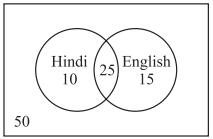
In a group of $50$ people, $35$ speak Hindi, $25$ speak both Hindi and English, and all the people speak Hindi or English or both. The number of people who speak English only is
A
$40$
B
$20$
C
$15$
D
$10$
Solution
(C) Let $H$ be the set of people who speak Hindi and $E$ be the set of people who speak English.
Given:
Total number of people $n(H \cup E) = 50$
Number of people who speak Hindi $n(H) = 35$
Number of people who speak both Hindi and English $n(H \cap E) = 25$
First, find the number of people who speak Hindi only:
$n(H \text{ only}) = n(H) - n(H \cap E) = 35 - 25 = 10$
Since all people speak either Hindi or English or both, the total number of people is given by:
$n(H \cup E) = n(H \text{ only}) + n(E \text{ only}) + n(H \cap E)$
$50 = 10 + n(E \text{ only}) + 25$
$50 = 35 + n(E \text{ only})$
$n(E \text{ only}) = 50 - 35 = 15$
Therefore, the number of people who speak English only is $15$.
Given:
Total number of people $n(H \cup E) = 50$
Number of people who speak Hindi $n(H) = 35$
Number of people who speak both Hindi and English $n(H \cap E) = 25$
First, find the number of people who speak Hindi only:
$n(H \text{ only}) = n(H) - n(H \cap E) = 35 - 25 = 10$
Since all people speak either Hindi or English or both, the total number of people is given by:
$n(H \cup E) = n(H \text{ only}) + n(E \text{ only}) + n(H \cap E)$
$50 = 10 + n(E \text{ only}) + 25$
$50 = 35 + n(E \text{ only})$
$n(E \text{ only}) = 50 - 35 = 15$
Therefore, the number of people who speak English only is $15$.
0 likes
View Solution198
MediumMCQ
In a certain office,$72 \%$ of the workers prefer cold drink and $44 \%$ prefer tea. If each of them prefers cold drink or tea and $40$ like both,then the total number of workers in the office is
A
$40$
B
$250$
C
$220$
D
$210$
Solution
(B) Let the total number of workers be $x$.
Let $C$ be the set of workers who prefer cold drink and $T$ be the set of workers who prefer tea.
Given: $n(C) = 72 \% \text{ of } x$,$n(T) = 44 \% \text{ of } x$.
Since every worker prefers at least one drink,$n(C \cup T) = 100 \% \text{ of } x$.
We know that $n(C \cup T) = n(C) + n(T) - n(C \cap T)$.
Substituting the values: $100 \% = 72 \% + 44 \% - n(C \cap T) \%$.
$100 \% = 116 \% - n(C \cap T) \%$.
Therefore,$n(C \cap T) = 116 \% - 100 \% = 16 \%$.
It is given that $40$ workers like both,so $16 \% \text{ of } x = 40$.
$x = \frac{40 \times 100}{16} = 250$.
Thus,the total number of workers is $250$.
Let $C$ be the set of workers who prefer cold drink and $T$ be the set of workers who prefer tea.
Given: $n(C) = 72 \% \text{ of } x$,$n(T) = 44 \% \text{ of } x$.
Since every worker prefers at least one drink,$n(C \cup T) = 100 \% \text{ of } x$.
We know that $n(C \cup T) = n(C) + n(T) - n(C \cap T)$.
Substituting the values: $100 \% = 72 \% + 44 \% - n(C \cap T) \%$.
$100 \% = 116 \% - n(C \cap T) \%$.
Therefore,$n(C \cap T) = 116 \% - 100 \% = 16 \%$.
It is given that $40$ workers like both,so $16 \% \text{ of } x = 40$.
$x = \frac{40 \times 100}{16} = 250$.
Thus,the total number of workers is $250$.
0 likes
View Solution199
EasyMCQ
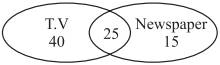
In a survey of a town,it was found that $65 \%$ of the people surveyed watch the news on $T.V.$,$40 \%$ read a newspaper,and $25 \%$ read a newspaper and watch the news on $T.V.$ What percent of the people surveyed neither watch the news on $T.V.$ nor read a newspaper?
A
$5$
B
$10$
C
$20$
D
$15$
Solution
(C) Let $A$ be the set of people who watch news on $T.V.$ and $B$ be the set of people who read a newspaper.
Given: $n(A) = 65 \%$,$n(B) = 40 \%$,and $n(A \cap B) = 25 \%$.
The percentage of people who watch news on $T.V.$ or read a newspaper is given by the union formula:
$n(A \cup B) = n(A) + n(B) - n(A \cap B)$
$n(A \cup B) = 65 \% + 40 \% - 25 \% = 80 \%$.
The percentage of people who neither watch news on $T.V.$ nor read a newspaper is:
$100 \% - n(A \cup B) = 100 \% - 80 \% = 20 \%$.
Given: $n(A) = 65 \%$,$n(B) = 40 \%$,and $n(A \cap B) = 25 \%$.
The percentage of people who watch news on $T.V.$ or read a newspaper is given by the union formula:
$n(A \cup B) = n(A) + n(B) - n(A \cap B)$
$n(A \cup B) = 65 \% + 40 \% - 25 \% = 80 \%$.
The percentage of people who neither watch news on $T.V.$ nor read a newspaper is:
$100 \% - n(A \cup B) = 100 \% - 80 \% = 20 \%$.
0 likes
View Solution200
MediumMCQ
There are $80$ families in a small extension area. $20$ percent of these families own a car each. $50$ percent of the remaining families own a motor cycle each. How many families in that extension do not own any vehicle?
A
$30$
B
$32$
C
$23$
D
$36$
Solution
(B) Total number of families $= 80$.
Number of families owning a car $= 20 \% \text{ of } 80 = \frac{20}{100} \times 80 = 16$.
Remaining families $= 80 - 16 = 64$.
Number of families owning a motorcycle $= 50 \% \text{ of the remaining families} = \frac{50}{100} \times 64 = 32$.
Total number of families owning a vehicle $= 16 + 32 = 48$.
Number of families not owning any vehicle $= 80 - 48 = 32$.
Number of families owning a car $= 20 \% \text{ of } 80 = \frac{20}{100} \times 80 = 16$.
Remaining families $= 80 - 16 = 64$.
Number of families owning a motorcycle $= 50 \% \text{ of the remaining families} = \frac{50}{100} \times 64 = 32$.
Total number of families owning a vehicle $= 16 + 32 = 48$.
Number of families not owning any vehicle $= 80 - 48 = 32$.
0 likes
View SolutionAlgebra — Set Theory · Frequently Asked Questions
1Are these Algebra questions useful for JEE and NEET?
Yes. All questions in this section are mapped to JEE Main and NEET exam patterns. Previous year questions from JEE Main, NEET, GUJCET and state-level exams are included with full solutions.
2Can I switch to Hindi or Gujarati for these questions?
Yes. Use the language tabs in the hero section or the sidebar to view the same questions and solutions in English, Hindi or Gujarati.
3How do I generate a question paper from this subtopic?
Use the Vedclass Exam Paper Generator — select the chapter and subtopic, set difficulty, and generate Sets A, B, C, D automatically. First 3 chapters of every subject are free.
Vedclass Products
For Students
Vedclass Test Series
Mock tests in real JEE/NEET style with performance analysis. 5-day free trial.
Start Free TrialFor Teachers
Exam Paper Generator
Generate Set A/B/C/D papers from this chapter in 2 minutes. 3 chapters free.
Try FreeFor Institutes
Online Exam Module
Live online exams with unlimited students, 360° analytics & white-label branding.
See DemoFor Teachers & Institutes
Generate a Algebra Exam Paper in 2 Minutes
Select subtopic & difficulty — Sets A, B, C, D auto-generated with No Repeat logic.
First 3 chapters of every subject are free — no payment required.