
A English
Mix Example - WHY DO WE FALL ILL? Questions in English
Class 9 Science · WHY DO WE FALL ILL? · Mix Example - WHY DO WE FALL ILL?
147+
Questions
English
Language
100%
With Solutions
Showing 50 of 147 questions in English
51
Medium
$(a)$ Name a worm which is found in our small intestine.
$(b)$ Name the bacteria which can cause acne.
$(c)$ Which protozoan is responsible for sleeping sickness?
$(d)$ Which disease is caused by the protozoan Leishmania?
$(b)$ Name the bacteria which can cause acne.
$(c)$ Which protozoan is responsible for sleeping sickness?
$(d)$ Which disease is caused by the protozoan Leishmania?
Solution
(N/A) The worm found in the human small intestine is the Roundworm, scientifically known as $Ascaris lumbricoides$.
$(b)$ The bacteria responsible for causing acne is $Staphylococcus$ (specifically $Staphylococcus epidermidis$ or $Staphylococcus aureus$ strains).
$(c)$ The protozoan responsible for sleeping sickness is $Trypanosoma$ (specifically $Trypanosoma brucei$).
$(d)$ The disease caused by the protozoan $Leishmania$ is Kala-azar (also known as visceral leishmaniasis).
$(b)$ The bacteria responsible for causing acne is $Staphylococcus$ (specifically $Staphylococcus epidermidis$ or $Staphylococcus aureus$ strains).
$(c)$ The protozoan responsible for sleeping sickness is $Trypanosoma$ (specifically $Trypanosoma brucei$).
$(d)$ The disease caused by the protozoan $Leishmania$ is Kala-azar (also known as visceral leishmaniasis).
0 likes
View Solution52
EasyMCQ
Your younger brother observes some mosquitoes sucking juices of cut fruit pieces,though it is common knowledge that mosquitoes suck blood of humans. How will you explain this behaviour to him?
A
Only male mosquitoes suck blood.
B
Only female mosquitoes suck blood for egg production,while both sexes feed on plant juices/nectar for energy.
C
Mosquitoes have changed their diet due to evolution.
D
Mosquitoes suck fruit juice when they are sick.
Solution
(B) In many species of mosquitoes,males feed on fruit juices or plant nectar to obtain carbohydrates for energy. Females also feed on these substances for energy,but they require a blood meal to obtain the proteins and lipids necessary for the development and maturation of their eggs.
0 likes
View Solution53
Easy
Why is $DPT$ called a Triple antigen?
Solution
(N/A) $DPT$ is known as a Triple antigen because it is a vaccine that provides immunity against three distinct diseases:
$(i)$ Diphtheria: Caused by the bacterium $Corynebacterium$ $\text{diphtheriae}$.
$(ii)$ Pertussis: Also known as whooping cough, caused by the bacterium $Bordetella$ $\text{pertussis}$.
$(iii)$ Tetanus: Caused by the bacterium $Clostridium$ $\text{tetani}$.
Since it protects against these three specific pathogens simultaneously, it is referred to as a Triple antigen.
$(i)$ Diphtheria: Caused by the bacterium $Corynebacterium$ $\text{diphtheriae}$.
$(ii)$ Pertussis: Also known as whooping cough, caused by the bacterium $Bordetella$ $\text{pertussis}$.
$(iii)$ Tetanus: Caused by the bacterium $Clostridium$ $\text{tetani}$.
Since it protects against these three specific pathogens simultaneously, it is referred to as a Triple antigen.
0 likes
View Solution54
MediumMCQ
What are the symptoms shown by a person if
$(i)$ Lungs get infected?
$(ii)$ Stomach is infected?
$(i)$ Lungs get infected?
$(ii)$ Stomach is infected?
A
$N$/$A$
B
$N$/$A$
C
$N$/$A$
D
$N$/$A$
Solution
(N/A) $(i)$ If the lungs are infected,the person typically experiences symptoms such as a persistent cough,chest pain,and breathlessness or difficulty in breathing.
$(ii)$ If the stomach is infected,the person typically experiences symptoms such as stomach ache (abdominal pain),loose motions (diarrhea),and vomiting.
$(ii)$ If the stomach is infected,the person typically experiences symptoms such as stomach ache (abdominal pain),loose motions (diarrhea),and vomiting.
0 likes
View Solution55
Medium
Give any four reasons to justify why it is more difficult to prepare antiviral medicines than antibiotics.
Solution
(N/A) $(i)$ Viruses have very few biochemical mechanisms of their own.
$(ii)$ They enter the host cells to replicate.
$(iii)$ They use the host's cellular machinery for their own life processes.
$(iv)$ There are very few virus-specific targets available to aim at for drug development.
$(ii)$ They enter the host cells to replicate.
$(iii)$ They use the host's cellular machinery for their own life processes.
$(iv)$ There are very few virus-specific targets available to aim at for drug development.
0 likes
View Solution56
Medium
List four preventive measures against communicable diseases.
Solution
(N/A) $(i)$ Health education
$(ii)$ Isolation
$(iii)$ Proper sanitation
$(iv)$ Sterilization of articles used by patients
$(v)$ Vaccination
$(vi)$ Provision of safe water supply (any four)
$(ii)$ Isolation
$(iii)$ Proper sanitation
$(iv)$ Sterilization of articles used by patients
$(v)$ Vaccination
$(vi)$ Provision of safe water supply (any four)
0 likes
View Solution57
Easy
List any four essential factors that must be taken care of by an individual for keeping good health.
Solution
(N/A) To maintain good health,an individual must focus on the following four essential factors:
$(i)$ Balanced diet: Consuming a diet that provides all necessary nutrients in the correct proportions is essential for the proper functioning of the body.
$(ii)$ Disease-free environment: Living in a clean environment free from pathogens and vectors is crucial to prevent the spread of infectious diseases.
$(iii)$ Proper sanitation: Maintaining personal and public hygiene,including clean water supply and proper waste disposal,helps in preventing the growth of disease-causing organisms.
$(iv)$ Mental and social stability: Good health is not just the absence of disease but a state of complete physical,mental,and social well-being. Maintaining positive social relationships and mental peace is vital for overall health.
$(i)$ Balanced diet: Consuming a diet that provides all necessary nutrients in the correct proportions is essential for the proper functioning of the body.
$(ii)$ Disease-free environment: Living in a clean environment free from pathogens and vectors is crucial to prevent the spread of infectious diseases.
$(iii)$ Proper sanitation: Maintaining personal and public hygiene,including clean water supply and proper waste disposal,helps in preventing the growth of disease-causing organisms.
$(iv)$ Mental and social stability: Good health is not just the absence of disease but a state of complete physical,mental,and social well-being. Maintaining positive social relationships and mental peace is vital for overall health.
0 likes
View Solution58
Medium
Explain how individual health depends on social and mental well-being.
Solution
(N/A) Individual health is not merely the absence of disease; it is a state of complete physical,mental,and social well-being.
$1$. Social well-being: We live in a society,and our surroundings significantly impact our health. Proper sanitation,clean drinking water,garbage disposal,and the absence of open drainage are essential for preventing the spread of diseases. $A$ clean environment reduces the risk of infections.
$2$. Mental well-being: Mental health is crucial for overall physical health. If an individual is stressed,anxious,or unhappy,it can lead to physical ailments like high blood pressure or digestive issues. Social equality,harmony,and a supportive environment are essential for maintaining a healthy mental state.
$1$. Social well-being: We live in a society,and our surroundings significantly impact our health. Proper sanitation,clean drinking water,garbage disposal,and the absence of open drainage are essential for preventing the spread of diseases. $A$ clean environment reduces the risk of infections.
$2$. Mental well-being: Mental health is crucial for overall physical health. If an individual is stressed,anxious,or unhappy,it can lead to physical ailments like high blood pressure or digestive issues. Social equality,harmony,and a supportive environment are essential for maintaining a healthy mental state.
0 likes
View Solution59
Medium
How can we prevent water-borne and vector-borne infections?
Solution
(N/A) Water-borne infections can be prevented by ensuring the availability of safe and clean drinking water,such as by boiling or filtering water.
Vector-borne infections can be prevented by maintaining a clean environment,preventing the stagnation of water to stop mosquito breeding,and using protective measures like mosquito nets and repellents.
Vector-borne infections can be prevented by maintaining a clean environment,preventing the stagnation of water to stop mosquito breeding,and using protective measures like mosquito nets and repellents.
0 likes
View Solution60
Medium
What causes encephalitis? How does it enter the body? Which organ does it infect? What are the symptoms if this organ is infected? How can it be prevented?
Solution
(N/A) Encephalitis is primarily caused by a virus. It enters the body through the bite of an infected mosquito.
The virus specifically infects the brain.
Symptoms: If the brain is infected,the following symptoms occur:
- Severe headache
- Vomiting
- Fits (seizures)
- Unconsciousness or confusion.
Prevention: It can be prevented by avoiding mosquito bites,using mosquito nets,and controlling mosquito breeding sites.
The virus specifically infects the brain.
Symptoms: If the brain is infected,the following symptoms occur:
- Severe headache
- Vomiting
- Fits (seizures)
- Unconsciousness or confusion.
Prevention: It can be prevented by avoiding mosquito bites,using mosquito nets,and controlling mosquito breeding sites.
0 likes
View Solution61
Medium
State in tabular form the modes of transmission of each of the following diseases:
$(a)$ Syphilis
$(b)$ Tuberculosis
$(c)$ Jaundice
$(d)$ Japanese encephalitis
$(a)$ Syphilis
$(b)$ Tuberculosis
$(c)$ Jaundice
$(d)$ Japanese encephalitis
Solution
(N/A)
| Name of disease | Mode of transmission |
|---|---|
| $(a)$ Syphilis | Sexual contact |
| $(b)$ Tuberculosis | Air (droplet infection) |
| $(c)$ Jaundice | Contaminated water |
| $(d)$ Japanese encephalitis | Mosquito bite (vector-borne) |
0 likes
View Solution62
Easy
What is inflammation? Write the symptoms of this in the human body.
Solution
(N/A) Inflammation is a local response of the immune system where it recruits various cells to the affected tissue to eliminate disease-causing microbes or damaged cells.
The primary symptoms of inflammation in the human body include:
$1$. Swelling (Edema)
$2$. Pain
$3$. Fever (or localized heat)
$4$. Redness
The primary symptoms of inflammation in the human body include:
$1$. Swelling (Edema)
$2$. Pain
$3$. Fever (or localized heat)
$4$. Redness
0 likes
View Solution63
Medium
$(a)$ State the method of transmission of each of the following diseases:
$(i)$ Cholera
$(ii)$ $AIDS$
$(iii)$ Malaria
$(iv)$ Pneumonia
$(b)$ Name the disease a person will get if the pathogen targets the liver of a person.
$(i)$ Cholera
$(ii)$ $AIDS$
$(iii)$ Malaria
$(iv)$ Pneumonia
$(b)$ Name the disease a person will get if the pathogen targets the liver of a person.
Solution
(N/A) Methods of transmission:
$(i)$ Cholera: It is a water-borne disease transmitted through the consumption of contaminated food or water.
$(ii)$ $AIDS$: It is transmitted through sexual contact with an infected person,sharing infected needles,or blood transfusion.
$(iii)$ Malaria: It is transmitted through the bite of an infected female $Anopheles$ mosquito,which acts as a vector.
$(iv)$ Pneumonia: It is an air-borne disease transmitted through droplets released by an infected person during coughing or sneezing.
$(b)$ If the pathogen targets the liver,the person will suffer from Hepatitis (commonly known as jaundice).
$(i)$ Cholera: It is a water-borne disease transmitted through the consumption of contaminated food or water.
$(ii)$ $AIDS$: It is transmitted through sexual contact with an infected person,sharing infected needles,or blood transfusion.
$(iii)$ Malaria: It is transmitted through the bite of an infected female $Anopheles$ mosquito,which acts as a vector.
$(iv)$ Pneumonia: It is an air-borne disease transmitted through droplets released by an infected person during coughing or sneezing.
$(b)$ If the pathogen targets the liver,the person will suffer from Hepatitis (commonly known as jaundice).
0 likes
View Solution64
Medium
Differentiate between infectious and non-infectious diseases (any three differences).
Solution
(N/A)
| Infectious Diseases | Non-Infectious Diseases |
| $(i)$ These diseases spread from an infected person to a healthy person. | $(i)$ These diseases do not spread from an infected person to a healthy person. |
| $(ii)$ These are usually caused by pathogens like bacteria,viruses,fungi,or parasites. | $(ii)$ These are caused by internal factors like genetic disorders,hormonal imbalances,or lifestyle choices. |
| $(iii)$ These are communicable diseases,e.g.,common cold,influenza,and tuberculosis. | $(iii)$ These are non-communicable diseases,e.g.,diabetes,hypertension,and cancer. |
0 likes
View Solution65
Medium
Fill in the following table:
| $S.No.$ | Disease | Point of Entry | Target Organ |
| $1.$ Japanese encephalitis | $(a)$ | $(b)$ | |
| $2.$ $HIV$ | $(c)$ | $(d)$ | |
| $3.$ Tuberculosis | $(e)$ | $(f)$ |
Solution
$(a)$ Mosquito bite/Skin
$(b)$ Brain
$(c)$ Sexual organs/Blood
$(d)$ Lymph nodes/Immune system
$(e)$ Nose/Mouth (Respiratory tract)
$(f)$ Lungs
$(b)$ Brain
$(c)$ Sexual organs/Blood
$(d)$ Lymph nodes/Immune system
$(e)$ Nose/Mouth (Respiratory tract)
$(f)$ Lungs
0 likes
View Solution66
Medium
What are the symptoms and causes of malaria? What is the mode of transmission of the disease? How can it be prevented and controlled?
Solution
(N/A) Disease: Malaria.
Causative microorganism: $Plasmodium$ (a protozoan).
Mode of transmission: Bite of an infected female $Anopheles$ mosquito.
Symptoms: General weakness,muscular pain,nausea,and high fever accompanied by sweating and shivering.
Prevention and Control: Use mosquito nets and repellents. Spray kerosene or oil on stagnant water to kill mosquito larvae. Avoid the accumulation of stagnant water in the surroundings to prevent mosquito breeding.
Treatment: Antimalarial drugs like quinine (derived from the $Cinchona$ tree) are used for treatment.
Causative microorganism: $Plasmodium$ (a protozoan).
Mode of transmission: Bite of an infected female $Anopheles$ mosquito.
Symptoms: General weakness,muscular pain,nausea,and high fever accompanied by sweating and shivering.
Prevention and Control: Use mosquito nets and repellents. Spray kerosene or oil on stagnant water to kill mosquito larvae. Avoid the accumulation of stagnant water in the surroundings to prevent mosquito breeding.
Treatment: Antimalarial drugs like quinine (derived from the $Cinchona$ tree) are used for treatment.
0 likes
View Solution67
Difficult
Raju of Class $IX$ was suffering from chickenpox. His friends Priya and Shaurya wanted to visit him. Shaurya's parents did not allow him to go. Priya had already suffered from it a few months before. Priya's parents allowed her to visit him. What could be the reason behind their parents' decision? What is the basis of the principle of immunisation?
Solution
(N/A) As Priya had already suffered from chickenpox a few months back,her body has become immune to the chickenpox-causing microbe. So,if that microbe enters her body again,her immune system will recognize and fight it effectively. Hence,her parents allowed her to visit Raju.
On the other hand,as Shaurya has never suffered from chickenpox,his body is not immune to it. Therefore,his parents refused to let him visit Raju to prevent him from getting infected.
The basis of the principle of immunisation: It involves stimulating the host's immune system to develop immunity against a specific disease-causing agent. This is achieved by introducing weakened or dead microbes (vaccines) of that disease into the body. Once the body starts producing antibodies,it can fight against the actual pathogen,and the body becomes immune to that disease.
On the other hand,as Shaurya has never suffered from chickenpox,his body is not immune to it. Therefore,his parents refused to let him visit Raju to prevent him from getting infected.
The basis of the principle of immunisation: It involves stimulating the host's immune system to develop immunity against a specific disease-causing agent. This is achieved by introducing weakened or dead microbes (vaccines) of that disease into the body. Once the body starts producing antibodies,it can fight against the actual pathogen,and the body becomes immune to that disease.
0 likes
View Solution68
Medium
Study the given chart carefully and fill in the blanks $(a)$,$(b)$,and $(c)$:
| $S$.No. | Name of the disease | Causative organism | Mode of transmission |
|---|---|---|---|
| $1$. Polio | $(a)$ | Infection of virus directly/orally | |
| $2$. $(b)$ | Lyssa virus | Virus enters human body with saliva of an infected animal | |
| $3$. Typhoid | Salmonella typhi | $(c)$ |
Solution
(A) Poliomyelitis virus (Polio virus).
$(b)$ Rabies.
$(c)$ Bacteria enters the body via the gastrointestinal tract through contaminated food or water.
$(b)$ Rabies.
$(c)$ Bacteria enters the body via the gastrointestinal tract through contaminated food or water.
0 likes
View Solution69
Medium
Complete the given table:
| Disease | Causative organism | Mode of transmission |
|---|---|---|
| Dengue fever | $... (a) ...$ | $... (b) ...$ |
| $... (c) ...$ | Vibrio cholerae | Contaminated food and water |
| $... (d) ...$ | $HIV$ | $... (e) ...$ |
| Common cold | Virus | $... (f) ...$ |
Solution
(N/A) Dengue virus (Flavivirus)
$(b)$ Aedes mosquito (Vector)
$(c)$ Cholera
$(d)$ $AIDS$
$(e)$ Sexual contact,blood transfusion,or sharing infected needles
$(f)$ Droplet infection (Airborne)
$(b)$ Aedes mosquito (Vector)
$(c)$ Cholera
$(d)$ $AIDS$
$(e)$ Sexual contact,blood transfusion,or sharing infected needles
$(f)$ Droplet infection (Airborne)
0 likes
View Solution70
Medium
Label the modes of disease transmission from $(a)$ to $(f)$ in the provided diagram.
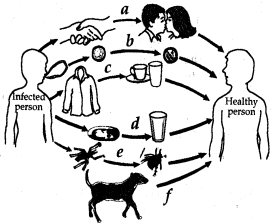
Solution
(N/A) Direct contact (e.g.,physical touch or kissing).
$(b)$ By air (e.g.,droplets from coughing or sneezing).
$(c)$ Indirect contact (e.g.,sharing personal items like clothes or utensils).
$(d)$ By food/water (e.g.,contaminated food or water).
$(e)$ Mosquito/insect (e.g.,vector-borne transmission).
$(f)$ Rabid animal (e.g.,animal bite).
$(b)$ By air (e.g.,droplets from coughing or sneezing).
$(c)$ Indirect contact (e.g.,sharing personal items like clothes or utensils).
$(d)$ By food/water (e.g.,contaminated food or water).
$(e)$ Mosquito/insect (e.g.,vector-borne transmission).
$(f)$ Rabid animal (e.g.,animal bite).
0 likes
View Solution71
Medium
Distinguish between acute and chronic diseases.
Solution
(N/A)
| Acute disease | Chronic disease |
| $(i)$ Lasts for a short period. Causes major effects on general health in a very short time. | $(i)$ Lasts for a long period. It takes a long time to cause major effects on general health. |
| $(ii)$ No long-term feeling of tiredness. | $(ii)$ One feels tired all the time. |
| $(iii)$ Weight loss does not occur and one does not become short of breath. | $(iii)$ Weight loss occurs and one becomes short of breath. |
0 likes
View Solution72
Medium
Given below are a few situations:
$(i)$ Geeta of Class $IX$ was having a common cold. She sits with Sarika,who also develops the disease.
$(ii)$ Animesh of Class $IX$ shifted to a new residence with his family where a water purification system has not been installed yet. He develops Cholera and Dysentery.
$(i)$ Geeta of Class $IX$ was having a common cold. She sits with Sarika,who also develops the disease.
$(ii)$ Animesh of Class $IX$ shifted to a new residence with his family where a water purification system has not been installed yet. He develops Cholera and Dysentery.
Solution
(N/A) $(i)$ Transmission by air (airborne disease).
$(ii)$ Transmission by water (waterborne disease).
Both situations describe the spread of communicable diseases.
$(ii)$ Transmission by water (waterborne disease).
Both situations describe the spread of communicable diseases.
0 likes
View Solution73
Easy
$(a)$ Which part of the body is infected by the malaria-causing microbe?
$(b)$ What are the two ways to treat an infectious disease?
$(b)$ What are the two ways to treat an infectious disease?
Solution
(N/A) The malaria-causing microbe (Plasmodium) first infects the liver cells and then the red blood cells (RBCs).
$(b)$ The two ways to treat an infectious disease are:
$1.$ To reduce the effects of the disease (symptomatic treatment).
$2.$ To kill the cause of the disease (e.g.,using antibiotics or anti-malarial drugs).
$(b)$ The two ways to treat an infectious disease are:
$1.$ To reduce the effects of the disease (symptomatic treatment).
$2.$ To kill the cause of the disease (e.g.,using antibiotics or anti-malarial drugs).
0 likes
View Solution74
Medium
$(a)$ The immune system is essential for our health. Comment on the above statement.
$(b)$ How can we acquire immunity?
$(b)$ How can we acquire immunity?
Solution
(N/A) The immune system acts as a vital defence mechanism that protects our body against pathogenic microbes. It consists of specialized cells and proteins that identify,target,and eliminate infectious agents,thereby maintaining overall health and preventing diseases.
$(b)$ Immunity can be acquired in two primary ways:
$1$. Natural acquisition: When a person suffers from a specific disease once,the body develops memory cells and antibodies against those specific antigens. This provides long-term protection against the same pathogen.
$2$. Artificial acquisition: Vaccines can be administered to introduce weakened or dead pathogens (or their components) into the body. This stimulates the immune system to produce antibodies without causing the actual disease,thereby conferring immunity.
$(b)$ Immunity can be acquired in two primary ways:
$1$. Natural acquisition: When a person suffers from a specific disease once,the body develops memory cells and antibodies against those specific antigens. This provides long-term protection against the same pathogen.
$2$. Artificial acquisition: Vaccines can be administered to introduce weakened or dead pathogens (or their components) into the body. This stimulates the immune system to produce antibodies without causing the actual disease,thereby conferring immunity.
0 likes
View Solution75
MediumMCQ
What are two approaches to treat any infectious diseases?
A
Symptomatic treatment and vaccination
B
Symptomatic treatment and killing the causative agent
C
Antibiotics and surgery
D
Isolation and quarantine
Solution
(B) $(i)$ To reduce the effects of the disease (symptom-directed treatment): One can take medicines to reduce symptoms like fever,pain,or inflammation,or take rest to conserve energy.
$(ii)$ To eliminate the cause of the disease: Medicines can be taken to kill the specific microbes by blocking:
$(a)$ The metabolic pathways specific for the synthesis of new substances required by the pathogen.
$(b)$ The respiration processes required by specific groups of pathogenic organisms.
$(ii)$ To eliminate the cause of the disease: Medicines can be taken to kill the specific microbes by blocking:
$(a)$ The metabolic pathways specific for the synthesis of new substances required by the pathogen.
$(b)$ The respiration processes required by specific groups of pathogenic organisms.
0 likes
View Solution76
Medium
$A$ person was bitten by a stray dog. After some days,his nature became irritated,and he started fearing water.
$(a)$ Name the disease.
$(b)$ Is there any vaccine plan available?
$(c)$ Is there any plan of your local authority for the control of this disease?
$(a)$ Name the disease.
$(b)$ Is there any vaccine plan available?
$(c)$ Is there any plan of your local authority for the control of this disease?
Solution
(N/A) The disease is Rabies (also known as Hydrophobia).
$(b)$ Yes,an anti-rabies vaccine is available for both pre-exposure and post-exposure prophylaxis.
$(c)$ Yes,local authorities implement programs such as the compulsory vaccination of pet dogs,stray dog population control through sterilization ($ABC$ - Animal Birth Control),and public awareness campaigns to prevent the spread of rabies.
$(b)$ Yes,an anti-rabies vaccine is available for both pre-exposure and post-exposure prophylaxis.
$(c)$ Yes,local authorities implement programs such as the compulsory vaccination of pet dogs,stray dog population control through sterilization ($ABC$ - Animal Birth Control),and public awareness campaigns to prevent the spread of rabies.
0 likes
View Solution77
Medium
$(a)$ Who discovered the first vaccine?
$(b)$ Name two viral diseases that can be prevented by using vaccines. What is immunity?
$(b)$ Name two viral diseases that can be prevented by using vaccines. What is immunity?
Solution
(N/A) Edward Jenner discovered the first vaccine.
$(b)$ Two viral diseases that can be prevented by vaccines are Hepatitis $A$ and Polio.
Immunity is the ability of an organism to resist a particular infection or toxin by the action of specific antibodies or sensitized white blood cells. It is the body's defense mechanism against disease-causing microorganisms (antigens). When antigens enter the body,the immune system produces antibodies to neutralize them,thereby preventing the disease.
$(b)$ Two viral diseases that can be prevented by vaccines are Hepatitis $A$ and Polio.
Immunity is the ability of an organism to resist a particular infection or toxin by the action of specific antibodies or sensitized white blood cells. It is the body's defense mechanism against disease-causing microorganisms (antigens). When antigens enter the body,the immune system produces antibodies to neutralize them,thereby preventing the disease.
0 likes
View Solution78
Medium
Write the cause,symptoms,and prevention of $AIDS$.
Solution
(N/A) Cause: $AIDS$ is caused by the $HIV$ ($Human$ $Immunodeficiency$ $Virus$).
Symptoms: The symptoms include significant weight loss,night sweats,loss of appetite,persistent fever,and overall weakness of the body due to a compromised immune system.
Prevention: $AIDS$ can be prevented by avoiding sexual contact with unknown persons,using only sterilized needles and blades,and ensuring that blood used for transfusion is screened and free from $HIV$.
Symptoms: The symptoms include significant weight loss,night sweats,loss of appetite,persistent fever,and overall weakness of the body due to a compromised immune system.
Prevention: $AIDS$ can be prevented by avoiding sexual contact with unknown persons,using only sterilized needles and blades,and ensuring that blood used for transfusion is screened and free from $HIV$.
0 likes
View Solution79
Medium
$(a)$ What is immunisation?
$(b)$ Categorise the following into acute,chronic,infectious,or non-infectious diseases: Typhoid,$TB$,Goitre,Elephantiasis.
$(b)$ Categorise the following into acute,chronic,infectious,or non-infectious diseases: Typhoid,$TB$,Goitre,Elephantiasis.
Solution
(N/A) Immunisation is the process by which an individual's immune system becomes fortified against an infectious agent through artificial means,such as vaccination.
$(b)$ The classification of the given diseases is as follows:
- Typhoid: Infectious and Acute.
- $TB$ (Tuberculosis): Infectious and Chronic.
- Goitre: Non-infectious and Chronic.
- Elephantiasis: Infectious and Chronic.
$(b)$ The classification of the given diseases is as follows:
- Typhoid: Infectious and Acute.
- $TB$ (Tuberculosis): Infectious and Chronic.
- Goitre: Non-infectious and Chronic.
- Elephantiasis: Infectious and Chronic.
0 likes
View Solution80
Medium
List three harmful effects of infectious disease.
Solution
(N/A) The three harmful effects of infectious disease are:
$(a)$ The body functions of the person suffering from the disease are damaged and may never recover completely.
$(b)$ Treatment of the disease takes time,and the person suffering is likely to be bedridden for some time,leading to a loss of productivity.
$(c)$ The infected person serves as a source of infection,which can spread the disease to other healthy individuals in the community.
$(a)$ The body functions of the person suffering from the disease are damaged and may never recover completely.
$(b)$ Treatment of the disease takes time,and the person suffering is likely to be bedridden for some time,leading to a loss of productivity.
$(c)$ The infected person serves as a source of infection,which can spread the disease to other healthy individuals in the community.
0 likes
View Solution81
Medium
Give the cause and remedy for:
$(a)$ Hepatitis
$(b)$ $AIDS$
$(c)$ Malaria
$(a)$ Hepatitis
$(b)$ $AIDS$
$(c)$ Malaria
Solution
(N/A)
| Disease | Cause and Remedy |
|---|---|
| $(a)$ Hepatitis | $(i)$ Cause: Hepatitis virus. $(ii)$ Remedy: Avoid contaminated food and water,and get vaccinated for Hepatitis $A$ and $B$. |
| $(b)$ $AIDS$ | $(i)$ Cause: Human Immunodeficiency Virus $(HIV)$. $(ii)$ Remedy: Avoid sharing needles,razors,or blades,and practice safe sexual contact. |
| $(c)$ Malaria | $(i)$ Cause: Protozoan parasite transmitted by female Anopheles mosquitoes. $(ii)$ Remedy: Maintain hygienic conditions,prevent water stagnation to stop mosquito breeding,and use mosquito repellents or nets. |
0 likes
View Solution82
Medium
$A$ person has lost his power to fight infections. Name the disease the person is suffering from. State the pathogen and modes of transmission of this disease.
Solution
(N/A) The person is suffering from $AIDS$ (Acquired Immuno Deficiency Syndrome).
The pathogen responsible for this disease is a virus known as $HIV$ (Human Immunodeficiency Virus).
The modes of transmission of $HIV$ are:
$(i)$ Unprotected intimate sexual contact with an infected person.
$(ii)$ Transfusion of contaminated blood or blood products.
$(iii)$ Sharing of contaminated needles,syringes,or razors used by an infected person.
The pathogen responsible for this disease is a virus known as $HIV$ (Human Immunodeficiency Virus).
The modes of transmission of $HIV$ are:
$(i)$ Unprotected intimate sexual contact with an infected person.
$(ii)$ Transfusion of contaminated blood or blood products.
$(iii)$ Sharing of contaminated needles,syringes,or razors used by an infected person.
0 likes
View Solution83
EasyMCQ
Name diseases which are caused by:
$(i)$ virus
$(ii)$ bacteria
$(iii)$ protozoa.
(Give two examples for each)
$(i)$ virus
$(ii)$ bacteria
$(iii)$ protozoa.
(Give two examples for each)
A
Virus: Common cold,Influenza
B
Bacteria: Typhoid,Cholera
C
Protozoa: Malaria,Kala-azar
D
All of the above
Solution
(D) $(i)$ Virus: Common cold and Influenza.
$(ii)$ Bacteria: Typhoid and Cholera.
$(iii)$ Protozoa: Malaria and Kala-azar.
$(ii)$ Bacteria: Typhoid and Cholera.
$(iii)$ Protozoa: Malaria and Kala-azar.
0 likes
View Solution84
Medium
$(a)$ State the principle of immunisation. Name two diseases for which vaccines are available.
$(b)$ Mention two basic principles of prevention of infectious diseases.
$(b)$ Mention two basic principles of prevention of infectious diseases.
Solution
(N/A) The principle of immunisation is based on the property of the immune system to develop memory against a specific microbe. When a vaccine (a weakened or dead microbe) is introduced into the body,the immune system recognizes it as foreign,produces antibodies,and creates memory cells. This allows the body to fight off the actual pathogen effectively if exposed in the future.
Examples of diseases for which vaccines are available: $Polio$,$Tetanus$.
$(b)$ The two basic principles of prevention of infectious diseases are:
$(i)$ General ways of prevention: This involves maintaining personal and public hygiene,such as keeping surroundings clean,ensuring safe drinking water,and proper waste disposal to prevent the spread of pathogens.
$(ii)$ Specific ways of prevention: This involves strengthening the immune system through proper nutrition and the use of vaccines to provide specific immunity against particular infectious agents.
Examples of diseases for which vaccines are available: $Polio$,$Tetanus$.
$(b)$ The two basic principles of prevention of infectious diseases are:
$(i)$ General ways of prevention: This involves maintaining personal and public hygiene,such as keeping surroundings clean,ensuring safe drinking water,and proper waste disposal to prevent the spread of pathogens.
$(ii)$ Specific ways of prevention: This involves strengthening the immune system through proper nutrition and the use of vaccines to provide specific immunity against particular infectious agents.
0 likes
View Solution85
Medium
$(a)$ Write the principles of treatment that are generally followed by a doctor to treat infectious diseases.
$(b)$ Write two ways by which $HIV$ ($AIDS$ virus) may get transmitted from one person to the other.
$(b)$ Write two ways by which $HIV$ ($AIDS$ virus) may get transmitted from one person to the other.
Solution
(N/A) Principles of treatment:
$(i)$ To reduce the effect of the disease: This involves symptomatic treatment,such as taking medicines to lower fever,reduce pain,or control loose motions.
$(ii)$ To kill the cause of the disease: This involves administering specific medicines (like antibiotics or antivirals) to kill the specific microbe responsible for the infection.
$(b)$ Two ways by which $HIV$ ($AIDS$ virus) is transmitted:
$(i)$ Through unprotected sexual contact with an infected person.
$(ii)$ Through the exchange of infected blood or blood products (e.g.,sharing needles or blood transfusion).
$(i)$ To reduce the effect of the disease: This involves symptomatic treatment,such as taking medicines to lower fever,reduce pain,or control loose motions.
$(ii)$ To kill the cause of the disease: This involves administering specific medicines (like antibiotics or antivirals) to kill the specific microbe responsible for the infection.
$(b)$ Two ways by which $HIV$ ($AIDS$ virus) is transmitted:
$(i)$ Through unprotected sexual contact with an infected person.
$(ii)$ Through the exchange of infected blood or blood products (e.g.,sharing needles or blood transfusion).
0 likes
View Solution86
Medium
$(a)$ What are the two ways by which an infectious disease can be treated?
$(b)$ Explain the mode of action of antibiotics.
$(b)$ Explain the mode of action of antibiotics.
Solution
(N/A) The two ways to treat an infectious disease are:
$(i)$ To reduce the effects of the disease: This involves symptomatic treatment,such as taking medicines to lower fever,reduce pain,or manage inflammation,while the body's immune system fights the infection.
$(ii)$ To kill the cause of the disease: This involves taking specific medicines like antibiotics,antivirals,or antifungals that target and eliminate the specific pathogen (bacteria,virus,or fungus) causing the infection.
$(b)$ Antibiotics work by blocking specific biochemical pathways that are essential for the survival of bacteria. For example,many antibiotics block the bacterial process of building a cell wall. Since human cells do not build cell walls in the same way,these drugs kill the bacteria without harming human cells.
$(i)$ To reduce the effects of the disease: This involves symptomatic treatment,such as taking medicines to lower fever,reduce pain,or manage inflammation,while the body's immune system fights the infection.
$(ii)$ To kill the cause of the disease: This involves taking specific medicines like antibiotics,antivirals,or antifungals that target and eliminate the specific pathogen (bacteria,virus,or fungus) causing the infection.
$(b)$ Antibiotics work by blocking specific biochemical pathways that are essential for the survival of bacteria. For example,many antibiotics block the bacterial process of building a cell wall. Since human cells do not build cell walls in the same way,these drugs kill the bacteria without harming human cells.
0 likes
View Solution87
Difficult
Health is not merely the absence of disease. How can we define health? Classify diseases on the basis of:
$(i)$ Duration of the diseases:
$(ii)$ Cause of the diseases. Give one example of each type.
$(i)$ Duration of the diseases:
$(ii)$ Cause of the diseases. Give one example of each type.
Solution
(N/A) Health is defined as a state of complete physical,mental,and social well-being,not merely the absence of disease or infirmity.
$(i)$ Classification based on duration:
$1.$ Acute diseases: Diseases that last for a very short period of time.
Example: Common cold.
$2.$ Chronic diseases: Diseases that last for a long time,even as much as a lifetime.
Example: Elephantiasis.
$(ii)$ Classification based on cause:
$1.$ Infectious (Communicable) diseases: Caused by external agents like pathogens (bacteria,viruses,fungi,protozoa).
Example: Malaria (caused by Plasmodium).
$2.$ Non-infectious (Non-communicable) diseases: Caused by internal factors like genetic abnormalities,hormonal imbalances,or nutritional deficiencies.
Example: Diabetes or Rickets (due to Vitamin $D$ deficiency).
$(i)$ Classification based on duration:
$1.$ Acute diseases: Diseases that last for a very short period of time.
Example: Common cold.
$2.$ Chronic diseases: Diseases that last for a long time,even as much as a lifetime.
Example: Elephantiasis.
$(ii)$ Classification based on cause:
$1.$ Infectious (Communicable) diseases: Caused by external agents like pathogens (bacteria,viruses,fungi,protozoa).
Example: Malaria (caused by Plasmodium).
$2.$ Non-infectious (Non-communicable) diseases: Caused by internal factors like genetic abnormalities,hormonal imbalances,or nutritional deficiencies.
Example: Diabetes or Rickets (due to Vitamin $D$ deficiency).
0 likes
View Solution88
Medium
Explain the following statements:
$(a)$ Being disease-free is not the same as being healthy.
$(b)$ Community health is essential for good individual health.
$(c)$ Villagers suffer from cholera more than urban people.
$(a)$ Being disease-free is not the same as being healthy.
$(b)$ Community health is essential for good individual health.
$(c)$ Villagers suffer from cholera more than urban people.
Solution
(N/A) Health refers to a state of complete physical,mental,and social well-being,not merely the absence of disease. $A$ person may be disease-free but still suffer from poor mental or social health.
$(b)$ Individual health is dependent on the environment. Community health ensures proper sanitation,hygiene,and disease control,which prevents the spread of infectious diseases to individuals.
$(c)$ Cholera is a water-borne disease. In many villages,access to clean,treated drinking water and proper sewage disposal is limited compared to urban areas,leading to a higher incidence of cholera.
$(b)$ Individual health is dependent on the environment. Community health ensures proper sanitation,hygiene,and disease control,which prevents the spread of infectious diseases to individuals.
$(c)$ Cholera is a water-borne disease. In many villages,access to clean,treated drinking water and proper sewage disposal is limited compared to urban areas,leading to a higher incidence of cholera.
0 likes
View Solution89
Medium
Explain the following statement by giving two examples: 'It is not necessary that the pathogen affects an organ or tissue depending upon its point of entry.'
Solution
(N/A) The statement implies that the site of infection is not always determined by the entry point of the pathogen. Pathogens often travel through the body to reach specific target organs.
Examples:
$(a)$ $AIDS$ causing virus: Enters through sexual contact or blood transfusion,but spreads to lymph nodes throughout the body.
$(b)$ Japanese encephalitis: The virus enters the blood through a mosquito bite but specifically targets and reaches the brain.
$(c)$ Malaria: The protozoan $Plasmodium$ enters the blood through a mosquito bite,travels to the liver,and then infects the $RBCs$ (Red Blood Cells).
Examples:
$(a)$ $AIDS$ causing virus: Enters through sexual contact or blood transfusion,but spreads to lymph nodes throughout the body.
$(b)$ Japanese encephalitis: The virus enters the blood through a mosquito bite but specifically targets and reaches the brain.
$(c)$ Malaria: The protozoan $Plasmodium$ enters the blood through a mosquito bite,travels to the liver,and then infects the $RBCs$ (Red Blood Cells).
0 likes
View Solution90
Medium
Educating parents would help a lot in reducing the incidences of diseases in children. Justify the statement with five reasons.
Solution
(N/A) $(i)$ Educated parents understand the importance of a healthy and balanced diet for their children,which prevents nutritional deficiency disorders and supports the proper functioning of the immune system.
$(ii)$ They are aware of the modes of disease transmission and therefore maintain hygienic conditions at home.
$(iii)$ Parents will ensure the provision of safe,uncontaminated water to prevent water-borne diseases.
$(iv)$ Educated parents can provide initial symptomatic care and promptly seek medical consultation to address the root cause of the disease.
$(v)$ Educated parents can instill a sense of social and moral responsibility in their children to maintain a clean environment,thereby preventing the spread of infections.
$(ii)$ They are aware of the modes of disease transmission and therefore maintain hygienic conditions at home.
$(iii)$ Parents will ensure the provision of safe,uncontaminated water to prevent water-borne diseases.
$(iv)$ Educated parents can provide initial symptomatic care and promptly seek medical consultation to address the root cause of the disease.
$(v)$ Educated parents can instill a sense of social and moral responsibility in their children to maintain a clean environment,thereby preventing the spread of infections.
0 likes
View Solution91
Medium
Justify the following statements:
$(a)$ "Availability of proper and sufficient food would prevent infectious diseases."
$(b)$ "The general ways of preventing infection mostly relate to preventing exposure." List three points of prevention of exposure.
$(a)$ "Availability of proper and sufficient food would prevent infectious diseases."
$(b)$ "The general ways of preventing infection mostly relate to preventing exposure." List three points of prevention of exposure.
Solution
(N/A) Yes, this statement is correct.
The immune system requires proper nutrition to function effectively. If an individual does not receive sufficient food and nourishment, the immune system becomes weak and cannot fight off pathogens effectively, making the person more susceptible to infectious diseases.
$(b)$ Yes, this statement is correct.
General ways to prevent exposure include:
$(i)$ For air-borne microbes, we can prevent exposure by avoiding overcrowded living conditions.
$(ii)$ For water-borne microbes, we can prevent exposure by providing safe and clean drinking water.
$(iii)$ For vector-borne diseases, we can prevent exposure by maintaining a clean environment to eliminate breeding grounds for vectors like mosquitoes.
The immune system requires proper nutrition to function effectively. If an individual does not receive sufficient food and nourishment, the immune system becomes weak and cannot fight off pathogens effectively, making the person more susceptible to infectious diseases.
$(b)$ Yes, this statement is correct.
General ways to prevent exposure include:
$(i)$ For air-borne microbes, we can prevent exposure by avoiding overcrowded living conditions.
$(ii)$ For water-borne microbes, we can prevent exposure by providing safe and clean drinking water.
$(iii)$ For vector-borne diseases, we can prevent exposure by maintaining a clean environment to eliminate breeding grounds for vectors like mosquitoes.
0 likes
View Solution92
Medium
Classify the following diseases into communicable and non-communicable diseases:
$(a)$ Cancer
$(b)$ High blood pressure
$(c)$ Common cold
$(d)$ Diabetes
$(e)$ Tuberculosis
$(f)$ Night blindness
$(g)$ $SARS$
$(h)$ Typhoid
$(i)$ Cholera
$(j)$ Dengue
$(a)$ Cancer
$(b)$ High blood pressure
$(c)$ Common cold
$(d)$ Diabetes
$(e)$ Tuberculosis
$(f)$ Night blindness
$(g)$ $SARS$
$(h)$ Typhoid
$(i)$ Cholera
$(j)$ Dengue
Solution
(N/A) Diseases are classified based on whether they can spread from an infected person to a healthy person (communicable) or not (non-communicable).
$(a)$ Cancer: Non-communicable (caused by genetic mutations or environmental factors,not pathogens).
$(b)$ High blood pressure: Non-communicable (a lifestyle or physiological disorder).
$(c)$ Common cold: Communicable (caused by viruses,spreads through droplets).
$(d)$ Diabetes: Non-communicable (a metabolic disorder).
$(e)$ Tuberculosis: Communicable (caused by bacteria,spreads through air).
$(f)$ Night blindness: Non-communicable (caused by Vitamin $A$ deficiency).
$(g)$ $SARS$: Communicable (caused by a virus,spreads through respiratory droplets).
$(h)$ Typhoid: Communicable (caused by bacteria,spreads through contaminated food/water).
$(i)$ Cholera: Communicable (caused by bacteria,spreads through contaminated food/water).
$(j)$ Dengue: Communicable (caused by a virus,transmitted by mosquitoes).
$(a)$ Cancer: Non-communicable (caused by genetic mutations or environmental factors,not pathogens).
$(b)$ High blood pressure: Non-communicable (a lifestyle or physiological disorder).
$(c)$ Common cold: Communicable (caused by viruses,spreads through droplets).
$(d)$ Diabetes: Non-communicable (a metabolic disorder).
$(e)$ Tuberculosis: Communicable (caused by bacteria,spreads through air).
$(f)$ Night blindness: Non-communicable (caused by Vitamin $A$ deficiency).
$(g)$ $SARS$: Communicable (caused by a virus,spreads through respiratory droplets).
$(h)$ Typhoid: Communicable (caused by bacteria,spreads through contaminated food/water).
$(i)$ Cholera: Communicable (caused by bacteria,spreads through contaminated food/water).
$(j)$ Dengue: Communicable (caused by a virus,transmitted by mosquitoes).
0 likes
View Solution93
Medium
Associate the following diseases/infections with their causative agents:
$(a)$ Sleeping sickness
$(b)$ $SARS$
$(c)$ Kala-azar
$(d)$ Acne
$(e)$ $AIDS$
$(f)$ Dengue fever
$(g)$ Malaria
$(h)$ Brain fever
$(i)$ Chickenpox
$(j)$ Polio
$(a)$ Sleeping sickness
$(b)$ $SARS$
$(c)$ Kala-azar
$(d)$ Acne
$(e)$ $AIDS$
$(f)$ Dengue fever
$(g)$ Malaria
$(h)$ Brain fever
$(i)$ Chickenpox
$(j)$ Polio
Solution
(N/A) The following table lists the diseases and their respective causative agents:
| Disease | Causative Agent |
|---|---|
| $(a)$ Sleeping sickness | $Trypanosoma$ (Protozoan) |
| $(b)$ $SARS$ | Virus |
| $(c)$ Kala-azar | $Leishmania$ (Protozoan) |
| $(d)$ Acne | $Staphylococcus$ (Bacteria) |
| $(e)$ $AIDS$ | Virus $(HIV)$ |
| $(f)$ Dengue fever | Virus |
| $(g)$ Malaria | $Plasmodium$ (Protozoan) |
| $(h)$ Brain fever | Virus |
| $(i)$ Chickenpox | Virus |
| $(j)$ Polio | Virus |
0 likes
View Solution94
Medium
Write the names of three diseases caused by viruses. Give a full account of any one of them.
Solution
(N/A) Three diseases caused by viruses are:
$(a)$ Influenza
$(b)$ Hepatitis
$(c)$ $AIDS$
Detailed account of $AIDS$ (Acquired Immuno Deficiency Syndrome):
Cause: It is caused by the retrovirus $HIV$ (Human Immuno Deficiency Virus).
Mode of Transmission:
$(i)$ Blood transfusion.
$(ii)$ Unprotected sexual contact.
$(iii)$ Use of contaminated needles and syringes,sharing razors,or piercing instruments.
$(iv)$ From an infected mother to the developing foetus through the placenta.
Symptoms:
$(i)$ Prolonged fever.
$(ii)$ Swollen lymph glands.
$(iii)$ Significant weight loss and loss of appetite.
$(iv)$ Unexplained bleeding.
$(v)$ Decreased count of blood platelets causing haemorrhage.
$(vi)$ Loss of memory and mental ability.
$(vii)$ The patient becomes highly susceptible to opportunistic infections.
Detection:
It is detected using the $ELISA$ test and the Western Blot test.
Prevention:
$(i)$ Practicing safe sex.
$(ii)$ Use of disposable syringes,needles,and fresh razors.
$(iii)$ Mandatory testing of blood before transfusion.
$(iv)$ Public education through $AIDS$ awareness programmes.
$(v)$ Avoiding pregnancy in $HIV$-infected mothers.
Treatment: There is no permanent cure for $AIDS$ so far; only antiretroviral therapy is used to manage the viral load.
$(a)$ Influenza
$(b)$ Hepatitis
$(c)$ $AIDS$
Detailed account of $AIDS$ (Acquired Immuno Deficiency Syndrome):
Cause: It is caused by the retrovirus $HIV$ (Human Immuno Deficiency Virus).
Mode of Transmission:
$(i)$ Blood transfusion.
$(ii)$ Unprotected sexual contact.
$(iii)$ Use of contaminated needles and syringes,sharing razors,or piercing instruments.
$(iv)$ From an infected mother to the developing foetus through the placenta.
Symptoms:
$(i)$ Prolonged fever.
$(ii)$ Swollen lymph glands.
$(iii)$ Significant weight loss and loss of appetite.
$(iv)$ Unexplained bleeding.
$(v)$ Decreased count of blood platelets causing haemorrhage.
$(vi)$ Loss of memory and mental ability.
$(vii)$ The patient becomes highly susceptible to opportunistic infections.
Detection:
It is detected using the $ELISA$ test and the Western Blot test.
Prevention:
$(i)$ Practicing safe sex.
$(ii)$ Use of disposable syringes,needles,and fresh razors.
$(iii)$ Mandatory testing of blood before transfusion.
$(iv)$ Public education through $AIDS$ awareness programmes.
$(v)$ Avoiding pregnancy in $HIV$-infected mothers.
Treatment: There is no permanent cure for $AIDS$ so far; only antiretroviral therapy is used to manage the viral load.
0 likes
View Solution95
Medium
How are signs of a disease different from symptoms of a disease?
Solution
(N/A)
| Signs of a disease | Symptoms of a disease |
|---|---|
| $(i)$ Signs are objective,definite indications of a disease that can be measured or observed by a physician. | $(i)$ Symptoms are subjective experiences reported by the patient,which indicate the presence of a disease. |
| $(ii)$ Signs are what doctors look for during a physical examination to diagnose a specific condition. | $(ii)$ Symptoms are what the patient feels (e.g.,pain,headache,nausea) and describes to the doctor. |
0 likes
View Solution96
Medium
How does the $HIV$ virus affect the body and kill the affected person?
Solution
(N/A) In $HIV$ infection:
$(i)$ The virus enters the immune system and damages its function by targeting $T-helper$ cells.
$(ii)$ The body can no longer effectively fight off the many minor infections that it encounters every day.
$(iii)$ $A$ very small cold can progress into severe $Pneumonia$,and minor gut infections can lead to major diarrhea with significant blood loss,eventually leading to the death of the patient.
$(i)$ The virus enters the immune system and damages its function by targeting $T-helper$ cells.
$(ii)$ The body can no longer effectively fight off the many minor infections that it encounters every day.
$(iii)$ $A$ very small cold can progress into severe $Pneumonia$,and minor gut infections can lead to major diarrhea with significant blood loss,eventually leading to the death of the patient.
0 likes
View Solution97
Medium
What is meant by a community? How is our personal health related to community issues? Explain in brief.
Solution
(N/A) community refers to a group of organisms of different species that interact with each other and their environment within a common habitat.
Our personal health is deeply connected to community issues because:
$1$. We live in a society where we share resources like water,air,and food. If the community environment is not clean,it leads to the spread of diseases (e.g.,improper waste disposal leads to vector-borne diseases).
$2$. Public hygiene and sanitation are community responsibilities. Even if an individual maintains personal hygiene,they can still fall ill if the surrounding community environment is polluted or unhygienic.
$3$. Therefore,both personal health and community health are interdependent; a healthy community environment is essential for maintaining individual well-being.
Our personal health is deeply connected to community issues because:
$1$. We live in a society where we share resources like water,air,and food. If the community environment is not clean,it leads to the spread of diseases (e.g.,improper waste disposal leads to vector-borne diseases).
$2$. Public hygiene and sanitation are community responsibilities. Even if an individual maintains personal hygiene,they can still fall ill if the surrounding community environment is polluted or unhygienic.
$3$. Therefore,both personal health and community health are interdependent; a healthy community environment is essential for maintaining individual well-being.
0 likes
View Solution98
Medium
$(a)$ Why do parents immunize their newborn babies?
$(b)$ What are the ways to prevent mosquitoes from breeding?
$(b)$ What are the ways to prevent mosquitoes from breeding?
Solution
(N/A) Parents immunize newborn babies to protect them from deadly infectious diseases by providing immunity through the administration of specific vaccines.
$(b)$ Ways to prevent mosquitoes from breeding include:
$1$. Do not allow water to stagnate in surroundings,as stagnant water is a breeding ground for mosquitoes.
$2$. Clean water coolers,flower pots,and tanks regularly.
$3$. Maintain swimming pools with proper care and use appropriate chemicals to prevent larval growth.
$(b)$ Ways to prevent mosquitoes from breeding include:
$1$. Do not allow water to stagnate in surroundings,as stagnant water is a breeding ground for mosquitoes.
$2$. Clean water coolers,flower pots,and tanks regularly.
$3$. Maintain swimming pools with proper care and use appropriate chemicals to prevent larval growth.
0 likes
View Solution99
Medium
$A$ rabid dog was seen in a colony and everyone was afraid of going near to it. Name the disease and state how this disease is transmitted. The dog is presently considered the reservoir of the disease. What is the meaning of 'reservoir' here? What steps should the Government take to prevent the spread of the disease?
Solution
(N/A) The disease is $Rabies$ and it is transmitted by the bite of a rabid dog.
The word 'reservoir' here means that the dog acts as a carrier or a source of the pathogen,which can be transmitted to humans.
The government should take the following steps to prevent the spread of the disease:
$1.$ Provide anti-rabies vaccines to patients who have been bitten.
$2.$ Implement compulsory immunization programs for stray dogs and cats. Pet dogs must also be vaccinated with anti-rabies vaccines.
$3.$ Identify and isolate or eliminate animals showing symptoms of rabies,such as excessive salivation and aggressive behavior.
The word 'reservoir' here means that the dog acts as a carrier or a source of the pathogen,which can be transmitted to humans.
The government should take the following steps to prevent the spread of the disease:
$1.$ Provide anti-rabies vaccines to patients who have been bitten.
$2.$ Implement compulsory immunization programs for stray dogs and cats. Pet dogs must also be vaccinated with anti-rabies vaccines.
$3.$ Identify and isolate or eliminate animals showing symptoms of rabies,such as excessive salivation and aggressive behavior.
0 likes
View Solution100
Medium
Priya's mother uses iodised salt at home. One day while cooking,Priya asked her mother about iodised salt. She said people who do not use iodised salt suffer from deficiency of iodine which leads to goitre and hypothyroidism.
$(a)$ What are the physical symptoms of goitre and hypothyroidism?
$(b)$ How will you inform others about the importance of iodised salt?
$(c)$ Is iodine a metal or a non-metal?
$(d)$ What are the physical properties of iodine?
$(e)$ What is the difference between iodised salt and normal salt?
$(a)$ What are the physical symptoms of goitre and hypothyroidism?
$(b)$ How will you inform others about the importance of iodised salt?
$(c)$ Is iodine a metal or a non-metal?
$(d)$ What are the physical properties of iodine?
$(e)$ What is the difference between iodised salt and normal salt?
Solution
(N/A) The physical symptoms of goitre and hypothyroidism are as follows:
$(i)$ During hypothyroidism,the metabolic rate of the body decreases.
$(ii)$ Increased sleep and lethargy are observed along with increased body weight.
$(iii)$ Swelling of the neck (goitre) and sometimes swelling of the legs is observed.
$(iv)$ During goitre,the thyroid gland enlarges significantly.
$(b)$ Others can be informed about the importance of iodised salt through posters,banners,or by organizing small awareness programs in the locality.
$(c)$ Iodine is a non-metal with the symbol $I$.
$(d)$ Iodine is a non-metal that appears as a metallic grey solid and turns into a violet gas upon heating. It has a boiling point of about $457.4 \ K$ and a density of about $4.933 \ g/cm^3$. Iodine undergoes sublimation when heated.
$(e)$ There is no significant difference in the chemical structure of the base salt. The main difference is that normal salt is primarily $NaCl$,whereas iodised salt has a small amount of iodine compounds (like potassium iodide) added to $NaCl$,which is an essential micronutrient. This is necessary because iodine levels are low in many soils worldwide,leading to a deficiency in crops and subsequently in humans,causing goitre.
$(i)$ During hypothyroidism,the metabolic rate of the body decreases.
$(ii)$ Increased sleep and lethargy are observed along with increased body weight.
$(iii)$ Swelling of the neck (goitre) and sometimes swelling of the legs is observed.
$(iv)$ During goitre,the thyroid gland enlarges significantly.
$(b)$ Others can be informed about the importance of iodised salt through posters,banners,or by organizing small awareness programs in the locality.
$(c)$ Iodine is a non-metal with the symbol $I$.
$(d)$ Iodine is a non-metal that appears as a metallic grey solid and turns into a violet gas upon heating. It has a boiling point of about $457.4 \ K$ and a density of about $4.933 \ g/cm^3$. Iodine undergoes sublimation when heated.
$(e)$ There is no significant difference in the chemical structure of the base salt. The main difference is that normal salt is primarily $NaCl$,whereas iodised salt has a small amount of iodine compounds (like potassium iodide) added to $NaCl$,which is an essential micronutrient. This is necessary because iodine levels are low in many soils worldwide,leading to a deficiency in crops and subsequently in humans,causing goitre.
0 likes
View SolutionWHY DO WE FALL ILL? — Mix Example - WHY DO WE FALL ILL? · Frequently Asked Questions
1Are these WHY DO WE FALL ILL? questions useful for JEE and NEET?
Yes. All questions in this section are mapped to JEE Main and NEET exam patterns. Previous year questions from JEE Main, NEET, GUJCET and state-level exams are included with full solutions.
2Can I switch to Hindi or Gujarati for these questions?
Yes. Use the language tabs in the hero section or the sidebar to view the same questions and solutions in English, Hindi or Gujarati.
3How do I generate a question paper from this subtopic?
Use the Vedclass Exam Paper Generator — select the chapter and subtopic, set difficulty, and generate Sets A, B, C, D automatically. First 3 chapters of every subject are free.
Vedclass Products
For Students
Vedclass Test Series
Mock tests in real JEE/NEET style with performance analysis. 5-day free trial.
Start Free TrialFor Teachers
Exam Paper Generator
Generate Set A/B/C/D papers from this chapter in 2 minutes. 3 chapters free.
Try FreeFor Institutes
Online Exam Module
Live online exams with unlimited students, 360° analytics & white-label branding.
See DemoFor Teachers & Institutes
Generate a WHY DO WE FALL ILL? Exam Paper in 2 Minutes
Select subtopic & difficulty — Sets A, B, C, D auto-generated with No Repeat logic.
First 3 chapters of every subject are free — no payment required.