
A English
Mix Example - THE FUNDAMENTAL UNIT OF LIFE Questions in English
Class 9 Science · THE FUNDAMENTAL UNIT OF LIFE · Mix Example - THE FUNDAMENTAL UNIT OF LIFE
211+
Questions
English
Language
100%
With Solutions
Showing 50 of 211 questions in English
101
EasyMCQ
What makes lysosomes such effective digestive bags?
A
Presence of high-pressure gas
B
Presence of powerful digestive enzymes
C
Presence of specialized storage proteins
D
Presence of complex lipid bilayers
Solution
(B) Lysosomes are known as 'digestive bags' because they contain powerful digestive enzymes (hydrolytic enzymes) synthesized by the Rough Endoplasmic Reticulum $(RER)$. These enzymes are capable of breaking down all types of organic material,including worn-out cell organelles,foreign substances,and food particles,through the process of intracellular digestion.
0 likes
View Solution102
EasyMCQ
The raisins added to porridge swell up after some time. Name the process involved.
A
Diffusion
B
Osmosis
C
Active transport
D
Plasmolysis
Solution
(B) The process involved is $Osmosis$.
When raisins are placed in a liquid medium like porridge,the concentration of water inside the raisins is lower than the concentration of water in the surrounding medium.
Due to this concentration gradient,water molecules move from the surrounding medium into the raisins through their semi-permeable cell membranes.
This movement of water from a region of higher water concentration to a region of lower water concentration through a semi-permeable membrane is known as $Osmosis$.
When raisins are placed in a liquid medium like porridge,the concentration of water inside the raisins is lower than the concentration of water in the surrounding medium.
Due to this concentration gradient,water molecules move from the surrounding medium into the raisins through their semi-permeable cell membranes.
This movement of water from a region of higher water concentration to a region of lower water concentration through a semi-permeable membrane is known as $Osmosis$.
0 likes
View Solution103
EasyMCQ
How is $DNA$ present in a cell which is:
$(a)$ dividing?
$(b)$ not dividing?
$(a)$ dividing?
$(b)$ not dividing?
A
Chromosomes
B
Chromatin material
C
Nucleoplasm
D
Cytoplasm
Solution
(A) In a dividing cell,$DNA$ is organized into compact,thread-like structures called chromosomes.
$(b)$ In a non-dividing cell,$DNA$ is present as a loose,tangled network of thread-like structures known as chromatin material.
$(b)$ In a non-dividing cell,$DNA$ is present as a loose,tangled network of thread-like structures known as chromatin material.
0 likes
View Solution104
EasyMCQ
Who discovered the Golgi apparatus? Describe its structure and functions.
A
Camillo Golgi; Stacked cisternae; Packaging and secretion.
B
Robert Hooke; Fluid mosaic model; Protein synthesis.
C
George Palade; Ribosomes; Lipid synthesis.
D
Christian de Duve; Lysosomes; Digestion.
Solution
(A) The Golgi apparatus was discovered by Camillo Golgi in $1898$.
Structure: It consists of a system of membrane-bound vesicles arranged approximately parallel to each other in stacks called cisternae. These membranes often have connections with the membranes of the endoplasmic reticulum $(ER)$.
Functions: The primary function of the Golgi apparatus is the packaging and dispatching of materials synthesized in the cell to various targets inside and outside the cell. It is also involved in the formation of lysosomes and the synthesis of complex sugars from simple sugars.
Structure: It consists of a system of membrane-bound vesicles arranged approximately parallel to each other in stacks called cisternae. These membranes often have connections with the membranes of the endoplasmic reticulum $(ER)$.
Functions: The primary function of the Golgi apparatus is the packaging and dispatching of materials synthesized in the cell to various targets inside and outside the cell. It is also involved in the formation of lysosomes and the synthesis of complex sugars from simple sugars.
0 likes
View Solution105
Easy
What is the name given to:
$(a)$ components of the cell?
$(b)$ energy currency of the cell?
$(a)$ components of the cell?
$(b)$ energy currency of the cell?
Solution
(N/A) The components of the cell are known as cell organelles. Each organelle performs a specific function such as protein synthesis,waste disposal,or energy production.
$(b)$ The energy currency of the cell is Adenosine Triphosphate $(ATP)$. It is produced in the mitochondria during cellular respiration and provides energy for various metabolic activities.
$(b)$ The energy currency of the cell is Adenosine Triphosphate $(ATP)$. It is produced in the mitochondria during cellular respiration and provides energy for various metabolic activities.
0 likes
View Solution106
Easy
Describe the structure of mitochondria with special reference to its membrane covering.
Solution
(N/A) $(i)$ Mitochondria are bounded by a double membrane structure.
$(ii)$ The outer membrane is porous and allows the passage of various molecules.
$(iii)$ The inner membrane is deeply folded into structures called cristae.
$(iv)$ These folds significantly increase the surface area for $ATP$ generating chemical reactions.
$(ii)$ The outer membrane is porous and allows the passage of various molecules.
$(iii)$ The inner membrane is deeply folded into structures called cristae.
$(iv)$ These folds significantly increase the surface area for $ATP$ generating chemical reactions.
0 likes
View Solution107
Easy
List two differences between $SER$ and $RER$.
Solution
(N/A)
| $SER$ (Smooth Endoplasmic Reticulum) | $RER$ (Rough Endoplasmic Reticulum) |
|---|---|
| $1$. Ribosomes are absent on the surface. | $1$. Ribosomes are present on the surface. |
| $2$. It is primarily involved in lipid synthesis. | $2$. It is primarily involved in protein synthesis. |
0 likes
View Solution108
Easy
Name any two cell organelles which are bound by a double-layered membrane. Give one function of each.
Solution
(N/A) $Mitochondria$: Site of $ATP$ generating reactions.
$Chloroplasts$: Site of photosynthesis.
$Chloroplasts$: Site of photosynthesis.
0 likes
View Solution109
Easy
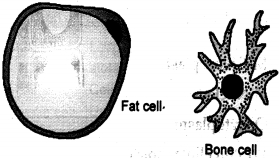
Draw any two cell shapes to justify the statement that cells come in a variety of shapes.
Solution
(N/A) Cells exhibit a wide variety of shapes and sizes,which are often related to their specific functions in an organism.
For example:
$1$. Fat cells are generally spherical or oval in shape,which helps them in storing fat droplets efficiently.
$2$. Bone cells (osteocytes) have a branched or star-like shape,which allows them to connect with other cells and form a structural network in the bone tissue.
These differences in shape demonstrate that cell morphology is adapted to perform specialized tasks within the body.
For example:
$1$. Fat cells are generally spherical or oval in shape,which helps them in storing fat droplets efficiently.
$2$. Bone cells (osteocytes) have a branched or star-like shape,which allows them to connect with other cells and form a structural network in the bone tissue.
These differences in shape demonstrate that cell morphology is adapted to perform specialized tasks within the body.
0 likes
View Solution110
Medium
Differentiate between: Nucleus and nucleoid.
Solution
(N/A)
| Nucleus | Nucleoid |
|---|---|
| $1.$ Nuclear membrane is present. | $1.$ Nuclear membrane is absent. |
| $2.$ Chromatin network and more than one chromosome are present. | $2.$ Only one circular chromosome is present. |
0 likes
View Solution111
Medium
Explain how cell walls permit the cells of fungi to withstand very dilute external media without bursting.
Solution
(N/A) Fungi can withstand very dilute (hypotonic) external media without bursting due to the presence of rigid cell walls. When placed in a hypotonic solution,water enters the fungal cells through osmosis,causing them to swell. As the cell expands,it exerts turgor pressure against the cell wall. The cell wall,being rigid and strong,exerts an equal and opposite wall pressure,which prevents the cell from bursting.
0 likes
View Solution112
Easy
Name the scientist who discovered cells. List any two single-celled (unicellular) organisms.
Solution
(N/A) The scientist who discovered cells is $Robert \ Hooke$ in the year $1665$.
Two examples of single-celled (unicellular) organisms are:
$(i)$ $Amoeba$
$(ii)$ $Paramecium$
Two examples of single-celled (unicellular) organisms are:
$(i)$ $Amoeba$
$(ii)$ $Paramecium$
0 likes
View Solution113
Medium
What type of enzymes are present in the lysosomes? What is their function? Which cell organelles manufacture these enzymes?
Solution
(N/A) $(i)$ Lysosomes contain powerful digestive enzymes known as hydrolytic enzymes.
$(ii)$ These enzymes are capable of breaking down all organic materials. Thus, they help to keep the cell clean by digesting foreign materials as well as worn-out cell organelles.
$(iii)$ The Rough Endoplasmic Reticulum $(RER)$ is responsible for manufacturing these enzymes.
$(ii)$ These enzymes are capable of breaking down all organic materials. Thus, they help to keep the cell clean by digesting foreign materials as well as worn-out cell organelles.
$(iii)$ The Rough Endoplasmic Reticulum $(RER)$ is responsible for manufacturing these enzymes.
0 likes
View Solution114
Medium
In what aspects do vacuoles in plant cells differ from those in animal cells?
Solution
(N/A)
| Vacuoles in Plant Cell | Vacuoles in Animal Cell |
|---|---|
| $1$. Vacuoles are very large and few in number. | $1$. Vacuoles are small-sized and more in number. |
| $2$. Vacuoles are full of cell sap and provide turgidity and rigidity to the cell. | $2$. Vacuoles may contain food items and are called food vacuoles. In some organisms such as $Amoeba$,vacuoles become specialized to expel excess water and waste products from the cell. |
0 likes
View Solution115
EasyMCQ
Why are mitochondria referred to as 'strange organelles'?
A
They have their own $DNA$ and ribosomes.
B
They are involved in cellular respiration.
C
They are present in all eukaryotic cells.
D
They produce $ATP$ molecules.
Solution
(A) Mitochondria are referred to as 'strange organelles' because they possess their own $DNA$ and ribosomes.
This unique feature allows them to synthesize some of their own proteins independently.
Due to this capability,they are considered semi-autonomous organelles.
This unique feature allows them to synthesize some of their own proteins independently.
Due to this capability,they are considered semi-autonomous organelles.
0 likes
View Solution116
Medium
$(a)$ What is $DNA$? Where is it found?
$(b)$ Name the functional segment of $DNA$.
$(b)$ Name the functional segment of $DNA$.
Solution
(N/A) $DNA$ stands for Deoxyribonucleic acid. It is a complex molecule that contains the genetic instructions necessary for the development, functioning, growth, and reproduction of all known organisms. In a non-dividing cell, $DNA$ is found within the nucleus as a component of chromatin material. When the cell prepares to divide, this chromatin material condenses and organizes into structures called chromosomes.
$(b)$ The functional segments of $DNA$ are known as genes. Genes are the basic units of heredity and are responsible for the transmission of traits from parents to offspring.
$(b)$ The functional segments of $DNA$ are known as genes. Genes are the basic units of heredity and are responsible for the transmission of traits from parents to offspring.
0 likes
View Solution117
Easy
Name the energy currency of the cell. Which cell organelle releases this currency?
Solution
(N/A) $(i)$ The energy currency of the cell is $ATP$ (Adenosine Triphosphate).
$(ii)$ The cell organelle that releases this energy is the Mitochondria,which is often referred to as the 'powerhouse of the cell'.
$(ii)$ The cell organelle that releases this energy is the Mitochondria,which is often referred to as the 'powerhouse of the cell'.
0 likes
View Solution118
Medium
State the cell theory. Name the scientists who presented it.
Solution
(N/A) The cell theory states that:
$(i)$ All living organisms are composed of cells and products of cells.
$(ii)$ All cells arise from pre-existing cells.
The cell theory was originally proposed by Matthias Schleiden $(1838)$ and Theodor Schwann $(1839)$.
Later,Rudolf Virchow $(1855)$ expanded the theory by suggesting that all cells arise from pre-existing cells (Omnis cellula-e cellula).
$(i)$ All living organisms are composed of cells and products of cells.
$(ii)$ All cells arise from pre-existing cells.
The cell theory was originally proposed by Matthias Schleiden $(1838)$ and Theodor Schwann $(1839)$.
Later,Rudolf Virchow $(1855)$ expanded the theory by suggesting that all cells arise from pre-existing cells (Omnis cellula-e cellula).
0 likes
View Solution119
Easy
What are genes? What is their function?
Solution
(N/A) Genes are the segments of $DNA$ occupying specific positions on the chromosomes.
These are the fundamental units of heredity that are transmitted from one generation to another via chromosomes.
They carry the genetic information required for the synthesis of proteins,which in turn control various cellular activities,determine specific cell functions,and regulate the expression of traits.
These are the fundamental units of heredity that are transmitted from one generation to another via chromosomes.
They carry the genetic information required for the synthesis of proteins,which in turn control various cellular activities,determine specific cell functions,and regulate the expression of traits.
0 likes
View Solution120
Medium
Differentiate between the plasma membrane and cell wall.
Solution
(N/A)
| Plasma Membrane | Cell Wall |
|---|---|
| $(1)$ It is made up of lipids and proteins. | $(1)$ It is made up of cellulose. |
| $(2)$ It is a living structure. | $(2)$ It is a dead structure. |
| $(3)$ It is present in both plant and animal cells. | $(3)$ It is found exclusively in plant cells. |
0 likes
View Solution121
Easy
$(a)$ What would happen to the life of a cell if there was no Golgi apparatus?
$(b)$ Which cell organelle detoxifies poisons and drugs in the liver of vertebrates?
$(b)$ Which cell organelle detoxifies poisons and drugs in the liver of vertebrates?
Solution
(N/A) If there were no Golgi apparatus,the materials synthesized near the $ER$ would not be packaged,modified,stored,or transported to various targets inside and outside the cell. Furthermore,the formation of lysosomes would not take place,as they are produced by the Golgi apparatus.
$(b)$ The smooth endoplasmic reticulum $(SER)$ is the cell organelle responsible for detoxifying many poisons and drugs in the liver cells of vertebrates.
$(b)$ The smooth endoplasmic reticulum $(SER)$ is the cell organelle responsible for detoxifying many poisons and drugs in the liver cells of vertebrates.
0 likes
View Solution122
EasyMCQ
What are chromoplasts and leucoplasts? Give an example of chromoplasts which contains green pigment.
A
Chromoplasts are green,leucoplasts are white.
B
Chromoplasts are coloured,leucoplasts are colourless.
C
Chromoplasts are colourless,leucoplasts are coloured.
D
Both are green.
Solution
(B) Chromoplasts are coloured plastids that contain pigments like carotenoids,which provide yellow,orange,or red colours to plant parts.
Leucoplasts are white or colourless plastids primarily involved in the storage of nutrients like starch,oils,and proteins.
An example of a chromoplast that contains green pigment is the chloroplast,which contains chlorophyll.
Leucoplasts are white or colourless plastids primarily involved in the storage of nutrients like starch,oils,and proteins.
An example of a chromoplast that contains green pigment is the chloroplast,which contains chlorophyll.
0 likes
View Solution123
Easy
List two types of plastids. State one function of each.
Solution
(N/A) The two types of plastids are $Chloroplasts$ and $Leucoplasts$.
$1$. $Chloroplasts$: These contain pigments like chlorophyll and are responsible for performing photosynthesis in plants.
$2$. $Leucoplasts$: These are colourless plastids that primarily function in the storage of nutrients such as starch,oils,and protein granules.
$1$. $Chloroplasts$: These contain pigments like chlorophyll and are responsible for performing photosynthesis in plants.
$2$. $Leucoplasts$: These are colourless plastids that primarily function in the storage of nutrients such as starch,oils,and protein granules.
0 likes
View Solution124
Medium
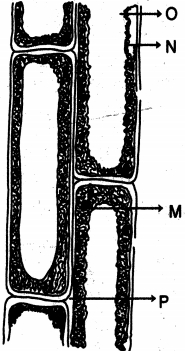
The given diagram shows the longitudinal section of collenchyma tissue. Label the parts '$M$','$N$','$O$',and '$P$' in the given diagram.
Solution
(N/A) $M$ - Chloroplast
$N$ - Nucleus
$O$ - Cytoplasm
$P$ - Intercellular space
$N$ - Nucleus
$O$ - Cytoplasm
$P$ - Intercellular space
0 likes
View Solution125
Medium
Identify and name the following cell structures.
$(a)$ The undefined nuclear region of a prokaryotic cell.
$(b)$ The site of energy release inside the cell.
$(a)$ The undefined nuclear region of a prokaryotic cell.
$(b)$ The site of energy release inside the cell.
Solution
(N/A) Nucleoid: In prokaryotic cells,the genetic material is not enclosed by a nuclear membrane. This undefined nuclear region containing only nucleic acids is known as the nucleoid.
$(b)$ Mitochondria: These are known as the powerhouses of the cell because they generate most of the cell's supply of adenosine triphosphate $(ATP)$,which is used as a source of chemical energy.
$(b)$ Mitochondria: These are known as the powerhouses of the cell because they generate most of the cell's supply of adenosine triphosphate $(ATP)$,which is used as a source of chemical energy.
0 likes
View Solution126
Medium
Write two statements to show that lysosomes are aptly called the suicide bags of the cell.
Solution
(N/A) $(i)$ Lysosomes contain powerful digestive enzymes capable of breaking down all organic material.
$(ii)$ During the disturbance in cellular metabolism,i.e.,when the cell gets damaged,lysosomes may burst and the enzymes digest their own cell.
$(ii)$ During the disturbance in cellular metabolism,i.e.,when the cell gets damaged,lysosomes may burst and the enzymes digest their own cell.
0 likes
View Solution127
Medium
Classify the organisms on the basis of the number of cells. Give two examples each.
Solution
(N/A) Unicellular organisms: These are organisms made up of a single cell only.
Examples: $Chlamydomonas$,$Amoeba$,$Bacteria$,$Paramecium$ (any two).
$(b)$ Multicellular organisms: These are organisms in which many cells group together in a single body to perform different functions and form various body parts.
Examples: Fungi,plants,and animals (any two).
Examples: $Chlamydomonas$,$Amoeba$,$Bacteria$,$Paramecium$ (any two).
$(b)$ Multicellular organisms: These are organisms in which many cells group together in a single body to perform different functions and form various body parts.
Examples: Fungi,plants,and animals (any two).
0 likes
View Solution128
Medium
Expand the following:
$(i)$ $RER$
$(ii)$ $SER$
$(iii)$ $DNA$
$(iv)$ $RNA$
$(v)$ $ATP$
$(vi)$ $SPM$
$(i)$ $RER$
$(ii)$ $SER$
$(iii)$ $DNA$
$(iv)$ $RNA$
$(v)$ $ATP$
$(vi)$ $SPM$
Solution
(N/A) $(i)$ $RER$: Rough Endoplasmic Reticulum
$(ii)$ $SER$: Smooth Endoplasmic Reticulum
$(iii)$ $DNA$: Deoxyribonucleic Acid
$(iv)$ $RNA$: Ribonucleic Acid
$(v)$ $ATP$: Adenosine Triphosphate
$(vi)$ $SPM$: Selectively Permeable Membrane
$(ii)$ $SER$: Smooth Endoplasmic Reticulum
$(iii)$ $DNA$: Deoxyribonucleic Acid
$(iv)$ $RNA$: Ribonucleic Acid
$(v)$ $ATP$: Adenosine Triphosphate
$(vi)$ $SPM$: Selectively Permeable Membrane
0 likes
View Solution129
Medium
Identify the type of cell and write one characteristic feature for each of the following descriptions:
$(i)$ Large vacuole,nucleus pushed to the periphery.
$(ii)$ Cell does not burst even in a very dilute medium.
$(iii)$ Nuclear region is not well-defined and is known as the nucleoid.
$(i)$ Large vacuole,nucleus pushed to the periphery.
$(ii)$ Cell does not burst even in a very dilute medium.
$(iii)$ Nuclear region is not well-defined and is known as the nucleoid.
Solution
(A)
| $(i)$ Type of Cell | Characteristic Feature |
|---|---|
| Plant cell | Presence of a large central vacuole that occupies most of the cell volume,pushing the nucleus to the periphery. |
| $(ii)$ Type of Cell | Characteristic Feature |
| Plant cell | The rigid cell wall provides structural support and prevents the cell from bursting due to osmotic pressure in a hypotonic (dilute) medium. |
| $(iii)$ Type of Cell | Characteristic Feature |
| Prokaryotic cell | The nuclear region is not surrounded by a nuclear membrane and is referred to as the nucleoid; membrane-bound organelles are absent. |
0 likes
View Solution130
Medium
State the reason for the following:
$(i)$ Mitochondria are known as the powerhouse of the cell.
$(ii)$ Plastids are able to make their own protein.
$(iii)$ Plant cells shrink when kept in a hypertonic solution.
$(i)$ Mitochondria are known as the powerhouse of the cell.
$(ii)$ Plastids are able to make their own protein.
$(iii)$ Plant cells shrink when kept in a hypertonic solution.
Solution
(N/A) $(i)$ Oxidation of food takes place in mitochondria,and they release energy in the form of $ATP$. This energy is required for various chemical activities essential for life. Hence,mitochondria are known as the powerhouse of the cell.
$(ii)$ Plastids contain their own $DNA$ and ribosomes. Therefore,they are capable of synthesizing their own proteins.
$(iii)$ $A$ hypertonic solution has a lower water concentration than the cytoplasm of the cell. When a plant cell is placed in such a solution,water moves out of the cell due to the process of exosmosis,causing the cell to shrink.
$(ii)$ Plastids contain their own $DNA$ and ribosomes. Therefore,they are capable of synthesizing their own proteins.
$(iii)$ $A$ hypertonic solution has a lower water concentration than the cytoplasm of the cell. When a plant cell is placed in such a solution,water moves out of the cell due to the process of exosmosis,causing the cell to shrink.
0 likes
View Solution131
Medium
$(i)$ Why is the cell called the structural and functional unit of life?
$(ii)$ Why is the plasma membrane called a selectively permeable membrane?
$(iii)$ Name the factor which decides the movement of water across the plasma membrane.
$(ii)$ Why is the plasma membrane called a selectively permeable membrane?
$(iii)$ Name the factor which decides the movement of water across the plasma membrane.
Solution
(N/A) $(i)$ Cells are the smallest units that constitute the body of all living organisms and perform basic life processes essential for survival. Therefore,the cell is known as the structural and functional unit of life.
$(ii)$ The plasma membrane is called a selectively permeable membrane because it allows the movement of only certain selected substances into and out of the cell,while restricting the movement of others.
$(iii)$ The concentration of dissolved substances (solutes) in the water determines the movement of water across the plasma membrane,a process known as osmosis.
$(ii)$ The plasma membrane is called a selectively permeable membrane because it allows the movement of only certain selected substances into and out of the cell,while restricting the movement of others.
$(iii)$ The concentration of dissolved substances (solutes) in the water determines the movement of water across the plasma membrane,a process known as osmosis.
0 likes
View Solution132
Medium
List the specific functions of the following:
$(i)$ Rough endoplasmic reticulum
$(ii)$ Golgi apparatus
$(iii)$ Lysosomes
$(iv)$ Mitochondria
$(v)$ Plastids
$(vi)$ Vacuoles
$(i)$ Rough endoplasmic reticulum
$(ii)$ Golgi apparatus
$(iii)$ Lysosomes
$(iv)$ Mitochondria
$(v)$ Plastids
$(vi)$ Vacuoles
Solution
(N/A) $(i)$ Rough endoplasmic reticulum is the site of protein synthesis.
$(ii)$ Golgi apparatus is involved in the storage,modification,and packaging of products in vesicles. It also synthesizes complex sugars from simple sugars and is involved in the formation of lysosomes.
$(iii)$ Lysosomes act as the waste disposal system of the cell by digesting foreign materials and worn-out cell organelles.
$(iv)$ Mitochondria are known as the powerhouses of the cell because they produce energy in the form of $ATP$ through cellular respiration.
$(v)$ Plastids are the sites of photosynthesis in plants and store pigments like chlorophyll.
$(vi)$ Vacuoles provide storage for nutrients and water. In some organisms,they help in the digestion of food and the expulsion of excess water and waste.
$(ii)$ Golgi apparatus is involved in the storage,modification,and packaging of products in vesicles. It also synthesizes complex sugars from simple sugars and is involved in the formation of lysosomes.
$(iii)$ Lysosomes act as the waste disposal system of the cell by digesting foreign materials and worn-out cell organelles.
$(iv)$ Mitochondria are known as the powerhouses of the cell because they produce energy in the form of $ATP$ through cellular respiration.
$(v)$ Plastids are the sites of photosynthesis in plants and store pigments like chlorophyll.
$(vi)$ Vacuoles provide storage for nutrients and water. In some organisms,they help in the digestion of food and the expulsion of excess water and waste.
0 likes
View Solution133
Medium
What will happen if
$(a)$ ribosomes are removed from the cell,
$(b)$ Golgi apparatus is removed from the cell,and
$(c)$ plasma membrane ruptures?
$(a)$ ribosomes are removed from the cell,
$(b)$ Golgi apparatus is removed from the cell,and
$(c)$ plasma membrane ruptures?
Solution
(N/A) Proteins will not be synthesized because ribosomes are the sites of protein synthesis.
$(b)$ Packaging and dispatching of materials,synthesis of complex sugars,and formation of lysosomes will be adversely affected.
$(c)$ The cell will lose its integrity,and the internal cellular contents will leak out,leading to the death of the cell.
$(b)$ Packaging and dispatching of materials,synthesis of complex sugars,and formation of lysosomes will be adversely affected.
$(c)$ The cell will lose its integrity,and the internal cellular contents will leak out,leading to the death of the cell.
0 likes
View Solution134
Medium
Describe the role played by the Lysosomes. Why are they termed as 'suicidal bags'? How do they perform their function?
Solution
(N/A) Role: Lysosomes act as the waste disposal system of the cell. They help in the digestion of foreign materials entering the cell,such as bacteria or food,and also remove worn-out cell organelles by digesting them.
Suicidal Bags: They are termed as 'suicidal bags' because when the cell gets damaged or its metabolic activity is disturbed,lysosomes may burst,and the digestive enzymes contained within them digest their own cell.
Mechanism: Lysosomes contain powerful digestive enzymes (hydrolytic enzymes) synthesized by the Rough Endoplasmic Reticulum $(RER)$. These enzymes are capable of breaking down all types of organic material,allowing the lysosome to digest unwanted cellular debris or foreign particles.
Suicidal Bags: They are termed as 'suicidal bags' because when the cell gets damaged or its metabolic activity is disturbed,lysosomes may burst,and the digestive enzymes contained within them digest their own cell.
Mechanism: Lysosomes contain powerful digestive enzymes (hydrolytic enzymes) synthesized by the Rough Endoplasmic Reticulum $(RER)$. These enzymes are capable of breaking down all types of organic material,allowing the lysosome to digest unwanted cellular debris or foreign particles.
0 likes
View Solution135
Medium
Differentiate between diffusion and osmosis. Write any two examples where a living organism uses osmosis to absorb water.
Solution
(N/A) Diffusion is the spontaneous movement of a substance from a region of higher concentration to a region of lower concentration. Osmosis is the movement of water molecules from a region of higher water concentration to a region of lower water concentration through a semipermeable membrane.
$(i)$ Unicellular freshwater organisms,such as Amoeba,gain water through osmosis.
$(ii)$ Plant roots absorb water from the soil through osmosis.
$(i)$ Unicellular freshwater organisms,such as Amoeba,gain water through osmosis.
$(ii)$ Plant roots absorb water from the soil through osmosis.
0 likes
View Solution136
Medium
$(a)$ Name the organelle which provides turgidity and rigidity to the plant cell. Name any two substances which are present in it.
$(b)$ How are they useful in unicellular organisms?
$(b)$ How are they useful in unicellular organisms?
Solution
(N/A) The organelle is the $Vacuole$. Two substances present in it are $Amino \ acids$ and $Sugars$ (or $Proteins$, $Organic \ acids$).
$(b)$ $(i)$ In $Amoeba$, food vacuoles contain the food items captured by the organism.
$(ii)$ In many other unicellular organisms, specialized vacuoles (like contractile vacuoles) play an important role in expelling excess water and some wastes from the cell.
$(b)$ $(i)$ In $Amoeba$, food vacuoles contain the food items captured by the organism.
$(ii)$ In many other unicellular organisms, specialized vacuoles (like contractile vacuoles) play an important role in expelling excess water and some wastes from the cell.
0 likes
View Solution137
Medium
Write two similarities and one dissimilarity between mitochondria and plastid.
Solution
(N/A) $(i)$ Similarities:
$(a)$ Both are double-membrane-bound organelles.
$(b)$ Both possess their own circular $DNA$ and ribosomes (semi-autonomous nature).
$(ii)$ Dissimilarity:
Mitochondria are the sites of cellular respiration and energy production $(ATP)$,whereas plastids (specifically chloroplasts) are the sites of photosynthesis and food production.
$(a)$ Both are double-membrane-bound organelles.
$(b)$ Both possess their own circular $DNA$ and ribosomes (semi-autonomous nature).
$(ii)$ Dissimilarity:
Mitochondria are the sites of cellular respiration and energy production $(ATP)$,whereas plastids (specifically chloroplasts) are the sites of photosynthesis and food production.
0 likes
View Solution138
Medium
$(a)$ List any two structural differences and two similarities between a plant cell and an animal cell.
$(b)$ What would happen if an animal cell is kept in distilled water for $24$ hours?
$(b)$ What would happen if an animal cell is kept in distilled water for $24$ hours?
Solution
(N/A) Differences:
Similarities:
$(i)$ Both possess a cell membrane.
$(ii)$ Both contain a nucleus.
$(iii)$ Both contain cytoplasm and various cell organelles.
$(b)$ When an animal cell is placed in distilled water (a hypotonic solution),water enters the cell through the process of osmosis. As a result,the cell will swell and eventually burst because animal cells lack a rigid cell wall to withstand the internal turgor pressure.
| Plant Cell | Animal Cell |
| $(i)$ Presence of cell wall. | $(i)$ Cell wall is absent. |
| $(ii)$ Large central vacuole is present. | $(ii)$ Vacuoles are small or absent. |
| $(iii)$ Plastids are present. | $(iii)$ Plastids are absent. |
Similarities:
$(i)$ Both possess a cell membrane.
$(ii)$ Both contain a nucleus.
$(iii)$ Both contain cytoplasm and various cell organelles.
$(b)$ When an animal cell is placed in distilled water (a hypotonic solution),water enters the cell through the process of osmosis. As a result,the cell will swell and eventually burst because animal cells lack a rigid cell wall to withstand the internal turgor pressure.
0 likes
View Solution139
Medium
$(a)$ Write two points of difference between the nuclear region of a bacterial cell and the nuclear region of an animal cell.
$(b)$ Which structure present in the nuclear region of a living cell bears genes?
$(b)$ Which structure present in the nuclear region of a living cell bears genes?
Solution
(N/A)
$(b)$ The structure present in the nuclear region that bears genes is the $DNA$ (Deoxyribonucleic acid) molecule,which is organized into chromosomes.
| Nuclear region of a bacterial cell | Nuclear region of an animal cell |
|---|---|
| $(i)$ Poorly defined and lacks a nuclear membrane. | $(i)$ Well-defined and membrane-bound. |
| $(ii)$ Contains a single chromosome. | $(ii)$ Contains more than one chromosome. |
$(b)$ The structure present in the nuclear region that bears genes is the $DNA$ (Deoxyribonucleic acid) molecule,which is organized into chromosomes.
0 likes
View Solution140
Medium
Mention the differences seen between prokaryotic and eukaryotic cells regarding:
$(i)$ Nuclear region
$(ii)$ Cell organelles
$(iii)$ Chlorophyll.
$(i)$ Nuclear region
$(ii)$ Cell organelles
$(iii)$ Chlorophyll.
Solution
(N/A)
| Parameter | Prokaryotic Cell | Eukaryotic Cell |
|---|---|---|
| $(i)$ Nuclear region | Poorly defined due to the absence of a nuclear membrane; known as nucleoid. | Well-defined and surrounded by a nuclear membrane. |
| $(ii)$ Cell organelles | Membrane-bound cell organelles are absent. | Membrane-bound cell organelles are present. |
| $(iii)$ Chlorophyll | Associated with membranous vesicles (bag-like structures),not with plastids. | Associated with plastids (chloroplasts). |
0 likes
View Solution141
Medium
$(a)$ What are the consequences of the following conditions?
$(i)$ $A$ cell having higher water concentration than the surrounding medium.
$(ii)$ $A$ cell having lower water concentration than the surrounding medium.
$(iii)$ $A$ cell having equal water concentration to its surrounding medium.
$(b)$ Name the materials of which the cell membrane and cell wall are composed.
$(i)$ $A$ cell having higher water concentration than the surrounding medium.
$(ii)$ $A$ cell having lower water concentration than the surrounding medium.
$(iii)$ $A$ cell having equal water concentration to its surrounding medium.
$(b)$ Name the materials of which the cell membrane and cell wall are composed.
Solution
(N/A) $(i)$ The cell will lose water by osmosis; therefore,the cell will shrink. This occurs in a hypertonic solution.
$(ii)$ The cell will gain water by osmosis; therefore,the cell will swell up. This occurs in a hypotonic solution.
$(iii)$ In the case of equal concentration,there will be no net movement of water; therefore,the cell will stay at the same size. This occurs in an isotonic solution.
$(b)$ The cell membrane is composed of lipids and proteins.
The cell wall is composed of cellulose.
$(ii)$ The cell will gain water by osmosis; therefore,the cell will swell up. This occurs in a hypotonic solution.
$(iii)$ In the case of equal concentration,there will be no net movement of water; therefore,the cell will stay at the same size. This occurs in an isotonic solution.
$(b)$ The cell membrane is composed of lipids and proteins.
The cell wall is composed of cellulose.
0 likes
View Solution142
Medium
Give the chemical composition and functions of plasma membrane and cell wall. Differentiate between the two.
Solution
(N/A) The plasma membrane is primarily composed of lipids and proteins,while the cell wall is mainly made up of cellulose.
Functions:
- Plasma membrane: It regulates the movement of substances into and out of the cell (selectively permeable) and provides protection.
- Cell wall: It provides structural support,shape,and protection to the plant cell.
Functions:
- Plasma membrane: It regulates the movement of substances into and out of the cell (selectively permeable) and provides protection.
- Cell wall: It provides structural support,shape,and protection to the plant cell.
| Cell wall | Plasma membrane |
|---|---|
| $1$. It is non-living. | $1$. It is living. |
| $2$. It is permeable. | $2$. It is semipermeable. |
| $3$. It is found only in plant cells. | $3$. It is found in both plant and animal cells. |
| $4$. It is rigid. | $4$. It is flexible. |
0 likes
View Solution143
Medium
$(i)$ Differentiate between rough and smooth endoplasmic reticulum.
$(ii)$ How is endoplasmic reticulum important for membrane biogenesis?
$(ii)$ How is endoplasmic reticulum important for membrane biogenesis?
Solution
(N/A) $(i)$
$(ii)$ The proteins and lipids synthesized by the endoplasmic reticulum are essential for building the cell membrane, a process known as membrane biogenesis.
| Rough endoplasmic reticulum $(RER)$ | Smooth endoplasmic reticulum $(SER)$ |
| $1.$ It appears rough under a microscope. | $1.$ It appears smooth under a microscope. |
| $2.$ It has ribosomes attached to its surface. | $2.$ It does not have ribosomes attached to its surface. |
| $3.$ It is involved in protein synthesis and transport. | $3.$ It is involved in lipid synthesis and detoxification of drugs and poisons. |
$(ii)$ The proteins and lipids synthesized by the endoplasmic reticulum are essential for building the cell membrane, a process known as membrane biogenesis.
0 likes
View Solution144
Medium
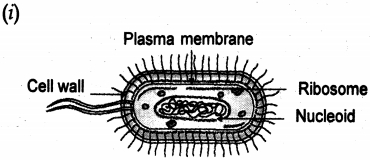
$(i)$ Draw a diagram of a prokaryotic cell and label the following parts on it: Cell wall,ribosome,nucleoid,plasma membrane.
$(ii)$ Why are organisms like bacteria called prokaryotes?
$(ii)$ Why are organisms like bacteria called prokaryotes?
Solution
(N/A) $(i)$ The diagram of a prokaryotic cell is provided in the image.
$(ii)$ In bacteria,the nuclear region is poorly developed or undefined because it lacks a nuclear membrane. Such an undefined nuclear region,which contains only nucleic acids,is called a nucleoid. Organisms that possess such cells with an undefined nuclear region are called prokaryotes (pro = primitive,karyote = nucleus).
$(ii)$ In bacteria,the nuclear region is poorly developed or undefined because it lacks a nuclear membrane. Such an undefined nuclear region,which contains only nucleic acids,is called a nucleoid. Organisms that possess such cells with an undefined nuclear region are called prokaryotes (pro = primitive,karyote = nucleus).
0 likes
View Solution145
Medium
Differentiate between prokaryotic and eukaryotic cells.
Solution
(N/A)
| Prokaryotic Cell | Eukaryotic Cell |
| $1$. Size is generally small $(0.5-10 \mu m)$. | $1$. Size is generally larger $(1-100 \mu m)$. |
| $2$. Nuclear region is not surrounded by a nuclear membrane. | $2$. Nuclear region is surrounded by a nuclear membrane. |
| $3$. Membrane-bound organelles such as mitochondria,lysosomes,and endoplasmic reticulum are absent. | $3$. All membrane-bound organelles are present. |
| $4$. Nucleolus is absent. | $4$. Nucleolus is present. |
| $5$. Cell division occurs by fission or budding (no mitosis). | $5$. Cell division is mitotic or meiotic. |
| $6$. They always have a single chromosome. | $6$. They have more than one chromosome. |
| $7$. $DNA$ is circular and lies free in the cytoplasm (no true nucleus). | $7$. $DNA$ is linear and contained within a nucleus. |
| $8$. $DNA$ is naked (not associated with histones). e.g.,$PPLO$,bacteria,and blue-green algae. | $8$. $DNA$ is associated with proteins (histones) to form chromosomes. e.g.,Plants and animals. |
0 likes
View Solution146
Medium
$(a)$ What role do vacuoles play in a typical plant cell?
$(b)$ What will happen if the Golgi apparatus is removed from the cell?
$(c)$ Why is the inner membrane of mitochondria deeply folded?
$(b)$ What will happen if the Golgi apparatus is removed from the cell?
$(c)$ Why is the inner membrane of mitochondria deeply folded?
Solution
(N/A) $(i)$ Vacuoles are storage sacs for solid or liquid contents.
$(ii)$ In plant cells,vacuoles are full of cell sap and provide turgidity and rigidity to the cell.
$(iii)$ Many substances important for the life of the plant cell,such as amino acids,sugars,various organic acids,and some proteins,are stored in vacuoles.
$(b)$ If the Golgi apparatus were removed from the cell,the following would occur:
$(i)$ Packaging and dispatching of proteins to various targets inside and outside the cell would be disrupted.
$(ii)$ Cellular products could not be stored or modified.
$(iii)$ The formation of complex sugars from simple sugars would not take place.
$(iv)$ Lysosome formation would be affected,leading to the accumulation of worn-out organelles,which could result in cell death.
$(c)$ The deeply folded inner membrane of mitochondria,known as cristae,creates a large surface area for $ATP$-generating chemical reactions.
$(ii)$ In plant cells,vacuoles are full of cell sap and provide turgidity and rigidity to the cell.
$(iii)$ Many substances important for the life of the plant cell,such as amino acids,sugars,various organic acids,and some proteins,are stored in vacuoles.
$(b)$ If the Golgi apparatus were removed from the cell,the following would occur:
$(i)$ Packaging and dispatching of proteins to various targets inside and outside the cell would be disrupted.
$(ii)$ Cellular products could not be stored or modified.
$(iii)$ The formation of complex sugars from simple sugars would not take place.
$(iv)$ Lysosome formation would be affected,leading to the accumulation of worn-out organelles,which could result in cell death.
$(c)$ The deeply folded inner membrane of mitochondria,known as cristae,creates a large surface area for $ATP$-generating chemical reactions.
0 likes
View Solution147
Medium
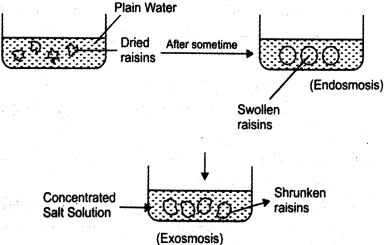
Describe an activity to demonstrate endosmosis and exosmosis. Draw a diagram also.
Solution
Activity to show endosmosis and exosmosis:
Put dried raisins in plain water and leave them for some time. Then,place these swollen raisins into a concentrated salt solution.
Observation:
$(i)$ When dried raisins are placed in plain water,they swell up due to the osmotic entry of water into the raisins. Plain water acts as a hypotonic medium for the raisins.
$(ii)$ When the swollen raisins are transferred to a concentrated salt solution,they shrink again. The concentrated solution acts as a hypertonic medium for the swollen raisins. Exosmosis occurs,and the raisins lose water.
Put dried raisins in plain water and leave them for some time. Then,place these swollen raisins into a concentrated salt solution.
Observation:
$(i)$ When dried raisins are placed in plain water,they swell up due to the osmotic entry of water into the raisins. Plain water acts as a hypotonic medium for the raisins.
$(ii)$ When the swollen raisins are transferred to a concentrated salt solution,they shrink again. The concentrated solution acts as a hypertonic medium for the swollen raisins. Exosmosis occurs,and the raisins lose water.
0 likes
View Solution148
EasyMCQ
Which is the only cell organelle visible in a prokaryotic cell?
A
Mitochondria
B
Ribosomes
C
Lysosomes
D
Endoplasmic Reticulum
Solution
(B) Prokaryotic cells lack membrane-bound organelles such as mitochondria,lysosomes,and the endoplasmic reticulum. The only cell organelle present in prokaryotic cells is the ribosome,which is non-membrane-bound and responsible for protein synthesis.
0 likes
View Solution149
EasyMCQ
The Golgi apparatus has a system of membrane-bound vesicles arranged in parallel stacks. What are these called?
A
Cisterns
B
Vacuoles
C
Lysosomes
D
Ribosomes
Solution
(A) The Golgi apparatus consists of a system of membrane-bound vesicles arranged approximately parallel to each other in stacks called cisterns. These cisterns are flattened,sac-like structures that play a crucial role in the packaging and modification of proteins and lipids.
0 likes
View Solution150
Easy
When observed under a microscope,small pores are seen in the epidermis of the leaf. What are these pores called? Write two functions of these pores.
Solution
(N/A) These pores are called Stomata.
$(i)$ They facilitate the exchange of gases like $CO_2$ and $O_2$ between the plant and the atmosphere.
$(ii)$ They facilitate the process of transpiration,which is the loss of water in the form of water vapor from the aerial parts of the plant.
$(i)$ They facilitate the exchange of gases like $CO_2$ and $O_2$ between the plant and the atmosphere.
$(ii)$ They facilitate the process of transpiration,which is the loss of water in the form of water vapor from the aerial parts of the plant.
0 likes
View SolutionTHE FUNDAMENTAL UNIT OF LIFE — Mix Example - THE FUNDAMENTAL UNIT OF LIFE · Frequently Asked Questions
1Are these THE FUNDAMENTAL UNIT OF LIFE questions useful for JEE and NEET?
Yes. All questions in this section are mapped to JEE Main and NEET exam patterns. Previous year questions from JEE Main, NEET, GUJCET and state-level exams are included with full solutions.
2Can I switch to Hindi or Gujarati for these questions?
Yes. Use the language tabs in the hero section or the sidebar to view the same questions and solutions in English, Hindi or Gujarati.
3How do I generate a question paper from this subtopic?
Use the Vedclass Exam Paper Generator — select the chapter and subtopic, set difficulty, and generate Sets A, B, C, D automatically. First 3 chapters of every subject are free.
Vedclass Products
For Students
Vedclass Test Series
Mock tests in real JEE/NEET style with performance analysis. 5-day free trial.
Start Free TrialFor Teachers
Exam Paper Generator
Generate Set A/B/C/D papers from this chapter in 2 minutes. 3 chapters free.
Try FreeFor Institutes
Online Exam Module
Live online exams with unlimited students, 360° analytics & white-label branding.
See DemoFor Teachers & Institutes
Generate a THE FUNDAMENTAL UNIT OF LIFE Exam Paper in 2 Minutes
Select subtopic & difficulty — Sets A, B, C, D auto-generated with No Repeat logic.
First 3 chapters of every subject are free — no payment required.