
A English
Mix Example - THE FUNDAMENTAL UNIT OF LIFE Questions in English
Class 9 Science · THE FUNDAMENTAL UNIT OF LIFE · Mix Example - THE FUNDAMENTAL UNIT OF LIFE
211+
Questions
English
Language
100%
With Solutions
Showing 50 of 211 questions in English
51
Medium
How are chromatin,chromatid,and chromosomes related to each other?
Solution
(N/A) Chromatin is the loose,thread-like form of $DNA$ and proteins found in the nucleus during interphase. When a cell prepares to divide,this chromatin condenses into thicker,distinct structures called chromatids. $A$ chromosome is the structural unit formed by one or two identical chromatids (sister chromatids) joined at the centromere,which serves to package and organize genetic material for cell division.
0 likes
View Solution52
Medium
What are the consequences of the following conditions?
$(a)$ $A$ cell containing higher water concentration than the surrounding medium.
$(b)$ $A$ cell having lower water concentration than the surrounding medium.
$(c)$ $A$ cell having equal water concentration to its surrounding medium.
$(a)$ $A$ cell containing higher water concentration than the surrounding medium.
$(b)$ $A$ cell having lower water concentration than the surrounding medium.
$(c)$ $A$ cell having equal water concentration to its surrounding medium.
Solution
(N/A) When a cell has a higher water concentration than the surrounding medium,water moves out of the cell into the medium. This process is known as exosmosis,which causes the cell to shrink or become plasmolysed.
$(b)$ When a cell has a lower water concentration than the surrounding medium,water moves from the medium into the cell. This process is known as endosmosis,which causes the cell to swell or become turgid.
$(c)$ When a cell has an equal water concentration to its surrounding medium,there is no net movement of water across the cell membrane. The cell remains in an isotonic state,and its size and shape remain unchanged.
$(b)$ When a cell has a lower water concentration than the surrounding medium,water moves from the medium into the cell. This process is known as endosmosis,which causes the cell to swell or become turgid.
$(c)$ When a cell has an equal water concentration to its surrounding medium,there is no net movement of water across the cell membrane. The cell remains in an isotonic state,and its size and shape remain unchanged.
1 likes
View Solution53
Medium
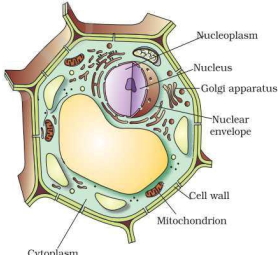
Draw a plant cell and label the parts which:
$(a)$ determines the function and development of the cell
$(b)$ packages materials coming from the endoplasmic reticulum
$(c)$ provides structural strength to the cell to withstand hypotonic external media without bursting
$(d)$ is the site for many biochemical reactions necessary to sustain life
$(e)$ is a fluid contained inside the nucleus
$(a)$ determines the function and development of the cell
$(b)$ packages materials coming from the endoplasmic reticulum
$(c)$ provides structural strength to the cell to withstand hypotonic external media without bursting
$(d)$ is the site for many biochemical reactions necessary to sustain life
$(e)$ is a fluid contained inside the nucleus
Solution
(N/A) Nucleus: It controls all cellular activities and development.
$(b)$ Golgi apparatus: It is responsible for packaging and dispatching materials synthesized in the endoplasmic reticulum.
$(c)$ Cell wall: It provides structural support and protection,allowing the cell to withstand hypotonic environments without bursting.
$(d)$ Cytoplasm: It is the jelly-like substance where many essential biochemical reactions occur.
$(e)$ Nucleoplasm: It is the fluid matrix present inside the nucleus.
$(b)$ Golgi apparatus: It is responsible for packaging and dispatching materials synthesized in the endoplasmic reticulum.
$(c)$ Cell wall: It provides structural support and protection,allowing the cell to withstand hypotonic environments without bursting.
$(d)$ Cytoplasm: It is the jelly-like substance where many essential biochemical reactions occur.
$(e)$ Nucleoplasm: It is the fluid matrix present inside the nucleus.
0 likes
View Solution54
Easy
Illustrate a plant cell as seen under an electron microscope. How is it different from an animal cell?
.jpg)
Solution
(N/A) plant cell is characterized by the presence of a rigid cell wall,large central vacuole,and plastids. The differences between a plant cell and an animal cell are summarized in the table below:
| Feature | Animal Cell vs Plant Cell |
|---|---|
| $1.$ Cell wall | Absent in animal cells; Present in plant cells. |
| $2.$ Plastids | Absent in animal cells; Present in plant cells. |
| $3.$ Vacuoles | Small or absent in animal cells; Large central vacuole present in plant cells. |
| $4.$ Centrioles | Present in animal cells; Absent in plant cells. |
0 likes
View Solution55
Medium
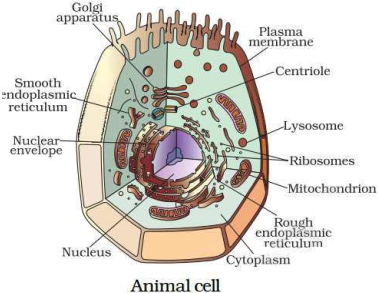
Draw a neat labelled diagram of an animal cell.
Solution
(N/A) An animal cell is a eukaryotic cell that lacks a cell wall and contains various membrane-bound organelles. Key components include:
$1$. Plasma membrane: The outer boundary of the cell.
$2$. Nucleus: The control center containing genetic material.
$3$. Cytoplasm: The jelly-like substance filling the cell.
$4$. Mitochondria: The powerhouse of the cell.
$5$. Endoplasmic Reticulum (Rough and Smooth): Involved in protein and lipid synthesis.
$6$. Golgi apparatus: Responsible for packaging and modifying proteins.
$7$. Lysosomes: Known as the suicide bags of the cell.
$8$. Ribosomes: Sites of protein synthesis.
$9$. Centrioles: Involved in cell division.
$1$. Plasma membrane: The outer boundary of the cell.
$2$. Nucleus: The control center containing genetic material.
$3$. Cytoplasm: The jelly-like substance filling the cell.
$4$. Mitochondria: The powerhouse of the cell.
$5$. Endoplasmic Reticulum (Rough and Smooth): Involved in protein and lipid synthesis.
$6$. Golgi apparatus: Responsible for packaging and modifying proteins.
$7$. Lysosomes: Known as the suicide bags of the cell.
$8$. Ribosomes: Sites of protein synthesis.
$9$. Centrioles: Involved in cell division.
0 likes
View Solution56
Medium
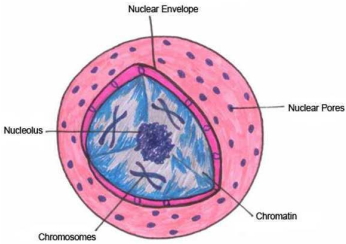
Draw a well-labelled diagram of an eukaryotic nucleus. How is it different from a nucleoid?
Solution
(N/A) The eukaryotic nucleus is a membrane-bound organelle that contains the cell's genetic material. It consists of a nuclear envelope,nucleolus,chromatin,and nuclear pores. $A$ nucleoid,on the other hand,is an irregularly shaped region within a prokaryotic cell that contains all or most of the genetic material.
| Nucleus | Nucleoid |
|---|---|
| $(i)$ Nuclear membrane is present. | $(i)$ Nuclear membrane is absent. |
| $(ii)$ Nucleolus is present. | $(ii)$ Nucleolus is absent. |
| $(iii)$ Genetic material is enclosed within the nuclear envelope. | $(iii)$ Genetic material is not contained in any membrane-bound structure. |
| $(iv)$ Found in eukaryotic cells. | $(iv)$ Found in prokaryotic cells. |
0 likes
View Solution57
Easy
Differentiate between rough and smooth endoplasmic reticulum. How is endoplasmic reticulum important for membrane biogenesis?
Solution
(N/A) The ribosomes, which are present in all active cells, are the sites of protein synthesis. Endoplasmic reticulum helps in transporting these proteins to various places. The smooth endoplasmic reticulum helps in the manufacture of fat and lipids, which, along with proteins, help in building the cell membrane, a process known as membrane biogenesis.
| Smooth Endoplasmic Reticulum $(SER)$ | Rough Endoplasmic Reticulum $(RER)$ |
| $SER$ does not have ribosomal particles on its surface, hence it looks smooth. It helps in the manufacture of lipids and fat molecules. | $RER$ has particles of ribosomes on its surface. Ribosomes are the sites of protein synthesis. |
2 likes
View Solution58
Medium
In brief,state what happens when:
$(a)$ dry apricots are left for some time in pure water and later transferred to a sugar solution?
$(b)$ a Red Blood Cell $(RBC)$ is kept in a concentrated saline solution?
$(c)$ the plasma membrane of a cell breaks down?
$(d)$ Rhoeo leaves are boiled in water first and then a drop of sugar syrup is put on them?
$(e)$ the Golgi apparatus is removed from the cell?
$(a)$ dry apricots are left for some time in pure water and later transferred to a sugar solution?
$(b)$ a Red Blood Cell $(RBC)$ is kept in a concentrated saline solution?
$(c)$ the plasma membrane of a cell breaks down?
$(d)$ Rhoeo leaves are boiled in water first and then a drop of sugar syrup is put on them?
$(e)$ the Golgi apparatus is removed from the cell?
Solution
(N/A) Initially,the dry apricots swell due to endosmosis (water enters the cells). When transferred to a sugar solution,they shrink due to exosmosis (water leaves the cells).
$(b)$ The $RBC$ will lose water to the surrounding hypertonic environment through osmosis,causing the cell to shrink (crenation).
$(c)$ The cell will lose its integrity and die,as the plasma membrane is essential for regulating the movement of substances in and out of the cell.
$(d)$ Boiling kills the cells of the Rhoeo leaves. Since the cells are dead,they cannot perform plasmolysis,and therefore,no change will be observed when sugar syrup is added.
$(e)$ The Golgi apparatus is responsible for packaging and modifying proteins and lipids. If it is removed,all vesicle formation,packaging,and secretion processes within the cell will stop.
$(b)$ The $RBC$ will lose water to the surrounding hypertonic environment through osmosis,causing the cell to shrink (crenation).
$(c)$ The cell will lose its integrity and die,as the plasma membrane is essential for regulating the movement of substances in and out of the cell.
$(d)$ Boiling kills the cells of the Rhoeo leaves. Since the cells are dead,they cannot perform plasmolysis,and therefore,no change will be observed when sugar syrup is added.
$(e)$ The Golgi apparatus is responsible for packaging and modifying proteins and lipids. If it is removed,all vesicle formation,packaging,and secretion processes within the cell will stop.
0 likes
View Solution59
Easy
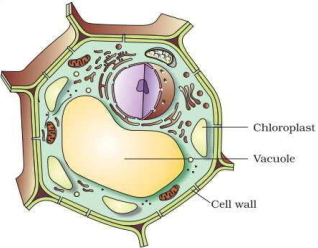
Draw a neat diagram of a plant cell and label any three parts which differentiate it from an animal cell.
Solution
(N/A) The three parts that differentiate a plant cell from an animal cell are as follows:
$1$. Cell Wall: It is a rigid outer covering present only in plant cells,providing structural support and protection.
$2$. Chloroplast: These are plastids containing chlorophyll,which are responsible for photosynthesis and are absent in animal cells.
$3$. Large Central Vacuole: Plant cells typically contain a large,permanent central vacuole that occupies most of the cell volume,whereas animal cells have either no vacuoles or very small,temporary ones.
$1$. Cell Wall: It is a rigid outer covering present only in plant cells,providing structural support and protection.
$2$. Chloroplast: These are plastids containing chlorophyll,which are responsible for photosynthesis and are absent in animal cells.
$3$. Large Central Vacuole: Plant cells typically contain a large,permanent central vacuole that occupies most of the cell volume,whereas animal cells have either no vacuoles or very small,temporary ones.
0 likes
View Solution60
Easy
Name an organelle which maintains the turgidity and rigidity of mature plant cells.
Solution
(N/A) The organelle responsible for maintaining the turgidity and rigidity of mature plant cells is the $Vacuole$. In plant cells, large central vacuoles occupy up to $90\%$ of the cell volume. The cell sap contained within the vacuole exerts pressure against the cell wall, known as turgor pressure, which provides structural support and rigidity to the plant.
0 likes
View Solution61
EasyMCQ
Which part of the cell is called the brain of the cell?
A
Mitochondria
B
Nucleus
C
Ribosome
D
Lysosome
Solution
(B) The $Nucleus$ is called the brain of the cell because it contains the genetic material $(DNA)$ and controls all the metabolic activities and cellular functions of the cell.
0 likes
View Solution62
EasyMCQ
Which cell organelle is living and which is dead out of cell membrane and cell wall?
A
Cell membrane is dead,cell wall is living.
B
Cell membrane is living,cell wall is dead.
C
Both are living.
D
Both are dead.
Solution
(B) The cell membrane is a living structure composed of lipids and proteins that regulates the movement of substances in and out of the cell.
The cell wall is a non-living,rigid outer covering found in plant cells,fungi,and bacteria,primarily composed of cellulose,which provides structural support and protection.
The cell wall is a non-living,rigid outer covering found in plant cells,fungi,and bacteria,primarily composed of cellulose,which provides structural support and protection.
0 likes
View Solution63
Easy
Name the following:
$(i)$ The cells which have a changing shape.
$(ii)$ The cells which have a typical shape.
$(i)$ The cells which have a changing shape.
$(ii)$ The cells which have a typical shape.
Solution
(N/A) $(i)$ $Amoeba$ is a unicellular organism that constantly changes its shape by forming pseudopodia to move and capture food.
$(ii)$ $Nerve$ $cell$ (neuron) has a fixed,typical shape with a long axon and dendrites to facilitate the transmission of electrical impulses throughout the body.
$(ii)$ $Nerve$ $cell$ (neuron) has a fixed,typical shape with a long axon and dendrites to facilitate the transmission of electrical impulses throughout the body.
0 likes
View Solution64
EasyMCQ
Which plastid would you expect to be present in $(i)$ Papaya and $(ii)$ Grass?
A
Chromoplasts,Chloroplasts
B
Chloroplasts,Chromoplasts
C
Leucoplasts,Chloroplasts
D
Chromoplasts,Leucoplasts
Solution
(A) $(i)$ Papaya contains chromoplasts,which are colored plastids (other than green) that provide yellow,orange,or red pigments to fruits.
$(ii)$ Grass contains chloroplasts,which are green-colored plastids containing chlorophyll,essential for photosynthesis.
$(ii)$ Grass contains chloroplasts,which are green-colored plastids containing chlorophyll,essential for photosynthesis.
0 likes
View Solution65
EasyMCQ
Name the cell organelle which is generally small-sized in animal cells and large in plant cells.
A
Mitochondria
B
Vacuoles
C
Lysosomes
D
Golgi apparatus
Solution
(B) The cell organelle that is generally small-sized in animal cells and large in plant cells is the $Vacuole$.
In plant cells, $Vacuoles$ are large, membrane-bound sacs that can occupy up to $90\%$ of the cell volume, providing turgidity and rigidity to the cell.
In animal cells, if present, $Vacuoles$ are either absent or very small in size.
In plant cells, $Vacuoles$ are large, membrane-bound sacs that can occupy up to $90\%$ of the cell volume, providing turgidity and rigidity to the cell.
In animal cells, if present, $Vacuoles$ are either absent or very small in size.
0 likes
View Solution66
EasyMCQ
When do chromatin fibres organize themselves into chromosomes?
A
During interphase
B
During cell division
C
During protein synthesis
D
During $DNA$ replication
Solution
(B) Whenever the cell is about to divide,i.e.,during cell division,the chromatin materials get organised into chromosomes. This condensation allows for the equal distribution of genetic material into daughter cells.
0 likes
View Solution67
EasyMCQ
Which structure do the cork cells resemble as observed by Robert Hooke?
A
Honeycomb
B
Brick wall
C
Honeycomb-like structure
D
None of the above
Solution
(A) Robert Hooke examined a thin slice of cork under a primitive microscope. He observed that the cork resembled the structure of a honeycomb consisting of many little compartments. He named these compartments '$cells$'.
0 likes
View Solution68
EasyMCQ
Who observed the cell for the first time and when?
A
Robert Hooke,$1665$
B
Anton van Leeuwenhoek,$1674$
C
Robert Brown,$1831$
D
Rudolf Virchow,$1855$
Solution
(A) The cell was first observed by Robert Hooke in $1665$. He examined a thin slice of cork under a primitive microscope and observed that it consisted of many small,box-like compartments,which he termed 'cells'.
0 likes
View Solution69
Easy
Define cell. What does it mean in Latin?
Solution
(N/A) cell is defined as the basic structural,functional,and biological unit of all living organisms.
In Latin,the word 'cellula' means 'a little room'.
In Latin,the word 'cellula' means 'a little room'.
0 likes
View Solution70
EasyMCQ
Name the smallest known cell.
A
Bacteria
B
Mycoplasma $(PPLO)$
C
Virus
D
Red Blood Cell
Solution
(B) The smallest known cell is the $PPLO$ (Pleuro-Pneumonia Like Organism),also known as $Mycoplasma$.
It is approximately $0.1\, \mu m$ in diameter.
These organisms lack a cell wall,which allows them to change their shape and survive without oxygen.
It is approximately $0.1\, \mu m$ in diameter.
These organisms lack a cell wall,which allows them to change their shape and survive without oxygen.
0 likes
View Solution71
EasyMCQ
Name the largest known cell.
A
Nerve cell
B
Ostrich egg
C
Bacteria
D
Mycoplasma
Solution
(B) The largest known isolated single cell is the egg of an ostrich.
Its size is approximately $170\, mm \times 135\, mm$.
Its size is approximately $170\, mm \times 135\, mm$.
0 likes
View Solution72
EasyMCQ
Name the longest cell of the human body.
A
Muscle cell
B
Nerve cell
C
Blood cell
D
Bone cell
Solution
(B) The nerve cell (neuron) is the longest cell in the human body. These cells can reach lengths of up to $1 \ m$ or more,extending from the spinal cord to the extremities.
0 likes
View Solution73
Easy
Name two unicellular animals.
Solution
(N/A) Two examples of unicellular animals are $Amoeba$ and $Paramecium$. These organisms consist of a single cell that performs all essential life functions,such as respiration,nutrition,and reproduction.
0 likes
View Solution74
EasyMCQ
Name the nucleic acids present in the cell.
A
$DNA$ and Protein
B
$RNA$ and $DNA$
C
Protein and $RNA$
D
$DNA$ and Carbohydrates
Solution
(B) The two primary types of nucleic acids found in a cell are $DNA$ (Deoxyribonucleic acid) and $RNA$ (Ribonucleic acid).
$DNA$ serves as the genetic material that stores hereditary information.
$RNA$ is primarily involved in protein synthesis and gene expression.
$DNA$ serves as the genetic material that stores hereditary information.
$RNA$ is primarily involved in protein synthesis and gene expression.
0 likes
View Solution75
Easy
What is the full form of $RNA$ and $DNA$?
Solution
(N/A) $RNA$ stands for Ribonucleic acid.
$DNA$ stands for Deoxyribonucleic acid.
$DNA$ stands for Deoxyribonucleic acid.
0 likes
View Solution76
Easy
Give examples of prokaryotic cells.
Solution
(N/A) Prokaryotic cells are cells that lack a well-defined nucleus and membrane-bound organelles. Examples of organisms with prokaryotic cells include bacteria and blue-green algae (also known as cyanobacteria).
0 likes
View Solution77
EasyMCQ
What are chromosomes made of?
A
$DNA$ and $RNA$
B
$DNA$ and histone proteins
C
$RNA$ and proteins
D
Only $DNA$
Solution
(B) Chromosomes are thread-like structures located inside the nucleus of animal and plant cells.
Each chromosome is made of protein and a single molecule of deoxyribonucleic acid $(DNA)$.
These proteins are primarily histone proteins,which help in the packaging of $DNA$ into compact structures.
Each chromosome is made of protein and a single molecule of deoxyribonucleic acid $(DNA)$.
These proteins are primarily histone proteins,which help in the packaging of $DNA$ into compact structures.
0 likes
View Solution78
EasyMCQ
Where are genes located?
A
In the cytoplasm
B
On the chromosomes
C
In the mitochondria
D
In the ribosomes
Solution
(B) Genes are the functional units of heredity and are segments of $DNA$. These genes are physically located on the chromosomes,which are thread-like structures found within the nucleus of eukaryotic cells.
0 likes
View Solution79
EasyMCQ
What is the chemical composition of the cell wall in plants and fungi,respectively?
A
Chitin and Cellulose
B
Cellulose and Chitin
C
Cellulose and Peptidoglycan
D
Pectin and Chitin
Solution
(B) In plants,the cell wall is primarily composed of cellulose,which provides structural support and rigidity to the plant cells.
In fungi,the cell wall is composed of chitin,a complex polysaccharide that is also found in the exoskeletons of arthropods.
In fungi,the cell wall is composed of chitin,a complex polysaccharide that is also found in the exoskeletons of arthropods.
0 likes
View Solution80
EasyMCQ
What is the main function of a vacuole?
A
Storage of proteins
B
Maintenance of cell turgidity and storage of substances
C
Protein synthesis
D
Lipid synthesis
Solution
(B) Vacuoles are membrane-bound organelles found in the cytoplasm of cells.
In plant cells,they are large and occupy a significant portion of the cell volume,providing turgidity and rigidity to the cell by maintaining internal pressure.
They also serve as storage sacs for various substances,including water,nutrients,and waste products.
In plant cells,they are large and occupy a significant portion of the cell volume,providing turgidity and rigidity to the cell by maintaining internal pressure.
They also serve as storage sacs for various substances,including water,nutrients,and waste products.
0 likes
View Solution81
EasyMCQ
What is a nucleoid?
A
$A$ membrane-bound nucleus
B
The genetic material of a prokaryotic cell
C
$A$ type of ribosome
D
$A$ storage organelle
Solution
(B) In prokaryotic cells,the genetic material is not enclosed by a nuclear membrane. This undefined nuclear region containing only nucleic acids is known as the nucleoid.
0 likes
View Solution82
Easy
Name two double membraned cell organelles.
Solution
(N/A) The two cell organelles that possess a double membrane are the $Chloroplast$ and the $Mitochondria$. These organelles are unique because they contain their own $DNA$ and ribosomes,which supports the endosymbiotic theory.
0 likes
View Solution83
EasyMCQ
Name the cell organelles which are without a membrane.
A
Mitochondria
B
Ribosomes
C
Lysosomes
D
Golgi apparatus
Solution
(B) The cell organelles that lack a membrane are known as non-membrane-bound organelles.
Ribosomes are the primary example of such organelles,as they are composed of $RNA$ and proteins and are not enclosed by any lipid bilayer membrane.
Centrosomes are another example of non-membrane-bound organelles found in animal cells.
Ribosomes are the primary example of such organelles,as they are composed of $RNA$ and proteins and are not enclosed by any lipid bilayer membrane.
Centrosomes are another example of non-membrane-bound organelles found in animal cells.
0 likes
View Solution84
EasyMCQ
Name the single membrane-bound cell organelle which is found in an animal cell.
A
Lysosome
B
Mitochondria
C
Nucleus
D
Chloroplast
Solution
(A) The $Lysosome$ is a single membrane-bound cell organelle found in animal cells. It contains powerful digestive enzymes that help in the breakdown of waste materials and foreign substances within the cell.
0 likes
View Solution85
EasyMCQ
What is the role of smooth endoplasmic reticulum in the liver cells of vertebrate animals?
A
Protein synthesis
B
Detoxification of drugs and poisons
C
Lipid synthesis
D
Storage of calcium ions
Solution
(B) In the liver cells of vertebrate animals,the smooth endoplasmic reticulum $(SER)$ plays a crucial role in the detoxification of many poisons and drugs.
0 likes
View Solution86
EasyMCQ
Which type of animal cell lacks both mitochondria and endoplasmic reticulum?
A
Mature mammalian red blood cells
B
White blood cells
C
Liver cells
D
Muscle cells
Solution
(A) Mature mammalian $RBCs$ (Red Blood Cells) lack both mitochondria and endoplasmic reticulum.
This adaptation allows them to carry more hemoglobin,thereby increasing their oxygen-carrying capacity.
They rely on anaerobic respiration for their energy requirements.
This adaptation allows them to carry more hemoglobin,thereby increasing their oxygen-carrying capacity.
They rely on anaerobic respiration for their energy requirements.
0 likes
View Solution87
EasyMCQ
What is endocytosis?
A
The process of taking in food and other substances by the cell through its plasma membrane.
B
The process of releasing waste materials from the cell.
C
The process of cell division.
D
The process of protein synthesis.
Solution
(A) Endocytosis is the cellular process by which cells ingest external materials,such as nutrients or fluids,by engulfing them within the plasma membrane.
This process involves the plasma membrane folding inward to form a vesicle that encloses the substance,which is then transported into the cytoplasm.
This process involves the plasma membrane folding inward to form a vesicle that encloses the substance,which is then transported into the cytoplasm.
0 likes
View Solution88
EasyMCQ
What is osmosis?
A
The movement of solute particles from high to low concentration.
B
The movement of water molecules from a region of high water concentration to a region of low water concentration through a selectively permeable membrane.
C
The movement of gases across a cell membrane.
D
The process of energy production in cells.
Solution
(B) Osmosis is a special case of diffusion.
It is defined as the net movement of water molecules from a region of higher water concentration (or higher water potential) to a region of lower water concentration (or lower water potential) through a selectively permeable membrane.
This process continues until equilibrium is reached.
It is defined as the net movement of water molecules from a region of higher water concentration (or higher water potential) to a region of lower water concentration (or lower water potential) through a selectively permeable membrane.
This process continues until equilibrium is reached.
0 likes
View Solution89
Easy
Do you agree that "$A$ cell is a building unit of an organism"? If yes, explain why.
Solution
(N/A) Yes, $I$ agree that a cell is the building unit of an organism.
$1$. Structural Basis: Just as bricks are the building blocks of a building, cells are the fundamental structural units of all living organisms.
$2$. Functional Basis: All life processes, such as metabolism, respiration, and reproduction, occur at the cellular level.
$3$. Organization: Cells organize to form tissues, which form organs, organ systems, and finally the complete organism. Therefore, the cell is the basic unit of life.
$1$. Structural Basis: Just as bricks are the building blocks of a building, cells are the fundamental structural units of all living organisms.
$2$. Functional Basis: All life processes, such as metabolism, respiration, and reproduction, occur at the cellular level.
$3$. Organization: Cells organize to form tissues, which form organs, organ systems, and finally the complete organism. Therefore, the cell is the basic unit of life.
0 likes
View Solution90
EasyMCQ
Why is the mitochondrion called the 'powerhouse of the cell'?
A
It produces proteins.
B
It generates energy in the form of $ATP$.
C
It stores genetic material.
D
It helps in waste disposal.
Solution
(B) The mitochondrion is known as the 'powerhouse of the cell' because it is the site of cellular respiration.
During this process,it oxidizes nutrients (food) to release energy.
This energy is stored and released in the form of $Adenosine$ $Triphosphate$ $(ATP)$,which is the energy currency of the cell.
During this process,it oxidizes nutrients (food) to release energy.
This energy is stored and released in the form of $Adenosine$ $Triphosphate$ $(ATP)$,which is the energy currency of the cell.
0 likes
View Solution91
EasyMCQ
Why are plastids called the 'kitchens of the cell'?
A
They store proteins.
B
They contain pigments that trap solar energy to synthesize food (glucose).
C
They produce $ATP$ for cellular activities.
D
They help in the transport of materials.
Solution
(B) Plastids,specifically chloroplasts,contain pigments like chlorophyll that can trap solar energy.
This trapped energy is used to convert inorganic raw materials into chemical energy in the form of food,known as glucose,through the process of photosynthesis.
Since they are responsible for the production of food for the cell,they are referred to as the 'kitchens of the cell'.
This trapped energy is used to convert inorganic raw materials into chemical energy in the form of food,known as glucose,through the process of photosynthesis.
Since they are responsible for the production of food for the cell,they are referred to as the 'kitchens of the cell'.
0 likes
View Solution92
Easy
Why is the endoplasmic reticulum called the transporting channel of the cell?
Solution
(N/A) The endoplasmic reticulum $(ER)$ is called the transporting channel of the cell because it serves as a network of membranes that facilitates the transport of materials,particularly proteins and lipids,between various regions of the cytoplasm or between the cytoplasm and the nucleus.
0 likes
View Solution93
Easy
Name the processes by which $CO_{2}$ and $H_{2}O$ move into and out of the cell.
Solution
(N/A) The movement of $CO_{2}$ into and out of the cell occurs through the process of diffusion,which is the spontaneous movement of a substance from a region of higher concentration to a region of lower concentration.
The movement of $H_{2}O$ into and out of the cell occurs through the process of osmosis,which is the movement of water molecules from a region of higher water potential to a region of lower water potential through a selectively permeable membrane.
The movement of $H_{2}O$ into and out of the cell occurs through the process of osmosis,which is the movement of water molecules from a region of higher water potential to a region of lower water potential through a selectively permeable membrane.
0 likes
View Solution94
EasyMCQ
Name the plastid which stores starch,oils and protein granules.
A
Chromoplast
B
Chloroplast
C
Leucoplast
D
Amyloplast
Solution
(C) The plastid that stores starch,oils,and protein granules is known as the $Leucoplast$.
$Leucoplasts$ are primarily storage plastids that lack pigments.
Depending on the type of nutrient stored,they are further classified as $Amyloplasts$ (for starch),$Elaioplasts$ (for oils/fats),and $Aleuroplasts$ (for proteins).
$Leucoplasts$ are primarily storage plastids that lack pigments.
Depending on the type of nutrient stored,they are further classified as $Amyloplasts$ (for starch),$Elaioplasts$ (for oils/fats),and $Aleuroplasts$ (for proteins).
0 likes
View Solution95
EasyMCQ
What is lacking in a virus which makes it dependent on a living cell to multiply?
A
Cell wall
B
Metabolic machinery
C
Genetic material
D
Ribosomes
Solution
(B) virus lacks its own metabolic machinery,such as ribosomes,enzymes,and energy-generating systems,which are necessary for protein synthesis and replication. Because it lacks these essential components,it must hijack the metabolic machinery of a living host cell to multiply.
0 likes
View Solution96
Easy
State the function of chromosome in a cell.
Solution
(N/A) Chromosomes are thread-like structures located inside the nucleus of animal and plant cells. Each chromosome is made of protein and a single molecule of deoxyribonucleic acid $(DNA)$. The primary function of chromosomes is to carry genetic information from one generation to the next in the form of genes. They play a crucial role in cell division,heredity,variation,and evolutionary processes by ensuring that $DNA$ is accurately replicated and distributed to daughter cells.
0 likes
View Solution97
EasyMCQ
Name the cell organelle which you would associate with the elimination of old and worn-out cells.
A
Lysosomes
B
Mitochondria
C
Ribosomes
D
Golgi apparatus
Solution
(A) The cell organelle associated with the elimination of old and worn-out cells is the $Lysosome$.
$Lysosomes$ contain powerful digestive enzymes capable of breaking down all organic material.
When a cell gets damaged or old, $lysosomes$ may burst, and the enzymes digest their own cell, which is why they are often referred to as the '$suicide \text{ bags}$' of the cell.
$Lysosomes$ contain powerful digestive enzymes capable of breaking down all organic material.
When a cell gets damaged or old, $lysosomes$ may burst, and the enzymes digest their own cell, which is why they are often referred to as the '$suicide \text{ bags}$' of the cell.
0 likes
View Solution98
EasyMCQ
When a living plant cell loses water through osmosis,there is contraction of the contents of the cell away from the cell wall. What is this phenomenon called?
A
Plasmolysis
B
Endosmosis
C
Diffusion
D
Active transport
Solution
(A) When a living plant cell is placed in a hypertonic solution,water moves out of the cell due to osmosis.
This loss of water causes the protoplast to shrink and pull away from the cell wall.
This specific phenomenon is known as Plasmolysis.
This loss of water causes the protoplast to shrink and pull away from the cell wall.
This specific phenomenon is known as Plasmolysis.
0 likes
View Solution99
EasyMCQ
Name the cell organelle responsible for intracellular transport.
A
Mitochondria
B
Endoplasmic Reticulum
C
Golgi Apparatus
D
Lysosomes
Solution
(B) The $Endoplasmic \text{ } Reticulum$ $(ER)$ is the cell organelle responsible for intracellular transport. It forms a network of membrane-bound tubules and vesicles that act as a transport system for materials, particularly proteins and lipids, between various regions of the cytoplasm.
0 likes
View Solution100
EasyMCQ
Name the functional unit of $DNA$ that carries genetic information.
A
Chromosome
B
Gene
C
Nucleotide
D
Ribosome
Solution
(B) The functional unit of $DNA$ that carries genetic information is known as a $Gene$. Genes are specific segments of $DNA$ sequences that code for functional molecules,typically proteins,which determine the traits and characteristics of an organism.
0 likes
View SolutionTHE FUNDAMENTAL UNIT OF LIFE — Mix Example - THE FUNDAMENTAL UNIT OF LIFE · Frequently Asked Questions
1Are these THE FUNDAMENTAL UNIT OF LIFE questions useful for JEE and NEET?
Yes. All questions in this section are mapped to JEE Main and NEET exam patterns. Previous year questions from JEE Main, NEET, GUJCET and state-level exams are included with full solutions.
2Can I switch to Hindi or Gujarati for these questions?
Yes. Use the language tabs in the hero section or the sidebar to view the same questions and solutions in English, Hindi or Gujarati.
3How do I generate a question paper from this subtopic?
Use the Vedclass Exam Paper Generator — select the chapter and subtopic, set difficulty, and generate Sets A, B, C, D automatically. First 3 chapters of every subject are free.
Vedclass Products
For Students
Vedclass Test Series
Mock tests in real JEE/NEET style with performance analysis. 5-day free trial.
Start Free TrialFor Teachers
Exam Paper Generator
Generate Set A/B/C/D papers from this chapter in 2 minutes. 3 chapters free.
Try FreeFor Institutes
Online Exam Module
Live online exams with unlimited students, 360° analytics & white-label branding.
See DemoFor Teachers & Institutes
Generate a THE FUNDAMENTAL UNIT OF LIFE Exam Paper in 2 Minutes
Select subtopic & difficulty — Sets A, B, C, D auto-generated with No Repeat logic.
First 3 chapters of every subject are free — no payment required.