
A English
Textbook - IMPROVEMENT IN FOOD RESOURCES Questions in English
Class 9 Science · IMPROVEMENT IN FOOD RESOURCES · Textbook - IMPROVEMENT IN FOOD RESOURCES
26+
Questions
English
Language
100%
With Solutions
Showing 26 of 26 questions in English
1
MediumMCQ
What do we get from cereals,pulses,fruits and vegetables?
A
Carbohydrates,proteins,vitamins and minerals
B
Only fats
C
Only carbohydrates
D
Only proteins
Solution
(A) The nutrients obtained from these food sources are as follows:
$1$. Cereals (wheat,rice,maize,etc.): These are primary sources of carbohydrates which provide energy to the body.
$2$. Pulses (pea,gram,soybean,etc.): These are rich sources of proteins required for growth and repair.
$3$. Vegetables and fruits: These provide essential vitamins,minerals,carbohydrates,proteins,and fats,which are necessary for maintaining good health and immunity.
$1$. Cereals (wheat,rice,maize,etc.): These are primary sources of carbohydrates which provide energy to the body.
$2$. Pulses (pea,gram,soybean,etc.): These are rich sources of proteins required for growth and repair.
$3$. Vegetables and fruits: These provide essential vitamins,minerals,carbohydrates,proteins,and fats,which are necessary for maintaining good health and immunity.
0 likes
View Solution2
Medium
How do biotic and abiotic factors affect crop production?
Solution
(N/A) Factors that affect crop production are categorized into two types:
$1$. Biotic factors: These include living organisms such as rodents,pests,insects,bacteria,and fungi that cause damage to stored grains and standing crops.
$2$. Abiotic factors: These include non-living environmental conditions such as temperature,humidity,moisture,wind,and soil salinity.
Both biotic and abiotic factors affect crop production in the following ways:
- Weight loss: Pests and moisture can reduce the overall mass of the grain.
- Infestation of insects: Biotic agents can consume or damage the crops.
- Poor germination ability: Environmental stress or fungal infection reduces the viability of seeds.
- Discoloration: Chemical or biological changes lead to a loss of quality and color in the produce.
$1$. Biotic factors: These include living organisms such as rodents,pests,insects,bacteria,and fungi that cause damage to stored grains and standing crops.
$2$. Abiotic factors: These include non-living environmental conditions such as temperature,humidity,moisture,wind,and soil salinity.
Both biotic and abiotic factors affect crop production in the following ways:
- Weight loss: Pests and moisture can reduce the overall mass of the grain.
- Infestation of insects: Biotic agents can consume or damage the crops.
- Poor germination ability: Environmental stress or fungal infection reduces the viability of seeds.
- Discoloration: Chemical or biological changes lead to a loss of quality and color in the produce.
3 likes
View Solution3
EasyMCQ
What are the desirable agronomic characteristics for crop improvements?
A
Tallness and profuse branching in cereals
B
Dwarfness in fodder crops
C
Tallness and profuse branching in fodder crops
D
High nutrient consumption in all crops
Solution
(C) Desirable agronomic characteristics are specific to the type of crop being grown:
$1$. For fodder crops,tallness and profuse branching are desirable traits because they increase the total biomass available for livestock.
$2$. For cereal crops,dwarfness is a desirable trait because it ensures that the plant uses fewer nutrients for vegetative growth,allowing more energy to be directed toward grain production,and it also makes the crop less prone to lodging (falling over due to wind or rain).
$1$. For fodder crops,tallness and profuse branching are desirable traits because they increase the total biomass available for livestock.
$2$. For cereal crops,dwarfness is a desirable trait because it ensures that the plant uses fewer nutrients for vegetative growth,allowing more energy to be directed toward grain production,and it also makes the crop less prone to lodging (falling over due to wind or rain).
2 likes
View Solution4
Easy
What are macro-nutrients and why are they called macronutrients?
Solution
(N/A) Macronutrients are essential mineral elements that are required by plants in relatively large quantities for their growth and development.
They are called macronutrients because the term 'macro' implies 'large' or 'great', indicating that these nutrients are needed in significant amounts (usually in excess of $10 \text{ mmol kg}^{-1}$ of dry matter) compared to micronutrients.
Examples include:
$(i)$ $N, P, S$ which are essential components of proteins.
$(ii)$ $Ca$ which is a structural component of the cell wall.
$(iii)$ $Mg$ which is a central component of the chlorophyll molecule.
They are called macronutrients because the term 'macro' implies 'large' or 'great', indicating that these nutrients are needed in significant amounts (usually in excess of $10 \text{ mmol kg}^{-1}$ of dry matter) compared to micronutrients.
Examples include:
$(i)$ $N, P, S$ which are essential components of proteins.
$(ii)$ $Ca$ which is a structural component of the cell wall.
$(iii)$ $Mg$ which is a central component of the chlorophyll molecule.
0 likes
View Solution5
MediumMCQ
How do plants get nutrients?
A
Through photosynthesis
B
From the soil through roots
C
From the atmosphere through leaves
D
By consuming other plants
Solution
(B) Soil is the primary source of nutrients for plants.
Plants absorb dissolved mineral nutrients from the soil through their root systems.
This water and the dissolved nutrients are then transported to different parts of the plant body through the $xylem$ tissue.
Plants absorb dissolved mineral nutrients from the soil through their root systems.
This water and the dissolved nutrients are then transported to different parts of the plant body through the $xylem$ tissue.
0 likes
View Solution6
Medium
Compare the use of manure and fertilizers in maintaining soil fertility.
Solution
(N/A) Use of manure in maintaining soil quality:
$(i)$ Manures are a very rich source of organic matter (humus) for the soil. Humus helps to restore the water retention capacity of sandy soil and improves drainage in clayey soil.
$(ii)$ Manures are sources of beneficial soil organisms,such as soil-friendly bacteria.
Use of fertilizers on soil quality:
$(i)$ Excess use of fertilizers causes dryness of the soil,which increases the rate of soil erosion.
$(ii)$ Continuous use of fertilizers decreases the organic matter content,which reduces the porosity of the soil,preventing plant roots from getting sufficient oxygen.
$(i)$ Manures are a very rich source of organic matter (humus) for the soil. Humus helps to restore the water retention capacity of sandy soil and improves drainage in clayey soil.
$(ii)$ Manures are sources of beneficial soil organisms,such as soil-friendly bacteria.
Use of fertilizers on soil quality:
$(i)$ Excess use of fertilizers causes dryness of the soil,which increases the rate of soil erosion.
$(ii)$ Continuous use of fertilizers decreases the organic matter content,which reduces the porosity of the soil,preventing plant roots from getting sufficient oxygen.
0 likes
View Solution7
MediumMCQ
Which of the following conditions will give the most benefits? Why?
$(a)$ Farmers use high-quality seeds,do not adopt irrigation or use fertilizers.
$(b)$ Farmers use ordinary seeds,adopt irrigation and use fertilizer.
$(c)$ Farmers use quality seeds,adopt irrigation,use fertilizer and use crop protection measures.
$(a)$ Farmers use high-quality seeds,do not adopt irrigation or use fertilizers.
$(b)$ Farmers use ordinary seeds,adopt irrigation and use fertilizer.
$(c)$ Farmers use quality seeds,adopt irrigation,use fertilizer and use crop protection measures.
A
$(a)$ Farmers use high-quality seeds,do not adopt irrigation or use fertilizers.
B
$(b)$ Farmers use ordinary seeds,adopt irrigation and use fertilizer.
C
$(c)$ Farmers use quality seeds,adopt irrigation,use fertilizer and use crop protection measures.
Solution
(C) The $(c)$ option is the best condition to obtain the most benefits.
This is because crop production is a complex process that depends on multiple factors.
Using only high-quality seeds is insufficient if the plants do not receive adequate water through irrigation,essential nutrients through fertilizers,and protection from pests,diseases,and weeds through crop protection measures.
Option $(c)$ integrates all these essential agricultural practices,ensuring optimal growth and maximum yield.
This is because crop production is a complex process that depends on multiple factors.
Using only high-quality seeds is insufficient if the plants do not receive adequate water through irrigation,essential nutrients through fertilizers,and protection from pests,diseases,and weeds through crop protection measures.
Option $(c)$ integrates all these essential agricultural practices,ensuring optimal growth and maximum yield.
0 likes
View Solution8
EasyMCQ
Why should preventive measures and biological control methods be preferred for protecting crops?
A
They are highly toxic to humans.
B
They are cost-effective and environmentally friendly.
C
They completely eliminate all insects.
D
They require expensive chemical fertilizers.
Solution
(B) Preventive measures and biological control methods are preferred for crop protection because:
$1$. They minimize environmental pollution by reducing the reliance on harmful chemical pesticides.
$2$. They do not negatively affect the soil quality or fertility.
$3$. They are simple to implement and economically viable for farmers.
$4$. They maintain the ecological balance by targeting specific pests without harming beneficial organisms.
$1$. They minimize environmental pollution by reducing the reliance on harmful chemical pesticides.
$2$. They do not negatively affect the soil quality or fertility.
$3$. They are simple to implement and economically viable for farmers.
$4$. They maintain the ecological balance by targeting specific pests without harming beneficial organisms.
0 likes
View Solution9
Easy
What factors may be responsible for losses of grains during storage?
Solution
(N/A) The factors responsible for the loss of grains during storage are categorized into two main types:
$(i)$ Abiotic factors: These include environmental conditions such as moisture content (humidity) and temperature,which can lead to degradation,spoilage,and germination of stored grains.
$(ii)$ Biotic factors: These include living organisms such as insects,rodents (rats/mice),birds,mites,and microorganisms like bacteria and fungi,which consume or contaminate the stored grains.
$(i)$ Abiotic factors: These include environmental conditions such as moisture content (humidity) and temperature,which can lead to degradation,spoilage,and germination of stored grains.
$(ii)$ Biotic factors: These include living organisms such as insects,rodents (rats/mice),birds,mites,and microorganisms like bacteria and fungi,which consume or contaminate the stored grains.
0 likes
View Solution10
MediumMCQ
Which method is commonly used for improving cattle breeds and why?
A
Inbreeding
B
Cross-breeding
C
Outcrossing
D
Artificial Insemination
Solution
(B) The method commonly used for improving cattle breeds is $Cross-breeding$.
This process involves mating an indigenous breed of cattle with an exotic (foreign) breed.
The primary objective is to combine desirable traits from both parents in the offspring.
The resulting cross-breed is selected for high milk yield,early maturity,and increased resistance to diseases and harsh climatic conditions.
This process involves mating an indigenous breed of cattle with an exotic (foreign) breed.
The primary objective is to combine desirable traits from both parents in the offspring.
The resulting cross-breed is selected for high milk yield,early maturity,and increased resistance to diseases and harsh climatic conditions.
0 likes
View Solution11
Medium
Discuss the implications of the following statement:
"It is interesting to note that poultry is India's most efficient converter of low fibre food stuff (which is unfit for human consumption) into highly nutritious animal protein food."
"It is interesting to note that poultry is India's most efficient converter of low fibre food stuff (which is unfit for human consumption) into highly nutritious animal protein food."
Solution
(N/A) Poultry birds are highly efficient converters of agricultural by-products and low-quality fibrous wastes, which are otherwise unfit for human consumption, into high-quality animal protein in the form of meat and eggs.
In addition to providing protein-rich food, poultry farming also yields valuable by-products such as feathers and nutrient-rich manure, which is used as organic fertilizer for crops.
Therefore, the statement highlights the economic and nutritional significance of poultry farming in India, as it utilizes waste materials to produce essential human food.
In addition to providing protein-rich food, poultry farming also yields valuable by-products such as feathers and nutrient-rich manure, which is used as organic fertilizer for crops.
Therefore, the statement highlights the economic and nutritional significance of poultry farming in India, as it utilizes waste materials to produce essential human food.
0 likes
View Solution12
EasyMCQ
What management practices are common in dairy and poultry farming?
A
Proper shelter and hygiene
B
Nutritious food and water
C
Disease control and vaccination
D
All of the above
Solution
(D) The common management practices in dairy and poultry farming include:
$1$. Well-designed and hygienic shelter: Providing a clean,dry,and well-ventilated environment is essential for the health of the animals.
$2$. Proper nutrition: Providing balanced and nutritious food is required to obtain a good yield of milk,eggs,and meat.
$3$. Disease control: Implementing complete protection from disease-causing agents like $virus$,$bacteria$,or $fungi$ through regular health checkups and vaccinations.
$1$. Well-designed and hygienic shelter: Providing a clean,dry,and well-ventilated environment is essential for the health of the animals.
$2$. Proper nutrition: Providing balanced and nutritious food is required to obtain a good yield of milk,eggs,and meat.
$3$. Disease control: Implementing complete protection from disease-causing agents like $virus$,$bacteria$,or $fungi$ through regular health checkups and vaccinations.
0 likes
View Solution13
Medium
What are the differences between broilers and layers and in their management?
Solution
(N/A) $1$. Definition: Poultry birds raised specifically for meat production are known as $broilers$,while those raised for egg production are known as $layers$.
$2$. Nutritional Requirements: $Broiler$ feed must be rich in protein,with adequate fat content,and high levels of vitamins $A$ and $K$ to support rapid growth. $Layer$ feed requires a balanced diet with sufficient calcium for eggshell formation.
$3$. Management Practices: $Broilers$ are kept in smaller spaces and require less light compared to $layers$. $Layers$ require more space,proper ventilation,and specific lighting schedules to maintain optimal egg-laying cycles.
$2$. Nutritional Requirements: $Broiler$ feed must be rich in protein,with adequate fat content,and high levels of vitamins $A$ and $K$ to support rapid growth. $Layer$ feed requires a balanced diet with sufficient calcium for eggshell formation.
$3$. Management Practices: $Broilers$ are kept in smaller spaces and require less light compared to $layers$. $Layers$ require more space,proper ventilation,and specific lighting schedules to maintain optimal egg-laying cycles.
0 likes
View Solution14
Easy
How are fish obtained?
Solution
(N/A) Fish are obtained by two ways:
$(i)$ Capture fisheries: This involves obtaining fish from natural resources like rivers,lakes,and oceans.
$(ii)$ Culture fisheries (Fish farming): This involves the commercial rearing of fish in controlled environments like ponds,tanks,or reservoirs.
$(i)$ Capture fisheries: This involves obtaining fish from natural resources like rivers,lakes,and oceans.
$(ii)$ Culture fisheries (Fish farming): This involves the commercial rearing of fish in controlled environments like ponds,tanks,or reservoirs.
0 likes
View Solution15
Medium
What are the advantages of composite fish culture?
Solution
(N/A) Composite fish culture involves the combination of five or six fish species in a single fish pond.
The selection of these species is based on their food habits,ensuring that they do not compete for food among themselves.
As a result,the food available in all parts of the pond is utilized efficiently without inter-species competition.
This leads to a significant increase in the overall fish yield from the pond.
The selection of these species is based on their food habits,ensuring that they do not compete for food among themselves.
As a result,the food available in all parts of the pond is utilized efficiently without inter-species competition.
This leads to a significant increase in the overall fish yield from the pond.
0 likes
View Solution16
MediumMCQ
What are the desirable characters of bee varieties suitable for honey production?
A
High honey collection capacity
B
Frequent swarming behavior
C
Aggressive nature
D
Low breeding capacity
Solution
(A) The desirable characters in bee varieties for honey production are:
$(a)$ High capacity to collect a large amount of honey.
$(b)$ They should stay in the beehive for a longer duration.
$(c)$ They should have good breeding capacity.
$(d)$ They should sting less.
$(a)$ High capacity to collect a large amount of honey.
$(b)$ They should stay in the beehive for a longer duration.
$(c)$ They should have good breeding capacity.
$(d)$ They should sting less.
0 likes
View Solution17
Easy
What is pasturage and how is it related to honey production?
Solution
(N/A) Pasturage refers to the availability of flowers to the honey bees for the collection of nectar and pollen.
It is directly related to honey production because the quality and taste of the honey produced depend on the type and quantity of flowers available to the bees for foraging.
It is directly related to honey production because the quality and taste of the honey produced depend on the type and quantity of flowers available to the bees for foraging.
0 likes
View Solution18
Medium
Explain any one method of crop production which ensures high yield.
Solution
(N/A) Intercropping is a method used for high-yielding crop production. In this method,two or more crops are grown simultaneously on the same field in a definite pattern. $A$ few rows of one crop alternate with a few rows of a second crop.
Example: Soybean and maize,or finger millet (bajara) and cowpea (lobia). The selected crops should have different nutrient requirements. This ensures maximum utilization of the nutrients supplied. It also prevents pests and diseases from spreading to all the plants belonging to one crop in a field. This method results in a better crop yield.
Example: Soybean and maize,or finger millet (bajara) and cowpea (lobia). The selected crops should have different nutrient requirements. This ensures maximum utilization of the nutrients supplied. It also prevents pests and diseases from spreading to all the plants belonging to one crop in a field. This method results in a better crop yield.
0 likes
View Solution19
EasyMCQ
Why are manure and fertilizers used in fields?
A
To increase the soil fertility and provide essential nutrients to plants.
B
To kill the pests and insects in the field.
C
To reduce the water requirement of the crops.
D
To change the pH of the soil to acidic.
Solution
(A) Manure and fertilizers are used in fields to replenish the soil with essential nutrients such as $N$,$P$,and $K$.
These nutrients are vital for the healthy vegetative growth of plants,including the development of leaves,stems,and roots.
By providing a nutrient-rich environment,they ensure the production of healthy crops,which ultimately leads to higher agricultural yields.
These nutrients are vital for the healthy vegetative growth of plants,including the development of leaves,stems,and roots.
By providing a nutrient-rich environment,they ensure the production of healthy crops,which ultimately leads to higher agricultural yields.
0 likes
View Solution20
Difficult
What are the advantages of inter-cropping and crop rotation?
Solution
(N/A) Advantages of inter-cropping:
$1$. It helps in maintaining soil fertility.
$2$. It saves time and labour.
$3$. It increases productivity per unit area.
$4$. Both crops can be easily harvested and threshed separately.
Advantages of crop rotation:
$1$. It improves soil fertility.
$2$. It reduces pest infestation and diseases.
$3$. It helps in weed control.
$4$. It avoids the depletion of a particular nutrient from the soil.
$1$. It helps in maintaining soil fertility.
$2$. It saves time and labour.
$3$. It increases productivity per unit area.
$4$. Both crops can be easily harvested and threshed separately.
Advantages of crop rotation:
$1$. It improves soil fertility.
$2$. It reduces pest infestation and diseases.
$3$. It helps in weed control.
$4$. It avoids the depletion of a particular nutrient from the soil.
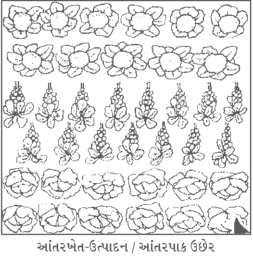
0 likes
View Solution21
Difficult
What is genetic manipulation? How is it useful in agricultural practices?
Solution
(N/A) Genetic manipulation is the process of transferring desirable genes from one organism to another to produce varieties with specific,beneficial characteristics.
Examples include the development of fodder crops with profuse branching or high-yielding varieties of maize and wheat.
Uses in agricultural practices:
$1$. It improves adaptability to adverse environmental conditions such as drought,salinity,or extreme temperatures.
$2$. It allows for the incorporation of desirable traits like disease resistance or pest resistance.
$3$. It helps in significantly increasing crop yield and improving the nutritional quality of the produce.
$4$. It can lead to shorter maturation periods,allowing for multiple cropping cycles within a single year.
Examples include the development of fodder crops with profuse branching or high-yielding varieties of maize and wheat.
Uses in agricultural practices:
$1$. It improves adaptability to adverse environmental conditions such as drought,salinity,or extreme temperatures.
$2$. It allows for the incorporation of desirable traits like disease resistance or pest resistance.
$3$. It helps in significantly increasing crop yield and improving the nutritional quality of the produce.
$4$. It can lead to shorter maturation periods,allowing for multiple cropping cycles within a single year.
0 likes
View Solution22
Medium
How do storage grain losses occur?
Solution
(N/A) The main reasons for the losses of storage grains are abiotic and biotic factors.
The abiotic factors include: Moisture and temperature.
The biotic factors include: Insects,rodents,birds,mites,and bacteria.
The abiotic factors include: Moisture and temperature.
The biotic factors include: Insects,rodents,birds,mites,and bacteria.
0 likes
View Solution23
MediumMCQ
How do good animal husbandry practices benefit farmers?
A
They increase the lifespan of animals.
B
They improve the quality and quantity of animal products.
C
They reduce the need for veterinary care.
D
They eliminate the need for animal feed.
Solution
(B) Benefits of good animal husbandry practices:
$(i)$ It provides improved breeds of domestic animals.
$(ii)$ It increases the production of products like milk,eggs,and meat.
$(iii)$ Proper shelter,feeding,care,and protection against diseases help the farmers to improve their economic conditions.
$(i)$ It provides improved breeds of domestic animals.
$(ii)$ It increases the production of products like milk,eggs,and meat.
$(iii)$ Proper shelter,feeding,care,and protection against diseases help the farmers to improve their economic conditions.
0 likes
View Solution24
MediumMCQ
What are the benefits of cattle farming?
A
Increased milk production
B
Production of good quality meat,fibre,and skin
C
Availability of good breeds of draught animals
D
All of the above
Solution
(D) The benefits of cattle farming include:
$(i)$ Increased milk production: Proper management and breeding lead to higher yields of milk.
$(ii)$ Production of good quality meat,fibre,and skin: Cattle farming provides essential raw materials like meat for food,and skin/hides for the leather industry.
$(iii)$ Availability of good breeds of draught animals: It helps in breeding strong animals that are useful for agricultural tasks like ploughing,irrigation,and carting.
$(i)$ Increased milk production: Proper management and breeding lead to higher yields of milk.
$(ii)$ Production of good quality meat,fibre,and skin: Cattle farming provides essential raw materials like meat for food,and skin/hides for the leather industry.
$(iii)$ Availability of good breeds of draught animals: It helps in breeding strong animals that are useful for agricultural tasks like ploughing,irrigation,and carting.
2 likes
View Solution25
EasyMCQ
For increasing production,what is common in poultry,fisheries and bee-keeping?
A
Inbreeding
B
Cross-breeding
C
Hybridization
D
Artificial insemination
Solution
(B) Cross-breeding is a common practice used in poultry,fisheries,and bee-keeping to enhance production. By crossing different breeds or varieties,breeders can combine desirable traits such as higher yield,disease resistance,and better quality,leading to improved overall productivity.
0 likes
View Solution26
Medium
How do you differentiate between capture fishing,mariculture,and aquaculture?
Solution
(N/A) Differences between capture fishing,mariculture,and aquaculture:
$1.$ Capture Fishing:
- Fish are obtained from natural resources like ponds,canals,rivers,and oceans.
- Locating fish is relatively easy,and they are captured using various types of fishing nets.
$2.$ Mariculture:
- It is a specialized method of marine fish culture practiced in the open sea.
- Fish are located with the help of satellites and echosounders,and they are caught using fishing nets from fishing boats.
$3.$ Aquaculture:
- It involves the production and management of fish in freshwater (ponds,lakes) and brackish water resources.
- Fish are easily located and harvested using fishing nets or other controlled methods.
$1.$ Capture Fishing:
- Fish are obtained from natural resources like ponds,canals,rivers,and oceans.
- Locating fish is relatively easy,and they are captured using various types of fishing nets.
$2.$ Mariculture:
- It is a specialized method of marine fish culture practiced in the open sea.
- Fish are located with the help of satellites and echosounders,and they are caught using fishing nets from fishing boats.
$3.$ Aquaculture:
- It involves the production and management of fish in freshwater (ponds,lakes) and brackish water resources.
- Fish are easily located and harvested using fishing nets or other controlled methods.
0 likes
View SolutionIMPROVEMENT IN FOOD RESOURCES — Textbook - IMPROVEMENT IN FOOD RESOURCES · Frequently Asked Questions
1Are these IMPROVEMENT IN FOOD RESOURCES questions useful for JEE and NEET?
Yes. All questions in this section are mapped to JEE Main and NEET exam patterns. Previous year questions from JEE Main, NEET, GUJCET and state-level exams are included with full solutions.
2Can I switch to Hindi or Gujarati for these questions?
Yes. Use the language tabs in the hero section or the sidebar to view the same questions and solutions in English, Hindi or Gujarati.
3How do I generate a question paper from this subtopic?
Use the Vedclass Exam Paper Generator — select the chapter and subtopic, set difficulty, and generate Sets A, B, C, D automatically. First 3 chapters of every subject are free.
Vedclass Products
For Students
Vedclass Test Series
Mock tests in real JEE/NEET style with performance analysis. 5-day free trial.
Start Free TrialFor Teachers
Exam Paper Generator
Generate Set A/B/C/D papers from this chapter in 2 minutes. 3 chapters free.
Try FreeFor Institutes
Online Exam Module
Live online exams with unlimited students, 360° analytics & white-label branding.
See DemoFor Teachers & Institutes
Generate a IMPROVEMENT IN FOOD RESOURCES Exam Paper in 2 Minutes
Select subtopic & difficulty — Sets A, B, C, D auto-generated with No Repeat logic.
First 3 chapters of every subject are free — no payment required.