
A English
Mix Example - IMPROVEMENT IN FOOD RESOURCES Questions in English
Class 9 Science · IMPROVEMENT IN FOOD RESOURCES · Mix Example - IMPROVEMENT IN FOOD RESOURCES
221+
Questions
English
Language
100%
With Solutions
Showing 50 of 221 questions in English
1
MediumMCQ
Which one is an oil-yielding plant among the following?
A
Sunflower
B
Lentil
C
Cauliflower
D
Hibiscus
Solution
(A) Lentils are pulse-yielding plants.
Cauliflower is a vegetable.
Hibiscus is a flowering plant.
Sunflower seeds are rich in oil and are used for extracting edible oil.
Cauliflower is a vegetable.
Hibiscus is a flowering plant.
Sunflower seeds are rich in oil and are used for extracting edible oil.
0 likes
View Solution2
MediumMCQ
Which one is not a source of carbohydrate?
A
Rice
B
Gram
C
Sorghum
D
Millets
Solution
(B) Carbohydrates are the main source of energy in food crops. Rice,Sorghum,and Millets are primarily carbohydrate-rich crops. Gram (chickpea) is a pulse crop and is primarily a rich source of protein,not carbohydrate.
0 likes
View Solution3
MediumMCQ
Find out the wrong statement from the following:
A
White revolution is meant for increase in milk production.
B
Blue revolution is meant for increase in fish production.
C
None of the above.
D
Increasing food production without compromising with environmental quality is called as sustainable agriculture.
Solution
(C) The statement in option $A$ is correct because the White Revolution (Operation Flood) was launched to increase milk production.
The statement in option $B$ is correct because the Blue Revolution is associated with the increase in fish and aquatic product production.
The statement in option $D$ is correct because sustainable agriculture refers to farming practices that meet current food needs without compromising the ability of future generations to meet their own needs,while maintaining environmental quality.
Since all the given statements are correct,the correct answer is $C$ (None of the above).
The statement in option $B$ is correct because the Blue Revolution is associated with the increase in fish and aquatic product production.
The statement in option $D$ is correct because sustainable agriculture refers to farming practices that meet current food needs without compromising the ability of future generations to meet their own needs,while maintaining environmental quality.
Since all the given statements are correct,the correct answer is $C$ (None of the above).
0 likes
View Solution4
MediumMCQ
To solve the food problem of the country,which among the following is necessary?
A
Increased production and storage of food grains
B
Easy access of people to the food grain
C
People should have money to purchase the grains
D
All of the above
Solution
(D) To ensure food security in a country,three fundamental criteria must be met:
$1$. Increased production and effective storage of food grains to ensure availability.
$2$. Easy access for the population to the available food grains.
$3$. Economic affordability,meaning people must have sufficient income to purchase the food.
Therefore,all the mentioned factors are necessary to solve the food problem.
$1$. Increased production and effective storage of food grains to ensure availability.
$2$. Easy access for the population to the available food grains.
$3$. Economic affordability,meaning people must have sufficient income to purchase the food.
Therefore,all the mentioned factors are necessary to solve the food problem.
0 likes
View Solution5
MediumMCQ
Find out the correct sentence:
$(i)$ Hybridisation means crossing between genetically dissimilar plants.
$(ii)$ Cross between two varieties is called as inter-varietal hybridisation.
$(iii)$ Introducing genes of desired character into a plant gives genetically modified crop.
$(iv)$ Cross between plants of two species is called as inter-specific hybridisation.
$(i)$ Hybridisation means crossing between genetically dissimilar plants.
$(ii)$ Cross between two varieties is called as inter-varietal hybridisation.
$(iii)$ Introducing genes of desired character into a plant gives genetically modified crop.
$(iv)$ Cross between plants of two species is called as inter-specific hybridisation.
A
$(i)$ and $(iii)$
B
$(ii)$ and $(iv)$
C
$(ii)$ and $(iii)$
D
$(iii)$ and $(iv)$
Solution
(A) Statement $(i)$ is correct: Hybridisation is the crossing between genetically dissimilar plants.
Statement $(ii)$ is correct: $A$ cross between two different varieties is known as inter-varietal hybridisation.
Statement $(iii)$ is correct: Introducing genes of desired characters into a plant results in a genetically modified crop.
Statement $(iv)$ is incorrect: $A$ cross between plants of two different species is called inter-specific hybridisation,not inter-varietal.
Therefore,statements $(i)$,$(ii)$,and $(iii)$ are correct. Given the options,$(i)$ and $(iii)$ are correct,but $(ii)$ and $(iii)$ are also correct. Based on standard textbook definitions,$(i)$ and $(iii)$ are the most accurate choices provided in option $A$.
Statement $(ii)$ is correct: $A$ cross between two different varieties is known as inter-varietal hybridisation.
Statement $(iii)$ is correct: Introducing genes of desired characters into a plant results in a genetically modified crop.
Statement $(iv)$ is incorrect: $A$ cross between plants of two different species is called inter-specific hybridisation,not inter-varietal.
Therefore,statements $(i)$,$(ii)$,and $(iii)$ are correct. Given the options,$(i)$ and $(iii)$ are correct,but $(ii)$ and $(iii)$ are also correct. Based on standard textbook definitions,$(i)$ and $(iii)$ are the most accurate choices provided in option $A$.
0 likes
View Solution6
EasyMCQ
Weeds affect the crop plants by
A
killing of plants in field before they grow
B
competing for various resources of crops (plants) causing low availability of nutrients
C
dominating the plants to grow
D
all of the above
Solution
(B) Weeds are unwanted plants that grow in a cultivated field along with the main crop. They affect crop plants by competing for essential resources such as sunlight,water,nutrients,and space. This competition reduces the availability of these resources for the main crop,leading to stunted growth and reduced yield.
0 likes
View Solution7
MediumMCQ
Which one of the following species of honey bee is an Italian species?
A
Apis dorsata
B
Apis florae
C
Apis mellifera
D
Apis cerana indica
Solution
(C) The Italian honey bee species is $Apis \ mellifera$.
This species is widely used in commercial beekeeping because it has high honey collection capacity,stings less,and breeds very well.
$Apis \ dorsata$ is the rock bee,$Apis \ florae$ is the little bee,and $Apis \ cerana \ indica$ is the Indian hive bee.
This species is widely used in commercial beekeeping because it has high honey collection capacity,stings less,and breeds very well.
$Apis \ dorsata$ is the rock bee,$Apis \ florae$ is the little bee,and $Apis \ cerana \ indica$ is the Indian hive bee.
0 likes
View Solution8
MediumMCQ
Find out the correct sentence about manure:
$(i)$ Manure contains large quantities of organic matter and small quantities of nutrients.
$(ii)$ It increases the water holding capacity of sandy soil.
$(iii)$ It helps in draining out of excess of water from clayey soil.
$(iv)$ Its excessive use pollutes environment because it is made of animal excretory waste.
$(i)$ Manure contains large quantities of organic matter and small quantities of nutrients.
$(ii)$ It increases the water holding capacity of sandy soil.
$(iii)$ It helps in draining out of excess of water from clayey soil.
$(iv)$ Its excessive use pollutes environment because it is made of animal excretory waste.
A
$(i)$ and $(iii)$
B
$(iii)$ and $(iv)$
C
$(ii)$ and $(iii)$
D
$(i), (ii)$ and $(iii)$
Solution
(D) Statement $(i)$ is correct: Manure is a bulky source of organic matter that provides nutrients in small quantities.
Statement $(ii)$ is correct: The addition of organic matter improves the soil structure,thereby increasing the water-holding capacity of sandy soil.
Statement $(iii)$ is correct: Organic matter helps in improving the soil structure of clayey soil,which facilitates the drainage of excess water.
Statement $(iv)$ is incorrect: Manure is eco-friendly and sustainable; it does not pollute the environment but rather helps in recycling agricultural and animal waste.
Therefore,the correct statements are $(i), (ii)$,and $(iii)$.
Statement $(ii)$ is correct: The addition of organic matter improves the soil structure,thereby increasing the water-holding capacity of sandy soil.
Statement $(iii)$ is correct: Organic matter helps in improving the soil structure of clayey soil,which facilitates the drainage of excess water.
Statement $(iv)$ is incorrect: Manure is eco-friendly and sustainable; it does not pollute the environment but rather helps in recycling agricultural and animal waste.
Therefore,the correct statements are $(i), (ii)$,and $(iii)$.
0 likes
View Solution9
EasyMCQ
Cattle husbandry is done for the following purposes:
$(i)$ Milk production
$(ii)$ Agricultural work
$(iii)$ Meat production
$(iv)$ Egg production
$(i)$ Milk production
$(ii)$ Agricultural work
$(iii)$ Meat production
$(iv)$ Egg production
A
$(i), (ii)$ and $(iii)$
B
$(ii), (iii)$ and $(iv)$
C
$(iii)$ and $(iv)$
D
$(i)$ and $(iv)$
Solution
(A) Cattle husbandry involves the rearing of cows and buffaloes for various economic purposes.
$(i)$ Milk production is a primary purpose of cattle farming.
$(ii)$ Cattle are used for agricultural work such as ploughing,tilling,and carting in many regions.
$(iii)$ Meat production is also a purpose for which cattle are reared in certain systems.
$(iv)$ Egg production is associated with poultry farming,not cattle husbandry.
Therefore,the correct purposes are $(i), (ii),$ and $(iii)$.
$(i)$ Milk production is a primary purpose of cattle farming.
$(ii)$ Cattle are used for agricultural work such as ploughing,tilling,and carting in many regions.
$(iii)$ Meat production is also a purpose for which cattle are reared in certain systems.
$(iv)$ Egg production is associated with poultry farming,not cattle husbandry.
Therefore,the correct purposes are $(i), (ii),$ and $(iii)$.
0 likes
View Solution10
MediumMCQ
Which of the following are Indian cattle?
$(i)$ $Bos$ $indicus$
$(ii)$ $Bos$ $domestica$
$(iii)$ $Bos$ $bubalis$
$(iv)$ $Bos$ $vulgaris$
$(i)$ $Bos$ $indicus$
$(ii)$ $Bos$ $domestica$
$(iii)$ $Bos$ $bubalis$
$(iv)$ $Bos$ $vulgaris$
A
$(i)$ and $(ii)$
B
$(i)$ and $(iii)$
C
$(ii)$ and $(iii)$
D
$(iii)$ and $(iv)$
Solution
(B) The scientific name for the Indian cow is $Bos$ $indicus$.
The scientific name for the Indian buffalo is $Bos$ $bubalis$ (also commonly referred to as $Bubalus$ $bubalis$).
$Bos$ $domestica$ and $Bos$ $vulgaris$ are not valid scientific names for cattle species.
Therefore,both $(i)$ and $(iii)$ represent Indian cattle.
The scientific name for the Indian buffalo is $Bos$ $bubalis$ (also commonly referred to as $Bubalus$ $bubalis$).
$Bos$ $domestica$ and $Bos$ $vulgaris$ are not valid scientific names for cattle species.
Therefore,both $(i)$ and $(iii)$ represent Indian cattle.
0 likes
View Solution11
MediumMCQ
Which of the following are exotic breeds of cattle?
A
$(i)$ and $(iii)$
B
$(i)$ and $(iv)$
C
$(ii)$ and $(iii)$
D
$(ii)$ and $(iv)$
Solution
(C) Exotic breeds are foreign breeds that are selected for long lactation periods.
$(i)$ Brawn is not a recognized cattle breed.
$(ii)$ Jersey is a well-known exotic breed of cattle originating from the Channel Islands.
$(iii)$ Brown Swiss is an exotic breed of cattle originating from Switzerland.
$(iv)$ Jersey Swiss is not a standard breed name.
Therefore,$(ii)$ and $(iii)$ are the correct exotic breeds.
$(i)$ Brawn is not a recognized cattle breed.
$(ii)$ Jersey is a well-known exotic breed of cattle originating from the Channel Islands.
$(iii)$ Brown Swiss is an exotic breed of cattle originating from Switzerland.
$(iv)$ Jersey Swiss is not a standard breed name.
Therefore,$(ii)$ and $(iii)$ are the correct exotic breeds.
0 likes
View Solution12
EasyMCQ
Poultry farming is undertaken to raise which of the following?
$(i)$ Egg production
$(ii)$ Feather production
$(iii)$ Chicken meat
$(iv)$ Milk production
$(i)$ Egg production
$(ii)$ Feather production
$(iii)$ Chicken meat
$(iv)$ Milk production
A
$(iii)$ and $(iv)$
B
$(i)$ and $(ii)$
C
$(ii)$ and $(iii)$
D
$(i)$ and $(iii)$
Solution
(D) Poultry farming refers to the rearing of domesticated fowl for commercial purposes.
$(i)$ Egg production is a primary objective of poultry farming (layers).
$(ii)$ Feather production is not a primary commercial objective of poultry farming.
$(iii)$ Chicken meat production is a primary objective of poultry farming (broilers).
$(iv)$ Milk production is associated with dairy farming,not poultry farming,as birds are not mammals.
Therefore,poultry farming is undertaken for $(i)$ and $(iii)$.
$(i)$ Egg production is a primary objective of poultry farming (layers).
$(ii)$ Feather production is not a primary commercial objective of poultry farming.
$(iii)$ Chicken meat production is a primary objective of poultry farming (broilers).
$(iv)$ Milk production is associated with dairy farming,not poultry farming,as birds are not mammals.
Therefore,poultry farming is undertaken for $(i)$ and $(iii)$.
0 likes
View Solution13
MediumMCQ
Poultry fowl are susceptible to the following pathogens:
A
Viruses
B
Bacteria
C
Fungi
D
All of the above
Solution
(D) Poultry birds are susceptible to various infectious diseases caused by different types of pathogens. These include:
$1$. Viruses (e.g.,Ranikhet disease,Bird flu).
$2$. Bacteria (e.g.,Fowl cholera,Salmonellosis).
$3$. Fungi (e.g.,Aspergillosis).
Therefore,poultry fowl are susceptible to all of these pathogens.
$1$. Viruses (e.g.,Ranikhet disease,Bird flu).
$2$. Bacteria (e.g.,Fowl cholera,Salmonellosis).
$3$. Fungi (e.g.,Aspergillosis).
Therefore,poultry fowl are susceptible to all of these pathogens.
0 likes
View Solution14
EasyMCQ
Which one of the following fishes is a surface feeder?
A
Rohus
B
Catlas
C
Common carps
D
Mrigals
Solution
(B) In composite fish farming,different species of fish are selected based on their feeding habits to utilize all available food in the pond.
$1$. $Catla$ $(Catlas)$ are surface feeders.
$2$. $Rohu$ $(Rohus)$ are column feeders (feed in the middle zone).
$3$. $Mrigal$ $(Mrigals)$ and $Common$ $carps$ are bottom feeders.
Therefore,$Catlas$ is the correct answer as it is a surface feeder.
$1$. $Catla$ $(Catlas)$ are surface feeders.
$2$. $Rohu$ $(Rohus)$ are column feeders (feed in the middle zone).
$3$. $Mrigal$ $(Mrigals)$ and $Common$ $carps$ are bottom feeders.
Therefore,$Catlas$ is the correct answer as it is a surface feeder.
0 likes
View Solution15
MediumMCQ
Animal husbandry is the scientific management of
$(i)$ animal breeding
$(ii)$ culture of animals
$(iii)$ animal livestock
$(iv)$ rearing of animals
$(i)$ animal breeding
$(ii)$ culture of animals
$(iii)$ animal livestock
$(iv)$ rearing of animals
A
$(i), (ii)$ and $(iii)$
B
$(ii), (iii)$ and $(iv)$
C
$(i), (iii)$ and $(iv)$
D
$(i), (ii)$ and $(iv)$
Solution
(C) Animal husbandry is the agricultural practice of breeding and raising livestock.
It involves the scientific management of:
$(i)$ Animal breeding: Selective breeding to improve desirable traits.
$(iii)$ Animal livestock: Proper care and management of farm animals.
$(iv)$ Rearing of animals: Providing food,shelter,and protection to animals.
$(ii)$ Culture of animals (like tissue culture) is not a part of animal husbandry.
Therefore,the correct combination is $(i), (iii),$ and $(iv)$.
It involves the scientific management of:
$(i)$ Animal breeding: Selective breeding to improve desirable traits.
$(iii)$ Animal livestock: Proper care and management of farm animals.
$(iv)$ Rearing of animals: Providing food,shelter,and protection to animals.
$(ii)$ Culture of animals (like tissue culture) is not a part of animal husbandry.
Therefore,the correct combination is $(i), (iii),$ and $(iv)$.
0 likes
View Solution16
MediumMCQ
Which one of the following nutrients is not available in fertilizers?
A
Nitrogen
B
Phosphorus
C
Potassium
D
Iron
Solution
(D) Fertilizers are commercially produced plant nutrients that supply essential elements like Nitrogen $(N)$,Phosphorus $(P)$,and Potassium $(K)$. Iron is a micronutrient that plants absorb directly from the soil. There are no standard commercial fertilizers formulated to supply iron to plants.
0 likes
View Solution17
MediumMCQ
Preventive and control measures adopted for the storage of grains include
A
all of the above
B
proper drying
C
fumigation
D
strict cleaning
Solution
(A) The storage of grains requires effective preventive and control measures to protect them from biotic factors (insects,rodents,fungi,mites,bacteria) and abiotic factors (inappropriate moisture and temperature).
$1$. Strict cleaning: The grains must be cleaned properly before storage to remove debris and contaminants.
$2$. Proper drying: The grains must be dried in the sun and then in the shade to reduce moisture content,which prevents fungal growth.
$3$. Fumigation: Using chemicals (fumigants) that produce toxic fumes to kill pests and insects within the storage area.
Since all these methods are essential for grain storage,the correct answer is 'all of the above'.
$1$. Strict cleaning: The grains must be cleaned properly before storage to remove debris and contaminants.
$2$. Proper drying: The grains must be dried in the sun and then in the shade to reduce moisture content,which prevents fungal growth.
$3$. Fumigation: Using chemicals (fumigants) that produce toxic fumes to kill pests and insects within the storage area.
Since all these methods are essential for grain storage,the correct answer is 'all of the above'.
0 likes
View Solution18
MediumMCQ
Match the column $A$ with the column $B$:
| Column $A$ | Column $B$ |
| $(a)$ Catla | $(i)$ Bottom feeders |
| $(b)$ Rohu | $(ii)$ Surface feeders |
| $(c)$ Mrigal | $(iii)$ Middle-zone feeders |
| $(d)$ Fish farming | $(iv)$ Culture fishery |
A
$(a) - (iii), (b) - (ii), (c) - (i), (d) - (iv)$
B
$(a) - (ii), (b) - (iii), (c) - (i), (d) - (iv)$
C
$(a) - (i), (b) - (iii), (c) - (ii), (d) - (iv)$
D
$(a) - (iii), (b) - (i), (c) - (iv), (d) - (i)$
Solution
(B) The correct matching is as follows:
$(a)$ Catla is a surface feeder, so $(a) - (ii)$.
$(b)$ Rohu is a middle-zone feeder, so $(b) - (iii)$.
$(c)$ Mrigal is a bottom feeder, so $(c) - (i)$.
$(d)$ Fish farming is known as culture fishery, so $(d) - (iv)$.
Therefore, the correct sequence is $(a) - (ii), (b) - (iii), (c) - (i), (d) - (iv)$.
$(a)$ Catla is a surface feeder, so $(a) - (ii)$.
$(b)$ Rohu is a middle-zone feeder, so $(b) - (iii)$.
$(c)$ Mrigal is a bottom feeder, so $(c) - (i)$.
$(d)$ Fish farming is known as culture fishery, so $(d) - (iv)$.
Therefore, the correct sequence is $(a) - (ii), (b) - (iii), (c) - (i), (d) - (iv)$.
0 likes
View Solution19
Medium
Fill in the blanks:
$(a)$ Pigeon pea is a good source of . . . . . . .
$(b)$ Berseem is an important . . . . . . crop.
$(c)$ The crops which are grown in the rainy season are called . . . . . . crops.
$(d)$ . . . . . . are rich in vitamins.
$(e)$ . . . . . . crop grows in the winter season.
$(a)$ Pigeon pea is a good source of . . . . . . .
$(b)$ Berseem is an important . . . . . . crop.
$(c)$ The crops which are grown in the rainy season are called . . . . . . crops.
$(d)$ . . . . . . are rich in vitamins.
$(e)$ . . . . . . crop grows in the winter season.
Solution
(N/A) Pigeon pea is a good source of protein.
$(b)$ Berseem is an important fodder crop.
$(c)$ The crops which are grown in the rainy season are called Kharif crops.
$(d)$ Vegetables are rich in vitamins.
$(e)$ Rabi crop grows in the winter season.
$(b)$ Berseem is an important fodder crop.
$(c)$ The crops which are grown in the rainy season are called Kharif crops.
$(d)$ Vegetables are rich in vitamins.
$(e)$ Rabi crop grows in the winter season.
0 likes
View Solution20
Medium
What is a $GM$ crop? Name any one such crop which is grown in India.
Solution
(N/A) crop that has been developed by introducing a new gene from another source to obtain a desired character is called a genetically modified $(GM)$ crop.
$Bt$ Cotton is an example of a $GM$ crop grown in India,which is made insect-resistant by introducing a gene from the bacterium $Bacillus$ $thuringiensis$.
$Bt$ Cotton is an example of a $GM$ crop grown in India,which is made insect-resistant by introducing a gene from the bacterium $Bacillus$ $thuringiensis$.
0 likes
View Solution21
Medium
List out some useful traits in improved crops.
Solution
(N/A) Useful traits of improved crops are:
$(a)$ Higher yield: To increase the productivity of the crop per acre.
$(b)$ Improved nutritional quality: To enhance the protein,oil,vitamin,mineral,or micronutrient content.
$(c)$ Resistance to biotic and abiotic stresses: To make crops resistant to diseases,insects,and pests (biotic) and stresses like drought,salinity,heat,or cold (abiotic).
$(d)$ Change in maturity duration: To develop varieties that mature in a shorter duration,allowing farmers to grow multiple crops in a year.
$(e)$ Wide range of adaptability: To allow crops to grow in different climatic conditions.
$(f)$ Desired agronomic characteristics: To develop traits like dwarfness in cereals (for less nutrient consumption) or tallness and profuse branching in fodder crops.
$(a)$ Higher yield: To increase the productivity of the crop per acre.
$(b)$ Improved nutritional quality: To enhance the protein,oil,vitamin,mineral,or micronutrient content.
$(c)$ Resistance to biotic and abiotic stresses: To make crops resistant to diseases,insects,and pests (biotic) and stresses like drought,salinity,heat,or cold (abiotic).
$(d)$ Change in maturity duration: To develop varieties that mature in a shorter duration,allowing farmers to grow multiple crops in a year.
$(e)$ Wide range of adaptability: To allow crops to grow in different climatic conditions.
$(f)$ Desired agronomic characteristics: To develop traits like dwarfness in cereals (for less nutrient consumption) or tallness and profuse branching in fodder crops.
0 likes
View Solution22
MediumMCQ
Why is organic matter important for crop production?
A
It improves soil structure.
B
It increases the water-holding capacity of sandy soil.
C
It helps in drainage and prevents waterlogging in clayey soil.
D
All of the above.
Solution
(D) Organic matter is crucial for crop production for the following reasons:
$(a)$ It improves the physical structure of the soil,making it more porous and suitable for root growth.
$(b)$ It increases the water-holding capacity of sandy soil,which helps in retaining moisture for plants.
$(c)$ In clayey soil,the addition of organic matter helps in improving drainage and prevents waterlogging,which is essential for healthy plant development.
$(a)$ It improves the physical structure of the soil,making it more porous and suitable for root growth.
$(b)$ It increases the water-holding capacity of sandy soil,which helps in retaining moisture for plants.
$(c)$ In clayey soil,the addition of organic matter helps in improving drainage and prevents waterlogging,which is essential for healthy plant development.
0 likes
View Solution23
EasyMCQ
Why is excess use of fertilizers detrimental for the environment?
A
They increase soil fertility indefinitely.
B
They lead to soil degradation and water pollution.
C
They are too expensive for farmers.
D
They kill all beneficial insects.
Solution
(B) Excess use of fertilizers is detrimental because they are not fully absorbed by plants.
Residual amounts of these chemicals leach into the groundwater,causing water pollution.
They can also lead to soil degradation by altering the soil pH and killing beneficial soil microorganisms.
Furthermore,runoff from fields can cause eutrophication in nearby water bodies,leading to the depletion of oxygen and harm to aquatic life.
Residual amounts of these chemicals leach into the groundwater,causing water pollution.
They can also lead to soil degradation by altering the soil pH and killing beneficial soil microorganisms.
Furthermore,runoff from fields can cause eutrophication in nearby water bodies,leading to the depletion of oxygen and harm to aquatic life.
0 likes
View Solution24
Medium
Give one word for the following:
$(a)$ Farming without the use of chemicals as fertilizers,herbicides,and pesticides is known as . . . . . . .
$(b)$ Growing of wheat and groundnut on the same field is called as . . . . . . .
$(c)$ Planting soybean and maize in alternate rows in the same field is called as . . . . . . .
$(d)$ Growing different crops on a piece of land in pre-planned succession is known as . . . . . . .
$(e)$ Xanthium and Parthenium are commonly known as . . . . . . .
$(f)$ Causal organism of any disease is called as . . . . . . .
$(a)$ Farming without the use of chemicals as fertilizers,herbicides,and pesticides is known as . . . . . . .
$(b)$ Growing of wheat and groundnut on the same field is called as . . . . . . .
$(c)$ Planting soybean and maize in alternate rows in the same field is called as . . . . . . .
$(d)$ Growing different crops on a piece of land in pre-planned succession is known as . . . . . . .
$(e)$ Xanthium and Parthenium are commonly known as . . . . . . .
$(f)$ Causal organism of any disease is called as . . . . . . .
Solution
(N/A) Organic farming
$(b)$ Mixed cropping
$(c)$ Inter-cropping
$(d)$ Crop rotation
$(e)$ Weeds
$(f)$ Pathogen
$(b)$ Mixed cropping
$(c)$ Inter-cropping
$(d)$ Crop rotation
$(e)$ Weeds
$(f)$ Pathogen
0 likes
View Solution25
MediumMCQ
Match the following Column $A$ and Column $B$:
| Column $A$ | Column $B$ |
| $(a)$ Cattle used for tilling and carting | $(i)$ Milk producing female |
| $(b)$ Indian breed of chicken | $(ii)$ Broiler |
| $(c)$ Sahiwal,Red Sindhi | $(iii)$ Draught animals |
| $(d)$ Milch | $(iv)$ Local breed of cattle |
| $(e)$ Chicken better fed for obtaining meat | $(v)$ Aseel |
A
$(a) - (iii), (b) - (v), (c) - (iv), (d) - (i), (e) - (ii)$
B
$(a) - (iii), (b) - (iv), (c) - (v), (d) - (i), (e) - (ii)$
C
$(a) - (i), (b) - (v), (c) - (iv), (d) - (iii), (e) - (ii)$
D
$(a) - (i), (b) - (v), (c) - (iv), (d) - (ii), (e) - (iii)$
Solution
(A) The correct matches are as follows:
$(a)$ Cattle used for tilling and carting are known as Draught animals $(iii)$.
$(b)$ Aseel $(v)$ is a well-known Indian breed of chicken.
$(c)$ Sahiwal and Red Sindhi $(iv)$ are examples of local breeds of cattle.
$(d)$ Milch animals $(i)$ are those that are milk-producing females.
$(e)$ Broilers $(ii)$ are chickens that are specifically fed and raised for obtaining meat.
Therefore, the correct sequence is $(a) - (iii), (b) - (v), (c) - (iv), (d) - (i), (e) - (ii)$.
$(a)$ Cattle used for tilling and carting are known as Draught animals $(iii)$.
$(b)$ Aseel $(v)$ is a well-known Indian breed of chicken.
$(c)$ Sahiwal and Red Sindhi $(iv)$ are examples of local breeds of cattle.
$(d)$ Milch animals $(i)$ are those that are milk-producing females.
$(e)$ Broilers $(ii)$ are chickens that are specifically fed and raised for obtaining meat.
Therefore, the correct sequence is $(a) - (iii), (b) - (v), (c) - (iv), (d) - (i), (e) - (ii)$.
0 likes
View Solution26
MediumMCQ
If there is low rainfall in a village throughout the year,what measures will you suggest to the farmers for better cropping?
A
Use of high-yielding varieties only.
B
Practice farming with drought-resistant and early-maturing crop varieties.
C
Increase the use of chemical fertilizers.
D
Avoid farming during the rainy season.
Solution
(B) Farmers in low rainfall areas should be suggested to:
$(a)$ Practice farming with drought-resistant and early-maturing varieties of crops,as these varieties can survive with limited water and complete their life cycle quickly.
$(b)$ Enrich the soil with more humus (organic matter),as it significantly increases the water-holding capacity of the soil and helps retain moisture for a longer duration.
$(a)$ Practice farming with drought-resistant and early-maturing varieties of crops,as these varieties can survive with limited water and complete their life cycle quickly.
$(b)$ Enrich the soil with more humus (organic matter),as it significantly increases the water-holding capacity of the soil and helps retain moisture for a longer duration.
0 likes
View Solution27
Medium
Group the following crops and tabulate them as energy-yielding,protein-yielding,oil-yielding,and fodder crops: Wheat,rice,berseem,maize,gram,oat,pigeon pea,sudan grass,lentil,soybean,groundnut,castor,and mustard.
Solution
(N/A) $(1)$ Energy-yielding: Wheat,rice,maize.
$(2)$ Protein-yielding: Gram,pigeon pea,lentil,soybean.
$(3)$ Oil-yielding: Groundnut,castor,mustard,soybean.
$(4)$ Fodder crops: Berseem,oat,sudan grass.
$(2)$ Protein-yielding: Gram,pigeon pea,lentil,soybean.
$(3)$ Oil-yielding: Groundnut,castor,mustard,soybean.
$(4)$ Fodder crops: Berseem,oat,sudan grass.
0 likes
View Solution28
Medium
Define the terms hybridization and photoperiod.
Solution
(N/A) Hybridization: Hybridization refers to the crossing between genetically dissimilar organisms to produce offspring with desirable traits.
Photoperiod: Photoperiod is the duration of sunlight available to a plant. It significantly affects the growth,flowering,and maturation of crops.
Photoperiod: Photoperiod is the duration of sunlight available to a plant. It significantly affects the growth,flowering,and maturation of crops.
0 likes
View Solution29
Medium
Fill in the blanks:
$(a)$ Photoperiod affects the . . . . . . .
$(b)$ Kharif crops are cultivated from . . . . . . to . . . . . . .
$(c)$ Rabi crops are cultivated from . . . . . . to . . . . . . .
$(d)$ Paddy,maize,green gram,and black gram are . . . . . . crops.
$(e)$ Wheat,gram,pea,and mustard are . . . . . . crops.
$(a)$ Photoperiod affects the . . . . . . .
$(b)$ Kharif crops are cultivated from . . . . . . to . . . . . . .
$(c)$ Rabi crops are cultivated from . . . . . . to . . . . . . .
$(d)$ Paddy,maize,green gram,and black gram are . . . . . . crops.
$(e)$ Wheat,gram,pea,and mustard are . . . . . . crops.
Solution
(N/A) Photoperiod affects the flowering of plants.
$(b)$ Kharif crops are cultivated from June to October.
$(c)$ Rabi crops are cultivated from November to April.
$(d)$ Paddy,maize,green gram,and black gram are Kharif crops.
$(e)$ Wheat,gram,pea,and mustard are Rabi crops.
$(b)$ Kharif crops are cultivated from June to October.
$(c)$ Rabi crops are cultivated from November to April.
$(d)$ Paddy,maize,green gram,and black gram are Kharif crops.
$(e)$ Wheat,gram,pea,and mustard are Rabi crops.
0 likes
View Solution30
Easy
Cultivation practices and crop yield are related to environmental conditions. Explain.
Solution
(N/A) Different crops and cultivation practices require specific environmental conditions such as temperature,humidity,and photoperiod for their growth and the completion of their life cycle.
$1$. Photoperiod: The duration of sunlight exposure affects the flowering and growth of plants.
$2$. Temperature: Different crops have specific temperature requirements for germination and development.
$3$. Seasonal Variation: Crops are categorized based on their environmental needs,such as $Kharif$ crops (grown in the rainy season) and $Rabi$ crops (grown in the winter season).
Therefore,selecting the right crop for the right season and environment is essential for maximizing crop yield.
$1$. Photoperiod: The duration of sunlight exposure affects the flowering and growth of plants.
$2$. Temperature: Different crops have specific temperature requirements for germination and development.
$3$. Seasonal Variation: Crops are categorized based on their environmental needs,such as $Kharif$ crops (grown in the rainy season) and $Rabi$ crops (grown in the winter season).
Therefore,selecting the right crop for the right season and environment is essential for maximizing crop yield.
0 likes
View Solution31
Medium
Fill in the blanks:
$(a)$ $A$ total of . . . . . . nutrients are essential to plants.
$(b)$ . . . . . . and . . . . . . are supplied by air to plants.
$(c)$ . . . . . . is supplied by water to plants.
$(d)$ Soil supplies . . . . . . nutrients to plants.
$(e)$ . . . . . . nutrients are required in large quantities and are called . . . . . . .
$(f)$ . . . . . . nutrients are needed in small quantities for plants and are called . . . . . . .
$(a)$ $A$ total of . . . . . . nutrients are essential to plants.
$(b)$ . . . . . . and . . . . . . are supplied by air to plants.
$(c)$ . . . . . . is supplied by water to plants.
$(d)$ Soil supplies . . . . . . nutrients to plants.
$(e)$ . . . . . . nutrients are required in large quantities and are called . . . . . . .
$(f)$ . . . . . . nutrients are needed in small quantities for plants and are called . . . . . . .
Solution
(N/A) $16$ nutrients are essential for plants.
$(b)$ Carbon and Oxygen are supplied by air to plants.
$(c)$ Hydrogen is supplied by water to plants.
$(d)$ Soil supplies $13$ nutrients to plants.
$(e)$ Six nutrients are required in large quantities and are called macronutrients.
$(f)$ Seven nutrients are needed in small quantities for plants and are called micronutrients.
$(b)$ Carbon and Oxygen are supplied by air to plants.
$(c)$ Hydrogen is supplied by water to plants.
$(d)$ Soil supplies $13$ nutrients to plants.
$(e)$ Six nutrients are required in large quantities and are called macronutrients.
$(f)$ Seven nutrients are needed in small quantities for plants and are called micronutrients.
0 likes
View Solution32
Medium
Differentiate between compost and vermicompost.
Solution
(N/A) Compost: It is the process of decomposition of farm waste materials such as livestock excreta,vegetable wastes,animal refuse,domestic waste,straw,and eradicated weeds,which are then used as manure.
Vermicompost: It is the compost prepared from organic matter by using earthworms,which significantly hastens the process of decomposition.
Vermicompost: It is the compost prepared from organic matter by using earthworms,which significantly hastens the process of decomposition.
0 likes
View Solution33
MediumMCQ
Arrange these statements in the correct sequence for the preparation of green manure.
$(a)$ Green plants are decomposed in the soil.
$(b)$ Green plants are cultivated for preparing manure or crop plant parts are used.
$(c)$ Plants are ploughed and mixed into the soil.
$(d)$ After decomposition,it becomes green manure.
$(a)$ Green plants are decomposed in the soil.
$(b)$ Green plants are cultivated for preparing manure or crop plant parts are used.
$(c)$ Plants are ploughed and mixed into the soil.
$(d)$ After decomposition,it becomes green manure.
A
$(c) \to (b) \to (a) \to (d)$
B
$(b) \to (c) \to (a) \to (d)$
C
$(b) \to (c) \to (d) \to (a)$
D
$(b) \to (d) \to (a) \to (c)$
Solution
(B) The correct sequence for the preparation of green manure is as follows:
$1$. $(b)$ Green plants are cultivated for preparing manure or crop plant parts are used.
$2$. $(c)$ Plants are ploughed and mixed into the soil.
$3$. $(a)$ Green plants are decomposed in the soil.
$4$. $(d)$ After decomposition,it becomes green manure.
Therefore,the correct sequence is $(b) \to (c) \to (a) \to (d)$.
$1$. $(b)$ Green plants are cultivated for preparing manure or crop plant parts are used.
$2$. $(c)$ Plants are ploughed and mixed into the soil.
$3$. $(a)$ Green plants are decomposed in the soil.
$4$. $(d)$ After decomposition,it becomes green manure.
Therefore,the correct sequence is $(b) \to (c) \to (a) \to (d)$.
0 likes
View Solution34
Medium
An Italian bee variety $A. mellifera$ has been introduced in India for honey production. Write about its merits over other varieties.
Solution
(N/A) The merits of the Italian bee variety $A. mellifera$ are as follows:
$(a)$ It has a high honey collection capacity.
$(b)$ It stings much less compared to indigenous varieties.
$(c)$ It stays in the given beehive for long periods.
$(d)$ It breeds very well.
$(a)$ It has a high honey collection capacity.
$(b)$ It stings much less compared to indigenous varieties.
$(c)$ It stays in the given beehive for long periods.
$(d)$ It breeds very well.
0 likes
View Solution35
EasyMCQ
In agricultural practices,higher input gives higher yield. Discuss how?
A
By increasing the use of fertilizers and pesticides.
B
By using high-yielding varieties of seeds and modern machinery.
C
By investing in better irrigation and storage facilities.
D
All of the above.
Solution
(D) In agricultural practices,higher input leads to higher yield because it allows for the adoption of advanced farming technologies and better resources.
Financial conditions of farmers determine their ability to invest in high-quality inputs such as high-yielding variety $(HYV)$ seeds,fertilizers,pesticides,and modern irrigation systems.
The farmer's purchasing capacity directly influences the choice of cropping systems and production practices.
Therefore,higher financial investment enables the implementation of intensive farming techniques,which ultimately results in increased crop production.
Financial conditions of farmers determine their ability to invest in high-quality inputs such as high-yielding variety $(HYV)$ seeds,fertilizers,pesticides,and modern irrigation systems.
The farmer's purchasing capacity directly influences the choice of cropping systems and production practices.
Therefore,higher financial investment enables the implementation of intensive farming techniques,which ultimately results in increased crop production.
0 likes
View Solution36
Medium
Discuss the role of hybridisation in crop improvement.
Solution
(N/A) Hybridisation refers to the crossing between genetically dissimilar plants. It can be inter-varietal (between different varieties),inter-specific (between different species),or inter-generic (between different genera).
Two plants with desirable traits are selected and cross-bred to obtain a new progeny that combines the beneficial characteristics of both parents.
This method is crucial in crop improvement as it helps in developing varieties with higher yield,improved quality,better disease resistance,and enhanced pest resistance.
Two plants with desirable traits are selected and cross-bred to obtain a new progeny that combines the beneficial characteristics of both parents.
This method is crucial in crop improvement as it helps in developing varieties with higher yield,improved quality,better disease resistance,and enhanced pest resistance.
0 likes
View Solution37
Medium
Define $(i)$ Vermicompost,$(ii)$ Green manure,and $(iii)$ Biofertilizer.
Solution
(N/A) $(i)$ Vermicompost: Compost is a type of manure rich in organic matter and nutrients. The compost prepared by using earthworms to hasten the process of decomposition of plant and animal refuse is called Vermicompost.
$(ii)$ Green manure: The manure prepared by decomposing green plants in the field itself is called green manure. For example,sun hemp is grown in fields,mulched by ploughing,and allowed to decompose in the field to prepare green manure.
$(iii)$ Biofertilizer: Living organisms that are used as fertilizers to supply nutrients to plants are called biofertilizers. For example,blue-green algae,which fix nitrogen in the soil of rice fields,act as biofertilizers.
$(ii)$ Green manure: The manure prepared by decomposing green plants in the field itself is called green manure. For example,sun hemp is grown in fields,mulched by ploughing,and allowed to decompose in the field to prepare green manure.
$(iii)$ Biofertilizer: Living organisms that are used as fertilizers to supply nutrients to plants are called biofertilizers. For example,blue-green algae,which fix nitrogen in the soil of rice fields,act as biofertilizers.
0 likes
View Solution38
Medium
Discuss various methods for weed control.
Solution
(N/A) Weeds are unwanted plants that grow along with the main crop and compete for nutrients,space,and sunlight. Various methods for weed control include:
$(a)$ Mechanical removal: This involves uprooting or cutting weeds manually or using simple tools like a trowel or hoe.
$(b)$ Proper seed bed preparation: Preparing the soil thoroughly before sowing helps in destroying existing weeds and their seeds.
$(c)$ Timely sowing of crops: Sowing crops at the right time ensures that the crop plants grow faster and shade the ground,preventing weed germination.
$(d)$ Intercropping and crop rotation: These agricultural practices disrupt the life cycle of weeds,making it difficult for them to establish themselves in the field.
$(e)$ Use of weedicides: Chemical substances specifically designed to kill weeds without harming the main crop.
$(a)$ Mechanical removal: This involves uprooting or cutting weeds manually or using simple tools like a trowel or hoe.
$(b)$ Proper seed bed preparation: Preparing the soil thoroughly before sowing helps in destroying existing weeds and their seeds.
$(c)$ Timely sowing of crops: Sowing crops at the right time ensures that the crop plants grow faster and shade the ground,preventing weed germination.
$(d)$ Intercropping and crop rotation: These agricultural practices disrupt the life cycle of weeds,making it difficult for them to establish themselves in the field.
$(e)$ Use of weedicides: Chemical substances specifically designed to kill weeds without harming the main crop.
0 likes
View Solution39
Medium
Differentiate between the following:
$(i)$ Capture fishery and Culture fishery
$(ii)$ Mixed cropping and Intercropping
$(iii)$ Bee keeping and Poultry farming
$(i)$ Capture fishery and Culture fishery
$(ii)$ Mixed cropping and Intercropping
$(iii)$ Bee keeping and Poultry farming
Solution
(N/A) $(i)$ Capture fishery is the method of obtaining fish from natural resources,whereas culture fishery is the method of obtaining fish through fish farming.
$(ii)$ Mixed cropping involves growing two or more crops simultaneously on the same piece of land without a specific pattern. Intercropping involves growing two or more crops simultaneously on the same field in a definite pattern,such as in alternating rows.
$(iii)$ Bee keeping is the practice of rearing honey bees for the production of honey and wax. Poultry farming is the practice of raising domestic fowl for the production of eggs and meat.
$(ii)$ Mixed cropping involves growing two or more crops simultaneously on the same piece of land without a specific pattern. Intercropping involves growing two or more crops simultaneously on the same field in a definite pattern,such as in alternating rows.
$(iii)$ Bee keeping is the practice of rearing honey bees for the production of honey and wax. Poultry farming is the practice of raising domestic fowl for the production of eggs and meat.
0 likes
View Solution40
Medium
What are the merits and demerits of fish culture?
Solution
(N/A) Merits:
$(i)$ $A$ large quantity of desired fish can be produced in a small area.
$(ii)$ Selective breeding allows for the improvement of fish quality and yield.
Demerits:
$(i)$ Intensive fish farming can pose a threat to local biodiversity if non-native species escape into the wild.
$(ii)$ It often focuses only on economically important and highly valued fish species,potentially neglecting others.
$(i)$ $A$ large quantity of desired fish can be produced in a small area.
$(ii)$ Selective breeding allows for the improvement of fish quality and yield.
Demerits:
$(i)$ Intensive fish farming can pose a threat to local biodiversity if non-native species escape into the wild.
$(ii)$ It often focuses only on economically important and highly valued fish species,potentially neglecting others.
0 likes
View Solution41
Medium
What do you understand by composite fish culture?
Solution
(N/A) Composite fish culture is a method of farming five or six species of fish,both indigenous and exotic,together in a single fish pond.
These species are selected such that they do not compete for food among themselves because they have different food habits.
As a result,the food available in all parts of the pond is utilized efficiently.
For example,$Catlas$ are surface feeders,$Rohu$ are middle-zone feeders,and $Mrigals$ and common carps are bottom feeders.
These species are selected such that they do not compete for food among themselves because they have different food habits.
As a result,the food available in all parts of the pond is utilized efficiently.
For example,$Catlas$ are surface feeders,$Rohu$ are middle-zone feeders,and $Mrigals$ and common carps are bottom feeders.
0 likes
View Solution42
EasyMCQ
Why should bee keeping be done in good pasturage?
A
To increase the number of bees.
B
To improve the quality and quantity of honey.
C
To prevent diseases in bees.
D
To reduce the cost of maintenance.
Solution
(B) Bees require nectar and pollen to produce honey and sustain the colony.
Good pasturage provides an abundance of flowers with high-quality nectar and pollen.
This availability directly helps bees produce honey of better quality and in larger quantities.
Furthermore,access to specific types of flowers allows beekeepers to produce honey with unique tastes,colors,and consistencies.
Good pasturage provides an abundance of flowers with high-quality nectar and pollen.
This availability directly helps bees produce honey of better quality and in larger quantities.
Furthermore,access to specific types of flowers allows beekeepers to produce honey with unique tastes,colors,and consistencies.
0 likes
View Solution43
Easy
Write the modes by which insects affect the crop yield.
Solution
(N/A) Following are the different modes by which insect pests affect the crop yield:
$(i)$ Cutting: Some insect pests cut different plant parts like leaves,fruits,and flowers,thereby damaging the plant. Damaged leaves result in a lower rate of photosynthesis,and damaged flowers lead to reduced seed production.
$(ii)$ Borers: Some pests bore into plant parts and live inside,such as stem borers or fruit borers. These pests consume the plant's resources.
$(iii)$ Suckers: Some pests use their specialized mouthparts (proboscis) to suck cell sap from various plant parts,weakening the plant.
$(i)$ Cutting: Some insect pests cut different plant parts like leaves,fruits,and flowers,thereby damaging the plant. Damaged leaves result in a lower rate of photosynthesis,and damaged flowers lead to reduced seed production.
$(ii)$ Borers: Some pests bore into plant parts and live inside,such as stem borers or fruit borers. These pests consume the plant's resources.
$(iii)$ Suckers: Some pests use their specialized mouthparts (proboscis) to suck cell sap from various plant parts,weakening the plant.
0 likes
View Solution44
Medium
Discuss why pesticides are used in very accurate concentration and in a very appropriate manner.
Solution
(N/A) Pesticides are used in very accurate concentrations and in a very appropriate manner because,if used in excess,they:
$(a)$ Harm the soil and cause a loss of fertility.
$(b)$ Check the replenishment of organic matter.
$(c)$ Kill the beneficial micro-organisms of the soil.
$(d)$ Cause air,water,and soil pollution.
$(a)$ Harm the soil and cause a loss of fertility.
$(b)$ Check the replenishment of organic matter.
$(c)$ Kill the beneficial micro-organisms of the soil.
$(d)$ Cause air,water,and soil pollution.
0 likes
View Solution45
Medium
Name two types of animal feed and write their functions.
Solution
(N/A) Two types of animal feed are as follows:
$1$. Roughage: Roughage constitutes the bulk of animal feed. It helps the animal feel satiated and aids in the proper digestion of food. It is primarily provided by husk,hay,grass,and chopped leaves.
$2$. Concentrates: Concentrates are nutrient-rich feeds containing high levels of proteins,carbohydrates,and minerals. They are specially prepared according to the specific nutritional requirements of the cattle and are available in the market.
$1$. Roughage: Roughage constitutes the bulk of animal feed. It helps the animal feel satiated and aids in the proper digestion of food. It is primarily provided by husk,hay,grass,and chopped leaves.
$2$. Concentrates: Concentrates are nutrient-rich feeds containing high levels of proteins,carbohydrates,and minerals. They are specially prepared according to the specific nutritional requirements of the cattle and are available in the market.
0 likes
View Solution46
MediumMCQ
What would happen if poultry birds are larger in size and have no summer adaptation capacity? In order to get small-sized poultry birds having summer adaptability,what method will be employed?
A
They will have increased egg production; Cross-breeding
B
They will have decreased egg production; Cross-breeding
C
They will have increased egg production; Inbreeding
D
They will have decreased egg production; Inbreeding
Solution
(B) Maintenance of optimal temperature is essential for better egg production in poultry birds.
Larger body size increases the surface area,making the birds more susceptible to heat stress,and the lack of summer adaptability further exacerbates this,leading to a decline in egg production.
To obtain smaller-sized poultry birds with higher summer adaptability,the method of cross-breeding is employed.
Smaller size is also advantageous for better housing management and lower feed requirements.
Larger body size increases the surface area,making the birds more susceptible to heat stress,and the lack of summer adaptability further exacerbates this,leading to a decline in egg production.
To obtain smaller-sized poultry birds with higher summer adaptability,the method of cross-breeding is employed.
Smaller size is also advantageous for better housing management and lower feed requirements.
0 likes
View Solution47
Medium
Suggest some preventive measures for the diseases of poultry birds.
Solution
(N/A) The preventive measures for diseases in poultry birds include:
$(a)$ Proper cleaning and sanitation of poultry farms to maintain hygiene.
$(b)$ Regular spraying of disinfectants to eliminate pathogens.
$(c)$ Timely and appropriate vaccination of birds to build immunity against common diseases.
$(d)$ Providing clean drinking water and nutritious,uncontaminated feed.
$(e)$ Isolating sick birds to prevent the spread of infection to healthy ones.
$(a)$ Proper cleaning and sanitation of poultry farms to maintain hygiene.
$(b)$ Regular spraying of disinfectants to eliminate pathogens.
$(c)$ Timely and appropriate vaccination of birds to build immunity against common diseases.
$(d)$ Providing clean drinking water and nutritious,uncontaminated feed.
$(e)$ Isolating sick birds to prevent the spread of infection to healthy ones.
0 likes
View Solution48
Difficult
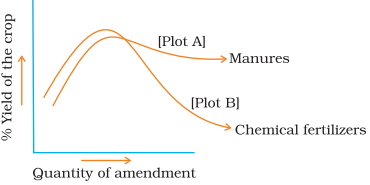
The figure shows two crop fields [Plots $A$ and $B$] that have been treated with manures and chemical fertilizers,respectively,while keeping other environmental factors constant. Observe the graph and answer the following questions.
$(i)$ Why does plot $B$ show a sudden increase and then a gradual decrease in yield?
$(ii)$ Why is the highest peak in the plot $A$ graph slightly delayed?
$(iii)$ What is the reason for the different patterns of the two graphs?
$(i)$ Why does plot $B$ show a sudden increase and then a gradual decrease in yield?
$(ii)$ Why is the highest peak in the plot $A$ graph slightly delayed?
$(iii)$ What is the reason for the different patterns of the two graphs?
Solution
(N/A) $(i)$ With the addition of chemical fertilizers,there is a sudden increase in yield due to the release of nutrients like $N, P, K$ in high quantities. The gradual decline in the graph may be due to the continuous use and high quantity of chemicals,which kill microbes useful for replenishing organic matter in the soil. This decreases soil fertility.
$(ii)$ Manures supply small quantities of nutrients to the soil slowly as they contain large amounts of organic matter. They enrich the soil with nutrients,thereby increasing soil fertility continuously.
$(iii)$ The difference in the two graphs indicates that the use of manure is beneficial for long-term cropping as the yield tends to remain high even when the quantity of manure increases.
In the case of Plot $B$,chemical fertilizers may cause various problems when used continuously for a long time. The loss of microbial activity reduces the decomposition of organic matter,and as a result,soil fertility is lost,which negatively affects the yield.
$(ii)$ Manures supply small quantities of nutrients to the soil slowly as they contain large amounts of organic matter. They enrich the soil with nutrients,thereby increasing soil fertility continuously.
$(iii)$ The difference in the two graphs indicates that the use of manure is beneficial for long-term cropping as the yield tends to remain high even when the quantity of manure increases.
In the case of Plot $B$,chemical fertilizers may cause various problems when used continuously for a long time. The loss of microbial activity reduces the decomposition of organic matter,and as a result,soil fertility is lost,which negatively affects the yield.
2 likes
View Solution49
Medium
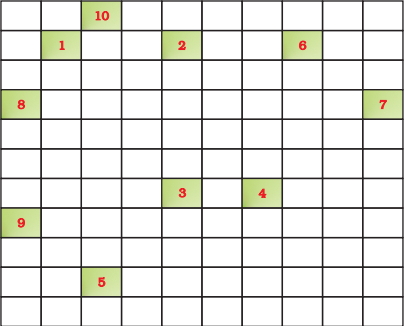
Complete the crossword puzzle (Fig.).
Across
$1.$ Oil yielding plant $(9)$
$3.$ Crop grown in winter season $(4)$
$5.$ Fixed by Rhizobium $(8)$
$9.$ Common honey bee $(4)$
Downward
$2.$ Animal feed $(6)$
$4.$ $A$ micronutrient $(5)$
$6.$ Unwanted plant in crop fields $(4)$
$7.$ An exotic breed of chicken $(7)$
$8.$ Bottom feeders in fish pond $(7)$
$10.$ $A$ marine fish $(4)$
Across
$1.$ Oil yielding plant $(9)$
$3.$ Crop grown in winter season $(4)$
$5.$ Fixed by Rhizobium $(8)$
$9.$ Common honey bee $(4)$
Downward
$2.$ Animal feed $(6)$
$4.$ $A$ micronutrient $(5)$
$6.$ Unwanted plant in crop fields $(4)$
$7.$ An exotic breed of chicken $(7)$
$8.$ Bottom feeders in fish pond $(7)$
$10.$ $A$ marine fish $(4)$
Solution
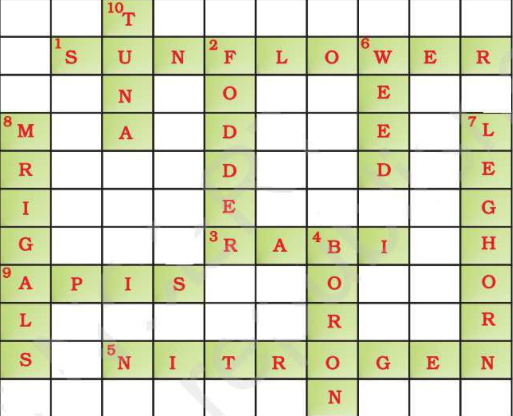
(A) The completed crossword puzzle is as follows:
Across:
$1.$ $SUNFLOWER$
$3.$ $RABI$
$5.$ $NITROGEN$
$9.$ $APIS$
Downward:
$2.$ $FODDER$
$4.$ $BORON$
$6.$ $WEED$
$7.$ $LEGHORN$
$8.$ $MRIGALS$
$10.$ $TUNA$
Across:
$1.$ $SUNFLOWER$
$3.$ $RABI$
$5.$ $NITROGEN$
$9.$ $APIS$
Downward:
$2.$ $FODDER$
$4.$ $BORON$
$6.$ $WEED$
$7.$ $LEGHORN$
$8.$ $MRIGALS$
$10.$ $TUNA$
0 likes
View Solution50
Easy
Mention any two abiotic factors that affect crop production.
Solution
(N/A) Abiotic factors are non-living components of the environment that influence crop growth and yield. Two such factors are:
$1$. Drought: Lack of water availability leads to stunted growth and reduced yield.
$2$. Salinity: High salt concentration in the soil can interfere with nutrient uptake and cause osmotic stress in plants.
$1$. Drought: Lack of water availability leads to stunted growth and reduced yield.
$2$. Salinity: High salt concentration in the soil can interfere with nutrient uptake and cause osmotic stress in plants.
0 likes
View SolutionIMPROVEMENT IN FOOD RESOURCES — Mix Example - IMPROVEMENT IN FOOD RESOURCES · Frequently Asked Questions
1Are these IMPROVEMENT IN FOOD RESOURCES questions useful for JEE and NEET?
Yes. All questions in this section are mapped to JEE Main and NEET exam patterns. Previous year questions from JEE Main, NEET, GUJCET and state-level exams are included with full solutions.
2Can I switch to Hindi or Gujarati for these questions?
Yes. Use the language tabs in the hero section or the sidebar to view the same questions and solutions in English, Hindi or Gujarati.
3How do I generate a question paper from this subtopic?
Use the Vedclass Exam Paper Generator — select the chapter and subtopic, set difficulty, and generate Sets A, B, C, D automatically. First 3 chapters of every subject are free.
Vedclass Products
For Students
Vedclass Test Series
Mock tests in real JEE/NEET style with performance analysis. 5-day free trial.
Start Free TrialFor Teachers
Exam Paper Generator
Generate Set A/B/C/D papers from this chapter in 2 minutes. 3 chapters free.
Try FreeFor Institutes
Online Exam Module
Live online exams with unlimited students, 360° analytics & white-label branding.
See DemoFor Teachers & Institutes
Generate a IMPROVEMENT IN FOOD RESOURCES Exam Paper in 2 Minutes
Select subtopic & difficulty — Sets A, B, C, D auto-generated with No Repeat logic.
First 3 chapters of every subject are free — no payment required.