
A English
Mix Example - DIVERSITY IN LIVING ORGANISMS Questions in English
Class 9 Science · DIVERSITY IN LIVING ORGANISMS · Mix Example - DIVERSITY IN LIVING ORGANISMS
215+
Questions
English
Language
100%
With Solutions
Showing 50 of 215 questions in English
101
Medium
Mention the problem which is associated with using local names of organisms. How was this resolved? Name the scientist who introduced the above solution.
Solution
(N/A) The problem with using local names is that they vary from region to region and language to language,making it difficult for people to know if they are referring to the same organism.
$(b)$ This was resolved by adopting a universal system of naming known as $Binomial$ $nomenclature$,where each organism is given a unique scientific name consisting of two parts: the genus and the species.
$(c)$ The scientist who introduced this system is $Carolus$ $Linnaeus$.
$(b)$ This was resolved by adopting a universal system of naming known as $Binomial$ $nomenclature$,where each organism is given a unique scientific name consisting of two parts: the genus and the species.
$(c)$ The scientist who introduced this system is $Carolus$ $Linnaeus$.
0 likes
View Solution102
Medium
State any three differences between cryptogamae and phanerogamae.
Solution
(N/A)
| $CRYPTOGAMAE$ | $PHANEROGAMAE$ |
| $(i)$ The reproductive organs are inconspicuous or hidden. | $(i)$ The reproductive organs are well-differentiated and visible. |
| $(ii)$ They do not produce seeds. | $(ii)$ They produce seeds. |
| $(iii)$ They reproduce through spores. | $(iii)$ They reproduce through seeds containing embryos. |
0 likes
View Solution103
Medium
Classify the following organisms into their respective kingdoms as per Whittaker's five kingdom classification:
$Amoeba$,$Euglena$,Birds,Herbs,Cats,$Lactobacillus$.
$Amoeba$,$Euglena$,Birds,Herbs,Cats,$Lactobacillus$.
Solution
(N/A) $Amoeba$ belongs to Kingdom Protista.
$Euglena$ belongs to Kingdom Protista.
Birds belong to Kingdom Animalia.
Herbs belong to Kingdom Plantae.
Cats belong to Kingdom Animalia.
$Lactobacillus$ belongs to Kingdom Monera.
$Euglena$ belongs to Kingdom Protista.
Birds belong to Kingdom Animalia.
Herbs belong to Kingdom Plantae.
Cats belong to Kingdom Animalia.
$Lactobacillus$ belongs to Kingdom Monera.
0 likes
View Solution104
Difficult
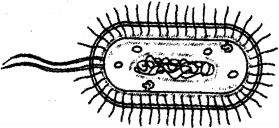
Bacteria and Cyanobacteria are included under kingdom Monera. Explain in detail the structure of $E.$ Coli bacteria. What kind of body design does it have? State its mode of nutrition.
Solution
(N/A) Structure of $E$. Coli bacterium:
$1$. Cell Envelope: $E$. Coli is a prokaryotic organism. Its cell envelope consists of an outer capsule,a cell wall,and a plasma membrane,which provide protection and structural integrity.
$2$. Genetic Material: It lacks a well-defined nucleus. Its genetic material,which is a single circular $DNA$ molecule,is located in a region called the nucleoid.
$3$. Appendages: The surface of the cell has hair-like structures called fimbriae or pili for attachment,and one or more long,whip-like structures called flagella for locomotion.
$4$. Cytoplasm: The cytoplasm contains ribosomes for protein synthesis and various inclusions.
Body Design: It has a simple,unicellular,prokaryotic body design. It is rod-shaped (bacillus).
Mode of Nutrition: $E$. Coli is heterotrophic,specifically a chemoheterotroph,as it obtains nutrients from organic matter in its environment.
$1$. Cell Envelope: $E$. Coli is a prokaryotic organism. Its cell envelope consists of an outer capsule,a cell wall,and a plasma membrane,which provide protection and structural integrity.
$2$. Genetic Material: It lacks a well-defined nucleus. Its genetic material,which is a single circular $DNA$ molecule,is located in a region called the nucleoid.
$3$. Appendages: The surface of the cell has hair-like structures called fimbriae or pili for attachment,and one or more long,whip-like structures called flagella for locomotion.
$4$. Cytoplasm: The cytoplasm contains ribosomes for protein synthesis and various inclusions.
Body Design: It has a simple,unicellular,prokaryotic body design. It is rod-shaped (bacillus).
Mode of Nutrition: $E$. Coli is heterotrophic,specifically a chemoheterotroph,as it obtains nutrients from organic matter in its environment.
0 likes
View Solution105
Medium
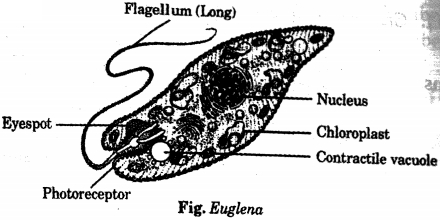
Draw a diagram of $Euglena$ and label the following parts:
Flagellum,photoreceptor,eyespot,chloroplast,nucleus,contractile vacuole.
Flagellum,photoreceptor,eyespot,chloroplast,nucleus,contractile vacuole.
Solution
(N/A) The diagram of $Euglena$ shows its characteristic spindle-shaped body.
Key structures include:
$1$. $Flagellum$: $A$ long,whip-like structure used for locomotion.
$2$. $Photoreceptor$: $A$ light-sensitive region located near the base of the flagellum.
$3$. $Eyespot$ $(Stigma)$: $A$ pigmented organelle that helps the organism detect light direction.
$4$. $Chloroplast$: Green,disc-shaped organelles responsible for photosynthesis.
$5$. $Nucleus$: The central control center containing genetic material.
$6$. $Contractile$ $vacuole$: An organelle involved in osmoregulation by expelling excess water.
Key structures include:
$1$. $Flagellum$: $A$ long,whip-like structure used for locomotion.
$2$. $Photoreceptor$: $A$ light-sensitive region located near the base of the flagellum.
$3$. $Eyespot$ $(Stigma)$: $A$ pigmented organelle that helps the organism detect light direction.
$4$. $Chloroplast$: Green,disc-shaped organelles responsible for photosynthesis.
$5$. $Nucleus$: The central control center containing genetic material.
$6$. $Contractile$ $vacuole$: An organelle involved in osmoregulation by expelling excess water.
0 likes
View Solution106
Medium
Give the differences between bony and cartilaginous fish.
Solution
(N/A)
| $BONY\, FISH$ | $CARTILAGINOUS\, FISH$ |
|---|---|
| $(i)$ Found in both freshwater and marine water. | $(i)$ Mostly found in marine water. |
| $(ii)$ Mouth is terminal in position. | $(ii)$ Mouth is usually ventral. |
| $(iii)$ Endoskeleton is made of bone. | $(iii)$ Endoskeleton is made of cartilage. |
| $(iv)$ Body is usually spindle-shaped. Examples: $Labeo$,$Anabas$. | $(iv)$ Body is dorsoventrally flattened. Examples: $Torpedo$,$Scoliodon$. |
0 likes
View Solution107
Medium
What is the difference between Bryophyta and Pteridophyta?
Solution
(N/A)
| $BRYOPHYTA$ | $PTERIDOPHYTA$ |
|---|---|
| $(i)$ The plant body is not differentiated into true root,stem,and leaves. | $(i)$ The plant body is differentiated into true root,stem,and leaves. |
| $(ii)$ The main plant body is gametophytic. | $(ii)$ The main plant body is sporophytic. |
| $(iii)$ They lack a true vascular system. Examples: $Riccia$,$Funaria$ (moss),etc. | $(iii)$ They are terrestrial vascular plants. Examples: $Dryopteris$ (fern),$Lycopodium$,etc. |
0 likes
View Solution108
Medium
What is the difference between algae and fungi?
Solution
| $ALGAE$ | $FUNGI$ |
|---|---|
| $(i)$ Algae are autotrophic. | $(i)$ Fungi are heterotrophic. |
| $(ii)$ Most of the algae are aquatic. | $(ii)$ Most of the fungi are terrestrial. |
| $(iii)$ The cell wall is made up of cellulose. | $(iii)$ The cell wall is made up of chitin. |
| $(iv)$ Algae contain starch as a stored food material. | $(iv)$ Fungi contain glycogen and oil as a stored food material. |
0 likes
View Solution109
Medium
Give the points of differences between non-chordates and chordates.
Solution
(N/A)
Detailed explanation:
$1$. In non-chordates,the notochord is completely absent throughout their life cycle.
$2$. The central nervous system in non-chordates is solid and located ventrally,whereas in chordates,it is hollow and located dorsally.
$3$. Chordates possess pharyngeal gill slits at some stage of their development,which are absent in non-chordates.
$4$. The heart in non-chordates is typically dorsal,while in chordates,it is located ventrally.
$5$. $A$ post-anal tail is a characteristic feature of chordates,which is absent in non-chordates.
| Non-chordates | Chordates |
|---|---|
| $(i)$ Notochord is absent. | $(i)$ Notochord is present. |
| $(ii)$ Central nervous system is solid and ventral. | $(ii)$ Central nervous system is hollow and dorsal. |
| $(iii)$ Pharyngeal gill slits are absent. | $(iii)$ Pharyngeal gill slits are present. |
| $(iv)$ Heart,if present,is dorsal. | $(iv)$ Heart is ventral. |
| $(v)$ Post-anal tail is absent. | $(v)$ Post-anal tail is present. |
Detailed explanation:
$1$. In non-chordates,the notochord is completely absent throughout their life cycle.
$2$. The central nervous system in non-chordates is solid and located ventrally,whereas in chordates,it is hollow and located dorsally.
$3$. Chordates possess pharyngeal gill slits at some stage of their development,which are absent in non-chordates.
$4$. The heart in non-chordates is typically dorsal,while in chordates,it is located ventrally.
$5$. $A$ post-anal tail is a characteristic feature of chordates,which is absent in non-chordates.
0 likes
View Solution110
Medium
Give the main features of chordates.
Solution
(N/A) All chordates possess the following fundamental features:
$(i)$ Presence of a notochord.
$(ii)$ Presence of a dorsal hollow nerve cord.
$(iii)$ Presence of paired pharyngeal gill slits.
$(iv)$ Presence of a post-anal tail.
$(v)$ They are triploblastic,bilaterally symmetrical,and coelomate animals.
$(i)$ Presence of a notochord.
$(ii)$ Presence of a dorsal hollow nerve cord.
$(iii)$ Presence of paired pharyngeal gill slits.
$(iv)$ Presence of a post-anal tail.
$(v)$ They are triploblastic,bilaterally symmetrical,and coelomate animals.
0 likes
View Solution111
Medium
Identify the plant bodies,which are commonly named as 'cryptogamae'. State and explain two characteristics,which are exhibited by each category of these plant bodies.
Solution
(N/A) The plant groups collectively known as 'cryptogamae' are Thallophyta,Bryophyta,and Pteridophyta.
$1$. Thallophyta: These plants have a simple,undifferentiated body structure (thallus) and lack specialized vascular tissues (xylem and phloem).
$2$. Bryophyta: These are known as amphibians of the plant kingdom; they possess a thalloid or leafy body and require water for fertilization.
$3$. Pteridophyta: These are the first terrestrial plants to possess vascular tissues (xylem and phloem) and have a well-differentiated plant body into roots,stems,and leaves.
$1$. Thallophyta: These plants have a simple,undifferentiated body structure (thallus) and lack specialized vascular tissues (xylem and phloem).
$2$. Bryophyta: These are known as amphibians of the plant kingdom; they possess a thalloid or leafy body and require water for fertilization.
$3$. Pteridophyta: These are the first terrestrial plants to possess vascular tissues (xylem and phloem) and have a well-differentiated plant body into roots,stems,and leaves.
0 likes
View Solution112
Medium
Pick the odd one out and justify your choice by giving reasons:
$(a)$ Moss,Fern,Pinus,Spirogyra.
$(b)$ Sea Cucumber,Octopus,Feather Star,Starfish.
$(a)$ Moss,Fern,Pinus,Spirogyra.
$(b)$ Sea Cucumber,Octopus,Feather Star,Starfish.
Solution
(A-D) $Pinus$ is the odd one out because it is a phanerogam (seed-bearing plant),whereas the others (Moss,Fern,and $Spirogyra$) are cryptogams (non-seed-bearing plants).
$(b)$ Octopus is the odd one out because it belongs to the phylum $Mollusca$,whereas the others (Sea Cucumber,Feather Star,and Starfish) belong to the phylum $Echinodermata$.
$(b)$ Octopus is the odd one out because it belongs to the phylum $Mollusca$,whereas the others (Sea Cucumber,Feather Star,and Starfish) belong to the phylum $Echinodermata$.
0 likes
View Solution113
Medium
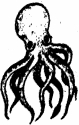
Name the phylum to which the organism shown in the image belongs. Write any two characteristic features of this phylum.
Solution
(N/A) The organism shown in the image is an octopus,which belongs to the phylum Mollusca.
Two characteristic features of the phylum Mollusca are:
$1$. They have a muscular foot used for locomotion.
$2$. They possess an open circulatory system and a reduced coelomic cavity.
Two characteristic features of the phylum Mollusca are:
$1$. They have a muscular foot used for locomotion.
$2$. They possess an open circulatory system and a reduced coelomic cavity.
0 likes
View Solution114
Medium
Write one difference for each of the following pairs:
$(i)$ Thallophyta and Bryophyta
$(ii)$ Nematoda and Annelida
$(iii)$ Amphibia and Reptilia
$(i)$ Thallophyta and Bryophyta
$(ii)$ Nematoda and Annelida
$(iii)$ Amphibia and Reptilia
Solution
(N/A) The differences are as follows:
$1$. Thallophyta and Bryophyta:
$2$. Nematoda and Annelida:
$3$. Amphibia and Reptilia:
$1$. Thallophyta and Bryophyta:
| $Thallophyta$ | $Bryophyta$ |
| The plant body is not differentiated into root,stem,and leaves. | The plant body is differentiated to form stem and leaf-like structures. |
$2$. Nematoda and Annelida:
| $Nematoda$ | $Annelida$ |
| Pseudocoelom is present; the body is round and unsegmented. | True coelom is present; the body is segmented. |
$3$. Amphibia and Reptilia:
| $Amphibia$ | $Reptilia$ |
| They can live on both land and in water; they breathe through lungs,gills,or skin. | They are mostly terrestrial; they breathe through lungs. |
0 likes
View Solution115
Medium
Classify the following organisms based on the absence $/$ presence of true coelom,i.e.,acoelomate,pseudocoelomate,and coelomate:
$(a)$ Scorpion
$(b)$ Sea anemone
$(c)$ Ascaris
$(d)$ Earthworm
$(e)$ Wuchereria
$(f)$ Nereis
$(a)$ Scorpion
$(b)$ Sea anemone
$(c)$ Ascaris
$(d)$ Earthworm
$(e)$ Wuchereria
$(f)$ Nereis
Solution
(N/A) Scorpion: Coelomate (Phylum Arthropoda)
$(b)$ Sea anemone: Acoelomate (Phylum Cnidaria)
$(c)$ Ascaris: Pseudocoelomate (Phylum Aschelminthes)
$(d)$ Earthworm: Coelomate (Phylum Annelida)
$(e)$ Wuchereria: Pseudocoelomate (Phylum Aschelminthes)
$(f)$ Nereis: Coelomate (Phylum Annelida)
$(b)$ Sea anemone: Acoelomate (Phylum Cnidaria)
$(c)$ Ascaris: Pseudocoelomate (Phylum Aschelminthes)
$(d)$ Earthworm: Coelomate (Phylum Annelida)
$(e)$ Wuchereria: Pseudocoelomate (Phylum Aschelminthes)
$(f)$ Nereis: Coelomate (Phylum Annelida)
0 likes
View Solution116
Medium
On the basis of the following features,identify the group and give one example of each:
$(i)$ Presence of notochord at some stage of life.
$(ii)$ Unicellular,microscopic,and eukaryotic.
$(iii)$ Seeds are enclosed in fruits.
$(i)$ Presence of notochord at some stage of life.
$(ii)$ Unicellular,microscopic,and eukaryotic.
$(iii)$ Seeds are enclosed in fruits.
Solution
(N/A) $(i)$ Protochordata,e.g.,$Balanoglossus$.
$(ii)$ Protista,e.g.,$Amoeba$ or $Euglena$.
$(iii)$ Angiospermae,e.g.,China rose,mustard,or any flowering plant.
$(ii)$ Protista,e.g.,$Amoeba$ or $Euglena$.
$(iii)$ Angiospermae,e.g.,China rose,mustard,or any flowering plant.
0 likes
View Solution117
Medium
$(a)$ What is the significance of binomial nomenclature?
$(b)$ Who introduced the system of scientific naming?
$(c)$ Write any two conventions followed while writing the scientific names.
$(b)$ Who introduced the system of scientific naming?
$(c)$ Write any two conventions followed while writing the scientific names.
Solution
(N/A) Binomial nomenclature is a system of providing a distinct scientific name to organisms,consisting of two components: the first name represents the genus and the second name represents the species. This ensures that an organism has a unique name recognized globally,avoiding confusion caused by local or common names.
$(b)$ The system of binomial nomenclature was introduced by Carolus Linnaeus.
$(c)$ Two conventions followed while writing scientific names are:
$(i)$ The genus name begins with a capital letter,while the species name begins with a small letter.
$(ii)$ When printed,the scientific name is written in italics; when handwritten,both the genus and species names are underlined separately.
$(b)$ The system of binomial nomenclature was introduced by Carolus Linnaeus.
$(c)$ Two conventions followed while writing scientific names are:
$(i)$ The genus name begins with a capital letter,while the species name begins with a small letter.
$(ii)$ When printed,the scientific name is written in italics; when handwritten,both the genus and species names are underlined separately.
0 likes
View Solution118
Easy
Write the most striking features of the following phyla:
$(i)$ Arthropoda
$(ii)$ Amphibia
$(iii)$ Porifera
$(i)$ Arthropoda
$(ii)$ Amphibia
$(iii)$ Porifera
Solution
(N/A) $(i)$ Arthropoda: They possess jointed appendages and a chitinous exoskeleton.
$(ii)$ Amphibia: They are adapted to live both in water and on land,and they typically have moist,glandular skin without scales.
$(iii)$ Porifera: They are multicellular organisms with a body characterized by numerous pores (ostia) and a canal system for water circulation.
$(ii)$ Amphibia: They are adapted to live both in water and on land,and they typically have moist,glandular skin without scales.
$(iii)$ Porifera: They are multicellular organisms with a body characterized by numerous pores (ostia) and a canal system for water circulation.
0 likes
View Solution119
Medium
To which group do the following organisms belong and give one reason for each:
$(a)$ Cyanobacteria
$(b)$ Euglena
$(c)$ Ulothrix
$(a)$ Cyanobacteria
$(b)$ Euglena
$(c)$ Ulothrix
Solution
(N/A) Cyanobacteria belongs to the kingdom $Monera$. The reason is that they are prokaryotic organisms and do not have a well-defined nucleus or membrane-bound cell organelles.
$(b)$ Euglena belongs to the kingdom $Protista$. The reason is that they are unicellular,eukaryotic organisms that possess chloroplasts for photosynthesis.
$(c)$ Ulothrix belongs to the kingdom $Plantae$ (specifically the division $Thallophyta$). The reason is that their body is not well-differentiated into roots,stems,and leaves; they are multicellular,eukaryotic,filamentous,and photosynthetic.
$(b)$ Euglena belongs to the kingdom $Protista$. The reason is that they are unicellular,eukaryotic organisms that possess chloroplasts for photosynthesis.
$(c)$ Ulothrix belongs to the kingdom $Plantae$ (specifically the division $Thallophyta$). The reason is that their body is not well-differentiated into roots,stems,and leaves; they are multicellular,eukaryotic,filamentous,and photosynthetic.
0 likes
View Solution120
Difficult
$(a)$ In which two ways do amphibians differ from fishes?
$(b)$ Identify the phylum of organisms having the following characteristics:
$(i)$ Pore-bearing animals and radial symmetry.
$(ii)$ Body spiny and radial symmetry.
$(c)$ Why do gymnosperms not require water for fertilization?
$(b)$ Identify the phylum of organisms having the following characteristics:
$(i)$ Pore-bearing animals and radial symmetry.
$(ii)$ Body spiny and radial symmetry.
$(c)$ Why do gymnosperms not require water for fertilization?
Solution
(N/A) $(i)$ Amphibians have a three-chambered heart,whereas fishes have a two-chambered heart.
$(ii)$ Amphibians respire through lungs on land,whereas fishes respire through gills.
$(b)$ $(i)$ Phylum Porifera.
$(ii)$ Phylum Echinodermata.
$(c)$ Gymnosperms do not require water for fertilization because they produce pollen grains that are transferred to the female reproductive organs by wind (anemophily),allowing the male gametes to reach the egg without the need for an external water medium.
$(ii)$ Amphibians respire through lungs on land,whereas fishes respire through gills.
$(b)$ $(i)$ Phylum Porifera.
$(ii)$ Phylum Echinodermata.
$(c)$ Gymnosperms do not require water for fertilization because they produce pollen grains that are transferred to the female reproductive organs by wind (anemophily),allowing the male gametes to reach the egg without the need for an external water medium.
0 likes
View Solution121
Medium
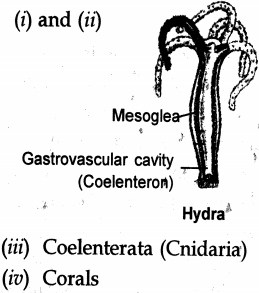
$(i)$ Draw a neat diagram of Hydra.
$(ii)$ Label mesoglea and gastrovascular cavity.
$(iii)$ Name the group of animals it belongs to.
$(iv)$ Name one species of this group that lives in colonies.
$(ii)$ Label mesoglea and gastrovascular cavity.
$(iii)$ Name the group of animals it belongs to.
$(iv)$ Name one species of this group that lives in colonies.
Solution
(N/A) $(i)$ and $(ii)$ The diagram of Hydra with the required labels is provided in the reference image.
$(iii)$ Hydra belongs to the phylum Coelenterata,also known as Cnidaria.
$(iv)$ Corals are a well-known example of animals in this group that live in colonies.
$(iii)$ Hydra belongs to the phylum Coelenterata,also known as Cnidaria.
$(iv)$ Corals are a well-known example of animals in this group that live in colonies.
0 likes
View Solution122
Medium
List three characteristics of kingdom $Monera$.
Solution
(N/A) $1.$ The organisms are prokaryotic,meaning they lack a well-defined nucleus and membrane-bound organelles.
$2.$ The cell wall is present in most members and is made up of peptidoglycan,though it is absent in some (e.g.,Mycoplasma).
$3.$ The mode of nutrition is diverse,ranging from autotrophic (photosynthetic or chemosynthetic) to heterotrophic (saprophytic or parasitic).
Examples include $Bacteria$ and $Blue-green$ algae (Cyanobacteria).
$2.$ The cell wall is present in most members and is made up of peptidoglycan,though it is absent in some (e.g.,Mycoplasma).
$3.$ The mode of nutrition is diverse,ranging from autotrophic (photosynthetic or chemosynthetic) to heterotrophic (saprophytic or parasitic).
Examples include $Bacteria$ and $Blue-green$ algae (Cyanobacteria).
0 likes
View Solution123
Medium
State the reason for the following:
$(i)$ Nematodes have a pseudocoelom.
$(ii)$ Arthropods have an open circulatory system.
$(iii)$ Echinoderms are named as such.
$(i)$ Nematodes have a pseudocoelom.
$(ii)$ Arthropods have an open circulatory system.
$(iii)$ Echinoderms are named as such.
Solution
(N/A) $(i)$ Nematodes are called pseudocoelomates because their body cavity is not fully lined by mesoderm; instead,the mesoderm is present as scattered pouches between the ectoderm and endoderm.
$(ii)$ Arthropods have an open circulatory system because their blood is pumped out of the heart into body cavities called sinuses or hemocoel,where it directly bathes the tissues and organs,rather than flowing through a closed network of vessels.
$(iii)$ Echinoderms are named so because they possess an endoskeleton of calcareous ossicles,which gives their body a spiny appearance (the term 'Echinodermata' is derived from Greek words meaning 'spiny skin').
$(ii)$ Arthropods have an open circulatory system because their blood is pumped out of the heart into body cavities called sinuses or hemocoel,where it directly bathes the tissues and organs,rather than flowing through a closed network of vessels.
$(iii)$ Echinoderms are named so because they possess an endoskeleton of calcareous ossicles,which gives their body a spiny appearance (the term 'Echinodermata' is derived from Greek words meaning 'spiny skin').
0 likes
View Solution124
Medium
State appropriate terms for the following:
$(i)$ Amphibians of the plant kingdom.
$(ii)$ Plants not having well-differentiated body design.
$(iii)$ Single-celled,eukaryotic,and photosynthetic organism.
$(i)$ Amphibians of the plant kingdom.
$(ii)$ Plants not having well-differentiated body design.
$(iii)$ Single-celled,eukaryotic,and photosynthetic organism.
Solution
(N/A) $(i)$ Bryophytes: These are known as the amphibians of the plant kingdom because they require water for fertilization despite living on land.
$(ii)$ Thallophytes: These are plants whose body is not differentiated into roots,stems,and leaves,forming a thallus-like structure.
$(iii)$ Protists (specifically algae like Chlamydomonas): These are unicellular,eukaryotic organisms that possess chloroplasts and perform photosynthesis.
$(ii)$ Thallophytes: These are plants whose body is not differentiated into roots,stems,and leaves,forming a thallus-like structure.
$(iii)$ Protists (specifically algae like Chlamydomonas): These are unicellular,eukaryotic organisms that possess chloroplasts and perform photosynthesis.
0 likes
View Solution125
Medium
State reasons for the following:
$(a)$ Mammals have mammary glands.
$(b)$ Annelids have a true body cavity.
$(c)$ Fish possess gills.
$(a)$ Mammals have mammary glands.
$(b)$ Annelids have a true body cavity.
$(c)$ Fish possess gills.
Solution
(N/A) Mammals have mammary glands to produce milk for nourishing their young ones.
$(b)$ Annelids have a true body cavity (coelom) because they exhibit a high degree of organ differentiation and tissue organization,allowing for complex internal systems.
$(c)$ Fish possess gills to extract dissolved oxygen from water,which is essential for their respiration in an aquatic environment.
$(b)$ Annelids have a true body cavity (coelom) because they exhibit a high degree of organ differentiation and tissue organization,allowing for complex internal systems.
$(c)$ Fish possess gills to extract dissolved oxygen from water,which is essential for their respiration in an aquatic environment.
0 likes
View Solution126
MediumMCQ
Classify the following organisms based on the presence of a true coelom: $Spongilla$,$Planaria$,$Scorpion$,$Birds$,$Ascaris$,$Nereis$.
A
Acoelomates: $Spongilla$,$Planaria$; Pseudocoelomates: $Ascaris$; Coelomates: $Scorpion$,$Birds$,$Nereis$.
B
Acoelomates: $Spongilla$,$Ascaris$; Pseudocoelomates: $Planaria$; Coelomates: $Scorpion$,$Birds$,$Nereis$.
C
Acoelomates: $Spongilla$,$Planaria$,$Ascaris$; Coelomates: $Scorpion$,$Birds$,$Nereis$.
D
Acoelomates: $Spongilla$; Pseudocoelomates: $Planaria$,$Ascaris$; Coelomates: $Scorpion$,$Birds$,$Nereis$.
Solution
(A) The classification based on the presence of a true coelom is as follows:
$1$. $Spongilla$ (Porifera): Acoelomate (No body cavity).
$2$. $Planaria$ (Platyhelminthes): Acoelomate (No body cavity).
$3$. $Ascaris$ (Nematoda): Pseudocoelomate (False body cavity).
$4$. $Scorpion$ (Arthropoda): Coelomate (True body cavity).
$5$. $Birds$ (Chordata): Coelomate (True body cavity).
$6$. $Nereis$ (Annelida): Coelomate (True body cavity).
Therefore,$Spongilla$ and $Planaria$ are acoelomates,$Ascaris$ is a pseudocoelomate,and $Scorpion$,$Birds$,and $Nereis$ are coelomates.
$1$. $Spongilla$ (Porifera): Acoelomate (No body cavity).
$2$. $Planaria$ (Platyhelminthes): Acoelomate (No body cavity).
$3$. $Ascaris$ (Nematoda): Pseudocoelomate (False body cavity).
$4$. $Scorpion$ (Arthropoda): Coelomate (True body cavity).
$5$. $Birds$ (Chordata): Coelomate (True body cavity).
$6$. $Nereis$ (Annelida): Coelomate (True body cavity).
Therefore,$Spongilla$ and $Planaria$ are acoelomates,$Ascaris$ is a pseudocoelomate,and $Scorpion$,$Birds$,and $Nereis$ are coelomates.
0 likes
View Solution127
Medium
Give reasons for the following:
$(a)$ Echidna and Platypus lay eggs but are considered as mammals.
$(b)$ Birds have pneumatic bones.
$(a)$ Echidna and Platypus lay eggs but are considered as mammals.
$(b)$ Birds have pneumatic bones.
Solution
(N/A) Echidna and Platypus are classified as mammals because they possess mammary glands to feed their young with milk,have hair on their bodies,and are warm-blooded (homeothermic),despite the fact that they lay eggs (oviparous).
$(b)$ Birds have pneumatic (hollow and air-filled) bones to reduce their body weight,which makes them light and facilitates flight.
$(b)$ Birds have pneumatic (hollow and air-filled) bones to reduce their body weight,which makes them light and facilitates flight.
0 likes
View Solution128
Easy
State reasons for the following:
$(i)$ Tapeworms do not have a digestive tract.
$(ii)$ Frogs have both skin and lungs for breathing.
$(iii)$ $A$ whale is a mammal,not a fish.
$(i)$ Tapeworms do not have a digestive tract.
$(ii)$ Frogs have both skin and lungs for breathing.
$(iii)$ $A$ whale is a mammal,not a fish.
Solution
(N/A) $(i)$ Tapeworms are endoparasites that live in the intestine of the host. They absorb pre-digested nutrients directly through their body surface,hence they do not require a digestive tract.
$(ii)$ Frogs exhibit cutaneous respiration through their moist skin while in water and pulmonary respiration through lungs while on land,allowing them to survive in both aquatic and terrestrial environments.
$(iii)$ $A$ whale is classified as a mammal because it is warm-blooded,gives birth to live young,possesses mammary glands to feed its offspring,and breathes air using lungs.
$(ii)$ Frogs exhibit cutaneous respiration through their moist skin while in water and pulmonary respiration through lungs while on land,allowing them to survive in both aquatic and terrestrial environments.
$(iii)$ $A$ whale is classified as a mammal because it is warm-blooded,gives birth to live young,possesses mammary glands to feed its offspring,and breathes air using lungs.
0 likes
View Solution129
Medium
$A$ student enters the museum and observes the animal specimens. He looks at the one marked 'whale' and calls it a type of fish. How will you explain to him that whales and fishes belong to two different classes? List any three distinguishing features to justify your statement.
Solution
(N/A) Whales belong to the class $Mammalia$, while fishes belong to the class $Pisces$. Here are three distinguishing features:
| $Whale$ | $Fish$ |
| $(i)$ It is a warm-blooded animal (homeothermic). | $(i)$ It is a cold-blooded animal (poikilothermic). |
| $(ii)$ It has a four-chambered heart. | $(ii)$ It has a two-chambered heart. |
| $(iii)$ It breathes through lungs. | $(iii)$ It breathes through gills. |
0 likes
View Solution130
Medium
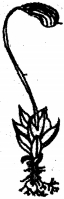
List the basic criteria for classifying the Plantae kingdom into various groups. Identify the following specimen given in the image and write its characteristic features.
Solution
(N/A) The basic criteria for classifying the Plantae kingdom are:
$(i)$ Differentiation of the plant body: Whether the plant body is well-differentiated into roots,stems,and leaves.
$(ii)$ Presence of vascular tissues: Whether the plant has specialized tissues (xylem and phloem) for the conduction of water and other substances.
$(iii)$ Ability to bear seeds: Whether the plant produces seeds and if those seeds are naked or enclosed within fruits.
The specimen shown in the image is $Funaria$ (a moss).
Its characteristic features are:
$(i)$ It belongs to the division Bryophyta.
$(ii)$ The plant body is differentiated into stem-like and leaf-like structures,but lacks true roots,stems,and leaves.
$(iii)$ It lacks specialized vascular tissues for the conduction of water and nutrients.
$(iv)$ It reproduces through spores and requires water for fertilization.
$(i)$ Differentiation of the plant body: Whether the plant body is well-differentiated into roots,stems,and leaves.
$(ii)$ Presence of vascular tissues: Whether the plant has specialized tissues (xylem and phloem) for the conduction of water and other substances.
$(iii)$ Ability to bear seeds: Whether the plant produces seeds and if those seeds are naked or enclosed within fruits.
The specimen shown in the image is $Funaria$ (a moss).
Its characteristic features are:
$(i)$ It belongs to the division Bryophyta.
$(ii)$ The plant body is differentiated into stem-like and leaf-like structures,but lacks true roots,stems,and leaves.
$(iii)$ It lacks specialized vascular tissues for the conduction of water and nutrients.
$(iv)$ It reproduces through spores and requires water for fertilization.
0 likes
View Solution131
Easy
State reasons for the following:
$(a)$ Protists have appendages like cilia or flagella.
$(b)$ Angiosperms are called so.
$(c)$ Fish have scales on their body.
$(a)$ Protists have appendages like cilia or flagella.
$(b)$ Angiosperms are called so.
$(c)$ Fish have scales on their body.
Solution
(N/A) Protists possess appendages like cilia or flagella primarily for locomotion,allowing them to move from one place to another in their aquatic environment.
$(b)$ The term Angiosperms is derived from the Greek words 'angio' meaning 'covered' and 'sperma' meaning 'seed'. They are called so because their seeds are enclosed within fruits.
$(c)$ Fish have scales on their body to provide protection,reduce friction while swimming,and prevent their skin from damage or decay due to constant exposure to water.
$(b)$ The term Angiosperms is derived from the Greek words 'angio' meaning 'covered' and 'sperma' meaning 'seed'. They are called so because their seeds are enclosed within fruits.
$(c)$ Fish have scales on their body to provide protection,reduce friction while swimming,and prevent their skin from damage or decay due to constant exposure to water.
0 likes
View Solution132
Easy
State any three bases for the classification of organisms into five kingdoms.
Solution
(N/A) The classification of organisms into five kingdoms,as proposed by $R$.$H$. Whittaker,is based on the following criteria:
$(a)$ Cell structure: Whether the organism is prokaryotic (lacking a defined nucleus) or eukaryotic (possessing a membrane-bound nucleus).
$(b)$ Body organization: Whether the organism is unicellular (single-celled) or multicellular (complex body structure).
$(c)$ Mode of nutrition: Whether the organism is autotrophic (synthesizing its own food) or heterotrophic (obtaining food from other sources).
$(a)$ Cell structure: Whether the organism is prokaryotic (lacking a defined nucleus) or eukaryotic (possessing a membrane-bound nucleus).
$(b)$ Body organization: Whether the organism is unicellular (single-celled) or multicellular (complex body structure).
$(c)$ Mode of nutrition: Whether the organism is autotrophic (synthesizing its own food) or heterotrophic (obtaining food from other sources).
0 likes
View Solution133
Medium
Write three characteristics each of the following groups of animals:
$(a)$ Platyhelminthes
$(b)$ Nematoda
$(a)$ Platyhelminthes
$(b)$ Nematoda
Solution
(N/A) Platyhelminthes:
$(i)$ They are bilaterally symmetrical.
$(ii)$ They are triploblastic (three germ layers).
$(iii)$ They are dorsiventrally flattened (flatworms).
$(iv)$ They are acoelomate (no body cavity).
$(b)$ Nematoda:
$(i)$ They are bilaterally symmetrical.
$(ii)$ They are triploblastic.
$(iii)$ They possess a pseudocoelom (false body cavity).
$(iv)$ Their body is cylindrical and unsegmented.
$(i)$ They are bilaterally symmetrical.
$(ii)$ They are triploblastic (three germ layers).
$(iii)$ They are dorsiventrally flattened (flatworms).
$(iv)$ They are acoelomate (no body cavity).
$(b)$ Nematoda:
$(i)$ They are bilaterally symmetrical.
$(ii)$ They are triploblastic.
$(iii)$ They possess a pseudocoelom (false body cavity).
$(iv)$ Their body is cylindrical and unsegmented.
0 likes
View Solution134
Easy
State reasons for the following:
$(a)$ Bryophytes are called amphibians of the plant kingdom.
$(b)$ Gymnosperms are called so (naked-seeded plants).
$(c)$ Birds have wings and feathers.
$(a)$ Bryophytes are called amphibians of the plant kingdom.
$(b)$ Gymnosperms are called so (naked-seeded plants).
$(c)$ Birds have wings and feathers.
Solution
(N/A) Bryophytes are called amphibians of the plant kingdom because they live on land but require water for fertilization,as their male gametes are motile and need a water medium to reach the female gametes.
$(b)$ Gymnosperms are called so because the term 'Gymnosperm' is derived from Greek words 'gymnos' meaning naked and 'sperma' meaning seed. They produce seeds that are not enclosed within an ovary or fruit.
$(c)$ Birds have wings and feathers to facilitate flight. Wings provide the necessary surface area for lift,while feathers help in streamlining the body,maintaining body temperature,and providing the aerodynamic structure required for flying.
$(b)$ Gymnosperms are called so because the term 'Gymnosperm' is derived from Greek words 'gymnos' meaning naked and 'sperma' meaning seed. They produce seeds that are not enclosed within an ovary or fruit.
$(c)$ Birds have wings and feathers to facilitate flight. Wings provide the necessary surface area for lift,while feathers help in streamlining the body,maintaining body temperature,and providing the aerodynamic structure required for flying.
0 likes
View Solution135
Medium
Explain the following terms:
$(a)$ Phanerogams
$(b)$ Symbiosis
$(c)$ Binomial Nomenclature
$(a)$ Phanerogams
$(b)$ Symbiosis
$(c)$ Binomial Nomenclature
Solution
(N/A) Phanerogams: These are plants with well-differentiated reproductive tissues that ultimately produce seeds. They are also known as seed-bearing plants.
$(b)$ Symbiosis: It is a permanent,mutually dependent relationship between two organisms in which both partners benefit. For example,the association between certain fungal species and blue-green algae (or cyanobacteria) forms lichens.
$(c)$ Binomial Nomenclature: This is a system of naming organisms using two words: the first word represents the generic name (genus) and the second word represents the specific epithet (species).
$(b)$ Symbiosis: It is a permanent,mutually dependent relationship between two organisms in which both partners benefit. For example,the association between certain fungal species and blue-green algae (or cyanobacteria) forms lichens.
$(c)$ Binomial Nomenclature: This is a system of naming organisms using two words: the first word represents the generic name (genus) and the second word represents the specific epithet (species).
0 likes
View Solution136
Medium
Identify the phylum of kingdom Animalia in which the animal has:
$(a)$ $A$ pseudocoelom
$(b)$ $A$ water-driven tube system
$(c)$ Jointed legs
$(d)$ Pores in the body leading to a canal system
$(e)$ Notochord at some stages of their life.
$(a)$ $A$ pseudocoelom
$(b)$ $A$ water-driven tube system
$(c)$ Jointed legs
$(d)$ Pores in the body leading to a canal system
$(e)$ Notochord at some stages of their life.
Solution
(N/A) Nematoda: These organisms possess a pseudocoelom,which is a body cavity not completely lined by mesoderm.
$(b)$ Echinodermata: These animals possess a unique water vascular system (water-driven tube system) which helps in locomotion,capture,and transport of food and respiration.
$(c)$ Arthropoda: This phylum is characterized by the presence of jointed appendages (jointed legs).
$(d)$ Porifera: These are pore-bearing animals where the body wall contains numerous ostia (pores) leading to a water canal system for circulation.
$(e)$ Chordata (specifically Protochordata): These animals possess a notochord at some stage of their life cycle.
$(b)$ Echinodermata: These animals possess a unique water vascular system (water-driven tube system) which helps in locomotion,capture,and transport of food and respiration.
$(c)$ Arthropoda: This phylum is characterized by the presence of jointed appendages (jointed legs).
$(d)$ Porifera: These are pore-bearing animals where the body wall contains numerous ostia (pores) leading to a water canal system for circulation.
$(e)$ Chordata (specifically Protochordata): These animals possess a notochord at some stage of their life cycle.
0 likes
View Solution137
Difficult
$(a)$ Associate any three phyla of Animalia with triploblastic body organisation and bilateral symmetry.
$(b)$ State the meaning of triploblastic body organisation and bilateral symmetry.
$(c)$ On the basis of presence or absence of coelom,compare the three phyla answered in $(a)$.
$(b)$ State the meaning of triploblastic body organisation and bilateral symmetry.
$(c)$ On the basis of presence or absence of coelom,compare the three phyla answered in $(a)$.
Solution
(N/A) Organisms belonging to phyla Platyhelminthes,Nematoda,and Annelida are triploblastic and exhibit bilateral symmetry.
$(b)$ Triploblastic body organisation refers to the presence of three germinal layers (ectoderm,mesoderm,and endoderm) in the developing embryo. Bilateral symmetry means that the body can be divided into identical left and right halves along a single plane.
$(c)$ Comparison based on coelom:
$1$. Platyhelminthes: Acoelomatic (lack a body cavity).
$2$. Nematoda: Pseudocoelomatic (have a false body cavity).
$3$. Annelida: Coelomatic (have a true body cavity lined by mesoderm).
$(b)$ Triploblastic body organisation refers to the presence of three germinal layers (ectoderm,mesoderm,and endoderm) in the developing embryo. Bilateral symmetry means that the body can be divided into identical left and right halves along a single plane.
$(c)$ Comparison based on coelom:
$1$. Platyhelminthes: Acoelomatic (lack a body cavity).
$2$. Nematoda: Pseudocoelomatic (have a false body cavity).
$3$. Annelida: Coelomatic (have a true body cavity lined by mesoderm).
0 likes
View Solution138
Medium
Differentiate between the following:
$(a)$ Tube system of feather star and canal system of $Euplectella$
$(b)$ Skeleton of shark and sea horse
$(c)$ Respiratory organs of tadpole and frog
$(d)$ Forelimbs of birds and lizard
$(e)$ Skin of tree frog and human
$(a)$ Tube system of feather star and canal system of $Euplectella$
$(b)$ Skeleton of shark and sea horse
$(c)$ Respiratory organs of tadpole and frog
$(d)$ Forelimbs of birds and lizard
$(e)$ Skin of tree frog and human
Solution
(N/A) Feather star $(Antedon)$ possesses a water vascular system (tube system) used for locomotion and food capture. $Euplectella$ (Venus flower basket) possesses a canal system (syconoid type) that facilitates water circulation for nutrition and respiration.
$(b)$ The skeleton of a shark is cartilaginous,meaning it is composed entirely of cartilage. The skeleton of a sea horse is bony,composed of calcified plates.
$(c)$ Tadpoles are aquatic larvae that respire primarily through gills. Adult frogs are semi-terrestrial and respire through lungs,skin (cutaneous respiration),and the buccal cavity.
$(d)$ The forelimbs of birds are modified into wings for flight. The forelimbs of lizards are pentadactyl limbs adapted for crawling or walking on land.
$(e)$ The skin of a tree frog is moist,slimy,and contains mucus glands to facilitate cutaneous respiration. Human skin is dry,keratinized,and contains sweat glands for thermoregulation and excretion,along with hair follicles.
$(b)$ The skeleton of a shark is cartilaginous,meaning it is composed entirely of cartilage. The skeleton of a sea horse is bony,composed of calcified plates.
$(c)$ Tadpoles are aquatic larvae that respire primarily through gills. Adult frogs are semi-terrestrial and respire through lungs,skin (cutaneous respiration),and the buccal cavity.
$(d)$ The forelimbs of birds are modified into wings for flight. The forelimbs of lizards are pentadactyl limbs adapted for crawling or walking on land.
$(e)$ The skin of a tree frog is moist,slimy,and contains mucus glands to facilitate cutaneous respiration. Human skin is dry,keratinized,and contains sweat glands for thermoregulation and excretion,along with hair follicles.
0 likes
View Solution139
Medium
$X, Y$ and $Z$ are living organisms.
$(a)$ Identify the group to which they belong on the basis of following features:
$(i)$ $X -$ Microscopic,unicellular,prokaryotic.
$(ii)$ $Y -$ Microscopic,unicellular,eukaryotic and shows locomotion with the help of pseudopodia/flagella.
$(iii)$ $Z -$ Multicellular,filamentous,eukaryotic,autotrophic and aquatic.
$(b)$ Which amongst the above is most advanced?
$(c)$ Name one organism each belonging to the groups of $X, Y$ and $Z$.
$(a)$ Identify the group to which they belong on the basis of following features:
$(i)$ $X -$ Microscopic,unicellular,prokaryotic.
$(ii)$ $Y -$ Microscopic,unicellular,eukaryotic and shows locomotion with the help of pseudopodia/flagella.
$(iii)$ $Z -$ Multicellular,filamentous,eukaryotic,autotrophic and aquatic.
$(b)$ Which amongst the above is most advanced?
$(c)$ Name one organism each belonging to the groups of $X, Y$ and $Z$.
Solution
(N/A) $(i)$ $X$ belongs to Kingdom Monera because it is unicellular and prokaryotic.
$(ii)$ $Y$ belongs to Kingdom Protista because it is unicellular,eukaryotic,and exhibits locomotion via pseudopodia or flagella.
$(iii)$ $Z$ belongs to Kingdom Plantae (specifically the division Thallophyta) because it is multicellular,eukaryotic,autotrophic,and aquatic.
$(b)$ Among the groups identified,$Z$ (Plantae) is the most advanced as it consists of complex,multicellular,autotrophic organisms compared to the unicellular Monera and Protista.
$(c)$ Examples:
$X -$ Bacteria (e.g.,$Escherichia \ coli$)
$Y -$ Amoeba or Euglena
$Z -$ Spirogyra
$(ii)$ $Y$ belongs to Kingdom Protista because it is unicellular,eukaryotic,and exhibits locomotion via pseudopodia or flagella.
$(iii)$ $Z$ belongs to Kingdom Plantae (specifically the division Thallophyta) because it is multicellular,eukaryotic,autotrophic,and aquatic.
$(b)$ Among the groups identified,$Z$ (Plantae) is the most advanced as it consists of complex,multicellular,autotrophic organisms compared to the unicellular Monera and Protista.
$(c)$ Examples:
$X -$ Bacteria (e.g.,$Escherichia \ coli$)
$Y -$ Amoeba or Euglena
$Z -$ Spirogyra
0 likes
View Solution140
Medium
To which class of Animalia does the housefly belong? Mention any three characteristic features of this class of animals. Give two other examples of this class of animals.
Solution
(N/A) The housefly belongs to the phylum $Arthropoda$ and the class $Insecta$.
Characteristic features of $Arthropoda$:
$1$. They are bilaterally symmetrical and their bodies are segmented.
$2$. They possess an open circulatory system.
$3$. They have a blood-filled coelomic cavity known as the $haemocoel$.
$4$. They possess jointed appendages (legs).
Examples of $Arthropoda$:
$Butterfly$,$scorpion$,$cockroach$,$centipede$,$spider$,and $prawn$.
Characteristic features of $Arthropoda$:
$1$. They are bilaterally symmetrical and their bodies are segmented.
$2$. They possess an open circulatory system.
$3$. They have a blood-filled coelomic cavity known as the $haemocoel$.
$4$. They possess jointed appendages (legs).
Examples of $Arthropoda$:
$Butterfly$,$scorpion$,$cockroach$,$centipede$,$spider$,and $prawn$.
0 likes
View Solution141
Medium
Classify the phylum Vertebrata into their further groups by giving two characteristics of each.
Solution
(N/A) $(i)$ Pisces: They have an exoskeleton of scales,an endoskeleton of bone/cartilage,and they breathe through gills.
$(ii)$ Amphibia: They possess gills in the larval stage and lungs in most adults; they have slimy,glandular skin.
$(iii)$ Reptilia: They have an exoskeleton of scales and are cold-blooded animals that lay eggs outside water.
$(iv)$ Aves: They have an exoskeleton of feathers,and their forelimbs are modified into wings for flight.
$(v)$ Mammalia: They have an exoskeleton of hair,possess external ears (pinnae),and are mostly viviparous (giving birth to young ones).
$(ii)$ Amphibia: They possess gills in the larval stage and lungs in most adults; they have slimy,glandular skin.
$(iii)$ Reptilia: They have an exoskeleton of scales and are cold-blooded animals that lay eggs outside water.
$(iv)$ Aves: They have an exoskeleton of feathers,and their forelimbs are modified into wings for flight.
$(v)$ Mammalia: They have an exoskeleton of hair,possess external ears (pinnae),and are mostly viviparous (giving birth to young ones).
0 likes
View Solution142
Difficult
Name the five classes of vertebrates. Compare any two on the basis of their $(i)$ Habitat,$(ii)$ Covering of skin,$(iii)$ Respiratory organs,$(iv)$ Chambers of heart,and $(v)$ Reproduction.
Solution
(N/A) The five classes of vertebrates are: $Pisces$,$Amphibia$,$Reptilia$,$Aves$,and $Mammalia$.
Comparison between two classes (e.g.,$Pisces$ and $Mammalia$):
Comparison between two classes (e.g.,$Pisces$ and $Mammalia$):
| Basis of Comparison | $Pisces$ | $Mammalia$ |
|---|---|---|
| $(i)$ Habitat | Aquatic | Mainly terrestrial |
| $(ii)$ Skin Covering | Scales | Hair |
| $(iii)$ Respiratory Organs | Gills | Lungs |
| $(iv)$ Heart Chambers | $2$ chambers | $4$ chambers |
| $(v)$ Reproduction | Lay eggs in water | Give birth to young ones |
0 likes
View Solution143
Medium
$(i)$ To which division of Plantae do algae belong? Write one characteristic of the division. Give two examples.
$(ii)$ Name the group:
$(a)$ Which includes unicellular eukaryotic organisms.
$(b)$ In which the mode of nutrition is saprophytic.
$(c)$ In which seeds are not enclosed in fruit.
$(iii)$ Classify flowering plants on the basis of the number of cotyledons present in the seed.
$(ii)$ Name the group:
$(a)$ Which includes unicellular eukaryotic organisms.
$(b)$ In which the mode of nutrition is saprophytic.
$(c)$ In which seeds are not enclosed in fruit.
$(iii)$ Classify flowering plants on the basis of the number of cotyledons present in the seed.
Solution
(N/A) $(i)$ Algae belong to the division Thallophyta.
Characteristic: The plant body is not differentiated into roots,stems,and leaves (thallus-like body).
Examples: $Spirogyra$,$Chara$ (or $Ulothrix$,$Cladophora$).
$(ii)$ $(a)$ Protista,$(b)$ Fungi,$(c)$ Gymnosperms.
$(iii)$ Flowering plants (Angiosperms) are classified based on the number of cotyledons as:
$1$. Monocots: Seeds contain only $1$ cotyledon.
$2$. Dicots: Seeds contain $2$ cotyledons.
Characteristic: The plant body is not differentiated into roots,stems,and leaves (thallus-like body).
Examples: $Spirogyra$,$Chara$ (or $Ulothrix$,$Cladophora$).
$(ii)$ $(a)$ Protista,$(b)$ Fungi,$(c)$ Gymnosperms.
$(iii)$ Flowering plants (Angiosperms) are classified based on the number of cotyledons as:
$1$. Monocots: Seeds contain only $1$ cotyledon.
$2$. Dicots: Seeds contain $2$ cotyledons.
0 likes
View Solution144
Difficult
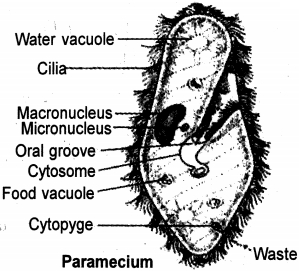
Draw the structure of Paramecium and label any six parts on it. List any two similarities and two differences between Amoeba and Paramecium.
Solution
(N/A) The structure of Paramecium includes parts such as Cilia,Macronucleus,Micronucleus,Oral groove,Cytostome,Food vacuole,and Cytopyge.
| Similarities between Amoeba and Paramecium | Differences between Amoeba and Paramecium |
|---|---|
| $(i)$ Both are unicellular eukaryotic organisms. | $(i)$ Amoeba has one nucleus,while Paramecium has two nuclei (macronucleus and micronucleus). |
| (ii) Both contain food vacuoles for digestion. | (ii) Amoeba moves with the help of pseudopodia,whereas Paramecium moves with the help of cilia. |
0 likes
View Solution145
Medium
Give the appropriate term for each of the following:
$(a)$ Complex sugar that makes the fungal cell wall
$(b)$ Exposed seeds
$(c)$ Blue-green algae
$(d)$ Basic unit of classification
$(e)$ Group of unicellular eukaryotic organisms
$(a)$ Complex sugar that makes the fungal cell wall
$(b)$ Exposed seeds
$(c)$ Blue-green algae
$(d)$ Basic unit of classification
$(e)$ Group of unicellular eukaryotic organisms
Solution
(N/A) Chitin: It is a complex polysaccharide that provides structural support to the fungal cell wall.
$(b)$ Gymnosperms: These are plants that produce seeds that are not enclosed within an ovary or fruit.
$(c)$ Cyanobacteria: These are photosynthetic prokaryotes commonly known as blue-green algae.
$(d)$ Species: It is the fundamental or basic unit of biological classification.
$(e)$ Protista: This kingdom consists of unicellular eukaryotic organisms.
$(b)$ Gymnosperms: These are plants that produce seeds that are not enclosed within an ovary or fruit.
$(c)$ Cyanobacteria: These are photosynthetic prokaryotes commonly known as blue-green algae.
$(d)$ Species: It is the fundamental or basic unit of biological classification.
$(e)$ Protista: This kingdom consists of unicellular eukaryotic organisms.
0 likes
View Solution146
Easy
Define evolution.
Solution
(N/A) Evolution is defined as the process by which different kinds of living organisms are thought to have developed and diversified from earlier forms during the history of the earth. It involves gradual changes in the genetic composition of a population over successive generations,often driven by natural selection and adaptation to the environment.
0 likes
View Solution147
EasyMCQ
Protochordates possess a notochord in larval forms. Appraise the use of this feature in these animals.
A
It provides a site for muscle attachment for movement.
B
It acts as a protective covering for the heart.
C
It helps in the digestion of food.
D
It is used for respiration.
Solution
(A) The notochord is a long,rod-like support structure (chord $=$ string) that runs along the back of the animal,separating the nervous tissue from the gut.
It provides a site for muscles to attach,which facilitates ease of movement.
It provides a site for muscles to attach,which facilitates ease of movement.
0 likes
View Solution148
Easy
Justify giving one reason: crocodiles have a four-chambered heart,but are still classified as reptiles.
Solution
(N/A) Crocodiles possess a four-chambered heart,yet they are classified as reptiles because they exhibit typical reptilian characteristics such as laying eggs with tough,leathery shells on land,which do not require water for development,unlike amphibians.
0 likes
View Solution149
Easy
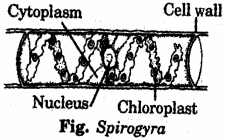
Draw the diagram of $Spirogyra$ and label the following parts:
$(a)$ Cell wall $(b)$ Pyrenoid $(c)$ Nucleus $(d)$ Chloroplast.
$(a)$ Cell wall $(b)$ Pyrenoid $(c)$ Nucleus $(d)$ Chloroplast.
Solution
(N/A) The diagram of $Spirogyra$ shows a filamentous green alga with a characteristic spiral-shaped chloroplast.
Key features to label:
$1$. Cell wall: The outermost protective layer of the cell.
$2$. Pyrenoid: Small,proteinaceous bodies embedded within the chloroplast,involved in starch storage.
$3$. Nucleus: The central organelle containing genetic material,usually suspended in the center of the cell by cytoplasmic strands.
$4$. Chloroplast: The ribbon-like,spiral structure responsible for photosynthesis.
Key features to label:
$1$. Cell wall: The outermost protective layer of the cell.
$2$. Pyrenoid: Small,proteinaceous bodies embedded within the chloroplast,involved in starch storage.
$3$. Nucleus: The central organelle containing genetic material,usually suspended in the center of the cell by cytoplasmic strands.
$4$. Chloroplast: The ribbon-like,spiral structure responsible for photosynthesis.
0 likes
View Solution150
Easy
Mention any three major differences between Porifera and Coelenterata.
Solution
(N/A)
| Porifera | Coelenterata |
|---|---|
| $(i)$ They exhibit cellular level of organization. | $(i)$ They exhibit tissue level of organization. |
| $(ii)$ Their body is diploblastic or lacks true tissue layers. | $(ii)$ Their body is distinctly diploblastic with two layers of cells. |
| $(iii)$ They possess numerous pores (ostia) all over the body for water circulation. | $(iii)$ They do not have pores all over the body; instead,they have a single opening called the hypostome. |
0 likes
View SolutionDIVERSITY IN LIVING ORGANISMS — Mix Example - DIVERSITY IN LIVING ORGANISMS · Frequently Asked Questions
1Are these DIVERSITY IN LIVING ORGANISMS questions useful for JEE and NEET?
Yes. All questions in this section are mapped to JEE Main and NEET exam patterns. Previous year questions from JEE Main, NEET, GUJCET and state-level exams are included with full solutions.
2Can I switch to Hindi or Gujarati for these questions?
Yes. Use the language tabs in the hero section or the sidebar to view the same questions and solutions in English, Hindi or Gujarati.
3How do I generate a question paper from this subtopic?
Use the Vedclass Exam Paper Generator — select the chapter and subtopic, set difficulty, and generate Sets A, B, C, D automatically. First 3 chapters of every subject are free.
Vedclass Products
For Students
Vedclass Test Series
Mock tests in real JEE/NEET style with performance analysis. 5-day free trial.
Start Free TrialFor Teachers
Exam Paper Generator
Generate Set A/B/C/D papers from this chapter in 2 minutes. 3 chapters free.
Try FreeFor Institutes
Online Exam Module
Live online exams with unlimited students, 360° analytics & white-label branding.
See DemoFor Teachers & Institutes
Generate a DIVERSITY IN LIVING ORGANISMS Exam Paper in 2 Minutes
Select subtopic & difficulty — Sets A, B, C, D auto-generated with No Repeat logic.
First 3 chapters of every subject are free — no payment required.