
A English
Mix Example - DIVERSITY IN LIVING ORGANISMS Questions in English
Class 9 Science · DIVERSITY IN LIVING ORGANISMS · Mix Example - DIVERSITY IN LIVING ORGANISMS
215+
Questions
English
Language
100%
With Solutions
Showing 50 of 215 questions in English
1
MediumMCQ
Find out the incorrect sentence.
A
Monerans have a well-defined nucleus.
B
$Whittaker$ considered cell structure,mode,and source of nutrition for classifying the organisms into five kingdoms.
C
Both $Monera$ and $Protista$ may be autotrophic and heterotrophic.
D
$Protista$ includes unicellular eukaryotic organisms.
Solution
(A) $Monerans$ are prokaryotes,which means they do not possess a well-defined nucleus. Their genetic material is not enclosed within a nuclear membrane. Therefore,the statement that $Monerans$ have a well-defined nucleus is incorrect.
0 likes
View Solution2
MediumMCQ
Which among the following has specialised tissue for the conduction of water?
$(i)$ Thallophyta
$(ii)$ Bryophyta
$(iii)$ Pteridophyta
$(iv)$ Gymnosperms
$(i)$ Thallophyta
$(ii)$ Bryophyta
$(iii)$ Pteridophyta
$(iv)$ Gymnosperms
A
$(i)$ and $(ii)$
B
$(iii)$ and $(iv)$
C
$(ii)$ and $(iii)$
D
$(i)$ and $(iv)$
Solution
(B) Specialised conductive tissues (xylem and phloem) are absent in Thallophyta and Bryophyta.
These tissues first appear in Pteridophyta and are also present in Gymnosperms.
Therefore,Pteridophyta and Gymnosperms possess specialised tissues for the conduction of water.
These tissues first appear in Pteridophyta and are also present in Gymnosperms.
Therefore,Pteridophyta and Gymnosperms possess specialised tissues for the conduction of water.
0 likes
View Solution3
EasyMCQ
Which among the following produce seeds?
A
Thallophyta
B
Bryophyta
C
Gymnosperms
D
Pteridophyta
Solution
(C) Plants are classified based on their ability to produce seeds.
$1$. Thallophyta,Bryophyta,and Pteridophyta are cryptogams,meaning they do not produce seeds.
$2$. Gymnosperms and Angiosperms are phanerogams,which are seed-bearing plants.
$3$. Therefore,among the given options,Gymnosperms are the only group that produces seeds.
$1$. Thallophyta,Bryophyta,and Pteridophyta are cryptogams,meaning they do not produce seeds.
$2$. Gymnosperms and Angiosperms are phanerogams,which are seed-bearing plants.
$3$. Therefore,among the given options,Gymnosperms are the only group that produces seeds.
0 likes
View Solution4
EasyMCQ
Which one is a true fish?
A
Jellyfish
B
Starfish
C
Silverfish
D
Dogfish
Solution
(D) true fish belongs to the class $Pisces$ (or $Chondrichthyes$/$Osteichthyes$).
$Dogfish$ $(Scoliodon)$ is a cartilaginous fish belonging to the class $Chondrichthyes$.
$Jellyfish$ is a member of the phylum $Cnidaria$ (or $Coelenterata$).
$Starfish$ is an echinoderm belonging to the phylum $Echinodermata$.
$Silverfish$ is an insect belonging to the phylum $Arthropoda$.
Therefore,$Dogfish$ is the only true fish among the given options.
$Dogfish$ $(Scoliodon)$ is a cartilaginous fish belonging to the class $Chondrichthyes$.
$Jellyfish$ is a member of the phylum $Cnidaria$ (or $Coelenterata$).
$Starfish$ is an echinoderm belonging to the phylum $Echinodermata$.
$Silverfish$ is an insect belonging to the phylum $Arthropoda$.
Therefore,$Dogfish$ is the only true fish among the given options.
0 likes
View Solution5
EasyMCQ
Which among the following phyla is exclusively marine?
A
Echinodermata
B
Porifera
C
Mollusca
D
Pisces
Solution
(A) The phylum $Echinodermata$ consists of organisms that are exclusively marine.
$Porifera$ (sponges) are mostly marine but some species are found in freshwater.
$Mollusca$ includes both marine and freshwater species.
$Pisces$ (fishes) are found in both marine and freshwater environments.
$Porifera$ (sponges) are mostly marine but some species are found in freshwater.
$Mollusca$ includes both marine and freshwater species.
$Pisces$ (fishes) are found in both marine and freshwater environments.
0 likes
View Solution6
MediumMCQ
Which among the following have an open circulatory system?
$(i)$ Arthropoda
$(ii)$ Mollusca
$(iii)$ Annelida
$(iv)$ Coelenterata
$(i)$ Arthropoda
$(ii)$ Mollusca
$(iii)$ Annelida
$(iv)$ Coelenterata
A
$(iii)$ and $(iv)$
B
$(i)$ and $(ii)$
C
$(i)$ and $(iii)$
D
$(ii)$ and $(iv)$
Solution
(B) An open circulatory system is a type of circulatory system where blood is pumped into body cavities,where tissues are surrounded by the blood.
$(i)$ Arthropoda: Most arthropods (e.g.,insects,crustaceans) possess an open circulatory system.
$(ii)$ Mollusca: Most molluscs (except cephalopods like octopus) possess an open circulatory system.
$(iii)$ Annelida: Annelids possess a closed circulatory system.
$(iv)$ Coelenterata: These organisms lack a specialized circulatory system as they rely on diffusion for transport.
Therefore,$(i)$ and $(ii)$ have an open circulatory system.
$(i)$ Arthropoda: Most arthropods (e.g.,insects,crustaceans) possess an open circulatory system.
$(ii)$ Mollusca: Most molluscs (except cephalopods like octopus) possess an open circulatory system.
$(iii)$ Annelida: Annelids possess a closed circulatory system.
$(iv)$ Coelenterata: These organisms lack a specialized circulatory system as they rely on diffusion for transport.
Therefore,$(i)$ and $(ii)$ have an open circulatory system.
0 likes
View Solution7
EasyMCQ
In which group of animals is the coelom filled with blood?
A
Nematoda
B
Annelida
C
Arthropoda
D
Echinodermata
Solution
(C) In $Arthropoda$, the body cavity is a $haemocoel$, which is a blood-filled cavity. The blood flows freely within this cavity, bathing the internal organs directly. This is characteristic of an open circulatory system.
0 likes
View Solution8
MediumMCQ
Elephantiasis is caused by
A
Liver flukes
B
Pinworm
C
Planarians
D
Wuchereria
Solution
(D) Elephantiasis, also known as filariasis, is a disease characterized by the thickening of the skin and underlying tissues, especially in the legs and male genitals. It is caused by parasitic filarial worms, specifically $Wuchereria \text{ } bancrofti$ and $Wuchereria \text{ } malayi$. These worms are transmitted to humans through the bite of infected mosquitoes. Therefore, the correct option is $D$.
0 likes
View Solution9
EasyMCQ
Which one is the most striking or common character of the vertebrates?
A
Presence of notochord
B
Presence of triploblastic condition
C
Presence of gill pouches
D
Presence of coelom
Solution
(A) The presence of a notochord is the defining and most striking characteristic of all vertebrates at some stage in their life cycle. While triploblastic condition,gill pouches,and coelom are also found in many non-vertebrate organisms,the notochord is unique to the phylum Chordata,to which all vertebrates belong.
0 likes
View Solution10
MediumMCQ
Which among the following have scales?
$(i)$ Amphibians
$(ii)$ Pisces
$(iii)$ Reptiles
$(iv)$ Mammals
$(i)$ Amphibians
$(ii)$ Pisces
$(iii)$ Reptiles
$(iv)$ Mammals
A
$(i)$ and $(iii)$
B
$(ii)$ and $(iii)$
C
$(iii)$ and $(iv)$
D
$(i)$ and $(ii)$
Solution
(B) The presence of scales is a characteristic feature of certain vertebrate classes.
$(i)$ Amphibians: Their skin is moist and lacks scales.
$(ii)$ Pisces (Fishes): Most fishes have an exoskeleton of scales.
$(iii)$ Reptiles: Their skin is dry and covered with scales.
$(iv)$ Mammals: Their skin is covered with hair,not scales.
Therefore,both Pisces and Reptiles possess scales. The correct option is $(ii)$ and $(iii)$.
$(i)$ Amphibians: Their skin is moist and lacks scales.
$(ii)$ Pisces (Fishes): Most fishes have an exoskeleton of scales.
$(iii)$ Reptiles: Their skin is dry and covered with scales.
$(iv)$ Mammals: Their skin is covered with hair,not scales.
Therefore,both Pisces and Reptiles possess scales. The correct option is $(ii)$ and $(iii)$.
0 likes
View Solution11
MediumMCQ
Find out the false statement.
A
$A$. Aves are warm-blooded,egg-laying,and have a four-chambered heart.
B
$B$. Aves have a feather-covered body,forelimbs are modified as wings,and they breathe through lungs.
C
$C$. Fishes,amphibians,and reptiles are oviparous.
D
$D$. Most of the mammals are viviparous.
Solution
(C) The statement '$C$' is false because not all fishes,amphibians,and reptiles are oviparous.
Some fishes (e.g.,sharks) and some reptiles (e.g.,certain snakes) are viviparous.
Amphibians generally exhibit external fertilization,and while many are oviparous,the classification is not universally applicable to all members of these groups as strictly oviparous.
Some fishes (e.g.,sharks) and some reptiles (e.g.,certain snakes) are viviparous.
Amphibians generally exhibit external fertilization,and while many are oviparous,the classification is not universally applicable to all members of these groups as strictly oviparous.
0 likes
View Solution12
EasyMCQ
Pteridophyta do not have
A
root
B
stem
C
leaves
D
flowers
Solution
(D) Pteridophytes are vascular cryptogams,meaning they possess roots,stems,and leaves but do not produce seeds or flowers. Flowers are reproductive structures found exclusively in angiosperms (flowering plants).
0 likes
View Solution13
EasyMCQ
Identify a member of the phylum Porifera.
A
Spongilla
B
Euglena
C
Penicillium
D
Hydra
Solution
(A) $Spongilla$ is a freshwater sponge that belongs to the phylum $Porifera$.
$Euglena$ is a unicellular protist belonging to the kingdom $Protista$.
$Penicillium$ is a type of fungus belonging to the kingdom $Fungi$.
$Hydra$ is a freshwater organism belonging to the phylum $Coelenterata$ (also known as $Cnidaria$).
$Euglena$ is a unicellular protist belonging to the kingdom $Protista$.
$Penicillium$ is a type of fungus belonging to the kingdom $Fungi$.
$Hydra$ is a freshwater organism belonging to the phylum $Coelenterata$ (also known as $Cnidaria$).
0 likes
View Solution14
EasyMCQ
Which of the following is not an aquatic animal?
A
Hydra
B
Filaria
C
Corals
D
Jelly fish
Solution
(B) Filaria is a disease caused by the parasitic worm $Wuchereria$ $bancrofti$. It is not an animal itself,but rather a medical condition. In contrast,$Hydra$,$Corals$,and $Jelly$ $fish$ are all aquatic animals belonging to the phylum $Cnidaria$.
0 likes
View Solution15
EasyMCQ
Amphibians do not have the following:
A
Three-chambered heart
B
Gills or lungs
C
Scales
D
Mucus glands
Solution
(C) Amphibians possess a three-chambered heart consisting of two atria and one ventricle.
They respire through lungs in their adult stage and through gills during their larval (tadpole) stage.
Their skin is moist and contains mucus glands to prevent desiccation.
Unlike reptiles,amphibians lack scales on their skin,which is why they are often referred to as having 'naked' skin.
They respire through lungs in their adult stage and through gills during their larval (tadpole) stage.
Their skin is moist and contains mucus glands to prevent desiccation.
Unlike reptiles,amphibians lack scales on their skin,which is why they are often referred to as having 'naked' skin.
0 likes
View Solution16
MediumMCQ
Organisms without a nucleus and cell organelles belong to:
$(i)$ Fungi
$(ii)$ Protista
$(iii)$ Cyanobacteria
$(iv)$ Archaebacteria
$(i)$ Fungi
$(ii)$ Protista
$(iii)$ Cyanobacteria
$(iv)$ Archaebacteria
A
$(i)$ and $(ii)$
B
$(ii)$ and $(iii)$
C
$(i)$ and $(iv)$
D
$(iii)$ and $(iv)$
Solution
(D) Organisms that lack a defined nucleus and membrane-bound cell organelles are classified as prokaryotes.
According to the five-kingdom classification,prokaryotes are placed under the Kingdom Monera.
Cyanobacteria (blue-green algae) and Archaebacteria are both members of the Kingdom Monera.
Fungi and Protista are eukaryotes,meaning they possess a well-defined nucleus and membrane-bound organelles.
Therefore,the correct group is $(iii)$ and $(iv)$.
According to the five-kingdom classification,prokaryotes are placed under the Kingdom Monera.
Cyanobacteria (blue-green algae) and Archaebacteria are both members of the Kingdom Monera.
Fungi and Protista are eukaryotes,meaning they possess a well-defined nucleus and membrane-bound organelles.
Therefore,the correct group is $(iii)$ and $(iv)$.
0 likes
View Solution17
EasyMCQ
Which of the following is not a criterion for classification of living organisms?
A
Height of the plant
B
Ability to produce one's own food
C
Membrane bound nucleus and cell organelles
D
Body design of the organism
Solution
(A) Classification of living organisms is based on fundamental characteristics such as cellular structure (prokaryotic vs eukaryotic),mode of nutrition (autotrophic vs heterotrophic),and body organization.
Height of a plant is a variable characteristic that changes with age and environmental conditions.
$A$ small shrub and a large tree can both belong to the same group (e.g.,angiosperms).
Therefore,the height of a plant is not a reliable criterion for biological classification.
Height of a plant is a variable characteristic that changes with age and environmental conditions.
$A$ small shrub and a large tree can both belong to the same group (e.g.,angiosperms).
Therefore,the height of a plant is not a reliable criterion for biological classification.
0 likes
View Solution18
MediumMCQ
Which of the following is not a characteristic feature of Protochordata?
A
Presence of notochord
B
Jointed legs
C
Bilateral symmetry and coelom
D
Presence of circulatory system
Solution
(B) Protochordates are marine animals that possess a notochord at some stage of their life cycle. They exhibit bilateral symmetry,are triploblastic,and have a coelom. However,jointed legs are a characteristic feature of the phylum $Arthropoda$,which belongs to the kingdom $Animalia$ but is distinct from the phylum $Chordata$ (which includes Protochordata). Therefore,jointed legs are not a feature of Protochordata.
0 likes
View Solution19
EasyMCQ
The locomotory organs of $Echinodermata$ are:
A
jointed legs
B
muscular feet
C
tube feet
D
parapodia
Solution
(C) The phylum $Echinodermata$ is characterized by the presence of a water vascular system. The locomotory organs in these organisms are known as $tube feet$ (or $podia$). These structures are used for locomotion, capturing food, and respiration.
0 likes
View Solution20
EasyMCQ
Corals are
A
Poriferans attached to some solid support
B
Cnidarians,that are solitary living
C
Poriferans present at the sea bed
D
Cnidarians that live in colonies
Solution
(D) Corals belong to the phylum $Cnidaria$ (also known as $Coelenterata$). They are marine invertebrates that typically live in large colonies. These colonies secrete calcium carbonate to form hard,protective skeletons,which eventually build up to form coral reefs.
0 likes
View Solution21
EasyMCQ
Who introduced the system of scientific nomenclature of organisms?
A
Carolus Linnaeus
B
Robert Whittaker
C
Robert Hooke
D
Ernst Haeckel
Solution
(A) Carolus Linnaeus introduced the system of scientific nomenclature,specifically known as binomial nomenclature.
This system provides a unique two-part name to every organism,consisting of a genus name and a species name.
This system provides a unique two-part name to every organism,consisting of a genus name and a species name.
0 likes
View Solution22
EasyMCQ
Two-chambered heart occurs in
A
crocodiles
B
fish
C
aves
D
amphibians
Solution
(B) two-chambered heart consists of one atrium and one ventricle. This type of heart is characteristic of fish,where deoxygenated blood is pumped to the gills for oxygenation and then distributed to the rest of the body. In contrast,amphibians have a three-chambered heart,while crocodiles and aves (birds) possess a four-chambered heart.
0 likes
View Solution23
EasyMCQ
The skeleton is made entirely of cartilage in:
A
Rohu
B
Tuna
C
Sharks
D
None of these
Solution
(C) Sharks belong to the class $Chondrichthyes$,which are cartilaginous fish,meaning their endoskeleton is composed entirely of cartilage. In contrast,$Rohu$ and $Tuna$ belong to the class $Osteichthyes$,which are bony fish.
0 likes
View Solution24
MediumMCQ
Which of the following is not an Annelid?
A
Nereis
B
Earthworm
C
Leech
D
Urchins
Solution
(D) Annelids are characterized by metameric segmentation. $Nereis$,Earthworm,and Leech are members of the phylum Annelida. Sea urchins belong to the phylum Echinodermata,not Annelida.
0 likes
View Solution25
EasyMCQ
The book $Systema \text{ } Naturae$ was written by:
A
Linnaeus
B
Haeckel
C
Whittaker
D
Robert Brown
Solution
(A) The book $Systema \text{ } Naturae$ is a seminal work in the history of biological classification. It was written by Carolus Linnaeus, who is known as the father of modern taxonomy. In this book, he introduced the system of binomial nomenclature for naming organisms.
0 likes
View Solution26
MediumMCQ
Karl Von Linne was involved with which branch of science?
A
Morphology
B
Taxonomy
C
Physiology
D
Medicine
Solution
(B) Karl Von Linne,also known as Carolus Linnaeus,is widely recognized as the 'Father of Taxonomy'.
He developed the system of binomial nomenclature,which is the formal system of naming organisms that is still used in biology today.
Therefore,he was primarily involved with the branch of science known as Taxonomy.
He developed the system of binomial nomenclature,which is the formal system of naming organisms that is still used in biology today.
Therefore,he was primarily involved with the branch of science known as Taxonomy.
0 likes
View Solution27
EasyMCQ
Real organs are absent in
A
Mollusca
B
Arthropoda
C
Coelenterata
D
Echinodermata
Solution
(C) Coelenterates exhibit a tissue level of organization,meaning their body is composed of specialized cells organized into tissues but lacks complex organ systems. Therefore,real organs are absent in them.
0 likes
View Solution28
EasyMCQ
Hard calcium carbonate structures are used as a skeleton by
A
Nematoda
B
Protochordata
C
Arthropoda
D
Echinodermata
Solution
(D) The members of the phylum $Echinodermata$ (such as starfish and sea urchins) possess an endoskeleton made of calcareous ossicles,which are hard structures composed of calcium carbonate. These structures provide support and protection to the organism.
0 likes
View Solution29
EasyMCQ
Differentiation in segmental fashion occurs in
A
Leech
B
Starfish
C
Snails
D
Ascaris
Solution
(A) The phenomenon of metameric segmentation,where the body is divided into repeating segments,is a characteristic feature of the phylum $Annelida$.
Leech $(Hirudinaria)$ belongs to the phylum $Annelida$,and therefore,it exhibits differentiation in a segmental fashion.
Starfish belongs to $Echinodermata$,Snails belong to $Mollusca$,and $Ascaris$ belongs to $Aschelminthes$ (or $Nematoda$),none of which exhibit true metameric segmentation.
Leech $(Hirudinaria)$ belongs to the phylum $Annelida$,and therefore,it exhibits differentiation in a segmental fashion.
Starfish belongs to $Echinodermata$,Snails belong to $Mollusca$,and $Ascaris$ belongs to $Aschelminthes$ (or $Nematoda$),none of which exhibit true metameric segmentation.
0 likes
View Solution30
MediumMCQ
In taxonomic hierarchy,family comes between
A
Class and Order
B
Order and Genus
C
Genus and Species
D
Division and Class
Solution
(B) The taxonomic hierarchy follows the sequence: Kingdom $\to $ Phylum/Division $\to $ Class $\to $ Order $\to $ Family $\to $ Genus $\to $ Species.
Therefore,the family category is placed between the order and the genus.
Therefore,the family category is placed between the order and the genus.
0 likes
View Solution31
MediumMCQ
$5$-Kingdom classification was given by:
A
Morgan
B
Linnaeus
C
$R$. Whittaker
D
Haeckel
Solution
(C) The $5$-Kingdom classification system was proposed by $R. H. Whittaker$ in $1969$.
This system classifies organisms into $5$ kingdoms: $Monera$,$Protista$,$Fungi$,$Plantae$,and $Animalia$.
This classification is based on criteria such as cell structure,body organization,mode of nutrition,and phylogenetic relationships.
This system classifies organisms into $5$ kingdoms: $Monera$,$Protista$,$Fungi$,$Plantae$,and $Animalia$.
This classification is based on criteria such as cell structure,body organization,mode of nutrition,and phylogenetic relationships.
0 likes
View Solution32
MediumMCQ
$A$ well-defined nucleus is absent in
A
Blue-green algae
B
Diatoms
C
Algae
D
Yeast
Solution
(A) Blue-green algae (Cyanobacteria) belong to the kingdom $Monera$. Organisms in this kingdom are prokaryotes,which means they lack a membrane-bound,well-defined nucleus and other membrane-bound organelles. In contrast,diatoms,algae,and yeast are eukaryotes and possess a well-defined nucleus.
0 likes
View Solution33
MediumMCQ
The 'Origin of Species' was written by:
A
Linnaeus
B
Darwin
C
Haeckel
D
Whittaker
Solution
(B) The book 'On the Origin of Species' was written by Charles Darwin. It was published on $24$ November $1859$ and is considered to be the foundation of evolutionary biology. In this work,Darwin introduced the scientific theory that populations evolve over the course of generations through a process of natural selection.
0 likes
View Solution34
MediumMCQ
Meena and Hari observed an animal in their garden. Hari called it an insect while Meena said it was an earthworm. Choose the character from the following which confirms that it is an insect.
A
Bilateral symmetrical body
B
Cylindrical body
C
Body with jointed legs
D
Body with little segmentation
Solution
(C) The presence of jointed legs is a defining characteristic of the phylum $Arthropoda$.
Since insects belong to the class $Insecta$ under the phylum $Arthropoda$,the presence of jointed legs confirms that the animal is an insect.
Since insects belong to the class $Insecta$ under the phylum $Arthropoda$,the presence of jointed legs confirms that the animal is an insect.
0 likes
View Solution35
Easy
Write true $(T)$ or false $(F)$ for the following statements:
$(a)$ Whittaker proposed five kingdom classification.
$(b)$ Monera is divided into Archaebacteria and Eubacteria.
$(c)$ Starting from Class,Species comes before the Genus.
$(d)$ Anabaena belongs to the kingdom Monera.
$(e)$ Blue green algae belongs to the kingdom Protista.
$(f)$ All prokaryotes are classified under Monera.
$(a)$ Whittaker proposed five kingdom classification.
$(b)$ Monera is divided into Archaebacteria and Eubacteria.
$(c)$ Starting from Class,Species comes before the Genus.
$(d)$ Anabaena belongs to the kingdom Monera.
$(e)$ Blue green algae belongs to the kingdom Protista.
$(f)$ All prokaryotes are classified under Monera.
Solution
(A) $T$: $R$.$H$. Whittaker proposed the five-kingdom classification system in $1969$.
$(b)$ $T$: The kingdom Monera is broadly categorized into Archaebacteria and Eubacteria.
$(c)$ $F$: In the taxonomic hierarchy,the order is Class,Order,Family,Genus,Species. Thus,Genus comes before Species.
$(d)$ $T$: Anabaena is a cyanobacterium (blue-green alga),which is a prokaryote and belongs to the kingdom Monera.
$(e)$ $F$: Blue-green algae (cyanobacteria) are prokaryotic organisms and are classified under the kingdom Monera,not Protista.
$(f)$ $T$: All prokaryotic organisms,which lack a defined nucleus and membrane-bound organelles,are placed in the kingdom Monera.
$(b)$ $T$: The kingdom Monera is broadly categorized into Archaebacteria and Eubacteria.
$(c)$ $F$: In the taxonomic hierarchy,the order is Class,Order,Family,Genus,Species. Thus,Genus comes before Species.
$(d)$ $T$: Anabaena is a cyanobacterium (blue-green alga),which is a prokaryote and belongs to the kingdom Monera.
$(e)$ $F$: Blue-green algae (cyanobacteria) are prokaryotic organisms and are classified under the kingdom Monera,not Protista.
$(f)$ $T$: All prokaryotic organisms,which lack a defined nucleus and membrane-bound organelles,are placed in the kingdom Monera.
0 likes
View Solution36
Easy
Fill in the blanks:
$(a)$ Fungi shows .............. mode of nutrition.
$(b)$ Cell wall of fungi is made up of ..............
$(c)$ Association between blue-green algae and fungi is called as ..............
$(d)$ Chemical nature of chitin is ..............
$(e)$ .............. has the smallest number of organisms with the maximum number of similar characters.
$(f)$ Plants without well-differentiated stem,root,and leaf are kept in ..............
$(g)$ .............. are called as amphibians of the plant kingdom.
$(a)$ Fungi shows .............. mode of nutrition.
$(b)$ Cell wall of fungi is made up of ..............
$(c)$ Association between blue-green algae and fungi is called as ..............
$(d)$ Chemical nature of chitin is ..............
$(e)$ .............. has the smallest number of organisms with the maximum number of similar characters.
$(f)$ Plants without well-differentiated stem,root,and leaf are kept in ..............
$(g)$ .............. are called as amphibians of the plant kingdom.
Solution
(A-D) Fungi exhibit a saprotrophic mode of nutrition,where they obtain nutrients from decaying organic matter.
$(b)$ The cell wall of fungi is composed of a complex polysaccharide called chitin.
$(c)$ The symbiotic association between blue-green algae (or cyanobacteria) and fungi is known as lichens.
$(d)$ Chemically,chitin is a complex carbohydrate,specifically a nitrogen-containing polysaccharide ($N$-acetylglucosamine).
$(e)$ Species is the basic unit of classification and contains the smallest number of organisms with the maximum number of similar characters.
$(f)$ Plants that lack a well-differentiated body structure (stem,root,and leaf) are classified under the group Thallophyta.
$(g)$ Bryophytes are referred to as the amphibians of the plant kingdom because they require water for fertilization despite living on land.
$(b)$ The cell wall of fungi is composed of a complex polysaccharide called chitin.
$(c)$ The symbiotic association between blue-green algae (or cyanobacteria) and fungi is known as lichens.
$(d)$ Chemically,chitin is a complex carbohydrate,specifically a nitrogen-containing polysaccharide ($N$-acetylglucosamine).
$(e)$ Species is the basic unit of classification and contains the smallest number of organisms with the maximum number of similar characters.
$(f)$ Plants that lack a well-differentiated body structure (stem,root,and leaf) are classified under the group Thallophyta.
$(g)$ Bryophytes are referred to as the amphibians of the plant kingdom because they require water for fertilization despite living on land.
0 likes
View Solution37
Easy
You are provided with the seeds of gram,wheat,rice,pumpkin,maize,and pea. Classify them into monocot and dicot seeds.
Solution
(N/A) The classification of the given seeds is as follows:
$1$. Gram: Dicot (contains two cotyledons).
$2$. Wheat: Monocot (contains one cotyledon).
$3$. Rice: Monocot (contains one cotyledon).
$4$. Pumpkin: Dicot (contains two cotyledons).
$5$. Maize: Monocot (contains one cotyledon).
$6$. Pea: Dicot (contains two cotyledons).
$1$. Gram: Dicot (contains two cotyledons).
$2$. Wheat: Monocot (contains one cotyledon).
$3$. Rice: Monocot (contains one cotyledon).
$4$. Pumpkin: Dicot (contains two cotyledons).
$5$. Maize: Monocot (contains one cotyledon).
$6$. Pea: Dicot (contains two cotyledons).
0 likes
View Solution38
MediumMCQ
Match items of column $(A)$ with items of column $(B)$:
| Column $(A)$ | Column $(B)$ |
| $(a)$ Naked seed | $(A)$ Angiosperms |
| $(b)$ Covered seed | $(B)$ Gymnosperms |
| $(c)$ Flagella | $(C)$ Bryophytes |
| $(d)$ Marchantia | $(D)$ Euglena |
| $(e)$ Marsilea | $(E)$ Thallophyta |
| $(f)$ Cladophora | $(F)$ Pteridophyta |
| $(g)$ Penicillium | $(G)$ Fungi |
A
$(a) - B, (b) - A, (c) - D, (d) - C, (e) - F, (f) - E, (g) - G$
B
$(a) - B, (b) - C, (c) - D, (d) - A, (e) - E, (f) - F, (g) - G$
C
$(a) - G, (b) - C, (c) - E, (d) - A, (e) - D, (f) - F, (g) - B$
D
$(a) - B, (b) - A, (c) - D, (d) - G, (e) - F, (f) - E, (g) - C$
Solution
(A) The correct matches are as follows:
$(a)$ Naked seed: $(B)$ Gymnosperms (seeds are not enclosed in fruits).
$(b)$ Covered seed: $(A)$ Angiosperms (seeds are enclosed within fruits).
$(c)$ Flagella: $(D)$ Euglena (locomotory organelle).
$(d)$ Marchantia: $(C)$ Bryophytes (a type of liverwort).
$(e)$ Marsilea: $(F)$ Pteridophyta (a type of fern).
$(f)$ Cladophora: $(E)$ Thallophyta (a type of green algae).
$(g)$ Penicillium: $(G)$ Fungi (a type of fungus).
Therefore, the correct sequence is $(a) - B, (b) - A, (c) - D, (d) - C, (e) - F, (f) - E, (g) - G$.
$(a)$ Naked seed: $(B)$ Gymnosperms (seeds are not enclosed in fruits).
$(b)$ Covered seed: $(A)$ Angiosperms (seeds are enclosed within fruits).
$(c)$ Flagella: $(D)$ Euglena (locomotory organelle).
$(d)$ Marchantia: $(C)$ Bryophytes (a type of liverwort).
$(e)$ Marsilea: $(F)$ Pteridophyta (a type of fern).
$(f)$ Cladophora: $(E)$ Thallophyta (a type of green algae).
$(g)$ Penicillium: $(G)$ Fungi (a type of fungus).
Therefore, the correct sequence is $(a) - B, (b) - A, (c) - D, (d) - C, (e) - F, (f) - E, (g) - G$.
0 likes
View Solution39
EasyMCQ
Match the items of Column $(A)$ with the items of Column $(B)$:
| Column $(A)$ | Column $(B)$ |
| $(a)$ Pore bearing animals | $(A)$ Arthropoda |
| $(b)$ Diploblastic | $(B)$ Coelenterata |
| $(c)$ Metameric segmentation | $(C)$ Porifera |
| $(d)$ Jointed legs | $(D)$ Echinodermata |
| $(e)$ Soft bodied animals | $(E)$ Mollusca |
| $(f)$ Spiny skinned animals | $(F)$ Annelida |
A
$(a) - C; (b) - A; (c) - F; (d) - B; (e) - D; (f) - E$
B
$(a) - C; (b) - B; (c) - F; (d) - A; (e) - E; (f) - D$
C
$(a) - B; (b) - C; (c) - F; (d) - E; (e) - A; (f) - D$
D
$(a) - C; (b) - D; (c) - A; (d) - F; (e) - E; (f) - B$
Solution
(B) Pore bearing animals are classified under the phylum Porifera $(C)$.
$(b)$ Diploblastic animals (having two germ layers) are characteristic of the phylum Coelenterata $(B)$.
$(c)$ Metameric segmentation is a key feature of the phylum Annelida $(F)$.
$(d)$ Jointed legs are the defining characteristic of the phylum Arthropoda $(A)$.
$(e)$ Soft-bodied animals are characteristic of the phylum Mollusca $(E)$.
$(f)$ Spiny-skinned animals belong to the phylum Echinodermata $(D)$.
Therefore, the correct matching is $(a) - C, (b) - B, (c) - F, (d) - A, (e) - E, (f) - D$.
$(b)$ Diploblastic animals (having two germ layers) are characteristic of the phylum Coelenterata $(B)$.
$(c)$ Metameric segmentation is a key feature of the phylum Annelida $(F)$.
$(d)$ Jointed legs are the defining characteristic of the phylum Arthropoda $(A)$.
$(e)$ Soft-bodied animals are characteristic of the phylum Mollusca $(E)$.
$(f)$ Spiny-skinned animals belong to the phylum Echinodermata $(D)$.
Therefore, the correct matching is $(a) - C, (b) - B, (c) - F, (d) - A, (e) - E, (f) - D$.
0 likes
View Solution40
Medium
Classify the following organisms based on the absence/presence of a true coelom (i.e., acoelomate, pseudocoelomate, and coelomate): $Spongilla$, $Sea \text{ } anemone$, $Planaria$, $Liver \text{ } fluke$, $Wuchereria$, $Ascaris$, $Nereis$, $Earthworm$, $Scorpion$, $Birds$, $Fishes$, $Horse$.
Solution
(N/A) $Spongilla$ - Acoelomate
$Sea \text{ } anemone$ - Acoelomate
$Planaria$ - Acoelomate
$Liver \text{ } fluke$ - Acoelomate
$Wuchereria$ - Pseudocoelomate
$Ascaris$ - Pseudocoelomate
$Nereis$ - Coelomate
$Earthworm$ - Coelomate
$Scorpion$ - Coelomate
$Birds$, $Fishes$, and $Horse$ - Coelomate
$Sea \text{ } anemone$ - Acoelomate
$Planaria$ - Acoelomate
$Liver \text{ } fluke$ - Acoelomate
$Wuchereria$ - Pseudocoelomate
$Ascaris$ - Pseudocoelomate
$Nereis$ - Coelomate
$Earthworm$ - Coelomate
$Scorpion$ - Coelomate
$Birds$, $Fishes$, and $Horse$ - Coelomate
0 likes
View Solution41
Medium
The endoskeleton of fishes is made up of cartilage or bone. Classify the following fishes as cartilaginous or bony: Torpedo,Sting ray,Dog fish,Rohu,Angler fish,Exocoetus.
Solution
(N/A) The classification of the given fishes based on their endoskeleton is as follows:
$1$. $Torpedo$ (Electric ray): Cartilaginous fish (Chondrichthyes).
$2$. $Sting$ $ray$: Cartilaginous fish (Chondrichthyes).
$3$. $Dog$ $fish$ $(Scoliodon)$: Cartilaginous fish (Chondrichthyes).
$4$. $Rohu$ ($Labeo$ $rohita$): Bony fish (Osteichthyes).
$5$. $Angler$ $fish$: Bony fish (Osteichthyes).
$6$. $Exocoetus$ (Flying fish): Bony fish (Osteichthyes).
$1$. $Torpedo$ (Electric ray): Cartilaginous fish (Chondrichthyes).
$2$. $Sting$ $ray$: Cartilaginous fish (Chondrichthyes).
$3$. $Dog$ $fish$ $(Scoliodon)$: Cartilaginous fish (Chondrichthyes).
$4$. $Rohu$ ($Labeo$ $rohita$): Bony fish (Osteichthyes).
$5$. $Angler$ $fish$: Bony fish (Osteichthyes).
$6$. $Exocoetus$ (Flying fish): Bony fish (Osteichthyes).
0 likes
View Solution42
Medium
Classify the following animals based on the number of chambers in their heart: Rohu,Scoliodon,Frog,Salamander,Flying lizard,King Cobra,Crocodile,Ostrich,Pigeon,Bat,Whale.
Solution
(N/A) The classification based on the number of heart chambers is as follows:
$1$. $2$-chambered heart: Rohu,Scoliodon.
$2$. $3$-chambered heart: Frog,Salamander,Flying lizard,King Cobra.
$3$. $4$-chambered heart: Crocodile,Ostrich,Pigeon,Bat,Whale.
$1$. $2$-chambered heart: Rohu,Scoliodon.
$2$. $3$-chambered heart: Frog,Salamander,Flying lizard,King Cobra.
$3$. $4$-chambered heart: Crocodile,Ostrich,Pigeon,Bat,Whale.
0 likes
View Solution43
Easy
Classify the following animals into cold-blooded and warm-blooded categories: Rohu,Scoliodon,Flying lizard,King Cobra,Frog,Salamander,Ostrich,Pigeon,Bat,Crocodile,and Whale.
Solution
(N/A) Animals are classified based on their ability to regulate body temperature:
$1$. Cold-blooded (Poikilothermic) animals: These animals cannot maintain a constant body temperature and their body temperature changes with the environment. These include: Rohu (Fish),Scoliodon (Dogfish),Frog (Amphibian),Salamander (Amphibian),Flying lizard (Reptile),King Cobra (Reptile),and Crocodile (Reptile).
$2$. Warm-blooded (Homeothermic) animals: These animals maintain a constant body temperature regardless of the environment. These include: Ostrich (Bird),Pigeon (Bird),Bat (Mammal),and Whale (Mammal).
$1$. Cold-blooded (Poikilothermic) animals: These animals cannot maintain a constant body temperature and their body temperature changes with the environment. These include: Rohu (Fish),Scoliodon (Dogfish),Frog (Amphibian),Salamander (Amphibian),Flying lizard (Reptile),King Cobra (Reptile),and Crocodile (Reptile).
$2$. Warm-blooded (Homeothermic) animals: These animals maintain a constant body temperature regardless of the environment. These include: Ostrich (Bird),Pigeon (Bird),Bat (Mammal),and Whale (Mammal).
0 likes
View Solution44
Easy
Name two egg-laying mammals.
Solution
(N/A) The two egg-laying mammals,also known as monotremes,are:
$(i)$ Platypus (Ornithorhynchus anatinus)
$(ii)$ Echidna (Tachyglossidae family,also known as spiny anteaters)
$(i)$ Platypus (Ornithorhynchus anatinus)
$(ii)$ Echidna (Tachyglossidae family,also known as spiny anteaters)
0 likes
View Solution45
Medium
Fill in the blanks:
$(a)$ Five kingdom classification of living organisms is given by ..............
$(b)$ Basic smallest unit of classification is .............
$(c)$ Prokaryotes are grouped in Kingdom ...............
$(d)$ Paramecium is a protista because of its ...............
$(e)$ Fungi do not contain .............
$(f)$ $A$ fungus ............. can be seen without microscope.
$(g)$ Common fungi used in preparing the bread is ...............
$(h)$ Algae and fungi form symbiotic association called ...........
$(a)$ Five kingdom classification of living organisms is given by ..............
$(b)$ Basic smallest unit of classification is .............
$(c)$ Prokaryotes are grouped in Kingdom ...............
$(d)$ Paramecium is a protista because of its ...............
$(e)$ Fungi do not contain .............
$(f)$ $A$ fungus ............. can be seen without microscope.
$(g)$ Common fungi used in preparing the bread is ...............
$(h)$ Algae and fungi form symbiotic association called ...........
Solution
(N/A) Robert Whittaker
$(b)$ Species
$(c)$ Monera
$(d)$ Eukaryotic unicellular nature
$(e)$ Chlorophyll
$(f)$ Mushroom
$(g)$ Yeast
$(h)$ Lichens
$(b)$ Species
$(c)$ Monera
$(d)$ Eukaryotic unicellular nature
$(e)$ Chlorophyll
$(f)$ Mushroom
$(g)$ Yeast
$(h)$ Lichens
0 likes
View Solution46
Medium
State whether the following statements are True $(T)$ or False $(F)$:
$(a)$ Gymnosperms differ from Angiosperms in having covered seeds.
$(b)$ Non-flowering plants are called Cryptogamae.
$(c)$ Bryophytes have conducting tissue.
$(d)$ Funaria is a moss.
$(e)$ Compound leaves are found in many ferns.
$(f)$ Seeds contain an embryo.
$(a)$ Gymnosperms differ from Angiosperms in having covered seeds.
$(b)$ Non-flowering plants are called Cryptogamae.
$(c)$ Bryophytes have conducting tissue.
$(d)$ Funaria is a moss.
$(e)$ Compound leaves are found in many ferns.
$(f)$ Seeds contain an embryo.
Solution
(A) $F$: Gymnosperms have naked seeds,whereas Angiosperms have covered seeds.
$(b)$ $T$: Cryptogamae are plants that do not produce flowers or seeds.
$(c)$ $F$: Bryophytes lack specialized conducting tissues like xylem and phloem.
$(d)$ $T$: Funaria is a common genus of mosses.
$(e)$ $T$: Many ferns possess fronds which are compound leaves.
$(f)$ $T$: $A$ seed is a reproductive structure that contains an embryo,food supply,and a protective coat.
$(b)$ $T$: Cryptogamae are plants that do not produce flowers or seeds.
$(c)$ $F$: Bryophytes lack specialized conducting tissues like xylem and phloem.
$(d)$ $T$: Funaria is a common genus of mosses.
$(e)$ $T$: Many ferns possess fronds which are compound leaves.
$(f)$ $T$: $A$ seed is a reproductive structure that contains an embryo,food supply,and a protective coat.
0 likes
View Solution47
Easy
Give examples for the following:
$(a)$ Bilateral,dorsiventral symmetry is found in ...............
$(b)$ Worms causing disease elephantiasis is ..............
$(c)$ Open circulatory system is found in ............. where coelomic cavity is filled with blood.
$(d)$ ............... are known to have pseudocoelom.
$(a)$ Bilateral,dorsiventral symmetry is found in ...............
$(b)$ Worms causing disease elephantiasis is ..............
$(c)$ Open circulatory system is found in ............. where coelomic cavity is filled with blood.
$(d)$ ............... are known to have pseudocoelom.
Solution
(A) Liver fluke (Fasciola hepatica) exhibits bilateral,dorsiventral symmetry.
$(b)$ Wuchereria bancrofti (Filarial worm) is the causative agent of elephantiasis.
$(c)$ Arthropods possess an open circulatory system where the coelomic cavity,known as the haemocoel,is filled with blood.
$(d)$ Nematodes (Roundworms) are characterized by the presence of a pseudocoelom,a body cavity that is not completely lined by mesoderm.
$(b)$ Wuchereria bancrofti (Filarial worm) is the causative agent of elephantiasis.
$(c)$ Arthropods possess an open circulatory system where the coelomic cavity,known as the haemocoel,is filled with blood.
$(d)$ Nematodes (Roundworms) are characterized by the presence of a pseudocoelom,a body cavity that is not completely lined by mesoderm.
0 likes
View Solution48
Medium
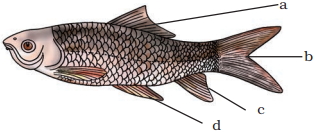
Label $a, b, c$ and $d$ given in the figure. Give the function of $(b)$.
Solution
(N/A) Dorsal fin
$(b)$ Caudal fin
$(c)$ Pelvic fin
$(d)$ Pectoral fin
Function of Caudal fin: The Caudal fin (tail fin) acts as a rudder and helps the fish in steering,balancing,and providing propulsion for streamlined movement in water.
$(b)$ Caudal fin
$(c)$ Pelvic fin
$(d)$ Pectoral fin
Function of Caudal fin: The Caudal fin (tail fin) acts as a rudder and helps the fish in steering,balancing,and providing propulsion for streamlined movement in water.
0 likes
View Solution49
Medium
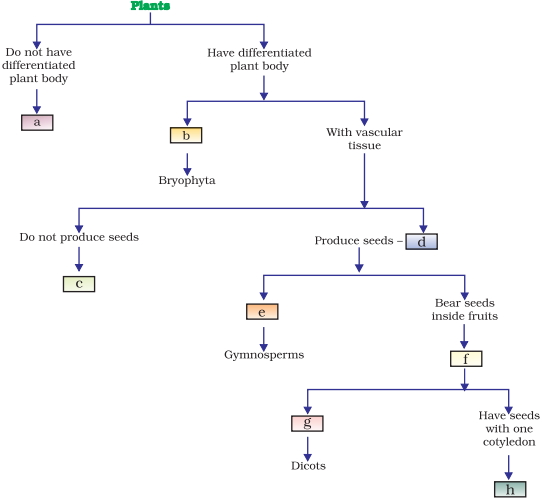
Fill in the boxes given in the figure with appropriate characteristics or plant groups.
Solution
(N/A) Thallophyta
$(b)$ Without specialized vascular tissue
$(c)$ Pteridophyta
$(d)$ Phanerogams
$(e)$ Bear naked seeds
$(f)$ Angiosperms
$(g)$ Have seeds with two cotyledons
$(h)$ Monocots
$(b)$ Without specialized vascular tissue
$(c)$ Pteridophyta
$(d)$ Phanerogams
$(e)$ Bear naked seeds
$(f)$ Angiosperms
$(g)$ Have seeds with two cotyledons
$(h)$ Monocots
0 likes
View Solution50
Medium
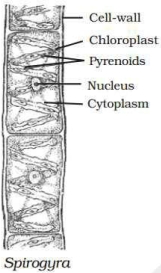
Write the names of a few thallophytes. Draw a labelled diagram of Spirogyra.
Solution
(N/A) Examples of thallophytes include: Ulothrix,Spirogyra,Cladophora,Ulva,and Chara.
The labelled diagram of Spirogyra shows the following structures:
$1$. Cell wall: The outer protective layer.
$2$. Chloroplast: The ribbon-shaped,spiral structure involved in photosynthesis.
$3$. Pyrenoids: Small bodies found within the chloroplast that store starch.
$4$. Nucleus: The central control unit of the cell.
$5$. Cytoplasm: The jelly-like substance filling the cell.
The labelled diagram of Spirogyra shows the following structures:
$1$. Cell wall: The outer protective layer.
$2$. Chloroplast: The ribbon-shaped,spiral structure involved in photosynthesis.
$3$. Pyrenoids: Small bodies found within the chloroplast that store starch.
$4$. Nucleus: The central control unit of the cell.
$5$. Cytoplasm: The jelly-like substance filling the cell.
0 likes
View SolutionDIVERSITY IN LIVING ORGANISMS — Mix Example - DIVERSITY IN LIVING ORGANISMS · Frequently Asked Questions
1Are these DIVERSITY IN LIVING ORGANISMS questions useful for JEE and NEET?
Yes. All questions in this section are mapped to JEE Main and NEET exam patterns. Previous year questions from JEE Main, NEET, GUJCET and state-level exams are included with full solutions.
2Can I switch to Hindi or Gujarati for these questions?
Yes. Use the language tabs in the hero section or the sidebar to view the same questions and solutions in English, Hindi or Gujarati.
3How do I generate a question paper from this subtopic?
Use the Vedclass Exam Paper Generator — select the chapter and subtopic, set difficulty, and generate Sets A, B, C, D automatically. First 3 chapters of every subject are free.
Vedclass Products
For Students
Vedclass Test Series
Mock tests in real JEE/NEET style with performance analysis. 5-day free trial.
Start Free TrialFor Teachers
Exam Paper Generator
Generate Set A/B/C/D papers from this chapter in 2 minutes. 3 chapters free.
Try FreeFor Institutes
Online Exam Module
Live online exams with unlimited students, 360° analytics & white-label branding.
See DemoFor Teachers & Institutes
Generate a DIVERSITY IN LIVING ORGANISMS Exam Paper in 2 Minutes
Select subtopic & difficulty — Sets A, B, C, D auto-generated with No Repeat logic.
First 3 chapters of every subject are free — no payment required.