
A English
Mix Example - DIVERSITY IN LIVING ORGANISMS Questions in English
Class 9 Science · DIVERSITY IN LIVING ORGANISMS · Mix Example - DIVERSITY IN LIVING ORGANISMS
215+
Questions
English
Language
100%
With Solutions
Showing 50 of 215 questions in English
151
Easy
Associate the following features with the groups in which they first appeared:
$(a)$ Vascular tissues
$(b)$ Notochord
$(c)$ Seeds inside fruits
$(a)$ Vascular tissues
$(b)$ Notochord
$(c)$ Seeds inside fruits
Solution
(A) Vascular tissues $-$ Pteridophyta: These are the first land plants to possess specialized vascular tissues ($xylem$ and $phloem$) for the conduction of water and nutrients.
$(b)$ Notochord $-$ Protochordata: The notochord is a flexible,rod-like structure that provides skeletal support and first appears in the group Protochordata.
$(c)$ Seeds inside fruits $-$ Angiosperms: Angiosperms are flowering plants where seeds are enclosed within fruits,which is a defining characteristic of this group.
$(b)$ Notochord $-$ Protochordata: The notochord is a flexible,rod-like structure that provides skeletal support and first appears in the group Protochordata.
$(c)$ Seeds inside fruits $-$ Angiosperms: Angiosperms are flowering plants where seeds are enclosed within fruits,which is a defining characteristic of this group.
0 likes
View Solution152
Medium
Name two plants for each of the following types:
$(i)$ Vascular cryptogams
$(ii)$ Naked seeded plants
$(iii)$ Flowering plants
$(i)$ Vascular cryptogams
$(ii)$ Naked seeded plants
$(iii)$ Flowering plants
Solution
(N/A) $(i)$ Vascular cryptogams (Pteridophytes) are plants that possess vascular tissues but do not produce seeds. Examples: $(a)$ Marsilea,$(b)$ Ferns (e.g.,Dryopteris).
$(ii)$ Naked seeded plants (Gymnosperms) are plants that produce seeds that are not enclosed within a fruit. Examples: $(a)$ Pinus,$(b)$ Cycas.
$(iii)$ Flowering plants (Angiosperms) are plants that produce seeds enclosed within fruits and have specialized reproductive structures called flowers. Examples: $(a)$ Paphiopedilum (Orchid),$(b)$ Ipomoea (Morning glory).
$(ii)$ Naked seeded plants (Gymnosperms) are plants that produce seeds that are not enclosed within a fruit. Examples: $(a)$ Pinus,$(b)$ Cycas.
$(iii)$ Flowering plants (Angiosperms) are plants that produce seeds enclosed within fruits and have specialized reproductive structures called flowers. Examples: $(a)$ Paphiopedilum (Orchid),$(b)$ Ipomoea (Morning glory).
0 likes
View Solution153
Medium
State reasons for the following:
$(a)$ Tapeworm does not have a digestive tract.
$(b)$ Frogs use both skin and lungs for breathing.
$(c)$ Birds have pneumatic/hollow bones.
$(a)$ Tapeworm does not have a digestive tract.
$(b)$ Frogs use both skin and lungs for breathing.
$(c)$ Birds have pneumatic/hollow bones.
Solution
(N/A) Tapeworms are endoparasites that live in the intestine of the host. They lack a digestive tract because they absorb pre-digested nutrients directly from the host's intestine through their body surface.
$(b)$ Frogs exhibit cutaneous respiration through their moist skin when submerged in water and pulmonary respiration using lungs when they are on land.
$(c)$ Birds possess pneumatic (hollow) bones to reduce their body weight,which is an essential adaptation for flight,allowing them to remain buoyant and fly efficiently.
$(b)$ Frogs exhibit cutaneous respiration through their moist skin when submerged in water and pulmonary respiration using lungs when they are on land.
$(c)$ Birds possess pneumatic (hollow) bones to reduce their body weight,which is an essential adaptation for flight,allowing them to remain buoyant and fly efficiently.
0 likes
View Solution154
Medium
Name two mammals which lay eggs. Between which two phyla do they serve as connecting link? Name a mammal which gives birth to poorly developed young ones.
Solution
(N/A) The two mammals that lay eggs are the $Echidna$ (spiny anteater) and the $Platypus$ (duck-billed platypus).
These egg-laying mammals,known as monotremes,serve as a connecting link between the class $Reptilia$ and the class $Mammalia$ because they possess characteristics of both groups (e.g.,laying eggs like reptiles but having mammary glands like mammals).
$A$ mammal that gives birth to poorly developed young ones is the $Kangaroo$ (a marsupial).
These egg-laying mammals,known as monotremes,serve as a connecting link between the class $Reptilia$ and the class $Mammalia$ because they possess characteristics of both groups (e.g.,laying eggs like reptiles but having mammary glands like mammals).
$A$ mammal that gives birth to poorly developed young ones is the $Kangaroo$ (a marsupial).
0 likes
View Solution155
Medium
Explain by giving three reasons,how the work done by earlier scientists with respect to classification is helpful to the present generation.
Solution
(N/A) The work done by earlier scientists or their theories is useful even for students of this generation for the following reasons:
$(i)$ The basic need for classifying organisms is to bring about order and organization in the study of biodiversity.
$(ii)$ Classification helps in understanding the evolutionary relationships between different organisms.
$(iii)$ Classification has predictive value. By placing an organism in a specific category based on its external morphology,we can predict its internal structure and characteristics based on the established knowledge of that group.
$(i)$ The basic need for classifying organisms is to bring about order and organization in the study of biodiversity.
$(ii)$ Classification helps in understanding the evolutionary relationships between different organisms.
$(iii)$ Classification has predictive value. By placing an organism in a specific category based on its external morphology,we can predict its internal structure and characteristics based on the established knowledge of that group.
0 likes
View Solution156
Easy
$A$ plant specimen was found without differentiated roots.
$(a)$ Which plant structure helps in attaching this plant to the substratum?
$(b)$ To which group would you classify this plant?
$(c)$ Which plant could it be?
$(a)$ Which plant structure helps in attaching this plant to the substratum?
$(b)$ To which group would you classify this plant?
$(c)$ Which plant could it be?
Solution
(N/A) The plant structure that helps in attaching the plant to the substratum is called the $Rhizoid$ or the $Thallus$ itself.
$(b)$ This plant belongs to the group $Thallophyta$,as the plant body is not differentiated into roots,stems,and leaves.
$(c)$ This plant could be an $Alga$ (e.g.,$Spirogyra$ or $Ulothrix$).
$(b)$ This plant belongs to the group $Thallophyta$,as the plant body is not differentiated into roots,stems,and leaves.
$(c)$ This plant could be an $Alga$ (e.g.,$Spirogyra$ or $Ulothrix$).
0 likes
View Solution157
Medium
Why are angiosperms so called? In which structures do the seeds develop? Why are cotyledons considered an important part of seed?
Solution
(N/A) Angiosperms are so called because they produce seeds that are enclosed within a fruit,which develops from the ovary.
Seeds develop within the ovary,which matures into a fruit after fertilization.
Cotyledons are considered an important part of the seed because they are embryonic leaves. They often serve as a food storage organ for the developing embryo and,in many cases,emerge and become green to perform photosynthesis when the seed germinates.
Seeds develop within the ovary,which matures into a fruit after fertilization.
Cotyledons are considered an important part of the seed because they are embryonic leaves. They often serve as a food storage organ for the developing embryo and,in many cases,emerge and become green to perform photosynthesis when the seed germinates.
0 likes
View Solution158
Difficult
Explain how,'Two areas of study namely $evolution$ and $classification$ are interlinked'. Justify this statement.
Solution
(N/A) $(i)$ When different forms of organisms are studied,it reflects that life has evolved during the course of evolution,and classification deals with grouping these organisms into groups and subgroups based on their similarities and differences.
$(ii)$ The more characteristics any two species have in common,the more closely they are related. This suggests that they will have a more recent ancestor (and vice-versa).
$(iii)$ Classification helps in tracing the evolutionary relationships between organisms.
Justification: Some groups of organisms have ancient body designs that have not changed much,whereas other groups have acquired their particular body designs relatively recently. Those in the first group are referred to as $primitive$,while those in the second group are $advanced$ organisms. Therefore,complexity in design increases over evolutionary time. Older organisms are simpler,while younger organisms are more complex. For example,the $forearm$ of a human and the $foreleg$ of a horse are $homologous$ structures; they share a common ancestral origin and fundamental plan,even though they perform different functions.
$(ii)$ The more characteristics any two species have in common,the more closely they are related. This suggests that they will have a more recent ancestor (and vice-versa).
$(iii)$ Classification helps in tracing the evolutionary relationships between organisms.
Justification: Some groups of organisms have ancient body designs that have not changed much,whereas other groups have acquired their particular body designs relatively recently. Those in the first group are referred to as $primitive$,while those in the second group are $advanced$ organisms. Therefore,complexity in design increases over evolutionary time. Older organisms are simpler,while younger organisms are more complex. For example,the $forearm$ of a human and the $foreleg$ of a horse are $homologous$ structures; they share a common ancestral origin and fundamental plan,even though they perform different functions.
0 likes
View Solution159
Medium
Associate the following features with appropriate organisms and their kingdom [in $(ii)$ and $(iv)$],division [in $(i)$] and phylum [in $(iii)$ and $(v)$].
$(i)$ Presence of pyrenoids
$(ii)$ Presence of heterocysts
$(iii)$ Presence of genital papillae and anus
$(iv)$ Presence of chloroplast and flagella
$(v)$ Presence of palp and parapodia
$(i)$ Presence of pyrenoids
$(ii)$ Presence of heterocysts
$(iii)$ Presence of genital papillae and anus
$(iv)$ Presence of chloroplast and flagella
$(v)$ Presence of palp and parapodia
Solution
(N/A)
| Feature | Organism and Kingdom/Division/Phylum |
| $(i)$ Presence of pyrenoids | $Spirogyra$,$Ulothrix$ (Division: Thallophyta) |
| $(ii)$ Presence of heterocysts | $Anabaena$ (Kingdom: Monera) |
| $(iii)$ Presence of genital papillae and anus | Earthworm (Phylum: Annelida) |
| $(iv)$ Presence of chloroplast and flagella | $Euglena$ (Kingdom: Protista) |
| $(v)$ Presence of palp and parapodia | $Nereis$ (Phylum: Annelida) |
0 likes
View Solution160
Difficult
Fungi are heterotrophic eukaryotic organisms and have a cell wall made of chitin. Name five cell organelles that are present in the fungal cell. Also,state two structural differences between a plant cell and a fungal cell. Which life form occurs due to the association of cells of fungi and algae?
Solution
(N/A) Five cell organelles present in a fungal cell are:
$(i)$ Nucleus
$(ii)$ Mitochondria
$(iii)$ Ribosome
$(iv)$ Endoplasmic reticulum
$(v)$ Golgi bodies
Two structural differences between a plant cell and a fungal cell are:
$(i)$ The cell wall of a plant cell is made up of cellulose,whereas the cell wall of a fungal cell is made up of chitin.
$(ii)$ Plant cells contain chloroplasts for photosynthesis,whereas fungal cells do not have chloroplasts.
The life form that occurs due to the symbiotic association between fungi and algae is called a lichen.
$(i)$ Nucleus
$(ii)$ Mitochondria
$(iii)$ Ribosome
$(iv)$ Endoplasmic reticulum
$(v)$ Golgi bodies
Two structural differences between a plant cell and a fungal cell are:
$(i)$ The cell wall of a plant cell is made up of cellulose,whereas the cell wall of a fungal cell is made up of chitin.
$(ii)$ Plant cells contain chloroplasts for photosynthesis,whereas fungal cells do not have chloroplasts.
The life form that occurs due to the symbiotic association between fungi and algae is called a lichen.
0 likes
View Solution161
Medium
$A$ plant specimen was found with rhizoids instead of differentiated roots.
$(a)$ Identify the group to which it belongs.
$(b)$ Write any two characteristics of this group.
$(c)$ Draw the diagram of a plant belonging to this group.
$(a)$ Identify the group to which it belongs.
$(b)$ Write any two characteristics of this group.
$(c)$ Draw the diagram of a plant belonging to this group.
Solution
(N/A) Bryophyta.
$(b)$ $(i)$ They are mostly terrestrial plants.
$(ii)$ They are found in damp and shady places.
$(iii)$ The plant body is commonly differentiated into stem and leaf-like structures.
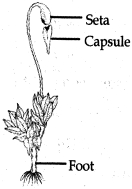
$(c)$ The diagram represents a moss plant (Funaria),which is a member of the Bryophyta group. It shows the gametophyte with leaf-like structures and rhizoids,and the sporophyte consisting of a foot,seta,and capsule.
$(b)$ $(i)$ They are mostly terrestrial plants.
$(ii)$ They are found in damp and shady places.
$(iii)$ The plant body is commonly differentiated into stem and leaf-like structures.
$(c)$ The diagram represents a moss plant (Funaria),which is a member of the Bryophyta group. It shows the gametophyte with leaf-like structures and rhizoids,and the sporophyte consisting of a foot,seta,and capsule.
0 likes
View Solution162
Medium
Give reasons:
$(a)$ Animals of phylum Platyhelminthes are called flatworms.
$(b)$ Bryophytes are called amphibians of the plant kingdom.
$(c)$ Fungi are called saprophytes.
$(d)$ Bacteria and tapeworms are very different in their body design.
$(e)$ Plants like Pinus and deodar are called gymnosperms.
$(a)$ Animals of phylum Platyhelminthes are called flatworms.
$(b)$ Bryophytes are called amphibians of the plant kingdom.
$(c)$ Fungi are called saprophytes.
$(d)$ Bacteria and tapeworms are very different in their body design.
$(e)$ Plants like Pinus and deodar are called gymnosperms.
Solution
(N/A) They are called flatworms because their body is dorsiventrally flattened,meaning they are flattened from the top to the bottom.
$(b)$ Bryophytes are called amphibians of the plant kingdom because they live on land but require water for the process of fertilisation,as their male gametes need water to reach the female gametes.
$(c)$ Fungi are called saprophytes because they obtain their nutrition from dead and decaying organic matter by secreting digestive enzymes outside their body and absorbing the resulting soluble nutrients.
$(d)$ Bacteria are unicellular prokaryotic organisms with a simple cellular structure,whereas tapeworms are multicellular eukaryotic organisms with complex organ-system level body organization,reflecting different evolutionary paths and adaptations.
$(e)$ Plants like Pinus and deodar are called gymnosperms because they bear naked seeds that are not enclosed within a fruit.
$(b)$ Bryophytes are called amphibians of the plant kingdom because they live on land but require water for the process of fertilisation,as their male gametes need water to reach the female gametes.
$(c)$ Fungi are called saprophytes because they obtain their nutrition from dead and decaying organic matter by secreting digestive enzymes outside their body and absorbing the resulting soluble nutrients.
$(d)$ Bacteria are unicellular prokaryotic organisms with a simple cellular structure,whereas tapeworms are multicellular eukaryotic organisms with complex organ-system level body organization,reflecting different evolutionary paths and adaptations.
$(e)$ Plants like Pinus and deodar are called gymnosperms because they bear naked seeds that are not enclosed within a fruit.
0 likes
View Solution163
Medium
Name the phylum to which the following organisms belong:
$(a)$ Organisms which have a peculiar water-driven tube system that they use for moving around.
$(b)$ Organisms which have a foot that is used for moving around and have an open circulatory system.
$(c)$ These organisms have holes or pores all over the body. These lead to a canal system that helps in circulating water throughout the body.
$(a)$ Organisms which have a peculiar water-driven tube system that they use for moving around.
$(b)$ Organisms which have a foot that is used for moving around and have an open circulatory system.
$(c)$ These organisms have holes or pores all over the body. These lead to a canal system that helps in circulating water throughout the body.
Solution
(N/A) The phylum is Echinodermata. These organisms possess a unique water vascular system (water-driven tube system) which is used for locomotion,capture and transport of food,and respiration.
$(b)$ The phylum is Mollusca. These organisms typically have a muscular foot used for locomotion and an open circulatory system (except for cephalopods).
$(c)$ The phylum is Porifera. These organisms are characterized by the presence of numerous pores (ostia) on their body,which lead to a canal system that facilitates water circulation for nutrition and gas exchange.
$(b)$ The phylum is Mollusca. These organisms typically have a muscular foot used for locomotion and an open circulatory system (except for cephalopods).
$(c)$ The phylum is Porifera. These organisms are characterized by the presence of numerous pores (ostia) on their body,which lead to a canal system that facilitates water circulation for nutrition and gas exchange.
0 likes
View Solution164
Medium
Write appropriate terms for the following:
$(i)$ Animals that are able to maintain a constant body temperature over a wide range of environmental temperatures.
$(ii)$ Animals which have a pseudocoelom.
$(iii)$ Plants which bear naked seeds.
$(i)$ Animals that are able to maintain a constant body temperature over a wide range of environmental temperatures.
$(ii)$ Animals which have a pseudocoelom.
$(iii)$ Plants which bear naked seeds.
Solution
(N/A) $(i)$ Warm-blooded animals (Endotherms): These organisms can regulate their internal body temperature regardless of the external environment.
$(ii)$ Nematodes (Roundworms): These are organisms belonging to the phylum Nematoda,characterized by a body cavity that is not fully lined by mesoderm,known as a pseudocoelom.
$(iii)$ Gymnosperms: These are seed-producing plants where the seeds are not enclosed within an ovary or fruit,hence they are referred to as 'naked seeds'.
$(ii)$ Nematodes (Roundworms): These are organisms belonging to the phylum Nematoda,characterized by a body cavity that is not fully lined by mesoderm,known as a pseudocoelom.
$(iii)$ Gymnosperms: These are seed-producing plants where the seeds are not enclosed within an ovary or fruit,hence they are referred to as 'naked seeds'.
0 likes
View Solution165
Medium
Give reasons for the following:
$(i)$ Bryophytes are called amphibians of the plant kingdom.
$(ii)$ From phylum Platyhelminthes onwards,animals are categorized as 'triploblastic.'
$(iii)$ The presence of 'coelom' in an animal's body is considered advantageous.
$(i)$ Bryophytes are called amphibians of the plant kingdom.
$(ii)$ From phylum Platyhelminthes onwards,animals are categorized as 'triploblastic.'
$(iii)$ The presence of 'coelom' in an animal's body is considered advantageous.
Solution
(N/A) $(i)$ Bryophytes are called amphibians of the plant kingdom because,like amphibians,they require water for fertilization. Their motile male gametes (antherozoids) need an aqueous medium to swim to the female gametes (egg).
$(ii)$ Animals from phylum Platyhelminthes onwards possess three germ layers: ectoderm,mesoderm,and endoderm. This 'triploblastic' condition allows for the development of complex,differentiated tissues and organs,providing a higher degree of body organization.
$(iii)$ The coelom is a true internal body cavity lined by mesoderm. It is advantageous because it provides space for the development and protection of well-developed internal organs,allowing them to grow and function independently of the body wall.
$(ii)$ Animals from phylum Platyhelminthes onwards possess three germ layers: ectoderm,mesoderm,and endoderm. This 'triploblastic' condition allows for the development of complex,differentiated tissues and organs,providing a higher degree of body organization.
$(iii)$ The coelom is a true internal body cavity lined by mesoderm. It is advantageous because it provides space for the development and protection of well-developed internal organs,allowing them to grow and function independently of the body wall.
0 likes
View Solution166
EasyMCQ
Hair-like cilia or whip-like flagella for locomotion are present in kingdom
A
Monera
B
Protista
C
Fungi
D
Plantae
Solution
(B) Kingdom $Protista$ includes unicellular eukaryotic organisms. Many members of this kingdom,such as $Paramecium$ (which has cilia) and $Euglena$ (which has flagella),possess specialized structures like cilia or flagella for locomotion. While some bacteria (Monera) also possess flagella,the presence of both cilia and flagella as characteristic locomotory organelles is a defining feature of various groups within the kingdom $Protista$.
0 likes
View Solution167
EasyMCQ
The branch of biology which deals with the principles and practice of classification of plants and animals is
A
Morphology
B
Ecology
C
Taxonomy
D
Geology
Solution
(C) Taxonomy is the branch of biology that deals with the identification,nomenclature,and classification of organisms.
It involves the principles and procedures used to categorize living beings into hierarchical groups based on their shared characteristics.
Morphology deals with the study of the form and structure of organisms.
Ecology is the study of the interactions between organisms and their environment.
Geology is the study of the Earth,its materials,and the processes acting upon them.
It involves the principles and procedures used to categorize living beings into hierarchical groups based on their shared characteristics.
Morphology deals with the study of the form and structure of organisms.
Ecology is the study of the interactions between organisms and their environment.
Geology is the study of the Earth,its materials,and the processes acting upon them.
0 likes
View Solution168
MediumMCQ
Organisms having 'pores' all over the body and a canal system for bringing in food and oxygen belong to the phylum:
A
Coelenterata
B
Annelida
C
Echinodermata
D
Porifera
Solution
(D) The organisms described are sponges.
They belong to the phylum $Porifera$.
These organisms are characterized by the presence of numerous pores called $ostia$ all over their body,which lead into a central cavity known as the $spongocoel$.
This system,known as the $canal$ $system$ or $water$ $transport$ $system$,helps in circulating water throughout the body to bring in food,oxygen,and remove waste products.
They belong to the phylum $Porifera$.
These organisms are characterized by the presence of numerous pores called $ostia$ all over their body,which lead into a central cavity known as the $spongocoel$.
This system,known as the $canal$ $system$ or $water$ $transport$ $system$,helps in circulating water throughout the body to bring in food,oxygen,and remove waste products.
0 likes
View Solution169
EasyMCQ
All organisms that are similar enough to breed and perpetuate are called
A
Species
B
Genera
C
Phylum
D
Family
Solution
(A) The biological definition of a $Species$ is a group of organisms that are capable of interbreeding and producing fertile offspring. This is the fundamental unit of classification in the taxonomic hierarchy.
0 likes
View Solution170
EasyMCQ
Which among the following have an open circulatory system?
$(i)$ Arthropoda
$(ii)$ Mollusca
$(iii)$ Annelida
$(iv)$ Coelenterata
$(i)$ Arthropoda
$(ii)$ Mollusca
$(iii)$ Annelida
$(iv)$ Coelenterata
A
$(iii)$ and $(iv)$
B
$(i)$ and $(ii)$
C
$(i)$ and $(iii)$
D
$(ii)$ and $(iv)$
Solution
(B) In an open circulatory system,blood is pumped out of the heart into body cavities (sinuses) where tissues are bathed in blood.
$(i)$ Arthropoda: Most arthropods (e.g.,insects,crustaceans) possess an open circulatory system.
$(ii)$ Mollusca: Most mollusks (except cephalopods like octopus) possess an open circulatory system.
$(iii)$ Annelida: Annelids (e.g.,earthworms) possess a closed circulatory system.
$(iv)$ Coelenterata: These organisms lack a specialized circulatory system; they rely on diffusion for transport.
Therefore,$(i)$ and $(ii)$ have an open circulatory system.
$(i)$ Arthropoda: Most arthropods (e.g.,insects,crustaceans) possess an open circulatory system.
$(ii)$ Mollusca: Most mollusks (except cephalopods like octopus) possess an open circulatory system.
$(iii)$ Annelida: Annelids (e.g.,earthworms) possess a closed circulatory system.
$(iv)$ Coelenterata: These organisms lack a specialized circulatory system; they rely on diffusion for transport.
Therefore,$(i)$ and $(ii)$ have an open circulatory system.
0 likes
View Solution171
EasyMCQ
In which group of animals,the coelom is filled with blood?
A
Annelida
B
Nematoda
C
Arthropoda
D
Echinodermata
Solution
(C) The body cavity in $Arthropoda$ is known as the $haemocoel$.
In this group,the coelom is reduced and filled with blood,which is why their circulatory system is of the open type.
In $Annelida$,the coelom is a true coelom containing coelomic fluid.
In $Nematoda$,the body cavity is a pseudocoelom.
In $Echinodermata$,the coelom is present but is part of the water vascular system.
In this group,the coelom is reduced and filled with blood,which is why their circulatory system is of the open type.
In $Annelida$,the coelom is a true coelom containing coelomic fluid.
In $Nematoda$,the body cavity is a pseudocoelom.
In $Echinodermata$,the coelom is present but is part of the water vascular system.
0 likes
View Solution172
EasyMCQ
Elephantiasis is caused by
A
Liver flukes
B
Wuchereria
C
Pinworm
D
Planarians
Solution
(B) Elephantiasis, also known as lymphatic filariasis, is a disease characterized by the thickening of the skin and underlying tissues, especially in the legs and male genitals.
It is caused by parasitic filarial worms, most commonly $Wuchereria$ $bancrofti$ or $Brugia$ $malayi$.
These parasites are transmitted to humans through the bite of infected mosquitoes.
Therefore, the correct option is $B$.
It is caused by parasitic filarial worms, most commonly $Wuchereria$ $bancrofti$ or $Brugia$ $malayi$.
These parasites are transmitted to humans through the bite of infected mosquitoes.
Therefore, the correct option is $B$.
0 likes
View Solution173
EasyMCQ
Which one is the most striking or common character of the vertebrates?
A
Presence of notochord
B
Presence of triploblastic condition
C
Presence of gill pouches
D
Presence of coelom
Solution
(A) The most fundamental and defining characteristic of the phylum $Chordata$,which includes vertebrates,is the presence of a $notochord$ at some stage of their life cycle.
In vertebrates,the $notochord$ is replaced by a cartilaginous or bony vertebral column in the adult stage.
While triploblastic condition,gill pouches,and coelom are also present in vertebrates,they are shared with many other invertebrate groups.
Therefore,the presence of a $notochord$ is the most distinct and defining feature that separates vertebrates from other animal groups.
In vertebrates,the $notochord$ is replaced by a cartilaginous or bony vertebral column in the adult stage.
While triploblastic condition,gill pouches,and coelom are also present in vertebrates,they are shared with many other invertebrate groups.
Therefore,the presence of a $notochord$ is the most distinct and defining feature that separates vertebrates from other animal groups.
0 likes
View Solution174
MediumMCQ
Find out the incorrect sentence.
A
Protista includes unicellular eukaryotic organisms.
B
Monerans have a well-defined nucleus.
C
Whittaker considered cell structure,mode,and source of nutrition for classifying the organisms into five kingdoms.
D
Both Monera and Protista may be autotrophic and heterotrophic.
Solution
(B) The incorrect sentence is $B$.
Monerans (Kingdom Monera) are prokaryotic organisms,meaning they lack a well-defined nucleus and membrane-bound organelles.
Protista includes unicellular eukaryotic organisms,which do possess a well-defined nucleus.
Whittaker's five-kingdom classification system is based on cell structure,body organization,mode of nutrition,and phylogenetic relationships.
Both Monera and Protista exhibit diverse modes of nutrition,including autotrophic (e.g.,cyanobacteria in Monera,algae in Protista) and heterotrophic (e.g.,bacteria in Monera,protozoans in Protista).
Monerans (Kingdom Monera) are prokaryotic organisms,meaning they lack a well-defined nucleus and membrane-bound organelles.
Protista includes unicellular eukaryotic organisms,which do possess a well-defined nucleus.
Whittaker's five-kingdom classification system is based on cell structure,body organization,mode of nutrition,and phylogenetic relationships.
Both Monera and Protista exhibit diverse modes of nutrition,including autotrophic (e.g.,cyanobacteria in Monera,algae in Protista) and heterotrophic (e.g.,bacteria in Monera,protozoans in Protista).
0 likes
View Solution175
MediumMCQ
Which among the following has specialised tissue for conduction of water?
$(i)$ Thallophyta
$(ii)$ Bryophyta
$(iii)$ Pteridophyta
$(iv)$ Gymnosperms
$(i)$ Thallophyta
$(ii)$ Bryophyta
$(iii)$ Pteridophyta
$(iv)$ Gymnosperms
A
$(i)$ and $(ii)$
B
$(ii)$ and $(iii)$
C
$(iii)$ and $(iv)$
D
$(i)$ and $(iv)$
Solution
(C) Specialised tissues for the conduction of water and minerals are known as vascular tissues (xylem and phloem).
$(i)$ Thallophyta: These are simple plants without differentiated plant bodies and lack vascular tissues.
$(ii)$ Bryophyta: These are known as amphibians of the plant kingdom and lack true vascular tissues.
$(iii)$ Pteridophyta: These are the first terrestrial plants to possess vascular tissues (xylem and phloem).
$(iv)$ Gymnosperms: These are seed-bearing plants that possess well-developed vascular tissues.
Therefore,both Pteridophyta and Gymnosperms have specialised tissues for the conduction of water.
$(i)$ Thallophyta: These are simple plants without differentiated plant bodies and lack vascular tissues.
$(ii)$ Bryophyta: These are known as amphibians of the plant kingdom and lack true vascular tissues.
$(iii)$ Pteridophyta: These are the first terrestrial plants to possess vascular tissues (xylem and phloem).
$(iv)$ Gymnosperms: These are seed-bearing plants that possess well-developed vascular tissues.
Therefore,both Pteridophyta and Gymnosperms have specialised tissues for the conduction of water.
0 likes
View Solution176
MediumMCQ
Which among the following have scales?
$(i)$ Amphibians
$(ii)$ Pisces
$(iii)$ Reptiles
$(iv)$ Mammals
$(i)$ Amphibians
$(ii)$ Pisces
$(iii)$ Reptiles
$(iv)$ Mammals
A
$(i)$ and $(iii)$
B
$(iii)$ and $(iv)$
C
$(i)$ and $(ii)$
D
$(ii)$ and $(iii)$
Solution
(D) Scales are protective structures found on the skin of certain vertebrates.
$(i)$ Amphibians have moist,glandular skin without scales.
$(ii)$ Pisces (fishes) generally have scales covering their body.
$(iii)$ Reptiles have dry,cornified skin covered with scales.
$(iv)$ Mammals have skin covered with hair,not scales.
Therefore,both Pisces and Reptiles possess scales. The correct option is $(ii)$ and $(iii)$.
$(i)$ Amphibians have moist,glandular skin without scales.
$(ii)$ Pisces (fishes) generally have scales covering their body.
$(iii)$ Reptiles have dry,cornified skin covered with scales.
$(iv)$ Mammals have skin covered with hair,not scales.
Therefore,both Pisces and Reptiles possess scales. The correct option is $(ii)$ and $(iii)$.
0 likes
View Solution177
EasyMCQ
Find out the false statement.
A
Fishes,amphibians and reptiles are oviparous.
B
Aves are warm-blooded,egg-laying and have a four-chambered heart.
C
Aves have a feather-covered body,forelimbs are modified as wings and breathe through lungs.
D
Most of the mammals are viviparous.
Solution
(A) The statement in option $A$ is false because while most fishes,amphibians,and reptiles are indeed oviparous,there are notable exceptions. For example,many sharks (like the Great White Shark) and some snakes (like the Viper) are ovoviviparous or viviparous. Therefore,the blanket statement that all fishes,amphibians,and reptiles are oviparous is scientifically incorrect.
$B$: $Aves$ (birds) are homeothermic (warm-blooded),oviparous,and possess a four-chambered heart. This is a correct statement.
$C$: $Aves$ are characterized by feathers,forelimbs modified into wings for flight,and respiration exclusively through lungs. This is a correct statement.
$D$: Most mammals are viviparous (give birth to young ones),with the exception of monotremes like the platypus and echidna. This is a correct statement.
$B$: $Aves$ (birds) are homeothermic (warm-blooded),oviparous,and possess a four-chambered heart. This is a correct statement.
$C$: $Aves$ are characterized by feathers,forelimbs modified into wings for flight,and respiration exclusively through lungs. This is a correct statement.
$D$: Most mammals are viviparous (give birth to young ones),with the exception of monotremes like the platypus and echidna. This is a correct statement.
0 likes
View Solution178
EasyMCQ
The locomotory organs of $Echinodermata$ are:
A
Muscular feet
B
Tube feet
C
Jointed legs
D
Parapodia
Solution
(B) The phylum $Echinodermata$ is characterized by the presence of a unique water vascular system.
This system plays a vital role in locomotion,capture and transport of food,and respiration.
The locomotory organs associated with the water vascular system are known as $Tube$ $feet$ (or $podia$).
These structures are extensions of the water vascular system that help the organism move and adhere to surfaces.
This system plays a vital role in locomotion,capture and transport of food,and respiration.
The locomotory organs associated with the water vascular system are known as $Tube$ $feet$ (or $podia$).
These structures are extensions of the water vascular system that help the organism move and adhere to surfaces.
0 likes
View Solution179
EasyMCQ
Corals are:
A
Poriferans attached to some solid support
B
Cnidarians that are solitary living
C
Cnidarians that live in colonies
D
Poriferans present at the seabed
Solution
(C) Corals belong to the phylum $Cnidaria$ (also known as $Coelenterata$).
They are marine invertebrates that typically live in compact colonies of many identical individual polyps.
These polyps secrete calcium carbonate to form a hard skeleton,which provides support and protection for the colony.
Therefore,corals are $Cnidarians$ that live in colonies.
They are marine invertebrates that typically live in compact colonies of many identical individual polyps.
These polyps secrete calcium carbonate to form a hard skeleton,which provides support and protection for the colony.
Therefore,corals are $Cnidarians$ that live in colonies.
0 likes
View Solution180
EasyMCQ
Which among the following produce seeds?
A
Thallophyta
B
Bryophyta
C
Pteridophyta
D
Gymnosperms
Solution
(D) The plant kingdom is classified into various groups based on their characteristics.
$1$. Thallophyta,Bryophyta,and Pteridophyta are cryptogams,meaning they do not produce seeds and have inconspicuous reproductive organs.
$2$. Gymnosperms and Angiosperms are phanerogams,which are seed-bearing plants.
$3$. Gymnosperms produce naked seeds,while Angiosperms produce seeds enclosed within fruits.
Therefore,among the given options,Gymnosperms are the ones that produce seeds.
$1$. Thallophyta,Bryophyta,and Pteridophyta are cryptogams,meaning they do not produce seeds and have inconspicuous reproductive organs.
$2$. Gymnosperms and Angiosperms are phanerogams,which are seed-bearing plants.
$3$. Gymnosperms produce naked seeds,while Angiosperms produce seeds enclosed within fruits.
Therefore,among the given options,Gymnosperms are the ones that produce seeds.
0 likes
View Solution181
MediumMCQ
Which one is a true fish?
A
Dogfish
B
Jellyfish
C
Starfish
D
Silverfish
Solution
(A) true fish belongs to the class $Pisces$ (or $Chondrichthyes$ and $Osteichthyes$ in modern classification),characterized by having gills,fins,and a backbone.
$Dogfish$ (also known as $Scoliodon$ or spiny dogfish) is a cartilaginous fish belonging to the class $Chondrichthyes$.
$Jellyfish$ is a cnidarian (invertebrate).
$Starfish$ is an echinoderm (invertebrate).
$Silverfish$ is an insect (arthropod).
Therefore,$Dogfish$ is the only true fish among the given options.
$Dogfish$ (also known as $Scoliodon$ or spiny dogfish) is a cartilaginous fish belonging to the class $Chondrichthyes$.
$Jellyfish$ is a cnidarian (invertebrate).
$Starfish$ is an echinoderm (invertebrate).
$Silverfish$ is an insect (arthropod).
Therefore,$Dogfish$ is the only true fish among the given options.
0 likes
View Solution182
EasyMCQ
Which among the following is exclusively marine?
A
Porifera
B
Echinodermata
C
Mollusca
D
Pisces
Solution
(B) The phylum $Echinodermata$ consists of organisms that are exclusively marine.
These animals are triploblastic and coelomate,possessing a unique water-vascular system that helps in locomotion,capture and transport of food,and respiration.
Examples include starfish $(Asterias)$,sea urchins $(Echinus)$,and sea cucumbers $(Cucumaria)$.
In contrast,$Porifera$,$Mollusca$,and $Pisces$ contain both marine and freshwater species.
These animals are triploblastic and coelomate,possessing a unique water-vascular system that helps in locomotion,capture and transport of food,and respiration.
Examples include starfish $(Asterias)$,sea urchins $(Echinus)$,and sea cucumbers $(Cucumaria)$.
In contrast,$Porifera$,$Mollusca$,and $Pisces$ contain both marine and freshwater species.
0 likes
View Solution183
EasyMCQ
$5-$Kingdom classification was proposed by:
A
Morgan
B
Linnaeus
C
$R. H.$ Whittaker
D
Haeckel
Solution
(C) The $5-$Kingdom classification system was proposed by $R. H.$ Whittaker in $1969$.
This system classifies organisms into five kingdoms: Monera,Protista,Fungi,Plantae,and Animalia.
The criteria used for this classification include cell structure,body organization,mode of nutrition,and phylogenetic relationships.
This system classifies organisms into five kingdoms: Monera,Protista,Fungi,Plantae,and Animalia.
The criteria used for this classification include cell structure,body organization,mode of nutrition,and phylogenetic relationships.
0 likes
View Solution184
EasyMCQ
Well-defined nucleus is absent in
A
Blue-green algae
B
Diatoms
C
Algae
D
Yeast
Solution
(A) well-defined nucleus is a characteristic feature of eukaryotic cells.
Blue-green algae (also known as Cyanobacteria) are prokaryotic organisms.
Prokaryotic cells lack a membrane-bound nucleus and other membrane-bound organelles.
Diatoms,algae (eukaryotic),and yeast (a fungus) are all eukaryotic organisms and possess a well-defined nucleus.
Therefore,the correct answer is Blue-green algae.
Blue-green algae (also known as Cyanobacteria) are prokaryotic organisms.
Prokaryotic cells lack a membrane-bound nucleus and other membrane-bound organelles.
Diatoms,algae (eukaryotic),and yeast (a fungus) are all eukaryotic organisms and possess a well-defined nucleus.
Therefore,the correct answer is Blue-green algae.
0 likes
View Solution185
EasyMCQ
The 'Origin of Species' was written by:
A
Darwin
B
Linnaeus
C
Haeckel
D
Whittaker
Solution
(A) The book titled 'On the Origin of Species' was published in $1859$ by the British naturalist Charles Darwin. This seminal work is considered the foundation of evolutionary biology,introducing the scientific theory that populations evolve over generations through a process of natural selection.
0 likes
View Solution186
EasyMCQ
The skeleton is made entirely of cartilage in
A
Tuna
B
Sharks
C
Rohu
D
None of these
Solution
(B) The class $Chondrichthyes$ (cartilaginous fishes) consists of organisms whose endoskeleton is entirely cartilaginous.
Sharks,rays,and skates belong to this class.
In contrast,$Tuna$ and $Rohu$ belong to the class $Osteichthyes$ (bony fishes),which possess a bony endoskeleton.
Therefore,the correct answer is $Sharks$.
Sharks,rays,and skates belong to this class.
In contrast,$Tuna$ and $Rohu$ belong to the class $Osteichthyes$ (bony fishes),which possess a bony endoskeleton.
Therefore,the correct answer is $Sharks$.
0 likes
View Solution187
EasyMCQ
Which of the following is not an Annelid?
A
Nereis
B
Earthworm
C
Urchins
D
Leech
Solution
(C) The phylum $Annelida$ includes segmented worms such as $Nereis$,earthworms $(Pheretima)$,and leeches $(Hirudinaria)$.
$Urchins$ (Sea urchins) belong to the phylum $Echinodermata$,characterized by a spiny skin and a water vascular system.
Therefore,$Urchins$ are not Annelids.
$Urchins$ (Sea urchins) belong to the phylum $Echinodermata$,characterized by a spiny skin and a water vascular system.
Therefore,$Urchins$ are not Annelids.
0 likes
View Solution188
EasyMCQ
The book 'Systema Naturae' was written by
A
Haeckel
B
Whittaker
C
Robert Brown
D
Linnaeus
Solution
(D) The book 'Systema Naturae' is one of the most significant works in the history of taxonomy.
It was written by Carolus Linnaeus,who is known as the 'Father of Taxonomy'.
In this book,he introduced the system of binomial nomenclature for naming organisms.
Therefore,the correct answer is $D$.
It was written by Carolus Linnaeus,who is known as the 'Father of Taxonomy'.
In this book,he introduced the system of binomial nomenclature for naming organisms.
Therefore,the correct answer is $D$.
0 likes
View Solution189
EasyMCQ
The animals having a blood-filled coelomic cavity belong to which phylum?
A
Arthropoda
B
Mollusca
C
Annelida
D
Echinodermata
Solution
(A) The body cavity in animals of phylum $Arthropoda$ is filled with blood and is known as the $haemocoel$.
In these animals,the true coelom is reduced and the body cavity acts as a circulatory system,which is referred to as an open circulatory system.
Therefore,animals with a blood-filled coelomic cavity belong to phylum $Arthropoda$.
In these animals,the true coelom is reduced and the body cavity acts as a circulatory system,which is referred to as an open circulatory system.
Therefore,animals with a blood-filled coelomic cavity belong to phylum $Arthropoda$.
0 likes
View Solution190
EasyMCQ
The animals having a two-chambered heart belong to the class:
A
Amphibia
B
Pisces
C
Reptilia
D
Aves
Solution
(B) In the animal kingdom,the class $Pisces$ (fishes) is characterized by having a two-chambered heart,consisting of one atrium and one ventricle.
This heart pumps deoxygenated blood to the gills for oxygenation,which then circulates to the rest of the body.
In contrast,$Amphibia$ and most $Reptilia$ have a three-chambered heart,while $Aves$ and mammals have a four-chambered heart.
This heart pumps deoxygenated blood to the gills for oxygenation,which then circulates to the rest of the body.
In contrast,$Amphibia$ and most $Reptilia$ have a three-chambered heart,while $Aves$ and mammals have a four-chambered heart.
0 likes
View Solution191
EasyMCQ
The system of scientific naming was introduced by
A
Ernst Haeckel
B
Robert Whittaker
C
Carolus Linnaeus
D
Carl Woese
Solution
(C) The system of scientific naming,known as Binomial Nomenclature,was introduced by $Carolus \ Linnaeus$.
In this system,each organism is given a scientific name consisting of two parts: the genus and the species.
This method provides a standardized way to name organisms globally,avoiding confusion caused by local common names.
In this system,each organism is given a scientific name consisting of two parts: the genus and the species.
This method provides a standardized way to name organisms globally,avoiding confusion caused by local common names.
0 likes
View Solution192
MediumMCQ
Organisms without a nucleus and cell organelles belong to:
$(i)$ Fungi
$(ii)$ Protista
$(iii)$ Cyanobacteria
$(iv)$ Archaebacteria
$(i)$ Fungi
$(ii)$ Protista
$(iii)$ Cyanobacteria
$(iv)$ Archaebacteria
A
$(i)$ and $(ii)$
B
$(i)$ and $(iv)$
C
$(ii)$ and $(iii)$
D
$(iii)$ and $(iv)$
Solution
(D) Organisms that lack a membrane-bound nucleus and membrane-bound cell organelles are classified as prokaryotes.
$(i)$ Fungi are eukaryotic organisms.
$(ii)$ Protista are eukaryotic organisms.
$(iii)$ Cyanobacteria are prokaryotic organisms (Kingdom Monera).
$(iv)$ Archaebacteria are prokaryotic organisms (Kingdom Monera).
Therefore,organisms $(iii)$ and $(iv)$ belong to the group of organisms without a nucleus and cell organelles.
$(i)$ Fungi are eukaryotic organisms.
$(ii)$ Protista are eukaryotic organisms.
$(iii)$ Cyanobacteria are prokaryotic organisms (Kingdom Monera).
$(iv)$ Archaebacteria are prokaryotic organisms (Kingdom Monera).
Therefore,organisms $(iii)$ and $(iv)$ belong to the group of organisms without a nucleus and cell organelles.
0 likes
View Solution193
EasyMCQ
Which of the following is not a criterion for the classification of living organisms?
A
Height of the plant
B
Body design of the organism
C
Ability to produce one's own food
D
Membrane-bound nucleus and cell organelles
Solution
(A) The classification of living organisms is based on fundamental characteristics that reflect evolutionary relationships and biological complexity.
$1$. Body design of the organism: This is a primary criterion as it reflects the complexity of the organism (e.g., unicellular vs. multicellular).
$2$. Ability to produce one's own food: This distinguishes autotrophs from heterotrophs, which is a fundamental biological trait.
$3$. Membrane-bound nucleus and cell organelles: This distinguishes prokaryotes from eukaryotes, a major evolutionary milestone.
$4$. Height of the plant: This is a superficial or variable trait that can change due to environmental factors and is not a stable, fundamental criterion for biological classification.
$1$. Body design of the organism: This is a primary criterion as it reflects the complexity of the organism (e.g., unicellular vs. multicellular).
$2$. Ability to produce one's own food: This distinguishes autotrophs from heterotrophs, which is a fundamental biological trait.
$3$. Membrane-bound nucleus and cell organelles: This distinguishes prokaryotes from eukaryotes, a major evolutionary milestone.
$4$. Height of the plant: This is a superficial or variable trait that can change due to environmental factors and is not a stable, fundamental criterion for biological classification.
0 likes
View Solution194
EasyMCQ
Which of the following features is not a characteristic of $Protochordata$?
A
Presence of notochord
B
Jointed legs
C
Bilateral symmetry and coelom
D
Presence of circulatory system
Solution
(B) $Protochordata$ are a group of marine animals that possess a notochord at some stage of their life cycle.
They exhibit bilateral symmetry,are triploblastic,and possess a coelom.
They have a circulatory system.
However,jointed legs are a characteristic feature of the phylum $Arthropoda$,not $Protochordata$.
Therefore,the correct answer is $B$.
They exhibit bilateral symmetry,are triploblastic,and possess a coelom.
They have a circulatory system.
However,jointed legs are a characteristic feature of the phylum $Arthropoda$,not $Protochordata$.
Therefore,the correct answer is $B$.
0 likes
View Solution195
EasyMCQ
Real organs are absent in
A
Mollusca
B
Arthropoda
C
Coelenterata
D
Echinodermata
Solution
(C) The organisms belonging to the phylum $Coelenterata$ (also known as $Cnidaria$) exhibit tissue-level organization.
In this level of organization,cells performing the same function are arranged into tissues,but they do not form complex organs or organ systems.
In contrast,$Mollusca$,$Arthropoda$,and $Echinodermata$ exhibit organ-system level of organization,where specialized organs work together to perform complex physiological functions.
In this level of organization,cells performing the same function are arranged into tissues,but they do not form complex organs or organ systems.
In contrast,$Mollusca$,$Arthropoda$,and $Echinodermata$ exhibit organ-system level of organization,where specialized organs work together to perform complex physiological functions.
0 likes
View Solution196
EasyMCQ
Hard calcium carbonate structures are used as a skeleton by
A
Nematoda
B
Arthropoda
C
Protochordata
D
Echinodermata
Solution
(D) The organisms belonging to the phylum $Echinodermata$ (e.g.,starfish,sea urchins) possess an endoskeleton composed of calcareous ossicles (calcium carbonate plates).
These structures provide support and protection to the soft body parts of the organism.
Therefore,hard calcium carbonate structures are used as a skeleton by $Echinodermata$.
These structures provide support and protection to the soft body parts of the organism.
Therefore,hard calcium carbonate structures are used as a skeleton by $Echinodermata$.
0 likes
View Solution197
EasyMCQ
Pteridophyta do not have
A
Flowers
B
Root
C
Stem
D
Leaves
Solution
(A) Pteridophytes are vascular cryptogams,meaning they possess xylem and phloem for the conduction of water and nutrients.
They have well-differentiated plant bodies consisting of true roots,stems,and leaves.
However,they are non-flowering plants and do not produce seeds.
Therefore,they lack flowers and seeds.
They have well-differentiated plant bodies consisting of true roots,stems,and leaves.
However,they are non-flowering plants and do not produce seeds.
Therefore,they lack flowers and seeds.
0 likes
View Solution198
EasyMCQ
Identify a member of the phylum Porifera.
A
Euglena
B
Spongilla
C
Penicillium
D
Hydra
Solution
(B) The phylum Porifera includes organisms commonly known as sponges.
$Spongilla$ is a well-known freshwater sponge belonging to the phylum Porifera.
$Euglena$ belongs to the kingdom Protista.
$Penicillium$ is a fungus.
$Hydra$ belongs to the phylum Cnidaria.
$Spongilla$ is a well-known freshwater sponge belonging to the phylum Porifera.
$Euglena$ belongs to the kingdom Protista.
$Penicillium$ is a fungus.
$Hydra$ belongs to the phylum Cnidaria.
0 likes
View Solution199
EasyMCQ
Which of the following is not an aquatic animal?
A
Hydra
B
Jellyfish
C
Filaria
D
Corals
Solution
(C) The correct answer is $C$ (Filaria).
$1$. $Hydra$, $Jellyfish$, and $Corals$ are all aquatic organisms that live in water environments.
$2$. $Filaria$ (specifically $Wuchereria$ $bancrofti$) is a parasitic nematode that lives inside the human body, specifically in the lymphatic system, and is not an aquatic animal.
$1$. $Hydra$, $Jellyfish$, and $Corals$ are all aquatic organisms that live in water environments.
$2$. $Filaria$ (specifically $Wuchereria$ $bancrofti$) is a parasitic nematode that lives inside the human body, specifically in the lymphatic system, and is not an aquatic animal.
0 likes
View Solution200
EasyMCQ
Amphibians do not have which of the following?
A
Three-chambered heart
B
Gills or lungs
C
Mucus glands
D
Scales
Solution
(D) Amphibians belong to the class $Amphibia$.
Key characteristics of amphibians include:
$1$. They have a $3$-chambered heart ($2$ atria and $1$ ventricle).
$2$. They respire through gills (in larval stages),lungs,or skin.
$3$. Their skin is moist and contains mucus glands to keep it hydrated.
$4$. Unlike reptiles,amphibians do not have scales on their skin.
Therefore,the correct answer is $D$.
Key characteristics of amphibians include:
$1$. They have a $3$-chambered heart ($2$ atria and $1$ ventricle).
$2$. They respire through gills (in larval stages),lungs,or skin.
$3$. Their skin is moist and contains mucus glands to keep it hydrated.
$4$. Unlike reptiles,amphibians do not have scales on their skin.
Therefore,the correct answer is $D$.
0 likes
View SolutionDIVERSITY IN LIVING ORGANISMS — Mix Example - DIVERSITY IN LIVING ORGANISMS · Frequently Asked Questions
1Are these DIVERSITY IN LIVING ORGANISMS questions useful for JEE and NEET?
Yes. All questions in this section are mapped to JEE Main and NEET exam patterns. Previous year questions from JEE Main, NEET, GUJCET and state-level exams are included with full solutions.
2Can I switch to Hindi or Gujarati for these questions?
Yes. Use the language tabs in the hero section or the sidebar to view the same questions and solutions in English, Hindi or Gujarati.
3How do I generate a question paper from this subtopic?
Use the Vedclass Exam Paper Generator — select the chapter and subtopic, set difficulty, and generate Sets A, B, C, D automatically. First 3 chapters of every subject are free.
Vedclass Products
For Students
Vedclass Test Series
Mock tests in real JEE/NEET style with performance analysis. 5-day free trial.
Start Free TrialFor Teachers
Exam Paper Generator
Generate Set A/B/C/D papers from this chapter in 2 minutes. 3 chapters free.
Try FreeFor Institutes
Online Exam Module
Live online exams with unlimited students, 360° analytics & white-label branding.
See DemoFor Teachers & Institutes
Generate a DIVERSITY IN LIVING ORGANISMS Exam Paper in 2 Minutes
Select subtopic & difficulty — Sets A, B, C, D auto-generated with No Repeat logic.
First 3 chapters of every subject are free — no payment required.