
A English
Mix Example - DIVERSITY IN LIVING ORGANISMS Questions in English
Class 9 Science · DIVERSITY IN LIVING ORGANISMS · Mix Example - DIVERSITY IN LIVING ORGANISMS
215+
Questions
English
Language
100%
With Solutions
Showing 50 of 215 questions in English
51
Difficult
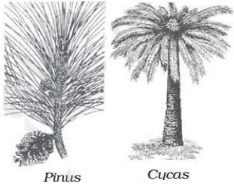
Thallophyta,Bryophyta,and Pteridophyta are called 'Cryptogams'. Gymnosperms and Angiosperms are called 'Phanerogams'. Discuss why? Draw or describe one example of a Gymnosperm.
Solution
(N/A) Thallophyta,Bryophyta,and Pteridophyta are classified as 'Cryptogams' because their reproductive organs are inconspicuous or hidden,and they do not produce seeds.
On the other hand,'Phanerogams' include Gymnosperms and Angiosperms. These plants possess well-differentiated reproductive tissues and produce seeds. In these plants,the embryo develops into a seed,which contains stored food for future growth.
An example of a Gymnosperm is $Pinus$ (Pine),which is a coniferous tree that produces seeds in cones.
On the other hand,'Phanerogams' include Gymnosperms and Angiosperms. These plants possess well-differentiated reproductive tissues and produce seeds. In these plants,the embryo develops into a seed,which contains stored food for future growth.
An example of a Gymnosperm is $Pinus$ (Pine),which is a coniferous tree that produces seeds in cones.
0 likes
View Solution52
Medium
Define the following terms and give one example of each:
$(a)$ Bilateral symmetry
$(b)$ Coelom
$(c)$ Triploblastic
$(a)$ Bilateral symmetry
$(b)$ Coelom
$(c)$ Triploblastic
Solution
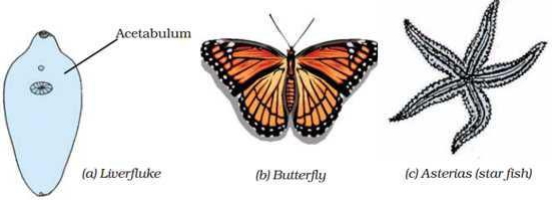
(N/A) Bilateral symmetry: It is a body plan in which the left and right halves of the body are mirror images of each other,e.g.,Liver fluke.
$(b)$ Coelom: It is the internal body cavity between the visceral organs and the body wall in which well-developed organs can be accommodated,e.g.,Butterfly.
$(c)$ Triploblastic: Animals having three germinal layers (ectoderm,mesoderm,and endoderm) from which differentiated tissues and organs can be formed are called triploblastic,e.g.,Starfish.
$(b)$ Coelom: It is the internal body cavity between the visceral organs and the body wall in which well-developed organs can be accommodated,e.g.,Butterfly.
$(c)$ Triploblastic: Animals having three germinal layers (ectoderm,mesoderm,and endoderm) from which differentiated tissues and organs can be formed are called triploblastic,e.g.,Starfish.
0 likes
View Solution53
Medium
You are given leech,Nereis,Scolopendra,prawn,and scorpion; all have a segmented body organization. Will you classify them in one group? If no,give the important characters based on which you will separate these organisms into different groups.
Solution
(N/A) No,all these organisms do not belong to the same group.
$1$. Leech and Nereis belong to the phylum $Annelida$ because they exhibit metameric segmentation,meaning their body is divided into many segments internally by septa.
$2$. Scolopendra,prawn,and scorpion belong to the phylum $Arthropoda$ because they possess jointed appendages,a chitinous exoskeleton,and an open circulatory system.
$1$. Leech and Nereis belong to the phylum $Annelida$ because they exhibit metameric segmentation,meaning their body is divided into many segments internally by septa.
$2$. Scolopendra,prawn,and scorpion belong to the phylum $Arthropoda$ because they possess jointed appendages,a chitinous exoskeleton,and an open circulatory system.
0 likes
View Solution54
MediumMCQ
Which organism is more complex and evolved among Bacteria,Mushroom,and Mango tree? Give reasons.
A
Bacteria
B
Mushroom
C
Mango tree
D
All are equally evolved
Solution
(C) The $Mango$ $tree$ is the most complex and evolved organism among the three.
$1$. $Mango$ $tree$ ($Mangifera$ $indica$) is a multicellular,eukaryotic,autotrophic plant with a well-developed vascular system,complex tissue organization,and seeds enclosed within fruits (Angiosperm).
$2$. $Bacteria$ are unicellular,prokaryotic organisms with a very simple cellular structure and lack membrane-bound organelles.
$3$. $Mushrooms$ (Fungi) are heterotrophic,eukaryotic organisms,but they lack complex tissue systems and vascular tissues,and they do not produce seeds or fruits.
$1$. $Mango$ $tree$ ($Mangifera$ $indica$) is a multicellular,eukaryotic,autotrophic plant with a well-developed vascular system,complex tissue organization,and seeds enclosed within fruits (Angiosperm).
$2$. $Bacteria$ are unicellular,prokaryotic organisms with a very simple cellular structure and lack membrane-bound organelles.
$3$. $Mushrooms$ (Fungi) are heterotrophic,eukaryotic organisms,but they lack complex tissue systems and vascular tissues,and they do not produce seeds or fruits.
0 likes
View Solution55
Medium
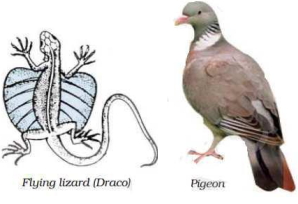
Differentiate between a flying lizard and a bird. Provide a diagram.
Solution
(N/A) The differences between a flying lizard $(Draco)$ and a bird are as follows:
$1$. Classification: Flying lizard belongs to the class $Reptilia$,while birds belong to the class $Aves$.
$2$. Body Temperature: Flying lizards are cold-blooded (poikilothermic),whereas birds are warm-blooded (homeothermic).
$3$. Body Covering: The body of a flying lizard is covered with scales,while the body of a bird is covered with feathers.
$4$. Heart Structure: Flying lizards typically have a three-chambered heart,whereas birds have a four-chambered heart.
$5$. Locomotion: Flying lizards use skin folds (patagium) for gliding,while birds have forelimbs modified into wings for true flight.
$1$. Classification: Flying lizard belongs to the class $Reptilia$,while birds belong to the class $Aves$.
$2$. Body Temperature: Flying lizards are cold-blooded (poikilothermic),whereas birds are warm-blooded (homeothermic).
$3$. Body Covering: The body of a flying lizard is covered with scales,while the body of a bird is covered with feathers.
$4$. Heart Structure: Flying lizards typically have a three-chambered heart,whereas birds have a four-chambered heart.
$5$. Locomotion: Flying lizards use skin folds (patagium) for gliding,while birds have forelimbs modified into wings for true flight.
0 likes
View Solution56
Medium
List out some common features in cat,rat and bat.
Solution
(N/A) Bat,rat,and cat belong to the class $Mammalia$ and share the following common features:
$(a)$ All possess a notochord at some stage of their life cycle.
$(b)$ All are warm-blooded (homeothermic) animals.
$(c)$ All have a four-chambered heart.
$(d)$ All have skin covered with hair and possess sweat and oil glands.
$(a)$ All possess a notochord at some stage of their life cycle.
$(b)$ All are warm-blooded (homeothermic) animals.
$(c)$ All have a four-chambered heart.
$(d)$ All have skin covered with hair and possess sweat and oil glands.
0 likes
View Solution57
DifficultMCQ
Why do we classify both snakes and turtles in the same class?
A
They are both aquatic animals.
B
They both have a four-chambered heart.
C
They both belong to the class Reptilia.
D
They both give birth to young ones.
Solution
(C) Snakes and turtles are both classified under the class $Reptilia$ because they share several key characteristics:
$(1)$ They are cold-blooded (poikilothermic) animals.
$(2)$ Their skin is dry and covered with scales or scutes.
$(3)$ They breathe exclusively through lungs.
$(4)$ They typically possess a three-chambered heart (except for crocodiles).
$(5)$ They are oviparous,meaning they lay eggs with a tough,leathery,or calcareous covering on land.
$(1)$ They are cold-blooded (poikilothermic) animals.
$(2)$ Their skin is dry and covered with scales or scutes.
$(3)$ They breathe exclusively through lungs.
$(4)$ They typically possess a three-chambered heart (except for crocodiles).
$(5)$ They are oviparous,meaning they lay eggs with a tough,leathery,or calcareous covering on land.
0 likes
View Solution58
Easy
Charles Darwin first described the idea of evolution in his book "The Origin of Species". Define the concept of evolution.
Solution
(N/A) According to Charles Darwin, evolution is the process by which life forms arise through the accumulation of changes in body design over generations, which help the organisms possessing these changes to survive and adapt better to their environment.
0 likes
View Solution59
EasyMCQ
Where are seeds of gymnosperms formed?
A
Inside the fruit
B
On the surface of scales or leaves
C
Inside the flower
D
Within the root system
Solution
(B) Gymnosperms are known as 'naked-seeded' plants because their seeds are not enclosed within an ovary or fruit.
Instead,the seeds of gymnosperms typically develop on the surface of specialized reproductive structures known as scales or leaves,often organized into cones (strobili).
Instead,the seeds of gymnosperms typically develop on the surface of specialized reproductive structures known as scales or leaves,often organized into cones (strobili).
0 likes
View Solution60
EasyMCQ
Who proposed the five-kingdom system of classification?
A
Carl Linnaeus
B
$R$.$H$. Whittaker
C
Ernst Haeckel
D
Aristotle
Solution
(B) The five-kingdom system of classification was proposed by $R.H.$ Whittaker in $1969$.
He classified organisms into five kingdoms: $Monera$,$Protista$,$Fungi$,$Plantae$,and $Animalia$.
This classification is based on cell structure,body organization,mode of nutrition,and phylogenetic relationships.
He classified organisms into five kingdoms: $Monera$,$Protista$,$Fungi$,$Plantae$,and $Animalia$.
This classification is based on cell structure,body organization,mode of nutrition,and phylogenetic relationships.
0 likes
View Solution61
EasyMCQ
What is symbiosis?
A
$A$ parasitic relationship
B
An obligatory mutually beneficial association
C
$A$ relationship where one organism benefits and the other is harmed
D
$A$ relationship where neither organism benefits
Solution
(B) Symbiosis is defined as an obligatory mutually beneficial association between two different organisms living in close physical contact. In this relationship,both organisms derive benefits from each other,which is essential for their survival.
0 likes
View Solution62
EasyMCQ
What is haemocoel?
A
$A$ body cavity filled with blood
B
$A$ type of respiratory organ
C
$A$ specialized excretory structure
D
$A$ muscular tissue layer
Solution
(A) The body cavity in certain invertebrates,such as arthropods and molluscs,which is filled with haemolymph (blood) is known as haemocoel.
In these organisms,the circulatory system is open,meaning blood does not remain confined within blood vessels but flows into these open spaces to bathe the tissues directly.
In these organisms,the circulatory system is open,meaning blood does not remain confined within blood vessels but flows into these open spaces to bathe the tissues directly.
0 likes
View Solution63
EasyMCQ
Which group of animals have haemocoel?
A
Annelida and Arthropoda
B
Arthropoda and Mollusca
C
Mollusca and Echinodermata
D
Platyhelminthes and Nematoda
Solution
(B) The haemocoel is a body cavity filled with blood,which is a characteristic feature of the phyla Arthropoda and Mollusca. In these animals,the circulatory system is open,meaning blood flows through the body cavity (haemocoel) rather than being confined entirely within blood vessels.
0 likes
View Solution64
EasyMCQ
How many chambers are present in the heart of fishes and frogs?
A
Fishes: $2$,Frogs: $3$
B
Fishes: $3$,Frogs: $2$
C
Fishes: $2$,Frogs: $4$
D
Fishes: $4$,Frogs: $3$
Solution
(A) The heart of fishes consists of $2$ chambers,which include one atrium and one ventricle.
In contrast,the heart of frogs consists of $3$ chambers,which include two atria and one ventricle.
In contrast,the heart of frogs consists of $3$ chambers,which include two atria and one ventricle.
0 likes
View Solution65
EasyMCQ
Who proposed the two kingdom classification?
A
Robert Whittaker
B
Carolus Linnaeus
C
Ernst Haeckel
D
Carl Woese
Solution
(B) The two-kingdom classification system was proposed by $Carolus \ Linnaeus$ in $1758$. He divided all living organisms into two kingdoms: $Plantae$ and $Animalia$.
0 likes
View Solution66
Easy
State the phylum to which liver fluke and Planaria belong.
Solution
(N/A) Liver fluke (Fasciola hepatica) and Planaria belong to the phylum Platyhelminthes. These organisms are commonly known as flatworms because their bodies are dorsoventrally flattened.
0 likes
View Solution67
EasyMCQ
Name the phylum to which Leech and Earthworm belong.
A
Arthropoda
B
Annelida
C
Mollusca
D
Platyhelminthes
Solution
(B) Leech (Hirudinaria) and Earthworm (Pheretima) belong to the phylum $Annelida$.
These organisms are characterized by a segmented body,which is a key feature of the phylum $Annelida$.
These organisms are characterized by a segmented body,which is a key feature of the phylum $Annelida$.
0 likes
View Solution68
EasyMCQ
Name an organism sensitive to $SO_{2}$ in air.
A
Bacteria
B
Lichens
C
Fungi
D
Algae
Solution
(B) Lichens are symbiotic associations between fungi and algae. They are highly sensitive to air pollution,particularly sulfur dioxide $(SO_{2})$,and are therefore used as bioindicators of air quality.
0 likes
View Solution69
Easy
Echinoderms have a system that they use for moving around. Name the system. What is their skeleton made-up of?
Solution
(N/A) Echinoderms possess a unique water-driven system known as the $Water$ $Vascular$ $System$,which is primarily used for locomotion,capturing food,and respiration.
Their endoskeleton is composed of hard,calcareous structures made of $Calcium$ $Carbonate$ $(CaCO_3)$ plates or ossicles.
Their endoskeleton is composed of hard,calcareous structures made of $Calcium$ $Carbonate$ $(CaCO_3)$ plates or ossicles.
0 likes
View Solution70
Easy
What do you understand by the term $diploblastic$? Give one example of an organism that is $diploblastic$.
Solution
(N/A) The term $diploblastic$ refers to organisms whose body cells are arranged in two embryonic layers: an external $ectoderm$ and an internal $endoderm$.
Between these two layers,an undifferentiated layer called $mesoglea$ is present.
Example: $Hydra$ (belonging to the phylum $Cnidaria$).
Between these two layers,an undifferentiated layer called $mesoglea$ is present.
Example: $Hydra$ (belonging to the phylum $Cnidaria$).
0 likes
View Solution71
EasyMCQ
Homo sapiens is the scientific name of human beings. What do these two terms imply?
A
Homo is the species and sapiens is the genus.
B
Homo is the genus and sapiens is the species.
C
Both are genus names.
D
Both are species names.
Solution
(B) In binomial nomenclature,the first word represents the genus and the second word represents the species.
Therefore,in the scientific name $Homo$ $sapiens$,$Homo$ is the generic name (genus) and $sapiens$ is the specific epithet (species).
Therefore,in the scientific name $Homo$ $sapiens$,$Homo$ is the generic name (genus) and $sapiens$ is the specific epithet (species).
0 likes
View Solution72
Medium
State the importance of classification.
Solution
(N/A) The importance of classification is as follows:
$(a)$ It facilitates the identification of organisms.
$(b)$ It helps to establish the relationships among various groups of organisms.
$(c)$ It helps to study the phylogeny and evolutionary history of organisms.
$(d)$ By studying a few representative organisms,the characteristics of the entire group can be understood.
$(a)$ It facilitates the identification of organisms.
$(b)$ It helps to establish the relationships among various groups of organisms.
$(c)$ It helps to study the phylogeny and evolutionary history of organisms.
$(d)$ By studying a few representative organisms,the characteristics of the entire group can be understood.
0 likes
View Solution73
Medium
Differentiate between the following (any one point):
$(a)$ Diploblastic and triploblastic animals
$(b)$ Warm-blooded and cold-blooded animals
$(a)$ Diploblastic and triploblastic animals
$(b)$ Warm-blooded and cold-blooded animals
Solution
(N/A) Diploblastic animals are those whose body is made up of two germinal layers (ectoderm and endoderm),whereas triploblastic animals have three germinal layers (ectoderm,mesoderm,and endoderm).
$(b)$ Warm-blooded animals (homeotherms) can maintain a constant internal body temperature regardless of the external environment,whereas cold-blooded animals (poikilotherms) change their body temperature according to the fluctuations in the environmental temperature.
$(b)$ Warm-blooded animals (homeotherms) can maintain a constant internal body temperature regardless of the external environment,whereas cold-blooded animals (poikilotherms) change their body temperature according to the fluctuations in the environmental temperature.
0 likes
View Solution74
MediumMCQ
What is bilateral symmetry?
A
Body can be divided into two identical halves by any plane passing through the center.
B
Body can be divided into two identical halves by only one plane.
C
Body cannot be divided into two identical halves.
D
Body can be divided into two identical halves by multiple planes.
Solution
(B) Bilateral symmetry is a type of body organization where the body of an organism can be divided into two identical left and right mirror-image halves by only one single plane passing through the central axis.
This is a characteristic feature of most complex animals,including humans,insects,and fish.
This is a characteristic feature of most complex animals,including humans,insects,and fish.
0 likes
View Solution75
Medium
What is a notochord? What is its function?
Solution
(N/A) notochord is a long,rod-like support structure (the term 'chord' means string) that runs along the back of an animal's body.
It serves to separate the nervous tissue from the gut.
Its primary function is to provide a site for muscle attachment,which facilitates ease of movement for the organism.
It serves to separate the nervous tissue from the gut.
Its primary function is to provide a site for muscle attachment,which facilitates ease of movement for the organism.
0 likes
View Solution76
Medium
Enlist four main features of organisms placed in the kingdom Protista.
Solution
(N/A) They are unicellular and primarily aquatic organisms.
$(b)$ They possess a typical eukaryotic cell structure with membrane-bound organelles and a well-defined nucleus.
$(c)$ Locomotion is facilitated by structures such as cilia,flagella,or pseudopodia.
$(d)$ Reproduction occurs through both asexual (e.g.,binary fission) and sexual (e.g.,syngamy) methods.
$(b)$ They possess a typical eukaryotic cell structure with membrane-bound organelles and a well-defined nucleus.
$(c)$ Locomotion is facilitated by structures such as cilia,flagella,or pseudopodia.
$(d)$ Reproduction occurs through both asexual (e.g.,binary fission) and sexual (e.g.,syngamy) methods.
0 likes
View Solution77
Easy
Characteristics of some organisms are given. Identify their group and give one example of each.
$(a)$ Single-celled,eukaryotic,and photosynthetic.
$(b)$ The body is divided into segments,may be unisexual or hermaphrodite.
$(a)$ Single-celled,eukaryotic,and photosynthetic.
$(b)$ The body is divided into segments,may be unisexual or hermaphrodite.
Solution
(N/A) The group is Kingdom Protista. These are unicellular eukaryotic organisms that can perform photosynthesis. Example: $Euglena$.
$(b)$ The group is Phylum Annelida. These organisms have a segmented body (metamerism) and can be either unisexual or hermaphrodite. Example: $Earthworm$ $(Pheretima)$.
$(b)$ The group is Phylum Annelida. These organisms have a segmented body (metamerism) and can be either unisexual or hermaphrodite. Example: $Earthworm$ $(Pheretima)$.
0 likes
View Solution78
EasyMCQ
Why are bryophytes called the amphibians of the plant kingdom?
A
They can live in both soil and water.
B
They require water for fertilization and reproduction.
C
They have a body that is differentiated into roots,stems,and leaves.
D
They are the first land plants.
Solution
(B) Bryophytes are referred to as the amphibians of the plant kingdom because,although they are terrestrial plants that live in damp and shaded areas,they require water for the process of fertilization. The male gametes (antherozoids) must swim through a film of water to reach the female gamete (egg) in the archegonium,making water essential for their life cycle.
0 likes
View Solution79
Easy
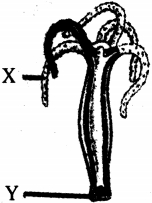
Label $X$ and $Y$ in the given diagram of Hydra.
Solution
(N/A) $X$ represents the tentacles,which are used for capturing prey and locomotion.
$Y$ represents the basal disc (or foot),which is used for attachment to a substrate.
$Y$ represents the basal disc (or foot),which is used for attachment to a substrate.
0 likes
View Solution80
Medium
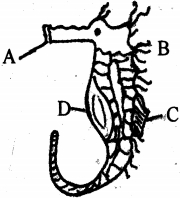
Identify and write the names of the parts labeled as $A, B, C$ and $D$ in the given figure of a seahorse in your answer book.
Solution
(N/A) $A -$ Mouth
$B -$ Dorsal fin
$C -$ Pectoral fin
$D -$ Brood pouch (This is where the male carries the eggs until they hatch.)
$B -$ Dorsal fin
$C -$ Pectoral fin
$D -$ Brood pouch (This is where the male carries the eggs until they hatch.)
0 likes
View Solution81
Medium
What are gymnosperms? Give two characteristics.
Solution
(N/A) Gymnosperms are a group of plants that bear naked seeds,meaning the seeds are not enclosed within a fruit.
Characteristic features:
$(i)$ They are usually perennial plants.
$(ii)$ They are typically evergreen and woody plants.
Characteristic features:
$(i)$ They are usually perennial plants.
$(ii)$ They are typically evergreen and woody plants.
0 likes
View Solution82
Medium
$(a)$ State two characteristic features of nematodes.
$(b)$ Identify the phylum with the help of the following features:
$(i)$ Spiny-skinned,radially symmetrical,and have tube feet.
$(ii)$ Triploblastic,worm-like,having a segmented body.
$(b)$ Identify the phylum with the help of the following features:
$(i)$ Spiny-skinned,radially symmetrical,and have tube feet.
$(ii)$ Triploblastic,worm-like,having a segmented body.
Solution
(N/A) Characteristic features of nematodes:
$(i)$ Nematodes have a cylindrical,bilaterally symmetrical,and triploblastic body.
$(ii)$ They are often parasitic and can cause diseases in plants and animals.
$(b)$ $(i)$ The phylum is $Echinodermata$. These organisms possess a spiny skin (calcareous ossicles),radial symmetry in adults,and a water vascular system with tube feet for locomotion.
$(ii)$ The phylum is $Annelida$. These organisms are triploblastic,coelomate,and exhibit true segmentation (metamerism) in their worm-like bodies.
$(i)$ Nematodes have a cylindrical,bilaterally symmetrical,and triploblastic body.
$(ii)$ They are often parasitic and can cause diseases in plants and animals.
$(b)$ $(i)$ The phylum is $Echinodermata$. These organisms possess a spiny skin (calcareous ossicles),radial symmetry in adults,and a water vascular system with tube feet for locomotion.
$(ii)$ The phylum is $Annelida$. These organisms are triploblastic,coelomate,and exhibit true segmentation (metamerism) in their worm-like bodies.
0 likes
View Solution83
MediumMCQ
Why are bats not placed in birds?
A
Bats have hair on their body.
B
Bats have mammary glands.
C
Bats give birth to young ones.
D
All of the above.
Solution
(D) Bats are not classified as birds because:
$(i)$ They lack feathers,which are a characteristic feature of birds.
$(ii)$ They possess mammary glands,which is a defining characteristic of mammals.
$(iii)$ They give birth to live young ones rather than laying eggs.
$(iv)$ Their body is covered with hair instead of feathers.
$(i)$ They lack feathers,which are a characteristic feature of birds.
$(ii)$ They possess mammary glands,which is a defining characteristic of mammals.
$(iii)$ They give birth to live young ones rather than laying eggs.
$(iv)$ Their body is covered with hair instead of feathers.
0 likes
View Solution84
Medium
Give one example of each:
$(a)$ Reptile which has a four-chambered heart.
$(b)$ Egg-laying mammal.
$(c)$ Parasitic Platyhelminthes.
$(d)$ Division among plants which has the simplest organisms.
$(a)$ Reptile which has a four-chambered heart.
$(b)$ Egg-laying mammal.
$(c)$ Parasitic Platyhelminthes.
$(d)$ Division among plants which has the simplest organisms.
Solution
(N/A) Crocodile: Most reptiles have a three-chambered heart,but the crocodile is an exception with a four-chambered heart.
$(b)$ Platypus: Also known as the duck-billed platypus,it is a monotreme that lays eggs instead of giving birth to live young.
$(c)$ Tapeworm: These are flatworms that live as parasites in the intestines of other animals.
$(d)$ Thallophyta: This division includes plants like algae that have a simple,undifferentiated body structure (thallus).
$(b)$ Platypus: Also known as the duck-billed platypus,it is a monotreme that lays eggs instead of giving birth to live young.
$(c)$ Tapeworm: These are flatworms that live as parasites in the intestines of other animals.
$(d)$ Thallophyta: This division includes plants like algae that have a simple,undifferentiated body structure (thallus).
0 likes
View Solution85
MediumMCQ
Identify the phylum for the following characteristics given:
$(a)$ Organisms with jointed appendages.
$(b)$ Organisms are generally flatworms.
$(c)$ Body is segmented.
$(d)$ Skin of organisms is full of spikes.
$(a)$ Organisms with jointed appendages.
$(b)$ Organisms are generally flatworms.
$(c)$ Body is segmented.
$(d)$ Skin of organisms is full of spikes.
A
Arthropoda,Platyhelminthes,Annelida,Echinodermata
B
Platyhelminthes,Arthropoda,Annelida,Echinodermata
C
Annelida,Platyhelminthes,Arthropoda,Echinodermata
D
Echinodermata,Arthropoda,Annelida,Platyhelminthes
Solution
(A) Arthropoda: These organisms possess jointed appendages,which is a characteristic feature of this phylum.
$(b)$ Platyhelminthes: These organisms are commonly known as flatworms due to their dorso-ventrally flattened bodies.
$(c)$ Annelida: These organisms exhibit true segmentation or metamerism in their body structure.
$(d)$ Echinodermata: These organisms have a spiny-skinned body surface,which is a diagnostic feature of this phylum.
$(b)$ Platyhelminthes: These organisms are commonly known as flatworms due to their dorso-ventrally flattened bodies.
$(c)$ Annelida: These organisms exhibit true segmentation or metamerism in their body structure.
$(d)$ Echinodermata: These organisms have a spiny-skinned body surface,which is a diagnostic feature of this phylum.
0 likes
View Solution86
Medium
$(a)$ Give a difference between lizards and snakes.
$(b)$ Name the type of nutrition in fungi.
$(b)$ Name the type of nutrition in fungi.
Solution
(N/A) Lizards: They possess two pairs of pentadactyl limbs.
Snakes: Pentadactyl limbs are absent.
$(b)$ Fungi exhibit a saprophytic mode of nutrition,where they absorb nutrients from dead and decaying organic matter.
Snakes: Pentadactyl limbs are absent.
$(b)$ Fungi exhibit a saprophytic mode of nutrition,where they absorb nutrients from dead and decaying organic matter.
0 likes
View Solution87
Medium
$(a)$ What are saprophytes?
$(b)$ Name the kingdom to which they belong.
$(c)$ What is the cell wall of fungi made-up of?
$(b)$ Name the kingdom to which they belong.
$(c)$ What is the cell wall of fungi made-up of?
Solution
(N/A) Saprophytes are organisms that obtain their nutrition from dead and decaying organic matter.
$(b)$ They belong to the Kingdom $Fungi$.
$(c)$ The cell wall of fungi is composed of a complex sugar called $chitin$.
$(b)$ They belong to the Kingdom $Fungi$.
$(c)$ The cell wall of fungi is composed of a complex sugar called $chitin$.
0 likes
View Solution88
MediumMCQ
Thallophyta,Bryophyta and Pteridophyta are classified as Cryptogamae,whereas Gymnosperms and Angiosperms are classified as Phanerogamae. Why?
A
Because of their habitat.
B
Because of their reproductive organs.
C
Because of their vascular tissues.
D
Because of their seed production.
Solution
(B) The classification is based on the nature of reproductive organs:
$1$. Thallophytes,Bryophytes,and Pteridophytes are classified as Cryptogamae (from Greek 'kryptos' meaning hidden and 'gamos' meaning marriage) because they have inconspicuous or hidden reproductive organs and do not produce seeds.
$2$. Gymnosperms and Angiosperms are classified as Phanerogamae (from Greek 'phaneros' meaning visible) because they have well-differentiated,visible reproductive organs and produce seeds.
$1$. Thallophytes,Bryophytes,and Pteridophytes are classified as Cryptogamae (from Greek 'kryptos' meaning hidden and 'gamos' meaning marriage) because they have inconspicuous or hidden reproductive organs and do not produce seeds.
$2$. Gymnosperms and Angiosperms are classified as Phanerogamae (from Greek 'phaneros' meaning visible) because they have well-differentiated,visible reproductive organs and produce seeds.
0 likes
View Solution89
Easy
What is binomial nomenclature? List two advantages of naming organisms.
Solution
(N/A) Binomial nomenclature is a formal system of naming living organisms by giving them a two-part name consisting of a generic name (genus) and a specific epithet (species).
Advantages:
$(i)$ It provides a standardized and unique name for each organism,which helps in the systematic study of the wide range of living organisms across the globe.
$(ii)$ It helps in maintaining an accurate record of biodiversity,which is essential for the identification and classification of organisms.
Advantages:
$(i)$ It provides a standardized and unique name for each organism,which helps in the systematic study of the wide range of living organisms across the globe.
$(ii)$ It helps in maintaining an accurate record of biodiversity,which is essential for the identification and classification of organisms.
0 likes
View Solution90
Easy
How are fungi similar and dissimilar to plants?
Solution
(N/A) Similarities: Both fungi and plants possess a rigid cell wall,which provides structural support to the organism.
Dissimilarities: Fungi are heterotrophic,meaning they obtain nutrients by absorbing organic matter from their environment,often acting as saprophytes or parasites. In contrast,plants are autotrophic,containing chlorophyll,which allows them to synthesize their own food through the process of photosynthesis.
Dissimilarities: Fungi are heterotrophic,meaning they obtain nutrients by absorbing organic matter from their environment,often acting as saprophytes or parasites. In contrast,plants are autotrophic,containing chlorophyll,which allows them to synthesize their own food through the process of photosynthesis.
0 likes
View Solution91
Medium
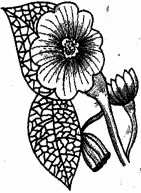
Is the given figure of an angiosperm plant a dicot or a monocot? Differentiate between dicot and monocot plants on the basis of venation in the leaf and the number of cotyledons in the seed.
Solution
(N/A) The given figure shows a plant with reticulate venation in its leaves,which is a characteristic feature of a dicot plant.
| Feature | Dicot Plant | Monocot Plant |
|---|---|---|
| Venation in leaf | Reticulate venation | Parallel venation |
| Number of cotyledons | Two cotyledons | One cotyledon |
0 likes
View Solution92
Medium
Mention any one characteristic feature of saprophytes.
Solution
(N/A) Saprophytes use decaying organic material as their source of food.
Many saprophytes have the capacity to become multicellular organisms at certain stages in their lives.
They possess cell walls made of a tough,complex sugar called chitin.
Some species exhibit symbiotic behavior.
Many saprophytes have the capacity to become multicellular organisms at certain stages in their lives.
They possess cell walls made of a tough,complex sugar called chitin.
Some species exhibit symbiotic behavior.
0 likes
View Solution93
Easy
Write two characteristic features of the phylum to which Ascaris belongs. Name the parasitic worm that causes elephantiasis.
Solution
(N/A) The phylum to which Ascaris belongs is Nematoda (or Aschelminthes).
Two characteristic features of this phylum are:
$1$. The body is cylindrical in shape and circular in cross-section.
$2$. They are pseudocoelomate,meaning they possess a false body cavity.
The parasitic worm that causes elephantiasis (filariasis) is Wuchereria bancrofti (commonly known as the Filarial worm).
Two characteristic features of this phylum are:
$1$. The body is cylindrical in shape and circular in cross-section.
$2$. They are pseudocoelomate,meaning they possess a false body cavity.
The parasitic worm that causes elephantiasis (filariasis) is Wuchereria bancrofti (commonly known as the Filarial worm).
0 likes
View Solution94
Easy
State the type of body cavity found in Platyhelminthes. Write whether they are parasitic or free-living.
Solution
(N/A) Platyhelminthes are acoelomate,meaning they lack a true body cavity (coelom).
They exhibit both lifestyles: many species are parasitic (e.g.,Tapeworms,Liver flukes),while some are free-living (e.g.,Planaria).
They exhibit both lifestyles: many species are parasitic (e.g.,Tapeworms,Liver flukes),while some are free-living (e.g.,Planaria).
0 likes
View Solution95
MediumMCQ
Identify the animal and plant groups having:
$(a)$ Animals without tissues,body bearing pores.
$(b)$ Plant body differentiated into roots,stems and leaves but do not produce seeds.
$(c)$ Body dorsoventrally flattened without coelom.
$(d)$ Segmented worms with true body cavity with extensive organ differentiation.
$(a)$ Animals without tissues,body bearing pores.
$(b)$ Plant body differentiated into roots,stems and leaves but do not produce seeds.
$(c)$ Body dorsoventrally flattened without coelom.
$(d)$ Segmented worms with true body cavity with extensive organ differentiation.
A
Porifera,Pteridophyta,Platyhelminthes,Annelida
B
Cnidaria,Bryophyta,Nematoda,Arthropoda
C
Ctenophora,Thallophyta,Annelida,Mollusca
D
Echinodermata,Gymnosperms,Platyhelminthes,Chordata
Solution
(A) Porifera: These are multicellular organisms without true tissues and possess numerous pores (ostia) on their body.
$(b)$ Pteridophyta: These plants have a well-differentiated body into roots,stems,and leaves but are cryptogams,meaning they do not produce seeds.
$(c)$ Platyhelminthes: These are commonly known as flatworms,characterized by a dorsoventrally flattened body and the absence of a coelom (acoelomate).
$(d)$ Annelida: These are segmented worms that possess a true coelom (body cavity) and show a high degree of organ differentiation.
$(b)$ Pteridophyta: These plants have a well-differentiated body into roots,stems,and leaves but are cryptogams,meaning they do not produce seeds.
$(c)$ Platyhelminthes: These are commonly known as flatworms,characterized by a dorsoventrally flattened body and the absence of a coelom (acoelomate).
$(d)$ Annelida: These are segmented worms that possess a true coelom (body cavity) and show a high degree of organ differentiation.
0 likes
View Solution96
Medium
An animal is dorsoventrally flattened,has three embryonic germ layers,and is acoelomate. Which phylum does it belong to? What are they commonly called? Give one example.
Solution
(N/A) The animal belongs to the phylum $Platyhelminthes$.
They are commonly called 'flatworms' because of their dorsoventrally flattened bodies.
One example is $Planaria$ (or $Fasciola$ / Liver fluke,or $Taenia$ / Tapeworm).
They are commonly called 'flatworms' because of their dorsoventrally flattened bodies.
One example is $Planaria$ (or $Fasciola$ / Liver fluke,or $Taenia$ / Tapeworm).
0 likes
View Solution97
Medium
List two similarities and two differences between the features of nematodes and annelids.
Solution
(N/A)
| Similarities between nematodes and annelids | Differences between nematodes and annelids |
|---|---|
| $1.$ Both have a bilaterally symmetrical body. | $1.$ Annelids have a segmented body,whereas nematodes have a cylindrical body. |
| $2.$ Both have triploblastic germ layers. | $2.$ Annelids have a true body cavity (coelom),whereas nematodes have a pseudocoelom. |
0 likes
View Solution98
Easy
The cell wall of fungi is made up of chitin.
$(i)$ What is the chemical nature of chitin?
$(ii)$ What is the mode of nutrition in fungi?
$(i)$ What is the chemical nature of chitin?
$(ii)$ What is the mode of nutrition in fungi?
Solution
(N/A) $(i)$ Chitin is a complex polysaccharide,specifically a nitrogen-containing derivative of glucose known as $N$-acetylglucosamine.
$(ii)$ Fungi exhibit a saprophytic mode of nutrition,where they absorb dissolved organic nutrients from dead and decaying matter by secreting digestive enzymes.
$(ii)$ Fungi exhibit a saprophytic mode of nutrition,where they absorb dissolved organic nutrients from dead and decaying matter by secreting digestive enzymes.
0 likes
View Solution99
Medium
Classify organisms of kingdom $Protista$ on the following basis and give an example of each:
$(a)$ Based on structure for locomotion.
$(b)$ Based on mode of nutrition.
$(a)$ Based on structure for locomotion.
$(b)$ Based on mode of nutrition.
Solution
(N/A) Based on the structure for locomotion:
$(i)$ Organisms having pseudopodia,e.g.,$Amoeba$.
$(ii)$ Organisms having hair-like cilia,e.g.,$Paramecium$.
$(iii)$ Organisms having whip-like flagella,e.g.,$Euglena$.
$(b)$ Based on the mode of nutrition:
$(i)$ Autotrophic: $Chlamydomonas$.
$(ii)$ Heterotrophic: $Oomycetes$ (or $Amoeba$ as a holozoic heterotroph).
$(i)$ Organisms having pseudopodia,e.g.,$Amoeba$.
$(ii)$ Organisms having hair-like cilia,e.g.,$Paramecium$.
$(iii)$ Organisms having whip-like flagella,e.g.,$Euglena$.
$(b)$ Based on the mode of nutrition:
$(i)$ Autotrophic: $Chlamydomonas$.
$(ii)$ Heterotrophic: $Oomycetes$ (or $Amoeba$ as a holozoic heterotroph).
0 likes
View Solution100
Medium
Study the figure and answer the following questions:
$(a)$ Label $A$ and $B$.
$(b)$ Identify the organism and its kingdom.
$(c)$ Name two organisms (other than the one shown here) belonging to the same kingdom.
$(a)$ Label $A$ and $B$.
$(b)$ Identify the organism and its kingdom.
$(c)$ Name two organisms (other than the one shown here) belonging to the same kingdom.
Solution
(N/A) Label $A$ represents Resting spores (Akinetes).
Label $B$ represents Heterocyst.
$(b)$ The organism shown is $Anabaena$ and it belongs to the kingdom $Monera$.
$(c)$ Two other organisms belonging to the kingdom $Monera$ are $Bacteria$ and $Mycoplasma$.
Label $B$ represents Heterocyst.
$(b)$ The organism shown is $Anabaena$ and it belongs to the kingdom $Monera$.
$(c)$ Two other organisms belonging to the kingdom $Monera$ are $Bacteria$ and $Mycoplasma$.
0 likes
View SolutionDIVERSITY IN LIVING ORGANISMS — Mix Example - DIVERSITY IN LIVING ORGANISMS · Frequently Asked Questions
1Are these DIVERSITY IN LIVING ORGANISMS questions useful for JEE and NEET?
Yes. All questions in this section are mapped to JEE Main and NEET exam patterns. Previous year questions from JEE Main, NEET, GUJCET and state-level exams are included with full solutions.
2Can I switch to Hindi or Gujarati for these questions?
Yes. Use the language tabs in the hero section or the sidebar to view the same questions and solutions in English, Hindi or Gujarati.
3How do I generate a question paper from this subtopic?
Use the Vedclass Exam Paper Generator — select the chapter and subtopic, set difficulty, and generate Sets A, B, C, D automatically. First 3 chapters of every subject are free.
Vedclass Products
For Students
Vedclass Test Series
Mock tests in real JEE/NEET style with performance analysis. 5-day free trial.
Start Free TrialFor Teachers
Exam Paper Generator
Generate Set A/B/C/D papers from this chapter in 2 minutes. 3 chapters free.
Try FreeFor Institutes
Online Exam Module
Live online exams with unlimited students, 360° analytics & white-label branding.
See DemoFor Teachers & Institutes
Generate a DIVERSITY IN LIVING ORGANISMS Exam Paper in 2 Minutes
Select subtopic & difficulty — Sets A, B, C, D auto-generated with No Repeat logic.
First 3 chapters of every subject are free — no payment required.