
A English
Textbook - Quadrilaterals Questions in English
Class 9 Mathematics · Quadrilaterals · Textbook - Quadrilaterals
49+
Questions
English
Language
100%
With Solutions
Showing 49 of 49 questions in English
1
Medium
Show that each angle of a rectangle is a right angle.
Solution
(N/A) Let us recall what a rectangle is.
$A$ rectangle is a parallelogram in which one angle is a right angle.
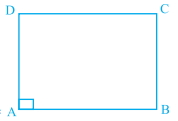
Let $ABCD$ be a rectangle in which $\angle A = 90^{\circ}$.
We have to show that $\angle B = \angle C = \angle D = 90^{\circ}$.
We have $AD \parallel BC$ and $AB$ is a transversal.
So,$\angle A + \angle B = 180^{\circ}$ (Interior angles on the same side of the transversal are supplementary).
But,$\angle A = 90^{\circ}$.
So,$\angle B = 180^{\circ} - \angle A = 180^{\circ} - 90^{\circ} = 90^{\circ}$.
Now,$\angle C = \angle A$ and $\angle D = \angle B$ (Opposite angles of a parallelogram are equal).
So,$\angle C = 90^{\circ}$ and $\angle D = 90^{\circ}$.
Therefore,each of the angles of a rectangle is a right angle.
$A$ rectangle is a parallelogram in which one angle is a right angle.
Let $ABCD$ be a rectangle in which $\angle A = 90^{\circ}$.
We have to show that $\angle B = \angle C = \angle D = 90^{\circ}$.
We have $AD \parallel BC$ and $AB$ is a transversal.
So,$\angle A + \angle B = 180^{\circ}$ (Interior angles on the same side of the transversal are supplementary).
But,$\angle A = 90^{\circ}$.
So,$\angle B = 180^{\circ} - \angle A = 180^{\circ} - 90^{\circ} = 90^{\circ}$.
Now,$\angle C = \angle A$ and $\angle D = \angle B$ (Opposite angles of a parallelogram are equal).
So,$\angle C = 90^{\circ}$ and $\angle D = 90^{\circ}$.
Therefore,each of the angles of a rectangle is a right angle.
0 likes
View Solution2
Difficult
Show that the diagonals of a rhombus are perpendicular to each other.
Solution
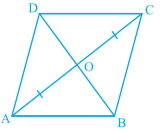
(N/A) Consider the rhombus $ABCD$ (see Fig.).
You know that $AB = BC = CD = DA$ (by definition of a rhombus).
Now,in $\Delta AOD$ and $\Delta COD$,
$OA = OC$ (Diagonals of a parallelogram bisect each other).
$OD = OD$ (Common side).
$AD = CD$ (Sides of a rhombus are equal).
Therefore,$\Delta AOD \cong \Delta COD$ ($SSS$ congruence rule).
This gives,$\angle AOD = \angle COD$ $(CPCT)$.
But,$\angle AOD + \angle COD = 180^{\circ}$ (Linear pair).
So,$2 \angle AOD = 180^{\circ}$.
Or,$\angle AOD = 90^{\circ}$.
Thus,the diagonals of a rhombus are perpendicular to each other.
You know that $AB = BC = CD = DA$ (by definition of a rhombus).
Now,in $\Delta AOD$ and $\Delta COD$,
$OA = OC$ (Diagonals of a parallelogram bisect each other).
$OD = OD$ (Common side).
$AD = CD$ (Sides of a rhombus are equal).
Therefore,$\Delta AOD \cong \Delta COD$ ($SSS$ congruence rule).
This gives,$\angle AOD = \angle COD$ $(CPCT)$.
But,$\angle AOD + \angle COD = 180^{\circ}$ (Linear pair).
So,$2 \angle AOD = 180^{\circ}$.
Or,$\angle AOD = 90^{\circ}$.
Thus,the diagonals of a rhombus are perpendicular to each other.
0 likes
View Solution3
Difficult
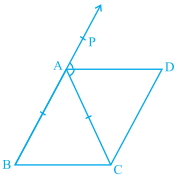
$ABC$ is an isosceles triangle in which $AB = AC$. $AD$ bisects exterior angle $PAC$ and $CD \parallel AB$ (see figure). Show that $\angle DAC = \angle BCA$.
Solution
(N/A) In $\Delta ABC$,we have $AB = AC$ (Given).
So,$\angle ABC = \angle ACB$ (Angles opposite to equal sides).
Also,$\angle PAC = \angle ABC + \angle ACB$ (Exterior angle property of a triangle).
Since $\angle ABC = \angle ACB$,we can write:
$\angle PAC = \angle ACB + \angle ACB = 2 \angle ACB$ ........... $(1)$
Now,$AD$ bisects $\angle PAC$,which means:
$\angle PAC = 2 \angle DAC$ ........... $(2)$
From equations $(1)$ and $(2)$,we get:
$2 \angle DAC = 2 \angle ACB$
Therefore,$\angle DAC = \angle ACB$ or $\angle DAC = \angle BCA$.
So,$\angle ABC = \angle ACB$ (Angles opposite to equal sides).
Also,$\angle PAC = \angle ABC + \angle ACB$ (Exterior angle property of a triangle).
Since $\angle ABC = \angle ACB$,we can write:
$\angle PAC = \angle ACB + \angle ACB = 2 \angle ACB$ ........... $(1)$
Now,$AD$ bisects $\angle PAC$,which means:
$\angle PAC = 2 \angle DAC$ ........... $(2)$
From equations $(1)$ and $(2)$,we get:
$2 \angle DAC = 2 \angle ACB$
Therefore,$\angle DAC = \angle ACB$ or $\angle DAC = \angle BCA$.
0 likes
View Solution4
Easy
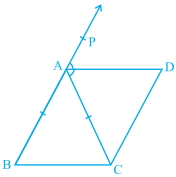
$ABC$ is an isosceles triangle in which $AB = AC$. $AD$ bisects exterior angle $PAC$ and $CD \parallel AB$ (see Fig). Show that $ABCD$ is a parallelogram.
Solution
(N/A) Given: $AB = AC$ in $\triangle ABC$. Therefore,$\angle ABC = \angle ACB$.
Since $AD$ is the bisector of exterior angle $PAC$,we have $\angle PAD = \angle CAD = \frac{1}{2} \angle PAC$.
We know that the exterior angle of a triangle is equal to the sum of the two interior opposite angles. Thus,$\angle PAC = \angle ABC + \angle ACB$.
Since $\angle ABC = \angle ACB$,we have $\angle PAC = 2 \angle ACB$.
Substituting this into the bisector equation: $\angle CAD = \frac{1}{2} (2 \angle ACB) = \angle ACB$.
These are alternate interior angles for lines $BC$ and $AD$ with transversal $AC$. Since the alternate interior angles are equal,$BC \parallel AD$.
We are given that $CD \parallel AB$.
Since both pairs of opposite sides are parallel ($BC \parallel AD$ and $AB \parallel CD$),$ABCD$ is a parallelogram.
Since $AD$ is the bisector of exterior angle $PAC$,we have $\angle PAD = \angle CAD = \frac{1}{2} \angle PAC$.
We know that the exterior angle of a triangle is equal to the sum of the two interior opposite angles. Thus,$\angle PAC = \angle ABC + \angle ACB$.
Since $\angle ABC = \angle ACB$,we have $\angle PAC = 2 \angle ACB$.
Substituting this into the bisector equation: $\angle CAD = \frac{1}{2} (2 \angle ACB) = \angle ACB$.
These are alternate interior angles for lines $BC$ and $AD$ with transversal $AC$. Since the alternate interior angles are equal,$BC \parallel AD$.
We are given that $CD \parallel AB$.
Since both pairs of opposite sides are parallel ($BC \parallel AD$ and $AB \parallel CD$),$ABCD$ is a parallelogram.
0 likes
View Solution5
Difficult
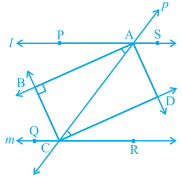
Two parallel lines $l$ and $m$ are intersected by a transversal $p$ (see Fig). Show that the quadrilateral formed by the bisectors of interior angles is a rectangle.
Solution
(N/A) It is given that $l \parallel m$ and transversal $p$ intersects them at points $A$ and $C$ respectively.
The bisectors of $\angle PAC$ and $\angle ACQ$ intersect at $B$,and the bisectors of $\angle SAC$ and $\angle ACR$ intersect at $D$.
We need to show that quadrilateral $ABCD$ is a rectangle.
Since $l \parallel m$ and $p$ is a transversal,$\angle PAC = \angle ACR$ (Alternate interior angles).
Therefore,$\frac{1}{2} \angle PAC = \frac{1}{2} \angle ACR$,which implies $\angle BAC = \angle ACD$.
These are alternate interior angles for lines $AB$ and $DC$ with $AC$ as a transversal,and since they are equal,$AB \parallel DC$.
Similarly,by considering $\angle ACB$ and $\angle CAD$,we can show that $BC \parallel AD$.
Since both pairs of opposite sides are parallel,$ABCD$ is a parallelogram.
Now,$\angle PAC + \angle CAS = 180^{\circ}$ (Linear pair).
Dividing by $2$,we get $\frac{1}{2} \angle PAC + \frac{1}{2} \angle CAS = 90^{\circ}$,which means $\angle BAC + \angle CAD = 90^{\circ}$,so $\angle BAD = 90^{\circ}$.
Since $ABCD$ is a parallelogram with one angle equal to $90^{\circ}$,it is a rectangle.
The bisectors of $\angle PAC$ and $\angle ACQ$ intersect at $B$,and the bisectors of $\angle SAC$ and $\angle ACR$ intersect at $D$.
We need to show that quadrilateral $ABCD$ is a rectangle.
Since $l \parallel m$ and $p$ is a transversal,$\angle PAC = \angle ACR$ (Alternate interior angles).
Therefore,$\frac{1}{2} \angle PAC = \frac{1}{2} \angle ACR$,which implies $\angle BAC = \angle ACD$.
These are alternate interior angles for lines $AB$ and $DC$ with $AC$ as a transversal,and since they are equal,$AB \parallel DC$.
Similarly,by considering $\angle ACB$ and $\angle CAD$,we can show that $BC \parallel AD$.
Since both pairs of opposite sides are parallel,$ABCD$ is a parallelogram.
Now,$\angle PAC + \angle CAS = 180^{\circ}$ (Linear pair).
Dividing by $2$,we get $\frac{1}{2} \angle PAC + \frac{1}{2} \angle CAS = 90^{\circ}$,which means $\angle BAC + \angle CAD = 90^{\circ}$,so $\angle BAD = 90^{\circ}$.
Since $ABCD$ is a parallelogram with one angle equal to $90^{\circ}$,it is a rectangle.
0 likes
View Solution6
Medium
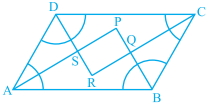
Show that the bisectors of the angles of a parallelogram form a rectangle.
Solution
(N/A) Let $P, Q, R$ and $S$ be the points of intersection of the bisectors of $\angle A$ and $\angle B$,$\angle B$ and $\angle C$,$\angle C$ and $\angle D$,and $\angle D$ and $\angle A$ respectively of parallelogram $ABCD$ (see figure).
In $\Delta ASD$,since $DS$ bisects $\angle D$ and $AS$ bisects $\angle A$,we have:
$\angle DAS + \angle ADS = \frac{1}{2} \angle A + \frac{1}{2} \angle D = \frac{1}{2} (\angle A + \angle D)$
Since $\angle A$ and $\angle D$ are interior angles on the same side of the transversal,$\angle A + \angle D = 180^{\circ}$.
Therefore,$\angle DAS + \angle ADS = \frac{1}{2} \times 180^{\circ} = 90^{\circ}$.
Using the angle sum property of a triangle in $\Delta ASD$:
$\angle DAS + \angle ADS + \angle DSA = 180^{\circ}$
$90^{\circ} + \angle DSA = 180^{\circ} \implies \angle DSA = 90^{\circ}$.
Since $\angle PSR$ and $\angle DSA$ are vertically opposite angles,$\angle PSR = 90^{\circ}$.
Similarly,it can be shown that $\angle SPQ = 90^{\circ}$,$\angle PQR = 90^{\circ}$,and $\angle SRQ = 90^{\circ}$.
Since all angles of the quadrilateral $PQRS$ are $90^{\circ}$,$PQRS$ is a rectangle.
In $\Delta ASD$,since $DS$ bisects $\angle D$ and $AS$ bisects $\angle A$,we have:
$\angle DAS + \angle ADS = \frac{1}{2} \angle A + \frac{1}{2} \angle D = \frac{1}{2} (\angle A + \angle D)$
Since $\angle A$ and $\angle D$ are interior angles on the same side of the transversal,$\angle A + \angle D = 180^{\circ}$.
Therefore,$\angle DAS + \angle ADS = \frac{1}{2} \times 180^{\circ} = 90^{\circ}$.
Using the angle sum property of a triangle in $\Delta ASD$:
$\angle DAS + \angle ADS + \angle DSA = 180^{\circ}$
$90^{\circ} + \angle DSA = 180^{\circ} \implies \angle DSA = 90^{\circ}$.
Since $\angle PSR$ and $\angle DSA$ are vertically opposite angles,$\angle PSR = 90^{\circ}$.
Similarly,it can be shown that $\angle SPQ = 90^{\circ}$,$\angle PQR = 90^{\circ}$,and $\angle SRQ = 90^{\circ}$.
Since all angles of the quadrilateral $PQRS$ are $90^{\circ}$,$PQRS$ is a rectangle.
0 likes
View Solution7
Medium
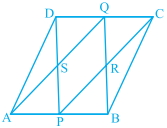
$ABCD$ is a parallelogram in which $P$ and $Q$ are mid-points of opposite sides $AB$ and $CD$ respectively. If $AQ$ intersects $DP$ at $S$ and $BQ$ intersects $CP$ at $R$,show that: $APCQ$ is a parallelogram.
Solution
(N/A) In quadrilateral $APCQ,$
$AP \parallel QC$ (since $AB \parallel CD$ and $P, Q$ are mid-points of $AB$ and $CD$ respectively) ............ $(1)$
$AP = \frac{1}{2} AB$ and $CQ = \frac{1}{2} CD$ (Given that $P$ and $Q$ are mid-points)
Also,$AB = CD$ (Opposite sides of a parallelogram are equal)
Since $AB = CD$,then $\frac{1}{2} AB = \frac{1}{2} CD$,which implies $AP = QC$ ............ $(2)$
From $(1)$ and $(2)$,since one pair of opposite sides is equal and parallel,$APCQ$ is a parallelogram.
$AP \parallel QC$ (since $AB \parallel CD$ and $P, Q$ are mid-points of $AB$ and $CD$ respectively) ............ $(1)$
$AP = \frac{1}{2} AB$ and $CQ = \frac{1}{2} CD$ (Given that $P$ and $Q$ are mid-points)
Also,$AB = CD$ (Opposite sides of a parallelogram are equal)
Since $AB = CD$,then $\frac{1}{2} AB = \frac{1}{2} CD$,which implies $AP = QC$ ............ $(2)$
From $(1)$ and $(2)$,since one pair of opposite sides is equal and parallel,$APCQ$ is a parallelogram.
0 likes
View Solution8
Easy
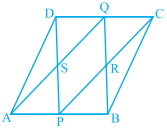
$ABCD$ is a parallelogram in which $P$ and $Q$ are mid-points of opposite sides $AB$ and $CD$ respectively. If $AQ$ intersects $DP$ at $S$ and $BQ$ intersects $CP$ at $R$,show that $DPBQ$ is a parallelogram.
Solution
(N/A) Given that $ABCD$ is a parallelogram,so $AB \,|| \,DC$ and $AB = DC$.
Since $P$ and $Q$ are mid-points of $AB$ and $CD$ respectively,we have $PB = \frac{1}{2} AB$ and $DQ = \frac{1}{2} DC$.
Since $AB = DC$,it follows that $\frac{1}{2} AB = \frac{1}{2} DC$,which implies $PB = DQ$.
Also,since $AB \,|| \,DC$,we have $PB \,|| \,DQ$.
In quadrilateral $DPBQ$,we have one pair of opposite sides ($PB$ and $DQ$) equal and parallel.
Therefore,$DPBQ$ is a parallelogram.
Since $P$ and $Q$ are mid-points of $AB$ and $CD$ respectively,we have $PB = \frac{1}{2} AB$ and $DQ = \frac{1}{2} DC$.
Since $AB = DC$,it follows that $\frac{1}{2} AB = \frac{1}{2} DC$,which implies $PB = DQ$.
Also,since $AB \,|| \,DC$,we have $PB \,|| \,DQ$.
In quadrilateral $DPBQ$,we have one pair of opposite sides ($PB$ and $DQ$) equal and parallel.
Therefore,$DPBQ$ is a parallelogram.
0 likes
View Solution9
Easy
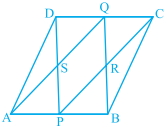
$ABCD$ is a parallelogram in which $P$ and $Q$ are mid-points of opposite sides $AB$ and $CD$ (see Fig.). If $AQ$ intersects $DP$ at $S$ and $BQ$ intersects $CP$ at $R$,show that $PSQR$ is a parallelogram.
Solution
(N/A) Given: $ABCD$ is a parallelogram,$P$ is the mid-point of $AB$,and $Q$ is the mid-point of $CD$.
Since $AB \,||\, CD$ and $AB = CD$,we have $AP \,||\, QC$ and $AP = \frac{1}{2} AB = \frac{1}{2} CD = QC$.
Since $AP \,||\, QC$ and $AP = QC$,$APCQ$ is a parallelogram.
Therefore,$AQ \,||\, PC$,which implies $SQ \,||\, PR$.
Similarly,$PB \,||\, DQ$ and $PB = \frac{1}{2} AB = \frac{1}{2} CD = DQ$.
Since $PB \,||\, DQ$ and $PB = DQ$,$PBQD$ is a parallelogram.
Therefore,$DP \,||\, BQ$,which implies $SP \,||\, QR$.
Since both pairs of opposite sides are parallel ($SQ \,||\, PR$ and $SP \,||\, QR$),$PSQR$ is a parallelogram.
Since $AB \,||\, CD$ and $AB = CD$,we have $AP \,||\, QC$ and $AP = \frac{1}{2} AB = \frac{1}{2} CD = QC$.
Since $AP \,||\, QC$ and $AP = QC$,$APCQ$ is a parallelogram.
Therefore,$AQ \,||\, PC$,which implies $SQ \,||\, PR$.
Similarly,$PB \,||\, DQ$ and $PB = \frac{1}{2} AB = \frac{1}{2} CD = DQ$.
Since $PB \,||\, DQ$ and $PB = DQ$,$PBQD$ is a parallelogram.
Therefore,$DP \,||\, BQ$,which implies $SP \,||\, QR$.
Since both pairs of opposite sides are parallel ($SQ \,||\, PR$ and $SP \,||\, QR$),$PSQR$ is a parallelogram.
0 likes
View Solution10
MediumMCQ
The angles of a quadrilateral are in the ratio $3 : 5 : 9 : 13$. Find all the angles of the quadrilateral.
A
$36^{\circ}, 60^{\circ}, 108^{\circ}, 156^{\circ}$
B
$30^{\circ}, 50^{\circ}, 90^{\circ}, 130^{\circ}$
C
$40^{\circ}, 60^{\circ}, 100^{\circ}, 160^{\circ}$
D
$36^{\circ}, 56^{\circ}, 108^{\circ}, 160^{\circ}$
Solution
(A) Let the angles of the quadrilateral be $3x, 5x, 9x$,and $13x$.
Since the sum of all the interior angles of a quadrilateral is $360^{\circ}$,we have:
$3x + 5x + 9x + 13x = 360^{\circ}$
Combining the terms:
$30x = 360^{\circ}$
Solving for $x$:
$x = \frac{360^{\circ}}{30} = 12^{\circ}$
Now,calculate each angle:
$3x = 3 \times 12^{\circ} = 36^{\circ}$
$5x = 5 \times 12^{\circ} = 60^{\circ}$
$9x = 9 \times 12^{\circ} = 108^{\circ}$
$13x = 13 \times 12^{\circ} = 156^{\circ}$
Thus,the angles of the quadrilateral are $36^{\circ}, 60^{\circ}, 108^{\circ}$,and $156^{\circ}$.
Since the sum of all the interior angles of a quadrilateral is $360^{\circ}$,we have:
$3x + 5x + 9x + 13x = 360^{\circ}$
Combining the terms:
$30x = 360^{\circ}$
Solving for $x$:
$x = \frac{360^{\circ}}{30} = 12^{\circ}$
Now,calculate each angle:
$3x = 3 \times 12^{\circ} = 36^{\circ}$
$5x = 5 \times 12^{\circ} = 60^{\circ}$
$9x = 9 \times 12^{\circ} = 108^{\circ}$
$13x = 13 \times 12^{\circ} = 156^{\circ}$
Thus,the angles of the quadrilateral are $36^{\circ}, 60^{\circ}, 108^{\circ}$,and $156^{\circ}$.
0 likes
View Solution11
Difficult
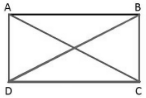
If the diagonals of a parallelogram are equal,then show that it is a rectangle.
Solution
(N/A) Let $ABCD$ be a parallelogram such that its diagonals are equal,i.e.,$AC = BD$.
In $\Delta ABC$ and $\Delta BAD$:
$AC = BD$ [Given]
$BC = AD$ [Opposite sides of a parallelogram are equal]
$AB = AB$ [Common side]
Therefore,by $SSS$ congruence criterion,$\Delta ABC \cong \Delta BAD$.
By $CPCT$,we have $\angle ABC = \angle BAD$ ............. $(1)$
Since $ABCD$ is a parallelogram,$AD \parallel BC$ and $AB$ is a transversal. Therefore,the sum of consecutive interior angles is $180^{\circ}$:
$\angle ABC + \angle BAD = 180^{\circ}$ [Consecutive interior angles are supplementary] ............. $(2)$
From $(1)$ and $(2)$,we get:
$\angle ABC + \angle ABC = 180^{\circ}$
$2 \angle ABC = 180^{\circ}$
$\angle ABC = 90^{\circ}$
Since $ABCD$ is a parallelogram with one angle equal to $90^{\circ}$,it is a rectangle.
In $\Delta ABC$ and $\Delta BAD$:
$AC = BD$ [Given]
$BC = AD$ [Opposite sides of a parallelogram are equal]
$AB = AB$ [Common side]
Therefore,by $SSS$ congruence criterion,$\Delta ABC \cong \Delta BAD$.
By $CPCT$,we have $\angle ABC = \angle BAD$ ............. $(1)$
Since $ABCD$ is a parallelogram,$AD \parallel BC$ and $AB$ is a transversal. Therefore,the sum of consecutive interior angles is $180^{\circ}$:
$\angle ABC + \angle BAD = 180^{\circ}$ [Consecutive interior angles are supplementary] ............. $(2)$
From $(1)$ and $(2)$,we get:
$\angle ABC + \angle ABC = 180^{\circ}$
$2 \angle ABC = 180^{\circ}$
$\angle ABC = 90^{\circ}$
Since $ABCD$ is a parallelogram with one angle equal to $90^{\circ}$,it is a rectangle.
0 likes
View Solution12
Medium
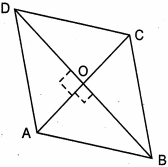
Show that if the diagonals of a quadrilateral bisect each other at right angles,then it is a rhombus.
Solution
(N/A) Let $ABCD$ be a quadrilateral such that its diagonals $AC$ and $BD$ bisect each other at right angles at point $O$.
In $\Delta AOB$ and $\Delta AOD$:
$AO = AO$ (Common side)
$OB = OD$ (Given that $O$ is the midpoint of $BD$)
$\angle AOB = \angle AOD = 90^{\circ}$ (Given)
By $SAS$ congruence criterion,$\Delta AOB \cong \Delta AOD$.
Therefore,$AB = AD$ (Corresponding parts of congruent triangles are equal) ... $(1)$
Similarly,by considering other pairs of triangles:
In $\Delta AOB$ and $\Delta COB$,we get $AB = CB$ ... $(2)$
In $\Delta COB$ and $\Delta COD$,we get $CB = CD$ ... $(3)$
In $\Delta COD$ and $\Delta AOD$,we get $CD = AD$ ... $(4)$
From $(1), (2), (3),$ and $(4)$,we have $AB = BC = CD = DA$.
Since all sides of the quadrilateral $ABCD$ are equal,it is a rhombus.
In $\Delta AOB$ and $\Delta AOD$:
$AO = AO$ (Common side)
$OB = OD$ (Given that $O$ is the midpoint of $BD$)
$\angle AOB = \angle AOD = 90^{\circ}$ (Given)
By $SAS$ congruence criterion,$\Delta AOB \cong \Delta AOD$.
Therefore,$AB = AD$ (Corresponding parts of congruent triangles are equal) ... $(1)$
Similarly,by considering other pairs of triangles:
In $\Delta AOB$ and $\Delta COB$,we get $AB = CB$ ... $(2)$
In $\Delta COB$ and $\Delta COD$,we get $CB = CD$ ... $(3)$
In $\Delta COD$ and $\Delta AOD$,we get $CD = AD$ ... $(4)$
From $(1), (2), (3),$ and $(4)$,we have $AB = BC = CD = DA$.
Since all sides of the quadrilateral $ABCD$ are equal,it is a rhombus.
0 likes
View Solution13
Difficult
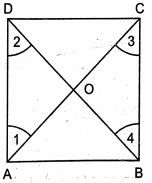
Show that the diagonals of a square are equal and bisect each other at right angles.
Solution
(N/A) We have a square $ABCD$ such that its diagonals $AC$ and $BD$ intersect at $O$.
$(i)$ To prove that the diagonals are equal,i.e.,$AC = BD$:
In $\Delta ABC$ and $\Delta BAD$,we have:
$AB = BA$ [Common]
$BC = AD$ [Opposite sides of the square $ABCD$]
$\angle ABC = \angle BAD = 90^{\circ}$ [All angles of a square are equal to $90^{\circ}$]
$\therefore \Delta ABC \cong \Delta BAD$ [$SAS$ criteria]
$\Rightarrow AC = BD$ ............. $(1)$
$(ii)$ To prove that $O$ is the mid-point of $AC$ and $BD$:
Because $AD \parallel BC$ and $AC$ is a transversal,$\angle 1 = \angle 3$ [Interior alternate angles].
Similarly,$\angle 2 = \angle 4$ [Interior alternate angles].
In $\Delta OAD$ and $\Delta OCB$,we have:
$AD = CB$ [Opposite sides of the square $ABCD$]
$\angle 1 = \angle 3$ [Proved]
$\angle 2 = \angle 4$ [Proved]
$\therefore \Delta OAD \cong \Delta OCB$ [$ASA$ criteria]
$\Rightarrow OA = OC$ and $OD = OB$
$\Rightarrow O$ is the mid-point of $AC$ and $BD$,i.e.,the diagonals $AC$ and $BD$ bisect each other at $O$. .......... $(2)$
$(iii)$ To prove that $AC \perp BD$:
In $\Delta OBA$ and $\Delta ODA$,we have:
$OB = OD$ [Proved]
$BA = DA$ [Opposite sides of the square]
$OA = OA$ [Common]
$\therefore \Delta OBA \cong \Delta ODA$ [$SSS$ criteria]
$\Rightarrow \angle AOB = \angle AOD$
Since $\angle AOB$ and $\angle AOD$ form a linear pair,$\angle AOB + \angle AOD = 180^{\circ}$.
$\Rightarrow \angle AOB = \angle AOD = 90^{\circ}$
$\Rightarrow AC \perp BD$ ............. $(3)$
From $(1)$,$(2)$,and $(3)$,we conclude that the diagonals of a square are equal and bisect each other at right angles.
$(i)$ To prove that the diagonals are equal,i.e.,$AC = BD$:
In $\Delta ABC$ and $\Delta BAD$,we have:
$AB = BA$ [Common]
$BC = AD$ [Opposite sides of the square $ABCD$]
$\angle ABC = \angle BAD = 90^{\circ}$ [All angles of a square are equal to $90^{\circ}$]
$\therefore \Delta ABC \cong \Delta BAD$ [$SAS$ criteria]
$\Rightarrow AC = BD$ ............. $(1)$
$(ii)$ To prove that $O$ is the mid-point of $AC$ and $BD$:
Because $AD \parallel BC$ and $AC$ is a transversal,$\angle 1 = \angle 3$ [Interior alternate angles].
Similarly,$\angle 2 = \angle 4$ [Interior alternate angles].
In $\Delta OAD$ and $\Delta OCB$,we have:
$AD = CB$ [Opposite sides of the square $ABCD$]
$\angle 1 = \angle 3$ [Proved]
$\angle 2 = \angle 4$ [Proved]
$\therefore \Delta OAD \cong \Delta OCB$ [$ASA$ criteria]
$\Rightarrow OA = OC$ and $OD = OB$
$\Rightarrow O$ is the mid-point of $AC$ and $BD$,i.e.,the diagonals $AC$ and $BD$ bisect each other at $O$. .......... $(2)$
$(iii)$ To prove that $AC \perp BD$:
In $\Delta OBA$ and $\Delta ODA$,we have:
$OB = OD$ [Proved]
$BA = DA$ [Opposite sides of the square]
$OA = OA$ [Common]
$\therefore \Delta OBA \cong \Delta ODA$ [$SSS$ criteria]
$\Rightarrow \angle AOB = \angle AOD$
Since $\angle AOB$ and $\angle AOD$ form a linear pair,$\angle AOB + \angle AOD = 180^{\circ}$.
$\Rightarrow \angle AOB = \angle AOD = 90^{\circ}$
$\Rightarrow AC \perp BD$ ............. $(3)$
From $(1)$,$(2)$,and $(3)$,we conclude that the diagonals of a square are equal and bisect each other at right angles.
0 likes
View Solution14
Difficult
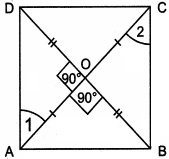
Show that if the diagonals of a quadrilateral are equal and bisect each other at right angles,then it is a square.
Solution
(N/A) Let $ABCD$ be a quadrilateral such that its diagonals $AC$ and $BD$ are equal $(AC = BD)$ and bisect each other at right angles at point $O$ ($AO = OC$,$BO = OD$,and $\angle AOB = \angle BOC = \angle COD = \angle DOA = 90^{\circ}$).
$1$. To prove $ABCD$ is a rhombus:
In $\Delta AOD$ and $\Delta AOB$:
$AO = AO$ (Common)
$OD = OB$ (Given)
$\angle AOD = \angle AOB = 90^{\circ}$ (Given)
By $SAS$ congruence criterion,$\Delta AOD \cong \Delta AOB$.
Therefore,$AD = AB$ $(CPCT)$.
Similarly,we can prove $AB = BC$,$BC = CD$,and $CD = DA$.
Thus,$AB = BC = CD = DA$. Since all sides are equal,$ABCD$ is a rhombus.
$2$. To prove $ABCD$ is a square:
In $\Delta ABC$ and $\Delta BAD$:
$AC = BD$ (Given)
$BC = AD$ (Sides of rhombus are equal)
$AB = BA$ (Common)
By $SSS$ congruence criterion,$\Delta ABC \cong \Delta BAD$.
Therefore,$\angle ABC = \angle BAD$ $(CPCT)$.
Since $AD \parallel BC$ and $AB$ is a transversal,the sum of consecutive interior angles is $180^{\circ}$:
$\angle ABC + \angle BAD = 180^{\circ}$.
Since $\angle ABC = \angle BAD$,we have $2 \angle ABC = 180^{\circ}$,which implies $\angle ABC = 90^{\circ}$.
$A$ rhombus with one angle equal to $90^{\circ}$ is a square. Hence,$ABCD$ is a square.
$1$. To prove $ABCD$ is a rhombus:
In $\Delta AOD$ and $\Delta AOB$:
$AO = AO$ (Common)
$OD = OB$ (Given)
$\angle AOD = \angle AOB = 90^{\circ}$ (Given)
By $SAS$ congruence criterion,$\Delta AOD \cong \Delta AOB$.
Therefore,$AD = AB$ $(CPCT)$.
Similarly,we can prove $AB = BC$,$BC = CD$,and $CD = DA$.
Thus,$AB = BC = CD = DA$. Since all sides are equal,$ABCD$ is a rhombus.
$2$. To prove $ABCD$ is a square:
In $\Delta ABC$ and $\Delta BAD$:
$AC = BD$ (Given)
$BC = AD$ (Sides of rhombus are equal)
$AB = BA$ (Common)
By $SSS$ congruence criterion,$\Delta ABC \cong \Delta BAD$.
Therefore,$\angle ABC = \angle BAD$ $(CPCT)$.
Since $AD \parallel BC$ and $AB$ is a transversal,the sum of consecutive interior angles is $180^{\circ}$:
$\angle ABC + \angle BAD = 180^{\circ}$.
Since $\angle ABC = \angle BAD$,we have $2 \angle ABC = 180^{\circ}$,which implies $\angle ABC = 90^{\circ}$.
$A$ rhombus with one angle equal to $90^{\circ}$ is a square. Hence,$ABCD$ is a square.
0 likes
View Solution15
Medium
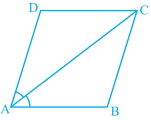
Diagonal $AC$ of a parallelogram $ABCD$ bisects $\angle A$ (see Fig). Show that it bisects $\angle C$ also.
Solution
(N/A) Given: $ABCD$ is a parallelogram in which diagonal $AC$ bisects $\angle A$. Thus,$\angle DAC = \angle BAC$.
To prove: $AC$ bisects $\angle C$,i.e.,$\angle DCA = \angle BCA$.
Proof:
$1$. Since $ABCD$ is a parallelogram,$AB \parallel DC$ and $AC$ is a transversal.
Therefore,$\angle BAC = \angle DCA$ (Alternate interior angles) ....... $(1)$
$2$. Also,$BC \parallel AD$ and $AC$ is a transversal.
Therefore,$\angle DAC = \angle BCA$ (Alternate interior angles) ....... $(2)$
$3$. Since $AC$ bisects $\angle A$,we have $\angle DAC = \angle BAC$ ....... $(3)$
$4$. From equations $(1)$,$(2)$,and $(3)$,we get:
$\angle DCA = \angle BCA$
Hence,$AC$ bisects $\angle C$.
To prove: $AC$ bisects $\angle C$,i.e.,$\angle DCA = \angle BCA$.
Proof:
$1$. Since $ABCD$ is a parallelogram,$AB \parallel DC$ and $AC$ is a transversal.
Therefore,$\angle BAC = \angle DCA$ (Alternate interior angles) ....... $(1)$
$2$. Also,$BC \parallel AD$ and $AC$ is a transversal.
Therefore,$\angle DAC = \angle BCA$ (Alternate interior angles) ....... $(2)$
$3$. Since $AC$ bisects $\angle A$,we have $\angle DAC = \angle BAC$ ....... $(3)$
$4$. From equations $(1)$,$(2)$,and $(3)$,we get:
$\angle DCA = \angle BCA$
Hence,$AC$ bisects $\angle C$.
0 likes
View Solution16
Medium
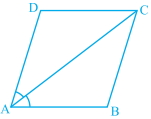
Diagonal $AC$ of a parallelogram $ABCD$ bisects $\angle A$ (see Fig). Show that $ABCD$ is a rhombus.
Solution
(N/A) Given: $A$ parallelogram $ABCD$ in which diagonal $AC$ bisects $\angle A$. So,$\angle DAC = \angle BAC$.
To prove: $ABCD$ is a rhombus.
Proof:
$1$. Since $ABCD$ is a parallelogram,$AD \parallel BC$ and $AC$ is a transversal.
Therefore,$\angle DAC = \angle BCA$ (Alternate interior angles).
$2$. We are given that $\angle DAC = \angle BAC$.
$3$. From steps $1$ and $2$,we get $\angle BAC = \angle BCA$.
$4$. In $\Delta ABC$,since $\angle BAC = \angle BCA$,the sides opposite to these angles must be equal.
Therefore,$BC = AB$ (Sides opposite to equal angles are equal).
$5$. In a parallelogram,opposite sides are equal,so $AB = CD$ and $AD = BC$.
$6$. Since $AB = BC$ and $AB = CD, BC = AD$,we have $AB = BC = CD = DA$.
Since all sides of the parallelogram $ABCD$ are equal,it is a rhombus.
To prove: $ABCD$ is a rhombus.
Proof:
$1$. Since $ABCD$ is a parallelogram,$AD \parallel BC$ and $AC$ is a transversal.
Therefore,$\angle DAC = \angle BCA$ (Alternate interior angles).
$2$. We are given that $\angle DAC = \angle BAC$.
$3$. From steps $1$ and $2$,we get $\angle BAC = \angle BCA$.
$4$. In $\Delta ABC$,since $\angle BAC = \angle BCA$,the sides opposite to these angles must be equal.
Therefore,$BC = AB$ (Sides opposite to equal angles are equal).
$5$. In a parallelogram,opposite sides are equal,so $AB = CD$ and $AD = BC$.
$6$. Since $AB = BC$ and $AB = CD, BC = AD$,we have $AB = BC = CD = DA$.
Since all sides of the parallelogram $ABCD$ are equal,it is a rhombus.
0 likes
View Solution17
Medium
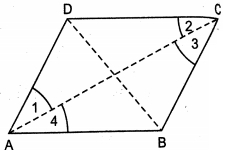
$ABCD$ is a rhombus. Show that diagonal $AC$ bisects $\angle A$ as well as $\angle C$ and diagonal $BD$ bisects $\angle B$ as well as $\angle D$.
Solution
(N/A) $ABCD$ is a rhombus.
$AB = BC = CD = AD$
Also,$AB \parallel CD$ and $AD \parallel BC$.
Now,in $\triangle ADC$,$AD = CD$ (sides of a rhombus).
Therefore,$\angle 1 = \angle 2$ (angles opposite to equal sides are equal) ....... $(1)$
Also,$CD \parallel AB$ (opposite sides of a parallelogram) and $AC$ is a transversal.
Therefore,$\angle 2 = \angle 3$ (alternate interior angles) ....... $(2)$
From $(1)$ and $(2)$,we have $\angle 1 = \angle 3$.
Similarly,since $AD \parallel BC$ and $AC$ is a transversal,$\angle 1 = \angle 4$ (alternate interior angles).
Since $\angle 1 = \angle 2$ and $\angle 1 = \angle 4$,we have $\angle 2 = \angle 4$ is not necessarily true,but rather $\angle 1 = \angle 4$ and $\angle 2 = \angle 3$ implies $AC$ bisects $\angle A$ and $\angle C$.
Thus,$AC$ bisects $\angle A$ and $\angle C$.
Similarly,we can prove that $BD$ bisects $\angle B$ and $\angle D$.
$AB = BC = CD = AD$
Also,$AB \parallel CD$ and $AD \parallel BC$.
Now,in $\triangle ADC$,$AD = CD$ (sides of a rhombus).
Therefore,$\angle 1 = \angle 2$ (angles opposite to equal sides are equal) ....... $(1)$
Also,$CD \parallel AB$ (opposite sides of a parallelogram) and $AC$ is a transversal.
Therefore,$\angle 2 = \angle 3$ (alternate interior angles) ....... $(2)$
From $(1)$ and $(2)$,we have $\angle 1 = \angle 3$.
Similarly,since $AD \parallel BC$ and $AC$ is a transversal,$\angle 1 = \angle 4$ (alternate interior angles).
Since $\angle 1 = \angle 2$ and $\angle 1 = \angle 4$,we have $\angle 2 = \angle 4$ is not necessarily true,but rather $\angle 1 = \angle 4$ and $\angle 2 = \angle 3$ implies $AC$ bisects $\angle A$ and $\angle C$.
Thus,$AC$ bisects $\angle A$ and $\angle C$.
Similarly,we can prove that $BD$ bisects $\angle B$ and $\angle D$.
0 likes
View Solution18
Medium
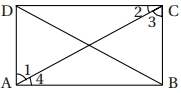
$ABCD$ is a rectangle in which diagonal $AC$ bisects $\angle A$ as well as $\angle C$. Show that $ABCD$ is a square.
Solution
(N/A) We have a rectangle $ABCD$ such that $AC$ bisects $\angle A$ as well as $\angle C$.
i.e.,$\angle 1 = \angle 4$ and $\angle 2 = \angle 3$ ....... $(1)$
Since a rectangle is a parallelogram,$ABCD$ is a parallelogram.
$\Rightarrow AB \parallel CD$ and $AC$ is a transversal.
$\therefore \angle 2 = \angle 4$ $[\text{Alternate interior angles}]$ .......... $(2)$
From $(1)$ and $(2)$,we have $\angle 3 = \angle 4$.
$\Rightarrow AB = BC$ $[\because \text{sides opposite to equal angles in } \Delta ABC \text{ are equal}]$.
Since $ABCD$ is a rectangle,$AB = CD$ and $BC = AD$.
$\therefore AB = BC = CD = AD$.
Thus,$ABCD$ is a rectangle having all of its sides equal,which means $ABCD$ is a square.
i.e.,$\angle 1 = \angle 4$ and $\angle 2 = \angle 3$ ....... $(1)$
Since a rectangle is a parallelogram,$ABCD$ is a parallelogram.
$\Rightarrow AB \parallel CD$ and $AC$ is a transversal.
$\therefore \angle 2 = \angle 4$ $[\text{Alternate interior angles}]$ .......... $(2)$
From $(1)$ and $(2)$,we have $\angle 3 = \angle 4$.
$\Rightarrow AB = BC$ $[\because \text{sides opposite to equal angles in } \Delta ABC \text{ are equal}]$.
Since $ABCD$ is a rectangle,$AB = CD$ and $BC = AD$.
$\therefore AB = BC = CD = AD$.
Thus,$ABCD$ is a rectangle having all of its sides equal,which means $ABCD$ is a square.
0 likes
View Solution19
Medium
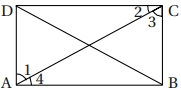
$ABCD$ is a rectangle in which diagonal $AC$ bisects $\angle A$ as well as $\angle C$. Show that: diagonal $BD$ bisects $\angle B$ as well as $\angle D$.
Solution
(N/A) Given: $ABCD$ is a rectangle in which diagonal $AC$ bisects $\angle A$ and $\angle C$.
$1$. Since $ABCD$ is a rectangle,$AB \parallel DC$ and $AD \parallel BC$.
$2$. Since $AC$ bisects $\angle A$,$\angle DAC = \angle BAC$. Also,$\angle DAC = \angle BCA$ (alternate interior angles).
$3$. Therefore,$\angle BAC = \angle BCA$. In $\triangle ABC$,sides opposite to equal angles are equal,so $AB = BC$.
$4$. $A$ rectangle with adjacent sides equal is a square. Thus,$ABCD$ is a square.
$5$. In a square,diagonals bisect the opposite angles.
$6$. Therefore,diagonal $BD$ bisects $\angle B$ as well as $\angle D$.
$1$. Since $ABCD$ is a rectangle,$AB \parallel DC$ and $AD \parallel BC$.
$2$. Since $AC$ bisects $\angle A$,$\angle DAC = \angle BAC$. Also,$\angle DAC = \angle BCA$ (alternate interior angles).
$3$. Therefore,$\angle BAC = \angle BCA$. In $\triangle ABC$,sides opposite to equal angles are equal,so $AB = BC$.
$4$. $A$ rectangle with adjacent sides equal is a square. Thus,$ABCD$ is a square.
$5$. In a square,diagonals bisect the opposite angles.
$6$. Therefore,diagonal $BD$ bisects $\angle B$ as well as $\angle D$.
0 likes
View Solution20
Medium
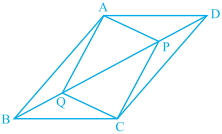
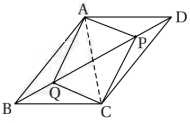
In parallelogram $ABCD$,two points $P$ and $Q$ are taken on diagonal $BD$ such that $DP = BQ$ (see Fig). Show that: $\Delta APD \cong \Delta CQB$.
Solution
(N/A) We have parallelogram $ABCD$. $BD$ is a diagonal and $P$ and $Q$ are points on $BD$ such that:
$DP = BQ$ [Given]
To prove that $\Delta APD \cong \Delta CQB$:
Since $AD \parallel BC$ and $BD$ is a transversal,$[\because ABCD$ is a parallelogram $]$
$\therefore \angle ADB = \angle CBD$ [Interior alternate angles]
$\Rightarrow \angle ADP = \angle CBQ$
Now,in $\Delta APD$ and $\Delta CQB$,we have:
$AD = CB$ [Opposite sides of a parallelogram are equal]
$DP = BQ$ [Given]
$\angle ADP = \angle CBQ$ [Proved above]
$\therefore$ By $SAS$ congruence criterion,we have:
$\Delta APD \cong \Delta CQB$.
$DP = BQ$ [Given]
To prove that $\Delta APD \cong \Delta CQB$:
Since $AD \parallel BC$ and $BD$ is a transversal,$[\because ABCD$ is a parallelogram $]$
$\therefore \angle ADB = \angle CBD$ [Interior alternate angles]
$\Rightarrow \angle ADP = \angle CBQ$
Now,in $\Delta APD$ and $\Delta CQB$,we have:
$AD = CB$ [Opposite sides of a parallelogram are equal]
$DP = BQ$ [Given]
$\angle ADP = \angle CBQ$ [Proved above]
$\therefore$ By $SAS$ congruence criterion,we have:
$\Delta APD \cong \Delta CQB$.
0 likes
View Solution21
Medium
In parallelogram $ABCD$,two points $P$ and $Q$ are taken on diagonal $BD$ such that $DP = BQ$ (see Fig). Show that: $AP = CQ$.
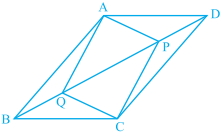
Solution
(N/A) Given: $ABCD$ is a parallelogram. $P$ and $Q$ are points on diagonal $BD$ such that $DP = BQ$.
To prove: $AP = CQ$.
Proof:
In $\Delta APD$ and $\Delta CQB$:
$1$. $AD = CB$ (Opposite sides of a parallelogram are equal)
$2$. $\angle ADP = \angle CBQ$ (Alternate interior angles as $AD \parallel BC$ and $BD$ is a transversal)
$3$. $DP = BQ$ (Given)
Therefore,by $SAS$ congruence rule,$\Delta APD \cong \Delta CQB$.
Since the triangles are congruent,their corresponding parts are equal $(CPCT)$.
Thus,$AP = CQ$.
To prove: $AP = CQ$.
Proof:
In $\Delta APD$ and $\Delta CQB$:
$1$. $AD = CB$ (Opposite sides of a parallelogram are equal)
$2$. $\angle ADP = \angle CBQ$ (Alternate interior angles as $AD \parallel BC$ and $BD$ is a transversal)
$3$. $DP = BQ$ (Given)
Therefore,by $SAS$ congruence rule,$\Delta APD \cong \Delta CQB$.
Since the triangles are congruent,their corresponding parts are equal $(CPCT)$.
Thus,$AP = CQ$.
0 likes
View Solution22
Medium
In parallelogram $ABCD$,two points $P$ and $Q$ are taken on diagonal $BD$ such that $DP = BQ$ (see figure). Show that: $\Delta AQB \cong \Delta CPD$.
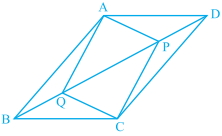
Solution
(N/A) We have parallelogram $ABCD$. $BD$ is a diagonal and $P$ and $Q$ are such that:
$PD = QB$ [Given]
To prove that $\Delta AQB \cong \Delta CPD$.
Since $AB \parallel CD$ and $BD$ is a transversal,$[\because ABCD$ is a parallelogram$]$
$\therefore \angle ABD = \angle CDB$
$\Rightarrow \angle ABQ = \angle CDP$
Now,in $\Delta AQB$ and $\Delta CPD$,we have:
$QB = PD$ [Given]
$\angle ABQ = \angle CDP$ [Proved above]
$AB = CD$ [Opposite sides of parallelogram $ABCD$]
$\therefore \Delta AQB \cong \Delta CPD$ [By $SAS$ congruence criterion]
$PD = QB$ [Given]
To prove that $\Delta AQB \cong \Delta CPD$.
Since $AB \parallel CD$ and $BD$ is a transversal,$[\because ABCD$ is a parallelogram$]$
$\therefore \angle ABD = \angle CDB$
$\Rightarrow \angle ABQ = \angle CDP$
Now,in $\Delta AQB$ and $\Delta CPD$,we have:
$QB = PD$ [Given]
$\angle ABQ = \angle CDP$ [Proved above]
$AB = CD$ [Opposite sides of parallelogram $ABCD$]
$\therefore \Delta AQB \cong \Delta CPD$ [By $SAS$ congruence criterion]
0 likes
View Solution23
Medium
In parallelogram $ABCD$,two points $P$ and $Q$ are taken on diagonal $BD$ such that $DP = BQ$ (see Fig). Show that: $AQ = CP$.
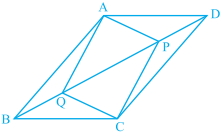
Solution
(N/A) Given: $ABCD$ is a parallelogram. $P$ and $Q$ are points on diagonal $BD$ such that $DP = BQ$.
To prove: $AQ = CP$.
Proof:
In $\Delta AQB$ and $\Delta CPD$:
$1$. $AB = CD$ (Opposite sides of a parallelogram are equal)
$2$. $\angle ABQ = \angle CDP$ (Alternate interior angles as $AB \parallel CD$ and $BD$ is a transversal)
$3$. $BQ = DP$ (Given)
Therefore,by $SAS$ congruence criterion,$\Delta AQB \cong \Delta CPD$.
Since the triangles are congruent,their corresponding parts are equal $(CPCT)$.
Thus,$AQ = CP$.
To prove: $AQ = CP$.
Proof:
In $\Delta AQB$ and $\Delta CPD$:
$1$. $AB = CD$ (Opposite sides of a parallelogram are equal)
$2$. $\angle ABQ = \angle CDP$ (Alternate interior angles as $AB \parallel CD$ and $BD$ is a transversal)
$3$. $BQ = DP$ (Given)
Therefore,by $SAS$ congruence criterion,$\Delta AQB \cong \Delta CPD$.
Since the triangles are congruent,their corresponding parts are equal $(CPCT)$.
Thus,$AQ = CP$.
0 likes
View Solution24
Medium
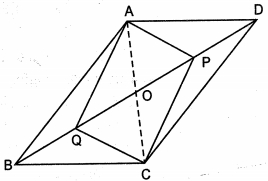
In parallelogram $ABCD$,two points $P$ and $Q$ are taken on diagonal $BD$ such that $DP = BQ$ (see figure). Show that $APCQ$ is a parallelogram.
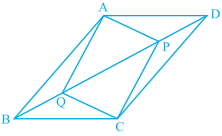
Solution
(N/A) We have parallelogram $ABCD$. $BD$ is a diagonal and points $P$ and $Q$ are such that $DP = BQ$ [Given].
To prove that $APCQ$ is a parallelogram.
Let us join $AC$ intersecting $BD$ at $O$.
Since the diagonals of a parallelogram bisect each other,we have $AO = CO$ and $BO = DO$ ... $(1)$.
We are given $DP = BQ$ ... $(2)$.
Subtracting equation $(2)$ from $BO = DO$,we get:
$BO - BQ = DO - DP$
$QO = PO$ ... $(3)$.
Now,in quadrilateral $APCQ$,the diagonals $AC$ and $PQ$ bisect each other at $O$ (from equations $(1)$ and $(3)$).
Since the diagonals of a quadrilateral bisect each other,$APCQ$ is a parallelogram.
To prove that $APCQ$ is a parallelogram.
Let us join $AC$ intersecting $BD$ at $O$.
Since the diagonals of a parallelogram bisect each other,we have $AO = CO$ and $BO = DO$ ... $(1)$.
We are given $DP = BQ$ ... $(2)$.
Subtracting equation $(2)$ from $BO = DO$,we get:
$BO - BQ = DO - DP$
$QO = PO$ ... $(3)$.
Now,in quadrilateral $APCQ$,the diagonals $AC$ and $PQ$ bisect each other at $O$ (from equations $(1)$ and $(3)$).
Since the diagonals of a quadrilateral bisect each other,$APCQ$ is a parallelogram.
0 likes
View Solution25
Medium
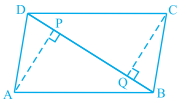
$ABCD$ is a parallelogram and $AP$ and $CQ$ are perpendiculars from vertices $A$ and $C$ on diagonal $BD$ (see Fig). Show that $\Delta APB \cong \Delta CQD$.
Solution
(N/A) In $\Delta APB$ and $\Delta CQD$,we have:
$1$. $\angle APB = \angle CQD = 90^{\circ}$ (Given,as $AP \perp BD$ and $CQ \perp BD$)
$2$. $AB = CD$ (Opposite sides of a parallelogram are equal)
$3$. $\angle ABP = \angle CDQ$ (Alternate interior angles,since $AB \parallel CD$ and $BD$ is a transversal)
Therefore,by the $AAS$ (Angle-Angle-Side) congruence criterion,we have:
$\Delta APB \cong \Delta CQD$
$1$. $\angle APB = \angle CQD = 90^{\circ}$ (Given,as $AP \perp BD$ and $CQ \perp BD$)
$2$. $AB = CD$ (Opposite sides of a parallelogram are equal)
$3$. $\angle ABP = \angle CDQ$ (Alternate interior angles,since $AB \parallel CD$ and $BD$ is a transversal)
Therefore,by the $AAS$ (Angle-Angle-Side) congruence criterion,we have:
$\Delta APB \cong \Delta CQD$
0 likes
View Solution26
Medium
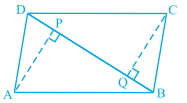
$ABCD$ is a parallelogram and $AP$ and $CQ$ are perpendiculars from vertices $A$ and $C$ on diagonal $BD$ (see figure). Show that $AP = CQ$.
Solution
(N/A) In $\Delta APB$ and $\Delta CQD$:
$1$. $\angle APB = \angle CQD = 90^\circ$ (Given that $AP \perp BD$ and $CQ \perp BD$)
$2$. $AB = CD$ (Opposite sides of a parallelogram are equal)
$3$. $\angle ABP = \angle CDQ$ (Alternate interior angles,as $AB \parallel CD$ and $BD$ is a transversal)
Therefore,by the $AAS$ congruence criterion,$\Delta APB \cong \Delta CQD$.
Since the triangles are congruent,their corresponding parts are equal $(CPCT)$.
Thus,$AP = CQ$.
$1$. $\angle APB = \angle CQD = 90^\circ$ (Given that $AP \perp BD$ and $CQ \perp BD$)
$2$. $AB = CD$ (Opposite sides of a parallelogram are equal)
$3$. $\angle ABP = \angle CDQ$ (Alternate interior angles,as $AB \parallel CD$ and $BD$ is a transversal)
Therefore,by the $AAS$ congruence criterion,$\Delta APB \cong \Delta CQD$.
Since the triangles are congruent,their corresponding parts are equal $(CPCT)$.
Thus,$AP = CQ$.
0 likes
View Solution27
Easy
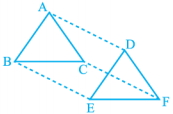
In $\Delta ABC$ and $\Delta DEF$,$AB = DE$,$AB \parallel DE$,$BC = EF$ and $BC \parallel EF$. Vertices $A, B$ and $C$ are joined to vertices $D, E$ and $F$ respectively. Show that quadrilateral $ABED$ is a parallelogram.
Solution
(N/A) To prove that $ABED$ is a parallelogram.
We know that a quadrilateral is a parallelogram if a pair of opposite sides is parallel and equal in length.
Given:
$AB = DE$
$AB \parallel DE$
In quadrilateral $ABED$,we have a pair of opposite sides ($AB$ and $DE$) which are both parallel and equal in length.
Therefore,$ABED$ is a parallelogram.
We know that a quadrilateral is a parallelogram if a pair of opposite sides is parallel and equal in length.
Given:
$AB = DE$
$AB \parallel DE$
In quadrilateral $ABED$,we have a pair of opposite sides ($AB$ and $DE$) which are both parallel and equal in length.
Therefore,$ABED$ is a parallelogram.
0 likes
View Solution28
Easy
In $\Delta ABC$ and $\Delta DEF$,$AB = DE$,$AB \parallel DE$,$BC = EF$ and $BC \parallel EF$. Vertices $A, B$ and $C$ are joined to vertices $D, E$ and $F$ respectively (see Fig). Show that quadrilateral $BEFC$ is a parallelogram.
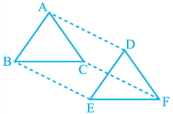
Solution
(N/A) To prove that $BEFC$ is a parallelogram.
Given that $BC = EF$ and $BC \parallel EF$.
$A$ quadrilateral is a parallelogram if one pair of opposite sides is equal and parallel.
Since $BEFC$ is a quadrilateral in which the pair of opposite sides $BC$ and $EF$ is equal and parallel,
Therefore,$BEFC$ is a parallelogram.
Given that $BC = EF$ and $BC \parallel EF$.
$A$ quadrilateral is a parallelogram if one pair of opposite sides is equal and parallel.
Since $BEFC$ is a quadrilateral in which the pair of opposite sides $BC$ and $EF$ is equal and parallel,
Therefore,$BEFC$ is a parallelogram.
0 likes
View Solution29
Medium
In $\Delta ABC$ and $\Delta DEF$,$AB = DE$,$AB \parallel DE$,$BC = EF$ and $BC \parallel EF$. Vertices $A, B$ and $C$ are joined to vertices $D, E$ and $F$ respectively (see figure). Show that $AD \parallel CF$ and $AD = CF$.
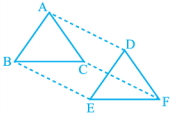
Solution
(N/A) To prove that $AD \parallel CF$ and $AD = CF$:
$1$. In quadrilateral $ABED$,we are given that $AB = DE$ and $AB \parallel DE$. Since one pair of opposite sides is equal and parallel,$ABED$ is a parallelogram.
Therefore,$AD \parallel BE$ and $AD = BE$ (Opposite sides of a parallelogram are equal and parallel) ... $(1)$
$2$. In quadrilateral $BEFC$,we are given that $BC = EF$ and $BC \parallel EF$. Since one pair of opposite sides is equal and parallel,$BEFC$ is a parallelogram.
Therefore,$BE \parallel CF$ and $BE = CF$ (Opposite sides of a parallelogram are equal and parallel) ... $(2)$
$3$. From equations $(1)$ and $(2)$,we have $AD \parallel BE$ and $BE \parallel CF$,which implies $AD \parallel CF$.
Also,$AD = BE$ and $BE = CF$,which implies $AD = CF$.
$1$. In quadrilateral $ABED$,we are given that $AB = DE$ and $AB \parallel DE$. Since one pair of opposite sides is equal and parallel,$ABED$ is a parallelogram.
Therefore,$AD \parallel BE$ and $AD = BE$ (Opposite sides of a parallelogram are equal and parallel) ... $(1)$
$2$. In quadrilateral $BEFC$,we are given that $BC = EF$ and $BC \parallel EF$. Since one pair of opposite sides is equal and parallel,$BEFC$ is a parallelogram.
Therefore,$BE \parallel CF$ and $BE = CF$ (Opposite sides of a parallelogram are equal and parallel) ... $(2)$
$3$. From equations $(1)$ and $(2)$,we have $AD \parallel BE$ and $BE \parallel CF$,which implies $AD \parallel CF$.
Also,$AD = BE$ and $BE = CF$,which implies $AD = CF$.
0 likes
View Solution30
Easy
In $\Delta ABC$ and $\Delta DEF$,$AB = DE$,$AB \parallel DE$,$BC = EF$ and $BC \parallel EF$. Vertices $A, B$ and $C$ are joined to vertices $D, E$ and $F$ respectively (see Fig). Show that quadrilateral $ACFD$ is a parallelogram.
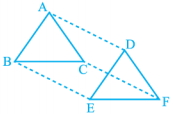
Solution
(N/A) Given: In $\Delta ABC$ and $\Delta DEF$,$AB = DE$,$AB \parallel DE$,$BC = EF$ and $BC \parallel EF$.
Step $1$: Consider quadrilateral $ABED$.
Since $AB = DE$ and $AB \parallel DE$,one pair of opposite sides is equal and parallel.
Therefore,$ABED$ is a parallelogram.
This implies $AD = BE$ and $AD \parallel BE$ (Opposite sides of a parallelogram are equal and parallel).
Step $2$: Consider quadrilateral $BCFE$.
Since $BC = EF$ and $BC \parallel EF$,one pair of opposite sides is equal and parallel.
Therefore,$BCFE$ is a parallelogram.
This implies $BE = CF$ and $BE \parallel CF$ (Opposite sides of a parallelogram are equal and parallel).
Step $3$: Consider quadrilateral $ACFD$.
From Step $1$,$AD \parallel BE$ and from Step $2$,$BE \parallel CF$. Thus,$AD \parallel CF$.
From Step $1$,$AD = BE$ and from Step $2$,$BE = CF$. Thus,$AD = CF$.
Since one pair of opposite sides ($AD$ and $CF$) is equal and parallel,quadrilateral $ACFD$ is a parallelogram.
Step $1$: Consider quadrilateral $ABED$.
Since $AB = DE$ and $AB \parallel DE$,one pair of opposite sides is equal and parallel.
Therefore,$ABED$ is a parallelogram.
This implies $AD = BE$ and $AD \parallel BE$ (Opposite sides of a parallelogram are equal and parallel).
Step $2$: Consider quadrilateral $BCFE$.
Since $BC = EF$ and $BC \parallel EF$,one pair of opposite sides is equal and parallel.
Therefore,$BCFE$ is a parallelogram.
This implies $BE = CF$ and $BE \parallel CF$ (Opposite sides of a parallelogram are equal and parallel).
Step $3$: Consider quadrilateral $ACFD$.
From Step $1$,$AD \parallel BE$ and from Step $2$,$BE \parallel CF$. Thus,$AD \parallel CF$.
From Step $1$,$AD = BE$ and from Step $2$,$BE = CF$. Thus,$AD = CF$.
Since one pair of opposite sides ($AD$ and $CF$) is equal and parallel,quadrilateral $ACFD$ is a parallelogram.
0 likes
View Solution31
Easy
In $\Delta ABC$ and $\Delta DEF$,$AB = DE$,$AB \parallel DE$,$BC = EF$ and $BC \parallel EF$. Vertices $A, B$ and $C$ are joined to vertices $D, E$ and $F$ respectively (see Fig). Show that $AC = DF$.
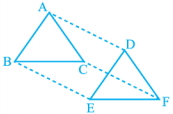
Solution
(N/A) Given: $AB = DE$,$AB \parallel DE$,$BC = EF$,and $BC \parallel EF$.
Step $1$: Consider quadrilateral $ABED$. Since $AB = DE$ and $AB \parallel DE$,one pair of opposite sides is equal and parallel. Therefore,$ABED$ is a parallelogram.
Step $2$: Since $ABED$ is a parallelogram,$AD = BE$ and $AD \parallel BE$.
Step $3$: Consider quadrilateral $BCFE$. Since $BC = EF$ and $BC \parallel EF$,one pair of opposite sides is equal and parallel. Therefore,$BCFE$ is a parallelogram.
Step $4$: Since $BCFE$ is a parallelogram,$BE = CF$ and $BE \parallel CF$.
Step $5$: From Step $2$ and Step $4$,we have $AD = BE$ and $BE = CF$,which implies $AD = CF$. Also,$AD \parallel BE$ and $BE \parallel CF$,which implies $AD \parallel CF$.
Step $6$: In quadrilateral $ACFD$,since $AD = CF$ and $AD \parallel CF$,it is a parallelogram.
Step $7$: Since $ACFD$ is a parallelogram,its opposite sides are equal. Therefore,$AC = DF$.
Step $1$: Consider quadrilateral $ABED$. Since $AB = DE$ and $AB \parallel DE$,one pair of opposite sides is equal and parallel. Therefore,$ABED$ is a parallelogram.
Step $2$: Since $ABED$ is a parallelogram,$AD = BE$ and $AD \parallel BE$.
Step $3$: Consider quadrilateral $BCFE$. Since $BC = EF$ and $BC \parallel EF$,one pair of opposite sides is equal and parallel. Therefore,$BCFE$ is a parallelogram.
Step $4$: Since $BCFE$ is a parallelogram,$BE = CF$ and $BE \parallel CF$.
Step $5$: From Step $2$ and Step $4$,we have $AD = BE$ and $BE = CF$,which implies $AD = CF$. Also,$AD \parallel BE$ and $BE \parallel CF$,which implies $AD \parallel CF$.
Step $6$: In quadrilateral $ACFD$,since $AD = CF$ and $AD \parallel CF$,it is a parallelogram.
Step $7$: Since $ACFD$ is a parallelogram,its opposite sides are equal. Therefore,$AC = DF$.
0 likes
View Solution32
Medium
In $\Delta ABC$ and $\Delta DEF$,$AB = DE$,$AB \parallel DE$,$BC = EF$ and $BC \parallel EF$. Vertices $A, B$ and $C$ are joined to vertices $D, E$ and $F$ respectively (see Fig). Show that $\Delta ABC \cong \Delta DEF$.
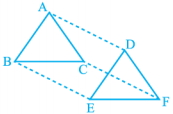
Solution
(N/A) Given: $AB = DE$,$AB \parallel DE$,$BC = EF$,and $BC \parallel EF$.
Step $1$: Since $AB = DE$ and $AB \parallel DE$,quadrilateral $ABED$ is a parallelogram. Therefore,$AD = BE$ and $AD \parallel BE$.
Step $2$: Since $BC = EF$ and $BC \parallel EF$,quadrilateral $BEFC$ is a parallelogram. Therefore,$BE = CF$ and $BE \parallel CF$.
Step $3$: From Step $1$ and Step $2$,we have $AD = BE$ and $BE = CF$,which implies $AD = CF$. Also,$AD \parallel CF$ because both are parallel to $BE$.
Step $4$: Since $AD = CF$ and $AD \parallel CF$,quadrilateral $ACFD$ is a parallelogram. Therefore,$AC = DF$.
Step $5$: In $\Delta ABC$ and $\Delta DEF$:
$AB = DE$ (Given)
$BC = EF$ (Given)
$AC = DF$ (Proved in Step $4$)
Therefore,by $SSS$ congruence criterion,$\Delta ABC \cong \Delta DEF$.
Step $1$: Since $AB = DE$ and $AB \parallel DE$,quadrilateral $ABED$ is a parallelogram. Therefore,$AD = BE$ and $AD \parallel BE$.
Step $2$: Since $BC = EF$ and $BC \parallel EF$,quadrilateral $BEFC$ is a parallelogram. Therefore,$BE = CF$ and $BE \parallel CF$.
Step $3$: From Step $1$ and Step $2$,we have $AD = BE$ and $BE = CF$,which implies $AD = CF$. Also,$AD \parallel CF$ because both are parallel to $BE$.
Step $4$: Since $AD = CF$ and $AD \parallel CF$,quadrilateral $ACFD$ is a parallelogram. Therefore,$AC = DF$.
Step $5$: In $\Delta ABC$ and $\Delta DEF$:
$AB = DE$ (Given)
$BC = EF$ (Given)
$AC = DF$ (Proved in Step $4$)
Therefore,by $SSS$ congruence criterion,$\Delta ABC \cong \Delta DEF$.
0 likes
View Solution33
Difficult
$ABCD$ is a trapezium in which $AB \parallel CD$ and $AD = BC$ (see Fig). Show that $\angle A = \angle B$.
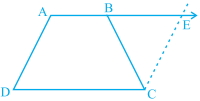
Solution
(N/A) We have $AB \parallel CD$ and $AD = BC$.
To prove that $\angle A = \angle B$.
Produce $AB$ to $E$ and draw $CE \parallel AD$.
$\therefore AB \parallel DC \Rightarrow AE \parallel DC$ [Given].
Also $AD \parallel CE$ [Construction].
$\therefore AECD$ is a parallelogram.
$\Rightarrow AD = CE$ [Opposite sides of the parallelogram $AECD$].
But $AD = BC$ [Given].
$\therefore BC = CE$.
Now,in $\Delta BCE$,we have $BC = CE$.
$\Rightarrow \angle CBE = \angle CEB$ ......... $(1)$ [$\because$ Angles opposite to equal sides of a triangle are equal].
Also,$\angle ABC + \angle CBE = 180^{\circ}$ [Linear pair] ......... $(2)$.
And $\angle A + \angle CEB = 180^{\circ}$ [$\because$ Adjacent angles of a parallelogram are supplementary] ......... $(3)$.
From $(2)$ and $(3)$,we get $\angle ABC + \angle CBE = \angle A + \angle CEB$.
But $\angle CBE = \angle CEB$ [Using $(1)$].
$\therefore \angle ABC = \angle A$,or $\angle B = \angle A$.
To prove that $\angle A = \angle B$.
Produce $AB$ to $E$ and draw $CE \parallel AD$.
$\therefore AB \parallel DC \Rightarrow AE \parallel DC$ [Given].
Also $AD \parallel CE$ [Construction].
$\therefore AECD$ is a parallelogram.
$\Rightarrow AD = CE$ [Opposite sides of the parallelogram $AECD$].
But $AD = BC$ [Given].
$\therefore BC = CE$.
Now,in $\Delta BCE$,we have $BC = CE$.
$\Rightarrow \angle CBE = \angle CEB$ ......... $(1)$ [$\because$ Angles opposite to equal sides of a triangle are equal].
Also,$\angle ABC + \angle CBE = 180^{\circ}$ [Linear pair] ......... $(2)$.
And $\angle A + \angle CEB = 180^{\circ}$ [$\because$ Adjacent angles of a parallelogram are supplementary] ......... $(3)$.
From $(2)$ and $(3)$,we get $\angle ABC + \angle CBE = \angle A + \angle CEB$.
But $\angle CBE = \angle CEB$ [Using $(1)$].
$\therefore \angle ABC = \angle A$,or $\angle B = \angle A$.
0 likes
View Solution34
Medium
$ABCD$ is a trapezium in which $AB \parallel CD$ and $AD = BC$ (see Fig). Show that $\angle C = \angle D$.
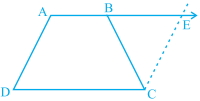
Solution
(N/A) To prove that $\angle C = \angle D$.
Construction: Extend $AB$ to $E$ and draw a line through $C$ parallel to $AD$ intersecting $AB$ produced at $E$.
Since $AD \parallel CE$ and $AE \parallel DC$,$AECD$ is a parallelogram.
Therefore,$AD = CE$ (opposite sides of a parallelogram).
Given that $AD = BC$,it follows that $BC = CE$.
In $\triangle BCE$,since $BC = CE$,the angles opposite to these sides are equal,so $\angle CBE = \angle CEB$.
Also,$\angle ABC + \angle CBE = 180^{\circ}$ (linear pair).
Since $AECD$ is a parallelogram,$\angle A = \angle ADC$ and $\angle D + \angle A = 180^{\circ}$ (consecutive interior angles).
Also,$\angle CEB = \angle A$ (corresponding angles as $AD \parallel CE$).
Since $\angle D + \angle A = 180^{\circ}$ and $\angle C + \angle B = 180^{\circ}$,and using the properties of the parallelogram and isosceles triangle,we conclude $\angle C = \angle D$.
Construction: Extend $AB$ to $E$ and draw a line through $C$ parallel to $AD$ intersecting $AB$ produced at $E$.
Since $AD \parallel CE$ and $AE \parallel DC$,$AECD$ is a parallelogram.
Therefore,$AD = CE$ (opposite sides of a parallelogram).
Given that $AD = BC$,it follows that $BC = CE$.
In $\triangle BCE$,since $BC = CE$,the angles opposite to these sides are equal,so $\angle CBE = \angle CEB$.
Also,$\angle ABC + \angle CBE = 180^{\circ}$ (linear pair).
Since $AECD$ is a parallelogram,$\angle A = \angle ADC$ and $\angle D + \angle A = 180^{\circ}$ (consecutive interior angles).
Also,$\angle CEB = \angle A$ (corresponding angles as $AD \parallel CE$).
Since $\angle D + \angle A = 180^{\circ}$ and $\angle C + \angle B = 180^{\circ}$,and using the properties of the parallelogram and isosceles triangle,we conclude $\angle C = \angle D$.
0 likes
View Solution35
Medium
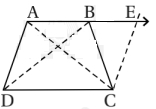
$ABCD$ is a trapezium in which $AB \parallel CD$ and $AD = BC$ (see Fig). Show that $\Delta ABC \cong \Delta BAD$.
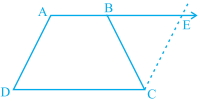
Solution
(N/A) To prove $\Delta ABC \cong \Delta BAD$:
Construction: Extend $AB$ and draw a line through $C$ parallel to $DA$ intersecting $AB$ produced at $E$.
$1$. Since $AD \parallel CE$ and $AE \parallel DC$,$AECD$ is a parallelogram.
$2$. Therefore,$AD = CE$ (opposite sides of a parallelogram).
$3$. Given $AD = BC$,so $BC = CE$. Thus,$\angle CEB = \angle CBE$ (angles opposite to equal sides in $\Delta BCE$).
$4$. Also,$\angle ABC + \angle CBE = 180^{\circ}$ (linear pair) and $\angle BAD + \angle ADC = 180^{\circ}$ (consecutive interior angles).
$5$. Since $AD \parallel CE$,$\angle ADC + \angle DCE = 180^{\circ}$.
$6$. By comparing these,we can establish $\angle ABC = \angle BAD$.
$7$. In $\Delta ABC$ and $\Delta BAD$:
- $AB = BA$ (Common side)
- $BC = AD$ (Given)
- $\angle ABC = \angle BAD$ (Proved above)
$8$. By $SAS$ congruence rule,$\Delta ABC \cong \Delta BAD$.
Construction: Extend $AB$ and draw a line through $C$ parallel to $DA$ intersecting $AB$ produced at $E$.
$1$. Since $AD \parallel CE$ and $AE \parallel DC$,$AECD$ is a parallelogram.
$2$. Therefore,$AD = CE$ (opposite sides of a parallelogram).
$3$. Given $AD = BC$,so $BC = CE$. Thus,$\angle CEB = \angle CBE$ (angles opposite to equal sides in $\Delta BCE$).
$4$. Also,$\angle ABC + \angle CBE = 180^{\circ}$ (linear pair) and $\angle BAD + \angle ADC = 180^{\circ}$ (consecutive interior angles).
$5$. Since $AD \parallel CE$,$\angle ADC + \angle DCE = 180^{\circ}$.
$6$. By comparing these,we can establish $\angle ABC = \angle BAD$.
$7$. In $\Delta ABC$ and $\Delta BAD$:
- $AB = BA$ (Common side)
- $BC = AD$ (Given)
- $\angle ABC = \angle BAD$ (Proved above)
$8$. By $SAS$ congruence rule,$\Delta ABC \cong \Delta BAD$.
0 likes
View Solution36
Medium
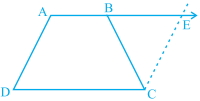
$ABCD$ is a trapezium in which $AB \parallel CD$ and $AD = BC$ (see Fig). Show that diagonal $AC =$ diagonal $BD$.
Solution
(A) Given: $ABCD$ is a trapezium with $AB \parallel CD$ and $AD = BC$.
Construction: Extend $AB$ and draw a line through $C$ parallel to $DA$ intersecting $AB$ produced at $E$.
Proof:
$1$. Since $AD \parallel CE$ (by construction) and $AE \parallel DC$ (given $AB \parallel DC$),$AECD$ is a parallelogram.
$2$. Therefore,$AD = CE$ (opposite sides of a parallelogram). Since $AD = BC$ (given),we have $BC = CE$.
$3$. In $\Delta BCE$,$BC = CE$,so $\angle CBE = \angle CEB$ (angles opposite to equal sides).
$4$. Also,$\angle ABC + \angle CBE = 180^\circ$ (linear pair). Since $\angle CEB = \angle CBE$,we have $\angle ABC + \angle CEB = 180^\circ$.
$5$. In $\Delta ABC$ and $\Delta BAD$:
- $AB = BA$ (common side)
- $AD = BC$ (given)
- $\angle DAB = \angle CBA$ (since $\angle D + \angle A = 180^\circ$ and $\angle C + \angle B = 180^\circ$,and $AD=BC$ implies an isosceles trapezium).
$6$. By $SAS$ congruence rule,$\Delta ABC \cong \Delta BAD$.
$7$. Therefore,$AC = BD$ (by $CPCT$).
Construction: Extend $AB$ and draw a line through $C$ parallel to $DA$ intersecting $AB$ produced at $E$.
Proof:
$1$. Since $AD \parallel CE$ (by construction) and $AE \parallel DC$ (given $AB \parallel DC$),$AECD$ is a parallelogram.
$2$. Therefore,$AD = CE$ (opposite sides of a parallelogram). Since $AD = BC$ (given),we have $BC = CE$.
$3$. In $\Delta BCE$,$BC = CE$,so $\angle CBE = \angle CEB$ (angles opposite to equal sides).
$4$. Also,$\angle ABC + \angle CBE = 180^\circ$ (linear pair). Since $\angle CEB = \angle CBE$,we have $\angle ABC + \angle CEB = 180^\circ$.
$5$. In $\Delta ABC$ and $\Delta BAD$:
- $AB = BA$ (common side)
- $AD = BC$ (given)
- $\angle DAB = \angle CBA$ (since $\angle D + \angle A = 180^\circ$ and $\angle C + \angle B = 180^\circ$,and $AD=BC$ implies an isosceles trapezium).
$6$. By $SAS$ congruence rule,$\Delta ABC \cong \Delta BAD$.
$7$. Therefore,$AC = BD$ (by $CPCT$).
0 likes
View Solution37
Medium
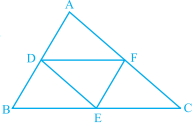
In $\Delta ABC$,$D$,$E$,and $F$ are respectively the mid-points of sides $AB$,$BC$,and $CA$. Show that $\Delta ABC$ is divided into four congruent triangles by joining $D$,$E$,and $F$.
Solution
(N/A) Since $D$ and $E$ are the mid-points of sides $AB$ and $BC$ of $\Delta ABC$,by the Mid-point Theorem,$DE \parallel AC$ and $DE = \frac{1}{2} AC = AF$.
Similarly,$DF \parallel BC$ and $EF \parallel AB$.
Therefore,$AFDE$,$BDFE$,and $DFCE$ are all parallelograms.
Now,$DE$ is a diagonal of the parallelogram $BDFE$,which divides it into two congruent triangles,so $\Delta BDE \cong \Delta FED$.
Similarly,$DF$ is a diagonal of the parallelogram $AFDE$,so $\Delta DAF \cong \Delta FED$.
Also,$EF$ is a diagonal of the parallelogram $DFCE$,so $\Delta EFC \cong \Delta FED$.
Since all three triangles are congruent to $\Delta FED$,it follows that all four triangles $(\Delta BDE, \Delta DAF, \Delta EFC, \text{ and } \Delta FED)$ are congruent to each other.
Similarly,$DF \parallel BC$ and $EF \parallel AB$.
Therefore,$AFDE$,$BDFE$,and $DFCE$ are all parallelograms.
Now,$DE$ is a diagonal of the parallelogram $BDFE$,which divides it into two congruent triangles,so $\Delta BDE \cong \Delta FED$.
Similarly,$DF$ is a diagonal of the parallelogram $AFDE$,so $\Delta DAF \cong \Delta FED$.
Also,$EF$ is a diagonal of the parallelogram $DFCE$,so $\Delta EFC \cong \Delta FED$.
Since all three triangles are congruent to $\Delta FED$,it follows that all four triangles $(\Delta BDE, \Delta DAF, \Delta EFC, \text{ and } \Delta FED)$ are congruent to each other.
0 likes
View Solution38
Medium
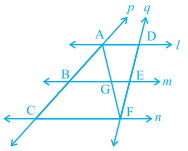
$l, m$ and $n$ are three parallel lines intersected by transversals $p$ and $q$ such that $l, m$ and $n$ cut off equal intercepts $AB$ and $BC$ on $p$ (see Fig). Show that $l, m$ and $n$ cut off equal intercepts $DE$ and $EF$ on $q$ also.
Solution
(N/A) We are given that $AB = BC$ and we have to prove that $DE = EF$.
Let us join $A$ to $F$ intersecting $m$ at $G$.
The quadrilateral $ADFC$ is divided into two triangles,namely $\Delta ACF$ and $\Delta AFD$.
In $\Delta ACF$,it is given that $B$ is the mid-point of $AC$ $(AB = BC)$ and $BG \parallel CF$ (since $m \parallel n$). By the converse of the mid-point theorem,$G$ is the mid-point of $AF$.
Now,in $\Delta AFD$,we have $G$ as the mid-point of $AF$ and $GE \parallel AD$ (since $m \parallel l$). By the converse of the mid-point theorem,$E$ is the mid-point of $DF$.
Therefore,$DE = EF$.
In other words,$l, m$ and $n$ cut off equal intercepts on $q$ also.
Let us join $A$ to $F$ intersecting $m$ at $G$.
The quadrilateral $ADFC$ is divided into two triangles,namely $\Delta ACF$ and $\Delta AFD$.
In $\Delta ACF$,it is given that $B$ is the mid-point of $AC$ $(AB = BC)$ and $BG \parallel CF$ (since $m \parallel n$). By the converse of the mid-point theorem,$G$ is the mid-point of $AF$.
Now,in $\Delta AFD$,we have $G$ as the mid-point of $AF$ and $GE \parallel AD$ (since $m \parallel l$). By the converse of the mid-point theorem,$E$ is the mid-point of $DF$.
Therefore,$DE = EF$.
In other words,$l, m$ and $n$ cut off equal intercepts on $q$ also.
0 likes
View Solution39
Medium
$ABCD$ is a quadrilateral in which $P$,$Q$,$R$ and $S$ are mid-points of the sides $AB$,$BC$,$CD$ and $DA$ (see figure). $AC$ is a diagonal. Show that: $SR \parallel AC$ and $SR = \frac{1}{2} AC$.
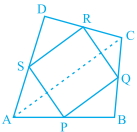
Solution
(N/A) Given: $ABCD$ is a quadrilateral,$P$,$Q$,$R$,$S$ are mid-points of sides $AB$,$BC$,$CD$,$DA$ respectively. $AC$ is a diagonal.
To prove: $SR \parallel AC$ and $SR = \frac{1}{2} AC$.
Proof: In $\Delta ACD$,we have:
$S$ is the mid-point of $AD$.
$R$ is the mid-point of $CD$.
According to the Mid-point Theorem,the line segment joining the mid-points of any two sides of a triangle is parallel to the third side and is half of it.
Therefore,in $\Delta ACD$,the line segment $SR$ joins the mid-points of sides $AD$ and $CD$.
Hence,$SR \parallel AC$ and $SR = \frac{1}{2} AC$.
To prove: $SR \parallel AC$ and $SR = \frac{1}{2} AC$.
Proof: In $\Delta ACD$,we have:
$S$ is the mid-point of $AD$.
$R$ is the mid-point of $CD$.
According to the Mid-point Theorem,the line segment joining the mid-points of any two sides of a triangle is parallel to the third side and is half of it.
Therefore,in $\Delta ACD$,the line segment $SR$ joins the mid-points of sides $AD$ and $CD$.
Hence,$SR \parallel AC$ and $SR = \frac{1}{2} AC$.
0 likes
View Solution40
Medium
$ABCD$ is a quadrilateral in which $P$,$Q$,$R$ and $S$ are mid-points of the sides $AB$,$BC$,$CD$ and $DA$ respectively (see figure). $AC$ is a diagonal. Show that: $PQ = SR$.
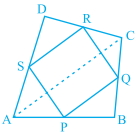
Solution
(N/A) Given: $P, Q, R, S$ are mid-points of sides $AB, BC, CD, DA$ respectively of quadrilateral $ABCD$. $AC$ is a diagonal.
To prove: $PQ = SR$.
Proof:
In $\triangle ABC$,$P$ is the mid-point of $AB$ and $Q$ is the mid-point of $BC$.
By the Mid-point Theorem,the line segment joining the mid-points of two sides of a triangle is parallel to the third side and is half of it.
Therefore,$PQ \parallel AC$ and $PQ = \frac{1}{2} AC$ ........ $(1)$
In $\triangle ADC$,$S$ is the mid-point of $AD$ and $R$ is the mid-point of $CD$.
By the Mid-point Theorem,$SR \parallel AC$ and $SR = \frac{1}{2} AC$ ........ $(2)$
From equations $(1)$ and $(2)$,since both $PQ$ and $SR$ are equal to $\frac{1}{2} AC$,we get $PQ = SR$.
To prove: $PQ = SR$.
Proof:
In $\triangle ABC$,$P$ is the mid-point of $AB$ and $Q$ is the mid-point of $BC$.
By the Mid-point Theorem,the line segment joining the mid-points of two sides of a triangle is parallel to the third side and is half of it.
Therefore,$PQ \parallel AC$ and $PQ = \frac{1}{2} AC$ ........ $(1)$
In $\triangle ADC$,$S$ is the mid-point of $AD$ and $R$ is the mid-point of $CD$.
By the Mid-point Theorem,$SR \parallel AC$ and $SR = \frac{1}{2} AC$ ........ $(2)$
From equations $(1)$ and $(2)$,since both $PQ$ and $SR$ are equal to $\frac{1}{2} AC$,we get $PQ = SR$.
0 likes
View Solution41
Medium
$ABCD$ is a quadrilateral in which $P$,$Q$,$R$ and $S$ are mid-points of the sides $AB$,$BC$,$CD$ and $DA$ (see Fig). $AC$ is a diagonal. Show that: $PQRS$ is a parallelogram.
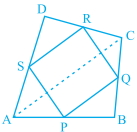
Solution
(N/A) To prove that $PQRS$ is a parallelogram.
In $\Delta ABC$,$P$ and $Q$ are the mid-points of $AB$ and $BC$.
$\therefore PQ = \frac{1}{2} AC$ and $PQ \parallel AC$ .......... $(1)$
In $\Delta ACD$,$S$ and $R$ are the mid-points of $DA$ and $CD$.
$\therefore SR = \frac{1}{2} AC$ and $SR \parallel AC$ .......... $(2)$
From $(1)$ and $(2)$,we get
$PQ = \frac{1}{2} AC = SR$ and $PQ \parallel AC \parallel SR$
$\Rightarrow PQ = SR$ and $PQ \parallel SR$
i.e.,one pair of opposite sides in quadrilateral $PQRS$ is equal and parallel.
$\therefore PQRS$ is a parallelogram.
In $\Delta ABC$,$P$ and $Q$ are the mid-points of $AB$ and $BC$.
$\therefore PQ = \frac{1}{2} AC$ and $PQ \parallel AC$ .......... $(1)$
In $\Delta ACD$,$S$ and $R$ are the mid-points of $DA$ and $CD$.
$\therefore SR = \frac{1}{2} AC$ and $SR \parallel AC$ .......... $(2)$
From $(1)$ and $(2)$,we get
$PQ = \frac{1}{2} AC = SR$ and $PQ \parallel AC \parallel SR$
$\Rightarrow PQ = SR$ and $PQ \parallel SR$
i.e.,one pair of opposite sides in quadrilateral $PQRS$ is equal and parallel.
$\therefore PQRS$ is a parallelogram.
0 likes
View Solution42
Difficult
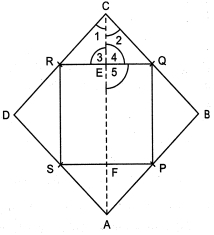
$ABCD$ is a rhombus and $P, Q, R$ and $S$ are mid-points of the sides $AB, BC, CD$ and $DA$ respectively. Show that the quadrilateral $PQRS$ is a rectangle.
Solution
(N/A) Given: $ABCD$ is a rhombus. $P, Q, R, S$ are mid-points of sides $AB, BC, CD, DA$ respectively.
To prove: $PQRS$ is a rectangle.
Construction: Join $AC$ and $BD$.
Proof:
$1$. In $\Delta ABC$,$P$ and $Q$ are mid-points of $AB$ and $BC$. By Mid-point Theorem,$PQ \parallel AC$ and $PQ = \frac{1}{2} AC$ ... $(1)$.
$2$. In $\Delta ADC$,$S$ and $R$ are mid-points of $AD$ and $CD$. By Mid-point Theorem,$SR \parallel AC$ and $SR = \frac{1}{2} AC$ ... $(2)$.
$3$. From $(1)$ and $(2)$,$PQ \parallel SR$ and $PQ = SR$. Since one pair of opposite sides is equal and parallel,$PQRS$ is a parallelogram.
$4$. In a rhombus,diagonals bisect each other at $90^{\circ}$. Let $AC$ and $BD$ intersect at $O$. Thus,$AC \perp BD$.
$5$. Since $PQ \parallel AC$ and $QR \parallel BD$,the angle between $PQ$ and $QR$ must be $90^{\circ}$ because the angle between $AC$ and $BD$ is $90^{\circ}$.
$6$. Since $PQRS$ is a parallelogram with one angle equal to $90^{\circ}$,$PQRS$ is a rectangle.
To prove: $PQRS$ is a rectangle.
Construction: Join $AC$ and $BD$.
Proof:
$1$. In $\Delta ABC$,$P$ and $Q$ are mid-points of $AB$ and $BC$. By Mid-point Theorem,$PQ \parallel AC$ and $PQ = \frac{1}{2} AC$ ... $(1)$.
$2$. In $\Delta ADC$,$S$ and $R$ are mid-points of $AD$ and $CD$. By Mid-point Theorem,$SR \parallel AC$ and $SR = \frac{1}{2} AC$ ... $(2)$.
$3$. From $(1)$ and $(2)$,$PQ \parallel SR$ and $PQ = SR$. Since one pair of opposite sides is equal and parallel,$PQRS$ is a parallelogram.
$4$. In a rhombus,diagonals bisect each other at $90^{\circ}$. Let $AC$ and $BD$ intersect at $O$. Thus,$AC \perp BD$.
$5$. Since $PQ \parallel AC$ and $QR \parallel BD$,the angle between $PQ$ and $QR$ must be $90^{\circ}$ because the angle between $AC$ and $BD$ is $90^{\circ}$.
$6$. Since $PQRS$ is a parallelogram with one angle equal to $90^{\circ}$,$PQRS$ is a rectangle.
0 likes
View Solution43
Medium
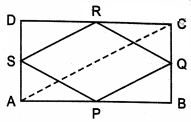
$ABCD$ is a rectangle and $P$,$Q$,$R$ and $S$ are mid-points of the sides $AB$,$BC$,$CD$ and $DA$ respectively. Show that the quadrilateral $PQRS$ is a rhombus.
Solution
(N/A) In a rectangle $ABCD$,$P$ is the mid-point of $AB$,$Q$ is the mid-point of $BC$,$R$ is the mid-point of $CD$,and $S$ is the mid-point of $DA$.
Draw diagonal $AC$.
In $\Delta ABC$,by the Mid-point theorem:
$PQ = \frac{1}{2} AC$ and $PQ \parallel AC$ ......... $(1)$
In $\Delta ACD$,by the Mid-point theorem:
$SR = \frac{1}{2} AC$ and $SR \parallel AC$ ......... $(2)$
From $(1)$ and $(2)$,we get $PQ = SR$ and $PQ \parallel SR$.
Similarly,by joining $BD$,we have $PS = QR$ and $PS \parallel QR$.
Since both pairs of opposite sides of quadrilateral $PQRS$ are equal and parallel,$PQRS$ is a parallelogram.
Now,in $\Delta PAS$ and $\Delta PBQ$:
$\angle A = \angle B = 90^{\circ}$ (Angles of a rectangle)
$AP = BP$ ($P$ is the mid-point of $AB$)
$AS = BQ$ (Halves of equal opposite sides $AD$ and $BC$)
By $SAS$ congruence criterion,$\Delta PAS \cong \Delta PBQ$.
Therefore,$PS = PQ$ (Corresponding parts of congruent triangles).
Since $PQRS$ is a parallelogram with adjacent sides $PS = PQ$,it follows that all sides are equal $(PQ = QR = RS = SP)$.
Thus,$PQRS$ is a rhombus.
Draw diagonal $AC$.
In $\Delta ABC$,by the Mid-point theorem:
$PQ = \frac{1}{2} AC$ and $PQ \parallel AC$ ......... $(1)$
In $\Delta ACD$,by the Mid-point theorem:
$SR = \frac{1}{2} AC$ and $SR \parallel AC$ ......... $(2)$
From $(1)$ and $(2)$,we get $PQ = SR$ and $PQ \parallel SR$.
Similarly,by joining $BD$,we have $PS = QR$ and $PS \parallel QR$.
Since both pairs of opposite sides of quadrilateral $PQRS$ are equal and parallel,$PQRS$ is a parallelogram.
Now,in $\Delta PAS$ and $\Delta PBQ$:
$\angle A = \angle B = 90^{\circ}$ (Angles of a rectangle)
$AP = BP$ ($P$ is the mid-point of $AB$)
$AS = BQ$ (Halves of equal opposite sides $AD$ and $BC$)
By $SAS$ congruence criterion,$\Delta PAS \cong \Delta PBQ$.
Therefore,$PS = PQ$ (Corresponding parts of congruent triangles).
Since $PQRS$ is a parallelogram with adjacent sides $PS = PQ$,it follows that all sides are equal $(PQ = QR = RS = SP)$.
Thus,$PQRS$ is a rhombus.
0 likes
View Solution44
Medium
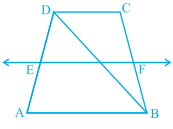
$ABCD$ is a trapezium in which $AB \parallel DC$,$BD$ is a diagonal,and $E$ is the mid-point of $AD$. $A$ line is drawn through $E$ parallel to $AB$ intersecting $BC$ at $F$. Show that $F$ is the mid-point of $BC$.
Solution
(N/A) In trapezium $ABCD$,$AB \parallel DC$. $E$ is the mid-point of $AD$. $EF$ is drawn parallel to $AB$. We have to prove that $F$ is the mid-point of $BC$.
Join $BD$.
In $\Delta DAB$:
Since $E$ is the mid-point of $AD$ [Given] and $EG \parallel AB$ [Since $EF \parallel AB$],by the converse of the mid-point theorem,$G$ is the mid-point of $BD$.
In $\Delta BDC$:
Since $G$ is the mid-point of $BD$ [Proved] and $GF \parallel DC$ [Since $AB \parallel DC$ and $EF \parallel AB$,therefore $GF \parallel DC$],by the converse of the mid-point theorem,$F$ is the mid-point of $BC$.
Join $BD$.
In $\Delta DAB$:
Since $E$ is the mid-point of $AD$ [Given] and $EG \parallel AB$ [Since $EF \parallel AB$],by the converse of the mid-point theorem,$G$ is the mid-point of $BD$.
In $\Delta BDC$:
Since $G$ is the mid-point of $BD$ [Proved] and $GF \parallel DC$ [Since $AB \parallel DC$ and $EF \parallel AB$,therefore $GF \parallel DC$],by the converse of the mid-point theorem,$F$ is the mid-point of $BC$.
0 likes
View Solution45
Difficult
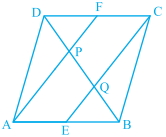
In a parallelogram $ABCD$,$E$ and $F$ are the mid-points of sides $AB$ and $CD$ respectively (see Fig). Show that the line segments $AF$ and $EC$ trisect the diagonal $BD$.
Solution
(N/A) Given: $ABCD$ is a parallelogram where $E$ and $F$ are mid-points of $AB$ and $CD$ respectively.
To prove: $AF$ and $EC$ trisect the diagonal $BD$,i.e.,$DP = PQ = QB$.
Proof:
Since $ABCD$ is a parallelogram,$AB \parallel DC$ and $AB = DC$.
Since $E$ and $F$ are mid-points,$AE = \frac{1}{2}AB$ and $FC = \frac{1}{2}DC$.
Since $AB = DC$,we have $AE = FC$.
Also,$AE \parallel FC$ because $AB \parallel DC$.
Thus,$AECF$ is a parallelogram (a quadrilateral with one pair of opposite sides equal and parallel).
Therefore,$AF \parallel EC$.
In $\Delta DQC$,$F$ is the mid-point of $DC$ and $FP \parallel CQ$ (since $AF \parallel EC$). By the converse of the mid-point theorem,$P$ is the mid-point of $DQ$,so $DP = PQ$ ... $(1)$.
In $\Delta ABP$,$E$ is the mid-point of $AB$ and $EQ \parallel AP$ (since $AF \parallel EC$). By the converse of the mid-point theorem,$Q$ is the mid-point of $BP$,so $PQ = QB$ ... $(2)$.
From $(1)$ and $(2)$,$DP = PQ = QB$.
Hence,$AF$ and $EC$ trisect the diagonal $BD$.
To prove: $AF$ and $EC$ trisect the diagonal $BD$,i.e.,$DP = PQ = QB$.
Proof:
Since $ABCD$ is a parallelogram,$AB \parallel DC$ and $AB = DC$.
Since $E$ and $F$ are mid-points,$AE = \frac{1}{2}AB$ and $FC = \frac{1}{2}DC$.
Since $AB = DC$,we have $AE = FC$.
Also,$AE \parallel FC$ because $AB \parallel DC$.
Thus,$AECF$ is a parallelogram (a quadrilateral with one pair of opposite sides equal and parallel).
Therefore,$AF \parallel EC$.
In $\Delta DQC$,$F$ is the mid-point of $DC$ and $FP \parallel CQ$ (since $AF \parallel EC$). By the converse of the mid-point theorem,$P$ is the mid-point of $DQ$,so $DP = PQ$ ... $(1)$.
In $\Delta ABP$,$E$ is the mid-point of $AB$ and $EQ \parallel AP$ (since $AF \parallel EC$). By the converse of the mid-point theorem,$Q$ is the mid-point of $BP$,so $PQ = QB$ ... $(2)$.
From $(1)$ and $(2)$,$DP = PQ = QB$.
Hence,$AF$ and $EC$ trisect the diagonal $BD$.
0 likes
View Solution46
Medium
Show that the line segments joining the mid-points of the opposite sides of a quadrilateral bisect each other.
Solution
(N/A) Let $ABCD$ be a quadrilateral such that the mid-points of sides $AB$,$BC$,$CD$,and $DA$ are $P$,$Q$,$R$,and $S$ respectively. We need to prove that the line segments joining the mid-points of opposite sides,i.e.,$PR$ and $SQ$,bisect each other at $O$.
Join $PQ$,$QR$,$RS$,and $SP$. Also,join $AC$ and $BD$.
In $\Delta ABC$,$P$ and $Q$ are the mid-points of $AB$ and $BC$ respectively.
By the Mid-point Theorem,$PQ \parallel AC$ and $PQ = \frac{1}{2} AC$.
In $\Delta ADC$,$S$ and $R$ are the mid-points of $AD$ and $CD$ respectively.
By the Mid-point Theorem,$SR \parallel AC$ and $SR = \frac{1}{2} AC$.
From the above,$PQ \parallel SR$ and $PQ = SR$.
Since one pair of opposite sides of quadrilateral $PQRS$ is equal and parallel,$PQRS$ is a parallelogram.
We know that the diagonals of a parallelogram bisect each other.
Therefore,the diagonals $PR$ and $SQ$ of the parallelogram $PQRS$ bisect each other at $O$.
Hence,the line segments joining the mid-points of the opposite sides of a quadrilateral bisect each other.
Join $PQ$,$QR$,$RS$,and $SP$. Also,join $AC$ and $BD$.
In $\Delta ABC$,$P$ and $Q$ are the mid-points of $AB$ and $BC$ respectively.
By the Mid-point Theorem,$PQ \parallel AC$ and $PQ = \frac{1}{2} AC$.
In $\Delta ADC$,$S$ and $R$ are the mid-points of $AD$ and $CD$ respectively.
By the Mid-point Theorem,$SR \parallel AC$ and $SR = \frac{1}{2} AC$.
From the above,$PQ \parallel SR$ and $PQ = SR$.
Since one pair of opposite sides of quadrilateral $PQRS$ is equal and parallel,$PQRS$ is a parallelogram.
We know that the diagonals of a parallelogram bisect each other.
Therefore,the diagonals $PR$ and $SQ$ of the parallelogram $PQRS$ bisect each other at $O$.
Hence,the line segments joining the mid-points of the opposite sides of a quadrilateral bisect each other.
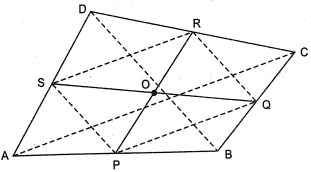
0 likes
View Solution47
Medium
$\Delta ABC$ is a triangle right-angled at $C$. $A$ line through the mid-point $M$ of hypotenuse $AB$ and parallel to $BC$ intersects $AC$ at $D$. Show that $D$ is the mid-point of $AC$.
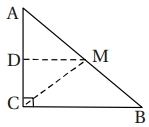
Solution
(N/A) We have a triangle $ABC$ such that $\angle C = 90^{\circ}$. $M$ is the mid-point of $AB$ and $MD \parallel BC$.
To prove that $D$ is the mid-point of $AC$.
In $\Delta ACB$,we have:
$M$ as the mid-point of $AB$. [Given]
$MD \parallel BC$. [Given]
Therefore,using the converse of the mid-point theorem,$D$ is the mid-point of $AC$.
To prove that $D$ is the mid-point of $AC$.
In $\Delta ACB$,we have:
$M$ as the mid-point of $AB$. [Given]
$MD \parallel BC$. [Given]
Therefore,using the converse of the mid-point theorem,$D$ is the mid-point of $AC$.
0 likes
View Solution48
Medium
$ABC$ is a triangle right-angled at $C$. $A$ line through the mid-point $M$ of hypotenuse $AB$ and parallel to $BC$ intersects $AC$ at $D$. Show that $MD \perp AC$.
Solution
(N/A) We have a triangle $ABC$ such that $\angle C = 90^{\circ}$. $M$ is the mid-point of $AB$ and $MD \parallel BC$.
To prove: $MD \perp AC$.
Since $MD \parallel BC$ and $AC$ is a transversal,
$\therefore \angle MDA = \angle BCA$ [Corresponding angles].
But $\angle BCA = 90^{\circ}$ [Given].
$\therefore \angle MDA = 90^{\circ}$.
$\Rightarrow MD \perp AC$.
To prove: $MD \perp AC$.
Since $MD \parallel BC$ and $AC$ is a transversal,
$\therefore \angle MDA = \angle BCA$ [Corresponding angles].
But $\angle BCA = 90^{\circ}$ [Given].
$\therefore \angle MDA = 90^{\circ}$.
$\Rightarrow MD \perp AC$.
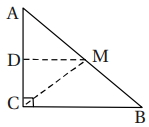
0 likes
View Solution49
Difficult
$ABC$ is a triangle right-angled at $C$. $A$ line through the mid-point $M$ of hypotenuse $AB$ and parallel to $BC$ intersects $AC$ at $D$. Show that $CM = MA = \frac{1}{2} AB$.
Solution
(N/A) Given: In $\Delta ABC$,$\angle C = 90^{\circ}$,$M$ is the mid-point of $AB$,and $MD \parallel BC$.
To prove: $CM = MA = \frac{1}{2} AB$.
Proof:
$1$. In $\Delta ABC$,since $MD \parallel BC$ and $M$ is the mid-point of $AB$,by the Converse of Mid-point Theorem,$D$ is the mid-point of $AC$. Thus,$AD = CD$.
$2$. Now,consider $\Delta ADM$ and $\Delta CDM$:
- $AD = CD$ (Proved above)
- $\angle ADM = \angle CDM = 90^{\circ}$ (Since $MD \parallel BC$ and $\angle ACB = 90^{\circ}$,$\angle ADM = \angle ACB = 90^{\circ}$ by corresponding angles)
- $DM = DM$ (Common side)
$3$. By $SAS$ congruence criterion,$\Delta ADM \cong \Delta CDM$.
$4$. By $c.p.c.t.$,$MA = MC$.
$5$. Since $M$ is the mid-point of $AB$,$MA = \frac{1}{2} AB$.
$6$. Therefore,$CM = MA = \frac{1}{2} AB$.
To prove: $CM = MA = \frac{1}{2} AB$.
Proof:
$1$. In $\Delta ABC$,since $MD \parallel BC$ and $M$ is the mid-point of $AB$,by the Converse of Mid-point Theorem,$D$ is the mid-point of $AC$. Thus,$AD = CD$.
$2$. Now,consider $\Delta ADM$ and $\Delta CDM$:
- $AD = CD$ (Proved above)
- $\angle ADM = \angle CDM = 90^{\circ}$ (Since $MD \parallel BC$ and $\angle ACB = 90^{\circ}$,$\angle ADM = \angle ACB = 90^{\circ}$ by corresponding angles)
- $DM = DM$ (Common side)
$3$. By $SAS$ congruence criterion,$\Delta ADM \cong \Delta CDM$.
$4$. By $c.p.c.t.$,$MA = MC$.
$5$. Since $M$ is the mid-point of $AB$,$MA = \frac{1}{2} AB$.
$6$. Therefore,$CM = MA = \frac{1}{2} AB$.
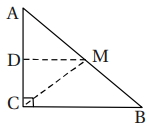
0 likes
View SolutionQuadrilaterals — Textbook - Quadrilaterals · Frequently Asked Questions
1Are these Quadrilaterals questions useful for JEE and NEET?
Yes. All questions in this section are mapped to JEE Main and NEET exam patterns. Previous year questions from JEE Main, NEET, GUJCET and state-level exams are included with full solutions.
2Can I switch to Hindi or Gujarati for these questions?
Yes. Use the language tabs in the hero section or the sidebar to view the same questions and solutions in English, Hindi or Gujarati.
3How do I generate a question paper from this subtopic?
Use the Vedclass Exam Paper Generator — select the chapter and subtopic, set difficulty, and generate Sets A, B, C, D automatically. First 3 chapters of every subject are free.
Vedclass Products
For Students
Vedclass Test Series
Mock tests in real JEE/NEET style with performance analysis. 5-day free trial.
Start Free TrialFor Teachers
Exam Paper Generator
Generate Set A/B/C/D papers from this chapter in 2 minutes. 3 chapters free.
Try FreeFor Institutes
Online Exam Module
Live online exams with unlimited students, 360° analytics & white-label branding.
See DemoFor Teachers & Institutes
Generate a Quadrilaterals Exam Paper in 2 Minutes
Select subtopic & difficulty — Sets A, B, C, D auto-generated with No Repeat logic.
First 3 chapters of every subject are free — no payment required.