
A English
Textbook - Lines and Angles Questions in English
Class 9 Mathematics · Lines and Angles · Textbook - Lines and Angles
26+
Questions
English
Language
100%
With Solutions
Showing 26 of 26 questions in English
1
Medium
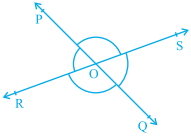
In the figure,lines $PQ$ and $RS$ intersect each other at point $O$. If $\angle POR : \angle ROQ = 5 : 7,$ find all the angles.
Solution
(N/A) Since $PQ$ is a straight line,the sum of angles forming a linear pair is $180^o$.
$\angle POR + \angle ROQ = 180^o$ (Linear pair axiom)
Given that $\angle POR : \angle ROQ = 5 : 7$.
Let $\angle POR = 5x$ and $\angle ROQ = 7x$.
Substituting these into the equation:
$5x + 7x = 180^o$
$12x = 180^o$
$x = 15^o$
Therefore,$\angle POR = 5 \times 15^o = 75^o$ and $\angle ROQ = 7 \times 15^o = 105^o$.
Since $PQ$ and $RS$ are intersecting lines,vertically opposite angles are equal:
$\angle POS = \angle ROQ = 105^o$
$\angle SOQ = \angle POR = 75^o$
Thus,the angles are $75^o, 105^o, 75^o,$ and $105^o$.
$\angle POR + \angle ROQ = 180^o$ (Linear pair axiom)
Given that $\angle POR : \angle ROQ = 5 : 7$.
Let $\angle POR = 5x$ and $\angle ROQ = 7x$.
Substituting these into the equation:
$5x + 7x = 180^o$
$12x = 180^o$
$x = 15^o$
Therefore,$\angle POR = 5 \times 15^o = 75^o$ and $\angle ROQ = 7 \times 15^o = 105^o$.
Since $PQ$ and $RS$ are intersecting lines,vertically opposite angles are equal:
$\angle POS = \angle ROQ = 105^o$
$\angle SOQ = \angle POR = 75^o$
Thus,the angles are $75^o, 105^o, 75^o,$ and $105^o$.
4 likes
View Solution2
MediumMCQ
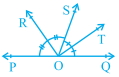
In the figure,ray $OS$ stands on a line $POQ$. Ray $OR$ and ray $OT$ are angle bisectors of $\angle POS$ and $\angle SOQ$,respectively. If $\angle POS = x$,find $\angle ROT$. (in $^o$)
A
$45$
B
$90$
C
$360$
D
$180$
Solution
(B) Ray $OS$ stands on the line $POQ$.
Therefore,$\angle POS + \angle SOQ = 180^o$ (Linear pair axiom).
Given that $\angle POS = x$.
Therefore,$x + \angle SOQ = 180^o$,which implies $\angle SOQ = 180^o - x$.
Now,ray $OR$ bisects $\angle POS$,therefore $\angle ROS = \frac{1}{2} \times \angle POS = \frac{x}{2}$.
Similarly,ray $OT$ bisects $\angle SOQ$,therefore $\angle SOT = \frac{1}{2} \times \angle SOQ = \frac{1}{2} \times (180^o - x) = 90^o - \frac{x}{2}$.
Now,$\angle ROT = \angle ROS + \angle SOT$.
Substituting the values,$\angle ROT = \frac{x}{2} + 90^o - \frac{x}{2} = 90^o$.
Therefore,$\angle POS + \angle SOQ = 180^o$ (Linear pair axiom).
Given that $\angle POS = x$.
Therefore,$x + \angle SOQ = 180^o$,which implies $\angle SOQ = 180^o - x$.
Now,ray $OR$ bisects $\angle POS$,therefore $\angle ROS = \frac{1}{2} \times \angle POS = \frac{x}{2}$.
Similarly,ray $OT$ bisects $\angle SOQ$,therefore $\angle SOT = \frac{1}{2} \times \angle SOQ = \frac{1}{2} \times (180^o - x) = 90^o - \frac{x}{2}$.
Now,$\angle ROT = \angle ROS + \angle SOT$.
Substituting the values,$\angle ROT = \frac{x}{2} + 90^o - \frac{x}{2} = 90^o$.
1 likes
View Solution3
Medium
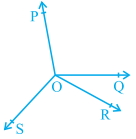
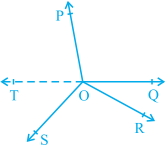
In the figure,$OP$,$OQ$,$OR$,and $OS$ are four rays. Prove that $\angle POQ + \angle QOR + \angle SOR + \angle POS = 360^o$.
Solution
(N/A) To prove this,we need to produce any of the rays $OP$,$OQ$,$OR$,or $OS$ backwards to a point. Let us produce ray $OQ$ backwards to a point $T$ such that $TOQ$ is a straight line.
Now,ray $OP$ stands on line $TOQ$.
Therefore,$\angle TOP + \angle POQ = 180^o$ ........ $(1)$ (Linear pair axiom)
Similarly,ray $OS$ stands on line $TOQ$.
Therefore,$\angle TOS + \angle SOQ = 180^o$ ........ $(2)$
But,$\angle SOQ = \angle SOR + \angle QOR$.
Substituting this into $(2)$,we get:
$\angle TOS + \angle SOR + \angle QOR = 180^o$ ........ $(3)$
Now,adding $(1)$ and $(3)$,we get:
$\angle TOP + \angle POQ + \angle TOS + \angle SOR + \angle QOR = 360^o$ ........ $(4)$
Since $\angle TOP + \angle TOS = \angle POS$,equation $(4)$ becomes:
$\angle POQ + \angle QOR + \angle SOR + \angle POS = 360^o$.
Now,ray $OP$ stands on line $TOQ$.
Therefore,$\angle TOP + \angle POQ = 180^o$ ........ $(1)$ (Linear pair axiom)
Similarly,ray $OS$ stands on line $TOQ$.
Therefore,$\angle TOS + \angle SOQ = 180^o$ ........ $(2)$
But,$\angle SOQ = \angle SOR + \angle QOR$.
Substituting this into $(2)$,we get:
$\angle TOS + \angle SOR + \angle QOR = 180^o$ ........ $(3)$
Now,adding $(1)$ and $(3)$,we get:
$\angle TOP + \angle POQ + \angle TOS + \angle SOR + \angle QOR = 360^o$ ........ $(4)$
Since $\angle TOP + \angle TOS = \angle POS$,equation $(4)$ becomes:
$\angle POQ + \angle QOR + \angle SOR + \angle POS = 360^o$.
0 likes
View Solution4
MediumMCQ
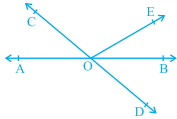
In the figure,lines $AB$ and $CD$ intersect at $O$. If $\angle AOC + \angle BOE = 70^o$ and $\angle BOD = 40^o$,find $\angle BOE$ and reflex $\angle COE$.
A
$30^o, 150^o$
B
$90^o, 270^o$
C
$70^o, 270^o$
D
$30^o, 250^o$
Solution
(D) Since $AB$ is a straight line,the sum of angles on one side of the line at point $O$ is $180^o$.
$\therefore \angle AOC + \angle COE + \angle BOE = 180^o$
Rearranging the terms,we get:
$(\angle AOC + \angle BOE) + \angle COE = 180^o$
Given that $\angle AOC + \angle BOE = 70^o$,substituting this value:
$70^o + \angle COE = 180^o$
$\angle COE = 180^o - 70^o = 110^o$
Reflex $\angle COE = 360^o - \angle COE = 360^o - 110^o = 250^o$
Since lines $AB$ and $CD$ intersect at $O$,vertically opposite angles are equal:
$\angle AOC = \angle BOD$
Given $\angle BOD = 40^o$,therefore $\angle AOC = 40^o$.
Using the given equation $\angle AOC + \angle BOE = 70^o$:
$40^o + \angle BOE = 70^o$
$\angle BOE = 70^o - 40^o = 30^o$
Thus,$\angle BOE = 30^o$ and reflex $\angle COE = 250^o$.
$\therefore \angle AOC + \angle COE + \angle BOE = 180^o$
Rearranging the terms,we get:
$(\angle AOC + \angle BOE) + \angle COE = 180^o$
Given that $\angle AOC + \angle BOE = 70^o$,substituting this value:
$70^o + \angle COE = 180^o$
$\angle COE = 180^o - 70^o = 110^o$
Reflex $\angle COE = 360^o - \angle COE = 360^o - 110^o = 250^o$
Since lines $AB$ and $CD$ intersect at $O$,vertically opposite angles are equal:
$\angle AOC = \angle BOD$
Given $\angle BOD = 40^o$,therefore $\angle AOC = 40^o$.
Using the given equation $\angle AOC + \angle BOE = 70^o$:
$40^o + \angle BOE = 70^o$
$\angle BOE = 70^o - 40^o = 30^o$
Thus,$\angle BOE = 30^o$ and reflex $\angle COE = 250^o$.
5 likes
View Solution5
MediumMCQ
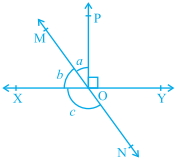
In the figure,lines $XY$ and $MN$ intersect at $O$. If $\angle POY = 90^o$ and $a: b = 2: 3$,find $c$. (in $^o$)
A
$126$
B
$145$
C
$136$
D
$120$
Solution
(A) $XOY$ is a straight line.
Therefore,$\angle b + \angle a + \angle POY = 180^o$ (Linear pair axiom).
Given that $\angle POY = 90^o$,so $\angle b + \angle a + 90^o = 180^o$,which implies $\angle b + \angle a = 90^o$.
Given $a: b = 2: 3$,let $a = 2x$ and $b = 3x$.
Then $2x + 3x = 90^o$,so $5x = 90^o$,which gives $x = 18^o$.
Thus,$\angle a = 2 \times 18^o = 36^o$ and $\angle b = 3 \times 18^o = 54^o$.
Since lines $XY$ and $MN$ intersect at $O$,$\angle XON$ and $\angle MOY$ are vertically opposite angles,and $\angle XOM$ and $\angle NOY$ are vertically opposite angles.
Here,$\angle c = \angle XOM = \angle a + \angle POY$ is not correct based on the figure. Looking at the figure,$\angle c = \angle XON$.
Since $XOY$ is a straight line,$\angle XON + \angle NOY = 180^o$.
Also,$\angle NOY = \angle b = 54^o$ (vertically opposite angles).
Therefore,$\angle c = 180^o - 54^o = 126^o$.
Therefore,$\angle b + \angle a + \angle POY = 180^o$ (Linear pair axiom).
Given that $\angle POY = 90^o$,so $\angle b + \angle a + 90^o = 180^o$,which implies $\angle b + \angle a = 90^o$.
Given $a: b = 2: 3$,let $a = 2x$ and $b = 3x$.
Then $2x + 3x = 90^o$,so $5x = 90^o$,which gives $x = 18^o$.
Thus,$\angle a = 2 \times 18^o = 36^o$ and $\angle b = 3 \times 18^o = 54^o$.
Since lines $XY$ and $MN$ intersect at $O$,$\angle XON$ and $\angle MOY$ are vertically opposite angles,and $\angle XOM$ and $\angle NOY$ are vertically opposite angles.
Here,$\angle c = \angle XOM = \angle a + \angle POY$ is not correct based on the figure. Looking at the figure,$\angle c = \angle XON$.
Since $XOY$ is a straight line,$\angle XON + \angle NOY = 180^o$.
Also,$\angle NOY = \angle b = 54^o$ (vertically opposite angles).
Therefore,$\angle c = 180^o - 54^o = 126^o$.
1 likes
View Solution6
Easy
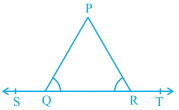
In the figure,if $\angle PQR = \angle PRQ$,then prove that $\angle PQS = \angle PRT$.
Solution
(N/A) Since $ST$ is a straight line,
$\therefore \angle PQS + \angle PQR = 180^\circ$ ........... $(1)$
Similarly,$\angle PRT + \angle PRQ = 180^\circ$ ........... $(2)$
From $(1)$ and $(2)$,we have
$\angle PQS + \angle PQR = \angle PRT + \angle PRQ$
But $\angle PQR = \angle PRQ$ [Given]
$\therefore \angle PQS = \angle PRT$
$\therefore \angle PQS + \angle PQR = 180^\circ$ ........... $(1)$
Similarly,$\angle PRT + \angle PRQ = 180^\circ$ ........... $(2)$
From $(1)$ and $(2)$,we have
$\angle PQS + \angle PQR = \angle PRT + \angle PRQ$
But $\angle PQR = \angle PRQ$ [Given]
$\therefore \angle PQS = \angle PRT$
0 likes
View Solution7
Medium
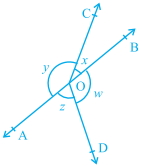
In the figure,if $x+y=w+z$,then prove that $AOB$ is a line.
Solution
(N/A) The sum of all the angles around a point is $360^\circ$.
Therefore,$x+y+z+w=360^\circ$.
We are given that $x+y=w+z$.
Substituting $(w+z)$ with $(x+y)$,we get:
$(x+y)+(x+y)=360^\circ$
$2(x+y)=360^\circ$
$x+y = \frac{360^\circ}{2} = 180^\circ$.
Since the sum of the adjacent angles $x$ and $y$ is $180^\circ$,they form a linear pair.
Therefore,$AOB$ is a straight line.
Therefore,$x+y+z+w=360^\circ$.
We are given that $x+y=w+z$.
Substituting $(w+z)$ with $(x+y)$,we get:
$(x+y)+(x+y)=360^\circ$
$2(x+y)=360^\circ$
$x+y = \frac{360^\circ}{2} = 180^\circ$.
Since the sum of the adjacent angles $x$ and $y$ is $180^\circ$,they form a linear pair.
Therefore,$AOB$ is a straight line.
1 likes
View Solution8
Medium
In the figure,$POQ$ is a line. Ray $OR$ is perpendicular to line $PQ$. $OS$ is another ray lying between rays $OP$ and $OR$. Prove that $\angle ROS = \frac{1}{2}(\angle QOS - \angle POS)$.
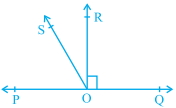
Solution
(N/A) $POQ$ is a straight line. [Given]
$\therefore \angle POS + \angle ROS + \angle ROQ = 180^o$
But $OR \perp PQ$,therefore $\angle ROQ = 90^o$.
Substituting $\angle ROQ = 90^o$ in the equation:
$\angle POS + \angle ROS + 90^o = 180^o$
$\Rightarrow \angle POS + \angle ROS = 90^o$ --- $(1)$
Now,we have $\angle QOS = \angle ROQ + \angle ROS$
Since $\angle ROQ = 90^o$,we have:
$\angle QOS = 90^o + \angle ROS$
$\Rightarrow 90^o = \angle QOS - \angle ROS$ --- $(2)$
From $(1)$ and $(2)$,we have:
$\angle POS + \angle ROS = \angle QOS - \angle ROS$
$\Rightarrow \angle ROS + \angle ROS = \angle QOS - \angle POS$
$\Rightarrow 2 \angle ROS = \angle QOS - \angle POS$
$\therefore \angle ROS = \frac{1}{2}(\angle QOS - \angle POS)$
$\therefore \angle POS + \angle ROS + \angle ROQ = 180^o$
But $OR \perp PQ$,therefore $\angle ROQ = 90^o$.
Substituting $\angle ROQ = 90^o$ in the equation:
$\angle POS + \angle ROS + 90^o = 180^o$
$\Rightarrow \angle POS + \angle ROS = 90^o$ --- $(1)$
Now,we have $\angle QOS = \angle ROQ + \angle ROS$
Since $\angle ROQ = 90^o$,we have:
$\angle QOS = 90^o + \angle ROS$
$\Rightarrow 90^o = \angle QOS - \angle ROS$ --- $(2)$
From $(1)$ and $(2)$,we have:
$\angle POS + \angle ROS = \angle QOS - \angle ROS$
$\Rightarrow \angle ROS + \angle ROS = \angle QOS - \angle POS$
$\Rightarrow 2 \angle ROS = \angle QOS - \angle POS$
$\therefore \angle ROS = \frac{1}{2}(\angle QOS - \angle POS)$
0 likes
View Solution9
DifficultMCQ
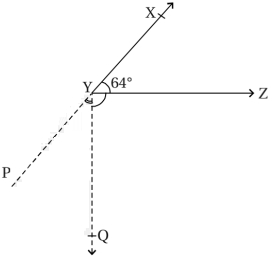
It is given that $\angle XYZ = 64^o$ and $XY$ is produced to point $P$. If ray $YQ$ bisects $\angle ZYP$,find $\angle XYQ$ and reflex $\angle QYP$. (in $^o$)
A
$302$
B
$126$
C
$180$
D
$175$
Solution
(A) $XYP$ is a straight line.
Therefore,$\angle XYZ + \angle ZYQ + \angle QYP = 180^o$.
Since $64^o + \angle ZYQ + \angle QYP = 180^o$ and $YQ$ bisects $\angle ZYP$,we have $\angle ZYQ = \angle QYP$.
Thus,$64^o + 2 \angle QYP = 180^o$.
$2 \angle QYP = 180^o - 64^o = 116^o$.
$\angle QYP = 58^o$.
Reflex $\angle QYP = 360^o - 58^o = 302^o$.
Now,$\angle XYQ = \angle XYZ + \angle ZYQ = 64^o + 58^o = 122^o$.
Therefore,$\angle XYZ + \angle ZYQ + \angle QYP = 180^o$.
Since $64^o + \angle ZYQ + \angle QYP = 180^o$ and $YQ$ bisects $\angle ZYP$,we have $\angle ZYQ = \angle QYP$.
Thus,$64^o + 2 \angle QYP = 180^o$.
$2 \angle QYP = 180^o - 64^o = 116^o$.
$\angle QYP = 58^o$.
Reflex $\angle QYP = 360^o - 58^o = 302^o$.
Now,$\angle XYQ = \angle XYZ + \angle ZYQ = 64^o + 58^o = 122^o$.
2 likes
View Solution10
MediumMCQ
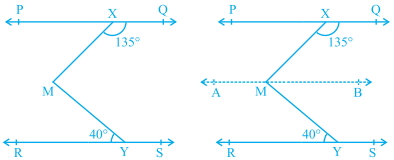
In the figure,if $PQ \parallel RS$,$\angle MXQ = 135^o$ and $\angle MYR = 40^o$,find $\angle XMY$. (in $^o$)
A
$90$
B
$85$
C
$180$
D
$45$
Solution
(B) To solve this,we draw a line $AB$ passing through point $M$ such that $AB \parallel PQ$. Since $PQ \parallel RS$ and $AB \parallel PQ$,it follows that $AB \parallel RS$.
Now,consider the transversal $XM$ intersecting parallel lines $PQ$ and $AB$. The interior angles on the same side of the transversal are supplementary.
Therefore,$\angle QXM + \angle XMB = 180^o$.
Given $\angle QXM = 135^o$,we have $135^o + \angle XMB = 180^o$,which gives $\angle XMB = 180^o - 135^o = 45^o$ (Equation $1$).
Next,consider the transversal $YM$ intersecting parallel lines $RS$ and $AB$. The alternate interior angles are equal.
Therefore,$\angle BMY = \angle MYR$.
Given $\angle MYR = 40^o$,we have $\angle BMY = 40^o$ (Equation $2$).
Finally,$\angle XMY = \angle XMB + \angle BMY$.
Substituting the values from Equation $1$ and Equation $2$,we get $\angle XMY = 45^o + 40^o = 85^o$.
Now,consider the transversal $XM$ intersecting parallel lines $PQ$ and $AB$. The interior angles on the same side of the transversal are supplementary.
Therefore,$\angle QXM + \angle XMB = 180^o$.
Given $\angle QXM = 135^o$,we have $135^o + \angle XMB = 180^o$,which gives $\angle XMB = 180^o - 135^o = 45^o$ (Equation $1$).
Next,consider the transversal $YM$ intersecting parallel lines $RS$ and $AB$. The alternate interior angles are equal.
Therefore,$\angle BMY = \angle MYR$.
Given $\angle MYR = 40^o$,we have $\angle BMY = 40^o$ (Equation $2$).
Finally,$\angle XMY = \angle XMB + \angle BMY$.
Substituting the values from Equation $1$ and Equation $2$,we get $\angle XMY = 45^o + 40^o = 85^o$.
0 likes
View Solution11
Medium
If a transversal intersects two lines such that the bisectors of a pair of corresponding angles are parallel,then prove that the two lines are parallel.
Solution
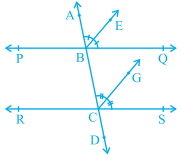
(N/A) In the figure,a transversal $AD$ intersects two lines $PQ$ and $RS$ at points $B$ and $C$ respectively. Ray $BE$ is the bisector of $\angle ABQ$ and ray $CG$ is the bisector of $\angle BCS$; and $BE \parallel CG$.
We are to prove that $PQ \parallel RS$.
It is given that ray $BE$ is the bisector of $\angle ABQ$.
Therefore,$\angle ABE = \frac{1}{2} \angle ABQ$ ...... $(1)$
Similarly,ray $CG$ is the bisector of $\angle BCS$.
Therefore,$\angle BCG = \frac{1}{2} \angle BCS$ ...... $(2)$
But $BE \parallel CG$ and $AD$ is the transversal.
Therefore,$\angle ABE = \angle BCG$ (Corresponding angles axiom) ...... $(3)$
Substituting $(1)$ and $(2)$ in $(3)$,you get
$\frac{1}{2} \angle ABQ = \frac{1}{2} \angle BCS$
That is,$\angle ABQ = \angle BCS$
But,they are the corresponding angles formed by transversal $AD$ with $PQ$ and $RS$; and are equal.
Therefore,$PQ \parallel RS$ (Converse of corresponding angles axiom).
We are to prove that $PQ \parallel RS$.
It is given that ray $BE$ is the bisector of $\angle ABQ$.
Therefore,$\angle ABE = \frac{1}{2} \angle ABQ$ ...... $(1)$
Similarly,ray $CG$ is the bisector of $\angle BCS$.
Therefore,$\angle BCG = \frac{1}{2} \angle BCS$ ...... $(2)$
But $BE \parallel CG$ and $AD$ is the transversal.
Therefore,$\angle ABE = \angle BCG$ (Corresponding angles axiom) ...... $(3)$
Substituting $(1)$ and $(2)$ in $(3)$,you get
$\frac{1}{2} \angle ABQ = \frac{1}{2} \angle BCS$
That is,$\angle ABQ = \angle BCS$
But,they are the corresponding angles formed by transversal $AD$ with $PQ$ and $RS$; and are equal.
Therefore,$PQ \parallel RS$ (Converse of corresponding angles axiom).
0 likes
View Solution12
MediumMCQ
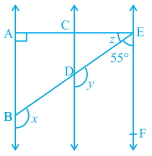
In the figure,$AB \parallel CD$ and $CD \parallel EF$. Also,$EA \perp AB$. If $\angle BEF = 55^o$,find the values of $x, y$,and $z$.
A
$x=90^o, y=85^o, z=35^o$
B
$x=125^o, y=35^o, z=35^o$
C
$x=120^o, y=125^o, z=75^o$
D
$x=125^o, y=125^o, z=35^o$
Solution
(D) Given that $AB \parallel CD$ and $CD \parallel EF$,therefore $AB \parallel EF$.
Since $CD \parallel EF$ and $ED$ is a transversal,the interior angles on the same side of the transversal are supplementary.
Thus,$y + 55^o = 180^o$.
$y = 180^o - 55^o = 125^o$.
Since $AB \parallel CD$ and $BE$ is a transversal,the corresponding angles are equal.
Thus,$x = y = 125^o$.
Since $EA \perp AB$ and $AB \parallel EF$,then $EA \perp EF$. Therefore,$\angle AEF = 90^o$.
From the figure,$\angle AEF = z + 55^o$.
$z + 55^o = 90^o$.
$z = 90^o - 55^o = 35^o$.
Therefore,$x = 125^o, y = 125^o, z = 35^o$.
Since $CD \parallel EF$ and $ED$ is a transversal,the interior angles on the same side of the transversal are supplementary.
Thus,$y + 55^o = 180^o$.
$y = 180^o - 55^o = 125^o$.
Since $AB \parallel CD$ and $BE$ is a transversal,the corresponding angles are equal.
Thus,$x = y = 125^o$.
Since $EA \perp AB$ and $AB \parallel EF$,then $EA \perp EF$. Therefore,$\angle AEF = 90^o$.
From the figure,$\angle AEF = z + 55^o$.
$z + 55^o = 90^o$.
$z = 90^o - 55^o = 35^o$.
Therefore,$x = 125^o, y = 125^o, z = 35^o$.
0 likes
View Solution13
Medium
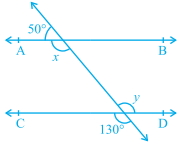
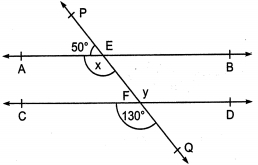
In the figure,find the values of $x$ and $y$ and then show that $AB \parallel CD$.
Solution
(N/A) From the figure,the line $PQ$ intersects the line $CD$ at point $F$.
Therefore,$y = 130^o$ (Vertically opposite angles) .......... $(1)$
Now,consider the line $AB$. The angle $x$ and the angle $50^o$ form a linear pair at the intersection point $E$.
Therefore,$x + 50^o = 180^o$ (Linear pair axiom)
$x = 180^o - 50^o = 130^o$ .......... $(2)$
From $(1)$ and $(2)$,we have $x = y = 130^o$.
Since these are alternate interior angles and they are equal,the lines $AB$ and $CD$ must be parallel.
Therefore,$AB \parallel CD$.
Therefore,$y = 130^o$ (Vertically opposite angles) .......... $(1)$
Now,consider the line $AB$. The angle $x$ and the angle $50^o$ form a linear pair at the intersection point $E$.
Therefore,$x + 50^o = 180^o$ (Linear pair axiom)
$x = 180^o - 50^o = 130^o$ .......... $(2)$
From $(1)$ and $(2)$,we have $x = y = 130^o$.
Since these are alternate interior angles and they are equal,the lines $AB$ and $CD$ must be parallel.
Therefore,$AB \parallel CD$.
3 likes
View Solution14
DifficultMCQ
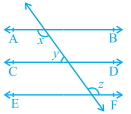
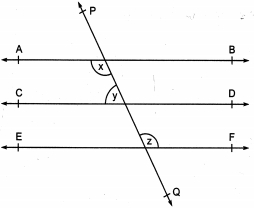
In the figure,if $AB \parallel CD$,$CD \parallel EF$ and $y: z = 3: 7$,find $x$. (in $^o$)
A
$160$
B
$126$
C
$180$
D
$195$
Solution
(B) Given: $AB \parallel CD$ and $CD \parallel EF$.
Since lines parallel to the same line are parallel to each other,we have $AB \parallel EF$.
Let the transversal intersect the lines $AB$,$CD$,and $EF$ at points $P$,$Q$,and $R$ respectively.
Since $AB \parallel EF$,the interior alternate angles are equal. Therefore,$\angle x = \angle z$ .......... $(1)$
Again,$AB \parallel CD$,so the sum of interior angles on the same side of the transversal is $180^o$.
Thus,$y + z = 180^o$.
Given $y: z = 3: 7$,let $y = 3k$ and $z = 7k$.
Then,$3k + 7k = 180^o \Rightarrow 10k = 180^o \Rightarrow k = 18^o$.
So,$z = 7 \times 18^o = 126^o$.
From $(1)$,$x = z = 126^o$.
Since lines parallel to the same line are parallel to each other,we have $AB \parallel EF$.
Let the transversal intersect the lines $AB$,$CD$,and $EF$ at points $P$,$Q$,and $R$ respectively.
Since $AB \parallel EF$,the interior alternate angles are equal. Therefore,$\angle x = \angle z$ .......... $(1)$
Again,$AB \parallel CD$,so the sum of interior angles on the same side of the transversal is $180^o$.
Thus,$y + z = 180^o$.
Given $y: z = 3: 7$,let $y = 3k$ and $z = 7k$.
Then,$3k + 7k = 180^o \Rightarrow 10k = 180^o \Rightarrow k = 18^o$.
So,$z = 7 \times 18^o = 126^o$.
From $(1)$,$x = z = 126^o$.
0 likes
View Solution15
Difficult
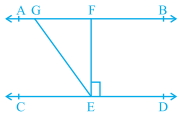
In the figure,if $AB \parallel CD$,$EF \perp CD$ and $\angle GED = 126^o$,find $\angle AGE$,$\angle GEF$ and $\angle FGE$.
Solution
(N/A) Given that $AB \parallel CD$,$EF \perp CD$,and $\angle GED = 126^o$.
$1$. Since $AB \parallel CD$ and $GE$ is a transversal,the alternate interior angles are equal.
Therefore,$\angle AGE = \angle GED$.
Given $\angle GED = 126^o$,so $\angle AGE = 126^o$.
$2$. We know that $\angle GED = \angle GEF + \angle FED$.
Since $EF \perp CD$,$\angle FED = 90^o$.
Therefore,$126^o = \angle GEF + 90^o$.
$\angle GEF = 126^o - 90^o = 36^o$.
$3$. Since $AB \parallel CD$ and $GE$ is a transversal,the sum of interior angles on the same side of the transversal is $180^o$.
Therefore,$\angle FGE + \angle GED = 180^o$.
$\angle FGE + 126^o = 180^o$.
$\angle FGE = 180^o - 126^o = 54^o$.
Thus,$\angle AGE = 126^o$,$\angle GEF = 36^o$,and $\angle FGE = 54^o$.
$1$. Since $AB \parallel CD$ and $GE$ is a transversal,the alternate interior angles are equal.
Therefore,$\angle AGE = \angle GED$.
Given $\angle GED = 126^o$,so $\angle AGE = 126^o$.
$2$. We know that $\angle GED = \angle GEF + \angle FED$.
Since $EF \perp CD$,$\angle FED = 90^o$.
Therefore,$126^o = \angle GEF + 90^o$.
$\angle GEF = 126^o - 90^o = 36^o$.
$3$. Since $AB \parallel CD$ and $GE$ is a transversal,the sum of interior angles on the same side of the transversal is $180^o$.
Therefore,$\angle FGE + \angle GED = 180^o$.
$\angle FGE + 126^o = 180^o$.
$\angle FGE = 180^o - 126^o = 54^o$.
Thus,$\angle AGE = 126^o$,$\angle GEF = 36^o$,and $\angle FGE = 54^o$.
0 likes
View Solution16
DifficultMCQ
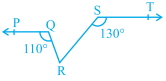
In the figure,if $PQ \parallel ST$,$\angle PQR = 110^o$ and $\angle RST = 130^o$,find $\angle QRS$. (in $^o$)
A
$120$
B
$90$
C
$360$
D
$60$
Solution
(D) Given: $PQ \parallel ST$,$\angle PQR = 110^o$,and $\angle RST = 130^o$.
Construction: Draw a line $EF$ parallel to $ST$ passing through point $R$.
Since $PQ \parallel ST$ and $EF \parallel ST$,it follows that $PQ \parallel EF$.
Since $PQ \parallel EF$ and $QR$ is a transversal,the sum of interior angles on the same side of the transversal is $180^o$ (or by alternate interior angles if extended). Alternatively,using alternate interior angles: $\angle PQR + \angle QRF = 180^o$ is incorrect here; rather,extend $PQ$ to meet $EF$ or use the property that $\angle PQR + \angle QRF = 180^o$ is not applicable directly. Let's use: $\angle PQR + \angle QRF = 180^o$ (consecutive interior angles) is wrong. Correct approach: $\angle PQR + \angle QRE = 180^o$ (consecutive interior angles) $\Rightarrow 110^o + \angle QRE = 180^o \Rightarrow \angle QRE = 70^o$.
Similarly,for $ST \parallel EF$ and transversal $RS$,$\angle RST + \angle SRE = 180^o$ (consecutive interior angles) $\Rightarrow 130^o + \angle SRE = 180^o \Rightarrow \angle SRE = 50^o$.
Now,$\angle QRS = \angle QRE + \angle SRE = 70^o + 50^o = 120^o$ is incorrect based on the figure. Let's re-evaluate: $\angle PQR = 110^o$. Draw $EF \parallel PQ$. Then $\angle PQR + \angle QRE = 180^o \Rightarrow \angle QRE = 70^o$. Since $PQ \parallel ST$ and $EF \parallel PQ$,then $EF \parallel ST$. Thus $\angle RST + \angle SRE = 180^o \Rightarrow 130^o + \angle SRE = 180^o \Rightarrow \angle SRE = 50^o$. From the figure,$\angle QRS = 360^o - (\angle QRE + \angle SRE)$ is not correct. Actually,$\angle QRS = 180^o - (70^o + 50^o) = 60^o$.
Construction: Draw a line $EF$ parallel to $ST$ passing through point $R$.
Since $PQ \parallel ST$ and $EF \parallel ST$,it follows that $PQ \parallel EF$.
Since $PQ \parallel EF$ and $QR$ is a transversal,the sum of interior angles on the same side of the transversal is $180^o$ (or by alternate interior angles if extended). Alternatively,using alternate interior angles: $\angle PQR + \angle QRF = 180^o$ is incorrect here; rather,extend $PQ$ to meet $EF$ or use the property that $\angle PQR + \angle QRF = 180^o$ is not applicable directly. Let's use: $\angle PQR + \angle QRF = 180^o$ (consecutive interior angles) is wrong. Correct approach: $\angle PQR + \angle QRE = 180^o$ (consecutive interior angles) $\Rightarrow 110^o + \angle QRE = 180^o \Rightarrow \angle QRE = 70^o$.
Similarly,for $ST \parallel EF$ and transversal $RS$,$\angle RST + \angle SRE = 180^o$ (consecutive interior angles) $\Rightarrow 130^o + \angle SRE = 180^o \Rightarrow \angle SRE = 50^o$.
Now,$\angle QRS = \angle QRE + \angle SRE = 70^o + 50^o = 120^o$ is incorrect based on the figure. Let's re-evaluate: $\angle PQR = 110^o$. Draw $EF \parallel PQ$. Then $\angle PQR + \angle QRE = 180^o \Rightarrow \angle QRE = 70^o$. Since $PQ \parallel ST$ and $EF \parallel PQ$,then $EF \parallel ST$. Thus $\angle RST + \angle SRE = 180^o \Rightarrow 130^o + \angle SRE = 180^o \Rightarrow \angle SRE = 50^o$. From the figure,$\angle QRS = 360^o - (\angle QRE + \angle SRE)$ is not correct. Actually,$\angle QRS = 180^o - (70^o + 50^o) = 60^o$.
0 likes
View Solution17
MediumMCQ
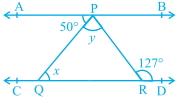
In the figure,if $AB \parallel CD$,$\angle APQ = 50^o$ and $\angle PRD = 127^o$,find $x$ and $y$.
A
$x = 50^o$ and $y = 77^o$
B
$x = 70^o$ and $y = 20^o$
C
$x = 30^o$ and $y = 150^o$
D
$x = 90^o$ and $y = 70^o$
Solution
(A) Given: $AB \parallel CD$,$\angle APQ = 50^o$,and $\angle PRD = 127^o$.
$1$. Since $AB \parallel CD$ and $PQ$ is a transversal,the alternate interior angles are equal.
Therefore,$\angle PQR = \angle APQ$.
Given $\angle APQ = 50^o$,so $x = 50^o$.
$2$. Since $AB \parallel CD$ and $PR$ is a transversal,the alternate interior angles are equal.
Therefore,$\angle APR = \angle PRD$.
Given $\angle PRD = 127^o$,so $\angle APR = 127^o$.
We know that $\angle APR = \angle APQ + \angle QPR$.
Substituting the values,$127^o = 50^o + y$.
$y = 127^o - 50^o = 77^o$.
Thus,$x = 50^o$ and $y = 77^o$.
$1$. Since $AB \parallel CD$ and $PQ$ is a transversal,the alternate interior angles are equal.
Therefore,$\angle PQR = \angle APQ$.
Given $\angle APQ = 50^o$,so $x = 50^o$.
$2$. Since $AB \parallel CD$ and $PR$ is a transversal,the alternate interior angles are equal.
Therefore,$\angle APR = \angle PRD$.
Given $\angle PRD = 127^o$,so $\angle APR = 127^o$.
We know that $\angle APR = \angle APQ + \angle QPR$.
Substituting the values,$127^o = 50^o + y$.
$y = 127^o - 50^o = 77^o$.
Thus,$x = 50^o$ and $y = 77^o$.
0 likes
View Solution18
Difficult
In the figure,$PQ$ and $RS$ are two mirrors placed parallel to each other. An incident ray $AB$ strikes the mirror $PQ$ at $B$,the reflected ray moves along the path $BC$ and strikes the mirror $RS$ at $C$ and again reflects back along $CD$. Prove that $AB \parallel CD$.
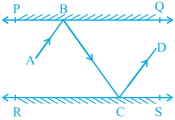
Solution
(N/A) $(i)$ Perpendiculars to parallel lines are parallel.
$(ii)$ According to the laws of reflection,the angle of incidence $=$ the angle of reflection.
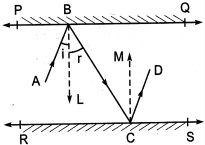
Draw ray $BL \perp PQ$ and $CM \perp RS$.
$\because PQ \parallel RS$ [Given]
$\therefore BL \parallel CM$ [$\because BL \perp PQ$ and $CM \perp RS$]
And $BC$ is a transversal.
$\therefore \angle LBC = \angle MCB$ [Interior alternate angles] ......... $(1)$
Since,(Angle of incidence) $=$ (Angle of reflection)
$\therefore \angle ABL = \angle LBC$ and $\angle MCB = \angle MCD$
$\Rightarrow \angle ABL = \angle MCD$
$\therefore$ From $(1)$,we have
$\angle LBC + \angle ABL = \angle MCB + \angle MCD$ [Equals are added to equals]
$\Rightarrow \angle ABC = \angle BCD$
i.e.,the angles of a pair of interior alternate angles are equal.
$\therefore AB \parallel CD$.
$(ii)$ According to the laws of reflection,the angle of incidence $=$ the angle of reflection.
Draw ray $BL \perp PQ$ and $CM \perp RS$.
$\because PQ \parallel RS$ [Given]
$\therefore BL \parallel CM$ [$\because BL \perp PQ$ and $CM \perp RS$]
And $BC$ is a transversal.
$\therefore \angle LBC = \angle MCB$ [Interior alternate angles] ......... $(1)$
Since,(Angle of incidence) $=$ (Angle of reflection)
$\therefore \angle ABL = \angle LBC$ and $\angle MCB = \angle MCD$
$\Rightarrow \angle ABL = \angle MCD$
$\therefore$ From $(1)$,we have
$\angle LBC + \angle ABL = \angle MCB + \angle MCD$ [Equals are added to equals]
$\Rightarrow \angle ABC = \angle BCD$
i.e.,the angles of a pair of interior alternate angles are equal.
$\therefore AB \parallel CD$.
2 likes
View Solution19
EasyMCQ
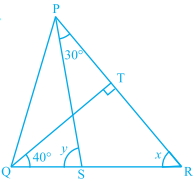
In the figure,if $QT \perp PR$,$\angle TQR = 40^o$ and $\angle SPR = 30^o$,find $x$ and $y$.
A
$x=90^o$ and $y=270^o$
B
$x=180^o$ and $y=90^o$
C
$x=50^o$ and $y=80^o$
D
$x=45^o$ and $y=45^o$
Solution
(C) In $\Delta TQR$,since $QT \perp PR$,$\angle QTR = 90^o$.
By the angle sum property of a triangle,the sum of angles in $\Delta TQR$ is $180^o$:
$\angle QTR + \angle TQR + \angle TRQ = 180^o$
$90^o + 40^o + x = 180^o$
$130^o + x = 180^o$
$x = 180^o - 130^o = 50^o$
Now,consider $\Delta P S R$. The exterior angle $y$ of $\Delta P S R$ is equal to the sum of the two interior opposite angles:
$y = \angle SPR + \angle PRS$
$y = 30^o + x$
$y = 30^o + 50^o = 80^o$
Thus,$x = 50^o$ and $y = 80^o$.
By the angle sum property of a triangle,the sum of angles in $\Delta TQR$ is $180^o$:
$\angle QTR + \angle TQR + \angle TRQ = 180^o$
$90^o + 40^o + x = 180^o$
$130^o + x = 180^o$
$x = 180^o - 130^o = 50^o$
Now,consider $\Delta P S R$. The exterior angle $y$ of $\Delta P S R$ is equal to the sum of the two interior opposite angles:
$y = \angle SPR + \angle PRS$
$y = 30^o + x$
$y = 30^o + 50^o = 80^o$
Thus,$x = 50^o$ and $y = 80^o$.
0 likes
View Solution20
Difficult
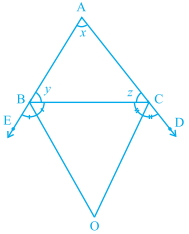
In the figure,the sides $AB$ and $AC$ of $\Delta ABC$ are produced to points $E$ and $D$ respectively. If the bisectors $BO$ and $CO$ of $\angle CBE$ and $\angle BCD$ respectively meet at point $O$,then prove that $\angle BOC = 90^o - \frac{1}{2} \angle BAC$.
Solution
(N/A) Ray $BO$ is the bisector of $\angle CBE$.
Therefore,$\angle CBO = \frac{1}{2} \angle CBE = \frac{1}{2}(180^o - y) = 90^o - \frac{y}{2}$ ......... $(1)$
Similarly,ray $CO$ is the bisector of $\angle BCD$.
Therefore,$\angle BCO = \frac{1}{2} \angle BCD = \frac{1}{2}(180^o - z) = 90^o - \frac{z}{2}$ ......... $(2)$
In $\Delta BOC$,$\angle BOC + \angle BCO + \angle CBO = 180^o$ ......... $(3)$
Substituting $(1)$ and $(2)$ in $(3)$,we get:
$\angle BOC + (90^o - \frac{z}{2}) + (90^o - \frac{y}{2}) = 180^o$
$\angle BOC + 180^o - \frac{1}{2}(y + z) = 180^o$
$\angle BOC = \frac{1}{2}(y + z)$ ......... $(4)$
In $\Delta ABC$,$x + y + z = 180^o$ (Angle sum property of a triangle).
Therefore,$y + z = 180^o - x$.
Substituting this in $(4)$:
$\angle BOC = \frac{1}{2}(180^o - x) = 90^o - \frac{x}{2} = 90^o - \frac{1}{2} \angle BAC$.
Therefore,$\angle CBO = \frac{1}{2} \angle CBE = \frac{1}{2}(180^o - y) = 90^o - \frac{y}{2}$ ......... $(1)$
Similarly,ray $CO$ is the bisector of $\angle BCD$.
Therefore,$\angle BCO = \frac{1}{2} \angle BCD = \frac{1}{2}(180^o - z) = 90^o - \frac{z}{2}$ ......... $(2)$
In $\Delta BOC$,$\angle BOC + \angle BCO + \angle CBO = 180^o$ ......... $(3)$
Substituting $(1)$ and $(2)$ in $(3)$,we get:
$\angle BOC + (90^o - \frac{z}{2}) + (90^o - \frac{y}{2}) = 180^o$
$\angle BOC + 180^o - \frac{1}{2}(y + z) = 180^o$
$\angle BOC = \frac{1}{2}(y + z)$ ......... $(4)$
In $\Delta ABC$,$x + y + z = 180^o$ (Angle sum property of a triangle).
Therefore,$y + z = 180^o - x$.
Substituting this in $(4)$:
$\angle BOC = \frac{1}{2}(180^o - x) = 90^o - \frac{x}{2} = 90^o - \frac{1}{2} \angle BAC$.
0 likes
View Solution21
MediumMCQ
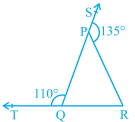
In the figure,sides $QP$ and $RQ$ of $\Delta PQR$ are produced to points $S$ and $T$ respectively. If $\angle SPR = 135^o$ and $\angle PQT = 110^o$,find $\angle PRQ$. (in $^o$)
A
$65$
B
$75$
C
$85$
D
$95$
Solution
(A) Since $TQR$ is a straight line,
$\therefore \angle TQP + \angle PQR = 180^o$ [Linear pair axiom]
$\Rightarrow 110^o + \angle PQR = 180^o$
$\Rightarrow \angle PQR = 180^o - 110^o = 70^o$
Now,for $\Delta PQR$,the side $QP$ is produced to $S$.
Therefore,$\angle SPR$ is an exterior angle of $\Delta PQR$.
By the exterior angle property,the exterior angle is equal to the sum of the two interior opposite angles.
$\therefore \angle SPR = \angle PQR + \angle PRQ$
$135^o = 70^o + \angle PRQ$
$\Rightarrow \angle PRQ = 135^o - 70^o$
$\Rightarrow \angle PRQ = 65^o$
$\therefore \angle TQP + \angle PQR = 180^o$ [Linear pair axiom]
$\Rightarrow 110^o + \angle PQR = 180^o$
$\Rightarrow \angle PQR = 180^o - 110^o = 70^o$
Now,for $\Delta PQR$,the side $QP$ is produced to $S$.
Therefore,$\angle SPR$ is an exterior angle of $\Delta PQR$.
By the exterior angle property,the exterior angle is equal to the sum of the two interior opposite angles.
$\therefore \angle SPR = \angle PQR + \angle PRQ$
$135^o = 70^o + \angle PRQ$
$\Rightarrow \angle PRQ = 135^o - 70^o$
$\Rightarrow \angle PRQ = 65^o$
0 likes
View Solution22
DifficultMCQ
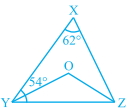
In the figure,$\angle X = 62^o$ and $\angle XYZ = 54^o$. If $YO$ and $ZO$ are the bisectors of $\angle XYZ$ and $\angle XZY$ respectively of $\Delta XYZ$,find $\angle OZY$ and $\angle YOZ$.
A
$30^o$ and $150^o$
B
$32^o$ and $121^o$
C
$30^o$ and $120^o$
D
$35^o$ and $55^o$
Solution
(B) In $\Delta XYZ$,the sum of angles is $180^o$.
$\angle XYZ + \angle YZX + \angle ZXY = 180^o$
Given $\angle XYZ = 54^o$ and $\angle ZXY = 62^o$.
$54^o + \angle YZX + 62^o = 180^o$
$\angle YZX = 180^o - 116^o = 64^o$.
Since $YO$ and $ZO$ are bisectors of $\angle XYZ$ and $\angle XZY$ respectively:
$\angle OZY = \frac{1}{2} \angle XZY = \frac{1}{2} (64^o) = 32^o$.
$\angle OYZ = \frac{1}{2} \angle XYZ = \frac{1}{2} (54^o) = 27^o$.
In $\Delta OYZ$,the sum of angles is $180^o$:
$\angle YOZ + \angle OYZ + \angle OZY = 180^o$
$\angle YOZ + 27^o + 32^o = 180^o$
$\angle YOZ = 180^o - 59^o = 121^o$.
Thus,$\angle OZY = 32^o$ and $\angle YOZ = 121^o$.
$\angle XYZ + \angle YZX + \angle ZXY = 180^o$
Given $\angle XYZ = 54^o$ and $\angle ZXY = 62^o$.
$54^o + \angle YZX + 62^o = 180^o$
$\angle YZX = 180^o - 116^o = 64^o$.
Since $YO$ and $ZO$ are bisectors of $\angle XYZ$ and $\angle XZY$ respectively:
$\angle OZY = \frac{1}{2} \angle XZY = \frac{1}{2} (64^o) = 32^o$.
$\angle OYZ = \frac{1}{2} \angle XYZ = \frac{1}{2} (54^o) = 27^o$.
In $\Delta OYZ$,the sum of angles is $180^o$:
$\angle YOZ + \angle OYZ + \angle OZY = 180^o$
$\angle YOZ + 27^o + 32^o = 180^o$
$\angle YOZ = 180^o - 59^o = 121^o$.
Thus,$\angle OZY = 32^o$ and $\angle YOZ = 121^o$.
0 likes
View Solution23
MediumMCQ
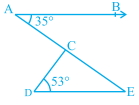
In the figure,if $AB \parallel DE$,$\angle BAC = 35^o$ and $\angle CDE = 53^o$,find $\angle DCE$. (in $^o$)
A
$65$
B
$180$
C
$92$
D
$90$
Solution
(C) Given that $AB \parallel DE$ and $AE$ acts as a transversal.
Since $AB \parallel DE$,the alternate interior angles are equal.
Therefore,$\angle AED = \angle BAC = 35^o$.
Now,consider the triangle $\Delta CDE$.
The sum of the angles in a triangle is $180^o$.
So,$\angle CDE + \angle DEC + \angle DCE = 180^o$.
Substituting the known values,we get $53^o + 35^o + \angle DCE = 180^o$.
$88^o + \angle DCE = 180^o$.
$\angle DCE = 180^o - 88^o = 92^o$.
Since $AB \parallel DE$,the alternate interior angles are equal.
Therefore,$\angle AED = \angle BAC = 35^o$.
Now,consider the triangle $\Delta CDE$.
The sum of the angles in a triangle is $180^o$.
So,$\angle CDE + \angle DEC + \angle DCE = 180^o$.
Substituting the known values,we get $53^o + 35^o + \angle DCE = 180^o$.
$88^o + \angle DCE = 180^o$.
$\angle DCE = 180^o - 88^o = 92^o$.
0 likes
View Solution24
MediumMCQ
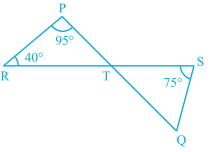
In the figure,if lines $PQ$ and $RS$ intersect at point $T$,such that $\angle PRT = 40^\circ$,$\angle RPT = 95^\circ$ and $\angle TSQ = 75^\circ$,find $\angle SQT$. (in $^\circ$)
A
$45$
B
$90$
C
$85$
D
$60$
Solution
(D) In $\Delta PRT$,
$\angle P + \angle R + \angle PTR = 180^\circ$ [By the angle sum property of a triangle]
$\Rightarrow 95^\circ + 40^\circ + \angle PTR = 180^\circ$
$\Rightarrow \angle PTR = 180^\circ - 135^\circ = 45^\circ$
Since lines $PQ$ and $RS$ intersect at $T$,the vertically opposite angles are equal.
$\therefore \angle QTS = \angle PTR = 45^\circ$
Now,in $\Delta TQS$,
$\angle TSQ + \angle STQ + \angle SQT = 180^\circ$ [By the angle sum property of a triangle]
$\Rightarrow 75^\circ + 45^\circ + \angle SQT = 180^\circ$
$\Rightarrow 120^\circ + \angle SQT = 180^\circ$
$\Rightarrow \angle SQT = 180^\circ - 120^\circ = 60^\circ$
Thus,$\angle SQT = 60^\circ$.
$\angle P + \angle R + \angle PTR = 180^\circ$ [By the angle sum property of a triangle]
$\Rightarrow 95^\circ + 40^\circ + \angle PTR = 180^\circ$
$\Rightarrow \angle PTR = 180^\circ - 135^\circ = 45^\circ$
Since lines $PQ$ and $RS$ intersect at $T$,the vertically opposite angles are equal.
$\therefore \angle QTS = \angle PTR = 45^\circ$
Now,in $\Delta TQS$,
$\angle TSQ + \angle STQ + \angle SQT = 180^\circ$ [By the angle sum property of a triangle]
$\Rightarrow 75^\circ + 45^\circ + \angle SQT = 180^\circ$
$\Rightarrow 120^\circ + \angle SQT = 180^\circ$
$\Rightarrow \angle SQT = 180^\circ - 120^\circ = 60^\circ$
Thus,$\angle SQT = 60^\circ$.
0 likes
View Solution25
DifficultMCQ
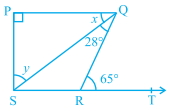
In the figure,if $PQ \perp PS$,$PQ \parallel SR$,$\angle SQR = 28^o$ and $\angle QRT = 65^o$,then find the values of $x$ and $y$.
A
$x = 37^o$ and $y = 53^o$
B
$x = 73^o$ and $y = 27^o$
C
$x = 30^o$ and $y = 60^o$
D
$x = 45^o$ and $y = 45^o$
Solution
(A) In $\Delta QRS$,the side $SR$ is produced to $T$.
Therefore,the exterior angle $\angle QRT = \angle RQS + \angle RSQ$ (Exterior angle property).
Given $\angle RQS = 28^o$ and $\angle QRT = 65^o$.
So,$28^o + \angle RSQ = 65^o$.
$\angle RSQ = 65^o - 28^o = 37^o$.
Since $PQ \parallel SR$ and $QS$ is a transversal,the alternate interior angles are equal.
Therefore,$\angle PQS = \angle RSQ$.
$x = 37^o$.
Given $PQ \perp PS$,so $\angle SPQ = 90^o$.
In $\Delta PQS$,by the angle sum property,$\angle SPQ + \angle PQS + \angle PSQ = 180^o$.
$90^o + x + y = 180^o$.
$90^o + 37^o + y = 180^o$.
$127^o + y = 180^o$.
$y = 180^o - 127^o = 53^o$.
Thus,$x = 37^o$ and $y = 53^o$.
Therefore,the exterior angle $\angle QRT = \angle RQS + \angle RSQ$ (Exterior angle property).
Given $\angle RQS = 28^o$ and $\angle QRT = 65^o$.
So,$28^o + \angle RSQ = 65^o$.
$\angle RSQ = 65^o - 28^o = 37^o$.
Since $PQ \parallel SR$ and $QS$ is a transversal,the alternate interior angles are equal.
Therefore,$\angle PQS = \angle RSQ$.
$x = 37^o$.
Given $PQ \perp PS$,so $\angle SPQ = 90^o$.
In $\Delta PQS$,by the angle sum property,$\angle SPQ + \angle PQS + \angle PSQ = 180^o$.
$90^o + x + y = 180^o$.
$90^o + 37^o + y = 180^o$.
$127^o + y = 180^o$.
$y = 180^o - 127^o = 53^o$.
Thus,$x = 37^o$ and $y = 53^o$.
0 likes
View Solution26
Medium
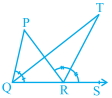
In the figure,the side $QR$ of $\Delta PQR$ is produced to a point $S$. If the bisectors of $\angle PQR$ and $\angle PRS$ meet at point $T$,then prove that $\angle QTR = \frac{1}{2} \angle QPR$.
Solution
(N/A) In $\Delta PQR$,the side $QR$ is produced to $S$.
$\therefore$ Exterior $\angle PRS = \text{Sum of the interior opposite angles}$
$\Rightarrow \angle PRS = \angle P + \angle Q$
Since $QT$ and $RT$ are bisectors of $\angle PQR$ and $\angle PRS$ respectively,
$\therefore \angle TQR = \frac{1}{2} \angle PQR$ and $\angle TRS = \frac{1}{2} \angle PRS$.
Now,in $\Delta QRT$,the exterior angle $\angle TRS = \angle TQR + \angle QTR$.
Substituting the values:
$\frac{1}{2} \angle PRS = \frac{1}{2} \angle PQR + \angle QTR$
$\angle QTR = \frac{1}{2} \angle PRS - \frac{1}{2} \angle PQR$
$\angle QTR = \frac{1}{2} (\angle PRS - \angle PQR)$
Since $\angle PRS = \angle P + \angle PQR$ (exterior angle property),
$\angle QTR = \frac{1}{2} (\angle P + \angle PQR - \angle PQR)$
$\angle QTR = \frac{1}{2} \angle P$
i.e.,$\angle QTR = \frac{1}{2} \angle QPR$.
$\therefore$ Exterior $\angle PRS = \text{Sum of the interior opposite angles}$
$\Rightarrow \angle PRS = \angle P + \angle Q$
Since $QT$ and $RT$ are bisectors of $\angle PQR$ and $\angle PRS$ respectively,
$\therefore \angle TQR = \frac{1}{2} \angle PQR$ and $\angle TRS = \frac{1}{2} \angle PRS$.
Now,in $\Delta QRT$,the exterior angle $\angle TRS = \angle TQR + \angle QTR$.
Substituting the values:
$\frac{1}{2} \angle PRS = \frac{1}{2} \angle PQR + \angle QTR$
$\angle QTR = \frac{1}{2} \angle PRS - \frac{1}{2} \angle PQR$
$\angle QTR = \frac{1}{2} (\angle PRS - \angle PQR)$
Since $\angle PRS = \angle P + \angle PQR$ (exterior angle property),
$\angle QTR = \frac{1}{2} (\angle P + \angle PQR - \angle PQR)$
$\angle QTR = \frac{1}{2} \angle P$
i.e.,$\angle QTR = \frac{1}{2} \angle QPR$.
1 likes
View SolutionLines and Angles — Textbook - Lines and Angles · Frequently Asked Questions
1Are these Lines and Angles questions useful for JEE and NEET?
Yes. All questions in this section are mapped to JEE Main and NEET exam patterns. Previous year questions from JEE Main, NEET, GUJCET and state-level exams are included with full solutions.
2Can I switch to Hindi or Gujarati for these questions?
Yes. Use the language tabs in the hero section or the sidebar to view the same questions and solutions in English, Hindi or Gujarati.
3How do I generate a question paper from this subtopic?
Use the Vedclass Exam Paper Generator — select the chapter and subtopic, set difficulty, and generate Sets A, B, C, D automatically. First 3 chapters of every subject are free.
Vedclass Products
For Students
Vedclass Test Series
Mock tests in real JEE/NEET style with performance analysis. 5-day free trial.
Start Free TrialFor Teachers
Exam Paper Generator
Generate Set A/B/C/D papers from this chapter in 2 minutes. 3 chapters free.
Try FreeFor Institutes
Online Exam Module
Live online exams with unlimited students, 360° analytics & white-label branding.
See DemoFor Teachers & Institutes
Generate a Lines and Angles Exam Paper in 2 Minutes
Select subtopic & difficulty — Sets A, B, C, D auto-generated with No Repeat logic.
First 3 chapters of every subject are free — no payment required.