
A English
Mix Examples - Lines and Angles Questions in English
Class 9 Mathematics · Lines and Angles · Mix Examples - Lines and Angles
125+
Questions
English
Language
100%
With Solutions
Showing 50 of 125 questions in English
51
MediumMCQ
$\angle A$ and $\angle B$ are complementary angles. If $\angle A : \angle B = 1 : 5$,then find $\angle A$ and $\angle B$.
A
$\angle A = 30^{\circ}, \angle B = 80^{\circ}$
B
$\angle A = 30^{\circ}, \angle B = 50^{\circ}$
C
$\angle A = 15^{\circ}, \angle B = 75^{\circ}$
D
$\angle A = 25^{\circ}, \angle B = 70^{\circ}$
Solution
(C) Two angles are said to be complementary if their sum is $90^{\circ}$.
Given that $\angle A + \angle B = 90^{\circ}$.
Also,the ratio $\angle A : \angle B = 1 : 5$. Let $\angle A = x$ and $\angle B = 5x$.
Substituting these into the sum equation: $x + 5x = 90^{\circ}$.
$6x = 90^{\circ}$.
$x = 90^{\circ} / 6 = 15^{\circ}$.
Therefore,$\angle A = 15^{\circ}$ and $\angle B = 5 \times 15^{\circ} = 75^{\circ}$.
Given that $\angle A + \angle B = 90^{\circ}$.
Also,the ratio $\angle A : \angle B = 1 : 5$. Let $\angle A = x$ and $\angle B = 5x$.
Substituting these into the sum equation: $x + 5x = 90^{\circ}$.
$6x = 90^{\circ}$.
$x = 90^{\circ} / 6 = 15^{\circ}$.
Therefore,$\angle A = 15^{\circ}$ and $\angle B = 5 \times 15^{\circ} = 75^{\circ}$.
2 likes
View Solution52
MediumMCQ
$\angle X$ and $\angle Y$ are supplementary angles. If $\angle X : \angle Y = 23 : 13$,then find $\angle X$ and $\angle Y$.
A
$\angle X = 115^{\circ}, \angle Y = 65^{\circ}$
B
$\angle X = 125^{\circ}, \angle Y = 55^{\circ}$
C
$\angle X = 105^{\circ}, \angle Y = 75^{\circ}$
D
$\angle X = 135^{\circ}, \angle Y = 45^{\circ}$
Solution
(A) Two angles are supplementary if their sum is $180^{\circ}$.
Given $\angle X : \angle Y = 23 : 13$,let $\angle X = 23k$ and $\angle Y = 13k$.
Since they are supplementary,$23k + 13k = 180^{\circ}$.
$36k = 180^{\circ}$.
$k = \frac{180^{\circ}}{36} = 5^{\circ}$.
Therefore,$\angle X = 23 \times 5^{\circ} = 115^{\circ}$ and $\angle Y = 13 \times 5^{\circ} = 65^{\circ}$.
Given $\angle X : \angle Y = 23 : 13$,let $\angle X = 23k$ and $\angle Y = 13k$.
Since they are supplementary,$23k + 13k = 180^{\circ}$.
$36k = 180^{\circ}$.
$k = \frac{180^{\circ}}{36} = 5^{\circ}$.
Therefore,$\angle X = 23 \times 5^{\circ} = 115^{\circ}$ and $\angle Y = 13 \times 5^{\circ} = 65^{\circ}$.
3 likes
View Solution53
MediumMCQ
$\angle P$ and $\angle Q$ are complementary angles. If $\angle P = 3x + 15^{\circ}$ and $\angle Q = x + 7^{\circ}$,then find $\angle P$ and $\angle Q$.
A
$\angle P = 66^{\circ}, \angle Q = 24^{\circ}$
B
$\angle P = 60^{\circ}, \angle Q = 25^{\circ}$
C
$\angle P = 75^{\circ}, \angle Q = 20^{\circ}$
D
$\angle P = 55^{\circ}, \angle Q = 15^{\circ}$
Solution
(A) Two angles are complementary if their sum is $90^{\circ}$.
Therefore,$\angle P + \angle Q = 90^{\circ}$.
Substituting the given expressions: $(3x + 15^{\circ}) + (x + 7^{\circ}) = 90^{\circ}$.
Combining like terms: $4x + 22^{\circ} = 90^{\circ}$.
Subtracting $22^{\circ}$ from both sides: $4x = 68^{\circ}$.
Dividing by $4$: $x = 17^{\circ}$.
Now,calculate $\angle P$: $\angle P = 3(17^{\circ}) + 15^{\circ} = 51^{\circ} + 15^{\circ} = 66^{\circ}$.
Calculate $\angle Q$: $\angle Q = 17^{\circ} + 7^{\circ} = 24^{\circ}$.
Thus,$\angle P = 66^{\circ}$ and $\angle Q = 24^{\circ}$.
Therefore,$\angle P + \angle Q = 90^{\circ}$.
Substituting the given expressions: $(3x + 15^{\circ}) + (x + 7^{\circ}) = 90^{\circ}$.
Combining like terms: $4x + 22^{\circ} = 90^{\circ}$.
Subtracting $22^{\circ}$ from both sides: $4x = 68^{\circ}$.
Dividing by $4$: $x = 17^{\circ}$.
Now,calculate $\angle P$: $\angle P = 3(17^{\circ}) + 15^{\circ} = 51^{\circ} + 15^{\circ} = 66^{\circ}$.
Calculate $\angle Q$: $\angle Q = 17^{\circ} + 7^{\circ} = 24^{\circ}$.
Thus,$\angle P = 66^{\circ}$ and $\angle Q = 24^{\circ}$.
0 likes
View Solution54
MediumMCQ
$\angle A$ and $\angle B$ are supplementary angles. If $\angle A = 3x - 10^{\circ}$ and $\angle B = 2x + 30^{\circ}$,then find $\angle A$ and $\angle B$.
A
$\angle A = 70^{\circ}, \angle B = 75^{\circ}$
B
$\angle A = 86^{\circ}, \angle B = 94^{\circ}$
C
$\angle A = 75^{\circ}, \angle B = 96^{\circ}$
D
$\angle A = 82^{\circ}, \angle B = 90^{\circ}$
Solution
(B) Two angles are supplementary if their sum is $180^{\circ}$.
Therefore,$\angle A + \angle B = 180^{\circ}$.
Substituting the given expressions: $(3x - 10^{\circ}) + (2x + 30^{\circ}) = 180^{\circ}$.
Combining like terms: $5x + 20^{\circ} = 180^{\circ}$.
Subtracting $20^{\circ}$ from both sides: $5x = 160^{\circ}$.
Dividing by $5$: $x = 32^{\circ}$.
Now,calculate $\angle A$: $\angle A = 3(32^{\circ}) - 10^{\circ} = 96^{\circ} - 10^{\circ} = 86^{\circ}$.
Calculate $\angle B$: $\angle B = 2(32^{\circ}) + 30^{\circ} = 64^{\circ} + 30^{\circ} = 94^{\circ}$.
Thus,$\angle A = 86^{\circ}$ and $\angle B = 94^{\circ}$.
Therefore,$\angle A + \angle B = 180^{\circ}$.
Substituting the given expressions: $(3x - 10^{\circ}) + (2x + 30^{\circ}) = 180^{\circ}$.
Combining like terms: $5x + 20^{\circ} = 180^{\circ}$.
Subtracting $20^{\circ}$ from both sides: $5x = 160^{\circ}$.
Dividing by $5$: $x = 32^{\circ}$.
Now,calculate $\angle A$: $\angle A = 3(32^{\circ}) - 10^{\circ} = 96^{\circ} - 10^{\circ} = 86^{\circ}$.
Calculate $\angle B$: $\angle B = 2(32^{\circ}) + 30^{\circ} = 64^{\circ} + 30^{\circ} = 94^{\circ}$.
Thus,$\angle A = 86^{\circ}$ and $\angle B = 94^{\circ}$.
1 likes
View Solution55
MediumMCQ
$\angle X$ and $\angle Y$ are complementary angles. If $\angle X = 4 \angle Y$,then find $\angle X$ and $\angle Y$.
A
$\angle X = 72^{\circ}, \angle Y = 18^{\circ}$
B
$\angle X = 80^{\circ}, \angle Y = 20^{\circ}$
C
$\angle X = 60^{\circ}, \angle Y = 15^{\circ}$
D
$\angle X = 75^{\circ}, \angle Y = 15^{\circ}$
Solution
(A) Two angles are complementary if their sum is $90^{\circ}$.
Given: $\angle X + \angle Y = 90^{\circ}$ and $\angle X = 4 \angle Y$.
Substitute the value of $\angle X$ in the first equation:
$4 \angle Y + \angle Y = 90^{\circ}$
$5 \angle Y = 90^{\circ}$
$\angle Y = 90^{\circ} / 5 = 18^{\circ}$.
Now,find $\angle X$:
$\angle X = 4 \times 18^{\circ} = 72^{\circ}$.
Thus,$\angle X = 72^{\circ}$ and $\angle Y = 18^{\circ}$.
Given: $\angle X + \angle Y = 90^{\circ}$ and $\angle X = 4 \angle Y$.
Substitute the value of $\angle X$ in the first equation:
$4 \angle Y + \angle Y = 90^{\circ}$
$5 \angle Y = 90^{\circ}$
$\angle Y = 90^{\circ} / 5 = 18^{\circ}$.
Now,find $\angle X$:
$\angle X = 4 \times 18^{\circ} = 72^{\circ}$.
Thus,$\angle X = 72^{\circ}$ and $\angle Y = 18^{\circ}$.
0 likes
View Solution56
MediumMCQ
$\angle P$ and $\angle Q$ are supplementary angles. If $\angle P = 11 \angle Q$,then find $\angle P$ and $\angle Q$.
A
$\angle P = 125^{\circ}, \angle Q = 15^{\circ}$
B
$\angle P = 115^{\circ}, \angle Q = 36^{\circ}$
C
$\angle P = 160^{\circ}, \angle Q = 75^{\circ}$
D
$\angle P = 165^{\circ}, \angle Q = 15^{\circ}$
Solution
(D) Two angles are supplementary if their sum is $180^{\circ}$.
Therefore,$\angle P + \angle Q = 180^{\circ}$.
Given that $\angle P = 11 \angle Q$.
Substituting the value of $\angle P$ in the first equation:
$11 \angle Q + \angle Q = 180^{\circ}$
$12 \angle Q = 180^{\circ}$
$\angle Q = \frac{180^{\circ}}{12} = 15^{\circ}$.
Now,find $\angle P$:
$\angle P = 11 \times 15^{\circ} = 165^{\circ}$.
Thus,$\angle P = 165^{\circ}$ and $\angle Q = 15^{\circ}$.
Therefore,$\angle P + \angle Q = 180^{\circ}$.
Given that $\angle P = 11 \angle Q$.
Substituting the value of $\angle P$ in the first equation:
$11 \angle Q + \angle Q = 180^{\circ}$
$12 \angle Q = 180^{\circ}$
$\angle Q = \frac{180^{\circ}}{12} = 15^{\circ}$.
Now,find $\angle P$:
$\angle P = 11 \times 15^{\circ} = 165^{\circ}$.
Thus,$\angle P = 165^{\circ}$ and $\angle Q = 15^{\circ}$.
0 likes
View Solution57
MediumMCQ
$\angle A$ and $\angle B$ are complementary angles. If $\angle A = \angle B - 20^{\circ}$,then find $\angle A$ and $\angle B$.
A
$\angle A = 35^{\circ}, \quad \angle B = 55^{\circ}$
B
$\angle A = 45^{\circ}, \quad \angle B = 65^{\circ}$
C
$\angle A = 25^{\circ}, \quad \angle B = 85^{\circ}$
D
$\angle A = 40^{\circ}, \quad \angle B = 90^{\circ}$
Solution
(A) Two angles are complementary if their sum is $90^{\circ}$.
Therefore,$\angle A + \angle B = 90^{\circ}$.
Given that $\angle A = \angle B - 20^{\circ}$.
Substituting the value of $\angle A$ in the first equation:
$(\angle B - 20^{\circ}) + \angle B = 90^{\circ}$
$2\angle B - 20^{\circ} = 90^{\circ}$
$2\angle B = 110^{\circ}$
$\angle B = 55^{\circ}$.
Now,find $\angle A$:
$\angle A = 55^{\circ} - 20^{\circ} = 35^{\circ}$.
Thus,$\angle A = 35^{\circ}$ and $\angle B = 55^{\circ}$.
Therefore,$\angle A + \angle B = 90^{\circ}$.
Given that $\angle A = \angle B - 20^{\circ}$.
Substituting the value of $\angle A$ in the first equation:
$(\angle B - 20^{\circ}) + \angle B = 90^{\circ}$
$2\angle B - 20^{\circ} = 90^{\circ}$
$2\angle B = 110^{\circ}$
$\angle B = 55^{\circ}$.
Now,find $\angle A$:
$\angle A = 55^{\circ} - 20^{\circ} = 35^{\circ}$.
Thus,$\angle A = 35^{\circ}$ and $\angle B = 55^{\circ}$.
0 likes
View Solution58
MediumMCQ
$\angle P$ and $\angle Q$ are supplementary angles. If $\angle P = \angle Q + 35^{\circ}$,then find $\angle P$ and $\angle Q$.
A
$\angle P = 107.5^{\circ}, \angle Q = 72.5^{\circ}$
B
$\angle P = 108.5^{\circ}, \angle Q = 73.5^{\circ}$
C
$\angle P = 110.5^{\circ}, \angle Q = 75.5^{\circ}$
D
$\angle P = 100.5^{\circ}, \angle Q = 70.5^{\circ}$
Solution
(A) Two angles are supplementary if their sum is $180^{\circ}$.
Given: $\angle P + \angle Q = 180^{\circ}$ (Equation $1$)
Given: $\angle P = \angle Q + 35^{\circ}$ (Equation $2$)
Substitute Equation $2$ into Equation $1$:
$(\angle Q + 35^{\circ}) + \angle Q = 180^{\circ}$
$2\angle Q + 35^{\circ} = 180^{\circ}$
$2\angle Q = 180^{\circ} - 35^{\circ}$
$2\angle Q = 145^{\circ}$
$\angle Q = 145^{\circ} / 2 = 72.5^{\circ}$
Now,find $\angle P$ using Equation $2$:
$\angle P = 72.5^{\circ} + 35^{\circ} = 107.5^{\circ}$
Thus,$\angle P = 107.5^{\circ}$ and $\angle Q = 72.5^{\circ}$.
Given: $\angle P + \angle Q = 180^{\circ}$ (Equation $1$)
Given: $\angle P = \angle Q + 35^{\circ}$ (Equation $2$)
Substitute Equation $2$ into Equation $1$:
$(\angle Q + 35^{\circ}) + \angle Q = 180^{\circ}$
$2\angle Q + 35^{\circ} = 180^{\circ}$
$2\angle Q = 180^{\circ} - 35^{\circ}$
$2\angle Q = 145^{\circ}$
$\angle Q = 145^{\circ} / 2 = 72.5^{\circ}$
Now,find $\angle P$ using Equation $2$:
$\angle P = 72.5^{\circ} + 35^{\circ} = 107.5^{\circ}$
Thus,$\angle P = 107.5^{\circ}$ and $\angle Q = 72.5^{\circ}$.
1 likes
View Solution59
MediumMCQ
$\angle APC$ and $\angle BPD$ are vertically opposite angles. If $\angle APC = 3x - 20^{\circ}$ and $\angle BPD = 2x + 30^{\circ}$,then find $x$ and the measure of both angles.
A
$x = 50^{\circ}, 130^{\circ}, 130^{\circ}$
B
$x = 40^{\circ}, 100^{\circ}, 100^{\circ}$
C
$x = 60^{\circ}, 160^{\circ}, 160^{\circ}$
D
$x = 30^{\circ}, 70^{\circ}, 70^{\circ}$
Solution
(A) Since $\angle APC$ and $\angle BPD$ are vertically opposite angles,they must be equal.
Therefore,$3x - 20^{\circ} = 2x + 30^{\circ}$.
Subtracting $2x$ from both sides,we get $x - 20^{\circ} = 30^{\circ}$.
Adding $20^{\circ}$ to both sides,we get $x = 50^{\circ}$.
Now,substitute $x = 50^{\circ}$ into the expressions for the angles:
$\angle APC = 3(50^{\circ}) - 20^{\circ} = 150^{\circ} - 20^{\circ} = 130^{\circ}$.
$\angle BPD = 2(50^{\circ}) + 30^{\circ} = 100^{\circ} + 30^{\circ} = 130^{\circ}$.
Thus,$x = 50^{\circ}$ and both angles measure $130^{\circ}$.
Therefore,$3x - 20^{\circ} = 2x + 30^{\circ}$.
Subtracting $2x$ from both sides,we get $x - 20^{\circ} = 30^{\circ}$.
Adding $20^{\circ}$ to both sides,we get $x = 50^{\circ}$.
Now,substitute $x = 50^{\circ}$ into the expressions for the angles:
$\angle APC = 3(50^{\circ}) - 20^{\circ} = 150^{\circ} - 20^{\circ} = 130^{\circ}$.
$\angle BPD = 2(50^{\circ}) + 30^{\circ} = 100^{\circ} + 30^{\circ} = 130^{\circ}$.
Thus,$x = 50^{\circ}$ and both angles measure $130^{\circ}$.
0 likes
View Solution60
MediumMCQ
$\angle ABD$ and $\angle DBC$ are adjacent angles. If $\angle ABD = 1.5x^{\circ}$,$\angle DBC = 2x^{\circ}$,and $\angle ABC = 70^{\circ}$,then find $x$ and the measures of $\angle ABD$ and $\angle DBC$.
A
$x = 20^{\circ}, \angle ABD = 30^{\circ}, \angle DBC = 40^{\circ}$
B
$x = 15^{\circ}, \angle ABD = 22.5^{\circ}, \angle DBC = 30^{\circ}$
C
$x = 25^{\circ}, \angle ABD = 37.5^{\circ}, \angle DBC = 50^{\circ}$
D
$x = 10^{\circ}, \angle ABD = 15^{\circ}, \angle DBC = 20^{\circ}$
Solution
(A) Since $\angle ABD$ and $\angle DBC$ are adjacent angles,their sum is equal to $\angle ABC$.
Therefore,$\angle ABD + \angle DBC = \angle ABC$.
Substituting the given values: $1.5x + 2x = 70$.
$3.5x = 70$.
$x = \frac{70}{3.5} = 20$.
Now,calculate the angles:
$\angle ABD = 1.5 \times 20^{\circ} = 30^{\circ}$.
$\angle DBC = 2 \times 20^{\circ} = 40^{\circ}$.
Thus,$x = 20$,$\angle ABD = 30^{\circ}$,and $\angle DBC = 40^{\circ}$.
Therefore,$\angle ABD + \angle DBC = \angle ABC$.
Substituting the given values: $1.5x + 2x = 70$.
$3.5x = 70$.
$x = \frac{70}{3.5} = 20$.
Now,calculate the angles:
$\angle ABD = 1.5 \times 20^{\circ} = 30^{\circ}$.
$\angle DBC = 2 \times 20^{\circ} = 40^{\circ}$.
Thus,$x = 20$,$\angle ABD = 30^{\circ}$,and $\angle DBC = 40^{\circ}$.
0 likes
View Solution61
DifficultMCQ
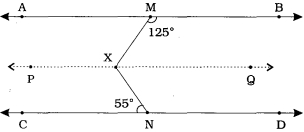
In the figure,if $AB \parallel CD$,$\angle BMX = 125^{\circ}$ and $\angle CNX = 55^{\circ}$,find $\angle MXN$. (in $^{\circ}$)
A
$110$
B
$120$
C
$130$
D
$140$
Solution
(A) Draw a line $PQ \parallel AB$,passing through point $X$ as shown in the figure.
Now,$PQ \parallel AB$ and $AB \parallel CD$.
Therefore,$CD \parallel PQ$ (since $AB \parallel CD$ and $AB \parallel PQ$).
Consider the transversal $MX$ intersecting parallel lines $AB$ and $PQ$. The interior angles on the same side of the transversal are supplementary.
$\therefore \angle BMX + \angle MXQ = 180^{\circ}$
Given $\angle BMX = 125^{\circ}$,we have:
$125^{\circ} + \angle MXQ = 180^{\circ}$
$\therefore \angle MXQ = 180^{\circ} - 125^{\circ} = 55^{\circ}$ $(1)$
Now,consider the transversal $NX$ intersecting parallel lines $CD$ and $PQ$. The alternate interior angles are equal.
$\therefore \angle NXQ = \angle XNC = 55^{\circ}$ $(2)$
Finally,$\angle MXN = \angle MXQ + \angle NXQ$.
Substituting the values from $(1)$ and $(2)$:
$\angle MXN = 55^{\circ} + 55^{\circ} = 110^{\circ}$.
Now,$PQ \parallel AB$ and $AB \parallel CD$.
Therefore,$CD \parallel PQ$ (since $AB \parallel CD$ and $AB \parallel PQ$).
Consider the transversal $MX$ intersecting parallel lines $AB$ and $PQ$. The interior angles on the same side of the transversal are supplementary.
$\therefore \angle BMX + \angle MXQ = 180^{\circ}$
Given $\angle BMX = 125^{\circ}$,we have:
$125^{\circ} + \angle MXQ = 180^{\circ}$
$\therefore \angle MXQ = 180^{\circ} - 125^{\circ} = 55^{\circ}$ $(1)$
Now,consider the transversal $NX$ intersecting parallel lines $CD$ and $PQ$. The alternate interior angles are equal.
$\therefore \angle NXQ = \angle XNC = 55^{\circ}$ $(2)$
Finally,$\angle MXN = \angle MXQ + \angle NXQ$.
Substituting the values from $(1)$ and $(2)$:
$\angle MXN = 55^{\circ} + 55^{\circ} = 110^{\circ}$.
0 likes
View Solution62
Medium
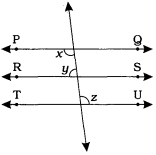
In the given figure,if $PQ \parallel RS$ and $RS \parallel TU$,and $y: z = 7: 8$,find $x$.
Solution
$(96^{\circ})$ Given: $PQ \parallel RS$ and $RS \parallel TU$.
Since lines parallel to the same line are parallel to each other,we have $PQ \parallel TU$.
Therefore,$x = z$ (Alternate interior angles).
Now,for $PQ \parallel RS$,the interior angles on the same side of the transversal are supplementary.
Therefore,$x + y = 180^{\circ}$.
Substituting $x = z$ in the equation,we get $z + y = 180^{\circ}$.
Given the ratio $y: z = 7: 8$,let $y = 7k$ and $z = 8k$.
Substituting these into the equation: $7k + 8k = 180^{\circ} \implies 15k = 180^{\circ} \implies k = 12^{\circ}$.
Thus,$y = 7 \times 12^{\circ} = 84^{\circ}$ and $z = 8 \times 12^{\circ} = 96^{\circ}$.
Since $x = z$,we have $x = 96^{\circ}$.
Since lines parallel to the same line are parallel to each other,we have $PQ \parallel TU$.
Therefore,$x = z$ (Alternate interior angles).
Now,for $PQ \parallel RS$,the interior angles on the same side of the transversal are supplementary.
Therefore,$x + y = 180^{\circ}$.
Substituting $x = z$ in the equation,we get $z + y = 180^{\circ}$.
Given the ratio $y: z = 7: 8$,let $y = 7k$ and $z = 8k$.
Substituting these into the equation: $7k + 8k = 180^{\circ} \implies 15k = 180^{\circ} \implies k = 12^{\circ}$.
Thus,$y = 7 \times 12^{\circ} = 84^{\circ}$ and $z = 8 \times 12^{\circ} = 96^{\circ}$.
Since $x = z$,we have $x = 96^{\circ}$.
0 likes
View Solution63
MediumMCQ
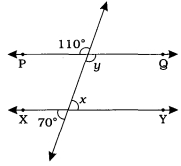
In the given figure,find the values of $x$ and $y$ and then show that $PQ \parallel XY.$
A
$x=20^{\circ}, y=150^{\circ}$
B
$x=50^{\circ}, y=90^{\circ}$
C
$x=70^{\circ}, y=110^{\circ}$
D
$x=80^{\circ}, y=10^{\circ}$
Solution
(C) $1$. From the figure,the angle $x$ and the angle $70^{\circ}$ are vertically opposite angles. Therefore,$x = 70^{\circ}$.
$2$. The angle $y$ and the angle $110^{\circ}$ form a linear pair on the line $PQ$. Therefore,$y + 110^{\circ} = 180^{\circ}$,which gives $y = 180^{\circ} - 110^{\circ} = 70^{\circ}$. Wait,looking at the figure,$y$ is vertically opposite to $110^{\circ}$,so $y = 110^{\circ}$.
$3$. Alternatively,the interior angles on the same side of the transversal are $y$ and $x$. Since $y = 110^{\circ}$ and $x = 70^{\circ}$,their sum is $110^{\circ} + 70^{\circ} = 180^{\circ}$.
$4$. Since the sum of the interior angles on the same side of the transversal is $180^{\circ}$,the lines $PQ$ and $XY$ must be parallel $(PQ \parallel XY)$.
$2$. The angle $y$ and the angle $110^{\circ}$ form a linear pair on the line $PQ$. Therefore,$y + 110^{\circ} = 180^{\circ}$,which gives $y = 180^{\circ} - 110^{\circ} = 70^{\circ}$. Wait,looking at the figure,$y$ is vertically opposite to $110^{\circ}$,so $y = 110^{\circ}$.
$3$. Alternatively,the interior angles on the same side of the transversal are $y$ and $x$. Since $y = 110^{\circ}$ and $x = 70^{\circ}$,their sum is $110^{\circ} + 70^{\circ} = 180^{\circ}$.
$4$. Since the sum of the interior angles on the same side of the transversal is $180^{\circ}$,the lines $PQ$ and $XY$ must be parallel $(PQ \parallel XY)$.
0 likes
View Solution64
MediumMCQ
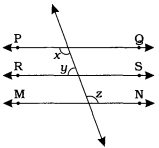
In the given figure,if $PQ || RS$,$RS || MN$ and $y: z = 7: 11$,then find $x$. (in $^o$)
A
$150$
B
$140$
C
$120$
D
$110$
Solution
(D) Given that $PQ || RS$ and $RS || MN$. Therefore,$PQ || MN$.
From the figure,the angle $x$ and $z$ are alternate interior angles if we consider the transversal line,but looking at the positions,$x$ and $z$ are interior angles on the same side of the transversal for lines $PQ$ and $MN$,so $x + z = 180^o$.
Also,$y$ and $z$ are consecutive interior angles between lines $RS$ and $MN$,so $y + z = 180^o$.
This implies $y = x$ (as both are supplementary to $z$).
Given $y: z = 7: 11$,let $y = 7k$ and $z = 11k$.
Since $y + z = 180^o$,we have $7k + 11k = 180^o$,which gives $18k = 180^o$,so $k = 10^o$.
Thus,$y = 7 \times 10^o = 70^o$ and $z = 11 \times 10^o = 110^o$.
Since $x + z = 180^o$ (consecutive interior angles for $PQ || MN$),we have $x + 110^o = 180^o$.
Therefore,$x = 180^o - 110^o = 70^o$.
Wait,checking the figure again: $x$ and $y$ are consecutive interior angles between $PQ$ and $RS$,so $x + y = 180^o$. Since $y = 70^o$,$x = 180^o - 70^o = 110^o$.
From the figure,the angle $x$ and $z$ are alternate interior angles if we consider the transversal line,but looking at the positions,$x$ and $z$ are interior angles on the same side of the transversal for lines $PQ$ and $MN$,so $x + z = 180^o$.
Also,$y$ and $z$ are consecutive interior angles between lines $RS$ and $MN$,so $y + z = 180^o$.
This implies $y = x$ (as both are supplementary to $z$).
Given $y: z = 7: 11$,let $y = 7k$ and $z = 11k$.
Since $y + z = 180^o$,we have $7k + 11k = 180^o$,which gives $18k = 180^o$,so $k = 10^o$.
Thus,$y = 7 \times 10^o = 70^o$ and $z = 11 \times 10^o = 110^o$.
Since $x + z = 180^o$ (consecutive interior angles for $PQ || MN$),we have $x + 110^o = 180^o$.
Therefore,$x = 180^o - 110^o = 70^o$.
Wait,checking the figure again: $x$ and $y$ are consecutive interior angles between $PQ$ and $RS$,so $x + y = 180^o$. Since $y = 70^o$,$x = 180^o - 70^o = 110^o$.
0 likes
View Solution65
Medium
In the given figure,if $PQ \parallel RS$,$YZ \perp RS$ and $\angle SZX = 143^{\circ}$,then find $\angle PXZ$,$\angle XZY$ and $\angle YXZ$.
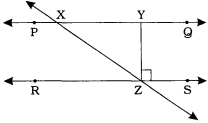
Solution
(N/A) $1$. Given: $PQ \parallel RS$,$YZ \perp RS$ (i.e.,$\angle YZS = 90^{\circ}$),and $\angle SZX = 143^{\circ}$.
$2$. Since $RS$ is a straight line,$\angle RZX + \angle SZX = 180^{\circ}$ (Linear pair).
$\angle RZX + 143^{\circ} = 180^{\circ} \implies \angle RZX = 37^{\circ}$.
$3$. Since $PQ \parallel RS$,the alternate interior angles are equal. Thus,$\angle PXZ = \angle RZX = 37^{\circ}$.
$4$. Since $YZ \perp RS$,$\angle YZS = 90^{\circ}$. Also,$\angle XZY + \angle YZS = \angle XZS$. Since $\angle XZS$ and $\angle RZX$ are vertically opposite angles,$\angle XZS = \angle RZX = 37^{\circ}$. However,looking at the geometry,$\angle XZY = \angle YZS - \angle XZS = 90^{\circ} - 37^{\circ} = 53^{\circ}$.
$5$. In $\triangle XYZ$,the sum of angles is $180^{\circ}$. $\angle YXZ + \angle XZY + \angle XYZ = 180^{\circ}$. Since $PQ \parallel RS$ and $YZ \perp RS$,$\angle XYZ = 90^{\circ}$.
$\angle YXZ + 53^{\circ} + 90^{\circ} = 180^{\circ} \implies \angle YXZ = 180^{\circ} - 143^{\circ} = 37^{\circ}$.
$2$. Since $RS$ is a straight line,$\angle RZX + \angle SZX = 180^{\circ}$ (Linear pair).
$\angle RZX + 143^{\circ} = 180^{\circ} \implies \angle RZX = 37^{\circ}$.
$3$. Since $PQ \parallel RS$,the alternate interior angles are equal. Thus,$\angle PXZ = \angle RZX = 37^{\circ}$.
$4$. Since $YZ \perp RS$,$\angle YZS = 90^{\circ}$. Also,$\angle XZY + \angle YZS = \angle XZS$. Since $\angle XZS$ and $\angle RZX$ are vertically opposite angles,$\angle XZS = \angle RZX = 37^{\circ}$. However,looking at the geometry,$\angle XZY = \angle YZS - \angle XZS = 90^{\circ} - 37^{\circ} = 53^{\circ}$.
$5$. In $\triangle XYZ$,the sum of angles is $180^{\circ}$. $\angle YXZ + \angle XZY + \angle XYZ = 180^{\circ}$. Since $PQ \parallel RS$ and $YZ \perp RS$,$\angle XYZ = 90^{\circ}$.
$\angle YXZ + 53^{\circ} + 90^{\circ} = 180^{\circ} \implies \angle YXZ = 180^{\circ} - 143^{\circ} = 37^{\circ}$.
2 likes
View Solution66
MediumMCQ
In the given figure,if $AB \parallel CD$,$\angle PCD = 130^{\circ}$ and $\angle PBA = 140^{\circ}$,then find $\angle BPC$. (in $^{\circ}$)
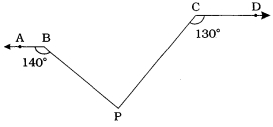
A
$50$
B
$90$
C
$80$
D
$40$
Solution
(B) To find $\angle BPC$,draw a line $EF$ passing through point $P$ such that $EF \parallel AB$. Since $AB \parallel CD$ and $EF \parallel AB$,it follows that $EF \parallel CD$.
$1$. Consider the parallel lines $AB$ and $EF$. Since $BP$ is a transversal,the interior angles on the same side sum to $180^{\circ}$.
$\angle PBA + \angle BPE = 180^{\circ}$
$140^{\circ} + \angle BPE = 180^{\circ}$
$\angle BPE = 180^{\circ} - 140^{\circ} = 40^{\circ}$.
$2$. Consider the parallel lines $CD$ and $EF$. Since $CP$ is a transversal,the interior angles on the same side sum to $180^{\circ}$.
$\angle PCD + \angle CPE = 180^{\circ}$
$130^{\circ} + \angle CPE = 180^{\circ}$
$\angle CPE = 180^{\circ} - 130^{\circ} = 50^{\circ}$.
$3$. Now,$\angle BPC = \angle BPE + \angle CPE = 40^{\circ} + 50^{\circ} = 90^{\circ}$.
$1$. Consider the parallel lines $AB$ and $EF$. Since $BP$ is a transversal,the interior angles on the same side sum to $180^{\circ}$.
$\angle PBA + \angle BPE = 180^{\circ}$
$140^{\circ} + \angle BPE = 180^{\circ}$
$\angle BPE = 180^{\circ} - 140^{\circ} = 40^{\circ}$.
$2$. Consider the parallel lines $CD$ and $EF$. Since $CP$ is a transversal,the interior angles on the same side sum to $180^{\circ}$.
$\angle PCD + \angle CPE = 180^{\circ}$
$130^{\circ} + \angle CPE = 180^{\circ}$
$\angle CPE = 180^{\circ} - 130^{\circ} = 50^{\circ}$.
$3$. Now,$\angle BPC = \angle BPE + \angle CPE = 40^{\circ} + 50^{\circ} = 90^{\circ}$.
0 likes
View Solution67
MediumMCQ
In the given figure,if $AB \parallel CD$,$\angle AXY = 80^{\circ}$ and $\angle XZD = 140^{\circ}$,then find $x$ and $y$.
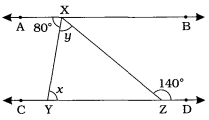
A
$x=10^{\circ}, y=80^{\circ}$
B
$x=70^{\circ}, y=50^{\circ}$
C
$x=80^{\circ}, y=60^{\circ}$
D
$x=40^{\circ}, y=20^{\circ}$
Solution
(C) Given $AB \parallel CD$.
Since $AB \parallel CD$ and $XY$ is a transversal,the alternate interior angles are equal. Therefore,$\angle C Y X = \angle AXY = 80^{\circ}$.
Since $CYD$ is a straight line,$\angle C Y X + \angle X Y Z = 180^{\circ}$ (linear pair).
$80^{\circ} + x = 180^{\circ} \implies x = 100^{\circ}$.
Wait,looking at the figure,$\angle X Y Z$ is an interior angle. Since $AB \parallel CD$,$\angle AXY + \angle X Y C = 180^{\circ}$ (consecutive interior angles).
$80^{\circ} + \angle X Y C = 180^{\circ} \implies \angle X Y C = 100^{\circ}$.
Since $CYD$ is a straight line,$\angle X Y C + \angle X Y Z = 180^{\circ} \implies 100^{\circ} + x = 180^{\circ} \implies x = 80^{\circ}$.
Now,for $\angle XZD = 140^{\circ}$,since $CYD$ is a straight line,$\angle X Z Y + \angle X Z D = 180^{\circ} \implies \angle X Z Y + 140^{\circ} = 180^{\circ} \implies \angle X Z Y = 40^{\circ}$.
In $\triangle XYZ$,the sum of angles is $180^{\circ}$.
$\angle X Y Z + \angle X Z Y + \angle Y X Z = 180^{\circ} \implies 80^{\circ} + 40^{\circ} + y = 180^{\circ} \implies 120^{\circ} + y = 180^{\circ} \implies y = 60^{\circ}$.
Thus,$x = 80^{\circ}$ and $y = 60^{\circ}$.
Since $AB \parallel CD$ and $XY$ is a transversal,the alternate interior angles are equal. Therefore,$\angle C Y X = \angle AXY = 80^{\circ}$.
Since $CYD$ is a straight line,$\angle C Y X + \angle X Y Z = 180^{\circ}$ (linear pair).
$80^{\circ} + x = 180^{\circ} \implies x = 100^{\circ}$.
Wait,looking at the figure,$\angle X Y Z$ is an interior angle. Since $AB \parallel CD$,$\angle AXY + \angle X Y C = 180^{\circ}$ (consecutive interior angles).
$80^{\circ} + \angle X Y C = 180^{\circ} \implies \angle X Y C = 100^{\circ}$.
Since $CYD$ is a straight line,$\angle X Y C + \angle X Y Z = 180^{\circ} \implies 100^{\circ} + x = 180^{\circ} \implies x = 80^{\circ}$.
Now,for $\angle XZD = 140^{\circ}$,since $CYD$ is a straight line,$\angle X Z Y + \angle X Z D = 180^{\circ} \implies \angle X Z Y + 140^{\circ} = 180^{\circ} \implies \angle X Z Y = 40^{\circ}$.
In $\triangle XYZ$,the sum of angles is $180^{\circ}$.
$\angle X Y Z + \angle X Z Y + \angle Y X Z = 180^{\circ} \implies 80^{\circ} + 40^{\circ} + y = 180^{\circ} \implies 120^{\circ} + y = 180^{\circ} \implies y = 60^{\circ}$.
Thus,$x = 80^{\circ}$ and $y = 60^{\circ}$.
1 likes
View Solution68
MediumMCQ
Ray $YM$ is the bisector of $\angle XYZ$ and ray $YN$ is the bisector of $\angle MYZ$. If $\angle XYN = 45^{\circ}$,then find $\angle XYZ$. (in $^{\circ}$)
A
$30$
B
$40$
C
$50$
D
$60$
Solution
(D) Let $\angle XYZ = 2\theta$. Since $YM$ is the bisector of $\angle XYZ$,we have $\angle XYM = \angle MYZ = \theta$.
Since $YN$ is the bisector of $\angle MYZ$,we have $\angle MYN = \angle NYZ = \frac{\theta}{2}$.
Given that $\angle XYN = 45^{\circ}$,we can express this as $\angle XYM + \angle MYN = 45^{\circ}$.
Substituting the values,we get $\theta + \frac{\theta}{2} = 45^{\circ}$.
This simplifies to $\frac{3\theta}{2} = 45^{\circ}$,which gives $3\theta = 90^{\circ}$,so $\theta = 30^{\circ}$.
Therefore,$\angle XYZ = 2\theta = 2(30^{\circ}) = 60^{\circ}$.
Since $YN$ is the bisector of $\angle MYZ$,we have $\angle MYN = \angle NYZ = \frac{\theta}{2}$.
Given that $\angle XYN = 45^{\circ}$,we can express this as $\angle XYM + \angle MYN = 45^{\circ}$.
Substituting the values,we get $\theta + \frac{\theta}{2} = 45^{\circ}$.
This simplifies to $\frac{3\theta}{2} = 45^{\circ}$,which gives $3\theta = 90^{\circ}$,so $\theta = 30^{\circ}$.
Therefore,$\angle XYZ = 2\theta = 2(30^{\circ}) = 60^{\circ}$.
0 likes
View Solution69
Medium
Ray $BD$ is the bisector of $\angle ABC$ and ray $BE$ is the bisector of $\angle DBC$. If $\angle EBC = 19^{\circ},$ then find $\angle DBC, \angle ABC$ and $\angle ABE$.
Solution
(N/A) Given that ray $BE$ is the bisector of $\angle DBC$,we have $\angle EBC = \angle EBD = 19^{\circ}$.
Therefore,$\angle DBC = \angle EBC + \angle EBD = 19^{\circ} + 19^{\circ} = 38^{\circ}$.
Since ray $BD$ is the bisector of $\angle ABC$,we have $\angle ABD = \angle DBC = 38^{\circ}$.
Thus,$\angle ABC = \angle ABD + \angle DBC = 38^{\circ} + 38^{\circ} = 76^{\circ}$.
Finally,$\angle ABE = \angle ABD + \angle DBE = 38^{\circ} + 19^{\circ} = 57^{\circ}$.
Therefore,$\angle DBC = \angle EBC + \angle EBD = 19^{\circ} + 19^{\circ} = 38^{\circ}$.
Since ray $BD$ is the bisector of $\angle ABC$,we have $\angle ABD = \angle DBC = 38^{\circ}$.
Thus,$\angle ABC = \angle ABD + \angle DBC = 38^{\circ} + 38^{\circ} = 76^{\circ}$.
Finally,$\angle ABE = \angle ABD + \angle DBE = 38^{\circ} + 19^{\circ} = 57^{\circ}$.
0 likes
View Solution70
MediumMCQ
$\angle ABC$ and $\angle ABD$ are a linear pair of angles. If $\angle ABC : \angle ABD = 17 : 13$,then find $\angle ABC$ and $\angle ABD$.
A
$102^{\circ}$ and $78^{\circ}$
B
$103^{\circ}$ and $77^{\circ}$
C
$100^{\circ}$ and $80^{\circ}$
D
$92^{\circ}$ and $65^{\circ}$
Solution
(A) Since $\angle ABC$ and $\angle ABD$ form a linear pair,their sum is $180^{\circ}$.
Let $\angle ABC = 17x$ and $\angle ABD = 13x$.
Therefore,$17x + 13x = 180^{\circ}$.
$30x = 180^{\circ}$,which gives $x = 6^{\circ}$.
Now,$\angle ABC = 17 \times 6^{\circ} = 102^{\circ}$.
And $\angle ABD = 13 \times 6^{\circ} = 78^{\circ}$.
Let $\angle ABC = 17x$ and $\angle ABD = 13x$.
Therefore,$17x + 13x = 180^{\circ}$.
$30x = 180^{\circ}$,which gives $x = 6^{\circ}$.
Now,$\angle ABC = 17 \times 6^{\circ} = 102^{\circ}$.
And $\angle ABD = 13 \times 6^{\circ} = 78^{\circ}$.
2 likes
View Solution71
MediumMCQ
$\angle PQR$ and $\angle PQS$ are a linear pair of angles. If $11 \angle PQR = 9 \angle PQS$,then find $\angle PQR$ and $\angle PQS$.
A
$72^{\circ}$ and $92^{\circ}$
B
$78^{\circ}$ and $95^{\circ}$
C
$81^{\circ}$ and $99^{\circ}$
D
$65^{\circ}$ and $85^{\circ}$
Solution
(C) Since $\angle PQR$ and $\angle PQS$ form a linear pair,their sum is $180^{\circ}$.
$\angle PQR + \angle PQS = 180^{\circ}$ (Equation $1$).
Given that $11 \angle PQR = 9 \angle PQS$,we can write $\angle PQS = \frac{11}{9} \angle PQR$.
Substitute this into Equation $1$:
$\angle PQR + \frac{11}{9} \angle PQR = 180^{\circ}$.
$\frac{9 \angle PQR + 11 \angle PQR}{9} = 180^{\circ}$.
$\frac{20 \angle PQR}{9} = 180^{\circ}$.
$20 \angle PQR = 1620^{\circ}$.
$\angle PQR = \frac{1620^{\circ}}{20} = 81^{\circ}$.
Now,find $\angle PQS$:
$\angle PQS = 180^{\circ} - 81^{\circ} = 99^{\circ}$.
Thus,$\angle PQR = 81^{\circ}$ and $\angle PQS = 99^{\circ}$.
$\angle PQR + \angle PQS = 180^{\circ}$ (Equation $1$).
Given that $11 \angle PQR = 9 \angle PQS$,we can write $\angle PQS = \frac{11}{9} \angle PQR$.
Substitute this into Equation $1$:
$\angle PQR + \frac{11}{9} \angle PQR = 180^{\circ}$.
$\frac{9 \angle PQR + 11 \angle PQR}{9} = 180^{\circ}$.
$\frac{20 \angle PQR}{9} = 180^{\circ}$.
$20 \angle PQR = 1620^{\circ}$.
$\angle PQR = \frac{1620^{\circ}}{20} = 81^{\circ}$.
Now,find $\angle PQS$:
$\angle PQS = 180^{\circ} - 81^{\circ} = 99^{\circ}$.
Thus,$\angle PQR = 81^{\circ}$ and $\angle PQS = 99^{\circ}$.
0 likes
View Solution72
MediumMCQ
Lines $AB$ and $CD$ intersect at $P$. If $\angle APC = 2x + 30^{\circ}$ and $\angle BPD = 4x - 20^{\circ}$,then find $x$,$\angle APC$,and $\angle BPD$.
A
$x = 25, \angle APC = 80^{\circ}, \angle BPD = 80^{\circ}$
B
$x = 20, \angle APC = 70^{\circ}, \angle BPD = 60^{\circ}$
C
$x = 30, \angle APC = 90^{\circ}, \angle BPD = 100^{\circ}$
D
$x = 25, \angle APC = 70^{\circ}, \angle BPD = 90^{\circ}$
Solution
(A) When two lines intersect,the vertically opposite angles are equal.
Since lines $AB$ and $CD$ intersect at $P$,$\angle APC$ and $\angle BPD$ are vertically opposite angles.
Therefore,$\angle APC = \angle BPD$.
Substituting the given expressions: $2x + 30^{\circ} = 4x - 20^{\circ}$.
Rearranging the terms: $30^{\circ} + 20^{\circ} = 4x - 2x$.
$50^{\circ} = 2x$,which gives $x = 25^{\circ}$.
Now,calculate the angles:
$\angle APC = 2(25) + 30 = 50 + 30 = 80^{\circ}$.
$\angle BPD = 4(25) - 20 = 100 - 20 = 80^{\circ}$.
Thus,$x = 25$,$\angle APC = 80^{\circ}$,and $\angle BPD = 80^{\circ}$.
Since lines $AB$ and $CD$ intersect at $P$,$\angle APC$ and $\angle BPD$ are vertically opposite angles.
Therefore,$\angle APC = \angle BPD$.
Substituting the given expressions: $2x + 30^{\circ} = 4x - 20^{\circ}$.
Rearranging the terms: $30^{\circ} + 20^{\circ} = 4x - 2x$.
$50^{\circ} = 2x$,which gives $x = 25^{\circ}$.
Now,calculate the angles:
$\angle APC = 2(25) + 30 = 50 + 30 = 80^{\circ}$.
$\angle BPD = 4(25) - 20 = 100 - 20 = 80^{\circ}$.
Thus,$x = 25$,$\angle APC = 80^{\circ}$,and $\angle BPD = 80^{\circ}$.
0 likes
View Solution73
Medium
In the given figure,$AB \parallel DE$ and $BC \parallel EF$. Prove that $\angle ABC = \angle DEF$.
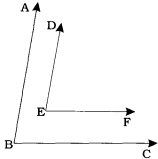
Solution
(N/A) Given: $AB \parallel DE$ and $BC \parallel EF$.
To prove: $\angle ABC = \angle DEF$.
Construction: Extend $DE$ to intersect $BC$ at point $G$.
Proof:
$1$. Since $AB \parallel DE$ and $BC$ is a transversal,$\angle ABC = \angle DGC$ (Corresponding angles).
$2$. Since $BC \parallel EF$ and $DE$ is a transversal,$\angle DGC = \angle DEF$ (Corresponding angles).
$3$. From equations $(1)$ and $(2)$,we get $\angle ABC = \angle DEF$.
Hence proved.
To prove: $\angle ABC = \angle DEF$.
Construction: Extend $DE$ to intersect $BC$ at point $G$.
Proof:
$1$. Since $AB \parallel DE$ and $BC$ is a transversal,$\angle ABC = \angle DGC$ (Corresponding angles).
$2$. Since $BC \parallel EF$ and $DE$ is a transversal,$\angle DGC = \angle DEF$ (Corresponding angles).
$3$. From equations $(1)$ and $(2)$,we get $\angle ABC = \angle DEF$.
Hence proved.
0 likes
View Solution74
Medium
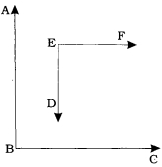
In the given figure,$AB \parallel DE$ and $BC \parallel EF$. Prove that $\angle ABC + \angle DEF = 180^{\circ}$.
Solution
(N/A) Given: $AB \parallel DE$ and $BC \parallel EF$.
To prove: $\angle ABC + \angle DEF = 180^{\circ}$.
Construction: Extend $ED$ to meet $BC$ at point $G$.
Proof:
Since $AB \parallel DE$ and $ED$ is extended to $G$,we have $AB \parallel DG$.
Since $AB \parallel DG$ and $BG$ is a transversal,the interior angles on the same side are supplementary,but here $AB$ and $DG$ are parallel and $BC$ is a transversal,so $\angle ABC + \angle BGD = 180^{\circ}$ (Consecutive interior angles).
Now,consider $BC \parallel EF$. Since $BC \parallel EF$ and $EG$ is a transversal,$\angle BGD = \angle DEF$ (Corresponding angles).
Substituting $\angle BGD = \angle DEF$ in the first equation,we get $\angle ABC + \angle DEF = 180^{\circ}$.
Hence proved.
To prove: $\angle ABC + \angle DEF = 180^{\circ}$.
Construction: Extend $ED$ to meet $BC$ at point $G$.
Proof:
Since $AB \parallel DE$ and $ED$ is extended to $G$,we have $AB \parallel DG$.
Since $AB \parallel DG$ and $BG$ is a transversal,the interior angles on the same side are supplementary,but here $AB$ and $DG$ are parallel and $BC$ is a transversal,so $\angle ABC + \angle BGD = 180^{\circ}$ (Consecutive interior angles).
Now,consider $BC \parallel EF$. Since $BC \parallel EF$ and $EG$ is a transversal,$\angle BGD = \angle DEF$ (Corresponding angles).
Substituting $\angle BGD = \angle DEF$ in the first equation,we get $\angle ABC + \angle DEF = 180^{\circ}$.
Hence proved.
0 likes
View Solution75
MediumMCQ
In $\Delta ABC$,$\angle A : \angle B : \angle C = 5 : 7 : 8$. Find the measure of each angle of $\Delta ABC$.
A
$45^{\circ}, 63^{\circ}, 72^{\circ}$
B
$50^{\circ}, 70^{\circ}, 60^{\circ}$
C
$40^{\circ}, 80^{\circ}, 60^{\circ}$
D
$30^{\circ}, 90^{\circ}, 60^{\circ}$
Solution
(A) In $\Delta ABC$,the sum of the interior angles is $\angle A + \angle B + \angle C = 180^{\circ}$.
Given the ratio $\angle A : \angle B : \angle C = 5 : 7 : 8$,let the angles be $5x, 7x,$ and $8x$.
Sum of the angles: $5x + 7x + 8x = 180^{\circ}$.
$20x = 180^{\circ}$.
$x = \frac{180^{\circ}}{20} = 9^{\circ}$.
Therefore,the angles are:
$\angle A = 5 \times 9^{\circ} = 45^{\circ}$.
$\angle B = 7 \times 9^{\circ} = 63^{\circ}$.
$\angle C = 8 \times 9^{\circ} = 72^{\circ}$.
Given the ratio $\angle A : \angle B : \angle C = 5 : 7 : 8$,let the angles be $5x, 7x,$ and $8x$.
Sum of the angles: $5x + 7x + 8x = 180^{\circ}$.
$20x = 180^{\circ}$.
$x = \frac{180^{\circ}}{20} = 9^{\circ}$.
Therefore,the angles are:
$\angle A = 5 \times 9^{\circ} = 45^{\circ}$.
$\angle B = 7 \times 9^{\circ} = 63^{\circ}$.
$\angle C = 8 \times 9^{\circ} = 72^{\circ}$.
0 likes
View Solution76
Difficult
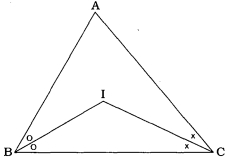
In $\Delta ABC$,the bisectors of $\angle B$ and $\angle C$ intersect each other at $I$. Prove that $\angle BIC = 90^{\circ} + \frac{1}{2} \angle A$.
Solution
(N/A) In $\Delta ABC$,the sum of angles is $180^{\circ}$,so $\angle A + \angle ABC + \angle ACB = 180^{\circ}$.
$\therefore \angle ABC + \angle ACB = 180^{\circ} - \angle A \quad \dots(1)$
The bisectors of $\angle B$ and $\angle C$ intersect at $I$.
$\therefore \angle IBC = \frac{1}{2} \angle ABC$ and $\angle ICB = \frac{1}{2} \angle ACB$.
In $\Delta IBC$,the sum of angles is $180^{\circ}$,so $\angle BIC + \angle IBC + \angle ICB = 180^{\circ}$.
$\therefore \angle BIC = 180^{\circ} - (\angle IBC + \angle ICB)$.
Substituting the values of $\angle IBC$ and $\angle ICB$:
$\therefore \angle BIC = 180^{\circ} - \left[ \frac{1}{2} \angle ABC + \frac{1}{2} \angle ACB \right]$.
$\therefore \angle BIC = 180^{\circ} - \frac{1}{2} (\angle ABC + \angle ACB)$.
Using equation $(1)$:
$\therefore \angle BIC = 180^{\circ} - \frac{1}{2} (180^{\circ} - \angle A)$.
$\therefore \angle BIC = 180^{\circ} - 90^{\circ} + \frac{1}{2} \angle A$.
$\therefore \angle BIC = 90^{\circ} + \frac{1}{2} \angle A$.
$\therefore \angle ABC + \angle ACB = 180^{\circ} - \angle A \quad \dots(1)$
The bisectors of $\angle B$ and $\angle C$ intersect at $I$.
$\therefore \angle IBC = \frac{1}{2} \angle ABC$ and $\angle ICB = \frac{1}{2} \angle ACB$.
In $\Delta IBC$,the sum of angles is $180^{\circ}$,so $\angle BIC + \angle IBC + \angle ICB = 180^{\circ}$.
$\therefore \angle BIC = 180^{\circ} - (\angle IBC + \angle ICB)$.
Substituting the values of $\angle IBC$ and $\angle ICB$:
$\therefore \angle BIC = 180^{\circ} - \left[ \frac{1}{2} \angle ABC + \frac{1}{2} \angle ACB \right]$.
$\therefore \angle BIC = 180^{\circ} - \frac{1}{2} (\angle ABC + \angle ACB)$.
Using equation $(1)$:
$\therefore \angle BIC = 180^{\circ} - \frac{1}{2} (180^{\circ} - \angle A)$.
$\therefore \angle BIC = 180^{\circ} - 90^{\circ} + \frac{1}{2} \angle A$.
$\therefore \angle BIC = 90^{\circ} + \frac{1}{2} \angle A$.
0 likes
View Solution77
MediumMCQ
In $\Delta PQR$,$\angle P : \angle Q : \angle R = 5 : 2 : 2$. Find the measure of each angle of $\Delta PQR$.
A
$\angle P = 100^{\circ}, \angle Q = 40^{\circ}, \angle R = 40^{\circ}$
B
$\angle P = 80^{\circ}, \angle Q = 50^{\circ}, \angle R = 50^{\circ}$
C
$\angle P = 90^{\circ}, \angle Q = 45^{\circ}, \angle R = 45^{\circ}$
D
$\angle P = 110^{\circ}, \angle Q = 35^{\circ}, \angle R = 35^{\circ}$
Solution
(A) Let the angles of $\Delta PQR$ be $5x$,$2x$,and $2x$ respectively.
According to the angle sum property of a triangle,the sum of all interior angles is $180^{\circ}$.
Therefore,$5x + 2x + 2x = 180^{\circ}$.
$9x = 180^{\circ}$.
$x = 20^{\circ}$.
Now,calculating each angle:
$\angle P = 5x = 5 \times 20^{\circ} = 100^{\circ}$.
$\angle Q = 2x = 2 \times 20^{\circ} = 40^{\circ}$.
$\angle R = 2x = 2 \times 20^{\circ} = 40^{\circ}$.
Thus,the angles are $100^{\circ}, 40^{\circ}, 40^{\circ}$.
According to the angle sum property of a triangle,the sum of all interior angles is $180^{\circ}$.
Therefore,$5x + 2x + 2x = 180^{\circ}$.
$9x = 180^{\circ}$.
$x = 20^{\circ}$.
Now,calculating each angle:
$\angle P = 5x = 5 \times 20^{\circ} = 100^{\circ}$.
$\angle Q = 2x = 2 \times 20^{\circ} = 40^{\circ}$.
$\angle R = 2x = 2 \times 20^{\circ} = 40^{\circ}$.
Thus,the angles are $100^{\circ}, 40^{\circ}, 40^{\circ}$.
0 likes
View Solution78
MediumMCQ
In $\Delta ABC$,$\angle A + \angle B = 80^{\circ}$ and $\angle B + \angle C = 150^{\circ}$. Find the measure of each angle of $\Delta ABC$.
A
$\angle A = 30^{\circ}, \angle B = 50^{\circ}, \angle C = 100^{\circ}$
B
$\angle A = 40^{\circ}, \angle B = 40^{\circ}, \angle C = 100^{\circ}$
C
$\angle A = 20^{\circ}, \angle B = 60^{\circ}, \angle C = 90^{\circ}$
D
$\angle A = 50^{\circ}, \angle B = 30^{\circ}, \angle C = 120^{\circ}$
Solution
(A) We know that the sum of all angles in a triangle is $180^{\circ}$,so $\angle A + \angle B + \angle C = 180^{\circ}$.
Given: $\angle A + \angle B = 80^{\circ}$ and $\angle B + \angle C = 150^{\circ}$.
Substituting $\angle A + \angle B = 80^{\circ}$ into the sum equation: $80^{\circ} + \angle C = 180^{\circ} \implies \angle C = 180^{\circ} - 80^{\circ} = 100^{\circ}$.
Substituting $\angle C = 100^{\circ}$ into $\angle B + \angle C = 150^{\circ}$: $\angle B + 100^{\circ} = 150^{\circ} \implies \angle B = 50^{\circ}$.
Substituting $\angle B = 50^{\circ}$ into $\angle A + \angle B = 80^{\circ}$: $\angle A + 50^{\circ} = 80^{\circ} \implies \angle A = 30^{\circ}$.
Thus,the angles are $\angle A = 30^{\circ}, \angle B = 50^{\circ}, \angle C = 100^{\circ}$.
Given: $\angle A + \angle B = 80^{\circ}$ and $\angle B + \angle C = 150^{\circ}$.
Substituting $\angle A + \angle B = 80^{\circ}$ into the sum equation: $80^{\circ} + \angle C = 180^{\circ} \implies \angle C = 180^{\circ} - 80^{\circ} = 100^{\circ}$.
Substituting $\angle C = 100^{\circ}$ into $\angle B + \angle C = 150^{\circ}$: $\angle B + 100^{\circ} = 150^{\circ} \implies \angle B = 50^{\circ}$.
Substituting $\angle B = 50^{\circ}$ into $\angle A + \angle B = 80^{\circ}$: $\angle A + 50^{\circ} = 80^{\circ} \implies \angle A = 30^{\circ}$.
Thus,the angles are $\angle A = 30^{\circ}, \angle B = 50^{\circ}, \angle C = 100^{\circ}$.
0 likes
View Solution79
MediumMCQ
In $\Delta ABC$,$\angle B = \frac{\angle A + \angle C}{2}$ and $\angle A : \angle C = 1 : 2$. Find the measure of each angle of $\Delta ABC$.
A
$\angle A = 40^{\circ}, \angle B = 60^{\circ}, \angle C = 80^{\circ}$
B
$\angle A = 30^{\circ}, \angle B = 60^{\circ}, \angle C = 90^{\circ}$
C
$\angle A = 50^{\circ}, \angle B = 60^{\circ}, \angle C = 70^{\circ}$
D
$\angle A = 20^{\circ}, \angle B = 60^{\circ}, \angle C = 100^{\circ}$
Solution
(A) We know that the sum of angles in a triangle is $180^{\circ}$,so $\angle A + \angle B + \angle C = 180^{\circ}$.
Given $\angle B = \frac{\angle A + \angle C}{2}$,which implies $2\angle B = \angle A + \angle C$.
Substituting this into the sum equation: $2\angle B + \angle B = 180^{\circ} \implies 3\angle B = 180^{\circ} \implies \angle B = 60^{\circ}$.
Now,$\angle A + \angle C = 180^{\circ} - 60^{\circ} = 120^{\circ}$.
Given the ratio $\angle A : \angle C = 1 : 2$,let $\angle A = x$ and $\angle C = 2x$.
Then $x + 2x = 120^{\circ} \implies 3x = 120^{\circ} \implies x = 40^{\circ}$.
Therefore,$\angle A = 40^{\circ}$ and $\angle C = 2(40^{\circ}) = 80^{\circ}$.
The angles are $\angle A = 40^{\circ}, \angle B = 60^{\circ}, \angle C = 80^{\circ}$.
Given $\angle B = \frac{\angle A + \angle C}{2}$,which implies $2\angle B = \angle A + \angle C$.
Substituting this into the sum equation: $2\angle B + \angle B = 180^{\circ} \implies 3\angle B = 180^{\circ} \implies \angle B = 60^{\circ}$.
Now,$\angle A + \angle C = 180^{\circ} - 60^{\circ} = 120^{\circ}$.
Given the ratio $\angle A : \angle C = 1 : 2$,let $\angle A = x$ and $\angle C = 2x$.
Then $x + 2x = 120^{\circ} \implies 3x = 120^{\circ} \implies x = 40^{\circ}$.
Therefore,$\angle A = 40^{\circ}$ and $\angle C = 2(40^{\circ}) = 80^{\circ}$.
The angles are $\angle A = 40^{\circ}, \angle B = 60^{\circ}, \angle C = 80^{\circ}$.
0 likes
View Solution80
MediumMCQ
Side $QR$ of $\Delta PQR$ is extended on both the sides so that exterior angles $\angle PQS$ and $\angle PRT$ are formed. If $\angle PQS = 100^{\circ}$ and $\angle PRT = 130^{\circ}$,find the measure of each angle of $\Delta PQR$.
A
$\angle P = 50^{\circ}, \angle Q = 80^{\circ}, \angle R = 50^{\circ}$
B
$\angle P = 60^{\circ}, \angle Q = 70^{\circ}, \angle R = 50^{\circ}$
C
$\angle P = 70^{\circ}, \angle Q = 60^{\circ}, \angle R = 50^{\circ}$
D
$\angle P = 50^{\circ}, \angle Q = 70^{\circ}, \angle R = 60^{\circ}$
Solution
(A) Since $S-Q-R-T$ is a straight line,$\angle PQS$ and $\angle PQR$ form a linear pair. Therefore,$\angle PQR = 180^{\circ} - 100^{\circ} = 80^{\circ}$.
Similarly,$\angle PRT$ and $\angle PRQ$ form a linear pair. Therefore,$\angle PRQ = 180^{\circ} - 130^{\circ} = 50^{\circ}$.
In $\Delta PQR$,the sum of all interior angles is $180^{\circ}$.
Thus,$\angle P + \angle Q + \angle R = 180^{\circ}$.
$\angle P + 80^{\circ} + 50^{\circ} = 180^{\circ}$.
$\angle P + 130^{\circ} = 180^{\circ}$.
$\angle P = 180^{\circ} - 130^{\circ} = 50^{\circ}$.
Hence,the angles are $\angle P = 50^{\circ}, \angle Q = 80^{\circ}, \angle R = 50^{\circ}$.
Similarly,$\angle PRT$ and $\angle PRQ$ form a linear pair. Therefore,$\angle PRQ = 180^{\circ} - 130^{\circ} = 50^{\circ}$.
In $\Delta PQR$,the sum of all interior angles is $180^{\circ}$.
Thus,$\angle P + \angle Q + \angle R = 180^{\circ}$.
$\angle P + 80^{\circ} + 50^{\circ} = 180^{\circ}$.
$\angle P + 130^{\circ} = 180^{\circ}$.
$\angle P = 180^{\circ} - 130^{\circ} = 50^{\circ}$.
Hence,the angles are $\angle P = 50^{\circ}, \angle Q = 80^{\circ}, \angle R = 50^{\circ}$.
0 likes
View Solution81
MediumMCQ
In $\Delta ABC$,$\angle A = 2x - 10^{\circ}$,$\angle B = x + 10^{\circ}$,and $\angle C = 2x - 20^{\circ}$. Find the measure of each angle of $\Delta ABC$.
A
$\angle A = 70^{\circ}, \angle B = 50^{\circ}, \angle C = 60^{\circ}$
B
$\angle A = 60^{\circ}, \angle B = 60^{\circ}, \angle C = 60^{\circ}$
C
$\angle A = 80^{\circ}, \angle B = 40^{\circ}, \angle C = 60^{\circ}$
D
$\angle A = 75^{\circ}, \angle B = 45^{\circ}, \angle C = 60^{\circ}$
Solution
(A) The sum of the angles in a triangle is $180^{\circ}$.
Therefore,$\angle A + \angle B + \angle C = 180^{\circ}$.
Substituting the given values: $(2x - 10^{\circ}) + (x + 10^{\circ}) + (2x - 20^{\circ}) = 180^{\circ}$.
Combining like terms: $5x - 20^{\circ} = 180^{\circ}$.
$5x = 200^{\circ}$.
$x = 40^{\circ}$.
Now,calculate each angle:
$\angle A = 2(40^{\circ}) - 10^{\circ} = 80^{\circ} - 10^{\circ} = 70^{\circ}$.
$\angle B = 40^{\circ} + 10^{\circ} = 50^{\circ}$.
$\angle C = 2(40^{\circ}) - 20^{\circ} = 80^{\circ} - 20^{\circ} = 60^{\circ}$.
Thus,the angles are $\angle A = 70^{\circ}, \angle B = 50^{\circ}, \angle C = 60^{\circ}$.
Therefore,$\angle A + \angle B + \angle C = 180^{\circ}$.
Substituting the given values: $(2x - 10^{\circ}) + (x + 10^{\circ}) + (2x - 20^{\circ}) = 180^{\circ}$.
Combining like terms: $5x - 20^{\circ} = 180^{\circ}$.
$5x = 200^{\circ}$.
$x = 40^{\circ}$.
Now,calculate each angle:
$\angle A = 2(40^{\circ}) - 10^{\circ} = 80^{\circ} - 10^{\circ} = 70^{\circ}$.
$\angle B = 40^{\circ} + 10^{\circ} = 50^{\circ}$.
$\angle C = 2(40^{\circ}) - 20^{\circ} = 80^{\circ} - 20^{\circ} = 60^{\circ}$.
Thus,the angles are $\angle A = 70^{\circ}, \angle B = 50^{\circ}, \angle C = 60^{\circ}$.
0 likes
View Solution82
Medium
Prove that the sum of angles of any convex quadrilateral is $360^{\circ} .$
Solution
(N/A) Let $ABCD$ be a convex quadrilateral.
Draw a diagonal $AC$ which divides the quadrilateral into two triangles,$\triangle ABC$ and $\triangle ADC$.
We know that the sum of the angles of a triangle is $180^{\circ}$.
For $\triangle ABC$,$\angle BAC + \angle ABC + \angle BCA = 180^{\circ}$ (Equation $1$).
For $\triangle ADC$,$\angle DAC + \angle ADC + \angle DCA = 180^{\circ}$ (Equation $2$).
Adding Equation $1$ and Equation $2$,we get:
$(\angle BAC + \angle DAC) + \angle ABC + \angle ADC + (\angle BCA + \angle DCA) = 180^{\circ} + 180^{\circ}$.
From the figure,$\angle BAC + \angle DAC = \angle A$ and $\angle BCA + \angle DCA = \angle C$.
Therefore,$\angle A + \angle B + \angle C + \angle D = 360^{\circ}$.
Hence,the sum of the angles of a convex quadrilateral is $360^{\circ}$.
Draw a diagonal $AC$ which divides the quadrilateral into two triangles,$\triangle ABC$ and $\triangle ADC$.
We know that the sum of the angles of a triangle is $180^{\circ}$.
For $\triangle ABC$,$\angle BAC + \angle ABC + \angle BCA = 180^{\circ}$ (Equation $1$).
For $\triangle ADC$,$\angle DAC + \angle ADC + \angle DCA = 180^{\circ}$ (Equation $2$).
Adding Equation $1$ and Equation $2$,we get:
$(\angle BAC + \angle DAC) + \angle ABC + \angle ADC + (\angle BCA + \angle DCA) = 180^{\circ} + 180^{\circ}$.
From the figure,$\angle BAC + \angle DAC = \angle A$ and $\angle BCA + \angle DCA = \angle C$.
Therefore,$\angle A + \angle B + \angle C + \angle D = 360^{\circ}$.
Hence,the sum of the angles of a convex quadrilateral is $360^{\circ}$.
0 likes
View Solution83
Difficult
In $\Delta ABC$,the sides $AB$ and $AC$ are produced to $D$ and $E$ respectively,so that exterior angles $\angle CBD$ and $\angle BCE$ are formed. If bisectors of $\angle CBD$ and $\angle BCE$ intersect at point $O$,prove that $\angle BOC = 90^{\circ} - \frac{1}{2} \angle A$.
Solution
(N/A) Let $\angle ABC = y$ and $\angle ACB = z$. The exterior angles are $\angle CBD = 180^{\circ} - y$ and $\angle BCE = 180^{\circ} - z$.
Since $BO$ and $CO$ are bisectors of $\angle CBD$ and $\angle BCE$ respectively,we have:
$\angle CBO = \frac{1}{2} \angle CBD = \frac{1}{2} (180^{\circ} - y) = 90^{\circ} - \frac{y}{2}$
$\angle BCO = \frac{1}{2} \angle BCE = \frac{1}{2} (180^{\circ} - z) = 90^{\circ} - \frac{z}{2}$
In $\Delta BOC$,the sum of angles is $180^{\circ}$:
$\angle BOC + \angle CBO + \angle BCO = 180^{\circ}$
$\angle BOC + (90^{\circ} - \frac{y}{2}) + (90^{\circ} - \frac{z}{2}) = 180^{\circ}$
$\angle BOC + 180^{\circ} - \frac{1}{2}(y + z) = 180^{\circ}$
$\angle BOC = \frac{1}{2}(y + z)$
In $\Delta ABC$,$y + z + \angle A = 180^{\circ}$,so $y + z = 180^{\circ} - \angle A$.
Substituting this into the equation for $\angle BOC$:
$\angle BOC = \frac{1}{2}(180^{\circ} - \angle A) = 90^{\circ} - \frac{1}{2} \angle A$.
Since $BO$ and $CO$ are bisectors of $\angle CBD$ and $\angle BCE$ respectively,we have:
$\angle CBO = \frac{1}{2} \angle CBD = \frac{1}{2} (180^{\circ} - y) = 90^{\circ} - \frac{y}{2}$
$\angle BCO = \frac{1}{2} \angle BCE = \frac{1}{2} (180^{\circ} - z) = 90^{\circ} - \frac{z}{2}$
In $\Delta BOC$,the sum of angles is $180^{\circ}$:
$\angle BOC + \angle CBO + \angle BCO = 180^{\circ}$
$\angle BOC + (90^{\circ} - \frac{y}{2}) + (90^{\circ} - \frac{z}{2}) = 180^{\circ}$
$\angle BOC + 180^{\circ} - \frac{1}{2}(y + z) = 180^{\circ}$
$\angle BOC = \frac{1}{2}(y + z)$
In $\Delta ABC$,$y + z + \angle A = 180^{\circ}$,so $y + z = 180^{\circ} - \angle A$.
Substituting this into the equation for $\angle BOC$:
$\angle BOC = \frac{1}{2}(180^{\circ} - \angle A) = 90^{\circ} - \frac{1}{2} \angle A$.
0 likes
View Solution84
Difficult
$\angle ACD$ is an exterior angle of $\Delta ABC$ and the bisector of $\angle A$ intersects $BC$ at $E$. Prove that $\angle ABC + \angle ACD = 2 \angle AEC$.
Solution
(N/A) Let $\angle ABC = \angle B$,$\angle ACB = \angle C$,and $\angle BAC = \angle A$.
Since $AE$ is the bisector of $\angle BAC$,we have $\angle BAE = \angle CAE = \frac{1}{2} \angle A$.
In $\Delta ABC$,the exterior angle $\angle ACD = \angle ABC + \angle BAC = \angle B + \angle A$.
In $\Delta AEC$,the exterior angle $\angle AEC$ is not directly applicable,so we use the angle sum property: $\angle AEC = 180^\circ - (\angle C + \angle CAE) = 180^\circ - (\angle C + \frac{1}{2} \angle A)$.
Alternatively,in $\Delta AEC$,$\angle AEC = \angle B + \angle BAE = \angle B + \frac{1}{2} \angle A$.
Multiplying by $2$,we get $2 \angle AEC = 2 \angle B + \angle A$.
We know $\angle ABC + \angle ACD = \angle B + (\angle B + \angle A) = 2 \angle B + \angle A$.
Thus,$\angle ABC + \angle ACD = 2 \angle AEC$.
Since $AE$ is the bisector of $\angle BAC$,we have $\angle BAE = \angle CAE = \frac{1}{2} \angle A$.
In $\Delta ABC$,the exterior angle $\angle ACD = \angle ABC + \angle BAC = \angle B + \angle A$.
In $\Delta AEC$,the exterior angle $\angle AEC$ is not directly applicable,so we use the angle sum property: $\angle AEC = 180^\circ - (\angle C + \angle CAE) = 180^\circ - (\angle C + \frac{1}{2} \angle A)$.
Alternatively,in $\Delta AEC$,$\angle AEC = \angle B + \angle BAE = \angle B + \frac{1}{2} \angle A$.
Multiplying by $2$,we get $2 \angle AEC = 2 \angle B + \angle A$.
We know $\angle ABC + \angle ACD = \angle B + (\angle B + \angle A) = 2 \angle B + \angle A$.
Thus,$\angle ABC + \angle ACD = 2 \angle AEC$.
0 likes
View Solution85
Difficult
$\angle ACD$ is an exterior angle of $\Delta ABC$. The bisector of $\angle ABC$ and exterior $\angle ACD$ intersect each other at point $E$. Prove that,$\angle BEC = \frac{1}{2} \angle BAC$.
Solution
(N/A) In $\Delta ABC$,$\angle ACD$ is an exterior angle. By the exterior angle theorem,$\angle ACD = \angle BAC + \angle ABC$.
In $\Delta EBC$,$\angle ECD$ is an exterior angle. Therefore,$\angle ECD = \angle EBC + \angle BEC$.
Since $BE$ is the bisector of $\angle ABC$,$\angle EBC = \frac{1}{2} \angle ABC$.
Since $CE$ is the bisector of $\angle ACD$,$\angle ECD = \frac{1}{2} \angle ACD = \frac{1}{2} (\angle BAC + \angle ABC)$.
Substituting these into the equation for $\Delta EBC$: $\frac{1}{2} (\angle BAC + \angle ABC) = \frac{1}{2} \angle ABC + \angle BEC$.
Simplifying,$\frac{1}{2} \angle BAC + \frac{1}{2} \angle ABC = \frac{1}{2} \angle ABC + \angle BEC$.
Thus,$\angle BEC = \frac{1}{2} \angle BAC$.
In $\Delta EBC$,$\angle ECD$ is an exterior angle. Therefore,$\angle ECD = \angle EBC + \angle BEC$.
Since $BE$ is the bisector of $\angle ABC$,$\angle EBC = \frac{1}{2} \angle ABC$.
Since $CE$ is the bisector of $\angle ACD$,$\angle ECD = \frac{1}{2} \angle ACD = \frac{1}{2} (\angle BAC + \angle ABC)$.
Substituting these into the equation for $\Delta EBC$: $\frac{1}{2} (\angle BAC + \angle ABC) = \frac{1}{2} \angle ABC + \angle BEC$.
Simplifying,$\frac{1}{2} \angle BAC + \frac{1}{2} \angle ABC = \frac{1}{2} \angle ABC + \angle BEC$.
Thus,$\angle BEC = \frac{1}{2} \angle BAC$.
1 likes
View Solution86
DifficultMCQ
In $\Delta ABC$,$\angle B = 70^{\circ}$ and $\angle C = 80^{\circ}$. The bisector of $\angle A$ intersects $BC$ at $D$. Find $\angle ADB$ and $\angle ADC$.
A
$90^{\circ}$ and $80^{\circ}$
B
$95^{\circ}$ and $85^{\circ}$
C
$75^{\circ}$ and $75^{\circ}$
D
$60^{\circ}$ and $65^{\circ}$
Solution
(B) In $\Delta ABC$,the sum of angles is $180^{\circ}$.
$\angle A + \angle B + \angle C = 180^{\circ}$
$\angle A + 70^{\circ} + 80^{\circ} = 180^{\circ}$
$\angle A = 180^{\circ} - 150^{\circ} = 30^{\circ}$.
Since $AD$ is the bisector of $\angle A$,$\angle BAD = \angle CAD = \frac{30^{\circ}}{2} = 15^{\circ}$.
In $\Delta ABD$,$\angle ADB = 180^{\circ} - (\angle B + \angle BAD) = 180^{\circ} - (70^{\circ} + 15^{\circ}) = 180^{\circ} - 85^{\circ} = 95^{\circ}$.
In $\Delta ADC$,$\angle ADC = 180^{\circ} - (\angle C + \angle CAD) = 180^{\circ} - (80^{\circ} + 15^{\circ}) = 180^{\circ} - 95^{\circ} = 85^{\circ}$.
$\angle A + \angle B + \angle C = 180^{\circ}$
$\angle A + 70^{\circ} + 80^{\circ} = 180^{\circ}$
$\angle A = 180^{\circ} - 150^{\circ} = 30^{\circ}$.
Since $AD$ is the bisector of $\angle A$,$\angle BAD = \angle CAD = \frac{30^{\circ}}{2} = 15^{\circ}$.
In $\Delta ABD$,$\angle ADB = 180^{\circ} - (\angle B + \angle BAD) = 180^{\circ} - (70^{\circ} + 15^{\circ}) = 180^{\circ} - 85^{\circ} = 95^{\circ}$.
In $\Delta ADC$,$\angle ADC = 180^{\circ} - (\angle C + \angle CAD) = 180^{\circ} - (80^{\circ} + 15^{\circ}) = 180^{\circ} - 95^{\circ} = 85^{\circ}$.
0 likes
View Solution87
Difficult
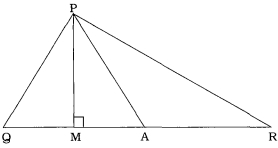
In the given figure,in $\Delta PQR$,$\angle Q > \angle R$. $PM \perp QR$ and $PA$ is the bisector of $\angle QPR$. Prove that $\angle APM = \frac{1}{2}(\angle Q - \angle R)$.
Solution
(N/A) In $\Delta PQR$,let $\angle QPR = 2\alpha$. Since $PA$ is the angle bisector,$\angle QPA = \angle RPA = \alpha$.
In $\Delta PQR$,$\angle Q + \angle R + \angle QPR = 180^{\circ}$,so $\angle Q + \angle R + 2\alpha = 180^{\circ}$,which implies $\alpha = 90^{\circ} - \frac{1}{2}(\angle Q + \angle R)$.
In $\Delta PMQ$,$\angle PMQ = 90^{\circ}$,so $\angle QPM = 90^{\circ} - \angle Q$.
Now,$\angle APM = \angle QPA - \angle QPM$.
Substituting the values: $\angle APM = \alpha - (90^{\circ} - \angle Q)$.
$\angle APM = [90^{\circ} - \frac{1}{2}(\angle Q + \angle R)] - 90^{\circ} + \angle Q$.
$\angle APM = \angle Q - \frac{1}{2}\angle Q - \frac{1}{2}\angle R$.
$\angle APM = \frac{1}{2}\angle Q - \frac{1}{2}\angle R = \frac{1}{2}(\angle Q - \angle R)$.
Hence,proved.
In $\Delta PQR$,$\angle Q + \angle R + \angle QPR = 180^{\circ}$,so $\angle Q + \angle R + 2\alpha = 180^{\circ}$,which implies $\alpha = 90^{\circ} - \frac{1}{2}(\angle Q + \angle R)$.
In $\Delta PMQ$,$\angle PMQ = 90^{\circ}$,so $\angle QPM = 90^{\circ} - \angle Q$.
Now,$\angle APM = \angle QPA - \angle QPM$.
Substituting the values: $\angle APM = \alpha - (90^{\circ} - \angle Q)$.
$\angle APM = [90^{\circ} - \frac{1}{2}(\angle Q + \angle R)] - 90^{\circ} + \angle Q$.
$\angle APM = \angle Q - \frac{1}{2}\angle Q - \frac{1}{2}\angle R$.
$\angle APM = \frac{1}{2}\angle Q - \frac{1}{2}\angle R = \frac{1}{2}(\angle Q - \angle R)$.
Hence,proved.
0 likes
View Solution88
Easy
State whether each of the following statements is true or false:
$(1)$ If a transversal intersects two parallel lines,then the interior angles on the same side of the transversal are equal.
$(2)$ The maximum number of acute angles in any triangle is two.
$(1)$ If a transversal intersects two parallel lines,then the interior angles on the same side of the transversal are equal.
$(2)$ The maximum number of acute angles in any triangle is two.
Solution
(B) $(1)$ False. If a transversal intersects two parallel lines,the interior angles on the same side of the transversal are supplementary (their sum is $180^{\circ}$),not equal.
$(2)$ False. In any triangle,the sum of all three angles is $180^{\circ}$. It is possible for all three angles to be acute (e.g.,in an equilateral triangle,all angles are $60^{\circ}$),so the maximum number of acute angles in a triangle is three.
$(2)$ False. In any triangle,the sum of all three angles is $180^{\circ}$. It is possible for all three angles to be acute (e.g.,in an equilateral triangle,all angles are $60^{\circ}$),so the maximum number of acute angles in a triangle is three.
0 likes
View Solution89
Medium
State whether each of the following statements is true or false:
$(1)$ The maximum number of right angles in any triangle is two.
$(2)$ The supplementary angle of the complementary angle of an angle having measure $33^{\circ}$ has measure $123^{\circ}$.
$(1)$ The maximum number of right angles in any triangle is two.
$(2)$ The supplementary angle of the complementary angle of an angle having measure $33^{\circ}$ has measure $123^{\circ}$.
Solution
(N/A) $(1)$ False. The sum of all angles in a triangle is $180^{\circ}$. If a triangle had two right angles $(90^{\circ} + 90^{\circ} = 180^{\circ})$,the third angle would have to be $0^{\circ}$,which is impossible for a triangle.
$(2)$ True. The complementary angle of $33^{\circ}$ is $90^{\circ} - 33^{\circ} = 57^{\circ}$. The supplementary angle of $57^{\circ}$ is $180^{\circ} - 57^{\circ} = 123^{\circ}$.
$(2)$ True. The complementary angle of $33^{\circ}$ is $90^{\circ} - 33^{\circ} = 57^{\circ}$. The supplementary angle of $57^{\circ}$ is $180^{\circ} - 57^{\circ} = 123^{\circ}$.
0 likes
View Solution90
MediumMCQ
State whether the following statement is true or false:
$(1)$ In $\Delta PQR$,$\angle P = \angle Q = 95^{\circ}$ is possible.
$(1)$ In $\Delta PQR$,$\angle P = \angle Q = 95^{\circ}$ is possible.
A
True
B
False
Solution
(B) The sum of all interior angles in a triangle is always $180^{\circ}$.
Given that $\angle P = 95^{\circ}$ and $\angle Q = 95^{\circ}$.
Sum of these two angles $= 95^{\circ} + 95^{\circ} = 190^{\circ}$.
Since $190^{\circ} > 180^{\circ}$,it is impossible for a triangle to have two angles each equal to $95^{\circ}$ because the sum of the angles would exceed the angle sum property of a triangle.
Therefore,the statement is False.
Given that $\angle P = 95^{\circ}$ and $\angle Q = 95^{\circ}$.
Sum of these two angles $= 95^{\circ} + 95^{\circ} = 190^{\circ}$.
Since $190^{\circ} > 180^{\circ}$,it is impossible for a triangle to have two angles each equal to $95^{\circ}$ because the sum of the angles would exceed the angle sum property of a triangle.
Therefore,the statement is False.
0 likes
View Solution91
EasyMCQ
$\angle A = \angle B$. If $\angle A$ and $\angle B$ are supplementary angles,then $\angle A = \ldots$ (in $^o$)
A
$50$
B
$40$
C
$90$
D
$55$
Solution
(C) Supplementary angles are two angles whose sum is $180^o$.
Given that $\angle A = \angle B$ and they are supplementary,we have $\angle A + \angle B = 180^o$.
Substituting $\angle B$ with $\angle A$,we get $\angle A + \angle A = 180^o$.
$2 \angle A = 180^o$.
$\angle A = \frac{180^o}{2} = 90^o$.
Given that $\angle A = \angle B$ and they are supplementary,we have $\angle A + \angle B = 180^o$.
Substituting $\angle B$ with $\angle A$,we get $\angle A + \angle A = 180^o$.
$2 \angle A = 180^o$.
$\angle A = \frac{180^o}{2} = 90^o$.
0 likes
View Solution92
EasyMCQ
If an angle is $20^{\circ}$ more than its complementary angle,then the measure of that angle is $\ldots \ldots \ldots$ (in $^{\circ}$)
A
$35$
B
$65$
C
$100$
D
$55$
Solution
(D) Let the measure of the angle be $x^{\circ}$.
Since the sum of complementary angles is $90^{\circ}$,the complementary angle of $x^{\circ}$ is $(90 - x)^{\circ}$.
According to the problem,the angle is $20^{\circ}$ more than its complement:
$x = (90 - x) + 20$
$x = 110 - x$
$2x = 110$
$x = 55^{\circ}$
Therefore,the measure of the angle is $55^{\circ}$.
Since the sum of complementary angles is $90^{\circ}$,the complementary angle of $x^{\circ}$ is $(90 - x)^{\circ}$.
According to the problem,the angle is $20^{\circ}$ more than its complement:
$x = (90 - x) + 20$
$x = 110 - x$
$2x = 110$
$x = 55^{\circ}$
Therefore,the measure of the angle is $55^{\circ}$.
0 likes
View Solution93
EasyMCQ
An angle is $40^{\circ}$ less than its supplementary angle,then its measure is $\ldots \ldots \ldots .$ (in $^{\circ}$)
A
$70$
B
$80$
C
$90$
D
$100$
Solution
(A) Let the measure of the angle be $x^{\circ}$.
Since the sum of supplementary angles is $180^{\circ}$,the supplementary angle is $(180 - x)^{\circ}$.
According to the problem,the angle is $40^{\circ}$ less than its supplementary angle:
$x = (180 - x) - 40$
$x = 140 - x$
$2x = 140$
$x = 70^{\circ}$.
Therefore,the measure of the angle is $70^{\circ}$.
Since the sum of supplementary angles is $180^{\circ}$,the supplementary angle is $(180 - x)^{\circ}$.
According to the problem,the angle is $40^{\circ}$ less than its supplementary angle:
$x = (180 - x) - 40$
$x = 140 - x$
$2x = 140$
$x = 70^{\circ}$.
Therefore,the measure of the angle is $70^{\circ}$.
0 likes
View Solution94
MediumMCQ
$\angle A$ and $\angle B$ are supplementary angles. If $\angle A : \angle B = 3 : 7$,then $\angle B = \dots$ (in $^o$)
A
$63$
B
$126$
C
$54$
D
$18$
Solution
(B) Two angles are supplementary if their sum is $180^o$.
Given $\angle A : \angle B = 3 : 7$,let $\angle A = 3x$ and $\angle B = 7x$.
Since they are supplementary,$3x + 7x = 180^o$.
$10x = 180^o$,which implies $x = 18^o$.
Therefore,$\angle B = 7x = 7 \times 18^o = 126^o$.
Given $\angle A : \angle B = 3 : 7$,let $\angle A = 3x$ and $\angle B = 7x$.
Since they are supplementary,$3x + 7x = 180^o$.
$10x = 180^o$,which implies $x = 18^o$.
Therefore,$\angle B = 7x = 7 \times 18^o = 126^o$.
0 likes
View Solution95
EasyMCQ
If one of the two angles of a linear pair has measure $x^{\circ},$ then the other angle has measure of $\ldots \ldots . .$
A
$90-x^{\circ}$
B
$180+x^{\circ}$
C
$180-x^{\circ}$
D
$90+x^{\circ}$
Solution
(C) linear pair is a pair of adjacent angles formed by intersecting lines.
The sum of the measures of the angles in a linear pair is always $180^{\circ}$.
Let the measure of the first angle be $x^{\circ}$.
Let the measure of the second angle be $y^{\circ}$.
According to the definition of a linear pair,$x^{\circ} + y^{\circ} = 180^{\circ}$.
Therefore,the measure of the other angle is $y^{\circ} = 180^{\circ} - x^{\circ}$.
The sum of the measures of the angles in a linear pair is always $180^{\circ}$.
Let the measure of the first angle be $x^{\circ}$.
Let the measure of the second angle be $y^{\circ}$.
According to the definition of a linear pair,$x^{\circ} + y^{\circ} = 180^{\circ}$.
Therefore,the measure of the other angle is $y^{\circ} = 180^{\circ} - x^{\circ}$.
0 likes
View Solution96
EasyMCQ
The measures of two vertically opposite angles are $(5x + 30^{\circ})$ and $(8x - 60^{\circ})$,then the value of $x = \dots$
A
$45$
B
$90$
C
$60$
D
$30$
Solution
(D) Vertically opposite angles are always equal to each other.
Given that the two angles are $(5x + 30^{\circ})$ and $(8x - 60^{\circ})$.
Therefore,we can set up the equation: $5x + 30 = 8x - 60$.
Subtract $5x$ from both sides: $30 = 3x - 60$.
Add $60$ to both sides: $90 = 3x$.
Divide by $3$: $x = 30$.
Thus,the value of $x$ is $30$.
Given that the two angles are $(5x + 30^{\circ})$ and $(8x - 60^{\circ})$.
Therefore,we can set up the equation: $5x + 30 = 8x - 60$.
Subtract $5x$ from both sides: $30 = 3x - 60$.
Add $60$ to both sides: $90 = 3x$.
Divide by $3$: $x = 30$.
Thus,the value of $x$ is $30$.
0 likes
View Solution97
EasyMCQ
If one of the two angles of a linear pair has measure $75^{\circ}$,the measure of the other is $\ldots \ldots \ldots$ (in $^{\circ}$)
A
$105$
B
$15$
C
$75$
D
$120$
Solution
(A) linear pair is a pair of adjacent angles formed by intersecting lines. The sum of the measures of the angles in a linear pair is always $180^{\circ}$.
Given that one angle is $75^{\circ}$.
Let the measure of the other angle be $x$.
Therefore,$75^{\circ} + x = 180^{\circ}$.
$x = 180^{\circ} - 75^{\circ}$.
$x = 105^{\circ}$.
Thus,the measure of the other angle is $105^{\circ}$.
Given that one angle is $75^{\circ}$.
Let the measure of the other angle be $x$.
Therefore,$75^{\circ} + x = 180^{\circ}$.
$x = 180^{\circ} - 75^{\circ}$.
$x = 105^{\circ}$.
Thus,the measure of the other angle is $105^{\circ}$.
0 likes
View Solution98
EasyMCQ
The supplementary angle of the complementary angle of an angle having measure $32^{\circ}$ has measure.......... (in $^{\circ}$)
A
$68$
B
$122$
C
$148$
D
$58$
Solution
(B) Step $1$: Find the complementary angle of $32^{\circ}$.
The sum of two complementary angles is $90^{\circ}$.
Complementary angle = $90^{\circ} - 32^{\circ} = 58^{\circ}$.
Step $2$: Find the supplementary angle of the result obtained in Step $1$.
The sum of two supplementary angles is $180^{\circ}$.
Supplementary angle = $180^{\circ} - 58^{\circ} = 122^{\circ}$.
Therefore,the correct option is $B$.
The sum of two complementary angles is $90^{\circ}$.
Complementary angle = $90^{\circ} - 32^{\circ} = 58^{\circ}$.
Step $2$: Find the supplementary angle of the result obtained in Step $1$.
The sum of two supplementary angles is $180^{\circ}$.
Supplementary angle = $180^{\circ} - 58^{\circ} = 122^{\circ}$.
Therefore,the correct option is $B$.
0 likes
View Solution99
EasyMCQ
The complementary angle of the supplementary angle of an angle having measure $132^{\circ}$ has measure $\ldots \ldots \ldots .$. (in $^{\circ}$)
A
$82$
B
$58$
C
$42$
D
$48$
Solution
(C) Step $1$: Find the supplementary angle of $132^{\circ}$.
Two angles are supplementary if their sum is $180^{\circ}$.
Supplementary angle $= 180^{\circ} - 132^{\circ} = 48^{\circ}$.
Step $2$: Find the complementary angle of the result obtained in Step $1$.
Two angles are complementary if their sum is $90^{\circ}$.
Complementary angle $= 90^{\circ} - 48^{\circ} = 42^{\circ}$.
Therefore,the correct answer is $42^{\circ}$.
Two angles are supplementary if their sum is $180^{\circ}$.
Supplementary angle $= 180^{\circ} - 132^{\circ} = 48^{\circ}$.
Step $2$: Find the complementary angle of the result obtained in Step $1$.
Two angles are complementary if their sum is $90^{\circ}$.
Complementary angle $= 90^{\circ} - 48^{\circ} = 42^{\circ}$.
Therefore,the correct answer is $42^{\circ}$.
0 likes
View Solution100
MediumMCQ
In $\Delta XYZ$,$\angle X : \angle Y : \angle Z = 1 : 4 : 4$,then $\angle Z = \ldots$ (in $^{\circ}$)
A
$20$
B
$40$
C
$60$
D
$80$
Solution
(D) Let the angles of $\Delta XYZ$ be $x$,$4x$,and $4x$ respectively.
We know that the sum of the angles in a triangle is $180^{\circ}$.
Therefore,$x + 4x + 4x = 180^{\circ}$.
$9x = 180^{\circ}$.
$x = 20^{\circ}$.
Now,$\angle Z = 4x = 4 \times 20^{\circ} = 80^{\circ}$.
We know that the sum of the angles in a triangle is $180^{\circ}$.
Therefore,$x + 4x + 4x = 180^{\circ}$.
$9x = 180^{\circ}$.
$x = 20^{\circ}$.
Now,$\angle Z = 4x = 4 \times 20^{\circ} = 80^{\circ}$.
0 likes
View SolutionLines and Angles — Mix Examples - Lines and Angles · Frequently Asked Questions
1Are these Lines and Angles questions useful for JEE and NEET?
Yes. All questions in this section are mapped to JEE Main and NEET exam patterns. Previous year questions from JEE Main, NEET, GUJCET and state-level exams are included with full solutions.
2Can I switch to Hindi or Gujarati for these questions?
Yes. Use the language tabs in the hero section or the sidebar to view the same questions and solutions in English, Hindi or Gujarati.
3How do I generate a question paper from this subtopic?
Use the Vedclass Exam Paper Generator — select the chapter and subtopic, set difficulty, and generate Sets A, B, C, D automatically. First 3 chapters of every subject are free.
Vedclass Products
For Students
Vedclass Test Series
Mock tests in real JEE/NEET style with performance analysis. 5-day free trial.
Start Free TrialFor Teachers
Exam Paper Generator
Generate Set A/B/C/D papers from this chapter in 2 minutes. 3 chapters free.
Try FreeFor Institutes
Online Exam Module
Live online exams with unlimited students, 360° analytics & white-label branding.
See DemoFor Teachers & Institutes
Generate a Lines and Angles Exam Paper in 2 Minutes
Select subtopic & difficulty — Sets A, B, C, D auto-generated with No Repeat logic.
First 3 chapters of every subject are free — no payment required.