
A English
Mix Examples - Introduction to Euclid’s Geometry Questions in English
Class 9 Mathematics · Introduction to Euclid’s Geometry · Mix Examples - Introduction to Euclid’s Geometry
99+
Questions
English
Language
100%
With Solutions
Showing 49 of 99 questions in English
51
Medium
Solve the following question using an appropriate Euclid's axiom:
In the figure,$X$ and $Y$ are the mid-points of $AC$ and $BC$ respectively,and $AX = CY$. Show that $AC = BC$.
In the figure,$X$ and $Y$ are the mid-points of $AC$ and $BC$ respectively,and $AX = CY$. Show that $AC = BC$.
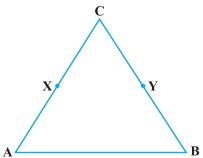
Solution
(N/A) Given: $AX = CY$ and $X, Y$ are the mid-points of $AC$ and $BC$ respectively.
Since $X$ is the mid-point of $AC$,we have $AC = 2AX$.
Since $Y$ is the mid-point of $BC$,we have $BC = 2CY$.
According to Euclid's axiom $6$,"Things which are double of the same things are equal to one another."
Since $AX = CY$,their doubles must also be equal.
Therefore,$2AX = 2CY$.
Substituting the values,we get $AC = BC$.
Since $X$ is the mid-point of $AC$,we have $AC = 2AX$.
Since $Y$ is the mid-point of $BC$,we have $BC = 2CY$.
According to Euclid's axiom $6$,"Things which are double of the same things are equal to one another."
Since $AX = CY$,their doubles must also be equal.
Therefore,$2AX = 2CY$.
Substituting the values,we get $AC = BC$.
0 likes
View Solution52
Medium
Solve the following question using the appropriate Euclid's axiom:
In the figure,we have $BX = \frac{1}{2} AB$,$BY = \frac{1}{2} BC$ and $AB = BC$.
Show that $BX = BY$.
In the figure,we have $BX = \frac{1}{2} AB$,$BY = \frac{1}{2} BC$ and $AB = BC$.
Show that $BX = BY$.
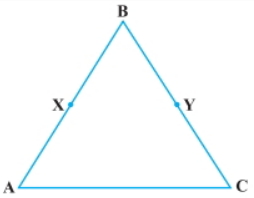
Solution
(N/A) We have $AB = BC$ [Given].
According to Euclid's axiom,things which are halves of the same things are equal to one another.
Since $AB = BC$,their halves must also be equal:
$\frac{1}{2} AB = \frac{1}{2} BC$.
Given that $BX = \frac{1}{2} AB$ and $BY = \frac{1}{2} BC$,we can substitute these into the equation above.
Therefore,$BX = BY$.
According to Euclid's axiom,things which are halves of the same things are equal to one another.
Since $AB = BC$,their halves must also be equal:
$\frac{1}{2} AB = \frac{1}{2} BC$.
Given that $BX = \frac{1}{2} AB$ and $BY = \frac{1}{2} BC$,we can substitute these into the equation above.
Therefore,$BX = BY$.
0 likes
View Solution53
Easy
Solve the following question using an appropriate Euclid's axiom:
In the figure,we have $\angle 1 = \angle 2$ and $\angle 2 = \angle 3$. Show that $\angle 1 = \angle 3$.
In the figure,we have $\angle 1 = \angle 2$ and $\angle 2 = \angle 3$. Show that $\angle 1 = \angle 3$.
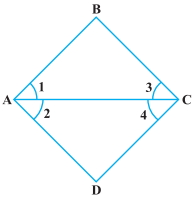
Solution
(N/A) We are given:
$\angle 1 = \angle 2$ (Given)
$\angle 2 = \angle 3$ (Given)
According to Euclid's first axiom,"Things which are equal to the same thing are equal to one another."
Since both $\angle 1$ and $\angle 3$ are equal to $\angle 2$,it follows that $\angle 1 = \angle 3$.
$\angle 1 = \angle 2$ (Given)
$\angle 2 = \angle 3$ (Given)
According to Euclid's first axiom,"Things which are equal to the same thing are equal to one another."
Since both $\angle 1$ and $\angle 3$ are equal to $\angle 2$,it follows that $\angle 1 = \angle 3$.
0 likes
View Solution54
Medium
Solve the following question using the appropriate Euclid's axiom:
In the figure,we have
$\angle 1 = \angle 3$ and $\angle 2 = \angle 4$. Show that $\angle A = \angle C$.
In the figure,we have
$\angle 1 = \angle 3$ and $\angle 2 = \angle 4$. Show that $\angle A = \angle C$.
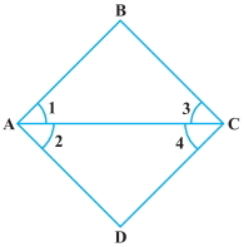
Solution
(N/A) We have $\angle 1 = \angle 3$ ..... $(1)$ [Given]
And $\angle 2 = \angle 4$ ..... $(2)$ [Given]
Now,by Euclid's axiom $2$,which states that if equals are added to equals,the wholes are equal.
Adding $(1)$ and $(2)$,we get
$\angle 1 + \angle 2 = \angle 3 + \angle 4$
Since $\angle 1 + \angle 2 = \angle A$ and $\angle 3 + \angle 4 = \angle C$,
Therefore,$\angle A = \angle C$.
And $\angle 2 = \angle 4$ ..... $(2)$ [Given]
Now,by Euclid's axiom $2$,which states that if equals are added to equals,the wholes are equal.
Adding $(1)$ and $(2)$,we get
$\angle 1 + \angle 2 = \angle 3 + \angle 4$
Since $\angle 1 + \angle 2 = \angle A$ and $\angle 3 + \angle 4 = \angle C$,
Therefore,$\angle A = \angle C$.
0 likes
View Solution55
Medium
Solve the following question using an appropriate Euclid's axiom:
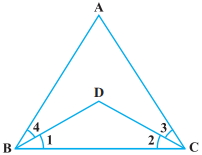
In the figure,we have $\angle ABC = \angle ACB$ and $\angle 3 = \angle 4$. Show that $\angle 1 = \angle 2$.
In the figure,we have $\angle ABC = \angle ACB$ and $\angle 3 = \angle 4$. Show that $\angle 1 = \angle 2$.
Solution
(N/A) We are given:
$\angle ABC = \angle ACB$ ...$(1)$
$\angle 3 = \angle 4$ ...$(2)$
According to Euclid's Axiom $3$,if equals are subtracted from equals,the remainders are equal.
Subtracting equation $(2)$ from equation $(1)$,we get:
$\angle ABC - \angle 4 = \angle ACB - \angle 3$
From the figure,$\angle ABC - \angle 4 = \angle 1$ and $\angle ACB - \angle 3 = \angle 2$.
Therefore,$\angle 1 = \angle 2$.
$\angle ABC = \angle ACB$ ...$(1)$
$\angle 3 = \angle 4$ ...$(2)$
According to Euclid's Axiom $3$,if equals are subtracted from equals,the remainders are equal.
Subtracting equation $(2)$ from equation $(1)$,we get:
$\angle ABC - \angle 4 = \angle ACB - \angle 3$
From the figure,$\angle ABC - \angle 4 = \angle 1$ and $\angle ACB - \angle 3 = \angle 2$.
Therefore,$\angle 1 = \angle 2$.
0 likes
View Solution56
Medium
Solve the following question using an appropriate Euclid's axiom:
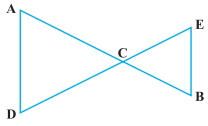
In the figure,we have $AC = DC$ and $CB = CE$. Show that $AB = DE$.
In the figure,we have $AC = DC$ and $CB = CE$. Show that $AB = DE$.
Solution
(N/A) We have $AC = DC$ $\dots(1)$ [Given]
And $CB = CE$ $\dots(2)$ [Given]
Now,by Euclid's second axiom,if equals are added to equals,the wholes are equal.
Adding $(1)$ and $(2)$,we get:
$AC + CB = DC + CE$
Since $AC + CB = AB$ and $DC + CE = DE$,we have:
$AB = DE$.
And $CB = CE$ $\dots(2)$ [Given]
Now,by Euclid's second axiom,if equals are added to equals,the wholes are equal.
Adding $(1)$ and $(2)$,we get:
$AC + CB = DC + CE$
Since $AC + CB = AB$ and $DC + CE = DE$,we have:
$AB = DE$.
0 likes
View Solution57
Medium
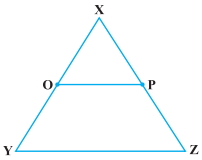
In the figure,if $OX = \frac{1}{2} XY$,$PX = \frac{1}{2} XZ$ and $OX = PX$,show that $XY = XZ$.
Solution
(N/A) Given: $OX = \frac{1}{2} XY$,$PX = \frac{1}{2} XZ$ and $OX = PX$.
Since $OX = PX$,we can substitute the given values:
$\frac{1}{2} XY = \frac{1}{2} XZ$
According to Euclid's axiom,"Things which are double of the same things are equal to one another."
Multiplying both sides by $2$,we get:
$2 \times (\frac{1}{2} XY) = 2 \times (\frac{1}{2} XZ)$
$XY = XZ$
Hence,it is shown that $XY = XZ$.
Since $OX = PX$,we can substitute the given values:
$\frac{1}{2} XY = \frac{1}{2} XZ$
According to Euclid's axiom,"Things which are double of the same things are equal to one another."
Multiplying both sides by $2$,we get:
$2 \times (\frac{1}{2} XY) = 2 \times (\frac{1}{2} XZ)$
$XY = XZ$
Hence,it is shown that $XY = XZ$.
0 likes
View Solution58
Medium
Solve the following question using an appropriate Euclid's axiom:
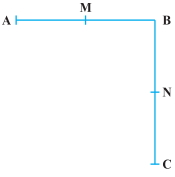
In the figure:
$AB = BC$,$M$ is the mid-point of $AB$ and $N$ is the mid-point of $BC$. Show that $AM = NC$.
In the figure:
$AB = BC$,$M$ is the mid-point of $AB$ and $N$ is the mid-point of $BC$. Show that $AM = NC$.
Solution
(N/A) Given: $AB = BC$ ... $(1)$
Since $M$ is the mid-point of $AB$,we have $AM = MB = \frac{1}{2} AB$.
Therefore,$AB = 2 AM$ ... $(2)$
Since $N$ is the mid-point of $BC$,we have $BN = NC = \frac{1}{2} BC$.
Therefore,$BC = 2 NC$ ... $(3)$
From equation $(1)$,we have $AB = BC$.
Substituting the values from $(2)$ and $(3)$ into $(1)$,we get:
$2 AM = 2 NC$
According to Euclid's axiom: "Things which are halves of the same things are equal to one another."
Since $AM = \frac{1}{2} AB$ and $NC = \frac{1}{2} BC$,and $AB = BC$,it follows that $AM = NC$.
Since $M$ is the mid-point of $AB$,we have $AM = MB = \frac{1}{2} AB$.
Therefore,$AB = 2 AM$ ... $(2)$
Since $N$ is the mid-point of $BC$,we have $BN = NC = \frac{1}{2} BC$.
Therefore,$BC = 2 NC$ ... $(3)$
From equation $(1)$,we have $AB = BC$.
Substituting the values from $(2)$ and $(3)$ into $(1)$,we get:
$2 AM = 2 NC$
According to Euclid's axiom: "Things which are halves of the same things are equal to one another."
Since $AM = \frac{1}{2} AB$ and $NC = \frac{1}{2} BC$,and $AB = BC$,it follows that $AM = NC$.
0 likes
View Solution59
Medium
Solve the following question using appropriate Euclid's axiom:
In the figure:
$BM = BN$,$M$ is the mid-point of $AB$ and $N$ is the mid-point of $BC$. Show that $AB = BC$.
In the figure:
$BM = BN$,$M$ is the mid-point of $AB$ and $N$ is the mid-point of $BC$. Show that $AB = BC$.
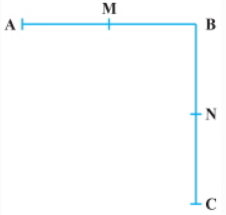
Solution
(N/A) Given: $BM = BN$ ... $(1)$
Since $M$ is the mid-point of $AB$,we have $AM = BM$ ... $(2)$
Since $N$ is the mid-point of $BC$,we have $BN = NC$ ... $(3)$
From $(1)$,$(2)$,and $(3)$,we can say that $AM = NC$ ... $(4)$
Now,adding $(1)$ and $(4)$,we get:
$BM + AM = BN + NC$
Since $BM + AM = AB$ and $BN + NC = BC$,we have:
$AB = BC$
This is justified by Euclid's second axiom: "If equals are added to equals,the wholes are equal."
Since $M$ is the mid-point of $AB$,we have $AM = BM$ ... $(2)$
Since $N$ is the mid-point of $BC$,we have $BN = NC$ ... $(3)$
From $(1)$,$(2)$,and $(3)$,we can say that $AM = NC$ ... $(4)$
Now,adding $(1)$ and $(4)$,we get:
$BM + AM = BN + NC$
Since $BM + AM = AB$ and $BN + NC = BC$,we have:
$AB = BC$
This is justified by Euclid's second axiom: "If equals are added to equals,the wholes are equal."
0 likes
View Solution60
Medium
Read the following statement:
"$A$ square is a polygon made up of four line segments,out of which,length of three line segments are equal to the length of fourth one and all its angles are right angles".
Define the terms used in this definition which you feel necessary. Are there any undefined terms in this? Can you justify that all angles and sides of a square are equal?
"$A$ square is a polygon made up of four line segments,out of which,length of three line segments are equal to the length of fourth one and all its angles are right angles".
Define the terms used in this definition which you feel necessary. Are there any undefined terms in this? Can you justify that all angles and sides of a square are equal?
Solution
(N/A) The terms that need to be defined are:
Polygon: $A$ simple closed figure made up of three or more line segments.
Line segment: Part of a line with two end points.
Line: Undefined term.
Point: Undefined term.
Angle: $A$ figure formed by two rays with a common initial point.
Ray: Part of a line with one end point.
Right angle: An angle whose measure is $90^{\circ}$.
Undefined terms used are: line,point.
Euclid's fourth postulate states that "all right angles are equal to one another."
In a square,all angles are right angles; therefore,all angles are equal (from Euclid's fourth postulate).
Three line segments are equal to the fourth line segment (given).
Therefore,all the four sides of a square are equal (by Euclid's first axiom: "things which are equal to the same thing are equal to one another.")
Polygon: $A$ simple closed figure made up of three or more line segments.
Line segment: Part of a line with two end points.
Line: Undefined term.
Point: Undefined term.
Angle: $A$ figure formed by two rays with a common initial point.
Ray: Part of a line with one end point.
Right angle: An angle whose measure is $90^{\circ}$.
Undefined terms used are: line,point.
Euclid's fourth postulate states that "all right angles are equal to one another."
In a square,all angles are right angles; therefore,all angles are equal (from Euclid's fourth postulate).
Three line segments are equal to the fourth line segment (given).
Therefore,all the four sides of a square are equal (by Euclid's first axiom: "things which are equal to the same thing are equal to one another.")
0 likes
View Solution61
Medium
Read the following statement:
An equilateral triangle is a polygon made up of three line segments out of which two line segments are equal to the third one and all its angles are $60^{\circ}$ each.
Define the terms used in this definition which you feel necessary. Are there any undefined terms in this? Can you justify that all sides and all angles are equal in an equilateral triangle?
An equilateral triangle is a polygon made up of three line segments out of which two line segments are equal to the third one and all its angles are $60^{\circ}$ each.
Define the terms used in this definition which you feel necessary. Are there any undefined terms in this? Can you justify that all sides and all angles are equal in an equilateral triangle?
Solution
(N/A) The terms that need to be defined are:
$1$. Polygon: $A$ simple closed figure made up of three or more line segments.
$2$. Line segment: $A$ part of a line with two end points.
$3$. Angle: $A$ figure formed by two rays with a common initial point.
Undefined terms used in the definition are: Line,Point,Part.
Justification:
Given that two line segments are equal to the third one,by the property of transitivity,all three sides of the equilateral triangle are equal.
Since all angles are $60^{\circ}$ each,they are equal to one another. According to Euclid's first axiom,things which are equal to the same thing are equal to one another. Thus,all angles are equal.
$1$. Polygon: $A$ simple closed figure made up of three or more line segments.
$2$. Line segment: $A$ part of a line with two end points.
$3$. Angle: $A$ figure formed by two rays with a common initial point.
Undefined terms used in the definition are: Line,Point,Part.
Justification:
Given that two line segments are equal to the third one,by the property of transitivity,all three sides of the equilateral triangle are equal.
Since all angles are $60^{\circ}$ each,they are equal to one another. According to Euclid's first axiom,things which are equal to the same thing are equal to one another. Thus,all angles are equal.
0 likes
View Solution62
Easy
Study the following statement: "Two intersecting lines cannot be perpendicular to the same line". Check whether it is an equivalent version to Euclid's fifth postulate.
Solution
(NO) Two intersecting lines cannot be both perpendicular to the same line because if two lines $l$ and $m$ are perpendicular to the same line $n$,then $l$ and $m$ must be parallel to each other.
Euclid's fifth postulate states that if a line segment falling on two straight lines makes the interior angles on the same side of it taken together less than two right angles,then the two straight lines,if produced indefinitely,meet on that side on which the sum of angles is less than two right angles.
Since the given statement describes the property of parallel lines and not the intersection of lines based on interior angles,it is not an equivalent version of Euclid's fifth postulate.
Euclid's fifth postulate states that if a line segment falling on two straight lines makes the interior angles on the same side of it taken together less than two right angles,then the two straight lines,if produced indefinitely,meet on that side on which the sum of angles is less than two right angles.
Since the given statement describes the property of parallel lines and not the intersection of lines based on interior angles,it is not an equivalent version of Euclid's fifth postulate.
0 likes
View Solution63
Easy
Read the following statements which are taken as axioms:
$(i)$ If a transversal intersects two parallel lines,then corresponding angles are not necessarily equal.
$(ii)$ If a transversal intersects two parallel lines,then alternate interior angles are equal.
Is this system of axioms consistent? Justify your answer.
$(i)$ If a transversal intersects two parallel lines,then corresponding angles are not necessarily equal.
$(ii)$ If a transversal intersects two parallel lines,then alternate interior angles are equal.
Is this system of axioms consistent? Justify your answer.
Solution
(N/A) No,this system of axioms is not consistent.
In Euclidean geometry,if a transversal intersects two parallel lines,the corresponding angles must be equal.
If we assume statement $(i)$ is true,it contradicts the fundamental property of parallel lines.
Furthermore,if corresponding angles are not equal,then the alternate interior angles cannot be equal,which contradicts statement $(ii)$.
Since the two statements lead to a logical contradiction,the system of axioms is inconsistent.
In Euclidean geometry,if a transversal intersects two parallel lines,the corresponding angles must be equal.
If we assume statement $(i)$ is true,it contradicts the fundamental property of parallel lines.
Furthermore,if corresponding angles are not equal,then the alternate interior angles cannot be equal,which contradicts statement $(ii)$.
Since the two statements lead to a logical contradiction,the system of axioms is inconsistent.
0 likes
View Solution64
Easy
Read the following two statements which are taken as axioms:
$(i)$ If two lines intersect each other,then the vertically opposite angles are not equal.
$(ii)$ If a ray stands on a line,then the sum of two adjacent angles so formed is equal to $180^{\circ}$.
Is this system of axioms consistent? Justify your answer.
$(i)$ If two lines intersect each other,then the vertically opposite angles are not equal.
$(ii)$ If a ray stands on a line,then the sum of two adjacent angles so formed is equal to $180^{\circ}$.
Is this system of axioms consistent? Justify your answer.
Solution
(B) The given system of axioms is not consistent.
Statement $(ii)$ is a standard geometric property (Linear Pair Axiom) which is universally true in Euclidean geometry.
If we accept statement $(ii)$,then for two intersecting lines,the angles formed on a straight line must sum to $180^{\circ}$.
By applying this property to both sides of the intersection,it can be mathematically proven that vertically opposite angles are always equal.
Since statement $(i)$ contradicts this proven result derived from statement $(ii)$,the system of axioms is inconsistent.
Statement $(ii)$ is a standard geometric property (Linear Pair Axiom) which is universally true in Euclidean geometry.
If we accept statement $(ii)$,then for two intersecting lines,the angles formed on a straight line must sum to $180^{\circ}$.
By applying this property to both sides of the intersection,it can be mathematically proven that vertically opposite angles are always equal.
Since statement $(i)$ contradicts this proven result derived from statement $(ii)$,the system of axioms is inconsistent.
0 likes
View Solution65
Easy
Read the following axioms:
$(i)$ Things which are equal to the same thing are equal to one another.
$(ii)$ If equals are added to equals,the wholes are equal.
$(iii)$ Things which are double of the same thing are equal to one another.
Check whether the given system of axioms is consistent or inconsistent.
$(i)$ Things which are equal to the same thing are equal to one another.
$(ii)$ If equals are added to equals,the wholes are equal.
$(iii)$ Things which are double of the same thing are equal to one another.
Check whether the given system of axioms is consistent or inconsistent.
Solution
(A) The given system of axioms is consistent.
$(i)$ This is Euclid's first axiom: 'Things which are equal to the same thing are equal to one another.'
$(ii)$ This is Euclid's second axiom: 'If equals are added to equals,the wholes are equal.'
$(iii)$ This is Euclid's third axiom: 'Things which are double of the same thing are equal to one another.'
Since all the given statements are standard axioms defined by Euclid,they do not contradict each other and are therefore consistent.
$(i)$ This is Euclid's first axiom: 'Things which are equal to the same thing are equal to one another.'
$(ii)$ This is Euclid's second axiom: 'If equals are added to equals,the wholes are equal.'
$(iii)$ This is Euclid's third axiom: 'Things which are double of the same thing are equal to one another.'
Since all the given statements are standard axioms defined by Euclid,they do not contradict each other and are therefore consistent.
0 likes
View Solution66
Easy
If $P$,$Q$,and $R$ are three points on a line,and $Q$ lies between $P$ and $R$ [see figure],then prove that $PQ + QR = PR$.

Solution
(N/A) In the figure given above,the line segment $PR$ coincides with the sum of line segments $PQ$ and $QR$.
Euclid's axiom $(4)$ states that things which coincide with one another are equal to one another.
Therefore,it can be deduced that $PQ + QR = PR$.
Note that,in this solution,it has been assumed that there is a unique line passing through two distinct points.
Euclid's axiom $(4)$ states that things which coincide with one another are equal to one another.
Therefore,it can be deduced that $PQ + QR = PR$.
Note that,in this solution,it has been assumed that there is a unique line passing through two distinct points.
0 likes
View Solution67
Easy
Find the solution to the equation $2x = 50$ and specify the Euclid's axiom used in it.
Solution
(A) Given the equation: $2x = 50$.
To solve for $x$,we divide both sides by $2$.
According to Euclid's Axiom $(7)$,which states: 'Things which are halves of the same things are equal to one another.'
Alternatively,applying the axiom: 'If equals are divided by equals,the remainders are equal.'
Thus,$x = 50 / 2 = 25$.
The solution is $x = 25$ and the axiom used is Euclid's Axiom $(7)$.
To solve for $x$,we divide both sides by $2$.
According to Euclid's Axiom $(7)$,which states: 'Things which are halves of the same things are equal to one another.'
Alternatively,applying the axiom: 'If equals are divided by equals,the remainders are equal.'
Thus,$x = 50 / 2 = 25$.
The solution is $x = 25$ and the axiom used is Euclid's Axiom $(7)$.
0 likes
View Solution68
Easy
If $PQ = RS$ in the given figure,prove that $PR = QS$. Mention Euclid's axioms used in it.

Solution
(N/A) Given: $PQ = RS$
From the figure,we can write:
$PR = PQ + QR$
$QS = QR + RS$
Since $PQ = RS$,we can add the same quantity $QR$ to both sides of the equation:
$PQ + QR = RS + QR$
Using Euclid's Axiom $(2)$,which states that 'If equals are added to equals,the wholes are equal',we get:
$PR = QS$
Thus,it is proved.
From the figure,we can write:
$PR = PQ + QR$
$QS = QR + RS$
Since $PQ = RS$,we can add the same quantity $QR$ to both sides of the equation:
$PQ + QR = RS + QR$
Using Euclid's Axiom $(2)$,which states that 'If equals are added to equals,the wholes are equal',we get:
$PR = QS$
Thus,it is proved.
0 likes
View Solution69
Easy
In the given figure,$C$ is the midpoint of $AB$ and $D$ is the midpoint of $AC$. Prove that $AD = \frac{1}{4} AB$. Mention the Euclid's axioms used in it.

Solution
(N/A) Given: $C$ is the midpoint of $AB$,so $AC = CB$. Since $AB = AC + CB$,we have $AB = AC + AC = 2AC$. Thus,$AC = \frac{1}{2} AB$.
Also,$D$ is the midpoint of $AC$,so $AD = DC$. Since $AC = AD + DC$,we have $AC = AD + AD = 2AD$. Thus,$AD = \frac{1}{2} AC$.
Substituting $AC = \frac{1}{2} AB$ into the equation $AD = \frac{1}{2} AC$,we get $AD = \frac{1}{2} (\frac{1}{2} AB) = \frac{1}{4} AB$.
Euclid's Axioms used:
$1$. Axiom $(7)$: Things which are half of the same things are equal to one another.
$2$. Axiom $(2)$: If equals are added to equals,the wholes are equal.
Also,$D$ is the midpoint of $AC$,so $AD = DC$. Since $AC = AD + DC$,we have $AC = AD + AD = 2AD$. Thus,$AD = \frac{1}{2} AC$.
Substituting $AC = \frac{1}{2} AB$ into the equation $AD = \frac{1}{2} AC$,we get $AD = \frac{1}{2} (\frac{1}{2} AB) = \frac{1}{4} AB$.
Euclid's Axioms used:
$1$. Axiom $(7)$: Things which are half of the same things are equal to one another.
$2$. Axiom $(2)$: If equals are added to equals,the wholes are equal.
0 likes
View Solution70
Easy
Consider the following statement: "There exists a pair of straight lines that are everywhere equidistant from one another." Is this statement a direct consequence of Euclid's fifth postulate? Explain.
Solution
(N/A) No,this statement is not a direct consequence of Euclid's fifth postulate.
Euclid's fifth postulate states that if a straight line falling on two straight lines makes the interior angles on the same side of it taken together less than two right angles,then the two straight lines,if produced indefinitely,meet on that side on which the sum of angles is less than two right angles.
However,the statement about lines being everywhere equidistant is equivalent to Euclid's fifth postulate,but it is known as Playfair's Axiom (or the parallel postulate).
Euclid's fifth postulate deals with the intersection of lines,whereas the concept of equidistant lines defines parallel lines. Therefore,while they are logically equivalent in Euclidean geometry,the statement is not a direct consequence of the fifth postulate itself but rather an alternative formulation.
Euclid's fifth postulate states that if a straight line falling on two straight lines makes the interior angles on the same side of it taken together less than two right angles,then the two straight lines,if produced indefinitely,meet on that side on which the sum of angles is less than two right angles.
However,the statement about lines being everywhere equidistant is equivalent to Euclid's fifth postulate,but it is known as Playfair's Axiom (or the parallel postulate).
Euclid's fifth postulate deals with the intersection of lines,whereas the concept of equidistant lines defines parallel lines. Therefore,while they are logically equivalent in Euclidean geometry,the statement is not a direct consequence of the fifth postulate itself but rather an alternative formulation.
0 likes
View Solution71
Easy
State whether the following statement is true or false:
Things which are double of the same thing are equal to one another.
Things which are double of the same thing are equal to one another.
Solution
(A) The statement is True.
According to Euclid's Axioms,things which are double of the same thing are equal to one another.
If $x = 2a$ and $y = 2a$,then $x = y$.
According to Euclid's Axioms,things which are double of the same thing are equal to one another.
If $x = 2a$ and $y = 2a$,then $x = y$.
0 likes
View Solution72
Easy
State whether the following statement is true or false:
There are an infinite number of lines which pass through two distinct points.
There are an infinite number of lines which pass through two distinct points.
Solution
(FALSE) The statement is False.
According to Euclid's first postulate,there is a unique line that passes through two distinct points. This means that only one straight line can be drawn through any two given distinct points.
According to Euclid's first postulate,there is a unique line that passes through two distinct points. This means that only one straight line can be drawn through any two given distinct points.
0 likes
View Solution73
Easy
State whether the following statement is true or false:
Euclid was a well-known student of Thales.
Euclid was a well-known student of Thales.
Solution
(B) The statement is False.
Euclid was a Greek mathematician,often referred to as the 'Father of Geometry',who lived around $300 \text{ BCE}$. Thales was a Greek philosopher who lived much earlier,around $624-546 \text{ BCE}$. Euclid was not a student of Thales; rather,Euclid compiled and organized the mathematical knowledge of his time in his famous work,the 'Elements'.
Euclid was a Greek mathematician,often referred to as the 'Father of Geometry',who lived around $300 \text{ BCE}$. Thales was a Greek philosopher who lived much earlier,around $624-546 \text{ BCE}$. Euclid was not a student of Thales; rather,Euclid compiled and organized the mathematical knowledge of his time in his famous work,the 'Elements'.
0 likes
View Solution74
Easy
State whether the following statement is true or false:
Two distinct lines cannot have more than one point in common.
Two distinct lines cannot have more than one point in common.
Solution
(TRUE) The statement is True.
According to Euclid's axioms and the fundamental properties of Euclidean geometry,two distinct lines can intersect at most at one point. If they were to share more than one point,they would coincide and become the same line,which contradicts the premise that the lines are distinct.
According to Euclid's axioms and the fundamental properties of Euclidean geometry,two distinct lines can intersect at most at one point. If they were to share more than one point,they would coincide and become the same line,which contradicts the premise that the lines are distinct.
0 likes
View Solution75
Easy
State whether the following statement is true or false:
Only one line can pass through a single point.
Only one line can pass through a single point.
Solution
(B) The statement is $False$.
According to Euclid's geometry,an infinite number of lines can pass through a single point.
According to Euclid's geometry,an infinite number of lines can pass through a single point.
0 likes
View Solution76
EasyMCQ
Euclid divided his famous treatise 'The Elements' into $\ldots \ldots \ldots$ chapters.
A
$9$
B
$21$
C
$15$
D
$13$
Solution
(D) Euclid,a Greek mathematician,is often referred to as the 'Father of Geometry'.
He compiled his knowledge of geometry in a famous treatise titled 'The Elements'.
This work was divided into $13$ chapters,which are traditionally referred to as 'books'.
Therefore,the correct answer is $13$.
He compiled his knowledge of geometry in a famous treatise titled 'The Elements'.
This work was divided into $13$ chapters,which are traditionally referred to as 'books'.
Therefore,the correct answer is $13$.
0 likes
View Solution77
EasyMCQ
Euclid was a native of $\ldots \ldots \ldots .$
A
Egypt
B
Babylonia
C
India
D
Greece
Solution
(A) Euclid was a Greek mathematician who lived in Alexandria,Egypt. He is often referred to as the 'Father of Geometry'. Historically,he is associated with the city of Alexandria in Egypt,where he taught and wrote his famous work,the 'Elements'.
0 likes
View Solution78
EasyMCQ
............ is credited with giving the first known proof.
A
Pythagoras
B
Thales
C
Euclid
D
Aryabhatt
Solution
(B) Thales is credited with giving the first known proof. He was a Greek mathematician who lived around $600 \text{ BC}$. He is often considered the first true mathematician because he moved beyond empirical observation to deductive reasoning.
0 likes
View Solution79
EasyMCQ
In ancient India,altars (or vedis) with combinations of shapes like rectangles,triangles,and trapeziums were required for $\ldots \ldots \ldots$
A
household rituals
B
educational programme
C
public worship
D
Vedic rituals
Solution
(D) In ancient India,altars (known as vedis) were constructed using specific geometric shapes such as rectangles,triangles,and trapeziums. These altars were specifically required for Vedic rituals. According to the Sulbasutras,the geometry of these altars was essential for the performance of various religious ceremonies.
0 likes
View Solution80
EasyMCQ
In ancient India,$\ldots \ldots \ldots$ altars were used for household rituals.
A
triangles and rectangles
B
parallelogram,quadrilateral and triangle
C
triangles and squares
D
square and circular
Solution
(D) In ancient India,altars with square and circular shapes were used for household rituals. These shapes were constructed using specific geometric principles for various religious ceremonies.
0 likes
View Solution81
EasyMCQ
Given two distinct points,there is a ......... line that passes through them.
A
unique
B
at least one
C
two
D
at least two
Solution
(A) According to Euclid's first postulate,there is a unique line that passes through two distinct points. This means that exactly one straight line can be drawn to connect any two given points in a plane.
0 likes
View Solution82
EasyMCQ
The edges of a surface are ............
A
points
B
lines
C
solid
D
plane
Solution
(B) According to Euclid's definitions,a surface is that which has length and breadth only. The edges of a surface are lines. Therefore,the correct option is $B$.
0 likes
View Solution83
EasyMCQ
One dimension in each step in the sequence of solids $-$ surfaces $-$ lines $-$ points is........ going on.
A
increasing
B
adding
C
decreasing
D
new coming
Solution
(C) In the sequence of geometric objects: solids ($3$ dimensions) $-$ surfaces ($2$ dimensions) $-$ lines ($1$ dimension) $-$ points ($0$ dimensions),the number of dimensions decreases by $1$ at each step. Therefore,the dimension is decreasing.
0 likes
View Solution84
EasyMCQ
In the Book of Elements $1$,how many definitions are given?
A
$15$
B
$18$
C
$11$
D
$23$
Solution
(D) Euclid,a Greek mathematician,compiled his work in a series of books known as the 'Elements'.
In Book $1$ of the 'Elements',Euclid listed $23$ definitions to establish the foundation of geometry.
Therefore,the correct answer is $23$.
In Book $1$ of the 'Elements',Euclid listed $23$ definitions to establish the foundation of geometry.
Therefore,the correct answer is $23$.
0 likes
View Solution85
EasyMCQ
$A$ solid has.........
A
shape,size and location
B
size and location
C
shape and location
D
shape and size
Solution
(A) According to Euclid's geometry,a solid is a three-dimensional object that occupies space. It is defined as having length,breadth,and height. Therefore,a solid possesses a definite shape,a definite size,and a specific location in space.
0 likes
View Solution86
EasyMCQ
The word $\ldots \ldots \ldots$ is used for the line segment by Euclid.
A
Ray
B
Terminated line
C
Straight line
D
Curve
Solution
(B) In Euclid's geometry,a line segment is defined as a part of a line that has two endpoints. Euclid referred to this concept as a 'terminated line' in his work 'The Elements'.
0 likes
View Solution87
EasyMCQ
$A$ line is a length without $\ldots \ldots \ldots$
A
breadth
B
length
C
thickness
D
point
Solution
(A) According to Euclid's definitions in geometry,a line is defined as 'breadthless length'. Therefore,a line is a length without breadth.
0 likes
View Solution88
EasyMCQ
The number of interwoven $\ldots \ldots$ triangles in Sriyantra (in the Atharvaveda) is nine.
A
equilateral
B
isosceles
C
scalene
D
right-angled
Solution
(B) The Sriyantra is a sacred geometric pattern used in meditation and worship. It consists of nine interwoven triangles. These triangles are specifically isosceles triangles,which are arranged in such a way that they create a complex geometric structure representing the union of masculine and feminine divine energy.
0 likes
View Solution89
EasyMCQ
In the Indus Valley Civilisation (about $3000 \, BC$),the bricks used had the ratio of $\ldots \ldots$ for length,breadth,and height,respectively.
A
$4: 2: 1$
B
$3: 2: 1$
C
$4: 3: 1$
D
$2: 1: 1$
Solution
(A) In the Indus Valley Civilisation,the bricks used for construction were found to have a standardized ratio of dimensions.
Archaeological excavations reveal that the ratio of length to breadth to height of these bricks was $4: 2: 1$.
Archaeological excavations reveal that the ratio of length to breadth to height of these bricks was $4: 2: 1$.
0 likes
View Solution90
EasyMCQ
$A$ statement that needs a proof is called a........
A
Axiom
B
Theorem
C
Postulate
D
Corollary
Solution
(B) statement that requires a logical proof based on previously established truths,axioms,or postulates is known as a $Theorem$. Axioms and postulates are self-evident truths that do not require a proof.
0 likes
View Solution91
EasyMCQ
The $\ldots \ldots \ldots$ was an important manual for geometric structures in ancient India.
A
Sulbasutra
B
Vedas
C
Upanishads
D
Puranas
Solution
(A) The $Sulbasutra$ were the ancient Indian texts that provided rules and instructions for the construction of altars and geometric structures. These texts are considered the earliest source of geometry in India.
0 likes
View Solution92
EasyMCQ
The boundaries of the solid are ...........
A
Lines
B
Points
C
Surfaces
D
Curves
Solution
(C) According to Euclid's geometry,a solid has three dimensions: length,breadth,and height. The boundaries of a solid are surfaces. These surfaces separate one part of space from another or separate the solid from the surrounding space. Therefore,the boundaries of a solid are surfaces.
0 likes
View Solution93
EasyMCQ
$A$ surface is that which has $\ldots \ldots \ldots$ only.
A
length and breadth
B
length and height
C
breadth and height
D
length,breadth and height
Solution
(A) According to Euclid's definitions in geometry,a surface is defined as that which has length and breadth only. It does not have any thickness or depth.
0 likes
View Solution94
EasyMCQ
Which country did Thales belong to?
A
Egypt
B
Greece
C
Babylon
D
India
Solution
(B) Thales was a famous Greek philosopher and mathematician. He is often considered the first mathematician in history. Therefore,he belonged to Greece.
0 likes
View Solution95
EasyMCQ
How many dimensions does a point have?
A
$1$
B
$2$
C
$0$
D
$4$
Solution
(C) In geometry,a point is defined as an entity that has no parts. It does not have any length,breadth,or height. Therefore,a point has $0$ dimensions.
0 likes
View Solution96
EasyMCQ
How many dimensions does a solid have?
A
$5$
B
$15$
C
$10$
D
$3$
Solution
(D) solid is a three-dimensional object.
It has length,breadth,and height.
Therefore,a solid has $3$ dimensions.
It has length,breadth,and height.
Therefore,a solid has $3$ dimensions.
0 likes
View Solution97
EasyMCQ
How many subsidiary triangles does a Sriyantra have?
A
$43$
B
$22$
C
$40$
D
$19$
Solution
(A) $Sriyantra$ is a complex geometric figure formed by the intersection of $9$ triangles. These $9$ triangles are of two types: $4$ triangles with their vertices pointing upwards (representing $Shiva$) and $5$ triangles with their vertices pointing downwards (representing $Shakti$). These $9$ primary triangles intersect to form $43$ smaller subsidiary triangles,which are known as $triangles$ within the $Sriyantra$ structure. Therefore,the total number of subsidiary triangles is $43$.
0 likes
View Solution98
EasyMCQ
How many dimensions does a surface have?
A
$0$
B
$2$
C
$5$
D
$9$
Solution
(B) surface is defined as having length and breadth but no thickness. Therefore,a surface has $2$ dimensions.
0 likes
View Solution99
EasyMCQ
How many dimensions does a line have?
A
$0$
B
$2$
C
$1$
D
$6$
Solution
(C) line is defined as having length but no breadth or height. Therefore,it has only one dimension,which is length. Thus,a line has $1$ dimension.
0 likes
View SolutionIntroduction to Euclid’s Geometry — Mix Examples - Introduction to Euclid’s Geometry · Frequently Asked Questions
1Are these Introduction to Euclid’s Geometry questions useful for JEE and NEET?
Yes. All questions in this section are mapped to JEE Main and NEET exam patterns. Previous year questions from JEE Main, NEET, GUJCET and state-level exams are included with full solutions.
2Can I switch to Hindi or Gujarati for these questions?
Yes. Use the language tabs in the hero section or the sidebar to view the same questions and solutions in English, Hindi or Gujarati.
3How do I generate a question paper from this subtopic?
Use the Vedclass Exam Paper Generator — select the chapter and subtopic, set difficulty, and generate Sets A, B, C, D automatically. First 3 chapters of every subject are free.
Vedclass Products
For Students
Vedclass Test Series
Mock tests in real JEE/NEET style with performance analysis. 5-day free trial.
Start Free TrialFor Teachers
Exam Paper Generator
Generate Set A/B/C/D papers from this chapter in 2 minutes. 3 chapters free.
Try FreeFor Institutes
Online Exam Module
Live online exams with unlimited students, 360° analytics & white-label branding.
See DemoFor Teachers & Institutes
Generate a Introduction to Euclid’s Geometry Exam Paper in 2 Minutes
Select subtopic & difficulty — Sets A, B, C, D auto-generated with No Repeat logic.
First 3 chapters of every subject are free — no payment required.