
A English
Textbook - Introduction to Euclid’s Geometry Questions in English
Class 9 Mathematics · Introduction to Euclid’s Geometry · Textbook - Introduction to Euclid’s Geometry
16+
Questions
English
Language
100%
With Solutions
Showing 16 of 16 questions in English
1
Easy
If $A$,$B$ and $C$ are three points on a line,and $B$ lies between $A$ and $C$ (see figure),then prove that $AB + BC = AC$.

Solution
(N/A) In the figure given above,the line segment $AC$ coincides with the sum of the line segments $AB$ and $BC$.
According to Euclid's Axiom $(4)$,things which coincide with one another are equal to one another.
Since the segment $AB + BC$ coincides with the segment $AC$,it follows that:
$AB + BC = AC$
Note that in this proof,it is assumed that there is a unique line passing through two distinct points.
According to Euclid's Axiom $(4)$,things which coincide with one another are equal to one another.
Since the segment $AB + BC$ coincides with the segment $AC$,it follows that:
$AB + BC = AC$
Note that in this proof,it is assumed that there is a unique line passing through two distinct points.
0 likes
View Solution2
Medium
Prove that an equilateral triangle can be constructed on any given line segment.
Solution
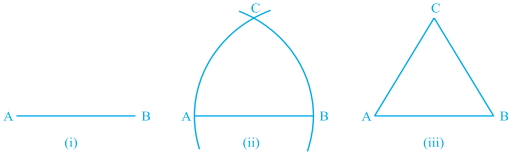
(N/A) In the statement above,a line segment of any length is given,say $AB$ [see Fig. $(i)$].
Here,you need to do some construction. Using Euclid's Postulate $3$,you can draw a circle with point $A$ as the centre and $AB$ as the radius [see Fig. $(ii)$]. Similarly,draw another circle with point $B$ as the centre and $BA$ as the radius. The two circles meet at a point,say $C$. Now,draw the line segments $AC$ and $BC$ to form $\Delta ABC$ [see Fig. $(iii)$].
So,you have to prove that this triangle is equilateral,i.e.,$AB = AC = BC$.
Now,$AB = AC$,since they are the radii of the same circle $(1)$.
Similarly,$AB = BC$ (Radii of the same circle) $(2)$.
From these two facts,and Euclid's axiom that things which are equal to the same thing are equal to one another,you can conclude that $AB = BC = AC$.
So,$\Delta ABC$ is an equilateral triangle.
Note that here Euclid has assumed,without mentioning anywhere,that the two circles drawn with centres $A$ and $B$ will meet each other at a point.
Here,you need to do some construction. Using Euclid's Postulate $3$,you can draw a circle with point $A$ as the centre and $AB$ as the radius [see Fig. $(ii)$]. Similarly,draw another circle with point $B$ as the centre and $BA$ as the radius. The two circles meet at a point,say $C$. Now,draw the line segments $AC$ and $BC$ to form $\Delta ABC$ [see Fig. $(iii)$].
So,you have to prove that this triangle is equilateral,i.e.,$AB = AC = BC$.
Now,$AB = AC$,since they are the radii of the same circle $(1)$.
Similarly,$AB = BC$ (Radii of the same circle) $(2)$.
From these two facts,and Euclid's axiom that things which are equal to the same thing are equal to one another,you can conclude that $AB = BC = AC$.
So,$\Delta ABC$ is an equilateral triangle.
Note that here Euclid has assumed,without mentioning anywhere,that the two circles drawn with centres $A$ and $B$ will meet each other at a point.
0 likes
View Solution3
Medium
Which of the following statements are true and which are false? Give reasons for your answers.
$(i)$ Only one line can pass through a single point.
$(ii)$ There are an infinite number of lines which pass through two distinct points.
$(iii)$ $A$ terminated line can be produced indefinitely on both the sides.
$(iv)$ If two circles are equal,then their radii are equal.
$(v)$ In the figure,if $AB = PQ$ and $PQ = XY,$ then $AB = XY$.
$(i)$ Only one line can pass through a single point.
$(ii)$ There are an infinite number of lines which pass through two distinct points.
$(iii)$ $A$ terminated line can be produced indefinitely on both the sides.
$(iv)$ If two circles are equal,then their radii are equal.
$(v)$ In the figure,if $AB = PQ$ and $PQ = XY,$ then $AB = XY$.

Solution
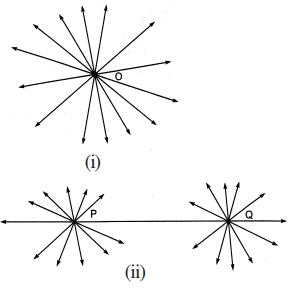
(A-D) $(i)$ False. If we mark a point $O$ on the surface of a paper,we can draw an infinite number of straight lines passing through $O$.
$(ii)$ False. There is one and only one line which passes through two distinct points $P$ and $Q$.
$(iii)$ True. According to Euclid's Postulate $2$,a terminated line can be produced indefinitely.
$(iv)$ True. If two circles are equal,their centers and boundaries coincide when superimposed,so their radii must be equal.
$(v)$ True. According to Euclid's axiom,things which are equal to the same thing are equal to one another.
$(ii)$ False. There is one and only one line which passes through two distinct points $P$ and $Q$.
$(iii)$ True. According to Euclid's Postulate $2$,a terminated line can be produced indefinitely.
$(iv)$ True. If two circles are equal,their centers and boundaries coincide when superimposed,so their radii must be equal.
$(v)$ True. According to Euclid's axiom,things which are equal to the same thing are equal to one another.
0 likes
View Solution4
Difficult
Give a definition for parallel lines. Are there other terms that need to be defined first? What are they,and how might you define them?
Solution
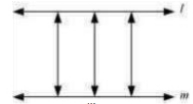
(N/A) Parallel lines: Two lines in a plane are said to be parallel if they do not intersect each other,no matter how far they are extended in either direction.
Yes,there are other terms that need to be defined first:
$1$. Point: $A$ point is a location in space that has no dimension (no length,breadth,or thickness).
$2$. Line: $A$ line is a breadthless length that extends infinitely in both directions.
$3$. Plane: $A$ surface which has length and breadth only.
$4$. Intersection: Two lines are said to intersect if they have a common point.
$5$. Distance between lines: The perpendicular distance between two parallel lines is constant at all points.
Yes,there are other terms that need to be defined first:
$1$. Point: $A$ point is a location in space that has no dimension (no length,breadth,or thickness).
$2$. Line: $A$ line is a breadthless length that extends infinitely in both directions.
$3$. Plane: $A$ surface which has length and breadth only.
$4$. Intersection: Two lines are said to intersect if they have a common point.
$5$. Distance between lines: The perpendicular distance between two parallel lines is constant at all points.
0 likes
View Solution5
Medium
Consider two 'postulates' given below:
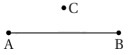
$(i)$ Given any two distinct points $A$ and $B$,there exists a third point $C$ which is in between $A$ and $B$.
$(ii)$ There exist at least three points that are not on the same line.
Do these postulates contain any undefined terms? Are these postulates consistent? Do they follow from Euclid's postulates? Explain.
$(i)$ Given any two distinct points $A$ and $B$,there exists a third point $C$ which is in between $A$ and $B$.
$(ii)$ There exist at least three points that are not on the same line.
Do these postulates contain any undefined terms? Are these postulates consistent? Do they follow from Euclid's postulates? Explain.
Solution
(N/A) Yes,these postulates contain undefined terms such as: 'Point' and 'Line'.
These postulates are consistent because they deal with two different situations:
$(i)$ states that given two points $A$ and $B$,there is a point $C$ lying on the line segment between them.
$(ii)$ states that,given $A$ and $B$,you can take a point $C$ that does not lie on the line passing through $A$ and $B$.
No,these postulates do not follow from Euclid's postulates. However,they follow from the axiom: 'Given two distinct points,there is a unique line that passes through them.'
These postulates are consistent because they deal with two different situations:
$(i)$ states that given two points $A$ and $B$,there is a point $C$ lying on the line segment between them.
$(ii)$ states that,given $A$ and $B$,you can take a point $C$ that does not lie on the line passing through $A$ and $B$.
No,these postulates do not follow from Euclid's postulates. However,they follow from the axiom: 'Given two distinct points,there is a unique line that passes through them.'
0 likes
View Solution6
Medium
If a point $C$ lies between two points $A$ and $B$ such that $AC = BC$,then prove that $AC = \frac{1}{2} AB$. Explain by drawing the figure.

Solution
(N/A) Given: Point $C$ lies between $A$ and $B$ such that $AC = BC$.
To prove: $AC = \frac{1}{2} AB$.
Proof:
Since $C$ lies between $A$ and $B$,we have $AC + BC = AB$.
Given that $AC = BC$.
Substituting $AC$ for $BC$ in the equation $AC + BC = AB$,we get:
$AC + AC = AB$
$2 AC = AB$
Dividing both sides by $2$,we get:
$AC = \frac{1}{2} AB$.
Hence proved.
To prove: $AC = \frac{1}{2} AB$.
Proof:
Since $C$ lies between $A$ and $B$,we have $AC + BC = AB$.
Given that $AC = BC$.
Substituting $AC$ for $BC$ in the equation $AC + BC = AB$,we get:
$AC + AC = AB$
$2 AC = AB$
Dividing both sides by $2$,we get:
$AC = \frac{1}{2} AB$.
Hence proved.
2 likes
View Solution7
Medium
If a point $C$ lies between two points $A$ and $B$ such that $AC = BC$,then prove that $AC = \frac{1}{2} AB$. Point $C$ is called a mid-point of line segment $AB$. Prove that every line segment has one and only one mid-point.
Solution
(N/A) Given that $C$ is a mid-point of line segment $AB$,so $AC = BC$.
Since $AC + BC = AB$,we can write $AC + AC = AB$,which implies $2AC = AB$,or $AC = \frac{1}{2} AB$.
To prove that every line segment has one and only one mid-point,let us assume that there are two distinct mid-points $C$ and $D$ for the line segment $AB$.
Since $C$ is a mid-point,$AC = \frac{1}{2} AB$ ............. $(1)$
Since $D$ is a mid-point,$AD = \frac{1}{2} AB$ ............. $(2)$
From $(1)$ and $(2)$,we have $AC = AD$.
This implies that points $C$ and $D$ must coincide.
Thus,every line segment has one and only one mid-point.
Since $AC + BC = AB$,we can write $AC + AC = AB$,which implies $2AC = AB$,or $AC = \frac{1}{2} AB$.
To prove that every line segment has one and only one mid-point,let us assume that there are two distinct mid-points $C$ and $D$ for the line segment $AB$.
Since $C$ is a mid-point,$AC = \frac{1}{2} AB$ ............. $(1)$
Since $D$ is a mid-point,$AD = \frac{1}{2} AB$ ............. $(2)$
From $(1)$ and $(2)$,we have $AC = AD$.
This implies that points $C$ and $D$ must coincide.
Thus,every line segment has one and only one mid-point.

0 likes
View Solution8
Medium
In the figure,if $AC = BD$,then prove that $AB = CD$.
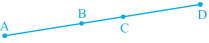
Solution
(N/A) We have,
$AC = BD$ [Given] .......... $(1)$
Since the point $B$ lies between $A$ and $C$,
$\therefore AC = AB + BC$ .......... $(2)$
Similarly,since the point $C$ lies between $B$ and $D$,
$\therefore BD = BC + CD$ .......... $(3)$
From $(1)$,$(2)$,and $(3)$,
$AB + BC = BC + CD$
Subtracting $BC$ from both sides (Euclid's axiom: If equals are subtracted from equals,the remainders are equal),
$\Rightarrow AB = CD$.
$AC = BD$ [Given] .......... $(1)$
Since the point $B$ lies between $A$ and $C$,
$\therefore AC = AB + BC$ .......... $(2)$
Similarly,since the point $C$ lies between $B$ and $D$,
$\therefore BD = BC + CD$ .......... $(3)$
From $(1)$,$(2)$,and $(3)$,
$AB + BC = BC + CD$
Subtracting $BC$ from both sides (Euclid's axiom: If equals are subtracted from equals,the remainders are equal),
$\Rightarrow AB = CD$.
0 likes
View Solution9
EasyMCQ
Why is Axiom $5$,in the list of Euclid's axioms,considered a 'universal truth'? (Note that the question is not about the fifth postulate.)
A
Because it is a mathematical rule.
B
Because it applies to all things in the universe.
C
Because it is a geometric theorem.
D
Because it was proven by Euclid.
Solution
(B) In the given list of Euclid's axioms,Axiom $5$ states: 'The whole is greater than the part'.
This statement is true for all things and in all parts of the universe,regardless of the nature of the objects.
Since it holds true universally without any exceptions,it is considered a 'universal truth'.
This statement is true for all things and in all parts of the universe,regardless of the nature of the objects.
Since it holds true universally without any exceptions,it is considered a 'universal truth'.
0 likes
View Solution10
Easy
Consider the following statement: There exists a pair of straight lines that are everywhere equidistant from one another. Is this statement a direct consequence of Euclid's fifth postulate? Explain.
Solution
(A) Take any line $l$ and a point $P$ not on $l$.
According to Playfair's axiom,which is equivalent to Euclid's fifth postulate,there exists a unique line $m$ passing through $P$ that is parallel to $l$.
By definition,the distance of a point from a line is the length of the perpendicular segment drawn from the point to the line.
Since the lines are parallel,the perpendicular distance from any point on line $m$ to line $l$ remains constant.
Therefore,these two lines are everywhere equidistant from one another,which is a direct consequence of the fifth postulate.
According to Playfair's axiom,which is equivalent to Euclid's fifth postulate,there exists a unique line $m$ passing through $P$ that is parallel to $l$.
By definition,the distance of a point from a line is the length of the perpendicular segment drawn from the point to the line.
Since the lines are parallel,the perpendicular distance from any point on line $m$ to line $l$ remains constant.
Therefore,these two lines are everywhere equidistant from one another,which is a direct consequence of the fifth postulate.
0 likes
View Solution11
Easy
How would you rewrite Euclid's fifth postulate so that it would be easier to understand?
Solution
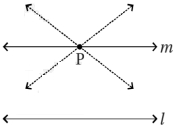
(N/A) Euclid's fifth postulate is often considered complex. An equivalent and easier-to-understand version is known as Playfair's Axiom,which states: 'For every line $l$ and for every point $P$ not lying on $l$,there exists a unique line $m$ passing through $P$ and parallel to $l$.' Alternatively,it can be stated as: 'Two distinct intersecting lines cannot be parallel to the same line.'
0 likes
View Solution12
Medium
Does Euclid's fifth postulate imply the existence of parallel lines? Explain.
Solution
(N/A) Yes,Euclid's fifth postulate implies the existence of parallel lines.
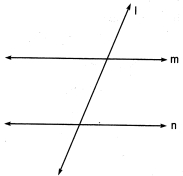
If a straight line $l$ falls on two lines $m$ and $n$ such that the sum of the interior angles on one side of $l$ is equal to two right angles $(180^{\circ})$,then by Euclid's fifth postulate,the lines $m$ and $n$ will not meet on this side of $l$.
Since the sum of the interior angles on the other side of the line $l$ will also be equal to two right angles $(180^{\circ})$,the lines will not meet on the other side either.
$\therefore$ The lines $m$ and $n$ never meet,which means they are parallel to each other.
If a straight line $l$ falls on two lines $m$ and $n$ such that the sum of the interior angles on one side of $l$ is equal to two right angles $(180^{\circ})$,then by Euclid's fifth postulate,the lines $m$ and $n$ will not meet on this side of $l$.
Since the sum of the interior angles on the other side of the line $l$ will also be equal to two right angles $(180^{\circ})$,the lines will not meet on the other side either.
$\therefore$ The lines $m$ and $n$ never meet,which means they are parallel to each other.
0 likes
View Solution13
Difficult
Give a definition for perpendicular lines. Are there other terms that need to be defined first? What are they,and how might you define them?
Solution
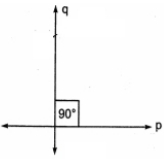
(N/A) Perpendicular lines: Two lines $p$ and $q$ lying in the same plane are said to be perpendicular if they intersect at a right angle $(90^{\circ})$,and we write them as $p \perp q$.
Yes,there are other terms that need to be defined first:
$1$. Line: $A$ line is a breadthless length that extends indefinitely in both directions.
$2$. Plane: $A$ surface which has only length and breadth.
$3$. Angle: The inclination between two intersecting lines.
$4$. Right angle: An angle whose measure is $90^{\circ}$.
Yes,there are other terms that need to be defined first:
$1$. Line: $A$ line is a breadthless length that extends indefinitely in both directions.
$2$. Plane: $A$ surface which has only length and breadth.
$3$. Angle: The inclination between two intersecting lines.
$4$. Right angle: An angle whose measure is $90^{\circ}$.
0 likes
View Solution14
Difficult
Give a definition for the term 'line segment'. Are there other terms that need to be defined first? What are they,and how might you define them?
Solution
(N/A) 'line segment' is defined as a part of a line that has two distinct endpoints and contains all the points on the line between them.
Yes,there are other terms that need to be defined first,specifically 'point' and 'line'.
$1$. Point: $A$ point is an exact location in space that has no dimensions (no length,breadth,or height).
$2$. Line: $A$ line is a straight path that extends infinitely in both directions and has no thickness.
Yes,there are other terms that need to be defined first,specifically 'point' and 'line'.
$1$. Point: $A$ point is an exact location in space that has no dimensions (no length,breadth,or height).
$2$. Line: $A$ line is a straight path that extends infinitely in both directions and has no thickness.

0 likes
View Solution15
Difficult
Give a definition for the radius of a circle. Are there other terms that need to be defined first? What are they,and how might you define them?
Solution
(N/A) Definition of the radius of a circle:
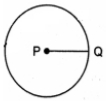
The distance from the center to a point on the circle is called the radius of the circle. In the figure,$P$ is the center and $Q$ is a point on the circle,then the line segment $PQ$ is the radius.
Other terms that need to be defined first:
$1$. Circle: $A$ circle is the set of all points in a plane that are at a fixed distance from a fixed point in the plane.
$2$. Center: The fixed point from which all points on the circle are at a fixed distance is called the center of the circle.
$3$. Point: $A$ point is that which has no part.
$4$. Plane: $A$ plane is a surface which lies evenly with the straight lines on itself.
The distance from the center to a point on the circle is called the radius of the circle. In the figure,$P$ is the center and $Q$ is a point on the circle,then the line segment $PQ$ is the radius.
Other terms that need to be defined first:
$1$. Circle: $A$ circle is the set of all points in a plane that are at a fixed distance from a fixed point in the plane.
$2$. Center: The fixed point from which all points on the circle are at a fixed distance is called the center of the circle.
$3$. Point: $A$ point is that which has no part.
$4$. Plane: $A$ plane is a surface which lies evenly with the straight lines on itself.
0 likes
View Solution16
Medium
Give a definition for square terms. Are there other terms that need to be defined first? What are they,and how might you define them?
Solution
(N/A) square is a quadrilateral in which all four angles are right angles and all four sides are equal.
To define a square,we need to define the following terms first:
$1$. Quadrilateral: $A$ simple closed figure made up of four line segments.
$2$. Line segment: $A$ part of a line with two end points.
$3$. Angle: The inclination between two rays having a common initial point.
$4$. Right angle: An angle whose measure is $90^{\circ}$.
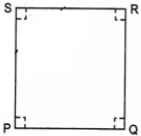
In the figure,$PQRS$ is a square.
To define a square,we need to define the following terms first:
$1$. Quadrilateral: $A$ simple closed figure made up of four line segments.
$2$. Line segment: $A$ part of a line with two end points.
$3$. Angle: The inclination between two rays having a common initial point.
$4$. Right angle: An angle whose measure is $90^{\circ}$.
In the figure,$PQRS$ is a square.
0 likes
View SolutionIntroduction to Euclid’s Geometry — Textbook - Introduction to Euclid’s Geometry · Frequently Asked Questions
1Are these Introduction to Euclid’s Geometry questions useful for JEE and NEET?
Yes. All questions in this section are mapped to JEE Main and NEET exam patterns. Previous year questions from JEE Main, NEET, GUJCET and state-level exams are included with full solutions.
2Can I switch to Hindi or Gujarati for these questions?
Yes. Use the language tabs in the hero section or the sidebar to view the same questions and solutions in English, Hindi or Gujarati.
3How do I generate a question paper from this subtopic?
Use the Vedclass Exam Paper Generator — select the chapter and subtopic, set difficulty, and generate Sets A, B, C, D automatically. First 3 chapters of every subject are free.
Vedclass Products
For Students
Vedclass Test Series
Mock tests in real JEE/NEET style with performance analysis. 5-day free trial.
Start Free TrialFor Teachers
Exam Paper Generator
Generate Set A/B/C/D papers from this chapter in 2 minutes. 3 chapters free.
Try FreeFor Institutes
Online Exam Module
Live online exams with unlimited students, 360° analytics & white-label branding.
See DemoFor Teachers & Institutes
Generate a Introduction to Euclid’s Geometry Exam Paper in 2 Minutes
Select subtopic & difficulty — Sets A, B, C, D auto-generated with No Repeat logic.
First 3 chapters of every subject are free — no payment required.