
A English
Mix Examples - Introduction to Euclid’s Geometry Questions in English
Class 9 Mathematics · Introduction to Euclid’s Geometry · Mix Examples - Introduction to Euclid’s Geometry
99+
Questions
English
Language
100%
With Solutions
Showing 50 of 99 questions in English
1
EasyMCQ
Euclid's second axiom is:
A
If equals be added to equals,the wholes are equal.
B
The things which are equal to the same thing are equal to one another.
C
If equals be subtracted from equals,the remainders are equals.
D
Things which coincide with one another are equal to one another.
Solution
(A) Euclid's axioms are fundamental assumptions used in geometry. The list of Euclid's axioms is as follows:
$1$. Things which are equal to the same thing are equal to one another.
$2$. If equals be added to equals,the wholes are equal.
$3$. If equals be subtracted from equals,the remainders are equals.
$4$. Things which coincide with one another are equal to one another.
$5$. The whole is greater than the part.
Therefore,Euclid's second axiom is: 'If equals be added to equals,the wholes are equal.'
$1$. Things which are equal to the same thing are equal to one another.
$2$. If equals be added to equals,the wholes are equal.
$3$. If equals be subtracted from equals,the remainders are equals.
$4$. Things which coincide with one another are equal to one another.
$5$. The whole is greater than the part.
Therefore,Euclid's second axiom is: 'If equals be added to equals,the wholes are equal.'
0 likes
View Solution2
EasyMCQ
Euclid's fifth postulate is:
A
The whole is greater than the part.
B
If a straight line falling on two straight lines makes the interior angles on the same side of it taken together less than two right angles,then the two straight lines if produced indefinitely,meet on that side on which the sum of angles is less than two right angles.
C
$A$ circle may be described with any centre and any radius.
D
All right angles are equal to one another.
Solution
(B) Euclid's fifth postulate states that if a straight line falling on two straight lines makes the interior angles on the same side of it taken together less than two right angles $(180^{\circ})$,then the two straight lines,if produced indefinitely,meet on that side on which the sum of angles is less than two right angles. This is a fundamental axiom in Euclidean geometry that relates to the parallel postulate.
0 likes
View Solution3
EasyMCQ
The things which are double of the same thing are
A
halves of the same thing
B
unequal
C
equal
D
doubles of the same thing
Solution
(C) According to Euclid's Axioms,specifically the axiom which states that 'Things which are double of the same things are equal to one another'.
If $x = 2a$ and $y = 2a$,then $x = y$.
Therefore,the things which are double of the same thing are equal.
If $x = 2a$ and $y = 2a$,then $x = y$.
Therefore,the things which are double of the same thing are equal.
0 likes
View Solution4
EasyMCQ
Axioms are assumed
A
definitions
B
theorems
C
universal truths specific to geometry
D
universal truths in all branches of mathematics
Solution
(D) In mathematics,axioms (or postulates) are fundamental statements or propositions that are assumed to be true without proof.
Specifically,Euclid's axioms are considered to be universal truths that apply to all branches of mathematics,not just geometry.
Unlike theorems,which require logical proof based on axioms,axioms serve as the starting point for all mathematical reasoning.
Specifically,Euclid's axioms are considered to be universal truths that apply to all branches of mathematics,not just geometry.
Unlike theorems,which require logical proof based on axioms,axioms serve as the starting point for all mathematical reasoning.
0 likes
View Solution5
EasyMCQ
John is of the same age as Mohan. Ram is also of the same age as Mohan. State the Euclid's axiom that illustrates the relative ages of John and Ram.
A
First Axiom
B
Second Axiom
C
Third Axiom
D
Fourth Axiom
Solution
(A) Let the age of John be $J$,the age of Mohan be $M$,and the age of Ram be $R$.
Given that $J = M$ and $R = M$.
According to Euclid's first axiom,'Things which are equal to the same thing are equal to one another'.
Since both $J$ and $R$ are equal to $M$,it follows that $J = R$.
Therefore,John and Ram are of the same age,which is illustrated by the First Axiom.
Given that $J = M$ and $R = M$.
According to Euclid's first axiom,'Things which are equal to the same thing are equal to one another'.
Since both $J$ and $R$ are equal to $M$,it follows that $J = R$.
Therefore,John and Ram are of the same age,which is illustrated by the First Axiom.
0 likes
View Solution6
DifficultMCQ
If a straight line falling on two straight lines makes the interior angles on the same side of it,whose sum is $120^{\circ}$,then the two straight lines,if produced indefinitely,meet on the side on which the sum of angles is
A
less than $120^{\circ}$
B
is equal to $120^{\circ}$
C
greater than $120^{\circ}$
D
greater than $180^{\circ}$
Solution
(A) According to Euclid's fifth postulate,if a straight line falling on two straight lines makes the interior angles on the same side of it taken together less than $180^{\circ}$,then the two straight lines,if produced indefinitely,meet on that side on which the sum of angles is less than $180^{\circ}$.
In the given problem,the sum of the interior angles on one side is $120^{\circ}$.
Since $120^{\circ} < 180^{\circ}$,the lines will meet on the side where the sum of the interior angles is less than $180^{\circ}$.
However,the question asks for the condition relative to the given sum. Since the lines meet on the side where the sum is less than $180^{\circ}$,and we are given a specific side with a sum of $120^{\circ}$,the lines will meet on this side because $120^{\circ} < 180^{\circ}$.
Among the given options,the lines meet on the side where the sum is less than $180^{\circ}$. Since the question asks for the side where the sum is less than $180^{\circ}$,and $120^{\circ}$ is the given sum,the lines meet on the side where the sum is $120^{\circ}$ (which is less than $180^{\circ}$).
In the given problem,the sum of the interior angles on one side is $120^{\circ}$.
Since $120^{\circ} < 180^{\circ}$,the lines will meet on the side where the sum of the interior angles is less than $180^{\circ}$.
However,the question asks for the condition relative to the given sum. Since the lines meet on the side where the sum is less than $180^{\circ}$,and we are given a specific side with a sum of $120^{\circ}$,the lines will meet on this side because $120^{\circ} < 180^{\circ}$.
Among the given options,the lines meet on the side where the sum is less than $180^{\circ}$. Since the question asks for the side where the sum is less than $180^{\circ}$,and $120^{\circ}$ is the given sum,the lines meet on the side where the sum is $120^{\circ}$ (which is less than $180^{\circ}$).
0 likes
View Solution7
EasyMCQ
The three steps from solids to points are:
A
Lines - surfaces - points - solids
B
Lines - points - surfaces - solids
C
Solids - surfaces - lines - points
D
Solids - lines - surfaces - points
Solution
(C) According to Euclid's geometry,the hierarchy of geometric figures is as follows:
$1$. $A$ solid has three dimensions (length,breadth,and height).
$2$. The boundary of a solid is a surface,which has two dimensions (length and breadth).
$3$. The boundary of a surface is a line,which has one dimension (length).
$4$. The end of a line is a point,which has no dimension.
Therefore,the sequence from solids to points is: Solids $\rightarrow$ Surfaces $\rightarrow$ Lines $\rightarrow$ Points.
$1$. $A$ solid has three dimensions (length,breadth,and height).
$2$. The boundary of a solid is a surface,which has two dimensions (length and breadth).
$3$. The boundary of a surface is a line,which has one dimension (length).
$4$. The end of a line is a point,which has no dimension.
Therefore,the sequence from solids to points is: Solids $\rightarrow$ Surfaces $\rightarrow$ Lines $\rightarrow$ Points.
0 likes
View Solution8
EasyMCQ
The number of dimensions a solid has is:
A
$1$
B
$2$
C
$0$
D
$3$
Solution
(D) solid is a three-dimensional object that has length,breadth,and height. It occupies space and can be moved from one place to another. Therefore,a solid has $3$ dimensions. Examples include a cuboid,cube,cylinder,and cone.
0 likes
View Solution9
EasyMCQ
The number of dimensions a surface has is:
A
$2$
B
$1$
C
$3$
D
$0$
Solution
(A) In geometry,a point has $0$ dimensions,a line has $1$ dimension,and a surface has $2$ dimensions (length and breadth). Therefore,the number of dimensions a surface has is $2$.
0 likes
View Solution10
EasyMCQ
The number of dimensions a point has is:
A
$1$
B
$0$
C
$2$
D
$3$
Solution
(B) According to Euclid's geometry,a point is defined as that which has no part.
Since it has no length,no breadth,and no height,it does not occupy any space.
Therefore,a point has $0$ dimensions.
Since it has no length,no breadth,and no height,it does not occupy any space.
Therefore,a point has $0$ dimensions.
0 likes
View Solution11
EasyMCQ
Euclid divided his famous treatise "The Elements" into:
A
$9$ chapters
B
$11$ chapters
C
$13$ chapters
D
$12$ chapters
Solution
(C) Euclid divided his famous treatise "The Elements" into $13$ chapters,which are known as books.
0 likes
View Solution12
EasyMCQ
The total number of propositions in the Elements are:
A
$55$
B
$13$
C
$460$
D
$465$
Solution
(D) Euclid's work,titled 'Elements',is a collection of $13$ books.
These books contain a total of $465$ propositions.
Therefore,the correct answer is $465$.
These books contain a total of $465$ propositions.
Therefore,the correct answer is $465$.
0 likes
View Solution13
EasyMCQ
Boundaries of solids are:
A
surfaces
B
curves
C
lines
D
points
Solution
(A) According to Euclid's geometry,the boundaries of solids are surfaces. $A$ solid has three dimensions (length,breadth,and height),and its boundary is a surface,which has two dimensions.
0 likes
View Solution14
EasyMCQ
Boundaries of surfaces are:
A
surfaces
B
curves
C
lines
D
points
Solution
(B) According to Euclid's definitions,a surface is that which has length and breadth only. The edges or boundaries of a surface are curves.
0 likes
View Solution15
EasyMCQ
In the Indus Valley Civilisation (about $3000\, B.C.$),the bricks used for construction work had dimensions in the ratio:
A
$1: 3: 4$
B
$4: 4: 1$
C
$4: 2: 1$
D
$4: 3: 2$
Solution
(C) In the Indus Valley Civilisation,the baked bricks used for construction were standardized. Archaeological findings confirm that these bricks typically maintained a length-to-width-to-thickness ratio of $4: 2: 1$. This ratio provided structural stability for the buildings constructed during that period.
0 likes
View Solution16
EasyMCQ
$A$ pyramid is a solid figure,the base of which is
A
only a triangle
B
only a square
C
only a rectangle
D
any polygon
Solution
(D) pyramid is a solid figure in three-dimensional geometry. It is formed by connecting a polygonal base to a point,called the apex. The base can be any polygon (such as a triangle,square,pentagon,etc.),and the side faces are triangles that meet at the apex.
0 likes
View Solution17
EasyMCQ
The side faces of a pyramid are:
A
Triangles
B
Squares
C
Polygons
D
Trapeziums
Solution
(A) pyramid is a polyhedron whose base is a polygon and whose side faces are triangles that meet at a common vertex called the apex.
0 likes
View Solution18
EasyMCQ
It is known that if $x+y=10$,then $x+y+z=10+z$. The Euclid's axiom that illustrates this statement is:
A
First Axiom
B
Second Axiom
C
Third Axiom
D
Fourth Axiom
Solution
(B) Euclid's second axiom states that if equals are added to equals,the wholes are equal.
In the given statement,we have $x+y=10$. Adding $z$ to both sides,we get $(x+y)+z = 10+z$.
Since $x+y$ and $10$ are equal,adding the same quantity $z$ to both sides maintains equality.
Therefore,this illustrates the second axiom.
In the given statement,we have $x+y=10$. Adding $z$ to both sides,we get $(x+y)+z = 10+z$.
Since $x+y$ and $10$ are equal,adding the same quantity $z$ to both sides maintains equality.
Therefore,this illustrates the second axiom.
0 likes
View Solution19
EasyMCQ
In ancient India,the shapes of altars used for household rituals were:
A
Rectangles and squares
B
Trapeziums and pyramids
C
Squares and circles
D
Triangles and rectangles
Solution
(C) In ancient India,the altars used for household rituals were constructed in the shapes of squares and circles. These geometric shapes were significant in the construction of Vedic altars (vedis) as described in the Sulbasutras.
0 likes
View Solution20
EasyMCQ
The number of interwoven isosceles triangles in Sriyantra (in the Atharva Veda) is:
A
$7$
B
$8$
C
$11$
D
$9$
Solution
(D) The Sriyantra is a complex sacred geometry pattern used in the Atharva Veda. It is composed of $9$ interwoven isosceles triangles. These triangles are arranged in such a way that they form a total of $43$ smaller triangles,but the primary interwoven structure consists of $9$ triangles.
0 likes
View Solution21
EasyMCQ
The Greeks emphasized on:
A
Deductive reasoning
B
Inductive reasoning
C
Both $A$ and $B$
D
Practical use of geometry
Solution
(A) The Greeks were primarily interested in establishing the truth of the statements they discovered using deductive reasoning.
Deductive reasoning involves using established axioms,postulates,and previously proven theorems to arrive at a logical conclusion.
$A$ Greek mathematician,Thales,is credited with giving the first known proof using this method.
Deductive reasoning involves using established axioms,postulates,and previously proven theorems to arrive at a logical conclusion.
$A$ Greek mathematician,Thales,is credited with giving the first known proof using this method.
0 likes
View Solution22
EasyMCQ
In Ancient India,altars with combinations of shapes like rectangles,triangles,and trapeziums were used for:
A
Household rituals
B
Public worship
C
Both $A$ and $B$
D
None of $A, B, C$
Solution
(B) In Ancient India,altars (vedis) were constructed for various purposes. Altars with combinations of shapes like rectangles,triangles,and trapeziums were specifically used for public worship,whereas household rituals typically involved circular or square-shaped altars.
0 likes
View Solution23
EasyMCQ
Euclid belongs to the country:
A
Babylonia
B
Egypt
C
Greece
D
India
Solution
(C) Euclid belongs to the country Greece.
Euclid,around $300 \, B.C.$,collected all known work in the field of mathematics and arranged it in his famous treatise called Elements.
Euclid,around $300 \, B.C.$,collected all known work in the field of mathematics and arranged it in his famous treatise called Elements.
0 likes
View Solution24
EasyMCQ
Pythagoras was a student of:
A
Archimedes
B
Both $A$ and $B$
C
Euclid
D
Thales
Solution
(D) Pythagoras $(572 \, BC)$ was a student of Thales.
Pythagoras and his group discovered many geometric properties and developed the theory of geometry to a great extent.
This process continued until $300 \, BC$.
At that time,Euclid,a teacher of mathematics at Alexandria in Egypt,collected all the known work and arranged it in his famous treatise.
Pythagoras and his group discovered many geometric properties and developed the theory of geometry to a great extent.
This process continued until $300 \, BC$.
At that time,Euclid,a teacher of mathematics at Alexandria in Egypt,collected all the known work and arranged it in his famous treatise.
0 likes
View Solution25
EasyMCQ
Which of the following needs a proof?
A
Theorem
B
Axiom
C
Definition
D
Postulate
Solution
(A) $Theorem$ is a mathematical statement that has been proven based on previously established statements such as other theorems,axioms,and postulates. Unlike axioms and postulates,which are assumed to be true without proof,a theorem requires a logical proof to be accepted as a valid mathematical truth.
0 likes
View Solution26
EasyMCQ
Euclid stated that all right angles are equal to each other in the form of
A
an axiom
B
a postulate
C
a definition
D
a proof
Solution
(B) Euclid's fourth postulate states that all right angles are equal to one another. Therefore,the correct answer is a postulate.
0 likes
View Solution27
EasyMCQ
'Lines are parallel if they do not intersect' is stated in the form of
A
an axiom
B
a postulate
C
a definition
D
a proof
Solution
(C) In Euclidean geometry,a statement that describes the meaning of a term or concept is known as a definition. The statement 'Lines are parallel if they do not intersect' defines the concept of parallel lines. Therefore,it is a definition.
0 likes
View Solution28
Easy
Write whether the following statement is True or False. Justify your answer.
$A$ pyramid is a solid figure,the base of which is a triangle,square,or some other polygon,and its side faces are equilateral triangles that converge to a point at the top.
$A$ pyramid is a solid figure,the base of which is a triangle,square,or some other polygon,and its side faces are equilateral triangles that converge to a point at the top.
Solution
(FALSE) The statement is False.
Justification: $A$ pyramid is a solid object with a polygonal base and triangular side faces that meet at a common vertex (apex). While the base can be any polygon,the side faces are not necessarily equilateral triangles; they can be any type of triangle depending on the dimensions of the base and the height of the pyramid.
Justification: $A$ pyramid is a solid object with a polygonal base and triangular side faces that meet at a common vertex (apex). While the base can be any polygon,the side faces are not necessarily equilateral triangles; they can be any type of triangle depending on the dimensions of the base and the height of the pyramid.
0 likes
View Solution29
Easy
Write whether the following statement is True or False. Justify your answer.
In the Vedic period,square and circular-shaped altars were used for household rituals,while altars whose shapes were combinations of rectangles,triangles,and trapeziums were used for public worship.
In the Vedic period,square and circular-shaped altars were used for household rituals,while altars whose shapes were combinations of rectangles,triangles,and trapeziums were used for public worship.
Solution
(TRUE) The statement is True.
The geometry of the Vedic period originated with the construction of 'vedis' (altars) and fireplaces for performing Vedic rites.
Household rituals used altars with square and circular shapes,whereas public worship required altars with complex shapes,which were combinations of rectangles,triangles,and trapeziums.
The geometry of the Vedic period originated with the construction of 'vedis' (altars) and fireplaces for performing Vedic rites.
Household rituals used altars with square and circular shapes,whereas public worship required altars with complex shapes,which were combinations of rectangles,triangles,and trapeziums.
0 likes
View Solution30
Easy
Write whether the following statement is True or False. Justify your answer.
In geometry,we take a point,a line,and a plane as undefined terms.
In geometry,we take a point,a line,and a plane as undefined terms.
Solution
(TRUE) True. In geometry,to define a point,a line,and a plane,we would need to define many other terms,which would lead to an infinite chain of definitions. To avoid this,mathematicians have agreed to treat these fundamental geometric concepts as undefined terms.
0 likes
View Solution31
Easy
State whether the following statement is True or False. Justify your answer.
If the area of a triangle equals the area of a rectangle and the area of the rectangle equals that of a square,then the area of the triangle also equals the area of the square.
If the area of a triangle equals the area of a rectangle and the area of the rectangle equals that of a square,then the area of the triangle also equals the area of the square.
Solution
(TRUE) The statement is True.
According to Euclid's first axiom: 'Things which are equal to the same thing are equal to one another.'
Let the area of the triangle be $A_1$,the area of the rectangle be $A_2$,and the area of the square be $A_3$.
Given: $A_1 = A_2$ and $A_2 = A_3$.
Since both $A_1$ and $A_3$ are equal to the same quantity $A_2$,it follows that $A_1 = A_3$.
Therefore,the area of the triangle is equal to the area of the square.
According to Euclid's first axiom: 'Things which are equal to the same thing are equal to one another.'
Let the area of the triangle be $A_1$,the area of the rectangle be $A_2$,and the area of the square be $A_3$.
Given: $A_1 = A_2$ and $A_2 = A_3$.
Since both $A_1$ and $A_3$ are equal to the same quantity $A_2$,it follows that $A_1 = A_3$.
Therefore,the area of the triangle is equal to the area of the square.
0 likes
View Solution32
EasyMCQ
State whether the following statement is True or False and justify your answer:
Euclid's fourth axiom states that things which coincide with one another are equal to one another.
Euclid's fourth axiom states that things which coincide with one another are equal to one another.
A
True
B
False
Solution
(A) The statement is True.
Euclid's fourth axiom states that things which coincide with one another are equal to one another. This means that if two objects can be placed on top of each other such that they cover each other completely,they are identical in size and shape,and thus equal.
Euclid's fourth axiom states that things which coincide with one another are equal to one another. This means that if two objects can be placed on top of each other such that they cover each other completely,they are identical in size and shape,and thus equal.
0 likes
View Solution33
Easy
Write whether the following statement is True or False. Justify your answer.
The Euclidean geometry is valid only for figures in the plane.
The Euclidean geometry is valid only for figures in the plane.
Solution
(TRUE) True. Euclidean geometry is based on the assumption of a flat surface (Euclidean plane). It fails on curved surfaces. For example,on a spherical surface,the sum of the angles of a triangle is always greater than $180^{\circ}$.
0 likes
View Solution34
EasyMCQ
State whether the following statement is True or False. Justify your answer.
Euclidean geometry is valid only for curved surfaces.
Euclidean geometry is valid only for curved surfaces.
A
True
B
False
Solution
(B) The given statement is $False$.
Euclidean geometry is a mathematical system attributed to the Greek mathematician Euclid,which describes the properties of points,lines,and planes in a flat,two-dimensional space (Euclidean plane).
It is specifically designed for flat surfaces. Geometry on curved surfaces is known as non-Euclidean geometry (such as spherical or hyperbolic geometry).
Therefore,Euclidean geometry is not valid for curved surfaces.
Euclidean geometry is a mathematical system attributed to the Greek mathematician Euclid,which describes the properties of points,lines,and planes in a flat,two-dimensional space (Euclidean plane).
It is specifically designed for flat surfaces. Geometry on curved surfaces is known as non-Euclidean geometry (such as spherical or hyperbolic geometry).
Therefore,Euclidean geometry is not valid for curved surfaces.
0 likes
View Solution35
Easy
State whether the following statement is True or False. Justify your answer.
The boundaries of the solids are curves.
The boundaries of the solids are curves.
Solution
(FALSE) The given statement is False.
Justification: According to Euclid's geometry,the boundaries of solids are surfaces,not curves. $A$ solid has three dimensions (length,breadth,and height),its boundaries are surfaces (two-dimensional),and the boundaries of surfaces are curves or straight lines (one-dimensional).
Justification: According to Euclid's geometry,the boundaries of solids are surfaces,not curves. $A$ solid has three dimensions (length,breadth,and height),its boundaries are surfaces (two-dimensional),and the boundaries of surfaces are curves or straight lines (one-dimensional).
0 likes
View Solution36
EasyMCQ
State whether the following statement is True or False. Justify your answer.
The edges of a surface are curves.
The edges of a surface are curves.
A
True
B
False
Solution
(B) The given statement is False.
According to Euclid's geometry,the edges of a surface are lines,not curves. $A$ surface is defined as that which has length and breadth only,and its boundaries or edges are lines.
According to Euclid's geometry,the edges of a surface are lines,not curves. $A$ surface is defined as that which has length and breadth only,and its boundaries or edges are lines.
0 likes
View Solution37
Easy
Write whether the following statement is True or False. Justify your answer.
The things which are double of the same thing are equal to one another.
The things which are double of the same thing are equal to one another.
Solution
(A) True.
This statement is one of Euclid's axioms. Euclid's axioms are fundamental assumptions used in geometry. Specifically,Euclid's sixth axiom states that "Things which are double of the same things are equal to one another."
If we have two quantities $x$ and $y$ such that both are double of a quantity $z$,then $x = 2z$ and $y = 2z$. Since both $x$ and $y$ are equal to $2z$,it follows that $x = y$.
This statement is one of Euclid's axioms. Euclid's axioms are fundamental assumptions used in geometry. Specifically,Euclid's sixth axiom states that "Things which are double of the same things are equal to one another."
If we have two quantities $x$ and $y$ such that both are double of a quantity $z$,then $x = 2z$ and $y = 2z$. Since both $x$ and $y$ are equal to $2z$,it follows that $x = y$.
0 likes
View Solution38
Easy
Write whether the following statement is True or False. Justify your answer.
If a quantity $B$ is a part of another quantity $A$,then $A$ can be written as the sum of $B$ and some third quantity $C$.
If a quantity $B$ is a part of another quantity $A$,then $A$ can be written as the sum of $B$ and some third quantity $C$.
Solution
(TRUE) The given statement is True.
According to Euclid's Axiom,"The whole is greater than the part."
Specifically,Euclid's third common notion states that if a quantity $B$ is a part of another quantity $A$,there exists another quantity $C$ such that $A = B + C$.
According to Euclid's Axiom,"The whole is greater than the part."
Specifically,Euclid's third common notion states that if a quantity $B$ is a part of another quantity $A$,there exists another quantity $C$ such that $A = B + C$.
0 likes
View Solution39
Easy
Write whether the following statement is True or False. Justify your answer.
"The statements that are proved are called axioms."
"The statements that are proved are called axioms."
Solution
(FALSE) The given statement is False.
Justification: Axioms are the basic assumptions or postulates that are taken for granted without proof. The statements that are proved using these axioms,postulates,and previously proven statements are called theorems.
Justification: Axioms are the basic assumptions or postulates that are taken for granted without proof. The statements that are proved using these axioms,postulates,and previously proven statements are called theorems.
0 likes
View Solution40
EasyMCQ
State whether the following statement is True or False. Justify your answer.
"For every line $l$ and for every point $P$ not lying on a given line $l$,there exists a unique line $m$ passing through $P$ and parallel to $l$." This is known as Playfair's axiom.
"For every line $l$ and for every point $P$ not lying on a given line $l$,there exists a unique line $m$ passing through $P$ and parallel to $l$." This is known as Playfair's axiom.
A
True
B
False
Solution
(A) The given statement is True.
Justification: Playfair's axiom states that for every line $l$ and for every point $P$ not lying on $l$,there exists a unique line $m$ passing through $P$ and parallel to $l$. This axiom is logically equivalent to Euclid's fifth postulate,which is a fundamental principle in Euclidean geometry.
Justification: Playfair's axiom states that for every line $l$ and for every point $P$ not lying on $l$,there exists a unique line $m$ passing through $P$ and parallel to $l$. This axiom is logically equivalent to Euclid's fifth postulate,which is a fundamental principle in Euclidean geometry.
0 likes
View Solution41
Easy
Write whether the following statement is True or False. Justify your answer.
Two distinct intersecting lines cannot be parallel to the same line.
Two distinct intersecting lines cannot be parallel to the same line.
Solution
(A) The statement is $True$.
Justification: According to Playfair's Axiom,which is an equivalent version of Euclid's fifth postulate,if a line $l$ and a point $P$ (not on $l$) are given,there exists exactly one line $m$ passing through $P$ such that $m$ is parallel to $l$.
If two distinct intersecting lines $m_1$ and $m_2$ were both parallel to the same line $l$,it would contradict the property that through a point not on a given line,there is only one unique line parallel to the given line. Therefore,two distinct intersecting lines cannot be parallel to the same line.
Justification: According to Playfair's Axiom,which is an equivalent version of Euclid's fifth postulate,if a line $l$ and a point $P$ (not on $l$) are given,there exists exactly one line $m$ passing through $P$ such that $m$ is parallel to $l$.
If two distinct intersecting lines $m_1$ and $m_2$ were both parallel to the same line $l$,it would contradict the property that through a point not on a given line,there is only one unique line parallel to the given line. Therefore,two distinct intersecting lines cannot be parallel to the same line.
0 likes
View Solution42
EasyMCQ
State whether the following statement is True or False. Justify your answer.
Attempts to prove Euclid's fifth postulate using the other postulates and axioms led to the discovery of several other geometries.
Attempts to prove Euclid's fifth postulate using the other postulates and axioms led to the discovery of several other geometries.
A
True
B
False
Solution
(A) The given statement is $True$. For centuries,mathematicians attempted to prove Euclid's fifth postulate (the parallel postulate) using his other four postulates and axioms. These efforts were unsuccessful in proving it as a theorem,but they eventually led to the discovery of several other consistent systems of geometry,collectively known as non-Euclidean geometries,such as spherical geometry and hyperbolic geometry.
0 likes
View Solution43
EasyMCQ
Ram and Ravi have the same weight. If they each gain weight by $2\, kg$,how will their new weights be compared?
A
Ram's weight will be greater than Ravi's weight.
B
Ravi's weight will be greater than Ram's weight.
C
Their new weights will be equal.
D
Their new weights cannot be determined.
Solution
(C) Let $x\, kg$ be the initial weight of both Ram and Ravi.
After gaining $2\, kg$,the new weight of Ram becomes $(x + 2)\, kg$ and the new weight of Ravi becomes $(x + 2)\, kg$.
According to Euclid's second axiom,if equals are added to equals,the wholes are equal.
Therefore,since the initial weights were equal and the same amount was added to both,their new weights remain equal.
After gaining $2\, kg$,the new weight of Ram becomes $(x + 2)\, kg$ and the new weight of Ravi becomes $(x + 2)\, kg$.
According to Euclid's second axiom,if equals are added to equals,the wholes are equal.
Therefore,since the initial weights were equal and the same amount was added to both,their new weights remain equal.
0 likes
View Solution44
Easy
Solve the equation $a-15=25$ and state which axiom do you use here.
Solution
(A) Given equation: $a-15=25$.
To solve for $a$,add $15$ to both sides of the equation.
$a-15+15=25+15$.
$a=40$.
The axiom used here is Euclid's second axiom,which states: "If equals are added to equals,the wholes are equal."
To solve for $a$,add $15$ to both sides of the equation.
$a-15+15=25+15$.
$a=40$.
The axiom used here is Euclid's second axiom,which states: "If equals are added to equals,the wholes are equal."
0 likes
View Solution45
Easy
In the figure,if $\angle 1 = \angle 3$,$\angle 2 = \angle 4$ and $\angle 3 = \angle 4$,write the relation between $\angle 1$ and $\angle 2$,using an Euclid's axiom.
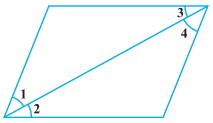
Solution
(N/A) Given: $\angle 1 = \angle 3$,$\angle 2 = \angle 4$ and $\angle 3 = \angle 4$.
Euclid's first axiom states that 'things which are equal to the same thing are equal to one another'.
Since $\angle 1 = \angle 3$ and $\angle 3 = \angle 4$,we have $\angle 1 = \angle 4$.
Now,we have $\angle 1 = \angle 4$ and $\angle 2 = \angle 4$.
By applying Euclid's first axiom,since both $\angle 1$ and $\angle 2$ are equal to the same angle $\angle 4$,it follows that $\angle 1 = \angle 2$.
Euclid's first axiom states that 'things which are equal to the same thing are equal to one another'.
Since $\angle 1 = \angle 3$ and $\angle 3 = \angle 4$,we have $\angle 1 = \angle 4$.
Now,we have $\angle 1 = \angle 4$ and $\angle 2 = \angle 4$.
By applying Euclid's first axiom,since both $\angle 1$ and $\angle 2$ are equal to the same angle $\angle 4$,it follows that $\angle 1 = \angle 2$.
0 likes
View Solution46
Medium
In the figure,we have: $AC = XD$,$C$ is the mid-point of $AB$ and $D$ is the mid-point of $XY$. Using Euclid's axiom,show that $AB = XY$.
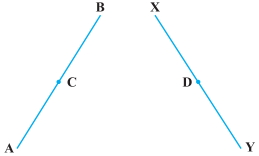
Solution
(N/A) Given that $C$ is the mid-point of $AB$,therefore $AB = 2AC$.
Given that $D$ is the mid-point of $XY$,therefore $XY = 2XD$.
We are also given that $AC = XD$.
Since things which are double of the same things are equal to one another (Euclid's Axiom),we can conclude that $AB = XY$.
Given that $D$ is the mid-point of $XY$,therefore $XY = 2XD$.
We are also given that $AC = XD$.
Since things which are double of the same things are equal to one another (Euclid's Axiom),we can conclude that $AB = XY$.
0 likes
View Solution47
Easy
Solve the following question using appropriate Euclid's axiom:
Two salesmen make equal sales during the month of August. In September,each salesman doubles his sale of the month of August. Compare their sales in September.
Two salesmen make equal sales during the month of August. In September,each salesman doubles his sale of the month of August. Compare their sales in September.
Solution
(N/A) Let the sales of two salesmen in the month of August be $x$ and $y$.
Since they make equal sales during the month of August,we have $x = y$.
In September,each salesman doubles his sale of the month of August,so their sales become $2x$ and $2y$.
According to Euclid's second axiom,'If equals are added to equals,the wholes are equal',and more specifically,the axiom stating 'Things which are double of the same things are equal to one another' applies here.
Since $x = y$,it follows that $2x = 2y$.
Therefore,the two salesmen make equal sales in the month of September.
Since they make equal sales during the month of August,we have $x = y$.
In September,each salesman doubles his sale of the month of August,so their sales become $2x$ and $2y$.
According to Euclid's second axiom,'If equals are added to equals,the wholes are equal',and more specifically,the axiom stating 'Things which are double of the same things are equal to one another' applies here.
Since $x = y$,it follows that $2x = 2y$.
Therefore,the two salesmen make equal sales in the month of September.
0 likes
View Solution48
EasyMCQ
Solve the following question using appropriate Euclid's axiom:
It is known that $x+y=10$ and that $x=z$. Show that $z+y=10$.
It is known that $x+y=10$ and that $x=z$. Show that $z+y=10$.
A
Euclid's Axiom $1$
B
Euclid's Axiom $2$
C
Euclid's Axiom $3$
D
Euclid's Axiom $4$
Solution
(B) Given that $x+y=10$ and $x=z$.
According to Euclid's second axiom,if equals are added to equals,the wholes are equal.
Since $x=z$,we can add $y$ to both sides of the equation $x=z$:
$x+y = z+y$.
We are given that $x+y=10$. Substituting $10$ for $x+y$ in the equation above:
$10 = z+y$.
Therefore,$z+y=10$.
According to Euclid's second axiom,if equals are added to equals,the wholes are equal.
Since $x=z$,we can add $y$ to both sides of the equation $x=z$:
$x+y = z+y$.
We are given that $x+y=10$. Substituting $10$ for $x+y$ in the equation above:
$10 = z+y$.
Therefore,$z+y=10$.
0 likes
View Solution49
Medium
Solve the following question using the appropriate Euclid's axiom:
Look at the figure. Show that the length $AH >$ the sum of the lengths of $AB + BC + CD$.
Look at the figure. Show that the length $AH >$ the sum of the lengths of $AB + BC + CD$.

Solution
(N/A) We observe that $AB, BC,$ and $CD$ are parts of the line segment $AD$.
Now,$AB + BC + CD = AD$ $......(1)$
By Euclid's axiom $5$,the whole is greater than the part. Since $AD$ is a part of the line segment $AH$,we have:
$AH > AD$
i.e.,Length $AH >$ sum of lengths of $AB + BC + CD$ [Using $(1)$].
Now,$AB + BC + CD = AD$ $......(1)$
By Euclid's axiom $5$,the whole is greater than the part. Since $AD$ is a part of the line segment $AH$,we have:
$AH > AD$
i.e.,Length $AH >$ sum of lengths of $AB + BC + CD$ [Using $(1)$].
0 likes
View Solution50
Easy
Solve the following question using an appropriate Euclid's axiom:
In the figure,we have $AB = BC$ and $BX = BY$. Show that $AX = CY$.
In the figure,we have $AB = BC$ and $BX = BY$. Show that $AX = CY$.
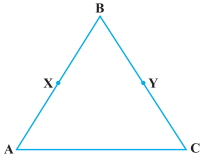
Solution
(N/A) We are given that:
$AB = BC$ ... $(1)$
$BX = BY$ ... $(2)$
According to Euclid's axiom $3$,if equals are subtracted from equals,the remainders are equal.
Subtracting equation $(2)$ from equation $(1)$,we get:
$AB - BX = BC - BY$
From the figure,$AB - BX = AX$ and $BC - BY = CY$.
Therefore,$AX = CY$.
$AB = BC$ ... $(1)$
$BX = BY$ ... $(2)$
According to Euclid's axiom $3$,if equals are subtracted from equals,the remainders are equal.
Subtracting equation $(2)$ from equation $(1)$,we get:
$AB - BX = BC - BY$
From the figure,$AB - BX = AX$ and $BC - BY = CY$.
Therefore,$AX = CY$.
0 likes
View SolutionIntroduction to Euclid’s Geometry — Mix Examples - Introduction to Euclid’s Geometry · Frequently Asked Questions
1Are these Introduction to Euclid’s Geometry questions useful for JEE and NEET?
Yes. All questions in this section are mapped to JEE Main and NEET exam patterns. Previous year questions from JEE Main, NEET, GUJCET and state-level exams are included with full solutions.
2Can I switch to Hindi or Gujarati for these questions?
Yes. Use the language tabs in the hero section or the sidebar to view the same questions and solutions in English, Hindi or Gujarati.
3How do I generate a question paper from this subtopic?
Use the Vedclass Exam Paper Generator — select the chapter and subtopic, set difficulty, and generate Sets A, B, C, D automatically. First 3 chapters of every subject are free.
Vedclass Products
For Students
Vedclass Test Series
Mock tests in real JEE/NEET style with performance analysis. 5-day free trial.
Start Free TrialFor Teachers
Exam Paper Generator
Generate Set A/B/C/D papers from this chapter in 2 minutes. 3 chapters free.
Try FreeFor Institutes
Online Exam Module
Live online exams with unlimited students, 360° analytics & white-label branding.
See DemoFor Teachers & Institutes
Generate a Introduction to Euclid’s Geometry Exam Paper in 2 Minutes
Select subtopic & difficulty — Sets A, B, C, D auto-generated with No Repeat logic.
First 3 chapters of every subject are free — no payment required.